
Fund of the week: Innoviva (INVA)

Innoviva is a listed permanent-capital vehicle built on two GSK respiratory royalties.
It files as a biopharmaceutical company. It behaves like a fund with an annuity attached, and it is in this series for that reason. A royalty stream it did not buy throws off around $240M a year with no cost of goods behind it.
That cash has been recycled into control stakes in small-cap biotech, secured lending at 14 percent, whole-company acquisitions, and, for five years, a $300M single-investor hedge fund run by Sarissa Capital on a 1 percent management fee and a 10 percent performance allocation. In most recent quarters the change in value of what Innoviva owns has moved reported earnings by more than the entire operating business earns.
The vehicle has no limited partners, no management fee at the top level, no redemption risk, and no fundraising cycle. Capacity is set by the royalty and the balance sheet. In fund terms it is evergreen, concentrated, and internally managed, with Sarissa Capital as the historical adviser and a board that has repeatedly followed its portfolio companies into operating roles.
Two answers up front, because they are the questions that matter for this series. Innoviva has never purchased a third-party royalty, and the one time it transacted in the standalone royalty market it was on the sell side. And it is not winding down: no strategic review, no plan of liquidation, no adviser retained, and a new wholly owned subsidiary launched in June 2026.
For the twelve months to 30 June 2026 the royalty book produced $240M and the operating platform produced $212M in net product sales and licence revenue. On current trajectories the operating side overtakes the royalty side within the next reporting year.
At a glance
- What it is: Innoviva, Inc. (NASDAQ: INVA), Burlingame, California; a diversified biopharmaceutical company with three declared divisions (royalty assets, Innoviva Specialty Therapeutics, strategic healthcare assets)
- Lineage: founded 1996 as Advanced Medicine, later Theravance, Inc.; spun out Theravance Biopharma in 2014 and renamed itself Innoviva in 2016, retaining the GSK royalty interests as the RemainCo
- Royalty rates: 15 percent on the first $3.0B of annual global net sales of RELVAR/BREO ELLIPTA and 5 percent above that; upward tiering of 6.5 to 10 percent on ANORO ELLIPTA
- Royalty counterparty: Glaxo Group Limited, sole payor on the royalty book
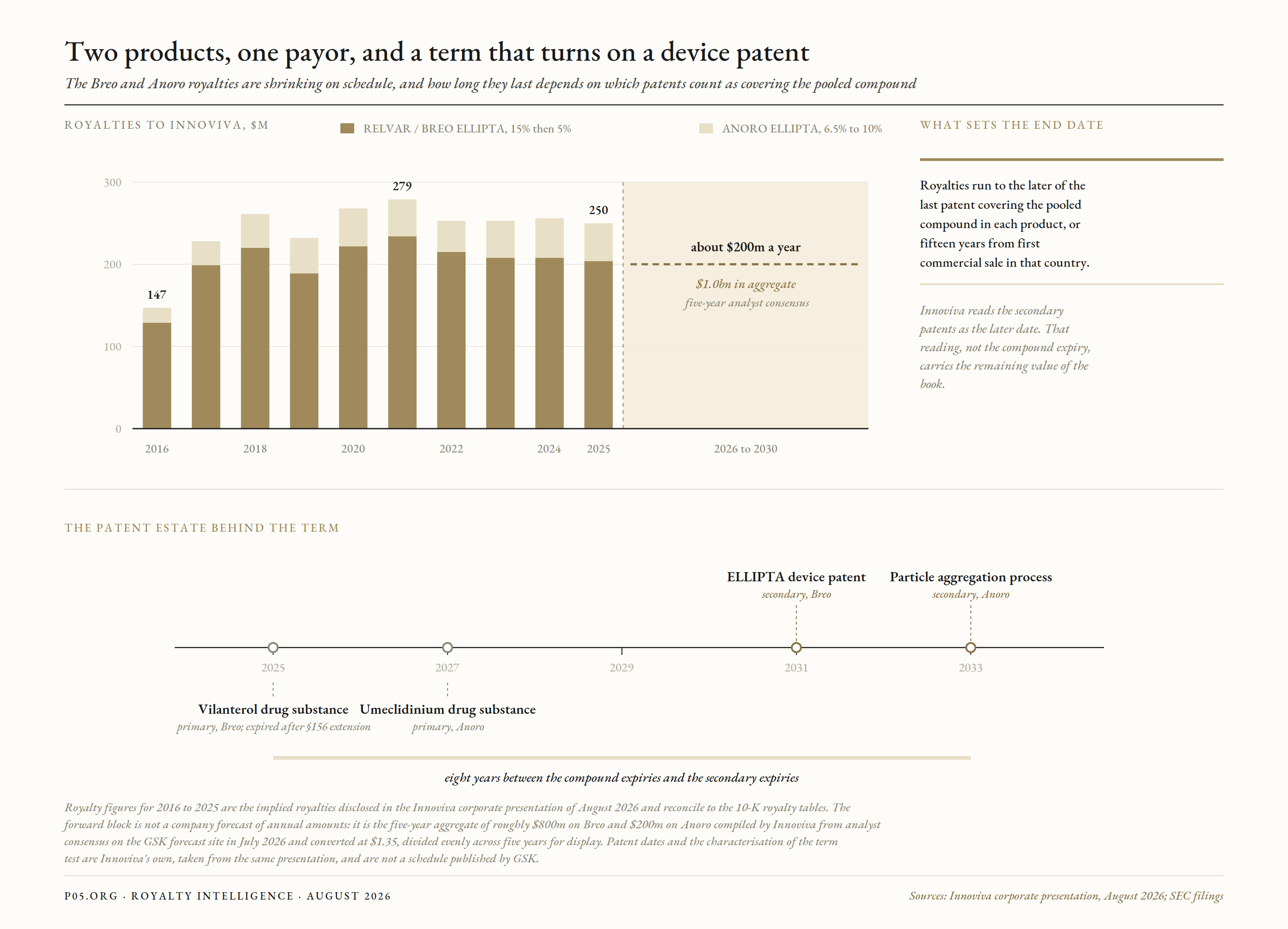
- LTM royalty revenue: $240M (Breo $193M, Anoro $47M), twelve months to 30 June 2026
- Q2 2026 gross royalties: $59.8M, comprising $47.7M Breo and $12.1M Anoro, against $67.3M a year earlier
- FY2025: total revenue $411.3M, net income $271.2M, gross royalties $250.3M
- Marketed products: GIAPREZA (angiotensin II), XACDURO (sulbactam-durlobactam), XERAVA (eravacycline), ZEVTERA (ceftobiprole, in-licensed from Basilea), plus NUZOLVENCE (zoliflodacin), approved 12 December 2025 and expected with patients in the second half of 2026
- Royalties purchased from third parties: none, at any point in the company's history; royalties are inherited from the 2002 GSK collaboration, absorbed through M&A, or originated by out-licensing owned products
- Royalties sold: the 15 percent economic interest in Theravance Respiratory Company, LLC, sold to Royalty Pharma in July 2022 for approximately $282M upfront plus a $50M contingent milestone
- Balance sheet at 30 June 2026: cash $570.4M, total assets $1.70B, stockholders' equity $1.23B, convertible senior notes due 2028 carried at $258.5M
- Strategic healthcare assets at 30 June 2026: $669.5M, of which $457.7M is Armata Pharmaceuticals, $177.3M other equity and convertible debt, $34.5M held by ISP Fund LP
- Armata ownership: 67.5 percent at 30 June 2026, held through Innoviva Strategic Opportunities, LLC, with a voting agreement running to January 2031 or first FDA approval
- Investment vehicles: Innoviva Strategic Opportunities, LLC (control stakes and secured lending), Innoviva TRC Holdings, LLC (minority equity), Innoviva Strategic Partners LLC (limited partner in ISP Fund LP, whose general partner is a Sarissa Capital affiliate, on a 1 percent management fee and 10 percent performance allocation)
- Capital returns: 2,602,168 shares repurchased for $56.4M under a $125M programme through Q2 2026; 72,245,485 shares outstanding at 31 July 2026
- Board: four directors, chaired by Jules Haimovitz, who also chairs Armata
- Largest disclosed holder: Sarissa Capital Management, 6,904,000 shares or 10.54 percent per its May 2023 Schedule 13D/A, and still its largest 13F position as of Q1 2026
- Market capitalisation: roughly $1.5B in mid-August 2026
The strategy, as stated
The strategy page sets out five headings: focus on what matters for value creation, build and leverage differentiated expertise, take a hands-on approach, be there for the long run, and maintain a flexible and efficient platform.
The substance under those headings is a capital allocation programme. Innoviva says it deploys into areas it considers sound and underappreciated, takes large stakes or outright ownership rather than passive positions, sits on boards and in operating seats, and accepts positions that look contrarian in the short term.
The corporate presentation is more specific about the destination. It describes the royalty stream as downside protection, the specialty therapeutics platform as the growth engine, and the strategic healthcare assets as asymmetric upside, with the last of those valued at approximately $670M.
The sequencing is the point. A declining, high-margin annuity funds an operating business and a venture book, and the operating business and venture book have to be worth more than the annuity by the time the annuity ends.
The business model: how the money is actually made
Innoviva reports as a biopharmaceutical company. It earns like a holding company with an annuity attached.
Four earnings engines
Royalty rent. Gross royalties of $59.8M in Q2 2026, $56.3M after amortisation of the 2014 milestone fees. There is no cost of goods, no field force, and no manufacturing behind that number. It is contractual rent on a molecule pool that GSK sells.
Product margin. Net product sales of $51.8M in Q2 2026 against $22.3M of cost of products sold and $6.6M of acquired intangible amortisation. That is roughly a 57 percent gross margin before the intangible charge and 44 percent after it, and it comes with a hospital sales force, distribution, inventory, and the inbound royalties payable to George Washington, Harvard, Basilea and AstraZeneca.
Licensing income. Upfronts, milestones and out-licence royalties from Zai Lab, PAION, Everest, Dr. Reddy's and GARDP, at $11.5M in Q2 2026 against $0.9M a year earlier. Lumpy, and close to pure margin.
Treasury and private credit. Interest and dividend income of $18.6M in the first half of 2026, against $9.5M a year earlier, on a cash balance above $550M plus the Armata loan book at 14 percent. Of that half-year figure, $8.2M was accrued interest converted into long-term investments rather than received in cash, which is the Armata paper capitalising rather than paying.
The arithmetic that matters
Q2 2026: total revenue $119.6M, gross profit $90.6M, operating expenses $39.8M, income from operations $50.9M.
Royalty revenue carries essentially no direct cost, so it supplies roughly $56M of that $90.6M of gross profit on 47 percent of revenue. What is left from products and licences is about $34.3M of gross profit, sitting against $39.8M of operating expenses.
On that split the non-royalty business ran at roughly a $5M operating deficit for the quarter, and the royalty was the entirety of the $50.9M operating profit. Innoviva does not publish operating expenses allocated between the businesses, so this is an approximation drawn from the consolidated statement rather than a disclosed segment result. The direction is the point. The royalty is currently paying for the platform being built to replace it.
Where net income comes from
| Period | Income from operations | Fair value changes on investments | Net income (loss) |
|---|---|---|---|
| FY2025 | $163.7M | $161.6M favourable | $271.2M |
| Q1 2026 | $38.2M | approximately $191M favourable | $186.6M |
| Q2 2026 | $50.9M | $161.0M unfavourable | $(83.4)M |

For three consecutive quarters the mark on the investment book has been between three and five times the operating result, and in two of them it decided the sign. The largest single line on the income statement is usually not revenue. It is the change in value of things the company owns.
That is the specific sense in which Innoviva behaves like an investor rather than an operator. The operating business generates cash; the investment book generates earnings, in both directions.
Cash in, cash out
Cash conversion is clean. Operating cash flow of $87.3M in the first half of 2026 against $89.0M of income from operations.
The uses tell the story. In the same half year Innoviva spent $51.3M on its own shares, $30.0M on purchases of equity and long-term investments, and $35.0M on trading securities, funded by operations plus $44.1M of sales out of the ISP Fund. Royalty and product cash goes into securities and into its own equity. No dividend has been paid.
It has financed against the royalty before
This matters for anyone assessing what the company might do with the remaining stream.
In April 2014 Theravance placed $450.0M of non-recourse 9 percent fixed rate term notes due 2029 through LABA Royalty Sub LLC, secured exclusively by a segregated account receiving 40 percent of the royalties due under the GSK collaboration. The structure carried a pay-in-kind feature before May 2016, under which shortfalls were added to principal; $44.0M of interest was capitalised that way, and the balance stood at $479.4M in March 2017 against $450M issued.
The company then unwound it. $50.0M was prepaid in May 2017 at the first penalty-free date, and the remaining $407.6M was repaid in August 2017 out of the proceeds of the 2.50 percent convertible notes due 2025 and a Term B loan, writing off $7.3M of unamortised issuance costs.
Read the capital structure history as a single sequence and the model becomes legible: securitise the royalty at 9 percent in 2014, refinance into cheap unsecured converts in 2017, buy back the payor's 32 percent equity stake in 2021, sell the third royalty outright in 2022, buy two commercial companies in the same summer, and from 2023 lend to investees at 14 percent. Every one of those is a capital structure decision rather than a commercial one.
What kind of company this makes it
Innoviva has permanent capital, no management fee, no limited partners, and no redemption risk, which are the advantages of a balance sheet investor. It also has one royalty it cannot replenish, because replenishing would mean bidding against Royalty Pharma and the specialist funds for assets priced in a competitive market.
Given that constraint, buying operating companies and taking control positions in small caps is the coherent response. It is capital allocation into places where a $1.5B company can be the largest voice in the room rather than the fifth-highest bid.
The royalty book
Two products, one payor.
RELVAR/BREO ELLIPTA (fluticasone furoate and vilanterol) carries 15 percent on the first $3.0B of annual global net sales and 5 percent above. ANORO ELLIPTA (umeclidinium and vilanterol) carries an upward tiering royalty from 6.5 to 10 percent. Sales of single-agent LABA medicines and combination medicines are aggregated for the Breo calculation.
Innoviva paid GSK $220.0M in approval and launch milestone fees during 2014. Those fees were capitalised and are amortised at $13.8M a year against royalty revenue, which is why gross royalties of $59.8M in Q2 2026 became $56.3M of reported royalty revenue.
The direction is down. Breo royalties fell 13 percent year on year in Q2 2026 and Anoro fell 4 percent. Full-year gross royalties have been flat to slightly declining for four years: $254M in 2022, $253M in 2023, $256M in 2024, $250M in 2025, all excluding Trelegy.
Term architecture
The duration question is the one that matters, and Innoviva's own description of it is worth reading closely. Per the corporate presentation, the collaboration agreement indicates royalties are paid until the later of the expiration of the last patent covering the pooled compound in each collaboration product, or fifteen years from first commercial sale of each product in that country.
The company then applies that test to its patent estate:
| Product | Primary US patent | Expiry | Key secondary US patent | Potential expiry |
|---|---|---|---|---|
| RELVAR/BREO ELLIPTA | Vilanterol drug substance (7,439,393) | 2025, after §156 extension | ELLIPTA device (8,746,242) | 2031, with paediatric exclusivity |
| ANORO ELLIPTA | Umeclidinium drug substance | 2027 | Particle aggregation process (9,763,965) | 2033 |
Innoviva states that for each portfolio product the secondary patent expiry would be the later date for royalty purposes, and that ex-US protection is generally longer dated. That is the company's reading of its own contract rather than a schedule published by GSK. The compound patents underpinning both products have either expired or expire within eighteen months.
Analyst consensus, as compiled by Innoviva from the GSK forecast site in July 2026 and converted at $1.35, projects $5.4B of Breo sales and $3.0B of Anoro sales over five years, implying roughly $800M and $200M of royalties respectively.
Does it acquire royalties, or only manage them?
The short answer is that Innoviva has never bought a royalty, has sold one, and has acquired several by accident.
That needs unpacking, because the three routes have different economics.
Route one: never purchased
There is no transaction in the record in which Innoviva paid cash to a third party for a standalone royalty or revenue interest. No purchased royalties appear on the balance sheet. No royalty acquisition programme is described in the strategy page, the corporate presentation, or the 10-K. The word Innoviva uses for the GSK stream is "core royalties portfolio", and the portfolio has two products in it, both from the same 2002 collaboration.
The only time the company has stood in the standalone royalty market it was selling. Announcing the 2022 Trelegy transaction, Pavel Raifeld described the counterparty as a market leader in healthcare royalty acquisitions, which is an accurate description of Royalty Pharma and an implicit statement about what Innoviva is not.
Route two: royalties acquired inside companies
Innoviva has acquired royalty streams, but always wrapped in an operating business.
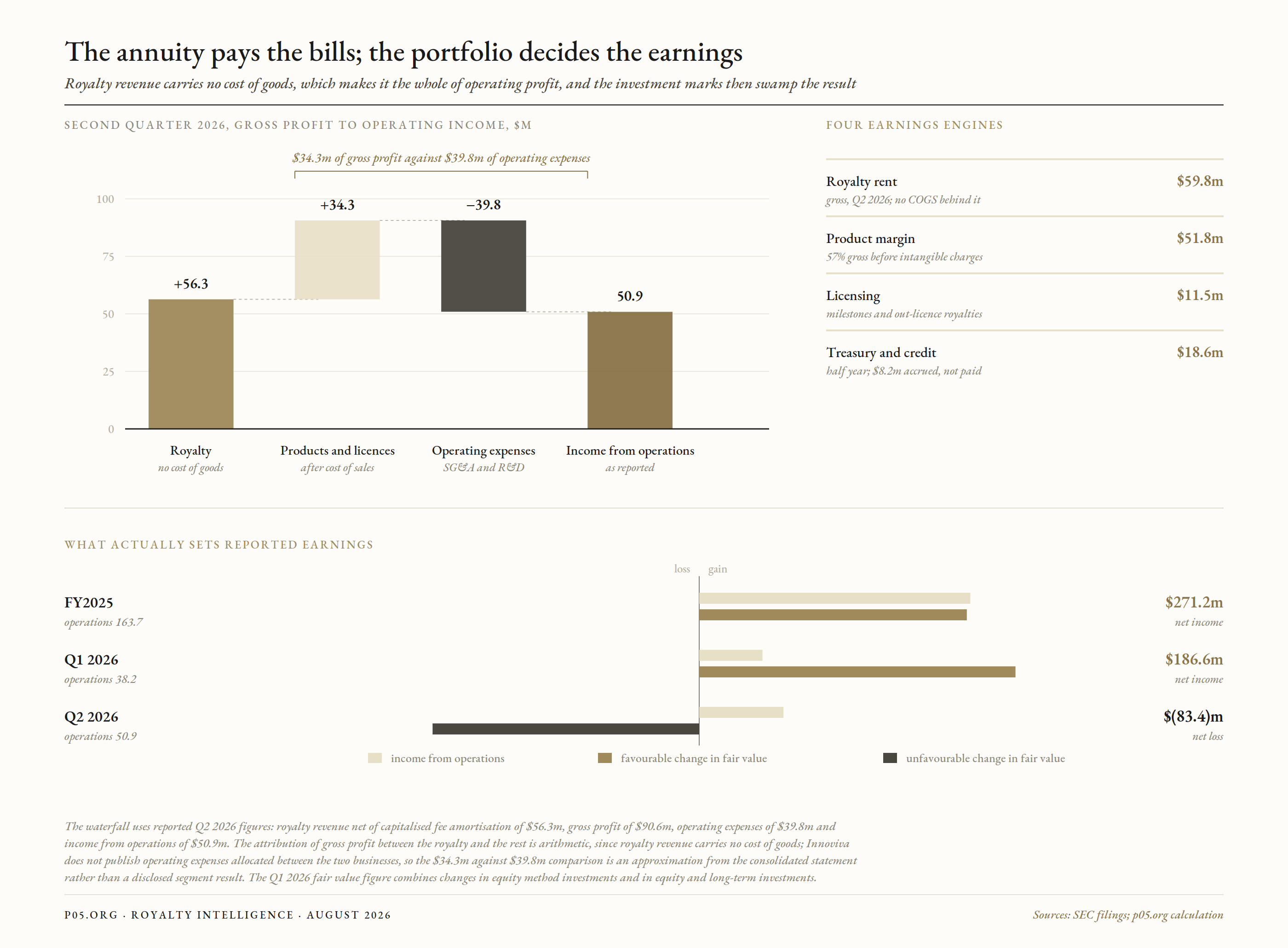
Buying Entasis in 2022 brought with it the Zai Lab licence for durlobactam and SUL-DUR in Asia-Pacific, carrying up to $91.0M in support and milestone payments and tiered royalties from high single to low double digits, plus the zoliflodacin rights that later produced the GARDP arrangement and the 2026 Dr. Reddy's agreement. Buying La Jolla brought the PAION licence for GIAPREZA and XERAVA in Europe, at up to $109.5M of commercial milestones and double-digit tiered royalties, and the Everest licence for XERAVA in China and South East Asia at low double-digit tiered royalties.
The prices were $113M for the Entasis equity and roughly $149M of enterprise value for La Jolla. Both deals were bought as commercial platforms; the royalty entitlements came along inside them, unpriced as far as any public disclosure shows.
This is a real acquisition channel, and it is cheaper than the auction market by construction. It also requires the buyer to want the operating business, the field force, the manufacturing and the regulatory obligations that come attached.
Route three: royalties originated
The larger part of Innoviva's non-GSK royalty entitlement is self-created. Every out-licence signed since 2022 has generated a new stream: Dr. Reddy's for XACDURO in Latin America, the Caribbean, Russia and the CIS in June 2026; the GARDP amendment for European rights to NUZOLVENCE in May 2026; the ongoing Zai Lab, PAION and Everest agreements.
That is origination rather than acquisition. Innoviva owns products, sells territory rights it will not commercialise itself, and keeps a royalty. Licence and other revenue reached $11.5M in Q2 2026 against $0.9M a year earlier, which is the visible start of that book.
And royalties paid
Running the other way, Innoviva has taken on royalty obligations by acquiring products: 6 percent to George Washington on GIAPREZA, 5 percent to Harvard on US XERAVA, high teens to mid twenties to Basilea on ZEVTERA, tiered single digits to AstraZeneca on durlobactam and zoliflodacin, low single digits to MIT on the LYNX platform.
So the company is a royalty payer as well as a royalty recipient, and on the products it sells itself, it is both at once.
What it means for the model
| Channel | Mechanism | Examples | Cost |
|---|---|---|---|
| Legacy | 2002 GSK collaboration | Breo, Anoro | Historic R&D plus $220.0M of milestone fees |
| Acquired inside companies | M&A | Zai Lab, PAION, Everest licences | Embedded in $113M and $149M deal prices |
| Originated | Out-licensing owned products | Dr. Reddy's, GARDP | Deal costs only |
| Purchased from third parties | None | None | Not applicable |
| Paid out | In-licensing products | GW, Harvard, Basilea, AstraZeneca, MIT | 5 to 25 percent of relevant net sales |
Innoviva manages one royalty portfolio it inherited, originates small ones from products it owns, absorbs others through M&A, and pays several. The one thing it does not do is compete for royalties on price.
Whether that is discipline or a limitation depends on how the next five years go. Buying royalties at auction requires a cost of capital that can clear against Royalty Pharma, Blackstone Life Sciences and HealthCare Royalty. Innoviva's answer has been to spend its royalty cash in a market where a $1.5B company can be the deciding voice instead of the marginal bidder. It is a defensible answer, and it means the royalty book will shrink to nothing on schedule unless something replaces it.
What was sold, and what was bought
Three transactions between May 2021 and August 2022 reset the company.
The GSK stake. In May 2021 Innoviva repurchased GSK's holding of approximately 32 million shares, 32 percent of the outstanding common stock, at $12.25 per share for $392M. GSK remained the royalty payor and ceased to be a shareholder.
The Trelegy sale. In July 2022 Royalty Pharma acquired all of the equity interests in Theravance Respiratory Company, LLC for $1.31B in cash upfront and up to $300M in sales milestones. TRC held an upward tiering royalty of 6.5 to 10 percent on worldwide Trelegy sales. Innoviva's share was the 15 percent economic interest, sold for approximately $282M upfront plus a $50M contingent milestone, together with the transfer to Innoviva of TRC's holdings in ImaginAb, Gate Neurosciences and Nanolive.
The two sellers structured their exits differently on the same asset. Theravance Biopharma took $1.1B upfront for its 85 percent plus up to $250M in milestones, and retained outer-year royalties covering ex-US sales from 2029 and US sales from 2031. It sold those outer-year rights to GSK for $225M in June 2025. Innoviva sold once and exited.
The acquisitions. In the same weeks, Innoviva completed the purchase of Entasis Therapeutics at $2.20 per share, valuing the equity at $113M on a fully diluted basis (it already held roughly 60 percent), and agreed to acquire La Jolla Pharmaceutical at $6.23 per share, an implied enterprise value of approximately $149M. Entasis brought sulbactam-durlobactam and zoliflodacin. La Jolla brought GIAPREZA and XERAVA. The two were integrated into Innoviva Specialty Therapeutics.
There is an irony in the record here. The 2017 Sarissa campaign attacked Innoviva's cost base for a royalty-collection business and asked the company to commit publicly to making no acquisition without shareholder approval. Sarissa won the board in 2018. The company it took over has since spent more than $500M acquiring operating assets.
Innoviva Specialty Therapeutics
Four marketed products, one approved and not yet launched, and a licensing web on both sides of the ledger.
| Product | Indication | LTM net sales and licence revenue |
|---|---|---|
| GIAPREZA | Vasoconstrictor for septic and other distributive shock | $80M |
| XACDURO | HABP/VABP caused by Acinetobacter baumannii | $107M, including $64M ex-US |
| XERAVA | Complicated intra-abdominal infections | $22M, including $9M ex-US |
| ZEVTERA | S. aureus bacteraemia, ABSSSI, CABP; launched mid-2025 | $1M |
| NUZOLVENCE | Uncomplicated urogenital gonorrhoea; approved December 2025 | $2M, licence revenue only |
US net product sales were $119.2M in 2025, up 47 percent, with guidance of at least $150M for 2026. Q2 2026 net product sales were $51.8M, of which $36.6M was US.
XACDURO and ZEVTERA both carry New Technology Add-On Payments, from October 2023 and October 2025 respectively, which pay hospitals above the standard MS-DRG for qualifying cases.
The inbound royalty stack
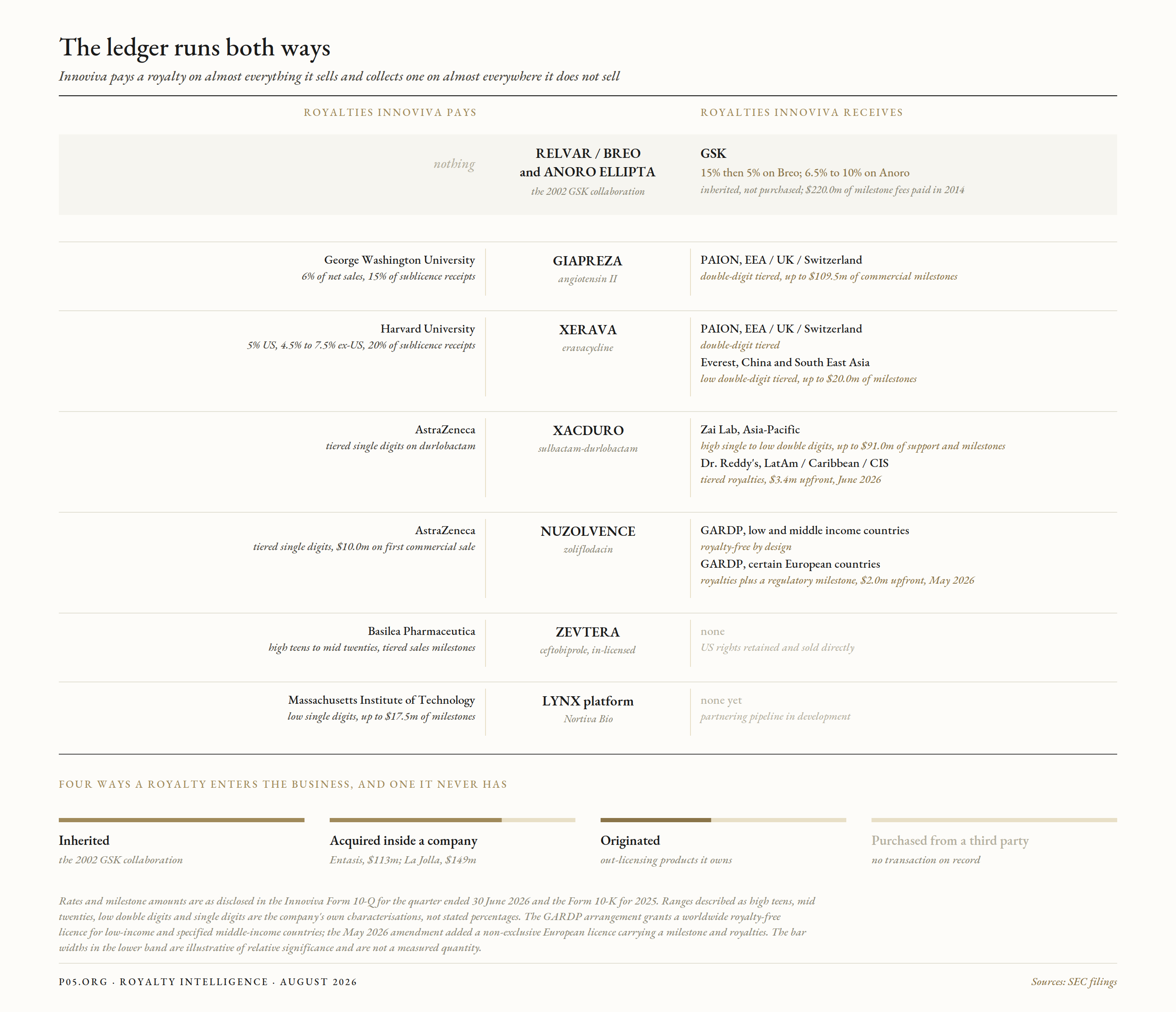
Innoviva pays royalties on almost everything it sells. The obligations are disclosed in the 10-Q and are unusually complete for a portfolio this size.
| Licensor | Product | Terms |
|---|---|---|
| George Washington University | GIAPREZA | 6 percent of net sales; 15 percent of sublicence receipts; runs to last-to-expire patent |
| Harvard University | XERAVA | 5 percent of direct US net sales; 4.5 to 7.5 percent tiered ex-US; 20 percent of sublicence receipts; up to approximately $15.1M in milestones |
| Basilea Pharmaceutica | ZEVTERA (US) | $4.0M upfront; tiered royalties from the high teens to the mid twenties; tiered sales milestones; term through US exclusivity in 2034 |
| AstraZeneca | durlobactam, zoliflodacin | Tiered single-digit royalties; $5.0M durlobactam sales milestone; $10.0M within two years of first zoliflodacin commercial sale |
| Massachusetts Institute of Technology | LYNX device | $0.5M upfront; up to $17.5M milestones; low single-digit royalty |
The Basilea rate is the one to note. High teens to mid twenties on a US in-licensed antibiotic is a demanding structure, and it sits on top of manufacturing purchased exclusively from the licensor.
The outbound royalty stack
Against that, Innoviva has built a set of territory licences that pay it.
| Licensee | Territory and product | Terms |
|---|---|---|
| Zai Lab | Asia-Pacific, SUL-DUR and combinations | Up to $91.0M in R&D support and milestones; tiered royalties from high single to low double digits; $4.0M regulatory milestone recognised in Q2 2026 |
| PAION (Humanwell) | EEA, UK, Switzerland; GIAPREZA and XERAVA | Up to $109.5M commercial milestones; double-digit tiered royalties, reducible for generic entry and after patent expiry |
| Everest Medicines | China and South East Asia; XERAVA | Up to $20.0M remaining sales milestones; low double-digit tiered royalties; term the latest of patent expiry, exclusivity expiry, or ten years from first commercial sale |
| Dr. Reddy's Laboratories | South and Central America, Caribbean, Russia and CIS; XACDURO | $3.4M upfront in June 2026; development, launch and commercial milestones; tiered royalties |
| GARDP | Low-income and specified middle-income countries; zoliflodacin | Royalty-free exclusive licence; May 2026 amendment added a non-exclusive European licence for $2.0M upfront plus a regulatory milestone and royalties |
Licence and other revenue was $11.5M in Q2 2026 against $0.9M a year earlier, almost all of it from these agreements.
Strategic healthcare assets
$669.5M at 30 June 2026, and heavily concentrated.
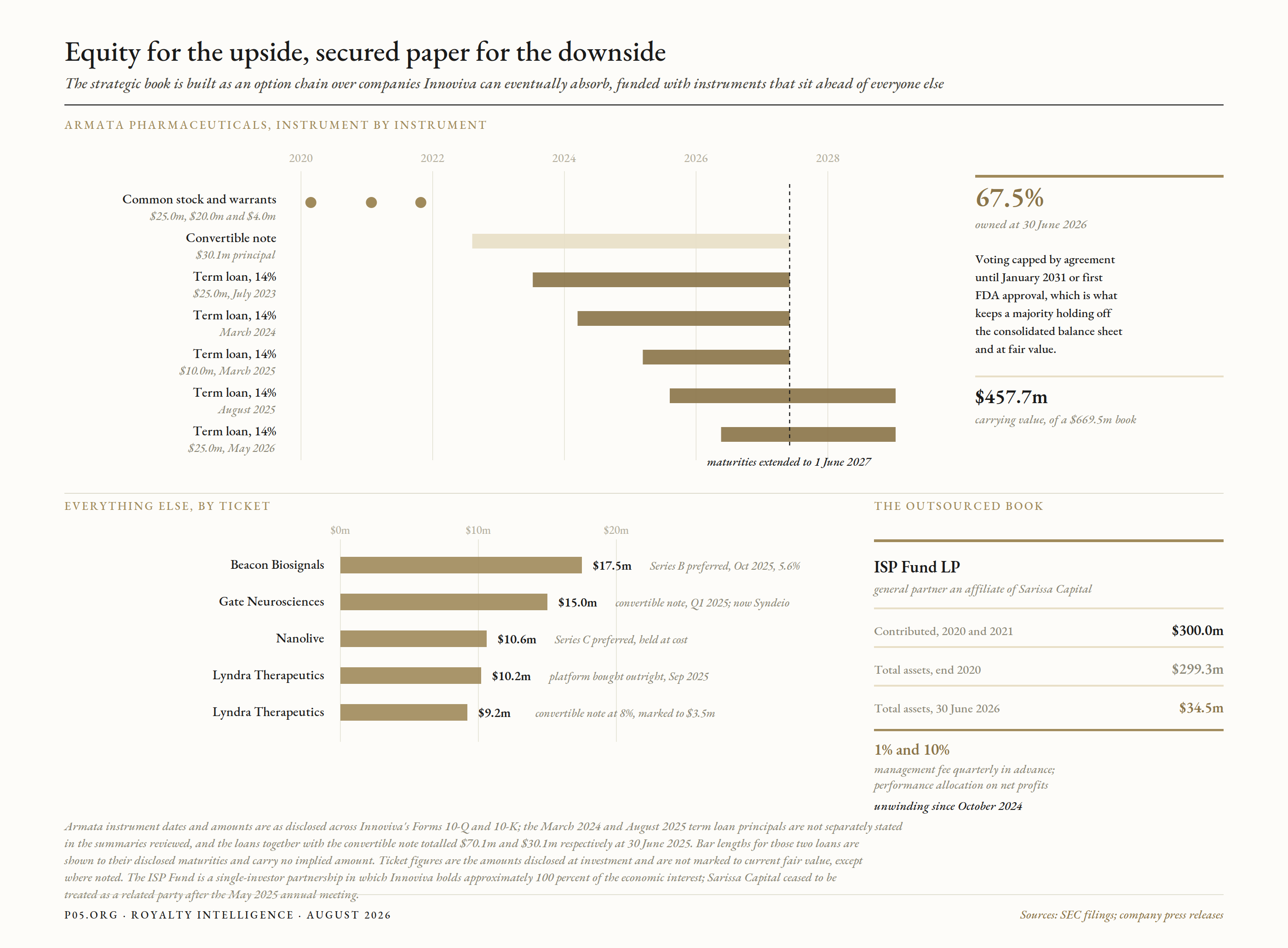
Armata Pharmaceuticals ($457.7M) is a clinical-stage bacteriophage developer. Innoviva has invested since the first quarter of 2020 in common stock, warrants, a convertible note and a series of term loans, and held 67.5 percent at 30 June 2026. In January 2026 the maturities of the convertible note and the 2023, 2024 and 2025 term loans were extended to 1 June 2027 and the warrants to January 2031. In May 2026 Innoviva Strategic Opportunities extended a further $25.0M term loan at 14 percent per annum, maturing January 2029, secured on substantially all of Armata's assets. Innoviva carries the position at fair value rather than consolidating it.
The Q2 2026 mark against Armata's share price produced a $161.0M unfavourable swing and a reported net loss of $83.4M for a quarter in which income from operations was $50.9M.
Nortiva Bio is wholly owned and was launched in June 2026 to develop the LYNX long-acting oral delivery platform, which Innoviva acquired from Lyndra Therapeutics in 2025 and licensed patent rights for from MIT in September 2025. The science originates in the Langer and Traverso labs. The lead programme is a once-monthly oral contraceptive supported by a $5M Gates Foundation grant.
Beacon Biosignals is an EEG and neuro-analytics company. Innoviva participated in the $86M Series B in November 2025, later extended to $97M.
Syndeio Biosciences is a synapse-focused neuropsychiatry company with zelquistinel in Phase 2 for major depressive disorder. Two Innoviva directors left the board in May 2026 to work on it.
The volatility of that book is worth a number. The July 2026 corporate presentation valued the strategic assets at approximately $773M as of 31 March 2026, with Armata at $603.4M. The August 2026 presentation valued them at approximately $670M as of 30 June 2026, with Armata at $457.7M. One quarter, one share price, $103M of headline value.
ISP Fund LP is a listed-equity vehicle in which Innoviva holds essentially all the economics. Innoviva elected to unwind its capital accounts in October 2024 and expects the remaining investments to be distributed during 2026. Total assets fell from $79.7M to $34.5M over the first half of 2026.
How Innoviva actually invests
The strategy page talks about hands-on ownership and asymmetric pay-offs. The filings show the mechanics, and they are more specific than the language suggests.
Four vehicles
| Entity | Role | Holdings |
|---|---|---|
| Innoviva Strategic Opportunities, LLC (ISO) | Control positions and secured lending | Armata; previously Entasis and the La Jolla acquisition vehicle |
| Innoviva TRC Holdings, LLC (ITH) | Minority equity | InCarda Therapeutics (9.1 percent), Beacon Biosignals (5.6 percent) |
| Innoviva Strategic Partners LLC | Fund investing and private credit | Limited partner in ISP Fund LP; the Lyndra convertible note |
| Wholly owned operating subsidiaries | Consolidated businesses | Entasis, La Jolla, Nortiva Bio |
ITH is the entity that sold the Trelegy royalty to Royalty Pharma in July 2022. The vehicle that exited the royalty is now the vehicle that holds the venture positions.
The outsourced book
The most unusual feature of the whole structure is ISP Fund LP.
On 11 December 2020 Innoviva entered a strategic partnership with Sarissa Capital comprising two agreements. The first was a Strategic Advisory Agreement under which Sarissa helps develop and execute the acquisition strategy, provided free of charge. The second was a subscription: Innoviva Strategic Partners LLC contributed $300.0M and became a limited partner of ISP Fund LP, a Delaware partnership whose general partner is an affiliate of Sarissa Capital and whose investment adviser is Sarissa Capital.
The economics are fund economics. Sarissa receives a 1 percent management fee payable quarterly in advance on the net asset value of the capital account, and the general partner takes a 10 percent annual performance allocation on net profits, with a thirty-six month lock-up. Innoviva held 100 percent of the partnership's economic interest from the start, so the fund is a single-investor vehicle running long positions in listed healthcare and biotech.
Two later events are worth noting. In May 2021 Strategic Partners took a $110.0M distribution to help fund the repurchase of GSK's stake, under a letter agreement requiring recontribution by 31 March 2022; the contribution was made on 30 March 2022 and approved by Innoviva's audit committee. Performance allocation accrued at the time of the distribution.
In October 2024 Innoviva elected to unwind its capital accounts. $47.5M was distributed in the first half of 2026 and the remaining investments are expected to be distributed during 2026. The partnership's total assets have gone from $299.3M at the end of 2020 to $34.5M at 30 June 2026.
The 10-K records that Sarissa Capital was treated as a related party until the May 2025 annual meeting, after which no Sarissa representatives sat on the board.
The instrument set
Innoviva rarely buys plain equity and holds it. Armata is the template for what it does instead:
| Date | Instrument | Amount |
|---|---|---|
| Q1 2020 | Common stock and warrants (8,710,800 shares plus 8,710,800 warrants) | approximately $25.0M |
| Jan and Mar 2021 | Common stock and warrants in two tranches (6,153,847 shares plus warrants) | approximately $20.0M |
| Oct 2021 | Common stock (1,212,122 shares) | approximately $4.0M |
| Various | Convertible note | $30.1M principal |
| Jul 2023 | Secured term loan at 14 percent | $25.0M |
| Mar 2024 | Secured term loan at 14 percent | undisclosed in summary; part of $70.1M total |
| Mar 2025 | Secured term loan at 14 percent | $10.0M |
| Aug 2025 | Secured term loan at 14 percent, maturing Jan 2029 | undisclosed in summary |
| May 2026 | Secured term loan at 14 percent, maturing Jan 2029 | $25.0M |
By mid-2025 the position was 25,076,769 shares (a 69.3 percent equity interest), 10,653,847 warrants struck at $3.25 to $5.00, $30.1M of convertible note and $70.1M of term loans. The loans are secured on substantially all assets of Armata and its material subsidiaries.
Equity for the upside, warrants for more upside, and 14 percent secured paper sitting ahead of everyone else for the downside. That is a structured credit toolkit applied to a majority-owned public investee, and it is the single most informative thing about how this company thinks about risk.
Typical ticket
Outside Armata, positions cluster between $10M and $25M:
- Gate Neurosciences: $15.0M convertible note in Q1 2025; the company merged into Syndeio Biosciences, which launched in May 2025 with more than $90M raised from Catalio, Innoviva, Tenmile, Luson, Palo Santo, with AbbVie and Lilly as strategic shareholders
- Beacon Biosignals: $17.5M for 1,448,303 Series B preferred shares in October 2025, a 5.6 percent stake at year end
- Lyndra Therapeutics: a $9.2M convertible promissory note at 8 percent in February 2025, written down to a $3.5M fair value by December 2025, followed in September 2025 by the purchase of the drug delivery platform outright for $10.2M upfront plus milestones and royalties
- Nanolive: $10.6M of Series C preferred, carried at cost under the measurement alternative
- InCarda Therapeutics: 36,742,250 common and preferred shares plus 2,490,033 warrants for a 9.1 percent interest
Pace is disclosed loosely rather than as a budget. Innoviva deployed $34.7M into strategic assets in Q1 2025, purchased $30.0M of equity and long-term investments in the first half of 2026, and reported $55.0M of aggregate capital commitment to portfolio companies in Q2 2026 alone.
Control without consolidation
Innoviva takes majority or near-majority stakes and then contractually caps its own votes. The original Armata voting agreement barred Innoviva and ISO from voting shares representing more than 49.5 percent on the election or removal of directors. The current version expires at the earlier of 26 January 2031 or the first FDA approval of an Armata product.
The effect is that Innoviva owns 67.5 percent of Armata, funds it, and holds the senior secured debt, while accounting for the position at fair value rather than consolidating it. Board overlap does the rest of the work: three of Armata's eight directors were also Innoviva directors as of the end of 2021, and Jules Haimovitz chairs both companies today.
The escalation pattern
Read across the portfolio and the same sequence repeats.
Entasis: private placement in 2020, a roughly 60 percent stake, then the rest bought for $42.4M in July 2022 and the company delisted.
Gate Neurosciences: acquired as part of the assets transferred out of TRC in the Royalty Pharma transaction, then a $15.0M convertible note in 2025, then a merger into Syndeio, then two Innoviva directors leaving the board in May 2026 to run it.
Lyndra: a convertible note in February 2025, a write-down, then the platform bought outright in September 2025, an MIT licence signed alongside it, and a relaunch as the wholly owned Nortiva Bio in June 2026.
Minority position first, then debt, then the asset or the whole company. The strategic asset book functions as an option chain over businesses Innoviva can eventually absorb into the operating platform, which is a coherent design and also explains why the marks are so volatile.
What it does not do
No purchased royalties. No revenue interests. No third-party fund commitments other than the Sarissa vehicle. No dividend, with capital returned through buybacks. Almost everything is elected into fair value through the income statement, which is why a single investee's share price can move the reported result by more than the entire operating business earns in a quarter.
Financial profile
| Item | Amount | Source and date |
|---|---|---|
| Total revenue | $411.3M (FY2025); $358.7M (FY2024) | Q4 2025 release, 25 Feb 2026 |
| Total revenue, H1 2026 | $217.6M against $188.9M | 10-Q, Q2 2026 |
| Gross royalties | $250.3M (FY2025); $59.8M (Q2 2026) | Q4 2025 release; 10-Q |
| Royalty revenue, net of capitalised fee amortisation | $56.3M (Q2 2026); $111.5M (H1 2026) | 10-Q |
| Net product sales | $51.8M (Q2 2026); $93.1M (H1 2026) | 10-Q |
| Licence and other revenue | $11.5M (Q2 2026) against $0.9M | 10-Q |
| Income from operations | $50.9M (Q2 2026); $89.0M (H1 2026) | 10-Q |
| Net income (loss) | $(83.4)M (Q2 2026); $103.2M (H1 2026); $271.2M (FY2025) | 10-Q; Q4 2025 release |
| Cash and equivalents | $570.4M | 30 June 2026 |
| Royalty and product receivables | $110.6M, up 25 percent year on year | 30 June 2026 |
| Equity method and long-term investments | $660.9M | 30 June 2026 |
| Capitalised fees, net | $49.2M | 30 June 2026 |
| Convertible senior notes due 2028 | $258.5M carrying value, approximately $261M principal | 30 June 2026 |
| Total assets / stockholders' equity | $1.70B / $1.23B | 30 June 2026 |
| Operating cash flow | $87.3M (H1 2026) against $92.7M | 10-Q |
| Share repurchases | $56.4M of a $125M programme, 2,602,168 shares | Through 30 June 2026 |
| Shares outstanding | 72,245,485 | 31 July 2026 |
Customer concentration on the product side is high: three customers accounted for 25, 21 and 21 percent of net product sales in Q2 2026.
Governance
The board has four members: Jules Haimovitz (chairperson, also chairman of Armata), Sarah J. Schlesinger, Josephine Linden and Pavel Raifeld, who has been CEO since 2020 and previously worked at Sarissa Capital.
The composition changed in May 2026. Stockholders elected five directors on 4 May. On 12 May, Derek Small and Mark DiPaolo resigned to focus on Syndeio Biosciences, where Small is chief executive and DiPaolo was expected to take an executive role; the filing recorded no disagreement with the company. Linden, formerly a Goldman Sachs partner, joined on 18 May and sits on the audit committee.
The prior history is worth stating plainly, because it shaped the current strategy. Sarissa Capital ran a proxy contest at the 2017 annual meeting, litigated when its nominees were not seated, won an order from the Delaware Court of Chancery in December 2017, and reconstituted the board in February 2018. DiPaolo chaired the board from May 2023 until his resignation.
Several relationships run across entities. Haimovitz chairs both Innoviva and Armata. Two former directors now run an investee. Innoviva's Armata position combines majority equity, warrants, a convertible note and five secured term loans, with the voting agreement suspended until 2031 or first approval.
Does it continue, or does it wind down?
The question is fair to ask of any company whose main asset has a defined end date, and it has a precedent in this exact business.
Nothing in the public record indicates a wind-down. There is no announced review of strategic alternatives, no plan of liquidation, no engagement of financial advisers for a company sale, no dissolution language in the filings, and no going-concern qualification. Every action in 2026 points the other way.
The affirmative evidence for continuation is dense:
- 2026 guidance of at least $150M in US net product sales, reaffirmed at the Q2 results on 5 August 2026
- A new wholly owned subsidiary, Nortiva Bio, launched in June 2026 around a platform acquired in 2025, with a lead programme heading toward the clinic
- $55.0M of aggregate capital commitment to portfolio companies in Q2 2026 alone, plus $30.0M of purchases of equity and long-term investments in the first half
- A new $25.0M secured term loan to Armata in May 2026 maturing January 2029, and Armata warrants extended to January 2031
- An in-licence from Basilea whose initial term runs through US exclusivity in 2034, and an MIT licence carrying up to $17.5M in future milestones
- Capital returned through buybacks rather than special dividends, which is the choice of a company retaining optionality rather than distributing a terminal value
- $261M of convertible notes maturing 2028, which sit inside the royalty tail rather than beyond it
- A board refreshed in May 2026 with an audit committee appointment, not a liquidation committee
What a wind-down would look like
PDL BioPharma is the template, and the closest structural analogue in the sector. PDL was a royalty company whose Queen patents expired; it announced a monetisation strategy in December 2019, its board approved a plan of complete liquidation in the first quarter of 2020, stockholders approved dissolution on 19 August 2020, and the certificate of dissolution was filed on 4 January 2021 after a voluntary Nasdaq delisting. The company sold royalties to SWK Holdings, spun off LENSAR, retired its converts, and entered a process the 10-K describes as taking a minimum of three years.
The sequence is recognisable: advisers retained, asset sales, debt retirement, delisting, dissolution. None of those steps is present at Innoviva.
The other half of the 2014 split shows a middle path. Theravance Biopharma formed a strategic review committee of independent directors in November 2024, sold its outer-year Trelegy royalty to GSK for $225M in June 2025 as the first outcome of that review, and has been returning capital. That is a company narrowing rather than dissolving.
The case that says otherwise
The structural profile is the classic wind-down candidate: a finite high-margin asset, a large cash balance, a small board, and an activist holder of roughly 10 percent. Sarissa's own 2017 thesis was that Innoviva should be run as a lean royalty collector and return capital to shareholders. The board Sarissa installed has done the opposite for eight years, spending more than $500M on operating assets. If the operating platform fails to close the gap left by the royalty, the original argument returns with better facts behind it.
There is also a third path that is neither continuation nor dissolution: a sale. Analyst notes in 2026 have raised takeover framing, on the argument that the market is pricing the royalty stream and assigning little to the commercial platform. That remains speculation, and no process has been disclosed.
What would actually signal a change
- A sale or securitisation of the residual Breo and Anoro royalty. Innoviva has monetised a royalty once already, and the remaining stream now has a defined tail, which makes it saleable. A sale would fund the operating business, or fund a distribution, and the difference between those two uses is the whole question.
- Conversion of the buyback into a special dividend or a formal capital return plan with a stated total.
- Formation of a strategic review committee, or the retention of a financial adviser on a whole-company basis.
- A halt to new capital commitments in the strategic asset book, particularly further Armata funding.
- Any amendment to Sarissa's Schedule 13D restating intent.
On the evidence as of August 2026, the company is building rather than closing. The honest formulation is that Innoviva has bought itself roughly five to seven years of royalty cash flow to prove that the operating platform can stand on its own, and the market is not yet convinced it will.
Blue team and red team
Blue team
- Two royalty streams with negligible incremental cost, producing $240M over the last twelve months, against a total operating expense base of $77.4M for the first half of 2026
- Contract duration mechanics that may run well past compound patent expiry: the later of last patent on the pooled compound or fifteen years from first commercial sale, country by country, with the ELLIPTA device patent potentially to 2031 and the particle process patent to 2033
- Consensus-based projection of roughly $1.0B of royalties over five years from the two products
- $570.4M of cash against $261M of convertible notes due 2028, with no other debt
- IST net product sales growing 46 percent year on year in Q2 2026, on 2026 guidance of at least $150M in US sales
- Five approved products, two of them with NTAP reimbursement add-ons, in categories where competition is thin
- An outbound licence network (Zai Lab, PAION, Everest, Dr. Reddy's, GARDP) that creates royalty income rather than buying it, on terms running to low double digits
- Capital deployed outside the royalty auction market entirely, with no requirement to clear a competitive bid
- An instrument set that protects the downside inside venture positions: majority equity paired with warrants and 14 percent secured term paper, rather than plain common stock
- Buyback running against a share count reduced from 74.6 million to 72.6 million in six months
Red team
- Single-payor concentration: GSK is the counterparty for the entire royalty book, and controls all commercialisation decisions
- The royalty book is shrinking, not flat: gross royalties fell 11 percent year on year in Q2 2026, with Breo down 13 percent
- The vilanterol compound patent has expired and the umeclidinium compound patent expires in 2027; the durability case rests on secondary device and process patents and on the fifteen-year clause, as characterised by the company rather than by the payor
- Earnings are dominated by marks, not operations: a $161.0M unfavourable fair value swing turned a $50.9M operating quarter into an $83.4M net loss
- Armata is $457.7M of a $669.5M strategic book, is clinical stage, and has required repeated maturity extensions plus a new $25M loan at 14 percent
- The IST gross margin carries a royalty stack of its own: 6 percent to George Washington on GIAPREZA, 5 percent to Harvard on US XERAVA, high teens to mid twenties to Basilea on ZEVTERA
- The two newest products contribute almost nothing so far: ZEVTERA recorded $0.35M in Q2 2026 and NUZOLVENCE is not yet with patients
- XERAVA is declining, at $9.4M in H1 2026 against $11.3M
- Product sales are concentrated in three distributors accounting for 67 percent of Q2 2026 net product sales
- Capital deployment has run through a related-party structure for most of the period: $300.0M placed in a fund whose general partner is a Sarissa affiliate, on a 1 percent management fee and a 10 percent performance allocation, while Sarissa principals sat on the Innoviva board
- The strategic asset process is opaque by design: no stated allocation budget, no hurdle, no disclosed realisations, and positions carried at fair value with no track record published
- A four-person board, two departures in a single week to run an investee company, and a chairperson who also chairs the largest portfolio holding
- No disclosed plan for what replaces royalty cash flow after the 2031 to 2033 window
Implications for the pharmaceutical royalty market
Innoviva is useful to royalty practitioners for four reasons, none of which involve buying royalties.
It is a seller, not a bidder. Anyone modelling the competitive set for sub-$500M royalty transactions should remove Innoviva from it. The company monetised its only saleable royalty in 2022 and has deployed the proceeds into operating assets and equity. Its remaining royalties are proprietary and unencumbered, which makes it a potential seller again rather than a competitor.
The term language is a diligence template. The Breo and Anoro royalties illustrate a structure common in older pooled-compound collaborations: royalties survive to the later of the last patent covering the pooled compound in the product, or fifteen years from first commercial sale in that country. Under that test a device or formulation patent can carry the stream years past the molecule. The gap between the 2025 vilanterol expiry and the 2031 device expiry is the entire remaining value of the Breo royalty. Diligence on any pooled-compound royalty should establish which patents count as covering the pooled compound, and who decides.
One asset, two exits, two designs. The 2022 TRC transaction is a rare case of two owners selling the same royalty on the same day with different structures. Innoviva took approximately $282M plus a $50M milestone for 15 percent and left. Theravance Biopharma took $1.1B plus up to $250M for 85 percent and kept the outer years, which it sold to GSK three years later for $225M. Retaining the tail was worth roughly $225M of nominal proceeds and three years of exposure. The two outcomes are a usable reference for structuring partial monetisations.
Payors buy back. GSK repurchased the outer-year Trelegy royalty from Theravance Biopharma in 2025 and had earlier exited its Innoviva equity. Payor repurchase remains an under-modelled exit for royalty holders, and it prices differently from a specialist buyer because the payor is removing a cost line rather than acquiring an asset.
There is also a data point on invisible streams. A commercial platform of five products generates at least five inbound royalty obligations and five outbound licences, most of them to private or non-US counterparties, and none of them appear in public royalty datasets except where a US issuer discloses them. Innoviva's 10-Q discloses all ten because it happens to be the SEC registrant. Most companies in this position are not.
There is one more transferable idea, on method rather than on royalties. Innoviva's venture positions are built as majority equity plus warrants plus 14 percent senior secured term paper on the same investee, with a voting cap that keeps the position off the consolidated balance sheet. That combination gives it the upside of an owner, the recovery position of a lender, and the accounting treatment of a passive holder. Royalty originators structuring around small-cap counterparties who need both capital and discipline will recognise the shape.
Recent developments, as of August 2026
- NUZOLVENCE (zoliflodacin) was approved by the FDA on 12 December 2025 for uncomplicated urogenital gonorrhoea, developed under a collaboration with GARDP that funded the Phase 3 trial; the product is expected to reach patients in the second half of 2026
- Dr. Reddy's Laboratories signed an exclusive distribution and licence agreement for XACDURO in June 2026 covering South and Central America, the Caribbean, Russia and CIS, with $3.4M upfront plus milestones and tiered royalties
- Nortiva Bio launched on 18 June 2026 as a wholly owned subsidiary carrying the LYNX platform acquired from Lyndra Therapeutics
- Board changes: Derek Small and Mark DiPaolo resigned on 12 May 2026; Josephine Linden joined on 18 May 2026
- Armata: a further $25.0M secured term loan at 14 percent in May 2026; Innoviva's stake stood at 67.5 percent at 30 June 2026; the Q2 mark-down drove the quarterly net loss
- GARDP amendment in May 2026 added a non-exclusive European licence for $2.0M upfront plus future regulatory milestone and royalties
- Buyback: $31.4M repurchased in Q2 2026, $56.4M cumulative under the $125M programme
- No royalty acquisition activity identified
Timeline
| Date | Event |
|---|---|
| 1996 | Founded as Advanced Medicine; later Theravance, Inc. |
| 2002 | LABA collaboration with GSK pools the LABA assets |
| 2013 | Breo launches in the US |
| 2014 | Anoro launches in the US; Theravance Biopharma spun off; $220.0M in milestone fees paid to GSK |
| 2016 | Parent renamed Innoviva |
| Dec 2017 | Delaware Court of Chancery orders Sarissa's nominees onto the board |
| Feb 2018 | Board reconstituted |
| 2020 | First infectious disease investments, including Entasis and Armata private placements |
| May 2021 | GSK's 32 percent stake repurchased for $392M at $12.25 per share |
| Jul 2022 | Entasis acquisition completed at $113M equity value; La Jolla agreed at approximately $149M enterprise value |
| 20 Jul 2022 | 15 percent TRC interest sold to Royalty Pharma for approximately $282M plus a $50M milestone |
| Aug 2022 | La Jolla acquisition completed |
| May 2023 | FDA approves XACDURO |
| Dec 2024 | Basilea agreement signed for US rights to ZEVTERA |
| Jun 2025 | Theravance Biopharma sells outer-year Trelegy royalties to GSK for $225M |
| Jul 2025 | ZEVTERA launches in the US |
| Sep 2025 | LYNX platform acquired; MIT licence signed |
| Nov 2025 | Beacon Biosignals Series B, Innoviva participating |
| 12 Dec 2025 | FDA approves NUZOLVENCE |
| Jan 2026 | Armata loan maturities extended; warrants extended to 2031 |
| May 2026 | Board changes; $25.0M Armata term loan at 14 percent; GARDP amendment |
| Jun 2026 | Dr. Reddy's XACDURO agreement; Nortiva Bio launched |
| 5 Aug 2026 | Q2 2026 results: revenue $119.6M, net loss $83.4M |
Conclusion
Innoviva is an evergreen, internally managed vehicle whose core asset is a declining annuity, whose growth engine is an acquired commercial platform, and whose reported earnings are set by a concentrated investment book.
On the acquire-or-manage question, the answer is neither of the obvious ones. Innoviva manages a royalty portfolio it inherited, originates new streams by out-licensing products it owns, absorbs others inside company acquisitions, and pays royalties on most of what it sells. It has never bought a royalty at auction and shows no intention of starting.
The royalty side is high quality and finite. Two products, one payor, 15 percent and 6.5 to 10 percent, roughly $240M a year and falling, with a contractual tail whose length depends on whether device and process patents count as covering the pooled compound. On the company's own reading that tail runs to 2031 and 2033.
The operating side is doing what it was bought to do. Net product sales and licence revenue reached $212M over the last twelve months, growing at rates in the mid-forties, off a purchase price of roughly $262M for the two companies that created it.
The venture side is the open question. Two thirds of a $669.5M book sits in one clinical-stage phage company that Innoviva controls, funds with secured debt at 14 percent, and marks to a volatile share price. That single position moved the company from a $50.9M operating quarter to an $83.4M net loss.
On the business model, the cleanest statement is arithmetic. Royalty revenue carries no direct cost and accounted for the whole of the $50.9M operating profit in Q2 2026, while products and licences roughly covered their own operating expenses. Below that line, the investment book moved earnings by three to five times the operating result in each of the last three quarters. Cash comes from an annuity and a hospital sales force. Reported profit comes from a securities portfolio.
On continuation, the record is one-directional. No strategic review, no plan of liquidation, no adviser retained, no dissolution language. Instead a new subsidiary launched in June 2026, a new secured loan written in May 2026, an in-licence running to 2034 and guidance reaffirmed in August 2026. PDL BioPharma shows what the alternative looks like, and none of its steps are present here.
For royalty markets the company is worth watching as a seller rather than a buyer, and worth reading for its contract mechanics. The term language on a pooled-compound collaboration signed in 2002 is still, twenty-four years later, the thing that determines whether roughly $1.0B of royalties gets paid.
All information in this article was accurate as of the research date and is derived from publicly available sources including SEC filings, company press releases, the Innoviva corporate presentation dated August 2026, and financial news reporting. Royalty duration statements attributed to Innoviva reflect the company's characterisation of the GSK collaboration agreement in its investor materials and are not a disclosed schedule agreed with the payor; patent expiry dates described as potential are the company's own designation. Five-year sales and royalty projections are analyst consensus figures compiled by Innoviva from the GSK forecast site, converted from GBP at a stated rate, and are estimates rather than guidance. Share price and market capitalisation figures are approximate and as of mid-August 2026. Sarissa Capital's holding is stated as of its most recent Schedule 13D/A and may have changed. Fair value figures for strategic healthcare assets are as of 30 June 2026 and are subject to material quarterly revision. The split of gross profit and operating expenses between the royalty business and the operating platform is the author's approximation from consolidated figures, since Innoviva does not publish operating expenses allocated between them; it is an estimate, not a disclosed segment result. Statements that no wind-down, liquidation, dissolution or strategic review process exists reflect the absence of any such disclosure in public filings and announcements identified as of the research date; companies are not obliged to disclose preliminary board deliberations, and absence of disclosure is not proof of absence. Takeover and valuation commentary attributed to analysts is third-party opinion. Nothing here constitutes a recommendation. Innoviva holds no purchased third-party royalties identified in this research. Information may have changed since publication. This content is for informational purposes only and does not constitute investment, legal, or financial advice. The author is not a lawyer or financial adviser.