
Fund of the week: Santé Ventures

Santé Ventures is an Austin venture manager that has spent twenty years building early-stage healthcare companies, sells most of them to strategic acquirers, and has structured those sales so that a meaningful part of the consideration arrives after closing as revenue-linked and milestone-linked payments.
The firm was founded in 2006 by Kevin Lalande, Joe Cunningham and Douglas French, who had previously run the healthcare venture practice at Austin Ventures and spun out with that firm's agreement. It launched Fund I in 2007, Fund II in 2011, Fund III in 2018, Fund IV in 2021 and Fund V in 2024, and now states that it manages over $1 billion across two strategies.
Santé holds no purchased royalty and no revenue interest. It has never announced one.
What makes it worth a royalty desk's time is the exit architecture. Boston Scientific's purchase of Farapulse carried revenue-based payments running three years past closing. Clinical and regulatory milestone payments beginning the year after the deal came with Johnson & Johnson's purchase of Laminar. The take-private of Lumos Pharma attached a contingent value right tied to annual global net revenue of LUM-201 as far out as 2037. Those are contingent claims on product revenue, held at fund level, sitting inside limited partnership vehicles whose largest disclosed investor is a US public pension.
The announcements describe them as milestone payments, revenue-based payments and contingent value rights. Each is a claim on the revenue or the regulatory progress of a product Santé no longer owns.
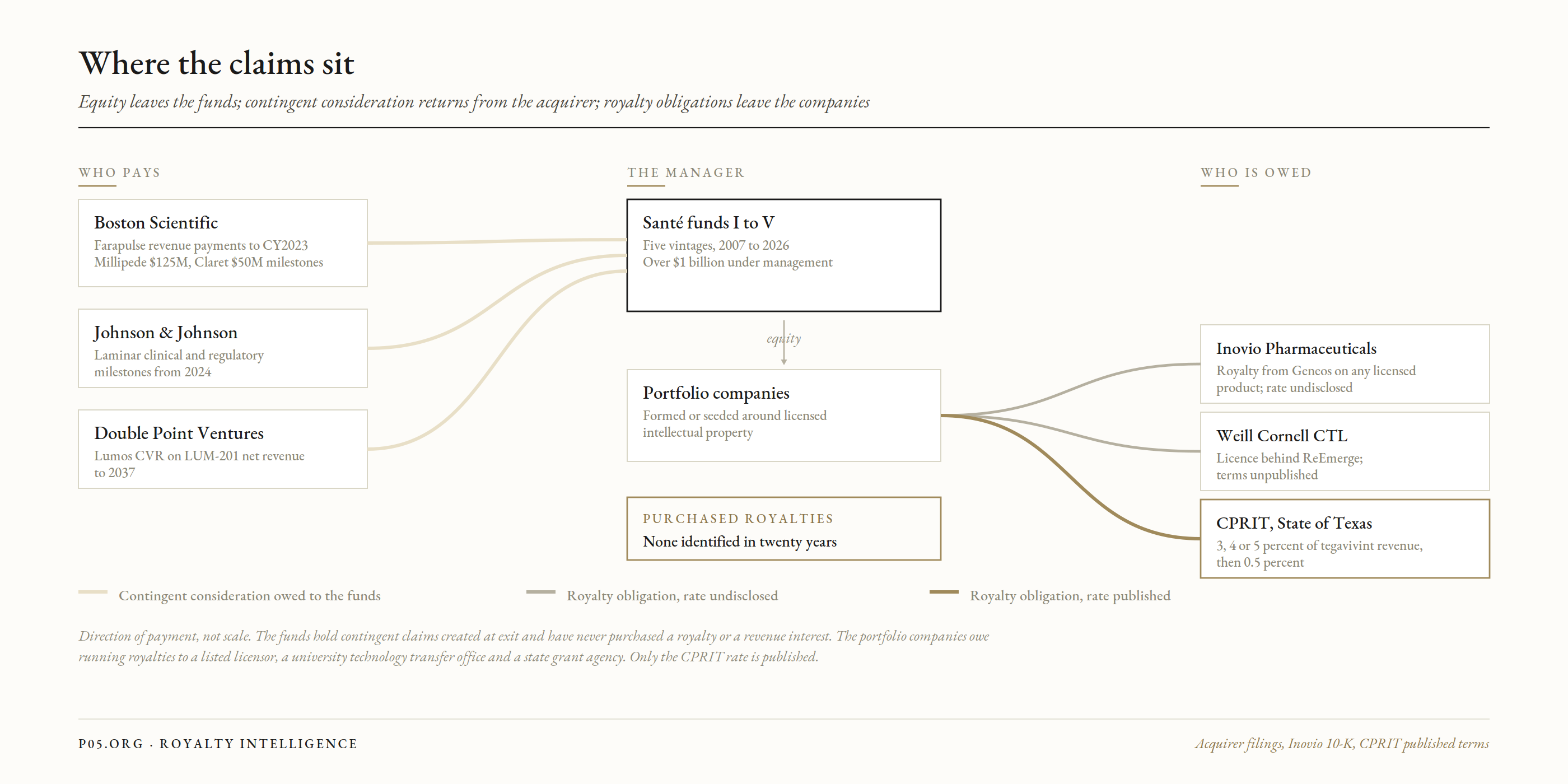
Equity leaves the funds, contingent consideration returns from the acquirer, and royalty obligations leave the portfolio companies. Direction of payment, not scale.
Currency note: every figure in this piece is stated in US dollars, as published by its source. ABK Biomedical is based in Halifax and Sonire Therapeutics in Japan, and the financings cited for both were announced in US dollars.
At a glance
- What it is: an independent US dollar venture manager investing third-party limited partner capital in early-stage biotech, medtech and digitally enabled healthcare, alongside a separate systematic public equity strategy
- Management entity: SHVMS, LLC, doing business as Santé Ventures, named as defendant of record in Rhee v. SHVMS, LLC
- Regulatory status: listed in SEC adviser records as an exempt reporting adviser, firm number 160280, filing since 2012
- Registered office: 1300 Red River Street, Suite 1500, Austin, Texas, having previously filed from 201 West 5th Street, Suite 1500
- Assets under management: over $1 billion in capital across two strategies, per the firm's own statement
- Fund sizes: Fund I $132M in 2007 and Fund II $139M in 2011, Fund III $250M in 2018, Fund IV $260M in 2021, Fund V $330M closed 2 February 2026 against a $300M target
- Named fund vehicles: Sante Health Ventures IV, LP and Sante Health Ventures IV Parallel A, LP, both Delaware, both filing a joint Form D on 31 March 2021; Sante Health Ventures V, LP, Delaware, CIK 0002016531; Santé Health Ventures III Parallel A, LP, the vehicle through which PSERS invested in Fund III
- Disclosed limited partner: the Pennsylvania Public School Employees' Retirement System, at $75M to Fund III and $75M to Fund IV
- Placement agent: Far Hills Group, LLC, CRD 32243, New York, named on the Fund IV Form D and described in PSERS materials as involved in allocations from investors other than PSERS
- Founders: Kevin Lalande, Founding Managing Director and Chief Investment Officer; Joe Cunningham, MD and Douglas French, both Founding Managing Directors
- Named exits: Laminar to Johnson & Johnson, Farapulse to Boston Scientific, AbVitro to Bristol Myers Squibb and Explorys to IBM, plus Claret Medical and Millipede to Boston Scientific, TVA Medical to Becton Dickinson and LDR Spine to Zimmer Biomet
- Royalty interests held by the fund: none identified
- Most recent disclosed activity: Jaguar LAA's acquisition of the Laminar assets from Johnson & Johnson on 11 September 2026, and ReEmerge's $37M Series A announced on 15 September 2026
A note on names. Santé Capital, an Australasian healthcare private equity firm, shares the brand and has no relationship to the Austin manager described here. Santé Capital is also the name Santé Ventures uses for its own public equity strategy, which adds a second layer to the collision.
A note on scope
Santé maintains a public website, a newsroom that carries portfolio press releases, a team page and a portfolio wall of company logos. It publishes no fund list with sizes, no limited partner roster, no performance figures and no statement of terms.
The quantitative material in this piece therefore comes from four places: Form D filings by the fund vehicles, the Pennsylvania Public School Employees' Retirement System's investment memoranda and quarterly disclosure reports, a federal court opinion arising from an employment dispute that put fund documents into the record, and SEC filings by the public companies that acquired Santé portfolio companies or that license technology to them.
The third of those channels put fund documents on the docket. A New York jury trial over a marketing employee's bonus produced a published reading of Section 1.2 of the Fund III limited partnership agreement, including the amount PSERS agreed to commit across two funds and the conditions under which it could decline the second.
Investment thesis and mandate
The stated approach is early-stage healthcare investing across biotechnology, medical technology and digitally enabled healthcare, concentrated on companies addressing clinical complexity, capital inefficiency or outdated care delivery models.
The mechanics are set out in the PSERS memorandum and nowhere in Santé's own materials. Cheques of $500,000 to $5 million per round in preferred or convertible preferred securities, often structured around milestone-based tranches at fixed valuations, targeting ownership above 20 percent, with reserves held to defend that position through later rounds. Hamilton Lane's letter in the same document describes Fund III as targeting 18 to 20 equity investments at $6 million to $12 million of total deployment each.
The geography was explicit. Around 70 percent of Fund III was earmarked for companies based in Texas or California, with the remainder deployed opportunistically across the United States, on the reasoning that Texas has substantial clinical and life science infrastructure and had historically lacked dedicated healthcare venture capital.
The part that matters for a royalty analysis is the company formation model. Santé told PSERS it expected to allocate a meaningful portion of Fund III to seed-stage de-novo ventures built around acquired intellectual property. That is a description of a manager whose companies begin life as licensees.
ReEmerge is the current example. The Center for Technology Licensing at Weill Cornell licensed the foundational intellectual property behind Cognitive Network Restoration Therapy to the company, which launched from stealth on 15 September 2026 with a $37M Series A co-led by Santé and U.S. Venture Partners. The licence terms have not been published.
The second strategy sits outside all of this. Santé Capital runs a systematic public equity book on the firm's MindRank software, and began trading capital in 2015 after three years of research and development, with Lalande credited as the designer of the original algorithms. No fund size, terms or performance for that strategy has been published, and it is separate from the venture funds described here.
There is no royalty, credit, structured finance or revenue-interest mandate anywhere in the firm's stated activity.
How capital enters and returns
Capital comes from limited partners into Delaware partnerships with parallel vehicles for particular investors. Returns have arrived by two routes, and the second is where the contingent economics live.
Outright acquisition by a strategic buyer. Explorys went to IBM. AbVitro went to Bristol Myers Squibb via Juno. TVA Medical went to Becton Dickinson. LDR Spine listed on Nasdaq and was then bought by Zimmer Biomet.
Acquisition with post-closing contingent consideration. This is the dominant pattern in the medtech book and it is documented in acquirer filings.
Boston Scientific closed Claret Medical on 2 August 2018 for $220M upfront plus a $50M reimbursement-based milestone that was achieved in the third quarter of that year. It exercised its option over the remaining shares of Millipede in the fourth quarter of 2018 for $325M upfront and up to a further $125M on a commercial milestone, having already paid $90M for its initial stake. As of 31 December 2020 it had made no incremental payment to Millipede's prior shareholders because the commercial milestone had not been achieved.
Farapulse carried the only revenue-linked consideration in the book. Boston Scientific had been an investor since 2014 and held roughly 27 percent. In June 2021 it exercised its option over the balance for approximately $295M, up to $92M on clinical and regulatory milestones, and additional revenue-based payments for the following three years. Gross of existing ownership and closing adjustments the company put the transaction at $450M upfront, up to $125M in achievement-based payments, and revenue-based payments through calendar year 2023.
Laminar followed the same shape at larger scale. Santé led the Series A in 2019 and remained the sole institutional investor through every subsequent round to the sale. Johnson & Johnson MedTech completed the acquisition on 30 November 2023 for $400M upfront subject to customary adjustments, with additional clinical and regulatory milestone payments in 2024 and beyond, and the asset went into Biosense Webster. Johnson & Johnson took an in-process research and development charge that reduced its 2023 adjusted EPS guidance by about $0.17 and expected a further $0.15 impact in 2024.
Then the position reversed. On 11 September 2026, Jaguar LAA, Inc. announced the acquisition of assets related to the Laminar program from Johnson & Johnson. Jaguar was formed in partnership with Santé Ventures and members of the Laminar management team, with Santé leading the formation and the financing. Financial terms were not disclosed.
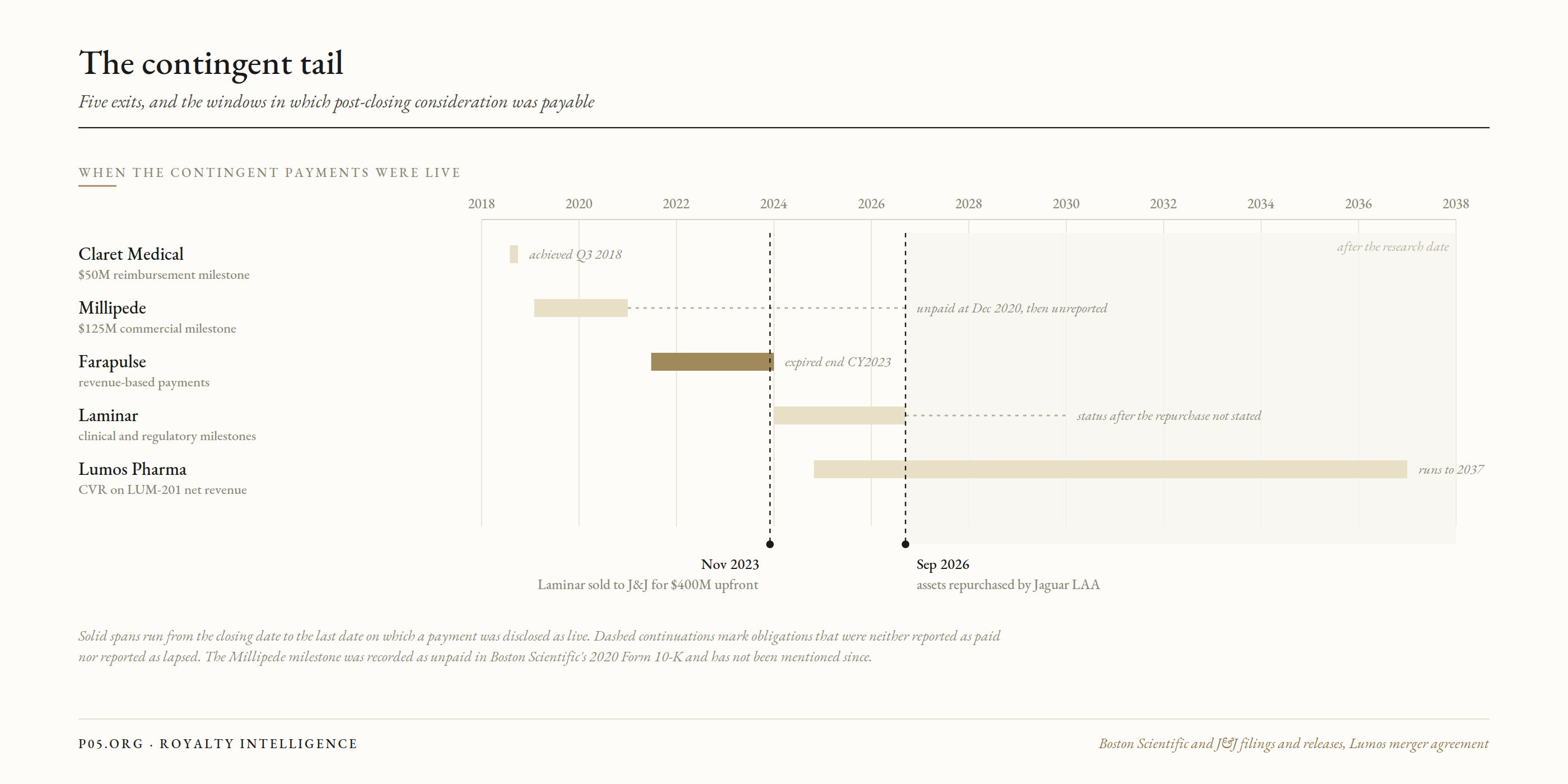
Five exits, and the windows in which post-closing consideration was payable. Dashed continuations mark obligations that were neither reported as paid nor reported as lapsed.
Thirty-four months separate the sale and the repurchase. Whether the original milestone ladder survives the repurchase, and in whose hands, is not stated in either announcement.
Financial profile and assets
| Item | Amount | Source and date |
|---|---|---|
| Assets under management | over $1B across two strategies | Santé, 2026 |
| Fund I | $132M | Crunchbase News, 2018, for a 2007 vintage |
| Fund II | $139M | Crunchbase News, 2018, for a 2011 vintage |
| Fund III | $250M, around 25 percent oversubscribed, more than 30 limited partners | Crunchbase News, 2018 |
| Fund III target and hard cap | $200M target, $250M hard cap | PSERS memorandum, 19 Dec 2018 |
| Funds I to III combined commitments | approximately $521M | PSERS memorandum, 19 Dec 2018 |
| Fund IV | $260M final close, more than two dozen limited partners, returning investors around 90 percent of capital | Santé, 16 Sep 2021 |
| Fund IV Form D offering amount | $250M, nothing sold at filing | Form D, 31 Mar 2021 |
| Fund V | $330M against a $300M target | Santé, 2 Feb 2026 |
| General partner commitment, Fund III | at least 2 percent of commitments, with 3 percent or $7.5M targeted internally | PSERS and Hamilton Lane, Dec 2018 |
| PSERS commitment, Fund III | $75M | PSERB Resolution 2019-02, 17 Jan 2019 |
| PSERS commitment, Fund IV | $75M | PSERB Resolution 2019-02, 17 Jan 2019 |
| PSERS dual fund commitment, Fund III LPA § 1.2(b) | $150M in aggregate across Fund III and Fund IV | Fund III Agreement, 28 May 2019, as quoted in the SDNY opinion |
| Fund III, PSERS position | $67.6M contributed, $24.9M distributed, $129.1M NAV, 29.1% net IRR, 2.28x TVPI | PSERS quarterly disclosure, 30 Sep 2024 |
| Fund IV, PSERS position | $40.3M contributed, nil distributed, $58.6M NAV, 24.4% net IRR, 1.45x TVPI | PSERS quarterly disclosure, 30 Sep 2024 |
| PSERS venture capital sleeve, for comparison | 6.1% net IRR, 1.4x TVPI, 10-year KS-PME 0.9x | PSERS quarterly disclosure, 30 Sep 2024 |
| Laminar, sale to Johnson & Johnson | $400M upfront plus clinical and regulatory milestones | 30 Nov 2023 |
| Farapulse, sale to Boston Scientific | approximately $295M for the 73 percent not owned, up to $92M in milestones, revenue-based payments for three years | 24 Jun 2021 |
| Millipede, sale to Boston Scientific | $90M for the initial stake, then $325M upfront and up to $125M on a commercial milestone | Q4 2018 and Jan 2019 |
| Claret Medical, sale to Boston Scientific | $220M upfront plus a $50M reimbursement milestone, achieved | 2 Aug 2018 |
| Lumos Pharma, take-private | $4.25 per share, roughly $38M equity value, plus one CVR per share | 23 Oct 2024 |
| Lumos priority review voucher sale to Merck | $60M in two instalments, $34.0M and $26.0M | Jul 2020 and Jan 2021 |
| Lumos ERVEBO royalty revenue | $1.5M in 2022 against $220,000 in 2021 | Lumos annual report for FY2022 |
| CPRIT standard revenue share, therapeutic programmes | 3, 4 or 5 percent of revenue until 4x the distributed grant is recovered, then 0.5 percent | CPRIT, published terms |
| Iterion, CPRIT funding and equity raised | $26M of CPRIT grants against roughly $28.8M of equity | Nov 2025 and vendor records |
| ReEmerge Series A | $37M, co-led by Santé and USVP | 15 Sep 2026 |
| ABK Biomedical Series D | $35M, led by J.P. Morgan Life Sciences Private Capital | 14 Oct 2025 |
| Clairity Series B | $43M, co-led by ACE Global Equity and Santé | 13 Nov 2025 |
| RapidPulse Series B | $48M | 16 Jul 2026 |
| Endovascular Engineering | $80M | 22 Jun 2026 |
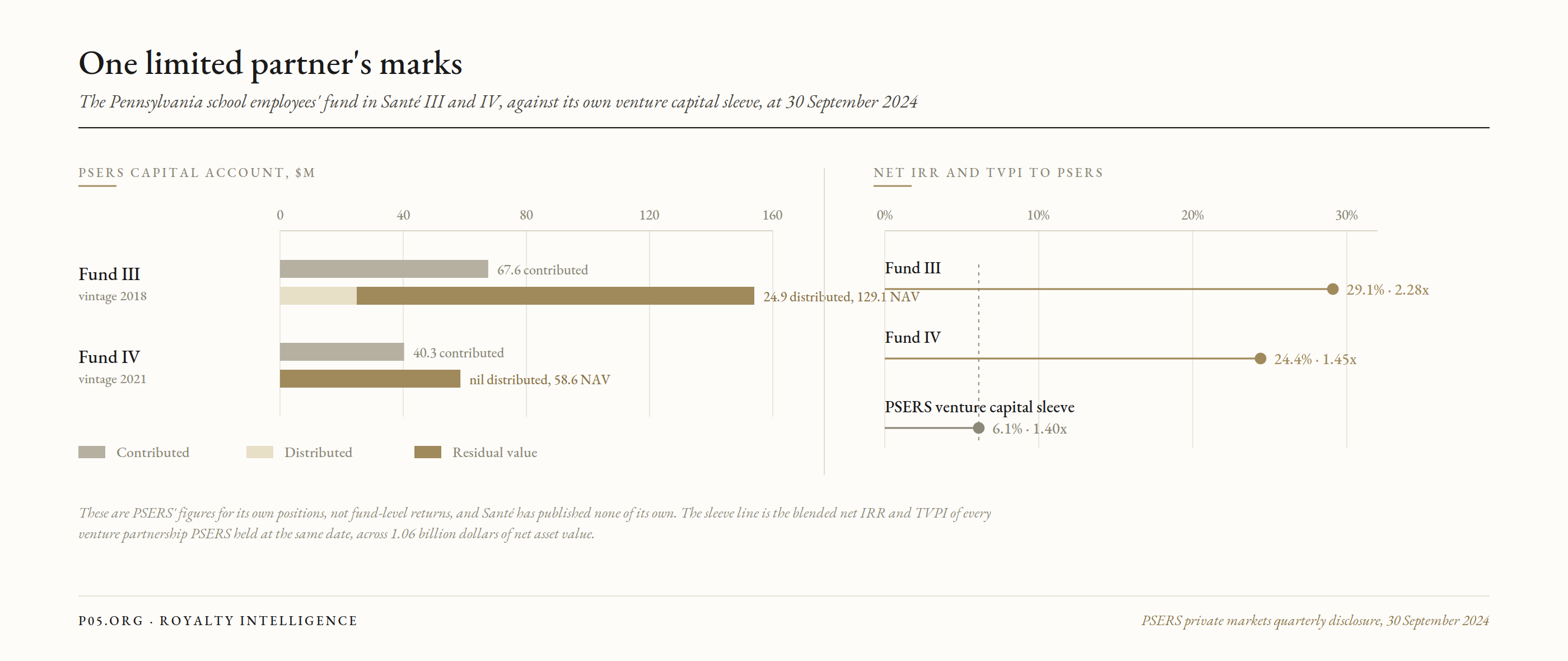
The PSERS positions in Fund III and Fund IV against the PSERS venture capital sleeve, at 30 September 2024. Capital account in millions of dollars, net IRR and TVPI as disclosed by the limited partner.
The PSERS figures are the only fund performance numbers in the public record for any Santé vehicle. They measure one limited partner's position, not the funds.
The portfolio book
Company names below are taken from the Santé portfolio page and the firm's newsroom, cross-checked against acquirer and licensor filings where those exist.
Exited, with contingent consideration documented in an acquirer's filings. Farapulse, Claret Medical, Millipede and Laminar, all four to Boston Scientific or Johnson & Johnson.
Exited, terms not disclosed at the level of contingent consideration. Explorys to IBM, AbVitro to Bristol Myers Squibb, TVA Medical to Becton Dickinson, LDR Spine to Zimmer Biomet via a Nasdaq listing, and Healthcare Highways.
Wound down. Molecular Templates, an Austin company where Santé's Chief Scientific Officer served as acting Chief Medical Officer, and which carried out-licensing royalty rights that are covered below.
Taken private. Lumos Pharma, acquired by Double Point Ventures in a tender offer that closed at the end of 2024.
Current private positions in therapeutics. Iterion Therapeutics, the Houston Wnt and beta-catenin company behind tegavivint. Geneos Therapeutics, in neoantigen-targeted personalised immunotherapy. Sensorium Therapeutics, ARI Therapeutics, Libra Therapeutics and Ten Bay Bio.
Current private positions in devices and diagnostics. ABK Biomedical, Apreo Health, RapidPulse, Cryosa, Endogenex, Endovascular Engineering, Kestrel, Cardiac Booster, Tangent Cardiovascular, Sonire Therapeutics, ReEmerge, Jaguar LAA and Clairity.
Current positions in healthcare services and software. Reimagine Care, Revelo Health, Rise Health, HNI Healthcare, CareHive, Aimbient, Outcomes, Solu, BradoAI, beHuman, Graici and Ryme.
Investors
There is no published limited partner roster. What exists is one pension's disclosure and a handful of vendor records.
PSERS is the confirmed anchor. On 17 January 2019 the board resolved to invest up to $150 million across Santé Health Ventures III and Santé Health Ventures IV, split $75 million to each, on the recommendation of staff and Hamilton Lane. At the time, PSERS had no prior history with the firm and the commitment was described as its first investment in early-stage healthcare venture in some time. Crunchbase News reported in 2018 that PSERS had also contributed to Funds I and II, which the fund-level record does not confirm either way.
The structure of that commitment is public only because of the litigation. Section 1.2(b) of the Fund III limited partnership agreement, signed 28 May 2019 and titled "Purpose: Dual Fund Commitment," provided that the investor had agreed in the aggregate to contribute a total of $150 million to the partnership and its immediate successor fund, comprising $75 million to Fund III and $75 million to Fund IV, with participation in Fund IV on the initial closing date for the family of funds then raised.
The conditions on that second commitment were narrow. PSERS could decline Fund IV if fewer than three of the current managing members or equivalent persons served in a similar capacity at the inception of Fund IV, if Fund IV's terms were not substantially similar to Fund III's, if a managing member had been convicted of a felony, or if operational due diligence produced a negative determination.
The agreement named Hamilton Lane, Aksia and AON as the permitted operational due diligence consultants and set out a cure-and-second-opinion process running to a third independent review.
The court construed that provision as legally binding, holding that the language obligated PSERS to invest a specific sum at a specific time subject to conditions, and that Santé would have had a cause of action for breach if PSERS had not funded Fund IV. Carried interest under both agreements was determined on a cross-fund basis.
A public pension therefore committed to two consecutive vintages in one document, with key-person protection and a terms-parity clause, in 2019, and funded the second in 2021.
Beyond PSERS, the record thins. PitchBook records Lockheed Martin Master Retirement Trust among Fund I's limited partners, Sentara Healthcare among Fund III's, and Guardian Life Insurance Company of America among Fund V's. Those are single names from a vendor that also reports PSERS as the sole limited partner of Fund IV, which the firm's own statement of more than two dozen Fund IV investors contradicts, so the vendor entries are partial.
Santé has characterised the base the same way across cycles. Fund III was around 25 percent oversubscribed with more than 30 limited partners.
Fund IV secured commitments from more than two dozen limited partners including new institutional investors in Asia and Latin America, with returning investors accounting for nearly 90 percent of the total. Fund V was described as reflecting an expansion of the limited partner base across domestic and international markets.
Far Hills Group, LLC appears on the Fund IV Form D as the recipient of sales compensation, soliciting in all states, with no foreign solicitation. PSERS materials state that no placement agent was compensated for the PSERS investment and that Far Hills was involved in allocations from investors other than PSERS.
For anyone underwriting this manager, the LP base is a public pension anchor plus a long tail of institutions and, on the firm's own account, a re-up rate near 90 percent into Fund IV. None of the tail is named.
Governance and team
The three founders remain in place after twenty years. Kevin Lalande is Founding Managing Director and Chief Investment Officer, with seven years at Austin Ventures and a period at McKinsey before that, an engineering degree, a Harvard MBA as a Baker Scholar and Siebel Scholar, and three internet companies founded and sold in the 1990s. Joe Cunningham, MD is a former Chief Medical Officer of the Providence Health System and former Vice Chair of the Ascension Health Ventures investment committee. Douglas French is a past President and Chief Executive of Ascension Health and the creator of Ascension Health Ventures.
Below them, the team page lists James Eadie, MD, Omar Khalil and Dennis McWilliams as Managing Directors, Casey Cunningham, MD as Partner and Chief Scientific Officer, and venture partners including Louis Bock, Thomas Krummel, MD and William Cohn, MD. McWilliams and Khalil were promoted to Managing Director alongside the Fund V close.
Hamilton Lane's 2018 diligence described an investment team of three managing directors and six other dedicated investment professionals, augmented by five data scientists and four operations and management professionals, with an average of 23 years of industry experience and half the investment team holding medical doctorates.
The same letter recorded that carried interest is distributed across the investment team down to senior associate level, and that the firm drew on two venture partners and 63 Strategic Advisory Council members for deal flow. PSERS put total headcount at 18 across a main office in Austin and a satellite office in Houston at that date.
Casey Cunningham has served as acting Chief Medical Officer for several Santé portfolio companies including Terapio, Molecular Templates and BetaCat Pharma, and is principal investigator on the CPRIT-funded Iterion study in liver, gallbladder and bile duct cancers. The firm has supplied clinical leadership to companies it formed, which is an operating role.
One governance item is in the public record. In Rhee v. SHVMS, LLC, a former Director of Marketing and Investor Relations sued over an unpaid bonus under a 2010 offer letter that promised 1.00 percent of capital directly raised. A jury found for the plaintiff on breach of contract in 2023 and again on damages in 2024.
The court granted summary judgment for Santé on unjust enrichment and breach of fiduciary duty, and dismissed the fraud claim at the pleading stage. In an opinion of 28 October 2024 the court remitted the second jury's $1.4 million award to $1.2 million, giving the plaintiff a choice between the reduced verdict and a further trial on damages. The disposition after that date was not identified in this research.
No fund-level management fee, carry arrangement or hurdle has been published beyond the cross-fund carry provision quoted in that opinion.
IP, royalties, and the economics of return
Santé holds no royalty. Its companies sit on both sides of royalty agreements, and one former position held a portfolio of out-licensing royalty rights that did not survive.
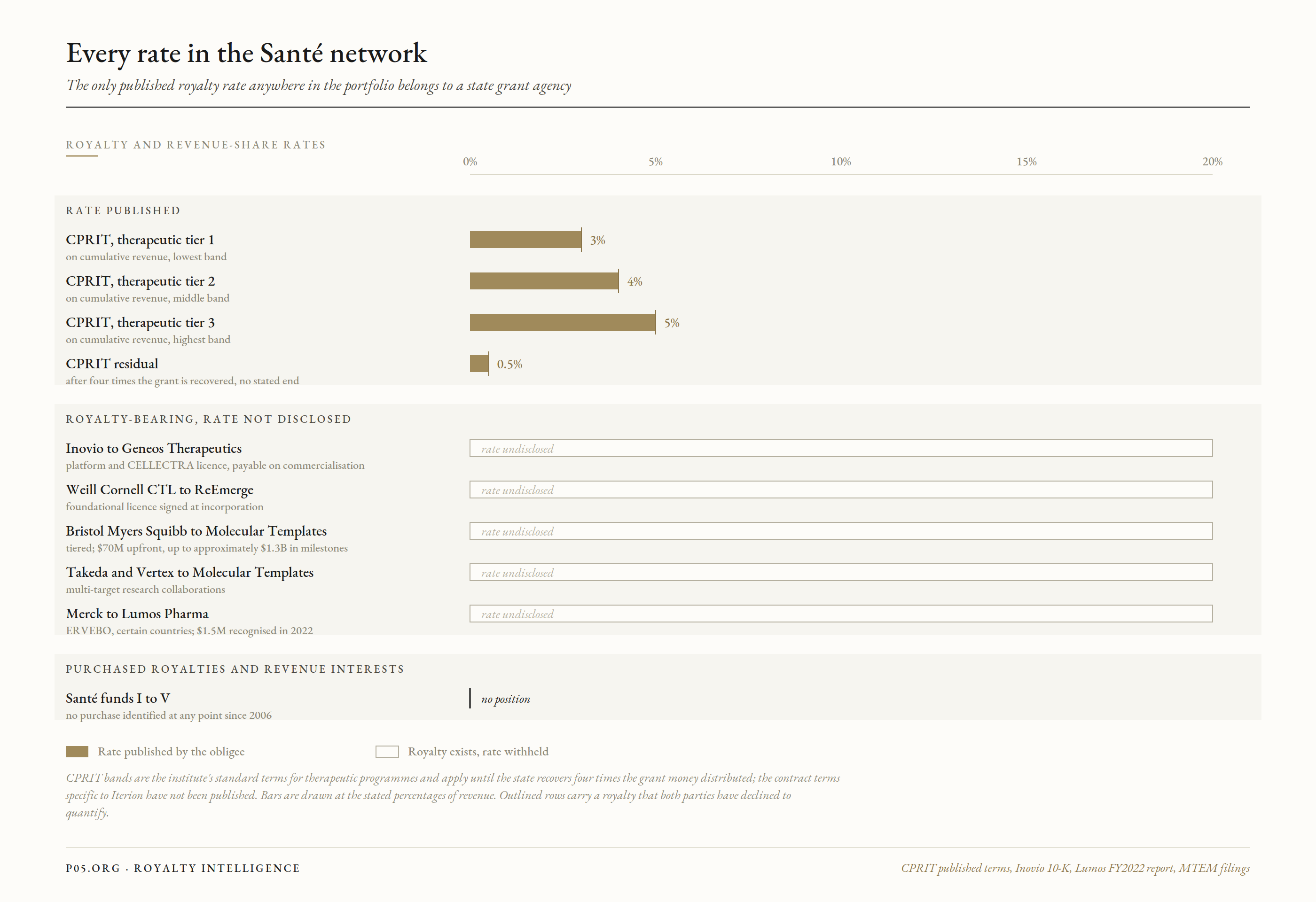
Every royalty and revenue-share rate identified in the Santé network, grouped by whether the obligee has published it. Bars are drawn at the stated percentages of revenue.
Molecular Templates and the out-licensing book that ended
Molecular Templates was an Austin biotech built on engineered toxin bodies, listed on Nasdaq as MTEM after a reverse merger, and carried multi-target research collaborations with Takeda and Vertex alongside a co-development arrangement with Takeda for TAK-169.
The Bristol Myers Squibb agreement was the largest. On 11 February 2021 the two companies announced a strategic research collaboration under which BMS made an up-front payment of $70 million, with MTEM eligible for near-term, development, regulatory and sales milestones of up to approximately $1.3 billion plus tiered royalty payments on future sales. BMS held an option to an exclusive worldwide licence for each selected target.
None of it converted. MTEM reduced its workforce to management in late 2024, wound down its Phase 1 trials, and on 16 December 2024 was notified by Nasdaq that it was a public shell whose continued listing was no longer warranted, having failed to file its Form 10-Q for the quarter ended 30 September 2024 and to maintain a $1.00 minimum bid. Trading was suspended on 26 December 2024 and the company did not appeal.
The royalty rights described in that agreement were tiered and undisclosed, and they reached no product. The licensor stopped filing before any option was exercised.
Lumos Pharma and the ERVEBO royalty
Lumos Pharma reached the public market through a reverse merger with NewLink Genetics, and inherited NewLink's agreement with Merck over rVSV∆G-ZEBOV.
Two instruments came with it. The priority review voucher granted on the FDA's approval of ERVEBO in December 2019 was split 60 percent to the company and 40 percent to Merck; under a July 2020 asset purchase agreement Merck bought the voucher for an aggregate $60 million in two instalments, $34.0 million received in the third quarter of 2020 and $26.0 million in January 2021, extinguishing the $35.7 million liability representing Merck's share.
The royalty itself was the smaller instrument. Under the NewLink Merck agreement as amended, the company earned royalties on vaccine sales in certain countries and recognised $1.5 million of royalty revenue in 2022 against $220,000 in 2021.
The company's own assessment was that the market would be concentrated in developing-world territories that are excluded from royalty payment or where the vaccine is donated or sold at low margin, and that material royalty payments were not expected.
The exit replaced the royalty with a contingent value right. Double Point Ventures' tender offer paid $4.25 per share in cash plus one non-transferable CVR per share, the CVR keyed to annual global net revenue of LUM-201 up to the year 2037, to transactions involving Lumos or its assets within 18 months of closing, and to sales or licensing agreements over legacy products other than LUM-201 entered into within that same window. Equity value at $4.25 was approximately $38 million against a $3.95 close the prior day.
The CVR runs thirteen years and is not transferable, and it sits on an asset that had not begun its Phase 3 trial at the time the merger agreement was signed.
Geneos and Inovio
Geneos Therapeutics sits on the other side of the agreement. It is a Santé portfolio company and a royalty obligor to a listed licensor.
Inovio Pharmaceuticals formed Geneos in 2016 and exclusively licenses its immunotherapy platform and CELLECTRA technology to Geneos for personalised, neoantigen-based cancer therapy, with the licence providing for potential royalty payments to Inovio if Geneos commercialises any licensed product. Inovio held 23 percent of Geneos on an as-converted basis as of 30 September 2025, has written its equity method investment down to zero, and has no obligation to fund the company.
Santé has been in Geneos since the initial $10.5 million financing in February 2019 and participated in the $12 million Series A1 in March 2021 and the $17 million Series A2 in March 2022. The royalty rate payable to Inovio is not disclosed in any Inovio filing.
Iterion and the CPRIT revenue share
Iterion Therapeutics is the Santé therapeutics position furthest into the clinic. Tegavivint is a TBL1 inhibitor targeting nuclear beta-catenin, with orphan drug and rare paediatric disease designations, and the company reported first clinical validation in Wnt-driven advanced hepatocellular carcinoma in an oral presentation at ASCO 2026.
Its funding has leaned on the Cancer Prevention and Research Institute of Texas. A $7.1 million product development grant awarded on 19 November 2025 brought total CPRIT funding to $26 million, against roughly $28.8 million of equity raised across the company's life. Other trials run through academic sponsors, including an Emory-sponsored study in relapsed or refractory osteosarcoma dosed in February 2026.
CPRIT product development awards carry revenue-sharing obligations back to the state of Texas, and the institute publishes its standard terms. For therapeutic programmes the rate is 3, 4 or 5 percent of revenue depending on cumulative revenue, running until the state has recovered four times the grant money distributed, after which a further 0.5 percent of revenue is payable with no stated end. On $26 million distributed, that schedule implies up to $104 million recoverable at 3 to 5 percent before the residual rate applies. The contract terms specific to Iterion's awards have not been published.
Where royalties do not exist
The services and software positions sell subscriptions and contracts. ABK Biomedical, whose $35 million Series D closed on 14 October 2025 with J.P. Morgan Life Sciences Private Capital leading, holds its own intellectual property in inorganic polymer microspheres and manufactures in house; Eye90 remains investigational. Clairity's $43 million Series B funds commercialisation of an FDA-authorised software product sold through health systems. Neither carries a disclosed out-licence.
Portfolio, as of September 2026
Stakes and entry valuations are undisclosed in every position.
| Position | What it is | Royalty and contingent-payment relevance |
|---|---|---|
| Laminar / Jaguar LAA | Left atrial appendage elimination via rotational motion | Sold to J&J Nov 2023 for $400M upfront plus clinical and regulatory milestones; assets reacquired by Santé-backed Jaguar LAA in Sep 2026, terms undisclosed |
| Farapulse | Pulsed field ablation for atrial fibrillation | Sold to Boston Scientific Jun 2021; approximately $295M for the 73 percent not owned, up to $92M in milestones, revenue-based payments for three years |
| Millipede | IRIS transcatheter annuloplasty ring | Sold to Boston Scientific Jan 2019; $325M upfront plus up to $125M on a commercial milestone, unpaid as of Dec 2020 |
| Claret Medical | Sentinel cerebral embolic protection | Sold to Boston Scientific Aug 2018; $220M upfront plus a $50M reimbursement milestone, achieved in Q3 2018 |
| Lumos Pharma | LUM-201 oral growth hormone secretagogue; legacy NewLink assets | Held an ERVEBO royalty from Merck, $1.5M recognised in 2022; taken private Oct 2024 at $4.25 plus a CVR tied to LUM-201 net revenue to 2037 |
| Molecular Templates | Engineered toxin bodies | Held tiered royalty rights from Bristol Myers Squibb within a $70M upfront and up to approximately $1.3B milestone package, plus Takeda and Vertex collaborations; delisted Dec 2024 and wound down |
| Geneos Therapeutics | Neoantigen-targeted personalised immunotherapy | Pays royalties to Inovio on any commercialised licensed product; rate undisclosed; Inovio holds 23 percent and carries the investment at zero |
| Iterion Therapeutics | Tegavivint, TBL1 and Wnt/beta-catenin inhibitor | No out-licence announced; $26M of CPRIT funding carries state revenue-sharing obligations |
| ReEmerge | Cognitive Network Restoration Therapy for traumatic brain injury | Built on intellectual property licensed from the Center for Technology Licensing at Weill Cornell; terms undisclosed |
| ABK Biomedical | Eye90 imageable Y90 radioembolisation microspheres | Own intellectual property and manufacturing; investigational; no out-licence identified |
| Clairity | FDA-authorised AI breast cancer risk prediction from mammography | Software product revenue; none identified |
| Apreo Health | Airway scaffold for severe emphysema | None disclosed |
| RapidPulse | Stroke aspiration technology; $48M Series B Jul 2026 | None disclosed |
| Endovascular Engineering | Thrombectomy; $80M raised Jun 2026 | None disclosed |
| Endogenex, Cryosa, Kestrel, Cardiac Booster, Tangent Cardiovascular, Sonire Therapeutics | Clinical-stage device positions | None disclosed |
| Sensorium Therapeutics, ARI Therapeutics, Libra Therapeutics, Ten Bay Bio | Private therapeutics positions | None disclosed |
| Reimagine Care, Revelo Health, Rise Health, HNI Healthcare, CareHive, Aimbient, Outcomes, Solu, BradoAI, beHuman, Graici, Ryme | Healthcare services and software | Contract and subscription revenue; none |
Blue team and red team
Blue team
- Twenty years of continuous operation under the same three founders, with the investment team's carried interest distributed down to senior associate level
- A realised exit channel through strategic medtech acquirers, with Boston Scientific taking three companies and Johnson & Johnson taking one at $400M upfront
- PSERS reports Fund III at 29.1 percent net IRR and 2.28x TVPI and Fund IV at 24.4 percent and 1.45x as of 30 September 2024, against a PSERS venture capital sleeve running 6.1 percent net IRR and a 10-year KS-PME of 0.9x
- A public pension that contracted for a dual fund commitment across two consecutive vintages, then performed on it, and a firm-reported re-up rate near 90 percent of Fund IV capital
- Fund V closed above its $300M target at $330M in February 2026
- Fund sizes have stepped up moderately across five vintages, from $132M in 2007 to $330M in 2026, with the increase from Fund IV to Fund V at 27 percent
- Contingent consideration from medtech exits creates revenue-linked and milestone-linked claims at fund level, which are cash flows arriving after the equity has been sold
- The Jaguar LAA transaction shows a manager able to reacquire a divested programme from a large-cap strategic and stand up a new company around it with the original development team
- The de-novo company formation model targets ownership positions above 20 percent in companies the firm helped incorporate, entered through milestone-based tranches at fixed valuations
Red team
- No purchased royalty, revenue interest or structured credit anywhere; every royalty in this piece belongs to a counterparty, a university or a state agency
- Fund sizes above are assembled from press reports and a Form D target; no fund's final close has been confirmed in a regulatory filing that also states amounts sold
- Performance is visible only through one limited partner's disclosure of its own position, at a date now nearly two years old, and neither Fund I, Fund II nor Fund V has any published performance at all
- Hamilton Lane's 2018 diligence letter described the general partner as having generated mixed net performance across prior funds, with Fund II top quartile and significant additional upside still expected in Fund I, which was written seven years after Fund I's vintage
- Molecular Templates ran a $70M upfront and a milestone ladder to approximately $1.3B with Bristol Myers Squibb, and was delisted as a public shell in December 2024 having failed to file its third-quarter report
- Fund IV had distributed nothing to PSERS as of September 2024, three years into its life, against $40.3M contributed
- Contingent consideration behaves differently from a running royalty in two respects visible here: the Millipede commercial milestone was still unpaid two years after closing, and Farapulse's revenue-based payments expired at the end of calendar 2023
- The Jaguar LAA repurchase leaves an open question about whether the Laminar milestone ladder survives, in whose hands, and on what terms, none of which either party disclosed
- Concentration on three founders who are now twenty years in, with the firm's clinical leadership repeatedly drawn from a single Chief Scientific Officer across multiple portfolio companies
- A jury found against the manager on breach of contract in an employment dispute over fundraising compensation, twice, with the award remitted to $1.2 million in October 2024 and the subsequent disposition not public
- The limited partner base is unnamed apart from PSERS and three single-source vendor entries, and vendor records on this manager are inconsistent enough that one reports PSERS as Fund IV's sole investor
- Geographic concentration in Texas and California was an explicit allocation target of roughly 70 percent in Fund III
- Iterion's $26 million of CPRIT funding attaches a state revenue-sharing claim to tegavivint at standard terms of 3 to 5 percent of revenue until four times the grant is recovered, then 0.5 percent with no stated end, ahead of any private claim
- The firm runs a systematic public equity strategy alongside the venture funds under the same brand, and publishes nothing about its size, terms or performance
Implications for the pharmaceutical royalty and biotech capital markets
Medtech venture exits generate revenue-linked claims that are never labelled as royalties. Farapulse carried revenue-based payments for three years past closing. Millipede carried a $125 million commercial milestone, and Lumos a CVR keyed to annual net revenue out to 2037. The holders are dissolved or dissolving partnerships and the individuals who once held shares.
No secondary market for these instruments has been identified. The disclosure sits in the acquirer's 10-K, which is the only place either side publishes it. The credit behind them is a large-cap medtech balance sheet, and the payment trigger is product revenue or a regulatory event, which is the same pair of variables that sits under a pharmaceutical royalty.
De-novo company formation around acquired intellectual property builds a university royalty stack under an entire venture portfolio. Santé told its anchor investor it would allocate a meaningful portion of a fund to seed-stage ventures built on licensed IP, and ReEmerge shows the model running: a Weill Cornell licence, a Nature Medicine publication, a 40-patient study and $37 million of Series A capital.
The ReEmerge licence terms are unpublished, which is the norm for technology transfer agreements at this stage. Anyone underwriting an asset originated by a company-creation venture manager should establish what the technology transfer office is owed before pricing the licensor's share.
State grant agencies hold royalty positions on published terms. Iterion has taken $26 million from CPRIT against roughly $28.8 million of private equity capital. CPRIT's standard therapeutic terms run at 3 to 5 percent of revenue until four times the distributed grant is recovered, then 0.5 percent with no stated end. Those rates sit ahead of any private claim on the same revenue.
Anyone underwriting a licensor's share of a future out-licence needs to know what fraction of the development cost came from an agency with a contractual claim on revenue, and that fraction is not in any commercial database.
A large-cap strategic divesting a programme back to its original venture investor creates a financing need. Johnson & Johnson bought Laminar for $400 million upfront in November 2023 and sold the assets back to a Santé-backed company in September 2026, with the original management team moving across.
In that structure the buyer is a newly formed private company with no revenue and a programme that needs funding to the next regulatory milestone.
The asset arrives with a documented clinical history and a prior arms-length valuation, which is more than most private financings put in front of an underwriter. Transactions of this kind are not visible until a press release appears, because neither the strategic nor the acquiring vehicle has a reporting obligation.
The disclosure entry point for a private US venture manager runs through its public pension investors and, occasionally, through its litigation. Everything quantitative in this piece about Santé's LP economics comes from PSERS resolutions, PSERS quarterly reports and a Southern District of New York opinion that quoted Section 1.2 of a limited partnership agreement into the record.
A manager with a state pension investor discloses commitment amounts, contributions, distributions, NAV, net IRR and TVPI on a quarterly lag, whether it wants to or not. A manager that litigates over fundraising compensation may put its fund terms on a public docket. Neither channel requires the manager's cooperation and neither costs anything to search.
Recent developments
- Jaguar LAA acquired the Laminar programme assets from Johnson & Johnson, announced 14 September 2026 for a transaction dated 11 September. Jaguar was formed in partnership with Santé Ventures and members of the Laminar management team, with Santé leading the formation, the financing and the transaction. Financial terms were not disclosed. This is a repurchase of a programme Santé sold to Johnson & Johnson in November 2023 for $400M upfront plus milestones
- ReEmerge launched from stealth with a $37M Series A on 15 September 2026, co-led by U.S. Venture Partners and Santé with Oxford Science Enterprises, 415 Capital, IAG Capital Partners, The Vertical Group and Dendrion Ventures participating. The company licensed its foundational intellectual property from the Center for Technology Licensing at Weill Cornell and will run a prospective single-arm multicentre study of up to 40 patients with chronic moderate-to-severe traumatic brain injury
- RapidPulse closed an oversubscribed $48M Series B on 16 July 2026 to advance clinical development of its stroke aspiration technology
- Endovascular Engineering raised $80M, reported 22 June 2026
- Iterion reported first clinical validation of tegavivint in Wnt-driven advanced hepatocellular carcinoma in an oral presentation at ASCO 2026 on 3 June 2026, following a first patient dosed in an Emory-sponsored osteosarcoma study in February 2026
- Endogenex announced full enrollment of the ReCET clinical study on 7 July 2026
- Sonire Therapeutics completed enrollment in SUNRISE-I, its randomised controlled trial of ultrasound-guided HIFU therapy in pancreatic cancer, on 3 June 2026
- Surgical Safety Technologies became Aimbient on 15 July 2026
- Fund V closed at $330M on 2 February 2026, above its $300M target, with Dennis McWilliams and Omar Khalil promoted to Managing Director
- Clairity raised a $43M Series B on 13 November 2025, co-led by ACE Global Equity and Santé, following FDA de novo authorisation of Clairity Breast in June 2025
- ABK Biomedical raised $35M in an oversubscribed Series D on 14 October 2025, led by J.P. Morgan Life Sciences Private Capital with F-Prime, Santé, Eight Roads and an undisclosed strategic participating
- No royalty or revenue-interest purchase has been identified at the fund level at any point in the firm's history
Financial history and recent developments
| Date | Event |
|---|---|
| 2006 | Santé Ventures founded by Kevin Lalande, Joe Cunningham and Douglas French, out of the Austin Ventures healthcare practice |
| 2007 | Fund I launched at $132M |
| 2011 | Fund II launched at $139M |
| 2 Aug 2018 | Boston Scientific closes Claret Medical for $220M upfront plus a $50M reimbursement milestone |
| Q4 2018 | Boston Scientific exercises its option over the remaining shares of Millipede |
| 19 Dec 2018 | PSERS staff and Hamilton Lane recommend up to $150M split across Funds III and IV |
| 17 Jan 2019 | PSERB Resolution 2019-02 approves the $150M dual commitment |
| 29 Jan 2019 | Boston Scientific closes Millipede at $325M upfront plus up to $125M on a commercial milestone |
| Feb 2019 | Geneos closes its initial $10.5M financing with Santé participating |
| 2019 | Santé leads the Laminar Series A and remains the sole institutional investor through to exit |
| 28 May 2019 | PSERS executes the Fund III limited partnership agreement containing the dual fund commitment at Section 1.2(b) |
| 30 Sep 2019 | Lumos Pharma completes its reverse merger with NewLink Genetics |
| Jul 2020 | Merck agrees to buy the ERVEBO priority review voucher from Lumos for $60M in two instalments |
| 31 Mar 2021 | Sante Health Ventures IV, LP and Parallel A file a Form D at a $250M offering amount, with Far Hills Group named |
| 1 Apr 2021 | PSERS executes the Fund IV limited partnership agreement |
| 24 Jun 2021 | Boston Scientific exercises its Farapulse option at approximately $295M plus up to $92M in milestones and three years of revenue-based payments |
| 16 Sep 2021 | Fund IV final close at $260M |
| Sep 2023 | First jury trial in Rhee v. SHVMS, LLC finds for the plaintiff on breach of contract |
| 30 Nov 2023 | Johnson & Johnson MedTech completes the Laminar acquisition at $400M upfront plus milestones |
| 27 Mar 2024 | Sante Health Ventures V, LP files its Form D |
| Jun 2024 | Second jury trial, on damages only, returns a $1.4M verdict |
| Oct 2024 | Molecular Templates reduces its workforce to management and winds down its Phase 1 trials |
| 23 Oct 2024 | Lumos Pharma agrees to a take-private at $4.25 per share plus a CVR running to 2037 |
| 28 Oct 2024 | SDNY remits the Rhee damages award to $1.2M |
| 16 Dec 2024 | Nasdaq notifies Molecular Templates that it is a public shell; trading suspended 26 December |
| Jun 2025 | Clairity Breast receives FDA de novo authorisation |
| 14 Oct 2025 | ABK Biomedical closes a $35M Series D |
| 13 Nov 2025 | Clairity closes a $43M Series B co-led by Santé |
| 19 Nov 2025 | CPRIT awards Iterion $7.1M, taking total CPRIT funding to $26M |
| 2 Feb 2026 | Fund V closes at $330M; McWilliams and Khalil promoted to Managing Director |
| 10 Feb 2026 | First patient dosed in the Emory-sponsored tegavivint osteosarcoma study |
| 3 Jun 2026 | Iterion presents tegavivint HCC data at ASCO; Sonire completes SUNRISE-I enrollment |
| 22 Jun 2026 | Endovascular Engineering raises $80M |
| 16 Jul 2026 | RapidPulse closes a $48M Series B |
| 11 Sep 2026 | Jaguar LAA acquires the Laminar programme assets from Johnson & Johnson |
| 15 Sep 2026 | ReEmerge launches with a $37M Series A co-led by Santé |
Conclusion
Santé Ventures manages over $1 billion across five venture funds and a public equity strategy, employs a team whose three founders have been in place since 2006, and has never bought a royalty.
What it has done is sell its companies to strategic acquirers and structure a portion of the consideration as claims on what happens after closing. Boston Scientific owed revenue-based payments on Farapulse through calendar 2023, and a $125 million commercial milestone on Millipede that was still unpaid two years later. Clinical and regulatory milestones on Laminar ran from 2024 onward at Johnson & Johnson. Lumos shareholders hold a CVR from Double Point Ventures keyed to LUM-201 net revenue as far out as 2037. Behind all of those claims are limited partnerships and the people who once held shares in the acquired companies.
On the other side of the ledger, the portfolio companies are obligors. Geneos owes Inovio a royalty on anything it commercialises, at an undisclosed rate. A licence signed at incorporation puts ReEmerge under the same obligation to Weill Cornell. The state of Texas holds 3 to 5 percent of tegavivint revenue until four times Iterion's $26 million of CPRIT grants is recovered, then 0.5 percent with no stated end. Molecular Templates held tiered royalty rights from Bristol Myers Squibb inside a package worth up to approximately $1.3 billion in milestones, and was delisted as a public shell in December 2024.
The only performance numbers anyone outside the firm can see belong to a Pennsylvania pension fund, which as of September 2024 marked Fund III at 2.28x and 29.1 percent net and Fund IV at 1.45x and 24.4 percent, against a venture sleeve running 6.1 percent.
What this manager shows a royalty desk is that a healthcare venture book with no royalty mandate accumulates revenue-linked claims on both sides of its balance sheet. The claims it holds have no observable price and no identified market. The claims its companies owe were signed at incorporation, before the first institutional round closed.
All information in this article was accurate as of September 2026 and is derived from publicly available sources including SEC filings, Form D notices, Pennsylvania Public School Employees' Retirement System investment memoranda and quarterly disclosure reports, a published opinion of the United States District Court for the Southern District of New York, company press releases, data-vendor records and financial news reporting. Information may have changed since publication. This content is for informational purposes only and does not constitute investment, legal, or financial advice. The author is not a lawyer or financial adviser.