
How it is made: royalty financing on process patents
On 12 August 2025 a security interest was recorded against American patent 9,816,156 in favour of LSI Financing LLC, as administrative agent. The patent belongs to ITM Isotope Technologies Munich. Every claim is to a method: making no-carrier-added lutetium-177 from irradiated ytterbium-176 by cation-exchange chromatography.
The lien stood behind a debt facility of up to $262.5 million from funds managed by Blue Owl, with $140 million drawn at first closing. Blue Owl's counsel called it a term loan. In June 2026 ITM moved the facility to Perceptive Advisors. Three months later Telix agreed to buy ITM for $1.65 billion upfront, a figure that includes $302 million of net debt assumed at closing.
ITM licenses its production technology to NTP in South Africa and to ANSTO in Australia, both on undisclosed terms. The company reported $273 million of revenue in 2025. The loan is a claim on that business, with the patent among the assets pledged.
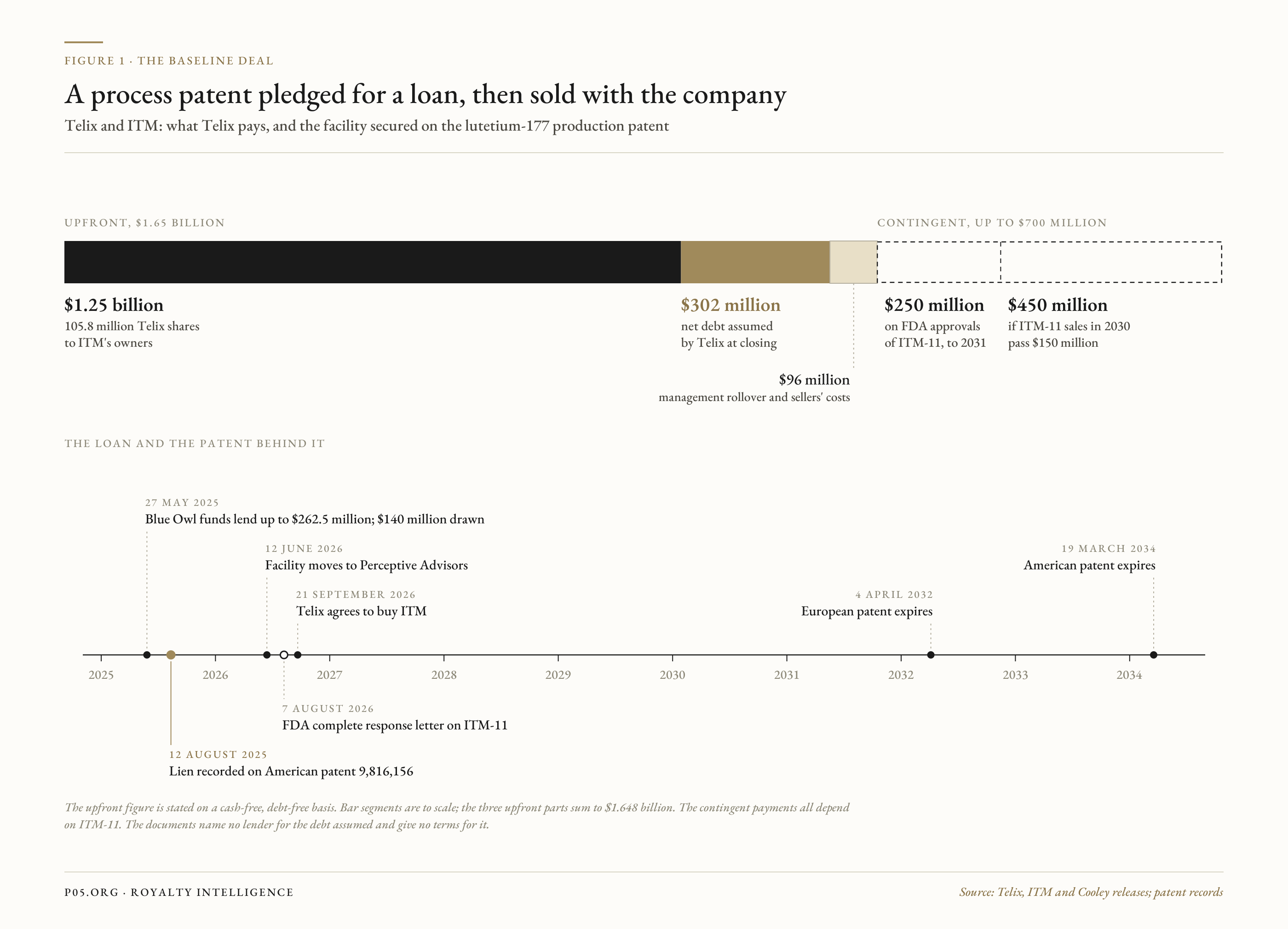
Figure 1. Telix and ITM: the $1.65 billion upfront and $700 million contingent consideration, to scale, and the dates of the loan and of the lutetium-177 production patent pledged for it.
A royalty on a process patent pays for the use of a method, and the licensee runs the method. It chooses where the product is made and whether to keep making it that way. Once the patent expires, it can argue that the payment has lost its basis.
Royalty funds have been buying such streams. Since 2020 HealthCare Royalty bought Nektar's, Marathon bought Aquestive's and Royalty Pharma bought MorphoSys's. Blackstone, XOMA and DRI followed with Sutro, Twist and Editas. What each buyer gets turns on four terms in the licence beneath: how the product is made, what the rate becomes at patent expiry, how long the know-how is paid for, and who may run the process.
1. When the product was made, and how
Genentech licensed its Cabilly patents to Biogen in 2004. They cover the making of antibodies in host cells, and they expired on 18 December 2018. Biogen then stopped paying on Tysabri that had been made before that date and sold after it, some of it as late as 2022. The rates, as reported, were 4.5 per cent in America and 3.5 per cent elsewhere.
A jury failed to agree in July 2025. On 30 September 2025 a federal court in California ruled for Genentech. It found the licence open to both readings, heard evidence of what the parties meant, and held that product made by the patented process before expiry is licensed product whenever it is sold. Biogen owes $88.3 million and about $35.9 million of interest. Its appeal to the Ninth Circuit was fully briefed in May 2026.
Pacira's royalty on Exparel ended in court after the drug moved to a new production scale. Under a 1994 assignment the Research Development Foundation took a royalty on Pacira's revenue. Exparel was first made in 45-litre batches and, from 2013, in 200-litre ones. The court had to decide whether a later patent was related to an earlier one. An April 2025 judgment freed Pacira from a low single-digit royalty, and in July the foundation repaid $28.3 million: $23.1 million paid under protest and $5.2 million of interest.
A small change of recipe can take a product outside the claims. Otsuka sued Lupin on a patent for a way of synthesising tolvaptan. A Delaware court found in July 2024 that Lupin used more reducing agent than the claims allow and so did not infringe. The Federal Circuit affirmed in May 2026.
Some licences set the price by who does the making. Under Lonza's licence for its GS expression system, as one licensee describes it, the royalty is below 1.0 per cent of net sales if Lonza makes the product and a low single-digit rate if a third party does. The duty to pay ends ten years after first commercial sale in each country.
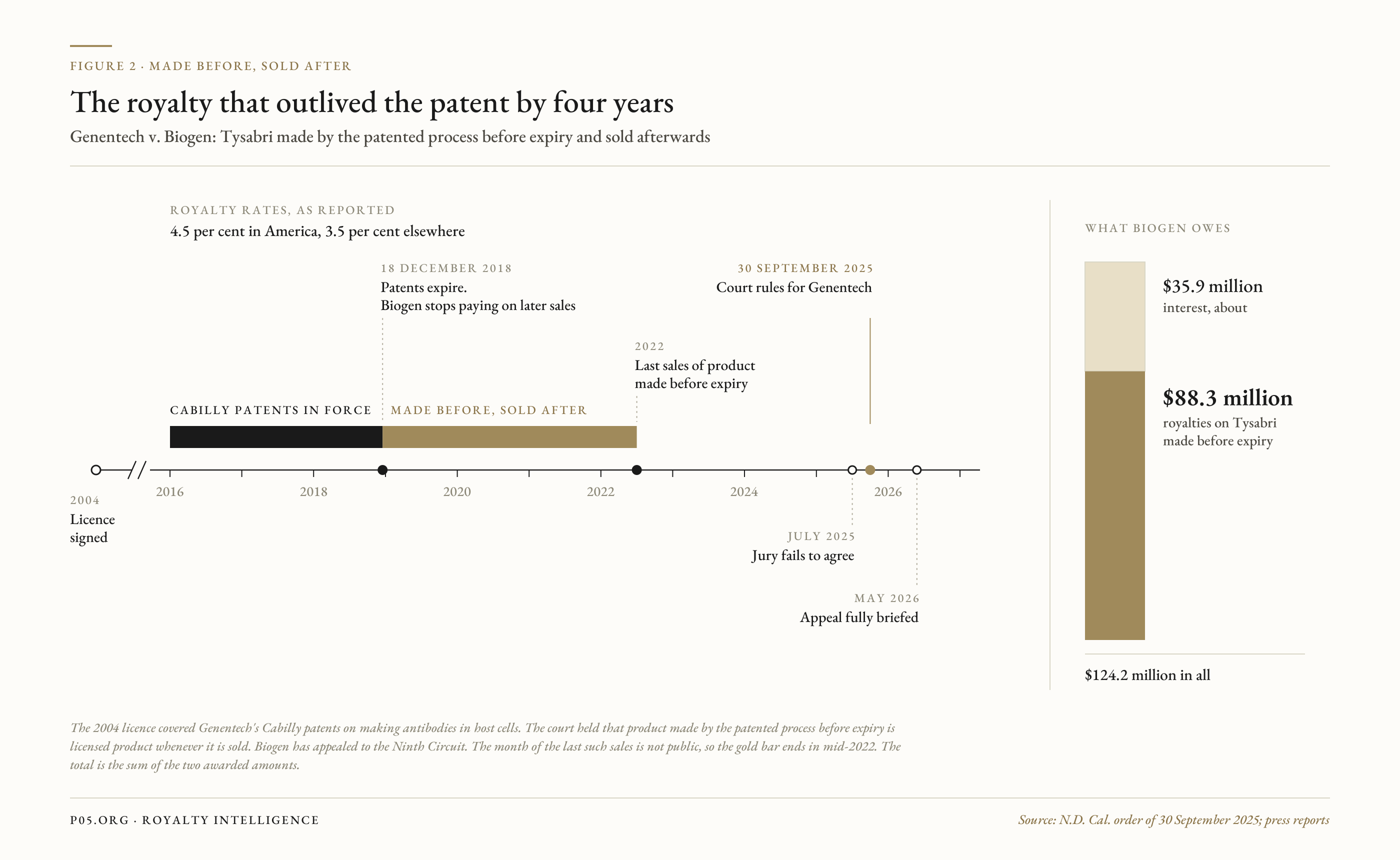
Figure 2. Genentech v. Biogen: Tysabri made before the Cabilly patents expired on 18 December 2018 and sold afterwards, with the royalties and interest the court awarded.
2. The step-down, and the patent that postpones it
Halozyme earned $868 million of royalties in 2025, up from $88.6 million in 2020. Drugmakers pay it for an enzyme that lets their antibodies be given under the skin. Its filings set out what happens when the patents on that enzyme run out. Where no valid claim of a patent developed with the partner covers the product in a country, the royalty rate is reduced for sales there. The size of the cut is undisclosed.
Its European patent was due to expire in March 2024. On 5 June 2024 the company announced European Patent No. 4269578, which covers the enzyme as obtained from Halozyme's manufacturing methods and expires on 6 March 2029. Halozyme said the grant prevents the cut in the rate on Darzalex SC in the 37 countries where the patent was validated. An investor presentation that October dated the reduction at March 2029 for those countries and March 2024 for the rest.
The antibody's own licensor had tried for more time and failed. Genmab argued that the under-the-skin form of daratumumab started a new 13-year royalty term from its first sale. An arbitral tribunal dismissed the claim in April 2023.
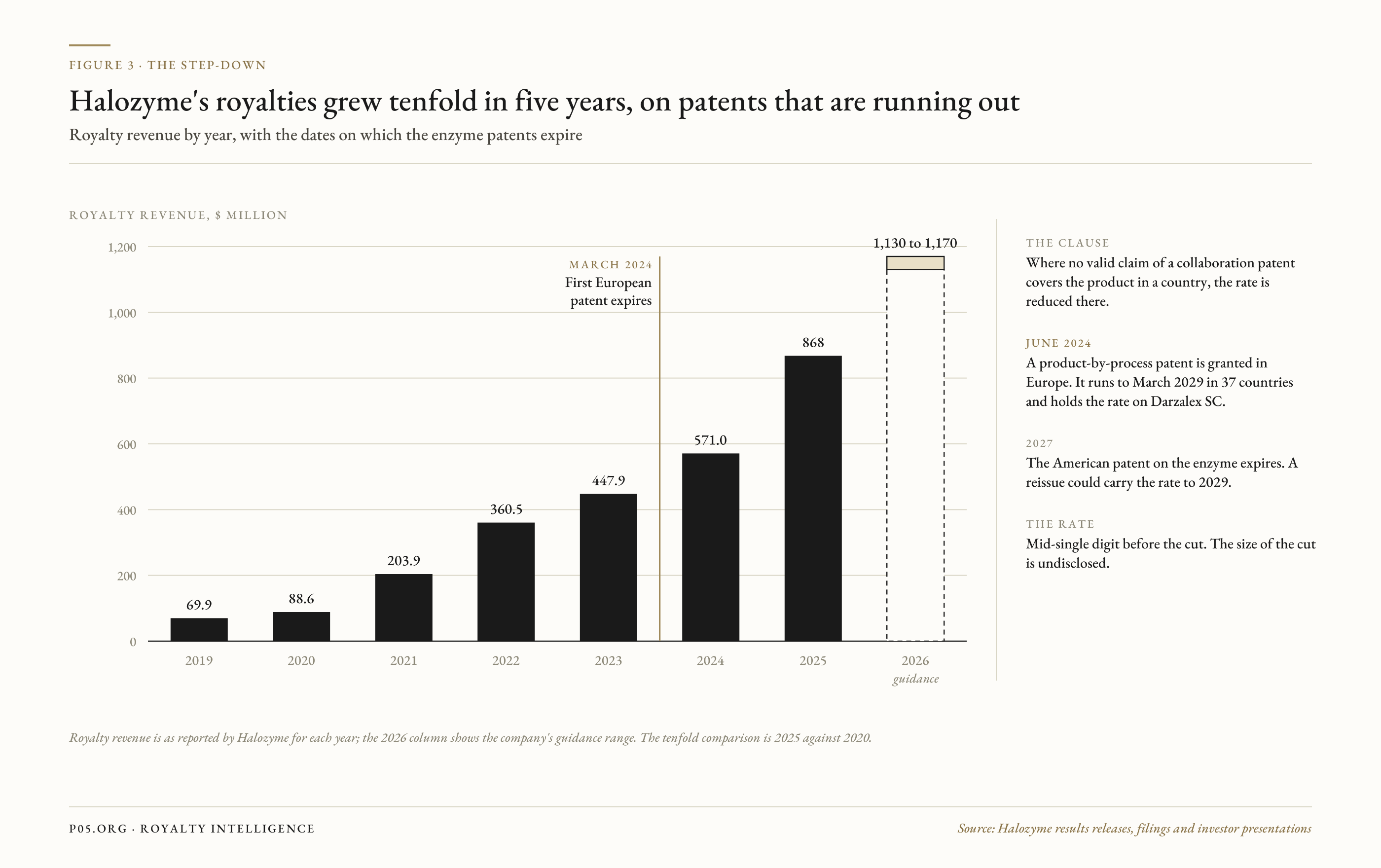
Figure 3. Halozyme's royalty revenue from 2019 to 2025, with guidance for 2026, against the dates on which its enzyme patents expire.
Halozyme's newer patents are under attack. It sued Merck in April 2025 over the under-the-skin form of Keytruda, which uses a rival enzyme from Alteogen. Merck answered with 14 petitions for post-grant review, of which 13 were taken up. In May 2026 the Patent Trial and Appeal Board found the challenged claims of two patents unpatentable. Halozyme won a preliminary injunction in Munich in December 2025 on EP 2 797 622. In May 2026 it submitted to revocation of the British part of that patent.
Alteogen's own royalty waits behind milestones. Merck took exclusive rights in February 2024, and royalties fall due only after the last sales milestone. Merck's filing puts the rate at 2 per cent of net sales and the sales milestones at up to $1.0 billion. Halozyme asked the patent office to review Alteogen's patent on producing the enzyme by temperature-shift cell culture. The office declined in May 2026.
Goodwin's database of more than 200 deals finds a cut on patent expiry in 95 per cent of royalty-bearing deals in its latest twelve months, up from 67 per cent in the period before. The survey is silent on the size of the cut. One public figure comes from a product royalty: in May 2025 Incyte and Novartis settled on a 50 per cent cut in the rate on American sales of Jakafi.
3. The tail after the patent
Nektar sold a tail and then sold it again. In December 2020 HealthCare Royalty paid $150 million for Nektar's royalties on Adynovate, Rebinyn and Movantik. The first two rest on Nektar's PEGylation technology. The royalties were to return to Nektar once the buyer had received $210 million, or $240 million if that took beyond 2025. In March 2024 HealthCare Royalty paid a further $15 million to remove the cap. It now keeps the royalties until the last payment under the licences.
How long a licence pays after the patent is a question of American law. Kimble v. Marvel Entertainment kept the rule that a patent royalty cannot run past expiry. The Supreme Court added that a royalty tied to a non-patent right can. Its example is a licence that pays 5 per cent for a patent and a trade secret together and 4 per cent for the secret alone.
Alkermes's NanoCrystal licence with Janssen is built that way. It carries a patent royalty of 1.5 per cent until the last valid claim and a separate know-how royalty in tiers of 3.5, 5.5 and 7.5 per cent, paid for 15 years from first commercial sale in each country.
Janssen tested it. In November 2021 it gave notice of partial termination and stopped paying on American sales of three Invega products. Alkermes's royalty revenue on them fell from $61.6 million in the first quarter of 2021 to nothing a year later. In December 2022 the tribunal held that Janssen could end the agreement and still owed royalties on products it went on selling. The final award of May 2023 gave Alkermes $195.4 million in back royalties and interest. Payments on Invega Trinza and Invega Hafyera run into 2030.
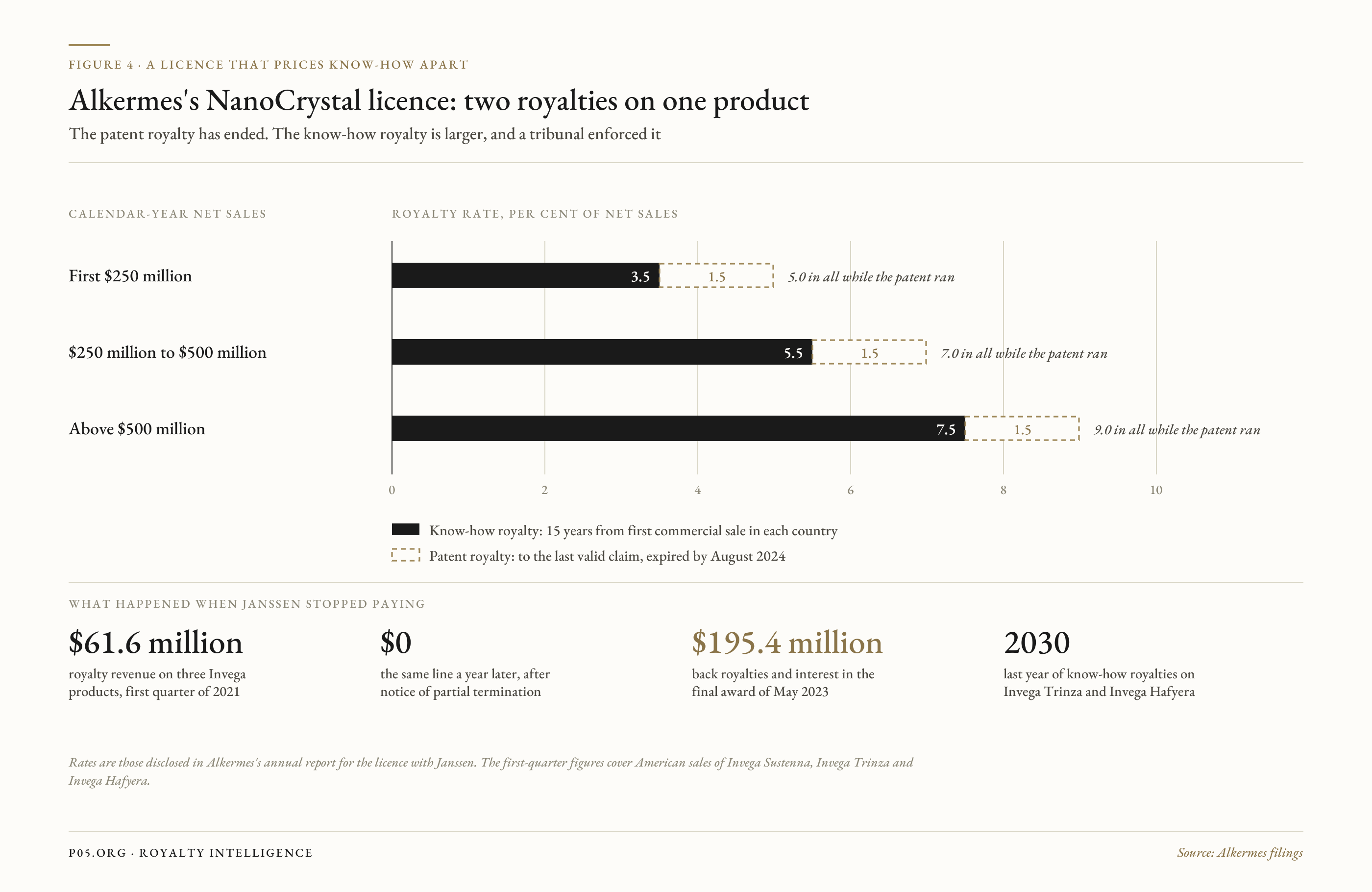
Figure 4. The two royalties in Alkermes's NanoCrystal licence with Janssen, by sales tier, and what followed when Janssen stopped paying.
Another panel sided with the licensee on another Alkermes licence. In October 2022 Acorda was awarded $15 million and $1.5 million of interest for Ampyra royalties paid after an Alkermes patent expired in 2018. It was also freed to buy from another supplier.
A royalty on a discovery tool held up in court in 2024. In Ares Trading v. Dyax, the Third Circuit enforced royalties on Bavencio to 2027, nine years after the licensed phage display patents expired. Its reason was that selling Bavencio makes no use of those patents. The screening that used them was finished during the term.
That reasoning assumes the act that earns the royalty and the act the patent covers are different. Where the patent claims the production method, each batch made after expiry uses the invention. On that reading a flat royalty that outlives a manufacturing patent stays caught by the Kimble rule. The point is untested.
Two other rulings from 2024 turned on the contract. In C.R. Bard v. Atrium Medical the Ninth Circuit read the licence first and then asked whether it charged for use of an expired patent. A minimum royalty survived because a Canadian patent was still in force. In Zimmer Biomet v. Insall the Seventh Circuit upheld knee-implant royalties after the last patent expired in 2018, because amendments in 1998 had cut the royalty loose from the patents.
Discovery royalties are sold on terms of the same kind. OmniAb's licences typically run for the longer of ten years from first commercial sale or the last patent, at low to mid single-digit rates. In October 2024 XOMA paid Twist Bioscience $15 million for half of the milestones and royalties on more than 60 early programmes that used Twist's antibody libraries. In June 2021 Royalty Pharma paid MorphoSys $1.425 billion upfront for a package led by the royalty on Tremfya, which Janssen developed from the MorphoSys library. It expects that royalty to end between 2031 and 2032.
A tool patent can also pay fixed fees. In October 2024 DRI Healthcare paid Editas $57 million for annual licence fees of $5 million to $40 million that Vertex owes for using Cas9 gene-editing technology in Casgevy.
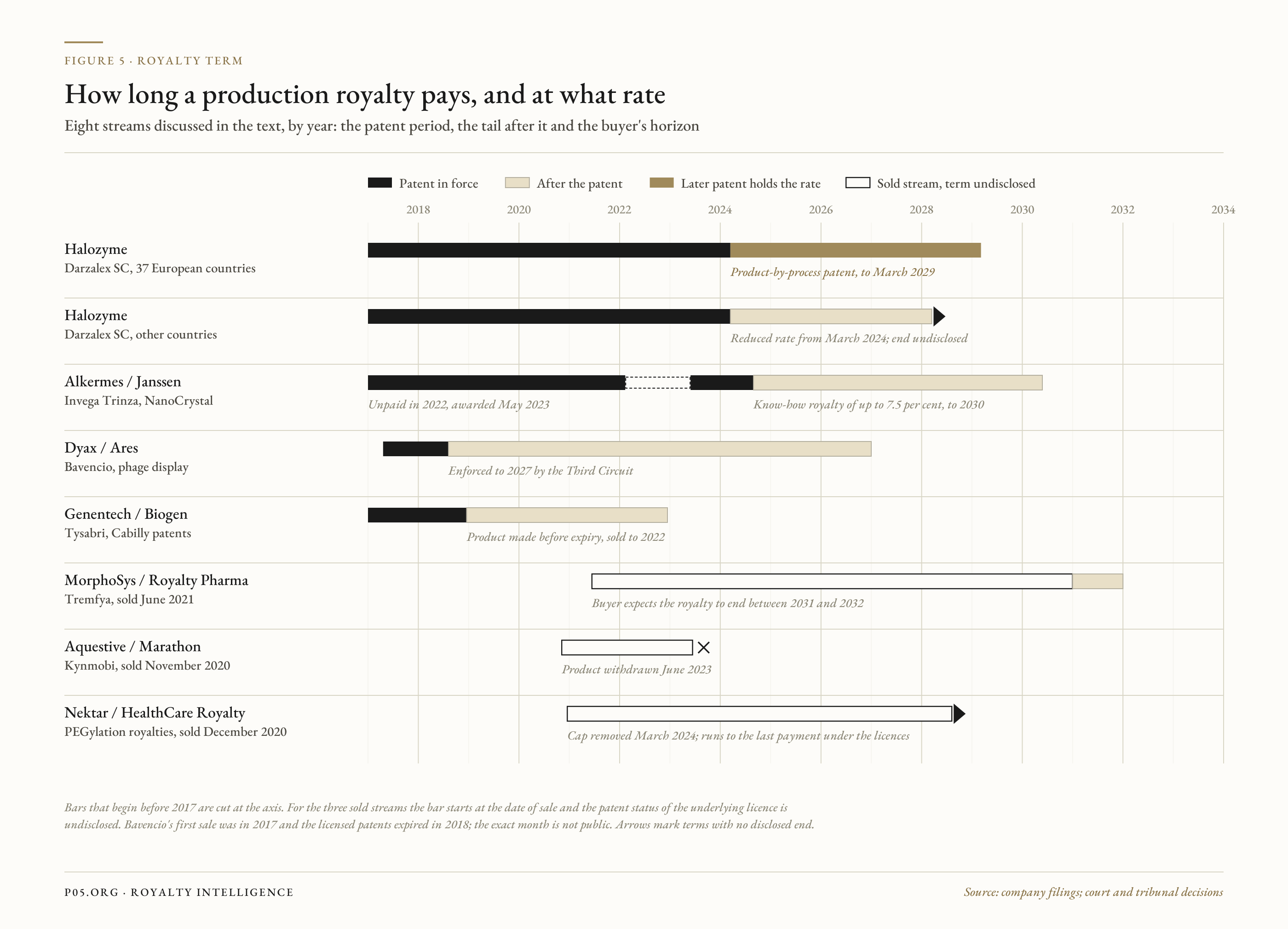
Figure 5. Royalty term in eight streams discussed in the text: the patent period, the tail after it, and where a later patent changes the rate.
4. What the patent can stop
A process patent cannot go in the Orange Book. The regulation says process patents "are not covered by this section", and the FDA repeated the point to Congress in 2022. A generic rival therefore faces no 30-month stay on one. The list is getting shorter. In Teva v. Amneal, in December 2024, the Federal Circuit ordered inhaler patents removed because their claims left out the active ingredient.
Biologics have their own route. The biosimilar statute makes the applicant disclose its manufacturing process, and the sponsor may assert process patents. A 2023 analysis by McDermott lawyers found that more than 75 per cent of the patents asserted across all biosimilar litigation were manufacturing patents.
Since 2020 such patents have been asserted often and decided seldom. Regeneron chose three manufacturing patents among six for its fast-track trial against Mylan over aflibercept. The judgment rested on a formulation patent. Janssen added four cell-culture patents to its ustekinumab suit against Amgen, which settled in May 2023. Amgen asserted 21 patents against Sandoz over denosumab, and that case settled in April 2024.
In July 2025 a Delaware jury found that Revance's Daxxify infringed three Allergan patents on the formulation and manufacture of Botox. It awarded $56 million at royalty rates of 15, 12 and 4 per cent.
Against product made abroad the tool is 35 U.S.C. 271(g), which makes it an infringement to import or sell a product made by a patented process. The section excludes product that is materially changed by later processes. An isotope that leaves the purification column and is then bound to a targeting molecule raises that question. In February 2020 a Delaware court held, in Genentech's bevacizumab suit against Amgen, that use or sale in America is enough, without importation.
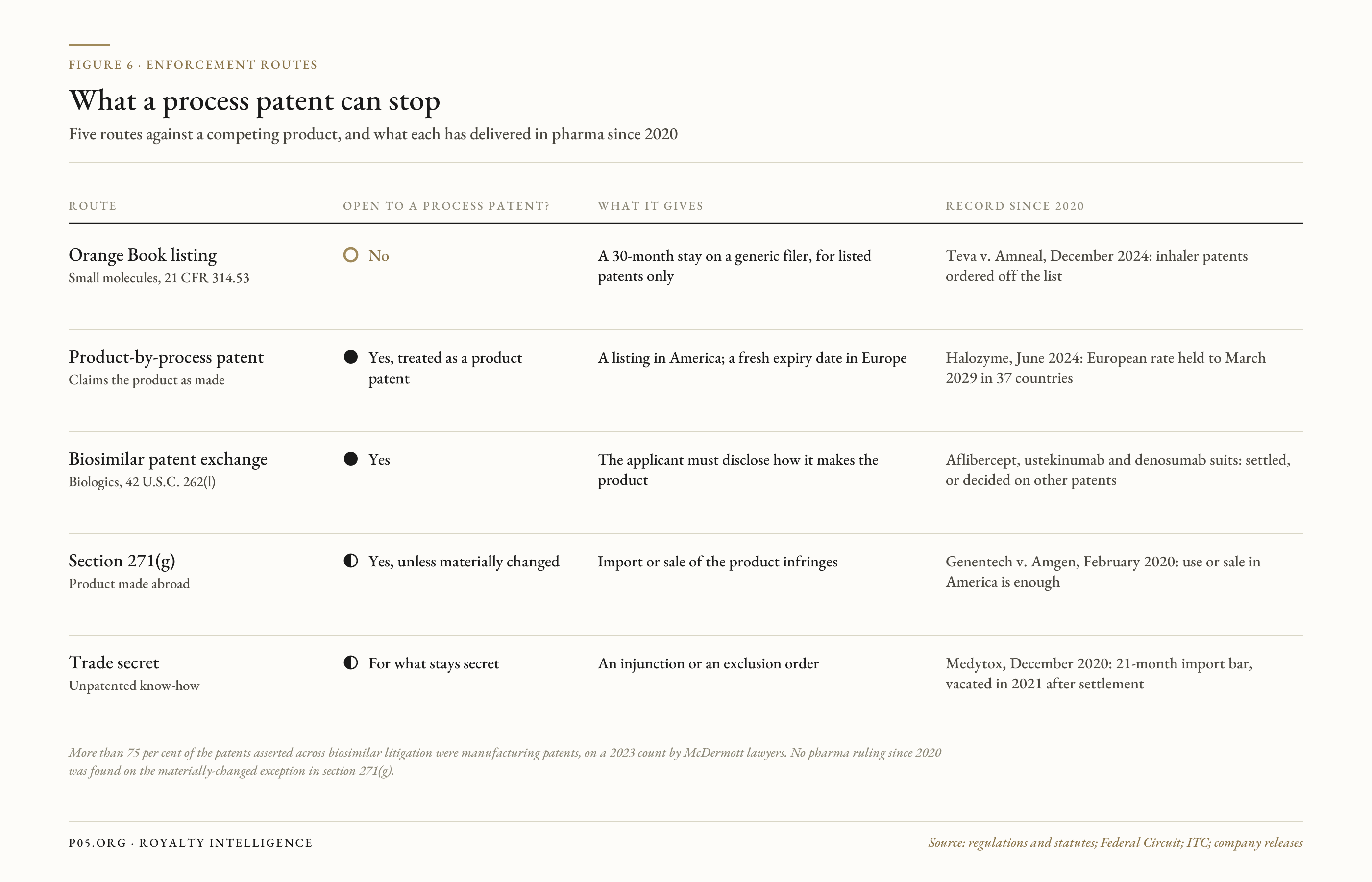
Figure 6. Five enforcement routes, whether each is open to a process patent, and what each has delivered in pharma since 2020.
5. When the licensee takes the process, or the product goes
In June 2023 Blackstone paid Sutro $140 million upfront, with up to $250 million more on return thresholds, for Sutro's 4 per cent royalty on Vaxcyte's vaccines. The royalty arises under a 2015 licence of Sutro's cell-free protein synthesis platform.
Five months later Vaxcyte took up an option to make the cell-free extract itself or to buy it from contract manufacturers. It paid $50 million, with $25 million more due within six months and up to $60 million in milestones. The new licence was royalty-free apart from the royalties already due under the 2015 agreement. Blackstone's royalty stayed in place after Sutro ceased to be the supplier.
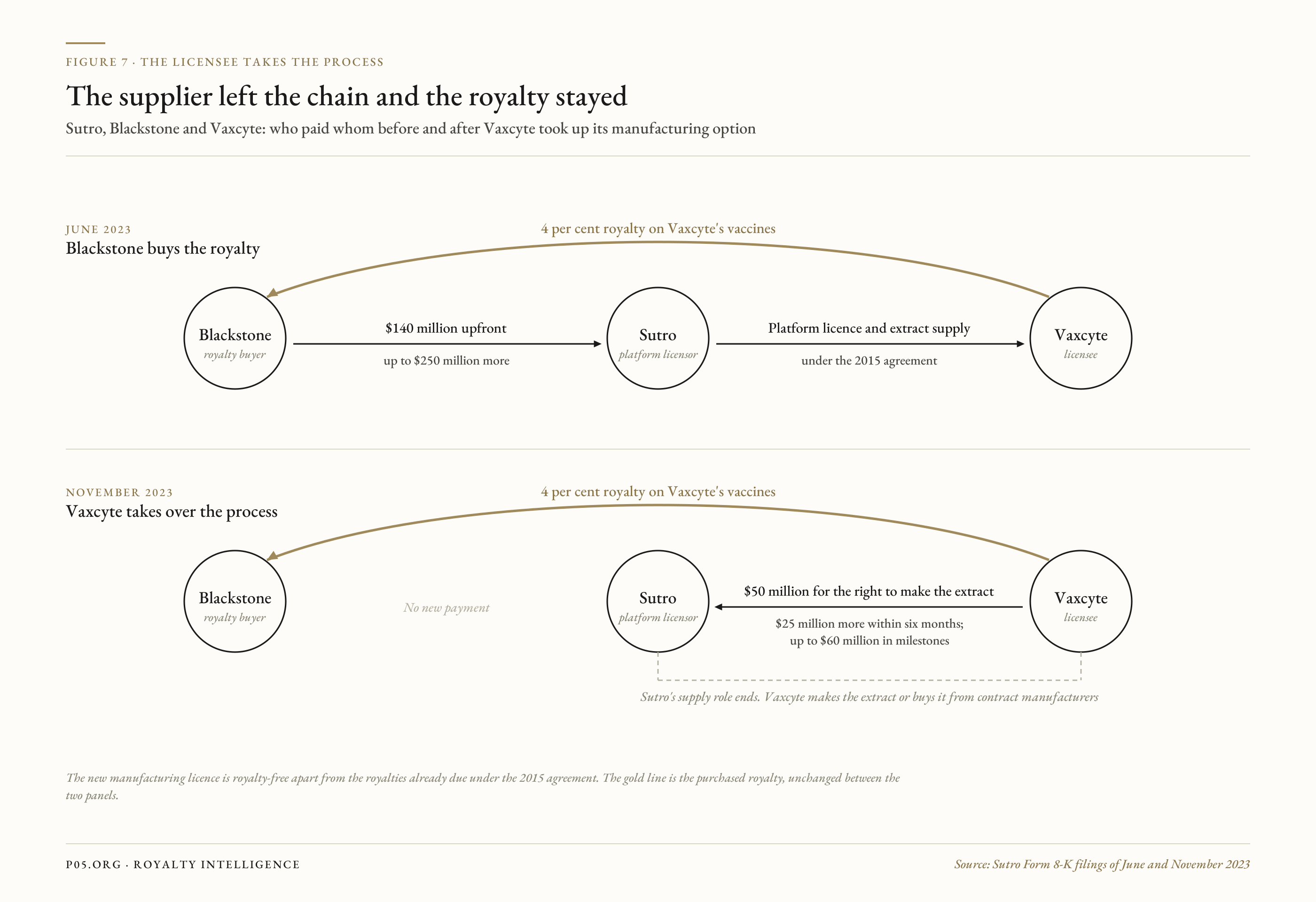
Figure 7. Sutro, Blackstone and Vaxcyte: payments before and after Vaxcyte took up its option to make the cell-free extract.
Marathon's royalty ended with the product. In November 2020 it bought Aquestive's royalties and milestones on Kynmobi, a film made with Aquestive's PharmFilm technology. Aquestive received $50 million, with up to $75 million more to come. The licence paid single-digit royalties until the patents expired. In June 2023 Sunovion withdrew Kynmobi in America and Canada, and Aquestive said it would probably receive none of the further payments.
Ligand bought a production platform outright. It acquired Pfenex in October 2020 for $437.5 million in cash and up to $78 million more, for a bacterial expression system suited to large-scale protein production. In September 2023 it merged the platform into a new company, Primrose Bio, and kept the royalties, which are low single-digit. In 2025 Ligand received $7.4 million on Vaxneuvance and $10.1 million on Capvaxive, Merck vaccines with estimated sales of $801 million and $752 million.
| Deal | Instrument | What the royalty runs on | Term | Outcome so far |
|---|---|---|---|---|
| Ligand / Pfenex, Oct 2020 | $437.5 million acquisition | Bacterial expression platform | Undisclosed | Low single-digit royalties; platform merged into Primrose Bio, 2023 |
| Aquestive / Marathon, Nov 2020 | $50 million received, up to $75 million more | PharmFilm licence to Sunovion | Until the licensed patents expire | Product withdrawn June 2023 |
| Nektar / HealthCare Royalty, Dec 2020 | $150 million sale | PEGylation licences, and Movantik | Until the last payment under the licences | Cap removed for $15 million, Mar 2024 |
| MorphoSys / Royalty Pharma, June 2021 | $1.425 billion upfront | Antibody library licence to Janssen | Undisclosed; buyer expects 2031 to 2032 | Paying |
| Sutro / Blackstone, June 2023 | $140 million sale, up to $250 million more | Cell-free synthesis platform licence | Undisclosed | Licensee took over manufacture; royalty kept |
| Twist / XOMA, Oct 2024 | $15 million for a half share | Antibody library partnerships | Undisclosed | More than 60 early programmes |
| Editas / DRI Healthcare, Oct 2024 | $57 million sale | Cas9 licence fees from Vertex | Until the last payment sold | Fees of $5 million to $40 million a year |
| ITM / Blue Owl, then Perceptive, 2025 to 2026 | Term loan of up to $262.5 million | Lien over the process patent | Patent expires 2034 in America | Debt assumed by Telix |
6. The patent as collateral
ITM's lender took the process patent as security. The American patent has an adjusted expiry of 19 March 2034. The European one, EP 2 546 839, is expected to expire on 4 April 2032.
Isotope makers have borrowed in other ways this year. On 29 September NorthStar took a growth facility of up to $185 million from Hercules Capital, with $100 million upfront. In April SHINE won a conditional commitment for a federal loan of up to $263 million for its molybdenum-99 plant. Both are plain debt.
Mallinckrodt's bankruptcy tested an unsecured royalty. In April 2024 the Third Circuit held in Mallinckrodt's bankruptcy that an unsecured royalty owed to the seller of the Acthar rights was an ordinary claim that Chapter 11 could discharge.
Production know-how sits outside the patent register and is protected as a trade secret. The American trade commission found in December 2020 that Medytox's manufacturing processes for botulinum toxin were trade secrets and that its bacterial strain was not. It barred Daewoong's product for 21 months. The parties settled, and the commission vacated the ruling in 2021.
What moves the position, and what only appears to
Terms that move it:
- The definition of licensed product. Genentech collected on Tysabri made before expiry and sold after, on the wording of a 2004 licence.
- The rate after the last valid claim. Alkermes states a know-how royalty of up to 7.5 per cent apart from a 1.5 per cent patent royalty. Halozyme's rate falls by an undisclosed amount.
- Whether a product-by-process patent can still be granted. European Patent No. 4269578 moved Halozyme's European date from 2024 to 2029 in 37 countries.
- Who makes the product, and what the licence charges when that changes. Lonza's rate rises when a third party manufactures.
- Whether the licensee holds an option over the process, and what the option says about existing royalties. Vaxcyte's left Sutro's 4 per cent in place.
- A cap, and who can buy it out. HealthCare Royalty paid $15 million to turn a capped Nektar royalty into an uncapped one.
Terms that only appear to:
- A patent expiry date. Biogen owes royalties on product sold up to four years after expiry.
- A long patent family. Merck filed 14 petitions against Halozyme's newer patents, and the first two decisions went its way.
- Ares v. Dyax, cited for a manufacturing royalty. The court relied on Ares never having used the patents.
- A recorded lien on the patent. Know-how and licence income are separate collateral.
- Sales of the product. Ligand received $7.4 million on $801 million of Vaxneuvance sales.
What each side should ask
For the fund providing the capital
- Is licensed product defined by date of sale, date of manufacture or use of the process, and can the licensee change the answer by changing how it makes the drug?
- What is the rate after the last valid claim, and does the licence price patents and know-how apart?
- Which later patents would hold the rate, and has anyone challenged them?
- May the licensee make the product itself or buy from a contract manufacturer, and does the royalty survive?
- What right of audit reaches the licensee's manufacturing records?
For the company raising it
- Can a product-by-process claim still be won where the first patent expires earliest?
- Is the know-how written down and kept secret well enough to support a tail?
- Does the covenant against amending the licence leave room to settle a dispute over rate?
For the licensee paying the royalty
- Does a change of site, scale or supplier take the product outside the claims?
- Is there a right to end the licence on notice, and what must still be paid afterwards?
- If the licensor's patent is pledged, has the lender agreed to leave the licence alone on enforcement?
ITM's lender holds a lien on a patent that claims a purification method and expires in 2034. Any royalty income behind it is undisclosed, and the debt now passes to Telix.
The royalty sales since 2020 were of streams whose length the buyer could read from the licence or had to guess. Nektar's runs to the last payment. Tremfya's is the buyer's estimate. Kynmobi's ended when the product was withdrawn.
The disputes went both ways. Janssen stopped paying Alkermes in 2022 and was ordered to resume in 2023. Biogen stopped paying Genentech when the patents expired in 2018 and was ordered to pay $88.3 million in 2025. Pacira stopped paying its licensor and got $28.3 million back.
All information in this article was accurate as of the research date and is derived from publicly available sources including SEC filings, issuer press releases, patent records, court opinions, statutes and regulations, and legal and financial commentary. Information may have changed since publication. This content is for informational purposes only and does not constitute investment, legal, accounting, tax, or financial advice. The author is not a lawyer, accountant, tax adviser, or financial adviser.