
When the royalty pays too slowly: five ways to make the investor whole

Phathom Pharmaceuticals had paid its royalty investors $28.9 million as of 30 June 2026 under a Revenue Interest Financing Agreement signed on 3 May 2022 with NovaQuest, Sagard and Hercules. The investors receive 10 per cent of net sales of vonoprazan products, stepping down at higher sales, and their right ends once they have received aggregate payments equal to 200 per cent of the Investment Amount, the sum they funded.
The funding history in the 10-Q adds up to $275 million: $100 million at closing, $160 million on FDA approval for erosive GERD and $15 million of additional funding. The ceiling is therefore $550 million (derived), and $28.9 million is 10.5 per cent of the $275 million that the first minimum-payment date requires (derived).
That date is 31 December 2028. If the investors have not received aggregate payments of at least 100 per cent of the Investment Amount by then, and at least 200 per cent by 31 December 2037, Phathom must pay cash sufficient to gross them up to the applicable Minimum Amount.
The buyer of a young royalty will often be behind any schedule in the first years, and the agreement has to say what the seller owes for that. Five instruments could answer the question: a higher rate, a cash payment, new equity, a repriced existing warrant, and cash-settled equity. The public record shows two of them in regular use. Which one a deal reaches for turns on the regime it falls under.
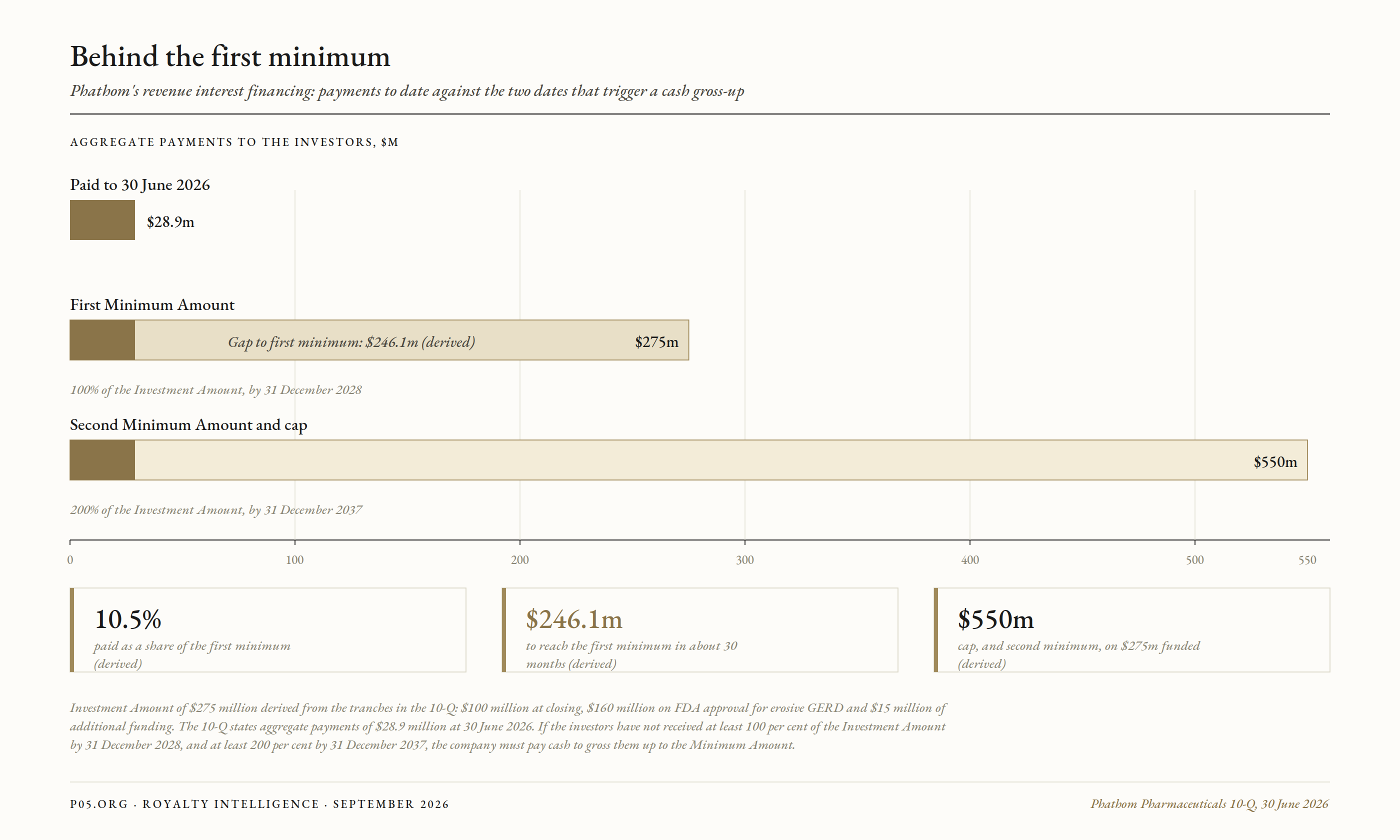
Figure 1. Phathom Pharmaceuticals' royalty financing. Payments to 30 June 2026 against the two Minimum Amounts that the company must gross up to in cash, and the 200 per cent cap. The Investment Amount of $275 million is derived from the tranches reported in the 10-Q.
The cap data for these deals sits in The quantum and the price, and this piece does not present it again.
1. Rate
The first instrument changes the percentage. The Re-Rate and Step-Up Provisions cover step-ups as such. One drafting variant sits outside both, because it sets the new rate by reference to the past.
Adaptive Biotechnologies sold a revenue interest to OrbiMed in September 2022. If OrbiMed had not received Revenue Interest Payments equal to its invested capital on or before 12 September 2028, the rate would rise to one that, applied retroactively to Adaptive's cumulative Revenue Base, would have produced payments equal to the sum of all Cumulative Purchaser Payments.
On the language quoted, the new rate is Cumulative Purchaser Payments divided by the cumulative Revenue Base (derived). It operates from the test date and the calculation that sets it looks backwards, so the further behind the buyer is, the higher the rate.
The target is one times invested capital, which sits below Adaptive's Return Cap of 165 per cent, a separate term.
Humacyte's agreement with Oberland Capital, dated 12 May 2023, uses the same construction. The Applicable Percentage is 7.50 per cent, and if Total Revenue Interest Payments on the Test Date are below 100 per cent of Cumulative Purchaser Payments it increases, as of and following that date, to a rate that would have produced 100 per cent had it applied from closing.
The Cap Multiplier is 150 per cent, or 195 per cent if payments on the Test Date are below 150 per cent. Amendment No. 2 of 17 September 2025 keeps the True-Up Payment among the Obligations. One agreement therefore carries a retroactive rate reset, a step in the cap and a cash true-up.
Adaptive did not reach its test date. It repurchased the revenue interests in June 2026, more than two years earlier, and the reset never operated.
2. Cash
The second instrument is a payment of money on a date. The agreements state a minimum, measured as a percentage of what the investor funded, and the company pays the difference in cash if royalties have not reached it.
| Company | Investor | Signed | First minimum | Second minimum |
|---|---|---|---|---|
| Phathom | NovaQuest, Sagard, Hercules | 3 May 2022 | 100% by 31 Dec 2028 | 200% by 31 Dec 2037 |
| Spero | HealthCare Royalty | 29 Sep 2021 | 60% by 30 Sep 2025 | 100% by 30 Sep 2027 |
| Marinus | Sagard | 28 Oct 2022 | 100% by 31 Dec 2027 | 190% by 31 Dec 2032 |
| Rhythm | HealthCare Royalty | 16 Jun 2022 | 60% by 31 Mar 2027 | 120% by 31 Mar 2029 |
Sources: Phathom, Spero, Marinus and Rhythm.
The dates carry the information. Spero's minimums fall about four and six years after signing, Rhythm's about five and seven, Marinus's about five and ten, and Phathom's about seven and sixteen.
The second minimum at Marinus is 190 per cent, which is also where its royalty terminates, and Phathom's second minimum of 200 per cent equals its cap. From those dates the royalty decides only when the investor is paid, and the total is fixed. Spero's second minimum is 100 per cent and Rhythm's is 120 per cent, against a Hard Cap that Rhythm's 8-K puts between 185 and 250 per cent.
Spero's guarantees the return of capital and Rhythm's 120 per cent of funding, and the rest is left to sales. The risk-allocation factors set out in Waived, not litigated treat a fixed obligation to pay as risk left with the seller, and that reading applies more strongly to a minimum that equals the cap.
The base also differs. Phathom and Marinus measure against the Investment Amount. Rhythm's 8-K measures against the amount funded to date, so a tranche drawn after signing raises the minimum that applies to the earlier dates.
The clause predates this vintage. Athenex's agreement with Sagard of 4 August 2020 required a payment equal to 40 per cent of the purchase price by 30 September 2024 and 100 per cent by 4 August 2026 if that amount had not been received, with a 6.0 per cent internal rate of return floor and a Hard Cap of 170 per cent. Athenex filed for Chapter 11 in May 2023, before either date arrived.
Spero's agreement adds a second protection. If tebipenem HBr had not been approved for complicated urinary tract infections by 31 December 2022, the 8-K provides for payment of the Initial Investment Amount plus interest at an annual 13.5 per cent rate of return.
Liquidia's agreement with HealthCare Royalty, signed on 9 January 2023, names the cash instrument differently. The IRR True-Up Payment Amount is the amount the investor would need to receive to yield an internal rate of return of 18 per cent on the Investment Amount, calculated with Excel's XIRR function after netting the payments already made, against a Hard Cap of 175 per cent.
A return-denominated minimum grows with every day the money is outstanding. The Fifth Amendment of 11 September 2024 keeps 18 per cent for the earlier investments and sets 16 per cent for $32.5 million funded afterwards, and the Sixth Amendment of 17 March 2025 continues the tranche-by-tranche approach at rates between 12 and 16 per cent.
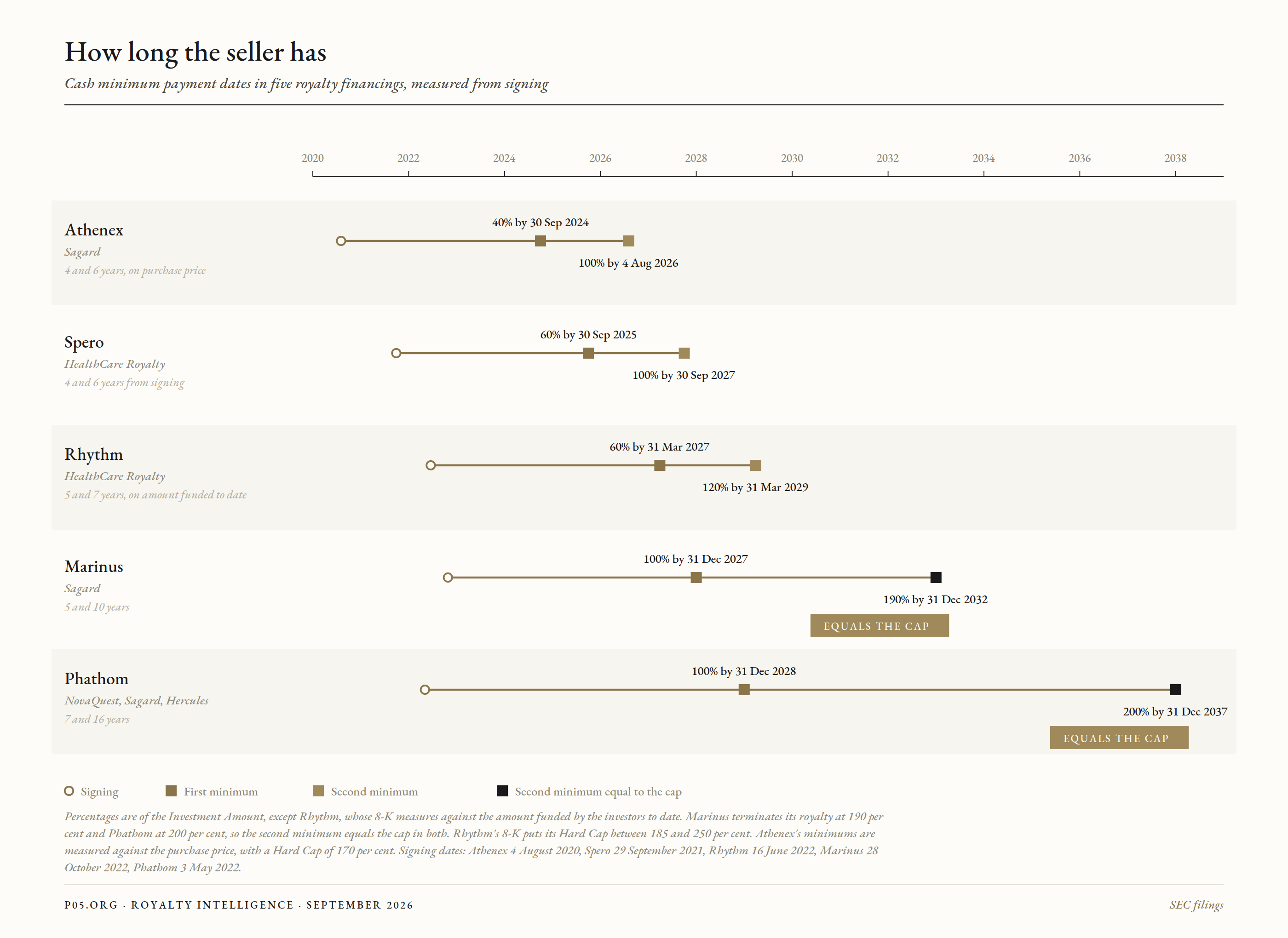
Figure 2. Minimum-payment dates in five agreements, measured from signing. Two of the five have a second minimum that equals the cap (Phathom at 200 per cent, Marinus at 190 per cent).
3. Real equity
Equity appears in royalty amendments, and it is easily read as compensation for being behind.
In the clearest public case, ADC Therapeutics agreed with HealthCare Royalty in February 2026 to reduce the change-of-control payment from $750 million to $150 million, or $200 million if the change of control occurs from 1 January 2028. HealthCare Royalty received warrants to purchase 9,834,776 common shares at $3.813, exercisable to 31 December 2030 and not transferable before 1 January 2028.
The company gave greater strategic flexibility as its reason for the amendment, and the amendment changes what the investor receives if the company is sold.
That is a different question from the one sections 1 and 2 answer. The Warrant Sweetener covers the transaction and the treatment of such warrants, and this piece does not repeat it.
Karyopharm supplies the second public case. In the Second Amendment of 1 August 2023, HealthCare Royalty received a warrant over 250,000 shares at $2.25, and the Hard Cap moved to 195 per cent of the Investment Amount. Equity there sat beside a change to the cap. In neither case does the filing present it as a payment for a delay.
4. Repricing a warrant already held
The fourth instrument adds no shares. The investor already holds a warrant, and the amendment lowers its strike.
Karyopharm did this on 8 May 2024. Section 16 of the Second Omnibus Amendment provides that the exercise price of the warrant issued to HCRP Fund III under the Second Amendment is reduced to an initial exercise price equal to that of the warrants issued to the holders of the company's Permitted Convertible Debt. The investor representative returns the warrant for cancellation in exchange for a new one at the revised price.
The press release puts the noteholders' warrants at $1.10 before the company's 1-for-15 reverse stock split, so the strike fell from $2.25 to $1.10 on 250,000 shares. Restated for the split, that is 16,667 shares at $33.75 falling to $16.50 (derived).
The price is set by a formula that refers to another holder's warrants, so the amendment states no strike of its own. On the text quoted it changes the price and nothing else. It sits in a larger amendment that also set the Applicable Tiered Percentage at 7.000 per cent from 1 April 2024 and provided for a cash payment of $49,494,864, a $15.0 million term loan note and a $5.0 million convertible note.
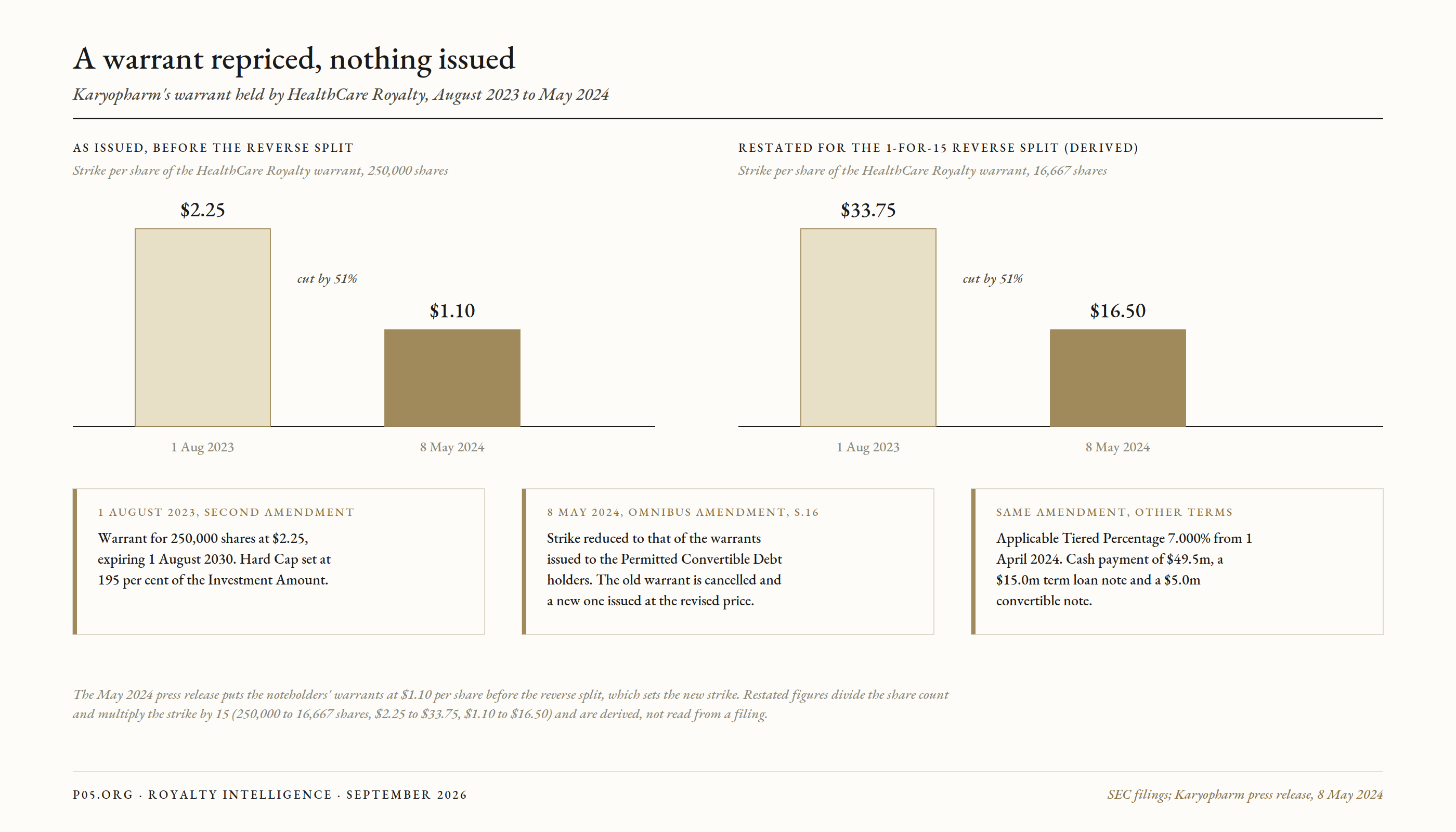
Figure 3. The HealthCare Royalty warrant at Karyopharm. Issued 1 August 2023 at $2.25 and repriced on 8 May 2024 to the strike of the convertible noteholders' warrants. Share counts and strikes after the 1-for-15 reverse split are derived.
The filings reviewed do not disclose the accounting effect of the repricing. One repricing is a single data point, and no other royalty-investor case turned up in the search behind this piece.
5. Phantom equity, a road not taken
The fifth instrument is cash-settled equity: payments that track the company's share price without any share being issued. Employers use it as phantom stock and stock appreciation rights.
No royalty or revenue-interest financing turned up in which an investor was compensated that way. The search covered company filings and press releases through web search and was not a full-text search of EDGAR, so it records the absence of a public precedent and does not prove there is none.
Two features may explain the absence. A payment settled in cash and indexed to the company's stock would ordinarily be carried as a liability at fair value, with changes through earnings, so the company takes on the volatility of an equity-linked instrument while the investor receives none of the ownership that makes a warrant attractive.
And the cash a phantom award pays could be paid directly as a rate or a minimum, at a known price and inside the agreement.
6. Why the first two dominate
Rate and cash sit inside the purchase agreement. The parties to the change are the parties to the deal and consent is contractual. No shareholder vote or listing-venue analysis arises, and no new classification question.
Equity leaves the agreement. A new issue can need shareholder approval, an analysis under Nasdaq Listing Rule 5635(d) and a classification under ASC 815-40, and it produces a dilution figure that the company must explain to its own investors. The Warrant Sweetener covers those mechanics.
The accounting for rate and cash runs through a number the company already publishes. Each changes the expected cash flows that set the effective interest rate on the obligation, as the accretion article shows for Karyopharm and uniQure.
Humacyte's agreement combines them: a reset of the rate, a step in the cap and a cash true-up sit in one document.
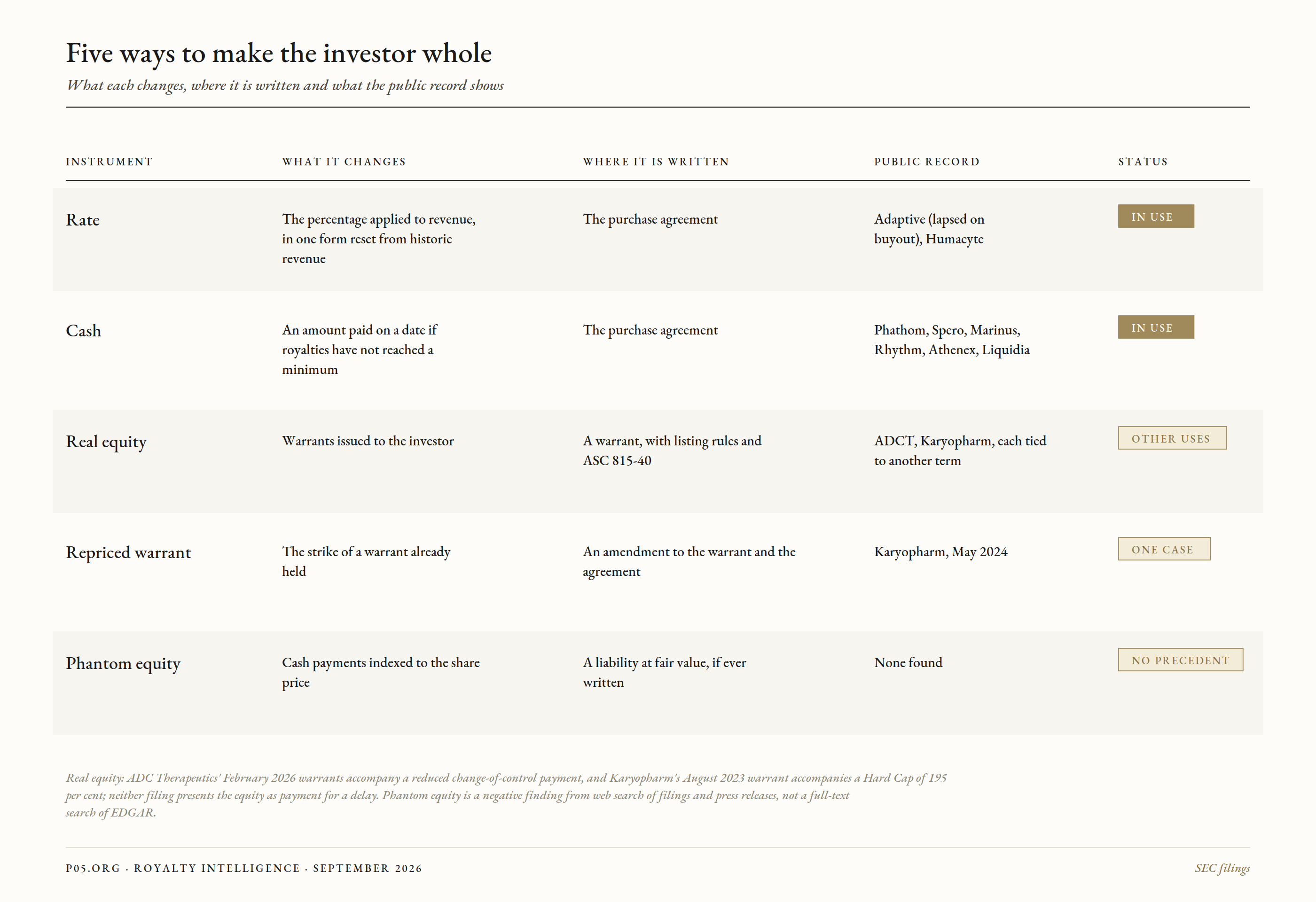
Figure 4. Five instruments for a buyer who is behind, by what each changes, where it is written and what the public record shows.
7. What each instrument costs in characterisation
Each of the five carries a cost in the analysis of whether the buyer bought a royalty or made a loan. The accretion article ranks the risk that each carries, and the ranking is not repeated here.
Deals of this kind are still being written and amended in 2026. Nuvation Bio and Sagard entered a Revenue Interest Financing Agreement on 3 March 2025 for $150 million, with payments of 5.5 per cent of annual US net sales up to $600 million and 3.0 per cent between $600 million and $1 billion. Payments cease at the earliest of 1.6 times the Investment Amount by the quarter ending 30 June 2031, 1.75 times by the quarter ending 30 June 2034, or 2.0 times thereafter.
The First Amendment of 24 June 2026 exists to permit up to $300 million of unsecured convertible senior notes and leaves the payment mechanics as they were. The 8-K describes date-stepped multiples and no minimum payment date, which is the cap route the accretion article covers.
What moves the position, and what only appears to
Terms that move it:
- A minimum equal to the cap. From that date the royalty decides when the investor is paid, and the total is fixed.
- The reference base for a minimum. An Investment Amount is fixed at signing, and an amount funded to date grows with each tranche.
- A rate reset calibrated on historic revenue, which sets the new rate by how far behind the buyer is.
- Equity that arrives in an amendment. The filing should say what it was given for.
Terms that only appear to:
- A warrant that sits beside a royalty agreement. In the public cases it paid for a change of control right or a cap change, and the delay clauses were separate.
- A repricing that adds no shares. The share count is unchanged and the value moved through the strike.
- A cap multiple without a minimum date. It leaves open whether the seller owes the difference in cash.
What each side should ask
For the investor
- What are the minimum dates measured from signing, and against which base?
- Does the second minimum equal the cap, and what does that do to the opinion on the position?
- Where a reset rate is calibrated on history, what rate does the seller's own forecast imply at the test date?
For the seller
- Is the cash minimum met from the same source as the royalty, and what happens to covenants if it is not?
- If equity is offered in an amendment, what is it given for, and does the document say so?
For a fund buying the position from someone else
- Has any minimum date been amended, and for what consideration?
- Does any warrant held by the original investor sit alongside the position, and has its strike changed?
All information in this article was accurate as of the research date and is derived from publicly available sources including SEC filings, issuer press releases, court opinions, and legal and financial commentary. Information may have changed since publication. This content is for informational purposes only and does not constitute investment, legal, accounting, tax, or financial advice. The author is not a lawyer, accountant, tax adviser, or financial adviser.