
How Often the EU Revokes a Marketing Authorisation, and What the Aumseqa Case Means for Royalty Investors

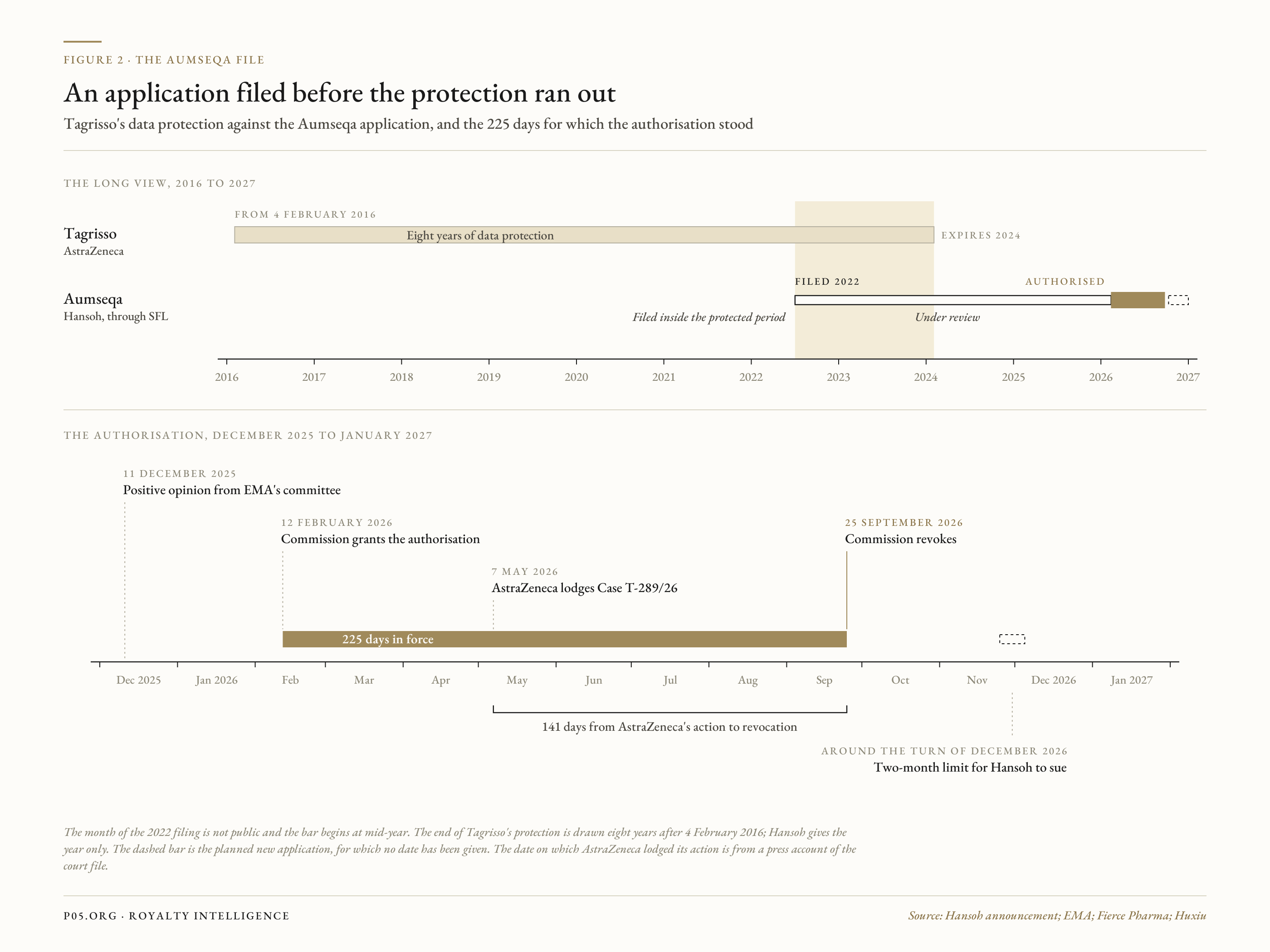
On 25 September 2026 the European Commission revoked the marketing authorisation for Aumseqa (aumolertinib), a lung-cancer drug developed by Hansoh Pharmaceutical of China. It had granted that authorisation on 12 February 2026, so the approval lasted 225 days. Hansoh reports no sales revenue outside China.
The decision turned on the file. Hansoh's 2022 application had cited results from FLAURA, the trial behind AstraZeneca's Tagrisso, and the Commission found that those results were still within their data protection period at the time. Regulatory data protection is the period during which no other applicant may rely on an originator's trial results. Tagrisso's began on 4 February 2016 and expired in 2024. Hansoh says the decision is unrelated to the "quality, safety, efficacy or clinical value" of the drug.
AstraZeneca had asked the General Court to annul the authorisation in Case T-289/26. The Commission did not wait for a judgment. According to Hansoh, it opened revocation proceedings "without awaiting the outcome" of that case.
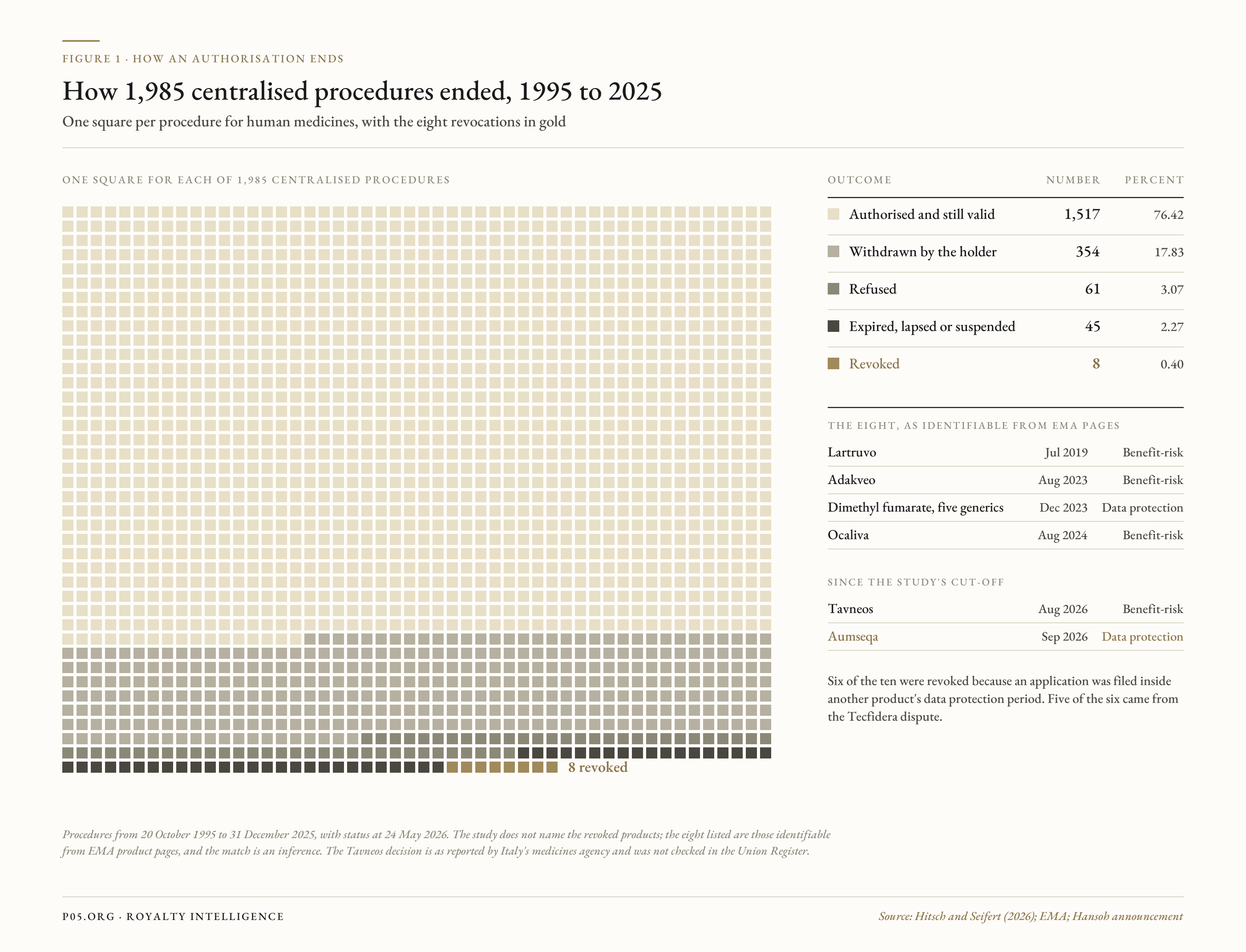
Such decisions are scarce. A study of thirty years of centralised procedures counts eight revocations among 1,985, and five of the eight appear to come from a single dispute over generic copies of Tecfidera.
The record suggests that Aumseqa is the first medicine with its own phase 3 trial to lose a European authorisation because its file leaned on a competitor's protected data. It also suggests that the way back is a new application, which in the one earlier case took about four months.
At a Glance
- The decision: revocation on 25 September 2026 of an authorisation that followed a positive opinion on 11 December 2025 and a grant on 12 February 2026
- The ground: in the words of the Commission's letter, without the FLAURA data the dossier "did not provide an adequate and sufficient basis for extrapolating the safety and efficacy of Aumseqa from an Asian to a European patient population"
- The holder: SFL Pharmaceuticals Deutschland GmbH of Lörrach, on Hansoh's behalf
- The base rate: of 1,985 centralised procedures from 1995 to 2025, 354 ended in withdrawal by the holder, 61 in refusal, 45 in expiry, lapse or suspension, and 8 in revocation
- The precedent: five generic dimethyl fumarate authorisations revoked on 13 December 2023 because they had been filed while Tecfidera's data protection was running
- The return path: Dimethyl fumarate Mylan, authorised again on 22 April 2024, 131 days after revocation
- The economics: Hansoh's former licensee outside China, EQRx, gave notice of termination on 1 August 2023; no current European partner or royalty on aumolertinib is disclosed
- Hansoh's plan: a new application on the original data package "as soon as possible", with the right to sue reserved
A Note on Scope
The count below covers human medicines authorised centrally, by the Commission on the advice of the European Medicines Agency (EMA). A revocation here means a Commission decision that ends an authorisation against the holder's wishes. Withdrawals at the holder's request are counted apart. They form the largest group by far.
Refusals to renew a conditional marketing authorisation are discussed beside revocations, because the product leaves the market in the same way. A conditional authorisation is an approval granted on incomplete data and renewed each year while the holder runs confirmatory studies.
National authorisations and veterinary medicines are left out. The numbers come from EMA product pages, Commission decisions, court judgments and one peer-reviewed study. No count was drawn from the EMA's own medicines table for this article.
How a European Authorisation Ends
An authorisation can end in several ways. The holder may withdraw it. A conditional authorisation may fail its annual renewal. The Commission may suspend or revoke after a review under Article 20 of Regulation (EC) No 726/2004. A product that is not marketed for three years loses its authorisation under the sunset clause, and a court may annul the decision that granted it.
Hitsch and Seifert of Hannover Medical School counted the outcomes in a 2026 paper. Their dataset holds 1,985 procedures from 20 October 1995 to 31 December 2025, with status taken on 24 May 2026.
| How the procedure ended | Number | Share of 1,985 |
|---|---|---|
| Authorised and still valid | 1,517 | 76.42 percent |
| Withdrawn at the holder's request | 354 | 17.83 percent |
| Refused after a negative opinion | 61 | 3.07 percent |
| Expired, lapsed or suspended | 45 | 2.27 percent |
| Revoked | 8 | 0.40 percent |
The paper does not name the eight. EMA's product pages show eight centralised revocations before its cut-off date: five dimethyl fumarate generics, Lartruvo, Adakveo and Ocaliva. That these are the study's eight is an inference, and the authors have not confirmed it.
Two more have followed. On 26 June 2026 EMA recommended revoking Tavneos (avacopan) because its benefits were "no longer proven to outweigh risks". Italy's medicines agency reports that the Commission adopted the recommendation on 4 August 2026. The decision itself was not checked in the Union Register. Aumseqa is the second.
No published series gives revocations by year, and the study does not separate suspensions from expiries. An older paper in BMJ Open found 18 products withdrawn, revoked or suspended for safety reasons between July 2012 and December 2016, a figure that includes national decisions.
The Tecfidera Generics
The earlier data-protection revocations grew out of a question about Biogen's multiple sclerosis drug. Tecfidera contains dimethyl fumarate, as did Fumaderm, an older Biogen product. If the two belonged to one global marketing authorisation, the rule that puts later versions of a substance on the first product's protection clock, Tecfidera's data protection had already run out.
EMA took the view that it had not, and refused to validate Polpharma's generic application on 30 July 2018. Polpharma sued and won in the General Court on 5 May 2021, and generic authorisations followed: Mylan, Neuraxpharm and Polpharma received theirs on 13 May 2022, Teva on 12 December 2022 and Accord on 15 February 2023.
A month after Accord's, on 16 March 2023, the Court of Justice set the Polpharma judgment aside. The generic applications had therefore been filed while Tecfidera's protection was running. On 13 December 2023 the Commission revoked all five to implement the judgment.
At least one of the products was on sale. Neuraxpharm said that "no further Dimethyl Fumarate Neuraxpharm will be put on the market" until the dispute was settled. Biogen claimed marketing protection until 3 February 2025. No public damages claim by a generic company was found.
Two of the five came back within months. Accord and Mylan were authorised again on 22 April 2024 on new applications. When those applications were filed is not public. Dates for Teva, Polpharma and Neuraxpharm could not be established from the pages reviewed.
The holders also went to court, and lost. The General Court dismissed the actions brought by Mylan, Neuraxpharm and Polpharma in Cases T-1181/23 to T-1183/23. In the Neuraxpharm judgment of 11 February 2026 the court held that the Commission had been obliged to revoke authorisations that the higher court's ruling had made unlawful. It accepted that Neuraxpharm had never been heard on the point, and still dismissed the action.
The generic companies did win a separate case. On 24 September 2025 the General Court annulled the Commission's decision of 2 May 2023 granting Tecfidera a further year of marketing protection. By then the year had already expired. An appeal is pending before the Court of Justice.
Conditional Approvals That Did Not Last
The other revocations rest on science. Each concerned a conditional authorisation whose confirmatory evidence disappointed.
Lilly's Lartruvo (olaratumab) was the first. It was authorised on 9 November 2016, its phase 3 study later showed no benefit, and EMA called the outcome the first revocation of a conditional marketing authorisation. The agency's referral page dates the Commission decision 19 July 2019, and the product page records 22 July 2019.
Novartis's Adakveo (crizanlizumab) followed. Authorised conditionally in October 2020, it was revoked on 3 August 2023 after its confirmatory study failed to reduce painful crises.
GSK's Blenrep (belantamab mafodotin) was not revoked. The Commission declined to renew its conditional authorisation on 23 February 2024. New combination data then supported a fresh authorisation on 23 July 2025, after 17 months off the European market.
Ocaliva (obeticholic acid) produced the longest fight. The Commission revoked it by decision of 30 August 2024. Five days later the President of the General Court suspended the revocation. He lifted the suspension on 26 November 2024, having found no urgency, so the interim relief lasted 83 days. On 23 September 2026, two days before the Aumseqa decision, the court dismissed Advanz Pharma's action in its entirety. Whether Advanz will appeal is not yet public.
PTC's Translarna (ataluren) held a conditional authorisation from 31 July 2014. Negative renewal opinions began in September 2023. In May 2024 the Commission sent one of them back to the committee, and it finally refused renewal on 28 March 2025. Translarna had brought in $70M of PTC's $187M of revenue in the second quarter of 2024, according to a Dow Jones report.
The Aumseqa Decision
Aumseqa belongs to neither group. It held a full authorisation, and its efficacy evidence was Hansoh's own. The first-line trial enrolled 429 patients and compared aumolertinib with gefitinib. EMA's summary records that patients on Aumseqa lived for an average of 19 months before their cancer worsened, against about 10 months on gefitinib.
That trial was run in Asian patients. After the 2022 filing, European regulators asked for a bridging study to connect the Chinese data to a European population. Hansoh describes the resulting package as "complete, independently generated Phase 3 clinical data and European pharmacokinetic bridging data". The file also drew on FLAURA to support the extrapolation, and Hansoh's own phrase for that use is "contextually referenced".
The human medicines committee adopted its positive opinion on 11 December 2025. Fierce Pharma places the recommendation in November 2025. The EMA date is used here. The Commission granted the authorisation on 12 February 2026 by decision C(2026) 1035 final.
AstraZeneca lodged its action on 7 May 2026, according to a Chinese press account of the court file. The defendant is the Commission, and the notice in the Official Journal confirms that the claim seeks annulment of the February decision. The pleas were not reviewed for this article.
The Commission's revocation letter of 25 September 2026 was signed by Sandra Gallina, director-general for health and food safety. With the authorisation gone, AstraZeneca's action may have lost its object. Whether the company will pursue it is not public.
Hansoh's board is "cautiously optimistic that a new marketing authorization can be obtained within a reasonably short timeframe". The company says EMA has signalled that it is willing to shorten the standard assessment, which runs to 210 days. The British authorisation, granted in June 2025, is outside the Commission's reach.
The Rule Behind It
European law protects an originator's data for eight years from first authorisation. A generic may not be sold for ten. Under Article 14(11) of Regulation (EC) No 726/2004 an eleventh year is available for a new indication of significant clinical benefit, provided that it is authorised within the first eight years. The General Court has read that time limit strictly.
A generic applicant relies on the originator's file by design, and the earlier revocations all involved generics. Aumseqa was a full application. On the reported reasoning, the Commission treats the use of protected results for one part of the case, here the step from Asian to European patients, as reliance. That Aumseqa was a full application made no difference.
Nor did it help that Tagrisso's protection had expired by the day the Commission granted Aumseqa. The application had been filed in 2022, when the protection had more than a year to run, and the filing date was the one that counted.
Competitors have used the courts this way before. Biogen challenged the Neuraxpharm authorisation soon after it was granted in May 2022. The generic companies in turn won standing against Tecfidera's extra year because it delayed their launches.
The European pharmaceutical package will alter the protection periods for future products. Law-firm commentary describes it as reshaping the regulatory exclusivity framework. Its transitional rules were not examined for this article.
The American Comparison
The nearest American case is Ruzurgi. In May 2019 the Food and Drug Administration approved Jacobus's amifampridine for children with Lambert-Eaton myasthenic syndrome, while Catalyst held orphan exclusivity for Firdapse. Catalyst sued. In September 2021 a federal appeals court held that the approval must be set aside, and on 1 February 2022 the agency converted it to a tentative approval. Catalyst bought the American rights to Ruzurgi in July 2022.
In both cases a rival's exclusivity removed an approval that the regulator had judged safe and effective. Ruzurgi had been on sale for nearly three years when it lost its approval, whereas Aumseqa had not been launched.
Regulators on the two sides of the Atlantic do not always move together on benefit-risk either. Ocaliva kept its American accelerated approval after Europe revoked it.
What Was Attached to Each Authorisation
| Product | Authorised | Lost | Ground | Months in force | Economic interests found | Returned |
|---|---|---|---|---|---|---|
| Lartruvo | 9 Nov 2016 | Jul 2019 | Benefit-risk | 32 | None found | No |
| Adakveo | Oct 2020 | 3 Aug 2023 | Benefit-risk | 33 | Not examined | No |
| Dimethyl fumarate Mylan | 13 May 2022 | 13 Dec 2023 | Data protection | 19 | None disclosed | 22 Apr 2024 |
| Dimethyl fumarate Neuraxpharm | 13 May 2022 | 13 Dec 2023 | Data protection | 19 | Product had been marketed | Not established |
| Dimethyl fumarate Polpharma | 13 May 2022 | 13 Dec 2023 | Data protection | 19 | None disclosed | Not established |
| Dimethyl fumarate Teva | 12 Dec 2022 | 13 Dec 2023 | Data protection | 12 | None disclosed | Not established |
| Dimethyl fumarate Accord | 15 Feb 2023 | 13 Dec 2023 | Data protection | 10 | None disclosed | 22 Apr 2024 |
| Blenrep | 25 Aug 2020 | 23 Feb 2024 | Not renewed | 42 | Not examined | 23 Jul 2025 |
| Ocaliva | Dec 2016 | 30 Aug 2024 | Benefit-risk | 92 | $405M paid by Advanz in 2022; $45M contingent; royalty to Intercept | No |
| Translarna | 31 Jul 2014 | 28 Mar 2025 | Not renewed | 128 | $70M of PTC's quarterly revenue | No |
| Aumseqa | 12 Feb 2026 | 25 Sep 2026 | Data protection | 7 | None disclosed; EQRx licence ended 2023 | New application planned |
Ocaliva carries the largest sum on the list. In 2022 Advanz bought Intercept's business outside America for $405M upfront, $45M contingent on extensions of orphan exclusivity, and royalties on any future sales in NASH. The revocation removed the indication on which the business rested. How the contingent payment was settled is not public.
Aumolertinib once had a Western licensee. EQRx took rights outside China in July 2020. Its licence set a royalty term, country by country, that ran to the latest of patent expiry, expiry of regulatory exclusivities and 11 years after first commercial sale. After EQRx gave notice in 2023, Hansoh said that it would keep the upfront and milestone payments already received and lead the European and British reviews itself. What SFL does beyond holding the authorisation is not public.
Blue Team
- The defect cures itself with time: Tagrisso's protection expired in 2024, so a new application on the same package meets no data-protection bar
- No concern about the drug: Hansoh reports that the decision raises none, and that EMA has indicated a shorter review
- A precedent for a quick return: Mylan's generic was authorised again 131 days after revocation
- Nothing was interrupted: no sales and no disclosed royalty stream depended on the authorisation, and Hansoh expects no material adverse impact
- A low base rate: revocations are 0.40 percent of procedures over thirty years
Red Team
- The ground now reaches a full application: a product whose efficacy evidence was its own lost its authorisation because one supporting argument used protected data
- The Commission moved on a competitor's filing: it revoked before the General Court ruled, 141 days after AstraZeneca lodged its action
- Courts have upheld every revocation challenged so far, including the dimethyl fumarate decisions, where the holder had not been heard
- Any other dossier that cites a protected trial as context carries the same exposure until that protection ends, and no public list of such dossiers exists
- The delay has a cost that the announcement does not measure: Aumseqa's European launch against Tagrisso waits on a second review whose length is unstated
Implications for the Pharmaceutical Royalty and Biotech Capital Markets
Five of the authorisations lost in Europe since 2019 were conditional, and each time the cause was confirmatory evidence that fell short. That risk is visible in advance, because a conditional authorisation is granted on the stated condition that further studies follow. The Tecfidera generics and Aumseqa are of another kind. Each had a file that satisfied the regulator on the science and broke a rule about whose data could be used and when.
For a full application the rule is hard to see from outside. Aumseqa was authorised with the FLAURA material in its file. The point surfaced only when the owner of the data went to court. A buyer of a royalty on a comparable asset would need the clinical modules of the dossier, and would need to set every outside dataset in them against the authorisation date of the product that generated it.
The date that counts is the day of filing. Tagrisso's protection lapsed in 2024, two years before the Commission granted Aumseqa, and the authorisation was revoked all the same. An applicant whose bridging argument needs a Western competitor's trial can remove the exposure by filing after that trial's protection has ended. Filing sooner saves time and leaves the file open to a challenge from the company that owns the data.
Licences and royalty agreements tie several terms to regulatory events. The EQRx licence measured its royalty term from first commercial sale and from the expiry of regulatory exclusivities in each country. A revocation followed by a second grant raises a drafting question that such language may not answer: whether the second authorisation is the approval that triggers a milestone, and which grant starts any period measured from approval. No current licence on aumolertinib is public, so the Aumseqa case will not show how the question is resolved.
The courts have so far offered little to a holder in Hansoh's position. Advanz obtained 83 days of interim relief for Ocaliva and lost on the merits, and the dimethyl fumarate holders lost outright, whereas Mylan's new application produced an authorisation in 131 days.
Recent Developments
- The Commission revokes the Aumseqa authorisation on 25 September 2026; Hansoh announces it two days later
- The General Court dismisses Advanz Pharma's challenge to the Ocaliva revocation in Case T-455/24 on 23 September 2026
- The Commission adopts the Tavneos revocation, according to Italy's medicines agency, on 4 August 2026
- EMA recommends revoking Tavneos on 26 June 2026
- AstraZeneca lodges Case T-289/26 against the Commission on 7 May 2026
- The General Court dismisses Neuraxpharm's challenge to its revocation on 11 February 2026
Chronology
| Date | Event |
|---|---|
| 31 Jul 2014 | Translarna receives a conditional authorisation |
| 4 Feb 2016 | Tagrisso's European data protection begins |
| 9 Nov 2016 | Lartruvo receives a conditional authorisation |
| 30 Jul 2018 | EMA refuses to validate Polpharma's dimethyl fumarate application |
| Jul 2019 | Commission revokes Lartruvo |
| Jul 2020 | Hansoh licenses aumolertinib outside China to EQRx |
| 5 May 2021 | General Court rules for Polpharma |
| 2022 | Aumolertinib application filed with EMA; the month is not public |
| 13 May 2022 | First generic dimethyl fumarate authorisations granted |
| 16 Mar 2023 | Court of Justice sets the Polpharma judgment aside |
| 1 Aug 2023 | EQRx gives notice terminating the aumolertinib licence |
| 3 Aug 2023 | Commission revokes Adakveo |
| 13 Dec 2023 | Commission revokes five dimethyl fumarate generics |
| 2024 | Tagrisso's data protection expires |
| 23 Feb 2024 | Commission declines to renew Blenrep |
| 22 Apr 2024 | Accord and Mylan dimethyl fumarate authorised again |
| 30 Aug 2024 | Commission revokes Ocaliva |
| 26 Nov 2024 | President of the General Court lifts the Ocaliva suspension |
| 28 Mar 2025 | Commission refuses to renew Translarna |
| Jun 2025 | British regulator approves aumolertinib |
| 23 Jul 2025 | Blenrep authorised again |
| 24 Sep 2025 | General Court annuls Tecfidera's extra year of protection |
| 11 Dec 2025 | Positive opinion on Aumseqa |
| 11 Feb 2026 | General Court dismisses Neuraxpharm's challenge |
| 12 Feb 2026 | Commission authorises Aumseqa |
| 7 May 2026 | AstraZeneca lodges Case T-289/26 |
| 26 Jun 2026 | EMA recommends revoking Tavneos |
| 23 Sep 2026 | General Court dismisses Advanz's Ocaliva action |
| 25 Sep 2026 | Commission revokes Aumseqa |
| 27 Sep 2026 | Hansoh announces the revocation |
Conclusion
On the count used here the Commission has revoked ten centralised authorisations, and six of them, Aumseqa included, fell to a rule about data protection. The first five were generics caught by a reversal in the Court of Justice. Aumseqa is an innovative medicine with its own phase 3 trial, and it was caught by the use of a rival's results to carry its data from one population to another.
The money at stake this time is small, because Hansoh had sold nothing in Europe and no partner or royalty is disclosed. The file matters more for the next China-originated asset that seeks a European authorisation on Asian data, and for whoever holds an economic interest in it.
Hansoh has promised a new application "as soon as possible" and has given no date. Mylan's 131 days ran from revocation to a second grant, and its filing date is unknown. If an innovative dossier can be reassessed at a generic's pace, which nothing on the record yet shows, a second Aumseqa authorisation would arrive early in 2027. Under Article 263 of the Treaty on the Functioning of the European Union an annulment action must be brought within two months, so Hansoh's reserved right to sue expires around the turn of December 2026.
All information in this report was accurate as of the research date and is derived from publicly available sources including court opinions, regulatory guidance, academic literature, SEC filings, and financial news reporting. Information may have changed since publication. This content is for informational purposes only and does not constitute investment, legal, or financial advice. The author is not a lawyer or financial adviser.