One firm on both sides: when the royalty holder is also the lender
On 24 June 2026 Nuvation Bio signed a first amendment to the revenue interest financing agreement it had made with Sagard fifteen months earlier. The company wanted to sell convertible notes, and the amendment permitted up to $300M of them, unsecured.

Its conditions reached across to a second contract. Every commitment under Nuvation's credit agreement had to be terminated, every obligation under it "paid in full in cash," and the intercreditor agreement between the two Sagard positions ended.
The lender's agent was to keep its lien on Nuvation's bank and securities accounts for the royalty investor's benefit until a covenant in the revenue interest agreement was met. The form of intercreditor agreement attached to the original deal became "[Reserved]."
Sagard sat on both sides of every one of those terms. In March 2025 one of its funds, Sagard Healthcare Partners (Delaware) II, had bought a $150M synthetic royalty on American sales of taletrectinib, and Sagard Holdings Manager became agent for a $100M senior secured term loan.
Both were funded on approval in June 2025, the loan only to its first $50M. On 30 June 2026 Nuvation used about $58.7M of the note proceeds to repay the loan, end the loan agreement and pay an amendment fee under the royalty agreement, and booked a $9.5M loss on extinguishment.
The notes, at 0.75 per cent and due 2032, came to $287.5M once the underwriters took up their option.
Our earlier piece on intercreditor agreements read the documents that rank a royalty holder against an outside lender. When the same manager holds both claims, the intercreditor agreement ranks one firm's own funds against each other, and the consents that would otherwise pass between two creditors pass within one.
We read the filings for 13 companies, from 2020 to November 2026, where one manager held a company's loan or notes and its royalty or revenue interest. In five the two claims sit in separate legal entities of the manager. In five more a single agent or holder group appears on both sides. In three the loan and the royalty are written into one instrument.
Two entities, one manager
The pairs written as two contracts with two affiliates look most like an ordinary stack. Revolution Medicines signed both in June 2025. Royalty Pharma Investments 2019 ICAV bought a revenue participation right on daraxonrasib for up to $1.25B, and Royalty Pharma Development Funding agreed to lend up to $750M under a loan agreement with Wilmington Trust as administrative agent.
The loan required an intercreditor agreement at signing, defined as one between the company, the agent and the purchaser or agent under a permitted royalty transaction, in the form of Exhibit E. That exhibit is not part of the filed copy. Royalty Pharma said at signing that it kept "the flexibility to syndicate all or a portion of this loan."
When Revolution drew $250M on approval in October 2026, its 8-K still named the Royalty Pharma entity as the lender. The October piece on the lapsed tranche covered what Revolution chose not to draw.
Cytokinetics has carried the same pairing since January 2022. Royalty Pharma Development Funding lends under a development funding loan, and Royalty Pharma Investments 2019 ICAV holds a revenue participation right on aficamten.
The company's annual report records that the two entities were affiliated with Royalty Pharma when the agreements were signed. Since May 2024 each term loan has been repaid at 190 per cent of principal over its life.
At 30 September 2026 a $175M seventh tranche was drawable at the company's discretion until 19 December, and the revenue participation liability stood at $381.6M, at an imputed rate of 28.4 per cent, up from 26.1 per cent three months earlier. No agreement ranking the loan against the revenue participation right appears in the filings.
Blackstone set the pattern at Alnylam in 2020, when its life sciences funds paid $1B for half of the inclisiran royalties and Blackstone's credit funds committed a first-lien term loan of up to $750M. Alnylam repaid the loan in the third quarter of 2022 from a convertible note issue.
Its quarterly report shows $762.1M paid on the term loan and a $76.6M loss on extinguishment. The royalty liability, $1.27B at 30 September 2022, stayed on the balance sheet.
BridgeBio followed the same course in 2025. In January 2024 Blue Owl and CPP Investments agreed to pay $500M on approval of acoramidis, $300M of it from Blue Owl, for 5 per cent of worldwide net sales capped at 1.9 times.
Blue Owl also funded a $450M senior secured facility at closing. After approval, BridgeBio sold $500M of 1.75 per cent convertible notes due 2031 to repay the facility and terminate it. The royalty runs on.
In all three companies that have refinanced, the loan was repaid from unsecured convertible notes, and the royalty held by the same manager stayed in place.
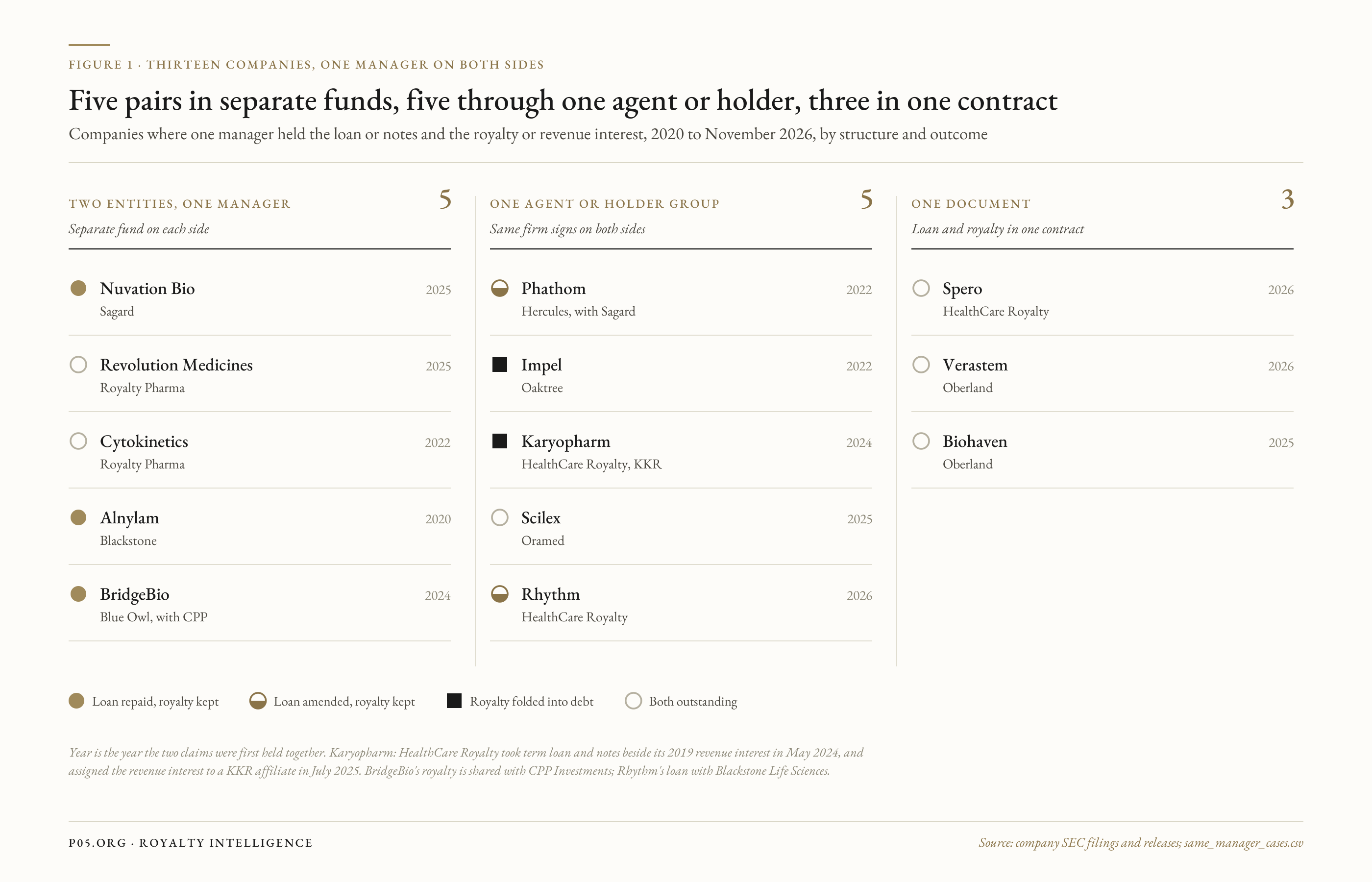
Thirteen companies where one manager held both the loan or notes and the royalty or revenue interest, by how the two claims are written.
One agent, one holder group
In the second group a single firm acts on both sides of the documents. Hercules Capital has been agent and lender under Phathom's term loan since September 2021, and in May 2022 it joined Sagard and NovaQuest as one of the three original investors in Phathom's revenue interest financing.
When a fourth investor joined that October, Hercules signed the joinder as agent for the lenders, under which the newcomer subordinated its claims to the loan. Sagard took part in the loan when Hercules expanded it in December 2023. In February 2026 Phathom modified the facility after a $130M equity offering. It paid down principal to $175M, lowered the rate and moved maturity to February 2029.
The same release says that cash hold covenants under the revenue interest agreement start in October 2026, with the largest obligation in 2026 expected at about $120M. The subordination agreement between the two groups remains redacted.
Oaktree used one instrument to amend both legs at Impel. In August 2023 a single amendment changed the credit agreement and the revenue interest agreement together, and revenue interest obligations were exchanged into first-lien term loans.
The Fund of the Week on Oaktree followed that case into bankruptcy.
HealthCare Royalty came to hold several layers of Karyopharm's stack. In the May 2024 refinancing it took $49.5M in cash, $15.0M of the new term loan and $5.0M of the new 2029 notes, and its revenue interest moved behind the term loan. In July 2025 it assigned the revenue interest agreement to an affiliate of KKR, which had bought a majority stake in HealthCare Royalty.
The disclosure statement for the Chapter 11 plan of 2 November records that the royalty investors also hold the preferred stock issued as forbearance consideration in September, and that holders of all the term loan, note and revenue interest claims signed the restructuring support agreement.
It does not say who held the term loan and notes delivered to HealthCare Royalty in 2024 at the petition date. The intercreditor terms are set out in our earlier piece.
Scilex shows one holder on both sides with two agents between them. Oramed holds Scilex's senior secured notes, including a Tranche A note of $101,875,000, and bought half of a 4 per cent royalty on Gloperba and Elyxyb in February 2025, sold in return for a further deferral of the notes.
he subordination agreement is signed by Efshar Hataya as royalty agent and Acquiom as note agent. The notes have no claim of any kind on the purchased receivables, whoever holds them.
One document
The third group puts both claims in a single contract. Spero's subsidiary sold HealthCare Royalty funds $105M of senior secured notes at a fixed 10 per cent in July 2026, backed by GSK's milestone and royalty payments on Utebzi.
The same funds paid $1,575,000 under a purchase agreement for 65.00 per cent of the GSK proceeds left after the Meiji royalty, payable "immediately following" payment in full of the notes. The two claims are paid in sequence and need no intercreditor agreement.
Oberland put a revenue leg inside Verastem's existing notes. Amendment No. 3, signed in August 2026, created Revenue Notes in place of two conditional tranches of $25M and $50M of fixed-interest notes.
They pay 4.50 per cent of net sales of avutometinib and defactinib, falling to 1.75 per cent after a test at the end of 2031, and mature in June 2033. The first $50M was due to be issued on 28 August, and a further $25M is available until May 2027 if quarterly sales reach $40M.
Both series are secured by the same first-priority lien on substantially all assets. Oberland's April 2025 notes for Biohaven, of up to $600M, combine a milestone payment and a single-digit royalty on troriluzole in the same instrument.
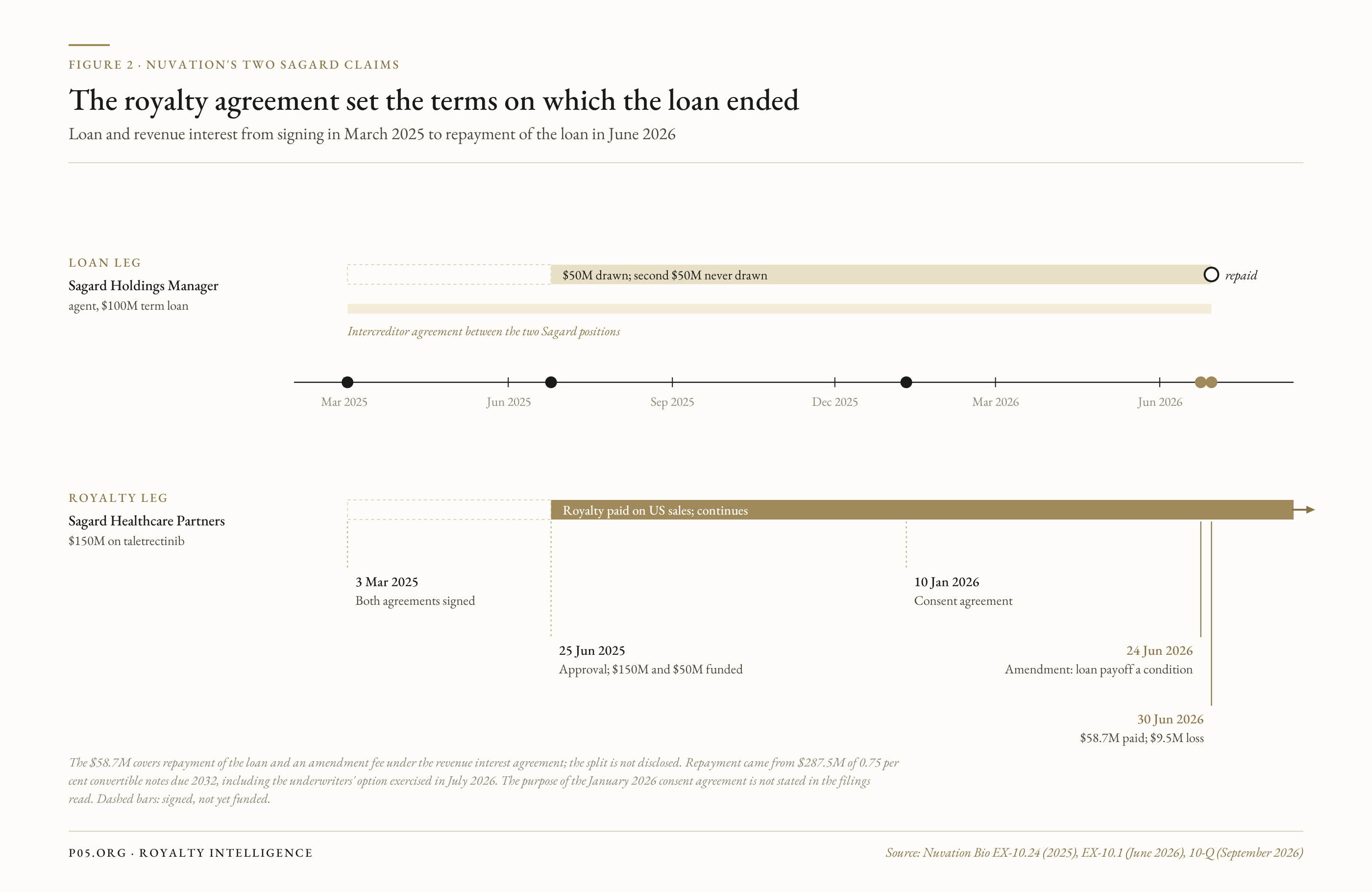
Nuvation's two Sagard claims from signing to the repayment of the loan.
When one leg changes hands
The pairing lasts as long as one firm holds both claims. At Karyopharm the revenue interest went to KKR with the manager that held it. Revolution's loan is free to move. It lets a lender transfer to an eligible assignee, a term that excludes a competitor and "a vulture or distressed debt fund".
A sale of a majority of the loan would leave the royalty with Royalty Pharma and the lenders' votes elsewhere, and the intercreditor agreement would then rank two different firms. Rhythm's new term loan was shared from the start. HealthCare Royalty leads it with Blackstone Life Sciences, and the revenue interest stays with HealthCare Royalty alone, as the Company of the Week on Rhythm described.
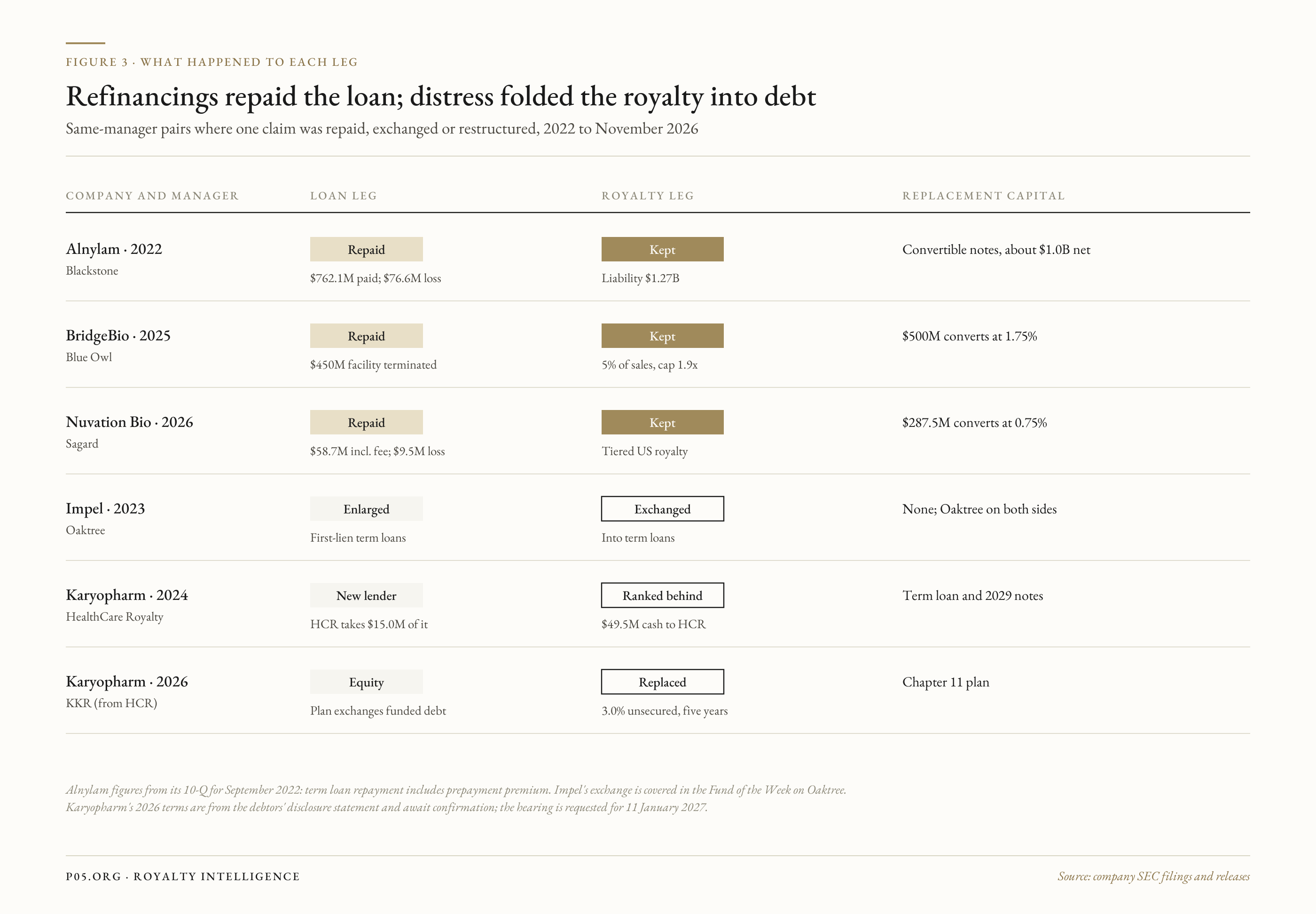
What happened to each claim where one leg was repaid, exchanged or restructured.
Implications for the Pharmaceutical Royalty Market
A company with both claims held by one manager negotiates its consents with one counterparty. Nuvation's royalty amendment set the terms on which the loan ended, and Impel's single instrument amended both agreements at once.
The tests written into the loan agreements, such as a majority of lenders, matter only once part of a loan has been sold.
The exits recorded so far fall into two groups. Alnylam, BridgeBio and Nuvation repaid the loan from unsecured convertible notes and kept the royalty, at a cost in prepayment and extinguishment charges of $76.6M at Alnylam and $9.5M at Nuvation. At Impel and Karyopharm, where the company was in difficulty, revenue interest obligations were turned into term loans or ranked behind them.
A third creditor arriving later meets terms the manager wrote for itself. Nuvation's revenue interest agreement now points to any "Other Intercreditor Agreement" that a future lender signs, and the original agreement required such a document to be no less favourable to the investor.
Revolution's loan defines its intercreditor agreement by reference to the purchaser under a permitted royalty transaction, which is how a second royalty buyer would enter. At Scilex the notes were subordinated on the royalty collateral by a holder that sits on both sides.
The documents that rank the two legs are mostly unfiled. Nuvation's form of intercreditor agreement and Revolution's Exhibit E are absent from the copies on EDGAR, Phathom's subordination agreement is redacted, and no ranking document appears at Cytokinetics or Alnylam.
In the one-document cases the ranking sits in the contract itself, as in Spero's payment sequence and Verastem's shared lien.
Conclusion
After 30 June Nuvation owed $287.5M on unsecured notes and owed Sagard royalties on taletrectinib under a revenue interest agreement whose intercreditor exhibit reads "[Reserved]." Sagard's loan was gone and its royalty remained. If Nuvation borrows on a secured basis again, the new lender will sign an intercreditor agreement with Sagard, and for the first time it will rank two different firms.
All information in this report was accurate as of the research date and is derived from publicly available sources including court opinions, regulatory guidance, academic literature, SEC filings, and financial news reporting. Information may have changed since publication. This content is for informational purposes only and does not constitute investment, legal, or financial advice. The author is not a lawyer or financial adviser.