Someone else's patent: what an injunction against a licensed product does to the licensor's royalty
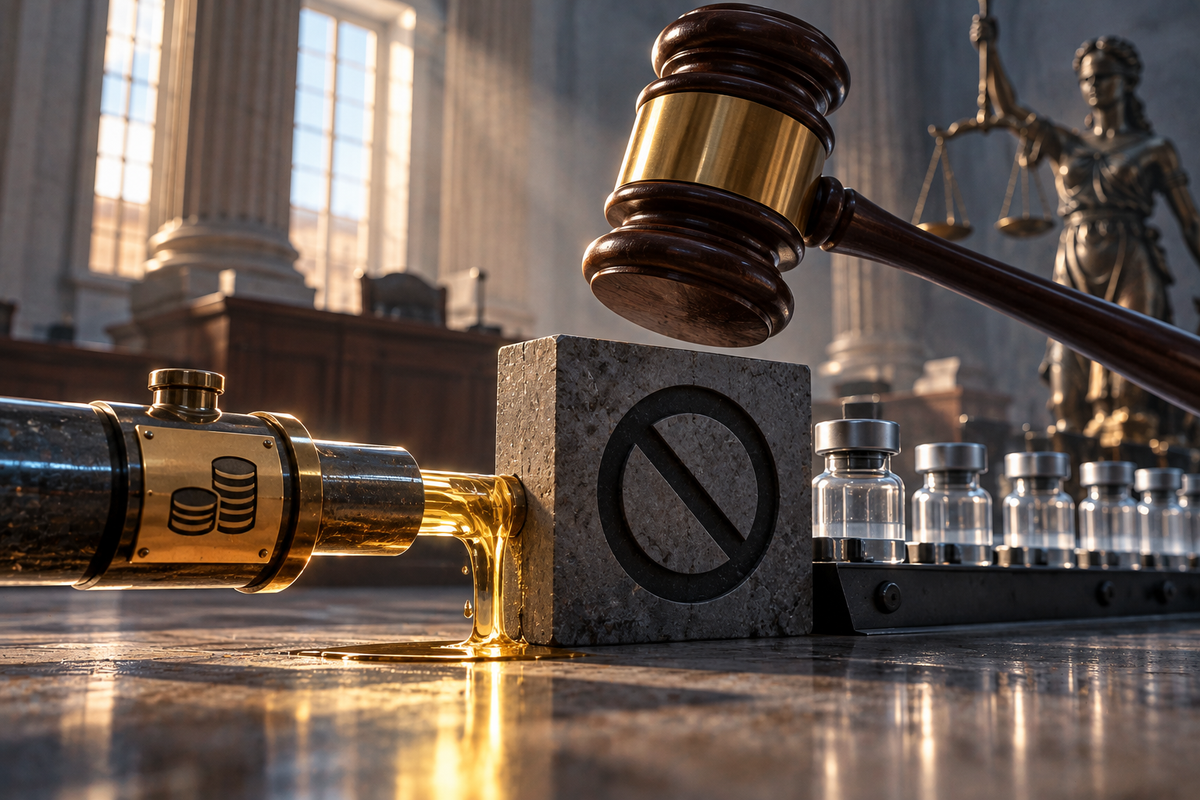
On 7 October the District Court of The Hague ordered MSD to stop selling the subcutaneous form of Keytruda in eight European countries. The patent belongs to Halozyme. The enzyme in the product belongs to neither party. Alteogen, a Korean company, makes berahyaluronidase alfa and licenses it to Merck, which owes it up to $1.0B in sales milestones and then a royalty on every dose sold.
Alteogen took no part in the case. Its income from the drug now depends on a dispute over a patent it does not own, between a licensee it does not control and a rival enzyme maker. A royalty rests on the licensee's freedom to sell, and the licensor has no hand in defending it. When a third party's patent stops the sales, the licence decides who bears the loss, and the clauses of a typical filed licence leave it with the licensor.
The order
The judgment answers a revocation action that MSD brought in the Netherlands in October 2025 against European patent 2 797 622, which claims modified PH20 polypeptides that stay stable in the presence of phenolic preservatives. Halozyme counterclaimed for infringement in eight countries.
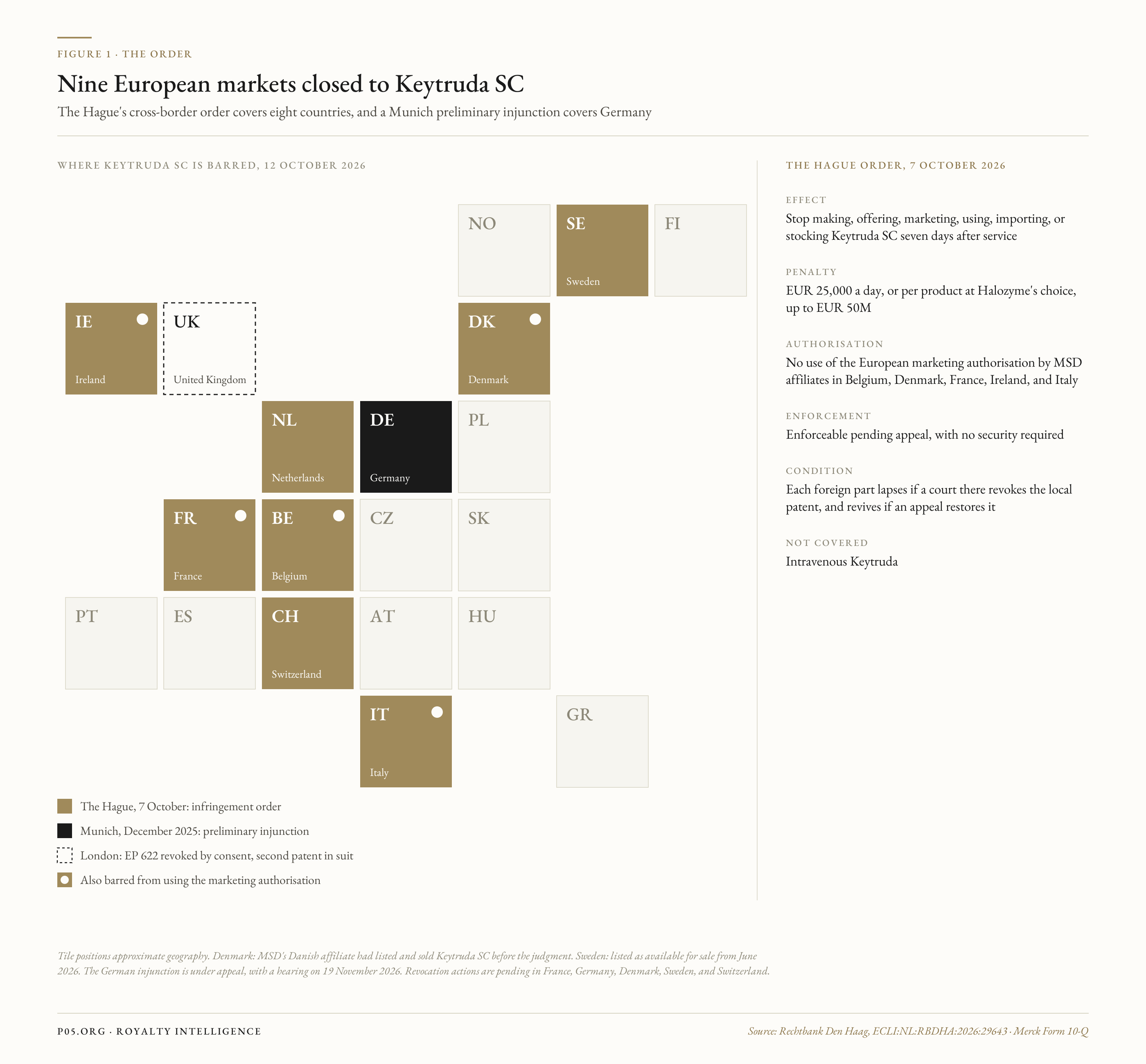
The court rejected every ground of invalidity and declared that Keytruda SC falls within the Belgian, Danish, French, Irish, Italian, Dutch, Swedish, and Swiss parts of the patent.
It then barred MSD, from seven days after service, from making, offering, marketing, using, importing, or stocking Keytruda SC in those countries. A second order bars MSD, as holder of the European marketing authorisation, from letting other MSD companies use that authorisation to sell the product in Belgium, Denmark, France, Ireland, and Italy.
The court found that the Danish affiliate had already put Keytruda SC on the market under it. Each breach costs EUR 25,000 a day or, at Halozyme's choice, EUR 25,000 per product, up to EUR 50M. The orders are enforceable pending appeal without security, and MSD must pay EUR 284,760 in costs.
The foreign parts carry a condition. Each order lapses for a country if a court there declares the local patent invalid at first instance, and revives if an appeal court restores it. The court set out why it departed from the Dutch Supreme Court's practice of staying such claims, citing the European Court of Justice's 2025 ruling in BSH v Electrolux. It saw no reasonable chance that other national courts would revoke the patent, noting that Germany's Federal Patent Court had given a preliminary opinion that it is valid.
Merck said it strongly disagreed with the cross-border injunction and called the patent invalid. It told Fierce Pharma it was evaluating next steps. No report of an appeal had appeared by 12 October.
Whose royalty it is
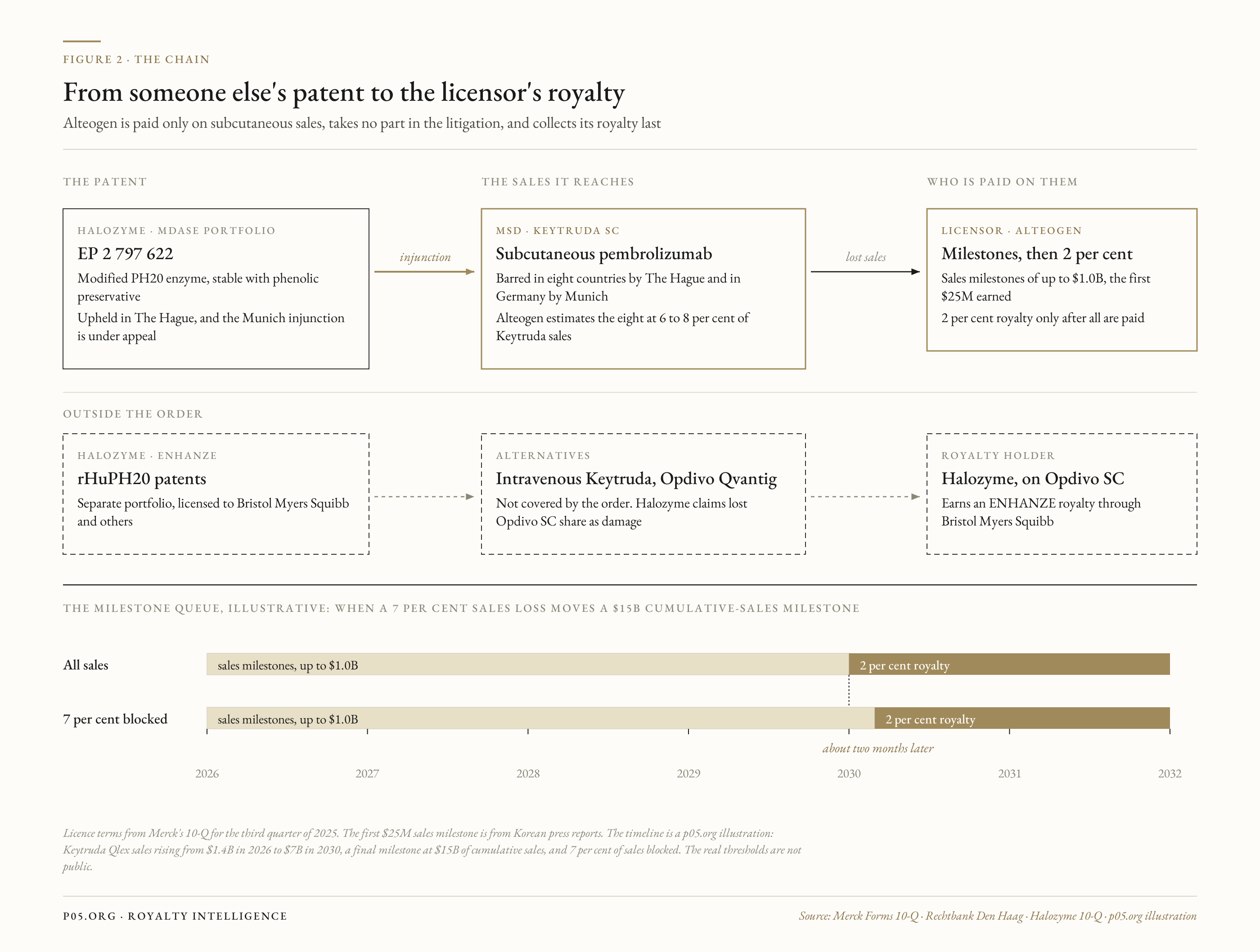
Merck converted its licence from Alteogen into an exclusive one for pembrolizumab in February 2024. Its 10-Q for the third quarter of 2025 sets out the terms: regulatory milestones of up to $51M, annual and cumulative sales milestones of up to $1.0B, and a 2 per cent royalty on net sales once all the sales milestones have been paid. American approval triggered $25M in regulatory milestones.
Merck judged that $680M of the sales milestones were probable and booked a liability of $705M against an intangible asset it amortises through 2030. Alteogen has said that the terms are confidential.
The money depends on subcutaneous sales alone. Intravenous Keytruda carries no hyaluronidase and is outside both the order and the royalty. Merck reported Keytruda Qlex sales of $590M in the first half of 2026, $89M of it outside America, against $15.8B of intravenous Keytruda.
It does not break out European sales. Alteogen told Korean media that the eight countries account for 6 to 8 per cent of Keytruda sales, and its shares fell 6.4 per cent on 8 October.
Halozyme's own licensees stand outside the dispute. The patents in suit belong to its MDASE portfolio, which Halozyme says is not licensed to any of its partners and is separate from ENHANZE, the rHuPH20 technology behind Bristol Myers Squibb's Opdivo Qvantig. The Hague court allowed Halozyme's claim for a declaration partly because Halozyme says the infringement cost it market share for Opdivo SC, on which it earns a royalty.
The case map
The Dutch order joins a Munich preliminary injunction that already bars Keytruda SC in Germany. The process-patent piece recorded that injunction, Halozyme's consent to revoke the British part of EP 622, and Merck's American petitions. Three later events matter here.
Merck's appeal against the Munich injunction will be heard on 19 November 2026. Revocation actions against the patent are pending in France, Germany, Denmark, Sweden, and Switzerland, and each of them can now lift the Dutch order for its country.
In July The Hague's interim relief judge refused Halozyme an urgent order to pull Keytruda SC from the Danish and Swedish price lists. Halozyme had argued that MSD broke a promise in its pleadings not to launch. The judge held that a statement in pleadings made to the court is not an undertaking to the other side, and made no ruling on the patent.
In America, Halozyme sued in New Jersey in April 2025 on 15 patents from the same family. Merck reports that all 15 are under post-grant or inter partes review, and that the Patent Trial and Appeal Board had issued four final decisions by August finding every challenged claim unpatentable. A fifth followed on 1 September. The American and European positions now point in opposite directions, and Keytruda Qlex continues to sell in America.
| Date | Forum | Patent | Event |
|---|---|---|---|
| 24 Apr 2025 | District of New Jersey | 15 American MDASE patents | Halozyme sues Merck for infringement |
| Aug to Sep 2025 | United Kingdom, France, Germany, the Netherlands | EP 622 | Merck files revocation actions, later adding Denmark, Sweden, and Switzerland |
| 4 Dec 2025 | Munich Regional Court | EP 622 | Preliminary injunction bars Keytruda SC in Germany |
| 12 May to 1 Sep 2026 | Patent Trial and Appeal Board | US 11,952,600, 12,152,262, 12,018,298, 12,110,520, and one more | Final decisions find every challenged claim unpatentable |
| 21 May 2026 | High Court, London | EP 622 | Revoked by consent, with indemnity costs against Halozyme. EP 3 130 347 remains in suit |
| 3 Jul 2026 | The Hague, interim relief | EP 622 | Urgent order for Denmark and Sweden refused |
| 7 Oct 2026 | The Hague District Court | EP 622 | Infringement in eight countries, with an injunction enforceable pending appeal |
| 19 Nov 2026 | German appeal court | EP 622 | Hearing of Merck's appeal against the Munich injunction |
The milestone queue
Alteogen's royalty sits behind $1.0B of sales milestones. Korean media reported in August that Alteogen had earned the first, of $25M. The thresholds that trigger the rest are not public.
In that order of payment, lost sales do two things. If each milestone is paid once, on first reaching a level of annual or cumulative sales, lost sales cut nothing from the $1.0B total. They push each threshold later, and with it the date on which the 2 per cent royalty starts. After the milestones, every dollar of lost sales costs Alteogen two cents.
The size of the delay depends on the blocked share of subcutaneous sales and on how fast those sales grow. Take Alteogen's own figure of about 7 per cent and an illustrative ramp for Keytruda Qlex from $1.4B in 2026 to $7B in 2030.
A milestone set at $15B of cumulative sales then arrives about two months later. If Germany and other markets lifted the blocked share to 12 per cent, the delay would be about three and a half months. These are p05.org assumptions, since neither company publishes the schedule.
The cost to Alteogen is small in those terms. The exposure lies in the structure. The licensor bears the timing of a dispute it cannot settle, and an injunction that ran to the patent's expiry, reported as about 2032 in Europe, would keep the product out of those markets for about six years. Those sales would never count towards the milestones or bear the royalty.
How licences allocate the loss
The Merck and Alteogen licence is not public, so its answer is unknown. Licences of this kind deal with a third party's patent in a handful of standard clauses. In the filed example below, none of them pays the licensor for sales that an injunction prevents.
A filed example shows the usual drafting. The 2017 licence from Bristol Myers Squibb to Ayala, filed by Immunome in 2024, lets the licensee cut its royalty by a redacted share of whatever it pays a third party for a licence it needs to avoid infringing, down to a redacted floor.
That clause works only once the licensee has taken a licence and pays for it. An injunction that the licensee fights and loses produces no third-party payment, and so no offset.
The same licence gives the licensee the first right to control the defence of a third-party claim, at its own cost. The licensee also indemnifies the licensor against third-party claims arising from its sales, including claims for patent infringement, unless the infringement stems from a breach of the licensor's warranties.
Those warranties speak as of the signing date and cover the licensor's own patents and any litigation already pending. An indemnity of that kind protects the licensor against being sued. It does nothing for royalties that never accrue.
The re-rate described how stacking offsets cut a royalty when the licensee pays another patent owner, typically by up to half of the third-party royalty and above a floor. If Merck settles with Halozyme on a royalty, an offset in its Alteogen licence would move part of that cost to Alteogen. Since Alteogen's royalty has not started, an offset would bite only after the milestones, unless the clause also reaches milestone payments.
Termination rights sit at the far end. A licensee that cannot sell in a market may be able to drop that territory, and a licensor may hold a right to terminate if the licensee stops using diligent efforts. Whether an injunction excuses the licensee from its diligence duty depends on how the clause defines commercially reasonable efforts.
A transfer between enzymes
The order moves value between two enzyme makers. Patients in the eight countries who would have received Keytruda SC will receive intravenous Keytruda or another treatment. If the alternative is Opdivo Qvantig, Halozyme collects its ENHANZE royalty through Bristol Myers Squibb, which the court accepted as the basis for a possible damages claim against MSD. Alteogen loses the equivalent sales from its milestone count.
The two companies' exposure to the courts is unequal for the same reason. Halozyme is a party, owns the patent, and chooses where to sue. Alteogen relies on Merck's defence and is not a party to the Dutch, German, or American actions, though Halozyme separately asked the American patent office to review an Alteogen patent on making the enzyme. The board refused to open that review in May.
What a royalty buyer checks
A buyer of a licensor's royalty prices the licensed patents and usually stops there. The Keytruda SC dispute puts a second set of patents on the list: those held by third parties that read on the licensee's product in its main markets. Freedom-to-operate opinions are the licensee's documents, and a licensor or its royalty buyer often sees only a summary, if anything.
The licence itself answers part of the question. A buyer can read the stacking offset for whether it applies to milestones as well as royalties, and for its floor. It can read the indemnity for whether it reaches lost royalties or, as in the filed example, only claims by third parties, and the defence clause for who controls the litigation and who may settle it. The diligence and termination clauses show whether the licensor can recover its rights if the licensee abandons a market under an injunction.
Payment order matters as much as the rate. A royalty that starts after a long run of sales milestones moves its value later in time, and lost sales in any market push it later still. A buyer that discounts such a stream for litigation risk has to model the delay to the start date, along with the lower sales.
The Munich appeal on 19 November is the next test. If the injunction there stands and Halozyme enforces the Dutch order, MSD's subcutaneous form will be off the market in nine European countries. In America, the patent board has so far rejected every challenged claim it has ruled on. Alteogen will collect nothing from those markets, from a dispute in which it is not a party.
All information in this report was accurate as of the research date and is derived from publicly available sources including court opinions, regulatory guidance, academic literature, SEC filings, and financial news reporting. Information may have changed since publication. This content is for informational purposes only and does not constitute investment, legal, or financial advice. The author is not a lawyer or financial adviser.