The Weekly Term Sheet (2026-W43)
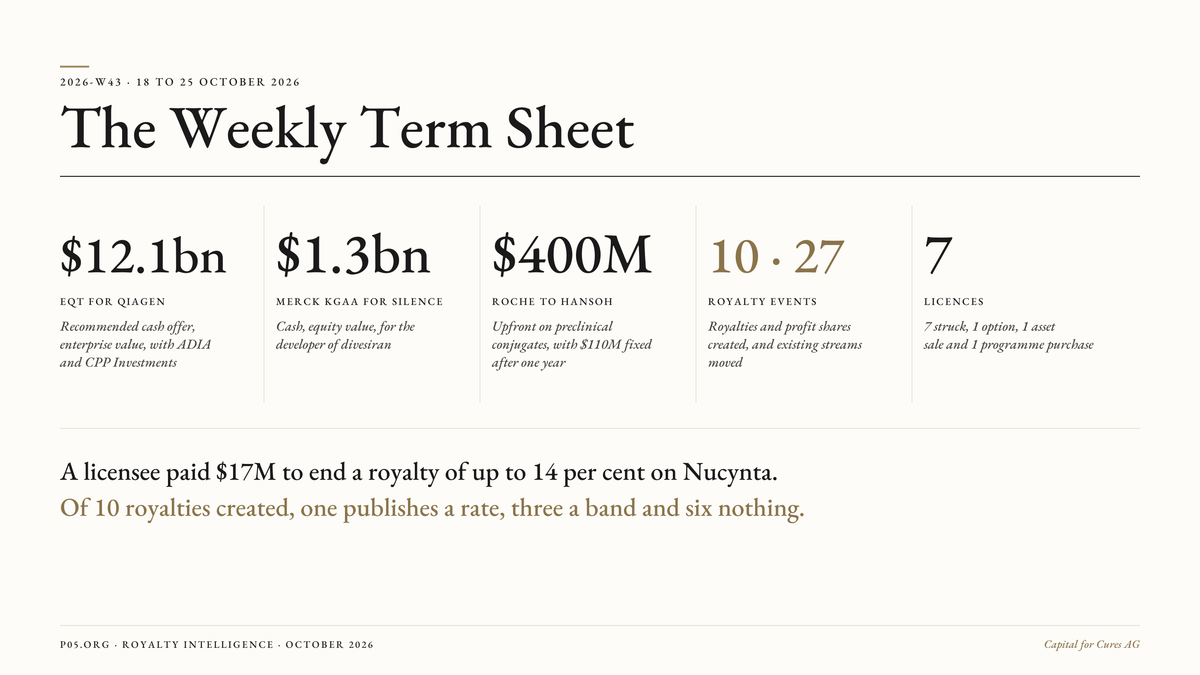
Merck KGaA agreed to buy Silence Therapeutics for an equity value of about USD 1.3bn in cash, and an EQT fund agreed a recommended cash offer for QIAGEN at an enterprise value of about USD 12.1bn. Hansoh licensed preclinical conjugates to Roche for USD 400m upfront and a fixed USD 110m a year later.
Collegium paid Grünenthal USD 17m to end a royalty of up to 14 per cent on Nucynta and the patent case behind it. Zymeworks licensed a DLL3 T cell engager to Roche with royalties from high single digits to mid-teens, Gilead agreed to pay USD 1.275bn in cash for PepStar's oral IL-23R programme, and Disc raised USD 450m after bitopertin met every Phase 3 endpoint. No tracked royalty buyer made a purchase.
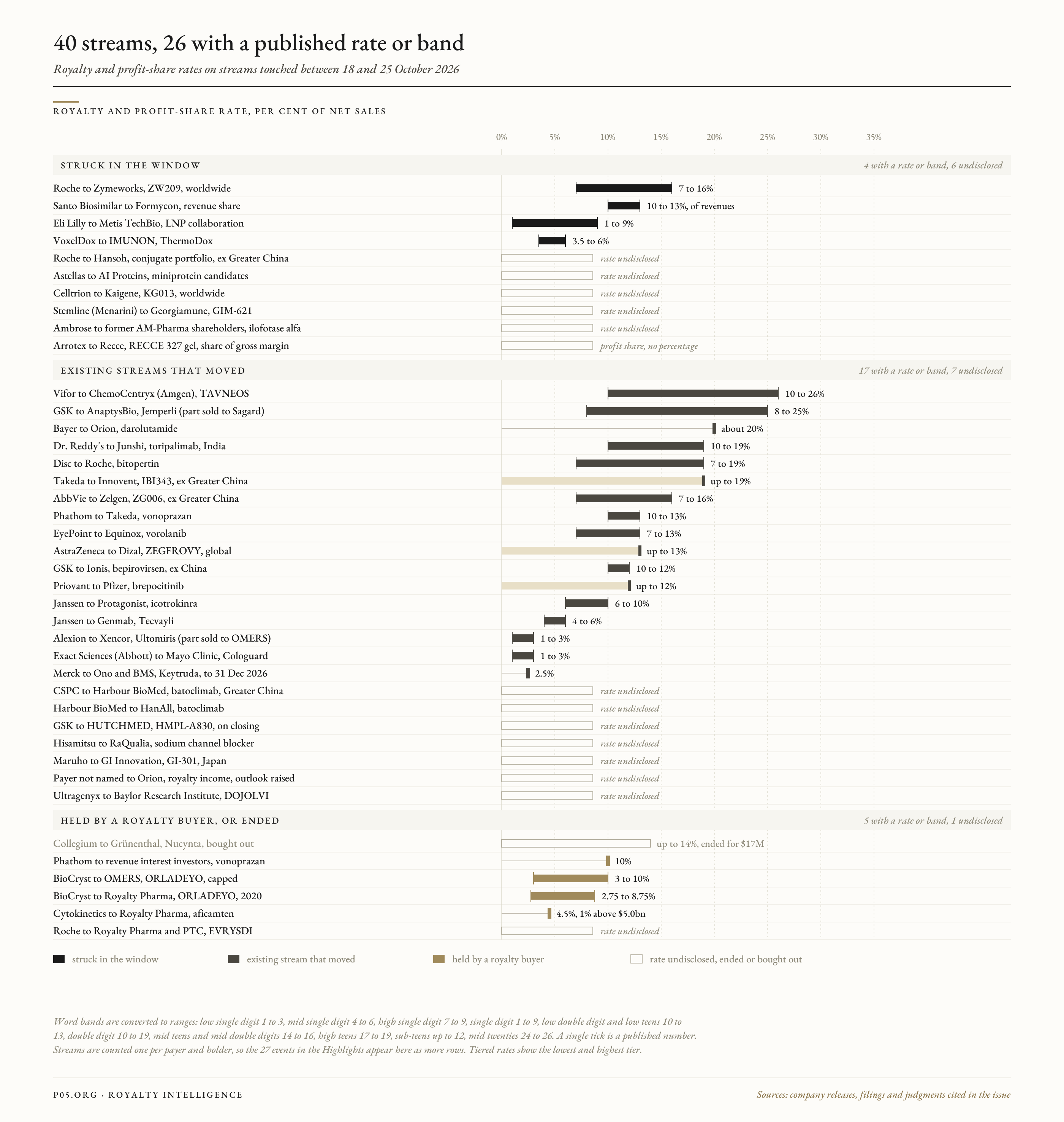
Royalty and profit-share rates on the 40 streams touched between 18 and 25 October, in three groups, with word bands converted to ranges. Twenty-six publish a rate or band and 14 are drawn as empty bars; the Nucynta royalty, bought out for USD 17m, is drawn in outline.
Currency and language note: all amounts are given in US dollars. Where a source uses another currency, the converted figure comes first and the original follows in brackets, at approximately EUR 0.86, SEK 9.50, NOK 10.30, CHF 0.885, DKK 6.40, GBP 0.74, JPY 146, KRW 1,370, CNY 7.10, HKD 7.78, TWD 32.0, AUD 1.41 and INR 88 per US dollar, being late September 2026 rates. Where a source published its own conversion, that figure is used. Quotations from sources in other languages are given in our English translation.
Highlights
Royalty events: 10 created and 27 existing streams moved. Seven new licences carry royalties or a profit share: Hansoh to Roche, Metis TechBio to Eli Lilly at single digits, AI Proteins to Astellas, Kaigene to Celltrion, Georgiamune to Stemline, Zymeworks to Roche at high single digits to mid-teens, and Recce to Arrotex on a share of gross margin.
IMUNON sold ThermoDox to VoxelDox for equity, milestones and royalties of 3.5 to 6 per cent, Ambrose bought AM-Pharma with royalties on future sales owed to the sellers, and Formycon agreed a low double-digit share of Santo Biosimilar's revenues in return for a licence and development services.
Collegium's payment of USD 17m ended its royalty of up to 14 per cent to Grünenthal. A settlement set generic DOJOLVI entry for 2033, which bounds Ultragenyx's royalty to Baylor Research Institute. A suit against the FDA challenges the exclusivity behind Phathom's royalty to Takeda and its 10 per cent revenue interest, and the court in the generic EVRYSDI case rejected the generic makers' reading of a crystalline-form patent.
Approvals moved the royalties of AnaptysBio and Sagard on Jemperli, Xencor and OMERS on Ultomiris, Royalty Pharma on MYQORZO in Canada, Royalty Pharma and OMERS on ORLADEYO pellets, Ionis on Hibsago, Junshi on toripalimab in India, Genmab on Tecvayli, Protagonist on icotrokinra in the United Kingdom, Harbour BioMed and HanAll on batoclimab in China, and Mayo Clinic on Cologuard Plus in Europe.
Japan asked doctors to stop starting new patients on TAVNEOS, which carries royalties of low teens to mid-twenties to ChemoCentryx. The Keytruda royalty Merck pays Ono and BMS ends ten weeks after a new European approval. AstraZeneca launched ZEGFROVY in the United States, with tiered royalties of up to low double digits to Dizal, and HUTCHMED's licence to GSK closed.
Phase 3 results moved the royalties Disc owes Roche, EyePoint owes Equinox, Priovant owes Pfizer, Takeda owes Innovent and Bayer pays Orion; all were positive except EyePoint's. Zelgen received a USD 10m milestone from AbbVie, RaQualia USD 1.4m (JPY 200m) from Hisamitsu and GI Innovation USD 3.5m from Maruho, and Orion raised its outlook on faster royalty growth.
M&A and restructuring: 6 agreed, 5 closed, 1 spin-off planned and 1 tender offer threshold met. Merck KGaA agreed to buy Silence for about USD 1.3bn in cash, and EQT's fund agreed a recommended offer for QIAGEN at about USD 12.1bn. DKSH agreed to buy NewBridge Pharmaceuticals for USD 390m, Myriad to sell its prenatal business to Labcorp for USD 210m, Suzhou Ribo to buy out the minority in Ribocure for new shares, and Kilitch to sell its Ethiopian subsidiary for USD 14m.
Alcon paid USD 550m plus contingent payments for Neurotech, Ambrose acquired AM-Pharma for up to about USD 187m (EUR 161m), Bolt completed a reverse merger with Prana alongside a USD 120m placement, Starpharma took control of Petalion and Flerie completed its merger with Biosergen. Abbott plans to spin off its nutrition business, and the tender offer for Recordati by a vehicle of CVC and GBL met its threshold, at about 74.6 per cent.
BB Biotech reported a nine-month profit of about USD 684m, with about USD 316m of takeover proceeds redeployed, and HBM Healthcare Investments a half-year profit of about USD 200m led by its private holdings.
Licence-outs and asset acquisitions: 7 licences, 1 option, 1 asset sale and 1 programme purchase. Hansoh licensed preclinical conjugates to Roche for USD 400m upfront and USD 110m after one year, and Gilead agreed to pay USD 1.275bn in cash at closing for PepStar's oral IL-23R programme. Zymeworks licensed ZW209 to Roche for USD 95m in upfront and Phase 1b payments and up to USD 718m more.
AI Proteins licensed future miniproteins to Astellas for over USD 400m in upfront and milestone payments, Kaigene licensed KG013 to Celltrion for up to USD 580.5m, Georgiamune licensed GIM-621 to Stemline for USD 45m near term and up to USD 1.1bn in total, and Metis TechBio signed an LNP collaboration with Lilly for up to about USD 1.1bn in milestones.
Visara took an option on YOLO Immune's ocular oncology programme, IMUNON sold ThermoDox to VoxelDox for equity, milestones and royalties, and Recce licensed its topical gel in Australia and New Zealand to Arrotex for a share of gross margin, with no upfront payment.
Regulatory: 13. The FDA approved Hibsago, GSK's hepatitis B antisense medicine licensed from Ionis, six days before its action date. It also approved Jemperli in locally advanced rectal cancer, Ultomiris in IgA nephropathy under accelerated approval, ORLADEYO pellets for adults and adolescents and Haemonetics' PerQseal Elite closure system.
The European Commission approved Keytruda plus Padcev around surgery in bladder cancer and Tecvayli from first relapse. China approved batoclimab, Harbour BioMed's first product, Health Canada approved MYQORZO, India toripalimab in oesophageal cancer and the United Kingdom icotrokinra. Cologuard Plus received a CE Mark, and Japan asked doctors to stop starting new patients on TAVNEOS.
Clinical: 12. Bitopertin met every Phase 3 endpoint and Disc raised USD 450m, while DURAVYU missed in wet AMD and EyePoint plans to cut about 53 per cent of its staff. Brepocitinib, lutikizumab, VDPHL01, TLC590, ACARIZAX in China and upacicalcet met their pivotal endpoints.
Rina-S gave Genmab its first Phase 3 result, arcotatug tavatecan added an overall survival benefit for Innovent and Takeda, and darolutamide cut the risk of metastasis or death by 58 per cent in early prostate cancer. Merck and Moderna released the full INTerpath-001 data, and Moderna's shares fell about 18 per cent that day. Launch: 1. AstraZeneca made ZEGFROVY available in the United States.
Structured capital: 2. Private funding: 12. Public capital and debt: 13 equity issues and 1 registration. Capital formation: 0. Animal health: 0. Crops and seeds: 0. Courts: 2 settlements, 1 suit against the FDA, 1 ruling and 1 new patent suit. Priority review vouchers: 0.
The largest public financing is Disc's upsized offering of USD 450m at USD 75.00 a share, followed by Lycia's initial public offering of USD 317.5m at the top of its range, Arcus's USD 250m offering, closed with the option exercised in full, and Zai Lab's USD 250m placement led by TCGX. TriGemX agreed to go public through TCGX's special purpose acquisition company with a USD 160m PIPE, and Surrozen drew a USD 95.1m second tranche on an IND clearance.
Smaller issues came from Teknova (USD 40m), Ondine (USD 13.5m), Nanologica, Adocia, Dogwood, Kubota and Biovica, and Windward Bio filed for a US listing with no price set.
Pathos AI raised USD 237m in a Series E led by Bristol Myers Squibb, alongside a USD 62.5m warrant exercise by its licensor Alphamab, Warp Sciences USD 215m, Star Therapeutics USD 200m and Nouscom USD 135m (EUR 120m), with the European Investment Bank among the new investors. Hexagon Bio raised USD 62m, ZAP Surgical USD 36m, TriOar USD 24.1m (KRW 33bn) and Arctic Therapeutics USD 21.5m.
Promaxo closed a USD 100m credit facility with the initial close of its Series C, and Ruichu, Inossia and 4Tissue raised smaller sums. Point8 committed up to USD 17.7m (AUD 25m) of trial co-funding to Invion for options that vest only at Phase 3, and Verrica gained access to the full USD 27.5m of its chairman's credit facility.
Rate disclosure across the window: 10 hard numbers and 18 bands. New royalties come with bands from Zymeworks (high single digits to mid-teens) and Metis TechBio (single digits), and Formycon's revenue share is low double digits. Windward Bio's registration disclosed two bands it owes Chinese licensors, from low single digits to low double digits and from mid to high single digits.
The hard numbers are IMUNON's 3.5 to 6 per cent from VoxelDox, AnaptysBio's tiers of 8 to 25 per cent on Jemperli, Royalty Pharma's 4.5 per cent on aficamten, the ORLADEYO tiers of Royalty Pharma and OMERS, Ionis's 10 to 12 per cent on bepirovirsen, Protagonist's 6 to 10 per cent on icotrokinra, Collegium's ended rate of up to 14 per cent, the 2.5 per cent Keytruda royalty, the 10 per cent revenue interest on vonoprazan and Orion's approximately 20 per cent on darolutamide.
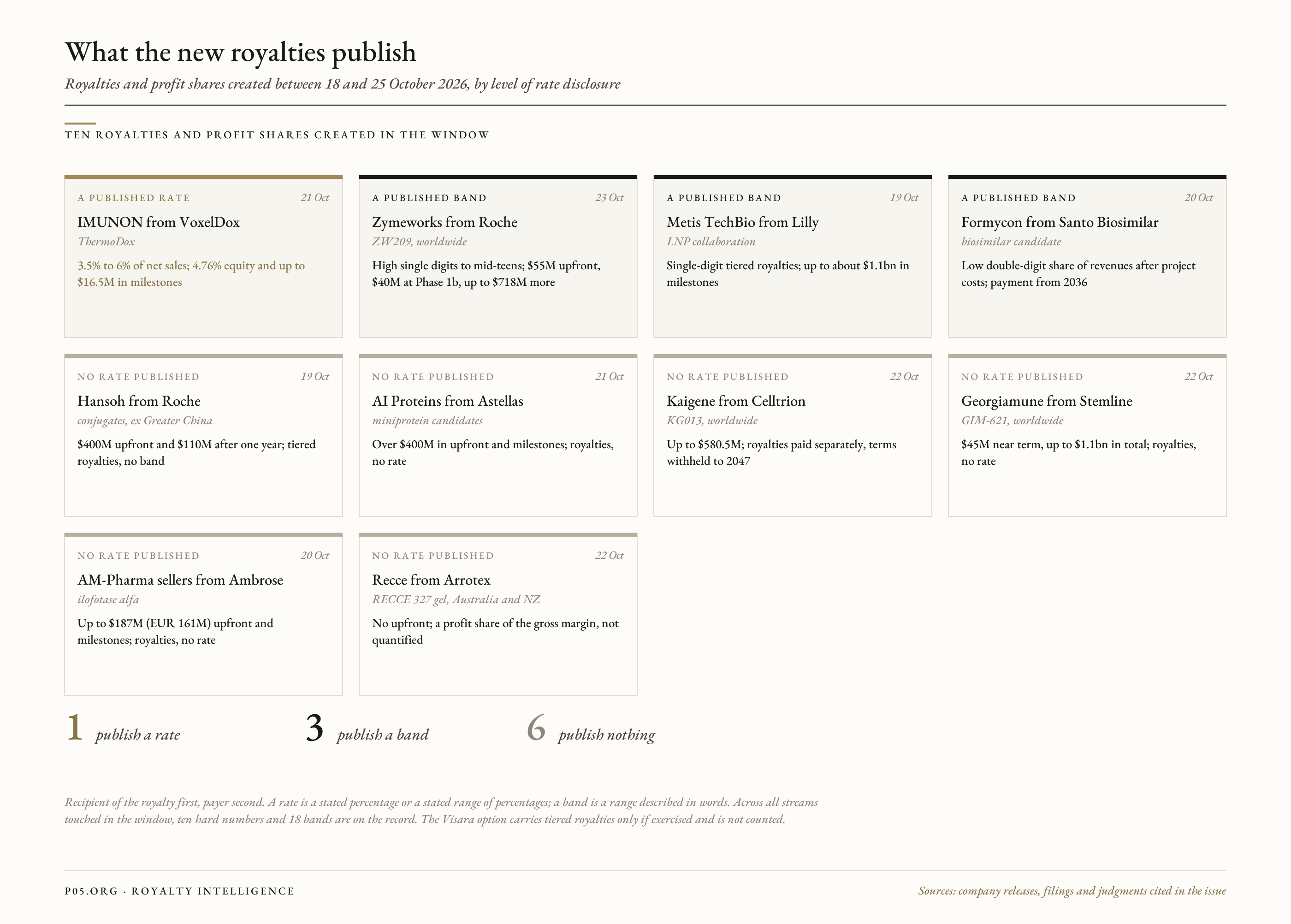
The 10 royalties and profit shares created in the window, by what each publishes: one a rate, three a band and six nothing.
Disc owes Roche high single digits to high teens, EyePoint owes Equinox high single to low double digits, Priovant owes Pfizer sub-teens, Takeda owes Innovent up to high teens, AbbVie owes Zelgen high single to mid double digits, AstraZeneca owes Dizal up to low double digits, and ChemoCentryx receives low teens to mid-twenties on TAVNEOS.
Genmab receives a mid-single digit royalty on Tecvayli, Xencor low single digits on Ultomiris, Mayo low single digits on Cologuard, Alphamab high single to low double digits from Pathos AI, Junshi double digits on toripalimab and Takeda low double digits on average from Phathom. Hansoh, AI Proteins, Kaigene, Georgiamune, HUTCHMED, Harbour BioMed and HanAll hold royalties with no rate stated.
Tracked royalty buyers inside the window: no purchase. Royalty Pharma's aficamten royalty gained a fifth approved market. Its ORLADEYO royalties, shared with OMERS, gained a new oral formulation in the United States, which adds little because US sales sit close to the USD 550m level above which no royalty is payable.
OMERS's Ultomiris royalty gained an indication under accelerated approval, Sagard's Jemperli interest a new US indication, and the EVRYSDI royalty Royalty Pharma bought from PTC was the subject of a claim construction ruling. Abingworth's secured product financing of Pathalys, from January 2023, now sits behind two positive pivotal trials.
Open in the remainder of the window. The tender offer for Pacira, due to start within fifteen business days of the pre-commencement filing of 8 October, that is by 29 October. No tender offer statement had been filed by 07:45 UTC on 25 October, per Pacira's filing list.
The closings of Lycia's offering and Bolt's USD 120m placement, both expected on 26 October, of Zai Lab's placement on or about 27 October and of Dogwood's investment by 29 October. The final results of the Recordati offer are due by 30 October, and its terms reopen from 3 to 9 November.
The scheduling hearing on 26 October in BDR Pharmaceuticals' suit against the FDA over VOQUEZNA exclusivity, and the hearing on 27 October of the Paradigm administrators' application to the Supreme Court of Western Australia to extend the convening period for the second creditors' meeting, for up to three months, per their notice of 23 October.
Without the extension the administrators would have "no alternative other than to recommend to creditors that Paradigm be wound up". Paradigm has redeemed further convertible notes, leaving "2,834,715 convertible notes remain outstanding", per a further notice.
The completion of BioXcel Therapeutics' asset sale in Chapter 11. On 21 October the court signed an "Order (A) Approving the Sale of the Debtors' Assets Free and Clear of Liens, Claims, Interests, and Encumbrances", against Teva's stalking-horse offer of "upfront cash in the amount of $57.5 million" plus development and commercial milestones, under an agreement that lapses if not completed by 30 October.
The hearing on the plan is set for 3 December, per the docket. The texts of the orders were not public by 08:00 UTC on 23 October, and BioXcel has filed nothing with the Securities and Exchange Commission since 1 September.
The closings of the offerings priced in W42 by Recursion and Alector, of the sale of Senti Biosciences' SENTI-202 subsidiary, approved by stockholders on 15 October, and the clearance of Labcorp's purchase of BioReference testing businesses from OPKO Health. None had been reported by 07:45 UTC on 25 October.
The DRI Healthcare purchase of the tavapadon payment rights, scheduled to close on 29 September, with no closing confirmation published by 21 October.
The result of Sareum's raise under the AIM capital access window, opened on 8 October with its shares suspended. Sareum receives "a net 63.5% of all future revenues" on SRA737, per its March 2025 announcement.
The scheme document for Silence, the QIAGEN offer document after clearance by BaFin, and the pricing of Windward Bio's initial public offering.
Resolved in the window: City Therapeutics closed its USD 230.0m initial public offering, First Tracks its private placement and Indaptus its USD 24.0m placement, and Iambic filed its restated certificate on completing its offering. The Paradigm creditors' meeting was held on 9 October.
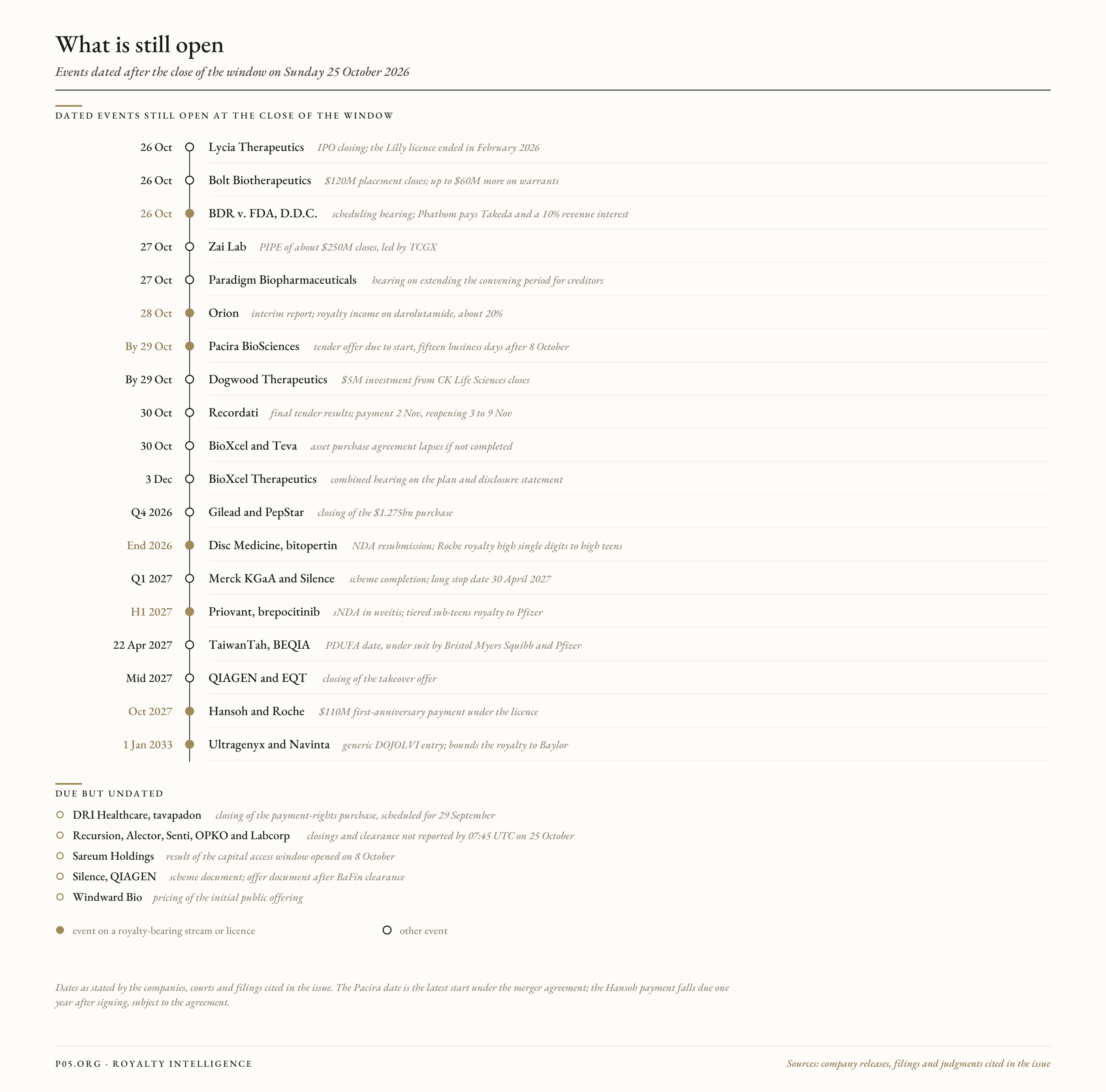
Dated events still open at the close of the window, from the Lycia and Bolt closings on 26 October to generic DOJOLVI entry on 1 January 2033, with five items due but undated. Gold marks an event on a royalty-bearing stream or licence.
M&A and Restructuring
w43_timeline The window day by day, dated by primary release or filing and filed in four lanes. The 10 royalties created are drawn in gold; five of them date from Tuesday 20 and Thursday 22 October.

DKSH and NewBridge Pharmaceuticals (Monday 19 October). DKSH (SIX: DKSH) agreed "to acquire 100% of NewBridge Pharmaceuticals", a "Dubai-headquartered healthcare commercialization platform with operations across 14 markets in the MENA region, for an enterprise value of USD 390 million". The announcement was made before the Swiss market opened, under the ad hoc publicity rules.
NewBridge was established in 2010 and has "a focused portfolio of innovative medicines across oncology, neurology, immunology, gastroenterology, and rare diseases", with Saudi Arabia and the United Arab Emirates among its key markets. It "is expected to generate Net sales of around USD 385 million in 2027, with a high single-digit EBITDA margin."
- Instrument: purchase of the whole company for cash; "The acquisition will be financed with debt". Closing is subject to regulatory approvals and "expected to close by the end of the first quarter of 2027". The seller is not named.
- Royalty read-through: none stated. NewBridge commercialises medicines for licensors in the region; no royalty, earn-out or contingent payment is disclosed.
Abbott (Wednesday 21 October). Abbott (NYSE: ABT) announced "its intention to separate its Nutrition business into an independent publicly traded company", with "approximately $8.5 billion in annual sales", about 16,000 employees and 14 manufacturing sites. Its brands include Similac, PediaSure, Pedialyte, Glucerna and Ensure. Daniel Salvadori, who runs the established pharmaceuticals and nutrition division, "will become chief executive officer of the new Nutrition company".
"Abbott intends to separate its Nutrition business through a tax-free distribution to Abbott shareholders", and "expects to complete the transaction by the end of 2027", subject to regulatory approvals, a Form 10 registration statement and final board approval. "After the transaction, Abbott will have sales of approximately $42 billion." Goldman Sachs is financial adviser and Wachtell, Lipton, Rosen & Katz legal counsel to Abbott. No sale price, licence, royalty or contingent payment is stated.
Merck KGaA, Darmstadt, Germany and Silence Therapeutics: USD 1.3bn cash takeover of an siRNA developer (Monday 19 October)
Silence Therapeutics (Nasdaq: SLN) announced that Merck KGaA, Darmstadt, Germany "has agreed to acquire Silence in an all-cash transaction with an enterprise value of $1.1 billion and an equity value of approximately $1.3 billion". Silence's chairman said the agreement "is the result of a competitive sale process".
- The price: "$20.00 in cash per American Depositary Share", each representing three ordinary shares, a 130 per cent premium to the close of 16 October and an 82 per cent premium to the 30-day volume-weighted average of USD 10.99.
- The asset: divesiran, an siRNA in polycythemia vera, which Merck KGaA is to take into Phase 3 after Phase 2 data.
- The terms: a UK scheme of arrangement, subject to Silence shareholder approval, sanction by the High Court of Justice of England and Wales and antitrust clearance in the United States and Germany. Holders of about 14 per cent of the votes signed voting and support agreements. Per the current report, the agreement may be terminated if the transaction is not completed by 30 April 2027; closing is expected in the first quarter of 2027.
- Termination fee: under the transaction agreement, Silence pays Merck KGaA "$13 million" in defined cases, including termination to accept a superior proposal. The agreement records that the Takeover Code "does not apply to Company or the Transaction".
- Advisers: Morgan Stanley and Centerview Partners as financial advisers and Cooley as legal counsel to Silence.
- Instrument: purchase of the whole company for cash. No contingent value right or earn-out.
- Royalty read-through: none stated in the release. Any partner economics on other Silence programmes pass with the company.
Suzhou Ribo Life Science and Ribocure (Monday 19 October). Suzhou Ribo Life Science (HKEX: 6938) agreed on 16 October to acquire "the remaining 49.71% shareholding" in Ribocure Pharmaceuticals AB for 14,087,085 new H shares. The stake is valued at about USD 103m (HKD 800.54m), from an appraisal of USD 210m (SEK 1,997,265,000) for the whole company.
Sellers include Erik Selin Fastigheter AB, a substantial shareholder of the target, so the deal is a connected transaction and needs approval at a general meeting.
- Instrument: share-for-share acquisition of a minority interest.
- Royalty read-through: Ribocure's licences to Boehringer Ingelheim and Madrigal Pharmaceuticals "clearly define the structure of upfront payments, milestone payments and sales royalties, resulting in relatively clear future income streams which can be forecasted and monetised", per the valuation summary. No rates are disclosed.
Starpharma and Petalion Therapeutics (Tuesday 20 October). Starpharma (ASX: SPL) announced before the market opened that it "increased its equity interest in Petalion Therapeutics ("Petalion") from 22.5% to 66%". It will contribute about USD 2.1m (AUD 3.0m) in cash and up to about USD 1.4m (AUD 2.0m) in research and development services. "Medicxi will retain 30%, and 4% will remain held by Petalion advisers."
Petalion is developing a dendrimer conjugate on Starpharma's DEP platform and has not yet selected a lead candidate. The announcement ended a trading halt of 16 October. No licence, milestone or royalty term is stated.
Ambrose Healthcare and AM-Pharma (Tuesday 20 October). Ambrose Healthcare, a private UK rare disease company, announced at 02:00 ET that it "has acquired 100% of the shares of AM-Pharma", a private company in Utrecht. "AM-Pharma's shareholders are entitled to receive up to €161 million comprising an upfront payment and milestone payments contingent on the commercialisation of AM-Pharma's Phase 2-ready treatment for hypophosphatasia (HPP), and royalties on future sales. Other financial terms are not disclosed."
The asset is ilofotase alfa, with orphan drug designation from the FDA and the EMA and "an agreed development plan built around a single pivotal study". The sellers, the upfront amount and the royalty band are not stated. The royalties create a new stream held by AM-Pharma's former shareholders.
On 21 October ValiRx (AIM: VAL) reported that its subsidiary ValiSeek holds about 5.55% of Ambrose, received under a licence of VAL401, and "is entitled to clinical and commercial milestone payments of up to £16 million, together with royalties", about USD 21.6m. No band is stated.
Myriad Genetics and Labcorp (Tuesday 20 October). Myriad Genetics (Nasdaq: MYGN) and Labcorp (NYSE: LH) announced a definitive agreement "for Myriad to sell its Prenatal Health testing business, which includes the Prequel, Foresight, SneakPeek, and FirstGene tests, to Labcorp for $210 million in cash, plus the value of the inventory of the Prenatal Health testing business at closing". Labcorp "expects the transaction to add approximately $160 million in revenue in year one".
Per Myriad's current report, the parties also "entered into a patent license agreement that will take effect as of the closing", with no terms stated. Labcorp pays Myriad a reverse termination fee of USD 10.5m if antitrust clearance fails. Closing is "expected to close by early 2027". Guggenheim Securities and Covington & Burling advise Myriad; Barclays and Polsinelli advise Labcorp.
The asset purchase agreement has no earn-out or royalty. At closing Labcorp grants Myriad "a non-exclusive, worldwide, royalty-free, fully paid-up, perpetual and irrevocable license" under the transferred patents outside the Labcorp field. Myriad may not commercialise prenatal genetic screening tests other than for cancer, or fetal gender tests, until a date in an undisclosed schedule.
Alcon and Neurotech (Tuesday 20 October). Alcon (NYSE, SIX: ALC) announced after the US close that it "paid $550 million to acquire Neurotech Pharmaceuticals, Inc." and "may be required to make additional contingent payments, including upon the achievement of commercial milestones". The asset is ENCELTO (revakinagene taroretcel-lwey) for macular telangiectasia type 2, which "currently is available in the U.S. only".
Alcon expects the deal to be "slightly dilutive to core diluted eps in 2027, and accretive thereafter". The milestone amounts, the sellers and ENCELTO sales are not stated. Goldman Sachs and Gibson, Dunn & Crutcher advised Alcon; J.P. Morgan and Cravath, Swaine & Moore led for Neurotech.
QIAGEN and EQT Private Equity: USD 12.1bn recommended cash takeover of a sample and assay technology group (Wednesday 21 October)
QIAGEN (NYSE, Frankfurt: QGEN) announced in an ad hoc release at 23:32 CEST a business combination agreement with Crown NL Bidco B.V., controlled by the EQT XI fund, with co-investors Luxinva S.A., "a wholly-owned subsidiary of the Abu Dhabi Investment Authority (ADIA)", and CPP Investment Board Europe. The bidder will make a voluntary public takeover offer of about USD 54.07 (EUR 46.50) per share in cash.
"The transaction values QIAGEN at approximately EUR 10.8 billion in enterprise value (approximately USD 12.1 billion at current exchange rates, including approximately USD 1.1 billion of net debt)."
- The price: "a premium of 40.3% to QIAGEN's unaffected share price as of 8 July 2026", the last trading day before reports of takeover interest, and 46.9% to the three-month volume-weighted average of about USD 36.81 (EUR 31.66).
- The conditions: "a minimum acceptance threshold of 50% of QIAGEN's outstanding share capital plus one share", resolutions at an extraordinary general meeting approving post-closing measures that give the bidder the whole business, a separate implementation decision by the QIAGEN boards, and "merger control and foreign investment clearances". The bidder's offer decision was published the same day under the German takeover act.
- The timetable: closing "is currently expected in mid-2027". "If closing has not occurred within 10 months of the date of this announcement because required regulatory approvals remain pending", QIAGEN may pay "an interim dividend of up to $0.47 per share", which "would not be deducted from the Offer Price".
- The financing: per the joint release, filed by QIAGEN with its Schedule 14D-9C on 22 October, EQT "has obtained committed equity and debt financing", and the offer "is not subject to any financing condition". Morgan Stanley, Jefferies, Deutsche Bank, SMBC, Crédit Agricole and UniCredit arrange the debt.
- Filings: the bidder and its co-investors filed the pre-commencement communications on Schedule TO-C on 22 October; the offer document is to follow clearance by BaFin.
- Advisers: Moelis & Company and Goldman Sachs Bank Europe advise QIAGEN, Perella Weinberg Partners its Supervisory Board, and De Brauw Blackstone Westbroek, Linklaters and Davis Polk & Wardwell are its counsel. Morgan Stanley and Jefferies lead for EQT, with Deutsche Bank, and Milbank, Stibbe and Paul Weiss as counsel. Clifford Chance advises ADIA and Freshfields CPP Investments.
- Results: the ad hoc reports preliminary third-quarter net sales of USD 548m and suspends the 2026 outlook.
- Instrument: public takeover offer for cash, followed by delisting from Frankfurt and the New York Stock Exchange. Under the business combination agreement of 21 October, filed on 23 October, QIAGEN owes "a termination payment of EUR 150,000,000" (about USD 174m) in specified cases, including termination for a "Superior Proposal", and the bidder owes "EUR 300,000,000" (about USD 349m) if the agreement ends because the competition or investment screening condition fails; the long stop date is "fifteen (15) months after the date hereof".
- Royalty read-through: none stated. QIAGEN sells its own instruments and consumables; no royalty, earn-out or contingent payment is disclosed.
Hansoh Pharmaceutical and Roche: conjugate portfolio licensed for USD 510m in fixed payments (Monday 19 October)
Hansoh Pharmaceutical (HKEX: 3692) announced as inside information that three subsidiaries signed a strategic collaboration and licence agreement with F. Hoffmann-La Roche on 17 October. It covers "two preclinical Hansoh ADC programs and multiple ADC programs based on Roche-proposed targets powered by Hansoh's proprietary ADC technology platform".
- The payments: "Hansoh will receive an upfront payment of US$400 million as well as a first anniversary payment of US$110 million, and be eligible to receive potentially more than US$15 billion in milestone payments associated with the development, regulatory approval and commercialization of the Programs, as well as tiered royalties on potential future product sales."
- The split: Hansoh leads development "up to the completion of global Phase Ia clinical trials" and keeps all rights in the Chinese Mainland, Hong Kong, Macau and Taiwan. Roche develops the programmes elsewhere.
- The option: Hansoh may select up to two programmes, contribute to their development outside Greater China and "become eligible to receive incremental upside from the commercialization of these two programs in the United States".
- Conditions: expiry of the waiting period under the Hart-Scott-Rodino Act and other regulatory filings.
- Instrument: exclusive ex-China licence with an upfront payment, a fixed anniversary payment, milestones and royalties.
- Royalty read-through: tiered royalties on future sales, band not stated. All programmes are preclinical, so the royalty claim is distant; the USD 110m anniversary payment is fixed and falls due in October 2027, subject to the agreement's terms.
Metis TechBio and Eli Lilly (Monday 19 October). Metis TechBio (HKEX: 7666), listed in Hong Kong in May 2026, entered a strategic collaboration with Eli Lilly "focused on the research and discovery of novel lipid nanoparticle (LNP)-based delivery solutions designed to enable tissue-specific delivery".
Metis "will be eligible to receive an upfront payment in the low double-digit millions of U.S. dollars, and up to approximately US$1.1 billion in development, regulatory, and commercial milestone payments", plus "single-digit tiered royalties based on annual net sales of products resulting from the collaboration".
- Instrument: research collaboration and licence with an upfront payment, milestones and royalties; territory and exclusivity not stated.
- Royalty read-through: a single-digit tiered royalty on products that do not yet exist.
Visara and YOLO Immune (Tuesday 20 October). Visara, a majority-owned subsidiary of NovaBridge Biosciences (Nasdaq: NBP), entered into "an asset purchase option agreement" with YOLO Immune for "an exclusive option to acquire worldwide rights to the YOL104 Program", a peptibody in ocular surface squamous neoplasia "currently under investigation".
Visara makes an upfront payment for the option. "If Visara exercises the option and completes the acquisition, YOLO would receive an exercise payment and would be eligible for development, regulatory and commercial milestone payments, as well as tiered royalties on net sales." No amount or band is disclosed.
AI Proteins and Astellas (Wednesday 21 October). AI Proteins, a private US company, announced a "Research Collaboration and License Agreement with Astellas Innovation Management LLC" to design miniprotein candidates against undisclosed targets. "Astellas holds an exclusive worldwide license to therapeutic candidates that emerge from the collaboration" and will take over development and commercialisation.
"AI Proteins is eligible to receive over $400 million in upfront and milestone payments, plus royalties on net sales of any resulting products." The split between upfront and milestones and the royalty rate are not disclosed.
IMUNON and VoxelDox Therapeutics (Wednesday 21 October). IMUNON (Nasdaq: IMNN) agreed to sell its rights to ThermoDox, a heat-activated liposomal formulation of doxorubicin and a legacy asset "that has been fully written off", to VoxelDox Therapeutics, a private company planning a Phase 1 trial in glioblastoma.
On completion of VoxelDox's financing, IMUNON "will receive an equity interest of approximately 4.76% in VoxelDox, together with the potential to receive up to $16.5 million in aggregate development and sales-based milestone payments and tiered royalties ranging from 3.5% to 6% on net sales of ThermoDox-related products, if approved."
Per the current report, the transaction "is contingent on VoxelDox raising at least $2.5 million", and if the transferred vials "are not usable, milestone payments and royalty rates will be reduced by 50%."
Recce Pharmaceuticals and Arrotex (Thursday 22 October). Recce Pharmaceuticals (ASX: RCE) granted Arrotex Pharmaceuticals exclusive rights to commercialise RECCE 327 topical gel in Australia and New Zealand, under a "Binding agreement that is not subject to any conditions precedent". The gel is in a registrational Phase 3 trial in diabetic foot infection.
The annexure states "Upfront and milestone payments: None." Instead, "Recce will receive a significant profit share of the gross margin (net sales less Recce's cost of goods) on Arrotex's sales of R327G in the Territory, paid quarterly." Recce remains the exclusive manufacturer, supplying at "cost plus margin, credited against Recce's profit share".
- Instrument: exclusive territorial licence and supply agreement, running until the later of the last licensed patent expiry in the territory and ten years after first sale in Australia.
- Royalty read-through: a profit share rather than a royalty; the share is not quantified, and it begins only after approval.
Celltrion and Kaigene: anti-APRIL antibody licensed in for up to USD 580.5m plus royalties (Thursday 22 October)
Celltrion (KRX: 068270) disclosed to the Korea Exchange a "License-in" agreement with Kaigene, Inc., a private US company, for KG013, "반감기 연장 기술이 적용된 장기 지속형 항-APRIL 항체" (a long-acting anti-APRIL antibody with half-life extension technology). The contract and the board decision are dated 22 October.
- The payments: "전체 계약 규모는 최대 $580,500,000 (약 7,695억원)" (a total contract size of up to USD 580.5m, about KRW 769.5bn), a sum that includes "선급금, 개발/허가 마일스톤 및 판매 마일스톤" (the upfront payment, development and approval milestones and sales milestones). The split is withheld at Kaigene's request.
- The royalty: the filing lists "선급금, 마일스톤 및 로열티의 조건 및 금액" (the terms and amounts of the upfront, milestones and royalty) as withheld until 15 February 2047, and warns that milestones and royalties "지급되지 않을 수도 있습니다" (may not be paid) if development, approval or sales thresholds are not met. Kaigene's own release of the same day states that "Royalties on net sales are payable separately" and that "Kaigene retains the option to participate in co-marketing in South Korea".
- The term: country by country until the latest of expiry of Kaigene's composition of matter patent, "라이선스 제품의 첫 판매로부터 12년 후" (twelve years after first sale) and expiry of regulatory exclusivity.
- Stage: the filing calls KG013 a second-generation antibody drug candidate and states no clinical stage.
- Instrument: exclusive in-licence with an upfront payment, development, approval and sales milestones and royalties on net sales.
- Royalty read-through: a new royalty owed to a private US licensor, rate and upfront undisclosed. Kaigene also licensed KG006 to Taisho in Japan in July for tiered royalties.
Menarini, Stemline and Georgiamune: oral immunotherapy licensed for USD 45m near term and up to USD 1.1bn plus royalties (Thursday 22 October)
The Menarini Group, its US subsidiary Stemline Therapeutics and Georgiamune, a private clinical-stage company in Gaithersburg, Maryland, announced "an exclusive worldwide license and collaboration agreement for GIM-621". The asset is "a preclinical-stage first-in-class oral small molecule immunotherapy with potential application across multiple solid tumors"; no target is named.
- The rights: "Stemline receives an exclusive, worldwide license to develop, manufacture and commercialize GIM-621."
- The payments: "Georgiamune will receive $45 million in upfront and near-term payments." It "is also eligible for preclinical, development, regulatory and commercial milestone payments, for a total potential deal value of up to $1.1 billion, plus royalties." The split between upfront and near-term payments is not stated.
- The licensor: Georgiamune has three programmes in the clinic, GIM-407, GIM-122 and GIM-531, which stay with it. No upstream licensor is named, and no advisers are named.
- Instrument: exclusive worldwide licence and collaboration with upfront and near-term payments, milestones and royalties.
- Royalty read-through: a new royalty owed to a private US licensor on a preclinical asset; no rate or band is stated.
Gilead and PepStar Therapeutics: USD 1.275bn in cash for an oral IL-23R inhibitor programme (Thursday 22 October)
Gilead Sciences (Nasdaq: GILD) announced after the US close "a definitive agreement to acquire an oral IL-23R inhibitor program, including lead asset HCXT-2001, from PepStar Therapeutics Limited, a privately held, clinical-stage biotechnology company". HCXT-2001 is "an investigational oral macrocyclic peptide inhibitor of IL-23R with an extended half-life currently in Phase 1 clinical trials".
- The rights: "The transaction provides Gilead with worldwide rights to the IL-23R inhibitor program, including HCXT-2001".
- The price: "$1.275 billion in upfront cash consideration, subject to customary adjustments, which is payable at closing". No milestone, contingent payment or royalty is stated.
- The timetable: "The transaction is expected to close in the fourth quarter of 2026", subject to customary conditions. Gilead expects it to reduce "GAAP and non-GAAP EPS by approximately $0.79 to $0.83" in the fourth quarter of 2026.
- Advisers: "Lazard is acting as the exclusive financial advisor for Gilead. Centerview Partners LLC is acting as the exclusive financial advisor for PepStar. Covington & Burling LLP and Mayer Brown LLP are serving as legal counsel to Gilead. Sidley Austin LLP is representing PepStar and Wilson Sonsini Goodrich & Rosati LLP are serving as patent counsel to PepStar."
- Instrument: purchase of a clinical programme for cash at closing.
- Royalty read-through: none stated; the whole value is paid upfront, with no royalty or earn-out retained by the seller.
Zymeworks and Roche: DLL3 T cell engager licensed for USD 95m near term and up to USD 718m more, with royalties from high single digits to mid-teens (Friday 23 October)
Zymeworks (Nasdaq: ZYME) announced a global licence and collaboration agreement with Roche for ZW209, "a T cell engager targeting DLL3", for which US IND clearance has been received. Per its current report, the agreement was signed on 22 October with F. Hoffmann-La Roche and Hoffmann-La Roche Inc.
- The rights: "an exclusive, worldwide, royalty-bearing license, with the right to grant sublicenses", covering ZW209, other DLL3 trispecific T cell engagers under Zymeworks intellectual property, and derivatives and back-ups. The licence takes effect after clearance under the Hart-Scott-Rodino Act.
- The payments: "an upfront, non-refundable payment of $55.0 million, due following receipt of HSR Clearance", "a non-refundable milestone payment of $40.0 million upon initiation of the Phase Ib Trial for the first Product", and "research, development, commercial, and sales-based milestone payments of up to $718 million".
- The royalty: "tiered high-single-digit to mid-teen royalties on annual net sales of Products, with customary reductions in specified circumstances", payable "until the latest of (i) 10 years from the date of the first commercial sale of such Product in such country and (ii) the expiry of the last valid claim of the licensed patents". The release states patents "extending into 2040’s".
- The work: Zymeworks runs the Phase Ia monotherapy dose escalation trial at Roche's expense; Roche is "solely responsible, at its sole expense" for all other development, manufacture and commercialisation, and may terminate "at any time by providing written notice". Zymeworks may not work on other DLL3 T cell engagers for up to five years. No advisers are named.
- Instrument: exclusive worldwide licence and collaboration with an upfront payment, a Phase Ib milestone, further milestones and tiered royalties.
- Royalty read-through: a new royalty owed by Roche to a US-listed licensor that already holds and aggregates royalties, on a Phase 1 asset, with a stated band of high single digits to mid-teens.
Bolt Biotherapeutics and Prana Therapies: reverse merger for a Phase 2 bispecific, with a USD 120m private placement (Friday 23 October)
Bolt Biotherapeutics (Nasdaq: BOLT) announced that it has acquired Prana Therapies, a private developer of half-life-extended multispecific antibodies. "The acquisition was structured as a sign-and-close reverse merger, in which the parties entered into a merger agreement for a stock-for-stock transaction."
- The consideration: all equity interests of Prana "were exchanged based on a fixed exchange ratio for a combination of 430,746 shares of Bolt common stock and 16,360.929 shares of Series D non-voting convertible preferred stock (representing 16,791,675 shares of Bolt common stock on an as-converted-to-common basis".
- The financing: "a private placement financing to raise $120 million in gross proceeds", for 13,995.311 shares of Series D non-voting convertible preferred stock "at a price of $8,574.30 per share (or $8.5743 per share on an as-converted basis)", with "up to an additional $60 million upon exercise of accompanying warrants". "The private placement is expected to close on October 26, 2026." The proceeds "are expected to fund operations into 2028". Per the current report, "On October 23, 2026, the Company completed its business combination with Prana", and the transaction "triggers termination of the agreement and payment of the $4.5 million termination payment" under Bolt's Redwood City lease.
- The ownership: former Bolt holders "will own approximately 6.9% of Bolt's common stock", Prana holders "approximately 51.7%" and the placement investors "approximately 41.4%".
- The asset: "PRA-216 is a novel IL-4Rα/TSLP bispecific antibody currently in Phase 2 development for asthma, COPD, and atopic dermatitis, with a Phase 2 study in EoE planned".
- Investors: "Deep Track Capital, ADAR1 Capital, Andreessen Horowitz (a16z), LYFE Capital, Coastlands Capital, Eventide Asset Management, Casdin Capital, Curie.Bio, SilverArc Capital, Soleus Capital, Deviation Capital and other institutional investors". No lead is named.
- Advisers: Jefferies, TD Cowen, Stifel and LifeSci Capital are placement agents; Tungsten Advisors is financial adviser and placement agent to Prana; Cooley is counsel to Prana and Sidley Austin to Bolt; Lake Street Capital Markets gave a fairness opinion to Bolt's board; Gibson, Dunn & Crutcher is counsel to the placement agents.
- Instrument: stock-for-stock reverse merger with a concurrent private placement of non-voting convertible preferred stock and warrants.
- Royalty read-through: none stated; neither the release nor the merger agreement filed with the current report provides a contingent value right, milestone or royalty for either group of holders.
BB Biotech (Friday 23 October). BB Biotech (SIX: BION), a Swiss investment company that holds listed biotechnology shares, reported that its "net profit for the period ended September 30, 2026, amounted to CHF 605 mn (profit of CHF 106 mn in the same period 2025)", about USD 684m against USD 120m. The third quarter contributed about USD 198m (CHF 175m), against USD 506m (CHF 448m) a year earlier.
In its quarterly review, BB Biotech states that its net asset value "returned 5.6% in CHF in the third quarter of 2026", while "The Nasdaq Biotechnology Index (NBI) gained 12.0% in CHF". "Vertex Pharmaceuticals completed its acquisition of Crinetics Pharmaceuticals, while GSK acquired Nuvalent", and "Proceeds of approximately CHF 280 mn from two M&A transactions were redeployed during the quarter", about USD 316m.
The company "initiated twelve new positions, exited eight positions and held investments in 43 companies", and "five BB Biotech portfolio companies have been involved in completed acquisitions in 2026". No royalty or licence is stated.
HBM Healthcare Investments (Friday 23 October). HBM Healthcare Investments (SIX: HBMN), a Swiss investor in private and listed healthcare companies, published its half-year report to 30 September with "a profit of CHF 177 million", about USD 200m, the figure given in its preliminary release of 1 October. "Net asset value per share (NAV) increased by 9.8 percent", the share price rose 7.8 percent, and the discount to net asset value is "around 21 percent".
"Private companies increased in value by CHF 138 million", about USD 156m, led by Eli Lilly's acquisition of Curevo Vaccine, a Dren Bio financing round, the business of Neurelis and five initial public offerings. Listed holdings rose by about USD 125m (CHF 111m), against CHF 107m in the preliminary release. Hedging of the US dollar "reduced this effect by CHF 28 million".
HBM invested about USD 33m (CHF 29m) in four new private companies and USD 54m (CHF 48m) in existing ones, including USD 10m in Crystalys Therapeutics and USD 5m in Lytica Therapeutics, and bought back 67,016 shares for about USD 18m (CHF 16.1m). No royalty or licence is stated.
Kilitch Drugs and HarmeeCare Pharmaceuticals (Friday 23 October). Kilitch Drugs (India) (BSE: 524500; NSE: KILITCH), a maker of parenteral and oral formulations, announced the sale of its entire shareholding in its Ethiopian subsidiary, Kilitch Estro Biotech, "to HarmeeCare Pharmaceuticals, an Ethiopian state-owned enterprise", in a transaction valued at USD 14m.
The company intends to use the net proceeds "towards reducing existing borrowings, lowering finance costs and supporting the phased expansion of its new manufacturing facility at Pen, Maharashtra", and keeps a presence in Ethiopia "through a proposed long-term supply and technical services agreement". No royalty is stated.
Flerie and Biosergen (Friday 23 October). Biosergen announced that the Swedish Companies Registration Office "has today registered the merger between Flerie AB (publ) ("Flerie") and Biosergen AB ("Biosergen")", and that the merger "is thus completed". Flerie issued 2,667,234 new ordinary shares as merger consideration.
"For every thirty-one (31) shares held in Biosergen, shareholders will receive one (1) newly issued ordinary share in Flerie", with delivery "on or about 28 October 2026". Biosergen develops the antifungal candidate BSG005. The merger was agreed before the window; it is all-share, and no contingent value right, milestone or royalty is stated.
Respighi BidCo, CVC, GBL and Recordati (Friday 23 October). Respighi BidCo reported the provisional results of its tender offer for Recordati (Euronext Milan: REC), the Italian specialty and rare disease group, at "Euro 53.00 (cum dividend) for each Share tendered", about USD 61.6. At the close of the acceptance period, "129,976,365 Shares" had been tendered, "approximately 62.152% of the Issuer's share capital", "including 97,912,463 Shares subject to the Rossini Undertaking to Tender".
With the persons acting in concert, among them funds of CVC and GBL, the offeror "would hold an aggregate shareholding representing approximately 74.580%", and "the Threshold Condition has been fulfilled". Payment is due on 2 November, the terms reopen from 3 to 9 November, and final results follow by 30 October. Recordati is to be delisted, by squeeze-out at 90% or otherwise through a "Delisting Merger". No royalty or contingent payment is stated.
Royalty-Bearing Positions
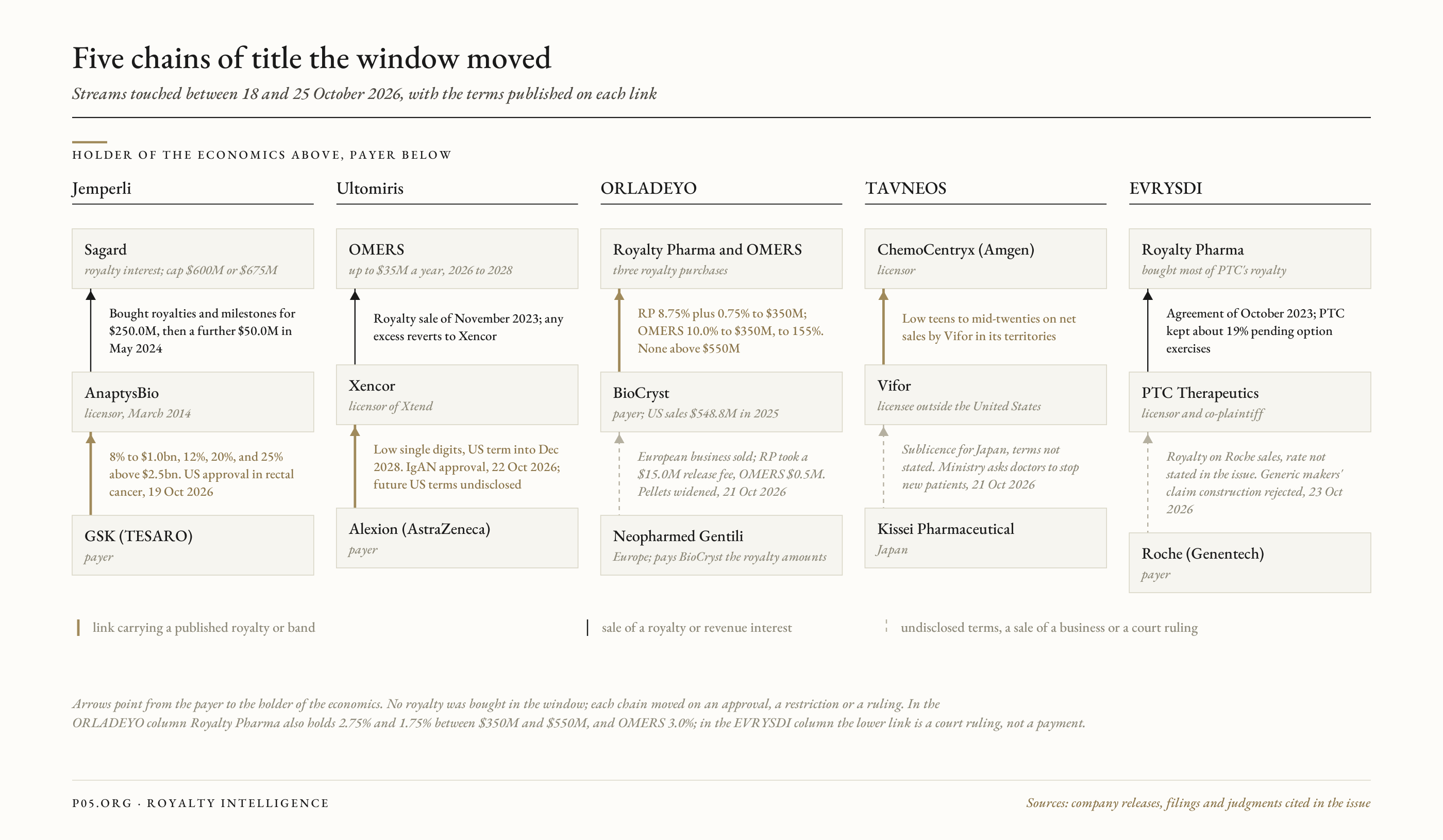
Five chains of title the window moved, holders of the economics above and payers below. Gold links carry a published royalty or band; dashed links carry undisclosed terms, a sale of a business or a court ruling.
Zelgen and AbbVie (Tuesday 20 October). Suzhou Zelgen Biopharmaceuticals (SSE: 688266) disclosed that it "近日收到艾伯维基于临床试验进展支付的1,000万美元近期里程碑付款" (recently received from AbbVie a USD 10m near-term milestone payment based on clinical trial progress) on ZG006 (alveltamig), after "1亿美元的首付款" (a USD 100m upfront payment) received early in the year.
Under the agreement of 30 December 2025, AbbVie holds development and commercialisation rights outside Greater China, and Zelgen is eligible for near-term and option payments of up to USD 60m, "最高达10.75亿美元的里程碑付款" (milestones of up to USD 1.075bn) and royalties on net sales outside Greater China "从高个位数到中双位数的阶梯式" (tiered from high single digits to mid double digits). The notice is announcement 2026-034, dated 21 October and released on the evening of 20 October.
RaQualia and Hisamitsu (Wednesday 21 October). RaQualia Pharma (TSE: 4579) announced that Hisamitsu Pharmaceutical has started a Phase 2 trial of a patch containing RaQualia's novel sodium channel blocker, so that "当社は久光製薬から契約に基づく一時金2億円を受領することが確定しました" (the company is confirmed to receive a JPY 200m lump sum from Hisamitsu under the agreement), about USD 1.4m.
Under the licence of December 2021 Hisamitsu holds worldwide exclusive rights, and RaQualia holds rights to "開発段階に応じたマイルストンならびに製品発売後に製品の売上高に応じた販売ロイヤルティおよび販売マイルストン" (development milestones and, after launch, sales royalties and sales milestones based on product sales). No band is stated. The payment is booked in the fourth quarter of 2026 and was already in the full-year forecast of 13 February.
GI Innovation and Maruho (Friday 23 October). GI Innovation (KOSDAQ: 358570) disclosed to the Korea Exchange a milestone of "$3,500,000" under its licence of 16 October 2023 with Maruho for GI-301 in Japan. The trigger is "일본 내 임상 2상 첫 환자 투여" (first patient dosed in the Phase 2 trial in Japan); the invoice is dated 23 October, and "기술료는 계약서에 의거하여 인보이스 발행 후 60일 이내 수령할 예정" (the fee is to be received within 60 days of the invoice under the contract).
The payment exceeds 10 per cent of GI Innovation's prior-year revenue of about USD 4.3m (KRW 5,838,086,757), which made the disclosure mandatory. No royalty rate is stated.
Orion (Tuesday 20 October). Orion (Nasdaq Helsinki: ORNBV) stated in an inside information release that its "royalty income has increased faster than expected during the first nine months of 2026, and this good development is anticipated to continue during the remainder of the year".
It raised its 2026 outlook to net sales of USD 2.41bn to 2.49bn (EUR 2,070m to 2,140m) and operating profit of USD 849m to 919m (EUR 730m to 790m), from USD 2.33bn to 2.44bn (EUR 2,000m to 2,100m) and USD 756m to 872m (EUR 650m to 750m) given on 17 July.
The release does not name the product or the payer of the royalty. The interim report for January to September is due on 28 October.
AstraZeneca and Dizal (Thursday 22 October). AstraZeneca (LSE, Nasdaq: AZN) announced "the US availability of ZEGFROVY® (sunvozertinib)" in non-small cell lung cancer with EGFR exon 20 insertion mutations after platinum-based chemotherapy. The indication carries accelerated approval, granted to Dizal in July 2025.
AstraZeneca took worldwide rights from Dizal (SSE: 688192) for "an upfront payment of $600m to Dizal together with additional payments of up to $900m", and "Dizal will receive tiered royalties on the global sales of Zegfrovy", per its completion release. Dizal's announcement 2026-037 puts the royalty at "最高到低双位数的阶梯式比例" (tiered rates of up to low double digits) on global sales.
HUTCHMED and GSK (Wednesday 21 October). HUTCHMED (Nasdaq, AIM: HCM; HKEX: 13) announced that, "following the completion of customary closing conditions including antitrust regulatory reviews", its exclusive development and licence agreement with a subsidiary of GSK "has closed". GSK holds "worldwide rights excluding Mainland China, Hong Kong, Macau and Taiwan" to HMPL-A830, an antibody conjugate with a KRAS inhibitor payload whose Phase I trial was initiated in September.
HUTCHMED "expects to receive US$110 million upfront payment shortly, and may receive additional development, regulatory and commercial milestone payments of up to a total of US$1.185 billion, as well as tiered royalties on annual net sales". No band is stated. The agreement was announced on 3 September.
Formycon, Biocelys and Santo Biosimilar (Tuesday 20 October). Formycon (FSE: FYB) disclosed as a related-party transaction a co-operation with Biocelys S.A. and Santo Biosimilar GmbH on a biosimilar candidate. Both counterparties are controlled by ATHOS KG, which holds more than 20 per cent of Formycon indirectly. The reference product is not named.
Formycon grants Santo "eine unbefristete, unwiderrufliche und unterlizenzierbare Lizenz an einer Klon-Zelle" (a perpetual, irrevocable and sublicensable licence to a clone cell) and provides development services, transferring "Rechte und Leistungen (einschließlich Zinsen) mit einem Zeitwert von EUR 40 – 45 Mio." (rights and services, including interest, with a fair value of USD 47m to 52m, EUR 40m to 45m). Santo finances the project and owns the results.
In return Formycon receives "eine prozentuale Beteiligung an den Erlösen der Santo Biosimilar GmbH im niedrigen zweistelligen Bereich, von welcher zunächst die Projektkosten einschließlich Zinsen abgezogen werden" (a low double-digit percentage share of Santo's revenues, from which project costs including interest are first deducted). "Eine Auszahlung der anteiligen Erlöse an die Gesellschaft wird voraussichtlich ab 2036 erfolgen" (payment of the share to the company is expected from 2036).
Collegium and Grünenthal: USD 17m ends the Nucynta royalty and the patent case (Monday 19 October)
Collegium Pharmaceutical (Nasdaq: COLL) disclosed in a current report under Item 1.02, filed at 20:05 UTC, that it has bought out the royalty it paid Grünenthal on its Nucynta franchise. No press release was found.
- The case: patent litigation in the United States District Court for the District of New Jersey, filed by Grünenthal in February 2026 "for patent infringement related to the launch of the authorized generic for Nucynta ER".
- The parties: Grünenthal GmbH, the licensor, against Collegium and Hikma Pharmaceuticals USA Inc., per the docket of Grünenthal GmbH v. Hikma Pharmaceuticals USA Inc., No. 2:26-cv-00999, before Judge Esther Salas. Hikma Pharmaceuticals PLC was dismissed from the case in June.
- The holding: a settlement of 15 October. "The parties mutually agreed to terminate the Grünenthal License in its entirety and the Consent Agreement solely with respect to the Territory", effective "following the Company's payment to Grünenthal of $17,000,000." Grünenthal also "assigned certain patents related to the Nucynta Products to the Company and filed a motion to dismiss the Nucynta Litigation." The docket records a notice of voluntary dismissal on 15 October and an order of dismissal on 16 October.
- The asset: Nucynta ER and Nucynta IR (tapentadol) and their authorised generics in the United States, acquired by Collegium in 2020.
- The licence or royalty at issue: Collegium was "obligated to make royalty payments directly to Grünenthal at rates of up to 14% of Net Sales (as defined therein) of the Nucynta Products, with the applicable rate determined based on the timing of certain patent expirations and when generic equivalents enter the market", per its quarterly report to 30 June 2026. "All obligations of the Company with respect to royalties under the Grünenthal License have been fully and finally discharged and no further royalties will be due".
- Instrument: termination of a royalty-bearing licence for a single cash payment, within a patent settlement.
- Royalty read-through: a royalty of up to 14 per cent on a marketed, genericising franchise ends for USD 17m. Counsel are not named.
Ultragenyx, Baylor Research Institute and Navinta: DOJOLVI generic entry set for 2033 (Monday 19 October)
Ultragenyx (Nasdaq: RARE) and Baylor Research Institute settled their patent case against Navinta over a generic of DOJOLVI (triheptanoin) oral liquid, per Ultragenyx's current report under Item 8.01, filed at 13:00 UTC. No press release was found.
- The case: patent litigation in the United States District Court for the District of New Jersey arising from Navinta's abbreviated new drug application for a generic DOJOLVI.
- The parties: Ultragenyx and Baylor Research Institute, the patent holders, against Navinta LLC.
- The holding: a settlement. "The Company will grant Navinta a non-exclusive, royalty-free license to market its generic version of DOJOLVI beginning January 1, 2033, which would be extended to July 1, 2033 if pediatric exclusivity is granted for DOJOLVI." "Similar patent litigation brought by the Company against other ANDA filers related to DOJOLVI remains pending." The agreement goes to the Federal Trade Commission and the Department of Justice. No payment is stated.
- The asset: DOJOLVI, approved in the United States for long-chain fatty acid oxidation disorders.
- The licence or royalty at issue: Ultragenyx licenses DOJOLVI from Baylor Research Institute and states in its annual report for 2025 that it pays a "royalty on net sales to BRI"; the rate is not disclosed.
- Instrument: patent settlement with a royalty-free generic entry licence.
- Royalty read-through: the settlement fixes the earliest generic entry by this filer at 1 January 2033, which bounds the term of the royalty owed to Baylor Research Institute on US sales unless the other cases end otherwise.
Phathom Pharmaceuticals, BDR Pharmaceuticals and the FDA (Friday 23 October). Phathom Pharmaceuticals (Nasdaq: PHAT) reported that BDR Pharmaceuticals International "has filed suit against the U.S. Food and Drug Administration (FDA) and related Federal Defendants in the United States District Court for the District of Columbia, principally challenging FDA's alleged refusal to receive an abbreviated new drug application (ANDA) referencing Phathom's new drug application (NDA) for VOQUEZNA". BDR alleges that the FDA "has improperly applied the GAIN Act to extend Phathom's New Chemical Entity (NCE) exclusivity".
Phathom states that the FDA "recognized 10 years of NCE exclusivity for VOQUEZNA tablets through May 3, 2032". The docket (No. 1:26-cv-03679, before Judge James E. Boasberg) shows the complaint filed on 21 October, with a motion for a preliminary injunction and a motion to expedite and consolidate the hearing with trial on the merits. A minute order of 22 October directs the parties to "appear for a scheduling hearing via zoom on October 26, 2026, at 10:00 a.m."
A motion to intervene was entered on 23 October; the movant is not named on the public docket. Phathom pays Takeda "tiered royalty payments averaging in the low double digits royalty rate on aggregate net sales", and its revenue interest investors "are entitled to receive a 10% royalty on net sales of products containing vonoprazan", per its annual report for 2025; the date of generic entry bounds both streams.
Genentech, Roche, PTC Therapeutics, Natco, Sun Pharma and Zydus (Friday 23 October). The United States District Court for the District of New Jersey issued an opinion and order on claim construction in the consolidated case (No. 24-10567) brought by Genentech, Hoffmann-La Roche and PTC Therapeutics over abbreviated new drug applications for generic EVRYSDI (risdiplam), the oral treatment for spinal muscular atrophy. The single disputed term was "crystalline Form A" in US Patent 12,122,789.
The defendants proposed "[t]he risdiplam crystalline form described in the specification as Form A, having all of the characteristics assigned to Form A in the specification." Judge Jennifer Choe-Groves, of the Court of International Trade sitting by designation, construed the term as "the crystalline anhydrous polymorphic Form A" of the named compound, without that requirement. No infringement or validity finding was made.
PTC Therapeutics sold most of its EVRYSDI royalty on Roche sales to Royalty Pharma and, after the agreement of October 2023, kept "approximately 19% of the Evrysdi royalty stream" pending option exercises, per its current report; the generic entry date bounds that stream.
Bristol Myers Squibb, Pfizer and TaiwanTah Biotech (Saturday 24 October). TaiwanTah Biotech (TWSE: 6467) disclosed that Bristol Myers Squibb and Pfizer brought a patent infringement suit in the United States District Court for the District of Delaware against BEQIA (TAH3311), its apixaban oral film filed under the 505(b)(2) route. The company "收到訴訟通知之日期為美國時間10月23日" (received notice of the suit on 23 October, US time); the filing gives no docket number.
The new drug application was resubmitted on 19 June 2026, with a "PDUFA Goal Date" of 22 April 2027. The company states that the case has "尚無重大影響" (no material impact) so far and that it continues "潛在合作機會洽談" (talks on potential partnerships). Apixaban is sold as ELIQUIS by the two plaintiffs; no licence or royalty is at issue.
Clinical and Regulatory
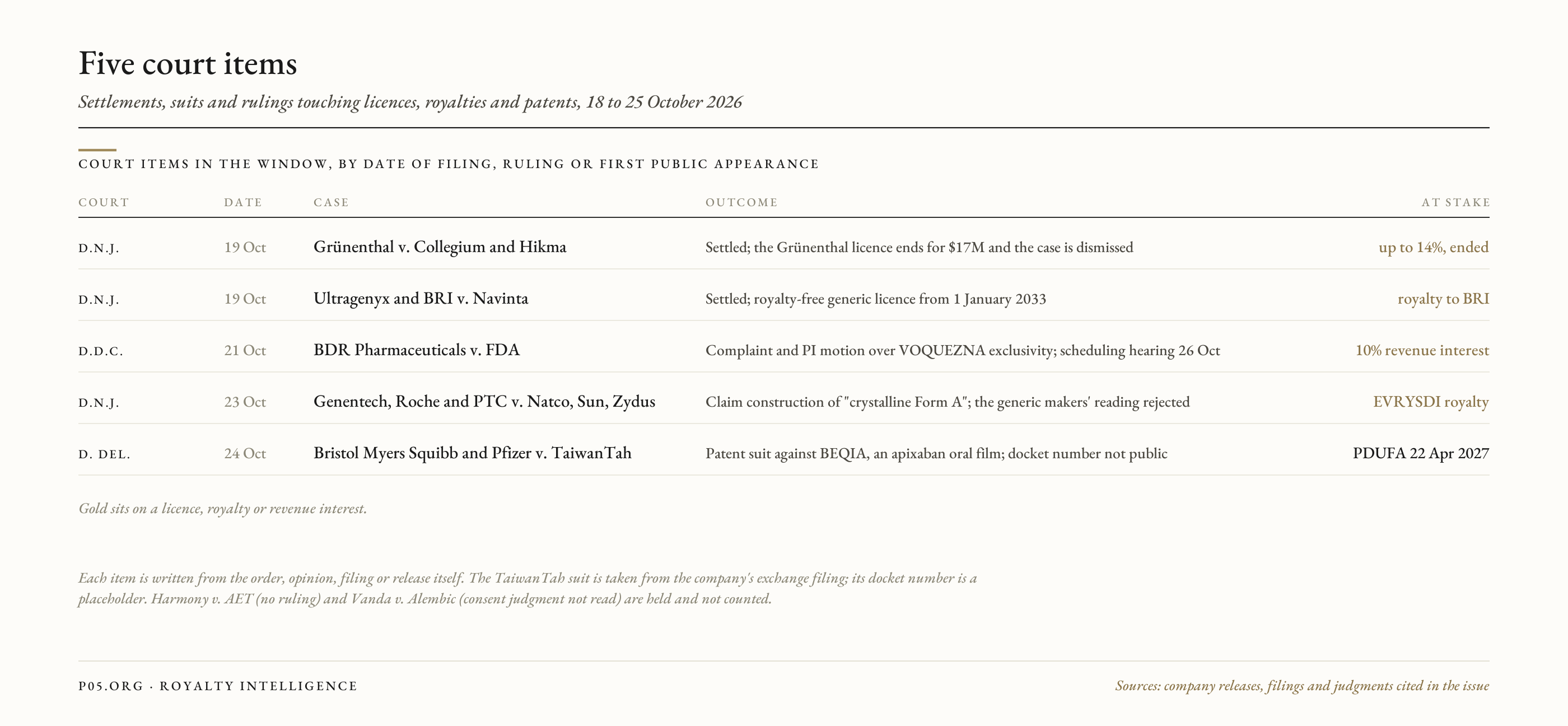
The five court items in the window, by court, date, outcome and what is at stake: two settlements, a suit against the FDA, a claim construction ruling and a new patent suit.
Disc Medicine and Roche: bitopertin meets every endpoint in Phase 3, ahead of a resubmission (Monday 19 October)
Disc Medicine (Nasdaq: IRON) announced at 07:00 ET that the APOLLO Phase 3 trial of bitopertin in erythropoietic protoporphyria "met all its primary and secondary endpoints". "Disc plans to resubmit an NDA to FDA by end of 2026, with an FDA decision anticipated by mid-2027."
- The licence: "Disc obtained global rights to bitopertin under a license agreement from Roche in May 2021."
- The royalty: Disc is "obligated to pay a royalty on annual net sales of licensed products at a tiered rate ranging from the high-single digits to the high teens", reduced "by 25% for lack of a valid claim" and "by 50% for prevalence of generic products", per its annual report for 2025.
- The milestones: "The next potential milestone payment is $15.0 million due upon regulatory approval in the United States", and Disc "will also pay Roche up to an aggregate of $120.0 million based on achievement of certain thresholds for annual net sales".
- Instrument: clinical readout under an existing in-licence.
- Financing: after the close on 19 October Disc announced "an underwritten public offering of $350 million of shares of its common stock and, in lieu of common stock to certain investors that so choose, pre-funded warrants", with "a 30-day option to purchase up to an additional $52.5 million". The proceeds are "to support the potential commercialization of bitopertin". "Jefferies, Leerink Partners, Morgan Stanley and Cantor are acting as joint book-running managers". The final prospectus supplement names Goodwin Procter as counsel to Disc and Wilmer Cutler Pickering Hale and Dorr as counsel to the underwriters.
- Pricing: on the evening of 20 October Disc priced the upsized deal: it "is selling 6,000,000 shares of common stock at a public offering price of $75.00 per share", for gross proceeds "expected to be $450 million", with "a 30-day option to purchase up to an additional 900,000 shares". "LifeSci Capital, BMO Capital Markets and H.C. Wainwright & Co. are acting as co-managers." Per its current report of 22 October, "The Offering closed on October 22, 2026", with net proceeds of "approximately $422.4 million", which with cash of "approximately $682.8 million" at 30 September fund operations "into 2030 without taking into account any potential net cash inflows from bitopertin".
- Royalty read-through: the result raises the likelihood that Roche's royalty, high-single digits to high teens, starts to pay after a decision expected by mid-2027. No stream moved yet.
EyePoint and Equinox: DURAVYU misses its second Phase 3 primary endpoint in wet AMD (Monday 19 October)
EyePoint (Nasdaq: EYPT) reported that LUCIA "did not achieve the primary endpoint of statistical non-inferiority in mean change in BCVA versus on-label aflibercept control". "LUGANO also did not meet the primary endpoint in its full dataset." The diabetic macular oedema programme continues, with two Phase 3 readouts "anticipated in Q4 2027".
- The licence: "Vorolanib is licensed to EyePoint exclusively by Equinox Sciences, a Betta Pharmaceuticals affiliate, for the localized treatment of all ophthalmic diseases outside of China, Macao, Hong Kong and Taiwan."
- The royalty: "The royalty rates range from the high-single digits to low-double digits depending on the level of annual net sales", payable until the later of twelve years after first commercial sale and generic launch, per EyePoint's annual report for 2025.
- Instrument: clinical readout under an existing in-licence.
- Next steps: in a second current report the same day, EyePoint said its board "approved a plan to reduce the Company's workforce by approximately 53% of employees and to conclude the pivotal Phase 3 wet AMD trials early". It expects annual savings of "approximately $30 million" and had "approximately $118 million in cash, cash equivalents, and short-term investments as of September 30, 2026".
- Royalty read-through: with the wet AMD trials ending early, the royalty to Equinox now rests on the diabetic macular oedema programme.
GSK, AnaptysBio and Sagard: Jemperli approved in locally advanced rectal cancer (Monday 19 October)
GSK announced that "the US Food and Drug Administration (FDA) has approved Jemperli (dostarlimab) as the first and only immunotherapy for adults with stage II and III microsatellite instability-high (MSI-H)/mismatch repair deficient (dMMR) locally advanced rectal cancer under the accelerated approval pathway". In the Phase II AZUR-1 trial, "68% of evaluable patients (98/144; 95% CI: 60%, 76%) achieved cCR12".
- The licence: "Jemperli was discovered by AnaptysBio, Inc. and licensed to TESARO, Inc., under a collaboration and exclusive license agreement signed in March 2014." TESARO is part of GSK.
- The royalty: AnaptysBio was "granted royalties upon sales of Jemperli, equal to 8% of Net Sales (as defined in the GSK Agreement) below $1.0 billion, 12% of Net Sales between $1.0 billion and $1.5 billion, 20% of Net Sales between $1.5 billion and $2.5 billion and 25% of Net Sales above $2.5 billion", per its transition report to 30 June 2026.
- The holder: AnaptysBio "received $250.0 million in exchange for royalties and milestones payable to us under our GSK collaboration on annual global net sales of Jemperli" from Sagard, and in May 2024 "sold additional receivables to Sagard in exchange for $50.0 million". Sagard's receipts are capped at "$600.0 million if received by the end of March 31, 2031, or $675.0 million if received thereafter".
- Instrument: regulatory approval of a new indication under an existing licence.
- Royalty read-through: the approval adds a US indication to the sales base on which the tiered royalty is paid, and so to the receipts counted towards Sagard's cap. No rate changed.
AstraZeneca, Xencor and OMERS: Ultomiris gains accelerated US approval in IgA nephropathy (Thursday 22 October)
AstraZeneca announced that "Alexion, AstraZeneca Rare Disease's Ultomiris (ravulizumab) has been approved in the US to reduce proteinuria in adults with primary immunoglobulin A nephropathy (IgAN) at risk for disease progression", based on a prespecified interim analysis of the I CAN Phase III trial showing a "43.4% reduction in proteinuria vs placebo at 34 weeks".
"Continued approval for this indication may be contingent upon verification and description of clinical benefit in the ongoing I CAN Phase III trial." It is the "fifth indication for Ultomiris", and filings are "under review in Japan and additional countries".
- The licence: Xencor (Nasdaq: XNCR) granted Alexion a licence to its Xtend technology in 2013, and "Alexion exercised its rights to one target program, ALXN1210, which is now marketed as Ultomiris", per Xencor's quarterly report to 30 June 2026.
- The royalty: Xencor "is entitled to receive royalties in the low single digits based on a percentage of net sales of Ultomiris", with a patent term extension carrying "the expected royalty term for Ultomiris® net sales into December 2028 in the United States".
- The holder: under the royalty sale agreement of November 2023, OMERS acquired "up to $35.0 million annually in royalties on future sales related to Ultomiris that occur from January 1, 2026 through December 31, 2028" and "up to $12.0 million annually" from 2029, with any excess "reverting to the Company".
- The dispute: on 4 March 2026 Alexion took the position "that it did not owe additional royalties for U.S. sales of Ultomiris". A settlement of 29 July led Xencor to recognise USD 27.6m for the period to 30 June, and "the remaining $77.4 million of settlement consideration relates to royalty rights for periods subsequent to June 30, 2026". Whether the settlement fixes future US royalties is not stated.
- Instrument: accelerated approval of a new indication under an existing licence.
- Royalty read-through: the approval widens the sales base of a low single-digit royalty partly held by OMERS; how US sales after June 2026 are paid under the settlement is not disclosed.
Cytokinetics and Royalty Pharma (Monday 19 October). Health Canada approved MYQORZO (aficamten) in symptomatic obstructive hypertrophic cardiomyopathy, which Cytokinetics (Nasdaq: CYTK) calls "the fifth regulatory approval for MYQORZO in less than a year". Royalty Pharma receives "4.5% up to $5.0 billion of worldwide annual net sales of aficamten and 1% above $5.0 billion", per Cytokinetics' annual report for 2025; the approval widens the sales base, not the rate.
Haemonetics and Vivasure (Monday 19 October). Haemonetics (NYSE: HAE) announced "U.S. Food and Drug Administration (FDA) approval of the PerQseal® Elite vascular closure system for large-bore arterial procedures", which came with its acquisition of Vivasure Medical in January 2026. That deal carried "up to an additional €85 million in contingent consideration based on sales growth and the achievement of certain other milestones", about USD 99m, per its January release.
The quarterly report to 27 June 2026 carries the contingent consideration at a fair value of USD 20.7m, "based on sales growth over the three years following the completion of the acquisition". Whether the approval is one of the milestones is not stated.
Veradermics (Monday 19 October). Veradermics (NYSE: MANE) reported that its second Phase 3 trial of VDPHL01, an oral extended-release minoxidil, in 536 men with pattern hair loss "met all primary and secondary endpoints". Target area hair count rose by 28.6 and 36.4 hairs per square centimetre on once and twice daily dosing, against 6.6 on placebo. No licence or royalty is stated.
TLC BioSciences (Monday 19 October). TLC BioSciences (TPEx: 7924) reported at 06:00 ET that TLC590 met the primary endpoint of its pivotal Phase 3 trial in 304 bunionectomy patients, reducing pain with movement over 72 hours against placebo (p=0.0024). It also beat liposomal bupivacaine on pain to 72 hours (p=0.0202), rescue opioid use (p=0.0177) and pain to 168 hours (p=0.0226).
The company is preparing a New Drug Application to the FDA and gives no date. No partner, licence or royalty is stated.
Abbott and Mayo Clinic (Tuesday 20 October). Abbott (NYSE: ABT) announced that "the Cologuard Plus® test has received CE Mark under the European Union's In Vitro Diagnostic Medical Devices Regulation (IVDR)". It "plans to introduce the test in select European markets, with the timing and availability varying by country". The test was "Developed in collaboration with Mayo Clinic".
Exact Sciences, the developer of Cologuard, states in its annual report for 2025 that it is "required to pay Mayo a low-single-digit royalty on the Company's net sales of current and future products using the licensed Mayo intellectual property". Whether the royalty reaches European sales is not stated.
GSK and Ionis (Tuesday 20 October). The FDA approved Hibsago (bepirovirsen), "in combination with existing antiviral therapy, to treat chronic hepatitis B virus (HBV) infection in certain adults without cirrhosis", six days before the action date of 26 October.
"The approval was granted to GSK plc." Across the two Phase 3 trials, "24% of patients who received Hibsago met the requirements to stop their existing medicine, compared with none who received placebo"; the label carries a "boxed warning for serious liver reactions as well as low platelet counts".
GSK's release of the same evening reports "a clinically meaningful 19% functional cure response rate (233 of 1,220 vs. 0 of 614 in the placebo group)" in the pooled B-Well data, a different measure from the FDA's. "Bepirovirsen is approved in Japan and the US." No price or launch date is given.
GSK licensed bepirovirsen from Ionis (Nasdaq: IONS) in 2019. Ionis repeated that it "is eligible to receive additional regulatory and sales milestone payments as well as tiered royalties of 10-12% on net sales of bepirovirsen", and named no milestone amount.
Its quarterly report to 30 June 2026 records an amendment under which the royalties run "on net sales of bepirovirsen worldwide, excluding China, Hong Kong and Macau", and states: "We will achieve the next payment of $35 million if bepirovirsen is approved in a major country other than China." The Japanese approval came after that report, so whether the US approval triggers a payment is not stated.
Dr. Reddy's and Junshi Biosciences (Wednesday 21 October). Dr. Reddy's (NSE: DRREDDY; NYSE: RDY) announced that the Indian regulator "has approved Zytorvi® (toripalimab) in combination with cisplatin and paclitaxel for the first-line treatment of adult patients with unresectable advanced, recurrent or metastatic esophageal squamous cell carcinoma (ESCC)", its second indication in India after nasopharyngeal carcinoma.
Dr. Reddy's "entered into a licensing and commercialization agreement with Junshi Biosciences in 2023 for toripalimab across 21 countries." Junshi's announcement of that agreement gives up to USD 728.3m in upfront, territory expansion and milestone payments, "plus double-digit percentage of royalties on the net sales of products containing toripalimab." India is in the initial territory. No Indian sales are stated.
BioCryst, Royalty Pharma and OMERS (Wednesday 21 October). BioCryst (Nasdaq: BCRX) announced that the FDA "has approved its supplemental New Drug Application (sNDA) for use of the oral pellet formulation of once-daily ORLADEYO® (berotralstat) for prophylactic therapy in adults and adolescents aged 12 years and older" with hereditary angioedema. The pellets were first approved in December 2025 for children aged 2 to under 12.
ORLADEYO carries three royalty sales, per BioCryst's annual report for 2025. Under the 2020 agreement Royalty Pharma receives 8.75% of annual net sales up to USD 350m and 2.75% between USD 350m and USD 550m. The 2021 agreement adds 0.75% and 1.75% on the same tiers, "in addition to the royalties payable to RPI under the 2020 RPI Royalty Purchase Agreement".
OMERS has received 10.0% up to USD 350m and 3.0% between USD 350m and USD 550m since January 2024, and "will no longer be entitled to receive any payments" once it has received 155.0% of its USD 150m purchase price. No royalty is payable on annual direct sales above USD 550m. The tiers apply to direct sales in the United States, certain European markets and other markets served directly or through distributors.
- Sales against the thresholds: ORLADEYO US net sales were USD 548.8m in 2025, and total ORLADEYO revenues USD 601.8m.
- Payments in 2025: royalties of USD 37.3m and USD 6.3m to Royalty Pharma under the two agreements and USD 42.1m to OMERS. On the sale of the European business to Neopharmed Gentili, Royalty Pharma received a USD 15.0m release fee and OMERS USD 0.5m; BioCryst now receives from the buyer amounts equal to the royalties owed on European sales.
- Instrument: label extension under existing royalty purchase agreements.
- Royalty read-through: with US net sales alone at USD 548.8m in 2025, close to the USD 550m level above which no royalty is payable, additional sales from the new formulation add little or nothing to the royalties.
Merck, Pfizer, Astellas and Ono (Wednesday 21 October). Merck (NYSE: MRK) announced that the European Commission approved KEYTRUDA plus Padcev as perioperative treatment for muscle-invasive bladder cancer, the "first and only PD-1 inhibitor plus antibody-drug conjugate regimen approved in the European Union (EU) for patients with MIBC regardless of cisplatin eligibility". The approval rests on the Phase 3 KEYNOTE-B15 trial, "conducted in collaboration with Pfizer and Astellas", in which the regimen cut the risk of event-free survival events by 47% (HR=0.53).
Merck pays a royalty on global KEYTRUDA sales under its 2017 patent settlement, per Ono's announcement: "2.5% from January 1, 2024 through December 31, 2026", with royalties "shared between ONO and BMS in a 25/75 percent allocation, respectively." The royalty ends ten weeks after the approval.
Kissei Pharmaceutical (Thursday 22 October). Kissei Pharmaceutical (TSE: 4547) reported that Japan's Ministry of Health, Labour and Welfare asked medical institutions on 21 October "新規の患者については、本剤の投与開始を差し控えること" (to refrain from starting new patients) on TAVNEOS (avacopan), and to consider "中止又は代替治療への切替えを原則として" (as a rule, stopping or switching to alternative treatment) for patients already on it.
The ministry's committee found that "承認審査時の提出資料の信頼性に問題があり得る" (the reliability of the data submitted for approval may be in question) and that it is "困難" (difficult) to judge that benefit outweighs risk. Kissei says the drug was created by ChemoCentryx in the United States and that it is examining the effect on its results. The release does not state the licence terms.
The ministry's notice of 21 October records that "欧州では、本年8月に承認を取消済み" (in Europe the approval was revoked in August) and that the United Kingdom plans to revoke it on 1 March 2027.
ChemoCentryx, now part of Amgen, licensed avacopan outside the United States to Vifor, "and Vifor has in turn sublicensed its right to commercialize TAVNEOS in Japan to its sublicensee Kissei"; ChemoCentryx receives "royalties, with rates ranging from the low teens to the mid-twenties, on future potential net sales of TAVNEOS by Vifor in the licensed territories", per its annual report for 2021.
Harbour BioMed, CSPC and HanAll Biopharma (Friday 23 October). HBM Holdings (HKEX: 2142) announced before the Hong Kong open that China's National Medical Products Administration approved batoclimab subcutaneous injection "as an add-on to standard therapy for the treatment of generalized myasthenia gravis" in adults who are anti-acetylcholine receptor antibody positive. "Batoclimab SC is the first approved product of the Group". In the Phase 3 trial "58.2% of patients treated with batoclimab SC achieved the primary endpoint, compared with 31.3% in the placebo group (P=0.001)."
"Pursuant to the license agreement entered into between the Group and NBP Pharma in October 2022, a subsidiary of CSPC Pharmaceutical Group is responsible for the commercialisation of batoclimab in Greater China". "The Group is entitled to receive tiered royalties based on annual net sales of batoclimab in Greater China." No band is stated.
"Batoclimab was originally developed by HanAll Biopharma Co., Ltd. ("HanAll") and licensed to Harbour BioMed in 2017". The announcement does not state what Harbour BioMed owes HanAll (KRX: 009420). Per Hankook Ilbo, "한올바이오파마는 하버바이오메드로부터 이번 품목허가에 따른 마일스톤(단계별 수수료)를 비롯해 향후 연간 순매출에 따른 로열티를 수취할 예정이다" (HanAll expects to receive from Harbour BioMed a milestone on this approval and royalties on future annual net sales). No amount or rate is disclosed.
Johnson & Johnson and Genmab (Friday 23 October). Johnson & Johnson (NYSE: JNJ) announced that "the European Commission (EC) has approved an indication extension of TECVAYLI (teclistamab) for the treatment of adult patients with relapsed/refractory multiple myeloma (RRMM) who have received at least one prior therapy".
In the MajesTEC-9 trial teclistamab reduced the risk of progression or death by 71 per cent "(hazard ratio [HR], 0.29; 95% confidence interval [CI], 0.23-0.38; p <0.001)" and the risk of death by 40 per cent "(HR, 0.60; 95% CI, 0.43-0.83; p = 0.002)" against standard of care.
Genmab (Nasdaq: GMAB) "receives a mid-single digit royalty on net sales of TECVAYLI subject to a reduction of such royalty payments in countries and territories where there are no relevant patents, among other reductions", per its annual report for 2024.
Johnson & Johnson and Protagonist (Friday 23 October). The UK Medicines and Healthcare products Regulatory Agency approved "icotrokinra hydrochloride (Icotyde) for the treatment of moderate to severe plaque psoriasis in adults and adolescents aged 12 years and older who weigh at least 40 kg and are candidates for systemic therapy". Authorisation "was granted on 23 October 2026 to Janssen-Cilag Limited".
Protagonist Therapeutics (Nasdaq: PTGX), the originator, is eligible for "upward tiering royalties on net product sales at percentages ranging from 6% percent to 10% percent, with 10% percent applicable for net sales over $4.0 billion", per its annual report for 2024. No milestone tied to the UK approval is stated.
ALK-Abelló and GenSci (Monday 19 October). ALK-Abelló (Nasdaq Copenhagen: ALK B) reported that its Phase 3 trial of ACARIZAX in 327 Chinese participants with house dust mite allergy "met the primary objective". "ALK will now work with its partner GenSci to file for regulatory approval of ACARIZAX® in China. Filing is expected in first half of 2027."
Subject to approval, the tablet "will be added to GenSci's portfolio under the partnership agreement announced in September 2025". No royalty or milestone term is stated.
Roivant, Priovant and Pfizer (Wednesday 21 October). Roivant (Nasdaq: ROIV) and Priovant reported positive results in the CLARITY-1 and CLARITY-2 Phase 3 trials of brepocitinib in non-infectious uveitis. "Priovant intends to file a supplemental New Drug Application (sNDA) for brepocitinib for treatment of NIU in the first half of calendar year 2027."
Brepocitinib is licensed from Pfizer: "Priovant is obligated to pay Pfizer a tiered, sub-teens royalty on aggregate net sales of its licensed products in Priovant's territory", plus "a mid tens-of-millions sales milestone payment", per Roivant's annual report for the year to 31 March 2026.
AbbVie (Thursday 22 October). AbbVie (NYSE: ABBV) reported that the Phase 3 INTREPID trial of lutikizumab, an IL-1α/1β antagonist, in adults and adolescents with moderate to severe hidradenitis suppurativa "met its primary endpoint and 8 ranked secondary endpoints". HiSCR75 at Week 16 was 31.4% against 23.4% on placebo (p≤0.001).
The safety profile was "similar to prior studies, with no new safety concerns identified". Lutikizumab is AbbVie's own antibody; no licence or royalty is stated.
Merck and Moderna (Thursday 22 October). Merck (NYSE: MRK) and Moderna (Nasdaq: MRNA) released the full results of the Phase 3 INTerpath-001 trial of intismeran autogene, an individualised mRNA neoantigen therapy, with KEYTRUDA in 1,137 patients with resected stage IIB to IV melanoma. The combination "significantly reduced the risk of recurrence or death by 42% (HR=0.58 [95% CI, 0.45–0.75]; two-sided p<0.001)" against KEYTRUDA alone, and "the two-year RFS rate was 82.2%" against 70.0%.
The topline was announced in August; the results are to be presented at the ESMO Presidential Symposium and "have been accepted for publication in The New England Journal of Medicine". Moderna and Merck "will share costs and any profits and losses worldwide related to mRNA-4157 equally", per Moderna's annual report for 2024. No royalty is stated.
The figures first appeared on a medical news site at about 12:30 ET, before the embargo for the congress lifted, and the companies released the results at 14:59 ET. Moderna's shares "slumped about 18% on Thursday" from a close of USD 245.81 the day before, per Yahoo Finance and its earlier report. Merck fell 1.8 per cent, per the same page.
Innovent and Takeda (Friday 23 October). Innovent Biologics (HKEX: 01801) presented at ESMO the second interim analysis of the Phase 3 G-HOPE-001 trial of arcotatug tavatecan, a CLDN18.2 antibody-drug conjugate, in previously treated gastric or gastro-oesophageal junction adenocarcinoma. "The median OS was 10.2 months in the arcotatug tavatecan group versus 6.9 months in the TPC group, representing a 43% reduction in the risk of death (HR=0.57, 95% CI: 0.45–0.73; P<0.0001)".
The progression-free survival result had been reported earlier; the overall survival result is new. The Chinese application "is currently under priority review". Takeda holds "exclusive global rights to develop, manufacture and commercialize IBI343 outside of Greater China" and pays "tiered royalties on net sales up to high-teens for the license of IBI343", per Innovent's release of October 2025.
Genmab (Friday 23 October). Genmab (Nasdaq Copenhagen and Nasdaq: GMAB) reported that the Phase 3 RAINFOL-02 trial of rinatabart sesutecan (Rina-S), a topoisomerase I inhibitor antibody-drug conjugate, in platinum-resistant ovarian cancer "met its primary endpoint of progression-free survival (PFS) and its key secondary endpoint of overall survival (OS)" against investigator's choice chemotherapy. In all 584 randomised patients, Rina-S "demonstrated a 71% reduction in the risk of disease progression or death (HR 0.29; 95% CI, 0.23-0.37; p<0.0001)"; the overall survival hazard ratio was 0.43.
It is "the first Phase 3 readout from our Rina-S program", and Genmab "plans to engage with regulatory authorities worldwide regarding potential next steps". Rina-S "is a trademark of ProfoundBio, US, Co. and Genmab (Suzhou) Co., Ltd."; no licence, milestone or royalty is stated.
Orion and Bayer (Saturday 24 October). Orion (Nasdaq Helsinki: ORNBV) reported that in the interim analysis of the Phase 3 DASL-HiCaP trial, darolutamide added to androgen deprivation and radiation therapy in prostate cancer at high risk of recurrence produced "a 58% reduction in the risk of metastasis or death" against placebo "(hazard ratio [HR] 0.42; 95% CI: 0.27–0.66; p=0.0001)". The overall survival hazard ratio was 0.88 (95% CI 0.49 to 1.59).
The investigator-initiated trial of 1,106 patients, run by the University of Sydney and the ANZUP group, "represents the first Phase III study of darolutamide in early prostate cancer". Bayer sells darolutamide as NUBEQA, and "Orion is entitled to receive annually tiered royalties on global darolutamide sales"; "The total annual royalty rate is approximately 20% including product sales to Bayer", per Orion's release of February 2022.
Pathalys Pharma (Friday 23 October). Pathalys Pharma, a private US company, reported after the US close at ASN Kidney Week that its calcimimetic upacicalcet "met the primary endpoint and prespecified secondary endpoints in two pivotal Phase 3 studies, PATH-1 and PATH-2", in secondary hyperparathyroidism in patients on haemodialysis. No earlier topline release was found.
Pathalys "retains worldwide commercial rights to upacicalcet, outside Japan and Asia", and in January 2023 it raised USD 150m in "Secured Product Financing and Equity led by Abingworth", with the "option to prepay its obligations in full at any time", per its release. The licensor and any royalty owed are not stated.
Public capital and debt.
TriGemX Bio and TCGX Acquisition Corp. (Monday 19 October). TriGemX Bio, the former Kallyope, agreed a business combination with TCGX Acquisition Corp. (Nasdaq: TCGX), with "a concurrent $160 million PIPE financing of common stock at $10.00 per share" from TCGX, Viking Global Investors, ADAR1 Capital Management, BVF Partners, Samsara BioCapital and Vianti Capital among others. Gross proceeds are "approximately $246 million", including about USD 86m in trust before redemptions, and the post-transaction equity value is "approximately $600 million".
The proceeds fund Phase 3 development of elismetrep, an oral treatment for migraine. Completion is expected in the first quarter of 2027, under the ticker TGEM. No licence or royalty is stated.
Ondine Biomedical (Tuesday 20 October). Ondine Biomedical (AIM: OBI) confirmed "total gross proceeds from the Placing and the Subscription are £10 million", about USD 13.5m, from "100,000,000 new Common Shares at 10p per share". The chief executive subscribed for about USD 1.4m (GBP 1.06m).
The result closed the AIM capital access window and restored trading. The proceeds "are expected to provide the Company with a cash runway into early 2028". Peel Hunt acted as bookrunner and Strand Hanson as nominated adviser. No licence or royalty is stated.
Dogwood Therapeutics (Monday 19 October). Dogwood Therapeutics (Nasdaq: DWTX) agreed "a $5 million investment from the Company's largest shareholder, a subsidiary of CK Life Sciences Int'l." for 4,098,360 shares at USD 1.22. "No warrants or other derivative securities are included in the transaction." Closing is expected "on or prior to October 29, 2026".
The proceeds fund Phase 3 preparation for Halneuron, whose Phase 2b trial in chemotherapy-induced neuropathic pain reads out in November 2026, and "extend operational runway through March 2027". No licence or royalty is stated.
Lycia Therapeutics (Tuesday 20 October). Lycia Therapeutics set terms for its initial public offering in an amended registration statement of 14,700,000 shares at an expected price "between $16.00 and $18.00 per share", on the Nasdaq Global Select Market under the symbol LYCA.
On the evening of 22 October Lycia priced "its upsized initial public offering of 17,640,000 shares of its common stock at an initial public offering price of $18.00 per share", with gross proceeds, before underwriting discounts and expenses, "expected to be approximately $317.5 million" and "a 30-day option to purchase up to an additional 2,646,000 shares". Trading starts on 23 October, and "The offering is expected to close on October 26, 2026".
Lycia is "conducting a Phase 1 clinical trial of LCA-0061", an IgE degrader. "Jefferies, TD Cowen, Evercore ISI and Guggenheim Securities are acting as joint book-running managers for the offering." Fenwick & West is company counsel and Cooley underwriters' counsel, per the final prospectus of 22 October, which also states: "In November 2025, we were notified of Lilly's election to terminate the Lilly Agreement without cause, which became effective on February 12, 2026." No licence milestone or royalty remains under that agreement.
Surrozen (Tuesday 20 October). Surrozen (Nasdaq: SRZN) closed the second tranche of its March 2025 private placement for about USD 95.1m. Per its current report, it issued 5,741,605 shares at USD 11.60, pre-funded warrants for 2,456,500 shares and Series E warrants for 4,099,052 shares at an exercise price of USD 11.54.
The tranche "was triggered by FDA clearance of the Company's Investigational New Drug (IND) application for SZN-8141 on October 2, 2026", and the company expects a "cash runway into 2029". No licence or royalty is stated.
Teknova (Tuesday 20 October). Alpha Teknova (Nasdaq: TKNO), a US maker of reagents for cell and gene therapy and other life science customers, announced after the US close "the pricing of its underwritten public offering of 8,000,000 shares of its common stock at a price to the public of $5.00 per share", for gross proceeds "expected to be $40 million", with a 30-day option for 1,200,000 further shares.
Closing is expected on about 22 October. Per the final prospectus supplement, TD Securities and William Blair are the representatives of the underwriters and proceeds before expenses are USD 37.6m.
The proceeds are for "general corporate purposes, including potentially the repayment of outstanding debt obligations". TD Cowen and William Blair are joint book-running managers, Craig-Hallum lead manager, Stephens and Roth Capital Partners co-managers, and Perella Weinberg Partners financial adviser to Teknova. The final prospectus supplement names Paul Hastings as counsel to Teknova and DLA Piper as counsel to the underwriters. No licence or royalty is stated.
Adocia (Tuesday 20 October). Adocia (Euronext Paris: ADOC) announced "un financement de 7 millions d'euros" (a financing of EUR 7m, USD 8.1m): a share issue of USD 3.5m (EUR 3m gross) through "1 477 934 actions ordinaires nouvelles, au prix de 2,04 euros par action" to its directors, its chief executive and a small group of existing investors, and a USD 4.7m (EUR 4m) increase in the current-account advance from Vester Finance, repayable in new shares or cash.
Adocia had EUR 8.4m of cash, enough to early in the second quarter of 2027; with the advance and cost cuts the runway reaches the first quarter of 2028, and to 2029 if it receives "le paiement d'étape de 20 millions de dollars sous condition de l'approbation de BC Lispro en Chine" (the USD 20m milestone conditional on approval of BC Lispro in China).
Arcus Biosciences (Wednesday 21 October). Arcus Biosciences (NYSE: RCUS) announced after the US close "the pricing of an underwritten public offering of 14,285,715 shares of its common stock at a price to the public of $17.50 per share", for gross proceeds "expected to be $250.0 million", with "a 30-day option to purchase up to 2,142,857 additional shares". Per the final prospectus supplement, net proceeds will be "approximately $234.5 million", and the underwriters expect to deliver the shares "on or about October 23, 2026".
"Jefferies, Leerink Partners, TD Cowen, Evercore ISI and Mizuho are acting as joint book-running managers." Per the preliminary prospectus supplement, the proceeds fund "the expansion and acceleration of our clinical development program for casdatifan"; Latham & Watkins acts for the company and Gunderson Dettmer for the underwriters. In a current report of 21 October Arcus estimated that it had "approximately $694.0 million in cash, cash equivalents and marketable securities as of September 30, 2026". No licence or royalty term changes.
On 23 October Arcus reported that "the Offering closed and the Company completed the sale and issuance of an aggregate of 16,428,572 shares of Common Stock, including the exercise in full of the Underwriters' Option", for "net proceeds of approximately $269.7 million". The underwriters bought the shares "at a price of $16.45 per share".
Zai Lab (Thursday 22 October). Zai Lab (Nasdaq: ZLAB; HKEX: 9688) agreed a private placement of 11,340,000 American depositary shares at USD 22.04, "no discount to the closing price per ADS of US$22.04 as quoted on Nasdaq on October 22, 2026". "The gross proceeds of the Private Placement are expected to be approximately US$249,933,600", and net proceeds about USD 241.2m. The new shares are "approximately 9.97% of the existing issued Ordinary Shares".
"The Private Placement is led by TCGX and includes participation from other new and existing investors including abrdn World Healthcare Fund, ADAR1 Capital Management, Balyasny Asset Management, Cormorant Asset Management, Frazier Life Sciences, RA Capital Management, RTW Investments, Sirenia Capital Management LP, Wellington Management, and Woodline Partners LP."
The proceeds support the "continued global development of zocilurtatug pelitecan (zoci), the Company's Delta-like ligand 3 (DLL3)-targeting antibody-drug conjugate (ADC)". "The PIPE financing is expected to close on or about October 27, 2026, subject to customary closing conditions." Leerink Partners is exclusive placement agent and Ropes & Gray legal adviser to Zai Lab, per the release. No licence or royalty term changes.
Nanologica (Friday 23 October). Nanologica (Nasdaq Stockholm: NICA), a maker of silica media for drug purification, resolved on a partly guaranteed rights issue of units of up to about USD 11.6m (SEK 110.5m), with an option for a further USD 1.1m (SEK 10m). The "Subscription price: SEK 1.68 per unit. Each unit consists of ten (10) new shares".
Commitments, guarantees and a guarantee intention cover "appx. SEK 85.7 million in total", or "appx. 77.6 percent of the Rights Issue". They come from the principal owner Flerie Invest, Ardena, the partner Sterling Pharma Solutions, partly by set-off, and Bergs Securities, whose bottom guarantee is a letter of intent.
The subscription period is expected to run from 3 November. "The Board of Directors assesses that the net proceeds from the Rights Issue are sufficient to finance the Company until the Company achieves positive cash flow." No licence or royalty is stated.
Kubota Pharmaceutical Holdings (Friday 23 October). Kubota Pharmaceutical Holdings (TSE Growth: 4596) resolved to issue two series of warrants by third-party allotment: the 41st series to EVO FUND, under a purchase agreement with a partial exercise commitment, and the 42nd series to its chairman and chief executive, Ryo Kubota. Each series covers 20,000,000 shares at an initial exercise price of JPY 60, and the exercise price of the 41st series resets every two trading days, with a floor of JPY 30.
At the initial price the total is about USD 16.5m (JPY 2,401.8m), with estimated net proceeds of about USD 16.3m (JPY 2,380.55m), for research on and commercialisation of emixustat and for working capital. Allotment is set for 9 November.
Kubota received a first milestone on 2 July under a supply and licence agreement of 2 March with Laboratoires KÔL for the supply of emixustat under the French compassionate use programme; the amount is not stated. Cash was about USD 10.8m (JPY 1,580m) at 30 June, and the company states that "continuing funding needs are expected".
Biovica International (Friday 23 October). Biovica International (Nasdaq First North: BIOVIC B), a Swedish maker of a blood test that monitors cancer treatment, reported that its rights issue of up to 97,303,733 new B shares "is therefore fully subscribed": about 49.97 per cent with subscription rights, 21.14 per cent without, and 28.89 per cent "allocated to HDF Cancer Monitoring BV ("HDF") in its capacity as guarantor".
"Assuming that ISP approves HDF's investment, the Company will receive proceeds of approximately SEK 29.2 million before deduction of costs", about USD 3.1m; allocation to HDF above about 29.9 per cent of the votes awaits the Inspectorate of Strategic Products. Zonda Partners is financial adviser and Baker McKenzie legal adviser. No royalty is stated.
Windward Bio (Friday 23 October). Windward Bio Group, a Basel-based developer of antibodies for respiratory disease, made public its registration statement for an initial public offering on the Nasdaq Global Market under the symbol "WWB". No price range is set. Jefferies, TD Cowen, Piper Sandler and UBS Investment Bank are named on the cover, and Cooley and Niederer Kraft Frey are counsel to the company.
WIN378, an antibody against thymic stromal lymphopoietin (TSLP), "is currently being evaluated in POLARIS-1, a Phase 2/3 study in severe uncontrolled asthma"; the Phase 3 portion began in September 2026. Windward licensed it from Kelun-Biotech and Harbour BioMed for upfront payments that "totaled $40.0 million", half in its own equity.
It owes them development milestones of up to USD 320m, commercial milestones of up to USD 600m per product and "low single-digit to low double-digits tiered royalties (a spread of not more than 5 percentage points) on net sales". Up to 50 per cent of the first seven development milestones, "up to $73.75 million", may be paid in shares after the offering.
For WIN027, licensed from Qyuns Therapeutics, Windward "paid Qyuns an upfront fee of $15 million and granted Qyuns a certain equity interest valued at $15 million", and owes development milestones of USD 100m, commercial milestones of up to USD 570m and "mid-single digit to high-single digit tiered royalties on net sales". Cash, cash equivalents and marketable securities were USD 207.3m at 30 June 2026.
Structured capital.
Invion (Wednesday 21 October). Invion (ASX: IVX) announced that Point8 "has committed to provide a multi-year co-funding facility of up to A$25 million, covering 50% of clinical trial invoices", about USD 17.7m. In return Invion grants options over 10 per cent of its issued capital that "can only be exercised if Point8 provides the funding and if Invion successfully commences Phase 3 trials"; the grant needs shareholder approval.
Rockford Capital provides "a R&D tax incentive (RDTI) financing facility of up to A$7.5 million (in aggregate) in FY27 and FY28", about USD 5.3m, at an "Interest rate of 16.0% a year and a drawdown fee of 1.50%", with "a final maturity date of 30 April 2029". No repayment or royalty is stated for the Point8 funding.
Verrica Pharmaceuticals (Thursday 22 October). Verrica Pharmaceuticals (Nasdaq: VRCA) announced that it "has achieved the pre-defined revenue, growth and operational milestones required to increase the maximum commitment amount" under its credit facility with "an entity controlled by Paul B. Manning", the chairman of its board. "The full $27.5 million of non-dilutive capital under the facility is now available to Verrica, with the first $12.5 million having been funded in September."
Borrowings bear interest at one-month SOFR "plus 8.00% per annum, subject to a SOFR floor of 4.50%", all "payable in kind"; the loans "will mature on December 31, 2030" and the facility "is secured by substantially all of the assets of Verrica and certain subsidiaries". The money funds two pivotal trials of YCANTH in common warts, reading out in the first quarter and in mid-2027. No royalty is stated.
Private funding.
Nouscom (Monday 19 October). Nouscom, a private company in Basel, announced "the closing of an oversubscribed €120 million ($135 million) Series D financing", co-led by M Ventures and Revelation Partners. The new investors are Angelini Industries, "the European Investment Bank (through Aurea, its co-investment facility with Angelini Ventures)" and "Neva SGR (Intesa Sanpaolo Group)"; existing investors including 5AM Ventures, Andera Partners and Angelini Ventures took part.
The proceeds fund NOUS-209, an off-the-shelf neoantigen vaccine, "through a single, global, registration-enabling clinical trial for cancer interception in Lynch Syndrome (LS) carriers". No licence or royalty is stated.
ZAP Surgical Systems (Monday 19 October). ZAP Surgical Systems, a private US maker of the ZAP-X robotic radiosurgery system, announced that it "has secured $36 million in financing led by Catalio Capital Management", "with continued support from Baheal, ZAP's strategic partner in China". The release cites nearly 10,000 patients treated worldwide. The instrument and the valuation are not stated, and no licence or royalty is disclosed.
Ruichu Pharmaceutical (Wednesday 21 October). Ruichu Pharmaceutical (瑞初医药), a private company in Nanjing developing drugs that target ageing cells, completed "数亿元超额认购A轮融资" (an oversubscribed Series A of several hundred million yuan), per Pedaily. The investors are Cathay Capital (凯辉基金), 复健资本, Efung Capital (倚锋资本) and Huatai GenScript (华泰金斯瑞).
The proceeds are to "加速推进公司已在临床阶段的创新药管线" (accelerate the company's clinical-stage pipeline), led by programmes in Phase 1. The exact amount is not disclosed and no company release was found. No licence or royalty is stated.
Arctic Therapeutics (Wednesday 21 October). Arctic Therapeutics, a private company in Reykjavik, announced "the closing of an oversubscribed $21.5 million financing round", led by Pekron, Investcorp-backed Sanos Group, Kaldbakur and Landvættir, a fund managed by AxUM Securities.
The proceeds are to advance AT-002 and AT-003 towards the clinic. Its lead programme AT-001 has completed "the 12-month core treatment period of its pivotal Phase IIb/III study" in a rare hereditary dementia, and the company is "advancing partnering and out-licensing activities for AT-001 and AT-004". Arctica Finance and BBA//Fjeldco advised. No licence or royalty is stated.
Promaxo (Thursday 22 October). Promaxo, a private company in Oakland, California, announced "the initial close of its Series C financing, with participation from New Science Ventures and Amara Ventures, as well as the successful closing of a $100M credit facility". Its portable MRI system "is the first in the United States to receive FDA 510(k) clearance for prostate biopsy and treatment" across healthcare settings.
The capital funds manufacturing capacity, backlog reduction and new regulatory filings. The equity amount and the lender are not named, and no licence or royalty is stated.
4Tissue (Thursday 22 October). 4Tissue, a private Belgian medtech company, announced "a €7 million Series A financing round", about USD 8.1m, and the appointment of Stéphanie Dupont as chief executive. The round funds the first-in-human study of an injectable, bioresorbable hydrogel for breast reconstruction and manufacturing scale-up. Virginie Saverys is the only investor named; no licence or royalty is stated.
Warp Sciences (Thursday 22 October). Warp Sciences, a private US company, announced that it "today emerged from stealth with $215 million in funding" to build "a U.S.-based chemistry contract research organization (CRO)" that combines chemists, AI and robotics. Its first service is "lead optimization analog synthesis", and it "has no proprietary drug pipeline".
The round "was led by Lightspeed, with participation from Premji Invest, Mayfield, IVP, Lux, Conviction, Menlo Ventures" and twelve further funds. Kevin Weil, formerly chief product officer at OpenAI, is co-founder and chief executive. The round type and valuation are not stated in the release, and no licence or royalty is stated.
TriOar (Thursday 22 October). TriOar, a private Korean developer of masked antibodies and antibody-drug conjugates, completed a "330억원 규모의 투자 유치" (financing of KRW 33bn), about USD 24.1m, in a Series C, per The Bio News. New investors include the Korea Development Bank and DS Asset Management; a second tranche of KRW 9bn came mainly from existing investors, taking the total raised to "770억원" (KRW 77bn), about USD 56.2m.
No company release was found, and no licence or royalty is stated.
Inossia (Wednesday 21 October). Inossia, a private company in Stockholm developing a bone cement softener for osteoporotic vertebral fractures, completed a financing of about USD 9.3m (SEK 88m) through a rights issue and a directed issue "primarily subscribed by Cradle Growth and the EIC Fund".
"The financing is structured in two tranches, with approximately 50 percent of the capital paid upon completion of the offering and the remaining amount to be invested upon FDA clearance of the product in the United States." "Aurelia Partners acted as financial advisor to Inossia in connection with the financing". No licence or royalty is stated.
Star Therapeutics (Friday 23 October). Star Therapeutics, a private company in South San Francisco, announced "a $200 million private financing". The round "follows the July 2026 acquisition of Star subsidiary Vega Therapeutics and was co-led by OrbiMed and Janus Henderson Investors", with Agent Capital, Catalio Capital Management, Cormorant Asset Management, New Leaf Venture Partners, NYBC Ventures, RA Capital Management, Redmile, Sofinnova Investments, Soleus Capital "and a leading sovereign wealth fund".
Incyte bought Vega "for up to $2 billion". The proceeds support the advance of preclinical programmes; no round letter, valuation, licence or royalty is stated.
Pathos AI and Alphamab Oncology (Friday 23 October). Pathos AI, a private company in New York, announced "the closing of a $237 million Series E financing round at a post-money valuation of approximately $3 billion. The financing was led by Bristol Myers Squibb". The proceeds go first to JSKN016, a TROP2/HER3 bispecific antibody-drug conjugate, "toward registrational studies".
The same day Alphamab Oncology (HKEX: 9966), which licensed JSKN016 to Pathos AI, disclosed that it "exercised the Warrant in full", subscribing for 4,720,365 Series E preferred shares "at an exercise price of US$13.24050 per share, representing an aggregate subscription price of approximately US$62.50 million". The filing does not say whether this sum is part of the USD 237m.
Under the licence of 3 August 2026, Alphamab is entitled to "a non-refundable upfront payment of US$125 million, milestone payments (with total aggregate consideration of up to US$2,093 million) and tiered royalties at high-single digit to low-double digit percentage rates on annual net sales in the Licensed Territory". The Pathos AI release does not mention Alphamab or the warrant.
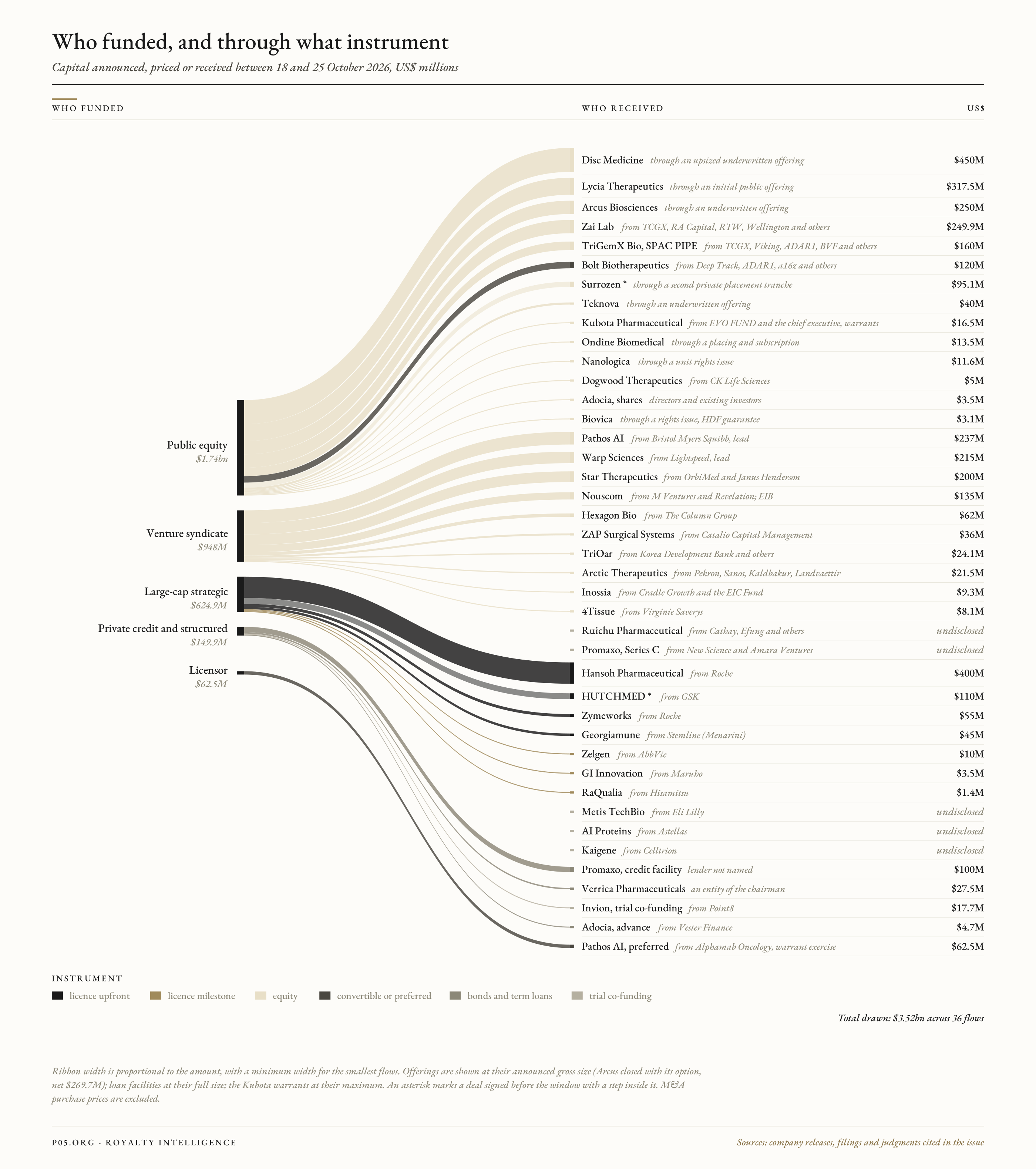
Who funded, and through what instrument, between 18 and 25 October: 36 flows totalling USD 3.52bn, grouped by capital category and coloured by instrument. An asterisk marks a deal signed before the window with a step inside it.
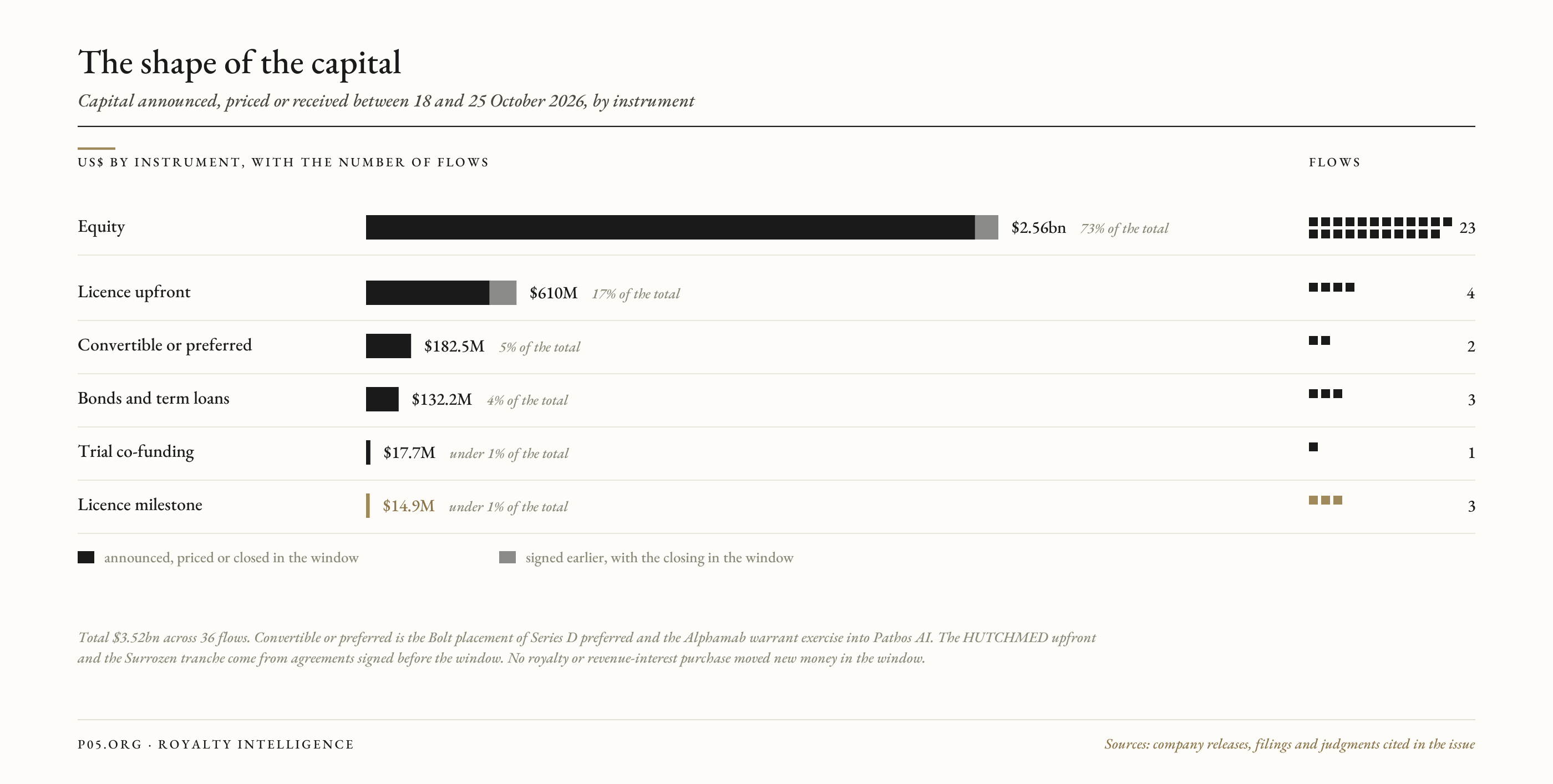
The same capital by instrument, with the number of flows. Equity is USD 2.56bn of the total; the lighter segments are the HUTCHMED upfront and the Surrozen tranche, agreed before the window.
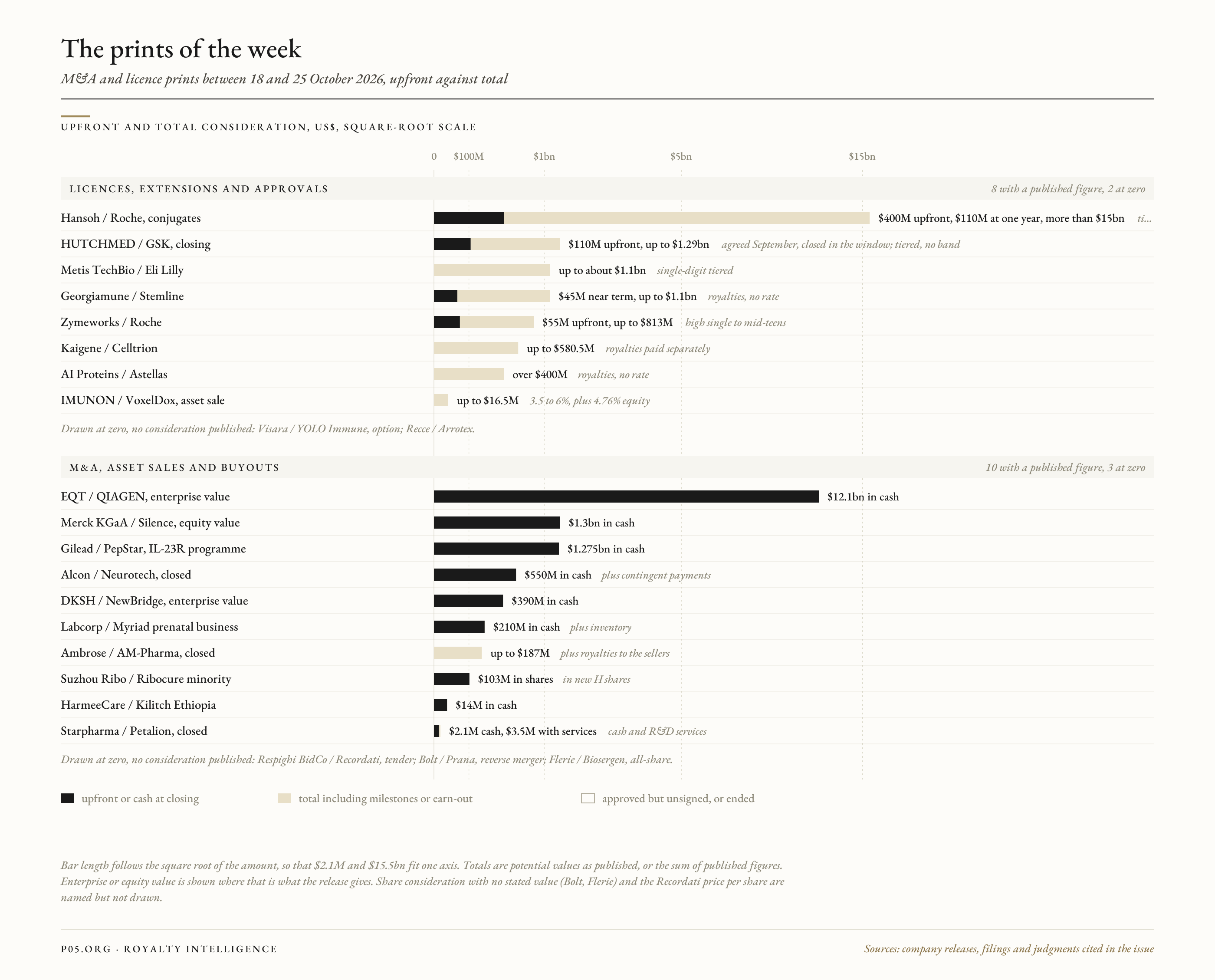
M&A and licence prints between 18 and 25 October on a square-root scale, upfront against total. Eighteen publish a figure and five publish no consideration.
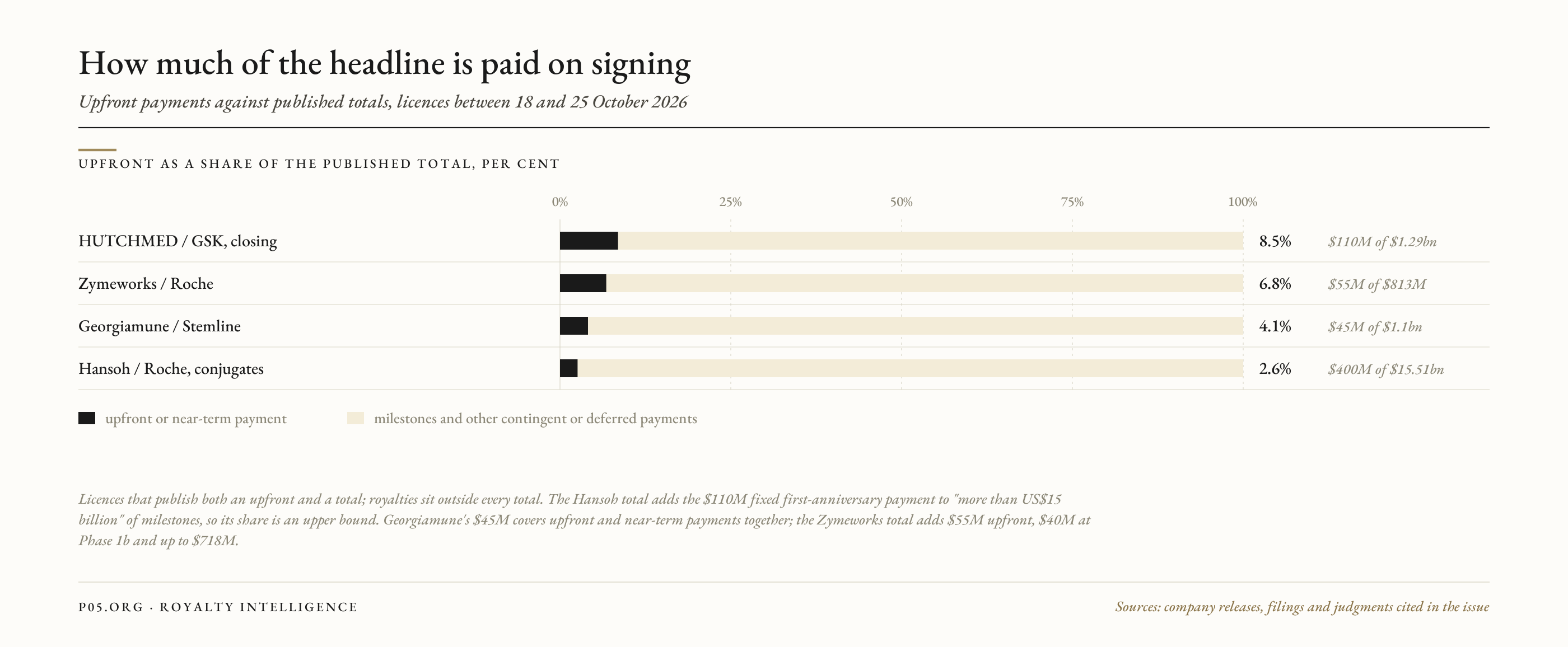
Upfront as a share of the published total, for the four licences that publish both. Royalties sit outside every total.
Hexagon Bio (Friday 23 October). Hexagon Bio, a private company in Menlo Park, California, announced a USD 62m Series C led by The Column Group, with existing investors including Nextech Invest, Deviation Capital, 8VC and CPP Investments. The proceeds fund a "Phase 1 trial of HEX-360, anticipated to begin in the first half of 2027".
"HEX-360 is a HER2-targeting ADC with a novel translation inhibitor" payload, and "is currently in IND-enabling studies". No licence or royalty is stated.
League Tables
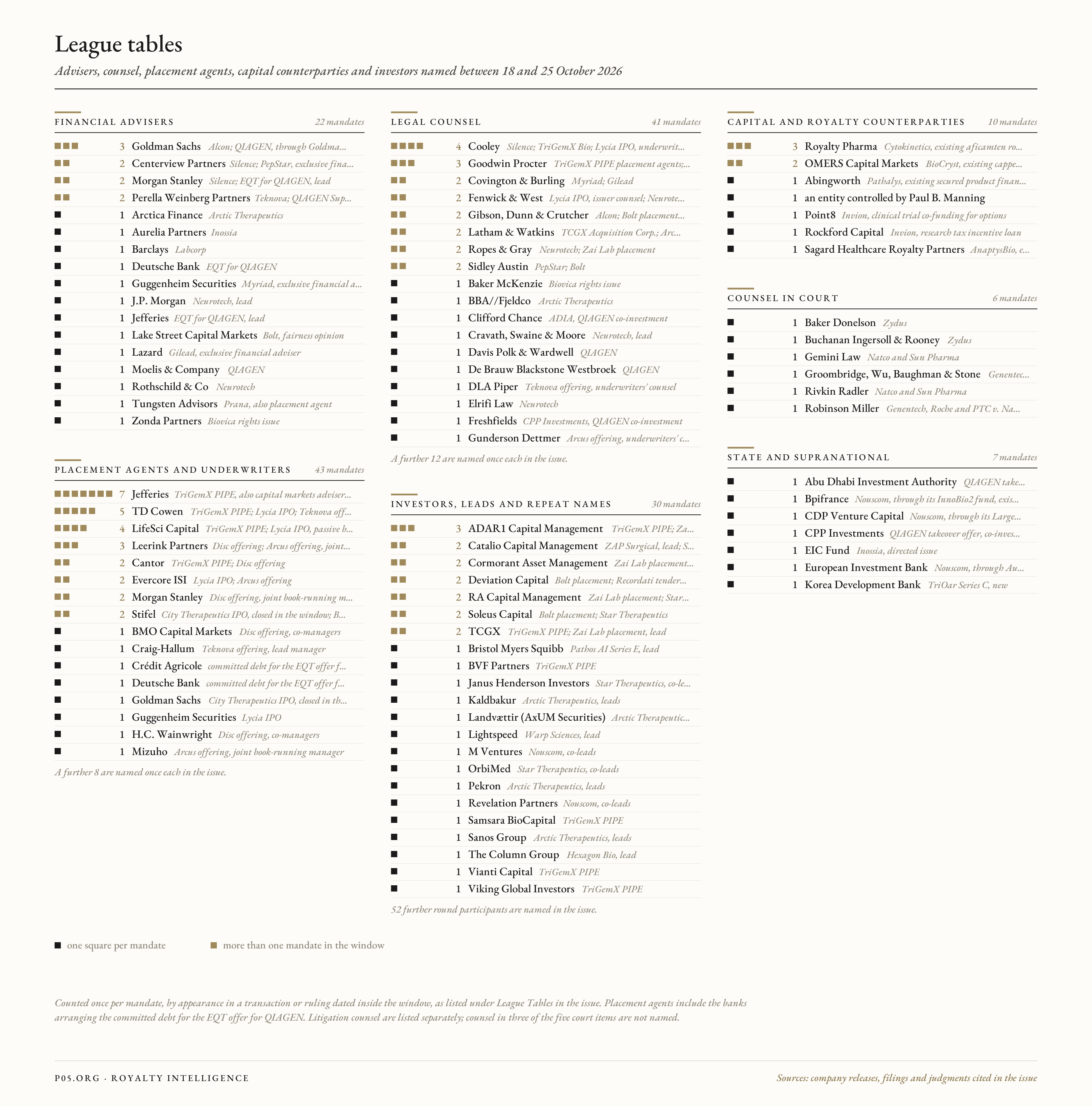
Financial and legal advisers, placement agents, counsel in court, capital and royalty counterparties and investors named in the issue for 18 to 25 October, counted once per mandate. Jefferies leads placement agents with seven, including the debt for the EQT offer, and Cooley leads legal counsel with four.
Financial advisers. Morgan Stanley, 2 (Silence; EQT for QIAGEN, lead); Centerview Partners, 2 (Silence; PepStar, exclusive financial adviser); Lazard, 1 (Gilead, exclusive financial adviser); Guggenheim Securities, 1 (Myriad, exclusive financial adviser); Barclays, 1 (Labcorp); Goldman Sachs, 3 (Alcon; QIAGEN, through Goldman Sachs Bank Europe; Abbott Nutrition separation); J.P. Morgan, 1 (Neurotech, lead); Rothschild & Co, 1 (Neurotech); Perella Weinberg Partners, 2 (Teknova; QIAGEN Supervisory Board); Moelis & Company, 1 (QIAGEN); Jefferies, 1 (EQT for QIAGEN, lead); Deutsche Bank, 1 (EQT for QIAGEN); Arctica Finance, 1 (Arctic Therapeutics); Aurelia Partners, 1 (Inossia); Tungsten Advisors, 1 (Prana, also placement agent); Lake Street Capital Markets, 1 (Bolt, fairness opinion); Zonda Partners, 1 (Biovica rights issue).
Legal counsel. Cooley, 4 (Silence; TriGemX Bio; Lycia IPO, underwriters' counsel; Prana); Goodwin Procter, 3 (TriGemX PIPE placement agents; City Therapeutics IPO, issuer counsel; Disc offering, issuer counsel); Latham & Watkins, 2 (TCGX Acquisition Corp.; Arcus offering, issuer counsel); Gunderson Dettmer, 1 (Arcus offering, underwriters' counsel); Ogier (Cayman), 1 (TriGemX Bio, Cayman counsel); Maples and Calder (Cayman), 1 (TCGX Acquisition Corp., Cayman counsel); Wilmer Cutler Pickering Hale and Dorr, 1 (Disc offering, underwriters' counsel); Fenwick & West, 2 (Lycia IPO, issuer counsel; Neurotech); Covington & Burling, 2 (Myriad; Gilead); Mayer Brown, 1 (Gilead); Sidley Austin, 2 (PepStar; Bolt); Wilson Sonsini Goodrich & Rosati, 1 (PepStar, patent counsel); Polsinelli, 1 (Labcorp); Gibson, Dunn & Crutcher, 2 (Alcon; Bolt placement agents); Cravath, Swaine & Moore, 1 (Neurotech, lead); Ropes & Gray, 2 (Neurotech; Zai Lab placement); Elrifi Law, 1 (Neurotech); BBA//Fjeldco, 1 (Arctic Therapeutics); Paul Hastings, 1 (Teknova offering, issuer counsel); DLA Piper, 1 (Teknova offering, underwriters' counsel); De Brauw Blackstone Westbroek, Linklaters and Davis Polk & Wardwell, 1 each (QIAGEN); Milbank, 1 (EQT for QIAGEN, lead); Stibbe and Paul Weiss, 1 each (EQT for QIAGEN); Clifford Chance, 1 (ADIA, QIAGEN co-investment); Freshfields, 1 (CPP Investments, QIAGEN co-investment); Wachtell, Lipton, Rosen & Katz, 1 (Abbott Nutrition separation); Baker McKenzie, 1 (Biovica rights issue).
Placement agents and capital markets advisers. Jefferies, 6 (TriGemX PIPE, also capital markets adviser to TCGX; Disc offering; City Therapeutics IPO; Lycia IPO; Arcus offering; Bolt placement); Cantor, 2 (TriGemX PIPE; Disc offering); LifeSci Capital, 4 (TriGemX PIPE; Lycia IPO, passive book-runner; Disc offering, co-manager; Bolt placement); TD Cowen, 5 (TriGemX PIPE; Lycia IPO; Teknova offering; Arcus offering; Bolt placement); Stifel, 2 (City Therapeutics IPO, closed in the window; Bolt placement); William Blair, 1 (Teknova offering, joint book-running manager); Craig-Hallum, 1 (Teknova offering, lead manager); Stephens and Roth Capital Partners, 1 each (Teknova offering, co-managers); BMO Capital Markets and H.C. Wainwright, 1 each (Disc offering, co-managers); Evercore ISI, 2 (Lycia IPO; Arcus offering); Guggenheim Securities, 1 (Lycia IPO); Mizuho, 1 (Arcus offering, joint book-running manager); Leerink Partners, 3 (Disc offering; Arcus offering, joint book-running manager; Zai Lab placement, exclusive placement agent); Morgan Stanley, 1 (Disc offering, joint book-running manager); Goldman Sachs and Oppenheimer, 1 each (City Therapeutics IPO, closed in the window); Peel Hunt, 1 (Ondine placing, bookrunner and broker); Strand Hanson, 1 (Ondine placing, nominated adviser); Morgan Stanley, Jefferies, Deutsche Bank, SMBC, Crédit Agricole and UniCredit, 1 each (committed debt for the EQT offer for QIAGEN, bookrunners and mandated lead arrangers).
Capital and royalty counterparties. Royalty Pharma, 3 (Cytokinetics, existing aficamten royalty; fifth approval; BioCryst, existing ORLADEYO royalties under two agreements; new formulation; PTC Therapeutics, existing EVRYSDI royalty; claim construction ruling); OMERS Capital Markets, 2 (BioCryst, existing capped ORLADEYO royalty; new formulation; Xencor, existing capped Ultomiris royalty; new US indication); Sagard Healthcare Royalty Partners, 1 (AnaptysBio, existing Jemperli royalty interest; new US indication); Point8, 1 (Invion, clinical trial co-funding for options); Rockford Capital, 1 (Invion, research tax incentive loan); an entity controlled by Paul B. Manning, 1 (Verrica, secured credit facility of USD 27.5m, now fully available); Abingworth, 1 (Pathalys, existing secured product financing of January 2023, lead; pivotal Phase 3 data).
Investors. M Ventures and Revelation Partners, 1 each (Nouscom, co-leads); Catalio Capital Management, 2 (ZAP Surgical, lead; Star Therapeutics); Baheal, 1 (ZAP Surgical, existing strategic partner); Angelini Industries and Neva SGR, 1 each (Nouscom, new); TCGX, 2 (TriGemX PIPE; Zai Lab placement, lead); ADAR1 Capital Management, 3 (TriGemX PIPE; Zai Lab placement; Bolt placement); Viking Global Investors, BVF Partners, Samsara BioCapital and Vianti Capital, 1 each (TriGemX PIPE); abrdn World Healthcare Fund, Balyasny Asset Management, Frazier Life Sciences, RTW Investments, Sirenia Capital Management, Wellington Management and Woodline Partners, 1 each (Zai Lab placement); Cormorant Asset Management and RA Capital Management, 2 each (Zai Lab placement; Star Therapeutics); CK Life Sciences, 1 (Dogwood placement); Cathay Capital, 复健资本, Efung Capital and Huatai GenScript, 1 each (Ruichu Series A); Pekron, Sanos Group, Kaldbakur and Landvættir (AxUM Securities), 1 each (Arctic Therapeutics, leads); EQT XI, 1 (QIAGEN takeover offer, bidder); New Science Ventures and Amara Ventures, 1 each (Promaxo Series C, initial close); Virginie Saverys, 1 (4Tissue Series A); Lightspeed, 1 (Warp Sciences, lead); Premji Invest, Mayfield, IVP, Lux, Conviction and Menlo Ventures, 1 each (Warp Sciences); DS Asset Management, 1 (TriOar Series C); Cradle Growth, 1 (Inossia); Flerie Invest and Ardena, 1 each (Nanologica rights issue, commitments and guarantees); Sterling Pharma Solutions, 1 (Nanologica, guarantee by set-off); Bergs Securities, 1 (Nanologica, bottom guarantee intention); EVO FUND, 1 (Kubota Pharmaceutical warrants, 41st series); Deep Track Capital, Andreessen Horowitz, LYFE Capital, Coastlands Capital, Eventide Asset Management, Casdin Capital, Curie.Bio, SilverArc Capital and Deviation Capital, 1 each (Bolt placement); Soleus Capital, 2 (Bolt placement; Star Therapeutics); OrbiMed and Janus Henderson Investors, 1 each (Star Therapeutics, co-leads); Agent Capital, New Leaf Venture Partners, NYBC Ventures, Redmile and Sofinnova Investments, 1 each (Star Therapeutics); Bristol Myers Squibb, 1 (Pathos AI Series E, lead); Alphamab Oncology, 1 (Pathos AI, warrant exercise); HDF Cancer Monitoring, 1 (Biovica rights issue, guarantor); The Column Group, 1 (Hexagon Bio, lead); Nextech Invest, 8VC, Deviation Capital and CPP Investments, also existing investors in Hexagon Bio. CVC Capital Partners IX and GBL (through Black Mountain), 1 each (Recordati tender offer, persons acting in concert with Respighi BidCo).
State and supranational participants. European Investment Bank, 1 (Nouscom, through Aurea, new); Bpifrance, 1 (Nouscom, through its InnoBio2 fund, existing); CDP Venture Capital, 1 (Nouscom, through its Large Ventures Fund, existing); Abu Dhabi Investment Authority, 1 (QIAGEN takeover offer, co-investor through Luxinva); CPP Investments, 1 (QIAGEN takeover offer, co-investor); Korea Development Bank, 1 (TriOar Series C, new); EIC Fund, 1 (Inossia, directed issue).
Courts. Groombridge, Wu, Baughman & Stone and Robinson Miller, 1 each (Genentech, Roche and PTC v. Natco, Sun and Zydus, plaintiffs); Gemini Law and Rivkin Radler, 1 each (Natco and Sun Pharma); Buchanan Ingersoll & Rooney and Baker Donelson, 1 each (Zydus). Counsel in Ultragenyx v. Navinta, in Grünenthal v. Collegium and in Bristol Myers Squibb and Pfizer v. TaiwanTah are not named in the filings or releases.
All information in this report was accurate as of the research date and is derived from publicly available sources including SEC filings, Hong Kong Stock Exchange announcements, National Stock Exchange of India filings, European Medicines Agency and Food and Drug Administration records, United States patent assignment records, company press releases and financial news reporting. Information may have changed since publication. This content is for informational purposes only and does not constitute investment, legal, or financial advice. The author is not a lawyer or financial adviser.