
Species-Specific Licences and Royalties in Animal Health: Structure, Allocation, and Recent Deals
What Are Species-Specific Royalties?
Species-specific royalties are licensing or royalty financing arrangements where payments are tied only to sales of a compound in a defined animal species or set of species. If a molecule can be developed for dogs, for cats, for cattle and for humans, a species-specific royalty gives the licensor or investor a claim on revenue from one taxon and nothing from the others.
They are the animal health analogue of the indication-specific royalty, and they are considerably more common than most royalty investors realise, because in animal health the species carve is not an exotic structure. It is the default. Almost every veterinary licence on file is a field-of-use licence in which the field is a taxon.
The comparison is worth making carefully, because the two carves are mirror images of each other in difficulty.
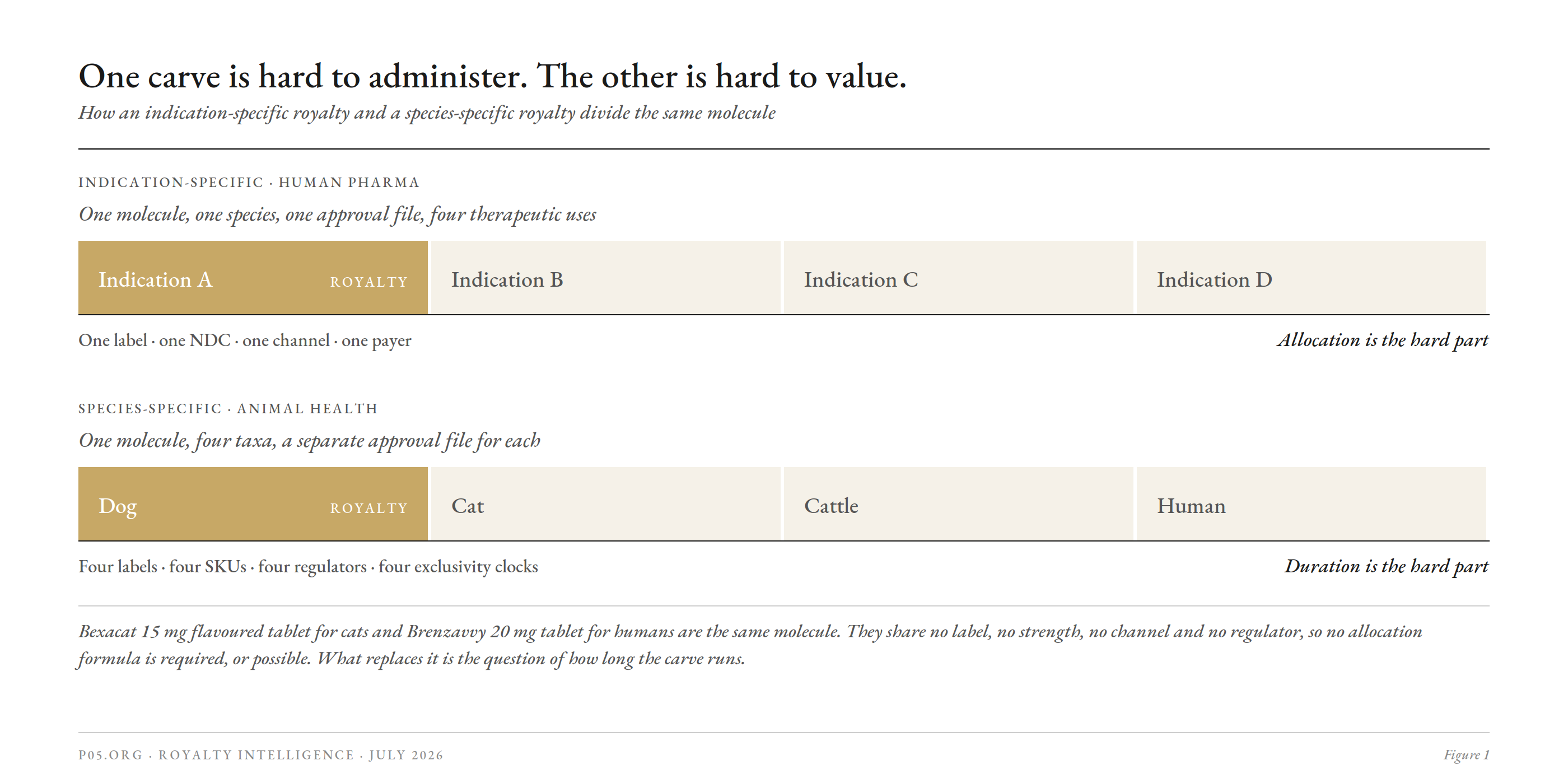
Figure 1. An indication carve splits one label between therapeutic uses, so the molecule remains one product with one NDC sold through one channel and the difficulty is working out which prescriptions belong to whom. A species carve splits one molecule between taxa, so nothing needs allocating and the difficulty moves to how long the carve lasts.
An indication carve is economically clean and operationally messy. A species carve is operationally clean and legally messy. Bexacat 15 mg flavoured tablet for cats and Brenzavvy 20 mg tablet for humans are the same molecule, and they share no commercial surface at all: separate approvals, separate labels, separate strengths, separate distribution, separate regulators. No allocation formula is required, or possible.
What replaces the allocation problem is a duration problem, and it has no equivalent anywhere in human pharma.
How the Two Carves Differ
| Feature | Indication carve (human pharma) | Species carve (animal health) |
|---|---|---|
| Basis of the carve | Therapeutic use of one product | Biological taxon, sometimes plus use |
| Allocation problem | Severe. Same NDC, needs ICD-10 or claims analysis | Effectively none. Separate NADA, label, SKU |
| Regulator | FDA CDER for all indications | FDA CVM, USDA APHIS, or EMA CVMP, by product type |
| Exclusivity length | Fixed at approval | Variable by species. EU 10, 14 or 18 years |
| Can the licensee extend it? | Only via paediatric or orphan mechanics | Yes. EU adds four years per additional species |
| Data exclusivity for biologics | 12 years, US BLA | None. USDA licenses vaccines under VSTA |
| Off-label leakage | Restricted, promotion prohibited | Lawful and routine under AMDUCA |
| Verification data | IQVIA, CMS claims, ICD-10 | Kynetec panels and internal estimates |
| Anti-circumvention risk | Successor product in same indication | Licensee adds an unlicensed species |
| Post-expiry tail | 80 to 90% erosion in year one | 20 to 40% over several years |
Two rows carry most of the weight.
The exclusivity row is where a species carve behaves unlike anything in human pharma.
Under Regulation (EU) 2019/6, Article 39, protection of technical documentation runs for 10 years for cattle, sheep for meat production, pigs, chickens, dogs and cats; 14 years for an antimicrobial for those species containing an antimicrobial active substance not previously authorised in the Union; 18 years for products for bees; and 14 years for animal species outside those lists. Article 40 then prolongs the period by four years where the first authorisation covers more than one additional species, or where a variation extends the authorisation to a further species, capped at 18 years overall, and only if the variation application is submitted at least three years before the existing protection expires.
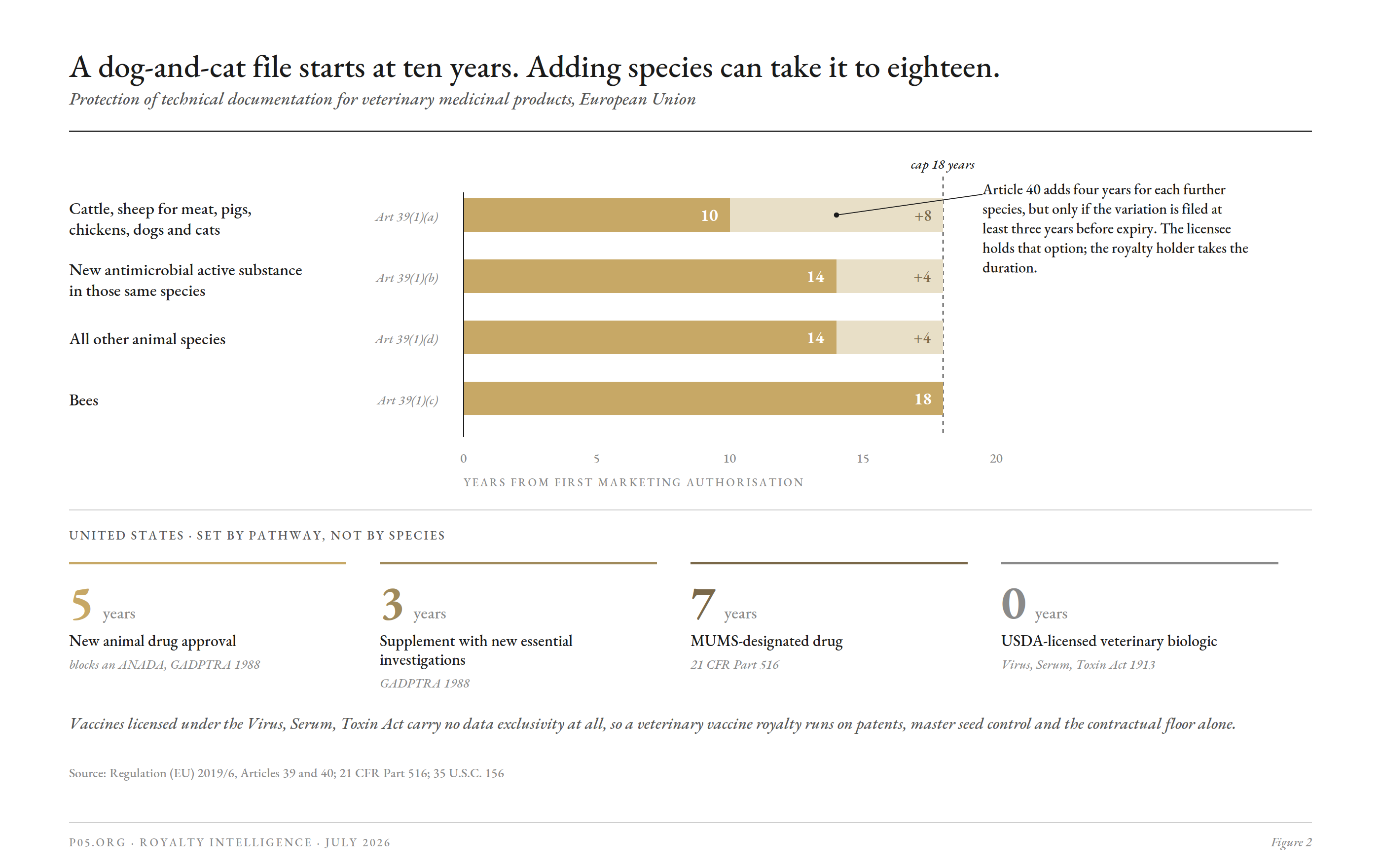
Figure 2. Protection of technical documentation under Regulation (EU) 2019/6, by species, with the Article 40 prolongation shown dashed and the 18-year cap marked. The United States runs shorter clocks and sets them by pathway rather than by species. Veterinary biologics licensed by USDA under the Virus, Serum, Toxin Act carry no data exclusivity at all.
The licensee decides whether to file the Article 40 variation. The royalty holder receives the duration. Neither of the two filed agreements examined below contains a covenant requiring the extension to be filed, or even requiring notice of a decision not to file.
The off-label row is where a species carve is weaker than an indication carve. Under the Animal Medicinal Drug Use Clarification Act of 1994 and 21 CFR Part 530, a veterinarian within a valid veterinarian-client-patient relationship may lawfully prescribe an approved human drug for use in an animal, or an animal drug in a species other than the labelled one. The AVMA's guidance confirms that extra-label use covers use in another species, for another indication, at another dose and by another route, and extends to approved human OTC products and to compounded preparations.
A species carve grants exclusivity over a label. It does not grant exclusivity over the therapy.
Contractual Structure
Species royalties are implemented through field-of-use licensing, exactly as indication carves are, with the Field defined by taxonomy instead of by disease. Two agreements are on file with the SEC in near-complete form, and between them they show there is no standard drafting convention.
The Aratana grapiprant agreement with Elanco, effective 22 April 2016, defines the field in eight words at Section 1.35: "Field of Use shall mean the field of non-human animal health." The carve is defined by negation, so every animal is in and every future species arrives automatically.
The Jaguar crofelemer agreement with Elanco, effective 27 January 2017, does the opposite. Section 1.33 defines the Field as the treatment of gastrointestinal diseases, conditions and symptoms, including chronic and acute diarrhoea, for dogs, cats or other domesticated or domestic-bred animals maintained as pets in the home, excluding equine. Three bounds at once: therapeutic area, species set, and the animal's living arrangement.
A domestic-bred animal not maintained as a pet in the home sits outside the grant, which leaves working dogs, kennelled animals and shelter populations in a position the agreement never resolves. Section 1.2 defines Additional Products for cats and other domesticated pets, again excluding equine. Horses appear twice as an exclusion and never as an inclusion.
Section 1.33 then carves a hole inside the hole. Jaguar retained the right to sell products for minor use and minor species indications "until such time as Elanco has the First Commercial Sale of a Licensed Product for an acute indication. At such time, Licensor shall immediately stop selling products for MUMS indications." A retained sub-field, extinguished by an event the licensee controls.
Which convention you inherited is a first-order valuation fact. Under the Aratana form, a licensee that develops the molecule in an unlicensed species still pays. Under the Jaguar form, it does not.
Running in the other direction, the Neurizon and Elanco licence of July 2025 grants exclusive global rights to Elanco's monepantel data package and intellectual property for the treatment, palliation, prevention or cure of neurodegenerative diseases in humans. A species carve and an indication carve stacked on the same molecule. Elanco keeps every animal use of what is, in its own hands, a sheep drench.
Economic Considerations: Duration Is the Variable
In an indication carve, the royalty term is usually the patent covering the licensed use. In a species carve it is built from three limbs, and on a thin-patent asset the third one does all the work.
Aratana Section 5.4: royalties run country-by-country and product-by-product from first commercial sale "until the latest of (a) the date on which there is no Valid Claim Covering the Product in the respective country; (b) the expiration of any regulatory exclusivity in such country covering such Product; and (c) the tenth (10th) anniversary of the First Commercial Sale of such Product in such country." Jaguar Section 5.4 uses the identical construction with the fifteenth anniversary in limb (c).
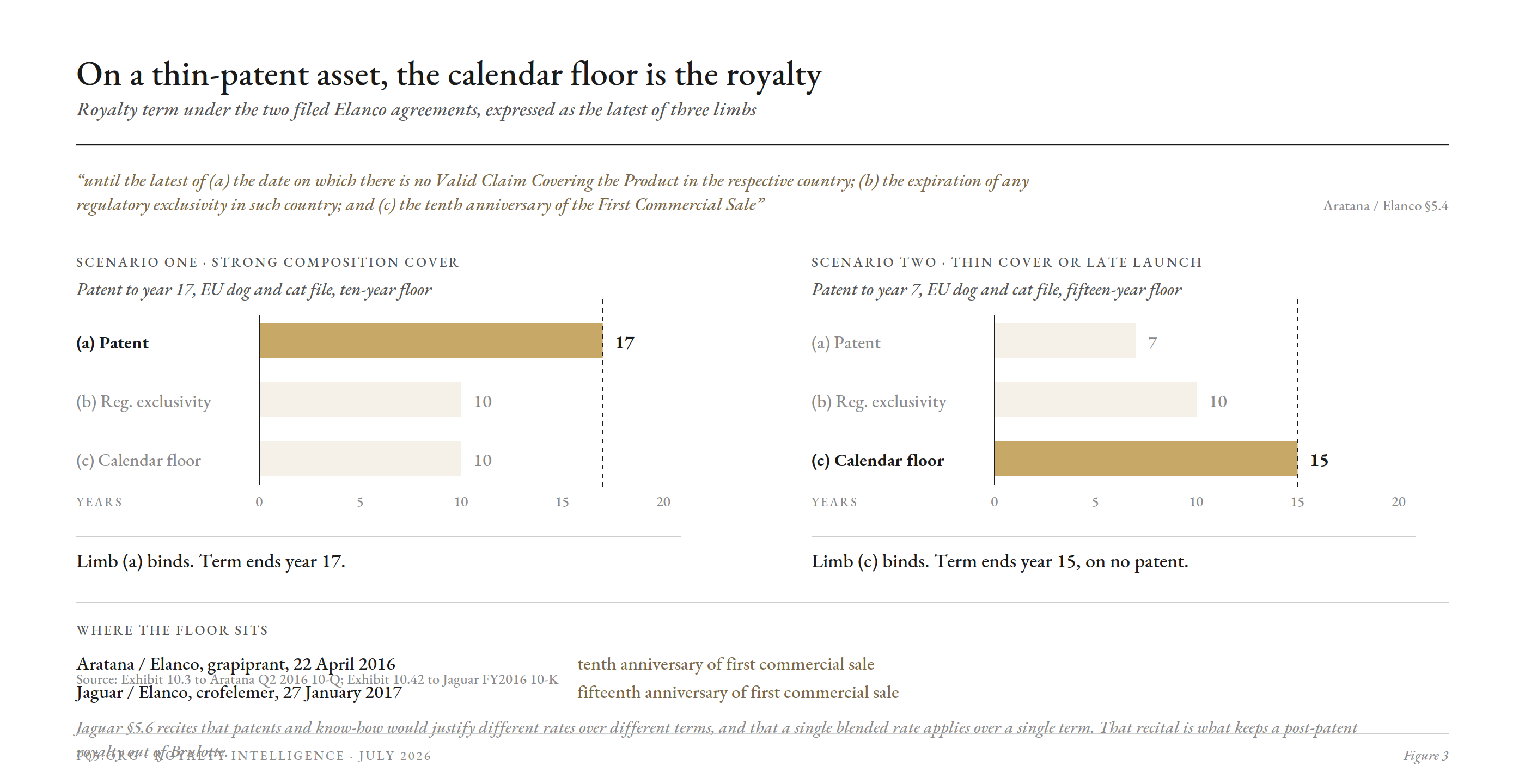
Figure 3. The term is the latest of the three limbs, not the later of the patent and the regulatory clock. Where composition cover is strong the patent binds and the floor is redundant. Where cover is thin or the launch is late, the calendar floor binds and the royalty runs on no intellectual property at all.
Three consequences follow, and none has an equivalent in an indication deal.
The counterparty holds a free duration option. Limb (b) tracks the Article 40 prolongation, so a licensee filing species extensions on schedule can add up to eight years to the contractual royalty term of a dog-and-cat product. The development cost falls on the licensee and the duration benefit falls on the royalty holder, which is why it is worth covenanting and why nobody does.
For vaccines, limb (b) is empty from the start. Animal biologicals are licensed by USDA APHIS under the Virus, Serum, Toxin Act of 1913 rather than by FDA under the FD&C Act. There is no data exclusivity analogue and no listed-patent blocking mechanism.
A veterinary vaccine royalty rests on patents, master seed control and the calendar floor, which is closer to an industrial trade secret royalty than to a pharmaceutical one.
The calendar floor needs a drafting shield. Jaguar Section 5.6 recites that the patents and the know-how "would justify royalty rates of differing amounts" and "would last for different royalty terms," and that the parties have chosen "a single, blended royalty rate for all Products" applying "during a single royalty term." That recital exists to keep a post-patent royalty out of the Brulotte line. Aratana has no equivalent in the visible text.
The offsetting benefit is that the post-expiry tail in animal health is real. Zoetis has said in its own risk disclosures that there is no large global animal health generics company, because of small per-product markets, direct distribution to veterinarians and the self-pay nature of the business, and that significant brand loyalty often continues after loss of patent and regulatory exclusivity. A limb (c) running to year fifteen is collecting on sales that in human pharma would have collapsed in year one.
Rate Architecture
Species royalties are not quoted as a single percentage in the underlying paper, whatever the press release says.
Jaguar Section 5.3 sets out a grid with two net sales tiers and three rate columns, keyed to the intellectual property and competitive state of the product in the relevant territory: covered by a Valid Claim; not covered by a Valid Claim and with no Competitive Product, United States only; and not covered by a Valid Claim outside the US, or, in the US, where a Competitive Product has entered. Six cells, evaluated per country, per product, per year, with tiering expressly marginal rather than cliff.
Aratana Section 5.3 solves it differently: one rate on net sales in the Co-Promotion Territory, defined at 1.12 as the United States, before a redacted date, and a second rate on net sales in the Elanco Exclusive Territory, defined at 1.29 as worldwide excluding the US, before that date or anywhere after it. Two rates keyed to territory, converging on a fixed calendar date as the co-promotion winds down.
The only species-carve royalty rates actually disclosed in public filings come from the human side of a veterinary molecule. Tarsus's FY2022 10-K states that it owes Elanco tiered royalties "in the mid-to-high single digits" on net sales by Tarsus and its sublicensees, clinical milestones to an aggregate maximum of $4.0M and commercial and sales threshold milestones to an aggregate maximum of $77.0M, plus a variable percentage of sublicensee proceeds "beginning in the low double-digits" and decreasing after certain milestones. That is meaningfully above the 4 to 6 percent commonly assumed for the XDEMVY stream.
Allocation and Monitoring
This is where a species carve is the better instrument, and it deserves to be said plainly: there is nothing to allocate. Each species has its own NADA or EU marketing authorisation, its own label, its own strength and format, its own trade name, its own SKU and its own sales channel. The ICD-10 analysis, the IQVIA panel purchase, the quarterly true-up and the CFO certification that an indication carve requires are all unnecessary.
Three exceptions do arise, and all three are worth pricing.
Combination products. Both filed agreements use the same standard formula: net sales of the product equal net sales of the combination multiplied by A/(A+B), where A is the weighted average sale price of the product sold separately in finished form and B is that of the other components; A/C where only A is determinable; one minus B/C where only B is determinable; and where neither can be determined, "the Net Sales of the Product shall be deemed to be equal to fifty percent (50%) of the Net Sales of the Combination Product."
Weighted average prices are computed once per calendar year, fixed for the following year, forecast in year one, and trued up in the first royalty payment of the next year. In animal health, combination is the norm rather than the exception.
Broad-spectrum parasiticide chewables, multi-antigen vaccines and fixed-dose dermatology products all engage these formulas, and if the standalone presentation is discontinued the base defaults to half the combination.
Extra-label leakage. The mirror image of the off-label problem in indication deals. There, off-label use suppresses the base because the sale is not "in the Indication." Here, a cheap human generic prescribed lawfully into the licensed species substitutes for the royalty-bearing veterinary product entirely. Where the veterinary product is a reformulation of a genericised human molecule, this is the base case rather than a tail risk. Where it is a genuinely novel entity with no human counterpart, it is negligible.
Species-jumping. The analogue of the successor-product problem that the Revolution Medicines and Royalty Pharma agreement solved with an indication-overlap clause. Whether it is covered depends entirely on whether the Field was drafted by negation or by enumeration, and whether there is a Competitive Product covenant.
Jaguar Section 4.5 has one, but because Competitive Product is defined by mechanism at 1.16, Elanco may launch a mechanistically different anti-diarrhoeal into the same clinic on the same visit without breaching.
The Deduction Stack
The claim that animal health has no gross-to-net because it is cash-pay does not survive the filings. Elanco's H1 2025 10-Q shows $469M recognised as a reduction of revenue for global sales rebates and discounts against $2,434M of reported net revenue, with $448M paid out over six months. Roughly 16 percent of gross. Product returns ran at approximately 1 percent of net revenue.
The licence agreements let most of that come off the royalty base. Jaguar Section 1.57 lists the deductions unredacted: trade, quantity and cash discounts; discounts, refunds, rebates, chargebacks, retroactive price adjustments and other allowances reducing the net selling price; returns and allowances; production, sale, delivery or use taxes; wholesaler inventory management fees; an allowance for distribution expenses; and "any other similar and customary deductions which are in accordance with GAAP."
Then Section 1.26, which is unredacted and is the single most useful number in either agreement. Distribution Expenses means "the allowance for distribution expenses not to exceed the following range of deduction: (a) U.S. 0.5% to 1.5% of the Net Sales, and (b) outside of the U.S. 5.5% to 6.5% of the Net Sales." An allowance, not a cost. It comes off by definition, incurred or not.
Currency conversion in both agreements uses "Elanco's then current standard exchange rate methodology," which is not a published fixing and cannot be reproduced or hedged by the licensor.
Step-Downs, Offsets and the Floor
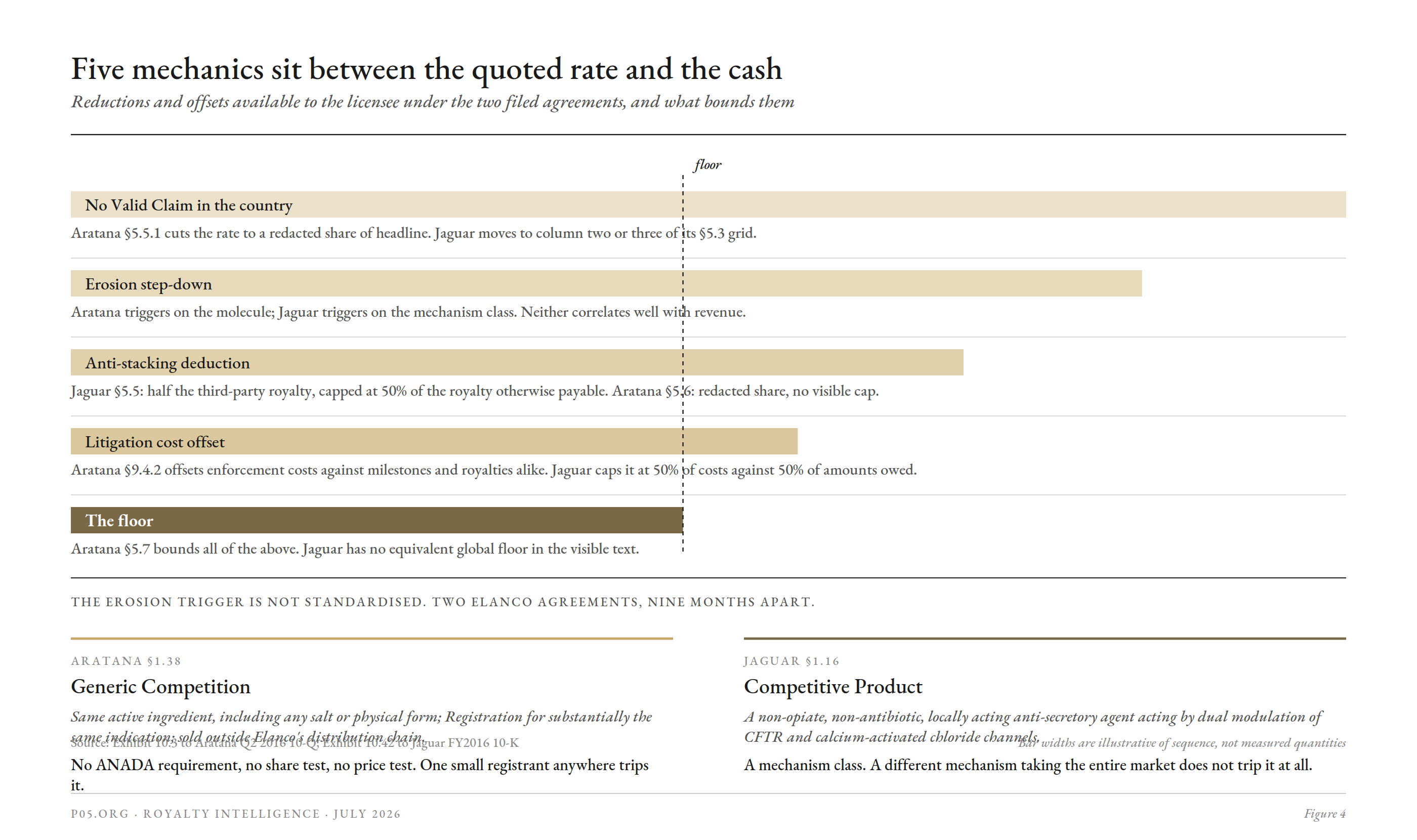
Figure 4. Five mechanics sit between the quoted percentage and the cash. The Aratana floor at Section 5.7 is drafted to catch offsets arising "pursuant to any other Section or Article of this Agreement," which reaches the Article 9 litigation offset. Jaguar substitutes a percentage cap on the stacking deduction and has no equivalent global floor.
The erosion trigger is the clause worth reading twice, because the two agreements define it differently and the difference is large. Aratana keys it to Generic Competition at 1.38, defined by the active ingredient including salts and physical forms, with no ANADA requirement, no substitutability test, no minimum share and no price condition.
One registered same-molecule product from one registrant satisfies it. Jaguar keys its third rate column to a Competitive Product defined at 1.16 by mechanism, so a generic satisfies it and so does an unrelated molecule with the same dual-channel action, while a mechanistically distinct competitor taking the entire market does not.
Aratana adds two conditions. The step-down is expressly non-cumulative with the no-Valid-Claim reduction, and it requires that neither party has commenced and is continuing an enforcement proceeding in that country. Litigation suspends the step-down, which makes the decision whether to sue a rate decision, taken by a party that after a monetisation has no economic stake in the answer.
The Reversion Trigger
Jaguar Section 4.4 has no counterpart in the Aratana agreement and no real counterpart in human royalty practice. Within six months of first commercial sale for the chronic indication, the parties must agree the minimum units Elanco will sell over a defined two-year period. Failing consensus within 45 days, "Elanco shall have final authority to set the Annual Minimum Sales minimums."
On each subsequent reset, failing agreement, "the minimum shall be set at eighty percent (80%) of the minimum sales for the prior year." Two consecutive misses, and if the parties cannot agree an adjustment, "Licensor shall have the right to terminate this Agreement, all licenses granted by Licensor to Elanco under this Agreement will be revoked and all rights to the Licensed Products will revert back to Licensor."
A purchaser of that royalty owns a payment right the licensee can extinguish by underperforming, with the reversion benefit flowing to the seller's residual rights rather than the buyer's purchased ones.
Enforcement, Audit and Verification
There is no audited veterinary prescription database equivalent to IQVIA. Elanco cites Kynetec quarterly data and internal estimates side by side when making share claims in its own earnings materials. A royalty holder cannot observe the base independently at all, which puts the entire verification burden on the audit clause.
Aratana Section 6.5.1 requires an independent certified public accountant acceptable to both parties, at the licensor's expense, examining records solely to verify net sales and payment correctness, each period auditable once.
Then: "Prior to any audit, Licensor must submit an audit plan, including audit scope, to Elanco. The execution of each audit requires Elanco's prior written consent, to be provided within [redacted] Business Days after Elanco's receipt thereof, to such audit plan which Elanco must not unreasonably withhold, delay or condition."
The party being audited approves the auditor and the scope.
Jaguar Section 6.5 is closer to market: three-year lookback, extendable two years past termination, once per period, cost shifting where the underpayment exceeds "five percent (5%) of the amount due or Fifty Thousand U.S. Dollars ($50,000), whichever is greater," with three-year record retention at 6.4.
Reporting cadence differs between the two and matters for anyone financing the flows. Aratana 6.2.1 requires a monthly estimate report plus a quarterly final and an annual reconciliation. Jaguar 6.2 requires only a quarterly report with payment within sixty calendar days of quarter end, which does not support a monthly waterfall without a reserve.
Legal and Accounting Considerations
The Upstream Layer
Neither filed agreement has a licensor who owned the molecule. Aratana held grapiprant under an Exclusive IP License Agreement for RQ-00000007 with RaQualia Pharma dated 27 December 2010, recited in Preliminary Statement A. Jaguar held crofelemer under the Napo License Agreement dated 27 January 2015, defined at 1.55.
Species carves stack more often than indication carves do, because the animal field is frequently sub-licensed onward. And the stacks behave in a specific way when the sector's dominant corporate event arrives.
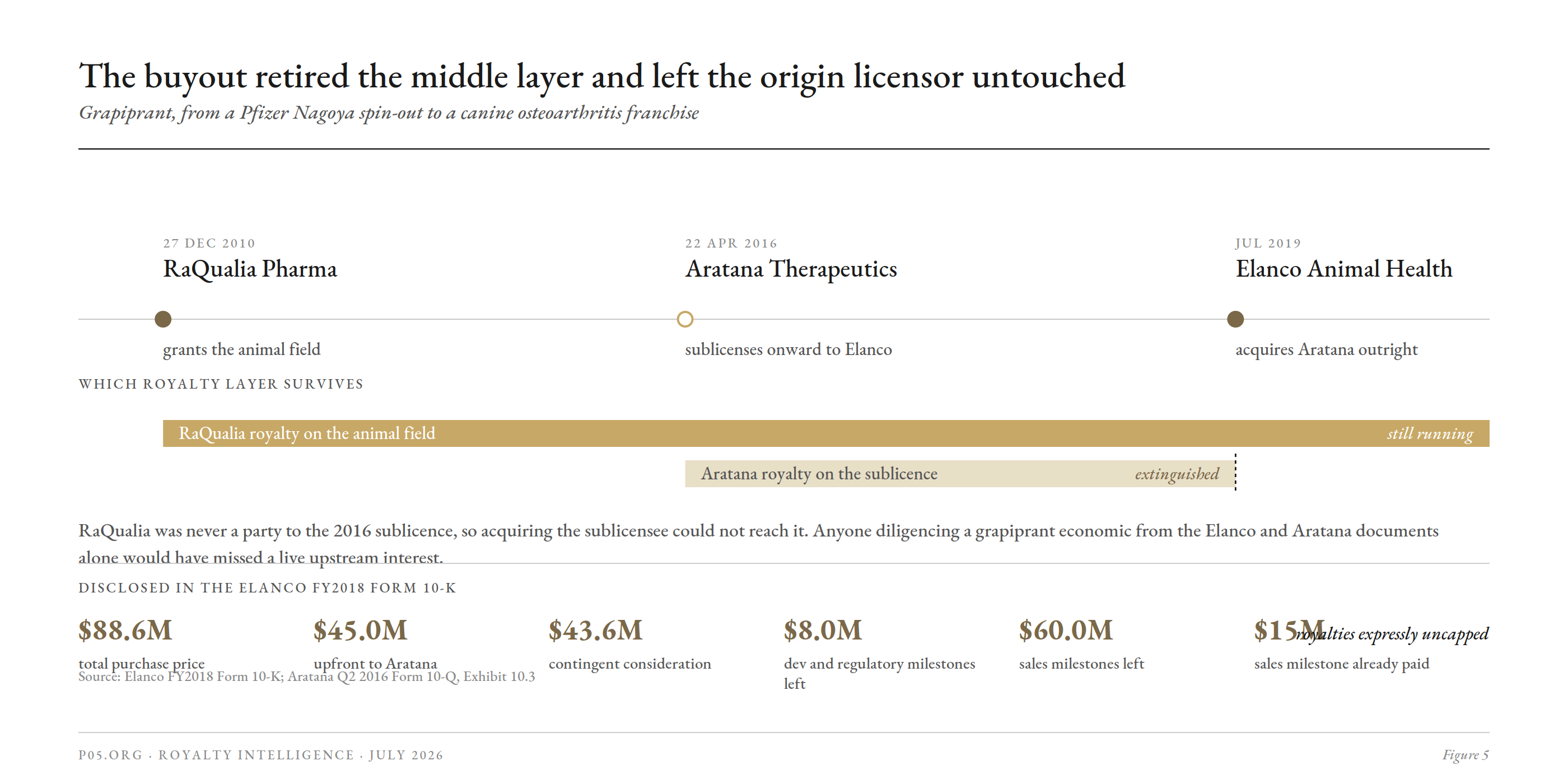
Figure 5. RaQualia granted the animal field to Aratana in 2010, Aratana sublicensed it to Elanco in 2016, and Elanco acquired Aratana in 2019. The acquisition extinguished the middle royalty layer and left the origin licensor untouched, because RaQualia was never a party to the sublicence.
Aratana Section 11.2.11 contains the covenant not to trigger the upstream termination right. Sections 14.7.1(c) and (d) contain the step-in: if Elanco terminates for the licensor's breach and keeps its licences, the licensor must assign the upstream agreement to Elanco or perform it for Elanco's benefit, with Elanco taking on the upstream payments. Both agreements carry the standard Section 365(n) Bankruptcy Code recital.
The origin licensors in this sector are usually small and often foreign. RaQualia is a Tokyo-listed Pfizer Nagoya spin-out. Napo was a Jaguar affiliate. Saiba, which Boehringer Ingelheim licensed and then bought, is Swiss. The credit protection that matters is a direct agreement with the upstream licensor, notice of upstream default and a right to cure.
Sale versus Financing
The accounting question is the same as in indication deals, and the one worked example in animal health resolved against sale treatment.
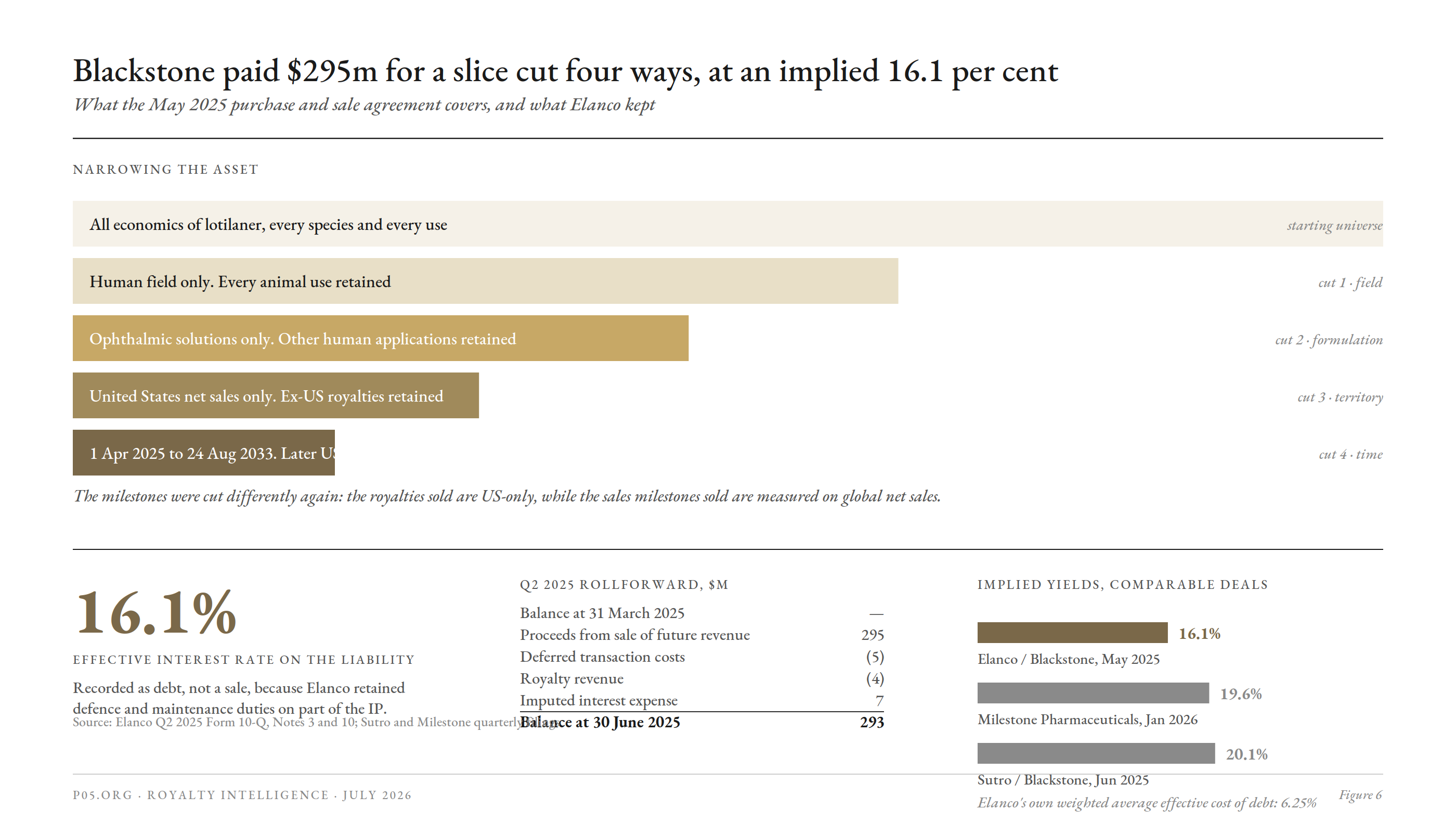
Figure 6. The XDEMVY monetisation, cut by field, formulation, territory and time, with Elanco's own disclosed effective interest rate. Because Elanco retained defence and maintenance obligations on part of the intellectual property, the $295M was recorded as a liability rather than a sale, which is why the implied yield is visible at all.
Elanco owes Blackstone nothing directly. Tarsus pays Blackstone through a third-party escrow account, so the flows appear nowhere in Elanco's cash flow statement, but Elanco must keep recognising royalties it does not receive as revenue and must impute interest on the liability.
That 16.1 percent is the only disclosed implied yield on a veterinary-origin royalty anywhere. Against Elanco's own 6.25 percent weighted average effective cost of debt at the time, Blackstone took roughly a thousand basis points for product risk on somebody else's product.
Tax and Withholding
The same considerations apply as in indication deals, with one aggravating feature: the upstream licensors in animal health are disproportionately Japanese, Swiss, Australian and German, so withholding and treaty analysis bites at two layers of the stack rather than one.
Both filed agreements contain the standard withholding clause, with Aratana adding that on an assignment to an affiliate or an acquirer, or on a merger, all subsequent payments are to be made without deduction or withholding.
Recent Deals (2023 to 2026)
Species-carved royalties transact rarely and disclose poorly. Here is the identifiable set.
Elanco and Blackstone, XDEMVY (May 2025)
Lotilaner is a veterinary isoxazoline, sold by Elanco as Credelio. Elanco licensed the human field to Tarsus in 2019; XDEMVY was approved in 2023 for Demodex blepharitis. In May 2025 Elanco sold the rights to the proceeds from US royalties and certain sales milestones to funds affiliated with Blackstone Life Sciences and Blackstone Credit and Insurance for $295M, with $5M of transaction costs, applying the net proceeds to term loan repayment. Morgan Stanley acted as sole structuring agent.
The window runs 1 April 2025 to 24 August 2033. Elanco retained all ex-US royalties, US royalties after that date, any future human application beyond ophthalmic solutions, and every animal use of the molecule. The royalties sold are US-only; the milestones sold are measured on global net sales.
When a veterinary-origin royalty reaches institutional size, it does so by crossing the species boundary first.
TheracosBio and HealthCare Royalty, Bexacat (August 2023)
Theracos acquired IncreVet in early 2022 and the animal field sat with an affiliate, BexCaFe, which licensed it to Elanco. FDA approved Bexacat on 9 December 2022, the first SGLT2 inhibitor approved in any animal species. HCRx's portfolio note states that it purchased the right to receive all royalty payments and a portion of sales-based milestones due from Elanco on Bexacat sales, and that Theracos monetised to fund the launch of Brenzavvy, the human formulation of the same parent molecule. Terms undisclosed.
The direction inverts the usual hierarchy: the feline royalty financed the human launch. The reason is underwriting difficulty rather than sentiment. The cat stream was approved, licensed to a large-cap partner with distribution in place, and reduced to a contractual obligation from one named obligor. The human product was a self-commercialised launch into the most crowded class in metabolic disease.
Note what a royalty investor could not have read across. The Bexacat label carries a boxed warning for diabetic and euglycaemic diabetic ketoacidosis and contraindicates use in insulin-experienced cats, and Boehringer's velagliflozin entered the identical feline indication the following year. In a species carve, the safety file, the competitive set and the prescribing workflow are all specific to the taxon.
Elanco and Neurizon, monepantel (July 2025, supply expanded June 2026)
Animal to human, with an indication carve stacked on top. Neurizon obtained exclusive global rights to Elanco's monepantel data package and IP for neurodegenerative diseases in humans. Terms: a nominal upfront, development milestones of $9.75M for initial licensed products and $5.2M for subsequent products, sales milestones up to $65M, and tiered single-digit royalties on global net sales. Elanco retains every animal use. The parties expanded into a long-term GMP supply agreement in June 2026.
The interesting feature is what Neurizon bought besides the licence: access to Elanco's animal safety and manufacturing data package, a regulatory asset created for one species and reused in another. That data reuse is why cross-species licences carry lower headline economics than a comparable human in-licence.
RaQualia, Aratana and Elanco, grapiprant (2010 to 2019)
The canonical stack, set out in Figure 5. The Elanco FY2018 10-K is unusually candid for an animal health deal, disclosing the $88.6M total purchase price, the $45.0M upfront and $43.6M contingent split, $8.0M of development and regulatory milestones and $60.0M of sales milestones outstanding at year end, a $15M sales milestone already paid, and the note that royalties are expressly uncapped.
Jaguar Animal Health and Elanco, crofelemer (January 2017)
$1,500,000 upfront plus reimbursement of the Acute Trial and Safety Study, five milestones all redacted, the three-column rate grid, a fifteen-year calendar floor, the Annual Minimum Sales reversion trigger and a mechanism-defined non-compete. Elanco could terminate on 90 days' notice at any time, or immediately on being dissatisfied with the dose-ranging study in its sole discretion.
Boehringer Ingelheim and Saiba Animal Health (2020 to 2024)
Research collaboration with options in 2020, exclusive licence on a virus-like particle vaccine in June 2023 with upfront, milestones and royalties, full acquisition in September 2024 which bought out the royalty obligations the licence had created. The collaboration to licence to acquisition sequence is the sector's dominant lifecycle, and it is designed to end the royalty rather than to trade it.
Ceva and Scout Bio, with UPenn retaining (2023)
When Ceva Santé Animale acquired the University of Pennsylvania spin-out Scout Bio, UPenn kept a royalty interest on the licensed IP. The university's stream survived the corporate buyout because it sits one layer below the company. Academic species carves are often the most durable royalties in the sector for exactly that reason: the licensor is not acquirable.
Summary Table: Species-Carve Deals
| Deal | Year | Direction | Consideration | Structure | Species field |
|---|---|---|---|---|---|
| Elanco / Blackstone (XDEMVY) | 2025 | Vet-origin human royalty sold | $295M | US-only, 2025 to 2033, ophthalmic only; 16.1% implied | Human, eye |
| Neurizon / Elanco (monepantel) | 2025 | Vet to human | Nominal upfront, $9.75M + $5.2M dev, $65M sales | Tiered single-digit global royalty | Human, neurodegenerative |
| TheracosBio / HCRx (Bexacat) | 2023 | Vet royalty sold | Undisclosed | All royalties, part of sales milestones | Feline |
| BI / Saiba | 2023 to 2024 | Vet licence then buyout | Undisclosed | Licence retired by acquisition | Companion animal |
| Ceva / Scout Bio (UPenn) | 2023 | Vet, academic upstream | Undisclosed | University royalty survives buyout | Companion animal |
| Jaguar / Elanco (crofelemer) | 2017 | Vet field-of-use | $1.5M upfront plus five milestones | 3x2 rate grid, 15-year floor, minimum sales | Dogs, cats, pets ex-equine |
| Aratana / Elanco (grapiprant) | 2016 | Vet sublicence | $45M upfront, $88.6M total | Territory-decay rates, 10-year floor, uncapped | Non-human animal |
| RaQualia / Aratana (grapiprant) | 2010 | Human to vet field | Undisclosed | Upfront, dev milestones, global royalty | Non-human animal |
Key Themes
The carve is easy and the clock is hard. Everything that makes an indication royalty difficult to administer is trivial in a species deal, and everything that makes an indication royalty easy to value is difficult in a species deal.
Duration is the counterparty's option. Article 40 of Regulation 2019/6 puts up to eight years of contractual royalty term in the licensee's gift, at the licensee's cost, with the benefit accruing to the licensor. It is the cheapest term any royalty buyer in this sector will ever negotiate for, and no agreement I have read covenants it.
The vaccine subset is a different asset. USDA licensure under the Virus, Serum, Toxin Act carries no data exclusivity, so a veterinary vaccine royalty should be underwritten closer to an industrial trade secret royalty than to a pharmaceutical one.
The direction of travel is out of the sector. Both institutional-scale transactions here involve a human-field cash flow. The animal-side economics on both molecules stayed unfinanced on the originator's balance sheet.
16.1 percent is the only price we have. Until there is a second and a third disclosed print, every species-carve royalty is being marked on judgement. That is simultaneously the reason institutions stay away and the reason the spread exists.
Conclusion
Species-specific royalties are the ordinary form of the animal health licence rather than a structuring innovation, which is why the sector has hundreds of them and almost no market in them. They are drafted as field-of-use licences with the field set by taxonomy, they pay on a rate matrix rather than a rate, they run on a term whose binding limb is usually a calendar floor rather than a patent, and they are verified through an audit clause that in at least one filed example requires the payer's consent to the audit plan.
What they do not have is the allocation problem that dominates indication carves. What they do have instead is a duration problem that dominates nothing in human pharma. The Article 40 species extension, the USDA exclusivity void, the AMDUCA leakage channel and the ten-or-fifteen-year contractual floor are four mechanics with no human analogue, and all four sit inside the royalty term rather than inside the rate.
The practical output is short. Trace the field definition to the origin licence, because the middle layers get acquired and the top one does not. Read limb (c) of the royalty term before reading the rate. Covenant the species extensions. Cap the anti-stacking deduction and demand a global floor drafted to reach offsets from anywhere in the agreement. And price the audit clause, because in a category with no independent panel, verification is the credit.
All information in this article was accurate as of the research date and is derived from publicly available sources including SEC filings and filed exhibits, issuer press releases, EU and US regulatory instruments and guidance, and product labelling. Contractual terms subject to confidential treatment in the original filings are described as to structure only. Information may have changed since publication. This content is for informational purposes only and does not constitute investment, legal, or financial advice. The author is not a lawyer or financial adviser.