
The Clinic Door: Why Early-Stage Royalty Financing Is So Complicated and So Rare
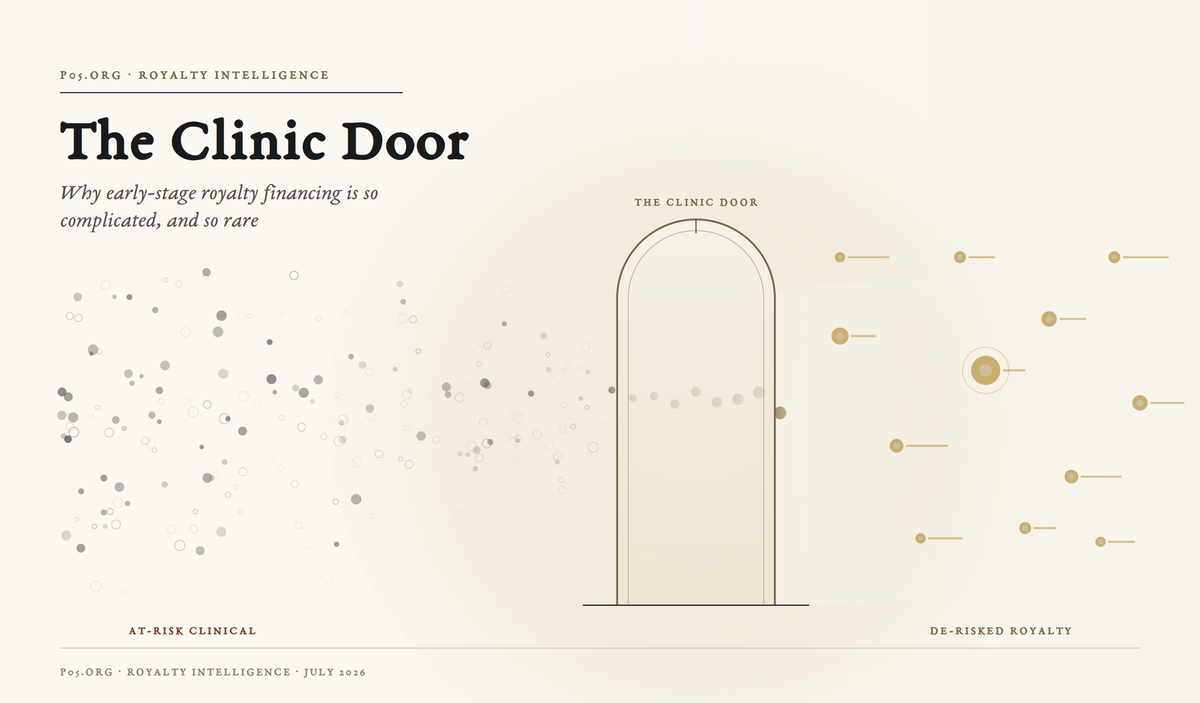
Pharmaceutical royalty finance is a growing asset class, but it stops before Phase 2. Gibson Dunn's tracker counts 133 disclosed transactions across the largest funds from 2020 to 2025, worth about 32.7 billion dollars, with a 2025 median deal size of 221 million dollars. Almost none of that capital buys a royalty on a drug that has not yet cleared the clinic. This is a field guide to the reasons: an option-shaped asset, a bespoke price, a fixed-cost floor, a transfer problem, and a buyer universe whose smallest ticket is larger than the whole strategy.
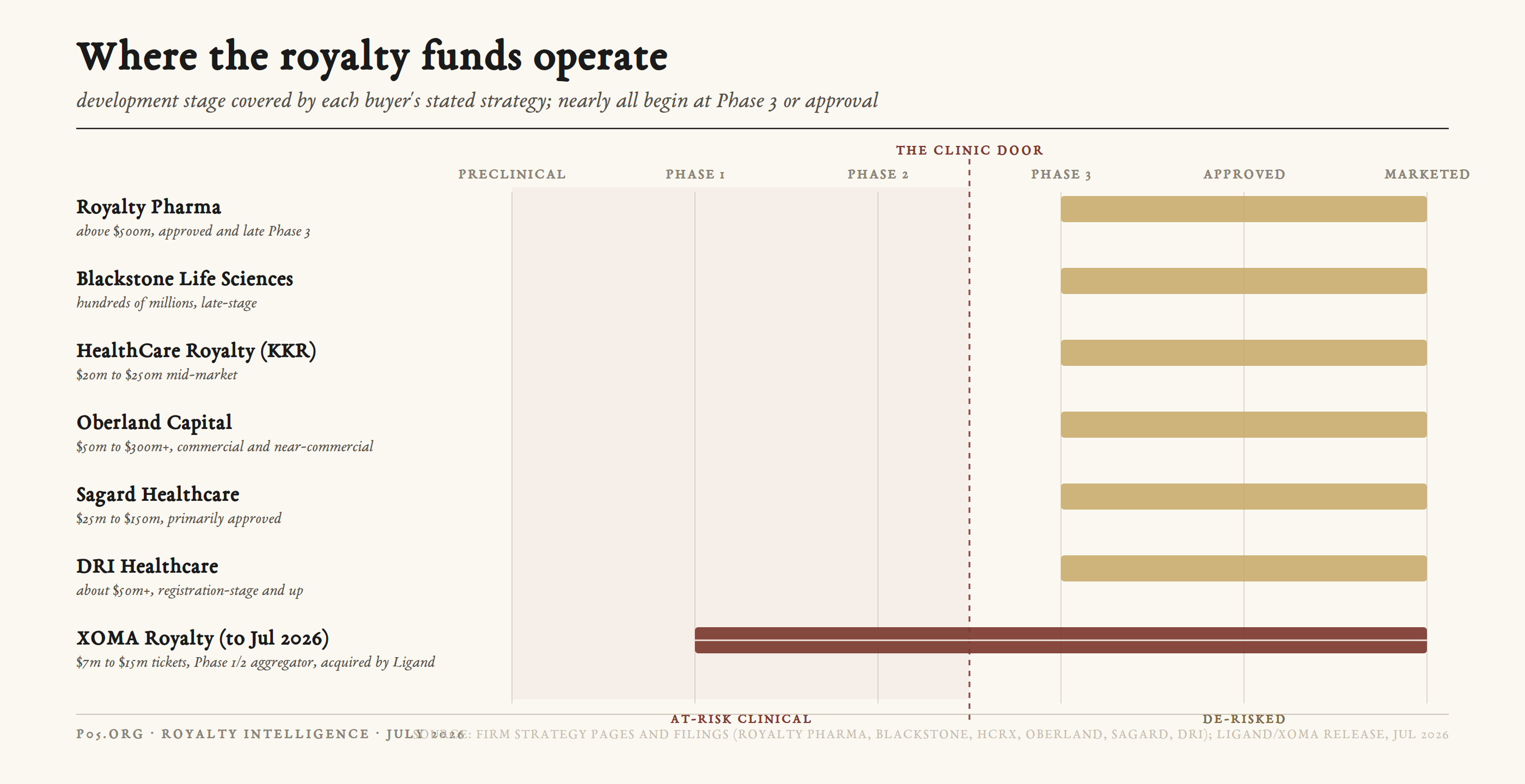
Nearly every institutional royalty buyer begins at Phase 3 or approval. The one listed exception, XOMA, was acquired by Ligand in July 2026.
The shape of the market
The disclosed royalty-finance market is a few dozen deals a year, concentrated at the large end. Gibson Dunn's 2026 market update records annual value rising from 5.2 billion dollars in 2020 to 7.1 billion in 2025, a dip to 3.9 billion in 2022, volume steady at 25 to 27 deals a year since 2023, and a median 2025 deal size of 221 million dollars. Goodwin puts total royalty financings at about 29.4 billion dollars for 2020 to 2024.
The buyers state their boundary plainly. Royalty Pharma, the largest, classifies every acquisition by approval status. It buys royalties on approved products, having deployed 13.2 billion dollars on them between 1996 and 2020, and buys development-stage royalties only after strong clinical proof of concept, meaning late Phase 2 and Phase 3. Its filing describes the model as carrying substantially reduced exposure to early-stage development risk.
The other institutional buyers describe themselves the same way. HealthCare Royalty, majority-owned by KKR since July 2025, invests in commercial and near-commercial assets. Oberland Capital's own strategy page targets 50 million to 300 million dollars on commercial and near-commercial products. Sagard Healthcare states a typical size of 25 million to 150 million dollars and primarily invests in approved products.
| Stage at purchase | Who buys here | Risk character |
|---|---|---|
| Approved / marketed | Royalty Pharma, HCRx, Blackstone, Oberland, Sagard, DRI, Ligand | Credit-like |
| Phase 3 / proof of concept | The same buyers, selectively | Late clinical plus commercial |
| Phase 1 and Phase 2 | Almost no one, as a standing strategy | Venture-like, tail-dependent |
The early slice is small even inside a small market. In the 2020 to 2024 survey, the great majority of pre-approval traditional royalty deals attached to Phase 3 assets already carrying positive data. Among true-sale synthetic royalties, the survey found only three genuinely pre-approval transactions, all of which deferred funding until approval. A standalone, disclosed purchase of a royalty on a Phase 1 or Phase 2 asset, at risk, is not a category with a meaningful count.
The reasons that band stays thin are structural, and they compound. Five are set out below, followed by two that sit underneath them.
Friction 1: the asset is an option, not a receivable
At Phase 1 there is no product and no sales, so there is no royalty. There is only the right to a future royalty, a contingent claim that pays nothing unless the molecule clears the clinic, clears a regulator, and then sells.
The base rate governs everything downstream. The probability of approval for a drug entering Phase 1 is about 6.7 percent on Citeline's 2024 data, down from 10.4 percent in 2014. The path runs roughly 47 percent from Phase 1 to Phase 2, 28 percent from Phase 2 to Phase 3, 55 percent from Phase 3 to filing, and about 90 percent from filing to approval. Phase 2 is the largest single drop.
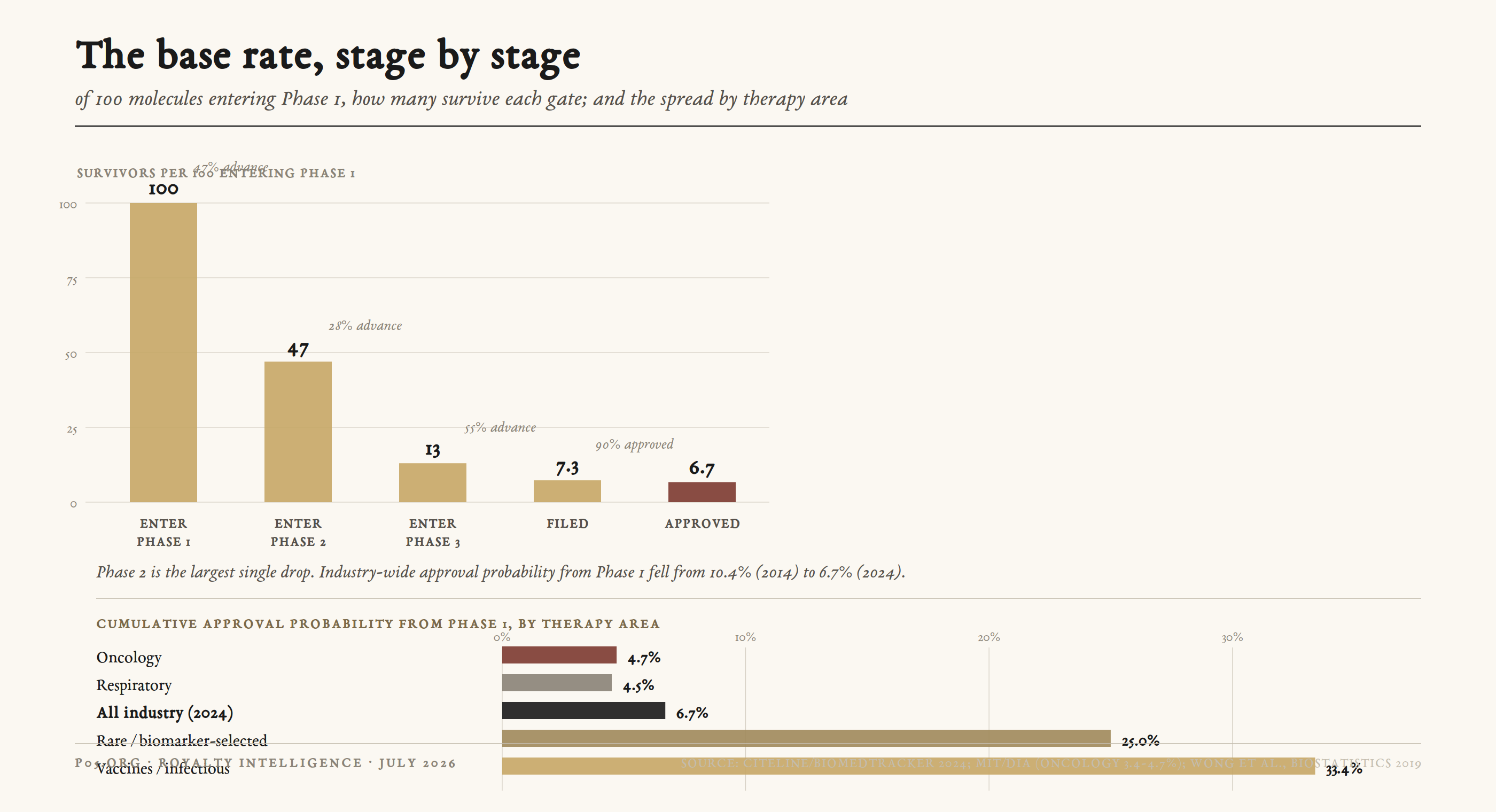
Approval probability collapses stage by stage, and the base rate varies by a factor of seven across therapy areas.
The base rate is not uniform. Oncology sits at the bottom, as low as 3.4 percent in the MIT and DIA study and about 4.7 percent in Citeline's recent count. Respiratory runs near 4.5 percent and hematology near 19.1 percent, while vaccines and infectious disease reach as high as 33.4 percent. Rare-disease and biomarker-selected programmes run several times the oncology figure, toward 25 percent. Asset selection moves the base rate by a factor of five or more.
An asset that pays nothing nine times in ten cannot be underwritten one name at a time. A single early royalty right most often returns only a partial run of milestones, well under its purchase price. The instrument exists only at the portfolio level, where a wide book lets a handful of survivors carry the rest. That distribution is the one venture capital is built on: roughly 60 percent of backed startups fail and about 5 to 6 percent of investments generate around 60 percent of returns, with the top one or two positions driving more than 80 percent of a fund's total return.
Two features distinguish an early-royalty book from a venture fund:
- The burn is not yours. A venture fund follows on through rounds before its losers die. An early-royalty buyer pays once, at entry, and the licensee funds the trials. Maximum loss per name is the ticket.
- The upside is capped. Venture equity is uncapped. A royalty is a fixed percentage of sales for a fixed patent life, so even a breakout returns a bounded multiple.
Width is therefore a requirement, not a preference. At a six to ten percent hit rate, the chance of catching zero winners is roughly a coin flip across twenty names and only becomes a genuine tail risk past fifty to a hundred. Width demands capital and deal flow that a small originator does not have, which puts the asset's minimum viable scale in tension with the small-ticket reality of the early segment.
Friction 2: there is no standard way to price it
The valuation standard for a clinical-stage royalty is risk-adjusted net present value, which weights each future cash flow by the cumulative probability of success rather than burying technical risk in the discount rate.
Two inputs move as an asset advances. The cumulative probability of success climbs from roughly 14 percent at Phase 2 entry toward certainty at approval, and the discount rate compresses from the 15 to 20 percent applied to pre-revenue biotech down to the 8 to 10 percent applied to commercial cash flows. Every input is an estimate.
There is no comparable to check the estimate against. The illiquid-cashflow markets that scaled at small ticket all built a standardised pricing layer first: music royalties trade against earnings history, life settlements against actuarial life expectancy, mineral royalties against production data. Early pharma royalties are heterogeneous, binary, and pre-revenue. Price discovery is a per-deal research exercise rather than a lookup against a curve, and the cost of that exercise does not fall with the size of the ticket.
This is one reason disclosed early deals are frequently milestone-heavy: milestones crystallise value at discrete, observable events, such as trial initiation or a partner acquisition, and reduce dependence on a valuation that cannot be benchmarked.
Friction 3: the fixed-cost stack does not amortise
To isolate the asset from the seller's bankruptcy, a buyer structures a true sale into a bankruptcy-remote special purpose vehicle, supported by true-sale and non-consolidation legal opinions.
The stack is largely fixed per deal. Non-consolidation opinions are typically only required and priced at balances at or above roughly 20 million dollars. SPV formation commonly uses a two-tier structure, doubling formation, maintenance, and independent-director costs. And the diligence spans the disciplines Mintz lists for a royalty purchase: corporate and M&A, intellectual property, litigation, FDA regulatory, bankruptcy, licensing, tax, reimbursement, antitrust, and healthcare.
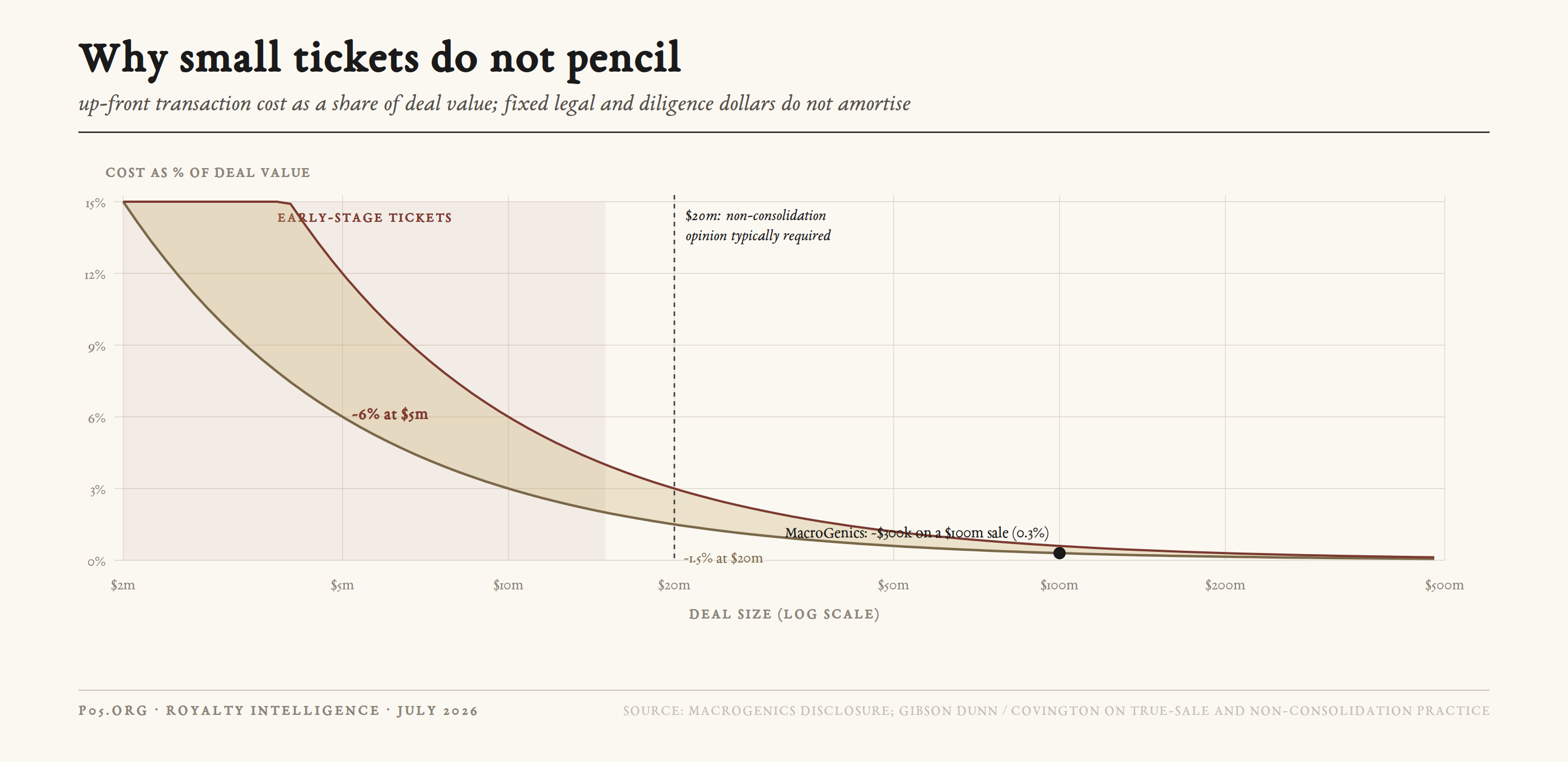
Fixed legal and diligence dollars are a rounding error on a large deal and a solvency problem on a small one.
The arithmetic is steep at small ticket. MacroGenics disclosed roughly 300,000 dollars of transaction costs on a 100 million dollar royalty sale, about 0.3 percent. Holding the absolute figure roughly constant, the same dollars are about 6 percent of a 5 million dollar ticket, before the regulated-industry diligence premium.
On a Phase 1 or Phase 2 asset with a cumulative approval probability near ten percent, that load is paid in full on every name, including the nine in ten that fail. This is the mechanism behind the observation that every institutional floor sits at 20 million dollars or more.
Friction 4: royalties are hard to move
Three legal doctrines govern whether a royalty can be transferred cleanly. Each is surmountable with structuring, and each adds cost, time, and basis points.
True sale versus recharacterisation. A royalty purchase is papered as a true sale so the asset survives the seller's bankruptcy, but the label does not control. Courts apply a fact-intensive test, and features that guarantee the buyer a return, such as caps, put rights, or top-up payments, push the characterisation toward a disguised secured loan that is pulled back into the estate. In re Shoot the Moon is the cautionary authority.
Executory-contract and rejection risk. Contingent payment rights are generally non-executory and fall outside the protection of section 365, so if the paying counterparty enters bankruptcy the holder can be left an unsecured creditor. Buyers respond by placing the licence and patents in a bankruptcy-remote SPV, as Athenex did for its Klisyri royalty, with a backup security interest under UCC Article 9.
Anti-assignment and change of control. Licence agreements routinely condition assignment on the counterparty's consent and restrict transfer on a change of control, so a royalty may not be freely assignable without a consent the licensee can withhold or price.
None of the three is fatal alone. Together they add a diligence burden heavier than an ordinary receivable to an asset that cannot support much of it, and they turn each transfer into a bespoke negotiation.
Friction 5: there is little to sell to
Even a de-risked early position has almost no natural buyer, because the exit-buyer floor sits well above the size of any single early deal, and the floor has risen over time.
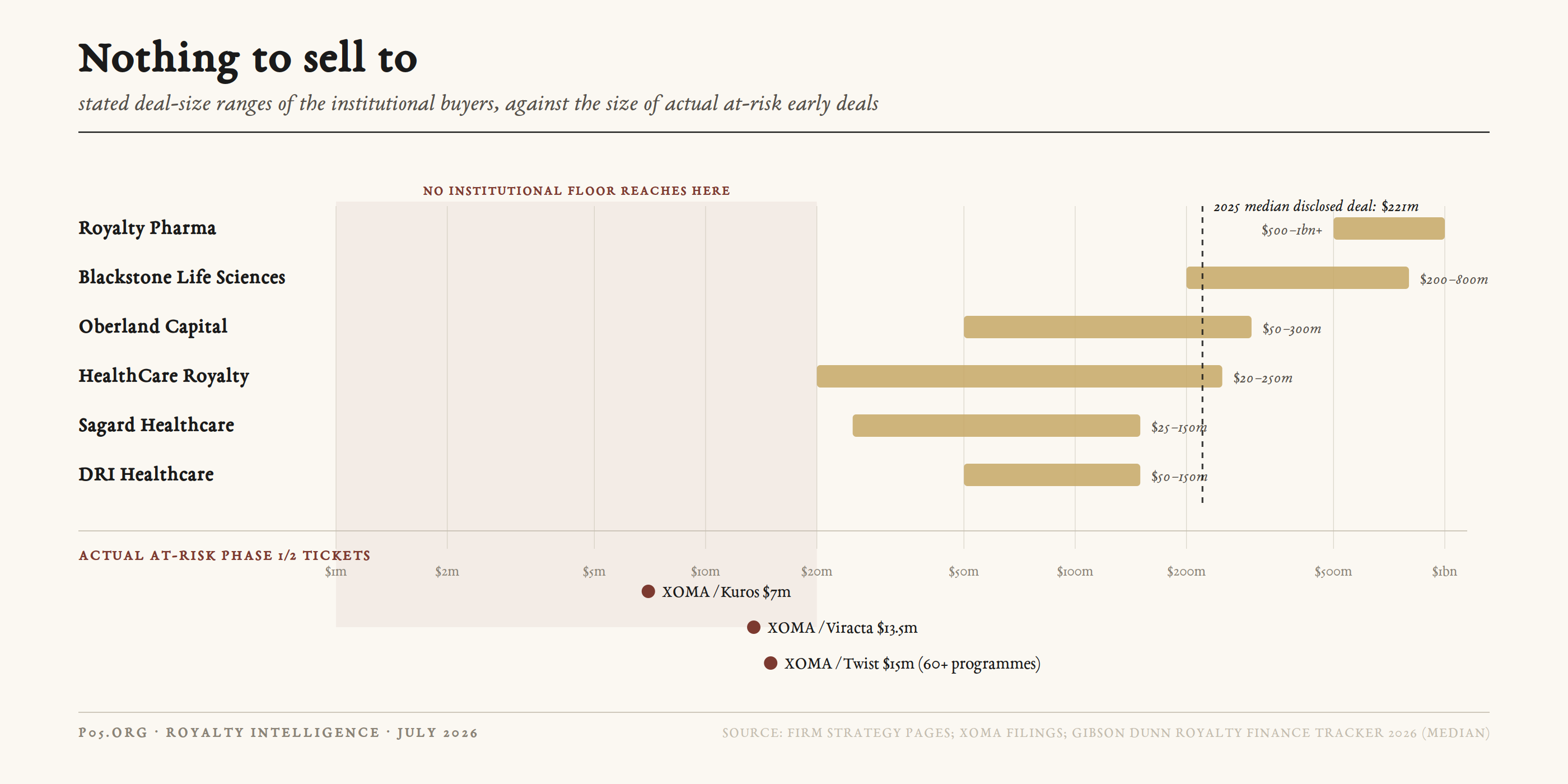
The institutional floors begin above 20 million dollars. The at-risk early tickets sit in a band no buyer's floor reaches.
The floors bracket the whole institutional field. Royalty Pharma dominates deals above 500 million dollars. Blackstone Life Sciences writes in the hundreds of millions. Oberland targets 50 to 300 million, HealthCare Royalty 20 to 250 million, Sagard 25 to 150 million, DRI around 50 million and up. The 2025 median disclosed deal was 221 million dollars.
A small originator would accumulate exactly what no one buys. To reach these buyers it would need to aggregate ten to twenty or more positions into a coherent 25 to 50 million dollar book, by which point the positions are seasoned, heterogeneous, and, if genuinely de-risked, in competition with the buyer's own origination. There is no liquid intermediary bid for a single early royalty of three to eight million dollars.
The discount is widest where the strategy is most exposed. Diversified, seasoned private-market secondaries clear around 92 percent of net asset value, but that is for senior, performing, pooled exposure, and discounts widen sharply for concentrated and tail-end positions. A single binary royalty is the definition of concentrated.
The clearest recent test came from SWK Holdings, the purest sub-25 million dollar royalty financier. In 2025 it exited rather than scaled, selling the Iluvien royalty to ANI for 17.3 million dollars and substantially all its remaining performing royalties to Soleus, at roughly book value and with no de-risking premium, then paying a special dividend.
Two further constraints underneath
Adverse selection at entry. The cheapest early royalties come from the most capital-constrained sellers and the least-contested assets, where information asymmetry is highest. Assets offered for early sale come disproportionately from owners under cash pressure, which is not the same population as the assets most likely to succeed.
Duration and vehicle mismatch at exit. Even a strategy framed as a flip must carry a position through a value-inflecting readout, often two to four years for a Phase 2, during which capital is locked in an illiquid binary.
Contingent, non-cash-yielding royalties also sit awkwardly in RIC and BDC income tests, can raise unrelated-business-taxable-income concerns for tax-exempt limited partners, and are marketable mainly through qualified-institutional-buyer channels, as with DRI's 250 million dollars of senior secured notes placed under Rule 144A.
What the market does instead
The common alternative is to fund the early-stage company while attaching the royalty to a de-risked asset, so the financier supports an early pipeline without holding early-stage risk.
Marinus Pharmaceuticals is the clean example. In 2022 it took 32.5 million dollars from Sagard Healthcare Partners to support, among other things, ongoing Phase 3 trials. The revenue interest Sagard bought was on US net sales of ZTALMY, a product the FDA had already approved, tiered around a 10 percent average rate and capped at 1.9 times the advance. The cash helped the pipeline; the risk sat on the approved product.
Gated tranches achieve the same separation. In July 2026 MeiraGTx announced up to 400 million dollars from Oberland Capital, of which only 125 million was funded at closing for low-single-digit royalties, with additional 50 million dollar tranches tied to Phase 2 data readouts in 2027 and to regulatory approvals in 2027 and 2028. Most of the capital is contingent on de-risking events.
Venture philanthropy is the same pattern from a different actor. The Cystic Fibrosis Foundation put in about 150 million dollars to de-risk Vertex's CF programme, then sold the resulting royalty to Royalty Pharma for 3.3 billion dollars in 2014. Royalty Pharma's filing notes it had approached the foundation in 2008, when Kalydeco produced promising Phase 2 data, then transacted only in 2014, after approval. The foundation took the early risk; the buyer waited at the clinic door.
What has been tried
The originate-and-hold-early idea is old and mostly unscaled.
Paul Royalty Fund was the platform-scale attempt. The healthcare arm of Paul Capital, itself a private-equity secondaries pioneer, ran close to a billion dollars across dedicated royalty funds and securitised most of a roughly 300 million dollar drug-royalty fund to a triple-A rating, showing that pooling and securitisation of royalty books is feasible. It wound down in the early 2010s on fund-level causes: capital deployed near a cycle top, a duration mismatch, and fees.
XOMA was the one scaled, listed early-stage aggregator. After pivoting from drug development in 2017 it described its focus as early to mid-stage clinical assets, primarily Phase 1 and 2, with substantially all research and commercialisation costs borne by the sponsors.
It bought two ways: royalty rights directly, as in the October 2024 Twist arrangement of 15 million dollars for a 50 percent interest across more than 60 early-stage programmes, roughly a quarter of a million dollars each; and whole listed biotechs trading below cash, returning the cash and keeping the out-licensed rights.
XOMA held rather than flipped, and in 2026 the niche was consolidated. On 14 July 2026 Ligand completed its acquisition of XOMA for about 739 million dollars, at 39 dollars a share in cash plus one non-transferable contingent value right per share tied to 75 percent of certain litigation proceeds.
The deal added seven commercial products, including VABYSMO, OJEMDA and MIPLYFFA, 14 late-stage programmes, and more than 100 further assets, more than doubling Ligand's portfolio to over 200. Ligand keeps the book; whether it keeps originating Phase 1 and Phase 2 rights at XOMA's pace is unsettled, and the transaction is guided to add about 0.50 and 1.50 dollars to 2026 and 2027 adjusted earnings per share, which early rights do not drive.
The full list of financings that took genuine Phase 1 or Phase 2 clinical risk on the royalty itself is short.
| Deal (buyer / seller) | Stage | Size | What the buyer took |
|---|---|---|---|
| DAY101 / tovorafenib (XOMA / Viracta) | Phase 2 | $13.5m | Royalty plus milestones; became OJEMDA |
| Vidutolimod (XOMA / Kuros) | Phase 2 | $7.0m | 100% of future royalties plus up to $25m milestones |
| Six programmes plus BOT/BAL (Ligand / Agenus) | Clinical | $100m | 18.75% of royalties, 31.875% of milestones |
| TEV-408 (Royalty Pharma / Teva) | Phase 1b/2a | up to $500m | A future royalty, most gated to Phase 2b data |
| Ivacaftor (CF Foundation / Vertex) | Phase 2 | ~$150m in | Royalty later sold for $3.3bn |
Even here, most of the money funds around the early risk. RTW's aficamten commitment funded at the start of the registration programme; the Teva deal pushes most capital past the Phase 2b readout.
What would have to change
The frictions specify what a viable structure would need to solve. The recurring answer from practitioners is standardisation and pooling before any resale, the same infrastructure that let adjacent small-ticket markets scale.
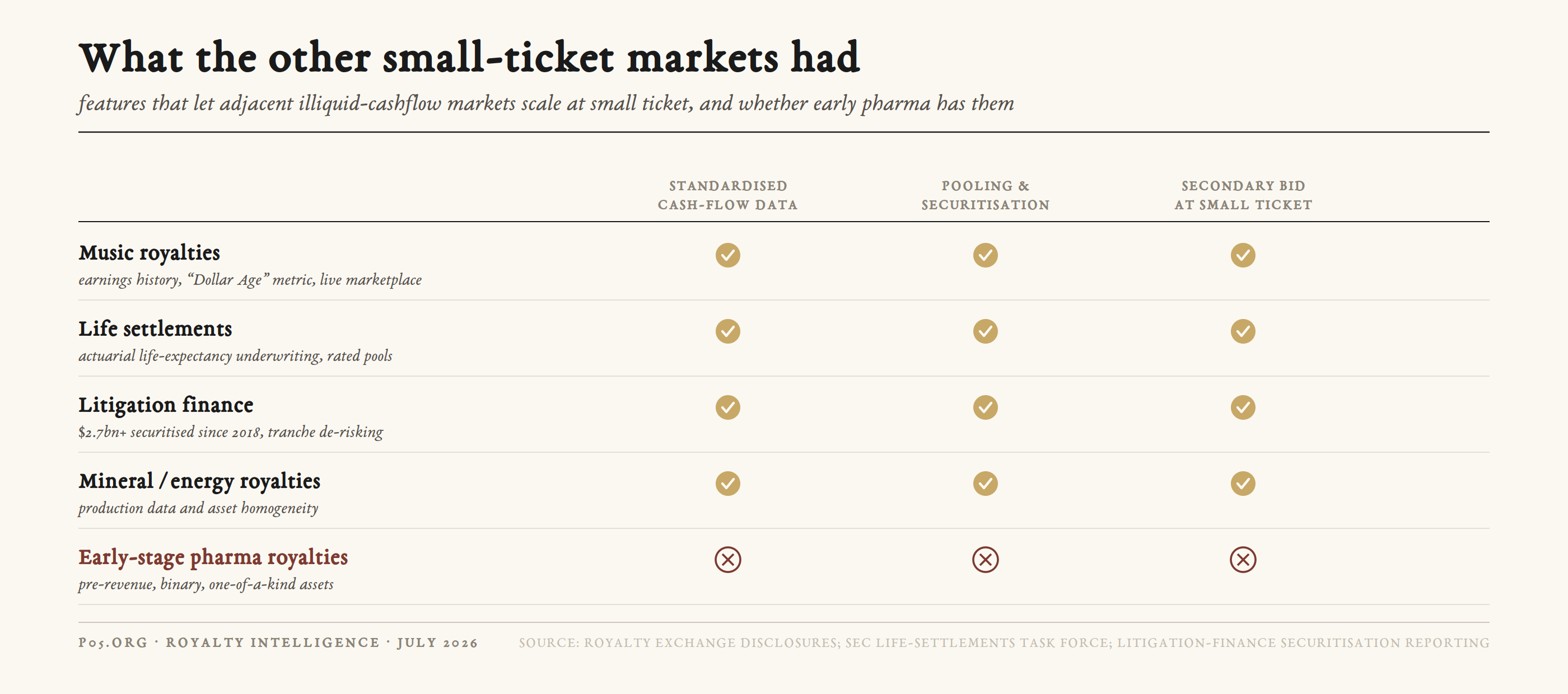
Music, life settlements, litigation finance, and mineral royalties each had standardised data, a pooling route, and a secondary bid. Early pharma royalties have none of the three.
Three pieces would be required together:
- A standardised purchase and synthetic template cheap enough to deploy on two-to-ten million dollar tickets, which attacks the fixed-cost stack directly.
- A pooling vehicle that warehouses many small early positions and issues rated or tranched paper, or sells a diversified book once seasoned, so the originator manufactures a 50 million dollar-plus book rather than selling singles into a market with a 20 million dollar floor.
- A data and pricing layer for early royalties comparable to actuarial life-expectancy underwriting, so price discovery stops being a per-deal exercise.
Paul Capital showed a pharma royalty book can be securitised to a triple-A rating. Doing it for early-stage, sub-scale, heterogeneous positions is unsolved, because rating agencies require the diversification and cash-flow predictability a Phase 2 asset cannot supply, so the securitisation channel opens only after de-risking, the step the strategy is trying to finance.
In sum
Early-stage royalty financing is rare for reasons that are structural rather than a matter of nerve. The raw material is abundant and growing; the idea has been tried at the single-deal level and once at platform scale.
What keeps the Phase 1 and Phase 2 band thin is a stack of independent frictions that compound. The asset is an option, so it works only at portfolio scale. It has no standardised comparable, so pricing is bespoke. Its fixed legal and diligence cost turns a 0.3 percent load on a large deal into a 6 percent load on a small one.
Moving it requires clearing three separate legal doctrines. And even a de-risked early position has almost no buyer, because every institutional floor sits above the size of the deal. Adverse selection weakens the entry, and a duration and vehicle mismatch weakens the exit.
Any one of these is soluble on a given deal. The combination, at a ticket size small enough to reach the early segment, is what the market has not solved, which is why its dominant response is to fund the company while attaching the royalty to a de-risked product.
The conditions under which a dedicated early-stage strategy could clear an institutional bar are specific and documented: deep entry discounts, portfolio breadth, and a standardisation-and-pooling layer that does not yet exist for early pharma royalties. Until it does, the market continues to draw its line at the clinic door.
All information in this article was accurate as of the research date and is derived from publicly available sources including SEC filings, court opinions, regulatory and legislative materials, company press releases, and professional-services and academic literature. Information may have changed since publication. This content is for informational purposes only and does not constitute investment, legal, or financial advice. The author is not a lawyer or financial adviser.