Structuring Around the Binary Risk: CVRs vs. Synthetic Royalty Swaps

Biotech valuation hinges on a small number of binary clinical events. A Phase 3 readout. An FDA approval letter. A manufacturing inspection that either passes or doesn't. These go/no-go moments create the fundamental tension in pharmaceutical M&A: buyers and sellers often agree on everything except the probability-adjusted net present value of pipeline assets still awaiting regulatory judgment.
Two financial instruments have emerged as the primary mechanisms for bridging this valuation gap. Contingent Value Rights represent the traditional public-market solution—a fixed dollar payout if specific milestones are achieved by specific deadlines. Synthetic Royalty Swaps offer a private-market alternative—structured upfront payments in exchange for a percentage of future revenues, with the counterparty effectively buying clinical risk for cash today.
The question for dealmakers navigating 2025's record M&A activity: which mechanism provides better risk-adjusted value for the seller (biotech shareholders) and the buyer (acquirer or royalty fund)?
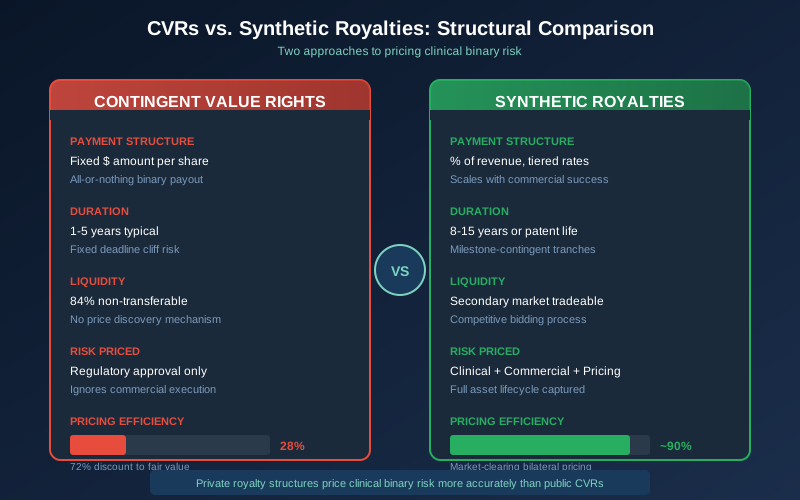
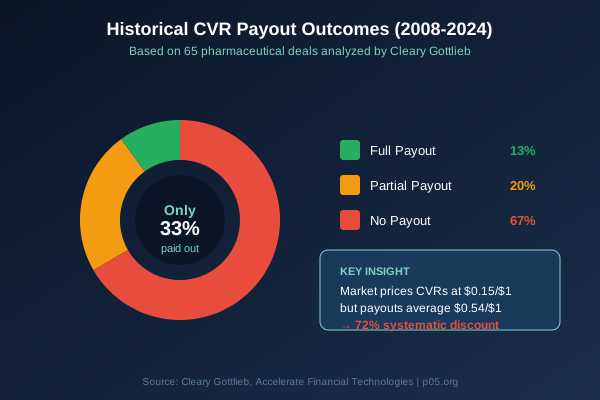
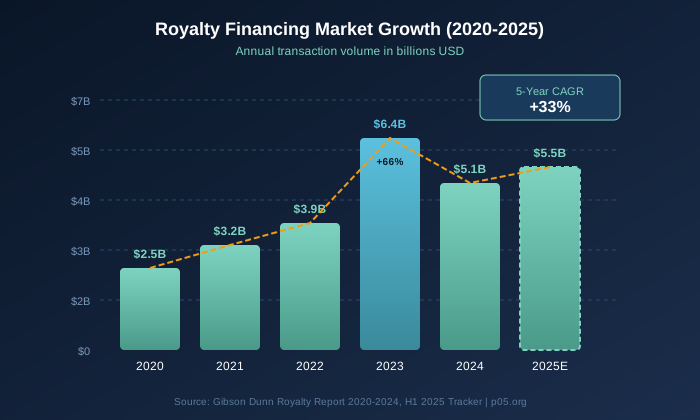
The evidence increasingly suggests that private royalty structures price clinical binary risk more accurately than public CVRs. Market-implied CVR prices average just $0.15 per dollar of maximum payout, while historical data shows CVRs have returned approximately $0.54 per dollar at resolution—a persistent 72% discount to probability-adjusted fair value. Meanwhile, synthetic royalty financing has grown at a 33% compound annual rate since 2020, with specialized funds deploying increasingly sophisticated milestone-contingent structures.
This analysis examines the structural differences between these instruments, profiles the landmark 2025 transactions in both categories, and provides a framework for understanding why private markets may be correcting for the shortcomings of the public CVR model.
The Contingent Value Right: Flaws in the Public Model
CVRs have become a fixture in life sciences M&A. According to Sidley Austin, they appeared in 38% of public biotech deals in 2023—though usage declined to 22% by late 2024 as market conditions shifted. The appeal is straightforward: CVRs allow acquirers to limit upfront payments while giving target shareholders participation in clinical success.
But structural flaws in the CVR model create systematic mispricing that benefits acquirers at shareholders' expense.
Fixed Payout, Flawed Price
The fundamental problem with CVRs is that payout amounts are negotiated during deal discussions—not derived from rigorous probability-weighted analysis. A CVR might promise $6 per share upon FDA approval, but that number reflects political compromise between investment bankers rather than actuarial precision.
Consider the structural limitation: CVR payouts are fixed dollar amounts that don't scale with commercial success. If a drug achieves blockbuster status generating $5 billion in annual sales, CVR holders receive exactly the same payment as if sales peaked at $500 million. The instrument captures regulatory binary risk but ignores the commercial upside that makes pharmaceutical assets valuable.
EisnerAmper describes the CVR's role as bridging "the valuation gap between buyer and seller by providing additional contingent consideration." But bridging a gap is not the same as pricing risk accurately—it's finding a number both parties can accept, regardless of whether that number reflects true expected value.
Short Duration Creates Cliff Risk
CVR timelines typically span 1-5 years, structured around near-term regulatory milestones. This creates cliff risk—the possibility that approval delays of even a few weeks can eliminate billions in potential value.
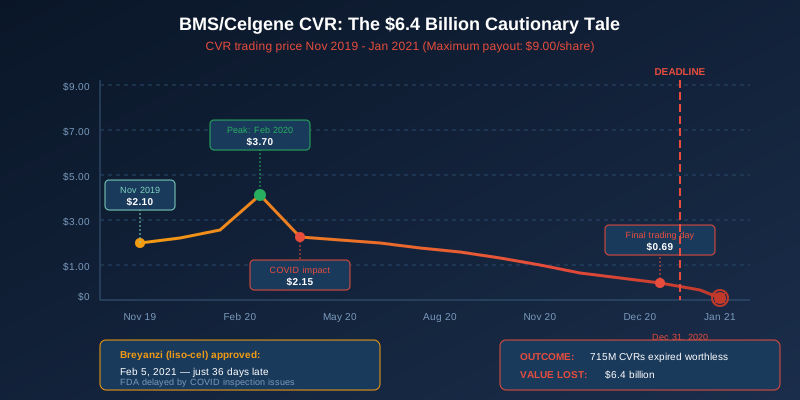
The BMS/Celgene catastrophe illustrates the danger. The $9 per share CVR required FDA approval of three drugs by December 31, 2020. Breyanzi (liso-cel) received approval on February 5, 2021—just 36 days after the deadline. The result: 715 million CVRs expired worthless, destroying $6.4 billion in potential shareholder value despite the drug's ultimate success.
Two of three drugs achieved approval. Yet the all-or-nothing structure paid nothing. Subsequent litigation alleging BMS "slow-rolled" approval has been dismissed, leaving CVR holders with no recourse.
The Liquidity Death Spiral
Perhaps the most damaging structural flaw: approximately 84% of CVRs are non-transferable. Target shareholders receive illiquid contractual rights they cannot sell, trade, or hedge. This design choice—driven by securities registration requirements—eliminates price discovery and prevents sophisticated investors from correcting mispricing through arbitrage.
Even tradeable CVRs suffer from severe liquidity constraints. Research from Yet Another Value Blog documents how CVRs trade like distressed equity rather than probability-weighted derivatives:
"The average timeline for an analyst to be at a job is probably two to three years"—shorter than most CVR payout horizons. There's "simply no upside to putting the CVR trade on, but there is a heck of a lot of downside and hassle."
Career risk, capital inefficiency, and valuation complexity combine to deter institutional participation. The Sanofi/Genzyme CVR—one of the few actively traded instruments—collapsed from $2.60 to $0.08 before litigation eventually recovered approximately $0.88 per CVR through a $315 million settlement.
The 2025 CVR Landscape: Four Case Studies
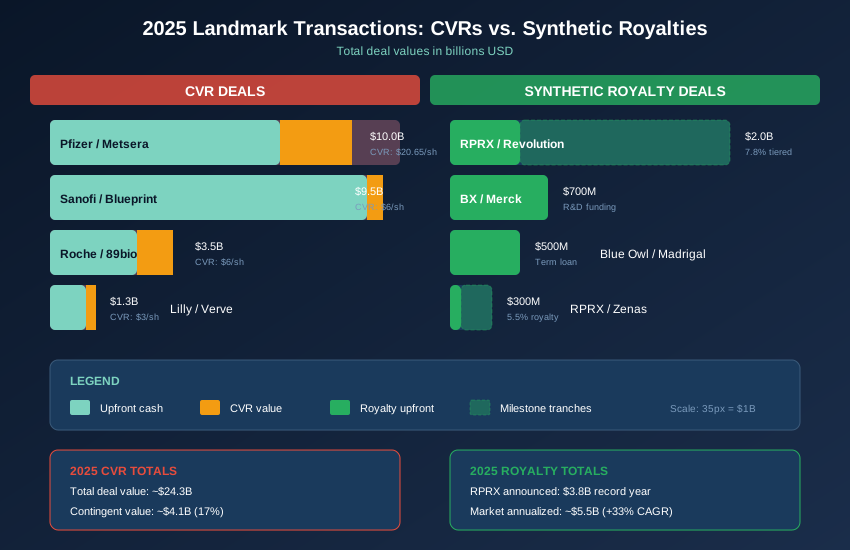
Despite structural flaws, CVR usage continues in major transactions. The 2025 vintage demonstrates both innovation in CVR design and the persistent limitations of the instrument.
Pfizer/Metsera: Bidding War Dynamics
Pfizer's November 2025 acquisition of obesity-focused Metsera emerged from competitive bidding against Novo Nordisk. The deal evolution illustrates how CVRs function as negotiation tools:
| Component | Initial Offer (Sept) | Final Deal (Nov) | Change |
|---|---|---|---|
| Upfront cash/share | $47.50 | $65.60 | +38% |
| CVR maximum/share | $22.50 | $20.65 | -8% |
| Total potential | ~$7.3B | ~$10B | +37% |
The CVR structure spans three milestones with escalating clinical risk:
| Milestone | Payment | Deadline | Risk Level |
|---|---|---|---|
| Phase 3 initiation (combo) | $4.60 | Dec 2027 | Lower |
| FDA approval (monotherapy) | $6.40 | Dec 2029 | Medium |
| FDA approval (combination) | $9.65 | Dec 2031 | Higher |
Seeking Alpha analyst Bram de Haas noted the "CVR structure is front-loaded on the more likely achievements"—Phase 3 initiation carries lower binary risk than regulatory approval. Yet the CVR remains non-transferable, preventing shareholders from monetizing their probability assessments.
Sanofi/Blueprint Medicines: Modest CVR, Mature Assets
Sanofi's $9.1 billion acquisition of Blueprint Medicines employed a smaller CVR—up to $6 per share—representing just 4.7% of total deal value. The CVR ties exclusively to BLU-808, an early-stage wild-type KIT inhibitor:
| Milestone | Payment | Deadline |
|---|---|---|
| Phase 2b/3 patient dosing | $2.00 | Dec 2028 |
| FDA approval | $4.00 | June 2032 |
Blueprint's already-approved Ayvakit generated $479 million in 2024 revenue with 60%+ year-over-year growth. The CVR structure effectively isolates pipeline risk from commercial-stage assets—allowing Sanofi to pay a premium for proven revenue while limiting exposure to development uncertainty.
Roche/89bio: Commercial Milestones
Roche's September 2025 acquisition of 89bio introduced a hybrid structure emphasizing commercial rather than regulatory milestones:
| Milestone | Payment | Deadline |
|---|---|---|
| First commercial sale (F4 MASH) | $2.00 | March 2030 |
| $3B annual sales | $1.50 | Dec 2033 |
| $4B annual sales | $2.50 | Dec 2035 |
This design acknowledges that regulatory approval alone doesn't guarantee commercial success. NAI 500 analysis found arbitrage desks "effectively assigned about 46 cents of value to the CVR"—implying low-single-digit probability of full $6 payout despite pegozafermin's promising Phase 3 data.
Eli Lilly/Verve Therapeutics: Decade-Long Horizon
Eli Lilly's $1 billion acquisition of gene-editing pioneer Verve includes the longest-duration CVR among 2025 deals—a 10-year horizon reflecting the extended development timeline for base-editing cardiovascular therapies:
| Milestone | Payment | Deadline |
|---|---|---|
| First U.S. Phase 3 patient dosed (VERVE-102) | $3.00 | 2035 |
William Blair analyst Myles Minter characterized the deal as a "bargain" against his $30.86 pre-deal fair value estimate, calling the CVR milestone "likely" with Phase 3 initiation possible by H1 2027.
2025 CVR Summary Table
| Acquirer | Target | Upfront | CVR Max | CVR % of Total | Tradeable | Key Trigger |
|---|---|---|---|---|---|---|
| Pfizer | Metsera | $65.60 | $20.65 | 24% | No | Clinical + Regulatory |
| Sanofi | Blueprint | $129.00 | $6.00 | 4.7% | No | Development |
| Roche | 89bio | $14.50 | $6.00 | 29% | No | Commercial Sales |
| Eli Lilly | Verve | $10.50 | $3.00 | 22% | No | Phase 3 Initiation |
The Synthetic Royalty Swap: A Dynamic Alternative
While CVRs transfer binary milestone risk through fixed payments, synthetic royalties create continuous revenue-sharing arrangements that scale with commercial success. The instrument has exploded in popularity: Royalty Pharma announced "a record year" for synthetic royalty transactions in 2025, with deals totaling up to $3.8 billion.
The fundamental difference: synthetic royalties price both clinical binary risk and commercial execution risk through a single instrument.
Variable Payout, True Risk Alignment
Unlike CVRs' fixed dollar payouts, synthetic royalties tie returns to actual product performance. If a drug achieves blockbuster status, royalty holders capture proportional upside. If commercial execution disappoints despite regulatory approval, returns adjust accordingly.
This alignment creates powerful incentives for accurate risk assessment. Covington partner Peter Schwartz explains:
"Lenders that do royalty financings are much better at assessing the risk profile of deals... You can't see that a company's got a steady EBITDA and get a certain multiple. You really need to understand science and the market."
Royalty Pharma employs MD/PhD analysts building proprietary probability-of-success databases from decades of transaction experience. This scientific depth enables more accurate pricing than political negotiations between M&A advisors.
Duration Matching Captures Full Asset Value
Synthetic royalties can be structured to run for the life of the patent—or until specific IRR targets are achieved. This duration matching better reflects pharmaceutical assets' true economic value than CVRs' 1-5 year windows.
Gibson Dunn analysis of 2020-2024 transactions found average royalty durations of 8-15 years, capturing the full commercialization arc from launch through patent expiration. Return caps—present in 44% of synthetic royalty deals—typically range from 1.3x to 3.4x with a median of 2.25x.
Tranched Structures Price Multiple Binary Risks
The most sophisticated synthetic royalties deploy capital in milestone-contingent tranches, limiting investor exposure until clinical uncertainty resolves. This staged approach allows granular pricing of individual binary events rather than aggregating them into single go/no-go structures.
Consider the typical tranching architecture:
| Tranche | Trigger | Risk Level | Typical Rate |
|---|---|---|---|
| 1 | Upfront | Highest | 5-8% |
| 2 | Positive Phase 3 data | High | 4-6% |
| 3 | FDA approval | Medium | 3-5% |
| 4 | Commercial milestone | Lower | 2-4% |
| 5 | Additional indication | Varies | 1-3% |
Each tranche prices remaining uncertainty at the moment of deployment—not the moment of initial negotiation. This dynamic pricing mechanism represents a fundamental advantage over CVRs' static structures.
2025 Synthetic Royalty Deals: A New Paradigm
The 2025 vintage of synthetic royalty transactions demonstrates increasing structural sophistication, with hybrid instruments combining royalty and debt components.
Revolution Medicines: The $2 Billion Template
Royalty Pharma's June 2025 deal with Revolution Medicines represents the largest synthetic royalty transaction in history—and a potential template for future mega-deals.
Synthetic Royalty Component ($1.25 billion):
| Tranche | Amount | Trigger | Type |
|---|---|---|---|
| 1 | $250M | Immediate | Required |
| 2 | $250M | Positive Phase 3 (RASolute 302) | Required |
| 3 | $250M | FDA approval (2L pancreatic) | Optional |
| 4 | $250M | Sales milestone | Optional |
| 5 | $250M | Positive Phase 3 (1L pancreatic) | Optional |
Tiered Royalty Rates (all tranches drawn):
| Annual Net Sales | Royalty Rate |
|---|---|
| $0-2 billion | 7.80% |
| $2-4 billion | 4.55% |
| $4-8 billion | 2.40% |
| Above $8 billion | 0% |
The declining royalty rates at higher sales thresholds protect Revolution's economics if RAS(ON) inhibitors achieve blockbuster status—while Royalty Pharma captures attractive risk-adjusted returns across a range of commercial outcomes.
The deal also includes a $750 million senior secured term loan at SOFR + 5.75% (3.5% floor). Fierce Biotech noted the term loan becomes available only after FDA approval—completely eliminating regulatory binary risk from the debt component.
Revolution CEO Mark Goldsmith emphasized the structure "preserves optionality as we scale our operations to create the industry-leading global targeted medicines franchise."
Zenas BioPharma: Milestone-Based Deployment
Royalty Pharma's September 2025 deal with Zenas BioPharma demonstrates milestone-contingent deployment for earlier-stage assets:
| Component | Amount | Trigger |
|---|---|---|
| Upfront | $75M | Immediate |
| Tranche 2 | $75M | Phase 3 INDIGO success |
| Tranche 3 | $75M | FDA approval (IgG4-RD) |
| Tranche 4 | $75M | FDA approval (SLE) |
| Royalty rate | 5.5% | Worldwide net sales |
Only 25% of total capital deploys upfront—limiting Royalty Pharma's exposure until clinical data validates the opportunity. Zenas CEO Lonnie Moulder stated the transaction "underscores our conviction in the potential of obexelimab as a franchise molecule."
Blackstone Life Sciences: R&D Funding Model
Blackstone deployed $700 million with Merck for sac-TMT (TROP2-targeting ADC) development—demonstrating how royalty structures can fund early-stage R&D without traditional equity dilution.
Key terms:
- Upfront: $700 million
- Royalty: Low-to-mid single digits on net sales
- Additional payments: Tiered milestones upon approval
The Merck deal exemplifies Blackstone's "ownership strategy"—providing development capital in exchange for royalty economics rather than equity stakes. This model generated a $3.1 billion exit when Novartis acquired Blackstone-backed Anthos Therapeutics.
Blue Owl Capital: Debt-Adjacent Structures
Blue Owl has pioneered debt-adjacent royalty structures, deploying significant capital through senior secured credit facilities:
| Company | Amount | Structure |
|---|---|---|
| Madrigal Pharmaceuticals | $500M | Senior secured term loan |
| ITM Isotope Technologies | $262.5M | Non-dilutive debt |
| BridgeBio (w/HCRx) | $300M | Royalty monetization |
These hybrid instruments blur the line between royalty financing and traditional lending—offering companies flexibility while providing Blue Owl with security packages protecting downside risk.
2025 Synthetic Royalty Summary Table
| Investor | Company | Total Value | Upfront | Royalty Rate | Structure |
|---|---|---|---|---|---|
| Royalty Pharma | Revolution Medicines | $2.0B | $250M | 7.80% tiered | Synthetic + debt |
| Royalty Pharma | Zenas/obexelimab | $300M | $75M | 5.5% flat | Milestone-based |
| Royalty Pharma | AMVUTTRA | $310M | $310M | 1% | Acquisition |
| DRI Healthcare | Viridian/veligrotug | $300M | $55M | 7.50% tiered | Synthetic |
| HealthCare Royalty | GENFIT/Iqirvo | €185M | €130M | Capped | Monetization |
| Blackstone | Merck/sac-TMT | $700M | $700M | Low-mid single | R&D funding |
| Blue Owl | Madrigal | $500M | $200M | N/A | Term loan |
Who Prices Risk More Accurately? The Structural Verdict
The case for synthetic royalties' superior pricing efficiency rests on three structural advantages: information asymmetry, incentive alignment, and portfolio diversification.
Information Asymmetry Favors Specialized Funds
CVR holders—typically former target shareholders—possess limited information beyond public merger proxy disclosures. They lack access to proprietary clinical databases, FDA correspondence analysis, or key opinion leader networks that inform sophisticated probability assessments.
Royalty funds operate differently. Royalty Pharma controls over 60% of the global royalty acquisition market, creating self-reinforcing informational advantages: historical track record informs current pricing, while deal flow concentration provides comparative valuation benchmarks unavailable to dispersed CVR holders.
Incentive Alignment Through Revenue Participation
CVRs create asymmetric incentives between acquirers and former shareholders. Once a deal closes, the acquirer controls development and regulatory strategy—with "commercially reasonable efforts" covenants providing limited protection. The BMS/Celgene litigation demonstrated how difficult it is to prove an acquirer deliberately delayed approval.
Synthetic royalties align incentives differently. The company retains operational control while the royalty holder's returns depend entirely on commercial success. Both parties benefit from faster development, successful commercialization, and aggressive market access—creating parallel rather than opposing interests.
Portfolio Diversification Enables Aggressive Pricing
Individual CVR holders face concentrated binary risk. A 100% loss is possible—indeed, probable given historical payout rates around 33%.
Royalty funds diversify across dozens of products and therapeutic areas. Royalty Pharma holds royalties on 35+ marketed therapies generating predictable cash flows that subsidize clinical-stage bets. This portfolio approach enables more aggressive pricing on individual binary events—capturing expected value that concentrated holders cannot access.
The Pricing Gap: Quantitative Evidence
Historical data reveals the magnitude of CVR mispricing:
| Metric | CVRs | Synthetic Royalties |
|---|---|---|
| Average market price | $0.15 per $1 max | Negotiated bilaterally |
| Average realized payout | $0.54 per $1 max | Return caps 1.3-3.4x |
| Implied discount | 72% | Market-clearing |
| Full payout rate | ~13% | N/A (continuous) |
| Any payout rate | ~33% | N/A (continuous) |
The persistent 72% discount suggests CVR markets fail to price clinical binary risk efficiently. Sophisticated capital that could correct mispricing through arbitrage is deterred by illiquidity, career risk, and capital inefficiency constraints.
Structural Comparison: CVRs vs. Synthetic Royalties
The following framework synthesizes key differences between instruments:
Risk Allocation Comparison
| Dimension | CVRs | Synthetic Royalties |
|---|---|---|
| Context | M&A consideration | Standalone financing |
| Payment trigger | Binary milestone | Continuous revenue |
| Typical duration | 1-5 years | 8-15 years |
| Transferability | Usually non-transferable | Tradeable |
| Control impact | Acquirer gains control | Company retains control |
| Risk profile | All-or-nothing | Proportional sharing |
| Pricing mechanism | Negotiated fixed amount | Probability-weighted |
| Upside capture | Capped at CVR amount | Scales with sales |
Covenant Structure Comparison
| Protection | CVRs | Synthetic Royalties |
|---|---|---|
| Efforts standard | "Commercially reasonable" | Specific performance |
| Enforcement | Rights agent, litigation | Direct contract |
| Information rights | Limited | Quarterly reporting |
| Security | Unsecured | Often secured |
| Consent rights | Minimal | Licensing restrictions |
Economic Profile Comparison
| Factor | CVRs | Synthetic Royalties |
|---|---|---|
| Seller dilution | None (contingent) | Revenue share |
| Buyer risk transfer | Full (if milestone met) | Continuous |
| Pricing efficiency | Low (72% discount) | High (competitive bids) |
| Liquidity | Poor | Secondary market |
| Tax treatment | Uncertain | Sale treatment |
Market Data: The Diverging Trajectories
CVR Market Trends
CVR usage has fluctuated significantly:
| Year | % of Life Sciences Deals |
|---|---|
| 2021 | ~25% |
| 2022 | ~35% |
| 2023 | 38% (peak) |
| 2024 | 22% |
| 2025 | ~25% (estimated) |
Sidley Austin notes that CVRs "continue to be discussed as a deal term in substantially more transactions" than ultimately include them—suggesting resistance from both buyers (complexity) and sellers (value leakage).
Royalty Financing Market Growth
The royalty financing market has grown dramatically:
| Year | Volume | YoY Growth |
|---|---|---|
| 2020 | ~$2.5B | Baseline |
| 2021 | ~$3.2B | +28% |
| 2022 | $3.86B | +21% |
| 2023 | $6.42B | +66% |
| 2024 | $5.07B | -21% |
| 2025E | $5.54B | +9% |
According to Gibson Dunn, H1 2025 saw 15 transactions totaling $2.77 billion—annualizing to over $5.5 billion. Average deal sizes reached $225.94 million with upfront payments averaging $114.92 million.
Institutional Capital Flows
KKR's July 2025 acquisition of majority ownership in HealthCare Royalty Partners signals continued institutional appetite for the asset class. HCRx manages approximately $3 billion across 55+ products—and KKR's involvement suggests further capital deployment ahead.
Deloitte survey data shows:
- 54% of biopharma executives increased interest in royalty funding
- 87% would consider royalties for at least some capital needs
- ~90% considering royalty financing in next 3 years
Historical CVR Outcomes: The Cautionary Evidence
Aggregate Payout Statistics
Cleary Gottlieb analysis of 65 pharmaceutical CVR deals (2008-2024) provides sobering data:
| Outcome | Count | Percentage |
|---|---|---|
| Full payout | 4 | ~13% |
| Partial payout | 6 | ~20% |
| No payout | ~20 | ~67% |
Two-thirds of resolved CVRs paid nothing to holders. Even among the minority that paid something, partial payments often reflected litigation settlements rather than milestone achievement.
Case Study: BMS/Celgene ($6.4B Destruction)
The BMS/Celgene CVR represents the largest value destruction in CVR history:
| Timeline | Event | CVR Price |
|---|---|---|
| Nov 2019 | Initial trading | $1.95-2.26 |
| Feb 2020 | Ozanimod progress | $3.70 |
| Mar 2020 | COVID uncertainty | $2.15 |
| Dec 2020 | Final trading day | $0.69 |
| Jan 2021 | CVR terminated | $0.00 |
The all-or-nothing structure required approval of three drugs (ozanimod, ide-cel, liso-cel) by December 31, 2020:
- Zeposia (ozanimod): Approved March 2020 ✓
- Abecma (ide-cel): Approved March 2021 ✓
- Breyanzi (liso-cel): Approved February 2021 ✗ (36 days late)
Two successful approvals. One missed deadline. Zero payout. $6.4 billion evaporated.
Case Study: Sanofi/Genzyme (Litigation Recovery)
The Sanofi/Genzyme CVR demonstrates how litigation can partially recover value—at significant cost:
| Phase | Value per CVR |
|---|---|
| Initial issue | ~$5.58 implied |
| Market trading | $2.60 |
| Trough (Mar 2016) | $0.08 |
| Pre-settlement (Oct 2019) | $0.84 |
| Settlement payout | $0.88 |
Lemtrada received FDA approval in November 2014—eight months after the March 2014 deadline. Litigation ultimately yielded a $315 million settlement, with approximately $107 million allocated to legal fees.
The lesson: even "successful" CVR litigation recovers only partial value after years of delay and substantial costs.
Market Evolution: Convergence and Innovation
CVRs Adopting Royalty Features
Recent CVR structures show evolution toward royalty-like characteristics:
Revenue-linked milestones: Roche/89bio's CVR includes $3B and $4B annual sales thresholds—effectively revenue participation rather than binary regulatory triggers.
Tiered structures: Multiple milestone payments spreading value across development phases rather than single go/no-go events.
Extended durations: Lilly/Verve's 10-year horizon approaches typical royalty financing terms.
Royalties Moving Earlier in Development
Synthetic royalty investors are increasingly willing to fund clinical-stage assets:
DRI Healthcare executed its first pre-approval synthetic royalty acquisition with KalVista's sebetralstat. Royalty Pharma's Revolution Medicines deal includes tranches contingent on Phase 3 data—not just regulatory approval.
Hybrid Instruments Emerging
The Revolution Medicines structure—combining $1.25 billion synthetic royalty with $750 million term loan—may represent a new template. These hybrids offer:
- Royalty component: Captures upside, prices clinical risk
- Debt component: Lower cost, becomes available post-approval
- Combined benefit: Comprehensive capital solution across development phases
Gibson Dunn projects "increased activity in royalty monetizations, synthetic royalty financings, and royalty/debt hybrid structures" through 2025-2026.
Implications for Market Participants
For Acquirers
CVRs remain attractive when:
- Targeting distressed assets where valuation gaps are substantial
- Bridging final bidding increments in competitive situations
- Isolating specific pipeline risks from commercial-stage assets
The Pfizer/Metsera playbook demonstrates effective use: CVR structure evolved during competitive bidding, ultimately allowing Pfizer to prevail against Novo Nordisk while deferring substantial consideration until clinical de-risking.
Key consideration: Non-transferability provisions limit sophisticated opposition—but may also reduce target shareholder support for deals.
For Target Shareholders
The systematic CVR discount suggests accepting lower upfront consideration may be suboptimal. The $0.15-to-$0.54 trading-to-payout ratio implies shareholders subsidize acquirer optionality by approximately 72%.
Strategic response: Demand higher upfront consideration, shorter milestone timelines, or transferable CVRs that enable price discovery.
For Investors Seeking Binary Exposure
The CVR market's inefficiencies present opportunity for investors able to warehouse long-duration binary risk without career or capital constraints.
Key screens: Focus on tradeable CVRs where market-implied probabilities diverge materially from clinical data, near-term catalysts create asymmetric payoffs, or litigation provides additional upside.
For Royalty Funds
The synthetic royalty market's growth reflects both capital availability and structural advantages. Competitive dynamics are intensifying—KKR's HCRx acquisition signals mainstream institutional interest.
Strategic positioning: Earlier-stage funding (pre-approval synthetics), hybrid structures (royalty + debt), and geographic expansion (European royalty monetizations) offer differentiation opportunities.
Conclusion: Private Markets Price Binary Risk Better
The evidence supports a clear conclusion: private royalty structures price clinical trial binary risk more accurately than public CVRs.
Information asymmetry favors specialized funds with scientific expertise and proprietary databases. Incentive alignment creates parallel interests between companies and royalty holders. Portfolio diversification enables aggressive pricing on individual binary events. And continuous revenue participation captures commercial upside that fixed CVR payouts miss entirely.
This doesn't mean CVRs will disappear. They serve distinct M&A functions—bridging valuation gaps at deal announcement, enabling competitive bidding dynamics, and allocating pipeline risk in strategic transactions. The 2025 deals demonstrate continued innovation in CVR design.
But the systematic mispricing of CVRs—trading at 72% discount to probability-adjusted value—creates both opportunity for sophisticated investors and value leakage for target shareholders. The market is responding through structural convergence: CVRs adopting royalty-like tiered and revenue-linked features, while royalty funds move earlier in development cycles.
For finance professionals in pharmaceutical royalty markets, the strategic implication is clear: wherever possible, structure risk transfer through private bilateral negotiation rather than public market mechanisms. The price discovery benefits of public trading are overwhelmed by structural barriers preventing efficient CVR pricing.
Until those barriers change—through standardization, improved liquidity, or institutional access provisions—private capital will continue pricing clinical binary risk more accurately than Wall Street.
The author is not a lawyer or financial adviser. This content does not constitute investment or legal advice. Information presented is for educational purposes only and should not be relied upon for making investment decisions.
Member discussion