The Capital Stacking Quagmire: Sequencing Royalty Deals in a Public Biotech
Introduction
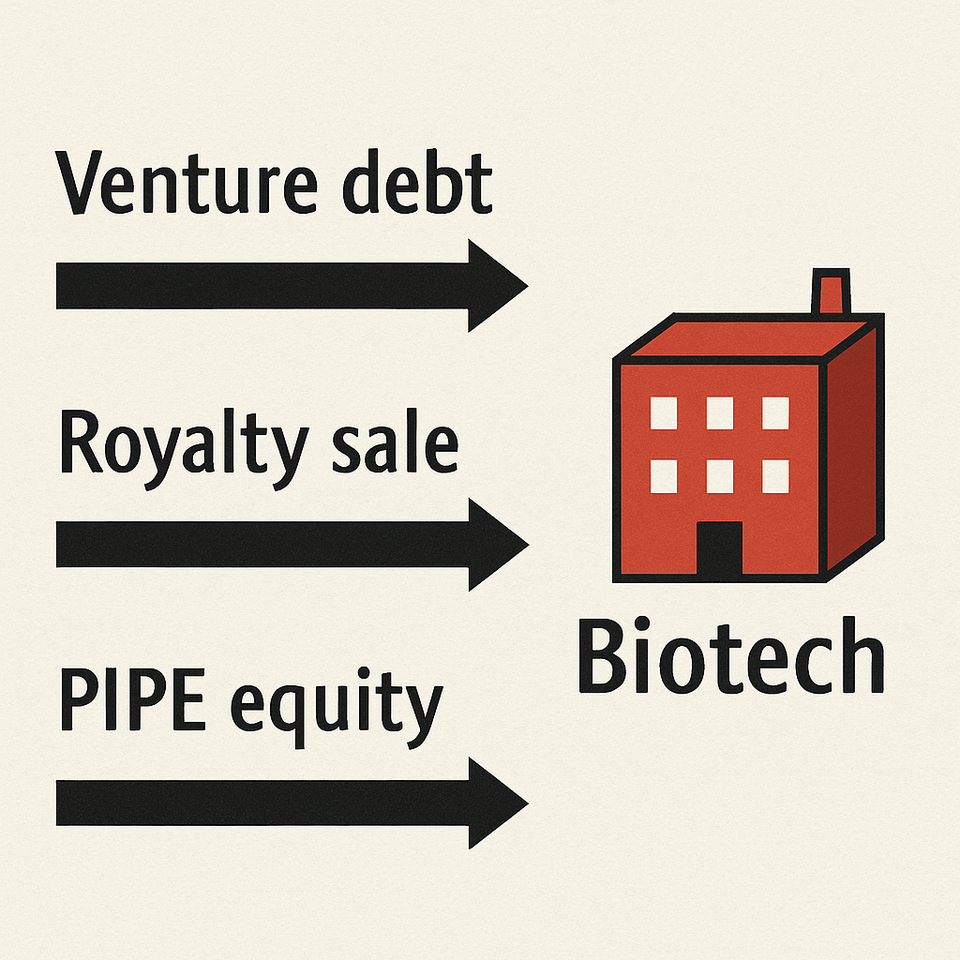
In today's tough biotech funding climate, many public biotechs have resorted to creative financing combos to stay afloat. Rather than relying on a single source of cash, a distressed company might simultaneously tap a term loan (venture debt), execute a royalty monetization deal, and secure an equity PIPE (Private Investment in Public Equity).
This multi-layered approach aims to maximize upfront capital while minimizing equity dilution – a lifeline when traditional stock offerings or IPOs are unfeasible. However, stacking these instruments on the same asset or product creates a legal and logistical quagmire.
Each investor group – lenders, royalty purchasers, and equity holders – has fundamentally conflicting priorities regarding claims on assets and cash flows. The challenge is engineering a capital stack that satisfies all parties without triggering defaults or undermining the company's future. In this deep dive, we examine how biotech companies in 2024–2025 have navigated this delicate balancing act, including real deal structures from the US and abroad, and analyze key issues like lien hierarchy, covenant overlaps, and even secondary trading of royalty interests.
Capital Stack Component Comparison
| Instrument | Primary Goal | Security Interest | Key Risk |
|---|---|---|---|
| Term Loan (Venture Debt) | First-priority claim on all assets; fixed interest + principal repayment | Blanket lien on IP, receivables, and company assets | Company insolvency before loan maturity |
| Royalty Monetization | Percentage of product revenue until return cap achieved | "True sale" of revenue stream; typically no direct lien on assets | Product commercial failure or revenue below projections |
| Equity PIPE | Future upside from company growth, acquisition, or IPO | Last in liquidation hierarchy (residual claim) | Dilution and value erosion from debt/royalty obligations |
Liens and Lock-Ups: Navigating the Hierarchy of Security Interests
One major complexity in layering debt and royalty financing is dealing with security interests (liens) on the biotech's intellectual property (IP) and revenue streams. Venture debt providers typically demand a first-priority lien on all assets, including the IP behind a drug candidate, as collateral for their loan.
By contrast, royalty financing is often structured as a "true sale" of a portion of the product's future revenue, rather than as secured debt. In theory, a true sale means the royalty buyer owns a piece of the revenue and does not take a direct lien on company assets. This flexibility is a selling point – "buyers do not look to encumber company assets" in many royalty deals, giving the biotech freedom to do additional financings.
But in practice, when a royalty deal and a secured loan coexist on the same asset, careful contracting is needed to delineate whose claim comes first and on what.
Intercreditor Agreements: The Key Tool
Intercreditor agreements are the key tool used to untangle these competing interests. The debt lender and the royalty investor typically negotiate an intercreditor (or subordination) agreement that locks in their relative rights. For example, if the lender has a blanket lien on the IP and related receivables, the intercreditor may carve out the specific revenue stream sold to the royalty investor.
In one case, a royalty financing deal gave the investor a "silent second" lien – explicitly junior to the existing bank's lien – and set up a special account for the royalty payments. The venture lender acknowledged it "has no security interest in… the Special Account or any cash held therein", effectively locking up that portion of revenue for the royalty buyer.
Such provisions ensure the lender can't sweep those funds, while the royalty investor agrees its claim on other assets is subordinated. In other words, the royalty is treated as an encumbrance only on the defined revenue stream, and the lender retains first dibs on the underlying IP and any remaining cash flows.
Negative Pledges and Consent Clauses
Another tactic is using negative pledges and consent clauses. The loan agreement often prohibits selling or assigning IP or revenue without the lender's consent. So the biotech must negotiate the royalty sale as a "permitted transaction" under the loan covenants. This usually entails the lender reviewing the royalty agreement terms and formally consenting to the sale (often via the intercreditor agreement).
The goal is to avoid the royalty deal itself triggering a default under the debt. In recent large financings, companies have managed this by doing the debt and royalty deals concurrently so that all parties sign off on the structure.
Case Study: Geron Corporation's 2024 Financing
Geron Corporation's 2024 financing is a prime example: Geron raised $125 million upfront by selling a royalty interest on its blood cancer drug and simultaneously secured a $250 million term loan. The loan was explicitly secured by all assets including IP, but Geron's sale of a portion of U.S. net sales to Royalty Pharma was structured to avoid interfering with that lien.
Thanks to an intercreditor arrangement and deal tailoring, Royalty Pharma's "true sale" revenue rights coexisted with Pharmakon's first-priority security interest without litigation. In effect, Pharmakon agreed not to contest Royalty Pharma's slice of the sales, and Geron covenanted to pay that slice as agreed – a delicate but workable truce in the capital stack.
Buyout Clauses and Exit Provisions
It's worth noting that royalty monetizations often lack hard collateral enforcement rights, compared to lenders. Royalty investors typically rely on contract rights to receive payments from product sales and may only get security interests in specific cases (e.g. synthetic development financings often include a lien).
This lighter touch can be advantageous: it means fewer asset lock-ups that might scare off other financiers. However, when things go wrong (e.g. the company defaults or declares bankruptcy), the hierarchy set by liens and the true sale will be stress-tested.
In practice, this is often achieved by contractual buyout clauses: for instance, Geron's royalty deal allows the obligation to Royalty Pharma to be discharged upon a change of control by paying a fixed multiple of the investment. That ensures that if the company is acquired or liquidated, the royalty interest can be cleared by paying Royalty Pharma a set amount, after which the asset is unencumbered for the acquirer.
Key Takeaway on Lien Hierarchy
In summary, lien hierarchy and lock-ups must be engineered with precision. Through intercreditor agreements, carve-outs like special accounts, consent covenants, and buyout options, companies can layer a royalty sale on top of a lien-heavy debt facility. The result, if done right, is a peace treaty of sorts: the senior lender feels its collateral is protected, and the royalty investor gains confidence it will get paid from the agreed revenue stream. Without these measures, the two non-dilutive investors would be on a collision course, jeopardizing the very lifeline the financing was meant to provide.
The Covenant Overlap: When Cash Streams Collide
Even if liens are sorted out, financial covenants and cash flow tests can create a minefield when multiple deals coincide. Venture loans often come with covenants like:
- Minimum cash balance
- Minimum cash runway (e.g. requiring the company to always have X months of operating cash on hand)
- Limits on cash outflows
Introducing a royalty stream obligation means a portion of future revenue will be siphoned off to the investor – effectively a built-in reduction in cash flow for the company. If not structured carefully, this can cause unintentional breaches of debt covenants or liquidity requirements.
The Cash Runway Problem
Consider a scenario where a debt agreement requires the company to maintain 12 months of cash runway. If the biotech's drug starts generating revenue, but 10% of those sales must be paid out to a royalty investor each quarter, the net cash retained is lower. This might shorten the projected runway and put the company at risk of violating the covenant, especially if expenses remain high.
In extreme cases, a revenue-based payout could even be interpreted as a form of indebtedness or restricted payment by a strict lender. Companies must therefore align the covenants of the debt with the reality of the royalty deal. This might involve negotiating exclusions or carve-outs in the definitions used for covenants.
For instance, the debt might exclude the royalty payments from the definition of "funded debt" or permit those payments as an exception under restricted payment clauses. In Geron's 2024 loan, the company was fortunate – there were no financial maintenance covenants at all, eliminating the risk of a cash-flow technical default. Not all companies have that luxury; many venture loans do impose covenants if the lender isn't fully confident in the borrower's outlook.
Cross-Default Clauses
Another area of overlap is cross-default clauses. Lenders know that if a company stops paying its royalty investor, trouble is brewing (it could indicate cash insolvency or a dispute). Thus, debt agreements often deem a default under the royalty contract as a default under the loan.
Geron's loan, for example, lists as an Event of Default any "cross-default of… royalty revenue contracts". This means if Geron fails to make the revenue interest payments to Royalty Pharma as promised, Pharmakon can accelerate the loan in response. Similarly, if the company defaulted on the loan (or went bankrupt), the royalty investor would likely cease getting paid – although as a true sale owner, the royalty investor might assert rights to revenue before unsecured creditors.
To avoid chaos, the intercreditor agreement can explicitly outline these scenarios. Often the royalty investor will agree not to declare a default or exercise remedies (like demanding acceleration of payments) without coordinating with the senior lender. In essence, the lender gets to "call the shots" in a distress scenario, while the royalty investor may sit tight or negotiate, knowing they are junior in a liquidation.
Cash Sweep Provisions
A real-case illustration of covenant overlap involves cash sweep provisions. Some debt deals require that above a certain cash threshold, excess cash must be used to prepay the loan. If a royalty deal is in place, who gets the "first cut" of cash – the lender via sweep or the royalty via its percentage?
Without clarity, the company could be squeezed between paying its royalty versus meeting a sweep covenant. The solution might be to stipulate that royalty payments are made prior to calculating any excess cash for sweeps, so that the royalty doesn't inadvertently trigger a sweep by reducing cash (or vice versa).
These details have to be ironed out in the term sheets and definitely by the definitive agreements. As one law firm noted, great care at the term sheet stage is needed to "clearly delineate lien and covenant scope" to avoid surprises later, because lenders may otherwise "struggle to find viable ways to step into intercreditor relationships" if terms are too restrictive.
The Juggling Act
In sum, overlapping financial covenants require thorough scenario planning. The finance team must model the cash flows under various outcomes – slow sales, fast sales, default – to ensure that paying the royalty won't trip a debt covenant or vice versa. Often the company's lawyers will push for covenant cushions or waivers specifically acknowledging the royalty payments.
And if an equity PIPE is also happening, those investors will want to ensure these covenants aren't so tight that a minor revenue miss or extra payment triggers a cascade of defaults that imperils the company. It is truly a juggling act: the company must keep all promises aligned, so that one hand (paying the royalty) doesn't slap the other (violating the loan agreement).
When done successfully, as seen in some 2024 deals, the company can thread the needle – obtaining cash from multiple sources without immediate punitive clauses. But if done poorly, covenant overlap can quickly land the biotech in a no-win situation: cash strapped, in technical default, and facing angry creditors on all sides.
The Secondary Royalty Sale: Slicing and Dicing Revenue Streams
An often overlooked wrinkle in royalty financings is what happens after the initial deal – specifically, the possibility of secondary sales or syndications of the royalty stream. The original royalty investor (Fund A) might not hold the entire deal through its life. These deals can be large and extend over many years, while investors' needs and strategies can change.
Increasingly, there have been cases of an original royalty holder selling a "strip" or tranche of their royalty rights to a third-party fund. This creates a second layer of complexity: now the revenue stream is split among multiple downstream investors who weren't in the original negotiations with the company.
Why Secondary Sales Occur
Portfolio management is one key reason. Royalty funds have finite lives and risk limits. Suppose Fund A provided $100 million for a royalty, expecting to hold it for 10+ years. If after a few years the drug is performing well (or conversely if the fund needs liquidity), Fund A might decide to monetize part of its position.
They could privately negotiate with another investment fund (Fund B) to sell, say, half of the remaining royalty for an upfront sum. Fund B then steps into the shoes of receiving that portion of the royalty payments going forward. This is akin to how mortgage lenders sell loans or investors trade bonds – a secondary market for royalties.
In fact, some funds specialize in secondary transactions, seeing an arbitrage opportunity in buying seasoned royalty streams that have less risk than brand-new ones. According to industry filings, royalty secondary investments involve buying interests in existing royalty funds or assets via private deals, often after the initial fundraising or investment period.
Such secondaries can avoid the early "J-curve" of a new investment (where payouts haven't started yet). For the original investor, it's a way to rebalance risk or free up capital – for example, if their fund is nearing its end, they might sell the tail end of royalties to return cash to their investors.
Implications for Companies
From the biotech company's perspective, a secondary sale does not directly bring new cash to the company, since it's between investors. However, it can have implications for the company: the new investor (Fund B) will now be an interested party, potentially with rights (through the original contract) to certain information or to consent to amendments.
Most royalty agreements allow assignments either freely or with company consent not to be unreasonably withheld. Companies typically anticipate this by including provisions that any assignee must agree to the same terms and that notice is given.
But consider a complex situation: if the original royalty was structured with, say, a single point of contact for the company (Fund A), a partial sale might result in the company now dealing with multiple payees. One investor might hold the rights to the first X% of sales and another to the next Y%. This resembles tranched funding or strips, which actually sometimes happens at the deal's inception too.
Tranched Structures and Arbitrage
In fact, some recent deals have been deliberately tranched – either over time or by sales tier – to meet different investors' profiles. For example, a deal could be split so Investor 1 funds immediately for rights to the first tier of royalties, and Investor 2 commits to fund later or gets the second tier of royalty above a sales threshold. These bespoke structures create a form of built-in secondary allocation.
An "obscure" variant cited in industry chatter is when an original investor uses a strip sale for arbitrage – essentially, selling the safest part of the royalty stream and retaining a riskier, high-upside part (or vice versa). If a drug's sales are ramping up, the front-end royalties might be quite certain, so selling those could fetch a high price (lower discount rate), while the original investor keeps the tail-end which might be riskier but could yield more if the drug is a long-term hit.
This way, the original investor reduces risk and recoups capital, and the secondary buyer gets a stable cash-yielding asset. Such transactions are usually private, but they highlight that the capital stack on a single asset can become even more layered over time – not only is the company balancing a lender and an initial royalty purchaser, but that royalty piece might later be owned by multiple parties.
Growing Secondary Market
The secondary market for pharma royalties has been growing as the overall royalty financing space matures. A Gibson Dunn report in 2025 noted more funds entering the arena and increasingly competitive pricing, and some new funds explicitly list secondary royalty deals as part of their strategy.
This increased liquidity can be a blessing – investors know they aren't locked in forever, which makes them more willing to deploy capital into royalty deals in the first place. However, from the company's vantage point, it's critical that any future transfers do not affect their operations or obligations.
Generally, the economics for the company remain the same (they will pay X% of sales regardless of who ultimately receives it). But if not carefully documented, there could be administrative hassle or even legal risk if, say, the company wasn't properly notified of an assignment and kept paying the original investor.
Thus, clarity in the contract around assignments and notice is key. Most agreements state that a certain bank or agent will continue to receive payments and distribute to whoever holds the interests, so the company just pays to one place. This way, even if slices of the royalty are sold off, the company's payment process doesn't change – it's behind the scenes that Fund B now gets a cut from Fund A's agent.
Key Takeaway on Secondary Sales
In summary, the rise of secondary royalty sales and tranche syndications adds another dimension to the capital stacking quagmire. It underscores that a company's capital structure on a given asset isn't static after the initial deal – it can evolve. For financially literate and risk-savvy observers, this is analogous to debt securitization or syndicated loans in more traditional finance.
The biotech must ensure that its agreements permit this flexibility while insulating the company from any negative effects. If managed well, secondary liquidity in royalty deals can actually benefit companies indirectly (by making primary royalty financing more attractive to investors, hence easier to obtain). But it certainly contributes to the complex mosaic of stakeholders who have a piece of the biotech's future revenues.
Engineering the Capital Stack to Satisfy Conflicting Priorities
Bringing together a term loan lender, a royalty purchaser, and new equity investors in a PIPE is like negotiating peace among three rival factions. Each has conflicting priorities:
- The lender wants stability and first claim on assets
- The royalty investor wants a guaranteed slice of revenue come hell or high water
- The PIPE equity investors want the company to grow the pie (the asset's value) without being devoured by the other two
How can a distressed public biotech legally and practically engineer such a capital stack so that all three groups sign on? The solution lies in careful structuring, aligned incentives, and a bit of creative compromise.
Strategy 1: Structure as a Coordinated Package
In many cases, the company will negotiate these transactions in parallel and even make them inter-conditional (each closing only if the others close). This ensures that each investor group knows the overall plan. For example, an investor committing fresh equity in a PIPE will take comfort if they see that alongside their cash, the company is getting non-dilutive capital that extends the runway (e.g. a loan and royalty sale) – but only if those other deals don't handcuff the company.
By orchestrating a simultaneous closing, the biotech can present a unified recapitalization plan. Geron's November 2024 recap again illustrates this: they announced the $125 million royalty sale and $250 million loan on the same day, as part of funding their drug launch.
Although Geron did not add a PIPE at that time, it had done an equity raise earlier, and the combined non-dilutive financing boosted investor confidence in its solvency. In a hypothetical distressed scenario, the PIPE might come alongside the debt/royalty; often the equity piece is used to fund near-term needs and satisfy any requirement that the company have a minimum equity cushion (some lenders or royalty investors insist the company raise a bit of equity so that those funds go into the business rather than servicing debt).
Strategy 2: Prioritize and Compartmentalize Claims
Legally, the company must delineate who gets paid, when, and from what sources, to avoid fights later. Typically, the priority of payment goes:
- Operating expenses and necessary R&D/commercial costs first (otherwise none of the parties get anything long-term)
- Royalty payments out of product revenues
- Debt service from general cash
- Equity getting value only if the company's growth leads to future profits or a buyout
This priority can even be codified: for instance, the intercreditor agreement might state that as long as the company is solvent, it will pay the royalty in the ordinary course (not viewed as a transfer to a creditor) and the lender won't interfere. Meanwhile, the lender's interest and principal will be paid from remaining cash.
Capped Returns and Exit Mechanisms
Equity holders, understanding they are last in line for claims, will focus on upside mechanisms: they might demand that the royalty be capped so it doesn't drain upside beyond a point, and that the debt is not open-ended (having a fixed maturity and interest).
Many royalty deals now include capped returns – once the investor achieves, say, 1.5–2.0× their investment, the royalty obligation ends. This is crucial for equity: it means if the drug is a runaway success, the company eventually regains the full revenue, benefiting shareholders.
In Geron's case, Royalty Pharma's payments cease after 1.65×–2.0× return (depending on timing), so equity holders know that the company won't be indefinitely sharing profits once the product hits a certain stride.
Similarly, if a change of control happens (i.e. someone buys the company), the royalty can be paid off at a defined price – this allows an acquirer to clear the decks (often a necessity for any M&A deal) and thus equity investors can still realize a clean takeover premium with the overhang resolved.
The term loan will likely demand first-priority payoff in any change of control as well (debt usually must be settled in an acquisition). So the agreements might specify that in a sale, the debt is paid off first, and concurrently the royalty is paid its buyout amount, then whatever remains goes to equity. In effect, the legal documents map out an orderly waterfall so that each party knows its place both in ongoing operations and in any extraordinary event.
Strategy 3: Align Incentives Through Covenants
To keep all parties satisfied, the company often gives each a degree of protection without completely handcuffing itself:
- The lender gets covenants to monitor company health (but as noted, perhaps no strict financial covenants if the company is too fragile)
- The royalty investor gets covenants that the company will not deliberately divert the specific product's revenue or encumber that asset further
- The equity PIPE investors may negotiate for board representation or vetoes on certain aggressive actions like selling additional royalty interests or taking on new debt
Everyone gets some reassurance: for example, the loan and royalty contracts both might include a minimum cash requirement at closing – ensuring the PIPE money or upfront royalty cash bolsters the balance sheet immediately.
If the company was on the brink of insolvency, all three groups want to see a cash infusion used for operations, not just shuffling money around. So the use of proceeds is often agreed: pay off any old debt (Geron used part of the new loan to clear an existing Hercules loan), and use the rest for working capital and R&D.
This benefits equity (company can execute its plan), satisfies the new lender (no lingering senior creditor ahead of them), and even the royalty investor (project is properly funded to maximize product sales). It's a classic "everyone gives a little" arrangement:
- The lender gave on allowing the royalty
- The royalty investor gave on capping returns and perhaps taking a back seat in default scenarios
- The equity investors accepted dilution but on the condition that the other financing extends the company's survival runway significantly
Strategy 4: Geographic and Regulatory Considerations
While the U.S. has led the way on such multi-layered financings, other regions are catching up and bring their own twists. In Europe, for instance, royalty deals have been on the rise in 2024–2025. Several European biotech companies (France's Genfit, Germany's MorphoSys and Heidelberg Pharma, etc.) entered royalty-based financings with U.S. or global funds.
These often require navigating different insolvency laws – in some jurisdictions, achieving a true sale or enforcing an intercreditor agreement may face legal nuances. Nonetheless, the same principles of priority and payment sequencing apply.
European deals typically also involve venture debt (sometimes from specialized lenders like European investment banks or funds) and equity raises (public or PIPEs), much like in the U.S. The coordination may even involve regulatory approval if, for example, a European company's royalty sale is considered an asset transfer that needs shareholder consent or works council notification.
In Asia, a nascent interest in royalty financing is emerging, and one could foresee similar stacking in the future, likely modeled on U.S./EU precedents. The key takeaway is that regardless of geography, the capital stack must be structured to clearly define rights. The parties often choose New York or English law for the contracts to give predictability, and they lean on common market standards developed largely in the U.S. market.
Case Study: Revolution Medicines' $2B Mega-Deal
Finally, it's instructive to look at a high-profile 2025 example that, while involving one major investor, mirrored the multi-instrument approach: Revolution Medicines' $2 billion funding from Royalty Pharma.
In mid-2025, Revolution Medicines secured up to $1.25 billion via a synthetic royalty on future sales of a cancer drug and a parallel $750 million term loan facility – all from Royalty Pharma as a one-stop-shop. This was touted as the largest-ever committed royalty deal, structured in tranches contingent on milestones.
Even though only one outside party was involved, the deal mimicked a stacked structure: a debt tranche (with interest at SOFR +5.75%, six-year term) and a revenue participation, each with its conditions. It highlights how a savvy investor can combine debt and royalty to meet a biotech's huge capital need.
Importantly, Revolution also did a sizable equity offering earlier, meaning they effectively had all three components over a short period (public equity raise, royalty sale, and loan) – the priorities were handled by contract because Royalty Pharma, being both lender and royalty purchaser, could internally resolve any conflict.
But for most companies dealing with separate parties, replicating this harmony requires aligning all the contracts via intercreditor agreements and consent provisions. Gibson Dunn's 2025 Royalty Report noted that their tally of royalty financings excluded the associated term loans or equity that often accompany them – for instance, excluding the $750 million loan alongside Revolution's royalty deal. This suggests that mixing royalties with debt or equity is no longer uncommon, and professionals now account for it explicitly when analyzing deal trends.
Key Takeaway on Capital Stack Engineering
In conclusion, to satisfy three fundamentally different investor classes, a distressed biotech must craft a capital stack where everyone sees a win:
- The lender gets comfort that their loan is protected and senior
- The royalty investor gains an attractive return tied to the asset with structural protections
- The PIPE equity investors see that the company has enough fuel to reach value-inflection milestones, with the debt/royalty ideally not over-burdening the long-term upside
Achieving this is a high-wire act of legal engineering – every agreement (loan, royalty, stock purchase) must dovetail with the others. The process involves intense negotiations and often the counsel of specialized lawyers who've navigated "bespoke financings" in this complex landscape.
When done successfully, the outcome is synergistic: the biotech emerges with a lifeline of cash and a chance to execute its strategy, and each investor class can plausibly claim they were prioritized appropriately. When done poorly, one investor's protections might undermine another's, leading to potential litigation or a broken deal.
As of 2025, we've seen enough real-world examples to glean best practices: start early, get all parties talking, model the combined cash flows, and put every priority in writing.
Conclusion
The capital stacking quagmire in public biotech finance reflects the harsh reality of today's market: companies with valuable science but distressed balance sheets must juggle diverse funding sources to survive. By layering venture debt, royalty monetizations, and equity injections on the same assets, they can access much-needed cash without solely relying on dilutive stock sales.
However, this lifeline comes with intricate entanglements:
- Hierarchies of liens and intercreditor pecking orders must be established to prevent turf wars between creditors
- Covenants across agreements need to be harmonized so that fulfilling one obligation doesn't inadvertently breach another
- Even after closing, the capital structure can evolve – royalty interests might be sliced and sold onward, further layering the puzzle
The experiences of 2024 and 2025 show that with careful planning, such structures can work. Companies like Geron managed to raise substantial non-dilutive capital alongside equity by explicitly addressing payment priorities and default scenarios in their contracts.
Major deals in 2025, including multi-billion arrangements, demonstrate investor appetite to provide creative financing mixtures when traditional avenues falter. The trend is global, too, extending beyond the U.S. into Europe and Asia as market players everywhere seek alternatives to straight equity raises.
Final Thoughts on Risk Allocation
For a financially literate, biologically savvy audience, the takeaway is this: capital stacking is an exercise in risk allocation and trust-building. Each investor gives the company cash based on a promise – a claim on assets, a cut of sales, or future equity value. The only way all three can feel secure is if those promises are structured to coexist rather than conflict.
Legal agreements become almost as critical as the science: a brilliantly engineered drug won't make it to patients if its developer collapses under financing disputes. Conversely, a well-engineered capital stack can buy a biotech the time and resources needed to achieve clinical and commercial success, to the benefit of all stakeholders.
As we move beyond 2025, biotech management teams and boards will likely continue refining this balancing act. Non-dilutive financing will remain attractive (nobody wants needless dilution in a down market), but it must be pursued with eyes open to the strings attached.
The priority of payments – who gets paid first and how much – is now as pivotal to a biotech's fate as any experimental data readout. In the end, successfully sequencing royalty deals, loans, and equity is about aligning incentives: making sure that each dollar in revenue or proceeds is allocated in a way that keeps all financiers supportive of the company's mission.
It is a delicate equilibrium, but when achieved, it transforms a desperate need for cash into a stable platform for growth, allowing the science to move forward despite the financial headwinds. The capital stack, if properly sequenced, becomes less a quagmire and more a ladder – one that can lift a biotech from distress toward the next breakthrough.
Comparison Table: Major Royalty-Debt Stacking Deals (2024-2025)
| Company | Date | Royalty Amount | Debt Amount | Total Capital | Product/Asset | Return Cap | Notable Features |
|---|---|---|---|---|---|---|---|
| Geron Corporation | Nov 2024 | $125M (Royalty Pharma) | $250M term loan (Pharmakon) | $375M | Imetelstat (blood cancer) | 1.65-2.0× | No financial maintenance covenants; concurrent closing |
| Revolution Medicines | Jun 2025 | $1.25B synthetic royalty | $750M term loan | $2.0B | RMC-6236 (oncology) | Not disclosed | Largest-ever royalty deal; single investor for both instruments |
Disclaimer: This article is for informational purposes only and does not constitute legal, financial, or investment advice. The author is not a lawyer or financial adviser. All information is derived from publicly available sources and may not be complete or current. Details regarding transactions, royalty structures, and financial arrangements may change. Readers should conduct their own due diligence and consult with appropriate legal and financial professionals before making any decisions.
Member discussion