
The Weekly Term Sheet (2026-W38)
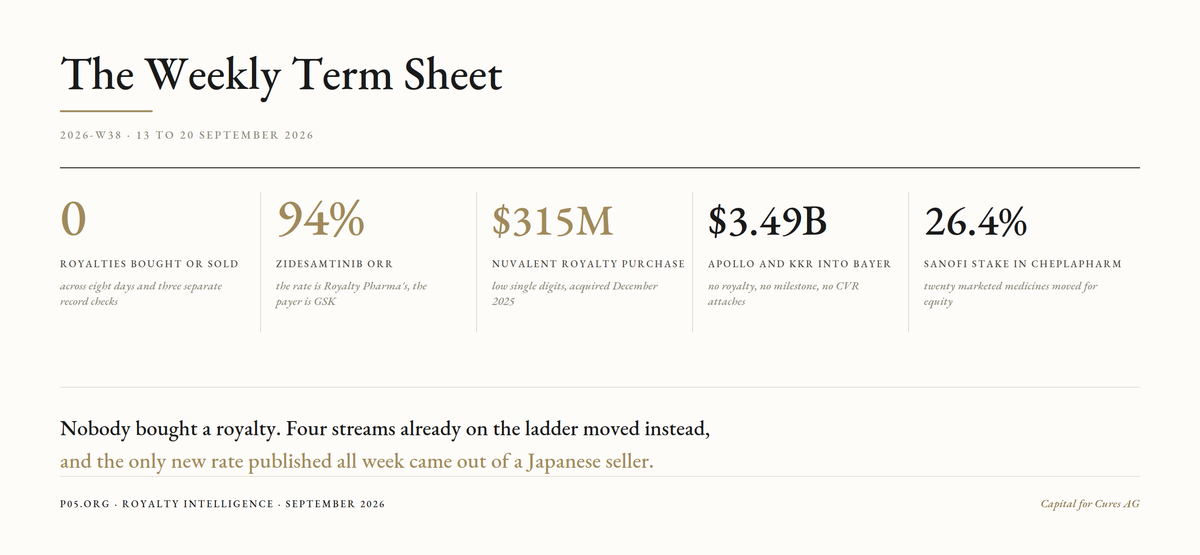
Nobody bought a royalty this week. The EDGAR full-text record carries no monetisation, purchase or revenue-interest filing for the window, and no tracked buyer announced a transaction. Four streams already on the ladder moved instead, three of them on a conference floor or an approval, and the fourth in the opposite direction: Novo Nordisk terminated its November 2024 collaboration with Ascendis Pharma on TransCon Semaglutide, returning the metabolic and cardiovascular rights and cancelling a ladder of up to $285M in milestones plus tiered royalties (BioStock).
The one that matters most is already paying. Nuvalent presented zidesamtinib in TKI-naive ROS1-positive non-small cell lung cancer in Seoul on 14 September at a 94% objective response rate by blinded independent central review, 88 of 94 evaluable patients (IASLC, via Medical Xpress). Royalty Pharma bought a low single-digit royalty on zidesamtinib and neladalkib for up to $315M in December 2025 (Royalty Pharma). The FDA approved zidesamtinib in July, so the stream is live, and the payer is GSK, which closed its $10.6B acquisition of Nuvalent on 15 July. The first-line data widens a base that is already generating.
Sanofi intends to move twenty marketed medicines and take no cash for them. Under a partnership announced on 14 September, Cheplapharm would take the portfolio, including Lovenox/Clexane outside the United States, together with manufacturing sites in Hungary, Singapore and France, and Sanofi would receive a 26.4% equity stake in the buyer (Cheplapharm). The release states an intention rather than an executed agreement, the commercial transfer is planned to begin in the first quarter of 2027, and full completion is expected by the third quarter of 2027. Additional financial detail is promised at a later stage.
The conference floor produced more royalty and partner content than the deal tape did, by a wide margin. Beyond zidesamtinib, Seoul carried the eight-year ADAURA survival update on Tagrisso, first-line HER2-mutant data on Enhertu, two Chinese-origin B7H3 and DLL3 ADCs reading out in second-line small cell lung cancer against Roche and GSK licences, zipalertinib under a Taiho and Cullinan co-development, and three separately partnered BioNTech assets. Eight partnered or royalty-bearing programmes in four days, and not one of the releases publishes a rate.
A Swiss hospital turns out to hold a rate on a Nasdaq-listed psychedelic. Definium Therapeutics, formerly MindMed, holds its lysergide rights under an exclusive licence from University Hospital Basel dated April 2020, and University Hospital Basel receives royalties and development revenue on any product marketed through the collaboration (MindMed). The company posted its third positive Phase 3 on 14 September and files an NDA in the first half of 2027. A Swiss academic institution sits underneath a Nasdaq-listed asset eighteen months from a marketed base, and the rate is undisclosed.
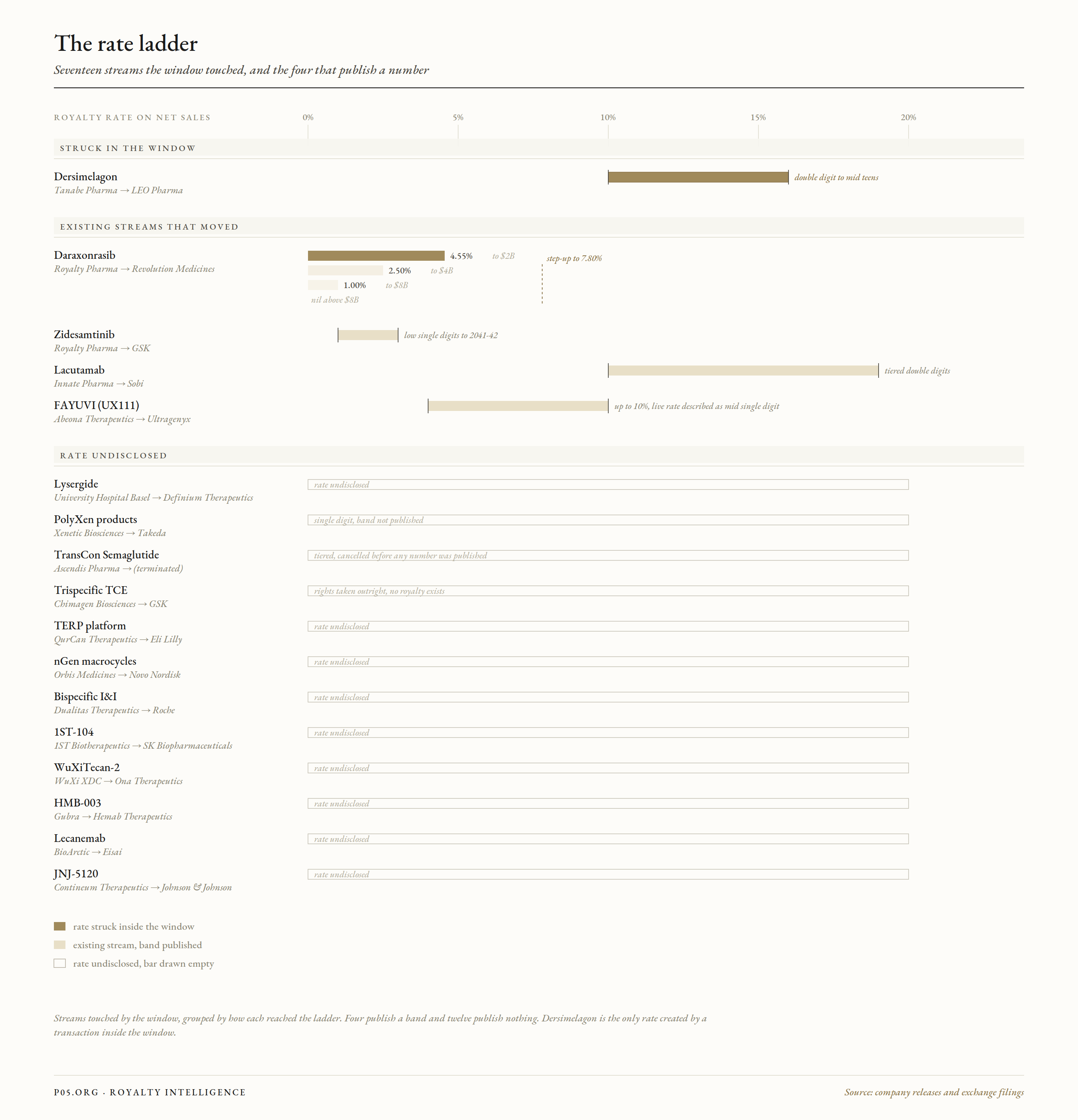
Streams touched by the window, grouped by how each reached the ladder. Two publish something: daraxonrasib at 4.55% to $2B, 2.50% to $4B, 1.00% to $8B and nil above, with step-ups to 7.80% on the lower bands on full draw; and zidesamtinib at low single digits to approximately 2041, a band rather than a number. The University Hospital Basel royalty on lysergide is drawn at zero height with the counterparty named, because its existence is confirmed and its rate is not. Eight partnered assets presenting in Seoul carry an upstream position with no disclosed rate at all.
Currency note: figures are converted to US dollars with the original in brackets, at approximately EUR 0.86, SEK 9.50, NOK 10.30, CHF 0.885, DKK 6.40, GBP 0.74, JPY 146, KRW 1,370, CNY 7.10, AUD 1.52 and INR 88 per US dollar, being September 2026 rates. Where a source published its own conversion, that figure is used.
Highlights
Royalty events: 10, none of them a purchase. Two streams on Royalty Pharma's book report, one on a readout and one on a designation; a third approval produces an unsold voucher; a tiered royalty is extinguished by termination; a $75M upfront is triggered by a closing; a 2017 licence is amended out of litigation; a royalty interest is converted into common stock; a royalty sold for no upfront by a distressed seller in 2022 goes live on an approval two days early; a twice-licensed ROS1 inhibitor takes a label expansion four months early; and the largest buyer in the market sets out where it intends to deploy next.
- Nuvalent / Royalty Pharma / zidesamtinib (14 Sep): in the global Phase 1/2 ARROS-1 trial (NCT05118789), 94% objective response rate by blinded independent central review in 94 efficacy-evaluable TKI-naive patients with advanced or metastatic ROS1-positive NSCLC, 88 of 94, with a 94% nine-month and 86% twelve-month duration-of-response rate and substantial intracranial activity, presented at WCLC in Seoul (IASLC). Royalty Pharma holds a low single-digit royalty on worldwide net sales of zidesamtinib and neladalkib, acquired from an undisclosed third party for up to $315M on 16 December 2025, $155M of it upfront (Royalty Pharma).
- Zidesamtinib was approved in July 2026, so the royalty is live, and GSK closed its $10.6B acquisition of Nuvalent on 15 July, so GSK is the payer. Neladalkib remains under review to 27 November 2026. Block below
- Revolution Medicines / Royalty Pharma / daraxonrasib (14 Sep): a third Breakthrough Therapy Designation for RASONQUE, for treatment-naive metastatic PDAC in combination with gemcitabine and nab-paclitaxel, on the Phase 1/2 RMC-GI-102 study feeding the running Phase 3 RASolute 303. The fifth BTD across the RAS(ON) portfolio. Royalty Pharma provides up to $1.25B in five $250M tranches against a 15-year tiered synthetic royalty on worldwide net sales, at 4.55% to $2B, 2.50% to $4B, 1.00% to $8B and zero above, with step-ups to 7.80% on lower bands on full draw, alongside a senior secured term loan of up to $750M at SOFR plus 5.75% (Royalty Pharma, Revolution Medicines). Block below
- Scholar Rock / ISEMBYLD / priority review voucher (approval 11 Sep, Form 8-K filed 14 Sep): FDA approval of apitegromab-mstn in spinal muscular atrophy carried a Rare Pediatric Disease Priority Review Voucher, now on the record in a Form 8-K filed 14 September. Apitegromab carries a Royalty Pharma royalty interest. The voucher has not been sold. Scholar Rock Netherlands withdrew the Isembyld marketing authorisation application in Europe. The withdrawal letter is dated 13 August and the company announced it on 21 August, both outside this window, and the CHMP meeting highlights of 18 September record it
- Ultragenyx / Abeona Therapeutics / FAYUVI (approved 17 Sep): the FDA granted standard full approval to FAYUVI (rebisufligene etisparvovec-hopf), previously UX111, for the neurologic manifestations of mucopolysaccharidosis type IIIA in paediatric patients with preserved neurodevelopmental function, two days ahead of the 19 September action date and on a resubmitted BLA following a July 2025 complete response letter on chemistry, manufacturing and controls. Ultragenyx received a Rare Pediatric Disease Priority Review Voucher on approval (Ultragenyx). The stream underneath it is the event. Ultragenyx took global rights from Abeona Therapeutics (Nasdaq: ABEO) on 17 May 2022 with no upfront payment, against up to $30M in commercial milestone payments following regulatory approval and tiered royalties of up to 10% on net sales (Ultragenyx).
- Abeona's shares had fallen nearly 90% in the preceding year and traded below $1 against a Nasdaq delisting risk when it signed (BioPharma Dive). Coverage on the approval date describes the live rate as mid-single-digit royalties on sales, with the $30M commercial milestone ladder triggered by the approval (Stocktwits). Below Abeona sits an academic originator. The therapy was developed by Haiyan Fu and Doug McCarty at Ohio State University and Nationwide Children's Hospital and licensed from there to Abeona. No upstream rate, milestone or licence term is disclosed on the public record
- Nuvation Bio / Daiichi Sankyo / Innovent / IBTROZI (16 Sep): the FDA approved a supplemental new drug application for IBTROZI (taletrectinib) carrying an updated duration of response in TKI-naive advanced ROS1-positive NSCLC, with a median duration of response of 49.7 months, approximately four months ahead of the action date (Nuvation Bio). The asset carries a licence on each side of Nuvation. Taletrectinib reached Nuvation Bio (NYSE: NUVB) through its acquisition of AnHeart Therapeutics, which had in-licensed the compound from Daiichi Sankyo; Greater China rights are exclusively licensed out to Innovent Biologics (Innovent).
- No upstream or downstream rate is disclosed on either leg. It is the second ROS1 label event of the window, alongside the zidesamtinib readout above
- Novo Nordisk / Ascendis Pharma / TransCon Semaglutide (announced by Ascendis on the evening of 14 Sep): Novo Nordisk terminated the collaboration signed in November 2024, and Ascendis Pharma A/S (Nasdaq: ASND) regains rights to the TransCon technology in metabolic and cardiovascular disease. The lead programme was TransCon Semaglutide, a monthly-dosed prodrug of the active substance in Wegovy. Ascendis had been entitled to up to $285M in upfront, development and regulatory milestone payments plus tiered royalties, with a further $77.5M per programme had Novo expanded the collaboration to additional metabolic or cardiovascular candidates. Ascendis states it will advance the programme itself and initiate multiple new cardiovascular and metabolic programmes including obesity; Jan Mikkelsen is chief executive.
- Novo has not commented on the decision. TransCon has produced three approved products: Skytrofa, Yorvipath and Yuviwel (BioStock). The rate was never disclosed
- Innate Pharma / Sobi / lacutamab (effective 16 Sep): the strategic partnership announced on 10 August became effective following expiry of the antitrust waiting periods and completion of the other closing conditions, triggering the $75M upfront payment (Innate). Innate is eligible for up to a further $40M in near-term development milestones connected to Sézary syndrome, and up to $465M related to Sobi's option to take full development rights and to future regulatory and commercial milestones, for up to $580M in total. Innate is eligible to receive tiered double-digit royalties on net sales (Innate, 10 August, Sobi).
- Innate conducts the TELLOMAK-3 confirmatory Phase 3 in cutaneous T-cell lymphoma, with first patient expected in Q1 2027, supporting a planned accelerated approval filing in Sézary syndrome and subsequent full approvals in Sézary syndrome and mycosis fungoides.
- Sobi receives exclusive global commercialisation rights on potential accelerated approval and is eligible to assume full global development rights after positive Phase 3 results. Lacutamab is a first-in-class anti-KIR3DL2 antibody holding FDA Fast Track and EMA PRIME designations. The upfront is expected to extend Innate's cash runway through Q3 2027 (Form 6-K). Jonathan Dickinson is chief executive of Innate; Guido Oelkers of Sobi, which had $2.95B (SEK 28bn) of 2025 revenue. A tiered double-digit band, published, on a Phase 3 asset
- Cardiff Oncology / Nerviano Medical Sciences (14 Sep): Cardiff Oncology (Nasdaq: CRDF) and Nerviano Medical Sciences S.r.l. settled their litigation and amended their 2017 Exclusive License Agreement on global rights to onvansertib, an oral PLK1 inhibitor, with a full and mutual release of all claims and a joint request to dismiss with prejudice in the Southern District of California. The parties clarified and expanded on the royalty structure in the licence agreement. Per management at the H.C. Wainwright conference the same day, the royalty rates are unchanged from the 2017 agreement and the royalty period now extends beyond the original 2035 patent term extension date, with the new date undisclosed.
- Inventorship and patent ownership are unchanged and all patents remain Cardiff patents. Cardiff retains exclusive worldwide rights and final decision-making authority over development. The amendment adds development objectives tied to the planned Phase 3 and gives NMS a board observer seat and a place on Cardiff's Scientific Advisory Board. Mani Mohindru is chief executive of Cardiff; Hugues Dolgos of NMS Group (Cardiff 8-K exhibit, H.C. Wainwright transcript). The dispute began in February 2026 when NMS alleged material breach over Cardiff declining to name an NMS employee as a joint inventor on US Patents 12,144,813 and 12,263,173; Cardiff sued on 19 May 2026 (Cardiff 8-K). A royalty term extended as settlement consideration, with the rate left untouched
- Jaguar Health (8-K filed 15 Sep, earliest event 11 Sep): Jaguar Health (Nasdaq: JAGX) reported three further exchanges of Series Q Perpetual Preferred Stock into common stock with Streeterville Capital, on 7 July (53,191 shares for 6 Series Q), 11 September (219,435 shares for 2.8 Series Q) and 14 September (31,847 shares for 0.4 Series Q), a total of 304,473 common shares for 9.2 Series Q shares, together with a separate exchange of 557,377 common shares to Lincoln Alternative Strategies LLC for cancellation of a 6% convertible promissory note with an outstanding balance of $175,016.36 (Form 8-K).
- The Series Q is royalty-derived paper. It was created in May 2026, when Jaguar exchanged portions of two royalty interests for perpetual preferred at $25,000 stated value per share carrying a 10% annual return paid in further Series Q shares: Uptown Capital took 500 shares against a $12.5M reduction in the December 2020 royalty interest, and Streeterville took 408 shares in two tranches against a $10.2M reduction in the August 2022 royalty interest (Form 8-K).
- Both royalty interests were $12M of original principal and both have been serially restructured rather than added to. In March 2026 each Royalty Repayment Amount was cut by 10%, to $11,125,282.54 for Uptown and $12,428,782.20 for Streeterville, monthly payments were pushed from 1 April to 1 July, and Napo granted Streeterville a security interest in the Lechlemer Collateral and the TDPRV Collateral, pledging a tropical disease priority review voucher against the 2025 note (Form 8-K). Global Amendment No. 5 in June 2026 pushed initiation again from 1 July to 1 October 2026 and reset the monthly royalty payment to the greater of $750,000 or the actual amount due (Form 8-K).
- Two further in-window events sit alongside. On 12 September Jaguar agreed to acquire a minority shareholder's entire holding in Napo Therapeutics S.p.A., closing 15 September, for 535,000 common shares plus a pre-funded warrant over 2,077,255 common shares. And on 15 September Jaguar announced a 1-for-15 reverse stock split effective 17 September, approved at an April 2026 special meeting, new CUSIP 47010C854, Equiniti Trust Company as exchange agent, cash in lieu of fractional shares, for Nasdaq listing compliance (Jaguar Health). All share counts above are pre-split
- Royalty Pharma (14 Sep, Morgan Stanley 24th Annual Global Healthcare Conference): management stated the firm reached its five-year $10B to $12B deployment target about one year ahead of schedule, and set out an expansion into R&D co-funding with Biogen, Teva and Johnson & Johnson, an entry into China, and a data and AI platform (Investing.com transcript)
The EDGAR record for the window. A full-text search of filings dated 13 to 16 September for synthetic royalty, royalty purchase agreement, revenue interest financing, royalty monetization and royalty-backed note returns nothing. The phrase revenue interest returns two hits, both outside this sector: a Prospect Capital 424B2 and a Laredo Oil 10-K. Priority review voucher returns the Scholar Rock 8-K above and a routine Benitec Biopharma 10-K reference. No royalty was bought, sold, monetised or refinanced under any of those phrases on the United States record in the first four days of this window. The Cardiff Oncology instrument above is captioned as a licence amendment, and the Jaguar Health exchanges are captioned as unregistered sales of equity securities.
For 16 to 18 September the same negative holds, established from the transaction record rather than from EDGAR. No royalty monetisation, synthetic royalty, revenue interest financing, royalty-backed note or milestone participation was announced, and none of fourteen tracked royalty buyers transacted: Royalty Pharma, HealthCare Royalty, DRI Healthcare, Blackstone Life Sciences, Oberland Capital, Sagard Healthcare, XOMA Royalty, Ligand, OrbiMed Royalty, Oaktree, Blue Owl, Abingworth, SWK Holdings and Xontogeny. No priority review voucher was sold. The only milestone participation interest in the window is the Dimerix facility set out below, and it was signed on 4 September with a drawdown deadline inside the window.
The weekend of 19 and 20 September closes the window with nothing further. A final sweep on the 20th, run across the newswires, the EMA and FDA, and the ASX, HKEX, SIX, Nasdaq Nordic, KOSDAQ and Tokyo announcement pages, produced no royalty-relevant event with an underlying announcement date of 19 or 20 September, and nothing filed late on Friday the 18th that a Friday sweep would have missed. Across the eight days of the window, no royalty was bought, sold or monetised anywhere the record reaches. The royalty-shaped instruments that did appear were each created inside a transaction doing something else: a milestone participation attached to a clinical facility, a profit share pledged to a pension fund as collateral, a royalty interest converted into common stock, and four licences that published the word tiered and no number.
M&A and restructuring: 11, and three of the eleven put a contingent interest into the consideration.
- Lisata Therapeutics / Marea Therapeutics (17 Sep, Liberty Corner): Lisata (Nasdaq: LSTA) acquired Marea Therapeutics in a stock-for-stock transaction at a fixed exchange ratio, alongside a concurrent $225M private placement of Series C non-voting convertible preferred stock at about $1.4914 per share on an as-converted basis. On a fully diluted as-converted basis, Lisata's existing holders retain approximately 2.39%, former Marea holders take approximately 59.54% and the private placement investors approximately 38.07%, across roughly 396.3 million shares as converted.
- The oversubscribed placement drew ** RA Capital Management, Forbion, Third Rock Ventures, Alpha Wave, Perceptive Advisors, Sofinnova Investments, Omega Funds, Surveyor Capital, Columbia Threadneedle Investments, Nantahala Capital, Affinity Asset Advisors, venBio and Rock Springs Capital.** Proceeds fund MAR001/005, an ANGPTL4 antibody in Phase 2b for severe hypertriglyceridemia, and MAR002, a growth hormone receptor antagonist entering Phase 2 in acromegaly, both reporting topline in Q4 2027, with operations funded into 2028.
- Lisata is evaluating next steps for certepetide, its CendR Platform cyclic peptide. Neither the acquisition nor the placement required a Lisata shareholder vote, though one is required to convert the preferred. Lisata reached this transaction from a failed one. A merger agreement with Kuva Labs signed 6 March 2026 was terminated by Kuva; Lisata sued in the Delaware Court of Chancery for breach and the $2.0M termination fee, and in August cut approximately 72% of full-time staff, including its chief medical officer (Lisata, 4 Aug).
- Marea launched on 18 June 2024 with a $190M combined Series A and B, led by Sofinnova Investments and co-led by Forbion, with Perceptive Xontogeny Venture Fund, venBio, Omega Funds, Alpha Wave, Surveyor Capital and founding investor Third Rock Ventures. Most of that syndicate reappears in the placement.
- David Mazzo is chief executive of Lisata; Josh Lehrer becomes chief operating officer and president of Lisata while remaining chief executive of Marea. H.C. Wainwright, which states it acted as exclusive financial adviser, advised Lisata, with Michael E. Meyers, Vice Chairman and Head of M&A and Strategic Advisory Services, and Mintz as counsel; Leerink Partners advised Marea with Goodwin Procter as counsel; Jefferies, Leerink Partners, Guggenheim Securities, Cantor and LifeSci Capital acted as placement agents with Cooley as their counsel (Lisata)
- Xenetic Biosciences / Santersus AG (16 Sep): a definitive all-stock share exchange agreement under which Santersus AG of Switzerland reverse-merges into Xenetic Biosciences (Nasdaq: XBIO), leaving Xenetic holders with approximately 15.0% and Santersus holders approximately 85.0% on a fully diluted as-converted basis subject to a net-cash adjustment, closing expected in Q4 2026, with the combined company to be renamed Santersus Bio, Inc. under the proposed ticker SNTS and headquartered in Framingham, Massachusetts. No transaction value and no concurrent financing are disclosed. Santersus brings NucleoCapture, an extracorporeal DNase device at pivotal stage in sepsis and pivotal-ready in systemic lupus erythematosus, both holding FDA Breakthrough Device Designation, plus DNase with anti-CD19 CAR-T in a Phase 1b (Xenetic).
- Xenetic is a royalty recipient, and the release does not say what happens to the royalty. Xenetic receives single-digit royalties from Takeda on net sales of certain products covered by a non-exclusive sublicence of its PolyXen technology granted in October 2017, which produced $806,923 of royalty revenue in Q1 2026 against $593,261 a year earlier, up 36% (Form 10-Q). The share exchange release makes no mention of royalties, royalty interests, royalty revenue or a contingent value right, so a growing Takeda royalty is being diluted to 15% with no disclosed treatment
- Aethlon Medical / North Immunology (17 Sep): a reverse merger with a concurrent private placement of approximately $180M gross, which includes conversion of approximately $34M of North Immunology's outstanding convertible promissory notes with accrued interest, premiums and fees. Pro forma equity value is approximately $346.5M, with Aethlon stockholders at approximately 4.75% and North Immunology stockholders at approximately 95.25%; the combined company becomes North Immunology, Inc. (Nasdaq: NRTX), closing targeted for Q1 2027. The consideration carries a contingent value right: Aethlon stockholders immediately prior to closing receive one CVR per share of common and preferred stock, entitling holders to net proceeds, if any, from a sale, licence, transfer, divestiture or other monetisation of Aethlon's legacy Hemopurifier business.
- No cap, threshold or percentage is disclosed on the CVR. The syndicate is Bain Capital Life Sciences, Janus Henderson Investors, Deep Track Capital, Longitude Capital, Soleus Capital, Invus, Sirenia Capital Management, Farallon Capital Management, Adage Capital Partners and TCGX, with no lead designated. Lead asset NOR-101 is a half-life-extended anti-IL-13 by IL-18 bispecific antibody, preclinical, with Phase 1a expected in Q1 2027 in atopic dermatitis (Aethlon). The company was founded and incubated by ADAR1 Capital Management. No academic licensor is disclosed
- CVC / Groupe Bruxelles Lambert / Recordati (13 Sep): the $12.44B (EUR 10.7bn) take-private of Milan-listed Recordati at $59.64 (EUR 51.29) per share drew organised opposition. All four independent directors opposed the offer, concluding that the price was inadequate on financial grounds, that shareholders faced a relevant degree of pressure to tender, and that the offer was not fair. Six minority shareholders told the FT they oppose the terms, and London activist Palliser Capital wrote to the board objecting to what it called a <q>lowball price</q>.
- The offer, launched in May with Groupe Bruxelles Lambert and others, is a 13% premium to the price before the approach became known in March.
- CVC has owned Recordati since 2018, when a consortium it led paid $3.52B (EUR 3.03bn) for the family holding company that owned 51.8%, implying $6.81B (EUR 5.86bn) of equity value for the whole company, and it had sought a sale for five years without attracting bids above the current level. CVC intends to proceed even without the 90% squeeze-out threshold, potentially reshuffling the board and delisting through a subsequent merger; failing that it would consider a block sale of its controlling stake. Recordati comprises a mature pharmaceuticals division and a faster-growing rare diseases franchise with US expansion potential, and minority holders argue a separation and individual sale of the two would accrue to CVC (Financial Times)
- Jazz Pharmaceuticals / Actio Biosciences (completed 15 Sep): Jazz (Nasdaq: JAZZ) closed its acquisition of privately held Actio Biosciences for $820M in upfront cash, through the merger of its indirect wholly owned subsidiary Knight Acquisition Corp. into Actio, with up to $500M in contingent development and commercial milestones, including $250M on regulatory approval of ABS-1230 in KCNT1-related epilepsy and $100M on first commercial sale, for $1.32B in total potential value. ABS-1230 is an oral selective small-molecule KCNT1 ion channel inhibitor holding FDA Fast Track, Rare Pediatric Disease and Orphan Drug designations.
- Before closing, Actio spun its non-ABS-1230 programmes into a newly formed private company funded by existing Actio investors, with Jazz taking a minority equity position and observer rights. Cooley advised Actio (Jazz 8-K, Jazz). The Rare Pediatric Disease designation makes a priority review voucher available on approval
- Veracyte / Convergent Genomics (announced 14 Sep): Veracyte (Nasdaq: VCYT) acquired Convergent Genomics for $150M in upfront cash plus up to $30M in additional cash tied to UroAmp commercial reimbursement milestones, $180M in total. UroAmp uses urinary tumour DNA sequencing for therapy-response monitoring and post-treatment surveillance in non-muscle invasive bladder cancer (Veracyte). The release states Veracyte "today announced its acquisition of Convergent Genomics" and discloses no closing conditions; no completion date is given. Milestones keyed to reimbursement rather than regulatory or sales events
- Ambu A/S / TIMS Medical (14 Sep): Ambu (OMX: AMBU B) agreed to acquire TIMS Medical for $45M in cash at closing plus earn-outs of up to $20M based on future performance, $65M in total potential value. TIMS supplies imaging and reporting solutions for endoscopy that integrate with hospital workflows and IT systems, and brings about 7,000 installations across US hospitals. Ambu confirmed its outlook for the 2025/26 financial year is unchanged (Ambu, via ad-hoc-news, Life Science Nordic)
- Sanofi / Cheplapharm (14 Sep): the two announced an intention to create a strategic partnership under which Cheplapharm would take 20 mature medicines and three manufacturing sites, and Sanofi would receive a 26.4% equity stake in Cheplapharm. The divested set includes Lovenox/Clexane (enoxaparin), excluding the United States. The sites are Csanyikvolgy in Hungary (about 400 employees), Jurong in Singapore (about 100) and Ploermel in France (about 65), with existing employment arrangements and collective agreements maintained. No cash consideration is disclosed and additional financial details follow later.
- Commercial transfer of the portfolio is planned to begin in Q1 2027 and the transaction is expected to be fully completed by Q3 2027, subject to employee consultation, regulatory approvals and customary closing conditions.
- No impact to Sanofi's 2026 guidance. The collaboration dates to 2014. Co-CEOs Edeltraud Lafer and Sebastian Braun; Thomas Grenier, EVP General Medicines, for Sanofi (Cheplapharm). Block below
- Samsung Biologics / PolyPeptide Group (main offer period opened 15 Sep): all-cash public tender offer through Samsung Peptide AG of Zug at $50.07 (CHF 44.31) net per share, an implied aggregate equity value of about $1.65B (CHF 1.46bn). A 40% premium to the undisturbed CHF 31.65 close of 10 April 2026 and about 11.6% over the 60-day VWAP before the 20 July pre-announcement. Minimum acceptance threshold of 66⅔% on a fully diluted basis excluding treasury shares. Draupnir Holding B.V., holding about 55.65%, has committed to tender all of it. The period runs to 12 October 2026 at 16:00 CET.
- PolyPeptide's independent directors unanimously recommend acceptance on a fairness opinion from IFBC AG; Sodali acts as information agent. Squeeze-out and SIX delisting intended on settlement (Samsung Biologics)
- eleva GmbH / Eleva Biologics / One04 Therapeutics (15 Sep, Freiburg im Breisgau): eleva GmbH separated into two stand-alone companies. Eleva Biologics GmbH & Co. KG takes the Bryotechnology moss-based expression platform on a partnership-led business model. One04 Therapeutics GmbH & Co. KG takes CPV-104, a wholly owned first-in-class recombinant full-length human Factor H therapy, into late-stage development. Both remain owned by eleva GmbH, which houses shared general and administrative functions, for separate financing strategies and increasingly independent capital structures. Bjorn Cochlovius is chief executive; Cohesion Bureau is investor contact. No financial terms, valuation or capital raise disclosed (Eleva). Block below
- Zymeworks / Theravance Biopharma (shareholder approval 18 Sep): Theravance Biopharma shareholders approved the merger with Zymeworks, with 40,993,370 votes in favour, 8,671 against and 84,733 abstentions on a 79.14% quorum, satisfying a closing condition (Theravance, via Investing.com). Closing is expected on or about 23 September, three days after this window closes. The agreement was struck on 29 June 2026 at $17.00 per share in cash, about $929M, plus a contingent value right paying Theravance holders 80% of net proceeds from any licensing, divestiture or monetisation of ampreloxetine over the following decade, with 20% to Zymeworks.
- Zymeworks is funding the purchase primarily with a $350M non-dilutive, non-recourse note from OMERS Life Sciences, secured by the Theravance assets and entities related to YUPELRI with no recourse to the rest of Zymeworks, under which 75% of the YUPELRI profit-share cash flows are assigned to OMERS to service the debt. What Zymeworks acquires is a 35% US net profit share in YUPELRI, on 2025 US net sales of $266.6M, up 12%, about $60M of annualised cash flow at current run rates, a licensed generic launch date of April 2039, and up to $125M of commercial milestones from Viatris.
- A further $100M TRELEGY ELLIPTA milestone from Royalty Pharma is expected in Q1 2027 on milestone conditions being met (Zymeworks). The profit share is the collateral
Licence-outs and asset acquisitions: 10, and every one of the three added on 17 September publishes a tiered royalty without publishing a rate; the tenth, added on 18 September, is the only one in the category that names a number.
- GSK / Chimagen Biosciences (15 Sep): GSK entered an agreement to acquire full global rights to a trispecific T cell-engager from Chimagen Biosciences, a privately held clinical-stage Chinese biotechnology company, for an upfront fee plus success-based development and commercial milestone payments, a total potential value of up to $750M, subject to customary closing conditions. The upfront is not broken out and no royalty on net sales is disclosed. The asset is unnamed and expected to enter Phase 1 in 2027. It binds T cells while simultaneously targeting two tumour-associated antigens, designed against the tolerability profiles that have limited existing TCEs in multiple myeloma. GSK puts the US TCE market for multiple myeloma above $10B by 2032.
- Hesham Abdullah, SVP and Global Head of Oncology R&D, for GSK; Zhenhao Zhou is chief executive of Chimagen (GSK 6-K, GSK). The second GSK and Chimagen transaction, after an earlier agreement on CMG1A46 (PharmaShots). Rights acquired outright rather than licensed, and no royalty on net sales
- Eli Lilly / QurCan Therapeutics (15 Sep): an exclusive research and collaboration agreement covering multiple programmes on PLNP-enabled genetic medicines for central and peripheral nervous system delivery, built on QurCan's TERP (Target-Engineered Responsive Polymer) hybrid polymer-lipid nanoparticle platform, which enables tissue-selective delivery of nucleotides to extra-hepatic sites including brain and spleen. Lilly leads research, clinical development and commercialisation. QurCan receives an upfront payment and a strategic investment from Lilly, and is eligible for research support payments together with research, development and commercial milestone payments of up to $237M per programme, in addition to tiered royalties on global net sales. TERP enables repeat-dosable systemic and targeted delivery of mRNA, DNA and oligonucleotide payloads.
- QurCan is Toronto-based, formerly Nanology Labs; Mohammad Ali Amini is chief executive (PharmaShots). The $237M figure is per programme, not a deal total, and the royalty is tiered but unrated
- Novo Nordisk / Orbis Medicines (17 Sep, Copenhagen): a strategic collaboration and licence agreement to discover and develop next-generation oral macrocycle therapeutics for cardiometabolic diseases. Orbis is eligible for up to $1.4B in upfront and potential development and commercial milestone payments, in addition to tiered royalties on future product sales. Novo will also make a strategic investment in Orbis. The collaboration runs on Orbis's nGen platform, which pairs generative AI with high-throughput synthesis in a lab-in-the-loop configuration to design nCycles, fully synthetic macrocycles optimised for oral bioavailability and membrane permeability, with the stated aim of replacing injectable medicines against targets already validated by blockbuster biologics.
- Orbis has raised $134.9M (EUR 116M) to date including a $104.7M (EUR 90M) Series A led by NEA, with Lilly Ventures, Cormorant, EIFO and existing investors Forbion and Novo Holdings. Offices in Copenhagen and Lausanne. Morten Graugaard is chief executive of Orbis; Brian Vandahl, SVP Therapeutics Discovery, for Novo (Orbis, via Forbion). A tiered royalty created at discovery stage, with no band disclosed, and the licensee's parent group already on the cap table through Novo Holdings
- Novartis / Sironax (16 Sep, Waltham): Novartis exercised its exclusive option to acquire the full global rights to Sironax's proprietary brain delivery platform, under the option and asset purchase agreement announced in July 2025. Sironax receives $125M following closing. The platform comprises brain delivery modules engineered to enable in vivo transport of monoclonal antibodies, peptides, proteins, gene therapies and other large biologics across the blood-brain barrier. Sironax retains rights to develop, manufacture and commercialise selected assets using the platform. It keeps three programmes in Phase 1b/2: SIR2501, a first-in-class allosteric SARM1 inhibitor in ALS and chemotherapy-induced peripheral neuropathy, with FDA Fast Track in the latter; SIR4156, a first-in-class NAMPT activator in metabolic dysfunction; and SIR9900, a brain-penetrant allosteric RIPK1 inhibitor.
- Shefali Agarwal is president and chief executive (Sironax, Sironax, July 2025). Rights acquired outright with no royalty disclosed, against a licence-back to the seller on selected assets
- Roche / Dualitas Therapeutics (17 Sep): a proximity-biology research collaboration and licence to discover and develop bispecific antibodies in immunology and inflammation. Dualitas takes a $36.5M upfront against research, development and commercial milestone payments to a total potential of up to $1B, plus tiered royalties (Dualitas). The royalty band is not disclosed. It is the largest disclosed upfront of the three licences signed on 17 September
- SK Biopharmaceuticals / 1ST Biotherapeutics / 1ST-104 (17 Sep): an exclusive global licence to a dual LRRK2 and c-Abl inhibitor for Parkinson's disease. 1STBIO takes a $1.8M upfront, a further $1.8M short-term milestone on candidate selection, additional milestones to a total agreement value of up to $314.8M, and tiered royalties based on global net sales. SK Biopharmaceuticals also made a $2.2M strategic equity investment (1ST Biotherapeutics). The royalty band is not disclosed. A $4.0M combined cash and equity payment against a $314.8M headline puts the disclosed upfront at 1.1% of stated deal value
- Ona Therapeutics / WuXi XDC / WuXiTecan-2 (17 Sep): an exclusive global out-licence of a payload-linker technology platform for antibody-drug conjugate research and development. WuXi XDC (HKEX: 2268) states the deal comprises an upfront payment and development, regulatory and sales milestone payments, and that it "will be eligible to receive tiered royalties on net sales upon commercialization of the resulting ADC product" (WuXi XDC). No amounts are disclosed in the company release. A total deal value has circulated in trade coverage and is not in the company release or an exchange filing, so it is not stated here. A contract development and manufacturing organisation taking a royalty on a platform it licenses out is the instrument to note
- Zealand Pharma / Elvinix (15 Sep): Zealand Pharma A/S (Nasdaq Copenhagen: ZEAL) granted Elvinix Inc. of Dover, Delaware an exclusive licence to its GLP-1/gastrin dual-agonist peptide patent families and an accompanying package of preclinical data, with rights to develop and commercialise in type 1 diabetes. Elvinix is preclinical and was co-founded by Alex Rabinovitch, Jay Skyler and Alexander Fleming; Daniil Koshelev is chief executive. No upfront, milestone or royalty terms are disclosed. Zealand has advanced more than ten candidates into clinical development, two of them to market (Business Wire). Carried by Business Wire as a paid press release; verify the terms with Zealand before anything from it is relied on
- Tempest Therapeutics / Hebei Senlang Biotechnology (15 Sep): Tempest (Nasdaq: TPST) took an exclusive option to license Senlang's CD7-targeted lentiviral vector platform and a portfolio of in vivo CAR-T candidates. The lead is a BCMA/GPRC5D dual-targeting in vivo CAR-T in Phase 1 dose escalation in relapsed or refractory multiple myeloma, with in vivo CAR-T generation and expansion observed at the highest evaluable dose and no Grade 3 or higher cytokine release syndrome and no ICANS as of 25 August 2026. If exercised, the platform would sit alongside Tempest's CD7-targeted lipid nanoparticle platform entering the clinic later in 2026.
- Matt Angel is chief executive (Investing News). No financial terms disclosed. The option runs both ways: in July 2026 Tempest granted Senlang an exclusive option to license TPST-4003 in China (Tempest)
- LEO Pharma / Tanabe Pharma / dersimelagon (18 Sep): LEO Pharma closed its acquisition of worldwide rights to dersimelagon from Tanabe Pharma (Mitsubishi Tanabe), first agreed 18 August 2026, and announced in the same release that the FDA has accepted the NDA for filing and granted Priority Review, with a PDUFA action date at the end of February 2027. Dersimelagon is an investigational, once-daily oral MC1R agonist for erythropoietic protoporphyria (EPP) and X-linked protoporphyria (XLP), rare genetic disorders in which sunlight exposure causes severe skin pain; the only currently approved EPP therapy requires an implant every eight weeks, where dersimelagon is oral.
- The acquisition carries an upfront and near-term milestones of up to $435M, further downstream milestones, and tiered royalties on net sales disclosed at double-digit to mid-teens rates (LEO Pharma, via BioSpace, Fierce Biotech, 18 Aug).
- Christophe Bourdon is chief executive of LEO Pharma. The August agreement falls outside this window; the closing and the Priority Review are both dated inside it
Regulatory: 10, and two of the ten are Japanese approvals expanding a marketed base while three come out of one CHMP meeting.
- OncoC4 / cesalatamig (16 Sep, Rockville): FDA Fast Track Designation for cesalatamig, also known as AI-081, a PD-1/VEGF bispecific antibody, in NSCLC that has progressed following concurrent or sequential PD-(L)1-targeted immunotherapy and platinum-based chemotherapy. Granted on safety and efficacy signals from the global Phase 1/2 BiPAVE-001 trials (NCT06635785) running at more than 50 sites across the United States and China, with the majority of patients enrolled in the US. The company states it is advancing to registrational Phase 3 in PD-(L)1-refractory or resistant NSCLC.
- Cesalatamig carries more than 40-fold higher affinity for VEGF than bevacizumab-based PD-(L)1/VEGF bispecifics. Yang Liu is co-founder, chief executive and chief scientific officer (OncoC4). Cesalatamig is wholly owned. OncoC4 separately holds the originating position on gotistobart, in pivotal Phase 3 with BioNTech and reported above
- BioArctic / Eisai / Leqembi Pen (16 Sep): the subcutaneous version of Leqembi (lecanemab), Leqembi Pen, was approved in Japan (BioArctic). BioArctic invented lecanemab and licensed it to Eisai under development and commercialisation agreements signed in 2007 and 2015; Eisai leads development, regulatory filings and commercialisation globally and shares profits equally with Biogen under their 2014 agreement. BioArctic bears no development costs in Alzheimer's disease and receives sales milestones and royalties on global sales, retaining Nordic co-promotion rights. Eisai forecasts Leqembi revenue of about $983M (JPY 143.5bn) for the year to March 2027 (BioArctic)
- Lundbeck / Vyepti (16 Sep): marketing authorisation granted in Japan for Vyepti (eptinezumab) for the prevention of migraine attacks (Lundbeck)
Regulatory: the remaining seven.
- CHMP, September meeting (met 14 to 17 Sep, highlights published 18 Sep): the Committee for Medicinal Products for Human Use recommended 12 medicines for approval and backed extensions of indication for 11 more, with no negative opinions (EMA). Yuviwel appears nowhere on any list, so no opinion was issued on it. Ascendis has guided to an EU decision in Q4. New opinions went to Frehemgo (denecimig, Novo Nordisk), Gevalka (ensartinib) and Sepalna (senaparib) to SFL Pharmaceuticals Deutschland, Klygefa (gefurulimab, Alexion Europe), Lifyorli (relacorilant, Corcept), Povofortay (povorcitinib, Incyte), VaxRabeo (Sanofi), the orphan Zeydovio (glepaglutide) below, two biosimilars and two generics.
- The eleven extensions run heavily to partnered or in-licensed assets: Enhertu (Daiichi Sankyo Europe) below, Padcev (Astellas), Keytruda (Merck Sharp and Dohme), Ocrevus (Roche), Tecvayli (Janssen Cilag), Cosentyx (Novartis Europharm), Jyseleca (filgotinib, Alfasigma), Sogroya (Novo Nordisk), Anzupgo (delgocitinib, Leo Pharma), Abiraterone Mylan and Pepaxti (Oncopeptides). Five applications were withdrawn, two initial and three extensions, and none of the five is an in-window event. CHMP publishes no rate, royalty or licence term on any of these
- AstraZeneca / Daiichi Sankyo / Enhertu (18 Sep): CHMP recommended Enhertu (trastuzumab deruxtecan) as adjuvant monotherapy for resected HER2-positive breast cancer with residual invasive disease after neoadjuvant taxane-based and HER2-targeted treatment, on DESTINY-Breast05 in 1,635 patients, where Enhertu reduced the risk of invasive disease recurrence or death by 53%, hazard ratio 0.47, with 92.4% alive and disease-free at three years against 83.7% on T-DM1 (AstraZeneca). AstraZeneca and Daiichi Sankyo jointly develop and commercialise Enhertu, with Daiichi Sankyo responsible for manufacturing and supply. No sales booking, profit-share or royalty terms are stated. Enhertu moved three times in six days: DESTINY-Lung04 in Seoul on the 14th, the NICE reversal in England on the 16th, and the European label on the 18th
- Zealand Pharma / Zeydovio (18 Sep, Copenhagen): a positive CHMP opinion for Zeydovio (glepaglutide) in short bowel syndrome, adopted as an orphan medicine (Zealand Pharma, via GlobeNewswire). Zealand's second appearance in this window, after the GLP-1/gastrin dual-agonist licence to Elvinix on the 15th. Glepaglutide is Zealand's own long-acting GLP-2 analogue and no inbound licensor or royalty is disclosed on it. The same company licensed a patent family out on undisclosed terms and took a first European opinion on a wholly owned asset inside four days
- Telix Pharmaceuticals / Pixclara (14 Sep): FDA approval of the NDA for Pixclara (floretyrosine F 18, 18F-FET), indicated to differentiate recurrent or progressive glioma from treatment-related change in adults and paediatric patients from one month of age. The first FDA-approved FET-PET product for glioma, against a PDUFA goal date of 11 September 2026. Safety evaluated in 382 patients; the agent targets LAT1 and LAT2. About 24,000 new US glioma cases annually. A Phase 3 in brain metastases is running (Telix). Follows a first NDA in August 2024 under 505(b)(2) and a complete response letter, with orphan designation October 2020 and Fast Track April 2024.
- The clinical package rests on an academic-industrial collaboration with UCSF supporting joint development and commercialisation. No inbound royalty is disclosed and none is asserted here (Telix)
- Armata Pharmaceuticals / AP-SA02 (14 Sep): Breakthrough Therapy Designation for the intravenous fixed multi-phage cocktail as adjunct treatment of complicated bacteraemia caused by methicillin-sensitive or methicillin-resistant Staphylococcus aureus, on the Phase 1b/2a diSArm study (NCT05184764) presented as a late-breaker at IDWeek 2025. Dosing every six hours for five days, no serious adverse events attributed, faster normalisation of C-reactive protein and interleukin-10. AP-SA02 now holds Breakthrough Therapy, Fast Track and QIDP designations. Phase 3 superiority study anticipated in the second half of 2026. Deborah Birx is chief executive (Armata). No royalty-bearing asset and no marketed base
- CSPC Pharmaceutical Group / SYS6010 (announced to HKEX 15 Sep): a fourth NMPA Breakthrough Therapy Designation for the EGFR-targeting antibody-drug conjugate, in recurrent or metastatic actionable genomic alteration negative non-squamous NSCLC that has progressed on prior immunotherapy and platinum-based chemotherapy, disclosed in parallel by CSPC (HKEX: 1093) and its A-share subsidiary CSPC Innovation (300765.SZ) (AllSci). The three prior designations were EGFR mutation-positive NSCLC after tyrosine kinase inhibitor and platinum failure (January 2025), unresectable locally advanced or metastatic oesophageal squamous cell carcinoma after first-line platinum and checkpoint inhibitor therapy (May 2026), and recurrent or metastatic head and neck squamous cell carcinoma after immunotherapy and platinum (1 September 2026).
- Separately on 14 Sep CSPC presented SYS6010 with enlonstobart in actionable-genomic-alteration-negative NSCLC at WCLC, at ORRs of 58.9% and 49.2%.
- SYS6010 is wholly self-developed and carries no out-licence. The June 2025 transaction that closed against CSPC's May 2025 disclosure of roughly $5B in potential aggregate value was the AstraZeneca AI-enabled oral small molecule discovery collaboration at $110M upfront, up to $1.62B in development milestones, up to $3.6B in sales milestones and single-digit royalties, not the EGFR-ADC
- Revolution Medicines / RASONQUE, above.
Clinical: 15, of which twelve are readouts, two discontinuations and one first dosing. Eleven sit on partnered or royalty-bearing programmes, and all but six reported in one room in Seoul.
The IASLC World Conference on Lung Cancer ran 12 to 15 September, so three of its four days fall inside this window.
- Nuvalent / zidesamtinib / ARROS-1 (14 Sep), above. The only in-window readout that reaches a stream a tracked fund owns
- AstraZeneca / TAGRISSO / ADAURA (14 Sep): eight-year exploratory results in resected early-stage EGFR-mutated NSCLC, Presidential Symposium, Abstract PL03.01, published simultaneously in the Journal of Thoracic Oncology. A 47% reduction in the risk of death in the primary Stage II-IIIA population (HR 0.53, 95% CI 0.38 to 0.75) and 48% across Stage IB-IIIA (HR 0.52, 95% CI 0.39 to 0.71). Eight-year OS 74% against 58% in the primary population and 79% against 64% overall. 682 patients across more than 200 centres in more than 20 countries, osimertinib 80 mg once daily for three years (NCT02511106).
- Exploratory, with 127 patients censored and a 4 May 2026 cutoff, and the separation held despite substantial crossover on recurrence (AstraZeneca). Osimertinib is AstraZeneca discovery, carried as AZD9291. No third-party royalty obligation was identified
- AstraZeneca / Daiichi Sankyo / Enhertu / DESTINY-Lung04 (14 Sep, Abstract PL03.08): first-line HER2-mutant non-squamous NSCLC, 454 patients. Trastuzumab deruxtecan monotherapy reduced the risk of progression or death by 37.0%, HR 0.63, 95% CI 0.50 to 0.79, p<0.0001, median PFS 14.3 against 8.3 months, ORR 70% against 44.5%, median duration of response 13.4 against 9.7 months, OS immature. Lead investigator Julia Rotow of Dana-Farber. Co-developed and co-commercialised by AstraZeneca and Daiichi Sankyo (PharmaShots)
- MediLink / Roche / tambotatug pelitecan / TAISHAN-302 (13 Sep, late-breaking Presidential Presentation, simultaneous New England Journal of Medicine publication): 451 patients across 85 study sites, all in China (NCT06612151), in relapsed small cell lung cancer after platinum chemotherapy with or without a PD-L1 inhibitor. Median OS 13.3 against 9.4 months on topotecan, stratified HR 0.46, 95% CI 0.35 to 0.62, p<0.0001, a 54% reduction in the risk of death. Median PFS 7.4 against 2.8 months, HR 0.29, 95% CI 0.23 to 0.37. Confirmed ORR 59.1% against 9.7%. In patients with baseline brain metastases, median intracranial PFS 6.1 against 4.2 months and intracranial response 32.4% against 2.9%.
- Grade 3 or higher treatment-related events 46.4% against 74.7%. Abstract PL02.03. The NMPA Center for Drug Evaluation has accepted the NDA. The second positive Phase 3 for the asset, after TAISHAN-301 in nasopharyngeal carcinoma. Tam-Peli is a B7-H3 antibody-drug conjugate on MediLink's TMALIN linker platform, holding US and China Breakthrough Therapy Designations in relapsed SCLC. Under the exclusive licensing agreement entered in January 2026, Roche holds development, manufacturing and commercialisation rights worldwide outside mainland China, Hong Kong and Macau, and states that it plans to rapidly initiate global Phase 3 trials. Levi Garraway is Roche's chief medical officer (Roche). The registrational dataset is single-country, so Roche's own territories are at the start of their development timeline rather than the end
- Hansoh / GSK / risvutatug rezetecan / ARTEMIS-008 (13 Sep, late-breaking): second-line relapsed small cell lung cancer, 461 patients randomised 1:1, all in China, data cut-off 6 June 2026, median follow-up 12.2 months. Median OS 18.5 against 10.3 months on topotecan, HR 0.46, 95% CI 0.35 to 0.62, p<0.0001; ORR 58.3%; Grade 3 or higher treatment-related adverse events 60.9% against 78.2%. Presented as PL02.04 (Hansoh, Hansoh, primary endpoint). GSK holds a licence. Both trials reported the identical hazard ratio and confidence interval on the same day. The control arms differ at 9.4 against 10.3 months and the follow-up at 9.2 against 12.2 months
- Taiho / Cullinan Therapeutics / zipalertinib / REZILIENT3 (14 Sep, Presidential Symposium): first-line EGFR exon 20 insertion NSCLC, 285 patients. Adding zipalertinib to platinum chemotherapy gave a median PFS improvement of 6.0 months, HR 0.50, 95% CI 0.34 to 0.73, p=0.00015. Presenting author Daniel Tan; investigator Helena Yu of Memorial Sloan Kettering (Taiho Oncology, Taiho, interim analysis). Co-developed by Taiho and Cullinan
- BioNTech / OncoC4 / gotistobart / PRESERVE-003 (14 Sep, mini-oral MO07.04): first median overall survival from non-pivotal stage 1 (NCT05671510) in metastatic squamous NSCLC after anti-PD-(L)1 and platinum. 87 patients, 45 to gotistobart and 42 to docetaxel. At a 17 July 2026 cutoff with 25.4 months median follow-up, median OS 18.5 against 10.0 months, HR 0.56, nominal p=0.0295. Grade 3 or higher treatment-related events 44.4% against 48.8%. Pivotal stage 2 running at more than 160 sites (BioNTech and OncoC4). The asset originated at OncoImmune and is advanced by OncoC4 of Rockville under a joint development programme with BioNTech. No licence terms are on the record. Block below
- BioNTech / Bristol Myers Squibb / Duality Biologics / pumitamig and elfetabart drozuntecan (14 to 15 Sep): longer-term pumitamig (BNT327/BMS986545) data including unresectable mesothelioma at 16.6 months median PFS and 25.8 months median OS after 23.5 months median follow-up, and a late-breaking oral on 15 September carrying the first lung cancer combination data for any PD-(L)1xVEGF bispecific with an ADC, pumitamig with elfetabart drozuntecan (BNT324/DB-1311) in Phase 1/2 NCT06892548 (BioNTech, European Biotechnology). Pumitamig originated at Biotheus, which BioNTech licensed from and then acquired outright; BMS took a global partnership in June 2025 at $1.5B upfront. Elfetabart drozuntecan runs on a Duality Biologics collaboration. Block below
- Akeso / Summit Therapeutics / ivonescimab (13 Sep, late-breaker): overall survival from the Phase 3 HARMONi-2 study of ivonescimab against pembrolizumab in first-line PD-L1-positive NSCLC. Median OS 30.8 against 22.6 months, HR 0.73, 95% CI 0.57 to 0.95, p=0.009, on 398 patients with 234 OS events at a 20 August 2026 cut-off (Akeso). Separately, Summit Therapeutics (Nasdaq: SMMT) presented updated OS from the global Phase 3 HARMONi trial of ivonescimab with chemotherapy in EGFR-mutated NSCLC at HR 0.76, median follow-up 23.2 months in Western patients, with a BLA action date of 14 November 2026. Akeso licensed ivonescimab to Summit for territories outside China
- Definium Therapeutics / DT120 / Panorama (14 Sep, and not in Seoul): topline from Panorama (MM120-301), the second Phase 3 of DT120 (lysergide) orally disintegrating tablet in generalised anxiety disorder. Primary and all key secondary efficacy endpoints met, with a placebo-adjusted HAM-A reduction of 5.1 points at week 12 on 100 µg, p<0.0001, Cohen's d=0.64. Randomised 2:1:2 to 100 µg, 50 µg or placebo; discontinuation 10.4%, 11.5% and 10.3%. Pre-NDA meeting in Q4 2026, NDA filing anticipated in H1 2027. Third positive Phase 3 after Emerge in MDD in June and Voyage in GAD in August at 5.4 points, d=0.81 (Definium). Block below
- ResoTher Pharma / RTP-026 (15 Sep, Copenhagen, and not in Seoul): Phase 2a topline in 66 patients with severe ST-elevation myocardial infarction undergoing standard percutaneous coronary intervention, randomised 3:1 across ascending dose groups of 25 µg/kg and 75 µg/kg, given as three intravenous infusions within 24 hours of PCI. The study was powered for safety and tolerability, and all efficacy findings are exploratory. No deaths and no withdrawals; three serious treatment-emergent adverse events on active treatment, each attributed to the underlying disease, and one on placebo.
- Cardiac troponin T rose 615% on placebo over the first 24 hours against 129% and 65% on the two active doses, and median final infarct size at day 90 was 6.6 g and 8.7 g against 9.3 g.
- The active arms were more severely ill at baseline. RTP-026 is an Annexin A1 mimetic originating in an invention at the William Harvey Research Institute, Queen Mary University of London, to which ResoTher owns all rights. The Phase 2a was financed by $2.9M (EUR 2.5M) in non-dilutive funding from the European Innovation Council. A larger international Phase 2b is planned, which the company states could support a partnership, a licence or a sale (ResoTher, via BioStock). The efficacy figures are the company's own and the study was not powered for them. No surviving academic royalty
- Novartis / VHB937 (16 Sep, and not in Seoul): Novartis discontinued development of VHB937, also known as lifonebart, a TREM2 stabiliser in amyotrophic lateral sclerosis, after the Phase 2 ASTRALS trial in 251 patients with early-stage disease failed both its primary and secondary endpoints. The primary endpoint compared VHB937 with placebo on a composite of ventilator-free survival and change on the ALS Functional Rating Scale-Revised. Confirmed by the company after the decision was communicated to the European Organization for Professionals and People with ALS.
- A mid-stage trial in Alzheimer's disease continues to recruit (Endpoints News, BioSpace). No licensor is on the record and no stream is reached. This is the fourth Novartis clinical setback in under a month, after the pelacarsen cardiovascular outcomes failure, the Phase 3 HARBOR miss for del-desiran, and the halt of eight of ten rap-cel trials following three patient deaths
- Contineum Therapeutics / Johnson & Johnson / JNJ-5120 (15 Sep, and not in Seoul): the Phase 2 in major depressive disorder missed its primary endpoint. 107 participants were randomised to one of two JNJ-5120 regimens or placebo, and at Day 5 neither regimen performed better than placebo on the depression scale. J&J continues to evaluate the results, including prespecified exploratory endpoints, and its review of the totality and clinical relevance of the findings will inform next steps (Contineum). JNJ-5120, also PIPE-307, is an M1 receptor antagonist J&J took global rights to in 2023 for $50M upfront and up to $1B in milestones from Pipeline Therapeutics, which rebranded as Contineum later that year (Fierce Biotech).
- This is the second failure on the asset: the relapsing-remitting multiple sclerosis trial missed ten months ago. William Blair removed JNJ-5120 from its model, having put probability of success at 35% before the readout, and Contineum shares fell 3.5% to $14.30 after hours. Most of Contineum's remaining value sits in PIPE-791, an LPAR1 antagonist in Phase 2 in idiopathic pulmonary fibrosis, whose next catalyst is read-through from Bristol Myers Squibb's Phase 3 of admilparant expected early in the fourth quarter (Fierce Biotech). No royalty rate is disclosed on the 2023 agreement in the sources reviewed
- Bristol Myers Squibb / Orum Therapeutics / ORM-6151 (17 Sep, and not in Seoul): Bristol Myers Squibb discontinued clinical development of ORM-6151, internally BMS-986497, a first-in-class anti-CD33 antibody-enabled GSPT1 degrader (a degrader-antibody conjugate whose antibody component derives from gemtuzumab of Mylotarg) in acute myeloid leukaemia and high-risk myelodysplastic syndromes, after reviewing Phase 1 data from a trial running across the US, Europe and Canada, with primary evaluation originally due February 2027. No efficacy or safety detail was disclosed with the decision.
- The asset reverts to Orum, which says it was notified without warning and does not plan to resume ORM-6151's development independently, redirecting resources instead to its next-generation CD123-targeting DAC, ORM-1153, cleared by the FDA for an IND with first dosing expected shortly (Korea Biomedical Review, Seoul Economic Daily).
- Bristol Myers Squibb had acquired the programme outright in November 2023 for a $100M upfront against a total potential value of $180M, structured as an asset purchase rather than a licence, with no royalty ever disclosed (Orum, via Business Wire, 6 Nov 2023, Fierce Biotech). Orum keeps the $100M upfront and is relieved of $80M of unearned milestones. No royalty was ever on the record to extinguish: the instrument was outright ownership with a reversion right, not a royalty-bearing licence, and BMS's obligations end entirely at the point of failure
- Gubra / Hemab Therapeutics / HMB-003 (17 Sep, and not in Seoul): first participant dosed in the Phase 1 trial (NCT07798505) of HMB-003, a subcutaneously administered peptide plasmin inhibitor designed as an antifibrinolytic therapy for heavy menstrual bleeding, a randomised, placebo-controlled, single-ascending-dose study in healthy adult volunteers, with results expected no later than mid-2027 (Hemab Therapeutics, via GlobeNewswire). HMB-003 originates on Gubra's streaMLine peptide discovery platform, under a collaboration agreement the two companies signed in August 2023: a single-digit DKK million upfront to Gubra in Q3 2023, with milestone and royalty terms left to a final agreement and no rate disclosed since (Gubra, Inderes).
- Hemab is solely responsible for HMB-003's development and commercialisation. Hemab completed a reverse merger onto Nasdaq in 2026 and trades as Hemab Therapeutics Holdings, Inc. (Nasdaq: COAG), headquartered in Cambridge, Massachusetts and Copenhagen; Benny Sørensen is chief executive
Rate disclosure across the window: four bands, one royalty asserted without a number, one cancelled before a number was ever published, one transaction that published $750M of milestones and no rate at all, and one $1B ladder impaired by a second failed readout rather than by any transaction. Daraxonrasib publishes a full tier schedule. Zidesamtinib publishes low single digits. Lacutamab publishes tiered double digits. Dersimelagon publishes double-digit to mid-teens tiers, disclosed the same day its acquisition closed. University Hospital Basel is confirmed to receive royalties on lysergide and no rate exists on the public record. The Ascendis tiered royalty on TransCon Semaglutide was terminated undisclosed. GSK took Chimagen's trispecific outright, so no rate exists to disclose. Lilly's licence from QurCan creates tiered royalties and publishes no band. The Tempest option and the Zealand licence disclose nothing at all. Four licence transactions in two days, four structures, no disclosed rate. Contineum's $1B ladder on JNJ-5120 now rests on whether J&J continues after two missed Phase 2 endpoints. Every other royalty-bearing or partnered position in the window, eight of them presenting in Seoul, discloses nothing.
Reimbursement and market access: 1, and the framework change behind it reaches every stream with UK exposure.
- NICE / NHS England / AstraZeneca / Daiichi Sankyo / Enhertu (recommended evening of 16 Sep, available from 17 Sep): NICE reversed its July 2024 rejection and recommended Enhertu (trastuzumab deruxtecan) for routine NHS use in HER2-low unresectable or metastatic breast cancer in England, following a new commercial agreement between NICE, NHS England and the two manufacturers. About 1,000 patients a year in England are eligible.
- The 2024 rejection had concluded the drug was not cost-effective at the price sought; the manufacturers are reported to have maintained their price, and the reversal follows changes to NICE's assessment framework introduced under the UK-US pharmaceutical agreement, which raised the upper QALY threshold from $40,541 (GBP 30,000) to $47,297 (GBP 35,000) and added a more granular approach to assessing quality of life at the end of August (STAT, IBTimes UK).
- List price is about $159,000 (GBP 118,000) per course, supplied to the NHS at a confidential discount. In the registrational data, median progression-free survival was 9.9 months against 5.1, and median overall survival 23.4 months against 16.8 (Newsy Today). Enhertu has been available in Scotland since 2023. Laura McMullin is UK general manager of Daiichi Sankyo. Enhertu is co-developed and co-commercialised by AstraZeneca and Daiichi Sankyo and appears separately on DESTINY-Lung04 and the CHMP adjuvant opinion
Structured capital: 1, and it is the largest transaction of the window.
- Apollo / KKR / Bayer (completed 16 Sep, signed 10 Jul): Apollo-managed funds and affiliates closed a $3.49B (EUR 3bn) equity capital solution for Bayer, with KKR joining as a significant minority participant. Apollo and KKR hold a minority, non-controlling stake in a newly established entity holding Bayer's long-acting reversible contraceptives business. Bayer retains a majority stake and complete operational control, and the percentages are not disclosed (Apollo, Bayer, 10 July).
- The assets: the hormonal intrauterine systems Mirena, which provides up to eight years of contraception, Kyleena and Jaydess/Skyla, together with the subdermal implant Jadelle. Combined 2025 sales of $1.59B (EUR 1.37bn), up more than 12% on volume and US demand, making LARC Bayer's fourth-largest product category and the one in which it is the dominant global player. First-quarter 2026 sales fell 10% to $367M (EUR 316m) (pharmaphorum, Fierce Pharma)
- The accounting: the entity remains fully consolidated in the Bayer Group financial statements, LARC revenues continue to be recorded in Bayer's results, and the business stays within the Pharmaceuticals Division's core operations. There are no changes to the LARC strategy or activities
- The structure: no milestone payments, no royalties and no contingent value rights attach. The sole disclosed financial term is the EUR 3.0bn upfront equity infusion. No preferred return, coupon or distribution waterfall is published
- The purpose, in the seller's words: chief financial officer Judith Hartmann described a strategic financing solution strengthening the capital structure and enhancing financial flexibility against increased liquidity requirements this year related to bond maturities and litigation procedures. Bayer is reported to be using the proceeds toward litigation costs tied to the herbicide Roundup (Bloomberg). Goldman Sachs called the financial implications broadly neutral for Bayer
- Advisers: BofA Securities and Deutsche Bank financial and Linklaters legal to Bayer; Centerview Partners financial and Latham & Watkins, Paul, Weiss, Rifkind, Wharton & Garrison and NautaDutilh legal to the Apollo funds. Jamshid Ehsani, Partner, leads for Apollo's High Grade Capital Solutions platform, which held about $1.05 trillion of group assets under management at 30 June 2026
Capital formation: 3.
- Bpifrance / InnoBio 3 (17 Sep, Paris): a further closing brings the fund to $240.7M (EUR 207M), described as its final size, announced alongside a meeting of G5 Santé at Bpifrance's offices. Subscribers include Sanofi, Servier, Ipsen, Bristol Myers Squibb and the Institut Pasteur. The third generation of the franchise, after $201.2M (EUR 173M) across 18 companies in the first fund and $236.0M (EUR 203M) across 14 in InnoBio 2 from 2018. Target portfolio of 12 to 14 companies, principally in France with openness to European projects, with initial investments generally of $7.0M to $9.3M (EUR 6M to 8M) and follow-on capacity, focused on oncology, immunology and inflammation, rare diseases and neuroscience at advanced preclinical and clinical stages.
- Five investments are already made: Adcytherix (ADCs), ARTHEx Biotech (RNA therapies), Coave Therapeutics (AAV vectors), Cyllene Therapeutics, formerly EG 427, and Enodia Therapeutics, created by Argobio Studio and the Institut Pasteur. Across the franchise since 2009: 37 companies financed, more than 25 products reaching Phase 2 or beyond, and 17 liquidity events, including Amolyt Pharma to AstraZeneca in a transaction of up to $1.05B, ImCheck Therapeutics to Ipsen at up to $1.16B (EUR 1bn) and Emergence Therapeutics to Eli Lilly. Bpifrance deployed $2.91B (EUR 2.5bn) in health in 2025 against a target of $11.63B (EUR 10bn) by 2030. Nicolas Dufourcq is chief executive of Bpifrance (Bpifrance)
- Transformation Capital / Fund IV (14 Sep): an oversubscribed hard-cap close at $850M for a growth equity fund targeting commercial-stage software and AI platforms in healthcare, taking the firm's total assets under management past $2.5B (Business Wire). Cooley acted for the manager. The only fund close recorded in the window
- Royalty Pharma / Blood Cancer United (15 Sep): a $7.5M donation to the Therapy Acceleration Program, a venture philanthropy initiative that deploys donations as venture capital investments in early-stage biotech and reinvests financial returns into the programme to fund future investments. Royalty Pharma is the first and largest corporate donor under an updated model that invites direct donations. Blood Cancer UK contributed $1M and Blood Cancer United committed $15M to the same phase. The gift follows a five-year, $7.5M alliance the two began in 2022 on healthcare disparities and clinical trial access.
- TAP was founded in 2007, has supported six therapies that went on to FDA approval or NCCN guideline inclusion, and has more than 30 active clinical studies running on supported therapies.
- Pablo Legorreta for Royalty Pharma; Dr E. Anders Kolb is president and chief executive of Blood Cancer United (Royalty Pharma). TAP supported foundational work at the University of Michigan and introduced it to Kura Oncology, which developed ziftomenib, now FDA-approved in relapsed or refractory NPM1-mutant acute myeloid leukaemia. Royalty Pharma's portfolio stands at royalties on more than 35 commercial products and 17 development-stage candidates
Animal health: 1.
- Rejuvenate Bio / Merck Animal Health (14 Sep): a $6M financing led by VCapital with participation from Merck Animal Health and Connecticut Innovations, announced alongside a strategic research and development collaboration with Merck Animal Health on companion animal gene therapy (Rejuvenate Bio). No licence, milestone or royalty terms disclosed on the collaboration
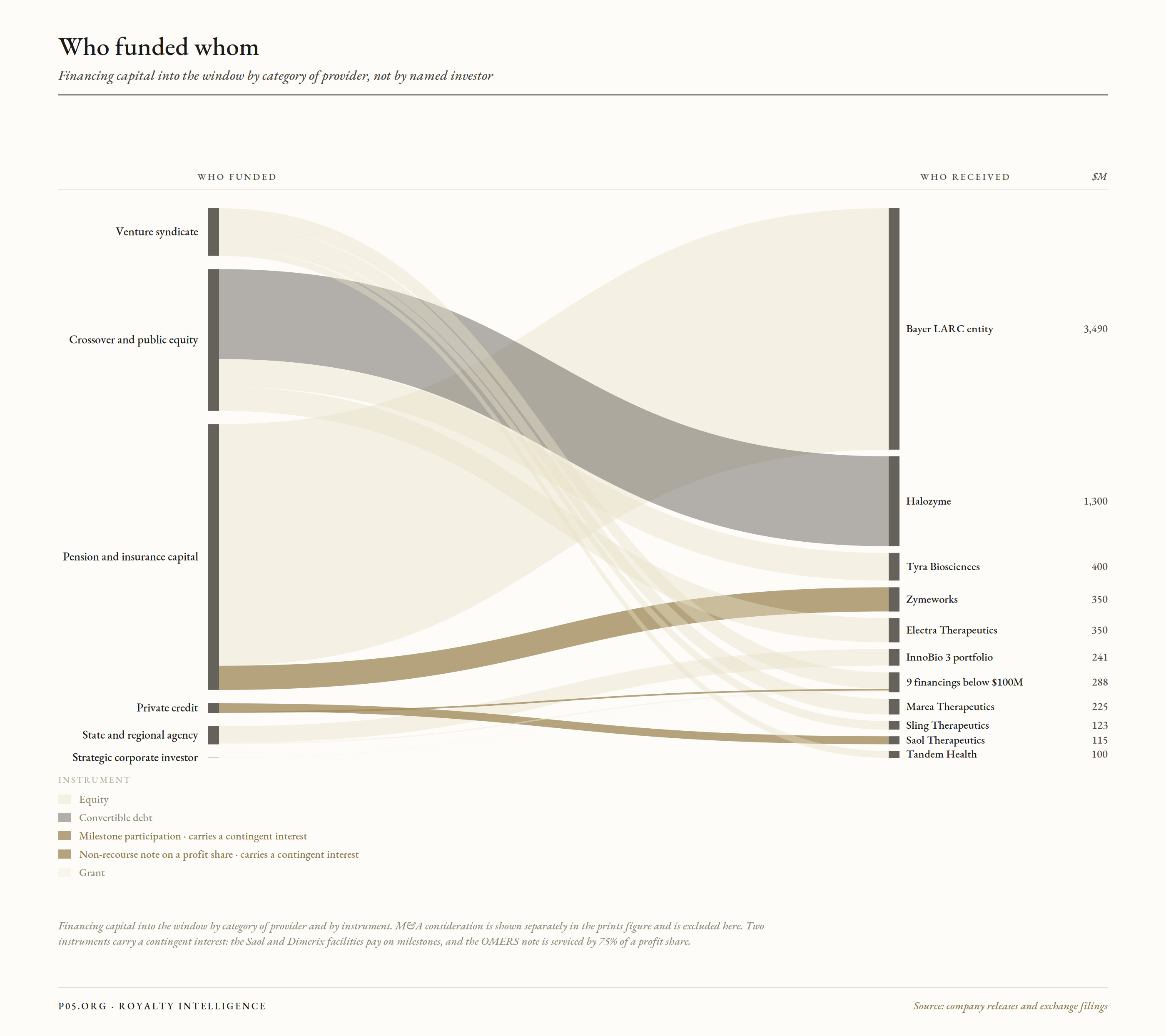
Financing capital into the window by category of provider and by instrument. M&A consideration is shown separately in the prints figure. Two instruments carry a contingent interest: the Saol and Dimerix facilities pay on milestones, and the OMERS note is serviced by 75% of a profit share.
Private funding: 9.
- ReEmerge (15 Sep, Minnesota): launched from stealth with an oversubscribed $37M Series A, led by U.S. Venture Partners and Santé, with Oxford Science Enterprises, 415 Capital, IAG Capital Partners, The Vertical Group and Dendrion Ventures (ReEmerge). Cognitive Network Restoration Therapy is a neurostimulation device that targets neural networks in the central thalamus to activate underperforming circuits after traumatic brain injury, developed under an exclusive licence from Cornell University. A prospective single-arm multicentre study of up to 40 patients with chronic moderate to severe TBI is planned (NCT07730099). Todd Langevin is chief executive; Nicholas Schiff, professor of neuroscience at Weill Cornell Medicine, is the co-founder and lead researcher.
- No equity, royalty, or milestone term of the Cornell licence is disclosed. Cornell is the tenth institutional licensor to surface in two windows, after Basel, Zurich, UCSF, Michigan, LifeArc, Seattle Children's, Ohio State, Nationwide Children's and Max Planck
- Sling Therapeutics (16 Sep, Ann Arbor): a $123M Series C led by Forbion, with existing investor TPG Life Sciences Innovations and new investor Sectoral Asset Management. Regina Salvat of Forbion and Francois Beaubien of Sectoral join the board. Proceeds advance linsitinib, an oral small molecule IGF-1R inhibitor for thyroid eye disease, through the global Phase 3 ORBIT pivotal trial, commenced after an end-of-Phase 2 meeting with the FDA earlier this year. The Phase 2b/3 LIDS trial met its primary endpoint on proptosis reduction.
- US Fast Track designation granted. TED affects more than 200,000 people in the US. Linsitinib has been given to more than 900 patients across 15 clinical trials. Ryan Zeidan is chief executive (Forbion).
- Linsitinib, also OSI-906, was discovered by OSI Pharmaceuticals, which Astellas acquired in 2010 for $4.0B, and Sling in-licensed it from Astellas in 2022 (Sling, June 2022). No upfront, milestone or royalty terms on the Astellas licence are disclosed. Sling launched in 2022 with a $35M Series A led by TPG's The Rise Fund and has raised $200M in total. ORBIT targets 120 participants over 24 weeks and has dosed its first patients. The approved IGF-1R therapies in TED are Amgen's Tepezza and Viridian's Lumvoa, both intravenous antibodies (Fierce Biotech)
- Circle Pharma (16 Sep, South San Francisco): a $92.5M Series E led by The Column Group, with Nextech Invest, RA Capital Management, Euclidean Capital and Eli Lilly and Company as a strategic investor (Circle Pharma). Lead asset CID-165 is a first-in-class oral macrocyclic cyclin D1 RxL inhibitor, preclinical, with clinical entry expected in Q1 2027 in ER-positive breast cancer. No licensor, in-licence or royalty is disclosed. RA Capital appears a third time in the window, after leading the Tyra offering on the 14th and co-leading the Lisata placement on the 17th; Eli Lilly appears a second time as an investor, after the QurCan option
- Tandem Health (14 Sep, Stockholm): a $100M Series B taking total funding to $160M, led by EQT's Scaleup Europe Fund in what is recorded as that fund's first healthcare investment, with Kinnevik, Northzone, Amino Collective and Visionaries. Tandem's Class IIa certified AI assistant is being extended into a clinic operating system (Tandem Health). The $160M total includes a $50M Series A in 2025, and Tandem states it supports more than 10,000 care organisations
- Altis Labs (17 Sep, Toronto): a $25M Series A co-led by OrbiMed and Qiming Venture Partners USA, with Innovation Endeavors, Benchstrength, Fusion Fund and the Cancer Breakthrough Fund. Proceeds expand the AI models across additional cancer types and scale commercial deployment with biopharmaceutical partners. Altis's flagship model IPRO generates survival predictions from routinely acquired radiology scans, trained on a multimodal oncology database spanning more than 500,000 patient years.
- In Johnson & Johnson's independent post-hoc analysis of the Phase 3 MARIPOSA trial, presented at the 2026 World Conference on Lung Cancer, the IPRO Response Rate detected a statistically significant treatment effect 11 months before the primary progression-free survival readout and 26 months before the final overall survival readout, where objective response rate failed to predict the survival benefit. Felix Baldauf-Lenschen is founder and chief executive; Tal Zaks signs for OrbiMed and Anna French for Qiming US (Altis Labs). The company's own release carries a 9 September dateline against a 17 September distribution and publication date
- Matisse Pharmaceuticals (17 Sep, Geleen): a $16.3M (EUR 14M) Series A led by the existing and new shareholder base, with participation from Brightlands Venture Partners and LIOF, the Limburg regional development agency, alongside private investors and management. Structured as a company-led round, which the company states preserves strategic flexibility while broadening the shareholder base. Proceeds primarily fund the Phase 2 trial of isupartob sodium in sepsis, plus regulatory, manufacturing and operational activities. Isupartob is a highly negatively charged agent designed to bind and neutralise positively charged extracellular histones, the mediators of endothelial injury and organ failure in sepsis.
- No treatment for sepsis is approved by any regulatory authority, against 49 million patients a year globally, mortality above 20%, and US costs above $62B annually. Founded 2014; Marcel Jacobs is chief executive (Matisse Pharmaceuticals). No licence, partner or royalty disclosed
- Orvida Pharma / Recordati (15 Sep): an interim financing led by Recordati with existing shareholders, to advance ontivatrep, a TRPV3 inhibitor, through Phase 1b in Olmsted syndrome and other rare genetic skin diseases. Amount undisclosed (Orvida, via GlobeNewswire). A commercial-stage specialty pharmaceutical company leading a private round in a rare-disease developer
- RegCell (15 Sep, Emeryville): $44M Series A led by Playground Global, with Jory Bell joining the board, alongside new investors Global Brain, Mitsui Chemicals, LG Technology Ventures, Alumni Ventures and Medical Incubator Japan and existing investors Fast Track Initiative, UTEC, Osaka University Venture Capital and Kyoto iCAP. Announced together with a second AMED grant that takes Japan's non-dilutive commitment to the company to about $59.3M (JPY 9.0bn), the first award having been about $37.3M (JPY 5.6bn) in 2024, implying roughly $22M (JPY 3.4bn) in this tranche. The combined figure reported as $66M is therefore equity plus state grant. First-generation epigenetically reprogrammed regulatory T cells, first indication autoimmune hepatitis (RegCell)
- Piomic Medical (18 Sep, Zurich): a $25M growth financing, led by Swisscanto (CH) Private Equity Switzerland Growth II L-QIF KmGK (Zürcher Kantonalbank's asset management arm) at CHF 10M, in what Swisscanto states is its first medtech investment, with Diabetes Venture Fund, Zürcher Kantonalbank, Verve Ventures, Sky Stiftung, N&V Capital, a Swiss single family office and other private and institutional investors (Piomic Medical, startupticker.ch). Takes cumulative funding past $50M in equity, convertible capital and non-dilutive funding and grants since inception. Proceeds complete the MAVERICKS IDE pivotal trial, 224 patients across 30 US sites and Medicare-covered, and the investigator-initiated NAZARÉ European vascular ulcer trial, fund a US market approval filing and COMS One market entry, and expand the platform into further indications.
- COMS (Concurrent Optical and Magnetic Stimulation) is a portable, non-invasive device combining light and magnetic stimulation to modulate regenerative pathways, lead indication refractory diabetic foot ulcers, whose five-year mortality the company describes as comparable to many cancers. It holds FDA Breakthrough Device Designation, CE marking, and what the company calls an unusually advanced US reimbursement position, including Alternative Pathway eligibility and CPT III codes effective January 2025. Andy Weymann, former chief medical officer of Smith+Nephew, joins the board as observer. Christopher Hertz is chief executive; Bertrand Hughes chairs the board. Own proprietary platform, no licence or royalty disclosed
Public capital and debt: 10.
- Halozyme Therapeutics (announced 16 Sep, priced 17 Sep upsized): a proposed $1.05B private offering of convertible senior notes due 1 October 2033 under Rule 144A, with a 13-day option for a further $150M, and with the initial conversion rate, interest rate and other terms stated as being determined at the time of pricing. Proceeds fund capped call transactions, the repurchase of the existing 0.25% convertible notes due 2027 and 1.00% convertible notes due 2028, and general corporate purposes including potential acquisitions (Halozyme).
- It priced upsized at $1.3B on 17 September at 1.50% per annum, maturing 1 October 2033, on an initial conversion rate of 7.1509 shares per $1,000 for a conversion price of about $139.84, a 27.5% premium to the $109.68 close, with a capped call cap of about $208.39 at a 90.0% premium. Capped calls take about $162.5M, leaving net proceeds of about $1.275B, or $1.471B if the $200M option is exercised. The concurrent repurchases are $151.7M principal of the 0.25% notes due 2027 at about $217.0M, and $220.0M of the 1.00% notes due 2028 at about $435.5M, $652.5M in total (Halozyme).
- Settlement is expected 22 September, two days after this window closes. Halozyme (Nasdaq: HALO) is the licensor behind the ENHANZE subcutaneous delivery platform and is the largest platform royalty recipient in the sector, so the instrument matters: a royalty recipient of that scale refinancing $1.3B of converts is raising against a royalty book rather than selling any part of it
- Beta Bionics (priced 15 Sep, closed 17 Sep, Irvine): a follow-on offering of 7,652,175 shares at $17.25 plus 1,043,484 pre-funded warrants, closing at $172.5M gross after full exercise of the underwriters' option, with J.P. Morgan, Piper Sandler, Wells Fargo Securities and Leerink Partners as underwriters (Beta Bionics). No licensor, in-licence or royalty is disclosed
- Circio Holding (15 Sep, Oslo): completed a capital raise of approximately $19.4M (NOK 200M) directed at the company's in vivo CAR-T programme, and separately published key information on a potential subsequent offering (BioStock). The largest Nordic financing in the window
- Goa Therapeutics (17 Sep): launched from stealth with $15.5M raised primarily from individual industry leaders, having already filed an amended registration statement for an initial public offering that could raise as much as $75M more (Form S-1/A). Lead asset GOA26 pairs an engineered alcohol dehydrogenase stable outside the liver, which the company describes as a thousand times more efficacious than the natural enzyme, with a second active ingredient that sequesters acetaldehyde. An IND is planned by the end of 2026 with a Phase 1 to follow in 2027. The first indication is clearing patients with high blood alcohol content for emergency surgery, against a stated figure that up to 50% of severe trauma presentations are intoxicated.
- In swine data presented at the American Association for the Surgery of Trauma, blood alcohol content fell 61.3% on average against control twenty minutes after treatment, with treatment given 90 minutes after dosing; earlier rat work reported complete clearance within five minutes. The science originated with Tami Ehrmann Barr, a protein engineering postdoctoral researcher at the Max Planck Institute; Andrew Altschuler funded her work from 2019 and the company was formed in 2024 (Fierce Biotech). Preclinical, no IND filed, and no licence or licensor disclosed
- Electra Therapeutics (terms set 14 Sep, priced 17 Sep, South San Francisco): terms were set for a Nasdaq IPO in an amended registration statement at 21.7 million shares at $14 to $16, for expected net proceeds of $296.6M at the midpoint rising to $341.9M on full exercise of the underwriters' option (Form S-1/A). The deal then priced upsized at 23,333,334 shares at $15.00 for approximately $350.0M gross, above the midpoint and above the top of the original share count, listing on the Nasdaq Global Select Market as ETRA, with closing expected 21 September. Jefferies, TD Cowen, Evercore ISI and Cantor are joint book-running managers (Electra).
- The company held $97.7M at 30 June, having raised a $183M Series C in October 2025. Use of proceeds is itemised: $220M to advance ipsoprubart through the ongoing global Phase 2/3 in secondary haemophagocytic lymphohistiocytosis and toward an approval application, $25M for an ongoing Phase 1 in natural killer and T cell malignancies, and $50M for ELA822, a monoclonal antibody against SIRP gamma, through a Phase 1 in healthy volunteers and into a planned Phase 1/2. Ipsoprubart targets signal regulatory proteins to selectively deplete pathological immune cells; a Phase 1b in malignancy-associated HLH reported 100% overall survival at eight weeks in 12 frontline patients. Phase 2/3 enrolment is expected to complete in 2027 with topline shortly after. Founded 2018, 46 full-time staff; Kathy Dong is chief executive (Fierce Biotech). No licensor, in-licence or royalty is disclosed
- Saol Therapeutics / Oaktree (closed 11 Sep, announced 15 Sep; Roswell, Dublin and Hamilton): a definitive agreement under which funds managed by Oaktree provide up to $115M in milestone-based capital, an initial tranche funding near-term launch readiness with the remainder released as specified regulatory, clinical and commercial milestones are met. Oaktree describes it as a credit facility; Kent Bailey, Managing Director, Life Sciences Lending, signs for Oaktree, which sits inside Brookfield's $416B credit platform. Dave Penake is chief executive of Saol, which is privately held and clinical-stage.
- Proceeds fund launch readiness for SL1009 (sodium dichloroacetate) in pyruvate dehydrogenase complex deficiency, a rare mitochondrial disease with no FDA-approved therapies, and lifecycle work on SL1009 in congenital lactic acidosis and SL1002 in further pain indications and spasticity.
- The NDA resubmission was filed 30 June 2026 and the FDA target action date is 30 December 2026, under Priority Review, Orphan Drug and Rare Pediatric Disease designations. Saol and Medosome Biotec will file a 510(k) for the dose-determining genetic test that would serve as a required companion diagnostic. A USPTO Notice of Allowance covering a method of administering SL1009 to patients on a ketogenic diet is anticipated to expire in 2045 (Saol). Dave Penake says Saol chose Oaktree because it understood <q>the long-term opportunity across our portfolio, not just the near-term launch</q>. Whether the facility carries a revenue participation alongside the coupon is not stated
- ExpreS2ion Biotech / Vator Securities / Alumni Capital (announced 15 Sep, Horsholm): two instruments alongside each other. A guarantee undertaking of $2.03M (SEK 19.3M) for the TO 13 warrant programme, covering about 60% of maximum proceeds. TO 13 carries a strike of $0.17 (SEK 1.60), the quota value, against a $0.13 (SEK 1.25) close on 14 September, leaving the warrants 22% out of the money with the exercise period running to 21 September and full exercise worth $3.41M (SEK 32.4M). Vator Securities underwrites, with lead investors Alumni Capital and Tellus Equity, and takes 10% of the guaranteed amount in cash and 30% in new shares at SEK 1.60, an effective guarantee fee of about 12% against the actual share price. Subject to an EGM on 1 October.
- Separately, a put option agreement with Alumni Capital for up to $5.26M (SEK 50M) of committed equity over 24 months, drawable at the company's discretion, each tranche capped at the lowest of $0.53M (SEK 5M), 500,000 shares, or 300% of recent median trading volume, priced at 94% of the lowest VWAP over the preceding four trading days.
- A floor price of $0.42 (SEK 4.00) applies, more than triple the current share price, below which the facility cannot be used. The commitment fee is 5%, $0.26M (SEK 2.5M), plus 500,000 shares, due at an Effective Date of 15 March 2027 at the earliest. Proceeds are earmarked first to take ES2B-C001, a first-in-class active immunotherapy for HER2-expressing cancers, through the Phase 1 primary readout, and second to strengthen the company's position in ongoing and planned licensing negotiations with international oncology players. Bent U. Frandsen is chief executive; Xavier Indeglia is portfolio manager at Alumni Capital (ExpreS2ion, via BioStock).
- PDS Biotechnology (Nasdaq: PDSB) (14 Sep): initial closing of a PIPE of up to $22.3M, with $11.3M in initial gross proceeds, led by Dr Patrick Soon-Shiong of NantWorks and AB Group Ltd, with Dr Soon-Shiong joining the board. Proceeds fund submission of a registrational Phase 3 protocol for PDS0301 (PDS Biotechnology)
- Tyra Biosciences (Nasdaq: TYRA) (priced 14 Sep, expected to close 15 Sep): a $400.0M underwritten offering, 9,079,000 shares at $22.03 plus pre-funded warrants for 9,078,529 shares at $22.029, led by RA Capital Management. Proceeds toward dabogratinib, an FGFR-targeted programme (Investing.com)
- Teva Pharmaceutical Industries (priced 10 Sep, settlement on or about 16 Sep, inside this window): the multi-tranche senior notes offering recorded in W37 with blank amount and coupon fields has priced at approximately $4.9B equivalent across five tranches: $1.163B (EUR 1.0bn) at 4.250% due 2033, $581M (EUR 500M) at 4.625% due 2036, $1.0B at 5.500% due 2034, $1.0B at 5.750% due 2037 and $1.2B at 5.250% due 2032, through Teva Pharmaceutical Finance Netherlands II, III and IV (Teva, via GlobeNewswire). Teva is separately named as an R&D co-funding counterparty in Royalty Pharma's Morgan Stanley remarks of 14 September
Priority review vouchers: 2 issued, 0 sold, and 1 anticipated on a December action date. Ultragenyx received a Rare Pediatric Disease voucher on the FAYUVI approval of 17 September, set out above. Saol Therapeutics states it anticipates receiving a Rare Pediatric Disease voucher on approval of SL1009, for which the FDA target action date is 30 December 2026. The Scholar Rock Rare Pediatric Disease voucher is now on the record in a Form 8-K filed 14 September. It joins the Ionis voucher on Zanvastro, also unsold. Scholar Rock's chief financial officer Vikas Sinha has said the company intends to sell its voucher, and recent voucher sales have run close to $200M. The 2026 disclosed band stands at $180M to $215M, and the programme is reauthorised to 30 September 2029.
Open from earlier issues, with no movement inside this window. HUTCHMED and GSK on antitrust clearance, the agreement signed 3 September at $110M upfront, up to $1.295B in total including up to $1.185B of milestones, plus tiered royalties, with the upfront payable at closing and antitrust review still outstanding at the close of this window; BioMarin and Ascendis, definitive agreement due 24 September; Intellia and OrbiMed, whether the synthetic-royalty restriction is a prohibition or a consent right; Jaguar Health and Future Pak, checked again in the final pass with no in-window filing, the crofelemer licence still dating to 12 January 2026 at $18M upfront, $16M at close and $2M after, against up to $20M of milestones; Aqilion; Innovad and Cinergis; Cape Fear BioCapital; ARCH Fund XIV; and Norwich v Kennedy, carried from W35 with no docket movement through four windows.
Open at the close of the window, 20 September. Six items were carried into the final pass. One is closed. The other five are closings scheduled for the days immediately after the window ends, on more than $2B of instruments.
- CHMP: closed. The committee met 14 to 17 September and published its highlights on the 18th. Yuviwel is absent from every list and no opinion was issued, against an Ascendis guidance of a Q4 EU decision. Set out in full above.
- Teva senior notes settlement, on or about 16 September. The pricing is confirmed at 10 September, outside this window, across five tranches: EUR 1.0bn at 4.250% due 2033, EUR 500m at 4.625% due 2036, $1.0bn at 5.500% due 2034, $1.0bn at 5.750% due 2037 and $1.2bn at 5.250% due 2032, issue prices 98.327% to 98.993%, about $4.9bn equivalent (Teva). No completion filing confirming settlement was located by the close of the window, so it is not carried as settled.
- Dimerix, mandatory drawdown of 50% of the $23.9M (A$34M) facility by 18 September, announced 4 September (Dimerix). The instrument is not plain debt. Alongside 10% per annum compounding annually on drawn amounts only and repayment by 17 January 2028, the lenders hold an unsecured right to an aggregate 30% of each milestone payment Dimerix receives under DMX-200 commercial licence agreements, capped in aggregate at 2.0x the amount drawn down. Lenders are independent US and Australia based investors plus SKIPTAN Pty Ltd (A$2.0M) and SKIPTAN Pty Ltd as trustee for the P&M Meurs Family Trust (A$10.0M), the latter two unsecured pending an ASX Listing Rule 10.1 waiver or shareholder approval while the remainder take a general security deed.
- Dimerix may take further commitments to A$50M before March 2027. The disclosed book behind the participation is five commercial partners, $53.3M (A$81M) of upfronts received to date and up to $155.9M (A$237M) of further development milestones. Proceeds fund DMX-200 expanded access programmes, commercial manufacturing readiness and pipeline expansion including DMX-652. No ASX announcement confirming the mandatory drawdown of about A$17M was located by the close of the window. The draw is therefore required and unconfirmed, and a completed drawdown would put a live milestone participation on the record.
- Electra Therapeutics, $350M IPO priced 17 September, trading opened 18 September, closing expected 21 September, one day after this window closes (Electra Therapeutics). It did not close early.
- Halozyme, settlement of the upsized $1.3B convertible notes expected 22 September. The pricing terms and the $652.5M of concurrent repurchases are now confirmed and set out above.
- Zymeworks and Theravance Biopharma, closing expected on or about 23 September following the shareholder approval of 18 September, set out above.
- Revolution Medicines, the mandatory first $250M term-loan tranche. The condition was satisfied on the 26 August approval and no 8-K disclosing the draw was on the EDGAR record at the close of this window.
Four closings fall in the three days after this window ends: Electra on the 21st, Halozyme on the 22nd, Zymeworks and Theravance on or about the 23rd, and the Teva settlement somewhere behind them. All four fall into W39 as confirmed closings.
M&A and Restructuring
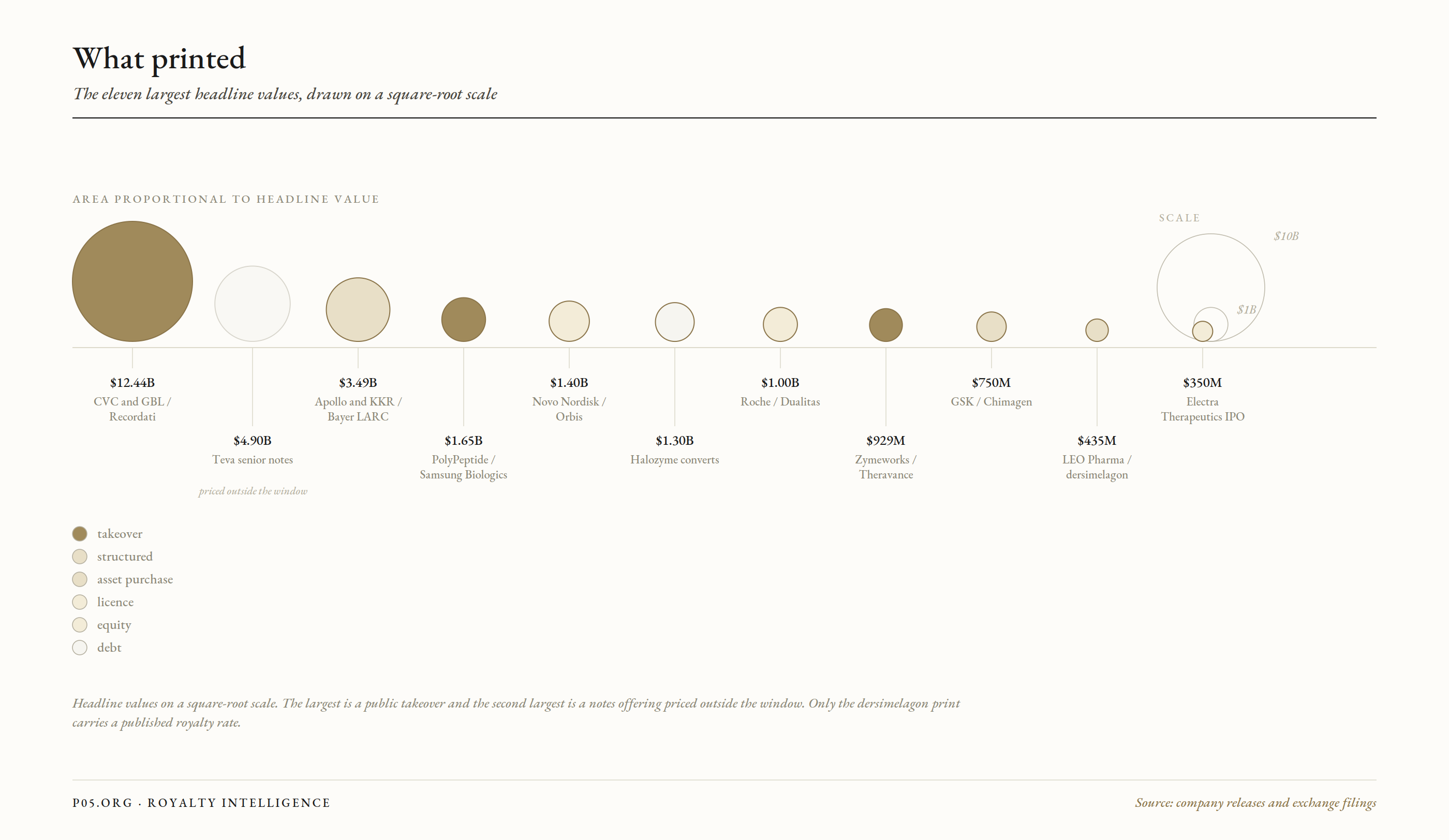
Three prints on a square-root scale. Only two carry a number: the PolyPeptide offer at $1.65B (CHF 1.46bn) of implied equity value and the Teva notes at approximately $4.9B equivalent. The Sanofi portfolio transfer is drawn at the width of its disclosed consideration, which is a percentage rather than a price, and the eleva separation is drawn at zero because nothing about it is priced.
Sanofi / Cheplapharm: Twenty Marketed Medicines Move Against Buyer Equity, and the Price Is Not Published (Mon Sep 14)
Sanofi (EURONEXT: SAN) and CHEPLAPHARM Arzneimittel GmbH announced their intention to create a strategic partnership under which Cheplapharm would take over a selection of mature medicines and manufacturing sites (Cheplapharm).
- The status: an announced intention, not an executed agreement. The release is written in the conditional throughout, and the transaction is subject to employee information and consultation procedures, regulatory approvals and customary closing conditions
- The consideration: a 26.4% equity stake in Cheplapharm to Sanofi. No cash figure is published, and additional financial details follow at a later stage
- The assets: 20 mature medicines, including Lovenox/Clexane (enoxaparin) excluding the United States, and three manufacturing sites: Csanyikvolgy in Hungary with about 400 employees, Jurong in Singapore with about 100, and Ploermel in France with about 65. Existing employment arrangements and collective agreements are maintained
- The timetable: commercial transfer of the medicine portfolio is planned to begin in the first quarter of 2027, followed by the site transfers, with the transaction expected to be fully completed by the third quarter of 2027. Eighteen months of execution risk sits between the announcement and the end state
- The buyer: family-owned, built on established medicines, and reported to have invested more than $7.21B (EUR 6.2bn) since inception, holding 3,440 marketing authorisations across 160 countries (Investing.com). Cheplapharm describes Lovenox/Clexane as a flagship product and is taking the manufacturing capability alongside it, framing the commitment as industrial rather than commercial
- Financial effect on the seller: no impact to Sanofi's 2026 guidance
- Instrument: a divestment settled in buyer equity leaves the seller holding a claim on the acquirer's balance sheet rather than on the products it sold. Cheplapharm's growth has been funded on debt raised against acquired brands, and Sanofi has taken slightly more than a quarter of that structure in place of a price
- What is not disclosed: whether any deferred consideration, earn-out, supply-linked payment or revenue interest attaches; how the manufacturing transfer is financed; and the enterprise value implied by a 26.4% stake. A published multiple on a twenty-brand mature portfolio would be the second such comparable on the ladder in a month, after the Novartis India and Pfizer trademark assignment at 5.5 times brand revenue
- Royalty read-through: none created on the public record and none extinguished. The eighteen-month transfer window is the origination point, because a portfolio in transit between two balance sheets is a portfolio whose financing is open. Recorded as the largest portfolio movement of the window, and as an origination target. A serial acquirer of marketed tail brands, with a large authorisation count and a debt-funded model, is the counterparty profile a revenue interest is normally written against
- Date: Announced Mon Sep 14, 2026
eleva / One04: A Platform Company and an Asset Company Separate, and the Licence Between Them Is Not Published (Tue Sep 15)
eleva GmbH of Freiburg im Breisgau split into Eleva Biologics GmbH & Co. KG and One04 Therapeutics GmbH & Co. KG, both still owned by the parent (Eleva).
- What each side takes: Eleva Biologics keeps the Bryotechnology platform, a moss-based expression system underpinned by more than 25 years of process engineering, GMP-validated, offering control over glycosylation and homogeneous production of proteins that resist CHO and yeast. One04 keeps CPV-104, wholly owned, recombinant full-length human Factor H, progressing through Phase 1
- The stated reason: capital structures tailored to distinct strategies. Eleva Biologics sells access to a platform; One04 raises against a single clinical asset and expects new investors. The parent retains shared general and administrative functions
- The asset: Factor H is a well-validated complement control protein that has long resisted drug development on manufacturability rather than biology. CPV-104 is the only Factor H therapeutic candidate in the clinic. Two moss-derived candidates have now entered clinical development in Europe under national authorisations
- Instrument. A partnership-led platform business is a royalty and milestone business by construction. Every Bryotechnology partnership Eleva Biologics signs will carry economics on a partner's product, which makes the separation the creation of a pure-play future licensor with no marketed base and no encumbrances on it yet
- What is not disclosed, and it is the whole question: whether One04 pays Eleva Biologics anything for the platform that made CPV-104. A separation of this shape normally crystallises an intra-group licence, and a licence from a platform entity to an asset entity on a Phase 1 product is a royalty struck at the earliest possible point in a stream's life. No royalty, rate, milestone ladder or transfer price appears anywhere in the release
- Royalty read-through: nothing on the ladder today and two positions that could reach it. Eleva Biologics as a licensor of future partner products, and whatever runs from One04 back to the platform on CPV-104. A German family of entities separating along the platform-and-asset line that royalty structures are written across, announced with no financial terms at all
- Date: Announced Tue Sep 15, 2026
Zymeworks / Theravance / OMERS: A Profit Share Pledged as Collateral, and a Pension Fund Taking 75% of the Cash Flow to Service It (Fri Sep 18)
- The vote. Theravance Biopharma shareholders approved the merger on 18 September, 40,993,370 in favour against 8,671 opposed on a 79.14% quorum, satisfying a closing condition (Theravance). Closing is expected on or about 23 September.
- Terms. $17.00 per share in cash, about $929M, agreed 29 June 2026, plus a contingent value right paying Theravance holders 80% of net proceeds from any licensing, divestiture or monetisation of ampreloxetine over the following decade, with 20% retained by Zymeworks and the designation to be made within a year of closing.
- What is being bought. A 35% US net profit share in YUPELRI, on 2025 US net sales of $266.6M, up 12%, producing about $60M of annualised cash flow at current run rates, with a licensed generic launch date of April 2039 and up to $125M of commercial milestones from Viatris on US net sales (Zymeworks).
- The financing, and it is the reason the transaction belongs here. $350M of the purchase price comes from a non-dilutive, non-recourse note from OMERS Life Sciences, secured by the Theravance assets and entities related to YUPELRI, with no recourse to the rest of Zymeworks. 75% of the YUPELRI profit-share cash flows are contractually assigned to OMERS to service the debt.
- Instrument. A profit share used as the sole collateral for acquisition debt. The lender takes the asset risk and none of the corporate risk, and the borrower's downside is capped at losing the thing it just bought. On roughly $60M of annualised cash flow, a $350M note serviced by 75% of that cash flow implies the lender is underwriting growth in the profit share, the Viatris milestones, or both, rather than the current run rate.
- Comparable. This is the closest structure in the window to a revenue interest written against a marketed product, and it was written by a pension manager rather than a royalty fund. Apollo and KKR took a minority equity position in the Bayer LARC entity in the same window with no royalty, no milestone and no contingent value right attached, so two pools of long-dated institutional capital entered the same sector eight days apart through opposite instruments.
- A third stream sits behind it. Zymeworks expects a $100M TRELEGY ELLIPTA milestone from Royalty Pharma in Q1 2027 on milestone conditions being met, which materially reduces the effective net cost of the acquisition.
- Royalty read-through. Three separate contingent instruments finance one purchase: a profit share pledged as collateral, a CVR over an asset neither party intends to develop, and a milestone receivable from the largest buyer in the market. None of the three is a royalty, and all three behave like one.
- Date. Agreed 29 June 2026, shareholder approval 18 September 2026, closing expected on or about 23 September 2026.
Royalty-Bearing Positions

Five stacks, drawn to the share of the payer's base each layer reaches. Only two publish a band. The YUPELRI stack is the only one where a layer has been pledged as collateral.
Nuvalent / Royalty Pharma / GSK: A Live Stream Reads Out at 94% in a Label It Does Not Yet Cover, and the Fund That Owns It Bought From Somebody Nobody Has Named (Mon Sep 14)
Nuvalent, acquired by GSK plc (LSE/NYSE: GSK) in July 2026, presented data for zidesamtinib in TKI-naive ROS1-positive non-small cell lung cancer from the global Phase 1/2 ARROS-1 trial (NCT05118789) at the IASLC World Conference on Lung Cancer in Seoul (IASLC, via Medical Xpress).
- The result: among 94 efficacy-evaluable TKI-naive patients, objective response rate by blinded independent central review was 94%, 88 of 94. The nine-month duration-of-response rate was 94% and the twelve-month rate 86%, with substantial intracranial activity
- What it sits next to: the pivotal TKI pre-treated dataset that supports the pending NDA showed ORR by BICR of 44% in 117 patients, rising to 51% in the 55 patients who had received one prior ROS1 TKI (Nuvalent). The approved label is the pre-treated one at 44%. The number presented this week is the first-line one at 94%, and first-line use is not yet approved
- The stream, and it was bought from a party nobody has identified. On 16 December 2025 Royalty Pharma acquired a low single-digit pre-existing royalty on worldwide net sales of each of zidesamtinib and neladalkib, from an undisclosed third party, for up to $315M, with expected duration running to approximately 2041 to 2042. Covington & Burling, Dechert and Maiwald advised Royalty Pharma (Royalty Pharma)
- The underwriting case as published: analyst consensus at the time put neladalkib at about $3.5B and zidesamtinib at about $1.9B of sales by 2035. A low single-digit rate against a combined $5.4B consensus base, for up to $315M, over a sixteen-year tail
- The seller is the interesting party. A pre-existing royalty on both of a clinical-stage company's lead assets, held by a third party willing to sell in December 2025 and not named in the release, is an originator position that existed before Royalty Pharma arrived. Neither Nuvalent's releases nor Royalty Pharma's identify it. The licence creating it is the document to find, and it is the template for what a ROS1 and ALK originator position looks like
- The approval, and it came early. The FDA approved zidesamtinib in July 2026 for adults with locally advanced or metastatic ROS1-positive NSCLC who received a prior ROS1 kinase inhibitor, ahead of the 18 September 2026 action date. The royalty is live and accruing. Neladalkib reported positive pivotal results in TKI pre-treated patients in November 2025 and remains under FDA review with an action date of 27 November 2026
- The payer changed in July. GSK completed its acquisition of Nuvalent on 15 July 2026 at $124.00 per share in cash, an aggregate equity value of approximately $10.6B (GBP 8.0bn) and $9.4B (GBP 7.1bn) net of cash acquired, funded primarily from new and existing debt facilities plus cash. The transaction was announced 9 June 2026 at a 40% premium to the last close and 26% to the 30-day average, and carried three lung cancer assets including NVL-330 in Phase 1. Luke Miels is chief executive of GSK. Royalty Pharma's counterparty on this stream is now a large-cap payer rather than a clinical-stage one
- Instrument: none created this week. Recorded as the only in-window event that moves an asset a tracked royalty fund owns
- Royalty read-through: a low single-digit rate running to 2042 across two assets in two adjacent oncogene-driven populations is a duration position. The pre-treated label is approved and paying; the first-line indication read out this week and is not yet filed; neladalkib decides on 27 November. $160M of the $315M sits behind contingencies the release does not specify
- Date: Data presented Mon Sep 14, 2026. Royalty acquired Tue Dec 16, 2025. Zidesamtinib approved July 2026. GSK acquisition completed Wed Jul 15, 2026
Revolution Medicines / Royalty Pharma: A Third Designation Widens the Base, and the Rate Falls as the Base Grows (Mon Sep 14)
Revolution Medicines, Inc. (Nasdaq: RVMD) announced that the FDA granted Breakthrough Therapy Designation to RASONQUE (daraxonrasib) for treatment-naive metastatic pancreatic adenocarcinoma in combination with gemcitabine and nab-paclitaxel (Revolution Medicines).
- The designation: the third BTD for RASONQUE and the fifth across the RAS(ON) portfolio, granted on the Phase 1/2 RMC-GI-102 study in treatment-naive RAS-mutant metastatic PDAC. Those data informed RASolute 303, the running global Phase 3 of RASONQUE as monotherapy and in combination with GnP against GnP alone, independent of tumour RAS genotype
- The approved base beneath it: RASONQUE was approved on 26 August 2026 for adults with metastatic PDAC who have received at least one prior systemic therapy or are unsuitable for multiagent therapy, on the Phase 3 RASolute 302, six and a half months ahead of the goal date, under priority review, orphan designation and the FDA Commissioner's National Priority Voucher pilot, with the NDA in Project Orbis (Revolution Medicines)
- The stream, and the schedule is published in full. Under the June 2025 funding agreement, Royalty Pharma provides up to $1.25B in five $250M tranches against a 15-year tiered synthetic royalty on worldwide annual net sales of daraxonrasib, and of zoldonrasib if approved in an overlapping indication. On the first two tranches the rates run 4.55% on the first $2B, 2.50% on $2B to $4B, 1.00% on $4B to $8B and zero above $8B. Rates adjust pro rata with the draw, with stepped-up tiers as high as 7.80% on lower bands if the remaining funding is taken.
- The rate on $0 to $2B may increase between 2030 and 2041 if prior-year sales fall below an agreed threshold (Royalty Pharma)
- The credit alongside it: a senior secured term loan of up to $750M at SOFR plus 5.75% with a 3.5% SOFR floor, maturing six years after the first $250M tranche is drawn, that first tranche mandatory following FDA approval in metastatic PDAC. The approval landed 26 August and no drawdown appears on the EDGAR record for this window. Two further $250M tranches sit at Revolution Medicines' option against annual net sales milestones. Royalty Pharma retains syndication flexibility
- What the tiering does to this designation. A first-line label multiplies the treated population. The rate falls as sales rise, so the holder receives 2.50% on the incremental dollar above $2B, 1.00% above $4B and nothing above $8B. The event that most enlarges the base is the event on which the holder's marginal rate is lowest
- Position at the last reported date: $1B of the funding commitment remained unfunded at 31 December 2025. Positive Phase 3 PDAC data activated the second $250M tranche, taking funding drawn to $500M
- Comparable: a published, fully tiered synthetic royalty on a marketed oncology asset, with a named step-up mechanism and a stated zero band. Few disclosed structures publish all three, and this one is directly usable on the ladder
- Royalty read-through: the open question is the draw rather than the rate. Each further $250M tranche Revolution Medicines elects raises the rate on the lower bands, so the stream's value moves with the borrower's financing decisions as much as with the label. Underwriting a tiered synthetic royalty of this shape means underwriting the issuer's capital plan
- Date: Announced Mon Sep 14, 2026
Ultragenyx / Abeona / FAYUVI: A Royalty Sold for No Upfront in 2022 Went Live Two Days Early (Thu Sep 17)
- The approval. The FDA approved FAYUVI (UX111) on 17 September, two days ahead of its action date, with a Rare Pediatric Disease Priority Review Voucher issued on approval (Ultragenyx).
- The stream underneath. Abeona Therapeutics holds tiered royalties of up to 10% on net sales, against up to $30M in commercial milestone payments following regulatory approval. Coverage on the approval date describes the live rate as mid-single-digit royalties on sales. Abeona took no upfront when it sold the programme to Ultragenyx in 2022.
- The chain, and it runs three deep. Ultragenyx pays Abeona. Ohio State University and Nationwide Children's Hospital sit underneath Abeona, and neither institution's rate is on the public record.
- Instrument. A distressed disposal that kept the economics. A seller with no cash took milestones and a rate rather than a price, and four years later the rate is live on an approved product while the milestones become payable. The 2022 transaction would have been invisible to any screen built on upfront consideration, because there was none.
- Comparable. Set against the zidesamtinib royalty Royalty Pharma bought for up to $315M with $155M upfront, FAYUVI is the same asset class reached by the opposite route: no cash at the point of sale, and the whole of the return deferred into the rate.
- Royalty read-through. A mid-single-digit live rate on an approved ultra-rare gene therapy, with two academic institutions underneath it and a voucher issued to the payer, is four separable interests created by one approval. Abeona is listed and the rate is disclosed; the Ohio State and Nationwide Children's positions are not, and would have to be reached through the institutions rather than the market.
- Date. 17 September 2026.
Clinical and Regulatory
BioNTech at WCLC: Three Assets, Three Upstream Positions, and One Licence That an Acquisition Already Extinguished (Mon Sep 14 and Tue Sep 15)
BioNTech SE (Nasdaq: BNTX) presented across three partnered assets in Seoul, each sitting on a different kind of upstream claim.
- Gotistobart, and the data is the most mature of the three. In PRESERVE-003 stage 1, median overall survival reached 18.5 months against 10.0 with docetaxel, hazard ratio 0.56, nominal p=0.0295, on 87 randomised patients at a 17 July 2026 cutoff with 25.4 months median follow-up. Grade 3 or higher treatment-related events ran 44.4% against 48.8%, so the chemotherapy-free arm was no worse tolerated. Pivotal stage 2 is enrolling at more than 160 sites with OS as the primary endpoint (BioNTech and OncoC4). At the December 2025 readout median OS had not been reached at almost 15 months, so this is the first point at which the number exists
- The upstream position on gotistobart: the molecule was developed at OncoImmune and is advanced by OncoC4, Inc. of Rockville under a joint development programme with BioNTech. A small private company holds the originating position on a Phase 3 asset that has now nearly doubled survival in a chemotherapy-refractory population. The licence terms are not on the record and the OncoC4 side is private, so the agreement is the document to find
- Pumitamig, and the licence no longer exists. BioNTech entered a global licensing and collaboration agreement with Biotheus and then acquired the company outright, taking full global rights. An acquisition of the licensor extinguishes the royalty rather than transferring it. In June 2025 Bristol Myers Squibb took a global development and commercialisation partnership at $1.5B upfront with further payments and milestones. The economics now run between two large caps with no third party in the middle
- Elfetabart drozuntecan, and this one still carries its licensor. BNT324/DB-1311 is a B7H3-targeted ADC developed with Duality Biologics (Suzhou). The late-breaking oral on 15 September is the first lung cancer combination data for any PD-(L)1xVEGF bispecific with an ADC, in Phase 1/2 NCT06892548. DualityBio also appears in W37, taking $45M upfront, more than $1B in milestones and tiered royalties from Genentech on the DUPAC payload platform. A Chinese ADC licensor appearing in consecutive windows against two different Western payers
- The wider room said the same thing. Seoul also carried MediLink under a Roche ex-China licence and Hansoh under a GSK licence, both reading out in second-line small cell lung cancer on the 13th at the same 0.46 hazard ratio, and Taiho with Cullinan on zipalertinib. Four Asian-origin assets presenting against four Western payers in four days, and no rate published on any of them.
- Instrument: none created. Recorded because three upstream structures were visible in one company's programme, and they are the three outcomes available to any originating licensor: keep the royalty, sell the company and lose it, or sit underneath a partnership that pays somebody else
- Royalty read-through: OncoC4 is the position to map. Private, holding the originating claim on an asset in pivotal stage 2, with the first survival number now published and a partner large enough to fund the rest. A licensor in that position has a financeable stream and a reason to look at one before approval
- Date: Gotistobart data Mon Sep 14, 2026. Pumitamig and elfetabart drozuntecan combination late-breaker Tue Sep 15, 2026
Definium Therapeutics: A Third Positive Phase 3 on Lysergide, and the Licensor Is a Swiss University Hospital (Mon Sep 14)
Definium Therapeutics, Inc. (Nasdaq: DFTX) reported topline results from Panorama, its second Phase 3 study of DT120 (lysergide) orally disintegrating tablet in adults with generalised anxiety disorder (Definium).
- The result: primary and all key secondary efficacy endpoints met. A placebo-adjusted HAM-A reduction of 5.1 points from baseline at week 12 on DT120 ODT 100 µg, p<0.0001, Cohen's d=0.64. Discontinuation rates of 10.4% on 100 µg, 11.5% on 50 µg and 10.3% on placebo
- The study: Panorama (MM120-301) enrolled participants aged 18 to 74 with a DSM-5-confirmed primary GAD diagnosis and a minimum HAM-A total score of 20, randomised 2:1:2 to a single dose of 100 µg, 50 µg or matching placebo
- The third readout in four months: Emerge in major depressive disorder in June, Voyage in GAD in August at a 5.4-point placebo-adjusted HAM-A reduction, p<0.0001, Cohen's d=0.81, and now Panorama (Definium, Voyage)
- What follows: pre-NDA meeting in the fourth quarter of 2026, NDA filing anticipated in the first half of 2027
- The regulatory position already held: FDA Breakthrough Therapy Designation in GAD, granted on the Phase 2b, which was published in JAMA, and a UK Innovation Passport under the Innovative Licensing and Access Pathway
- The company changed its name. DT120 was MM120, and Definium Therapeutics is Mind Medicine renamed. The trial code on the pivotal study is still MM120-301, which is how the continuity is visible in the primary documents
- The licensor, and it is confirmed. In April 2020 MindMed entered a multi-year branch-exclusive collaboration with the laboratory of Professor Matthias Liechti at University Hospital Basel, acquiring exclusive worldwide rights to data, compounds and patent rights associated with the Liechti Lab's research on LSD and other psychedelic compounds, including preclinical data and completed and ongoing LSD and MDMA clinical trials. The announcement states that University Hospital Basel will receive royalties and development revenue on any products marketed through the collaboration (MindMed)
- What the filings say, and it is not identical. The company's annual report describes the same agreement as one under which, subject to certain terms and conditions, it provides research funding and certain milestone payments in return for the exclusive licence to existing and future data and intellectual property, with Dr Liechti as principal investigator holding primary responsibility for the research studies. It records seven completed and four ongoing LSD trials within scope and states that the collaboration has generated a number of patent applications (MindMed annual report).
- The royalty is asserted in the 2020 announcement and the filing language reviewed describes research funding and milestones. No rate, milestone ladder or term appears in either
- The scope is wider than the asset. The licence reaches LSD and other psychedelic compounds, including MDMA work, so University Hospital Basel sits underneath more of the pipeline than DT120 alone, and the patent applications generated by the collaboration were filed on jointly produced data
- Instrument: an academic licence with a stated royalty, an undisclosed rate and a research-funding and milestone component that has been running since 2020, sitting underneath an asset eighteen months from an NDA
- Royalty read-through: two positions, not one. University Hospital Basel holds the originating academic royalty. Definium holds the product and, with no named commercial partner, sits at the point in the capital cycle where the choice is between an out-licence, a synthetic royalty against launch, and dilution. A single-dose product in a chronic indication changes what a royalty on it is worth, because the revenue line is a function of patients initiated rather than patients maintained. Any structure written against DT120 needs that distinction in the model before a rate is discussed
- Date: Panorama announced Mon Sep 14, 2026. The University Hospital Basel licence dates to Wed Apr 1, 2020
Royalty-Bearing Licence-Outs and Collaborations
LEO Pharma / Tanabe Pharma / dersimelagon: The Only Rate Anybody Published This Week, and It Came Out on the Day the Acquisition Closed (Fri Sep 18)
- Terms, and the band is published. LEO Pharma closed its acquisition of worldwide rights to dersimelagon from Tanabe Pharma and announced in the same release that the FDA had accepted the NDA and granted Priority Review, against a PDUFA action date at the end of February 2027. The consideration is up to $435M in upfront and near-term milestones, further downstream milestones, and tiered royalties on net sales at double-digit to mid-teens rates (LEO Pharma).
- The asset. A once-daily oral MC1R agonist for erythropoietic protoporphyria and X-linked protoporphyria, rare genetic disorders in which sunlight exposure produces severe skin pain. The only approved EPP therapy requires an implant every eight weeks.
- The sequence. Agreement announced 18 August, outside this window. Closing and Priority Review both 18 September, inside it. The gap between signing and closing is one month, which for a worldwide rights acquisition with no antitrust overhang is quick.
- Instrument. An asset acquisition that leaves a royalty behind it. LEO takes the rights outright and Tanabe keeps a tiered royalty on net sales plus a milestone ladder, so the seller converts a development asset into a stream it does not have to fund. The structure is the same one GSK declined to use on Chimagen in the same window, where the trispecific was taken outright with no royalty at all.
- Comparable, and this is why the rate matters. Four licence transactions in this window publish the word tiered and no number: Roche and Dualitas, SK Biopharmaceuticals and 1ST Biotherapeutics, Ona Therapeutics and WuXi XDC, and Eli Lilly and QurCan. Dersimelagon publishes double-digit to mid-teens. It is the only band created by a transaction inside the window, and the only point on the rate ladder that was not already there on Monday.
- Royalty read-through. A double-digit to mid-teens band on a rare-disease oral with Priority Review and a February action date is a stream with a defined start. What is not published is the tier structure: where the bands break, and whether mid-teens is reached at a sales level the EPP and XLP populations can support. EPP is rare enough that the top tier may never be touched, which is the question any buyer of this stream would price first.
- Date. 18 September 2026.
Innate Pharma / Sobi / lacutamab: A Published Double-Digit Band on a Phase 3 Asset, Effective Inside the Window (Tue Sep 16)
- Terms. The amended agreement between Innate Pharma and Sobi took effect on 16 September, under which Innate is eligible to receive tiered double-digit royalties on net sales (Innate, Innate, 10 August).
- The instrument. A licence amendment rather than a new transaction, so it produces no headline value and appears nowhere on the prints figure. The rate is the whole of the consideration that is visible.
- Comparable. Tiered double digits sits above the zidesamtinib low single digits Royalty Pharma bought for up to $315M, and below the dersimelagon double-digit to mid-teens struck two days later. Three of the four published bands in the window were set by parties outside the United States: a French licensor, a Swedish licensee and a Japanese seller.
- Royalty read-through. A double-digit band on a Phase 3 asset is the shape of position that reaches a monetisation conversation once the readout lands, and Innate is a listed company with a visible funding requirement. No purchase, option or right of first refusal over the stream is disclosed.
- Date. Effective 16 September 2026.
Structured Capital and Instruments
Dimerix: A Milestone Participation Wearing a Credit Agreement, and a Mandatory Drawdown Nobody Confirmed (Announced Fri Sep 4, Deadline Fri Sep 18)
- Terms. A $23.9M (A$34M) committed facility from independent US and Australian investors, announced 4 September, with a mandatory drawdown of 50% by 18 September and the balance discretionary to 31 March 2027, expandable to A$50M (Dimerix).
- The instrument is not plain debt. Alongside 10% per annum compounding on drawn amounts only and repayment by 17 January 2028, the lenders hold an unsecured right to an aggregate 30% of each milestone payment Dimerix receives under its DMX-200 commercial licence agreements, capped in aggregate at 2.0x the amount drawn down.
- The book behind the participation. Five commercial partners, $53.3M (A$81M) of upfronts received to date and up to $155.9M (A$237M) of further development milestones. The participation reaches the milestone ladder, not net sales, which makes it narrower than a royalty and earlier than one.
- The lenders. Independent investors plus SKIPTAN Pty Ltd (A$2.0M) and SKIPTAN Pty Ltd as trustee for the P&M Meurs Family Trust (A$10.0M), the latter two unsecured pending an ASX Listing Rule 10.1 waiver or shareholder approval, with the remainder taking a general security deed.
- Instrument. A capped participation in someone else's milestone ladder, priced alongside a coupon. The 2.0x cap converts it into a return-limited instrument rather than an open-ended interest, so it prices like mezzanine debt with equity-like triggers.
- Comparable. Saol Therapeutics took up to $115M of milestone-released credit from Oaktree three months before a PDUFA rather than selling a royalty on SL1009. Two developers in adjacent weeks chose a milestone-linked credit instrument over a rate, which sets the competitive question for anyone writing revenue interests at this stage.
- What did not happen. No ASX announcement confirming the mandatory drawdown of about A$17M was located by the close of the window. The draw is required and unconfirmed.
- Royalty read-through. A live drawdown would put an executed milestone participation on the Australian record with a published cap multiple, which is the disclosure a royalty desk can price against. Until it is confirmed, the instrument exists on paper and nowhere else.
- Date. Announced 4 September 2026, drawdown deadline 18 September 2026, unconfirmed at the close of the window.
Halozyme: The Largest Platform Royalty Recipient in the Sector Raised $1.3B Against Its Book and Sold None of It (Wed Sep 17)
- Terms. $1.3B of 1.50% convertible senior notes due 1 October 2033, upsized from $1.05B, with a 13-day option for a further $200M. Initial conversion rate 7.1509 shares per $1,000, a conversion price of about $139.84, a 27.5% premium to the $109.68 close on 17 September, and a capped call cap price of about $208.39 at a 90.0% premium (Halozyme).
- The uses. About $162.5M to the capped calls, leaving net proceeds of about $1.275B, or $1.471B if the option is exercised in full. Concurrent repurchases of $151.7M principal of the 0.25% notes due 2027 at about $217.0M, and $220.0M of the 1.00% notes due 2028 at about $435.5M, $652.5M of repurchase cost in total.
- What the company is. Halozyme licenses ENHANZE, the subcutaneous delivery platform, to a long list of large-cap partners and is the largest platform royalty recipient in the sector.
- Instrument, and the choice inside it. A royalty recipient of this scale has two ways to raise against its book: sell or borrow against the stream, or issue at the corporate level. Halozyme issued converts and bought back two earlier series, which raises against the royalty book without transferring any part of it. The capped call at a 90% premium buys back the dilution the converts create.
- Comparable. In the same window Zymeworks pledged a profit share as non-recourse collateral to fund an acquisition, and Dimerix and Saol sold participations in milestone ladders. Three developers monetised contingent cash flows directly, while the company with the largest such book raised unsecured at the holding company.
- Royalty read-through. The negative is the finding: the sector's biggest royalty recipient came to market for $1.3B and no part of the ENHANZE stream was offered, encumbered or referenced in the security. Any approach to this book starts from a balance sheet that has just refinanced without needing it.
- Date. Announced 16 September 2026, priced 17 September 2026, settlement expected 22 September 2026.
League Tables
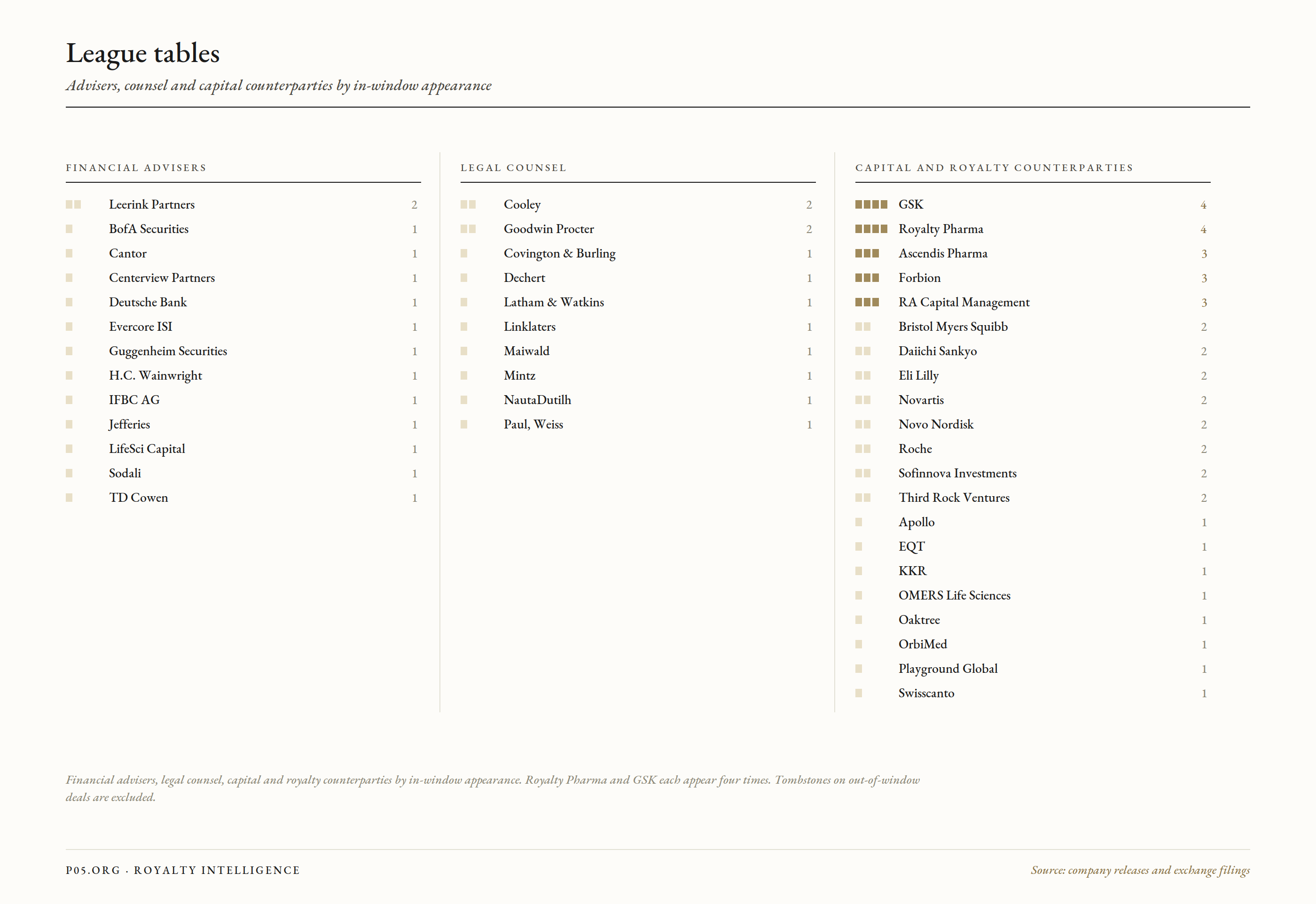
All information in this report was accurate as of the research date and is derived from publicly available sources including court opinions, regulatory guidance, academic literature, SEC filings, and financial news reporting. Information may have changed since publication. This content is for informational purposes only and does not constitute investment, legal, or financial advice. The author is not a lawyer or financial adviser.