
The last ten quarters: tail-end royalty income as bridge capital
A royalty with two or three years of income left is the wrong asset to hold and the right asset to spend. This is a worked account of what a short tail is worth, which variable sets the price, why the market's standard cap multiple cannot be written against one.

The bridge and the take-out piece followed short paper written against long assets: a 364-day facility against an RNA pipeline years from peak, a sixteen-year loan against a ramping royalty. This piece inverts the duration problem. A company holds a royalty on a partnered marketed product with loss of exclusivity around thirty months out.
It also holds its own candidate under review, needing capital to reach approval and launch. The funding asset is short, the funded asset is long, and the repayment source is already contracted.
Almost every convention a royalty desk carries into a commercial-stage purchase inverts on a tail. The discount rate stops doing the analytical work and the terminal erosion curve takes it over. A cap multiple at the market median cannot be repaid out of the remaining stream. A time-sliced step that is back-loaded on a growing royalty has to be front-loaded on a dying one.
The licensee, ordinarily the consent counterparty standing between the seller and its buyer, becomes the highest bidder. Omeros ran the whole sequence in public between 2022 and 2026, funding a first approval off a royalty on a product it had already sold.
1. The asset, and who is not bidding for it
The market that would price a tail is large and pointed elsewhere. Gibson Dunn's tracker records more than $32 billion of royalty-linked transactions closed across 2020 to 2025, with $7.1 billion in 2025, transaction count stabilising at 25 to 27 deals a year and a median deal size of $221 million.
Ligand completed its acquisition of XOMA Royalty on 14 July 2026 for a total equity value of approximately $739 million, and states a deployment rate of $150 million to $250 million annually in high-value royalty assets. XOMA's own filings had described its focus as early to mid-stage clinical assets, together with late-stage and commercial assets having long duration of market exclusivity, a mandate that excludes a thirty-month tail on its face.
Two of the bidders who might have competed for small positions now sit on one balance sheet.
The incumbent holders run their tails to expiry rather than trading them. Royalty Pharma's disclosure records its entitlement to cabozantinib royalties on US sales through September 2026, and guides to minimal Promacta royalty receipts in 2026. A diversified book absorbs a runoff position without incident. A single-product company holding the same position is in a different situation, because the cash it needs is needed now and the asset producing it has a date on it.
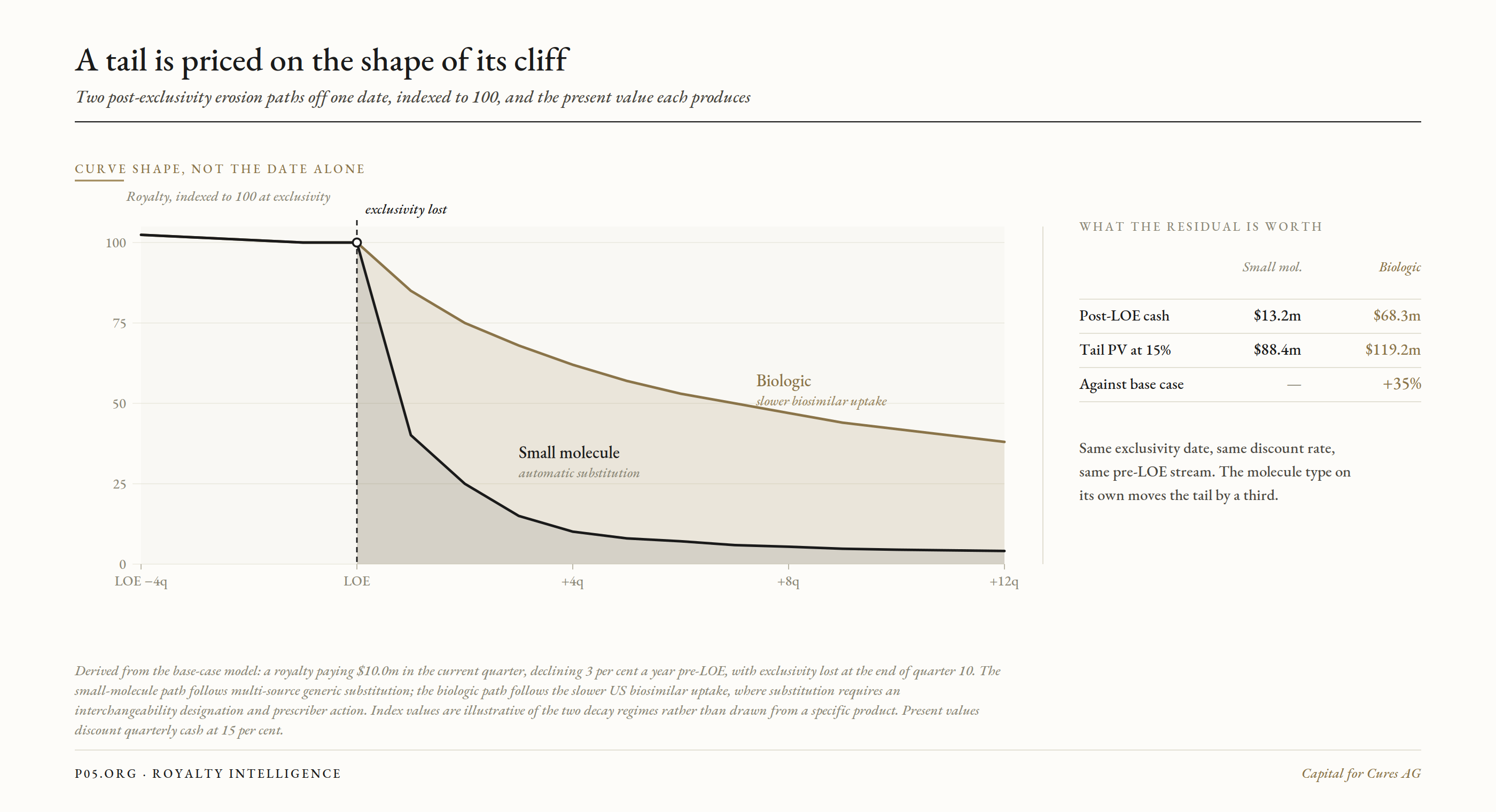
Figure 1. A tail is priced on the shape of its cliff. Two post-exclusivity erosion paths off one date, indexed to 100, with the present value each produces. Holding the date, the discount rate and the pre-LOE stream constant, the small-molecule path leaves $13.2m of post-exclusivity cash against $68.3m on the biologic path, and the tail moves from $88.4m to $119.2m. Derived.
2. The base case
The assumptions are stated so that every derived figure can be rebuilt, and none of the numbers in this section come from a filing. A holder receives a royalty on a partnered small-molecule product paying $10.0 million in the current quarter, declining at 3 per cent a year on a mature label. Loss of exclusivity falls at the end of quarter 10, roughly thirty months out.
Post-LOE royalties follow a small-molecule substitution cliff, falling to $3.75 million in the first post-LOE quarter and into single-digit millions within a year, then a trailing stub to the end of the royalty term. The holder also has its own candidate under FDA review.
| Quarter | Royalty ($m) | Quarter | Royalty ($m) |
|---|---|---|---|
| Q1 | 10.00 | Q9 | 9.41 |
| Q2 | 9.92 | Q10 (LOE) | 9.34 |
| Q3 | 9.85 | Q11 | 3.75 |
| Q4 | 9.77 | Q12 | 2.34 |
| Q5 | 9.70 | Q13 | 1.40 |
| Q6 | 9.63 | Q14 | 0.94 |
| Q7 | 9.55 | Q15 | 0.75 |
| Q8 | 9.48 | Q16 | 0.66 |
Derived. A stub of roughly $0.34 million to $0.55 million a quarter runs from Q17 to Q24.
Undiscounted lifetime cash is $110 million, of which $96.7 million, or 88 per cent, falls before the exclusivity date. Annual buckets run $39.6 million, $38.4 million, $24.8 million, $3.8 million, then under $2 million a year.
| Discount rate | PV ($m) | As % of nominal | Buyer nominal MOIC at that price |
|---|---|---|---|
| 11% | 93.2 | 84.8% | 1.18x |
| 12% | 92.0 | 83.7% | 1.19x |
| 15% | 88.4 | 80.4% | 1.24x |
| 20% | 83.0 | 75.6% | 1.32x |
Derived, discounting quarterly cash at the annual rate.
Moving the discount rate across the full 12 to 20 per cent band changes value by $9.0 million, about 10 per cent of the midpoint. The same eight-point move applied to a fifteen-year commercial royalty changes value by a third. A buyer underwriting to 15 per cent pays $88.4 million and collects $110 million over six years, a nominal multiple of 1.24 times, most of it back inside thirty months.
That profile suits permanent capital and suits a counterparty retiring its own obligation. It fits a closed-end vehicle with an investment period and a hurdle less comfortably, which is part of why the bidder list is short.
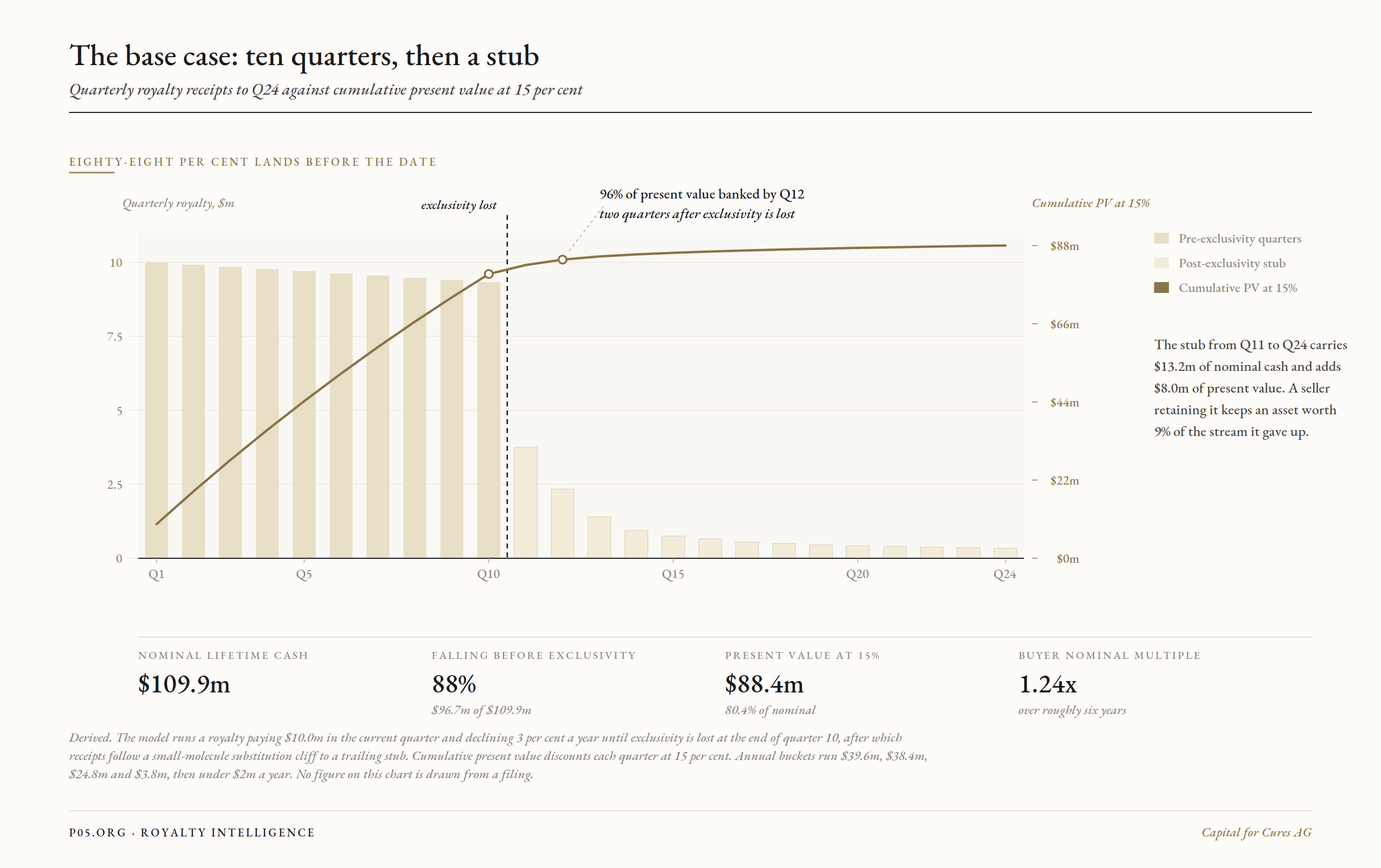
Figure 2. The base case. Quarterly receipts to Q24 against cumulative present value at 15 per cent, with the exclusivity line at the end of Q10. Eighty-eight per cent of the $109.9m of lifetime cash falls before that line, and 96 per cent of present value is banked two quarters after it. Derived.
3. What sets the price, ranked
Running the base case against each variable in turn gives an ordering that a fund used to long-duration underwriting does not start with.
| Variable | Case | PV at 15% ($m) | Change vs $88.4m |
|---|---|---|---|
| Licence terminated at end-Q6 | Stream stops | 52.2 | −40.9% |
| Erosion curve | Biologic decay rather than small molecule | 119.2 | +34.9% |
| Exclusivity date | Six months later | 100.2 | +13.4% |
| Exclusivity date | Six months earlier | 75.5 | −14.6% |
| Discount rate | 12% | 92.0 | +4.0% |
| Discount rate | 20% | 83.0 | −6.1% |
Derived. The biologic case replaces the post-LOE cliff with a first-year decline of roughly 40 per cent.
The discount rate is the narrowest bar on the chart, and it is the variable both sides spend the most time negotiating.
Erosion curve. The molecule type is a first-order input. A small-molecule product facing multi-source generics loses most of its volume to automatic pharmacy substitution within months.
A biologic facing biosimilars in the United States erodes more slowly, because substitution requires an interchangeability designation and prescriber action. Underwriting a biologic tail on small-molecule decay rates underprices it by a third on these assumptions, and the reverse overpays by the same order.
Exclusivity date. A six-month shift moves value by about $12 million to $13 million, three times the effect of a three-point move in the discount rate. Dates move for reasons that sit in the docket rather than the model: the thirty-month stay that follows a timely infringement suit on a Paragraph IV certification, a negotiated entry date in a settlement, an at-risk launch before final judgment, and the six months added by paediatric exclusivity under 21 U.S.C. 355a.
A tail buyer is underwriting a date, and the evidence for that date is the Orange Book listing, the litigation record and whatever settlement terms the licensee has disclosed.
Licence termination. The stream can stop before any generic files. Blueprint Medicines had received $175 million from Royalty Pharma in June 2022 for the ex-US Gavreto royalty under its Roche collaboration. When Roche terminated the pralsetinib collaboration and Blueprint discontinued ex-US Gavreto, the royalty purchase agreement was terminated and Blueprint recorded a debt extinguishment gain of $173.7 million, with the liability falling to a carrying value of $0.7 million. The patent had years to run.
A seller who took the proceeds as debt booked a non-cash gain; the buyer lost everything beyond what it had already collected. Late in a product's life, a licensee's portfolio decision is a live scenario rather than a remote one.
Reimbursement. A payment rule can compress an effective tail inside a patent term. OMIDRIA's economics turn on separate Medicare payment: under the NOPAIN provisions, CMS provides separate payment for qualifying non-opioid treatments in the hospital outpatient and ambulatory surgical center settings from 1 January 2025 through 31 December 2027.
A scheduled 2027 sunset inside a patent life running to the next decade makes a nominally long royalty behave like a short one. Any physician-administered product is priced against the payer rule alongside the Orange Book.
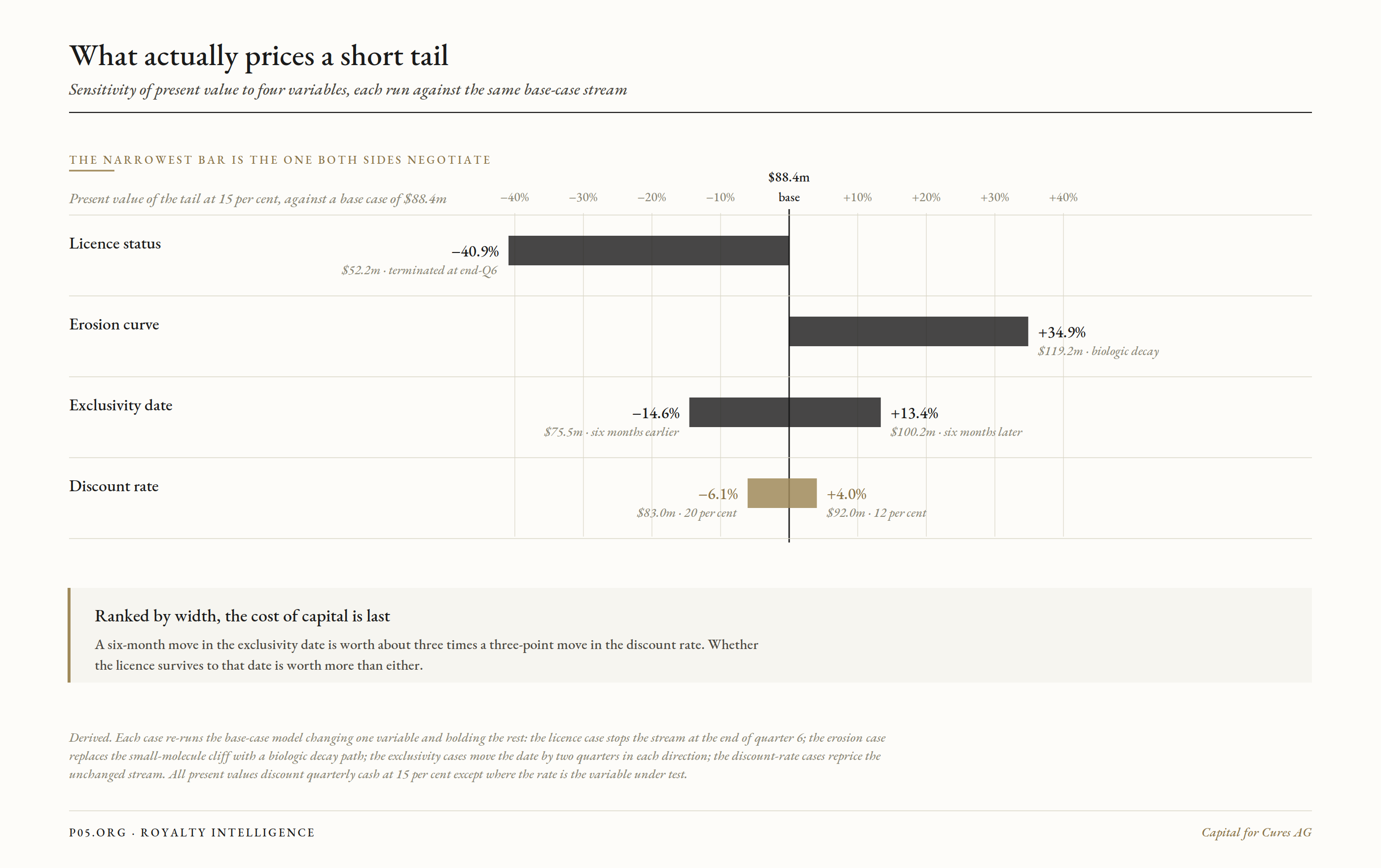
Figure 3. What prices a short tail, ranked by width. Each bar re-runs the base case changing one variable. Whether the licence survives to the date is worth more than the date; the date is worth about three times the discount rate. Derived.
4. Six routes, priced
| Route | Proceeds ($m) | Assumption | Cost to seller | Buyer outcome | Seller retains (nominal) |
|---|---|---|---|---|---|
| Outright sale | 88.4 | Buyer underwrites 15% | 15% implied | 1.24x over ~6 years | nil |
| Sale to licensee | 93.2 | Licensee underwrites 11% | 11% implied | 1.18x | nil |
| Capped loan, 1.42x on $65m | 65.0 | Cap cleared at Q10 | ~12.8% booked (Enanta comparator) | 32.7% IRR, capped | $17.6m, arriving from Q10 |
| Time slice, 80% of pre-LOE quarters | 64.3 | Buyer underwrites 15% | 15% implied | 1.20x | $32.6m |
| Equity | ~88 | Placement at a discount | cost of equity plus dilution | n/a | full tail |
| Structured term loan | ~86 | $88m facility, 2% OID, SOFR+600 | ~10–12% cash plus fees | n/a | full tail, encumbered |
Derived, except the Enanta and structured-loan pricing references given below.
The licensee pays more. Theravance Biopharma sold its retained Trelegy interest to the payer. GSK paid $225 million in cash for the outer-year royalties Theravance had kept back in its 2022 Royalty Pharma sale, covering 85 per cent of Trelegy royalties on sales from 2029 ex-US and 2031 in the US, while Theravance kept up to $150 million of retained Royalty Pharma milestones.
Those milestones then paid: FY2025 global net sales of approximately $3.9 billion triggered the $50 million milestone, with cash received in February 2026, and the $100 million FY2026 milestone requires approximately $3.5 billion. Theravance itself agreed on 29 June 2026 to be acquired by Zymeworks at $17.00 per share in cash plus a contingent value right.
A licensee holds the sales forecast the third party is trying to build, removes an audit and reporting counterparty from its own product, and needs no payment-direction mechanics because it is the payer.
On the base case, a licensee underwriting at 11 per cent pays $93.2 million against the $88.4 million a fund pays at 15 per cent, and still books a lower multiple. That is the structural reason a tail seller runs the licensee into the process first.
Equity and debt. A follow-on carries no cap and no claim on the tail, at a cost of equity that for a pre-launch company sits well above a low-teens imputed rate. A term loan sits alongside the tail rather than monetising it. Revolution Medicines' Royalty Pharma facility bears three-month SOFR plus 5.75 per cent with a 3.50 per cent floor, and BioCryst's 2023 Pharmakon refinancing bore three-month SOFR plus 7.00 per cent with a 1.75 per cent floor.
A cash coupon of that order runs through the quarters when the launch is consuming cash, and the maturity can fall before the new product self-funds.
5. The cap ceiling
A capped structure prices as debt: the buyer takes a defined share of the stream until aggregate payments reach a multiple of the advance. Enanta ran the standard version. In April 2023 it was paid a $200 million purchase price for 54.5 per cent of future quarterly royalty payments on MAVYRET/MAVIRET after 30 June 2023 through 30 June 2032, subject to a cap on aggregate payments equal to 1.42 times the purchase price.
Because of the cap and its continuing involvement, the proceeds were booked as a liability. At 30 June 2026 the liability stood at $125.1 million, with an effective annual imputed interest rate of approximately 12.8 per cent, and quarterly interest expense of $4.1 million against $1.6 million a year earlier.
Mavyret has years of stream behind that cap. A tail does not, and the arithmetic bites immediately. The cap has to be repayable out of the cash that remains, so the advance is bounded by lifetime cash divided by the multiple.
| Cap multiple | Maximum coverable advance ($m) | As % of the $88.4m asset |
|---|---|---|
| 1.2x | 91.6 | 104% |
| 1.3x | 84.5 | 96% |
| 1.42x (Enanta) | 77.4 | 88% |
| 1.5x | 73.3 | 83% |
| 1.9x (market median) | 57.8 | 65% |
Derived against $110 million of lifetime cash. Gibson Dunn records that among capped synthetic royalties the median cap is 1.9x on a range of 1.43x to 4.0x.
The market's median cap convention, applied to this asset, caps the raise at $57.8 million against a stream worth $88.4 million. The seller loses a third of its raise to a multiple that carries no information about the tail.
Pushing the advance up does not work either: $85 million at 1.42 times implies $120.7 million of payable against $110 million of lifetime cash, a shortfall of $10.8 million that no lender writes.
The implied returns explain why the ceiling binds rather than the pricing. An advance of $65 million at 1.42 times clears its $92.3 million cap in quarter 10, an internal rate of return of 32.7 per cent on a contracted cash flow, and leaves the seller $17.6 million of residual.
At $75 million the cap is not cleared until quarter 17, deep into the stub, and the IRR falls to 27.7 per cent with only $3.4 million of residual left. A buyer is happy to write the small advance at venture-equity returns. The company cannot get the size it needs out of it.
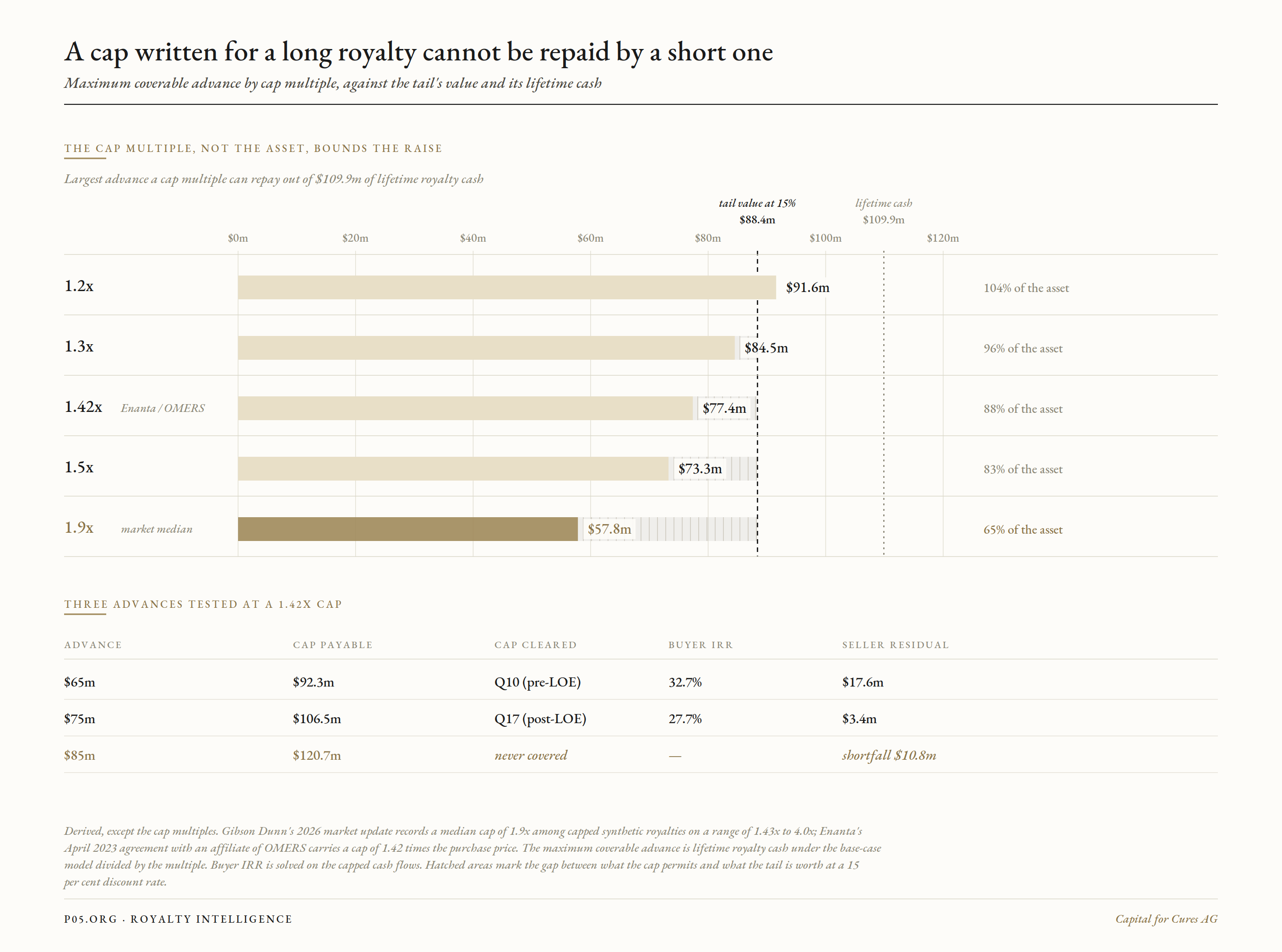
Figure 4. The cap ceiling. Largest advance each cap multiple can repay out of $109.9m of lifetime cash, against the tail’s $88.4m value. The market-median 1.9x cap bounds the raise at $57.8m, 65 per cent of the asset. Below, three advances tested at Enanta’s 1.42x. Cap multiples from Gibson Dunn and the Enanta filing; the rest derived.
6. Step direction on a time slice
Ionis sold Royalty Pharma a stepped slice: 25 per cent of Spinraza royalty payments from 2023 through 2027, increasing to 45 per cent in 2028, on up to $1.5 billion of annual sales, for $500 million upfront, reverting to Ionis once payments reach $475 million or $550 million depending on defined events.
The disclosed effective rate moved from 13.5 per cent at end-2024 to 12.4 per cent at end-2025 as the forecast was reassessed upward. After the pelacarsen Phase 3 result, Royalty Pharma stated that its Spinraza interest will revert after $550 million, a 1.1 times return.
Back-loading the step is rational on a stream expected to hold or grow. On a tail it destroys the instrument. Applying an Ionis-shaped 25 per cent slice stepping to 45 per cent in the final pre-LOE quarters to the base case yields $26.4 million of present value at 15 per cent against $33.9 million of nominal cash, because the high percentage arrives as the stream is collapsing.
Reversing the step to take 80 per cent of the pre-LOE quarters and nothing afterwards yields $64.3 million of present value on $77.3 million of nominal cash, a 1.20 times buyer multiple, and leaves the seller $32.6 million nominal including the whole post-LOE stub. Both figures are derived on the base case. The step direction is the design decision, and it points the opposite way from the market's reference deals.
7. Sequencing against the take-out
A tail bridge is worth what the take-out on the far side is worth. The take-out instrument is now standard. Nuvation Bio's Sagard package funded its $150 million royalty investment amount and a $50 million term loan tranche on 25 June 2025 following FDA approval of IBTROZI, with the synthetic royalty repurchasable at 1.4 to 2.0 times the investment amount on defined triggers.
Revolution Medicines runs the same shape at scale: after its Phase 3 read out, it received a $250 million payment from Royalty Pharma in May 2026 in connection with the Tranche 2 funding trigger. An approval-gated tranche is a committed take-out written on an observable regulatory fact, which is what a bridge needs on its far side.
Take the base case forward. The company draws $88.4 million from an outright sale at T0, burns $8 million a quarter through review, $15 million a quarter after launch, and holds a $150 million term loan that funds on approval, projected at the end of quarter 6.
| Quarter | Event | In ($m) | Out ($m) | Balance ($m) |
|---|---|---|---|---|
| T0 | Tail sold | 88.4 | nil | 88.4 |
| Q1 to Q5 | Review | nil | 40.0 | 48.4 |
| Q6 | Approval, term loan funds | 150.0 | 8.0 | 190.4 |
| Q7 to Q10 | Launch | nil | 60.0 | 130.4 |
Derived.
The sale proceeds alone carry 11 quarters at the pre-approval burn, so a slip to quarter 10 still lands inside the runway, with $8.4 million left in the quarter the take-out arrives. That is thin, and it is survivable.
Now run the same slip on the capped route, which raised $65 million upfront against $17.6 million of residual. The residual does not arrive until the cap clears, which on a $65 million advance is quarter 10.
The company therefore holds $65 million of cash and no royalty income for nine quarters. At $8 million a quarter it goes through zero during quarter 9, one quarter before its own retained cash begins and one quarter before the exclusivity date it was counting on.
| Route | Approval at Q6 | Approval at Q10 | Approval at Q12 |
|---|---|---|---|
| Outright sale, $88.4m | Balance holds | Balance holds, $8.4m low point | Balance holds |
| Capped 1.42x on $65m | Balance holds | Breaches zero in Q9 | Breaches zero in Q9 |
Derived on the same burn assumptions.
The capped structure retains upside that arrives at the exact moment the asset producing it dies. A company selecting between routes on headline retention, rather than on when the retained cash lands, selects the structure that fails on the timeline it is most likely to run.
Omeros ran the whole sequence with the timing intact. It sold DRI an interest in OMIDRIA US royalties for $125 million in gross proceeds in September 2022, then in February 2024 received $115.5 million more, with DRI taking all royalties on US net sales through 31 December 2031, $174 million of remaining annual caps extinguished, and two milestones of up to $27.5 million each payable in January 2026 and January 2028.
Omeros kept ex-US royalties and all global royalties from 2032. Management stated at the time that the upfront alone was projected to extend the operating runway into 2026 without diluting shareholders. The FDA approved narsoplimab, as YARTEMLEA, in December 2025, with US launch in January 2026.
A second source of take-out capital arrived alongside it: the sale of zaltenibart to Novo Nordisk provided $240 million payable at closing, applied in part to repaying $67.1 million of secured term loan principal.
At 30 June 2026 the OMIDRIA royalty obligation stood at $157.9 million, $21.5 million current and $136.4 million non-current.
The 2022 tranche was capped, and the 2024 amendment bought out those caps, converting a retained residual into cash at the point the company needed cash rather than optionality. The tail also funded a product the company no longer owned, which is the cleanest case for selling: the royalty was already a financial asset rather than a commercial position.
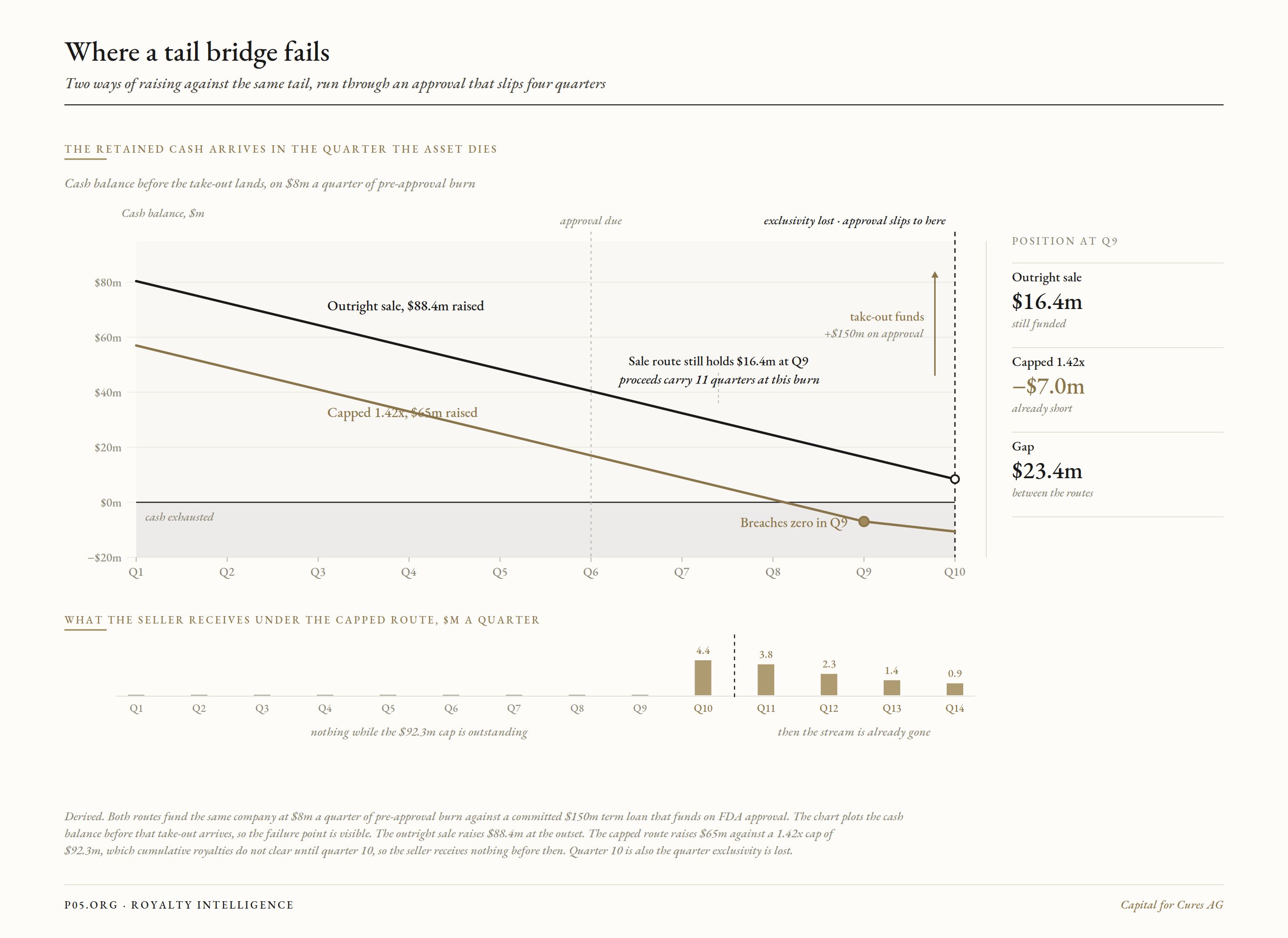
Figure 5. Where a tail bridge fails. Cash balance before the take-out lands, on the same burn and the same approval slip. The capped route breaches zero in Q9, one quarter before the cap clears and its retained cash begins, and that quarter is also the exclusivity date. Derived.
8. Characterisation and consent
Whether the proceeds are a borrowing or a sale is decided under ASC 470-10-25, where the presence of any of several factors creates a rebuttable presumption of debt classification, including significant continuing involvement in generating the cash flows and a return to the investor that is capped. A tail deal trips these readily.
Enanta books a liability amortised as interest expense under the effective-interest method while continuing to record the full royalty as revenue.
Omeros carries a royalty obligation remeasured each period. Blueprint's liability was extinguished under ASC 470-50 on termination. The recourse ladder piece sets out where a given structure sits, and bankruptcy remoteness through an SPV with true-sale and non-consolidation opinions is developed in the section 365 piece.
The consent gate piece set out who has to say yes before a royalty is sold, and each of those parties applies to a tail on its own terms: term lenders under the disposition covenant, revolving and convertible creditors where the documents reach asset sales, the licence counterparty under anti-assignment terms, prior buyers of overlapping economics holding rights of first refusal or offer, the payer through payment-direction mechanics, and upstream university or foundation licensors.
The UCC section 9-406 and 9-408 override renders a bare consent-to-assignment term ineffective against the transfer of a payment right; the covenant objection survives it.
One thing changes on a tail. Because the licensee is the natural high bidder, the consent counterparty and the buyer are frequently the same party, which turns the consent question into a price negotiation.
Theravance sold to GSK, the payer. Omeros sold to a third-party fund, with Rayner remitting through an escrow agent, so the payment mechanics were papered around the licensee. Where the incumbent lender runs a royalty strategy of its own, the consent request and a third-party process are run in parallel, since the lender may consent on terms or bid, which is the pattern the consent gate piece draws from the filed record.
What moves the position on a tail bridge, and what only appears to
Terms that move it:
- The exclusivity date and its legal supports, a thirty-month stay or a paediatric extension, carrying three times the valuation weight of a three-point move in the discount rate.
- The erosion assumption, which on these figures separates a biologic tail from a small-molecule tail by a third of present value.
- A cap multiple tested against lifetime cash rather than against market convention, because a 1.9x median cap bounds the raise at 65 per cent of the asset's value.
- A time slice stepped down into the post-LOE quarters rather than up, so the buyer's recovery completes before the cliff.
- A committed, approval-gated take-out drafted on an observable regulatory event, matched to the quarter the bridge asset stops paying.
- The identity of the buyer, since a licensee underwrites lower and clears the consent gate in the same signature.
Terms that only appear to:
- A headline cap multiple quoted without its coverage test, which reads as upside and functions as a ceiling on the raise.
- A retained residual whose arrival is gated on the cap clearing, which lands in the quarter the stream dies and is therefore unavailable in the scenario it was meant to cover.
- A milestone leg, which is optionality rather than runway and cannot be relied on in a sources and uses.
- A long stated royalty term on a product whose cash turns on a reimbursement rule with an earlier sunset.
- A discount-rate negotiation, which moves a tail's value by single digits while both sides treat it as the deal point.
What each side should ask
For the company monetising a tail to fund its own launch
- Does the raise carry past the approval that unlocks the take-out on a realistic review timeline, and where does the balance sit if approval slips two, three or four quarters?
- Does the exclusivity date fall before or after the projected take-out, and if the structure retains a residual, does that residual arrive before or after the date?
- Under a capped structure, what advance does the cap multiple permit against lifetime cash, and does that number reach what the launch costs?
- Has the licensee been brought into the process, and has a third-party bid been run alongside it to price the consent it would otherwise be asked to give for nothing?
For the fund buying or lending against a tail
- Is the position underwritten on the erosion curve the molecule justifies, and is the post-LOE residual modelled rather than assumed?
- Where do the licensee's own termination rights sit relative to the exclusivity date, and is a Blueprint-style pre-LOE termination priced?
- Does a payer or reimbursement rule govern the cash independently of the patent, and does its sunset fall inside the holding period?
- On a capped or stepped structure, does the recovery path complete before the cliff on the downside erosion case rather than the base case?
For the licensee weighing a buy-back
- Does retiring the royalty remove an audit and payment-direction obligation on your own product at a price below your own funding cost?
- Is the forecast advantage over third-party bidders large enough to justify underwriting below the fund rate, and does it dispose of the consent question a third-party sale would raise?
- If the seller is funding a launch with the proceeds, does the buy-back change your competitive exposure, and is that in the price?
Omeros monetised the OMIDRIA tail to DRI for $125 million and then $115.5 million, carried the runway to the December 2025 approval of narsoplimab, and took the bridge out with a launch and a $240 million asset sale. Enanta booked its capped OMERS sale as a liability standing at $125.1 million at 30 June 2026, accreting at approximately 12.8 per cent.
Theravance sold its Trelegy outer years to the payer for $225 million and collected the $50 million FY2025 milestone in February 2026. Blueprint watched a sold Gavreto royalty terminate into a $173.7 million accounting gain. Royalty Pharma runs its cabozantinib and Promacta tails to expiry without trading them. On a stream with ten quarters of income left, the discount rate moves the price by single digits, the exclusivity date by low teens, and the erosion curve and the licence itself by considerably more. What the launch costs is settled in the interval between the quarter the tail stops paying and the quarter the take-out funds.
All information in this article was accurate as of the research date and is derived from publicly available sources including SEC filings, issuer press releases, and legal and financial commentary. Information may have changed since publication. This content is for informational purposes only and does not constitute investment, legal, accounting, tax, or financial advice. The author is not a lawyer, accountant, tax adviser, or financial adviser. All model figures identified as derived are calculated from the stated assumptions and are not drawn from any source.