
The letter beside the contract: side letters in royalty financing

A royalty position is underwritten from a document set: the purchase agreement, the underlying licence, the security documents, the schedules. A side letter is the instrument that sits outside that set and changes what it means.
The term covers a signed writing that varies, supplements, waives or interprets a principal agreement without restating it. In royalty financing it appears under at least six labels. A numbered amendment. A waiver and consent. A payment direction letter. A counterparty consent. An acknowledgement. And, sometimes, a document the filer calls a side letter outright. The label is set by whoever drafted it, so a search for the phrase undercounts the population by a wide margin.
This piece works through the filed record, then through the enforcement questions that decide what a letter is worth, then through the fund layer where none of it is filed at all. It states the position as of 13 September 2026.
The document at Exhibit 10.4
Oramed Pharmaceuticals filed a Form 8-K on 3 March 2025 reporting an agreement dated 28 February 2025 with Scilex Pharmaceuticals and the other purchasers under the ZTlido royalty purchase and sale agreement of 8 October 2024. The 8-K body calls the document an "Amendment No. 1 Agreement" in one sentence and refers the reader to "the full text of the Side Letter" in the next, filed at Exhibit 10.4. The change was narrow. Scilex and Scilex Pharma may assign rights or delegate obligations without the purchasers' prior consent where a payoff of the debt instruments is in prospect and the transferee assumes the obligations.
An assignment covenant in a royalty purchase agreement is what stops the seller moving the payment obligation to a weaker credit. Relaxing it is a credit decision. It was disclosed under Item 1.01, which is the outcome the disclosure rules intend, and it is also the version of this instrument least likely to cause a buyer trouble later, because a diligence process reading the 8-K index will find it.
| Issuer | Counterparty | Date | Principal agreement | What the letter did | Filing |
|---|---|---|---|---|---|
| Oramed | Scilex and royalty purchasers | 28 Feb 2025 | ZTlido royalty purchase and sale agreement, 8 Oct 2024 | Permitted assignment and delegation without purchaser consent on a payoff condition | EX-10.4 to Form 8-K, Item 1.01 |
| Karyopharm | Antengene | 30 Jun 2025 | Selinexor licence agreement, 23 May 2018 | Delegated China regulatory and marketing authorisation holder duties, added an indemnity | EX-10.1 to Form 10-Q |
| Karyopharm | HealthCare Royalty | 7 Oct 2025 | Revenue interest financing agreement, 14 Sep 2019 | Sixth amendment restructuring the XPOVIO revenue interest | EX-10.6 to Form 8-K, Item 1.01 |
| Karyopharm | Term lenders, WSFS as agent | 7 Oct 2025 | Credit and guaranty agreement, 8 May 2024 | Waived specified defaults and default interest, added loans and warrants | EX-10.1 to Form 8-K, Item 1.01 |
| BioCryst | Athyrium as agent, required lenders | 19 Nov 2021 | Credit agreement, 7 Dec 2020 | Consented to the OMERS and Royalty Pharma synthetic royalty sales on Orladeyo | EX-10.101 to Form 10-K, redacted |
| Agenus | XOMA (US) LLC | 20 Sep 2018 | Royalty purchase agreement | Incyte and Merck direction letters as closing deliverables | EX-4.1 to Form 10-Q, redacted |
| Agenus | Ligand | May 2024 | Purchase and sale agreement | XOMA consent and payment direction letters as deliverables | EX-10.2 to Ligand Form 10-Q |
| Infinity Pharmaceuticals | HealthCare Royalty Partners III | 5 Mar 2019 | Purchase and sale agreement | Confidential disclosure letter of 29 Nov 2018 incorporated by definition | Referenced, never filed |
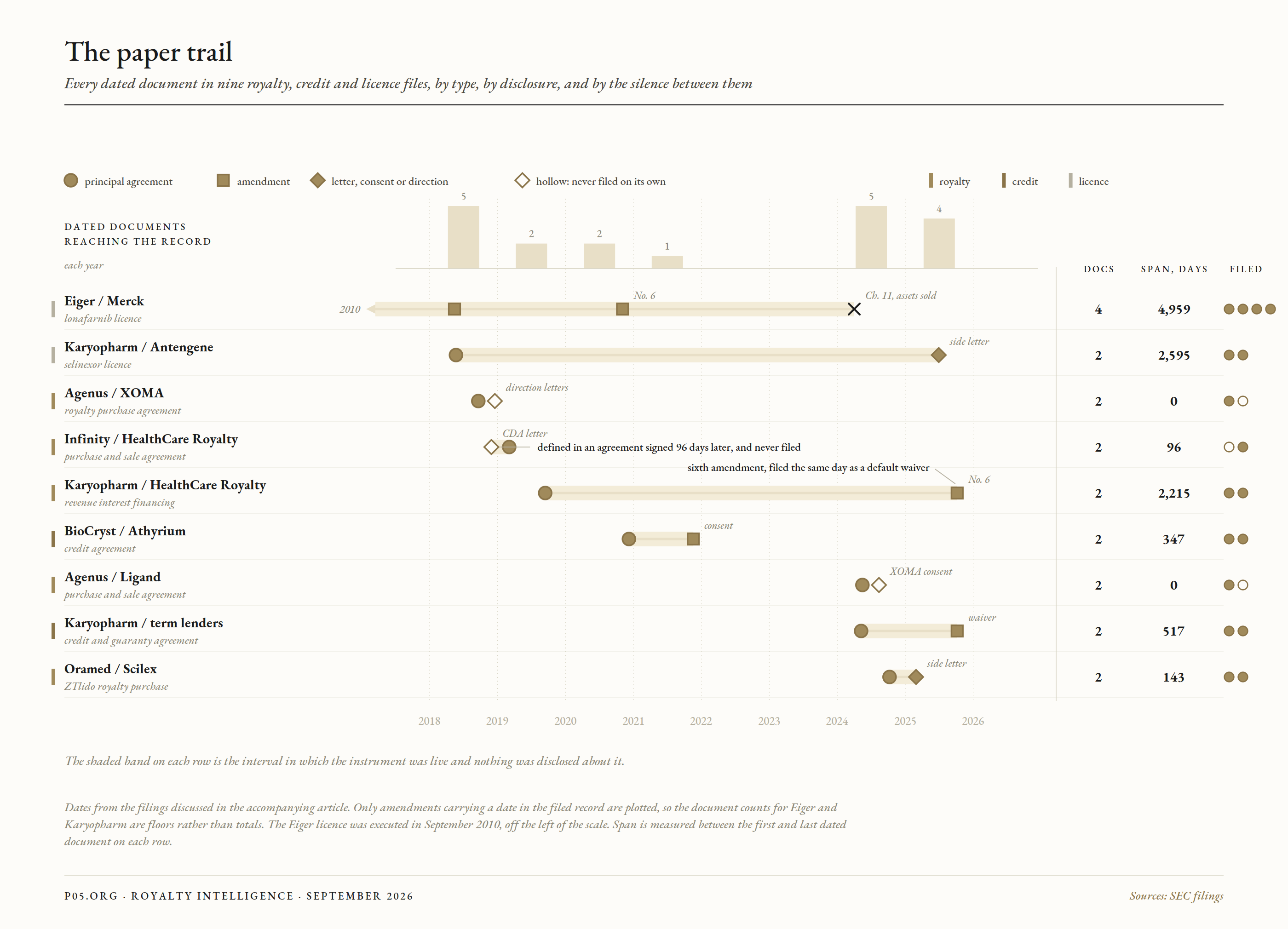
Figure 1. Every dated document in nine royalty, credit and licence files, by type, by disclosure, and by the silence between them.
The letter to the payer
A royalty purchase agreement binds the seller and the buyer. It does not bind the licensee, which is the entity that writes the cheque. Royalty agreements routinely disclaim third party beneficiaries, so the principal document has no purchase on the payer at all.
The gap is closed by a separate letter. The Agenus royalty purchase agreement with XOMA from September 2018 attaches a form of Incyte Direction Letter and a form of Merck Direction Letter as exhibits, instructing each licensee to remit royalties to a joint account rather than to Agenus. When Agenus sold overlapping economics to Ligand in May 2024, the deliverables included payment direction letters again, plus a separate XOMA consent: an acknowledgement from the first royalty buyer that the second sale did not disturb its position.
Agenus booked 63.9 million dollars of the Ligand proceeds as a liability rather than as a sale, on continuing involvement grounds. A stacked monetisation on one asset therefore produced two sets of direction letters, one inter-buyer consent, and an accounting treatment that says the seller did not fully part with the stream.
For a secondary buyer the practical instruction is to ask which letters the licensee signed. Those are the documents that keep the money arriving after the position changes hands, and they are the ones most often left out of a data room index because nobody classifies them as agreements.
The consent gate
A royalty monetisation by a company with existing debt needs the lenders to agree. BioCryst's Amendment Number One to Credit Agreement, dated 19 November 2021, records Athyrium as administrative agent and the required lenders permitting two synthetic royalty sales on Orladeyo, one to OCM IP Healthcare Holdings and one to RPI 2019 Intermediate Finance Trust, alongside a Royalty Pharma stock purchase. Without it the monetisation would have tripped the existing loan.
The exhibit reaches EDGAR with dates and figures bracketed out under the competitive harm standard. The shape of the permission is public; the conditions attached to it are not.
Waived defaults
The distressed version of this instrument is a forbearance. Karyopharm sold a revenue interest in XPOVIO to HealthCare Royalty in September 2019 for up to 150 million dollars. Six years later, on 7 October 2025, it filed two documents on the same Form 8-K. The sixth amendment to the revenue interest financing agreement restructured the revenue interest. The first amendment and waiver to the credit and guaranty agreement waived specified defaults and the right to collect default rate interest, then added new loans and warrants.
A sixth amendment is a readable signal on its own. The count of amendments to a revenue interest financing agreement is a screen anyone can run from an exhibit index, and it tracks how many times the original economics failed to hold.
Delegated authority
The same drafting device moves regulatory responsibility rather than money. Karyopharm's side letter with Antengene dated 30 June 2025, varying a 2018 selinexor licence, delegates China regulatory activities and marketing authorisation holder responsibilities, appoints Antengene affiliates as agents, and adds an indemnity running back to Karyopharm. The signature page is headed "Signature Page to License Agreement Side Letter", which settles how the drafters classified it.
Who holds the marketing authorisation decides who controls the filings a royalty depends on. A letter that moves it has moved a component of the stream's durability without touching the royalty rate.
Eiger, and the road not taken
Eiger BioPharmaceuticals varied its principal contracts by numbered amendment throughout. Its FY2021 Form 10-K contains no side letter: the Merck lonafarnib licence ran to Amendment No. 6, the Oxford Finance loan to a third amendment, and the Progeria Research Foundation collaboration and supply agreement to Amendment No. 1, filed with terms bracketed out.
The documents with the most economic content sit in the 2024 bankruptcy record instead. Eiger filed for Chapter 11 in the Northern District of Texas on 1 April 2024 with a stalking horse bid from Sentynl Therapeutics for Zokinvy at a base price of 26.0 million dollars. The auction ran 35 rounds, and Sentynl was designated the winning bidder at a base price of 46.1 million dollars, less a 0.9 million dollar credit for the termination fee, closing on 3 May 2024. The pipeline went to Amylyx under separate asset purchase agreements in June and August 2024. A Merck right of first negotiation over the lonafarnib licence shaped how the estate could run the process.
No side letter to a royalty instrument appears in that record. The amendment route leaves a numbered trail in the exhibit index, which is the version of this practice an outside analyst can follow.
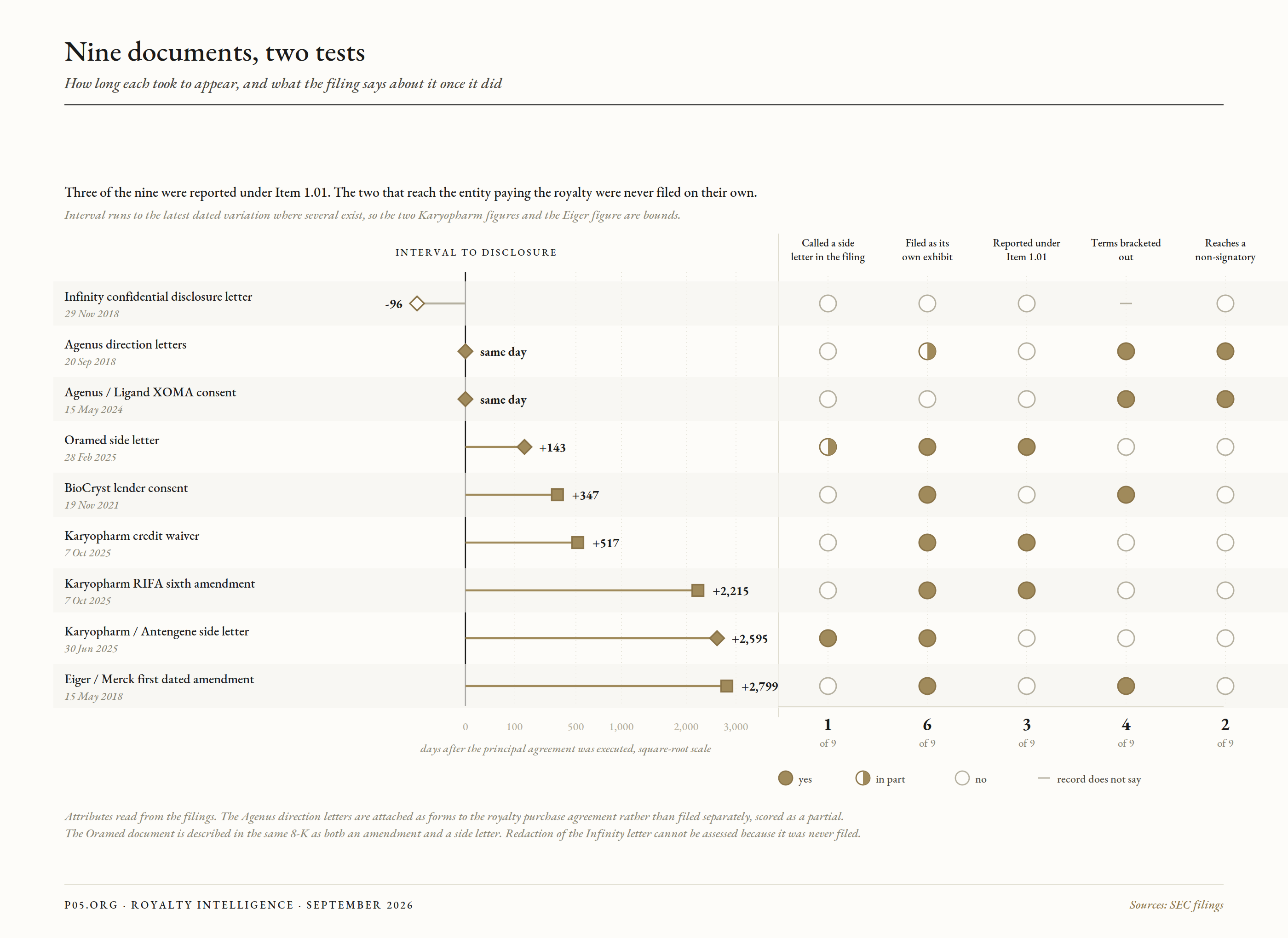
Figure 2. Nine documents: how long each took to appear, and what the filing says about it once it did.
Whether the letter binds
Three clauses in the principal agreement decide what a side letter is worth, and royalty purchase agreements carry all three as standard. The Infinity purchase and sale agreement with HealthCare Royalty runs an entire agreement clause at section 9.6 and a no waivers clause at 9.11, and the same document defines a confidential disclosure agreement by reference to a letter agreement of 29 November 2018 that was never filed.
Delaware will not treat a letter as binding simply because the principal agreement mentions it. In ev3, Inc. v. Lesh, 114 A.3d 527 (Del. 2014), a letter of intent expressly preserved by a later merger agreement's integration clause was held not to become binding on that account, and its provisions had no force where they conflicted with the controlling merger terms.
New York fixes the writing requirement by statute. General Obligations Law section 15-301 provides that a contract which cannot be changed orally may be changed only by a signed writing from the party against whom the change is enforced. The Court of Appeals in Israel v. Chabra, 12 N.Y.3d 158 (2009) read the no oral modification clause as an ordinary contract term to be harmonised with the rest of the agreement. A signed letter satisfies section 15-301. An understanding in correspondence does not.
The bankruptcy question is the one most often skipped. Under 11 U.S.C. section 365 a debtor assumes or rejects an executory contract in its entirety, so a debtor cannot generally assume a royalty agreement while rejecting the letter that varies it where the two form one integrated transaction. Integration is decided on the parties' intent, tested against severability under state law. The Sixth Circuit treated a lease and a related agreement as one non-severable transaction in EPLET, LLC v. DTE Pontiac North, LLC, and an Oregon district court affirmed that several development agreements formed a single indivisible contract to be assumed or rejected together. The boilerplate integration and severability clauses decide the answer, which makes them the operative provisions rather than the filler.
Letter agreements in life sciences do reach the courts, and they turn on scope. In LGM Holdings, LLC v. Schurder, No. 314, 2024 (Del. 22 Apr 2025), buyers of a group of pharmaceutical companies found post-closing FDA and DOJ exposure and litigated whether a post-closing letter agreement waived fraud claims; the Supreme Court found the waiver ambiguous and allowed fraudulent concealment to toll the indemnity survival period. The public record does not settle whether an undisclosed royalty side letter has produced reported litigation.
Where a letter reintroduces recourse, a repurchase right, a make-whole or a top-up that the principal agreement excluded, the true sale analysis reaches it. The factors are set out in the extinguishment piece. A letter does not sit outside that analysis because it sits outside the agreement.
Disclosure and redaction
A side letter that is a material definitive agreement triggers an Item 1.01 Form 8-K and an exhibit under Item 601(b)(10) of Regulation S-K. Materiality is the filer's judgement, and the filed set shows both outcomes.
How much of the letter the public sees changed in 2019. The FAST Act Modernization and Simplification of Regulation S-K adopting release permits registrants to redact information from material contract exhibits that is both immaterial and likely to cause competitive harm, without a confidential treatment request, provided the redactions are marked and flagged. The Federal Register version carries the same standard.
The filed population now divides three ways. A letter filed as its own exhibit, as at Oramed. A letter referenced in a definition and never filed, as at Infinity. A principal agreement filed with the economics bracketed out, as at BioCryst and Agenus. A redaction is a certification by the filer that the bracketed terms would cause competitive harm, which usually means they carry the pricing.
The fund layer
Fund level side letters are a different instrument and reach no public filing at all. A limited partner negotiates one with the general partner to secure terms the partnership agreement does not give everyone: fee and carry discounts, co-investment rights, excuse and exclusion rights, transfer rights, advisory committee seats, reporting undertakings, and tax and sovereign immunity provisions.
The most favoured nation clause turns a bilateral concession into a fund-wide one, allowing an electing investor to review other side letters after final closing and adopt more favourable terms subject to carve-outs and commitment tiers. Practitioner guidance recommends tiering the election by commitment size and carving out regulatory accommodations so a smaller investor cannot elect anchor economics. Prevalence data come from private surveys: Ontra's summary of the 2023/24 Hedge Fund Side Letter Study records MFN provisions rising from 33 per cent of side letters in 2022-23 to 41 per cent in 2023-24.
ILPA has pushed the mechanism into the partnership agreement itself. The Model LPA default at section 20.6.2 incorporates side letters into the agreement, gives every limited partner notice of all side letter terms after final closing, and grants automatic MFN rights subject to limited carve-outs, with no election process. Manager-side commentary notes that the model MFN is not conditioned on commitment size and omits several common carve-outs.
ILPA returned to the cost of the apparatus in 2026. The Alignment Gap, released 13 May 2026, records median organisational expense caps rising from roughly 20 basis points in 2019 to 2021 to about 25 basis points in 2024 to 2025, drawing on an Albourne survey of almost 2,000 funds, and recommends a cap at the lower of 5 basis points of target assets or 10 million dollars with 50-50 sharing above it. The guidance runs against a market practice in which side letter negotiation and MFN election costs are carved out of the cap and borne as uncapped partnership expenses.
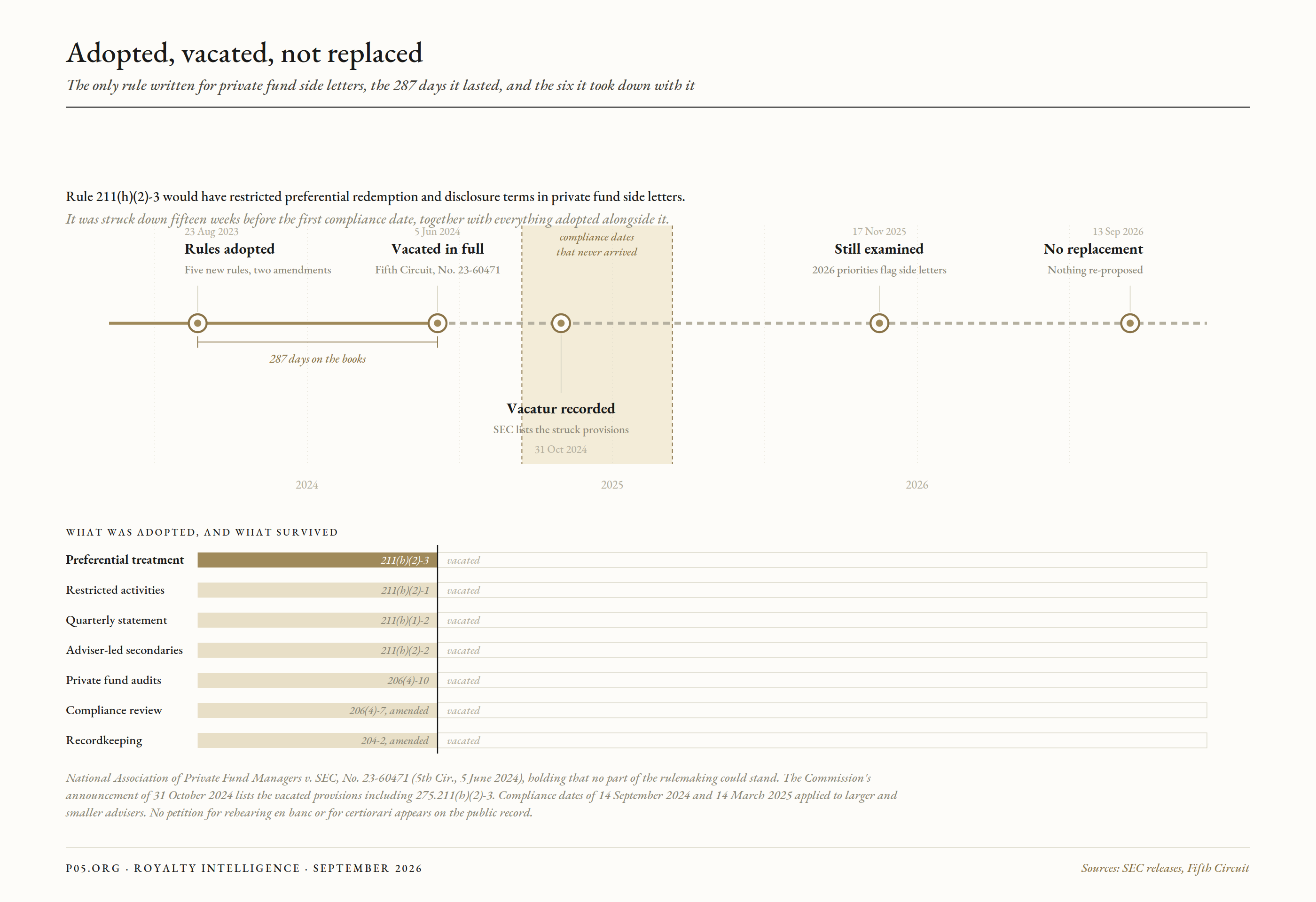
Figure 3. The only rule written for private fund side letters, the 287 days it lasted, and the six it took down with it.
The regulatory arc
The SEC adopted the Private Fund Adviser Rules in August 2023, including a preferential treatment rule at Rule 211(h)(2)-3 restricting certain side letter terms and requiring disclosure of others. The Fifth Circuit vacated the package on 5 June 2024 in National Association of Private Fund Managers v. SEC, No. 23-60471. The Commission's announcement of 31 October 2024 lists the vacated provisions by rule number and supplies the text of what was struck down.
No petition for rehearing en banc or for certiorari appears on the public record, and the preferential treatment rule has not been re-proposed. Side letters are governed by the general fiduciary duty under the Advisers Act. Examination attention continued: the Division of Examinations' 2026 priorities, published 17 November 2025, flag preferential treatment through side letter arrangements alongside fee and expense allocation, per law firm summaries. As of 13 September 2026 the rule is gone and the scrutiny remains.
In a royalty fund the expensive concession is rarely the fee. Origination is concentrated and single acquisitions can exceed a fund's capacity, so a co-investment right granted by letter is a claim on the next large royalty the manager originates, sitting in a document no counterparty to that royalty will ever see.
| Transaction layer | Fund layer | |
|---|---|---|
| Parties | Issuer, royalty buyer or lender, sometimes the licensee | General partner and one limited partner |
| Subject | Assignment, covenants, consents, payment direction, waivers, regulatory duties | Fees, carry, MFN, co-investment, excuse and transfer rights |
| Public visibility | Sometimes filed, often redacted, sometimes only referenced | Not filed; visible to other investors only through MFN notice |
| Cascade risk | None, bilateral by design | High, through MFN election |
| Who inherits it | Assignee of the royalty or loan, subject to the letter's assignment terms | Transferee limited partner, subject to the LPA |
What the filed record cannot show
The ceiling on public research here is low, and saying so is more useful than implying otherwise.
Fund level letters are never filed, so their terms, prevalence and cascades are visible only through private surveys. Among transaction level letters, the ones that matter most to a royalty buyer, those reintroducing recourse or repricing a covenant after a miss, are the ones most likely to be bracketed out under the FAST Act authority or referenced without being filed, as the Infinity confidential disclosure letter was. The filed set over-represents administrative letters.
A keyword census also undercounts. The same economic function appears as a consent, a direction letter, an acknowledgement or a numbered amendment, and searching for "side letter" finds only the fraction whose drafters used that phrase. Productive EDGAR terms were "revenue interest financing agreement", "royalty purchase agreement" and "payment direction letter", each paired with "side letter" or "consent". Searching "Licensee Instruction Letter" returned nothing of substance in royalty financing.
Where the structure points
Pull the deliverables list before the exhibits. A royalty purchase agreement names its closing deliverables in the definitions and conditions, and the direction letters, consents and acknowledgements sit there rather than in the exhibit index. The Agenus files show the pattern: the documents that bind the payer are attached as forms to the agreement, not filed separately.
Count the amendments. A sixth amendment to a revenue interest financing agreement is a public record of how many times the original economics failed to hold, and it can be read off an exhibit index in a few minutes. The Karyopharm sequence reached that count alongside a default waiver filed the same day.
Ask for a schedule of side letters, not a representation about them. A representation that no undisclosed letters exist is worth what any representation is worth after closing. A schedule delivered as a closing condition, with copies attached, is a document, and it is the only way a secondary buyer inherits the letters knowingly.
Draft toward integration or toward severability, and decide which before signing. Under section 365 the letter travels with the principal agreement where the two are integrated, and can be isolated where they are not. That outcome is set by the integration and severability clauses in the principal document, so they need drafting rather than copying.
Keep lender-style protections out of the letter where the deal is a sale. A make-whole, a repurchase right or a top-up placed in a side letter can pull a monetisation toward recharacterisation, and the analysis reads the whole documentary record. The signal to watch is any protection migrating out of the credit stack and into the royalty documents.
On the fund side, negotiate the MFN tier and its cost treatment together. Tier the election by commitment and carve out regulatory accommodations, and press for side letter and MFN administration costs to sit inside the organisational expense cap rather than in uncapped partnership expenses, which is the direction the 2026 ILPA guidance points.
All information in this report was accurate as of the research date and is derived from publicly available sources including court opinions, regulatory guidance, academic literature, SEC filings, and financial news reporting. Information may have changed since publication. This content is for informational purposes only and does not constitute investment, legal, or financial advice. The author is not a lawyer or financial adviser.