
Someone else's molecule: the component royalty and the option that comes before it
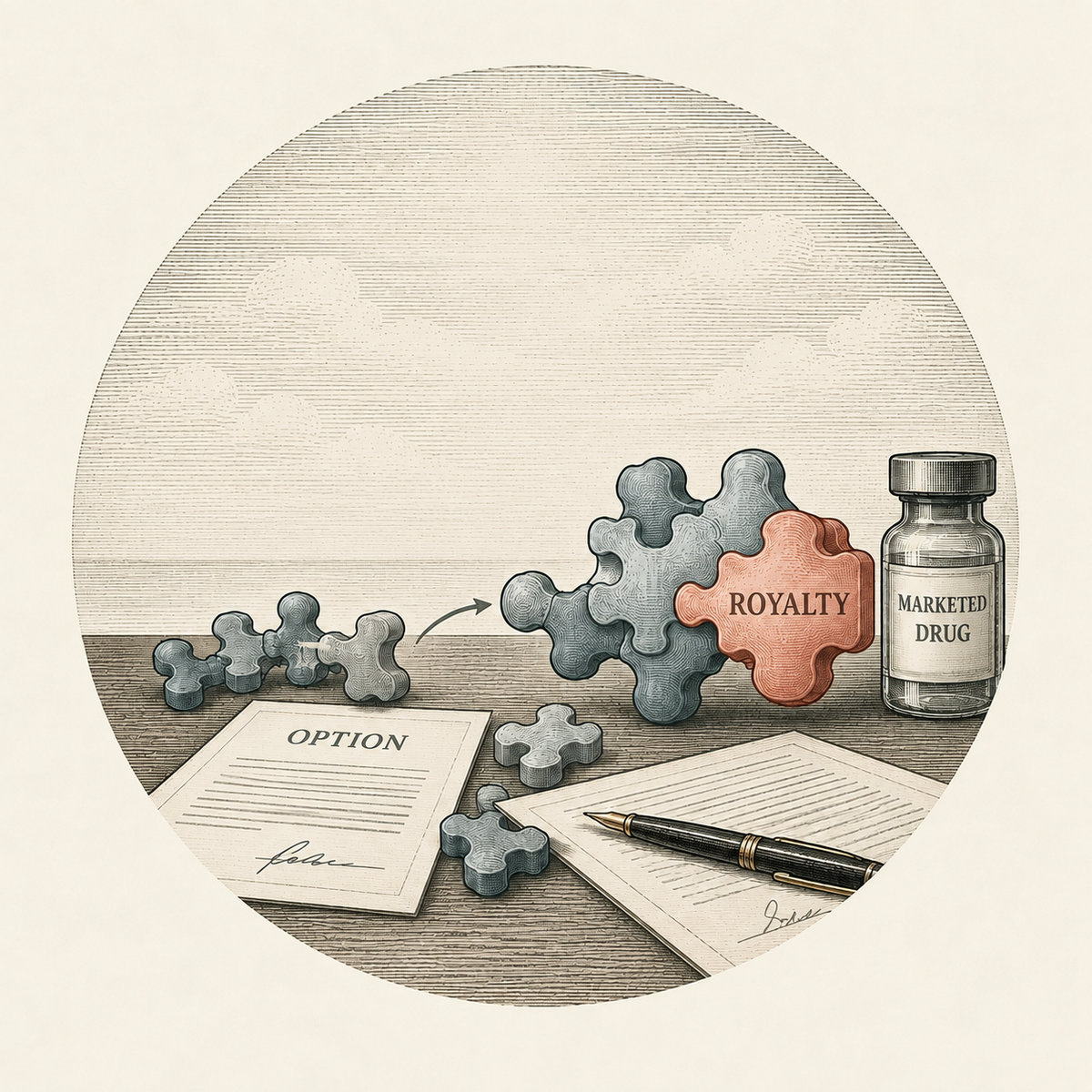
On 2 September 2026 Alteogen Inc. (KOSDAQ: 196170) entered an option and licence agreement with Novartis covering subcutaneous products built on ALT-B4, its recombinant human hyaluronidase. If every option is exercised and every milestone paid, Alteogen receives up to $3,223M. Novartis holds options to convert its own intravenous products to subcutaneous form. Until it exercises one on a named product, there is no licensed product, no net sales and no royalty.
Two things are being priced at once here, and they are priced differently. A royalty is an existing contractual entitlement to a share of net sales. An option is a right the licensee may never use, on a product it may never develop. Exercise probability sits in front of launch probability, and a ceiling built mostly of unexercised options is a decision tree wearing the clothes of a cash flow.
The second feature is the component. ALT-B4 is not a therapy. It is an enabling ingredient that depolymerises hyaluronan in the extracellular matrix so a biologic can be injected instead of infused. The same enzyme sits inside every licensee's product. What changes is whose molecule it rides.
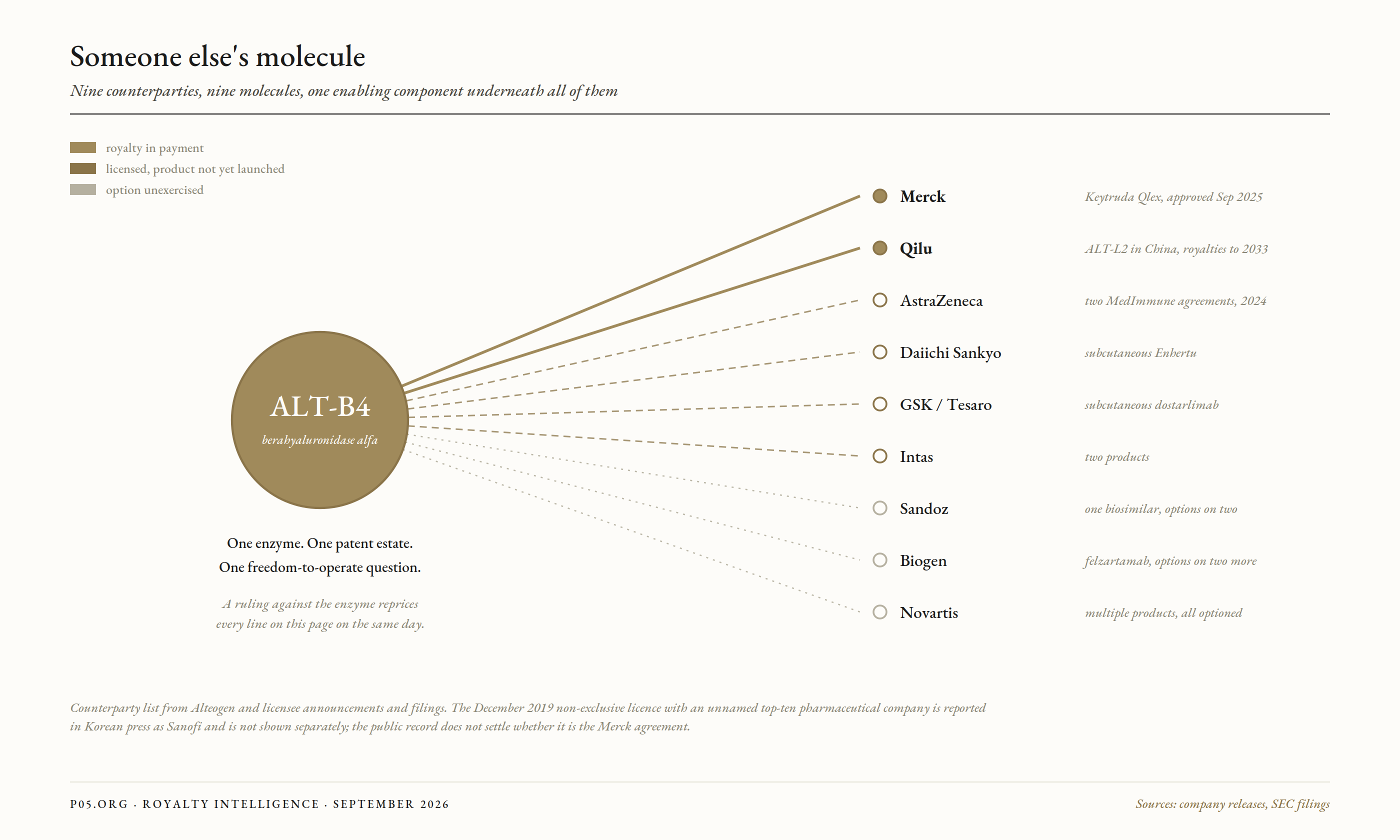
Figure 1. Nine counterparties, nine molecules, one enabling component underneath all of them.
This piece maps the ALT-B4 book, separates the part that pays from the part that is optional, and sets the structure against the record of component royalties that have been monetised. It states the position as of 13 September 2026; several of the proceedings described are live and are date-stamped where that matters.
The book
The 2026 vintage runs to four agreements. In January, Tesaro, a GSK subsidiary, licensed ALT-B4 for subcutaneous dostarlimab at $20M upfront against a $285M ceiling. In March, Biogen paid $20.0M upfront, with $10.0M on selection of a second programme and up to $39.0M, $80.0M and $430.0M in development, regulatory and commercial milestones, first product felzartamab, tiered royalties in the mid-single digits, with an option on a third product. On 4 August an undisclosed global pharmaceutical company took a single product at a $365M ceiling. Then Novartis. Korean reporting put the four agreements at a combined maximum contract value of $4.452bn (KRW 6.0965 trillion), of which the Novartis ceiling is about 72 per cent.
The earlier book is longer. Alteogen's first ALT-B4 agreement, in December 2019, was a non-exclusive global licence with an unnamed top-ten pharmaceutical company at $13M upfront and up to $1.373bn. Korean press in 2026 named that counterparty as Sanofi, which leaves the Merck relationship separately evidenced by Keytruda Qlex itself and by Merck's own royalty disclosure. The public record does not settle whether the 2019 agreement and the Merck agreement are the same contract, and a diligence file would need the Alteogen disclosure set to close that.
Intas took two products in January 2021 at $6M upfront and up to $109M on a mid-single to low-double-digit tiered royalty. Sandoz signed one biosimilar with options on two more in January 2023. AstraZeneca disclosed to the Korea Exchange two separate MedImmune agreements totalling $1.35bn, one at $25M upfront plus $725M and one at $20M upfront plus $580M, which resolves the $750M figure reported elsewhere as one of the pair. Daiichi Sankyo took worldwide rights to a subcutaneous Enhertu in November 2024 at $20M upfront and a $300M ceiling. In China, Qilu Pharmaceutical markets the ALT-L2 Herceptin biosimilar, a molecule royalty, with income expected to run to 2033.
| Counterparty | Date | Scope | Structure | Upfront | Ceiling | Royalty disclosed |
|---|---|---|---|---|---|---|
| Undisclosed top-ten (reported as Sanofi) | Dec 2019 | Non-exclusive, multi-product | Licence | $13M | up to $1.373bn | no |
| Intas | Jan 2021 | Two products | Licence | $6M | up to $109M | mid-single to low-double digit |
| Sandoz | Jan 2023 | One biosimilar + two options | Licence + options | not disclosed | not disclosed | no |
| AstraZeneca / MedImmune | 2024 | Two agreements | Licence | $25M + $20M | $1.35bn combined | no |
| Daiichi Sankyo | Nov 2024 | Subcutaneous Enhertu | Licence | $20M | up to $300M | tiered |
| Tesaro (GSK) | Jan 2026 | Subcutaneous dostarlimab | Licence | $20M | up to $285M | no |
| Biogen | Mar 2026 | Felzartamab + options | Licence + options | $20M (+$10M option) | up to $579M | mid-single digit |
| Undisclosed global pharma | Aug 2026 | Single product | Licence | not disclosed | up to $365M | no |
| Novartis | Sep 2026 | Multiple products and modalities | Options | not disclosed | up to $3,223M | on net sales, rate undisclosed |
| Merck (Keytruda Qlex) | see above | Pembrolizumab SC | Licence | see above | see above | 2%, from Merck filings |
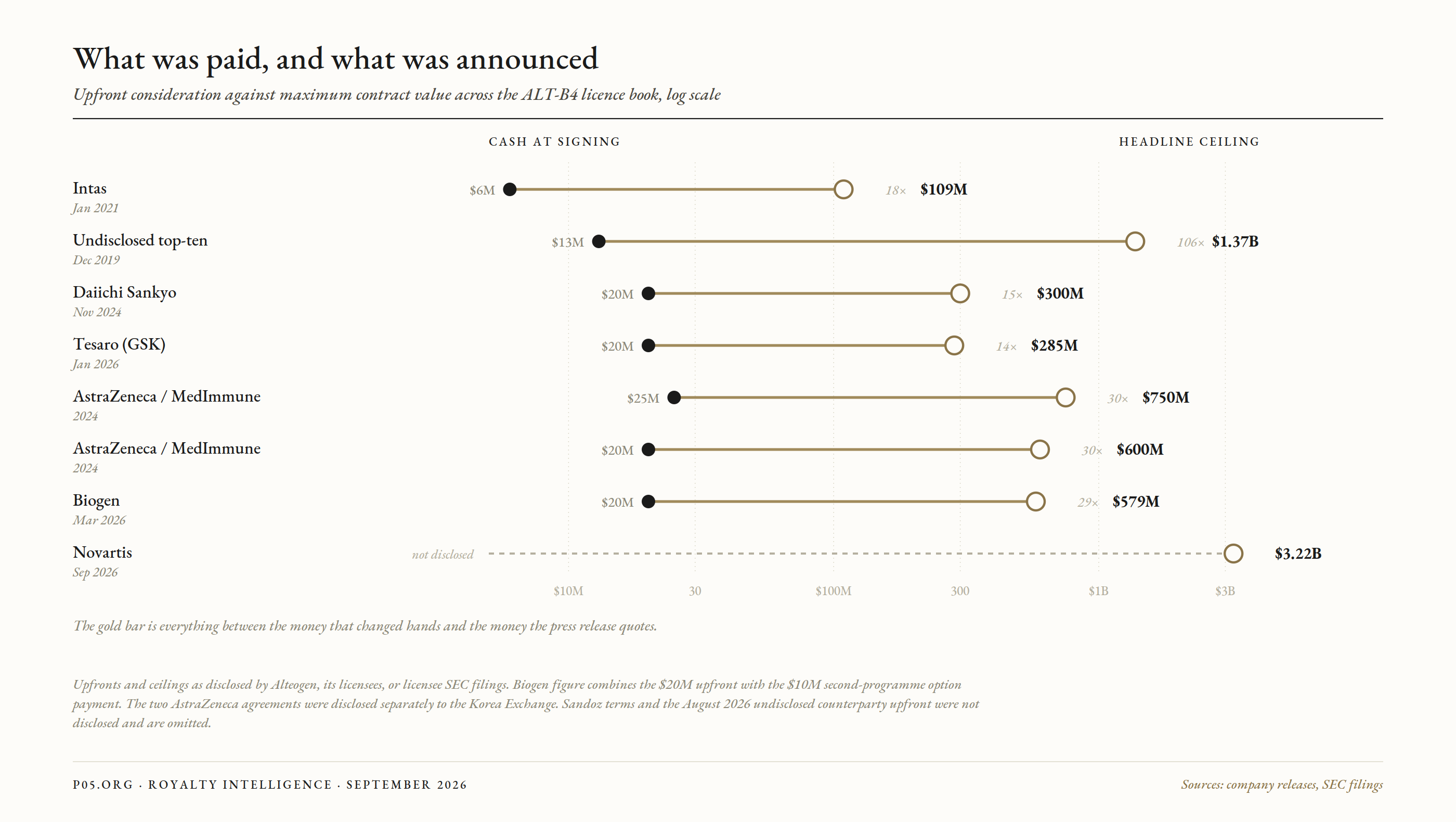
Figure 2. Upfront consideration against maximum contract value across the ALT-B4 licence book, log scale.
Two of those rows pay today. The Merck royalty turned on in the second quarter of 2026, and Qilu runs in China. Everything else is pre-launch, optional, or both.
| Paying | Optional or pre-commercial |
|---|---|
| Merck, Keytruda Qlex | Novartis, all options unexercised |
| Qilu, ALT-L2 in China | Biogen second and third programmes |
| Milestone and supply income across signed licences | Sandoz options on two further products |
| AstraZeneca, Daiichi Sankyo and GSK products pre-launch |
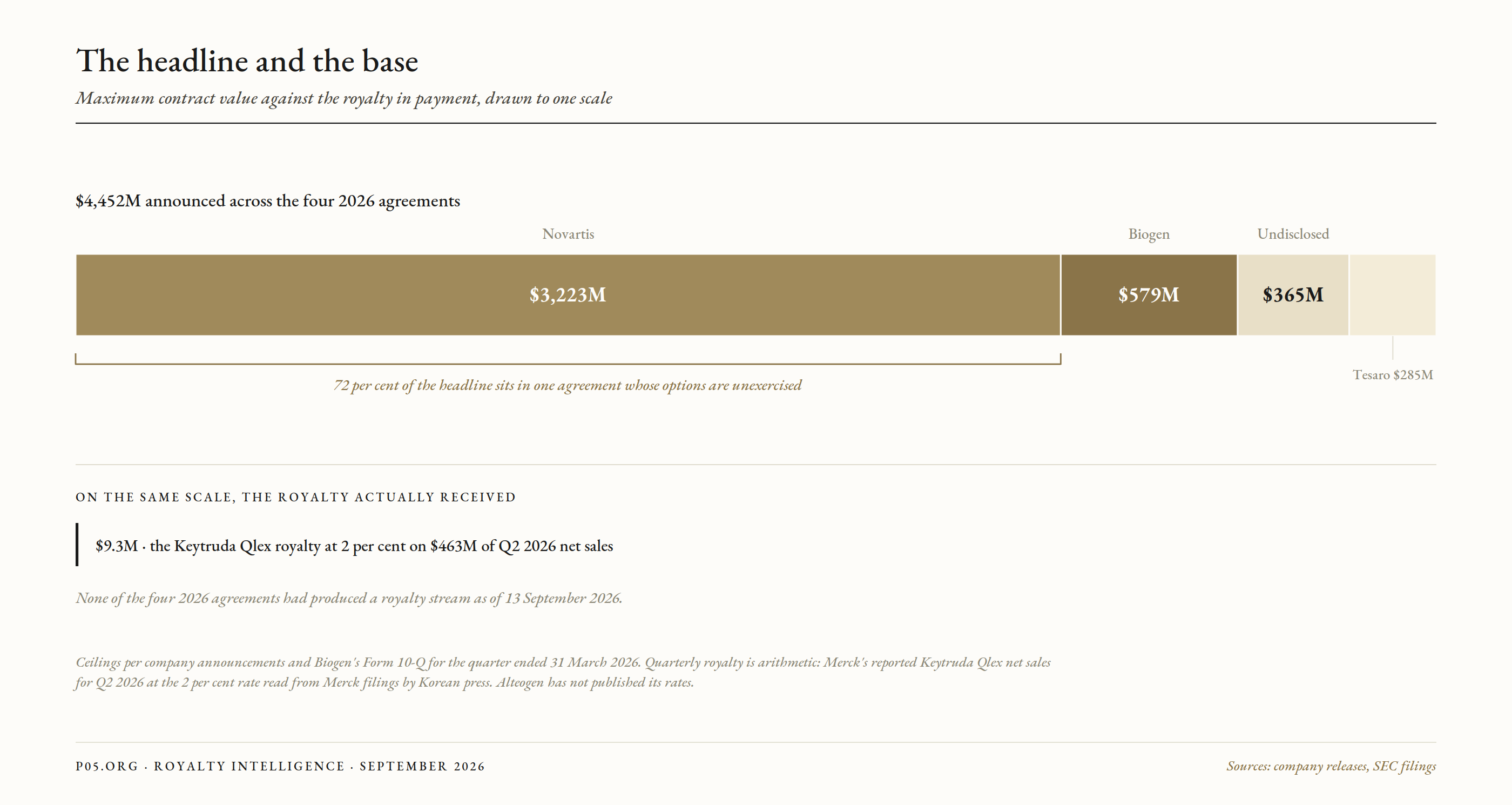
Figure 3. The 2026 headline value against the royalty in payment, drawn to one scale.
Alteogen's half-year accounts show the turn. The company reported revenue of KRW 140.5bn, operating profit of KRW 73.5bn and net profit of KRW 101.3bn for H1 2026, with royalty income of KRW 63.3bn including product supplied to Merck.
The rate arrived through the payer
Alteogen has not published its royalty rates. The Merck rate reached the market through Merck's own disclosure, at 2 per cent of net sales against the 4 to 5 per cent the market had assumed. Alteogen fell 22.35 per cent in a single session on the reading, with Edaily estimating that a 50 per cent intravenous-to-subcutaneous switch would produce roughly KRW 430bn a year at that rate. The figure is press-read from a licensee filing rather than published by the originator.
For diligence the sequence matters more than the number. On a component royalty the payer files the rate before the originator discloses it, and it files it on one product, leaving the other eight relationships unpriced.
What the stream rides
A molecule royalty tracks the molecule. ALT-B4's Merck stream tracks the conversion of intravenous volume to subcutaneous volume, which Merck chooses, against the cannibalisation of its own infusion business.
The conversion has been fast. The FDA approved Keytruda Qlex in September 2025, and Merck recorded about $40M of 2025 sales, roughly $35M of it in the fourth quarter, then $128M in Q1 2026 and $463M in Q2 2026 against combined Keytruda and Qlex sales of $8.4bn. Chief financial officer Caroline Litchfield said Merck was at double-digit Qlex penetration of the US business and on a path to 30 to 40 per cent adoption by the end of 2027.
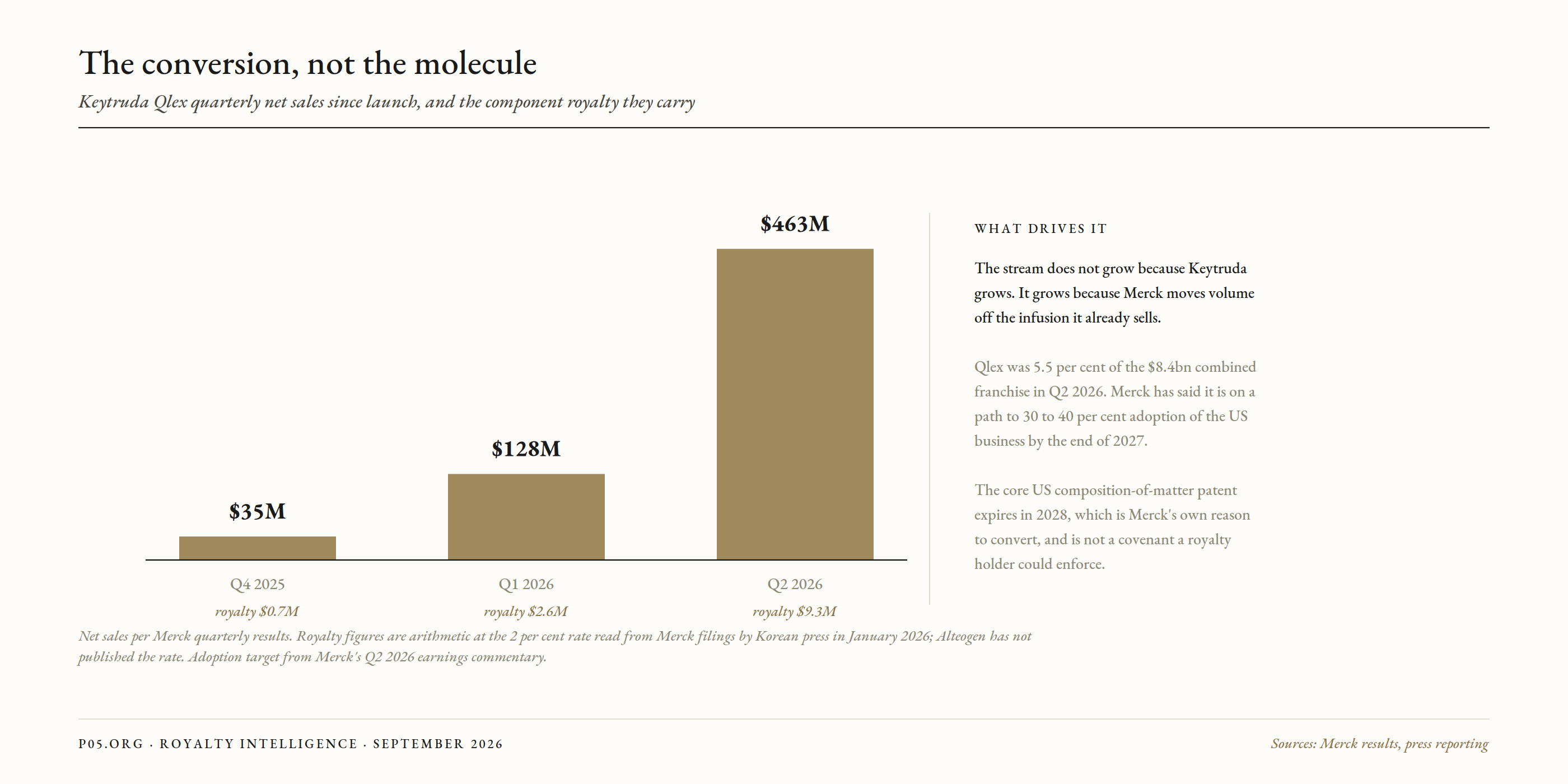
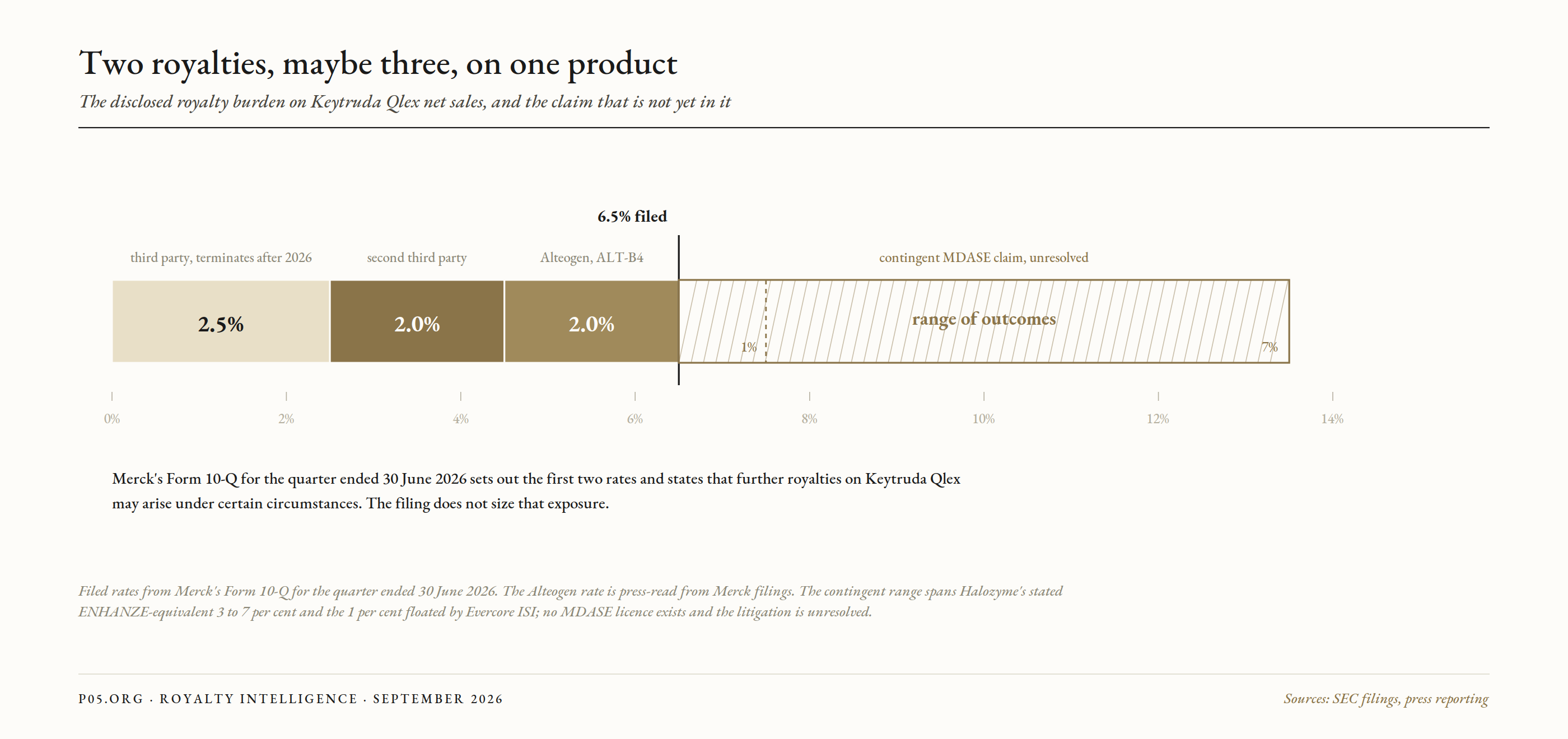
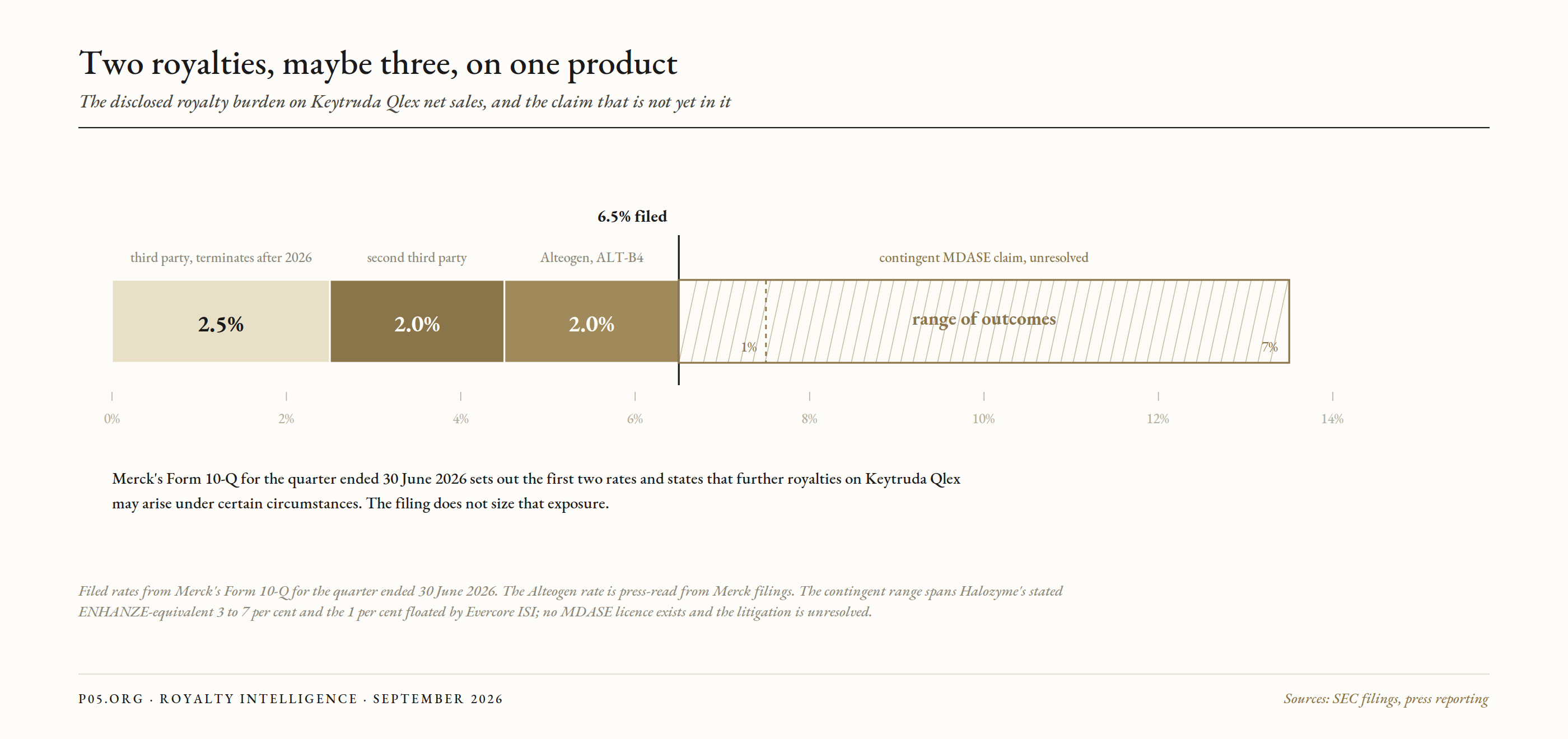
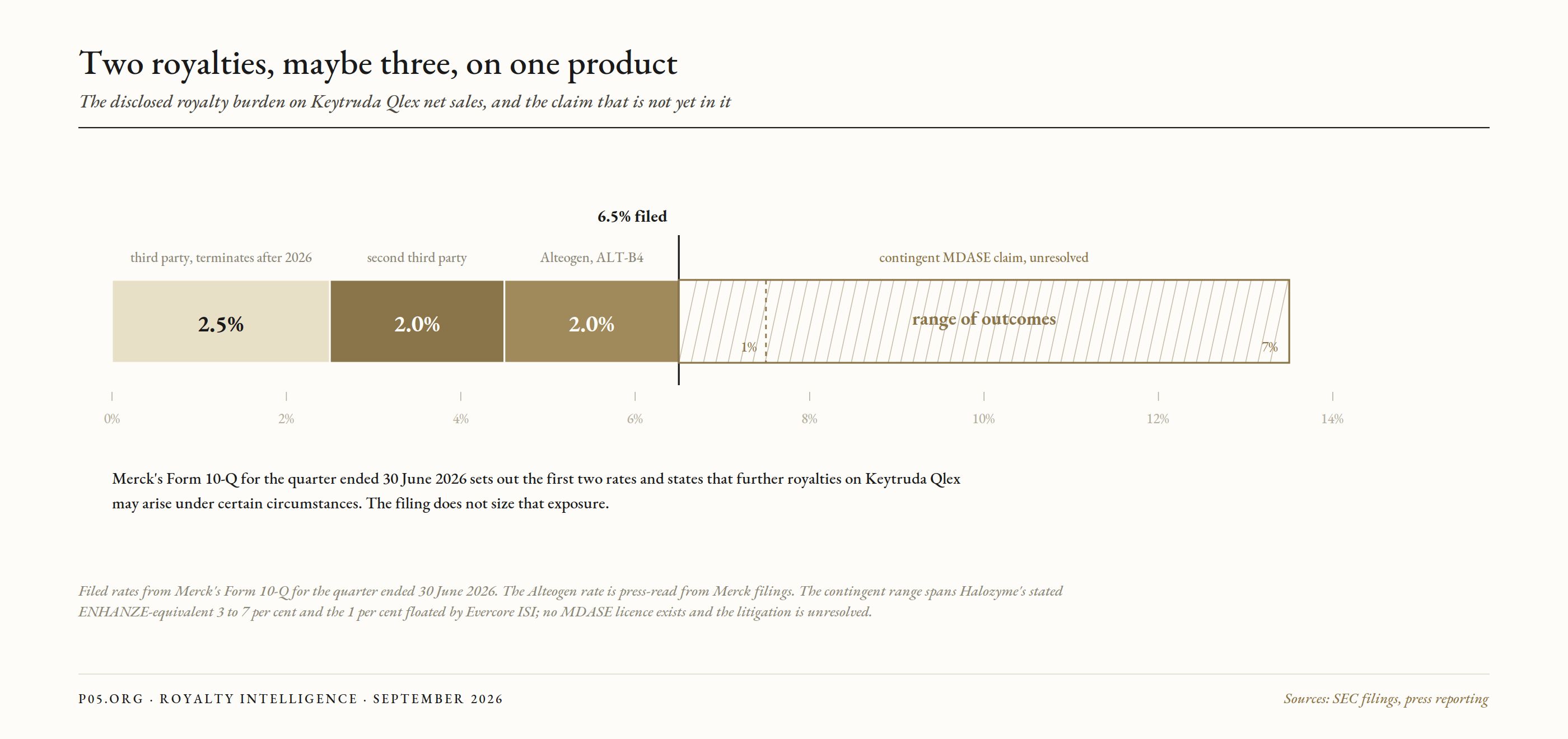
Figure 4. Keytruda Qlex quarterly net sales since launch, and the component royalty they carry.
The incentive behind that is the 2028 expiry of the core US Keytruda composition-of-matter patent, which gives Merck a reason to migrate volume that has nothing to do with Alteogen. A buyer of the stream holds no lever over the decision and would be underwriting a policy, not a covenant.
Forward estimates carry their own assumptions. Jefferies has put peak subcutaneous Keytruda sales at $5bn to $6.5bn, and an Evaluate consensus cited by PharmaVoice puts Qlex above $7bn in the early 2030s. At a 2 per cent rate, a $6bn subcutaneous franchise produces $120M a year to Alteogen. That figure holds only if the conversion reaches the level assumed and the rate stays where the filing puts it, and both are set by the payer.
Counterparty spread against IP concentration
Nine licensees off one enzyme spreads the demand side. A clinical failure at Biogen leaves the Daiichi Sankyo product untouched, and each contract has its own marketer, molecule and timetable.
The supply side runs the other way. Every stream depends on one enzyme, one patent estate and one freedom-to-operate question. A ruling against the enzyme reprices all of them on the same day. A portfolio priced off counterparty count alone carries the correlation for free.
The second royalty on the same product
Merck's Q2 2026 10-Q sets out the stack it already pays. Merck pays 2.5 per cent on worldwide Keytruda net sales to one third party, which also applies to Keytruda Qlex and terminates after 2026, and an additional 2 per cent to another third party. The same note adds that Merck may become subject to further royalties on Keytruda Qlex under certain circumstances. That sentence is the Halozyme exposure, unquantified in the filing.
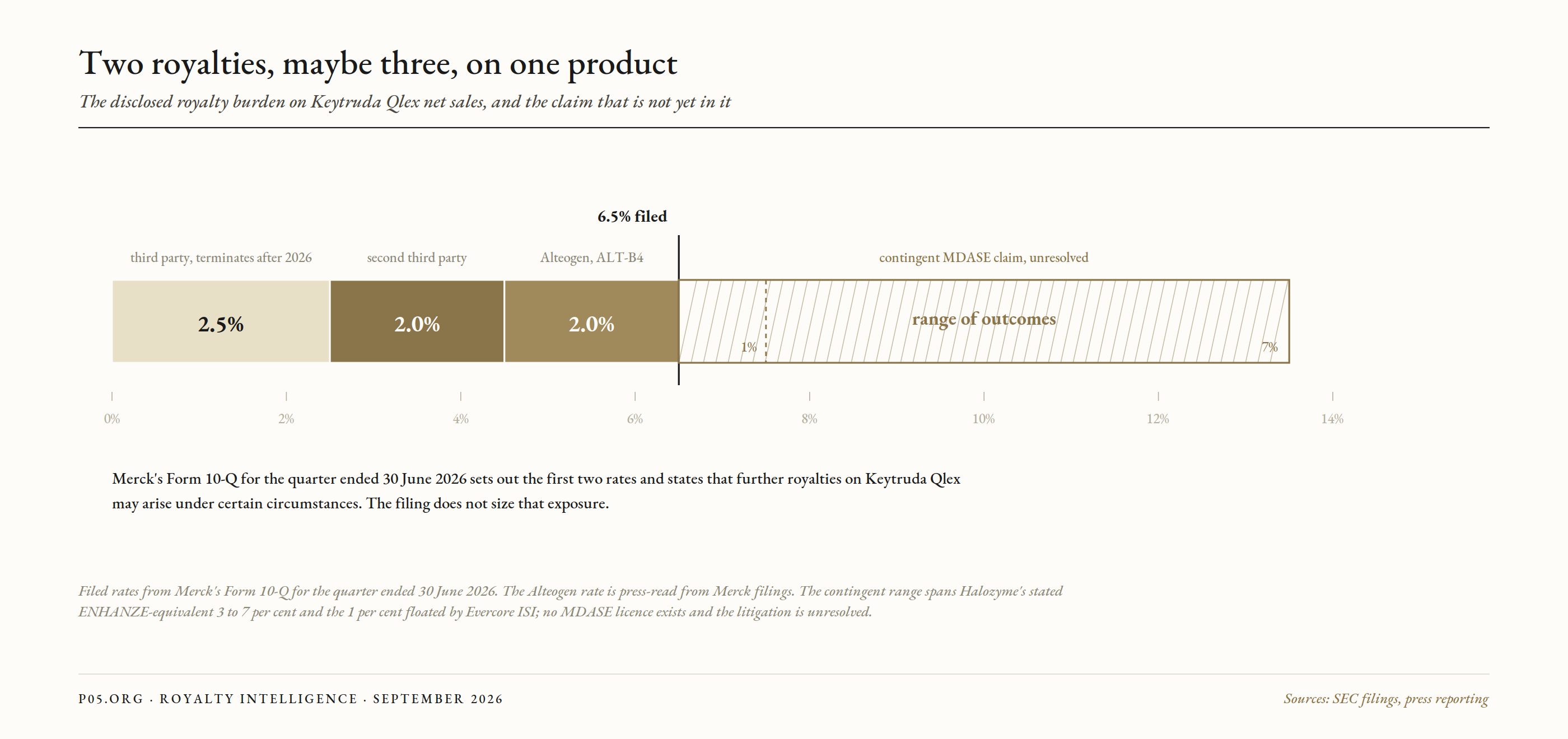
Figure 5. The disclosed royalty burden on Keytruda Qlex net sales, and the claim that is not yet in it.
The mechanism by which such a claim travels is visible in the Genmab accounts. Genmab discloses that it receives 8 to 10 per cent on Johnson & Johnson's Rybrevant, reduced by its share of J&J's royalty payments to Halozyme on the subcutaneous version. A component royalty layered onto a molecule can be pushed back up the chain onto the molecule's own royalty holders.
The litigation, as of 13 September 2026
Halozyme's MDASE portfolio covers modified hyaluronidases, and Halozyme sued Merck in the District of New Jersey on 24 April 2025 over 15 of those patents, Case No. 2:25-cv-03179. Merck answered at the Patent Trial and Appeal Board and in the European courts.
The PTAB record runs Merck's way. The first final written decision, on 12 May 2026, invalidated claims 1-4 and 8-21 of US 11,952,600 for lack of written description and enablement after Halozyme disclaimed claims 5-7. A second decision on the '262 patent followed on 18 May 2026, and institution was denied on PGR2025-00087 covering US 12,371,685 on 15 May 2026.
By its Q2 filing Merck disclosed that the PTAB had instituted 14 petitions, issued final written decisions on four finding every challenged claim unpatentable, and that Halozyme's Director Review requests had been denied. Merck's three March 2026 inter partes reviews were awaiting institution decisions expected in late September 2026; none had issued as of 13 September. Halozyme's own petition against Alteogen's ALT-B4 manufacturing patent, US 12,221,638, was denied institution on 15 May 2026.
Europe is unresolved. The Munich Regional Court granted a preliminary injunction against Keytruda SC on EP 2 797 622 on 4 December 2025; Merck appealed and its nullity action is pending before the German Federal Patent Court, with Merck having expected an appeal outcome in the second or third quarter of 2026 and no ruling on the public record as of 13 September. In the United Kingdom, Halozyme consented in May 2026 to revocation of the UK designation of EP 622, and the dispute proceeds on a separate patent.
In the Netherlands, The Hague dismissed Halozyme's preliminary injunction bid on 3 July 2026, and accelerated main proceedings were heard on 31 July 2026 with cross-border infringement counterclaims, pointing to a decision around late October.
If a licence is struck, Halozyme has indicated it would follow the ENHANZE structure at 3 to 7 per cent, while Evercore ISI's Umer Raffat has floated 1 per cent as a possible outcome.
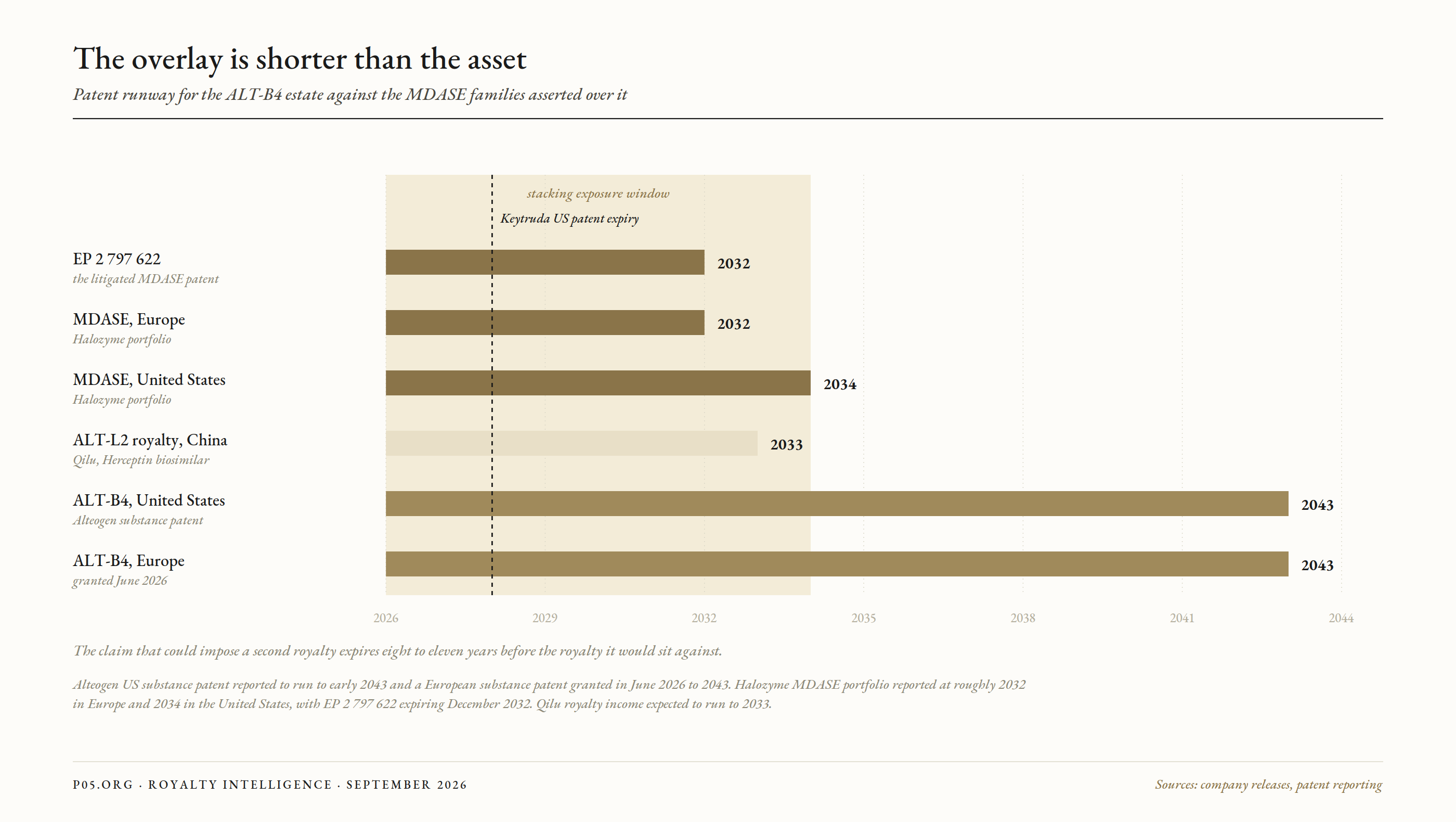
Figure 6. Patent runway for the ALT-B4 estate against the MDASE families asserted over it.
Duration favours Alteogen. Its US substance patent for ALT-B4 runs to early 2043, and a European substance patent granted in June 2026 secures rights there to 2043. The MDASE portfolio runs to roughly 2032 in Europe and 2034 in the United States, with EP 622 expiring in December 2032. The stacking claim therefore has a shorter tail than the royalty it would sit against, and discounts the near years harder than the far ones.
The mature comparable
Halozyme is the same instrument at scale and has never sold any of it. ENHANZE licenses rHuPH20 to Roche, Takeda, Pfizer, Janssen, AbbVie, Eli Lilly, Bristol-Myers Squibb, argenx, ViiV and Chugai among others, on a target-nomination structure with per-target fees, milestones and an average mid-single-digit royalty running for the longer of the last valid claim or ten years from first commercial sale in each country.
In Q2 2026 it reported total revenue of $481.0M including $307.7M of royalties, up 50 per cent year on year, and raised FY2026 guidance to revenue of $1.835bn to $1.910bn with royalties of $1.220bn to $1.245bn.
The cash has gone to buybacks and to buying platforms, including Elektrofi, with no part of the royalty book monetised or securitised in the public record. Halozyme has also kept MDASE outside ENHANZE, licensing those patents to none of its ENHANZE partners.
The monetisation record
The component and platform royalties that changed hands shared two features: the stream was in payment on an approved product, and the patent runway was mappable.
Kadcyla is the closest fit. Genentech licensed ImmunoGen's maytansinoid conjugation chemistry at 3 to 5 per cent where ImmunoGen held patents and 2 per cent where it did not. TPG-backed Immunity Royalty Holdings bought the stream in April 2015 for $200M against a capped structure, and OMERS acquired ImmunoGen's residual for a net $65.2M in January 2019 while simultaneously taking IRH's position, with ImmunoGen booking the proceeds as a liability and deferred revenue rather than a sale because of its continuing involvement. PDL BioPharma's humanisation-patent securitisation is the other established case and is treated in the p05.org spin-off piece.
The option framework has its own record, and it is thinner. Voyager Therapeutics licensed TRACER capsids to Novartis in March 2022 at $54M upfront with exercise fees on three CNS targets and options on two more. In March 2023 Novartis exercised two of the three for $25M and let the third lapse. No Voyager capsid royalty has been monetised.
Sangamo Therapeutics shows what the optional book fetches under stress. Its STAC-BBB capsid drew an Astellas licence in December 2024 at $20M upfront and up to $1.3bn across five targets and an Eli Lilly licence in April 2025 at $20M upfront and up to $1.4bn. Sangamo then filed Chapter 11 and sold the capsid platform together with its outlicensing royalty and milestone rights to Lilly for $50M plus assumed liabilities through a stalking-horse bid. Ceilings of $2.7bn cleared at $50M because nothing had been exercised.
Xencor's Fc-engineering royalties traded and were then contested. It sold portions of its interests in Ultomiris and Monjuvi to OMERS Life Sciences for $215M in November 2023, and in March 2026 Alexion took the position that no further US royalties are owed on Ultomiris.
Where a delivery component has been asserted against an unwilling payer, the resolution has been a lump sum. Arbutus and Genevant settled their lipid-nanoparticle claims with Moderna in March 2026 for $2.25bn, with $950M up front and up to $1.3bn contingent on an appellate ruling under 28 U.S.C. 1498, Genevant granting a paid-up licence in place of an ongoing royalty. Alkermes has held rather than sold, running tiered 3.5 to 9 per cent royalties on the Janssen Invega franchise through a termination attempt and arbitration. MedinCell financed itself against its BEPO streams with EUR 28M of non-dilutive bank debt and an EIB facility instead of selling the royalty.
Across Royalty Pharma, HealthCare Royalty, DRI, Blackstone, OMERS, XOMA, Sagard, Oberland and NovaQuest, the public record contains no purchase of a platform, excipient, linker or capsid royalty as such, and no purchase of an option-contingent stream before exercise.
Where the structure points
Underwrite the paying rows, and price the rest as options. The Merck and Qilu streams are component royalties on approved products with sales history and a patent runway to 2043, which is what Kadcyla looked like when it traded. The $3,223M Novartis ceiling is a set of decisions Novartis has not made. Discounting it as a stream misprices it by the whole option value, and the Sangamo auction is the mark for what an unexercised book realises.
Price the conversion, not the molecule. The base is the share of Keytruda volume Merck chooses to move, against Merck's own patent-cliff arithmetic. Any peak-sales figure carries that assumption and the 2 per cent rate with it; state both or the number means nothing.
Carry the stacking overlay as a rate, not a footnote. Merck has filed that further royalties on Qlex are possible, the Munich injunction stands pending appeal, and The Hague has not ruled. The exposure ends with the MDASE patents in 2032 to 2034, well inside the ALT-B4 term, so it belongs in the early years of the curve.
Take representations at the enzyme level. Counterparty spread does not diversify a single patent estate, and neither Alteogen nor any licensee can give clean freedom-to-operate representations while the MDASE proceedings run. The extinguishment vectors that apply to one stream here apply to all nine at once.
Halozyme has run this instrument for a decade at $1.2bn of annual royalties and has not sold a share of it. That is the clearest available read on what a component royalty book is worth to its holder relative to what a buyer will pay.
Standard disclaimer
All information in this report was accurate as of the research date and is derived from publicly available sources including court opinions, regulatory guidance, academic literature, SEC filings, and financial news reporting. Information may have changed since publication. This content is for informational purposes only and does not constitute investment, legal, or financial advice. The author is not a lawyer or financial adviser.