The price of leaving: what a lender collects when a royalty sale repays its loan

On 14 August Coherus Oncology drew $55M from a new loan led by Innovatus and repaid a $38.7M term loan from lenders advised by Barings. The Barings loan had been signed in May 2024, on the day Coherus sold a share of its American sales of UDENYCA and LOQTORZI to Coduet Royalty Holdings, a buyer group whose agreement Barings LLC signed as manager.
The royalty stayed in place. The new loan agreement charges a final fee of 4.00 per cent of the principal funded, due at maturity, on acceleration, or on prepayment. The fee rises to 10.00 per cent if Coherus enters an insolvency proceeding and borrows from Coduet, or from any other buyer under the royalty agreement, as debtor-in-possession lender, the senior lender that funds a company through bankruptcy.
The final fee is one of several charges a specialist lender collects when its loan ends. An exit fee, also called a final fee, a final payment, or an end-of-term charge, is a percentage of principal paid on the last day of the loan, whether that day is the maturity date or an early repayment.
A prepayment premium is a further percentage paid for repaying early, and it usually steps down each year. A make-whole is the interest the lender would have earned up to a fixed date, paid in a lump sum. Some lenders write the exit charge as a final payment that lifts their return to a stated internal rate of return.
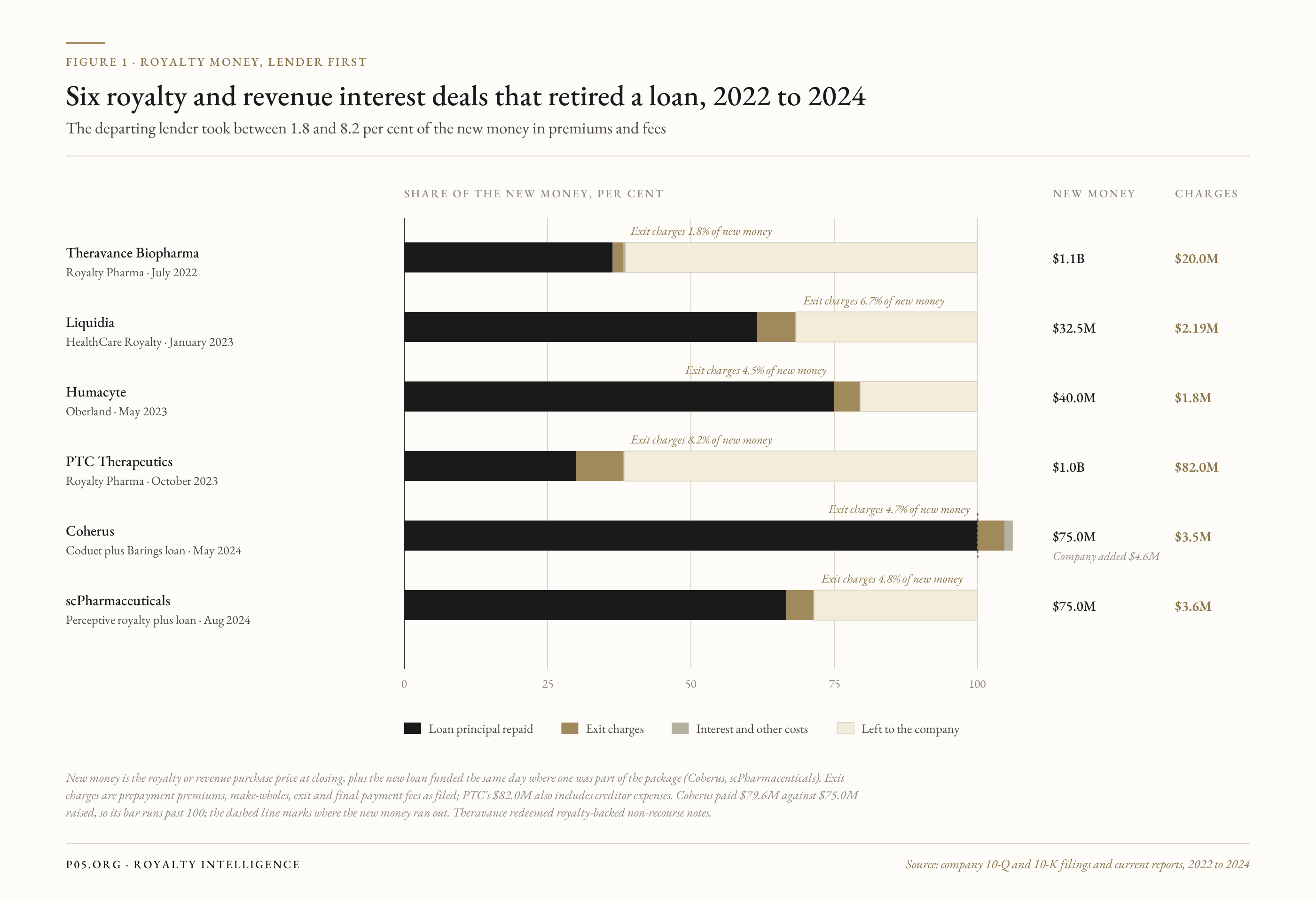
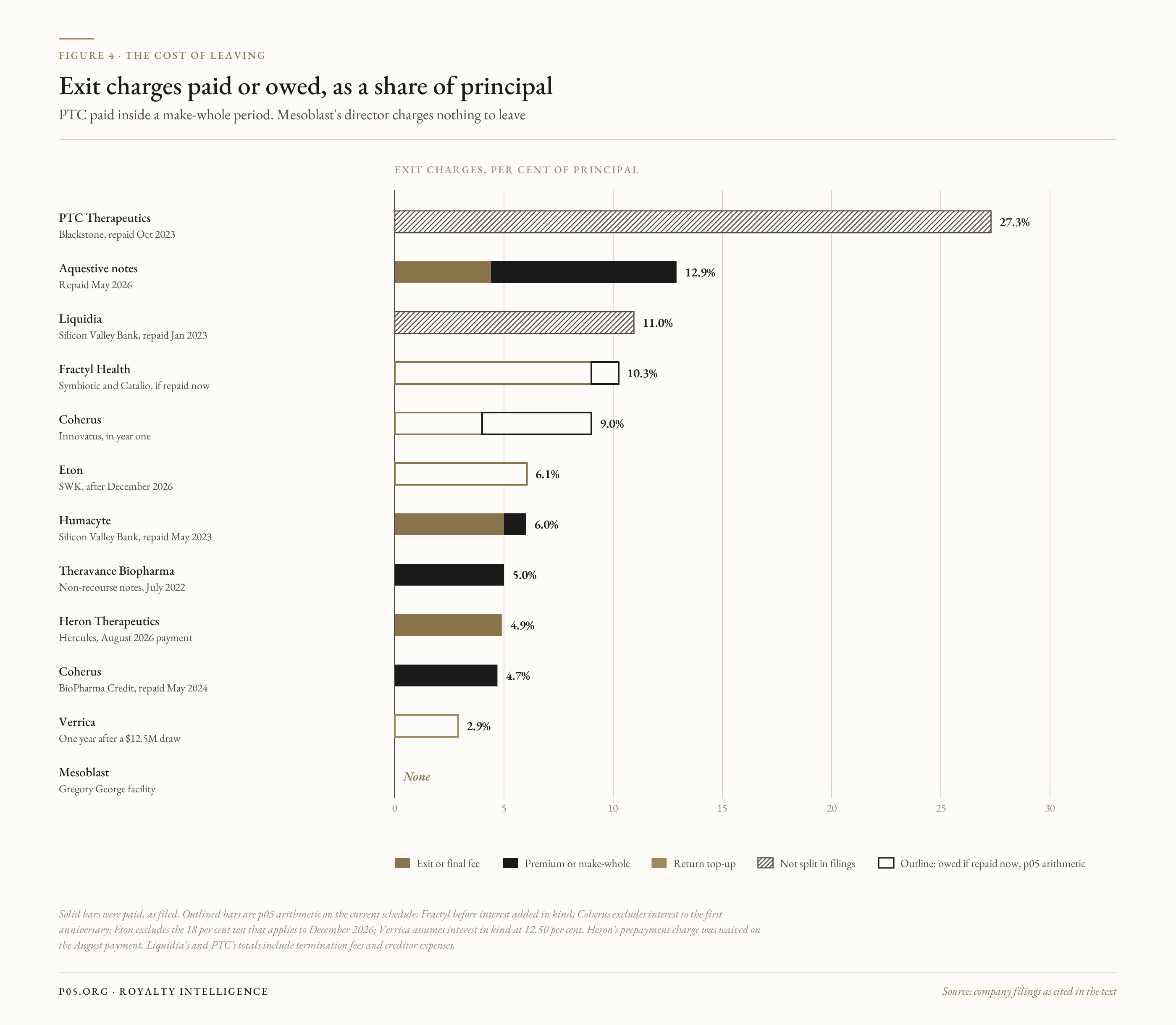
When a royalty sale retires such a loan, those charges come out of the royalty proceeds before the company sees any of the money. In the filings for royalty and revenue interest deals from 2022 to 2024, the departing lenders took between 1.8 and 8.2 per cent of the new money raised, and between 4.7 and 27.3 per cent of the principal they were repaid.
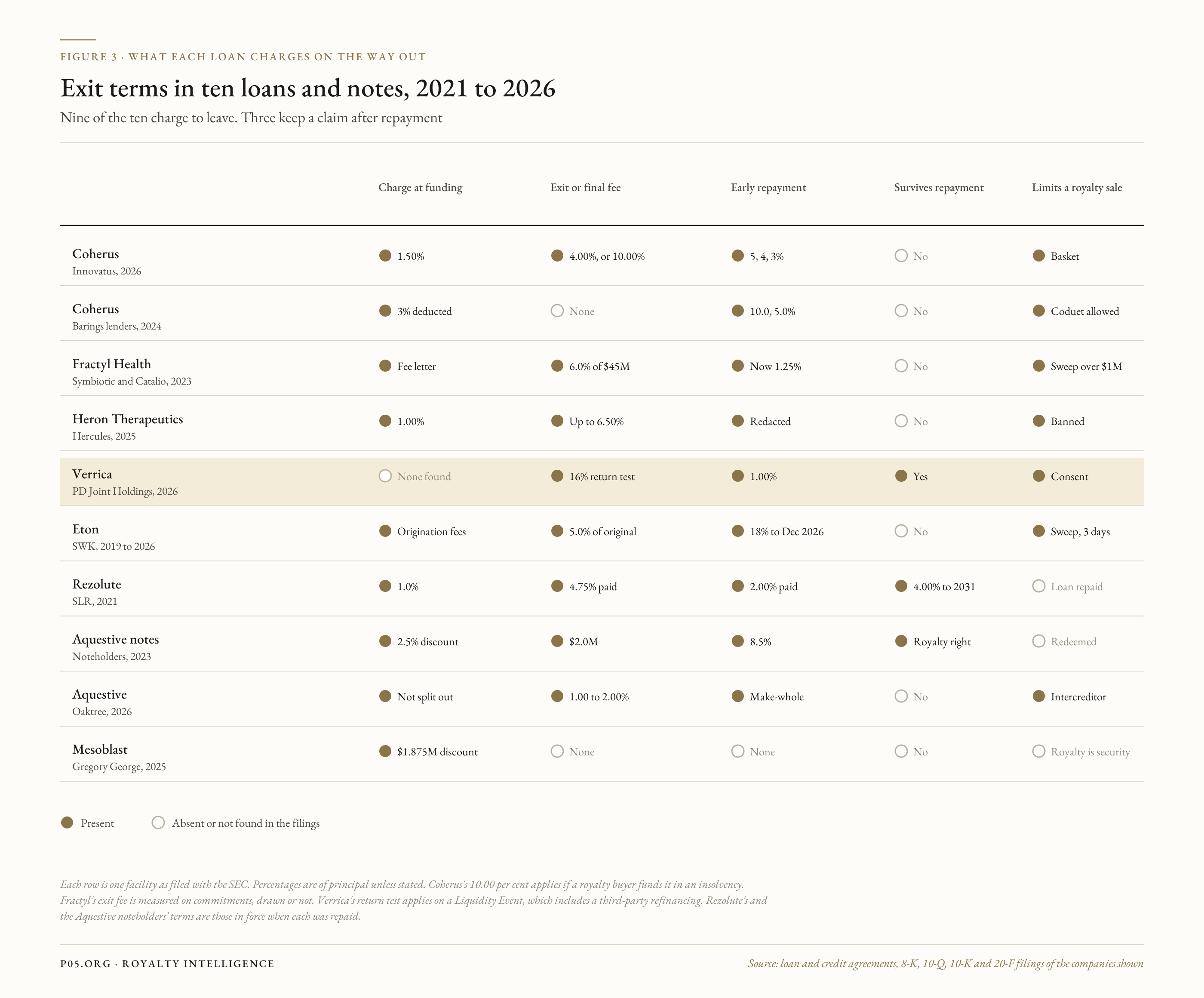
The loans signed, amended, or repaid since 2025 show where the next deductions will fall. One measures its exit fee on commitments never drawn, two set a target return of 16 or 18 per cent, and three keep a fee, a royalty, or a return payment alive after the debt is repaid.
Coduet and the loans beside it
Coherus entered 2024 owing $250.0M to BioPharma Credit. Its sale of the CIMERLI business forced a prepayment of $175.0M on 1 April 2024, and the lenders took a further $6.8M in prepayment premium and make-whole.
On 8 May the company repaid the remaining $75.0M. The payoff came to $79.6M, including a 3.0 per cent premium, a make-whole on interest, and lender fees, and the quarter's accounts booked a loss on extinguishment of $12.6M.
The money for that payoff came from a royalty sale and a loan signed on the same day. Coduet's buyer group paid $37.5M for a mid-single-digit percentage of the two products' American sales. The Barings-advised lenders funded a $38.7M loan at three-month SOFR, the Secured Overnight Financing Rate that replaced LIBOR as the floating benchmark, plus 8.00 per cent.
The loan agreement deducted 3 per cent as "additional consideration", leaving $37.5M. Of $75.0M raised, $3.5M went to the departing lenders as premium and make-whole.
The 2024 loan set its own price for leaving. Repayment before May 2025 carried a make-whole, repayment in the following year a premium of 10.0 per cent, and repayment in the year after that 5.0 per cent. The agreement also defined the Coduet sale as a "Permitted Royalty Transaction", so that a royalty and a loan, both arranged through Barings, could sit on the same products.
Coherus repaid the loan on 14 August 2026, in the 5.0 per cent year. On the schedule that premium comes to about $1.9M. The current report records the repayment and gives no payoff amount.
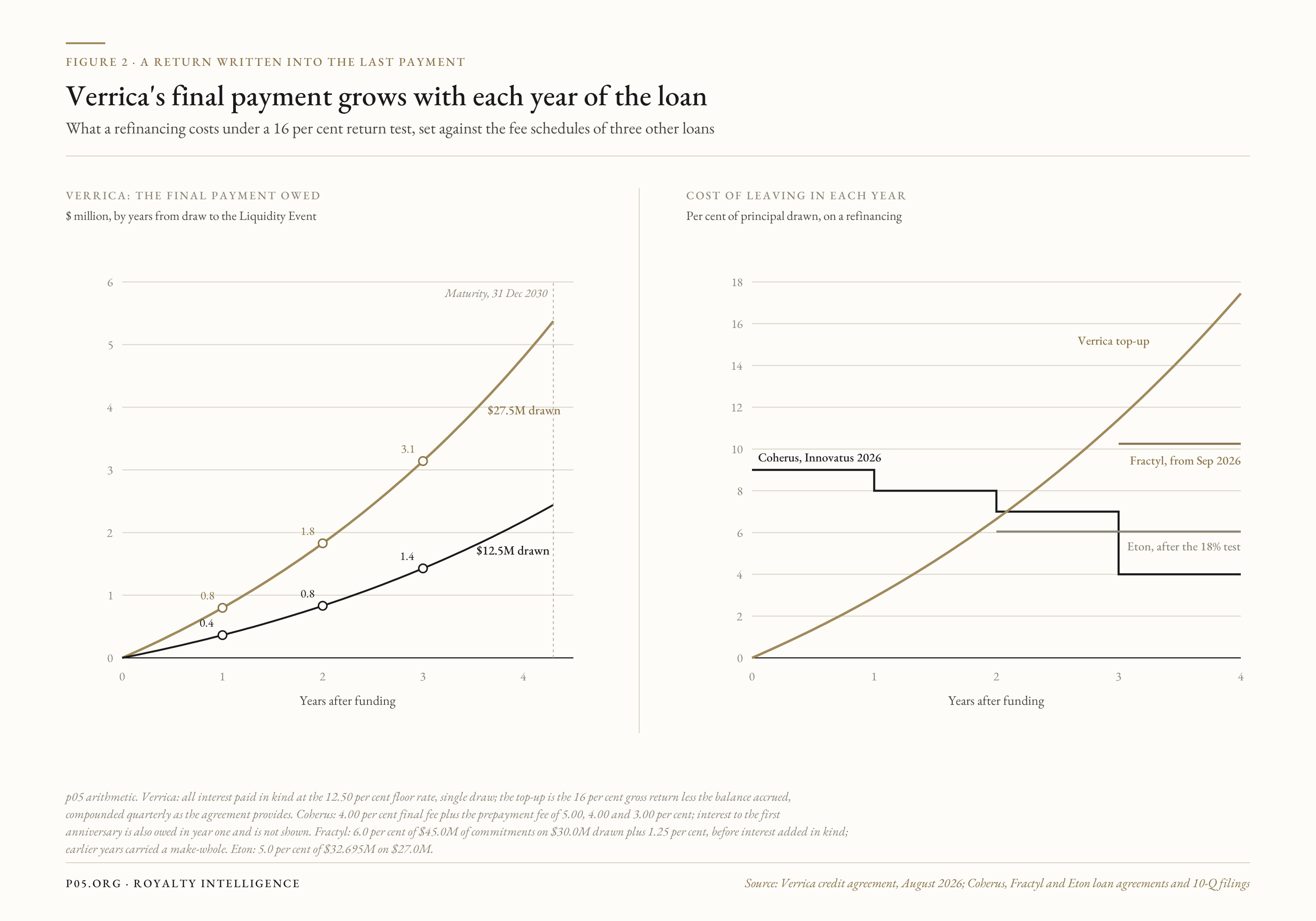
The Innovatus loan carries a facility fee of 1.50 per cent of each tranche when it funds, $0.8M on the first $55M. A prepayment in the first year costs 5.00 per cent plus interest to the first anniversary, then 4.00 and 3.00 per cent, and nothing after the third year. The final fee applies on top, $2.2M on a full repayment of the first $55M, or $5.5M in the insolvency case.
The agreement also permits royalty sales of up to 10 per cent of the sales of products Coherus acquires later, as true sales with no buy-back and no lien on the company's other assets.
Royalty money, lender first
Theravance Biopharma sold its interest in Theravance Respiratory Company, the holder of its Trelegy royalty, to Royalty Pharma in July 2022 and received about $1.1B in cash at closing. On 20 July it redeemed its non-recourse notes due 2035.
The redemption paid $400.0M of net principal, $4.7M of interest, an early redemption premium of $20.0M, and $0.2M of costs. The premium was 5.0 per cent of principal and 1.8 per cent of the cash from the sale.
Liquidia's revenue interest financing with HealthCare Royalty funded $32.5M on 27 January 2023. Of that, $22.2M went to retire the company's loan from Silicon Valley Bank and SVB Innovation Credit Fund.
The cash flow statement for the quarter shows $20.0M of principal and $2.19M of "debt prepayment and extinguishment costs", which included a final payment fee of 5 per cent. The lenders' charges took 6.7 per cent of the HealthCare Royalty money and equalled 11.0 per cent of the principal.
Humacyte used the first $40.0M from Oberland in May 2023 "to repay in full" its own loan from Silicon Valley Bank. It had drawn $30.0M. The loan carried a final payment fee of 5 per cent, $1.5M, and the company paid a prepayment premium of $0.3M on top, about 4.5 per cent of the Oberland money between them.
The largest payment in the group came from PTC Therapeutics. Its Blackstone credit agreement of October 2022 charged a make-whole on any repayment before the third anniversary. A year later PTC sold about two thirds of its remaining Evrysdi royalty to Royalty Pharma for $1.0B upfront and said the proceeds would retire the Blackstone debt.
On 19 October 2023 it repaid $300.0M of principal, $2.1M of interest, and $82.0M in "prepayment premiums, exit fees, and creditor expenses". The filings give no split of the $82.0M. It equals 27.3 per cent of the principal and 8.2 per cent of the royalty price.
scPharmaceuticals closed a package with Perceptive on 9 August 2024 that joined a $50.0M term loan to the sale of a tiered single-digit percentage of FUROSCIX sales for $25.0M at closing.
It used part of the proceeds to repay its Oaktree loan, including an exit fee of $1.0M, or 2.0 per cent of the amount funded, and a prepayment premium of $2.6M. The $3.6M took 4.8 per cent of the $75.0M raised that day.
| Company | Royalty or revenue buyer | Date | New money | Loan repaid | Exit charges paid | Share of new money | Share of principal |
|---|---|---|---|---|---|---|---|
| Theravance Biopharma | Royalty Pharma | July 2022 | about $1.1B | Non-recourse notes, $400.0M | $20.0M | 1.8 per cent | 5.0 per cent |
| Liquidia | HealthCare Royalty | January 2023 | $32.5M | Silicon Valley Bank, $20.0M | $2.19M | 6.7 per cent | 11.0 per cent |
| Humacyte | Oberland | May 2023 | $40.0M | Silicon Valley Bank, $30.0M | $1.8M | 4.5 per cent | 6.0 per cent |
| PTC Therapeutics | Royalty Pharma | October 2023 | $1.0B | Blackstone, $300.0M | $82.0M | 8.2 per cent | 27.3 per cent |
| Coherus | Coduet, with a Barings loan | May 2024 | $75.0M | BioPharma Credit, $75.0M | $3.5M | 4.7 per cent | 4.7 per cent |
| scPharmaceuticals | Perceptive, with a Perceptive loan | August 2024 | $75.0M | Oaktree, $50.0M | $3.6M | 4.8 per cent | 7.2 per cent |
A fee on money never drawn
Fractyl Health borrowed from Symbiotic Capital and Catalio under a credit agreement of September 2023 with $45.0M of commitments. It drew $30.0M. The second tranche of $15.0M was never drawn, and the exit fee is still measured on it.
The company's quarterly report for June 2026 sets the aggregate fee at "6.0% of the total commitment of $45.0 million plus all accrued PIK interest", where PIK, or payment in kind, is interest added to principal.
Before the interest added in kind, that is $2.7M, or 9.0 per cent of the money drawn. Blackstone's 2020 facility for Alnylam used the same base, with an exit fee of 1 per cent of all commitments.
A yield protection premium sits on top. It was a make-whole on interest through March 2026 plus a percentage that has stepped down to 1.25 per cent of principal since 7 September 2026, about $0.4M on the principal drawn.
The loan bears the higher of prime plus 5.50 per cent and 13.25 per cent, amortises at 1.5 per cent a month from September 2027, and falls due in September 2028.
The agreement sends asset sale money to the lenders. Section 9.09 restricts any sale, transfer, or exclusive licence, including a licence limited by geography or field of use. Where an asset sale outside the permitted baskets brings in more than $1M, or more than $2M in total, the borrower must prepay within two business days, together with "any applicable Yield Protection Premium and Exit Fee".
A royalty sale or a regional licence of Revita would pay the lenders first. On the current schedule the premium and the fixed part of the exit fee add up to at least $3.1M, or about 10.3 per cent of the principal.
Charges that rise with time
Hercules Capital's facility for Heron Therapeutics prices the exit by date. The amendment of August 2025 set up to $150M of commitments, a 1.00 per cent upfront facility charge, and an end-of-term charge of up to 6.25 per cent. The annual report for 2025 records a further amendment raising the charge to up to 6.50 per cent, depending on when the loan ends.
The tiers themselves are redacted, and so is a separate fixed charge carried over from the original facility of 2023. Heron drew $110.0M at prime, with a 7.5 per cent floor, plus 1.95 per cent in cash and 1.00 per cent in kind.
The fourth amendment, filed with the quarterly report for June 2026, required Heron to prepay $13.5M at once and up to $4.0M more by 15 September 2026. Hercules waived the prepayment charge on both payments and kept the end-of-term charge. On the first payment it was $661,500, which is 4.90 per cent of the principal repaid.
The charge does not apply to interest added in kind, so it falls on the $96.5M of drawn principal left after the first payment. At 4.90 per cent that gives about $4.7M, and at the 6.50 per cent maximum about $6.3M, before a prepayment charge whose rates are also redacted.
Section 7.8 of the facility provides that "in no event shall Borrower" or its subsidiaries "Transfer any royalty interest" in their assets. In the Rocket Pharmaceuticals facility of September 2026, the same lender wrote a priced exception for one royalty deal, set out in an earlier piece on loans that set the terms of a later royalty sale.
Heron has no such exception. A royalty buyer would have to fund the end-of-term charge, the prepayment charge, and the principal at closing, or wait for Hercules to consent.
A return written into the last payment
Verrica Pharmaceuticals signed a credit agreement on 3 August 2026 with PD Joint Holdings, an entity controlled by its chairman, Paul B. Manning. It made $12.5M available at once and $15.0M more on revenue and operating milestones, which the company reported as met on 22 October.
The first $12.5M was funded in September. Interest is paid in kind at one-month SOFR plus 8.00 per cent, with a SOFR floor of 4.50 per cent, and the loans mature on 31 December 2030.
In place of a fixed exit fee, the agreement sets a "Final Payment Amount". It is the amount by which "a sixteen percent (16.00%) gross internal rate of return" on the loans, measured from each draw date, exceeds the interest, principal, and fees already paid, interest in kind included.
The payment falls due on a Liquidity Event. The definition lists a sale, licence, or other disposal of 50 per cent or more of the company's assets, intellectual property included, a change of control, "refinancing of the Obligations by a third-party lender", a revenue threshold that is redacted, and two further triggers that are also redacted.
The obligation "shall survive repayment of the Obligations". An ordinary voluntary prepayment costs a fee of 1.00 per cent.
Each year of the loan adds to the payment. If interest accrues in kind at the floor rate of 12.50 per cent, compounded quarterly as the agreement provides, reaching the 16 per cent return requires a top-up of about $0.4M on $12.5M after one year, $0.8M after two, and $1.4M after three.
On the full $27.5M the same years give about $0.8M, $1.8M, and $3.1M. A refinancing by any other lender counts as a Liquidity Event, so the top-up falls due on the day Verrica replaces the loan. Section 6.13 adds a consent right.
Verrica may not assign, sublicense, or amend its licence with Torii Pharmaceutical, which sells YCANTH in Japan and pays Verrica on those sales, "unless Lender has provided its prior written consent", a consent the agreement says may not be unreasonably withheld.
Eton Pharmaceuticals carries a related test in its facility with SWK Funding. The sixth amendment of April 2026 cut the margin to SOFR plus 6.55 per cent and left an exit fee of 5.0 per cent of the original principal of the three earlier advances, $32.695M.
That comes to about $1.6M against the $27.0M outstanding at the end of June. A full prepayment before the second anniversary of the December 2024 advance must give SWK "an internal rate of return of eighteen percent (18.0%)" on that advance.
The anniversary falls in December 2026. Net cash proceeds of any disposition, a definition that excludes licences, must prepay the loan "within three (3) Business Days".
Fees that outlive the loan
Rezolute repaid its loan from SLR Investment Corp on 30 June 2022. It had drawn $15.0M of $30.0M, and it paid a final fee of 4.75 per cent and a prepayment fee of 2.00 per cent when it repaid. A separate exit fee agreement signed with the loan in April 2021 "survives the termination" of the loan agreement.
Under it Rezolute owes SLR 4.00 per cent of the principal funded, $0.6M, on a sale or exclusive licence of all or substantially all of its assets, a merger or change of control, or an issue of more than 35 per cent of its shares to new investors before 13 April 2031.
Rezolute's annual report for the year to June 2026 carries the obligation at a fair value of $0.5M, four years after the last interest payment.
Aquestive Therapeutics redeemed its 13.5 per cent senior secured notes on 12 May 2026 with the first $55M of a new Oaktree term loan. Its June quarter report records $45.0M of principal, an exit fee of $2.0M, and a prepayment premium of $3.825M, "equal to 108.5% of the principal amount".
The charges came to 12.9 per cent of the principal, and the redemption produced a loss on extinguishment of $11.7M. The noteholders had also received royalty right agreements in November 2023, paying them between 1.0 and 2.0 per cent of worldwide net sales of Anaphylm for eight years from its first sale.
Those agreements "remained outstanding as of June 30, 2026 after the redemption" of the notes, so the investors keep a royalty on a product that had no American approval at that date.
The Oaktree loan has an exit fee of 1.00 to 2.00 per cent of the amount repaid, at most $1.1M on the first tranche, and a make-whole to the first anniversary before a premium that steps down from 5.00 per cent.
Its lien sits beside a revenue interest that Aquestive agreed in August 2025 to sell to RTW for $75M, payable only on approval of Anaphylm by 30 June 2027, and the current report on the loan describes an intercreditor agreement between the two.
A loan with no exit charge
Mesoblast refinanced its debt in December 2025 with a $125M facility from Gregory George, a non-executive director and its largest shareholder. The loan bears 8.00 per cent fixed, pays interest only for five years, and is secured on the royalty that Mesoblast receives on TEMCELL sales in Japan.
Its annual report for the year to June 2026 records that the loan "can be repaid at any time without incurring early prepayment or make-whole fees, does not include exit fees".
The lender took an original issue discount of $1.875M at the start, with warrants over 3,225,756 shares at A$3.20. The proceeds repaid Oaktree, with $41.7M, and NovaQuest, whose revenue-linked loan was cleared with $25.0M in December and $50.4M in June.
| Facility | Lender | Exit or final fee | Premium or return test | Royalty or asset sale terms | Source |
|---|---|---|---|---|---|
| Coherus, 2026 | Innovatus | 4.00 per cent of principal funded, 10.00 per cent if a royalty buyer funds a bankruptcy | 5.00 per cent plus interest to year one, then 4.00 and 3.00 per cent | Royalty sales of up to 10 per cent on acquired products | Loan agreement |
| Coherus, 2024 | Barings-advised lenders | 3 per cent deducted at funding | Make-whole, then 10.0 and 5.0 per cent | Coduet sale permitted | Loan agreement |
| Fractyl Health, 2023 | Symbiotic and Catalio | 6.0 per cent of $45.0M of commitments plus interest in kind | Make-whole to March 2026, now 1.25 per cent | Sale proceeds above $1M prepay with premium and fee | Credit agreement |
| Heron Therapeutics, 2025 | Hercules | Up to 6.50 per cent of principal repaid, 4.90 per cent on the August 2026 payment | Rates redacted | No royalty transfer | Fourth amendment |
| Verrica Pharmaceuticals, 2026 | PD Joint Holdings | Top-up to a 16 per cent return on a Liquidity Event | 1.00 per cent on voluntary prepayment | Consent for changes to the Torii licence | Credit agreement |
| Eton Pharmaceuticals, 2019 to 2026 | SWK | 5.0 per cent of $32.695M of original principal | 18 per cent return to December 2026 | Disposition proceeds prepay in three days | Sixth amendment |
| Rezolute, 2021 | SLR | 4.00 per cent of principal funded, surviving to April 2031 | 2.00 per cent, paid in 2022 | Fee due on a sale of substantially all assets | Exit fee agreement |
| Aquestive notes, 2023 | Noteholders, not named | $2.0M | 8.5 per cent, paid May 2026 | Royalty on Anaphylm survives redemption | Quarterly report, June 2026 |
| Aquestive, 2026 | Oaktree | 1.00 to 2.00 per cent, at most $1.1M on the first tranche | Make-whole to year one, then from 5.00 per cent | Intercreditor with the RTW revenue interest | Current report, May 2026 |
| Mesoblast, 2025 | Gregory George | None | None | Secured on the TEMCELL royalty | Annual report, June 2026 |
Pricing a royalty that has to clear a loan
A buyer bidding for a royalty from a company with a specialist loan in place pays the lender's exit charges out of the price. The size of those charges depends on the date. PTC sold its royalty a year after signing its loan, inside the make-whole period, and paid Blackstone 27.3 per cent of principal on top of the principal. Coherus left its Barings loan in the 5.0 per cent year.
Fractyl's premium has fallen to 1.25 per cent, while its exit fee on $45.0M of commitments stays fixed. The schedule in each loan agreement shows how much a seller saves by waiting for the next step-down.
The covenants decide where the cash from a sale goes. Fractyl must prepay from asset sale money above $1M within two business days, and Eton within three, both with the premium attached. Heron may not transfer a royalty interest at all. Verrica's lender takes its 16 per cent return when the company sells half its assets or brings in a new lender.
In each of these facilities a royalty sale on the main product either needs the lender's consent or sends the lender its exit charges first. Coherus, Aquestive, and Rocket are the borrowers here whose loans make room for a named or defined royalty deal, and in each the lender's agreement sets the terms.
The charges also differ in what they measure. An exit fee on commitments, as at Fractyl and Alnylam, charges for capital the borrower never used. A surviving exit fee, as at Rezolute, charges for a loan that has gone.
A royalty right attached to notes, as at Aquestive, keeps paying after the notes are redeemed, so a buyer of a later royalty on the same product would sit beside it. A director's loan with no exit charge, as at Mesoblast, leaves the full proceeds of a refinancing with the company.
At Cytokinetics in 2022, Royalty Pharma provided both a royalty and a loan, and at Revolution Medicines in 2025 it did the same, charging a draw fee of 2.0 per cent on each loan tranche. Perceptive took both the loan and the revenue interest at scPharmaceuticals, and Barings sat on both sides at Coherus from 2024 to 2026. Where one firm holds both claims, the exit charge on the loan and the price of the royalty are set by the same counterparty.
The June piece on the secured term loan set out call protection with an 11.5 per cent minimum return on an Oberland note as its worked example.
Conclusion
Coherus now owes Innovatus 4.00 per cent of whatever it repays, at maturity or before. The rate rises to 10.00 per cent in one case, an insolvency funded by the holders of the royalty that Coherus sold in 2024. Coduet's revenue interest, paid quarterly on the two products' American sales, has outlasted both the loan that was signed beside it and the loan that the two together repaid.
On $55M the gap between the two rates is $3.3M. Innovatus signed the agreement that sets it on 12 August, two days before Coherus repaid the Barings-advised lenders.
All information in this report was accurate as of the research date and is derived from publicly available sources including court opinions, regulatory guidance, academic literature, SEC filings, and financial news reporting. Information may have changed since publication. This content is for informational purposes only and does not constitute investment, legal, or financial advice. The author is not a lawyer or financial adviser.