The release fee: what a royalty holder is paid when the product is sold

On 1 October 2025 BioCryst Pharmaceuticals closed the sale of its European ORLADEYO business to Neopharmed Gentili. BioCryst received $250.0M in cash for the shares of BioCryst Ireland, and may receive up to $14.0M more if revenue milestones are met before the end of 2032.
On the same day Neopharmed paid $15.0M to Royalty Pharma, and BioCryst paid $0.5M to OMERS. The annual report calls both payments royalty release fees. Neither the June announcement nor the closing press release mentions them.
The royalties did not stop. Under the stock purchase agreement, BioCryst Ireland pays BioCryst quarterly amounts equal to what BioCryst owes Royalty Pharma and OMERS on European sales, and BioCryst passes them on. European sales still count towards the royalty tiers and towards the OMERS cap.
The two holders gave up no rate and no term. The quarterly report records that both gave their written consent to the sale, and the fees were paid on the day it closed.
Both the 2020 Royalty Pharma agreement and the OMERS agreement let BioCryst make a "Permitted Sale" of rights relating to the product, provided it sends the holder executed copies.
The Royalty Pharma agreement requires BioCryst to pay the royalty without any setoff or offset, and each agreement gives the holder a back-up security interest in its royalty. The filed copies are redacted and do not show a clause requiring consent to the sale.
Sales of a product or a territory that carries a financing royalty are uncommon in the filings since 2020, and cash paid to a holder to let one close is less common still. In the cases read for this piece, holders took a cash fee, a minimum that survives the divestiture, a transfer of the claim to the buyer, or the product itself. One holder took nothing. The form followed the identity of the obligor after closing.
What Neopharmed paid for
BioCryst sold three royalties on ORLADEYO in 2020 and 2021. Royalty Pharma paid $125M in December 2020 for 8.75 per cent of annual net sales up to $350M and 2.75 per cent from $350M to $550M. It paid $150M in November 2021 for a further 0.75 and 1.75 per cent in the same bands.
OMERS paid $150M in the same month. Its payments stop once it has received 155 per cent of that price, or $232.5M. Neither holder is owed a royalty on global sales above $550M a year.
The annual report allocates $12.8M of Neopharmed's payment to the 2020 agreement and $2.2M to the 2021 agreement. BioCryst booked the $15.0M that Neopharmed paid on its behalf as its own licence and other revenue.
The stock purchase agreement defines the Royalty Release Fee as $15.0M in cash. Neopharmed paid it at closing to RPI 2019 Intermediate Finance Trust, the Royalty Pharma party to the 2020 agreement, separately from the purchase price. Among the closing deliveries, BioCryst had to provide releases of all liens over the assets of BioCryst Ireland other than permitted liens. Payment of the fee in full was a condition to BioCryst's obligation to close.
The amended licence that BioCryst Ireland signed on 1 October states that it has no obligations to the holders and owes its payments to BioCryst alone.
It then treated all three payments as a modification of the royalty debt. The $15.5M was capitalised as a reduction of the royalty financing obligations and is being amortised as interest expense under the effective interest method.
The buyer's payment to the seller's creditor enters BioCryst's accounts twice, once as revenue on the day of the sale and again as interest over the life of the royalties. BioCryst accounted for the rest of the deal as a licence of intellectual property, booking $243.3M as licence and other revenue, and a sale of BioCryst Ireland that produced $3.6M of other income.
At 31 December 2025 the three royalty agreements stood at $465.7M on BioCryst's balance sheet, with effective interest rates of 23.4 per cent on the 2020 Royalty Pharma agreement and 10.3 per cent on OMERS. The fees came to about 3 per cent of that amount.
The European business was a small part of ORLADEYO. BioCryst put the purchase price at about 5.4 times sales over the twelve months to June 2025, which implies European sales of about $46M a year. Global ORLADEYO revenue was $601.8M in 2025, so Europe was under 8 per cent of it.
Royalties paid and payable in 2025 came to $85.7M across the three agreements, of which $42.1M went to OMERS. That leaves about $43.6M for Royalty Pharma. Allocating each holder's receipts to Europe in proportion to sales puts Europe's share of the Royalty Pharma royalty at about $3.4M a year, and the fee at about four and a half years of it. These figures are p05.org calculations.
OMERS stood in a different place. At 30 June 2026 it had received or was owed $120.7M of its $232.5M ceiling, up $17.3M from $103.4M at 31 March. At that quarterly pace the remaining $111.8M is paid by the turn of 2028, and at the 2025 pace by early 2029.
Europe's share of the remaining $111.8M is about $8.6M on the same allocation. OMERS took $0.5M, about 6 per cent of that, for its consent.
Neither holder's economics moved, because the rate bands and the OMERS cap still run on global sales. What changed is the source of the European payments. Since 1 October they depend on BioCryst Ireland, which Neopharmed owns, paying BioCryst, which remains the obligor to both holders. On 8 October BioCryst used part of the proceeds to repay $198.7M of term debt to Pharmakon, which had also consented to the sale.
The pass-through mechanics were set out in the May Company of the Week on BioCryst.
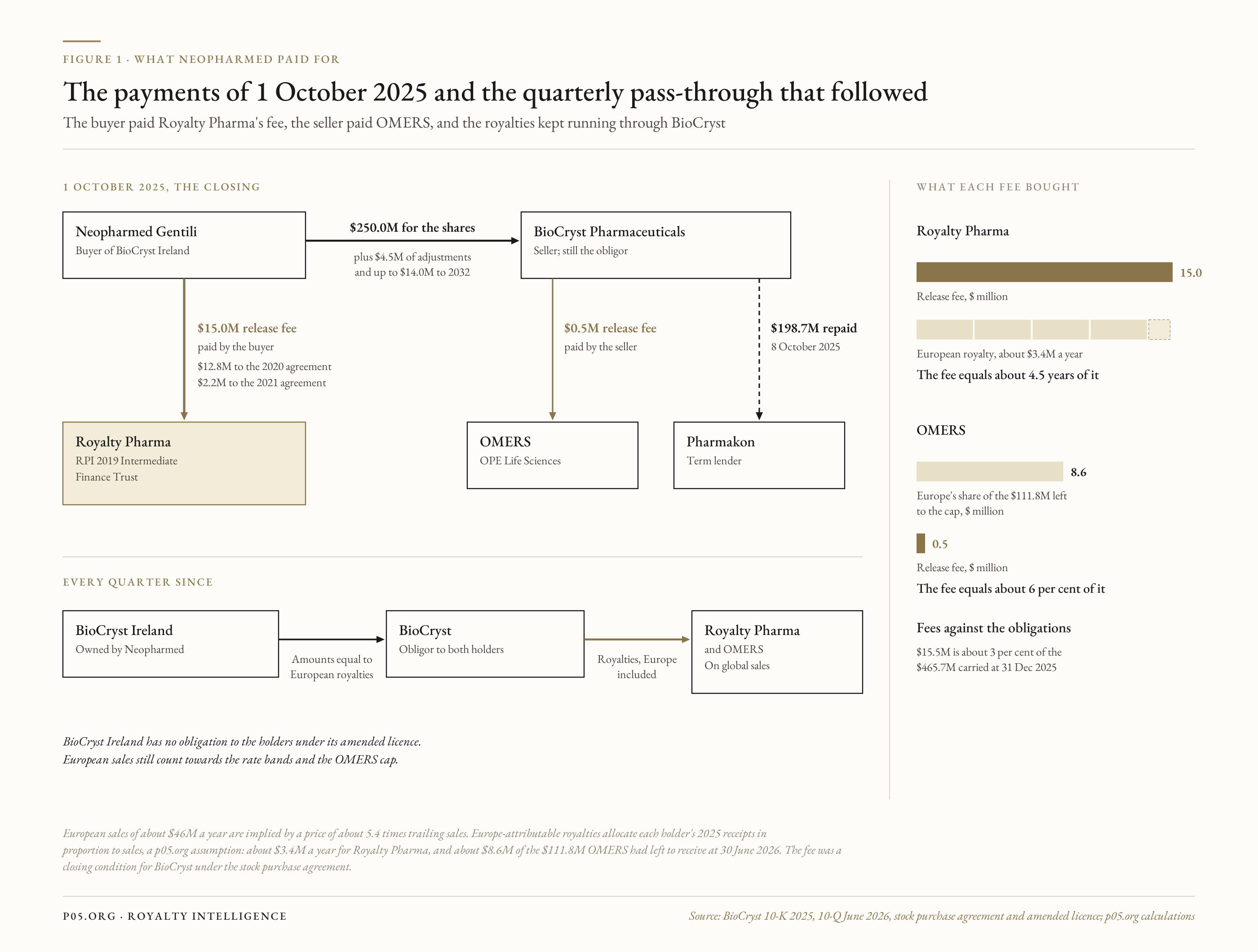
Payments on 1 October 2025 and the quarterly pass-through that followed. Allocation of royalties to Europe in proportion to sales is a p05.org assumption.
Two holders that took the product
The two cases from 2023 come from the other end of the credit range. In both, the company that owed the stream could no longer carry it, and the holder ended up owning the product.
In February 2020 RedHill Biopharma signed a royalty-backed term loan of up to $115M with HealthCare Royalty and drew $80M in March. HealthCare Royalty also took 4 per cent of RedHill's worldwide net revenues, on up to $75M a year.
Of the money drawn, $50M funded the American rights to Movantik, for which RedHill paid AstraZeneca $52.5M upfront and a further $15M 18 months later. RedHill also took over the royalty AstraZeneca owed Nektar Therapeutics, which originated the drug. Movantik had sold $96M in the United States in 2019.
In September 2022 HealthCare Royalty sent RedHill a notice of event of default. On 6 February 2023 RedHill transferred Movantik to Movantik Acquisition Co., an affiliate of HealthCare Royalty.
In exchange, all its obligations under the loan were extinguished, including principal, interest, the revenue interest, prepayment premiums, and exit fees.
RedHill had carried the loan at $115.2M at 31 December 2022, all of it classed as current.
Under the asset purchase agreement, the buyer, acting as administrative agent for the lenders, set off the full amount owed against the purchase price. HealthCare Royalty's affiliate assumed substantially all post-closing liabilities. RedHill kept the pre-closing ones, which it estimated at $27M at 31 March 2023.
RedHill recorded $35.5M of other income on the sale in the first quarter of 2023. It also recorded financial income of $21.2M, mostly the gain on extinguishing the debt.
The holder did not keep the product for long. In July 2024 Grünenthal agreed to buy Valinor Pharma, which by its own account had owned Movantik since early 2023, for about $250M. Grünenthal put the total deal value at about $250M, inclusive of all royalty obligations, and said it would pay from available liquidity.
Valinor's chairman was Clarke Futch, the chief executive of HealthCare Royalty. Movantik's American gross sales had passed $200M in 2023.
On the day of the announcement, 22 July 2024, RedHill signed a global termination agreement with Movantik Acquisition Co., Valinor Pharma, LLC, and HCR Redhill SPV, LLC. RedHill received about $9.9M in cash and control of a further $0.74M held in a restricted account.
The lien over its product Talicia was released, and its remaining credit ties to the three parties ended.
Ligand had paid Novan $12.0M in May 2019 to fund the development of berdazimer gel for molluscum contagiosum. In return Novan owed Ligand up to $20.0M in milestones and royalties of 7 to 10 per cent on net sales in the United States, Mexico, and Canada.
Novan filed for Chapter 11 in July 2023 with Ligand as the stalking horse bidder at $15.0M. The bidding procedures required any competing bidder to assume Ligand's funding and royalties agreement, so the royalty would have followed the product to any buyer. An auction on 31 August split the assets.
Under an amended agreement Ligand took the research and development business, including berdazimer and the NITRICIL platform, and the Sitavig assets of Novan's EPI Health unit for $12.15M.
The amount was credited against the debtor-in-possession loan of up to $15M that Ligand had provided. Mayne Pharma bought the RHOFADE assets for $8M in cash plus up to $1.5M of cure costs. The court approved Ligand's purchase in September.
A royalty that ended with the licence
In June 2022 Royalty Pharma paid Blueprint Medicines $175.0M for the royalties Roche owed it on GAVRETO, on sales outside the United States and Greater China. The purchase and sale agreement barred Blueprint from terminating the Roche licence without Royalty Pharma's consent. A separate section dealt with a termination by either party, in terms the filed copy redacts.
In February 2023 Roche gave notice that it would end the collaboration for convenience, with effect from 22 February 2024. On that day Blueprint agreed to sell its American rights to Rigel Pharmaceuticals for $15.0M, up to $102.5M in milestones and royalties of 10 to 30 per cent.
The same current report records that Blueprint and Royalty Pharma agreed to terminate their agreement, effective on the end of the Roche collaboration, and it describes no payment in either direction.
Blueprint's annual report adds that the termination did not affect the upfront payment, and that the last royalty due on Roche's sales up to the termination date has been paid.
Blueprint kept the $175.0M. It recorded a debt extinguishment gain of $173.7M in the first half of 2024, and at 30 June it had no plan for a new partner outside the United States and the CStone territory.
Royalty Pharma had already marked the asset down. It recorded a non-cash impairment of $182.1M on its GAVRETO royalty in the fourth quarter of 2022, citing the uncertainty of the drug's commercial outlook, before Roche gave notice. Its purchase covered Roche's sales only. The royalty Rigel pays on American sales goes to Blueprint.
The stream that went to the licensee
In November 2023 Cara Therapeutics sold HealthCare Royalty its royalties and milestones on difelikefalin for up to $40.0M, with $17.5M paid upfront. A further $20.0M followed in December 2023, when the price of Kapruvia in Germany cleared a set threshold, and the last $2.5M arrived in March 2025 on a 2024 sales milestone in Japan.
The payments stop once HealthCare Royalty has received twice what it paid, if that happens by the end of 2029, and 2.8 times otherwise. The royalties came from Maruishi in Japan and from CSL Vifor elsewhere.
On a change of control, the purchase agreement required Cara Royalty Sub, the subsidiary that held the royalties, to pay 2.8 times what HealthCare Royalty had paid, less the royalties it had received.
A merger that left outside holders with more than half the voting power counted, and so did a sale of substantially all the assets.
No payment was due if the acquirer was a Qualified Buyer: a listed biopharmaceutical company with a market capitalisation above $250M, or any other biopharmaceutical company with total assets of at least $500M, in each case counted together with its parent.
In an asset sale the exception applied only if the acquirer also assumed the obligations in writing.
HealthCare Royalty received $3.6M in 2024 and $1.5M in the first quarter of 2025. In December 2024 Cara agreed a reverse merger with Tvardi Therapeutics, and with it an asset purchase agreement with CSL Vifor. CSL Vifor bought the difelikefalin assets for $900k, and Cara paid it $3.0M to cover the extra costs it expected to bear.
Both deals closed on 15 April 2025. CSL Vifor and HealthCare Royalty replaced the royalty agreement with a new one under which CSL Vifor makes the payments to HealthCare Royalty, and Cara has no further obligations to it.
Tvardi's holders were to own about 72 per cent of the combined company, so the merger met the first test. Had the payment fallen due with no exception applying, it would have come to about $107M: 2.8 times the $40.0M HealthCare Royalty paid, less the $5.1M of royalties paid to it by the end of March 2025.
That figure is a p05.org calculation. The claim ran against Cara Royalty Sub, whose assets were the royalties themselves. Tvardi, a private company, reported total assets of $12.5M at 30 September 2024.
It was not listed, and its assets fell far short of $500M. CSL Vifor, whose parent CSL reported total assets of $38.0B for the year to June 2024, met the asset test, and it took on the payments to HealthCare Royalty. Cara paid a net $2.1M to place the stream with the company that already paid the royalties beneath it.
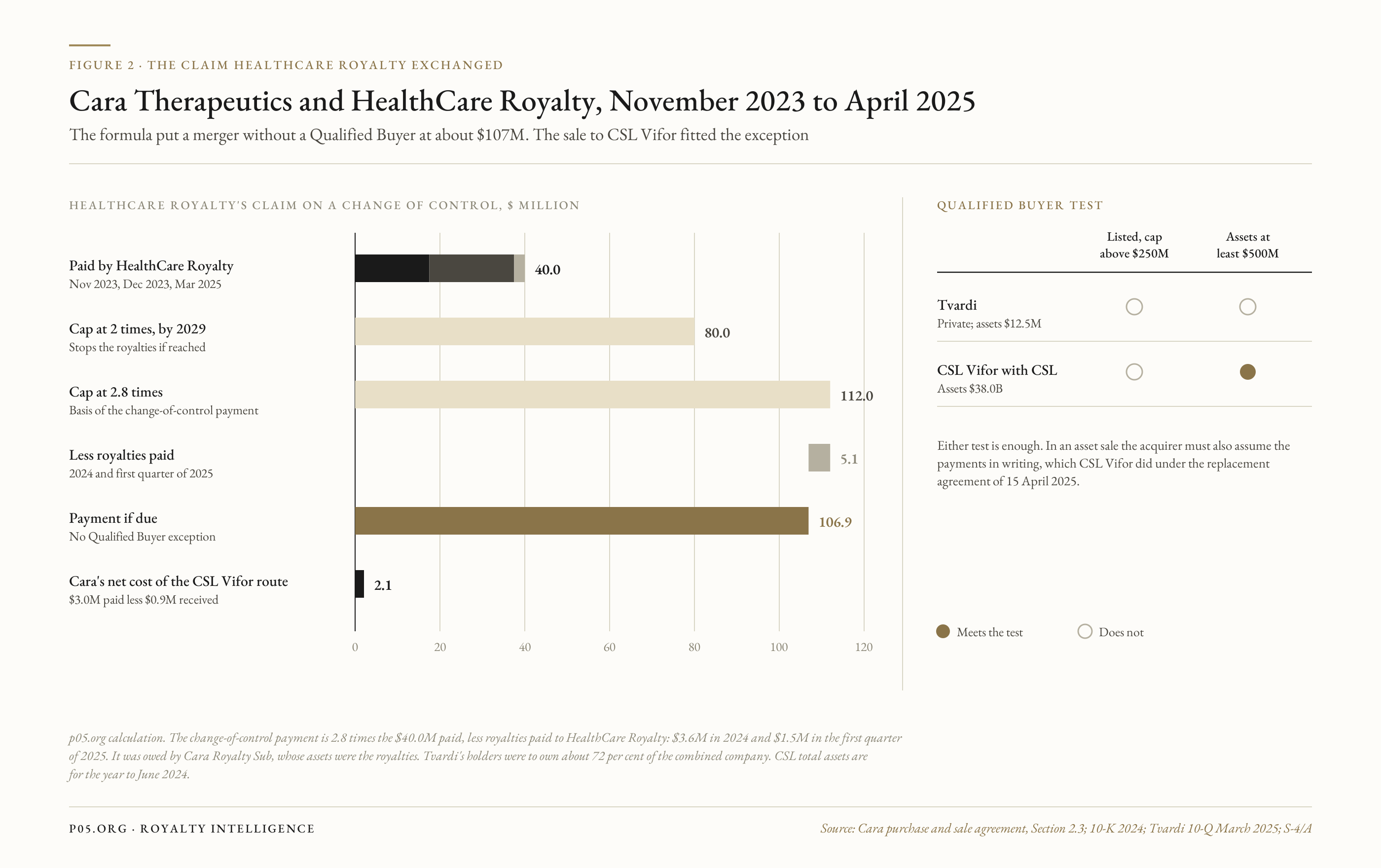
HealthCare Royalty's change-of-control claim under the Cara purchase agreement, and the Qualified Buyer test that the CSL Vifor route met. p05.org calculation.
A royalty that keeps its minimum
On 1 October 2025, the day BioCryst closed in Europe, Elutia closed the sale of its bioenvelope business to Boston Scientific for $88M in cash. The business carried a royalty to Ligand that Elutia had taken on when it bought the products from CorMatrix in 2017. The royalty is 5.0 per cent of sales through 31 May 2027, with a minimum of $4.4M a year.
Ligand's consent, release and amendment carried no fee. Elutia paid $1.1M of royalties already accrued, within five business days of closing, and Ligand released its liens over the assets Boston Scientific bought.
The amendment takes the bioenvelope assets out of the definition of the products and excludes their sale proceeds from the royalty base.
The minimum stays. The agreement already cut the minimum in proportion to the trailing sales of any product that was divested, and the amendment excludes this sale from that cut. Elutia still owes $4.4M a year, on a cardiovascular line that sold $2.9M in 2024.
From the closing to the end of the term the minimum comes to about $7.3M. A 5.0 per cent royalty on the cardiovascular line at its 2024 level would cover about $0.24M of that.
In the first quarter of 2025 the bioenvelopes sold $3.1M and the cardiovascular line $0.3M. Applied to that split, the proportional cut would have reduced the minimum by about 91 per cent, to about $0.7M over the same period.
The carve-out is therefore worth about $6.7M to Ligand, or about 7.6 per cent of the sale price. These are p05.org calculations, and the minimums for the final year sit in a schedule not reproduced in the filing.
The amendment also changed Ligand's rank. Elutia used the proceeds to repay its senior lender, SWK, and until Elutia signs a new senior facility Ligand's security interests rank as senior, first priority liens.
The same agreement lets Elutia assign it on a divestiture with Ligand's consent, which may not be unreasonably withheld for a creditworthy assignee that takes on the payments. Boston Scientific did not take them on.
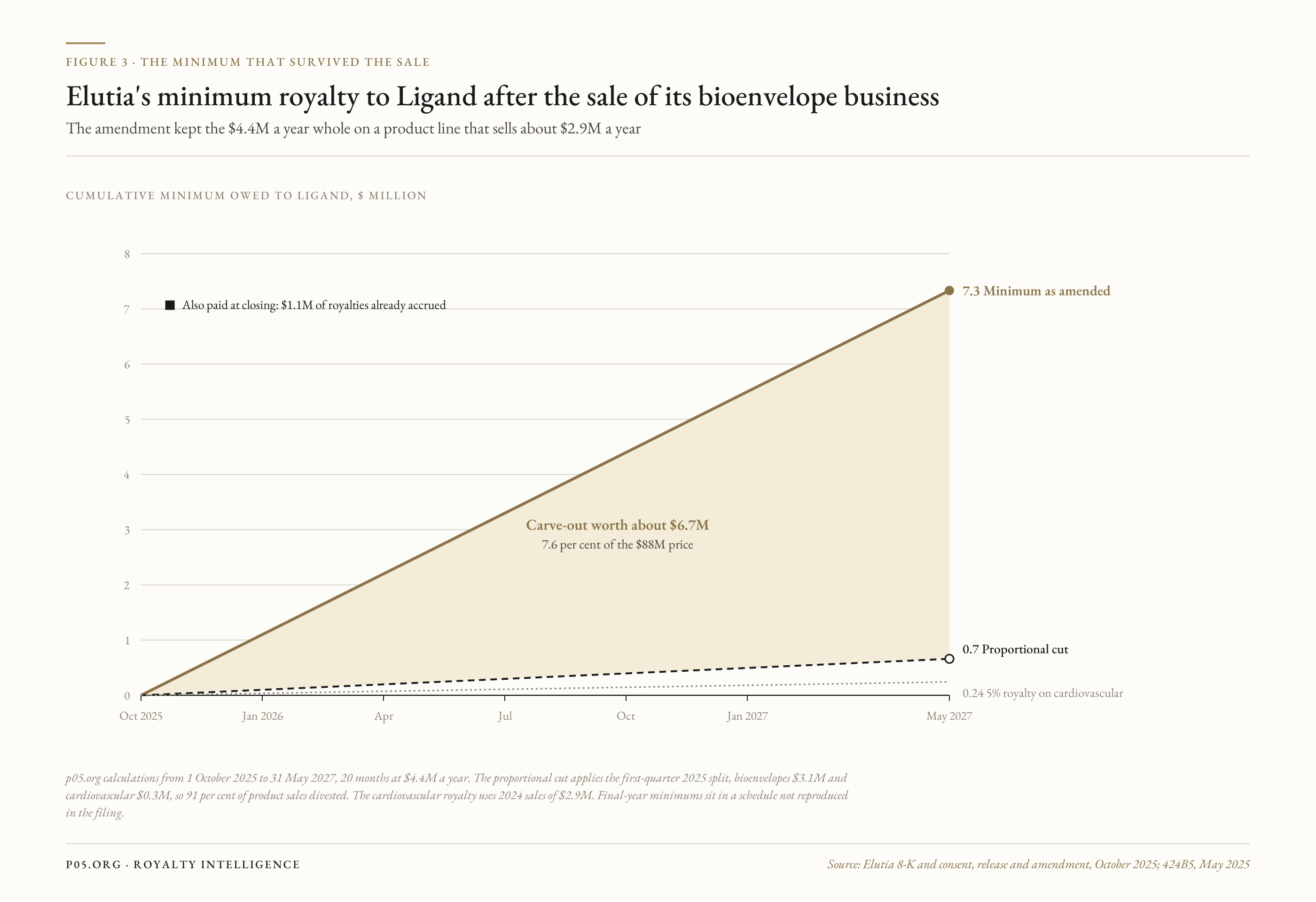
Minimum payments owed to Ligand from October 2025 to May 2027, as amended and under the proportional cut the amendment set aside. p05.org calculation on first-quarter 2025 sales.
| Company and holder | Closed | What was sold, and for how much | Holder's claim before | What the holder took | Who owes the stream after |
|---|---|---|---|---|---|
| RedHill / HealthCare Royalty | Feb 2023 | Movantik, by set-off against the loan | Term loan of $80M drawn with a 4 per cent revenue interest, in default | The product, sold with Valinor to Grünenthal in 2024 for about $250M | No one; the product passed to the holder's vehicle |
| Novan / Ligand | Sep 2023 | Research and development assets including berdazimer, plus Sitavig, $12.15M in a court sale | $12.0M funding for milestones and 7 to 10 per cent royalties | The product, as winning bidder | No one; the holder owns the product |
| Blueprint / Royalty Pharma | Feb 2024 | American GAVRETO rights to Rigel, $15.0M plus up to $102.5M and 10 to 30 per cent royalties | Royalties on Roche's sales outside the United States and Greater China, bought for $175.0M | Nothing disclosed; asset impaired by $182.1M in 2022 | No one; the new royalty on American sales goes to Blueprint |
| Cara / HealthCare Royalty | Apr 2025 | Difelikefalin assets to CSL Vifor, $900k, with Cara paying $3.0M | Royalties bought for $40.0M in three payments, 2023 to 2025; 2.8 times change-of-control payment | A claim on CSL Vifor | CSL Vifor |
| BioCryst / Royalty Pharma and OMERS | Oct 2025 | European ORLADEYO business, $250.0M plus up to $14.0M | Tiered royalties on global sales; OMERS capped at $232.5M | $15.0M from the buyer; $0.5M from the seller | BioCryst, funded by pass-through from BioCryst Ireland |
| Elutia / Ligand | Oct 2025 | Bioenvelope business, $88M | 5.0 per cent royalty with $4.4M annual minimum to May 2027 | $1.1M of arrears; minimum kept whole; senior liens | Elutia |
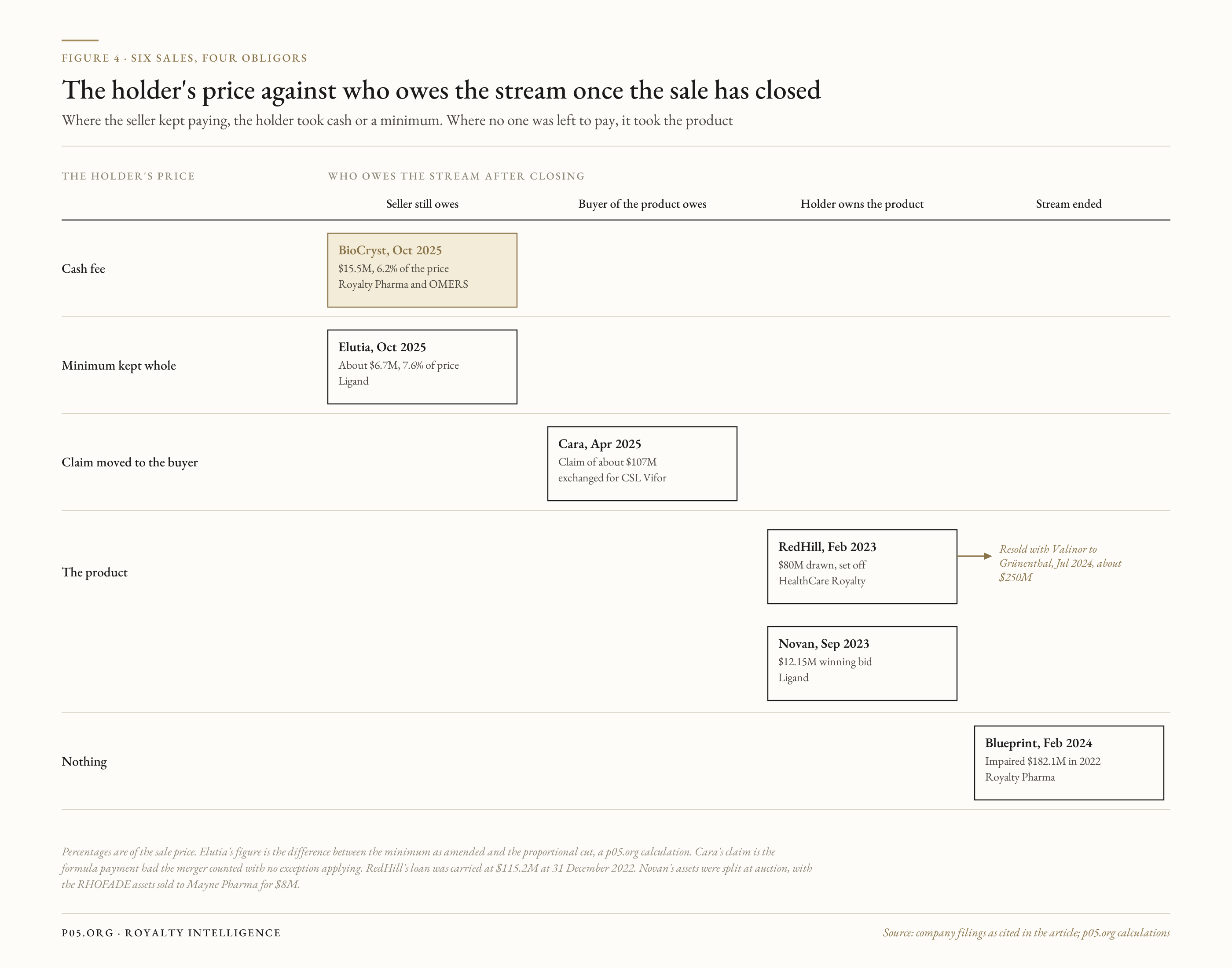
Six sales of a royalty-bearing product or territory, by the form of the holder's price and the obligor after closing.
Reading the price
The cases sort by who owes the stream after closing. At BioCryst and Elutia the seller still owes it. BioCryst's holders kept every payment right and took cash for the change in where the European payments come from. Ligand's royalty base left with the product, and its price was a minimum that the divestiture no longer reduces.
At Cara the obligor changed, and the new one was the company whose sales produce the payments. HealthCare Royalty gave up a change-of-control claim that the formula put near $107M against Cara Royalty Sub and took a direct claim on CSL Vifor. RedHill and Novan were obligors that could no longer pay.
Their holders took the product, by set-off in one case and by a winning bid in a court sale in the other. Grünenthal paid about $250M for Valinor 17 months after the transfer. RedHill had drawn $80M under the loan and carried it at $115.2M a few weeks before the transfer.
The comparison treats Valinor's price, which includes all royalty obligations, as a price for Movantik, and the release does not break it out. RedHill later received about $9.9M under the termination agreement. The sources read do not give what HealthCare Royalty spent running Valinor.
At Blueprint the holder took nothing, and it had impaired the asset more than a year before the licence ended. Its royalty was a claim on one licensee's sales, and the agreement ended with that licence. The sale to Rigel created a new royalty on a territory the 2022 contract did not reach.
The two consents of 1 October cost about the same share of the sale price. BioCryst's fees came to 6.2 per cent of the $250.0M, most of it paid by the buyer. Ligand's preserved minimum came to about 7.6 per cent of the $88M, paid by the seller over 20 months.
In both cases the sale was the source of cash to repay senior debt. That made a refusal costly for the seller, and the holder's signature was a condition of the money arriving.
At Cara the holder's alternative was a formula claim on a subsidiary whose only assets were royalties on a product Cara was selling. HealthCare Royalty exchanged that claim for a payer with a marketed product.
Implications for the Pharmaceutical Royalty Market
For a holder, the right to approve a sale of the product or a territory has value that a model of the stream does not show. Its size is set at signing, by whether a sale needs consent at all and whether a buyer may take on the payments.
Elutia's agreement had both an assignment route and a proportional cut. Ligand's price came from switching the cut off for one transaction. Blueprint shows the opposite case, a purchase tied to one licensee's payments that gave the holder no claim when the licensor sold the product to someone else.
For a company, the BioCryst structure shows what a pass-through costs to keep. The seller remains the obligor and carries the European payments on its balance sheet, and the $15.5M of fees adds to its interest expense for as long as the royalties run.
An assumption clause that lets a creditworthy buyer step in, of the kind in Elutia's agreement, gives the company a route whose cost does not depend on the holder's price.
For a buyer of the product, the royalty arrives either as a liability, as it did for CSL Vifor, or as a payment owed to the seller, as it did for Neopharmed. Neopharmed's $15.0M to Royalty Pharma sits outside the $250.0M headline price, and is part of what it paid for Europe.
Bayer's sale of Stivarga to Grünenthal for up to $431M (EUR 375M), set out in the Weekly Term Sheet for week 39, is due to close at the end of 2026 or early in 2027. The announcement names no royalty. Consents needed before a royalty itself can be sold were covered in the consent gate piece.
Conclusion
BioCryst's quarterly payments to Royalty Pharma and OMERS now include European royalties that BioCryst Ireland pays it first. At the pace of the second quarter of 2026, OMERS reaches its $232.5M ceiling around the turn of 2028, and after that only Royalty Pharma takes a share of European sales. Neopharmed's milestones of up to $14.0M run to the end of 2032.
Neopharmed paid $265.0M on 1 October 2025. Of that, $15.0M went to a creditor of the seller whose royalty runs on unchanged, and BioCryst recorded the payment as its own revenue.
All information in this report was accurate as of the research date and is derived from publicly available sources including court opinions, regulatory guidance, academic literature, SEC filings, and financial news reporting. Information may have changed since publication. This content is for informational purposes only and does not constitute investment, legal, or financial advice. The author is not a lawyer or financial adviser.