The rate that does not reset: royalty finance after cheap money

On 2 November two companies that owe HealthCare Royalty a share of their sales reported to the market. Karyopharm Therapeutics filed for Chapter 11 in the Southern District of Texas under a restructuring support agreement signed with every class of its creditors. The claims it lists include $129.0M of term loans, $123.6M of convertible notes at 9.00 per cent, and $113.5M under a revenue interest financing agreement signed with HealthCare Royalty in September 2019. The same day Rhythm Pharmaceuticals announced a five-year term loan facility of $750M, $500M of it committed, led by HealthCare Royalty in partnership with Blackstone.
It is priced at the Secured Overnight Financing Rate (SOFR), the floating benchmark for dollar loans, plus 4.60 per cent. With it came an amended and restated version of the revenue interest agreement Rhythm signed with HealthCare Royalty in June 2022.
Nine days later the Financial Times described the end of cheap money for corporate America. The paper's argument runs through floating-rate private credit. Such loans reset every quarter, so a rise in rates reaches lower-rated borrowers first, and it divides companies into those that can carry higher rates and those that cannot.
In pharmaceutical royalty finance the division runs along a different line. Many specialist loans signed since 2023 carry floors on their benchmark set high enough that the September rise did not reach them. Royalties and royalty-backed notes are priced once, at signing, as a share of sales or a fixed coupon.
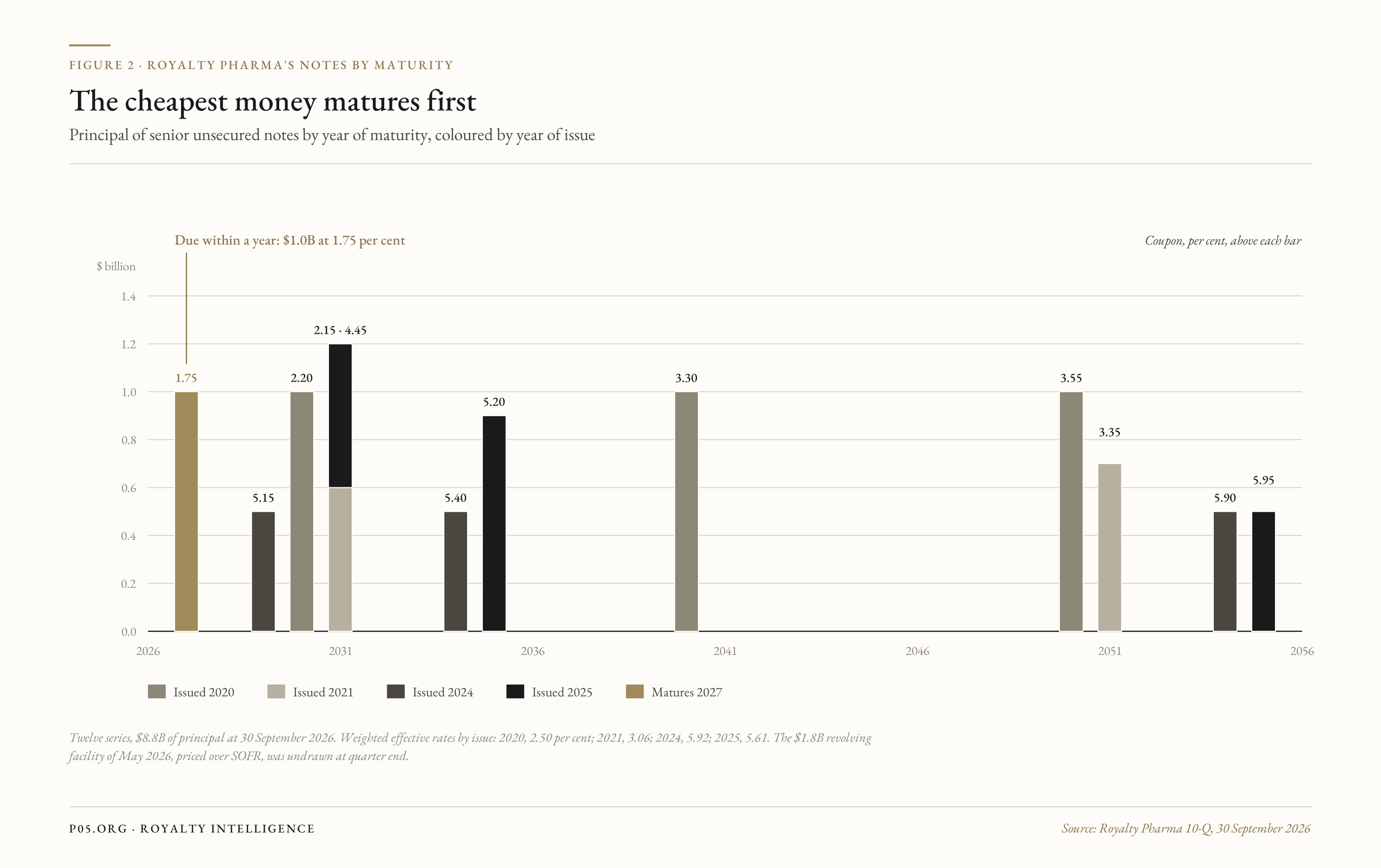
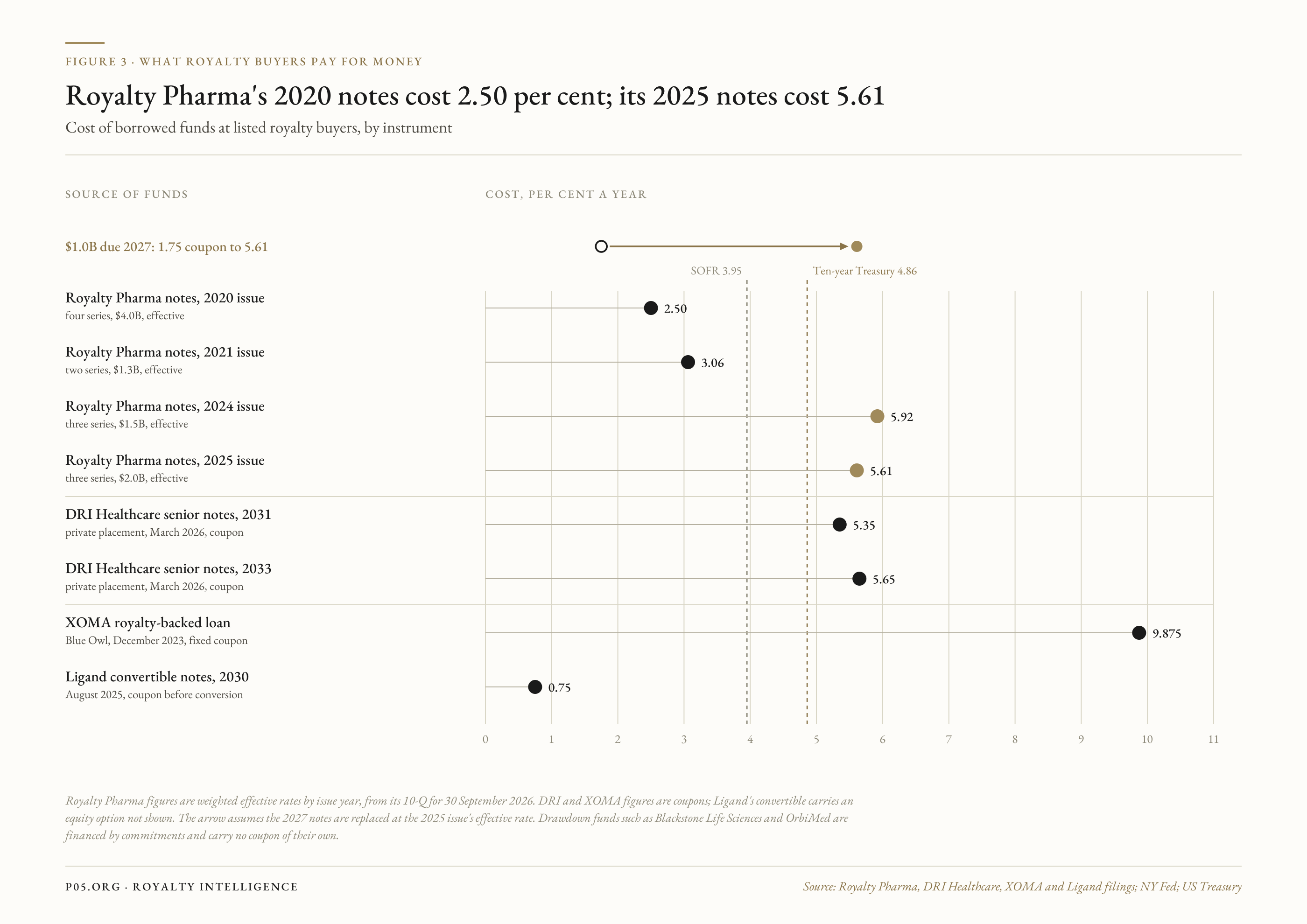
The cost that has moved most is the royalty buyer's own: Royalty Pharma has $1.0B of notes at 1.75 per cent falling due within a year, and the notes it sold in 2025 carry an effective rate of 5.61 per cent.
The rate and the curve
The Federal Open Market Committee raised the federal funds range by a quarter point to 3.75 to 4.00 per cent on 16 September, its first rise since 2023. It held the range on 28 October on a vote of 10 to 2. Consumer prices for October, published on 10 November, rose 0.4 per cent against a forecast of 0.3. After the release, federal funds futures priced 28 basis points of tightening at the meeting of 8 and 9 December and 63 basis points by the end of 2027.
The banks' prime rate moved from 6.75 to 7.00 per cent on 17 September. SOFR stood at 3.95 per cent in early November, and three-month Term SOFR at 4.08 per cent on 16 October. The ten-year Treasury yield passed 5 per cent in September for the first time since 2007 and closed at 4.86 per cent on 6 November.
A quarter point and the floor
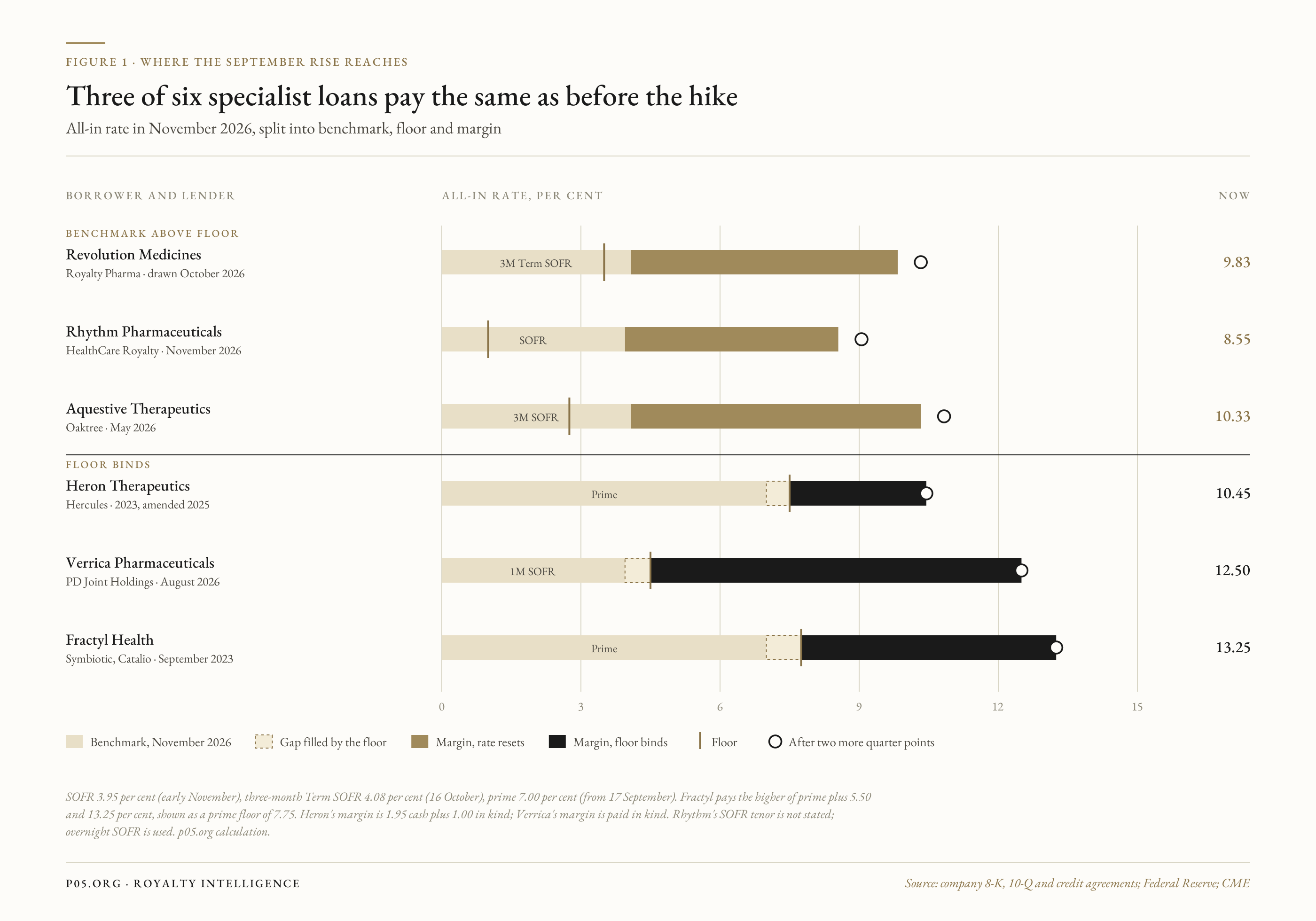
A specialist loan feels the benchmark only above its floor. Six facilities signed or drawn by royalty-active borrowers between 2023 and November 2026 show the spread of outcomes.
| Borrower and lender | Signed | Benchmark and floor | Margin | Rate, November 2026 | After two more quarter points |
|---|---|---|---|---|---|
| Revolution Medicines, Royalty Pharma | June 2025, drawn October 2026 | Three-month Term SOFR, 3.50 per cent floor | 5.75 | 9.83 per cent | 10.33 per cent |
| Rhythm Pharmaceuticals, HealthCare Royalty | November 2026 | SOFR, 1.00 per cent floor | 4.60 | 8.55 per cent | 9.05 per cent |
| Aquestive Therapeutics, Oaktree | May 2026 | Three-month SOFR, 2.75 per cent floor | 6.25 | 10.33 per cent | 10.83 per cent |
| Heron Therapeutics, Hercules | 2023, amended August 2025 | Prime, 7.50 per cent floor | 1.95 cash, 1.00 in kind | 10.45 per cent | 10.45 per cent |
| Verrica Pharmaceuticals, PD Joint Holdings | August 2026 | One-month SOFR, 4.50 per cent floor | 8.00, in kind | 12.50 per cent | 12.50 per cent |
| Fractyl Health, Symbiotic and Catalio | September 2023 | Higher of prime plus 5.50 and 13.25 per cent | n/a | 13.25 per cent | 13.25 per cent |
Three of the six pay the same after the September rise as before it, and would pay the same after two more. Heron's floor holds until prime passes 7.50 per cent and Verrica's until one-month SOFR passes 4.50 per cent, which in each case takes a third rise. Fractyl's minimum of 13.25 per cent holds until prime passes 7.75 per cent. Fractyl and Heron signed their facilities in 2023, when SOFR was above 5 per cent. Verrica's lender is an entity controlled by the company's chairman, and its floor sits 55 basis points above the benchmark.
The largest specialist lender reports the same pattern across its book. About 98 per cent of Hercules Capital's debt investments float with a floor, and nearly 60 per cent of its prime-based loans sat at their floor at the end of September, according to the company's third-quarter call. At the end of June the figure was 75 per cent. Life sciences companies took 54 per cent of the firm's new commitments in the third quarter.
The other three loans in the table reset. At Revolution Medicines and Rhythm, which have $500M drawn between them, each further quarter point adds $1.25M a year in interest. Revolution drew its $250M tranche on 8 October because the loan agreement made it compulsory on approval of RASONQUE. Two days later it let a $250M royalty tranche from the same counterparty lapse, as Royalty Pharma's quarterly report confirms.
The first test for private credit
The wider private credit market entered the rise with weaker numbers than the specialist lenders. Among business development companies (BDCs), the listed lending funds that publish every holding each quarter, the median share of investments on non-accrual at funds with a fixed life rose to 2.75 per cent of cost in the second quarter, from 1.81 per cent in the first, according to KBRA's compendium of 35 rated BDCs.
A Reuters analysis of 51 BDCs found unrealised losses equal to 2.35 per cent of net asset value in the first quarter, the largest quarterly markdown since the second quarter of 2022, with about $477M of interest paid in kind. Hercules reported two loans on non-accrual, 0.3 per cent of its portfolio at fair value.
Specialist pharmaceutical lending is a small part of that market, and the floors in its loans set when the stress arrives. A borrower at its floor pays a rate fixed in 2023 whatever the Federal Reserve does next. Once the benchmark clears the floor, every rise passes through in full.
Priced once, at signing
The royalty instruments written in 2026 carry no benchmark. Spero Therapeutics closed its financing with HealthCare Royalty on 8 July, three weeks after the American approval of Utebzi. A subsidiary sold $105M of senior secured notes at a fixed 10 per cent, with an original issue discount of $3.15M and a nine-year term. Interest not covered by GSK's milestone and royalty payments is added to principal each quarter.
A separate purchase agreement gives the buyers 65.00 per cent of the GSK payments that arrive after the notes are repaid, for $1.575M. At today's SOFR the fixed coupon equals a margin of 6.05 points.
Zymeworks raised $250M from Royalty Pharma on 2 March against 30 per cent of its Ziihera royalties from Jazz and BeOne. The annual report describes a loan at a fixed rate maturing on 31 December 2042.
The first-quarter report puts the total payable at $412.5M if the loan is repaid by the end of 2033, and about $481.3M at maturity, or 1.65 and 1.925 times the amount advanced. Management told investors the note had no stated interest rate. How fast Ziihera sells sets the cost.
Revolution Medicines' royalty works the same way. The two tranches it has taken pay Royalty Pharma 4.55 per cent of annual sales up to $2B, 2.50 per cent from $2B to $4B and 1.00 per cent from $4B to $8B, with no cap, according to Royalty Pharma.
Rhythm's 2022 revenue interest pays tiers of 11.5, 7.5 and 2.5 per cent of revenue up to a cap of 185 to 250 per cent, and the company books it as debt at an effective rate of 17.16 per cent. The new loan from the same counterparty starts at 8.55 per cent and moves with each reset.
What the buyers pay for money
Royalty Pharma funds itself with fixed-rate unsecured notes, and the coupons record the rates of each year it borrowed. Its quarterly report for September 2026 lists twelve series with $8.8B of principal.
| Issued | Series | Principal | Weighted effective rate |
|---|---|---|---|
| September 2020 | 1.75 per cent 2027, 2.20 per cent 2030, 3.30 per cent 2040, 3.55 per cent 2050 | $4.0B | 2.50 per cent |
| July 2021 | 2.15 per cent 2031, 3.35 per cent 2051 | $1.3B | 3.06 per cent |
| June 2024 | 5.15 per cent 2029, 5.40 per cent 2034, 5.90 per cent 2054 | $1.5B | 5.92 per cent |
| September 2025 | 4.45 per cent 2031, 5.20 per cent 2035, 5.95 per cent 2055 | $2.0B | 5.61 per cent |
The 2027 notes now sit in current liabilities at $997.0M. If Royalty Pharma replaces them at the effective rate of its 2025 issue, its interest bill rises by about $31.1M a year, roughly 0.9 per cent of the midpoint of its raised guidance for 2026 portfolio receipts of $3.50B to $3.55B. Interest expense for the first nine months of 2026 was $277.8M, against $213.5M a year earlier, after the September 2025 issue and the assumption of a $380M term loan, since repaid.
The company also signed a $1.8B unsecured revolving facility on 22 May, priced over SOFR and undrawn at the end of September.
The smaller listed buyers have also moved toward fixed rates. DRI Healthcare placed $250M of senior secured notes privately in the United States in March, $106M at 5.35 per cent due 2031 and $144M at 5.65 per cent due 2033, and used the money to repay part of its floating-rate credit facilities. In the third quarter it bought a royalty on American sales of Juvmo for $316M, its largest purchase, and exercised a put on its Ekterly position for a net $178.2M.
XOMA Royalty borrowed $130M from funds managed by Blue Owl in December 2023 against its Vabysmo receipts, at a fixed 9.875 per cent, with no recourse beyond the subsidiary that holds them. Ligand Pharmaceuticals sold $460M of convertible notes due 2030 at 0.75 per cent in August 2025, a coupon paid for with a conversion option on its shares.
The largest pools of royalty capital carry no coupon of their own. Blackstone closed its sixth life sciences fund at its hard cap of $6.3B in March, and OrbiMed its fifth royalty and credit fund at $1.86B in August 2025. Blackstone's money now also sits in a floating-rate loan, as HealthCare Royalty's partner in the Rhythm facility.
The last time buyers' funding costs rose, deal counts held. Gibson Dunn's tracker of 133 transactions records 25 to 27 royalty deals a year from 2023 to 2025, when the federal funds rate stood above 5 per cent. The contraction it records came in 2022, when rates rose and biotech equity fell together.
Two companies, one counterparty
Karyopharm's revenue interest has been restructured more than once. HealthCare Royalty paid $135.0M under the 2019 agreement, and total payments to it are capped at $263.3M. In the May 2024 refinancing the company paid HealthCare Royalty $49.5M in cash and gave it $15.0M of a new term loan and $5.0M of new convertible notes, and the royalty rate fell from 12.5 to a flat 7.0 per cent.
The term loan carried SOFR plus 9.25 per cent. In October 2025 a sixth amendment waived the royalty payments due in August and November 2025 and February and May 2026, and raised the rate to 8.00 per cent from April 2026. In the same package the term loan margin rose to SOFR plus 10.25 per cent.
The FT cites research showing that most companies which completed such liability management exercises defaulted again within three years. Karyopharm filed thirty months after the 2024 refinancing and thirteen months after the October 2025 package.
The plan gives the royalty a second form. In the restructuring term sheet, holders of 100 per cent of the term loans, both note series and the revenue interest claims have signed. If the company reorganises alone, the term lenders take 36.1 to 37.0 per cent of the equity and holders of the 2029 notes 33.3 to 34.1 per cent. If it merges with Ayrmid, the parent of Gamida Cell, the reorganised company's holders take 55 per cent of the combined business, which borrows up to $135M of new money at exit. They also take contingent value rights over XPOVIO in myelofibrosis.
These pay a synthetic royalty of 20.00 per cent of myelofibrosis net sales if the indication reaches the label by 31 December 2027, and 15.00 per cent if it arrives later. The royalty runs for seven years from first sale or until generic entry, whichever comes first. Karyopharm filed for accelerated approval in myelofibrosis on 31 August.
Rhythm's revenue interest moved the other way on the same day. The company's third-quarter release records an amended and restated agreement with HealthCare Royalty, signed with the loan. The chief financial officer said on the results call that it removes debt-like covenants and default provisions and limits HealthCare Royalty's lien to a backup security interest.
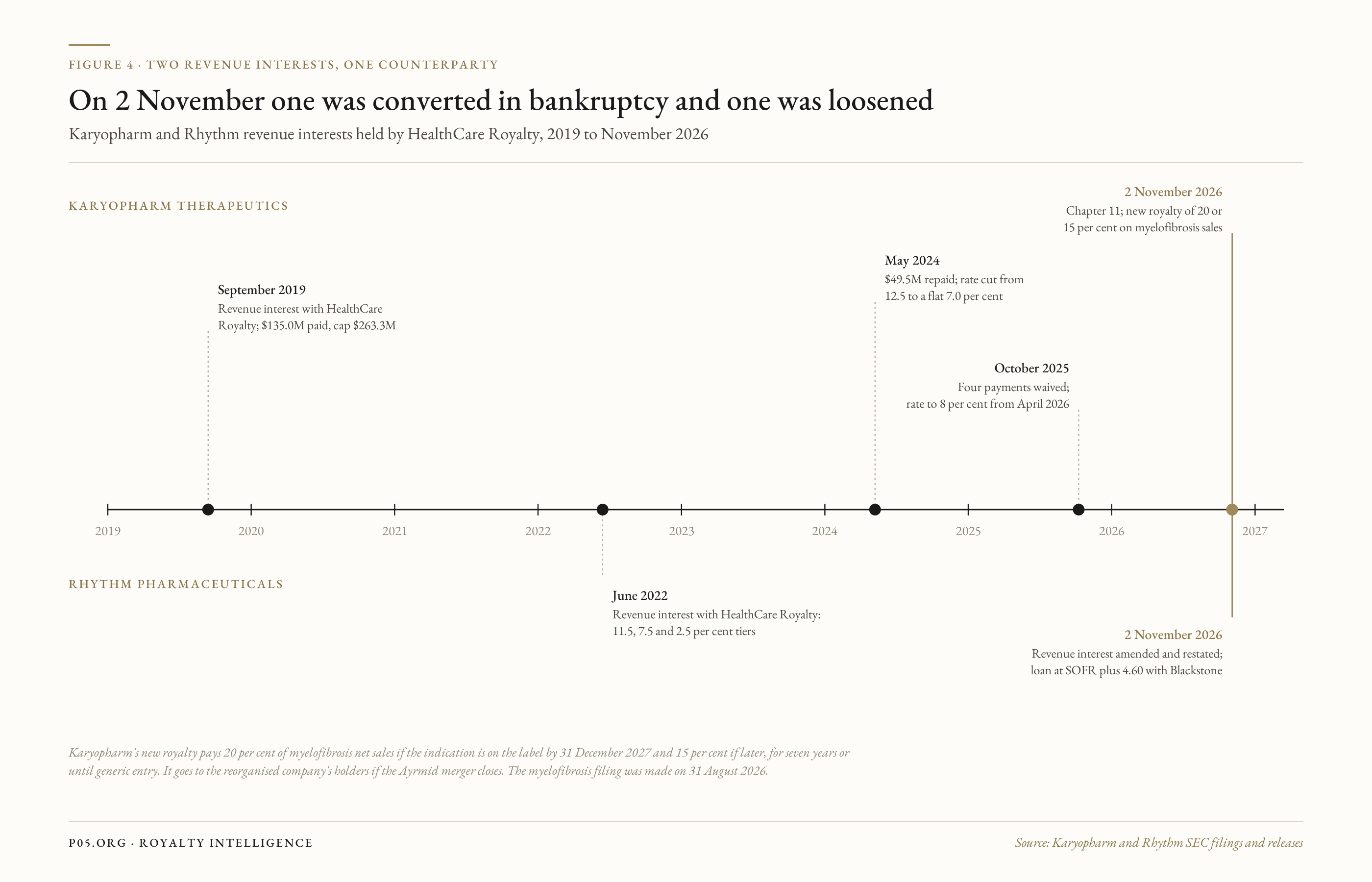
Rhythm draws $250M of the loan at closing, with no amortisation and no exit fee. The revenue interest keeps its tiers. The loan beside it resets with SOFR, from a floor of 1.00 per cent that the benchmark passed in 2022.
Implications for the Pharmaceutical Royalty Market
A borrower weighing a royalty against a loan compares a cost tied to its own sales with a cost tied to the market for money. Since September the second has risen for every borrower whose floor sits below the benchmark, and futures price more rises. Revolution Medicines and Rhythm took loans at 9.83 and 8.55 per cent all the same.
Both have marketed products, and each had royalty capacity it left unused or reshaped. Rhythm books its revenue interest at 17.16 per cent. The p05 model of Revolution's lapsed tranche put break-even with the loan at about $3.5B of peak sales.
The borrowers whose floors still bind feel none of this yet. Heron, Verrica and Fractyl pay what they agreed when rates were high or when the lender was the chairman. Hercules' share of prime loans at the floor fell from 75 to about 60 per cent between June and September.
For the borrowers left at the floor, the decision to refinance turns on maturities, covenants and the exit charges set out in an earlier piece. A rise in the benchmark starts to count only after a third quarter point.
On the buyer's side the change arrives in steps, as cheap notes mature. Royalty Pharma's 2027 maturity is the first of its 2020 series to come due at today's yields, and the 2030 notes follow. DRI fixed most of its new borrowing at 5.35 and 5.65 per cent before the September rise. A listed buyer funded at about 5.5 per cent that also pays a dividend needs returns above that level on new royalties.
Drawdown funds such as Blackstone's and OrbiMed's carry no coupon, and their investors set the return they require against a ten-year Treasury near 4.9 per cent.
Karyopharm shows the instrument used as restructuring currency. A revenue interest whose rate was cut in 2024 and whose payments were waived in 2025 ends as a claim in Chapter 11, and the plan creates a new royalty on an indication not yet approved to pay creditors.
Lotfi Karoui of Pimco told the FT he expects most of the pressure from higher rates to fall on low-quality borrowers, and he did not rule out another wave of liability management exercises.
Conclusion
The two documents filed on 2 November price money in the two ways the market now uses. Rhythm's lenders, HealthCare Royalty and Blackstone, will receive SOFR plus 4.60 per cent on $250M, reset each period. If the Ayrmid merger closes, Karyopharm's creditors will hold 55 per cent of the combined company and a royalty of 20 per cent on XPOVIO sales in myelofibrosis if the label arrives before the end of 2027, or 15 per cent if it arrives later. Of the two payments, only Rhythm's will change after the Federal Reserve meets on 8 and 9 December.
All information in this report was accurate as of the research date and is derived from publicly available sources including court opinions, regulatory guidance, academic literature, SEC filings, and financial news reporting. Information may have changed since publication. This content is for informational purposes only and does not constitute investment, legal, or financial advice. The author is not a lawyer or financial adviser.