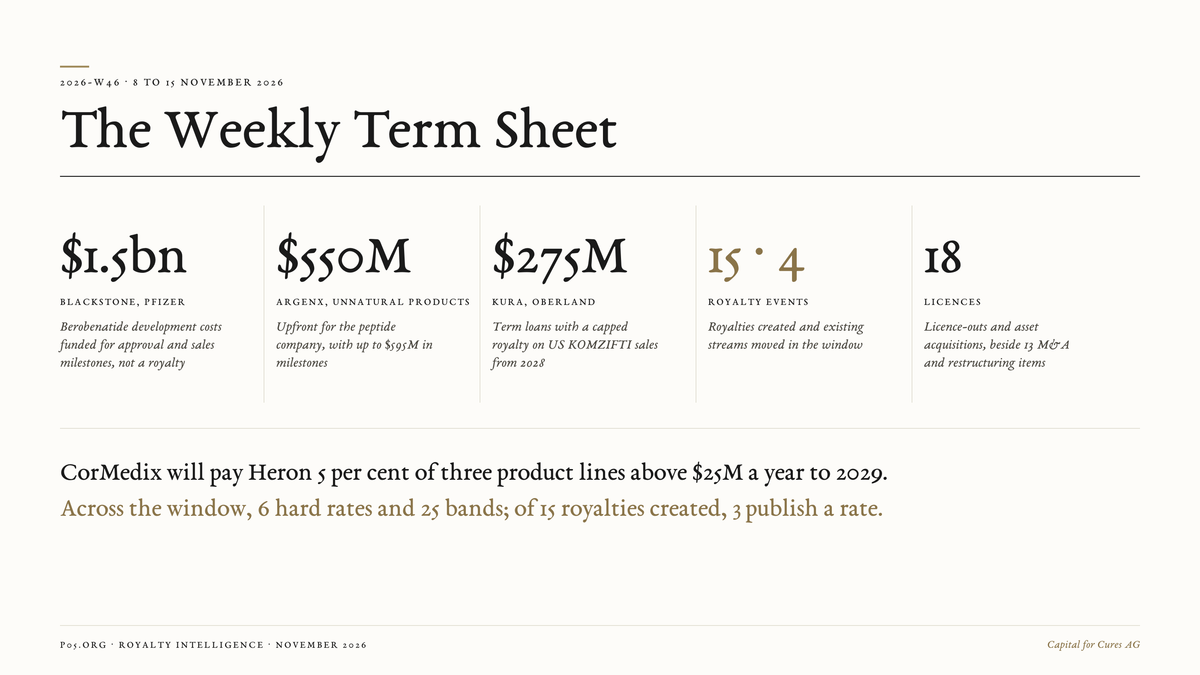
The Weekly Term Sheet (2026-W46)
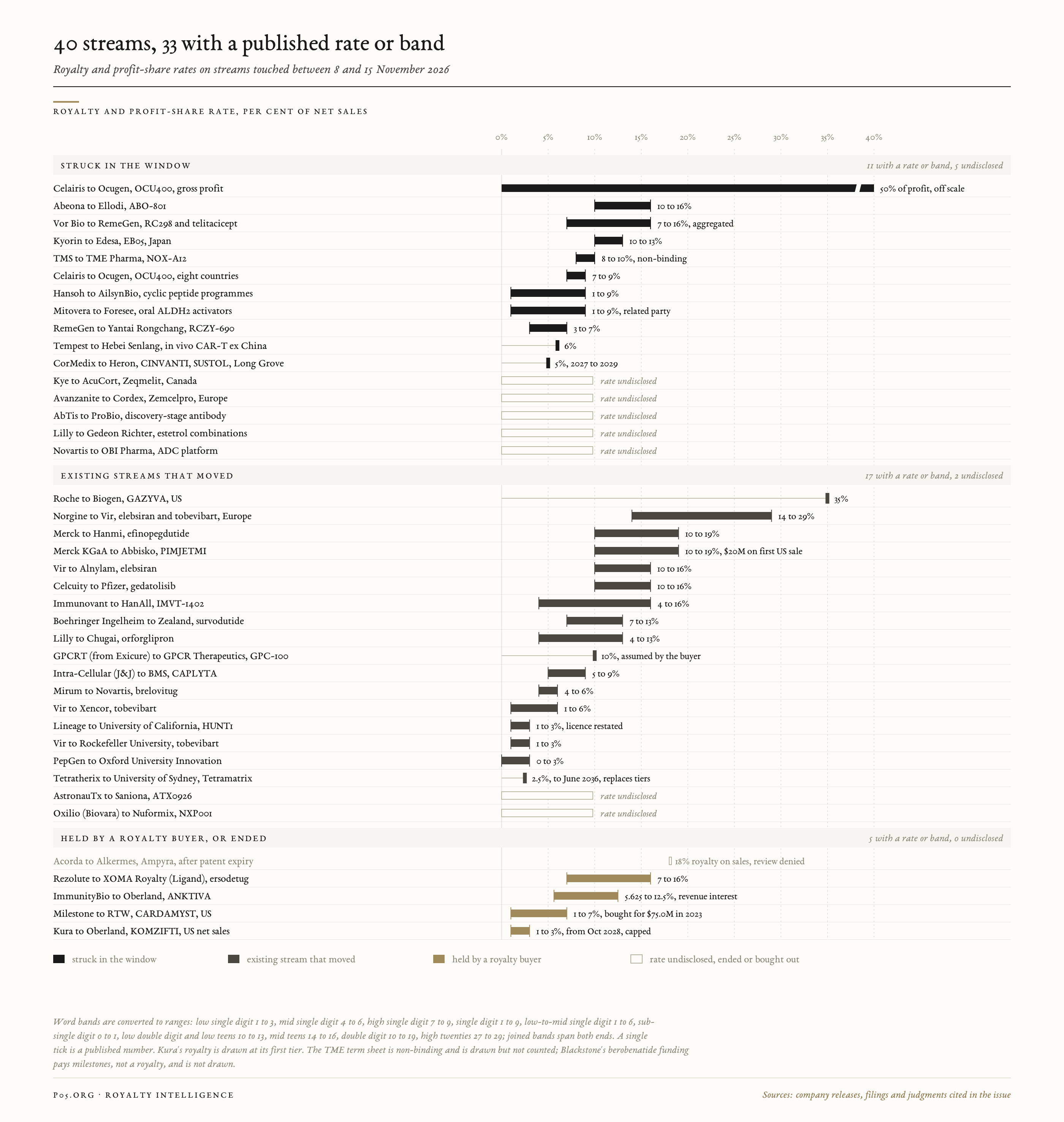
Royalty and profit-share rates on the 40 streams touched between 8 and 15 November, 33 of them with a published rate or band. Word bands are converted to ranges. Norgine's mid-teen to high-twenties royalty to Vir is the highest royalty band and Tetratherix's flat 2.5 per cent to the University of Sydney replaces a tiered royalty; Ocugen's 50 per cent of Celairis's gross profit and Biogen's 35 per cent of US GAZYVA profits are profit shares.
Highlights
Royalty events: 15 created and 4 existing streams moved. CorMedix will pay Heron 5 per cent of combined net sales of three product lines above USD 25m a year for 2027 to 2029, as part of buying Heron's assets. Abeona will pay Ellodi tiered royalties from the low to the mid teens on ABO-801, and RemeGen will pay Yantai Rongchang 3 to 7 per cent on a pan-RAS inhibitor.
Kyorin will pay Edesa low double-digit tiered royalties on Japanese net sales of EB05. Kye will pay AcuCort royalties on Canadian net sales of Zeqmelit, and Avanzanite will pay Cordex royalties on Zemcelpro in Europe; neither of those two rates is disclosed.
Tetratherix replaced the tiered royalty, licence fee royalty and minimum royalty it owes the University of Sydney on its Tetramatrix platform with a flat 2.5 per cent of net product revenue to June 2036. Saniona sold its AstronauTx shares for cash and kept its rights to milestones and tiered royalties on ATX0926.
Celairis will pay Ocugen a high single-digit royalty and half of its gross profit on OCU400 in Australia, New Zealand and six South-East Asian countries, and AbTis will pay ProBio royalties at an undisclosed rate on a discovery-stage antibody. Exicure agreed to pass the 10 per cent royalty it owes GPCR Therapeutics on GPC-100 to the buyer of the programme, GPCRT.
Kura will pay affiliates of Oberland a capped single-digit royalty on US net sales of KOMZIFTI from October 2028, alongside term loans of up to USD 275m. Tempest will pay Hebei Senlang a 6 per cent royalty on net sales of in vivo CAR-T products outside China after exercising its licence option.
Vor Bio will pay RemeGen tiered royalties from the high single digits to the mid teens on RC298, added to its telitacicept licence, and Lilly will pay Gedeon Richter tiered royalties at an undisclosed rate on products combining estetrol with its own compounds. Lineage took over the University of California licence behind NeuroAirmid's Huntington's disease cell therapy, amended and restated with royalties in the low single digits.
Novartis will pay OBI Pharma royalties at an undisclosed rate on net sales of products from their ADC platform licence, and Hansoh will pay AilsynBio single-digit royalties on products from its AI cyclic peptide programmes. Mitovera, a new company of Foresee's related party QPS, will pay Foresee single-digit royalties on sales of its oral ALDH2 activators.
M&A and restructuring: 13. argenx agreed to buy Unnatural Products, in which it already held a minority stake, for USD 550m upfront and up to USD 595m in milestone payments. CorMedix agreed to buy substantially all of Heron's assets for USD 145m in cash, CorMedix shares, earn-outs and a royalty, funded by a new Pharmakon term loan.
Charles River agreed to buy the bioanalysis and DMPK business of Frontage for about USD 470m and up to USD 75m in earn-outs, inside a privatisation of Frontage with Tigermed.
PharmaLogic agreed to buy Lantheus's contract manufacturing business with a long-term supply agreement, Spruce separated an antibody programme into a new subsidiary financed by convertible notes, and Coherus cut its headcount by about 30 per cent to concentrate its anti-CCR8 programme on oesophageal cancer.
MaxCyte agreed to buy Akron BioProducts for USD 105m in cash, about 20.6m shares and USD 20m in deferred payments, and AstraZeneca acquired the vaccine company Omniose on undisclosed terms.
PAI Pharma, owned by Olympus Partners, bought the hospital injectables company Nexus Pharmaceuticals on undisclosed terms, and Dechra agreed to buy Gallant Pet, a developer of stem cell therapies for pets, on confidential terms.
Cellectis expects to cut its headcount by up to 70 per cent over 2026 and 2027 as it leaves allogeneic CAR-T for in vivo gene editing. Nuformix signed non-binding heads of terms for an all-share merger with Biovara, a subsidiary of Oxilio, which owes Nuformix milestones and capped royalties on NXP001.
Lineage Cell Therapeutics bought NeuroAirmid for USD 2.4m in cash and 2.2m shares at closing, up to USD 5.4m a year later, up to USD 48.0m in milestones and a share of future deal proceeds.
Licence-outs and asset acquisitions: 18. Kyorin took Japanese rights to Edesa's Phase 3 antibody EB05 for USD 12m upfront and up to USD 134m in milestones, and AcuCort licensed Zeqmelit in Canada to Kye Pharmaceuticals.
Abeona bought ABO-801 from Ellodi for USD 20m in shares, milestones and royalties; RemeGen took a worldwide licence to RCZY-690 from a related party; and Avanzanite licensed Zemcelpro for 32 European countries from Cordex. XtalPi agreed an AI-led oncology discovery collaboration with Pierre Fabre, with an upfront payment, milestones and downstream economic participation; no figures were disclosed.
JW Therapeutics agreed to hand its AFP and GPC3 T-cell programmes back to Eureka for USD 10m upfront, 10 per cent of any onward deal and up to USD 100m in sales milestones. TME Pharma disclosed a non-binding term sheet with TMS for NOX-A12, with tiered royalties of 8 to 10 per cent.
Ocugen licensed OCU400 to Celairis for Australia, New Zealand and six ASEAN countries, ProBio licensed an oncology antibody to AbTis, and IMVIONIX bought the US and Canadian rights to BEOVU from Novartis on undisclosed terms. Exicure agreed to sell its GPC-100 programme and licence to GPCRT for about USD 4.8m (KRW 6.5bn). Tempest exercised its option to license Hebei Senlang's CD7-targeted in vivo CAR-T platform outside China.
Vor Bio added RemeGen's RC298 to its BAFF/APRIL licence for about USD 56m in cash and pre-funded warrants and up to USD 300m in development milestones. Gedeon Richter licensed estetrol to Lilly for combinations in women's health and cardiometabolic disease, with Lilly buying about USD 15m of Richter shares.
OBI Pharma licensed its ADC platform technology to Novartis for a new payload, for USD 30m upfront and a total potential value above USD 2bn. Hansoh licensed AilsynBio's AI discovery platform for oral cyclic peptides for up to about USD 44.6m (RMB 317m) in payments. Foresee licensed its oral ALDH2 activators to Mitovera, a related party, for USD 5m on signing, up to USD 473m in milestones, royalties and a 19 per cent stake, subject to its shareholders.
Also in the window, and not counted: MSD let its option on Ingenia's IGT-302 in glaucoma lapse, and TenNor gave Grand Life Sciences until July 2027 before it may terminate their rifasutenizol agreement over a delayed Chinese approval.
Vouchers: 1. Scholar Rock agreed to sell its rare paediatric disease voucher to BioNTech for USD 205m in cash.
Regulatory: 13. The FDA approved Bayer's asundexian, the first factor XIa inhibitor, for stroke risk reduction. The European Commission extended the Pepaxti label for Oncopeptides to third-line myeloma, and Adneuris submitted its NDA for cebranopadol in acute pain. The FDA accepted Celcuity's supplemental application for gedatolisib, which carries a royalty to Pfizer, in PIK3CA-mutant breast cancer.
Boehringer Ingelheim announced a positive CVMP opinion for SCOVELLA, the first treatment for hyperinsulinaemia in horses with equine metabolic syndrome. The FDA approved Merck KGaA's PIMJETMI (pimicotinib), which carries double-digit tiered royalties to Abbisko and a USD 20m milestone on the first US sale, in tenosynovial giant cell tumour.
China's NMPA approved Lilly's orforglipron, which carries a royalty to Chugai, for chronic weight management, and Taiho completed its US application for zipalertinib in first-line lung cancer, which would trigger a USD 100m milestone to Cullinan on approval. China's NMPA approved LEO Pharma's Anzupgo (delgocitinib) cream, in-licensed in 2014, in chronic hand eczema.
The European Commission approved Zealand's Zeydovio (glepaglutide) in short bowel syndrome, which Zealand is seeking to partner. The CHMP recommended seven new medicines, among them AstraZeneca's baxdrostat, and confirmed its refusal of Meplyffa on re-examination.
The FDA approved AstraZeneca's Imfinzi with Padcev around surgery in muscle-invasive bladder cancer for patients who cannot take cisplatin, and Roche's Gazyva, which carries a US profit share to Biogen, as the first drug for primary membranous nephropathy.
Clinical: 11. Vir's pivotal ECLIPSE 1 trial of elebsiran and tobevibart in chronic hepatitis delta met its primary endpoint; Vir pays royalties to Alnylam, Xencor and Rockefeller on the regimen and receives royalties from Norgine in Europe.
Boehringer Ingelheim's survodutide, which carries a royalty to Zealand, met its cardiovascular safety endpoint, completing the registrational programme. Lilly's orforglipron, which carries a royalty to Chugai, met its primary endpoint in obstructive sleep apnoea. Merck's efinopegdutide, which carries a royalty to Hanmi, reported Phase 2b results in MASH.
Immunovant's IMVT-1402, which carries a royalty to HanAll, met its primary endpoint in difficult-to-treat rheumatoid arthritis. ImmunityBio's ANKTIVA, on which Oberland holds a revenue interest, met its primary endpoint with BCG in BCG-naive bladder cancer.
Mirum's brelovitug, which carries a royalty to Novartis, met its primary endpoint in the second Phase 3 study in hepatitis delta. Johnson & Johnson's CAPLYTA, which carries a royalty to Bristol Myers Squibb, met its primary endpoint in a second pivotal study in bipolar mania, and Beam's risto-cel met its primary efficacy endpoint in the pivotal BEACON study in sickle cell disease.
PepGen's PGN-EDODM1, which carries a royalty to Oxford University Innovation, reported Phase 2 splicing data in myotonic dystrophy type 1. Rezolute's ersodetug, which carries a royalty to XOMA Royalty, now part of Ligand, met the primary endpoint of the Phase 3 upLIFT study in tumour hyperinsulinism on preliminary data.
Structured capital: 11. Hercules Capital agreed term loans of up to USD 200m with Atea, and Pharmakon a USD 150m term loan facility with CorMedix. Shionogi drew a bridge loan of about USD 2.05bn (JPY 300bn) from Sumitomo Mitsui Banking Corporation for its IntraBio acquisition. Trinity Capital agreed a term loan of up to USD 60m with Codexis, which repaid Innovatus.
Oberland agreed term loans of up to USD 275m, an equity investment and a capped royalty with Kura, which repaid Hercules, and Stereotaxis agreed convertible notes of up to USD 24m with long-term shareholders. Pentixapharm extended its convertible bond with its related-party holder Eckert & Ziegler to 2030, with the coupon rising from 4 to 6 per cent from 2027.
Funds managed by Blackstone Life Sciences agreed to pay up to USD 1.5bn of Pfizer's development costs for berobenatide in return for milestone payments tied to approval and sales.
Milestone and RTW, which also holds a royalty on CARDAMYST, extended the payment-in-kind period on RTW's convertible notes to March 2029. Accuray closed its exchange of USD 40m of TCW term loan, and TCW's USD 15m July investment, into convertible preferred stock, with its loan covenants waived to the end of 2027. Avenue Capital lent USD 12.5m to the telehealth company LifeMD, which repaid Citizens Bank.
Private funding: 9. Delix raised a USD 100m Series C led by Johnson & Johnson and the Dementia Discovery Fund, Oyster Therapeutics a USD 60m Series A-2 with Lilly among new investors, and SRTD Biotech a seed round of about USD 36.6m. PsiThera closed USD 25m with AbbVie Ventures among new investors, and Nanopath a USD 25m Series B.
VectorY raised about USD 83.5m (EUR 74.5m) with Angelini Ventures, Invest-NL and the European Investment Bank among new investors, the bank by a convertible loan of about USD 33.6m (EUR 30m). Neurosterix, spun out of Addex, closed a USD 105m Series B, and Eli Radiopharma a Series A of about USD 56m (nearly RMB 400m) led by Huagai Capital. D&D Pharmatech bought preferred shares in Z-Alpha Holdings, a US developer of an alpha radioligand, for about USD 7.5m.
Public capital: 17. Prime Medicine priced an underwritten offering of about USD 125m, and Neuronetics an offering of about USD 30m, part of which will prepay its Perceptive term loan. Kringle Pharma agreed a placement with its Japanese distributor and its contract manufacturer's parent, and warrants with Macquarie, for about USD 15.1m (JPY 2.2bn) in total. Double Bond Pharmaceutical resolved on a rights issue of about USD 1.07m, and Initiator Pharma on a directed issue of about USD 1.28m.
PepGen priced an underwritten offering of USD 125m, and Guardant Health USD 500m of zero-coupon convertible notes due 2032, most of the proceeds going to repurchase its notes due 2027. TYK Medicines agreed to issue H shares for about USD 37m (HKD 288.8m) to Qilu, its TY-9591 licensee, and to CVG Global. Cereno Scientific announced a rights issue of about USD 42m (SEK 400m) and the extension of its Fenja convertible loan to 2028.
Windward Bio priced its Nasdaq initial public offering at USD 175m, with a USD 50m placement to Sanofi alongside, and Vir an underwritten offering of USD 150m. The dental device company vVARDIS priced its NYSE initial public offering below its range at about USD 175m, and Voronoi issued private convertible bonds of about USD 38.5m (KRW 52.7bn).
Rezolute priced an offering of about USD 100m led by Frazier Life Sciences a minute after its Phase 3 results, Surrozen an offering of USD 60m, and InspireMD a USD 37.5m offering with warrants. Klaria Pharma closed its rights issue at about USD 11.7m (SEK 111.1m), a third of it paid by set-off against claims.
Courts: 13. The Supreme Court denied Acorda's petition in its post-expiration royalty dispute with Alkermes over Ampyra, and the public text of Lilly's renewed motion against Nektar's USD 90m verdict reached the docket. Amneal disclosed the licensed generic entry date in its CREXONT settlement with Sandoz, and Acadia set out its NUPLAZID exclusivity scenarios after the Federal Circuit argument.
Esperion settled with a seventh generic filer on NEXLETOL and NEXLIZET to April 2040, and Arbutus and Genevant filed new LNP patent suits against Pfizer in Japan and widened their Canadian case against Pfizer and BioNTech. TYK Medicines agreed to pay Huiyu about USD 42m (RMB 300m) to settle the dispute that stood in the way of its Qilu licence for TY-9591.
Alkermes settled its LYBALVI case with Teva, licensing generic entry from November 2039. Ferring, Finch and the University of Minnesota agreed to dismiss their cross-appeals in the Federal Circuit over the Rebyota patent judgment, and Bausch & Lomb and its licensor Eye Therapies sued Dr. Reddy's over a generic of Lumify Preservative Free. Tonix sued Dr. Reddy's over a generic of TONMYA, the Hague Local Division of the Unified Patent Court found that Pfizer and BioNTech's Comirnaty infringes a GSK patent, and the FTC sued to block Covetrus's USD 3.5bn purchase of MWI Animal Health from Cencora.
Rate disclosure across the window: 6 hard numbers and 25 bands.
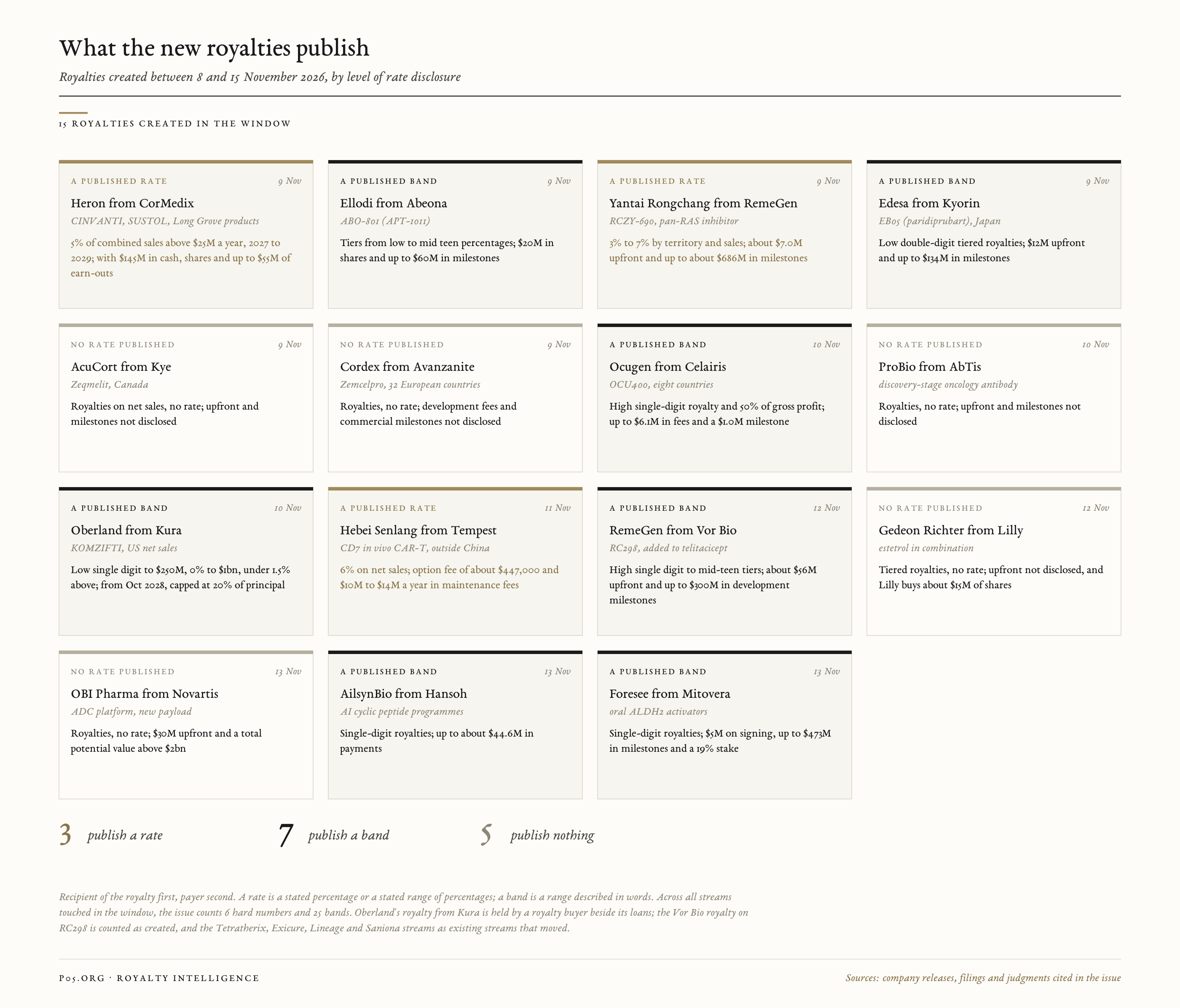
The fifteen royalties created in the window, by what each publishes. Three publish a rate (CorMedix to Heron, RemeGen to Yantai Rongchang and Tempest to Hebei Senlang), seven a band, and five, among them Novartis's royalty to OBI Pharma and Lilly's to Gedeon Richter, no rate at all.
Tracked royalty buyers inside the window: 2. Oberland took a capped royalty participation on US net sales of Kura's KOMZIFTI as part of its financing, and Blackstone Life Sciences agreed to fund up to USD 1.5bn of Pfizer's berobenatide programme for milestone payments; no royalty purchase was recorded.
Open at the start of the window. The tender offer for Pacira, which started on 30 October. Peach Purchaser, a Viatris subsidiary, filed its offer to purchase at "$36.50 per Share, to the seller thereof in cash", expiring "one minute after 11:59 p.m., Eastern Time, on November 16, 2026", and Pacira's board recommended acceptance in its Schedule 14D-9.
The waiting period under the HSR Act expired on 29 October. Viatris said in its third-quarter release of 5 November that "The transaction is expected to close by the end of November 2026", and its quarterly report of the same day that it "expects to fund the transaction primarily from excess cash with the remainder from short-term borrowings".
Pacira's first amendment to its Schedule 14D-9, filed on 3 November, adds employee materials and leaves the terms unchanged. Pacira said on 5 November that it "will not issue an earnings release for the quarterly period ended September 30, 2026, nor will it hold a conference call" and is withdrawing its 2026 guidance.
Pacira's quarterly report of the same day sets the fee it would owe Viatris on termination at "$ 62.0 million" and carries the Flexion contingent value rights at USD 3.0m, against payments that "could aggregate up to a total of $ 372.3 million" on milestones reached by 31 December 2030.
Pacira's tender offer expires one minute after 11:59 p.m. Eastern Time on 16 November, which is 05:00 UTC on 17 November, after the cut-off; no further amendment had been filed by 07:36 UTC on 15 November. Viatris's amendment of 12 November leaves the USD 36.50 price and the expiry unchanged and only updates the litigation passage: two stockholder complaints, Carroll v. Pacira BioSciences (Index No. 656215/2026) and Burke v. Pacira BioSciences (Index No. 656243/2026), and "fifteen demand letters".
Pacira's amendment to its Schedule 14D-9 of the same day adds that "The Pacira Defendants have not been served with the Complaints."
Pacira also disclosed the same evening that the Ninth Circuit, on 6 November, held "that the Company owes royalties on EXPAREL manufactured using its 200-liter process" to the Research Development Foundation. RDF "asserted that the issuance of that patent extends the Company's royalty obligations under the agreement until 2041"; Pacira is evaluating its legal options.
The reopening of the terms of the Recordati offer, which ends on 9 November, with payment for the reopening due "on 17 November 2026" per the offeror's final results notice of 26 October. A notice of 6 November says the CVC Investor "directly holds a total of no. 13,008,136 Recordati shares, representing approximately 6.220%", with Respighi BidCo unchanged at about 74.581 per cent.
The offeror's notice of 7 November says the offeror and the CVC Investor together "would hold an aggregate shareholding consisting of 180,395,563 Shares", "representing 86.262% of the Issuer's share capital", and that the reopening "will end at 5:30 p.m. (Italian time) on 9 November 2026".
The offeror's provisional results notice of the same evening says that 22,208,274 shares, "representing approximately 10.620% of the Issuer's share capital", were tendered in the reopening for about USD 1.37bn (EUR 1,177,038,522), and that the offeror and the CVC Investor will hold "approximately 91.928%".
The notice is headed "RECORDATI SHARES WILL BE DELISTED FROM EURONEXT MILAN": the offeror will use its right to purchase the remaining shares, "thereby implementing the Joint Procedure". Payment for the reopening stays on 17 November.
The offeror's final results notice of 13 November puts the holding at "approximately 91.923%" and sets the Joint Procedure on "the remaining aggregate maximum no. 16,890,530 Shares" at "Euro 53.00 for each Remaining Share", up to about USD 1.04bn (EUR 895,198,090) in all, on 24 November. Borsa Italiana will suspend the shares on 20 and 23 November and delist them "with effect from the trading session of Tuesday, 24 November 2026".
The closing of Bolt's USD 120m placement, expected on 26 October. Bolt's third-quarter release of 12 November says that "In October, Bolt completed its acquisition of Prana Therapies in a sign-and-close, stock-for-stock reverse merger and closed a concurrent $120 million private placement financing", which closes this item.
A Schedule 13G filed by Coastlands Capital on 6 November, with an event date of 30 October, counts "430,746 shares of Common Stock issued on October 23, 2026, as disclosed in the Current Report on Form 8-K filed by the Issuer on October 23, 2026" and excludes the Series D convertible preferred stock and warrants it also holds.
The closings of the offerings priced in W45 by Precision BioSciences (about USD 125m), INOVIO (about USD 75m), Orchestra BioMed (about USD 75m) and Annovis Bio (about USD 21.0m), and of the private placements agreed by Lyell Immunopharma (about USD 80m) and Evommune (about USD 30m).
Orchestra BioMed's final prospectus supplement expects delivery of the shares "on or about November 9, 2026". INOVIO's current report of 9 November says "On November 6, 2026, the Underwriters exercised the option to purchase 10,714,285 additional shares of Common Stock, in full", with "net proceeds" now "expected to be approximately $80.5 million" and closing "on or about November 9, 2026".
Annovis Bio announced on 9 November that its offering of about USD 21.0m closed on 6 November. Precision BioSciences' current report of 9 November restates the offering terms and does not report a closing. Orchestra BioMed's current report of 9 November says "Gross proceeds from the Offering were approximately $86.3 million", after the option was "exercised in full on November 6, 2026", and "The Offering closed on November 9, 2026."
INOVIO's third-quarter release of 10 November refers to "Net proceeds of $80.5 million from recently completed public offering". A Schedule 13D amendment filed by RA Capital on 10 November counts "4,966,889 shares of common stock issued in the private placement of equity securities by the Issuer that closed on November 6, 2026", the Evommune placement.
A Schedule 13G amendment filed by ARCH Venture on 10 November counts "7,428,040 shares of Common Stock sold by the Issuer in a private placement transaction on November 4, 2026", the Lyell placement; Lyell's resale registration of 13 November confirms that the shares "were sold to the selling stockholders in a private placement that closed on November 4, 2026". No closing of the Precision BioSciences offering had been filed by 07:36 UTC on 15 November.
The closing of the term loan of up to USD 750m led by HealthCare Royalty for Rhythm Pharmaceuticals, on which the amendment of Rhythm's existing revenue interest financing agreement becomes effective. Rhythm's third-quarter release describes "a five-year term loan facility led by KKR's HealthCare Royalty ("Healthcare Royalty") in partnership with Blackstone Life Sciences". No closing had been filed by 07:36 UTC on 15 November.
The closing of the sale of mitazalimab by Alligator Bioscience to Biossil, agreed on 31 October, where "Closing is expected within 30 days of signing". No closing had been reported by 07:33 UTC on 15 November; Alligator's financial calendar lists an extraordinary general meeting on 27 November.
The Karyopharm Chapter 11 sale process with Ayrmid as lead bidder (In re Karyopharm Therapeutics Inc., Bankr. S.D. Tex., No. 26-90827). A current report filed on 5 November says "Trading of the Company's common stock will be suspended on Nasdaq at the opening of business on November 11, 2026"; the company expects the transaction "to close in the first quarter of 2027", subject to court approval.
Its notice of late filing of 13 November confirms that "On November 11, 2026, the Nasdaq Stock Market (“Nasdaq”) suspended trading of the Company’s common stock."
The ANI Pharmaceuticals cash offer for Egetis Therapeutics, whose acceptance period "is expected to commence on or around 20 November 2026 and expire on or around 18 December 2026", per the Egetis board statement; the offer document had not been published by 07:33 UTC on 15 November.
Post-trial briefing in Exelixis's CABOMETYX patent case against MSN, after the bench trial that ended with closing arguments on 5 November, per the docket, where the minute entry of that day reads "The parties were directed to submit a stipulation and proposed order setting forth the agreed upon schedule". A stipulation and an order followed on 9 November (D.I. 279 and 280), and ten redacted documents and an exhibit list on 13 November (D.I. 281 to 291); none of these texts is public on the docket.
The Paradigm administrators said on 28 October that "the Supreme Court of Western Australia has approved a three (3) month extension of the convening period for the second meeting of creditors until 27 January 2027", after the hearing of 27 October; they expect to issue their report and convene the meeting "in the coming weeks".
The emergency motion connected to the BioXcel sale order and the appeal against the sale order, filed on 26 October, per the docket; the hearing of 30 October was cancelled by an agenda filed on 28 October, with no reason given in the docket text; the sale itself has completed. The debtors filed a plan supplement on 13 November (D.I. 330), and the hearing on the plan is set for 3 December.
The clearance of Labcorp's purchase of BioReference testing businesses from OPKO Health. Labcorp's quarterly report of 30 October says the deal "is anticipated to close mid-2027", and OPKO's quarterly report of 4 November that the parties may terminate "if the transaction has not closed by April 14, 2027". No clearance had been reported by 07:36 UTC on 15 November.
The scheme document for Silence, the QIAGEN offer document after clearance by BaFin, and the pricing of the initial public offering of Windward Bio. Windward Bio's amended registration statement of 9 November offers 10,294,117 common shares at a price "estimated to be between $16.00 and $18.00", and says "Sanofi has agreed to purchase, in a private placement, 1,532,691 common shares and pre-funded warrants to purchase 1,408,485 common shares for an aggregate purchase price of $50.0 million".
Windward Bio registered its common shares on the Nasdaq Stock Market after the close on 9 November, and Nasdaq filed its certification of the listing at 19:15 UTC on 12 November. Windward Bio priced at 23:18 UTC on 12 November at USD 17.00 a share, the middle of the range (see Public capital). Silence's quarterly report of 13 November says "The Transaction is expected to close in the first quarter of 2027"; neither a Silence proxy statement nor a QIAGEN Schedule TO had been filed on EDGAR by 07:38 UTC on 15 November.
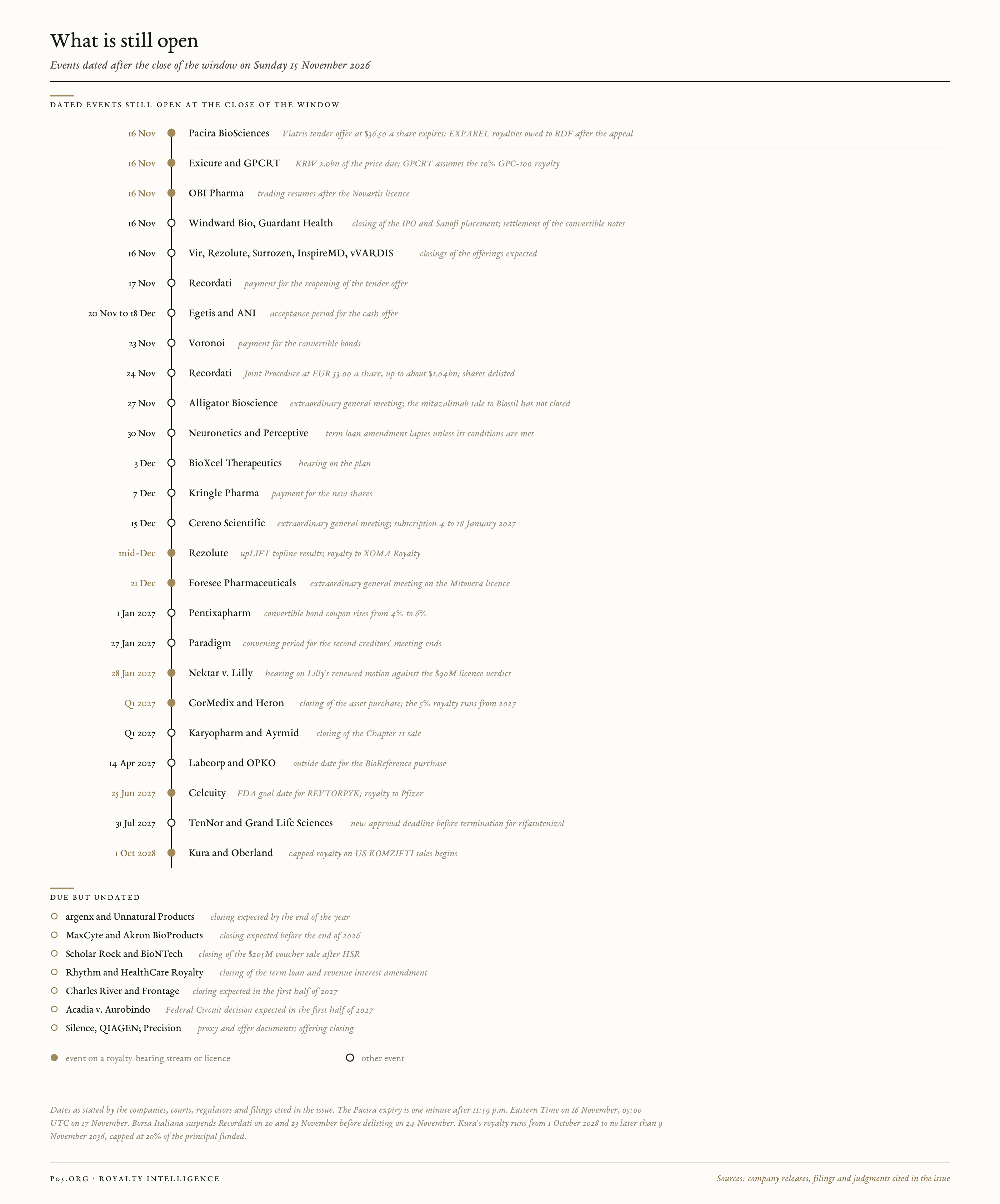
Events dated after the close of the window, from the expiry of the Viatris tender offer for Pacira on 16 November to the start of Oberland's capped royalty on US KOMZIFTI sales on 1 October 2028. Gold marks an event on a royalty-bearing stream or licence.
M&A and Restructuring
figures/w46_timeline.png The window day by day, dated by primary release or filing. Monday 9 November carried six of the fifteen royalties created, among them CorMedix's purchase of Heron's assets, and nine clinical and regulatory items; Friday 13 November the OBI, Hansoh and Foresee licences, six clinical and regulatory items and nine capital and court items.

argenx and Unnatural Products: USD 550m upfront and up to USD 595m in milestones for a peptide discovery company (Monday 9 November)
argenx (Euronext and Nasdaq: ARGX) agreed to acquire Unnatural Products (UNP), a private developer of macrocyclic peptides, at 06:00 UTC. argenx "already holds a minority stake in UNP, will acquire all remaining shares".
- Consideration: "an upfront payment of $550 million in cash on hand and up to $595 million in payments contingent on achievement of specified development and regulatory milestones", for a total of up to about USD 1.15bn.
- Form of the contingent part: UNP's own release describes it as "$550 million upfront plus contingent value rights tied to development and regulatory milestones".
- Existing partners: UNP has "partnerships with Novartis, Merck, and BridgeBio"; the terms of those agreements are not given.
- Timing: "expected to close by the end of the year, subject to customary closing conditions".
- Advisers: Morgan Stanley is financial adviser and DLA Piper legal adviser to argenx; argenx's report to the SEC adds that "Latham & Watkins LLP is serving as legal counsel to UNP".
- Instrument: acquisition for cash with contingent value rights.
- Royalty read-through: about 52 per cent of the potential value is contingent on milestones, and the selling shareholders hold the contingent rights.
CorMedix and Heron Therapeutics: USD 145m in cash, shares, up to USD 55m in earn-outs and a 5 per cent royalty for substantially all of Heron's assets (Monday 9 November)
CorMedix Therapeutics (Nasdaq: CRMD) agreed to buy substantially all of the assets of Heron Therapeutics (Nasdaq: HRTX), including ZYNRELEF, APONVIE, CINVANTI and SUSTOL, at 12:00 UTC. Heron stays listed and keeps the earn-out and royalty rights.
- Upfront: "$145 million in cash, subject to customary purchase price adjustments, plus 14,583,333 shares of CorMedix common stock", which the release values at "approximately $222.6 million" in total.
- Earn-outs: "$25 million if ZYNRELEF net sales equal or exceed $65 million for calendar year 2028, plus an additional $30 million if ZYNRELEF net sales equal or exceed $95 million for calendar year 2028".
- Royalty: "A 5% royalty on the portion of combined annual net sales of CINVANTI, SUSTOL and the products covered by Heron's multi-product Development and License Agreement which exceed $25 million in calendar year 2027, calendar year 2028 and calendar year 2029."
- Financing: CorMedix's current report describes a new senior secured term loan with funds managed by Pharmakon Advisors, with interest at "three-month Term SOFR, subject to a floor of 3.50%, plus 5.75% per annum". The "Tranche A Loan" of USD 75m is "to be used to fund the Proposed Transaction" and is "available to be funded on or prior to May 8, 2027, subject to the consummation of the Proposed Transaction"; a Tranche B Loan of up to USD 75m may fund other acquisitions.
- Lenders: BioPharma Credit said on 10 November that it "will invest up to US$50 million and BioPharma-V will invest up to an additional US$100 million in parallel". The loan will "mature five years after the first funding date", and "A one-time additional consideration of 1.50 per cent of each tranche is payable by CorMedix upon the funding of each respective tranche"; Tranche B is available "until 30 June 2028, in connection with the in-licensing or acquisition of commercial-stage pharmaceutical products".
- Seller's terms: Heron's own current report sets a "$4.0 million termination fee" and expense reimbursement "up to $2.5 million", with an outside date "six months after the date of the Purchase Agreement". Heron will exchange its "senior unsecured convertible notes due 2031 in an aggregate principal amount of $35.0 million" held by Rubric for CorMedix shares it receives.
- Heron after closing: the CorMedix shares are locked up for six months, after which Heron "may distribute such shares pro rata to its stockholders". Heron says its opportunities "may include, but are not limited to, the acquisition of products, product candidates, milestone payments and royalty streams".
- Licence and escrow: Heron's quarterly report names the licensor of the third product group: the royalty covers "the products covered by the Company's multi-product Development and License Agreement (the "License Agreement") with Long Grove Pharmaceuticals, LLC". Of the cash, "$2.0 million will be deposited into escrow", and post-closing adjustments "may not exceed $10.0 million in either direction".
- Heron's soliciting material: Heron's communications filed after the close on 9 November say "Hercules Capital is expected to be repaid at closing from the upfront cash consideration", that the Rubric exchange "is expected to occur in four quarterly tranches following the closing", and that "Stockholders representing approximately 22% of Heron's outstanding common stock, including Rubric, have agreed to vote with their shares in favor of the transaction".
- Timing: closing is expected in the first quarter of 2027, subject to Heron's shareholder vote and HSR clearance.
- Instrument: asset purchase for cash, shares, earn-outs and a royalty, funded by a term loan.
- Buyer's guidance: CorMedix's third-quarter release of 12 November expects "an anticipated revenue contribution of between $125 million and $150 million for the full-year 2027" from the Heron assets, which it says would "effectively double the Company's non-DefenCath annual product revenue".
- Royalty read-through: a new three-year inbound royalty for Heron above a USD 25m threshold, payable by CorMedix, alongside USD 55m of sales-based earn-outs.
Charles River and Frontage: about USD 470m and up to USD 75m in earn-outs for the bioanalysis and DMPK business, inside a privatisation with Tigermed (Monday 9 November)
Charles River Laboratories (NYSE: CRL) agreed to acquire the bioanalysis and drug metabolism and pharmacokinetics business of Frontage Holdings (HKEX: 1521) in Exton, Pennsylvania, at 11:10 UTC. The purchase sits inside a scheme to take Frontage private, set out in a joint announcement on HKEX by an offeror owned by Hongkong Tigermed, Charles River and Frontage's chairman.
- Charles River's price: "approximately $470 million in cash, subject to customary closing adjustments" and "additional payments of up to $75 million, contingent on future performance of the acquired businesses".
- Scheme price: a "Cancellation Price of HK$2.370 per Scheme Share", a premium of "approximately 107.9% over the closing price of HK$1.140" on the undisturbed date.
- Earn-out to scheme shareholders: for 2026, "US$5.00 for every US$1.00 by which such revenue exceeds US$114,000,000, up to a maximum aggregate 2026 Earnout Payment of US$50,000,000", and for 2027 up to USD 25.0m, each subject to an adjusted EBITDA margin test.
- Control: after the separation, "CRL shall have the sole control of the Target Business".
- Timing: closing is expected in the first half of 2027, subject to shareholder, court and regulatory approvals.
- Instrument: carve-out acquisition for cash with performance earn-outs, within a take-private scheme.
- Royalty read-through: no royalty; up to USD 75m of the value is contingent on the acquired business's revenue and margin in 2026 and 2027.
PharmaLogic and Lantheus (Monday 9 November). PharmaLogic Holdings, a private radiopharmacy and contract manufacturing group, agreed at 21:05 UTC "to acquire the CDMO business and Springfield, New Jersey manufacturing facility" from Lantheus Holdings (Nasdaq: LNTH). "The financial terms of the transaction were not disclosed."
The deal "also includes a long-term supply agreement under which Agilera will manufacture lutetium Lu 177 dotatate for Lantheus". Lantheus's own current report, filed after the close, dates the definitive agreement 8 November and says "the parties will enter into a long-term supply agreement under which PharmaLogic's therapeutic CDMO franchise, Agilera, will manufacture lutetium Lu 177 dotatate for the Company"; it gives no price. Instrument: carve-out acquisition with a supply agreement.
Spruce Biosciences and Adrenyx (Monday 9 November). Spruce Biosciences (Nasdaq: SPRB) said that "On November 6, 2026, Spruce separated the company's CRHX-101 (formerly SPR-202) program" into Adrenyx Biosciences, "a newly formed wholly-owned subsidiary of Spruce", which secured convertible notes of up to USD 10.0m from an institutional biotechnology investor.
Spruce "currently intends to distribute all of the outstanding shares of Adrenyx common stock to Spruce stockholders on a pro rata basis", and amended its Avenue term loan. Instrument: separation into a subsidiary financed by secured convertible notes.
Coherus Oncology (Monday 9 November). Coherus Oncology (Nasdaq: CHRS) announced after the close a "Strategic Prioritization Plan" that "reduces headcount by ~30%" and focuses tagmokitug with toripalimab on oesophageal cancer. "LOQTORZI revenue for Q3 2026 was $14.0 million", and cash, cash equivalents and marketable securities "totaled $83.6 million as of September 30, 2026".
Its quarterly report, filed the same evening, says its losses and "need for additional funding to support planned operations, raise substantial doubt about our ability to continue as a going concern".
The company expects to lower "our core cash burn by $6 million to $7 million quarterly". Instrument: restructuring.
MaxCyte and Akron BioProducts (Tuesday 10 November). MaxCyte (Nasdaq: MXCT) agreed on 9 November to buy Akron BioProducts, a supplier of cell-therapy manufacturing materials, from affiliates of Arcline, and announced it at 11:00 UTC. The consideration is "$105.0 million in cash payable at the closing", subject to adjustments, "20,639,733 shares" of MaxCyte common stock and "$20.0 million in guaranteed, deferred cash payments, consisting of $10.0 million each", due on the first business days of 2028 and 2029.
The deal needs HSR clearance and Nasdaq listing of the shares, has no financing condition or shareholder vote, and is expected to close before the end of 2026. Instrument: acquisition for cash, shares and deferred cash.
AstraZeneca and Omniose (Tuesday 10 November). Omniose, a preclinical bioconjugate vaccine company, announced at 13:00 UTC "that it has been acquired by AstraZeneca", after a three-year exclusive research collaboration, and "has become a wholly owned subsidiary" of AstraZeneca. No terms were disclosed. Instrument: completed acquisition, terms undisclosed.
Dechra and Gallant Pet (Monday 9 November). Dechra, the veterinary pharmaceuticals company, announced an agreement to acquire Gallant Pet, "a U.S.-based animal health biotechnology company pioneering off-the-shelf mesenchymal stromal cell therapies for pets". "Completion of the transaction remains subject to customary closing conditions. The parties have agreed that the terms of the transaction will remain confidential." Instrument: agreed acquisition in animal health, terms undisclosed.
Cellectis (Thursday 12 November). Cellectis (Nasdaq: CLLS; Euronext Growth: ALCLS) said in its third-quarter release that it "currently expects its global headcount to be reduced by up to 70% from its pre-transition level over the course of 2026 and 2027, subject to the completion of the applicable French works council consultation process". Its interim report says it has "determined to exit the development of lasme-cel and eti-cel, while seeking strategic partnering opportunities".
The company keeps "its existing cell therapy partnerships with AstraZeneca, Allogene, Servier and Iovance" and held "Cash, cash equivalents and fixed-term deposits of $149 million as of September 30, 2026", with a "cash runway into H2 2028". Instrument: workforce reduction and pipeline exit. Royalty read-through: the two clinical CAR-T programmes are open to partnering, and the out-licensed programmes continue.
Nuformix and Biovara (Wednesday 11 November). Nuformix (LSE: NFX) announced at 07:00 UTC heads of terms to acquire Biovara, "a privately owned UK pharmaceutical development company", by share-for-share exchange, "envisaged as a merger of equals, with the combined valuation of the enlarged group to be agreed". They "provide for an exclusivity period of six months and a transaction long-stop date of 30 April 2027" and are "principally non-binding"; completion requires a move from the Main Market to AIM, and the deal "may constitute a reverse takeover".
The announcement does not name Biovara's owner. Nuformix's annual results call Biovara a subsidiary of Oxilio, which bought the NXP001 aprepitant patents in 2023 while Nuformix "retained rights to receive further development milestones and royalties capped at £2 million per year" (about USD 2.7m). Instrument: non-binding heads of terms for an all-share merger. Royalty read-through: Nuformix would merge with a subsidiary of the company that owes it the NXP001 milestones and capped royalty; whether Biovara's LipAprep falls under that royalty is not stated.
IMVIONIX and Novartis (Tuesday 10 November). IMVIONIX, a private company founded in 2025 with Caligan Partners and Velan Capital, acquired at 14:30 UTC "exclusive commercial rights to BEOVU (brolucizumab-dbll) in the United States and Canada from Novartis" and will become the marketing authorisation holder there. "Financial terms of the transaction were not disclosed." Instrument: regional product acquisition, terms undisclosed.
PAI Pharma and Nexus Pharmaceuticals (Thursday 12 November). PAI Pharma, "a portfolio company of Olympus Partners", announced at 18:00 UTC "the acquisition of Nexus Pharmaceuticals, LLC", which brings "an established commercial portfolio of over 20 hospital injectable products". No price or other terms were disclosed. Instrument: private equity-backed acquisition, terms undisclosed.
Lineage Cell Therapeutics and NeuroAirmid (Thursday 12 November). Lineage (NYSE American: LCTX) bought NeuroAirmid Therapeutics, developer of the neural stem cell therapy HUNT1 for Huntington's disease, in the Phase 1b/2a REGEN4HD study, signing and closing on 12 November and announcing it at 21:03 UTC. At closing Lineage "paid $2.4 million in cash to the Sellers" and issued "2.2 million Lineage common shares", calculated from USD 2.1m.
It also agreed to pay "up to $5.4 million on the first anniversary of the closing" and "up to $48.0 million in the aggregate contingent upon achievement of specified clinical development and regulatory milestones". For each qualifying deal on the programme within ten years it owes "the greater of (i) a low seven-figure dollar amount and (ii) a single-digit percentage of those proceeds".
Lineage's release, filed with the same report, rounds the figures differently: "Upon closing of the transaction, Lineage paid approximately $4.7 million to NeuroAirmid investors, approximately half in cash and half in shares", and "A second payment of up to $5 million will be due" on the first anniversary.
The licence from the Regents of the University of California was amended and restated: "Lineage must pay quarterly royalties on net sales by Lineage and its sublicensees, determined by product and country, at percentages in the low single digits", plus "a percentage of sublicensing income in the low double digits". Instrument: acquisition for cash, shares, milestones and a share of deal proceeds. Royalty read-through: an upstream university royalty moves to a listed acquirer.
Gedeon Richter and Eli Lilly (Thursday 12 November). Gedeon Richter (BSE: RICHTER) announced a licence under which it "will grant Lilly exclusive, worldwide rights to develop, manufacture and commercialize medicine(s) containing E4 in combination with Lilly compound(s) for the treatment of women's health conditions and cardiometabolic diseases". Lilly also takes an option to co-commercialise Richter's oral estetrol monotherapy in the United States, approved in the European Economic Area as FYLREVY and under FDA review for vasomotor symptoms.
Lilly will make an upfront cash payment of an undisclosed amount, and Richter "will be eligible for regulatory and commercial milestone payments and tiered royalties on net sales of combination products". Lilly buys 381,354 Richter shares from treasury "for a total consideration of approximately USD 15 million"; the agreements need HSR clearance. Instrument: worldwide licence with a share purchase and a supply agreement.
OBI Pharma and Novartis (Friday 13 November). OBI Pharma (TPEx: 4174), whose shares were halted from 13 November pending a material announcement, signed a collaboration and licence agreement with Novartis Pharma AG for next-generation antibody-drug conjugates carrying a new payload, per the Economic Daily News report of 16:13 Taipei time. Novartis takes "全球獨家授權" (a global exclusive licence) to OBI's "相關ADC平台技術、專利及專業技術知識" (related ADC platform technology, patents and know-how) for "特定且尚未公開的藥物載荷" (specific, undisclosed payloads).
OBI's filing with the Taipei Exchange at 01:37 UTC on 14 November says "本公司將收取簽約金美金3,000萬元,並得依後續研發、法規核准及商業化進展收取里程碑款,總潛在交易價值超過美金20億元" (the company will receive a USD 30m signing fee and may receive milestone payments on development, regulatory approval and commercial progress, for a total potential deal value above USD 2bn). It adds "另得依授權產品淨銷售額收取權利金" (and may receive royalties on net sales of licensed products), with no rate, and cautions that the potential value "包含附條件之里程碑款,未必全數取得" (includes conditional milestones that may not all be received).
The exclusivity of the licence and a Novartis option to extend the collaboration to other payload classes are reported by the Economic Daily News and are not in the filing; OBI's own release is password-protected beyond its opening summary. Trading in OBI's shares resumes on 16 November. Instrument: platform licence with upfront, milestones and royalties. Royalty read-through: a new net-sales royalty at an undisclosed rate.
Covetrus, MWI Veterinary Supply and the FTC (Friday 13 November). The Federal Trade Commission sued in the Southern District of New York, joined by a group of states, to block the USD 3.5bn purchase of MWI Veterinary Supply from Cencora by Covetrus, which is owned by Clayton, Dubilier & Rice and TPG. The case was opened under seal as Federal Trade Commission v. CVET Topco, L.P. (No. 1:26-mc-00577).
Covetrus replied that "the FTC's lawsuit does not reflect an accurate understanding of how veterinarians actually buy the products they need" and that "we are fully prepared to defend them in court". Instrument: merger challenge in animal health distribution.
Royalty-Bearing Positions
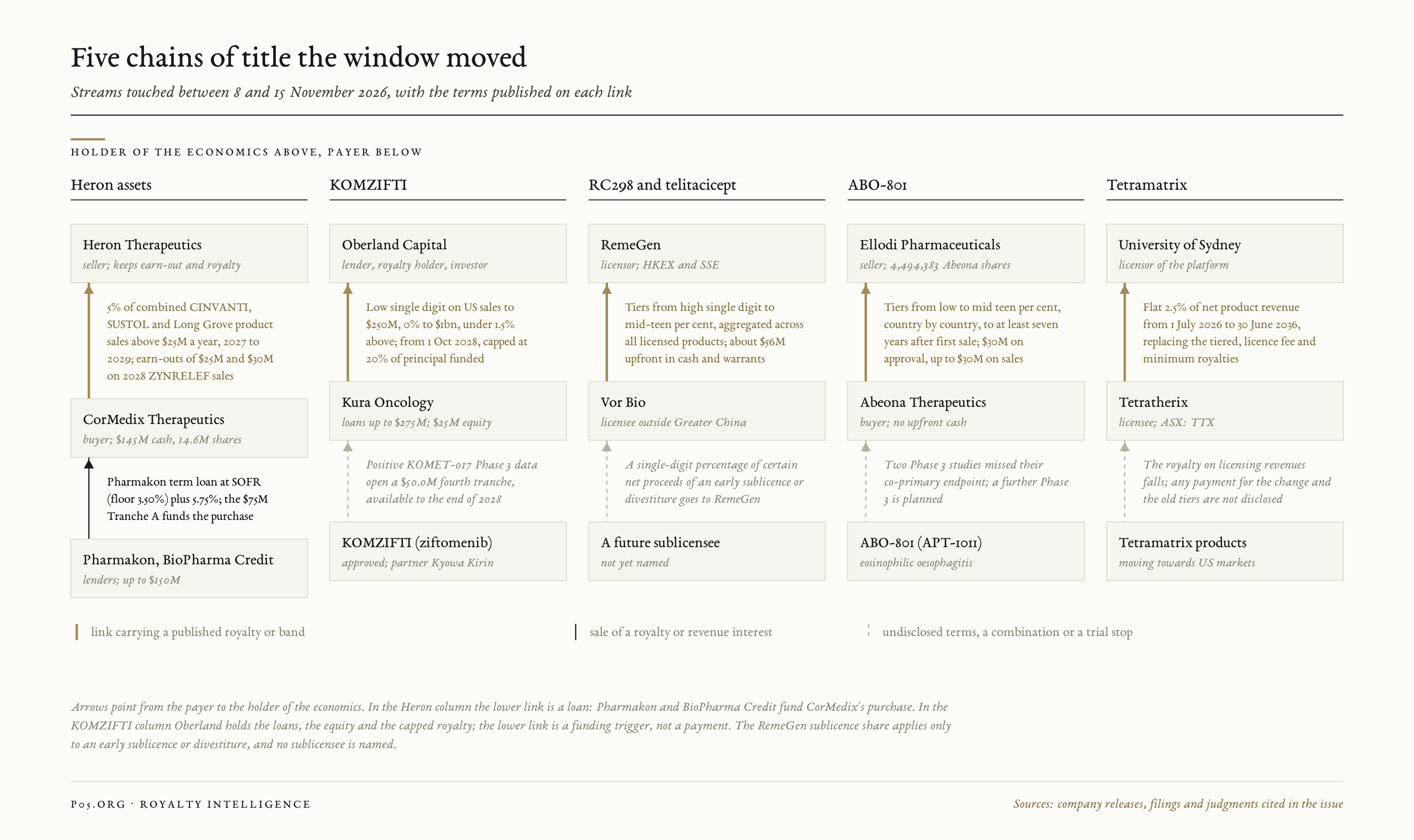
Five chains of title the window moved, with the holder of the economics above and the payer below: the Heron assets, KOMZIFTI, RC298 and telitacicept, ABO-801 and Tetramatrix, with the terms published on each link.
Tetratherix and the University of Sydney: tiered royalty replaced by a flat 2.5 per cent to 2036 (Monday 9 November)
Tetratherix (ASX: TTX) executed "a new Revenue Sharing Agreement with the University of Sydney", which licensed the Tetramatrix platform that began with its founder's doctoral research there. The release was lodged on the ASX at 22:22 UTC on 8 November.
- Effective date: "Effective from 1 July 2026, the agreement replaces the previous royalty and reporting obligations summarised in section 7.3(c) of TTX's Prospectus dated 4 June 2025".
- New rate: "the University will receive a flat royalty of 2.5% of net product revenue across TTX's product sales for a fixed term to 30 June 2036. This replaces the previous tiered royalty, licence fee royalty and indexed minimum royalty."
- Effect stated by the company: "The new single, flat royalty reduces the royalties payable on licensing revenues", per chief executive Will Knox, who says products are "now moving towards markets in the United States and beyond".
- Not disclosed: any payment for the change, and the previous tiers.
- Instrument: amendment of an upstream university licence.
- Royalty read-through: an outbound royalty is reset to a single rate on product revenue with a fixed end date, and the royalty on licensing revenues falls.
Kyorin and Edesa Biotech: Japanese rights to EB05 for USD 12m upfront, up to USD 134m in milestones and tiered royalties (Monday 9 November)
Kyorin Pharmaceutical (TSE: 4569) announced a licence from Edesa Biotech (Nasdaq: EDSA) for EB05 (paridiprubart), an antibody for acute respiratory distress syndrome, filed on TDnet at 06:30 UTC. "KYORIN has obtained the exclusive rights to develop and commercialize EB05 in Japan."
- Upfront and milestones: "KYORIN will make an upfront payment of USD 12 million to Edesa, along with milestone payments of up to USD 134 million based on the progress of development, NHI price listing, and the achievement of certain net sales targets."
- Royalty: "Additionally, royalties based on net sales will be paid to Edesa"; the Japanese filing describes them as tiered royalties on net sales (正味売上高に応じた段階的ロイヤリティ). Edesa's current report, filed at 11:05 UTC, says "Kyorin will pay the Company low double-digit tiered royalties on net sales of licensed products in the Licensed Territory, subject to specified reductions and adjustments".
- Milestone split: the same report gives "development and regulatory milestone payments of up to $55 million in the aggregate and sales-based milestone payments of up to ¥12.0 billion in the aggregate" (about USD 82m).
- Term: the licence runs "until the fifteenth anniversary of the first commercial sale of a licensed product in the Licensed Territory, subject to automatic renewal for successive two-year periods".
- Development: "Edesa and KYORIN intend to collaborate on future clinical development of EB05 in ARDS, with KYORIN responsible for clinical development activities in Japan."
- Upstream: EB05 is licensed to Edesa by NovImmune under an agreement of 17 April 2020; Edesa also gave notice ending its at-the-market facility with H.C. Wainwright from 16 November.
- Instrument: regional licence with upfront, milestones and royalty.
- Royalty read-through: a new inbound royalty stream for Edesa on Japanese sales, in a low double-digit tiered band; Edesa's quarterly report says it owes NovImmune "a percentage of any sublicensing revenue" in countries where it does not commercialise directly.
AcuCort and Kye Pharmaceuticals (Monday 9 November). AcuCort (Spotlight: ACUC) signed an exclusive licence and distribution agreement for Zeqmelit, its dexamethasone oral film, in Canada. "AcuCort will receive an upfront payment and milestone payments, revenue from product supply to Kye, and will also be entitled to royalties based on net sales."
No amounts or rates are disclosed. "The regulatory submission is planned for early 2027", and launch "is expected in 2028" subject to approval by Health Canada. Instrument: regional licence and supply agreement with upfront, milestones and royalties.
XtalPi and Pierre Fabre (Monday 9 November). XtalPi (HKEX: 2228) announced a research collaboration under which it will "de novo design and deliver novel small molecule therapeutics against undisclosed targets" in oncology, "and potentially dermatology and rare diseases", with Pierre Fabre Médicament "responsible for subsequent clinical and commercial development".
"The Collaboration includes an upfront payment, multiple milestone payments and downstream economic participation." No amount or rate is disclosed. A joint release of Laboratoires Pierre Fabre and XtalPi, dated 9 November on PR Newswire, says the specific financial terms have not been disclosed ("具体的な財務条件は公表されていません") and does not mention a royalty. Instrument: research collaboration with upfront, milestones and downstream economics.
Abeona and Ellodi: USD 20m in shares, up to USD 60m in milestones and tiered royalties from the low to the mid teens for ABO-801 (Monday 9 November)
Abeona Therapeutics (Nasdaq: ABEO) bought APT-1011, renamed ABO-801, an orally disintegrating fluticasone tablet for eosinophilic oesophagitis, from Ellodi Pharmaceuticals, announced at 11:30 UTC. The agreement was signed and closed on 6 November.
- Upfront: "the Company issued to Ellodi $20 million in value of Company common stock", "which amounted to 4,494,383 shares", per Abeona's current report; there is "No upfront cash consideration".
- Milestones: "$30 million upon FDA approval of a New Drug Application for APT-1011 and up to $30 million upon the achievement of certain sales milestones".
- Royalty: "royalty percentage tiers ranging from low to mid teen percentages", expiring country by country on the latest of the last valid claim, regulatory exclusivity and "the seventh anniversary of the first commercial sale".
- Stage: two Phase 3 studies were completed; "neither Phase 3 study met its prespecified co-primary patient-reported symptom endpoint". A further Phase 3 is planned.
- Financing: Abeona also agreed a private placement of about USD 30m at USD 3.75 a share.
- Instrument: asset purchase for shares, milestones and royalties.
- Royalty read-through: a new outbound royalty to Ellodi in a low to mid teen band, contingent on approval of a product whose first two Phase 3 trials missed their primary endpoint.
RemeGen and Yantai Rongchang: about USD 7.0m (RMB 50m) upfront, up to about USD 686m (RMB 4.87bn) in milestones and royalties of 3 to 7 per cent for a pan-RAS inhibitor (Monday 9 November)
RemeGen (HKEX: 9995; SSE: 688331) announced on HKEX at 13:28 UTC a licence from Yantai Rongchang Pharmaceutical, controlled by RemeGen's concert parties, to RCZY-690, a pan-RAS(ON) inhibitor. RemeGen receives "an exclusive, irrevocable, royalty-bearing and sublicensable license on a worldwide basis".
- Upfront: "a one-time, non-refundable upfront payment of RMB50 million" (about USD 7.0m).
- Milestones: "up to an aggregate amount of approximately RMB4,870 million" (about USD 686m), "among which up to an aggregate of RMB994 million was research and development related payments and up to an aggregate of approximately RMB3,876 million was sales related payments".
- Royalty: "royalties on annual net sales of Licensed Products at rates ranging from 3% to 7%, depending on the territory in which the relevant Licensed Products are commercialised and the level of annual net sales achieved".
- Stage: "RCZY-690 remains under clinical development".
- Conditions: a connected transaction requiring approval by RemeGen's independent shareholders.
- Instrument: worldwide in-licence from a related party with upfront, milestones and royalty.
- Royalty read-through: a new outbound royalty of 3 to 7 per cent from a listed company to a privately held affiliate of its controlling shareholders.
Avanzanite and Cordex (Monday 9 November). Cordex, an ExCellThera company, announced "exclusive licensing and supply agreements" granting Avanzanite Bioscience "commercialization rights for Zemcelpro® across 32 countries covering the European Economic Area, the United Kingdom and Switzerland", after the product's conditional marketing authorisation in Europe. Avanzanite's own release appeared at 06:00 UTC.
"The transaction includes development fees, commercial milestone payments and royalties", "supporting the funding of the planned Phase 3 trial". No amounts or rates are disclosed. Instrument: regional licence and supply agreement with development fees, milestones and royalties.
Ingenia Therapeutics and MSD (Monday 9 November). Ingenia Therapeutics (KOSDAQ) disclosed on DART at 09:36 UTC that it had received MSD's notice not to exercise its option on IGT-302 in glaucoma (옵션 미행사), ending that option. Ingenia had received USD 3.0m in co-development funding from EyeBio, now part of MSD, "해당 금액에 대한 반환 의무는 없습니다" (with no obligation to repay it). Instrument: lapse of a licence option.
JW Therapeutics and Eureka Therapeutics (Monday 9 November). JW (Cayman) Therapeutics (HKEX: 2126) agreed after trading hours to transfer to Eureka Therapeutics its rights under the 2020 licence for four autologous T-cell candidates against AFP and GPC3 in liver cancer, and to license related assets, for Greater China and ASEAN. Eureka's founder is a connected person of JW, and the deal is a very substantial disposal needing shareholder approval.
Per the Chinese version, Eureka pays "一次性預付款10百萬美元" (a one-off upfront payment of USD 10m) and, for any onward deal within 24 months, "交易代價百分之十(10%)" (10 per cent of the transaction consideration) for six years. Sales milestones "將不超過100百萬美元" (will not exceed USD 100m). Instrument: licence and asset transfer with a share of onward deal value.
TME Pharma and TMS (Tuesday 10 November). TME Pharma (Euronext Growth Paris: ALTME) disclosed at 07:30 UTC the terms of its exclusive negotiation agreement and non-binding term sheet with TMS Co., Ltd. for NOX-A12 in first-line glioblastoma, signed on 29 October. "The exclusive negotiation period of 6 months and the non-refundable exclusivity fee of €150,000 are binding", about USD 174,000.
The rest is non-binding: "Near term payments to TME Pharma of approximately € 10 million are conditional to signing of this definite agreement", about half in equity in a Japanese subsidiary of TMS. "Revenue potential from milestone payments is more than €100 million", and "Tiered royalties on net sales (8-10%) and a share of potential sublicensing revenues would be further in the future".
A definitive agreement "would only become effective once TMS' Japanese Subsidiary has secured enough funding for the GLORIA Trial to be restarted." Instrument: exclusivity fee with a non-binding licence term sheet.
Saniona and AstronauTx (Tuesday 10 November). Saniona (Nasdaq Stockholm: SANION) agreed "to sell its entire shareholding in AstronauTx Ltd ("AstronauTx") to existing AstronauTx investors for GBP 3.36 million (SEK 44.5 million) in cash", about USD 4.5m. Saniona received the shares in August when AstronauTx exercised its option on ATX0926.
"The transaction does not affect Saniona's rights under the collaboration, including potential milestone payments of up to USD 172 million and tiered royalties." No royalty rate is disclosed. Instrument: sale of licence-fee equity, with the royalty position retained.
Scholar Rock and BioNTech: rare paediatric disease voucher sold for USD 205m (Tuesday 10 November)
Scholar Rock (Nasdaq: SRRK) agreed on 9 November to sell the voucher awarded with the approval of ISEMBYLD to BioNTech, and disclosed it with its third-quarter results on 10 November. BioNTech said it "intends to use the PRV to support a future filing of an asset in its late-stage oncology pipeline."
- The voucher: a rare paediatric disease priority review voucher awarded "on September 11, 2026, upon approval of" ISEMBYLD (apitegromab-mstn).
- The price: "Buyer agreed to pay Scholar Rock $205 million, payable in cash, upon the closing of the sale."
- Conditions: closing is subject to the expiry or termination of the HSR waiting period; the agreement will be filed with Scholar Rock's 2026 annual report.
- The parties: the seller is Scholar Rock Inc., the subsidiary of Scholar Rock Holding Corporation; the buyer is BioNTech US Inc.
- Instrument: voucher sale for cash.
- Royalty read-through: no royalty; the price is USD 15m above the USD 190m Egetis received in W45.
Ocugen and Celairis Therapeutics: OCU400 licensed in Australia, New Zealand and six ASEAN countries for up to USD 7.1m, a high single-digit royalty and 50 per cent of gross profit (Tuesday 10 November)
Ocugen (Nasdaq: OCGN) licensed its Phase 3 modifier gene therapy OCU400 for retinitis pigmentosa to Celairis Therapeutics, a Sydney company founded in 2026, at about 12:00 UTC. Ocugen calls it its third regional partnership for OCU400; topline Phase 3 results are expected in the first quarter of 2027.
- Territory: an "exclusive, non-sublicensable, royalty-bearing license" in "Australia, Singapore, New Zealand, Malaysia, Thailand, Republic of the Philippines, Vietnam and Indonesia".
- Payments: "up to $6.1 million in the aggregate consisting of a fee, payable if the Company receives positive topline results from its Phase 3 LiMeliGht clinical trial of OCU400, and an up-front license fee", plus "a milestone payment of $1.0 million payable upon the approval of the licensed product by the Therapeutic Goods Administration in Australia".
- Royalty and profit share: "the Company will receive a high-single digit percentage royalty on net sales of the licensed product generated by Celairis in the Territory and 50% of gross profits derived by Celairis from net sales of the licensed product in the Territory."
- Supply: Ocugen keeps the sole right to manufacture; a supply agreement is to follow.
- Instrument: regional licence with upfront, milestones, royalty and profit share.
- Royalty read-through: a new inbound stream on a Phase 3 asset that combines a single-digit royalty with an equal split of gross profit; the upfront is not separated from the readout fee.
ProBio and AbTis (Tuesday 10 November). ProBio, the CRDMO of GenScript (HKEX: 1548), granted AbTis, a Dong-A ST subsidiary, "exclusive global rights to develop and commercialize a discovery-stage therapeutic antibody asset" against an oncology target at 14:38 UTC. "The agreement includes an upfront payment to ProBio, as well as potential developmental and commercial milestone payments and royalties on future sales"; no figures were given. Instrument: discovery-stage licence-out with royalties.
Exicure and GPCRT (Tuesday 10 November). Exicure (Nasdaq: XCUR) agreed at 20:50 UTC to sell its GPC-100 (burixafor) programme to GPCRT Inc. of Korea "for an aggregate cash purchase price of KRW 6.5 billion (approximately US$4.8 million)"; the assets "consist of the Company’s rights under its License and Collaboration Agreement with GPCR Therapeutics, Inc. dated January 19, 2025". The agreement was signed on 4 November.
The assignment agreement lists among the liabilities GPCRT assumes "Royalties of 10% on net sales of products containing GPC-100" owed to GPCR Therapeutics, together with "Future milestone payments #2–#7". KRW 2.0bn is payable by 16 November and KRW 4.0bn at closing, which needs GPCR Therapeutics' waiver and release. Instrument: programme and licence assignment with an assumed royalty.
Tempest Therapeutics and Hebei Senlang (Wednesday 11 November). Tempest (Nasdaq: TPST) announced at 13:53 UTC that it "has exercised its option" for an "exclusive license to develop and commercialize Senlang’s CD7-targeted lentiviral vector platform and associated in vivo CAR-T candidates worldwide, excluding China". The lead candidate is TPST-4903, a BCMA and GPRC5D dual-targeting candidate in a Phase 1 dose-escalation study in relapsed or refractory multiple myeloma.
The release gives no terms. Tempest's current report of 17 September sets an "option exercise fee of approximately $447,000", "annual maintenance fees escalating from $10 million to $14 million over the first three years (which the Company may elect to stop paying, with corresponding reductions to development timelines), a 6% royalty on net sales, and a share of any sublicense revenue". Instrument: option exercise creating an exclusive licence with a fixed royalty.
Kura Oncology and Oberland Capital: term loans of up to USD 275m, an equity investment and a capped royalty on US KOMZIFTI sales (Tuesday 10 November)
Kura Oncology (Nasdaq: KURA) disclosed with its third-quarter results at 21:02 UTC that it "Entered into a strategic financing agreement with affiliates of Oberland Capital providing up to $300 million in potential funding, including up to $275 million in debt financing and $25 million in equity investments". The agreements are dated 9 November; KOMZIFTI (ziftomenib) is approved in relapsed or refractory NPM1-mutant AML and partnered with Kyowa Kirin.
- At closing: "Received $55 million at closing, comprised of $50 million in debt funding, before fees, and a $5 million equity investment."
- Tranches: a USD 50.0m second tranche and a USD 25.0m third tranche at Kura's option; a USD 50.0m "fourth tranche available through December 31, 2028 following our announcement of positive clinical data from the KOMET-017 Phase 3 study of ziftomenib"; and a fifth tranche "subject to mutual agreement", per the quarterly report.
- Pricing: the loans "mature on November 9, 2033" and bear interest at three-month term SOFR "subject to a floor of 3.75%, plus 3.20%, with an overall annual interest rate cap of 8.95%"; for the first twelve quarters "50% is paid in kind and added to principal".
- Royalty: "we will owe a low single-digit royalty on the portion of annual net sales up to $250.0 million, 0% on the portion of annual net sales exceeding $250.0 million and up to $1.0 billion, and a less than 1.5% royalty on the portion of annual net sales exceeding $1.0 billion". The period "begins October 1, 2028" and ends no later than 9 November 2036; "The Cap Amount equals 20.0% of the aggregate principal amount funded under the Oberland Loan Agreement".
- Refinancing: "concurrent with the closing of the Oberland Loan Agreement, we terminated the Hercules Loan Agreement". Kura held USD 492.1m in cash, cash equivalents and short-term investments at 30 September.
- Instrument: senior term loan with an attached capped royalty participation and equity investment.
- Royalty read-through: a new outbound royalty on a launched product, capped at 20 per cent of the principal funded; the zero-rate middle band limits the holders' upside to the first USD 250m and to sales above USD 1bn.
Pfizer and Blackstone Life Sciences: up to USD 1.5bn of berobenatide development costs funded for approval and sales milestones (Wednesday 11 November)
Pfizer (NYSE: PFE) announced at 21:30 UTC that "funds managed by Blackstone will pay up to a total of $1.5 billion of development costs through 2028 for berobenatide", its monthly GLP-1 receptor agonist peptide for chronic weight management. Blackstone's perpetual private equity fund, BXPE, invests alongside the life sciences funds.
- The asset: berobenatide (PF'3944), with "10 ongoing and planned Phase 3 trials" in chronic weight management and obesity-related comorbidities including knee osteoarthritis and obstructive sleep apnoea.
- Return: "In exchange for the funding, Blackstone will be eligible to receive milestone-based payments, subject to U.S. regulatory approval of monthly dosing of injectable berobenatide monotherapy for chronic weight management, and achievement of certain commercial sales milestones."
- Timing: "Any milestone payments, if earned, will be payable to Blackstone over a multi-year period." No milestone amounts, return multiple or cap are disclosed.
- Rights: "Under the agreement, Blackstone does not acquire any rights or ownership in berobenatide, and Pfizer retains full operational control and decision-making with respect to the berobenatide program."
- Instrument: R&D co-funding repaid by approval and sales milestones.
- Royalty read-through: no royalty is created; the payments are approval and sales milestones, and the deal sits beside Blackstone Life Sciences' earlier development funding for Sanofi's SARCLISA and Boston Scientific's VITALYST.
Vor Bio and RemeGen: RC298 added to the telitacicept licence for about USD 56m upfront, up to USD 300m in development milestones and royalties from the high single digits to the mid teens (Thursday 12 November)
Vor Biopharma (Nasdaq: VOR) announced at 12:30 UTC that it has added RC298, a long-acting dual BAFF/APRIL inhibitor, to its licence from RemeGen (HKEX: 9995; SSE: 688331) for rights outside Greater China. The amended and restated agreement was signed on 11 November, per Vor's current report; RemeGen published its own announcement the same evening.
- Upfront: "approximately $56 million in aggregate upfront consideration, consisting of a $10 million upfront cash payment and pre-funded warrants to purchase 2.3 million shares of Vor Bio common stock", the warrants valued at about USD 46m on Vor's closing price of 11 November.
- Milestones: "up to an additional $300 million in development milestone payments, including $20 million payable upon the achievement of initial clinical development and technology transfer milestones".
- Whole licence: the current report lists "up to $330 million in regulatory milestone payments for the Initial Licensed Products, up to $300 million in development and commercial milestone payments for the Additional Licensed Products, and up to $3.775 billion in sales milestone payments for all Licensed Products".
- Royalty: "tiered royalties on net sales of the Licensed Products in the licensed territory, ranging from high single digit to mid-teen percentages of net sales, subject to customary reductions"; the release says the existing framework will apply "on an aggregated basis across all licensed products". RemeGen also receives "a single digit percentage of certain net proceeds" of an early sublicence or divestiture.
- Stage: RC298 "is currently in IND-enabling development, with an IND submission in China anticipated in the first half of 2027". Vor states a "Cash runway reaffirmed into early 2029".
- Instrument: amended and restated exclusive licence, paid in cash and pre-funded warrants.
- Royalty read-through: RemeGen's inbound royalty on telitacicept extends to a second product, with tiers and sales milestones applied on an aggregated basis.
Hansoh Pharmaceutical and AilsynBio (Friday 13 November). Hansoh Pharmaceutical (HKEX: 3692) announced that its subsidiary Hansoh (Shanghai) Healthtech signed a collaboration development agreement with AilsynBio, a Hong Kong AI-native biotechnology company, under which Hansoh "obtains a license to use AilsynBio's AI platform to discover novel oral cyclic peptide drug candidates". Hansoh "will have the right to select targets, acquire the intellectual property rights in the corresponding programs (the "Programs") and lead subsequent development".
AilsynBio "will be eligible to receive aggregate payments of up to RMB317 million and single-digit royalties on potential future net sales of products developed under the Programs", about USD 44.6m (RMB 317m) in payments. All percentage ratios are below 5 per cent, so the agreement is not a notifiable transaction. Instrument: discovery platform licence with milestones and royalties. Royalty read-through: a new single-digit royalty to the platform owner on any product from the programmes.
TenNor Therapeutics and Grand Life Sciences (Friday 13 November). TenNor Therapeutics (HKEX: 6872) disclosed on 13 November a supplemental agreement, signed on 12 November, to its exclusive commercialisation agreement of November 2024 with Grand Life Sciences for rifasutenizol (TNP-2198) in Greater China excluding Taiwan. The parties "agreed to extend, from December 31, 2026 to July 31, 2027" the deadline after which Grand Life Sciences may terminate if the first indication of rifasutenizol is not approved in China.
Instrument: amendment of a commercialisation licence. Royalty read-through: the partner's termination right on a delayed Chinese approval moves out by seven months; the economics of the agreement are unchanged.
Foresee Pharmaceuticals and Mitovera Therapeutics (Friday 13 November). Foresee Pharmaceuticals (TPEx: 6576) filed a supplementary material-information notice at 09:54 UTC (17:54 Taipei) that its board approved licensing the oral ALDH2 activator rights of its US subsidiary to Mitovera Therapeutics, a Delaware company newly formed by QPS; both are related parties of Foresee, and Mitovera bears all further development costs.
Foresee's US subsidiary is to receive "500萬美元簽約金、後續最高可達4億7,300萬美元之里程金,以及個位數百分比之銷售權利金" (a USD 5m signing fee, milestones of up to USD 473m and single-digit percentage royalties on sales) and "Mitovera之19%股權" (a 19 per cent stake in Mitovera). The notice says the transaction adds to working capital and lowers costs, and that it goes to an extraordinary general meeting; the licensed compound is not named.
The Taipei Exchange's material-information feed carries the same text. Foresee set the extraordinary general meeting for 21 December, and its board the same day proposed to that meeting a private placement of convertible bonds within a limit of 35,000,000 shares, for working capital and the repayment of bank loans, with "目前尚無確切規劃" (no definite plan at present). Instrument: related-party licence with signing fee, milestones, royalties and equity. Royalty read-through: a new single-digit royalty to Foresee, payable by a related-party start-up.
Clinical and Regulatory
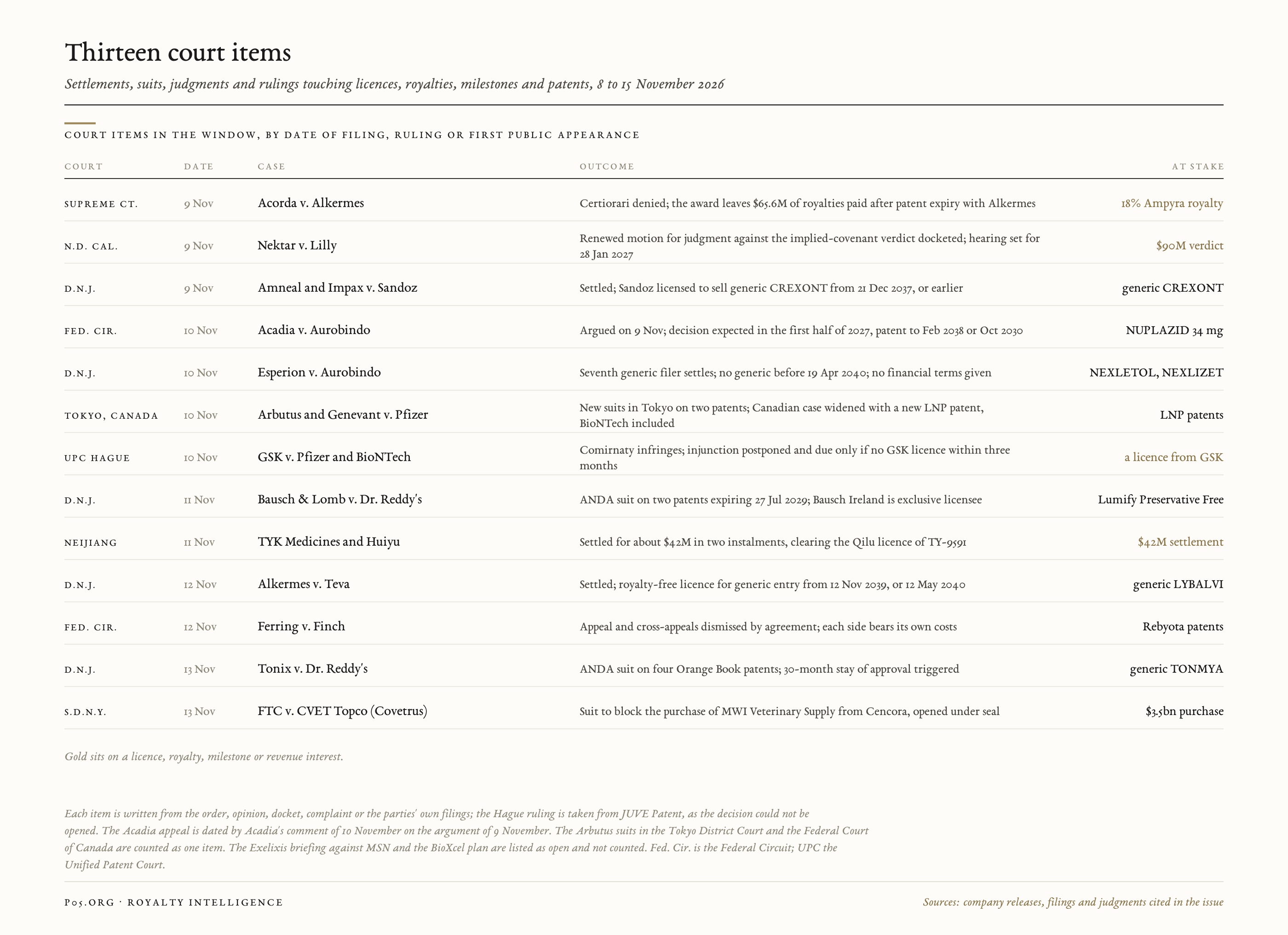
The thirteen court items of the window, by date of filing, ruling or first public appearance. Gold sits on a licence, royalty, milestone or revenue interest, as in the Supreme Court's denial of review in Acorda's challenge to the 18 per cent Ampyra royalty it paid Alkermes after patent expiry.
Vir, Alnylam and Norgine: pivotal ECLIPSE 1 trial in hepatitis delta meets its primary endpoint (Sunday 8 November)
Vir Biotechnology (Nasdaq: VIR) announced "positive topline results from the pivotal Phase 3 ECLIPSE 1 trial" of monthly elebsiran and tobevibart in chronic hepatitis delta, presented at AASLD at 21:15 UTC. The trial randomised 124 patients 2:1 against delayed treatment.
- Primary endpoint: per Vir's current report of 9 November, "met, with a 44% response rate in patients receiving elebsiran and tobevibart achieving undetectable virus as defined by hepatitis delta virus (HDV) RNA target not detected (TND) plus alanine aminotransferase (ALT) normalization at Week 48, compared with 0% in the delayed treatment group at Week 12 (p<0.0001)".
- Key secondary endpoint: "a 79% response rate in patients achieving undetectable virus at Week 48 versus 0% in the delayed treatment group".
- Next step: ECLIPSE 2 and ECLIPSE 3 data are "expected in the first quarter of 2027", supporting a filing "planned for U.S. FDA submission in mid-2027".
- Licence chain, elebsiran: Vir's annual report for 2025 says it will pay Alnylam "up to $145.0 million for remaining development and regulatory milestones for elebsiran" and "tiered royalties at percentages ranging from the low double-digits to mid-teens on annual net sales of siRNA products directed to HBV, such as elebsiran, whether for the treatment of HBV or HDV indications".
- Licence chain, tobevibart: Vir pays Xencor "tiered royalties based on net sales of licensed products ranging from low- to mid-single-digits" and Rockefeller University "a tiered royalty at a low single-digit percentage rate on net sales of licensed products".
- Inbound stream: Norgine holds the regimen for Europe, Australia and New Zealand; Vir "received an initial reimbursement of development costs from Norgine in the amount of €55 million in December 2025 and are eligible to receive up to an additional €495 million in clinical, regulatory and sales milestones, along with tiered, mid-teen to high-twenties percent royalties on net sales in the Norgine Territory".
- Instrument: pivotal Phase 3 readout.
- Royalty read-through: a registrational success moves one inbound stream (Norgine) and three outbound streams (Alnylam, Xencor, Rockefeller) towards a 2027 filing.
Zealand Pharma and Boehringer Ingelheim: survodutide meets its cardiovascular safety endpoint, completing the registrational programme (Monday 9 November)
Zealand Pharma (Nasdaq Copenhagen: ZEAL) announced at 14:45 UTC that Boehringer Ingelheim reported positive results from the Phase 3 SYNCHRONIZE-CVOT trial of survodutide, presented at the American Heart Association meeting and published in The Lancet.
- Primary endpoint: survodutide "did not increase the risk of major adverse cardiovascular events" against placebo, "(HR 0.89 [95% CI: 0.67-1.18]; p<0.0001 for non-inferiority using the treatment-regimen estimand)".
- Programme status: "the registrational Phase 3 SYNCHRONIZE program for survodutide in overweight and obesity is now complete", and Boehringer Ingelheim is "moving forward with global regulatory submissions in obesity".
- Licence chain: "Survodutide is licensed to Boehringer Ingelheim from Zealand Pharma", which is entitled to high single to low double-digit royalties on global sales, per its investor presentation.
- Instrument: Phase 3 cardiovascular outcomes readout.
- Royalty read-through: the last registrational trial for a licensed asset carrying an inbound royalty to Zealand has read out, ahead of filings in obesity.
Eli Lilly and Chugai (Monday 9 November). Lilly announced at 14:30 UTC that in the Phase 3 ATTAIN-OSA trial, "At 52 weeks, Foundayo met the primary endpoint, significantly reducing the apnea-hypopnea index (AHI)", by 21.1 events an hour against 4.3 on placebo in patients not using positive airway pressure.
Lilly "plans to submit Foundayo to the U.S. FDA for moderate-to-severe obstructive sleep apnea by the end of 2026". "Orforglipron was discovered by Chugai Pharmaceutical Co., Ltd. and licensed by Lilly in 2018"; Lilly's quarterly reports put Chugai's royalty in a band from mid single digits to low teens. Instrument: Phase 3 readout on a licensed product.
Oncopeptides (Monday 9 November). Oncopeptides (Nasdaq Stockholm: ONCO) said at 11:58 UTC that the European Commission approved a variation for Pepaxti (melflufen). "The decision expands the marketing authorization to include adult patients with multiple myeloma who have received at least two prior lines of therapy".
The company points to its "trajectory toward achieving positive cash flow during 2027". Instrument: EU label extension.
Adneuris Therapeutics (Monday 9 November). Adneuris, owned by Tris Pharma, submitted a New Drug Application to the FDA for cebranopadol in moderate to severe acute pain, backed by the Phase 3 ALLEVIATE-1 and ALLEVIATE-2 studies, announced at 13:00 UTC. Adneuris licensed Japan and South Korea to Maruishi in August, including a royalty investment in US sales. Instrument: NDA submission.
Merck and Hanmi (Monday 9 November). Merck (NYSE: MRK) reported at 18:05 UTC Phase 2b results for efinopegdutide in MASH with stage 2 to 3 fibrosis, presented at AASLD. MASH resolution without worsening of fibrosis at week 52 was 56, 63 and 61 per cent on the 4, 7 and 10 mg doses against 13 per cent on placebo.
"Efinopegdutide is being developed under an exclusive licensing agreement between Merck and Hanmi Pharmaceutical." Under the 2020 licence, Hanmi "is eligible to receive milestone payments up to $860 million" and "double-digit royalties on sales of approved product". Instrument: Phase 2b readout on a licensed product.
Celcuity and Pfizer (Monday 9 November). Celcuity (Nasdaq: CELC) announced at 13:30 UTC that the FDA accepted its supplemental NDA for REVTORPYK (gedatolisib) in HR-positive, HER2-negative, PIK3CA-mutant advanced breast cancer, with a goal date of 25 June 2027. Per its quarterly report, Celcuity "will pay Pfizer tiered royalties on sales of REVTORPYK at percentages ranging from the low to mid-teens". Instrument: supplemental NDA acceptance.
Bayer (Monday 9 November). The FDA approved Sunharbo (asundexian) 50 mg, "the first factor XIa (FXIa) inhibitor for use in combination with antiplatelet therapy to reduce the risk of stroke in adults following a recent mild-to-moderate non-cardioembolic ischemic stroke" or a high-risk transient ischaemic attack. "The approval was granted to Bayer HealthCare Pharmaceuticals Inc., Whippany, N.J."
In OCEANIC-STROKE, Sunharbo "significantly reduced the risk of ischemic stroke by 26% compared to placebo". It "is not approved for stroke prevention in patients with atrial fibrillation". Bayer said at 01:11 UTC on 10 November that it "anticipates that SUNHARBO will begin shipping in mid-to-late November". Neither the FDA release nor Bayer's own US and China approval releases name a licensor, partner or royalty. Instrument: US approval of an in-house product.
Immunovant and HanAll Biopharma: IMVT-1402 meets its primary endpoint in difficult-to-treat rheumatoid arthritis (Monday 9 November)
Immunovant (Nasdaq: IMVT) reported with its quarterly results at 12:00 UTC that IMVT-1402 600 mg met the primary endpoint of a potentially registrational trial. The antibody is licensed from HanAll Biopharma (KOSDAQ), which holds the royalty.
- The result: "IMVT-1402 600 mg met the primary endpoint of ACR20 response at Week 28 (92.5% vs. 75.6% placebo, p=0.0139)" in the randomised withdrawal period; "Participants randomized to IMVT-1402 300 mg did not show a difference from placebo".
- Next step: "FDA discussions planned for later this year to determine the path forward regarding the registrational program for IMVT-1402 in D2T RA".
- Licence: per Immunovant's quarterly report, Roivant "entered into a license agreement (the "HanAll Agreement") with HanAll Biopharma Co., Ltd." in December 2017, granting "the exclusive, royalty-bearing right to develop, import, use and commercialize" the antibodies, including IMVT-1402.
- Milestones: the remaining maximum is "$420.0 million (after an aggregate amount of $32.5 million paid for milestone events achieved as of September 30, 2026)".
- Royalty: "Tiered royalties ranging from the mid-single digits to mid-teens percentage of net sales of licensed products, subject to standard offsets and reductions, on a product-by-product and country-by-country basis, until the later of (1) expiration of patent and regulatory exclusivity or (2) the 11th anniversary of the first commercial sale of such product in such country."
- Instrument: clinical readout on an in-licensed antibody.
- Royalty read-through: a positive pivotal-stage result on a product carrying a mid-single-digit to mid-teens royalty and up to USD 420m of milestones to HanAll.
ImmunityBio and Oberland: ANKTIVA plus BCG meets its primary endpoint in BCG-naive bladder cancer (Monday 9 November)
ImmunityBio (Nasdaq: IBRX) reported that ANKTIVA plus BCG met the primary efficacy endpoint of the registrational QUILT-2.005 trial in BCG-naive non-muscle invasive bladder cancer. ANKTIVA is already approved in BCG-unresponsive disease and carries a revenue interest held by Oberland.
- The result: "ANKTIVA ® plus BCG met the primary efficacy endpoint in the randomized registrational trial of 370 subjects comparing intravesical ANKTIVA plus BCG with BCG alone", with "a statistically significant improvement in efficacy compared with BCG alone in patients with carcinoma in situ (CIS), with or without papillary tumors". No response rates were disclosed.
- Next step: "Database lock occurred on October 20, 2026 and the supplemental BLA is on track to be submitted to the FDA before year end 2026."
- Revenue interest: per the quarterly report, Oberland receives tiered payments "ranging from 5.625% to 12.50% (before funding of the Third Payment, 4.5% to 10.0%; before funding of the Second Payment, 3.0% to 7.0%)" of worldwide net sales outside China, falling to "a single rate of 2.8125 %" if payments reach USD 375.0m by 31 December 2029.
- Contingent value rights: from the 2017 Altor acquisition, about USD 304.0m is payable to former Altor holders if annual ANKTIVA net sales exceed USD 1.0bn before 31 December 2026.
- Funding: the report says "substantial doubt exists regarding our ability to continue as a going concern without additional funding or financial support".
- Instrument: registrational readout on a commercial product.
- Royalty read-through: a label expansion would enlarge the sales base of Oberland's revenue interest, at tiers of 5.625 to 12.50 per cent.
Mirum Pharmaceuticals and Novartis: brelovitug meets its primary endpoint in AZURE-4, the second Phase 3 study in hepatitis delta (Tuesday 10 November)
Mirum (Nasdaq: MIRM) reported at 12:30 UTC that "At Week 24, brelovitug met the primary endpoint, with 59% of patients receiving 300 mg QW and 44% receiving 900 mg Q4W achieving the combined endpoint of virologic response and ALT normalization, compared with 0% in the delayed-treatment arm" in AZURE-4. Mirum acquired brelovitug with Bluejay Therapeutics, which licensed it from Novartis.
- Next steps: "The Company plans to submit a Biologics License Application (“BLA”) to the U.S. Food and Drug Administration in the first half of 2027, with a potential U.S. commercial launch in the fourth quarter of 2027, if approved."
- Upstream royalty: Mirum's quarterly report says "The Company is also obligated to pay commercial royalties of mid-single digit percent of sales to Novartis", after up to USD 4.0m in remaining development milestones and up to USD 27.0m in commercial milestones.
- Instrument: pivotal Phase 3 readout.
- Royalty read-through: a mid-single-digit royalty to Novartis on an asset now heading for a 2027 filing.
Merck KGaA and Abbisko Therapeutics: FDA approves PIMJETMI (pimicotinib) in tenosynovial giant cell tumour (Tuesday 10 November)
The FDA approved "pimicotinib (Pimjetmi, EMD Serono, Inc.), a kinase inhibitor, for adults with symptomatic tenosynovial giant cell tumor (TGCT) for which surgical resection may cause worsening functional limitation or severe morbidity", per its notice posted at about 17:30 UTC. Merck KGaA announced the approval at about 18:15 UTC; pimicotinib was developed by Abbisko Therapeutics (HKEX: 2256) and is already approved in China.
- Licence: Merck KGaA took in November 2023 "an exclusive license to commercialize pimicotinib in mainland China, Hong Kong, Macau and Taiwan" with "an exclusive commercialization option in the rest of the world", for "an upfront payment of $70 million" and an option fee on exercise. Merck now describes itself as holding worldwide commercialisation rights.
- Milestones and royalty: "Abbisko will receive additional payments for the achievement of certain regulatory and commercial milestones" and "double-digit tiered royalties on net sales by Merck KGaA, Darmstadt, Germany".
- Abbisko's announcement: Abbisko filed on HKEXnews at 04:00 UTC on 11 November that "Upon the first commercial sale in the United States, Abbisko will receive an additional U.S. $20 million milestone payment". It adds that "Abbisko is also eligible to receive double-digit royalties on global net sales of PIMJETMI®, as well as potential payments relating to other regulatory, development, and commercial sales milestones".
- Source: the joint Abbisko and Merck KGaA release of 23:05 ET on 10 November repeats the royalty wording but gives no milestone amount; the USD 20m figure is cited to Abbisko's filing. Merck's own release on Business Wire could not be opened.
- Instrument: US approval of a licensed asset.
- Royalty read-through: a US launch adds the US market to the double-digit tiered royalty base Abbisko holds on Merck KGaA's net sales, and the first US sale triggers a USD 20m milestone.
Johnson & Johnson and Bristol Myers Squibb (Tuesday 10 November). Johnson & Johnson said that "Study 452, the second pivotal Phase 3 study evaluating CAPLYTA (lumateperone) for the treatment of manic episodes" in bipolar I disorder, "met its primary and key secondary endpoints". Intra-Cellular, now part of J&J, stated in its last annual report that it is "obliged to make tiered single digit percentage royalty payments ranging between 5 – 9% on sales of licensed products" to BMS. Instrument: pivotal readout for a label extension.
Beam Therapeutics (Tuesday 10 November). Beam (Nasdaq: BEAM) reported at 12:00 UTC that risto-cel (BEAM-101) met its primary efficacy endpoint at a prespecified interim analysis of the pivotal BEACON study in sickle cell disease, and plans a BLA as early as the end of 2026. Beam's base-editing licences from Harvard and Editas carry royalties; which of them covers risto-cel is not stated. Instrument: pivotal readout.
PepGen and Oxford University Innovation (Tuesday 10 November). PepGen (Nasdaq: PEPG) reported at 12:01 UTC from the 10 mg/kg cohort of its Phase 2 FREEDOM2-DM1 study a "Mean splicing correction of 46.5% following four monthly doses of PGN-EDODM1", with "five of six participants having more than 20% splicing correction".
PepGen's annual report says it must pay Oxford University Innovation "sub-single to low, single-digit percentage royalties" on net sales of licensed products above a threshold "between £20 million and £30 million". Instrument: Phase 2 readout.
Boehringer Ingelheim (Tuesday 10 November). Boehringer Ingelheim announced at 09:00 UTC a positive CVMP opinion for SCOVELLA (velagliflozin oral solution) for hyperinsulinaemia in horses with equine metabolic syndrome; the product "was approved and introduced in Great Britain earlier this year". It is an in-house product with no licence or royalty. Instrument: veterinary regulatory opinion.
Eli Lilly and Chugai: China (Thursday 12 November). China's National Medical Products Administration approved orforglipron calcium tablets (Muyouda), filed by Eli Lilly Nederland, as a Class 1 innovative drug, per the NMPA notice reprinted on 12 November. The indication is long-term weight management in adults with a body mass index of "≥30 kg/m2(肥胖)" (obesity), or 27 to under 30 with at least one weight-related comorbidity, alongside diet and exercise. The NMPA site and a Lilly release could not be opened. Instrument: national approval of a licensed product. Royalty read-through: a further territory for the orforglipron royalty Lilly pays Chugai.
Taiho Oncology and Cullinan Therapeutics (Thursday 12 November). Taiho completed at 21:30 UTC its US New Drug Application for zipalertinib with chemotherapy in first-line EGFR exon 20 insertion non-small cell lung cancer, under the FDA's Real-Time Oncology Review, based on the Phase 3 REZILIENT3 trial, which met its primary endpoint at an interim analysis.
Zipalertinib "is being developed by Taiho Oncology, Inc., its parent company, Taiho Pharmaceutical Co., Ltd., and in collaboration with Cullinan Therapeutics, Inc. in the U.S.", and "Cullinan Therapeutics is eligible to receive $30 million and $100 million in milestone payments upon second-line and first-line U.S. regulatory approvals, respectively." Instrument: NDA submission. Royalty read-through: an approval would trigger the USD 100m first-line milestone to Cullinan.
LEO Pharma (Friday 13 November). LEO Pharma announced at 07:00 UTC that "China’s National Medical Products Administration (NMPA) has approved Anzupgo® (delgocitinib) cream for the treatment of adult patients with moderate to severe chronic hand eczema", "for whom topical corticosteroids are inadequate or inappropriate". The release recalls that "In 2014, LEO Pharma obtained the exclusive rights to develop and commercialize delgocitinib for topical use", "excluding Japan, where Shionogi & Co., Ltd. owns the rights", and states no royalty or financial terms. Instrument: national approval of an in-licensed product. Royalty read-through: a further market for a licensed product; any royalty to the licensor is undisclosed.
Rezolute and XOMA Royalty (Friday 13 November). Rezolute (Nasdaq: RZLT) announced at 11:18 UTC that in the open-label Phase 3 upLIFT study of ersodetug in tumour hyperinsulinism "the primary efficacy endpoint has been achieved, based on preliminary results from a November 5th data evaluation". Significance required "at least 9 responders (≥56%), based on enrollment of 16 participants"; "To date, 13 participants have met the responder criterion, including 12 who also achieved a complete discontinuation of IV glucose".
Topline results with the statistical analysis of the primary endpoint "are expected by mid-December 2026". Ersodetug carries a royalty to XOMA Royalty, now a Ligand subsidiary; XOMA's annual report for 2025 says it "may receive development and commercial milestone payments of up to an aggregate of $232.0 million" and "royalties ranging from the high single digits to the mid-teens based on annual net sales". Instrument: pivotal readout. Royalty read-through: the second Phase 3 study of an asset with an outbound royalty to Ligand has met its primary endpoint on preliminary data.
Zealand Pharma (Friday 13 November). Zealand Pharma (Nasdaq Copenhagen: ZEAL) announced that "the European Commission (EC) has granted marketing authorization for Zeydovio TM (glepaglutide)", a long-acting GLP-2 analogue, "for the treatment of adults with short bowel syndrome (SBS)".
Zealand "is actively engaging in partnership discussions for the future global commercialization of glepaglutide for SBS", and the Phase 3 EASE-5 trial is enrolling "to support a U.S. NDA". Instrument: EU marketing authorisation of an unpartnered product. Royalty read-through: no licence exists yet; a partnering agreement would set the first economics on the product.
European Medicines Agency (Friday 13 November). The CHMP's meeting highlights for 9 to 12 November, published on 13 November, record "Seven new medicines recommended for approval; another 11 medicines recommended for extension of their therapeutic indications". The new medicines include Baxfendy (baxdrostat) "for the treatment of insufficiently controlled hypertension", applied for by AstraZeneca AB, and Zybrivo (sintilimab) in non-squamous non-small cell lung cancer, applied for by Fortvita Biologics (Ireland).
The committee also recommended Aumseqa (aumolertinib) in non-small cell lung cancer, applied for by SFL Pharmaceuticals Deutschland, and confirmed on re-examination its refusals of Meplyffa (arimoclomol citrate) for Niemann-Pick disease type C and of KemSu (sufentanil / ketamine) for acute pain in children. Among eleven extensions of indication, it "recommended extending the use of Gazyvaro (obinutuzumab) to treat adults with moderate-to-severe active systemic lupus erythematosus".
Instrument: positive opinions and two confirmed refusals, ahead of Commission decisions. Royalty read-through: the highlights state no licence terms; baxdrostat came to AstraZeneca with its purchase of CinCor, which had licensed it from Roche.
AstraZeneca, Pfizer and Astellas (Friday 13 November). The FDA approved "durvalumab (Imfinzi, AstraZeneca) in combination with enfortumab vedotin-ejfv as neoadjuvant treatment, followed by single agent durvalumab as adjuvant treatment after radical cystectomy", for adults with muscle-invasive bladder cancer "who are ineligible for or who have refused cisplatin based chemotherapy", on the VOLGA trial, which showed "statistically significant improvements in both EFS and OS" against cystectomy alone.
Enfortumab vedotin is Padcev, developed and sold by Pfizer and Astellas together; no third-party royalty on either product is disclosed. Instrument: supplemental approval of a combination. Royalty read-through: a further perioperative label for Padcev, whose economics are shared between its two owners.
Roche, Genentech and Biogen (Friday 13 November). The FDA approved at 22:33 UTC "Gazyva (obinutuzumab) injection to treat adults with primary membranous nephropathy at risk of disease progression, to induce remission of proteinuria", which the agency calls "the first drug approved specifically for the treatment of adults with primary membranous nephropathy". In the Phase 3 MAJESTY study of 142 adults, complete remission at week 104 was 36 per cent with Gazyva against 6 per cent with tacrolimus.
Gazyva carried "Breakthrough Therapy, Orphan Drug, and Priority Review designations for this approval". No release from Roche or Genentech had been issued by 07:43 UTC on 15 November.
- Upstream: Biogen's annual report for 2025 says it is "entitled to a tiered share of co-promotion operating profits and losses of GAZYVA in the U.S.", a formula that "provides for a 35.0 % share on the first $ 50.0 million of operating profits earned in the U.S. in each calendar year", and that "beginning in April 2023 the pre-tax profit share for GAZYVA decreased from 37.5 % to 35.0 %".
- Instrument: supplemental approval in a new indication.
- Royalty read-through: a new US indication for a product on which Biogen takes 35 per cent of US pre-tax profits.
Acorda Therapeutics and Alkermes: Supreme Court denies review of the Ampyra post-expiration royalty award (Monday 9 November)
The Supreme Court's order list of 9 November lists "26-498 ACORDA THERAPEUTICS, INC. V. ALKERMES PLC" under "CERTIORARI DENIED". The Second Circuit had affirmed the refusal to vacate an arbitration award on 15 July.
- The case: Acorda Therapeutics, Inc. v. Alkermes PLC, No. 26-498 (U.S.), on petition filed on 13 October; Alkermes waived its right to respond.
- The parties: Acorda, as licensee, against Alkermes, as licensor.
- The claim: "All told, Acorda paid approximately $82,183,983 in post-expiration royalties", of which "roughly $65.6 million" was paid "before formal protests" and "roughly $16.5 million under protest"; under New York's Voluntary Payment Doctrine the tribunal allowed recovery of the part paid under protest only.
- The holding left in place: the tribunal held that Alkermes's "use of a royalty agreement that projects beyond the expiration date of the patent" was "unlawful per se", and the petition says the award lets Alkermes retain "$65,629,716" in such royalties.
- The asset: Ampyra (dalfampridine), whose licensed patent "expired on July 30, 2018".
- The licence or royalty at issue: an "18% royalty on sales" under the 2003 licence agreement.
- Instrument: denial of certiorari, leaving in place an arbitration award on post-expiration royalties.
- Royalty read-through: royalties paid voluntarily after patent expiry stay with the licensor under the award; only payments made under protest are returned.
Nektar Therapeutics and Eli Lilly (Monday 9 November). The public text of Lilly's renewed motion for judgment as a matter of law, dated 2 November, was docketed on 9 November in Nektar Therapeutics v. Eli Lilly and Company (N.D. Cal., No. 3:23-cv-03943-JD). Lilly argues it "is entitled to judgment as a matter of law ("JMOL") on two independent grounds", against the jury's USD 90m implied-covenant verdict on the 2017 rezpegaldesleukin licence.
On royalties, Lilly says it terminated the agreement at will "before any royalties accrued". The hearing is set for 28 January 2027; the court has not ruled. Three further entries of 9 November, an administrative motion on sealing (D.I. 505), an entry docketed as a motion to alter or amend the judgment (D.I. 506) and a bill of costs (D.I. 507), are not public. Instrument: post-verdict motion in a licence dispute.
Amneal and Sandoz (Monday 9 November). Amneal (Nasdaq: AMRX) disclosed in its quarterly report, filed at 21:21 UTC, the terms of its settlement of the CREXONT (carbidopa and levodopa) patent cases against Sandoz in the District of New Jersey: "the Company and Impax granted Sandoz a license to begin selling generic versions of CREXONT ® on December 21, 2037, or earlier under certain circumstances." The agreement is dated 9 October, and "On November 3, 2026, the three above lawsuits were dismissed without prejudice."
The report says CREXONT "is also subject to a regulatory exclusivity until August 7, 2027"; Amneal's case against Alembic in Delaware continues. Instrument: Hatch-Waxman settlement with a licensed entry date.
Acadia Pharmaceuticals and Aurobindo (Tuesday 10 November). Acadia (Nasdaq: ACAD) commented on the Federal Circuit argument of 9 November in the appeal against the Delaware judgment upholding its '721 patent on the NUPLAZID 34 mg capsule (Acadia v. Aurobindo, No. 25-1875). "Acadia expects a decision in the first half of 2027."
"If the district court's judgment is upheld, Acadia expects the '721 patent to provide protection for the NUPLAZID 34 milligram capsule formulation until February 2038. If it is not upheld, Acadia expects patent protection to extend to October 2030". Acadia also expects NUPLAZID "to be subject to a negotiated price taking effect in 2029". Instrument: patent appeal argued, decision pending.
Esperion and Aurobindo (Tuesday 10 November). Esperion, owned by ARCHIMED, settled its Hatch-Waxman case against Aurobindo, the seventh generic filer to settle: "Aurobindo has agreed not to market a generic version of either NEXLETOL or NEXLIZET in the United States prior to April 19, 2040, unless certain limited circumstances customarily included in these types of agreements occur." The cases against MSN and Sandoz continue; no financial terms were given. Instrument: Hatch-Waxman settlement with an agreed entry date.
Arbutus Biopharma, Genevant and Pfizer (Tuesday 10 November). Arbutus (Nasdaq: ABUS) disclosed with its third-quarter results that it and Genevant "have filed additional lawsuits in Japan" against Pfizer Japan in the Tokyo District Court on Japanese Patents No. 5,475,753 and No. 7,936,499, and amended their Canadian case (Federal Court File No.
T-3200-26) against Pfizer, BioNTech and affiliates "to include infringement of a newly issued LNP patent", Canadian Patent No. 2,767,127, seeking damages and injunctions over the COVID-19 vaccines. On Moderna, it says the Federal Circuit heard expedited argument on 5 November "and a decision is forthcoming", with USD 1.3bn contingent on the outcome. Instrument: new and amended patent infringement suits.
GSK, Pfizer and BioNTech (Tuesday 10 November). The Hague Local Division of the Unified Patent Court ruled on 10 November that Pfizer and BioNTech's Comirnaty infringes GSK's European patent EP 2 590 626 on liposomes for RNA delivery, per JUVE Patent; the decision itself could not be opened.
The action is UPC_CFI_620/2025, brought by GlaxoSmithKline Biologicals in July 2025 and heard with counterclaims for revocation; JUVE cites it as UPC-CFI-0001511/2025.
JUVE reports that the court upheld the patent almost in full and revoked one claim. It granted an injunction for the countries where the patent is in force, other than Ireland and the United Kingdom, and postponed its enforcement until a final decision of the court on validity. The injunction then takes effect only if Pfizer and BioNTech have not taken a licence from GSK within three months.
Interim damages are about USD 2.3m (EUR 2m) and the value of the case about USD 58m (EUR 50m); the decision can be appealed. GSK's parallel case against Moderna ended in a settlement on 28 October. Instrument: first-instance infringement ruling with a conditional injunction. Royalty read-through: the ruling makes a licence from GSK the alternative to an injunction on a marketed vaccine; no rate is stated.
TYK Medicines and Huiyu (Wednesday 11 November). TYK Medicines (HKEX: 2410) agreed at 12:13 UTC a conditional settlement of its proceedings with Huiyu over "a purported cooperation agreement and distribution agreement", under which TYK "shall pay a total of RMB300.00 million" (about USD 42m) in two instalments of RMB 150m; Huiyu will withdraw its claims from the Neijiang Intermediate People's Court. The agreement needs approval by Huiyu's shareholders.
Huiyu "shall not raise any objection to" commercial activities on TY-9591, which TYK licensed to Qilu in July with "the upfront cash payment of RMB300.00 million and other milestone payments of up to an aggregate amount of RMB2.06 billion". TYK expects a loss of about USD 42m (RMB 300m) for 2026 and, in a second announcement, first commercial shipments of Kardorisso (TY-9591) by the end of November. Instrument: litigation settlement clearing a licensed asset.
Alkermes and Teva (Thursday 12 November). Alkermes (Nasdaq: ALKS) disclosed in a current report, filed at 12:04 UTC, the settlement of its LYBALVI (olanzapine and samidorphan) patent case against Teva in the District of New Jersey over ANDA No. 220379: "Alkermes will grant Teva a non-exclusive, royalty-free, non-transferable, non-sublicensable limited license to make, have made, use, import, sell and offer for sale Teva's products made under ANDA No. 220379 in the United States beginning on November 12, 2039, or, if Alkermes obtains pediatric exclusivity, on May 12, 2040, or earlier under certain circumstances."
The agreement is dated 6 November and the case was dismissed on 9 November, per the docket; it is subject to review by the Federal Trade Commission and the Department of Justice. Instrument: Hatch-Waxman settlement with a licensed entry date.
Ferring, Finch Therapeutics and the University of Minnesota (Thursday 12 November). The Federal Circuit dismissed the appeal and cross-appeals in Ferring Pharmaceuticals v. Finch Therapeutics Group (Nos. 2026-2055 and 2026-2089), from the District of Delaware judgment in No. 1:21-cv-01694. The order reads: "The parties having so agreed, it is ordered that: (1) The proceeding is DISMISSED under Fed. R. App. P. 42 (b). (2) Each side shall bear their own costs."
The appeal concerned the judgment of July 2026 on patents asserted against Ferring's Rebyota, with the University of Minnesota as counterclaim plaintiff. No release from the parties and no settlement terms were found. Instrument: consensual dismissal of a patent appeal on a marketed product.
Bausch & Lomb, Eye Therapies and Dr. Reddy's (Wednesday 11 November). Bausch & Lomb, Bausch + Lomb Ireland and Eye Therapies sued Dr. Reddy's in the District of New Jersey (No. 3:26-cv-14597) over ANDA No. 221730 for a generic of Lumify Preservative Free (brimonidine tartrate 0.025 per cent). The complaint states that "Eye Therapies is the owner of the Asserted Patents" and "Bausch Ireland exclusively licenses the Asserted Patents".
The asserted patents, US 12,311,050 and US 12,514,857, each expire on 27 July 2029. The complaint says the notice letter of 21 August 2026 was directed to three other patents "and which does not provide notice of any Paragraph IV certification with respect to the '050 or '857 patents". Instrument: Hatch-Waxman complaint on a licensed marketed product.
Tonix Pharmaceuticals and Dr. Reddy's (Friday 13 November). Tonix sued Dr. Reddy's in the District of New Jersey (No. 3:26-cv-14677, Judge Cecchi) on 13 November. The complaint is brought by Tonix Pharmaceuticals and its Irish subsidiary Tonix Pharma Limited, the owner of the patents, over Dr. Reddy's ANDA No. 221664, and asserts all four Orange Book patents. Tonix's current report of 2 October says it received on 1 October a notice of an ANDA for a generic of "TONMYA® (cyclobenzaprine hydrochloride) sublingual tablets, 2.8 mg", with a Paragraph IV certification on "U.S. Patent Nos. 9636408, 9956188, 10117936 and 10864175".
Tonix's current report filed at about 21:00 UTC says the complaint "alleges that by filing the ANDA, DRL has infringed certain of the Company's Orange Book-listed patents" and that its timely filing "triggers a statutory stay of final FDA approval of DRL's ANDA for up to 30 months, subject to applicable exceptions and court orders". Instrument: Hatch-Waxman complaint on a marketed product.
Double Bond Pharmaceutical (Monday 9 November). Double Bond Pharmaceutical (Spotlight: DBP) resolved on a rights issue of B shares at SEK 0.11 a share that raises about USD 1.07m (SEK 10.2m) before costs, "varav upp till cirka 3 MSEK genom kvittning av utestående lån" (of which up to about SEK 3m by set-off of outstanding loans). About 45.1 per cent is covered by subscription undertakings.
The board states that "det befintliga rörelsekapitalet inte är tillräckligt för verksamhetens behov under den kommande tolvmånadersperioden" (existing working capital is not sufficient for the business's needs over the coming twelve months). Instrument: rights issue.
Atea Pharmaceuticals and Hercules Capital (Monday 9 November). Atea Pharmaceuticals (Nasdaq: AVIR) agreed "senior secured term loans which mature on November 1, 2031", "for up to $200.0 million", with "a Tranche 1 Term Loan of $65.0 million drawn on the Closing Date" and later tranches tied to its Phase 3 hepatitis C programme and other milestones. Interest is the greater of prime plus 2.35 per cent and 9.35 per cent. Instrument: venture term loan.
Initiator Pharma (Monday 9 November). Initiator Pharma (Nasdaq First North: INIT) resolved on a directed issue of shares with warrants to Klockhuset Investment AB raising about USD 1.28m (DKK 8.2m) before costs. With existing cash the proceeds "are expected to finance Initiator into 2028". Instrument: directed issue.
Shionogi and Sumitomo Mitsui Banking Corporation (Tuesday 10 November). Shionogi (TSE: 4507) took a bridge loan of about USD 2.05bn (JPY 300bn) from Sumitomo Mitsui Banking Corporation at 06:30 UTC to fund its acquisition of IntraBio, announced on 5 October. The loan was agreed and drawn on 10 November at "基準金利+スプレッド" (base rate plus spread), is unsecured and has a final repayment date of 29 October 2027; Shionogi plans to refinance it with longer-term funding. Instrument: acquisition bridge loan.
Codexis and Trinity Capital (Tuesday 10 November). Codexis (Nasdaq: CDXS) agreed on 5 November, and announced on 10 November, a senior secured facility of up to USD 60m with Trinity Capital: "a term loan of $42.5 million, which was funded on the Closing Date", USD 7.5m available to 15 December 2027 subject to a debt-to-market-capitalisation test, and USD 10.0m at the lenders' discretion. Interest is "the greater of (i) 10.50% and (ii) the sum of (x) the lesser of The Wall Street Journal prime rate and 8.00%, plus (y) 3.75%", with interest only to 1 November 2030 and maturity on 1 November 2031.
The first tranche repaid about USD 43.6m owed to Innovatus. Trinity received warrants over 1,666,668 shares at USD 1.08. Instrument: venture term loan refinancing.
Stereotaxis (Tuesday 10 November). Stereotaxis (NYSE: STXS), a surgical robotics company, entered at 21:01 UTC into "definitive agreements with investors for a convertible note financing of up to $24 million": "an initial upfront closing of $12 million, and an additional $12 million draw available at Stereotaxis' option following certain regulatory milestones". The notes carry "a 10% annual interest rate, with interest accrued and due at maturity in three years" and convert at USD 1.21 a share, "a 30% premium to the 10-day volume weighted average price".
The company now has "$16 million in proforma cash and cash equivalents" and says the financing "bridges the Company to profitability". Instrument: convertible notes.
Pentixapharm and Eckert & Ziegler (Thursday 12 November). Pentixapharm (Frankfurt: PTP), a clinical-stage radiopharmaceutical company, agreed with Eckert & Ziegler, "as sole bondholder", to amend its "4.00% Corporate Convertible Bond 2024/2027 with an aggregate principal amount of EUR 18.5 million" (about USD 21.5m). "The term of the Convertible Bond is extended from 31 December 2027 to 31 December 2030", and Pentixapharm may call the 27 unissued bonds, "EUR 13.5 million", "until 30 June 2030".
Repayment of the EUR 5.0m already drawn is deferred by three years, and "the interest rate increases from 4.00% to 6.00% p.a. as of 1 January 2027". Eckert Wagniskapital und Frühphasenfinanzierung "holds more than 30% in each of the Company and EZAG"; the company values the amendment at "approximately EUR 3.7 million in total". Instrument: convertible bond amendment with a related-party holder.
Milestone Pharmaceuticals and RTW Investments (Friday 13 November). Milestone (Nasdaq: MIST) announced with its third-quarter results an amendment to its note purchase agreement with RTW Investments that "extends the payment-in-kind interest period on its convertible notes from March 31, 2027 to March 2029". Net product revenue for CARDAMYST was USD 1.0m in the quarter, and the company is "reducing operating expenses by approximately 30%", with cash of USD 145.4m.
The quarterly report adds "a reduction in workforce of approximately 20% of our current headcount", and the release says the Chief Financial Officer and the Chief Medical Officer "have departed from the leadership team", with about USD 2m in one-time charges.
RTW also holds the royalty bought under a 2023 agreement for "$ 75.0 million", per the quarterly report: "7 %" of annual US net sales of etripamil up to USD 500m, 4 per cent between USD 500m and USD 800m, and 1 per cent above. Instrument: amendment of convertible notes held by a royalty holder. Royalty read-through: the holder of the CARDAMYST royalty has deferred cash interest by two years during the launch.
Accuray and TCW (Friday 13 November). Accuray (Nasdaq: ARAY), a radiation oncology device company, completed at about 22:10 UTC its financing with TCW Asset Management, "the company's primary lender and largest shareholder". "TCW has exchanged $40 million in aggregate principal amount of its term loan for convertible preferred stock", and the USD 15m TCW invested in cash when the agreements were signed in July was exchanged for further preferred shares.
"Certain financial covenants under the company's existing term loan are waived through December 31, 2027. The first covenant test date is March 31, 2028", and "A delayed draw term loan of up to $5 million in aggregate principal amount is available to Accuray, subject to certain conditions". TCW may appoint two of seven directors. Instrument: exchange of term loan into convertible preferred stock, with a covenant waiver.
LifeMD and Avenue Capital (Thursday 12 November). LifeMD (Nasdaq: LFMD), a telehealth and pharmacy company, disclosed that on 9 November two Avenue Capital funds "made a loan to the Borrower in an aggregate principal amount of $12.5 million", "secured by a security interest in substantially all of the Borrower's assets". Interest is "the greater of (i) the sum of 4.50% plus the Prime Rate" and "(ii) 11.50%"; "Payments are interest only for up to 24 months", and "The Loan matures on May 1, 2030".
The lenders received warrants "to purchase $625,000 in the aggregate of the Company's common stock", and closing "was conditioned on the payoff and termination of the Company's credit facility with Citizens Bank, N.A." LifeMD may still "enter into a cohort-based financing that funds sales and marketing expense, with repayment coming from a share of the revenue of an underlying cohort". Instrument: senior secured venture loan with warrants, refinancing a bank facility.
Prime Medicine (Wednesday 11 November). Prime Medicine (Nasdaq: PRME) priced at about 02:40 UTC "an underwritten public offering of 35,714,286 shares of its common stock at a public offering price of $3.50 per share", for gross proceeds "expected to be approximately $125.0 million, excluding any exercise of the underwriters' option". The offering is expected to close on or about 12 November; "Jefferies, TD Cowen and Goldman Sachs & Co. LLC are acting as joint book-running managers".
Its final prospectus supplement of 12 November gives net proceeds of "approximately $117.1 million, or approximately $134.7 million" with the option exercised in full. Prime closed the offering at 21:15 UTC on 12 November, "which includes the full exercise of the underwriters' option to purchase 5,357,142 additional shares", for gross proceeds of "approximately $143.7 million". Instrument: underwritten follow-on offering.
Neuronetics (Wednesday 11 November). Neuronetics (Nasdaq: STIM), a commercial medical device company, priced at 03:39 UTC "18,750,000 shares of common stock at a public offering price of $1.60 per share", for gross proceeds "expected to be approximately $30 million", with an underwriters' option over 2,812,500 further shares. It intends "to use a portion of the net proceeds from this offering to repay a portion of the outstanding term loan" with Perceptive Credit Holdings IV.
The release ties the offering to the Perceptive Sixth Amendment of 5 November: if its conditions are met, "the reduction of those revenue covenants will resolve the going concern risk referenced in the Company's recent Form 10-Q filings". "William Blair is acting as the lead bookrunning manager", with BTIG and Canaccord Genuity as additional bookrunners; closing is expected on or about 12 November.
Neuronetics' current report of 10 November sets the condition as "an optional prepayment in an amount equal to no less than $15,000,000", and "If such conditions are not satisfied or waived on or before November 30, 2026, the Perceptive Sixth Amendment will automatically terminate." Instrument: underwritten follow-on offering.
Neuronetics filed its final prospectus supplement and a current report on 12 November; net proceeds are "approximately $27.7 million (or $31.9 million if the Underwriters' option to purchase the Optional Securities is exercised in full)", and "The Company expects the Offering to close on November 12, 2026".
PepGen (Thursday 12 November). PepGen (Nasdaq: PEPG) priced at 03:22 UTC "a public offering of 25,000,000 shares of its common stock at a price to the public of $5.00 per share"; "The aggregate gross proceeds to PepGen from this offering are expected to be $125 million". The underwriters have a 30-day option over 3,750,000 further shares, and closing is expected "on or about November 13, 2026".
The proceeds fund "ongoing clinical development of its product candidate" and general purposes. Leerink Partners, Stifel and Guggenheim Securities are joint bookrunning managers. The final prospectus supplement of 12 November states "We are offering 25,000,000 shares of our common stock in this offering", with no pre-funded warrants, and the current report of the same day gives net proceeds of "approximately $116.9 million, or approximately $134.5 million if the Underwriters exercise in full the option". Instrument: underwritten follow-on offering.
Guardant Health (Thursday 12 November). Guardant Health (Nasdaq: GH), a commercial cancer diagnostics company, priced at 06:09 UTC USD 500m of convertible senior notes due 15 May 2032 in a private offering to qualified institutional buyers, with an option for the initial purchasers over USD 50m more. The notes carry no regular interest and convert at about USD 208.95 a share, about 35 per cent above the closing price of 11 November.
Net proceeds are about USD 489.3m (about USD 538.3m with the option). Assuming full exercise of the option, Guardant expects to spend about USD 501.7m repurchasing its 0 per cent convertible notes due 2027 and USD 51.7m on capped calls with a cap price of USD 309.56; settlement is set for 16 November. The terms were read from a reprint summary; no 8-K had been filed by 07:36 UTC on 15 November. Instrument: convertible notes.
TYK Medicines (Thursday 12 November). TYK Medicines (HKEX: 2410) agreed at 14:45 UTC to issue "57,000,000 H Shares to Qilu and 19,000,000 H Shares to CVG Global at the Subscription Price of HK$3.80 per Subscription Share", "for an aggregate cash consideration of approximately HK$288.8 million" (about USD 37m), a discount of about 7.32 per cent to the closing price of 12 November.
Qilu, a wholly owned subsidiary of Qilu Pharmaceutical (Hainan) and the licensee of TY-9591, accepts a six-month lock-up; CVG Global does not. About 60 per cent of the net proceeds goes to "phase II and III clinical trials of TY-0540 in monotherapy for platinum-resistant ovarian cancer". Instrument: H-share subscription by a licensee.
Cereno Scientific (Thursday 12 November). Cereno Scientific (Nasdaq First North: CRNO B) announced at 16:20 UTC a rights issue of units of about USD 42m (SEK 400m), priced at "a discount of 35 per cent" to the theoretical ex-rights price, with warrants that could add up to SEK 250m and SEK 150m in 2027. An extraordinary general meeting votes on 15 December, and subscription is to run from 4 to 18 January 2027.
Under a new agreement with Fenja, "SEK 105 million of the Company's existing convertible loan of SEK 175 million is extended until November 2028", the rest is repaid in cash or set off against units, and a SEK 70m loan facility is added; drawn amounts "bear annual interest at STIBOR 3M (subject to a floor of 3 per cent) plus 9 percentage points". Fenja's undertaking of up to SEK 70m "does not provide any cash proceeds". Instrument: rights issue of units with a convertible loan extension.
Windward Bio and Sanofi (Thursday 12 November). Windward Bio of Basel, a clinical-stage developer of ultra-long-acting antibodies for respiratory and dermatologic diseases, priced at 23:18 UTC "its initial public offering of 10,294,117 common shares at a public offering price of $17.00 per share", with an option over 1,544,117 further shares. With the concurrent Sanofi placement of USD 50.0m, gross proceeds "are expected to be $225.0 million".
The shares trade on the Nasdaq Global Select Market from 13 November under "WWB", and closing is expected "on November 16, 2026". The pricing release, filed as a free writing prospectus, names the buyer as "Sanofi Foreign Participations B.V." and "Jefferies, TD Cowen, Piper Sandler and UBS Investment Bank" as joint book-running managers.
"The closing of the private placement is contingent and conditioned on consummation of the initial public offering". Instrument: initial public offering with a concurrent strategic placement.
Vir Biotechnology (Friday 13 November). Vir (Nasdaq: VIR), days after its ECLIPSE 1 readout in hepatitis delta, priced at 00:38 UTC an underwritten offering of 15,000,000 shares at USD 10.00, for gross proceeds of USD 150m, with an option over 2,250,000 further shares; Leerink Partners, Morgan Stanley and Evercore ISI are bookrunners, Raymond James is co-manager, and closing is expected on 16 November. The offering launched at 21:08 UTC with a preliminary prospectus supplement; the pricing terms were read from the Business Wire release as carried by BioSpace. Instrument: underwritten follow-on offering.
vVARDIS (Friday 13 November). vVARDIS Holding of Zug, "a Swiss healthcare company in the dental med-tech sector" selling the Curodont range, announced at 05:02 UTC "the pricing of its initial public offering of 9,722,223 Class A ordinary shares at a public offering price of $18.00 per share", below the range of USD 21 to 24 set on 6 November, for gross proceeds of about USD 175m before the underwriters' option over 1,458,333 further shares.
The shares opened on the New York Stock Exchange under "VVVV" about three hours after the start of trading on 13 November at USD 14 and later stood at USD 15.29, per the Swiss agency AWP as carried by cash.ch at 18:52 UTC. Closing is expected "on or about November 16, 2026"; Goldman Sachs and J.P. Morgan are joint bookrunning managers. Instrument: initial public offering.
Voronoi (Friday 13 November). Voronoi (KOSDAQ), a clinical-stage drug developer, resolved at 07:14 UTC to issue unsecured private convertible bonds of about USD 38.5m (KRW 52.7bn) for working capital, with a coupon of 0.0 per cent, a yield to maturity of 2.0 per cent and redemption at 110.4080 per cent on 23 November 2031.
The conversion price is KRW 111,510 a share, adjustable down to KRW 78,057, and holders may put the bonds from 23 November 2028 and every three months after; payment is due on 23 November. Instrument: private convertible bonds.
Rezolute (Friday 13 November). Rezolute priced at 11:19 UTC, a minute after its upLIFT results, "an underwritten offering of 22,040,976 shares of its common stock at an offering price of $3.87 per share" and pre-funded warrants over up to 3,800,000 shares at USD 3.869, for gross proceeds "expected to be approximately $100 million".
The "Transaction led by Frazier Life Sciences with participation from new and existing funds" is expected to close on or about 16 November, and the proceeds fund "ersodetug commercialization preparation". Instrument: underwritten follow-on offering.
Surrozen (Friday 13 November). Surrozen (Nasdaq: SRZN), a developer of Wnt-pathway therapeutics for sight-threatening eye disease, priced "an underwritten offering of 1,894,540 shares of its common stock at an offering price of $31.67 per share", for gross proceeds "expected to be $60 million".
The offering "includes participation from Access Biotechnology, Boxer Capital Management, Perceptive Advisors, RTW Investments, Venrock Healthcare Capital Partners, and other new and existing life sciences focused investors". The release, filed as a free writing prospectus, names "Morgan Stanley, Guggenheim Securities and Cantor" as joint book-running managers, and the offering "is expected to close on or about November 16, 2026". Instrument: underwritten follow-on offering.
InspireMD (Friday 13 November). InspireMD (Nasdaq: NSPR), maker of the CGuard Prime carotid stent, priced at 13:12 UTC its USD 37.5m public offering of "(i) 7,342,308 shares of its common stock, (ii) in lieu of common stock to certain investors, pre-funded warrants to purchase 50,350,000 shares of its common stock, and (iii) accompanying common warrants to purchase 43,269,231 shares".
"Lake Street Capital Markets is acting as the sole book runner for the offering", and closing is expected "on or about November 16, 2026". Instrument: underwritten public offering with warrants.
Klaria Pharma (Friday 13 November). Klaria Pharma Holding (First North: KLAR) announced the final outcome of its rights issue of units, raising about USD 11.7m (SEK 111.1m) before issue costs, of which about USD 3.9m (SEK 37.3m) "will be paid by way of set-off against claims on the Company"; the rights issue comprised a maximum of 61,494,038 units.
Subscriptions came to about SEK 90.6m, and the underwriter Vator Securities subscribes for about SEK 20.5m; the cash raised is about SEK 73.8m "before issue costs and repayment of loans". The TO1 warrants are expected to trade from about 30 November. Instrument: rights issue of units with warrants, partly by set-off.
Kringle Pharma (Wednesday 11 November). Kringle Pharma (TSE Growth: 4884) resolved at 06:50 UTC on a third-party allotment of new shares to Maruishi Pharmaceutical and ZENOAQ Holdings and on two series of share acquisition rights for Macquarie Bank under a "ターゲット・イシュー・プログラム「TIP」" (target issue programme). At the floor price of JPY 478, the shares raise about USD 3.4m ("499,988,000 円"); Maruishi is Kringle's distributor in spinal cord injury, and a wholly owned ZENOAQ subsidiary makes Kringle's recombinant HGF drug substance and is a shareholder.
The 19th series of rights is fixed at JPY 600 and the 20th at JPY 1,000, resettable by the board with a floor of JPY 260; together they cover 2,146,000 shares, with estimated net proceeds of about USD 11.7m ("1,705,252,950 円"). The net total of about USD 15.1m (JPY 2,205m) goes first to "米国での脊髄損傷急性期の第Ⅲ相試験の準備推進費用" (preparation of a US Phase 3 trial in acute spinal cord injury, JPY 678m). Payment for the shares is due on 7 December. Instrument: third-party allotment and warrants.
Delix Therapeutics (Monday 9 November). Delix Therapeutics closed "an oversubscribed $100 million Series C financing", "led by Johnson & Johnson, through its corporate venture capital organization, Johnson & Johnson Innovation – JJDC, Inc., and SV Health Investors' Dementia Discovery Fund (DDF)". The proceeds take zalsupindole into a Phase 2b study in major depressive disorder. Instrument: Series C equity.
Oyster Therapeutics (Tuesday 10 November). Kesmalea Therapeutics, renamed Oyster Therapeutics, announced at 07:00 UTC "the closing of a $60 million Series A-2 financing" for brain-penetrant tau degraders. The round was "led by 4BIO Capital", with new investors "including Eli Lilly and Company". The release headline and 4BIO's own release call the round a Series A, and name the new investors as "Eli Lilly and Company, Actium Group, CE Ventures and TOHO Ventures (managed by Global Brain)". Instrument: Series A-2 equity.
SRTD Biotech (Monday 9 November). SRTD Biotech of Jülich raised a seed round of about USD 36.6m (EUR 31.5m), led by Mérieux Equity Partners with NRW.BANK and the Boehringer Ingelheim Venture Fund as co-leads, and with Lilly Ventures and the High-Tech Gründerfonds participating, per the investor's release. Instrument: seed equity.
PsiThera (Tuesday 10 November). PsiThera announced "the closing of a $25 million financing", in which "New investors AbbVie Ventures and Lumination Capital participated, along with existing lead investors Samsara BioCapital and Lightstone Ventures"; Claire Leurent of AbbVie Ventures joins the board. Instrument: venture equity.
Nanopath (Tuesday 10 November). Nanopath, a women's health molecular diagnostics company, announced the "close of a $25 million Series B financing round, which includes $2 million in non-dilutive grant financing", co-led by Norwest and SV Health Investors' MedTech Convergence Fund with the Labcorp Venture Fund. Its Form D of 13 November gives a total offering of USD 36,760,740, of which USD 29,891,706 was sold, with the first sale on 22 October. Instrument: Series B equity.
VectorY Therapeutics (Wednesday 11 November). VectorY Therapeutics of Amsterdam, a clinical-stage company developing vectorised antibodies for neurodegenerative diseases, announced at 13:00 UTC "€74.5 million ($83.5 million) in new financing to advance its clinical and preclinical pipeline". New investors are Angelini Ventures, Invest-NL and the European Investment Bank, alongside returning investors including Forbion, EQT Life Sciences, MRL Ventures, Insight Partners, BioGeneration Ventures, Eli Lilly and Company and the ALS Investment Fund.
"Proceeds will support the advancement of VectorY’s lead program, VTx-002, through key clinical milestones", including the final readout of the Phase 1/2 PIONEER-ALS study. The European Investment Bank said the same day that it "has signed a €30 million convertible loan agreement" (about USD 33.6m) with VectorY; VectorY's release lists the bank among the new investors in the financing, and neither release says in terms whether the loan is counted in the EUR 74.5m. Instrument: venture equity and a convertible loan.
Neurosterix (Wednesday 11 November). Neurosterix of Geneva, spun out of Addex Therapeutics (SIX: ADXN) in 2024, closed at 21:32 UTC "a $105 million Series B financing from a syndicate of leading life science investors", per the Addex release. The round funds NTX-253, "a highly selective muscarinic M4 positive allosteric modulator (PAM), for schizophrenia", into Phase 2.
"Addex did not participate in the financing and its equity interest now represents 8.5% of the issued capital at a valuation of $18.6 million." Neurosterix's own release of 12 November says "The round was led by RTW Investments with participation from new investors Janus Henderson Investors, GV, Ikarian Capital, Affinity Asset Advisors, and Dellora Investments alongside existing investors Perceptive Advisors and Acorn Bioventures."
Andrew Miller, founder of Karuna Therapeutics, becomes Executive Chair, and Edmund Harrigan joins the board. Instrument: venture equity.
Eli Radiopharma (Thursday 12 November). Eli Radiopharma of Hangzhou, a preclinical radiopharmaceutical company founded in 2024, completed at 00:00 UTC a Series A of about USD 56m ("nearly RMB 400 million"), "led by Huagai Capital, with Bayland Capital as co-lead investor".
Boyu Ventures, Delian Capital and Innovent's InnoPinnacle Fund are among the other new investors. The Chinese report of the round says "部分项目即将推进IND申报工作" (some programmes will soon move to IND filing). Instrument: venture equity.
D&D Pharmatech and Z-Alpha Holdings (Thursday 12 November). D&D Pharmatech (KOSDAQ) disclosed at 01:54 UTC that it will buy 4,299,965 preferred shares of Z-Alpha Holdings, Inc., a related US company, for about USD 7.5m (KRW 10,025,248,610) in cash, for a 4.75 per cent stake, with completion on 16 November.
The stated purpose is "미국 알파 방사성 치료제 개발사 자금조달 참여를 통한 영향력 강화" (strengthening its influence by joining the financing of a US alpha radiotherapeutics developer). Instrument: strategic minority equity.
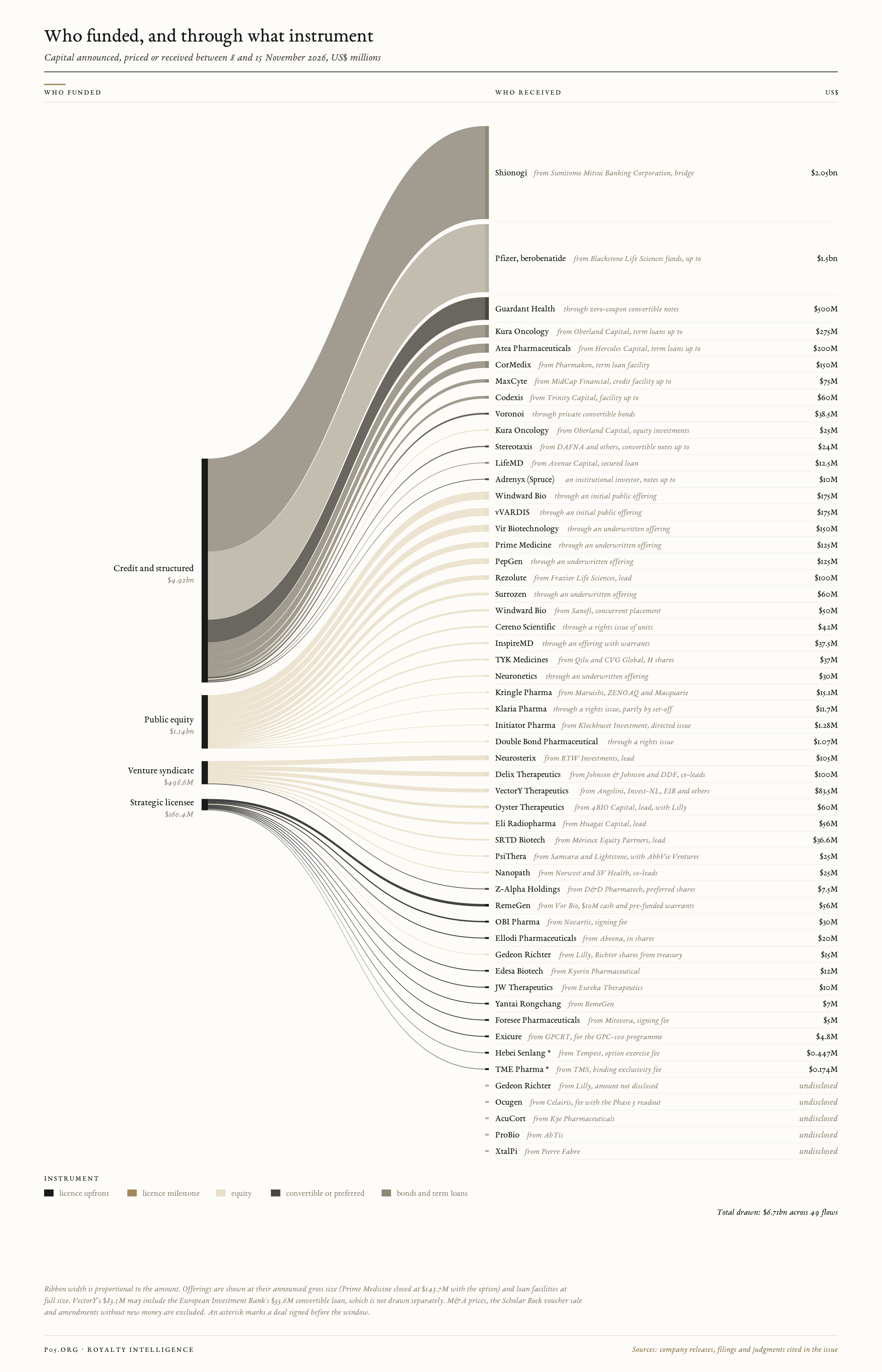
Capital announced, priced or received between 8 and 15 November: about USD 6.71bn across 49 flows. Credit and structured capital leads with USD 4.92bn, and Shionogi's USD 2.05bn bridge loan from Sumitomo Mitsui Banking Corporation is the largest single flow, ahead of Blackstone's up to USD 1.5bn for Pfizer's berobenatide. M&A prices and the Scholar Rock voucher sale are left out.
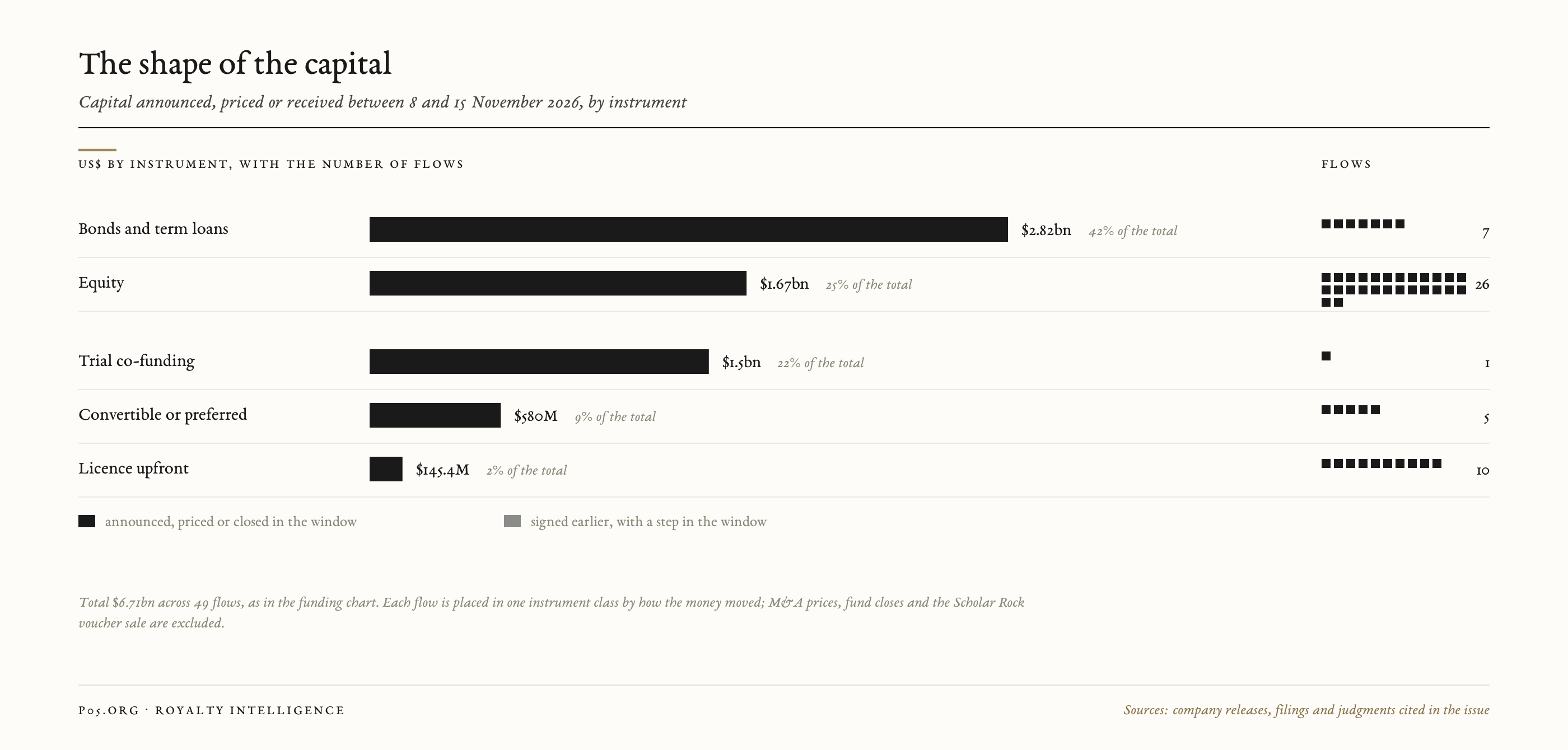
The same capital by instrument. Bonds and term loans make up 42 per cent of the total, equity 25 per cent and Blackstone's berobenatide co-funding 22 per cent; licence upfronts were USD 145.4m across ten payments, 2 per cent of the total.
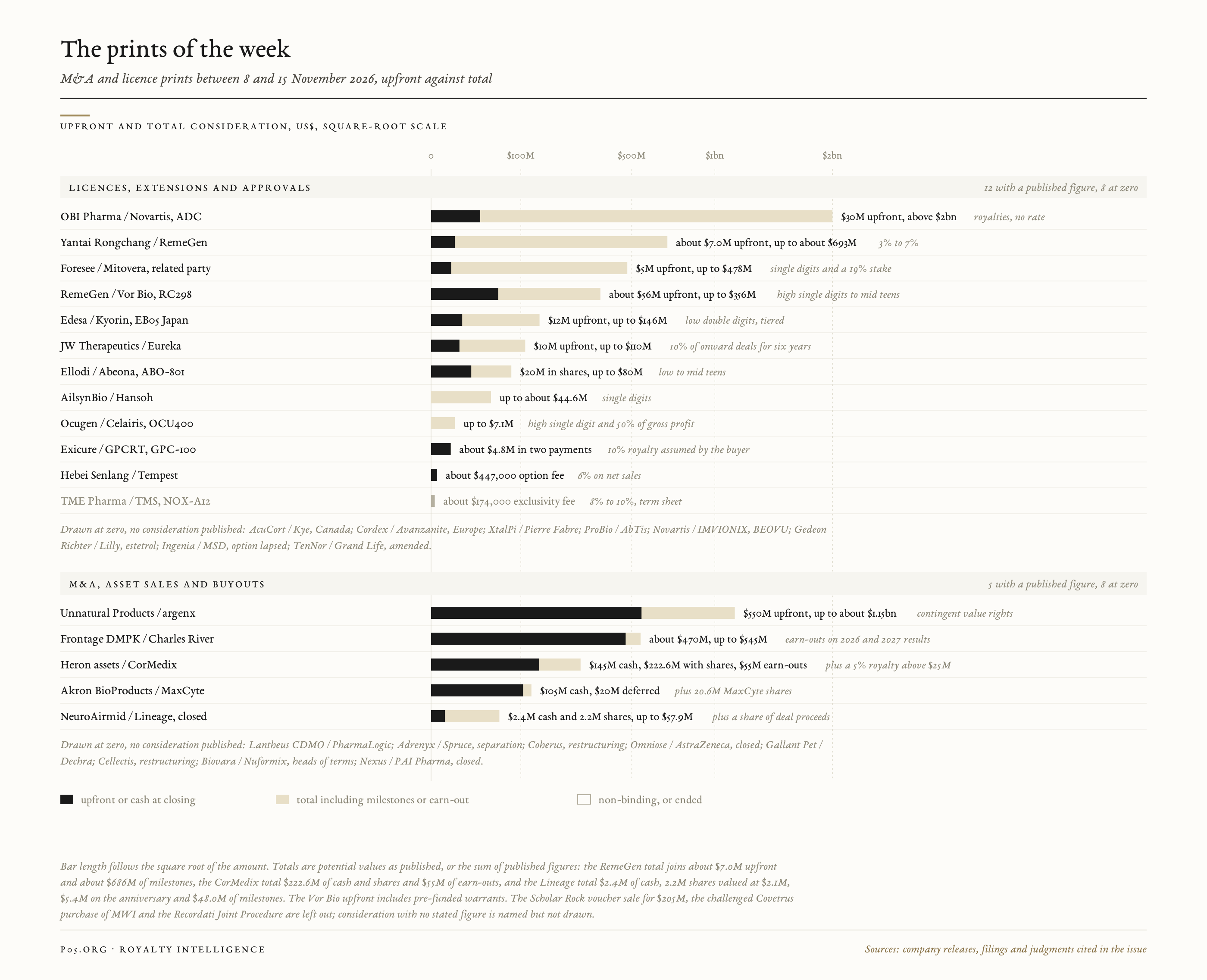
M&A and licence prints between 8 and 15 November on a square-root scale, upfront against total. Seventeen publish a figure and sixteen publish no consideration; argenx's USD 550m upfront for Unnatural Products is the largest cash print, and OBI Pharma's licence to Novartis, above USD 2bn, the largest headline.
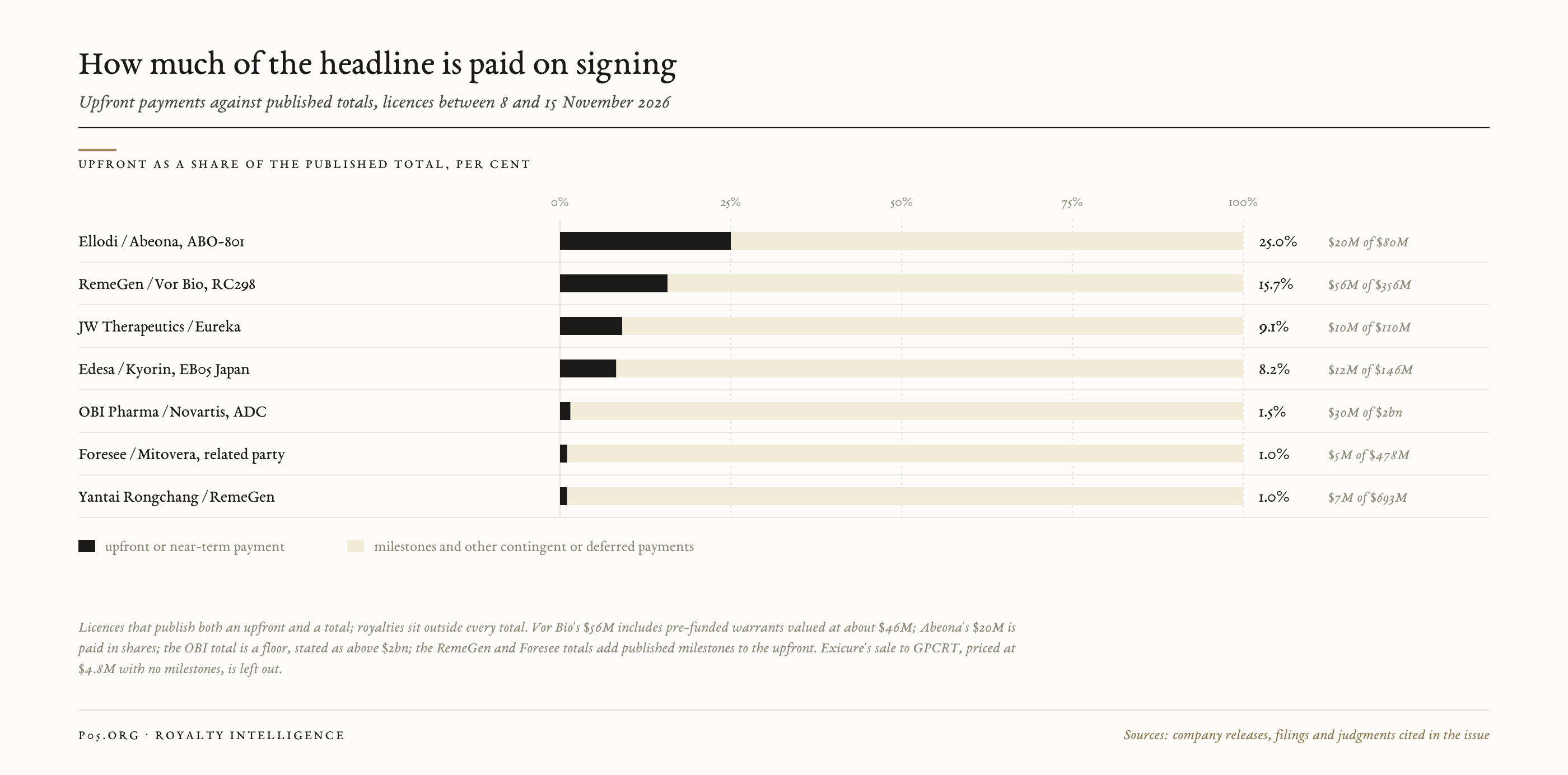
Upfront as a share of the published total, for the seven licences that publish both. Abeona's purchase of ABO-801 pays 25.0 per cent on signing, in shares, and RemeGen's licence from Yantai Rongchang and Foresee's to Mitovera 1.0 per cent each. Royalties sit outside every total.
League Tables
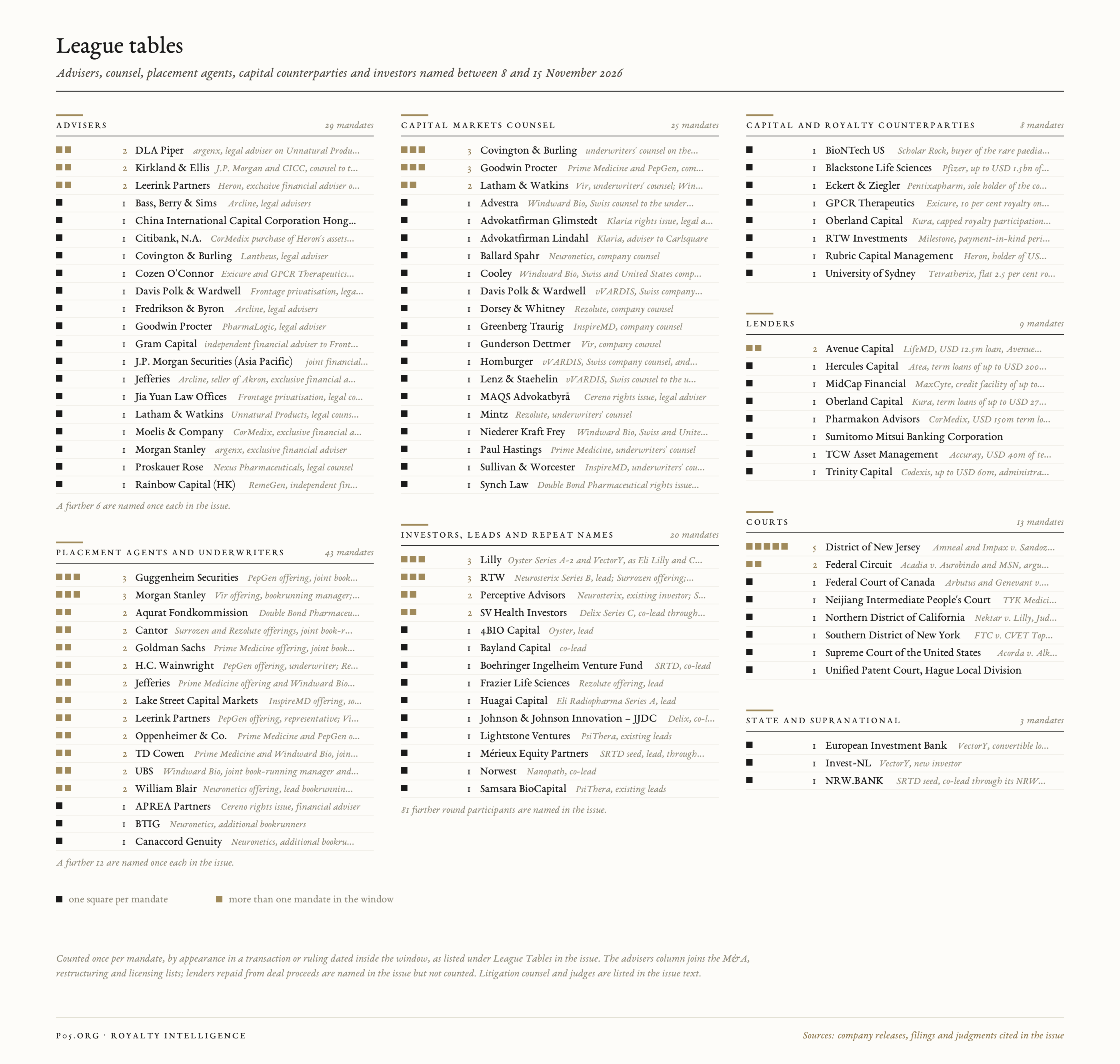
Advisers, counsel, placement agents, lenders, capital and royalty counterparties, courts and investors named in the issue for 8 to 15 November, counted once per mandate. Morgan Stanley and Guggenheim Securities lead the placement agents with three each, Covington & Burling and Goodwin Procter lead counsel with three each, and the District of New Jersey heard five of the court items.
Placement agents and capital markets advisers. Morgan Stanley, 3 (Vir offering, bookrunning manager; Surrozen and Rezolute offerings, joint book-running manager); Guggenheim Securities, 3 (PepGen offering, joint bookrunning manager; Surrozen and Rezolute offerings, joint book-running manager); Jefferies, 2 (Prime Medicine offering and Windward Bio initial public offering, joint book-running manager and representative; also placement agent on Windward's Sanofi placement); TD Cowen, 2 (Prime Medicine and Windward Bio, joint book-running manager, as TD Securities (USA)).
Goldman Sachs, 2 (Prime Medicine offering, joint book-running manager; vVARDIS initial public offering, representative); Leerink Partners, 2 (PepGen offering, representative; Vir offering, bookrunning manager); Cantor, 2 (Surrozen and Rezolute offerings, joint book-running manager); Oppenheimer & Co., 2 (Prime Medicine and PepGen offerings, underwriter); H.C. Wainwright, 2 (PepGen offering, underwriter; Rezolute offering, lead manager); William Blair, 2 (Neuronetics offering, lead bookrunning manager and representative; vVARDIS, underwriter).
UBS, 2 (Windward Bio, joint book-running manager and placement agent; vVARDIS, underwriter); Lake Street Capital Markets, 2 (InspireMD offering, sole book runner; Rezolute offering, co-manager); Aqurat Fondkommission, 2 (Double Bond Pharmaceutical and Cereno rights issues, issuing agent); Stifel, 1 (PepGen, joint bookrunning manager); LifeSci Capital, 1 (Prime Medicine, underwriter); Evercore ISI, 1 (Vir, bookrunning manager); Raymond James, 1 (Vir, co-manager); BTIG and Canaccord Genuity, 1 each (Neuronetics, additional bookrunners).
Piper Sandler, 1 (Windward Bio, joint book-running manager and placement agent); J.P. Morgan, 1 (vVARDIS, representative); Deutsche Bank Securities, 1 (vVARDIS, underwriter); Jones, 1 (Rezolute, lead manager); Maxim Group, 1 (Rezolute, co-manager); Vator Securities, 1 (Klaria rights issue, issuing agent and underwriter, subscribing about USD 2.2m (SEK 20.5m) under its commitment); Carlsquare, 1 (Klaria, financial adviser); Pro Rata, 1 (Klaria, adviser to Carlsquare); APREA Partners, 1 (Cereno rights issue, financial adviser). The vVARDIS and Windward syndicates are from the amended registration statements filed before pricing.
Capital markets counsel. Covington & Burling, 3 (underwriters' counsel on the Neuronetics and PepGen offerings, and United States counsel to the vVARDIS underwriters); Goodwin Procter, 2 (Prime Medicine and PepGen, company counsel; Prime also per the firm's release of 11 November); Latham & Watkins, 2 (Vir, underwriters' counsel; Windward Bio, United States counsel to the underwriters); Paul Hastings, 1 (Prime Medicine, underwriters' counsel); Ballard Spahr, 1 (Neuronetics, company counsel).
Gunderson Dettmer, 1 (Vir, company counsel); Niederer Kraft Frey and Cooley, 1 each (Windward Bio, Swiss and United States company counsel); Advestra, 1 (Windward Bio, Swiss counsel to the underwriters); Homburger and Davis Polk & Wardwell, 1 each (vVARDIS, Swiss company counsel, and United States counsel to the company and the selling shareholders); Lenz & Staehelin, 1 (vVARDIS, Swiss counsel to the underwriters); Dorsey & Whitney, 1 (Rezolute, company counsel); Mintz, 1 (Rezolute, underwriters' counsel).
Greenberg Traurig, 1 (InspireMD, company counsel); Sullivan & Worcester, 1 (InspireMD, underwriters' counsel); MAQS Advokatbyrå, 1 (Cereno rights issue, legal adviser); Synch Law, 1 (Double Bond Pharmaceutical rights issue, legal adviser); Advokatfirman Glimstedt, 1 (Klaria rights issue, legal adviser); Advokatfirman Lindahl, 1 (Klaria, adviser to Carlsquare). The vVARDIS, Windward and Rezolute counsel are named in the registration statements or the preliminary prospectus supplement filed before pricing.
Private round counsel. Goodwin Procter, 1 (Delix Series C, company counsel, per the firm's release of 9 November). No counsel was named for the other eight private rounds.
Investors. RTW, 3 (Neurosterix Series B, lead; Surrozen offering; Milestone, holder of the convertible notes whose payment-in-kind period was extended); Lilly, 3 (Oyster Series A-2 and VectorY, as Eli Lilly and Company; SRTD seed, as Lilly Ventures); SV Health Investors, 2 (Delix Series C, co-lead through the Dementia Discovery Fund; Nanopath Series B, co-lead through the MedTech Convergence Fund); Perceptive Advisors, 2 (Neurosterix, existing investor; Surrozen offering).
Frazier Life Sciences, 1 (Rezolute offering, lead); Access Biotechnology, Boxer Capital Management and Venrock Healthcare Capital Partners, 1 each (Surrozen offering); Sanofi, 1 (Windward Bio, USD 50.0m placement through Sanofi Foreign Participations B.V.); Qilu, 1 (TYK Medicines, 57,000,000 H shares, a subsidiary of Qilu Pharmaceutical (Hainan) and licensee of TY-9591); CVG Global, 1 (TYK Medicines, 19,000,000 H shares). Maruishi Pharmaceutical and ZENOAQ Holdings, 1 each (Kringle new shares); Macquarie Bank, 1 (Kringle, 19th and 20th series share acquisition rights).
Klockhuset Investment, 1 (Initiator directed issue); Investentia, 1 (Double Bond rights issue, undertaking of up to about USD 0.31m (SEK 3m) by set-off; two other undertakings are unnamed); Fenja Capital II and Fenja Capital Co-Invest I, 1 (Cereno, undertaking of up to about USD 7.4m (SEK 70m) by set-off). Johnson & Johnson Innovation – JJDC, 1 (Delix, co-lead); RA Capital, UC Investments, Artis Ventures, OMX Ventures, Dolby Family Ventures and Bail Capital, 1 each (Delix, existing).
Adage Capital Management, Hamilton Square Partners Management, Vestal Point Capital and YK Bioventures, 1 each (Delix, new). 4BIO Capital, 1 (Oyster, lead); CE Ventures, Actium Group and TOHO Ventures (managed by Global Brain), 1 each (Oyster, new); Syncona, Oxford Science Enterprises, Mission BioCapital and MGB Ventures, 1 each (Oyster, existing). Mérieux Equity Partners, 1 (SRTD seed, lead, through Mérieux Innovation 2); Boehringer Ingelheim Venture Fund, 1 (SRTD, co-lead); High-Tech Gründerfonds and Anobis Asset, 1 each (SRTD).
AbbVie Ventures and Lumination Capital, 1 each (PsiThera, new); Samsara BioCapital and Lightstone Ventures, 1 each (PsiThera, existing leads). Norwest, 1 (Nanopath, co-lead); Labcorp Venture Fund, 1 (Nanopath, strategic); Elderberry Ventures, GingerBread Capital and Alumni Ventures, 1 each (Nanopath). Angelini Ventures, 1 (VectorY, new); Forbion, EQT Life Sciences, MRL Ventures, Insight Partners, BioGeneration Ventures and the ALS Investment Fund, 1 each (VectorY, returning).
Janus Henderson Investors, GV, Ikarian Capital, Affinity Asset Advisors and Dellora Investments, 1 each (Neurosterix, new); Acorn Bioventures, 1 (Neurosterix, existing). Addex did not take part. Huagai Capital, 1 (Eli Radiopharma Series A, lead); Bayland Capital (康君资本), 1 (co-lead); Boyu Ventures, Delian Capital, Innovent's InnoPinnacle Fund, Haibang Venture, Bairui Capital, Shenzhen Angel FOF Management and Grand Flight Investment, 1 each (Eli, new).
CSPC & Growth Bio Fund, Huaige Capital, KHK Fund, Longfeng Venture, Hongsheng Capital, Bioclub Fund and Skyfield Capital, 1 each (Eli, existing). D&D Pharmatech, 1 (Z-Alpha Holdings preferred shares, about USD 7.5m). Voronoi convertible bonds of about USD 38.5m (KRW 52.7bn): Kiwoom Securities, 1 (KRW 10bn); DS Asset Management, 1 (three funds, KRW 12bn); DS Investment & Securities and Joy&July (조이앤줄라이), 1 each (KRW 5bn each); Life Asset Management, 1 (four funds, KRW 5bn).
GVA Asset Management, 1 (six funds, KRW 4.4bn); NH Investment & Securities, 1 (KRW 3bn); NH Hedge Asset Management, 1 (four funds, KRW 2.7bn); Mirae Asset Securities, 1 (KRW 2bn); NXVP BioNext New Technology Investment Fund, 1 (KRW 2bn); KB-GVA Premier Mezzanine New Technology Business Investment Fund, 1 (KRW 1.6bn). The trustee banks and brokers holding the funds are not counted.
Structured capital: Blackstone Life Sciences, 1 (Pfizer, up to USD 1.5bn of berobenatide development costs, with BXPE alongside); Oberland Capital, 1 (Kura, USD 25m of equity investments, USD 5m at closing, beside its loans); TCW Asset Management, 1 (Accuray, USD 55m of Series A convertible preferred stock, USD 15m in cash and USD 40m by exchange of term loan); DAFNA Capital Management, 1 (Stereotaxis, USD 2.0m of convertible notes through DAFNA LifeScience and DAFNA LifeScience Select; DAFNA's chief executive, Nathan Fischel, sits on the Stereotaxis board).
Eckert & Ziegler, 1 (Pentixapharm, sole bondholder, convertible bond extended to 2030). The other Stereotaxis noteholders are not named; the 8-K says only "certain accredited investors, including entities affiliated with certain members of our board of directors". The Rezolute participants other than Frazier are unnamed ("new and existing funds"), as are the Guardant initial purchasers.
State and supranational participants. European Investment Bank, 1 (VectorY, convertible loan of about USD 33.6m (EUR 30m), per the bank's release of 11 November, and listed by VectorY among the new investors); Invest-NL, 1 (VectorY, new investor); NRW.BANK, 1 (SRTD seed, co-lead through its NRW.Venture EU Tech&Scale fund). NRW.BANK says an InvestEU guarantee agreement with the European Commission backs its funding. That backing is indirect and not counted.
Shenzhen Angel FOF Management (深天使), an Eli Radiopharma investor, is listed under Investors only, because the release does not describe its ownership. Two of the Voronoi funds are named NH Hedge 국민성장 (national growth) and DS 국민참여 혁신성장 (citizens' participation innovative growth). Neither disclosure states a public sponsor, and they are not counted here.
M&A advisers. Leerink Partners, 2 (Heron, exclusive financial adviser on the asset sale to CorMedix; PharmaLogic, financial adviser on the Lantheus CDMO purchase); DLA Piper, 2 (argenx, legal adviser on Unnatural Products; Heron, legal counsel); Kirkland & Ellis, 2 (J.P. Morgan and CICC, counsel to them as joint financial advisers to the Frontage offeror; PAI Pharma, legal counsel on Nexus); Morgan Stanley, 1 (argenx, exclusive financial adviser); Latham & Watkins, 1 (Unnatural Products, legal counsel, also per the firm's release).
Moelis & Company, 1 (CorMedix, exclusive financial and financing adviser); Willkie Farr & Gallagher, 1 (CorMedix, legal counsel, and adviser on the debt financing per the firm's release); J.P. Morgan Securities (Asia Pacific) and China International Capital Corporation Hong Kong Securities, 1 each (joint financial advisers to the Frontage offeror owned by Tigermed, Charles River and Frontage's chairman); Davis Polk & Wardwell and Jia Yuan Law Offices, 1 each (Frontage privatisation, legal counsel, client not stated in the release); Gram Capital, 1 (independent financial adviser to Frontage's independent board committee).
Goodwin Procter, 1 (PharmaLogic, legal adviser); Solomon Partners Securities, 1 (Lantheus, financial adviser on the CDMO sale); Covington & Burling, 1 (Lantheus, legal adviser); Stifel, 1 (MaxCyte, exclusive financial adviser and exclusive financing agent on Akron BioProducts); Sidley Austin, 1 (MaxCyte, legal counsel); Jefferies, 1 (Arcline, seller of Akron, exclusive financial adviser); Bass, Berry & Sims and Fredrikson & Byron, 1 each (Arcline, legal advisers).
William Blair, 1 (PAI Pharma, exclusive adviser on Nexus); Proskauer Rose, 1 (Nexus Pharmaceuticals, legal counsel); SP Angel Corporate Finance, 1 (Nuformix, financial adviser on the proposed Biovara acquisition and the move to AIM); Citibank, N.A., 1 (CorMedix purchase of Heron's assets, escrow agent for USD 2.0m of the cash). No adviser is named for AstraZeneca and Omniose, Dechra and Gallant Pet, IMVIONIX and Novartis, or Lineage and NeuroAirmid.
Restructuring advisers. None named. The releases and reports read for Spruce's separation of CRHX-101 into Adrenyx, Coherus's Strategic Prioritization Plan and Cellectis's headcount reduction name no financial, legal or restructuring adviser. Adrenyx's noteholder is described only as "a leading institutional biotechnology investor".
Licensing advisers. Rainbow Capital (HK), 1 (RemeGen, independent financial adviser to the independent board committee and independent shareholders on the RCZY-690 licence from Yantai Rongchang); Cozen O'Connor, 1 (Exicure and GPCR Therapeutics USA, legal counsel on the assignment of the GPC-100 programme to GPCRT). No adviser is named in the primary documents read for the other sixteen licences and asset purchases, among them Kyorin and Edesa, Vor and RemeGen, Richter and Lilly, and OBI and Novartis.
Lenders. Pharmakon Advisors, 1 (CorMedix, USD 150m term loan facility for the Heron assets; BioPharma Credit PLC as collateral agent, BPCR Limited Partnership and BioPharma Credit Investments V (Master) LP as lenders); Oberland Capital, 1 (Kura, term loans of up to USD 275m; KRGD SA, LLC as administrative and collateral agent); Hercules Capital, 1 (Atea, term loans of up to USD 200m, agent); Trinity Capital, 1 (Codexis, up to USD 60m, administrative and collateral agent); Sumitomo Mitsui Banking Corporation, 1 (Shionogi, bridge loan of about USD 2.05bn (JPY 300bn)).
Avenue Capital, 2 (LifeMD, USD 12.5m loan, Avenue Venture Opportunities Fund II as lender and administrative and collateral agent with Avenue Growth Lending Fund III; Spruce, amended loan agreement with Avenue Capital Management II and Avenue Venture Opportunities Fund II); MidCap Financial, 1 (MaxCyte, credit facility of up to USD 75m alongside the Akron purchase); TCW Asset Management, 1 (Accuray, USD 40m of term loan exchanged into convertible preferred stock). Repaid or to be repaid, not counted: Hercules (Kura and Heron), Innovatus (Codexis) and Citizens Bank (LifeMD).
Capital and royalty counterparties. Oberland Capital, 1 (Kura, capped royalty participation on US KOMZIFTI sales from October 2028, and up to USD 25m of equity through its affiliate TPC Investments III); Blackstone Life Sciences, 1 (Pfizer, up to USD 1.5bn of berobenatide development costs for milestone payments); RTW Investments, 1 (Milestone, payment-in-kind period on its convertible notes extended to March 2029; also holds the CARDAMYST royalty); Eckert & Ziegler, 1 (Pentixapharm, sole holder of the convertible bond extended to 2030).
Rubric Capital Management, 1 (Heron, holder of USD 35.0m of convertible notes to be exchanged for CorMedix shares); BioNTech US, 1 (Scholar Rock, buyer of the rare paediatric disease voucher for USD 205m); University of Sydney, 1 (Tetratherix, flat 2.5 per cent royalty to June 2036 replacing the tiered royalty); GPCR Therapeutics, 1 (Exicure, 10 per cent royalty on GPC-100 assumed by the buyer, GPCRT). The Stereotaxis noteholders, the buyers of Saniona's AstronauTx shares and Adrenyx's noteholder are not named.
Courts. District of New Jersey, 5 (Amneal and Impax v. Sandoz; Esperion v. Aurobindo, Judges Neals and Choe-Groves; Alkermes v. Teva, Judge K. M. Williams; Bausch & Lomb and Eye Therapies v. Dr. Reddy's; Tonix v. Dr. Reddy's, Judge Cecchi); Federal Circuit, 2 (Acadia v. Aurobindo and MSN, argued on 9 November, from the District of Delaware, Judge G. B. Williams; Ferring v. Finch, from the District of Delaware, Judge Hall); Supreme Court of the United States, 1 (Acorda v. Alkermes, No. 26-498).
Northern District of California, 1 (Nektar v. Lilly, Judge Donato); Southern District of New York, 1 (FTC v. CVET Topco, miscellaneous docket 26-mc-577); Unified Patent Court, Hague Local Division, 1 (GSK v. Pfizer and BioNTech); Federal Court of Canada, 1 (Arbutus and Genevant v. Pfizer and BioNTech, T-3200-26), with the new suits against Pfizer in Japan; Neijiang Intermediate People's Court, 1 (TYK Medicines and Huiyu, settled).
Litigation counsel. Saul Ewing, 2 (Acadia, on the NUPLAZID appeal; Alkermes, against Teva); FBT Gibbons, 2 (Bausch & Lomb and Eye Therapies; Tonix); Sullivan & Cromwell, 1 (Acorda, Supreme Court petition); Goodwin Procter, 1 (Alkermes, Supreme Court); Kirkland & Ellis, 1 (Lilly, against Nektar); Quinn Emanuel, 1 (Nektar); Stone Conroy, 1 (Amneal, against Sandoz); Kratz & Barry, 1 (Aurobindo, Acadia appeal); Cole Schotz, 1 (MSN, Acadia appeal).
Greenberg Traurig, 1 (Teva, LYBALVI case); Womble Bond Dickinson, 1 (Ferring); Finnegan, 1 (Bausch & Lomb and Eye Therapies); Dechert, 1 (Tonix). Dr. Reddy's has no counsel on the public record in either new suit.
All information in this report was accurate as of the research date and is derived from publicly available sources including SEC filings, Hong Kong Stock Exchange announcements, National Stock Exchange of India filings, European Medicines Agency and Food and Drug Administration records, United States patent assignment records, company press releases and financial news reporting. Information may have changed since publication. This content is for informational purposes only and does not constitute investment, legal, or financial advice. The author is not a lawyer or financial adviser.
Currency and language note: all amounts are given in US dollars. Where a source uses another currency, the converted figure comes first and the original follows in brackets, at approximately EUR 0.86, SEK 9.50, NOK 10.30, CHF 0.885, DKK 6.40, GBP 0.74, JPY 146, KRW 1,370, CNY 7.10, HKD 7.78, TWD 32.0, AUD 1.41 and INR 88 per US dollar, being late September 2026 rates. Where a source published its own conversion, that figure is used. Quotations from sources in other languages are given in our English translation.