What a royalty audit recovers

On 17 March 2026 Judge Philip Halpern, sitting in White Plains, refused to dismiss a suit Regeneron had brought against Sanofi over Dupixent. The opinion turned on an audit clause. The parties' collaboration agreement lets each side's accountants check "the accuracy of all financial, accounting and numerical information and calculations provided, and payments made".
Sanofi had offered Regeneron's auditors selected passages of its contracts with pharmacy benefit managers, shown by screen-share and not to be copied. The court held that the full contracts plausibly fell within the clause.
According to Regeneron's complaint, its audit of 2021 and 2022 had already turned up a Dupixent rebate from 2021 that Sanofi never reported, and an adjustment of "many multiples of $75,000". The audit itself cost Regeneron a flat fee of more than $75,000. A protective order for discovery followed in July.
Dupixent's economics run through a profit share, but the problem is the one every royalty holder has. The payer computes the base, takes the deductions it reads the contract to allow and reports a number.
The audit clause is the holder's one tool for testing that number. Earlier pieces set out how a royalty is calculated and paid, what a buyer expects to find about audit history in the data room, and whether audit rights pass to a financier at all. This piece looks at what audits find, how much of it is collected, and what the clause is worth to the buyer of a stream.
What the clauses say
We read the audit clauses in 36 licence and collaboration agreements filed with the SEC, 33 of them signed since 2018, and in seven royalty purchase agreements.
Three terms decide what an audit can recover: how far back the auditor may look, the shortfall at which the licensee pays for the audit, and the interest on what is found. In all 22 agreements with a large pharmaceutical or biotech licensee, the cost-shifting percentage is redacted.
Fifteen of the 22 also redact the lookback, and eleven the interest rate. The legible terms come from university licences, small biotechs, a generic settlement and one inventor. Among them, 13 of 14 show a threshold. Eight are set at 5 per cent, one of which also requires a shortfall above $250,000, and the rest at 3, 7, 7.5 and 10 per cent. Where a lookback is stated, it is three years in 11 of 14 clauses.
Public templates sit close to that. The NIH model exclusive licence keeps records for five years and shifts the cost of an inspection that finds underpayment "in excess of five percent (5%) for any twelve (12) month period". It charges 1 per cent a month on payments more than 90 days late.
A study of 975 technology licences filed with the SEC between 1996 and 2015 found an average auditable period of 4.06 years. Fifty-one per cent of those contracts shifted audit fees to the licensee and 32 per cent charged interest on underpaid royalties.
The ends of the range are far apart. MIT's licence to Cyclerion of September 2025 lets MIT audit "all existing and relevant Records for all prior Reporting Periods" and shifts the cost if Cyclerion hinders the audit.
It also tolls "all applicable statutes of limitation and time-based defenses" once MIT asks for one. Johns Hopkins requires Capricor to pay underpayments found "for a period of seven (7) years prior to the inspection", whatever the statute of limitations says. At the other end, GSK's licence from Arrowhead allows an audit "not more than once every two (2) Calendar Years", and Pfizer's licence from Voyager charges interest at the federal funds rate with no margin.
Only six of the 36 bar auditors paid on contingency. Twenty-one limit how often the same period may be audited. None of the interest clauses uses SOFR, and four still refer to LIBOR.
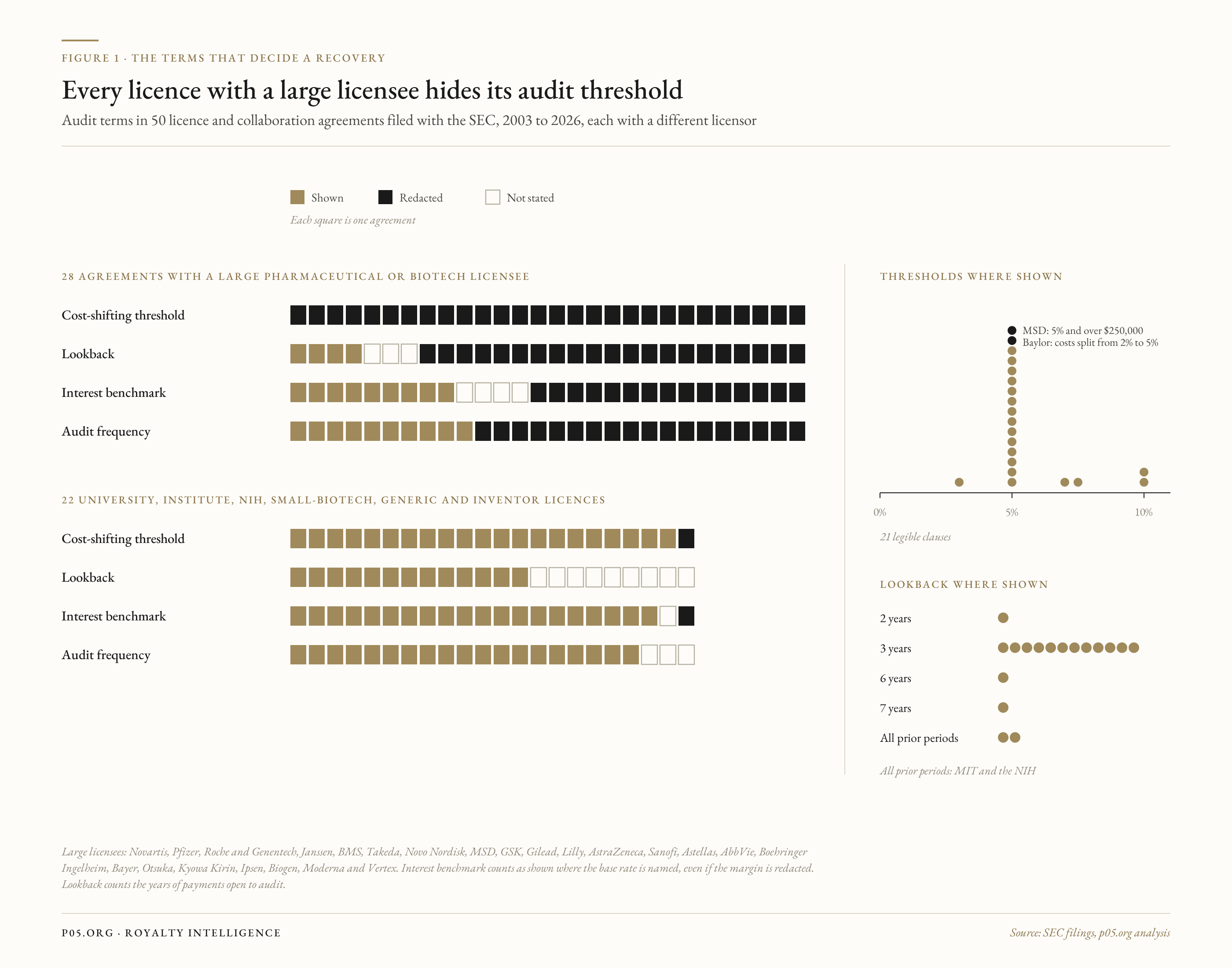
Audit terms in 36 licences filed with the SEC, by type of licensee. Every agreement with a large licensee redacts the cost-shifting threshold.
What audits find
Filings seldom say what an audit found. The public record that does comes from a university audit programme, court files and the case studies of the firms that run audits.
The University of California published the only figures with a stated sample. Of 27 audits completed between fiscal 2010 and 2016, 16 found underreported royalties, a rate of 59 per cent.
Invotex, an audit firm, puts the share at "approximately 87%" of licensees, from its own engagements since 1997, without giving a sample size.
The firms' case studies are undated, so they are given here by the date each was first captured by the web archive. Stout's account of a branded drug acquired in an M&A transaction, online by September 2020, describes an audit for a medical research institute.
The acquirer had changed its predecessor's reading of the allowable trade and quantity discounts without telling the licensor. It deducted returns on a forecast where the licence called for actual returns, and it reported nothing on sales through a foreign distributor.
The findings came to nearly $2M with interest, and because the shortfall exceeded the contractual threshold the licensee paid for the whole audit.
In another Stout case, a generic licensee of a university computed royalties on an intercompany transfer price where the contract required an arm's-length price, and treated some sales as outside the territory. It had under-reported by more than 50 per cent.
RSM's case study, online by May 2022, concerns a diagnostics licensor whose patents cover self-tests for strep throat, premature labour and mononucleosis. RSM audited three licensees on site and found underpayment at each.
One deducted cash discounts the licence did not allow. Others left countries off their reports, and whole product lines were missing. The largest finding turned on "Gross Final Sales", a royalty base the contract never defined. The licensee had netted several costs against the invoice.
RSM measured the base as the amount invoiced, put the shortfall at about $3.5M, and the parties settled for more than half of it.
Two cases put amounts on the public record. PDL BioPharma owned Depomed's royalty on Glumetza when Valeant, the licensee, had not provided the monthly reports or payments its contract required in 2015. At PDL's request Depomed exercised its audit right in February 2016.
The auditor finished in July 2017, Depomed sued in September, and Valeant paid $13.0M in October, all of it to PDL. A second audit, of 2016 to 2018, found no material adjustments.
The University of Texas licensed a Lyme disease patent to IDEXX in 2004 for its veterinary SNAP tests. The licence set 1 per cent for tests combining Lyme with "one other" test, half of it payable to Tulane, and 2.5 per cent for tests combining Lyme with other tick-borne diseases. From the start IDEXX paid the university 0.5 per cent on its combination tests, the university's half of the lower tier. As the patent neared expiry the university audited 13 years of payments.
The auditors found net sales above $912M, royalties paid of about $4.5M, and more than $18M owed at the higher rate. The Texas Supreme Court noted that IDEXX had seen in 2010 that the higher rate could apply and "never raised the issue".
The Regeneron rebate fits the pattern. Where the cause is disclosed, every finding in these cases is a reading of the contract that favoured the payer. The licensees took deductions their licences did not list, priced bases the licences did not define, chose the cheaper tier for a combination product or left territories and distributors off their reports.
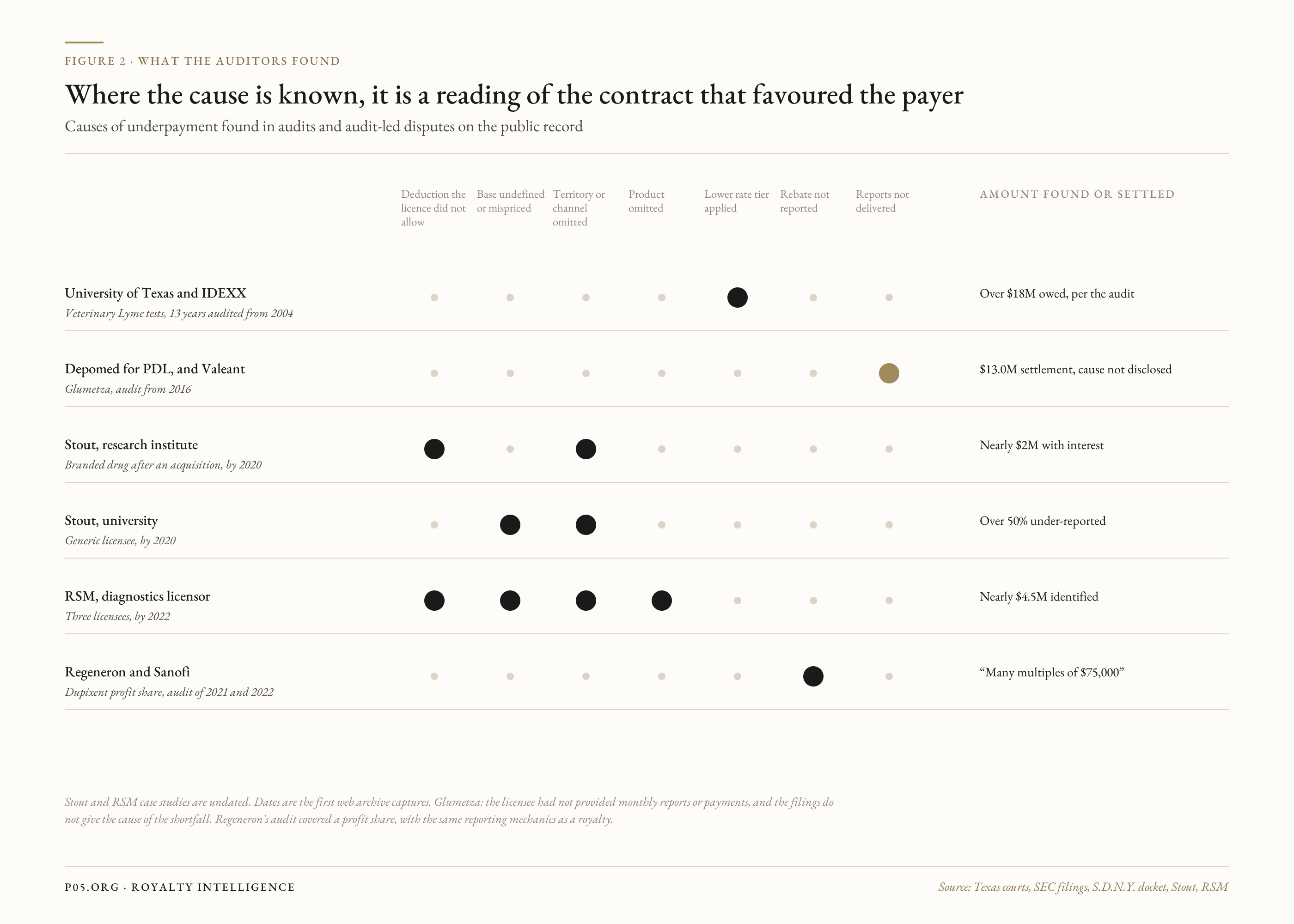
What audits and royalty reviews found, by case and cause.
What gets collected
Less is collected than is found. RSM identified "nearly $4.5 million" across the three licensees and reports recoveries "exceeding $2.5 million", plus late-payment penalties and interest.
The University of California identified more than $3M of underreporting and recovered $1,634,140 of it. In both, about half of what the auditors found came back.
The interest clause can be worth more than the shortfall. IDEXX's licence set interest at the Prime Rate on late payments and, in the audit clause, interest "at the highest allowable rate under Texas law" when an examination found an underpayment of 5 per cent or more.
On 3 April 2025 the Fourteenth Court of Appeals affirmed a judgment of more than $19M in royalties and more than $30M of prejudgment interest at 18 per cent, running from each quarterly due date since 2004. It held that the audit clause governs "incorrect royalty payments" that are "discovered through an audit".
The late-payment clause covers payments made late. IDEXX did not petition the Supreme Court, and the mandate issued in June 2025. The university's status helped. As a state body it faced no laches, estoppel, waiver or ratification defence, which a private licensor would have had to meet.
The cost of finding the money is modest next to these sums. The University of California puts a desk review at about $3,000 and a full audit at $40,000 to $60,000, and says about half of desk reviews lead to a full audit. Its programme paid $655,910 in fees from 2010 to 2016 and recovered $220,550 of them from licensees under cost-shifting clauses.
Over 14 years it found about $6.6M of underpayment at a net cost of $591,000.
Time limits are the larger loss. In Intermec v. TransCore, decided in August 2023, a Delaware court treated each quarterly underpayment as a separate breach under a three-year statute. It held the licensor on notice from its first quarterly report because it "had the ability to order an audit of the quarterly reports (and chose not to)".
In February 2024 the Sixth Circuit barred a licensor's claim against Becton Dickinson because the licence deemed payment statements "true and correct unless objected to and audited" within two years. An audit right left unused does not wait. Each quarter it is not exercised, the oldest quarter falls out of reach.
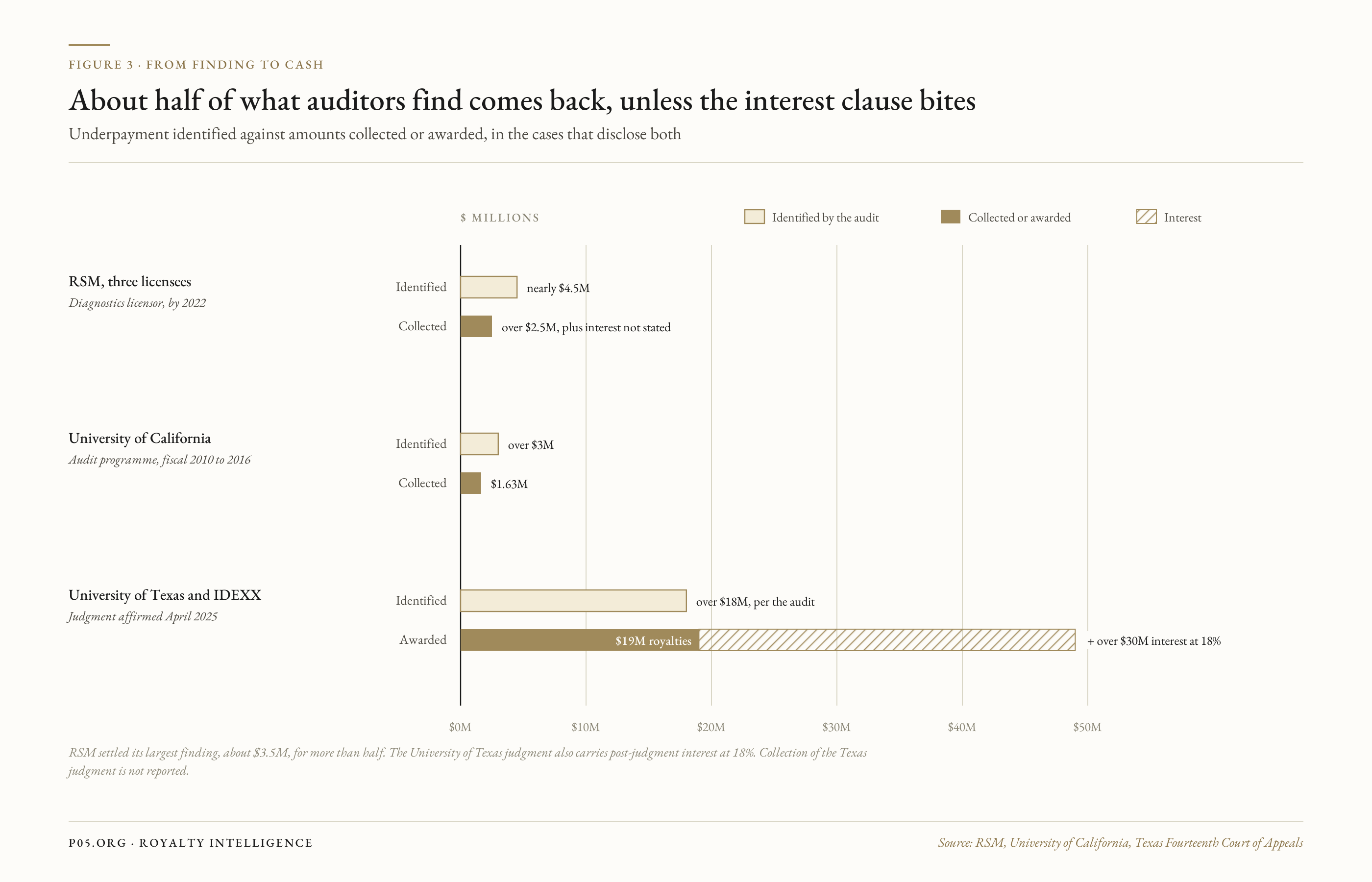
Identified underpayment against amounts collected in cases that disclose both.
What the right is worth to a buyer
None of the seven royalty purchase agreements gives the buyer a direct right to audit the licensee. Each works through the seller. Royalty Pharma's 2020 purchase from PTC is typical: the seller "may, or if requested by the Buyer, shall" give notice of an inspection, and each side bears its pro rata share of the cost. HealthCare Royalty's 2019 agreement with Infinity makes the purchaser pay for audits run at its request, and adds a right to inspect the seller's own books.
DRI's 2022 purchase of Omeros's Omidria royalties allows it to request an audit only for a year in which it did not receive its annual capped amount, and splits the cost equally. Esperion's 2024 sale to an Oaktree fund keeps for the seller "the exclusive right to inspect and audit" the licensee's records for periods before the purchased stream began.
The underlying licence sets the outer limit. Delaware's Supreme Court held in 2021 that a royalty fund that buys a stream takes the licence as written: "As assignee, DRIT is stuck with the agreement that Biogen negotiated".
Thirty of our 36 licences say nothing about audits by a royalty buyer. GSK's licence from Arrowhead lets Arrowhead assign "its right to receive the royalty reports and to conduct audits" to its counterparty in a securitisation, without consent.
Astellas's 2026 licence from Vir goes the other way: a "Monetization Partner" may see the agreement and the royalty reports, but "the other Party shall not be required to provide any information directly" to it.
The audit cuts both ways, and the purchase agreements price that too. PTC's buyer bears its pro rata share of any overpayment an audit reveals, in cash or as a credit against future royalties. When Royalty Pharma sued Boehringer Ingelheim for about €23M of linagliptin royalties, decided in 2021, Boehringer counterclaimed that it had overpaid, and Royalty Pharma admitted the counterclaim as it related to the original agreement.
A buyer that asks for an audit invites the licensee to look for its own errors in the same books.
Glumetza shows the right exercised for a buyer. PDL had bought the stream. It asked the seller to audit, the seller sued on the findings, and the $13.0M went to PDL. The Depomed royalty agreement obliged Depomed to act when PDL asked.
Implications for the Pharmaceutical Royalty Market
The public record prices audit rights badly because the terms that matter are hidden. Every large licensee in our sample redacts the threshold, so a buyer of a large-pharma royalty learns the lookback, the trigger and the interest rate only from the unredacted licence it receives in diligence.
Those three numbers set the size of the claim a first audit can produce, and they belong in the model next to the rate and the term.
The lookback is a wasting asset. With three years of reach, a buyer that closes and waits loses the oldest quarter of claims every quarter, and Intermec suggests a court may count an unused right against it.
The first audit after closing is part of the price. Where the seller keeps the pre-closing periods, as Esperion did, the buyer's audit reaches only what it bought, and any finding in the earlier years belongs to the seller.
The interest clause matters as much as the threshold. IDEXX paid more in interest than in royalties because one clause tied the highest lawful rate to underpayments found by audit. Where a large licensee's rate is legible, it is a benchmark rate plus a margin, down to Pfizer's flat federal funds rate.
Findings are mostly disputes about definitions. A rebate attributed to Dupixent, a tier for a combination test, an undefined base and a reinterpreted discount all end in a negotiation. In the two cases that report both figures, about half of the identified amount was collected.
In Stout's M&A case the new owner of the licence altered the discount treatment without notice, which makes the acquisition of a licensee a natural moment for an audit.
How capital enters and returns
An audit is a small outlay against a contingent recovery. The capital is the auditor's fee, a few thousand dollars for a desk review and tens of thousands for a full audit, and in Regeneron's case more than $75,000. It returns as the shortfall, the interest the clause allows and, above the threshold, the fee itself.
The University of California recovered about a third of its fees from licensees. In five of the seven purchase agreements the buyer pays for the audits it requests. Who keeps the recovery depends on the period: the buyer takes findings on the purchased stream, and the seller keeps findings on earlier years where it has reserved them.
For a fund that buys royalties, the audit is also the only check on the payer's arithmetic after closing. The licensee reports, the seller passes the report on, and the buyer can act only through the seller's covenant to audit on request. The value of that covenant is the size of the claims the licence leaves in reach when the buyer first uses it.
Conclusion
Regeneron's audit closed in September 2023 without the contracts its auditors had asked for. Three years later the dispute is about what its accountants may see. In May 2026 Sanofi told the court it had agreed to produce its benefit-manager contracts, "including all pricing relating to Licensed Products", under an attorneys'-eyes-only order. The years in question are 2021 and 2022, the period Regeneron named when it invoked the clause in February 2023.
All information in this report was accurate as of the research date and is derived from publicly available sources including court opinions, regulatory guidance, academic literature, SEC filings, and financial news reporting. Information may have changed since publication. This content is for informational purposes only and does not constitute investment, legal, or financial advice. The author is not a lawyer or financial adviser.