
The Royalty Nobody Buys: Why Biosimilars Generate Cash Flow and No Bid
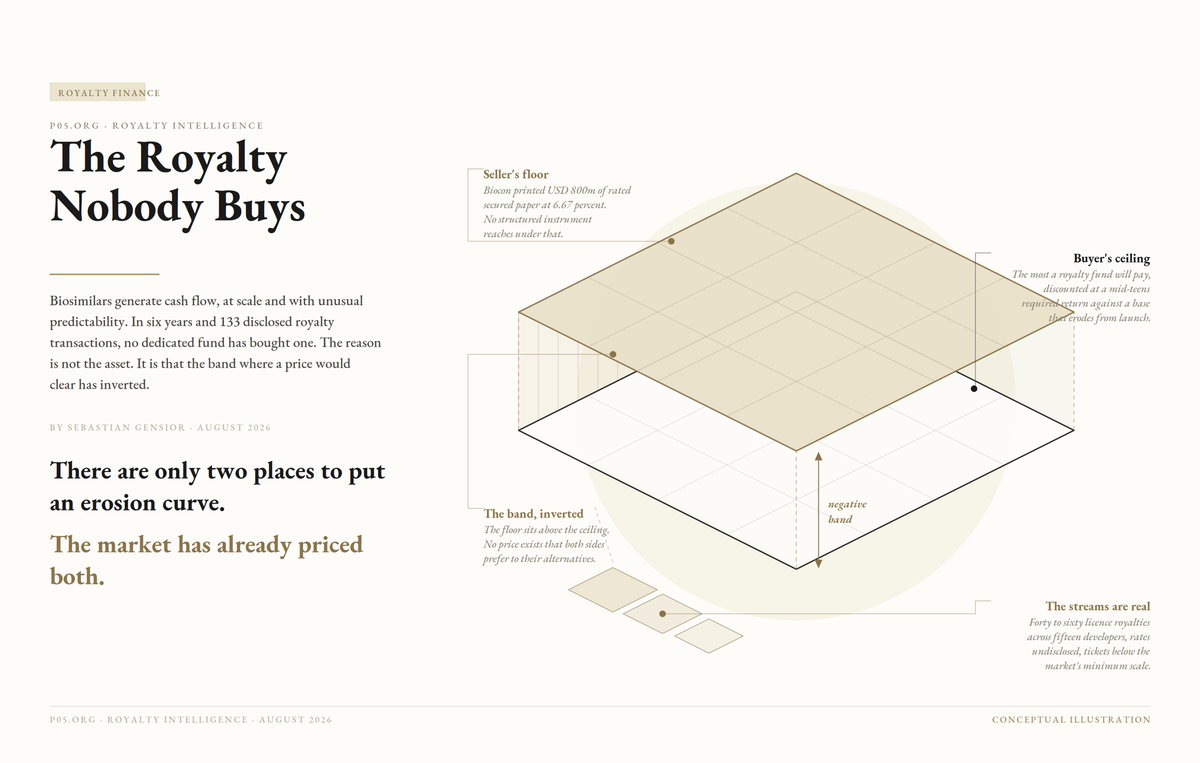
A royalty market prices duration. A biosimilar is an asset engineered to have none. That single sentence explains most of what follows, but not the part that matters. The absence of a biosimilar royalty market is not a gap waiting to be filled. It is an equilibrium, held in place from both sides at once.
The biosimilar industry in 2026 is large, profitable, and growing. Sandoz alone sold USD 3.29 billion of biosimilars in 2025, 30 percent of group revenue, growing 13 percent at constant currency, and grew biosimilars a further 20 percent in the first half of 2026. Samsung Bioepis compounds operating profit at triple-digit growth rates. Biocon Biologics carries a rated balance sheet. Celltrion, Bio-Thera, Henlius, Alvotech, Formycon and a dozen Indian and Chinese developers are all running licence agreements that pay royalties on net sales, in some cases across eight or more jurisdictions per molecule.
And in six years of a royalty finance market that has closed more than USD 32 billion across 133 transactions, no dedicated pharmaceutical royalty fund has publicly disclosed a transaction whose primary asset is a royalty on biosimilar net sales. Not Royalty Pharma, not HealthCare Royalty, not Sagard, not Blackstone Life Sciences, not Oberland, not DRI, not Ligand, not XOMA, not OMERS. In their filings, biosimilars appear in exactly one place: the risk factors.
This piece asks why, current to August 2026. It follows Royalty Financing for Biosimilars, which built the erosion-curve model and asked what a biosimilar royalty would be worth. That article answered the valuation question and left the market question open. This one closes it, and the answer is not the one the modelling implied.
The frame: the band is inverted
Start with the bid condition, because it organises everything that follows.
A royalty prints when there exists a price P acceptable to both sides. The buyer will pay up to the present value of the stream discounted at its required return. The seller will accept down to the present value of the same stream discounted at its marginal cost of alternative capital, because below that number the seller is better off borrowing.
P must satisfy: PV(C, r_seller) ≤ P ≤ PV(C, r_buyer)
The band between those two numbers is where every royalty transaction lives. It is wide when the buyer's required return is close to the seller's alternative, which is the ordinary case for a clinical-stage or newly commercial biotech whose alternative is dilutive equity or venture debt at 12 to 15 percent with warrant coverage. It narrows as the seller's credit improves. It closes when r_seller falls below r_buyer, at which point PV(C, r_seller) exceeds PV(C, r_buyer) and no price exists that both sides prefer to the alternative.
For biosimilars in 2026, the band is not narrow. It is inverted.
The February modelling put the implied yield on a biosimilar royalty in the mid-teens, driven by a revenue base that peaks in year three and declines thereafter. Against that, the observed 2025 and 2026 cost of debt across the biosimilar universe runs from 6.67 percent to 12.5 percent, and the largest players are not borrowing at all. There is no overlap. The seller can do better with a bond, and the buyer cannot justify the price the seller would need.
Everything below is an account of why each side of that inequality sits where it does, and what would have to move for the band to reopen.
One caveat belongs up front, because it changes where the argument lands. The band above is drawn for a royalty purchase, an uncapped or high-capped claim on a stream, priced off duration. Revenue interest financing prices off a different variable, and Part Three tests whether that difference is enough to reopen the band. It is not, though it fails for a different reason than most people assume.
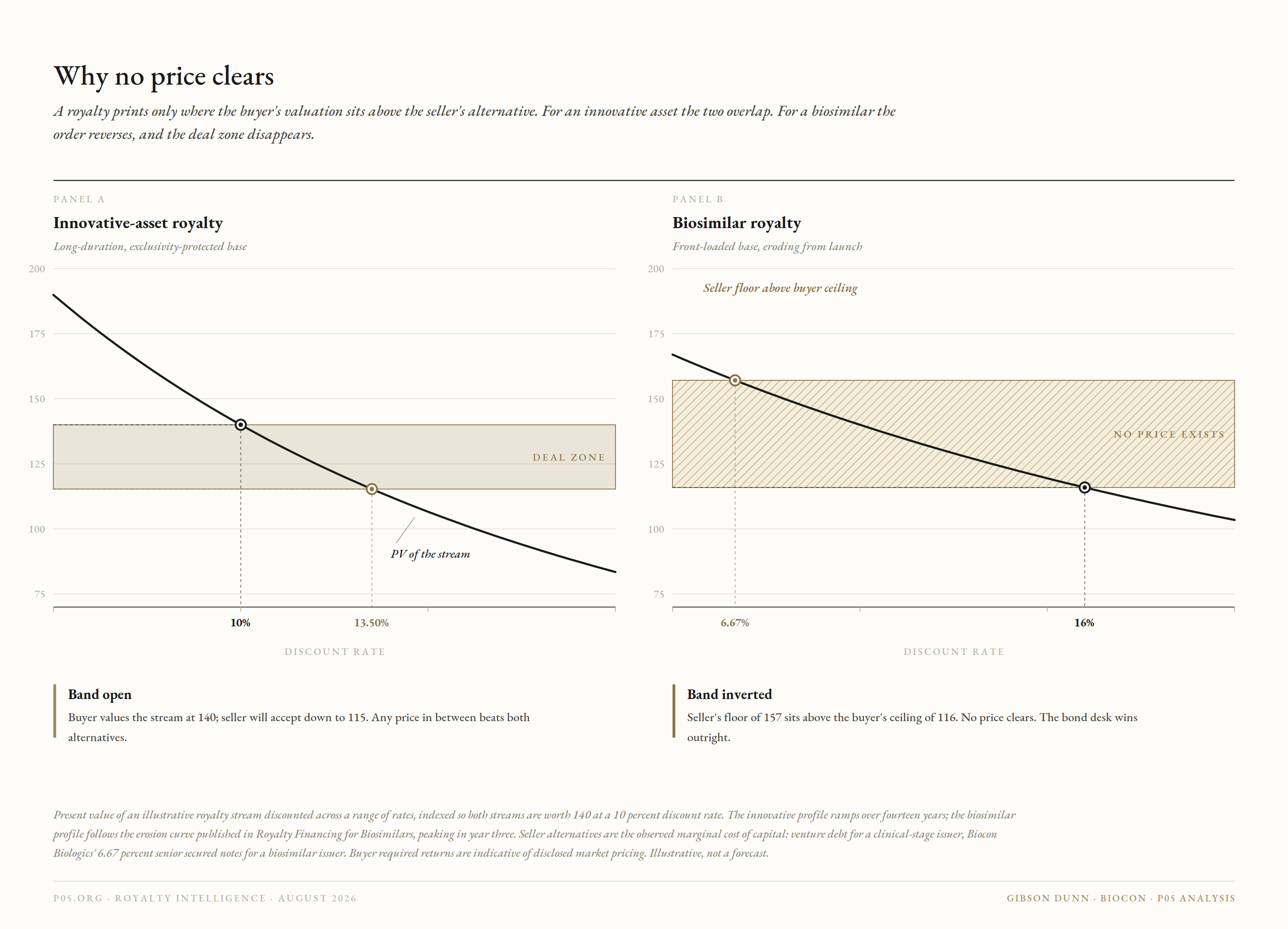
Why no price clears. A royalty prints only where the buyer's valuation sits above the seller's alternative; for a biosimilar the order reverses.
Part one: why the buyer's number is low
I. The base declines from the first payment
Every royalty valuation is an integral of cash flow against a survival curve. For an innovative biologic the cash flow term rises for five to eight years, plateaus, and then falls at loss of exclusivity. The survival curve does the interesting work, which is why When the Money Stops Early spent its length on the hazards that cut S(t) short.
For a biosimilar, the survival curve is comparatively benign and the cash flow term does the damage. There is no patent to invalidate, no Brulotte tail to defend, and usually no meaningful exclusivity to lose. What there is instead is a base that begins eroding at launch and never recovers.
The February model produced a company net sales curve peaking in year three at USD 408 million and falling to USD 108 million by year eight, on a reference market of USD 5 billion, with 15 percent annual price erosion and four competitors by year three. Those assumptions were, if anything, generous. The market has since supplied a harder number: across biosimilar classes, average sales price falls 52 percent within five years of class launch, and as of December 2025 the FDA had cleared biosimilars for 20 unique molecules across 90 approvals, of which 63, or 70 percent, had actually reached the market.
The consequence for a royalty buyer is arithmetic, not judgement. Where the base declines monotonically from the first payment, the buyer's receipts are front-loaded by construction, which sounds attractive and is not. Front-loaded receipts against a declining base mean the cap is either reached quickly, in which case the buyer wanted a bigger cap, or never reached at all, in which case the buyer holds an instrument that cannot deliver its contractual maximum at any point in the asset's life.
The February worked example landed precisely there. At a 6 percent rate on an USD 80 million purchase price with a USD 120 million cap, the cumulative receipts reached USD 118.9 million by year eight, USD 1.1 million short of a 1.5x cap, for an IRR of 11.2 percent. That is not a bad outcome. It is a bad shape, because it is the outcome of a structure that spends eight years failing to reach the lowest cap multiple in the market.
The comparison is what makes it fatal. Gibson Dunn's tracker puts the median cap among capped synthetic royalties at 1.9x, in a range of 1.43x to 4.0x. A biosimilar royalty that struggles to reach 1.5x in eight years is not competing at the bottom of that range. It sits under it.
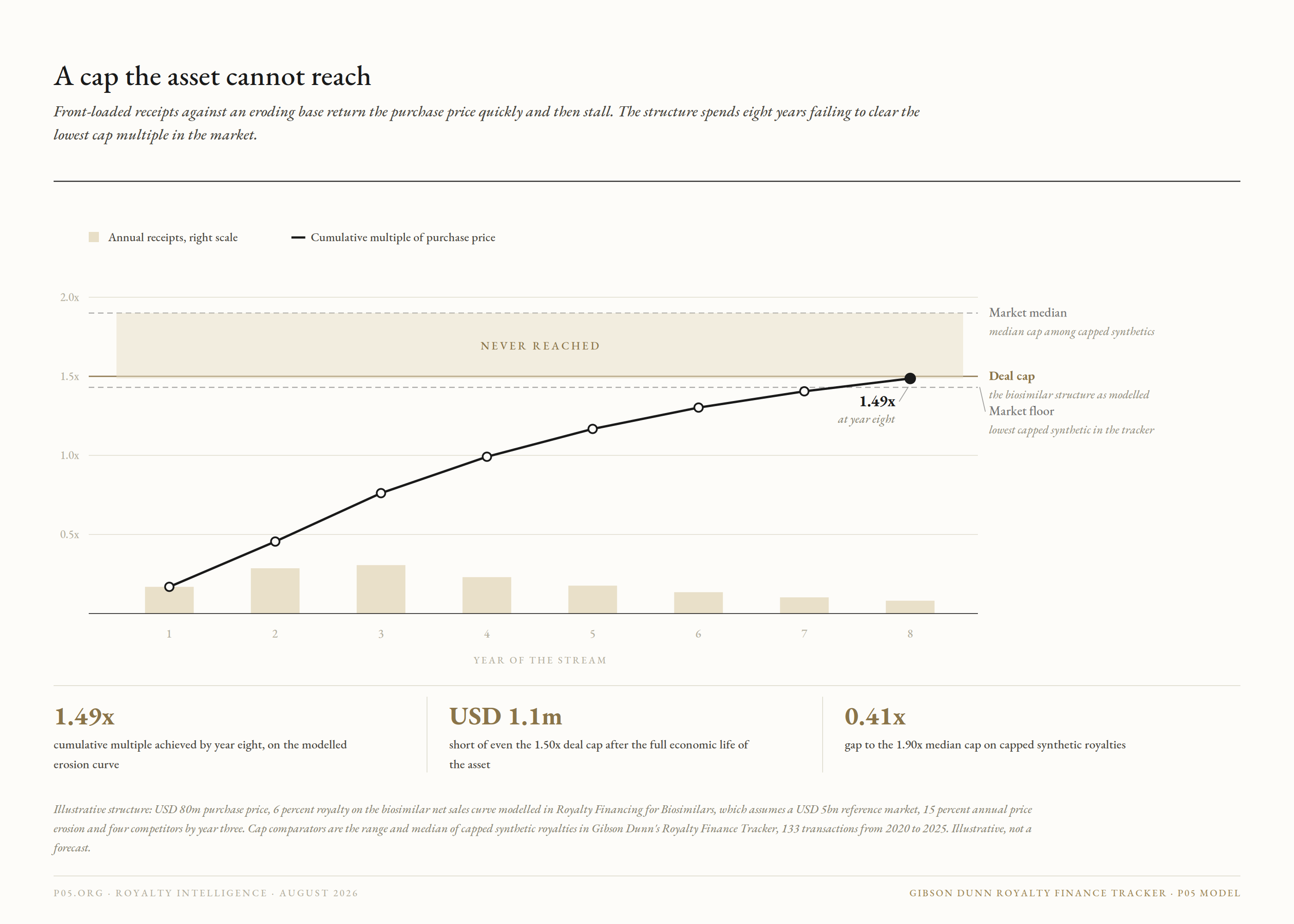
A cap the asset cannot reach. Cumulative receipts against the deal cap and the market's own range of capped synthetic multiples.
The modelling instruction is to stop treating the cap as a term to be negotiated and start treating it as a diagnostic. Solve for the cap multiple the erosion curve can actually deliver within the asset's economic life, then compare that number to the market median. Where the achievable cap sits below the market floor, the instrument is mispriced against its own comparables and rate tiering will not close the gap. Tier downward over time if you tier at all: tiering upward with sales, the innovative-asset convention, is backwards on a declining base.
II. You are buying the hazard, not hedging it
Royalty investors internalise this point long before they articulate it. As of July 2026 it is measurable.
Goodwin tracks royalty-reduction triggers across a proprietary database of more than 200 life sciences licensing and collaboration transactions. Its July 2026 analysis found that in the trailing twelve months, generic entry appeared as a royalty-reduction trigger in 100 percent of royalty-bearing deals, up from 63 percent in the prior period. Third-party IP payments appeared in 95 percent, up from 77 percent. Patent expiration in 95 percent, up from 67 percent. Loss of regulatory exclusivity, the least common trigger tracked, climbed from 15 to 26 percent.
The first of those figures is the one to sit with. Generic and biosimilar entry is now a contractual royalty-reduction trigger in every single royalty-bearing deal Goodwin sees.
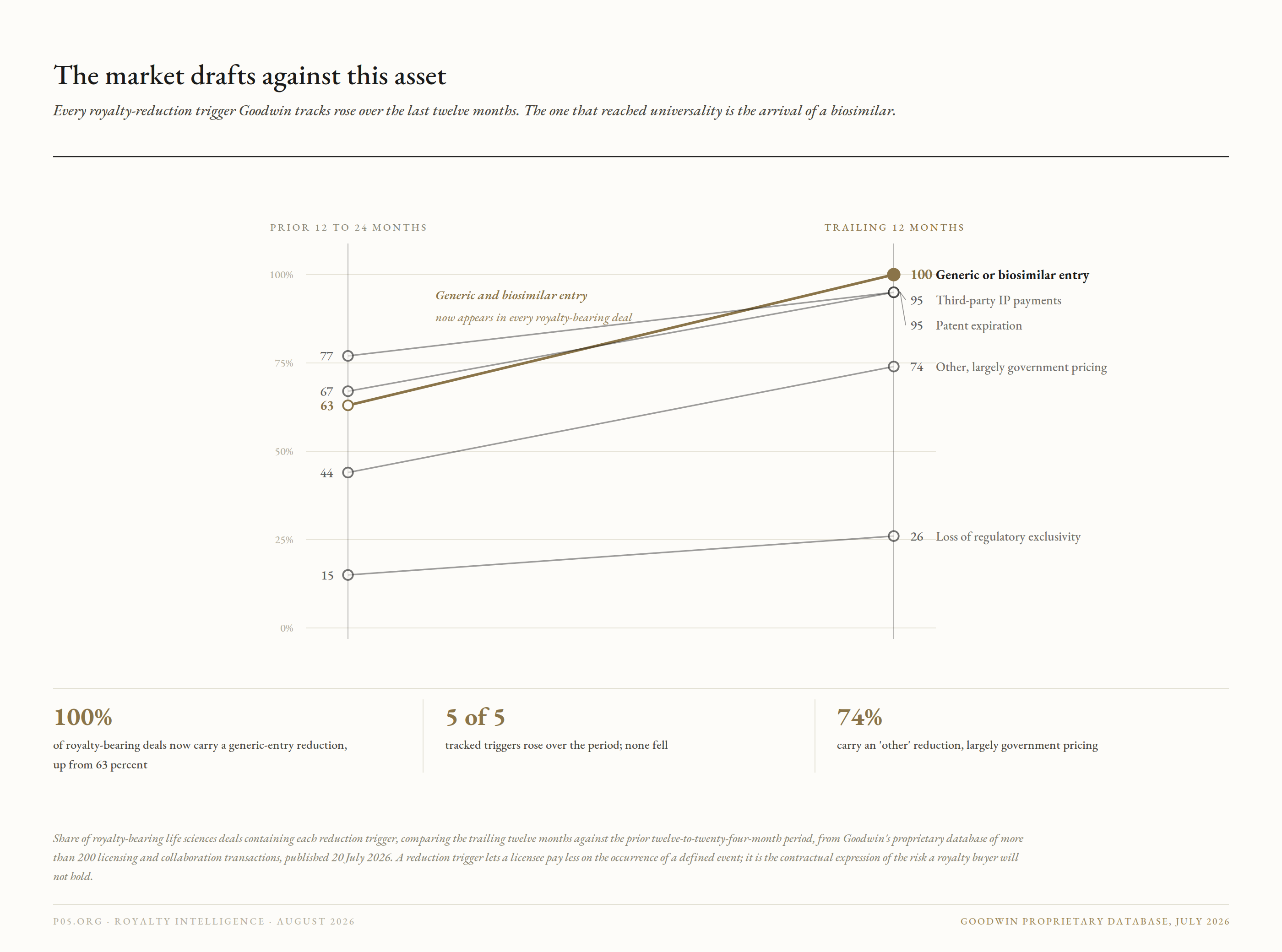
Figure 3. The market drafts against this asset. Generic and biosimilar entry now appears as a royalty-reduction trigger in every royalty-bearing deal Goodwin tracks.
Biosimilar entry is not a risk the royalty market tolerates. It is the risk the royalty market is drafted against, universally, without exception, in the current vintage. Every investment committee in this asset class has spent a decade building the muscle to identify, model and price the arrival of a biosimilar as the event that terminates a stream.
Asking that same committee to buy a royalty on a biosimilar asks it to invert the house view. The analytical machinery, the comparables set, the covenant templates and the institutional reflexes all point the other way, and they point that way harder in 2026 than in 2024.
A second-order effect follows. Because the reduction triggers have become near-universal, the royalty streams these funds already own are more exposed to biosimilar entry than they were, not less, and the marginal dollar of risk budget is being spent defending existing positions against exactly the assets a biosimilar royalty would represent. A fund that owns a portfolio of innovative-biologic royalties is, in aggregate, short biosimilar penetration. Buying a biosimilar royalty would be a hedge, in principle. In practice no allocator has framed it that way publicly, and the correlation argument has never appeared in a disclosed transaction.
The valuation point is that the biosimilar royalty is not underpriced because it has been overlooked. It is unpriced because the dominant buyer group holds a structurally opposed position, and the first fund to cross that line will be doing so against the grain of its own book.
III. The ticket is below minimum efficient scale
Gibson Dunn puts the median royalty deal size at USD 221 million in 2025, trending upward as buyers demonstrate comfort with larger commitments. Covington's fourth annual synthetic royalty study covers transactions of at least USD 25 million by public biotech companies, and notes that no 2025 deal funded a product that had not completed Phase III.
A single-molecule biosimilar licence royalty, at a mid-single-digit to low-double-digit rate on a partner's net sales in one or several territories, supports a ticket in the USD 20 million to USD 60 million range. That sits below the threshold at which the market's diligence, legal and monitoring cost structure is recoverable, which makes it a different kind of transaction rather than a smaller one.
The economics are unforgiving. A royalty purchase requires a true-sale opinion, an intercreditor negotiation where existing secured debt is present, jurisdiction-by-jurisdiction perfection, commercial diligence on the reference market and the competitive set, and ongoing reporting infrastructure. That cost stack is broadly fixed. Against a USD 221 million median it is a rounding error. Against a USD 40 million ticket it is a material share of the spread, and the deal does not clear internal hurdles even where the underlying asset is sound.
Sub-scale royalty origination is difficult across the board for this reason. In biosimilars it compounds the two constraints above instead of substituting for them.
IV. There is no collateral to foreclose
Covington's study records that the market has coalesced around a minimum level of bankruptcy protection in the form of security interests over intellectual property and other product assets, with one investor willing to go unsecured in 2025 and other elements remaining customisable.
Apply that convention to a biosimilar and it does not translate. The security package on an innovative asset is a composition-of-matter patent and its associated regulatory exclusivity, an asset with an identifiable market value and an identifiable acquirer set if the borrower fails. The security package on a biosimilar is the cell line, the process, the analytical comparability package and the dossier. Those have real value to a manufacturer with matching capacity and essentially none to a financial creditor exercising remedies.
There is also no recovery precedent. No major biosimilar-specific insolvency has produced a workout that a royalty buyer could use to anchor a recovery assumption. Coherus exited biosimilars solvently through a sequence of asset sales, not through a restructuring. That absence is itself a finding: an underwriter cannot mark a loss-given-default it has never observed, and in the absence of an observation the conservative assumption is total loss.
The closest comparison runs to the seller-bankruptcy analysis in the extinguishment piece. The defensive stack that protects a royalty buyer against recharacterisation, non-recourse framing, a precautionary UCC-1, clean documentation and a reasoned true-sale opinion, is designed to keep the stream out of a failing seller's estate. It works. But it protects the stream, and it assumes that a stream separated from the seller retains value. For a biosimilar licence royalty, the stream's value depends on a commercialisation partner continuing to promote a product against three or four competitors. Isolation from the seller does not isolate the buyer from that.
Part two: why the seller's number is high
V. The observed cost-of-capital stack
The modelling literature ignores this half of the argument, and it is the half that decides the outcome. The February piece estimated implied yields on biosimilar royalty financing in the mid-teens and compared that to venture debt at 12 to 15 percent with warrant coverage, concluding it might be competitive. Against the actual 2025 and 2026 print, it is not close.
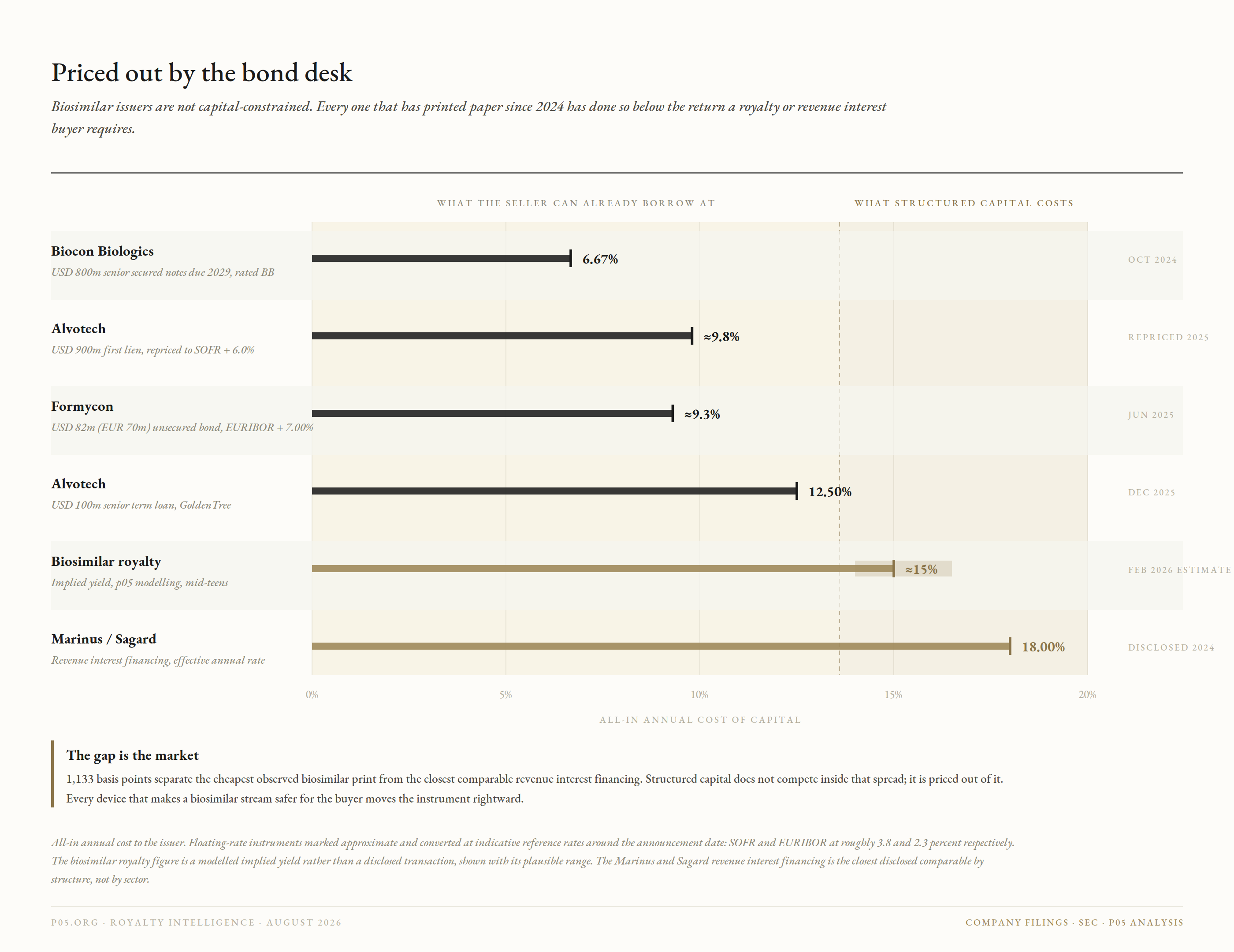
Priced out by the bond desk. Every biosimilar issuer that has printed paper since 2024 has done so below the return a structured buyer requires.
| Issuer | Instrument | Date | Cost |
|---|---|---|---|
| Biocon Biologics | USD 800 million senior secured notes due 2029, rated BB by S&P and Fitch | Oct 2024 | 6.67% |
| Alvotech | USD 900 million first lien tranche, GoldenTree, maturing June 2029, subsequently repriced | 2024, repriced 2025 | SOFR + 6.5%, repriced to SOFR + 6.0% |
| Formycon | USD 82 million (EUR 70 million) senior unsecured bond 2025/2029, oversubscribed from an initial EUR 50 million target | June 2025 | EURIBOR + 7.00% |
| Alvotech | USD 100 million senior term loan maturing December 2027, GoldenTree | Dec 2025 | 12.50% |
| Samsung Bioepis | none required | n/a |
Foreign-currency figures converted at spot around the announcement date.
The Biocon print is the one that ends the argument. A biosimilars business raised USD 800 million of five-year secured paper at 6.67 percent with an investment-grade-adjacent BB rating from two agencies, and used it to term out acquisition debt rather than monetise any part of the Yesintek, Hulio or Semglee economics. When a rated public bond market will fund the same underlying cash flows at 6.67 percent, a mid-teens royalty is not an alternative. It is a penalty.
The Formycon print matters for a different reason. Formycon is the smallest and least credit-worthy of the group, a Frankfurt-listed developer with three approved biosimilars and negative EBITDA at the time of issue. It still placed a senior unsecured floating bond at EURIBOR plus 700 basis points, and had to increase the size from EUR 50 million to EUR 70 million because of demand. That is roughly 9 to 10 percent all-in, unsecured, from retail and institutional bondholders, against an asset base a royalty buyer would have wanted a first lien over.
The Alvotech USD 100 million facility at 12.50 percent is the top of the observed range and the closest thing to a genuine comparison. Even there, the biosimilar royalty at mid-teens loses, and it loses while also requiring a true-sale structure, an intercreditor carve-out from GoldenTree's blanket first lien, and a cap that the erosion curve cannot reach.
At the other end, Samsung Bioepis has no financing need at all. Following the November 2025 spin-off from Samsung Biologics, Samsung Epis Holdings reported FY2025 revenue of roughly USD 1.21 billion (KRW 1.672 trillion) with operating profit of roughly USD 240 million (KRW 330.8 billion), up 101 percent year on year, and followed with Q1 2026 revenue of roughly USD 330 million (KRW 454.9 billion) and operating profit of roughly USD 104 million (KRW 144.0 billion). A business compounding operating profit at that rate off an internally funded base does not sell royalties.
The instruction here is to run the comparison the other way round before modelling any biosimilar royalty. Do not start from the buyer's required return and ask whether the asset supports it. Start from the seller's observed marginal cost of debt, price the royalty at that discount rate, and ask whether the buyer can live with the resulting number. For every biosimilar issuer that has printed paper since 2024, it cannot.
VI. The 2026 regulatory cost collapse removes the financing need
The band was already inverted. The FDA has spent the last ten months narrowing it further, from the direction nobody underwriting biosimilars in 2024 anticipated.
In October 2025 the agency issued draft guidance signalling that comparative efficacy studies would no longer be the default requirement for biosimilar approval, studies that require one to three years and cost approximately USD 24 million. On 9 March 2026 it followed with Revision 4 of the biosimilar development Q&As, streamlining clinical pharmacokinetic testing where scientifically justified, which the agency estimates could save up to 50 percent of PK study costs, roughly USD 20 million per programme, and revising the treatment of non-US-licensed comparator products so that clinical data from a non-US comparator can be used in defined circumstances without a separate IND. The 2015 final guidance on demonstrating biosimilarity was withdrawn as no longer representing current thinking.
Jones Day's reading is that if the drafts are finalised as written, the policy changes effectively collapse the distinction between biosimilarity and interchangeability, with high-quality analytical comparability plus PK and immunogenicity assessments generally sufficing, and the agency potentially approving all non-vaccine biosimilars as interchangeable. Finalisation was targeted for the first half of 2026.
This cuts three ways, and the net is negative for the royalty case.
It removes the financing need. The February piece opened on the observation that biosimilar companies spend USD 100 million to USD 250 million developing a product. Strip out a USD 24 million comparative efficacy study and half the PK burden and the low end of that range moves toward USD 60 million, which is inside the range a commercialisation partner will fund through an upfront payment. The gap that structured capital would have filled shrinks precisely where it was most fillable.
It increases the supply of streams and degrades each one. Cheaper development means more programmes per molecule, which means more entrants, which means the erosion curve in section I steepens. More royalty streams will exist. Each will be worth less.
It removes a duration argument that had not yet been priced. There is one genuine offset. If interchangeability becomes automatic on approval, first-interchangeable exclusivity could attach to the first approved biosimilar, delaying subsequent entrants who would not otherwise have sought the designation. That is a real duration argument for a first-mover royalty, and to my knowledge an unpriced one. It is also fragile: it hangs on final rule text and reaches one entrant per molecule.
The policy backdrop beyond the FDA runs the same direction. Goodwin's data shows the largest single increase in royalty-reduction triggers came in the "other" category, rising from 44 to 74 percent of deals, driven largely by government pricing. The GLOBE and GUARD most-favoured-nation models, published 23 December 2025 with proposed effective dates of 1 October 2026 and 1 January 2027 and final rules pending OMB review as of late June 2026, would impose mandatory rebates on a randomly selected 25 percent sample of Medicare beneficiaries. BsUFA III authority expires in September 2027, with reauthorisation negotiations under way through 2026.
None of this is dispositive on its own. Together it means the price side of the biosimilar base is under active policy pressure at the same moment the development side is being deregulated, which is the worst possible combination for anyone trying to underwrite a fixed multiple against a defined stream.
The one deal that printed, and what happened to it
There is a single disclosed transaction in which a biosimilar's net sales were sold as a royalty, and its full life cycle runs eleven months.
On 8 May 2024 Coherus BioSciences entered into a revenue participation right purchase and sale agreement with Coduet Royalty Holdings, LLC. For USD 37.5 million, Coherus sold the right to receive a mid-single-digit percentage of US net sales of UDENYCA, its pegfilgrastim biosimilar, and LOQTORZI, its novel PD-1 inhibitor, with the buyer's right terminating at 2.25 times. A separate USD 38.7 million senior secured term loan maturing May 2029 was entered into at the same time, and the proceeds retired the remaining USD 75 million of Coherus's Pharmakon Advisors facility.
Four features of that deal matter.
The buyer was a generalist. Coduet is a Barings-financed vehicle, not a dedicated royalty fund. The specialist buyer universe did not participate.
The biosimilar was blended with a novel asset. The revenue participation right sat across both UDENYCA and LOQTORZI. A buyer taking mid-single digits on a basket containing a patent-protected checkpoint inhibitor is not taking clean biosimilar risk, and the blending is the point: it is what made the risk saleable.
The cap was 2.25x, above the market median. On a declining pegfilgrastim base that is only achievable because LOQTORZI, a launch-stage novel asset, carries the back end.
It was repurchased at a premium within eleven months. In December 2024 Coherus agreed to divest UDENYCA to Intas for up to USD 558.4 million, and disclosed that at closing it would pay USD 49.1 million to buy out the UDENYCA portion of the Coduet agreement. The whole two-product right had cost USD 37.5 million in May 2024. The biosimilar slice alone cost USD 49.1 million to extinguish by April 2025. The LOQTORZI portion survives.
That last fact is the cleanest statement of the thesis available anywhere in the public record. Given the option to keep either half, the seller paid a premium to reacquire the biosimilar economics and left the innovative-asset economics with the buyer.
The precursor deal tells the same story from the other end. In 2019 HealthCare Royalty Partners provided Coherus with a USD 75 million facility underwritten against its biosimilar franchise, but structured as senior secured debt with covenants and a maturity, not as a royalty purchase. A dedicated royalty fund looked at biosimilar cash flows, decided they were worth lending against, and declined to buy them.
The instruction for anyone building a comparables set: there is one observation, it is contaminated by a novel asset, and it terminated by voluntary repurchase at a premium to the original consideration. Treat it as a single data point on the seller's revealed preference, not as a template.
Where the streams actually are
The absence of a bid does not mean the absence of an asset. The streams exist, they are numerous, and they sit one layer above where most people look.
The mistake is to look at the launcher's product revenue. The financeable layer is the developer's licence royalty from the commercialiser, and it is systematically invisible because it lives in private companies, Asian-listed companies, and undisclosed rate schedules.
The cleanest specimen anywhere is Klinge Biopharma. Klinge is a private German GmbH holding the exclusive global commercialisation rights to a single molecule, Formycon's aflibercept biosimilar FYB203, and it has licensed that molecule region by region:
| Territory | Licensee | Announced |
|---|---|---|
| Europe excluding Italy, and Israel | Teva | Jan 2025 |
| Asia-Pacific (Indonesia, Malaysia, Philippines, Singapore, Taiwan, Thailand, Vietnam, Hong Kong SAR) | Lotus Pharmaceutical | Feb 2025 |
| United States and Canada | Valorum Biologics | Jun 2025 |
| Selected European countries | Horus Pharma | Sep 2025 |
| Australia, and Latin America | Actor Pharmaceuticals, and Megalabs | Oct 2025 |
| Italy | NTC | Nov 2025 |
Every one of those agreements pays Klinge upfronts, milestones and royalties on net sales, with Formycon participating in the mid-single-digit to low-double-digit percentage range in all payment streams to Klinge, plus service payments and a volume-based profit component for organising commercial supply. On the Valorum deal, Formycon's own major shareholder ATHOS led the licensee's Series A.
That is a diversified, seven-counterparty, multi-jurisdiction royalty portfolio on a single molecule, held in an unlisted private company, never publicly valued, never monetised. It is the closest thing in existence to what a biosimilar royalty asset would look like if one were ever assembled deliberately.
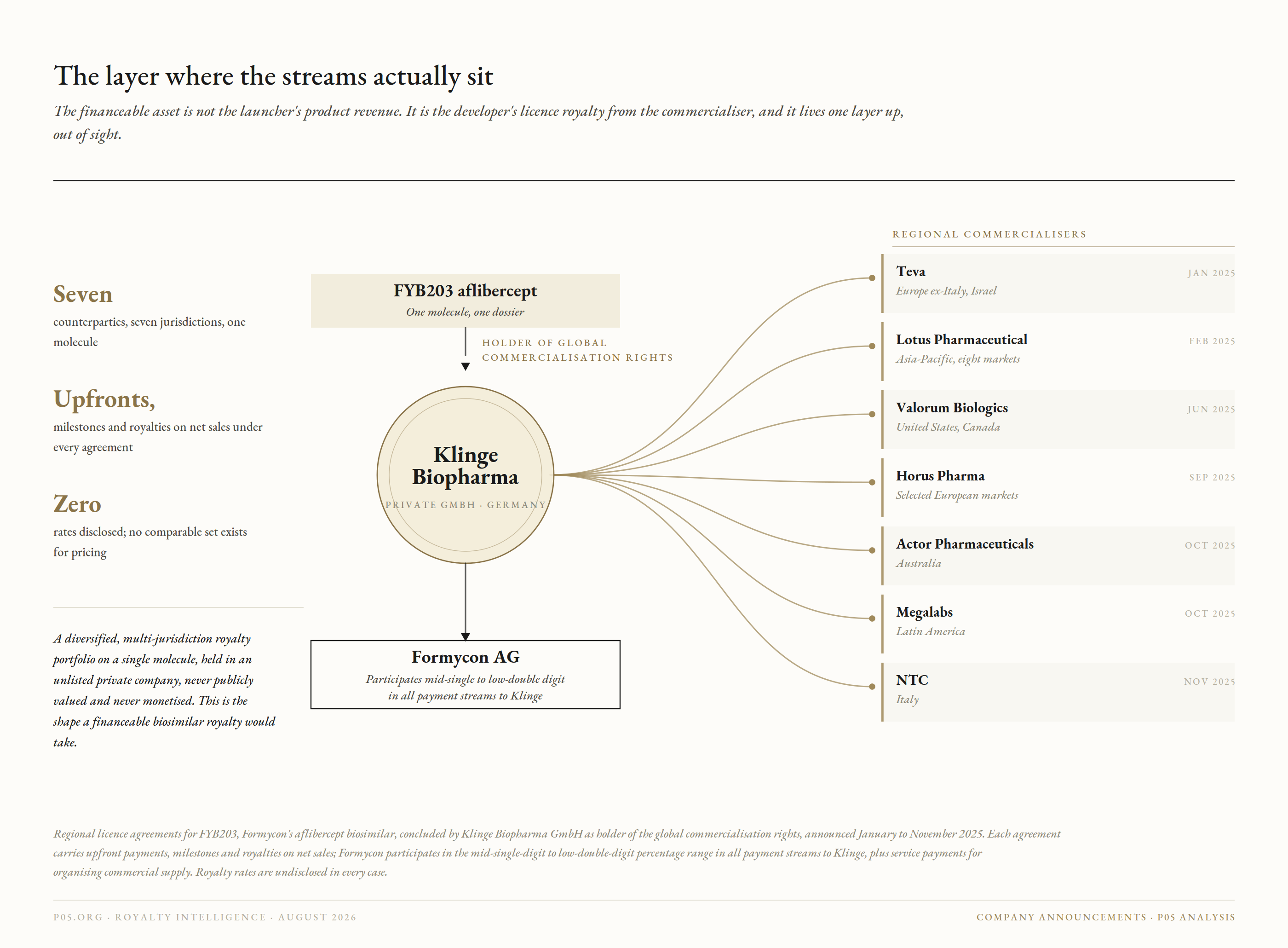
The layer where the streams actually sit. Klinge Biopharma's seven regional licences on a single molecule, and Formycon's participation beneath them.
The same shape recurs across the sector. Alvotech's FY2026 20-F disclosure records that Teva made upfront payments of USD 40 million through 31 March 2026, that Alvotech received USD 70.0 million in development milestones and USD 40.0 million in first-commercial-sale and sales-target milestones, that it remains entitled to up to a further USD 465 million in milestones, and that as consideration for supply it receives 40 percent of the value of Teva's net sales. The Stada agreement covering six products in European and selected non-European markets carries a further USD 6.7 million upfront, USD 73.4 million of development milestones and USD 25.5 million of commercial milestones received to the same date, with roughly 40 percent of estimated net sales.
Bio-Thera's arrangement with Hikma for the US ustekinumab biosimilar carried a USD 20 million upfront and up to USD 130 million in milestones, with Bio-Thera retaining development, manufacturing and supply and Hikma taking exclusive US commercialisation. Bio-Thera runs parallel structures with Sandoz on bevacizumab and Intas on golimumab. Henlius licenses pertuzumab and denosumab globally ex-China to Organon. Samsung Bioepis expanded its Sandoz partnership in March 2026 to up to five candidates including a vedolizumab biosimilar.
Call the addressable set 40 to 60 counterparty-level licence royalties across roughly 15 developers, with rates almost universally undisclosed. That is the origination gap, and it sits squarely in the sub-USD 50 million band that the deal-size problem in section III makes unfinanceable one at a time.
Part three: the instrument was never a royalty
Everything above prices a royalty purchase. That is the wrong instrument, and the case for the right one is stronger than the royalty case in ways worth setting out properly before explaining why it still does not clear.
The variance point
A royalty purchase underwrites the level and duration of a stream. Revenue interest financing underwrites the variance around a forecast within a defined window. Those are different questions, and biosimilars answer them very differently.
The erosion curve in section I is a statement about the mean. It says the base declines. It says nothing about how confidently you can predict the decline, and the honest answer is: unusually confidently. A biosimilar entering a known reference market against a countable set of competitors, at a price set by tender or formulary contract, is one of the more forecastable revenue streams in pharmaceuticals. The reference market size is public. The competitor set is visible years ahead through BPCIA litigation dockets, settlement dates and approval filings. The price trajectory follows an observable class pattern. IQVIA records that recent biosimilars have reached more than 60 percent of a molecule's volume within the first three years, which is a fast curve but a repeatable one.
Compare that to a novel launch, where the underwriter is estimating an unknown addressable population, an unknown uptake rate, an unknown payer response and an unknown competitive entry, with published analyses of pharmaceutical forecast error running well above 50 percent at the individual-product level.
Biosimilar revenue has low variance around a known declining mean. Novel launch revenue has high variance around an uncertain rising mean. For an instrument that needs a defined multiple returned inside a defined window, the first is the better credit. This is the strongest argument available for financing the sector, and the royalty framing hides it, because a royalty buyer's economics live in the tail and the biosimilar has nothing to put there.
The European tender channel is the extreme case. A won national tender is a contracted volume share at a contracted price for a contracted period, which is a receivable rather than a forecast. Celltrion has disclosed that a Norwegian infliximab award is expected to secure roughly 35 percent of that national IV market through January 2028. Underwriting that resembles underwriting a public-sector supply contract more than underwriting a drug.
What a revenue interest financing actually looks like
The template is on file. Marinus Pharmaceuticals and Sagard Healthcare Royalty Partners closed a revenue interest financing on 28 October 2022 with the following anatomy, as disclosed in Marinus's filings:
| Term | Marinus / Sagard |
|---|---|
| Investment amount | USD 32.5 million |
| Payment rate | 15 percent of the first USD 100 million of annual product revenue, 7.5 percent above that |
| Hard cap | 190 percent of investment amount, USD 61.8 million |
| Minimum amount | 100 percent of investment by 31 Dec 2027; 190 percent by 31 Dec 2032, with a cash gross-up obligation if not reached |
| Repurchase | 160 percent of investment before the third anniversary |
| Credit support | Subsidiary guarantors, minimum liquidity covenant |
| Effective annual rate | 18.00 percent |
Fifteen percent on the first USD 100 million, stepping down to 7.5 percent above it. That is a downward-tiered rate, front-loading receipts against the early years of the revenue curve, which is the structure section I identified as what a biosimilar needs and no innovative-asset royalty uses.
The rest of the market runs variants of the same machinery. Amarin's arrangement with BioPharma Credit carried a quarterly threshold on Vascepa revenue with shortfalls carried forward without interest to a future period, no compounding and no cliff, running until USD 150 million in aggregate had been repaid. Amarin disclosed that revenues fell below the contractual threshold in every quarter since inception, so the reduction mechanism ran continuously and the instrument behaved as designed under stress. Corcept's earlier BioPharma agreement went the other way and was entirely variable with no fixed minimums, 20 percent of net product sales subject to quarterly caps, expiring at USD 45.0 million cumulative, with the rate stepping to 50 percent and the caps lapsing if the company failed to devote commercially reasonable resources to promotion. That last clause is the diligence covenant from Vector VI of the extinguishment analysis, written into the payment rate instead of left to Delaware.
Sagard's published thesis names the customer: a commercial-stage company whose access to public markets has closed, in a segment where the transaction market more than tripled between 2021 and 2022 to roughly USD 3 billion. Sagard has continued at scale, paying Nuvation Bio USD 150 million on FDA approval of IBTROZI in June 2025 against tiered payments on US net sales.
Why this fixes the shape
Set the Marinus template against the four buy-side constraints in Part One and three of them dissolve.
The declining base stops mattering, because the hard cap is 190 percent achieved by a date certain instead of a multiple achieved over the asset's life, and the downward rate tier suits this cash-flow profile. Guarantors, a liquidity covenant and a security package do the work that foreclosable product collateral cannot. The ticket size fits: USD 32.5 million is a normal revenue interest financing, and SWK Holdings runs an entire book at USD 5.0 million to USD 25.0 million per transaction across structured debt, royalty monetisation and synthetic royalty.
Only the inverted house view survives untouched, and that is a question of which buyer, not of whether the structure works.
At this point the conclusion should flip. It does not, and one line of the table above is the reason.
Why it does not fix the price
The minimum amount is a gross-up obligation. If receipts fall short of 100 percent of the investment by the first reference date, the company writes a cheque for the difference. That single term makes the instrument insensitive to the erosion curve. It also makes it recourse.
An instrument carrying a dated minimum payment obligation, subsidiary guarantees, a liquidity covenant and a repurchase price is a loan wearing a revenue-linked amortisation schedule. Marinus priced it as one: 18.00 percent effective.
Against the mid-teens royalty estimate that is worse by 300 to 500 basis points, and against a cost-of-capital stack running 6.67 to 12.50 percent it is worse again. The band does not reopen. It inverts further.
A second cost does not appear in the rate. Each feature that moves the biosimilar's erosion risk onto the seller also points toward recharacterisation under the true-sale analysis, because recourse, guarantees, make-wholes and repurchase rights are the four factors Major's Furniture and Shoot the Moon treat as evidence of a disguised financing. A revenue interest engineered hard enough to survive the erosion curve is engineered hard enough to sit in the seller's estate if the seller files. The protection and the vulnerability are the same drafting.
The instruction is to stop asking whether biosimilar cash flows are stable and start asking who bears the instability. Where the buyer bears it, the instrument is a royalty and the erosion curve prices it out. Where the seller bears it, the instrument is debt and the bond market prices it out. Biosimilar cash flow is stable enough to finance. It is not stable enough to finance at a price that beats 6.67 percent, and every structural device that closes the gap moves the instrument into a market the issuer already accesses more cheaply.
Where it does work
The exception is narrow, and it is the entire opportunity.
Revenue interest financing works where the issuer cannot print a bond. Sagard's stated customer is a company locked out of the public markets, and that description does not fit Biocon, Celltrion, Samsung Bioepis or Sandoz. It fits Klinge, a private GmbH with seven regional licences and no public credit. It fits Bio-Thera, Shanghai-listed with US and European receivables from Hikma, Sandoz and Intas. It fits Polpharma Biologics, Valorum, Bioeq, Xbrane, and the tier of Indian and Korean developers below the majors. It nearly fits Formycon, which reached the retail bond market at EURIBOR plus 700 basis points and would plausibly have taken 12 to 14 percent on a product-level structure to avoid the disclosure and the covenant package.
The addressable segment is therefore not the biosimilar industry but the two dozen sub-investment-grade, often private, developers sitting one layer above the commercialisers, holding the licence royalties mapped in the previous section, with tickets of USD 15 million to USD 60 million and no access to rated paper. That is a real market, roughly SWK-sized, currently served by nobody underwriting biosimilars specifically.
The portfolio counter-evidence
An honest version of this argument has to confront the strongest case against it, which is that biosimilar revenue is demonstrably durable and growing, and that the erosion story is a molecule-level artefact that disappears at portfolio level.
Sandoz's numbers make that case better than anyone's. Biosimilars reached USD 3.29 billion in 2025, 30 percent of group revenue, up 13 percent at constant currency, against an industry-leading pipeline that stood at 27 assets at year end. The first half of 2026 was stronger: biosimilars up 20 percent, North American biosimilars up 47 percent at constant currency, Wyost at 54 percent and Jubbonti at 64 percent US biosimilar market share, Pyzchiva at 35 percent share in major European markets, Tyruko rising from 7 percent at launch to 17 percent in Europe, and the pipeline expanded to 36 assets. Management has taken to calling the period ahead a golden decade.
Those numbers are real, and they do not contradict the erosion argument. They explain it.
Sandoz's durability is a portfolio property, produced by continuous launch cadence across 36 assets, not by any individual molecule holding price. The same results disclosure that reports 19 percent North American biosimilar growth at constant growth rate also records that the difference from 2 percent at constant currency reflects the withdrawal of Cimerli in the first quarter of 2025. Sandoz had acquired Cimerli, the ranibizumab biosimilar, from Coherus for USD 170 million in January 2024. It withdrew the product roughly twelve months later.
A royalty buyer holding a royalty on Cimerli would have been wiped out inside a year while Sandoz's biosimilar franchise grew 13 percent. An operating platform absorbs that outcome; a financial claim on one asset does not. Read correctly, the portfolio observation strengthens the thesis: the durability in this sector belongs to the launcher, not to the stream.
The corollary is that any financeable biosimilar royalty has to acquire the portfolio property synthetically, by pooling across molecules, geographies and commercialisers, because no single stream possesses it.
The consolidation wave fits. Amneal's April 2026 agreement to acquire Kashiv BioSciences for USD 375 million in cash and USD 375 million in equity at closing plus up to USD 350 million in regulatory milestones and potential royalties, closing in the second half of 2026, is a bet that scale and launch cadence are the durable assets. Buyers are paying nine figures for platforms and nothing for streams.
The 2027 test: pembrolizumab, and the Qlex problem
If a biosimilar development funding transaction ever prints, the timing and the molecule are both identifiable now.
Korean developers are racing the pembrolizumab clock. Celltrion has initiated global Phase III trials for CT-P51 targeting completion by July 2028, and Samsung Bioepis completed patient recruitment for SB27 with a target trial completion of September 2026, against Keytruda core patents expiring in 2028 in the US and 2031 in Europe. Both are also running nivolumab and daratumumab programmes.
Pembrolizumab is the first molecule where three conditions align: a pre-launch capital requirement large enough to clear the ticket-size problem, an addressable market large enough to support a nine-figure structure, and enough credible developers to make competitive tension real. A 2027-vintage development funding bond of USD 150 million to USD 300 million against a pembrolizumab or nivolumab programme, structured on the MorphoSys precedent rather than as a synthetic royalty, is the plausible first print.
The counter-argument is strong enough to belong in the base case, not the sensitivity table.
In September 2025 the FDA approved Keytruda Qlex, a subcutaneous pembrolizumab formulation. Bloomberg Intelligence has since projected that meaningful pembrolizumab revenue erosion may not arrive until around 2033 rather than immediately after the 2028 expiry, worth approximately USD 22 billion more retained revenue than a pessimistic scenario. If subcutaneous conversion works at scale, every biosimilar royalty underwritten against IV reference sales is impaired at inception, not by competition from other biosimilars but by the originator moving the market out from under the reference product.
Call it the biosimilar analogue of the diligence problem. In the innovative-asset context the risk is that the licensee stops trying. Here the risk is that the originator succeeds at something else, and the addressable market the biosimilar was underwritten against stops being where the patients are. No covenant reaches it, no remedy attaches to it, and no Delaware case law governs it. The royalty holder carries it whole.
The nearer-term test is cleaner and arrives at the end of this year. Following Regeneron settlements, US aflibercept biosimilar launches cluster in the fourth quarter of 2026: Alvotech and Teva, Sandoz, and Formycon all in Q4 2026 or earlier in certain circumstances, and Celltrion on 31 December 2026, against Amgen's Pavblu which launched in October 2024. Four or five entrants inside a single quarter, into a market where the originator has already converted a large share of volume to a high-dose formulation, is the sharpest natural experiment on biosimilar revenue durability that has ever been run. Anyone building an erosion curve for this asset class should be collecting that data from January 2027.
Where the structure points
A few things follow for anyone deciding whether to originate, underwrite or hold one of these.
Test the band before modelling the asset. Price the stream at the seller's observed marginal cost of debt, not at a royalty fund's target return, and check whether a price exists that both sides prefer to their alternatives. For every biosimilar issuer that has printed paper since 2024, it does not. This test takes ten minutes and disposes of most of the sector.
Ask who bears the erosion before choosing the instrument. This question decides the structure and it is usually skipped. A royalty purchase puts the erosion curve on the buyer and prices out on duration. A revenue interest financing with a dated minimum payment puts it on the seller and prices out on rate, at 18 percent against a bond market at 6.67 percent. There is no third party to give it to. Any structure that appears to solve this is either mispricing the erosion or has quietly become recourse, in which case it belongs in the recharacterisation analysis, not the royalty analysis.
Screen on bond-market access, not on asset quality. The revenue interest financing customer is a company that cannot print. That excludes Biocon, Celltrion, Samsung Bioepis and Sandoz, and includes Klinge, Bio-Thera, Polpharma, Valorum, Bioeq and the tier below the majors. Origination effort spent at the top of the sector is wasted however attractive the streams look. The screen is a credit-rating question, not a commercial one.
Pool, or do not bother. No single biosimilar licence royalty possesses the durability property that makes a royalty financeable, and the Cimerli outcome shows what a single-stream position looks like when it fails. Six to ten regional licence royalties across two or three molecules and multiple commercialisers, on the Klinge shape, is the minimum viable structure. It supports a USD 75 million to USD 150 million ticket, clears the diligence cost stack, and diversifies the erosion risk that is idiosyncratic at molecule level.
Move the obligor up the credit stack. The credit-strongest party in a biosimilar licence is the commercialiser, Teva, Fresenius Kabi, Sandoz, Hikma, Organon, not the developer. A royalty structured as a direct payment obligation of the commercialiser, with the developer assigning the receivable, converts biosimilar risk into large-cap pharma trade receivable risk with a volume kicker. That is financeable in the 8 to 10 percent range, not the mid-teens, and at 8 to 10 percent the band reopens against every issuer in the table above except Biocon. No disclosed transaction has been structured this way. It is the most obvious unexploited trade in the sector.
Tier the rate down, and trigger on entrant count. Front-load and taper, on the Marinus pattern of a high rate on the first revenue band stepping down above it, which is the one piece of existing market machinery that already fits an eroding base. Then set step-ups on competitor-count triggers, on the fourth entrant receiving approval, rather than on absolute sales thresholds, because the sales threshold conflates a slow launch with a crowded market and only the second is the risk being hedged. The downward tier exists in the revenue interest market and has never been applied to a biosimilar. The entrant-count trigger exists nowhere and is the genuinely biosimilar-native term.
Underwrite the originator's lifecycle, not just the competitive set. The Keytruda Qlex problem is the dominant modelling risk in this asset class and it sits outside every covenant a royalty buyer can negotiate. Build the scenario where the reference product's formulation moves and the biosimilar's addressable market shrinks faster than the multi-entrant curve alone implies. Give it real probability weight, because the originator has both the incentive and, increasingly, the demonstrated capability.
Do not underwrite duration you cannot name. First-interchangeable exclusivity under the collapsing FDA framework is the one real duration argument available to a biosimilar first mover, and it hangs on final rule text that had not landed as of August 2026. Watch it. Do not model it yet.
Treat rate opacity as the binding constraint on the whole market. Royalty rates are undisclosed in nearly every biosimilar licence agreement in existence. Without a comparables set, every transaction is priced from first principles, every investment committee applies an uncertainty premium, and the premium is what keeps the band inverted. A classic private-market cold start, and the first handful of deals to print with public terms will do more to open the market than any structural innovation.
Comparative summary
The biosimilar royalty fails on both sides of the bid condition simultaneously, which is why it does not exist. Each constraint below is individually surmountable and they are not additive: the deal-size and collateral problems compound the erosion problem rather than sitting alongside it. The final column is the finding of Part Three, that a revenue interest financing resolves most of the buy-side column and none of the sell-side column.
| Constraint | Mechanism | Which side of the band | Resolved by a revenue interest structure? |
|---|---|---|---|
| Declining base | Cash flow peaks year 2 to 3, then erodes 10 to 20 percent annually | Buyer: achievable cap below market floor of 1.43x | Yes, via downward tier plus dated hard cap |
| Sub-scale ticket | USD 20 to 60 million against a USD 221 million median | Buyer: fixed diligence cost stack unrecoverable | Yes, this is the normal RIF ticket |
| No foreclosable collateral | Cell line and dossier have no financial-creditor value; no recovery precedent | Buyer: loss given default assumed total | Yes, via guarantors, covenants and liquidity tests |
| Inverted house view | Biosimilar entry is a reduction trigger in 100 percent of royalty deals | Buyer: institutional and correlation, not analytical | No, requires a different buyer group |
| Cheap alternative capital | Observed 6.67 to 12.5 percent versus 18 percent effective on a comparable RIF | Seller: bond market wins outright | No, and the minimum-payment gross-up widens the gap |
| Falling development cost | Roughly USD 44 million per programme removed by FDA guidance | Seller: partner upfronts now cover the gap | No |
The shape of the answer
The biosimilar royalty market is not an underexploited opportunity. It is a correctly identified non-opportunity in its current form, held closed by a bond market that funds the same cash flows more cheaply and a buyer universe whose entire analytical apparatus treats these assets as the terminal risk to everything else it owns.
The instrument question is the more interesting half, and it resolves somewhere unexpected. Biosimilar cash flow really is stable in the sense that matters to a lender: low variance around a mean everyone can see. The intuition that this ought to be financeable is sound. What the revenue interest market shows is that the stability is only available by contract, through a dated minimum payment that moves the erosion risk onto the seller, and that a stream made stable that way is a loan. Priced as one, on the closest available comparable, it comes to 18 percent. The erosion has not been removed. It has been sold back to the company that generated it, at a spread over what that company borrows unsecured.
There are two places to put an erosion curve, and the market has already priced both.
The February piece built the erosion curve and asked what a biosimilar royalty is worth. The answer, six months on, is that the number was probably right and the question was slightly wrong, because a stream's value and its financeability are different properties, and biosimilars separate them more cleanly than any other asset in this market.
What remains is narrower than the sector and more tractable than the modelling implied. Three things would open it, in ascending order of difficulty. A commercialiser-obligor structure that reprices the risk from developer credit to a Teva or Sandoz receivable, which requires only a licensee willing to sign. A pooled structure across molecules and commercialisers, on the aggregation logic set out in Pennies on the Dollar, which requires only an originator willing to assemble it. And rated paper, which requires a rating agency methodology that treats a biosimilar's erosion curve as an amortisation schedule rather than a hazard, on the model of music catalogue securitisation where predictable decay is the feature rather than the defect.
None has happened. The first two need no innovation at all, only origination, and they need it aimed at the two dozen sub-investment-grade developers holding licence royalties one layer above the commercialisers, not at the majors whose names make the sector look large. The streams are there. Klinge alone holds seven of them on one molecule. What is missing is not the cash flow, not the stability, and not the analysis. It is a buyer whose book is not already positioned against them, pointed at the part of the sector that cannot pick up a phone to a bond desk.
Standard disclaimer
All information in this report was accurate as of the research date and is derived from publicly available sources including SEC filings, regulatory guidance, company press releases, exchange announcements, and financial news reporting. Currency conversions are approximate and taken at spot around the relevant announcement date. Modelling references are illustrative and based on stated assumptions; they are not forecasts. Information may have changed since publication. This content is for informational purposes only and does not constitute investment, legal, or financial advice. The author is not a lawyer or financial adviser.