
The Weekly Term Sheet (2026-W32)
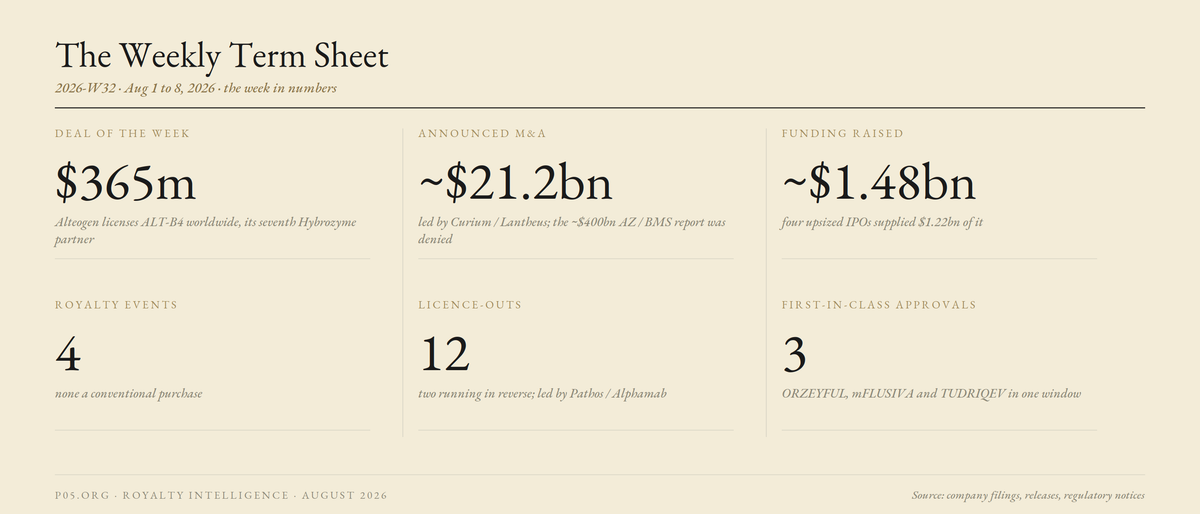
The largest story of the week did not happen. The FT reported, and Reuters corroborated, AstraZeneca and Bristol Myers Squibb merger talks near $400B; the market priced it (AZN as much as -9%, BMY +4-6%) and a senior source categorically denied it on Aug 5. Announced M&A was led by Curium (CapVest) / Lantheus (up to $8.0B, with a $12.00 CVR measured partly on royalty and sublicense income), KKR / Integer ($5.7B) and Supernus / Indivior ($2.2B), with Tarsus / Alkeus ($450M plus up to $800M) and P&G / Thorne ($3.8B) behind them.
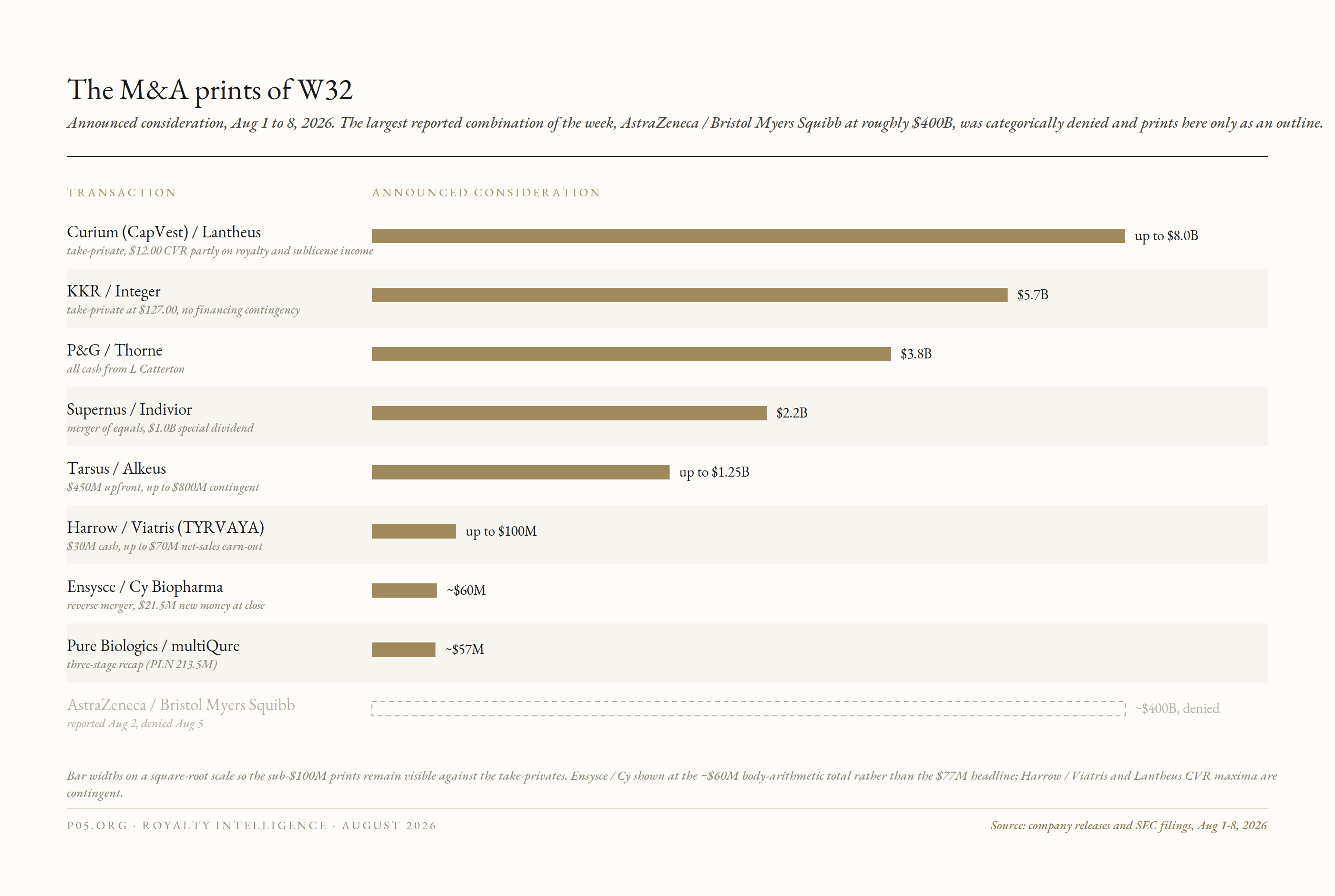
The M&A prints of the window on a square-root scale, with the denied AstraZeneca / Bristol Myers Squibb combination as an outline.
Royalty origination ran to twelve licence-outs and collaborations, two of them running in reverse: Actimed regained S-oxprenolol from Faraday, unwinding up to $123.5M of never-triggered milestones plus royalties, and Arcturus regained KOSTAIVE from CSL for $12M cash plus $16M of released liabilities. Pathos AI / Alphamab leads the disclosed rates (high-single to low-double-digit tiers on JSKN016), and the only synthetic-royalty print hides inside the Adneuris / Maruishi upfront ($10M). Royalty Pharma beat, raised, and bought nothing; so did Ligand.
Funding was the busiest IPO week of 2026: four deals priced for $1,167.1M gross, every one upsized, and the tape ranked them cleanly, with Braveheart holding a 66% debut premium on a disclosed 5-10% Hengrui royalty while Latigo faded to +1.4% and BlossomHill closed at issue. Vogenx, the only royalty-encumbered deal of the five, neither priced nor withdrew. Three first-in-class approvals landed (ORZEYFUL, mFLUSIVA, TUDRIQEV), Halozyme raised its royalty guide to $1.220-1.245B, and Zoetis cut for the second time this year.
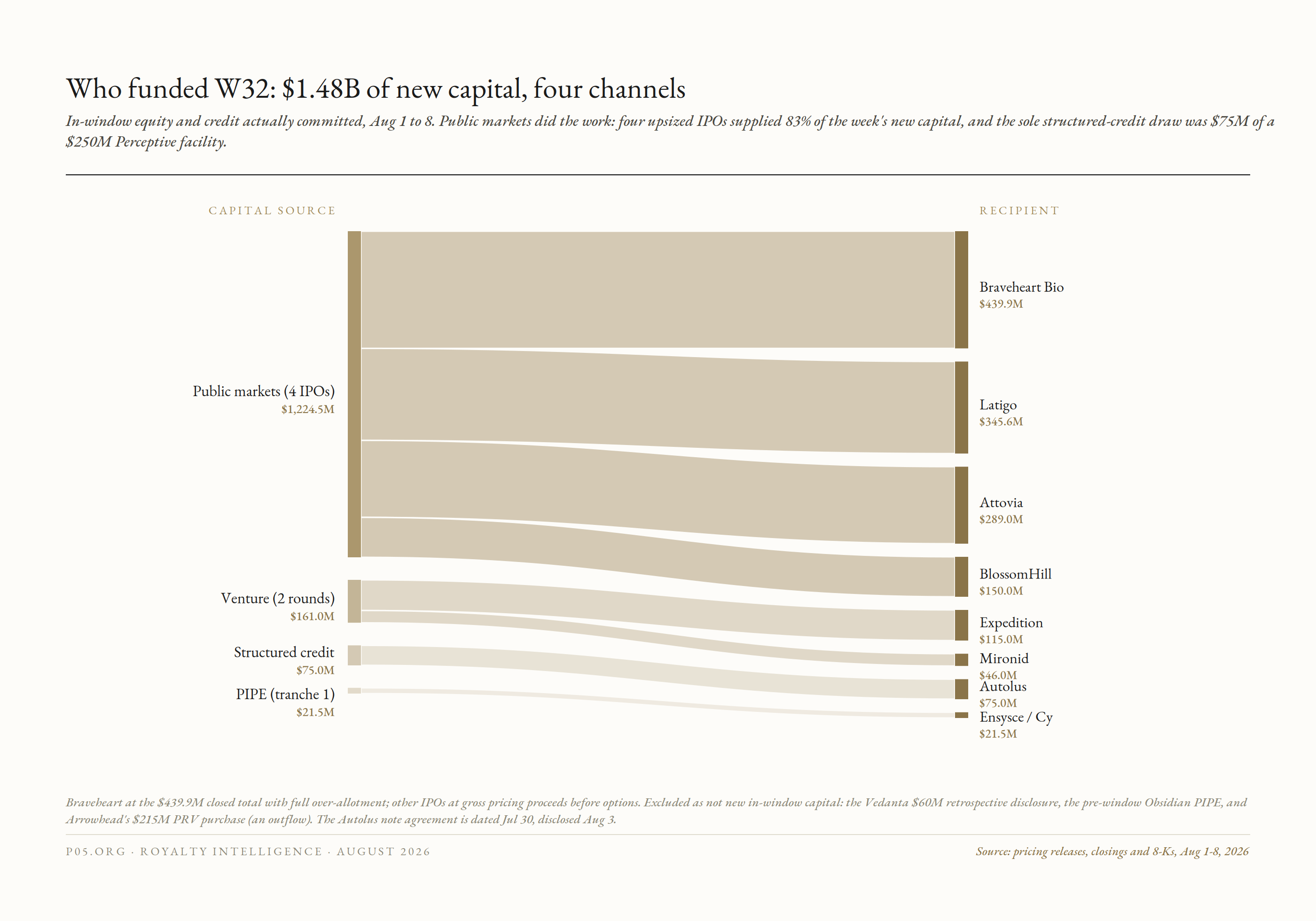
Who funded W32: four upsized IPOs supplied 83% of $1.48B in new in-window capital.
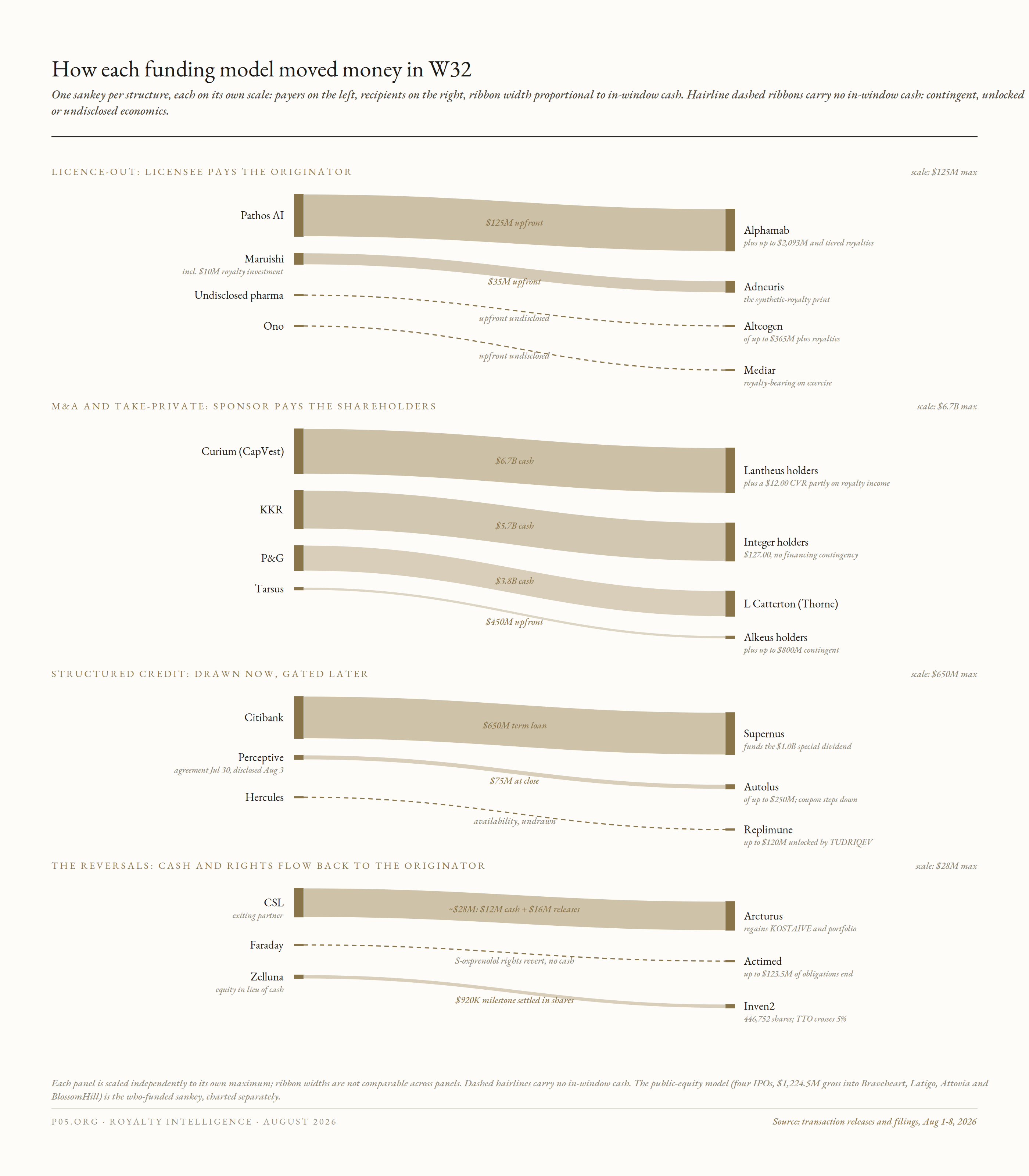
How each funding model moved money: licence-outs, take-privates, structured credit, and the reversals, each on its own scale, with the last panel running right to left.
Highlights:
- Royalty events: 4, none a conventional purchase. Royalty Pharma Q2 (Portfolio Receipts $773M, +6%; guidance raised again; no new transaction; 5 Aug); Alteogen / undisclosed pharma (worldwide ALT-B4, up to $365M plus royalties, the seventh Hybrozyme partner; 5 Aug); Adneuris / Maruishi ($10M US royalty investment inside a $35M upfront, the only synthetic print; 5 Aug); Inven2 / Zelluna (a TTO takes 446,752 shares over a $920K milestone, crossing 5%; 4 Aug).
- Rumoured and denied: AstraZeneca / Bristol Myers Squibb, ~$400B. FT 2 Aug, Reuters 3 Aug, AZN -9% and BMY +4-6%, categorical denial 5 Aug; logged because the price action was real.
- M&A and take-privates: 6 large, 1 product deal, 1 recap. Curium (CapVest) / Lantheus (up to $8.0B, CVR partly on royalty and sublicense income, 3 Aug); KKR / Integer ($127.00/share, ~$5.7B, 3 Aug); Supernus / Indivior ($2.2B merger of equals, $1.0B special dividend, 3 Aug); Tarsus / Alkeus ($450M plus up to $800M, Phase 3 Stargardt, 6 Aug); Harrow / Viatris ($30M plus up to $70M net-sales earn-out for TYRVAYA, 6 Aug); P&G / Thorne ($3.8B cash from L Catterton, 4 Aug); Obsidian / Galera (reverse merger completed plus $350M PIPE, first trade 4 Aug); Pure Biologics / multiQure (~$57M / PLN 213.5M recap, 5 Aug); Lisata (72% cut, Chancery suit, strategic review, 4 Aug); Aurora (lead PKU programme deprioritised seven months post-launch, 4 Aug).
- Licence-outs and collaborations: 12, two running in reverse. Actimed / Faraday (S-oxprenolol reversion, up to $123.5M plus royalties unwound, 6 Aug); Arcturus / CSL (KOSTAIVE reversion, $12M cash plus $16M releases, 6 Aug); Pathos AI / Alphamab ($125M up, up to $2,093M, high-single to low-double-digit tiers, 3 Aug); Adneuris / Maruishi ($35M up, double-digit tiers on Japan and Korea cebranopadol sales, 5 Aug); Mediar / Ono (option deal, royalty-bearing on exercise, 6 Aug); Pathos AI / AstraZeneca (AZD4241 co-exclusive, 4 Aug); Amplia / Lilly (supply-only, upstream CTx royalty, 4 Aug); Evexta / Roche (supply-only, 4 Aug); Phylo / Chugai (no economics, 4 Aug); Marengo / Ipsen (milestone eligibility inside an up-to-$1.2B collaboration, 4 Aug); Schrödinger / BMS (software expansion on a royalty-bearing base, 5 Aug); Recursion / Genentech (first option exercised, $3M, 5 Aug).
- Non-dilutive: Arrowhead buys a PRV for $215M to accelerate the plozasiran sHTG filing, disclosed with a beat-and-miss quarter (4 Aug).
- Funding: four IPOs priced for $1,167.1M gross, all upsized; one stalled. Attovia ($289.0M, +30% debut, Alamar royalty, 4-5 Aug); Braveheart ($382.5M above range, 10x subscribed, +66% debut held, offering closed at $439.9M with full greenshoe, 5-10% tiered Hengrui royalty, 5-7 Aug); Latigo ($345.6M top of range, debut faded from $21.00 to close +1.4%, 6-7 Aug); BlossomHill ($150.0M, debut flat at issue, 6-7 Aug); Vogenx (~$75M, Kissei royalty, no 424B4 and no Form RW on EDGAR: delayed, not withdrawn); Autolus / Perceptive (up to $250M senior secured notes, coupon steps down on performance, 3 Aug); Mironid ($46M / GBP 34M Series B, no university royalty found, 5 Aug); Expedition ($115M Series B above an ex-Fosun DPP1 licence, 5 Aug).
- Regulatory: 3 first-in-class approvals, 6 designations, 1 extinguishment. TUDRIQEV plus nivolumab (accelerated approval after two CRLs; label ORR 24.2% against the 33.6% the market traded; 6 Aug); ORZEYFUL (first OX2R agonist, no stream, 5 Aug); mFLUSIVA (first mRNA flu vaccine; no running royalty because the Genevant settlement bought a paid-up licence; 5 Aug); designations for Lexeo LX2020 (RMAT), Lilly olomorasib, Zai zocilurtatug (MediLink royalty), Aravax PVX108, Aclaris modzatinib, Multitude AMT-253 (3-6 Aug); Palforzia withdrawn worldwide, a royalty extinguished by exit rather than expiry (eff. 31 Jul).
- Policy: Section 232 tariffs live from Jul 31 for the 17 Annex III companies at a default 100%, second wave 29 Sep; thirteen pay MFN deal rates instead. Tariffs hit cost of goods, not net sales; the MFN price cuts that buy relief are where royalty holders are exposed.
- Earnings: 7 with royalty read-through. Halozyme (royalty revenue $307.7M, +50%; guide raised to $1.220-1.245B; 6 Aug); Royalty Pharma (above; 5 Aug); Zoetis (second guidance cut of the year, 6 Aug); Viatris (TYRVAYA sale disclosed with Q2; the ~$380M Biocon Limited block sale completed in July, closing a ~$780M total monetisation, 6 Aug); Roivant ($772M Genevant settlement share confirmed, 6 Aug); Lilly (revenue +48%, guidance raised, 5 Aug); Recursion ($7.7M revenue against a billions-deep contingent ladder, 5 Aug).
- Pipeline pruning: Lilly / Prevail. GBA1 Gaucher type 1 dropped; Parkinson's is the last surviving indication from the ~$1B 2020 acquisition (5 Aug).
- Legal / IP: 3. Novo / Ceban (Dutch injunction on a compounded semaglutide spray, base defence, 5 Aug); Amgen (material cyber breach, 8-K, 3 Aug); HRSA 340B rebate pilot (pricing overhang, no stream, 3 Aug).
- Resolved: Replimune / TUDRIQEV approved (6 Aug). +8.71% into the decision, roughly -11% after hours on the label ORR gap, ~$12.06 Friday close; Wedbush and BMO upgraded into the weakness; up to $120M of Hercules post-approval milestones unlock.
- Clinical: Hengrui twice in 24 hours. HRS9531 Phase 3 T2D win in China re-rates the Kailera (KAI-9531) stream the same evening the Braveheart BHB-1893 stream priced its IPO (5 Aug).
- Standing passes. Veterinary: no in-window event; the vet item is the Zoetis cut, with Neogen genomics and Covetrus / MWI still pending pre-window. Fund formation: no launch or close (TCGX Asia fund uncorroborated). Monetisations: zero aggregator purchases; the only purchase economics are the $10M inside the Maruishi upfront. PRV: one purchase, no sales.
- Unresolved: Vogenx (S-1/A 29 Jul; no 424B4, no Form RW).
- Reported in window: Ligand Q2. Royalties $48.0M, +32%; royalty guide unchanged at $225-250M; ~$700M deployable, no purchase. Ligand and Royalty Pharma both closed the week holding capital and buying nothing.
- Watch into W33: Vogenx 424B4 or RW; TUDRIQEV launch and the Hercules draw; Harrow / Viatris close (2H); the AZ / BMS denial; the Ingenia Kosdaq first trade (18 Aug); argenx / Forte tender (Q3); Section 232 second wave (29 Sep); Eton Q2 (13 Aug); LTGO and BLSM week two.
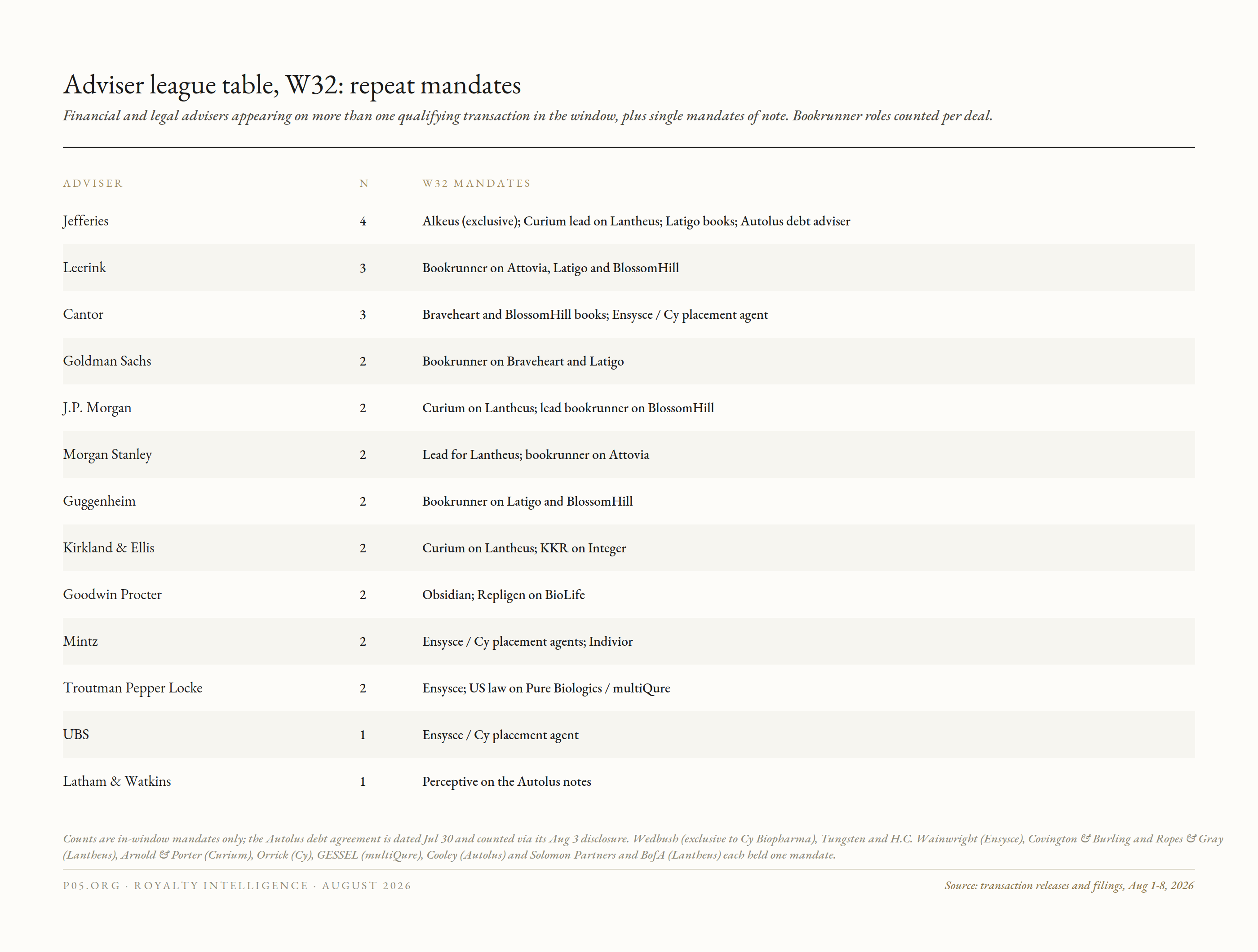
Adviser league table: Jefferies led with four in-window mandates.
Royalty Monetisations and Restructuring
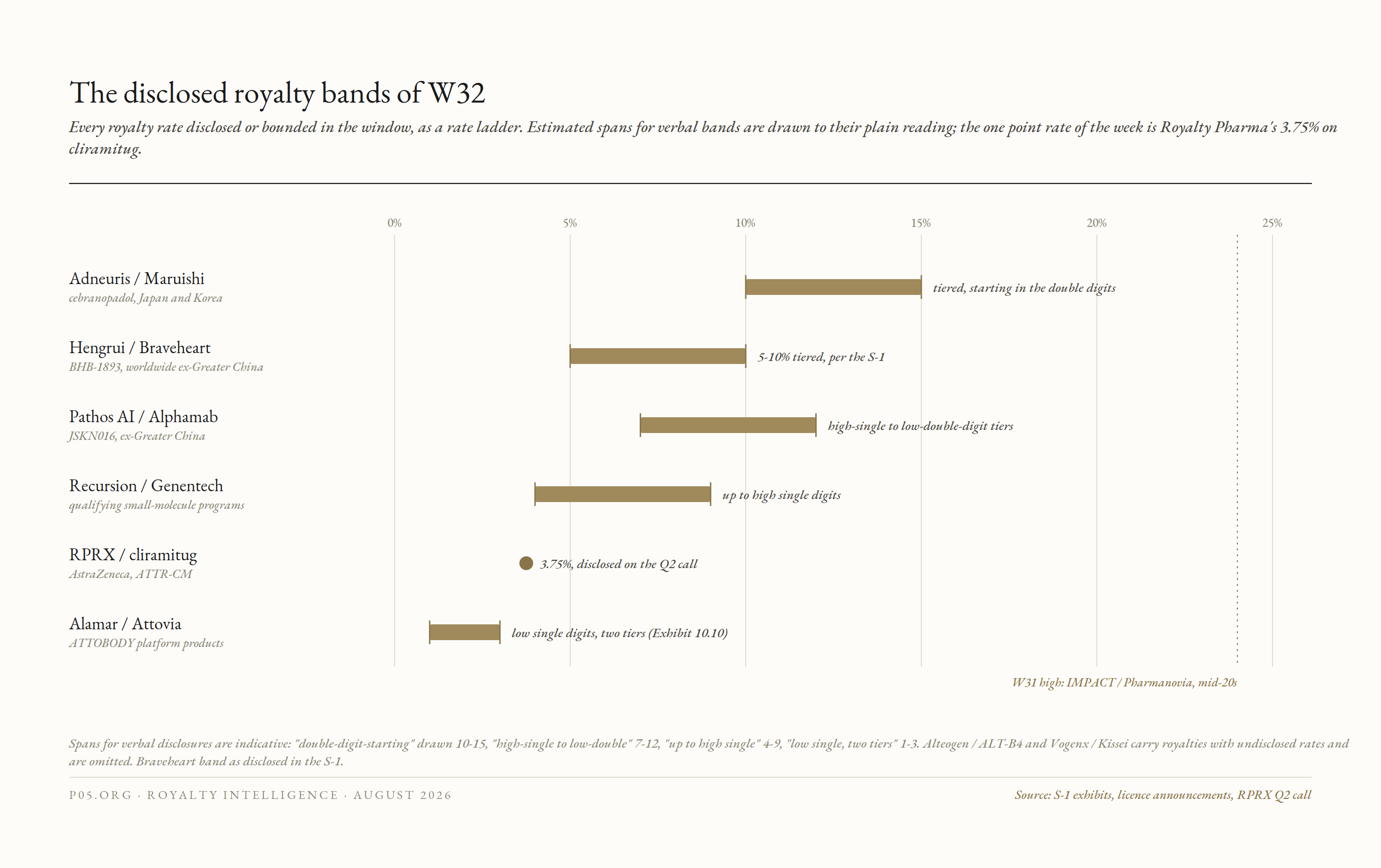
The disclosed royalty bands of the window as a rate ladder; the one point rate is Royalty Pharma's 3.75% on cliramitug.
Royalty Pharma: Q2 2026 Beats Guidance, Royalty Receipts Up 14%, No New Transaction Disclosed (Wed Aug 5)
Royalty Pharma (Nasdaq: RPRX) reported Q2 2026 pre-market and raised full-year guidance for the second time this year (release).
From the earnings call and the 3 Aug newsroom:
- Cliramitug rate: 3.75% on AstraZeneca's cliramitug, peak annual royalty potential $110-190M, expected IRR in the teens, for up to $425M including $125M upfront; a named rate, peak band and return target on one asset, directly usable as a comparable. On the call, not in the release
- Academic origination: Greg Raskin, M.D. appointed SVP, Head of Academic Initiatives (3 Aug, effective Aug 2026); the largest buyer building a dedicated function to source royalties directly from universities, hospitals and TTOs. It sits alongside the Inven2 / Zelluna item above
- Below the line: total income and other revenues $674M vs $579M; Adjusted EBITDA $736M; operating cash flow $728M; GAAP net income fell to $18M from $32M, the line most coverage led with
- Balance sheet and returns: $22B invested capital; ROIC 14.2%, return on invested equity 20.1% (TTM); rating upgraded to BBB across agencies; $4B+ of liquidity; ~$367M returned in H1; Q3 dividend $0.235
- Pipeline: 19 development-stage therapies, ~$2B peak royalty potential, a claimed 90% historical success rate; 25th consecutive quarter of double-digit Royalty Receipts growth
- Portfolio updates: daraxonrasib NDA accepted (pancreatic, EMA accelerated review started); Trodelvy approved FDA and EC in 1L mTNBC; Jideytro approved in ROS1+ NSCLC; Imdelltra approved by the EC in SCLC; Teva completed the Emalex acquisition (ecopipam, an RP-funded royalty asset)
- Print: Portfolio Receipts $773M (+6%), beating a $740-760M guide; Royalty Receipts $768M (+14%), the gap driven by milestones and other contractual receipts collapsing to $5M from $56M; operating cash flow $728M (+100%); Adjusted EBITDA $736M (+16%)
- Guidance: FY26 Portfolio Receipts raised to $3,400-3,500M from $3,325-3,450M, implying Royalty Receipts growth of 7-10%
- Deployment: $349M in Q2, $877M for the half; over $1B deployed year to date; announced transaction value up to $1.7B as of Aug 4; Q2 deployment principally royalty funding for daraxonrasib plus R&D funding for JNJ-4804 and litifilimab
- New transaction: none. The only deal disclosed is the already-logged Neurimmune / cliramitug purchase (up to $425M, $125M upfront, Jul 2026), taking the development-stage pipeline to 19 candidates
- Filing status: furnished via 8-K, press release as Exhibit 99.1; the 10-Q for the quarter ended Jun 30, 2026 was not yet posted; the Q2 Supplemental Financial Information workbook is available and carries per-royalty terms
- Portfolio detail: Tremfya $57M (+53%), Evrysdi $47M (+42%), Voranigo $46M (+72%), Imdelltra $17M (new), Amvuttra $9M (new), Promacta $8M (-75% on US generic entry)
- Balance sheet: cash $812M, debt principal $9.2B, $380M term loan repaid at maturity (Jul 2026); dividend $0.235/share; buyback ~0.9M shares for $45M in Q2
- Date: Reported Wed Aug 5, 2026, pre-market
Adneuris (Tris Pharma) / Maruishi: A $35M Upfront That Contains a $10M US Royalty Investment, the Only Synthetic-Royalty Economics in the Window (Wed Aug 5)
Adneuris Therapeutics, a wholly owned subsidiary of Tris Pharma, granted Maruishi Pharmaceutical exclusive rights to develop and commercialise cebranopadol in Japan and South Korea (release).
- Headline terms: $35M upfront, "including a $10 million U.S. royalty investment", plus development and commercial milestones and tiered royalties on Japan and South Korea net sales starting in the double digits
- Why it is a royalty item and not just a licence-out: the $10M is not consideration for the Japan and Korea rights. It is a payment for an interest in the US stream, a territory Maruishi does not take. A regional licensee is co-investing in the licensor's home-market royalty as part of the same instrument. That is a synthetic royalty wrapped inside a territorial licence, and it is the structure worth watching, because it lets a mid-cap Japanese partner take home-market economics without taking home-market commercial risk. The size of the retained US interest, its rate, its cap and whether it is a true sale or a financing are not disclosed
- Asset: cebranopadol, a first-in-class dual-NMR agonist at the nociceptin/orphanin FQ peptide (NOP) and µ-opioid peptide (MOP) receptors. Phase 3 complete in moderate-to-severe acute pain, Phase 2 across multiple chronic pain indications. Both ALLEVIATE studies showed significant 48-hour pain reduction with reduced opioid rescue use
- Filing path: Adneuris plans a US NDA later in 2026, which is what makes the US royalty interest priceable now rather than speculative
- Second ex-US deal in three weeks: follows the Zhejiang Conba Greater China licence (14 Jul, W29) at $17.5M upfront, more than $100M in milestones, and tiered royalties also starting in the double digits. Adneuris is building a territory-by-territory royalty book on a single pre-approval asset, financing US development off ex-US upfronts, the classic pre-commercial monetisation ladder
- Upstream, unconfirmed: cebranopadol originated at Grünenthal and reached Tris Pharma via Park Therapeutics. Whether a Grünenthal running royalty sits above the whole structure is not in the public record. If it does, the Maruishi US royalty investment is a sale of a net interest, not a gross one
- Date: Announced Wed Aug 5, 2026
Inven2 / Zelluna: A University TTO Takes Equity Instead of Cash on a Clinical Milestone, and Crosses 5% Doing It (Tue Aug 4)
Zelluna ASA (OSE: ZLNA) issued 446,752 new shares to Inven2 AS at NOK 19.7752, settling by set-off the $920K (EUR 791,666.70 / NOK 8,834,604.54) owed to Inven2 under an option and licence agreement with Zelluna's wholly owned subsidiary Zelluna Immunotherapy AS (Zelluna announcement; shareholding disclosure).
- What actually happened, which is not what the deal feeds called it. This is tagged in aggregators as a "settlement". It is not a dispute settlement. It is a contractual clinical milestone falling due and being paid in stock rather than cash. The trigger was dosing of the first patient in the first clinical trial of a licensed product, confirmed on 13 Jul 2026. The AGM on 23 Apr 2026 had pre-authorised up to NOK 800,000 of share capital for exactly this purpose, so the equity settlement was planned, not negotiated under distress
- The shareholding effect: Inven2 moves from 1,439,325 shares (about 4.9%) to 1,886,077 (about 6.3%), crossing the 5% threshold and triggering disclosure under section 4-2 of the Norwegian Securities Trading Act
- Underlying licence: signed just before Christmas 2019, granting Zelluna exclusive global rights to the entire TCR-NK platform developed and patented by Else Marit Inderberg and Sébastien Wälchli's group at Oslo University Hospital. Inven2 is the technology transfer office for Oslo University Hospital and the University of Oslo
- Asset: ZI-MA4-1, the first MAGE-A4-targeting TCR-NK therapy in clinical development anywhere, dosed in the ZIMA-101 Phase 1 at The Christie NHS Foundation Trust. Zelluna reached the public market by reverse-merging into Ultimovacs in 2025
- Why it matters structurally, and it cuts against the direction of travel in this issue. Every other item in this window is about converting a contingent interest into cash. This is a TTO doing the reverse: taking more exposure, not less, at the first clinical inflection. A milestone receivable is a senior, dated, cash claim. Ordinary equity in a small-cap Oslo-listed cell therapy company is neither. Inven2 has swapped a certain $920K for a position whose value moves with ZI-MA4-1 Phase 1 data
- The read. Either Inven2 believes the equity is worth materially more than par on the milestone, or Zelluna could not pay cash and the TTO absorbed it to keep the programme alive. Both are informative, and neither is visible from the transaction value alone. European TTOs converting milestone receivables into equity in cash-constrained licensees is a pattern worth counting, because it is precisely the receivable that a royalty or milestone buyer would otherwise have purchased. Every conversion is a monetisation that did not happen
- Currency basis: EUR is the contractual currency; NOK equivalent as stated in the announcement; USD converted at spot on announcement
- Date: Announced Tue Aug 4, 2026
M&A and Restructuring
Ensysce / Cy Biopharma: A Reverse Merger Described as an Acquisition, and a $77M Headline That Decomposes to $21.5M of New Money at Close (Thu Aug 6)
Ensysce Biosciences (Nasdaq: ENSC) announced completion of its acquisition of Cy Biopharma, alongside a private placement, on the final day of the window.
- Who acquired whom. Ensysce is the nominal acquirer, but on the disclosed post-approval fully diluted split, Cy Biopharma's former equityholders take approximately 74.94%, Ensysce approximately 7.57%, and new private placement investors approximately 17.49%, for a combined fully diluted equity value of about $122.9M. Cy's founder and CEO James Morrison becomes President of the combined company and joins the board. This is a reverse merger that gives a private CRPS developer a Nasdaq listing, structured and announced as an acquisition. Ensysce's own risk factors lead with possible Nasdaq delisting
- Decomposing the $77M, because the components are not equivalent:
- $21.5M gross from the initial private placement tranche, before placement agent fees and expenses. This is the only new third-party money at close
- $17.1M of Cy Biopharma's own cash, raised in a pre-acquisition convertible note financing. This is the target's balance sheet arriving with the target, not capital raised by the transaction
- Up to $38.6M contingent on a clinical trial milestone
- An internal inconsistency in the release, flagged: the subhead puts the milestone tranche at $38.6M; the body's own arithmetic makes it $21.5M (53,449 Series C shares at $402.24), matching the $21.5M initial tranche, with the $17.1M difference exactly the Cy cash figure listed separately
- Verified against the canonical source: the ACCESS Newswire PDF and Ensysce's own IR release (6 Aug, 08:00 EDT) are identical word for word, so it is not a wire artifact; subhead sums to $77.2M, body to $60.1M
- Treatment: if the body governs, new capital across both tranches is $43M and the true "up to" total is roughly $60.1M rather than $77M; verify against the 8-K before using any figure
- Structure: stock-for-stock merger at a fixed exchange ratio, 282,122 shares of Series C non-voting convertible preferred to Cy holders (282,122,000 as-converted), 120,260 shares to placement investors. Conversion to common at 1:1,000 requires stockholder approval under Nasdaq rules, and the company is contractually obliged to hold the meeting. Neither the acquisition nor the placement required an Ensysce shareholder vote to close. First tranche expected to close 7 Aug, one day outside the window
- A quiet cleanup: Ensysce also resolved all existing contractual matters with an unnamed third party in exchange for conversion of that party's Series B Preferred and warrants into common and Series C. An undisclosed settlement with an existing financing counterparty, folded into the recapitalisation
- Investors: led by Ally Bridge Group, with Perceptive Advisors, Dellora Investments, Ikarian Capital and Adage Capital Partners. Perceptive's second appearance in this window after the Autolus structured credit facility
- Asset: CY200, a neuroplastogen for Complex Regional Pain Syndrome Type 1, with FDA Orphan Drug Designation and a randomised Phase 2 reading out on the funded runway. No approved therapy exists in CRPS. Ensysce continues PF614-MPAR through the PF614-MPAR-102 study with National Institute on Drug Abuse funding, which is a live non-dilutive government stream on the legacy asset
- Royalty, unconfirmed: Ensysce's TAAP and MPAR platforms trace to Signature Therapeutics, and an upstream licence with running economics is plausible. Nothing is disclosed here. Flagged for follow-up, because the surviving entity now carries a legacy opioid-safety platform it is no longer led by, which is the classic profile for a platform royalty to be sold or forgotten
- Advisers, the deepest roster of any deal in the window relative to size: Troutman Pepper Locke legal to Ensysce; Orrick, Herrington & Sutcliffe legal to Cy Biopharma; Wedbush Securities exclusive financial adviser to Cy Biopharma; Tungsten Advisors and H.C. Wainwright financial advisers to Ensysce; Cantor and UBS Investment Bank placement agents; Mintz Levin counsel to the placement agents. Seven advisory mandates on a transaction with a $122.9M combined equity value
- Date: Announced Thu Aug 6, 2026; first tranche closing Fri Aug 7
Tarsus / Alkeus: $450M Upfront and Up to $800M for a Phase 3 Stargardt Asset Whose Topline Is Three Years Away (Thu Aug 6)
Tarsus Pharmaceuticals (Nasdaq: TARS) entered a definitive agreement to acquire Alkeus Pharmaceuticals, a privately held retinal disease company developing gildeuretinol acetate (ALK-001), announced alongside Tarsus Q2 results on the morning of 6 Aug (Tarsus release).
- Terms: $450M upfront, total consideration up to $800M, implying roughly $350M in contingent value. The structure of the contingent portion (milestones versus CVR, and what triggers it) is not in the release. Management call held the same morning at 08:00 ET
- Asset: gildeuretinol is a deuterium-modified vitamin A analogue that reduces formation of toxic vitamin A dimers in the retina, the accumulation that drives damage in ABCA4-mutation Stargardt disease. It is a mechanism play rather than a gene-editing or optogenetics approach. More than 400 individuals treated to date with over seven years of long-term tolerability data, and a reported 29.5% slower annualised growth rate of atrophic lesions against the untreated arm
- The timing risk, which is the striking part: topline Phase 3 NORTHSTAR data is expected in the second half of 2029. Tarsus is paying $450M in cash now against a readout three years out, in an indication (Stargardt, 30,000 to 60,000 US patients) with no FDA-approved therapy and a long history of failed development. NORTHSTAR opened enrolment in June 2026 targeting about 230 participants aged 8 to 45 across more than 55 sites in 11 countries, with FDA and EMA alignment secured pre-enrolment
- Designations, and the PRV angle: gildeuretinol holds Breakthrough Therapy, Orphan Drug and Rare Pediatric Disease designation. The last of those is the one with a balance-sheet consequence, because it is the gateway to a priority review voucher on approval. In a window where Arrowhead paid $215M for a PRV, a contingent voucher sitting behind a 2029 readout is a real, if heavily discounted, component of the $800M
- The royalty that already exists at Tarsus, and it comes out of animal health. Tarsus's Q2 cost of sales explicitly includes the royalty it pays on XDEMVY net product sales. XDEMVY is lotilaner, originally an Elanco animal-health compound, repurposed for Demodex blepharitis in humans. Tarsus is therefore already a royalty payer to an animal-health originator, and it is now bolting a second retinal asset on top of that base. Q2 product sales were $173.9M against $102.7M a year earlier. This is the cleanest live example in the issue of an animal-health-origin royalty running on a human commercial product, and it belongs in the standing veterinary pass on the payer side rather than the deal side
- Upstream on Alkeus, unconfirmed: gildeuretinol traces to work by Ilyas Washington, who was at Columbia University, and an institutional licence above the compound is likely. Nothing specific is in the accessible record. Flagged for follow-up, because a university royalty sitting above a $450M private acquisition is exactly the profile worth pricing
- Alkeus backers: Bain Capital Life Sciences led a $150M Series B in June 2023 with TCGX, Wellington Management and Sofinnova Investments. Joshua Boger, founder of Vertex, was executive chairman. Michel Dahan is President and CEO; co-founder Leonide Saad preceded him
- Advisers: Jefferies as exclusive financial adviser to Alkeus. Jefferies states this is its 17th biopharma M&A mandate since 2025 and that it has advised on marquee private biotechnology acquisitions representing more than $10B of deal value in 2026 alone. Tarsus-side advisers not disclosed
- Market: TARS closed +6.59% on the announcement day
- Date: Announced Thu Aug 6, 2026, pre-market
Harrow / Viatris: Up to $100M for TYRVAYA, a Divested Commercial Product With a Net-Sales-Contingent Earn-Out Doing the Work of a Royalty (Thu Aug 6)
Harrow (Nasdaq: HROW) entered a definitive agreement to acquire global rights to TYRVAYA (varenicline solution) nasal spray 0.03 mg from Viatris (Harrow release; Viatris Q2 release).
- Terms: $30M cash at closing plus up to $70M in contingent milestone payments tied to TYRVAYA net sales, total up to $100M; upfront funded from cash on hand; expected close 2H 2026
- Why the structure is the item: 70% of the maximum consideration is a capped, net-sales-contingent earn-out on an already-commercial product. Functionally that is a royalty with a cap, retained by the seller. Viatris keeps sales-linked exposure to an asset it no longer operates, on the same day it reports Q2. Whether the milestones are threshold-triggered lumps or a running percentage is not disclosed; either way, this is a deferred-consideration stream on a marketed pharmaceutical, precisely the sub-$50M-scale contingent asset class that never surfaces in a royalty database
- Asset: TYRVAYA, a cholinergic agonist and the first and only FDA-approved nasal spray for dry eye disease; approved in the US, China and Taiwan with marketing authorisation applications pending elsewhere. Slots next to Harrow's flagship VEVYE franchise as a second mechanism in the same indication, plus select Viatris talent transferring
- Chain of title, and the write-down arc: TYRVAYA arrived at Viatris through the Oyster Point Pharma acquisition (announced Nov 2022, closed Jan 2023: $11.00/share cash plus a CVR of up to $2.00/share tied to 2022 revenue and prescription targets), which Viatris framed at the time as the foundation of a new ophthalmology franchise.
- The write-down arc, quantified in the same release: the Q2 GAAP net loss of $119M is driven primarily by a $177.8M non-cash charge tied to the TYRVAYA sale, booked against a maximum $100M price, 70% of it contingent. An exit at up to $100M, 70% of it contingent, three and a half years later is a fraction of the entry cost of that franchise build, and it is disclosed inside a Q2 release that frames it as prioritising capital toward higher-growth opportunities.
- Viatris' side of the ledger, same release: the ~$380M Biocon Limited equity block sale completed in July (at a ~2.7% block discount, pre-window, recited with Q2), closing the monetisation of the former Biocon Biologics stake at approximately $780M in total; alongside a Q2 print of $3.8B revenue (+5%), adjusted EBITDA $1.2B (+8% operational) and raised guidance midpoints, Viatris disclosed two divestiture-monetisations in one earnings release, with the TYRVAYA close expected in 2H 2026
- Upstream: varenicline as a molecule is off-patent (Chantix); Oyster Point's estate is formulation and method-of-use IP. No third-party running royalty above TYRVAYA is identified in the accessible record; unconfirmed
- Date: Announced Thu Aug 6, 2026
Procter & Gamble / Thorne: $3.8B All Cash From L Catterton, the Largest Healthcare Transaction of the Window (Tue Aug 4)
Procter & Gamble (NYSE: PG) agreed to acquire Thorne, a practitioner-channel supplement and wellness brand, from L Catterton's Flagship Fund for $3.8B in cash. CEO Shailesh Jejurikar disclosed the price on CNBC on the morning of 4 Aug ahead of the formal release (P&G 10-K subsequent event note).
- Confirmed in the 10-K. P&G's fiscal 2026 Form 10-K carries the transaction as a Note 15 subsequent event dated 4 Aug 2026, with closing anticipated in the second quarter of fiscal 2027, calendar Q4 2026, subject to regulatory approval. That is the primary. Press reporting of "later this year" and "Q4 2026" both reconcile to it
- The return. L Catterton took Thorne private in 2023 for $680M, having listed at a $525M valuation in late 2021. A $3.8B exit is better than a $3B gain on a three-year hold, one of the largest consumer-health sponsor returns of the cycle
- Competitive process. Reuters reported a Haleon bid in June and an FT valuation of up to $4B. P&G declined to characterise it as a bidding war; Bloomberg reported P&G won one
- Scale: Thorne revenue passed $500M in 2025, majority from buyers under 40, with fast direct-to-consumer growth and NSF Certified for Sport positioning. It joins P&G Personal Health Care alongside Metamucil, Align and New Chapter
- Advisers: Jones Day for P&G (Andrew M. Levine, Ann M. Bomberger). L Catterton's advisers not disclosed
- Royalty: none created or extinguished. Logged because it is the largest healthcare transaction in the window and because supplements M&A is now pulling multiples that pharma sponsors will benchmark against. Comparable: Unilever's Grüns acquisition earlier in 2026
- Date: Announced Tue Aug 4, 2026
AstraZeneca / Bristol Myers Squibb: A Roughly $400B Merger Reported, Priced by the Market, Then Categorically Denied (Sun Aug 2 to Wed Aug 5)
The Financial Times reported on Sun Aug 2 that AstraZeneca (Nasdaq/LSE: AZN) and Bristol Myers Squibb (NYSE: BMY) had held preliminary discussions about a combination. Reuters corroborated on Mon Aug 3 through a person familiar with the matter. A senior source told Reuters on Wed Aug 5 that no discussions ever took place.
- Scale: AstraZeneca carried a market capitalisation of about $264B and Bristol Myers Squibb about $133B before the Monday session, so a combined entity of close to $400B, which would have been the largest pharmaceutical merger on record and the fourth most valuable drugmaker
- Market reaction, which is the part that is not in dispute: AZN fell as much as 7% in London on Monday and roughly 9% across the episode; BMY rose 4% to 6%
- The denial (5 Aug): "There is no deal between AstraZeneca and BMS. There never was a deal to be done, and there are no discussions between the companies." Neither company commented on the record at any point
- The denial held: no reporting from FT, Reuters or elsewhere revived the story on 6-8 Aug, and no UK RNS announcement appeared, which under UK market-abuse rules a live deal of this scale would have required. The only live AstraZeneca transaction surfaced in the window is a CSPC Pharmaceutical / AstraZeneca joint venture for biologics manufacturing in China (reported 5-6 Aug, economics undisclosed), a capacity and tariff-hedge play with no direct royalty relevance
- Sell-side reaction: Jefferies wrote that it was "a bit perplexed" given AZ's growth and innovation profile, adding that if one company does not need financial engineering it is AZ. Citi called the report a surprise given AZ's pipeline. One AZ holder told Reuters that on balance BMS shareholders would have been the winners
- The strategic logic that was floated: US exposure (AZ US sales were 42% of first-half 2026 revenue, BMS drew 69% of last-quarter revenue from the US, and AZ completed a direct NYSE listing earlier this year) and complementary oncology (AZ weighted to solid tumours, BMS to haematology and cell therapy). The obstacle is the same oncology overlap: AZ oncology was around $25B last year, close to half of total revenue, and cancer drugs were more than 40% of BMS sales through H1 2026
- Why it belongs in a royalty publication: BMS is a royalty payer on a long list of in-licensed and acquired assets, and is the counterparty on the Schrödinger collaboration logged separately in this issue. Consolidation at this scale changes the credit behind a large share of the outstanding oncology royalty universe in a single step, and it changes the number of independent bidders for the next asset. Nothing in the royalty stack re-rates on a denied rumour, but the episode is a live test of how quickly a $400B combination can be floated in this market
- Royalty: none created or extinguished
- Date: Reported Sun Aug 2, 2026 (FT); corroborated Mon Aug 3 (Reuters); denied Wed Aug 5, 2026 (Reuters)
Curium (CapVest) / Lantheus: Up to $8.0B Take-Private, CVR Milestones Measured on a Base That Includes Royalty and Sublicense Income (Mon Aug 3)
Curium, backed by CapVest Partners, agreed to acquire Lantheus Holdings (Nasdaq: LNTH) in an up-to-$8.0B take-private (Curium release).
- Structure: $102.50/share cash at closing plus a non-transferable CVR of up to $12.00/share (total up to $114.50); premiums 38% / 29% / 21% to the unaffected 60-day VWAP / 30-day VWAP / close (all to May 21, 2026); close expected 1H 2027
- CVR ladder: Prostate diagnostics (FY2030 only): $950M/$1.1B/$1.2B/$1.5B/$1.75B thresholds pay $1/$1/$2/$2/$2, $8.00 total. Neurology diagnostics (measurable on any of FY2028-2030): $300M pays $2.00, $350M pays $1.00, $3.00 total. DEFINITY (FY2030): $400M pays $1.00
- Royalty in the trigger: milestones measure on "Aggregate Adjusted Sales," defined to include royalties accrued, sublicense income, and clinical collaboration revenue, not product sales alone. Lantheus flags obligations under licences for MK-6240 and NAV-4694, both inside the neurology CVR tranche, so a licensor royalty sits above the very franchise that triggers CVR payments
- Portfolio: Pylarify, Pylarify TruVu, Definity, Neuraceq, plus pipeline PNT2003, LNTH-2501, OCTEVY
- Financing: no financing condition; CapVest controlling shareholder since 2017, recapitalised Curium at ~$7B last year
- Advisers: Morgan Stanley lead for Lantheus (BofA, Solomon Partners also advising), Covington & Burling and Ropes & Gray legal; Jefferies lead for Curium (J.P. Morgan, PJT Partners also advising), Kirkland & Ellis and Arnold & Porter legal
- Context: Lantheus is "pursuing value-maximising alternatives for its radiotherapeutic assets," a live carve-out signal
- Date: Announced Mon Aug 3, 2026
KKR / Integer Holdings: $5.7B Take-Private at $127.00/Share, No Financing Contingency (Mon Aug 3)
KKR agreed to acquire Integer Holdings (NYSE: ITGR) for $127.00/share in cash (release).
- Structure: $127.00/share, EV ~$5.7B; premium 51.8% to the Apr 29 close (day before Integer's strategic review announcement), 28.8% to the 30-day VWAP as of Jul 31; unanimous board approval; close expected by year-end 2026
- Financing: no financing contingency; KKR equity plus committed debt; broad-based employee ownership programme planned post-close
- Advisers: Goldman Sachs, Centerview, Barclays, UBS, Raymond James for Integer; Davis Polk legal; Jefferies and KKR Capital Markets on the debt side
- Housekeeping: Integer withdrew guidance, cancelled its Aug 6 earnings call; delists on completion
- Royalty: none; a contract manufacturer, no royalty stream
- Date: Announced Mon Aug 3, 2026
Supernus / Indivior: $2.2B All-Stock Merger of Equals, a $1.0B Dividend Funded by the Same Bank That Advises the Recipient (Mon Aug 3)
Supernus Pharmaceuticals and Indivior agreed to combine in an all-stock merger of equals valued at about $2.2B.
- Structure: all-stock; combined entity named Supernus, Inc. (Nasdaq: SUPN), HQ Rockville, MD; Jack Khattar President and CEO; Indivior director Tony Kingsley as Board Chair; a $1.0B special dividend to Indivior holders pre-closing
- Advisers: Cantor Fitzgerald lead for Supernus (Wells Fargo also advising), Saul Ewing legal (Morgan Lewis UK on certain matters); Jefferies and Piper Sandler joint for Indivior, Citi also advising, Goodwin Procter legal
- Financing: Citibank, N.A. provides a committed $650M senior secured term loan funding the dividend; Citi both advises Indivior and underwrites the loan that pays it
- Royalty: none disclosed
- Date: Announced Mon Aug 3, 2026
Obsidian Therapeutics / Galera: Reverse Merger Plus $350M PIPE, First Trade Closes Around $34.00 (Tue Aug 4)
Obsidian Therapeutics began trading on Nasdaq as OBX on Aug 4 following its reverse merger with Galera (announced 14 Apr 2026) and a concurrent $350M PIPE; the in-window event is the completion and first trade, not the merger announcement.
- PIPE syndicate: new: Balyasny, Caligan, Eventide, Nantahala, Octagon, Redmile, Spruce Street, Trails Edge; existing: Atlas, Deep Track, Foresite, Janus Henderson, Logos, Novo Holdings, Paradigm, Pivotal, RA Capital, RTW, TCGX, Wellington
- Asset: OBX-115, engineered TIL (IL-15-armored); Fast Track and RMAT; funds operations into 2H 2028
- First trade: day-one close ~$34.00; RTW characterised it as ~2.5x MOIC, ~170% uplift on its position
- Advisers: TD Cowen, William Blair, LifeSci Capital financial; Mintz, Sidley Austin legal; Lucid Capital Markets
- Royalty: none confirmed travelling; the Galera-legacy CVR is the only contingent overlay; upstream on OBX-115/cytoDRiVE unconfirmed
- Date: First trade Tue Aug 4, 2026
Pure Biologics (WSE: PUR): Three-Stage Recap and Re-Platform Into multiQure S.A., About $57M Issued at a $124M Market Value (Wed Aug 5)
Pure Biologics S.A. completed a three-stage transaction (share exchange, debt-to-equity conversion, public offering), each a condition precedent to the others (GESSEL case study).
- Aggregate: about $57M (PLN 213,504,603) issued; market value at completion about $124M (PLN 464M), ~2.2x issue price. Conversion at ~3.73 PLN/USD, spot around completion
- Stage 1: acquired 100% of Dystrogen Gene Therapies Inc. (Delaware) from BioFund Capital Management and JD Copilot, via in-kind share issue at about $39M (PLN 146.7M); former Dystrogen holders take ~64.98% of Pure Biologics
- Stage 2: debt-to-equity conversion of indebtedness to ACRX Investments (Cyprus), about $4.5M (PLN 16.8M)
- Stage 3: accelerated bookbuild of about $13M (PLN 50M) via IPOPEMA Securities and INC Brokerage House
- Asset: multiQure RNAi platform, Huntington's disease and other polyglutamine disorders; company plans to rename itself multiQure S.A.
- Advisers: GESSEL (Marczuk, Wieliński, Rzepecki, Stępniewska) with Troutman Pepper Locke on US law
- Royalty: none disclosed; a Delaware entity assembled by financial sponsors rather than an operating pharma is a high-probability in-licence, unconfirmed
- Date: Completed Wed Aug 5, 2026
Lisata Therapeutics: A Collapsed Take-Private Turns Into a 72% Workforce Cut, a Chancery Suit, and a Strategic-Alternatives Review (Tue Aug 4)
Lisata Therapeutics (Nasdaq: LSTA) restructured after its merger with Kuva Labs terminated, cutting staff and suing its former counterparty.
- Background: the Kuva deal contemplated $4.00/share cash plus a CVR worth up to a further $3.00. Kuva's tender offer lapsed one minute after 11:59 p.m. on Jul 20, 2026 when Kuva failed to secure financing; Lisata terminated Jul 24
- Actions (4 Aug): reduction in force of about 72% of full-time employees (roughly 15 of ~21); suit filed in the Delaware Court of Chancery seeking stockholder damages and the $2,000,000 termination fee owed under the merger agreement; strategic-alternatives review opened, spanning acquisition, merger, reverse merger, asset sales, and liquidation or dissolution
- Royalty: none identified on Lisata's assets; value-destructive to the equity but royalty-neutral. Worth tracking as a potential shell or asset-sale supply into the reverse-merger pipeline that has been running all summer
- Date: Announced Tue Aug 4, 2026, 07:00 ET
Aurora Therapeutics: The Doudna and Urnov Personalised Gene-Editing Startup Deprioritises Its Lead PKU Programme and Cuts Staff Seven Months After a $16M Launch (Tue Aug 4)
Aurora Therapeutics deprioritised its lead phenylketonuria programme and let go several staff about seven months after emerging from stealth (BioSpace; STAT).
- Company: Cambridge, MA; launched publicly Jan 9, 2026 with $16M seed led by Menlo Ventures, which incubated it. Founders Jennifer Doudna (Nobel laureate, CRISPR) and Fyodor Urnov (Innovative Genomics Institute, led the team that treated Baby KJ Muldoon). CEO Edward M. Kaye, formerly CEO of Stoke Therapeutics and previously Sarepta. Board chaired by Johnny Hu of Menlo
- Event, in the company's own words: a spokesperson told BioSpace, "We have decided to deprioritize the PKU program as others in the field have started their own programs," adding that "several team members were unfortunately let go." The company says it "remains committed to scaling gene editing for rare diseases" and is "focusing on bringing novel technology to address the areas of highest unmet need." Aurora's chief scientific officer departed earlier in the year
- The competitive squeeze: Beam Therapeutics is pursuing PKU with BEAM-304, an LNP-formulated base-editing approach correcting PAH mutations, in IND-enabling studies. Beam disclosed its programme roughly a month after Aurora launched
- What was being attempted: modular, mutation-specific CRISPR editors with AI-designed guides, paired with an umbrella regulatory strategy grouping multiple PAH variants under unified development paths, and modular GMP for small-batch manufacture. The model leaned on the FDA's new plausible mechanism pathway, which contemplates approving a platform rather than each variant-specific product
- Royalty: none identified, and the structural point is the interesting one. Bespoke, per-patient or per-variant gene editing has no natural royalty architecture, because there is no scaled net-sales base for a percentage to run against. Aurora's umbrella and platform-approval strategy was in effect an attempt to manufacture one, by aggregating variants into a single approvable product with a real commercial base. That this is the first prominent attempt at the model to retrench is a genuine data point on where the royalty-financeable frontier currently stops
- Note on framing: STAT reported the lead programme as scrapped with the company undercut by competition, IP hurdles and production issues; the company frames it to BioSpace as a deprioritisation with the platform intact. Both are logged. Headcount, remaining runway, and whether any Doudna, Urnov or IGI licence sits above the platform are not public
- Date: Reported Tue Aug 4, 2026
Royalty-Bearing License-Outs and Collaborations
Alteogen / Undisclosed Global Pharma: Exclusive ALT-B4 Licence Worth Up to $365M Plus Net Sales Royalties, Announced the Day Before Halozyme Reports (Wed Aug 5)
Alteogen (KOSDAQ: 196170) granted an undisclosed global pharmaceutical company exclusive worldwide rights to develop and commercialise a subcutaneous formulation of one biologic product using ALT-B4 (berahyaluronidase alfa), its recombinant human hyaluronidase built on the Hybrozyme platform (Alteogen release).
- Terms: up to $365M (KRW 521.9B) comprising an undisclosed upfront plus development, regulatory and sales milestones, plus separate royalties on net sales from first commercial sale. Partner, product and the milestone breakdown are all withheld for competitive reasons
- Mechanism: ALT-B4 temporarily depolymerises hyaluronan in the extracellular matrix, allowing large-volume subcutaneous administration of biologics that would otherwise require IV infusion. Functionally identical in purpose to Halozyme's ENHANZE
- Why it matters: it landed the day before Halozyme's Q2 print, the first year the ENHANZE royalty book clears $1B, and it is the seventh Hybrozyme partner after MSD (Keytruda SC royalties), AstraZeneca, Sandoz and Daiichi Sankyo: the only credible second source in a single-issuer royalty category
- The structural read: the SC-conversion royalty thesis rests on ENHANZE-class scarcity; a seventh Alteogen partner on an exclusive worldwide basis is the first hard evidence the scarcity premium is eroding. The Alteogen deal count, not Halozyme's guidance, is the leading indicator for anyone pricing a Halozyme-linked stream. Halozyme's counter, on its call the next day: the Alteogen signings cover targets Halozyme has exclusively licensed, and many of those companies came to Halozyme first
- Prior in the sequence: Alteogen took an ALT-B4 option deal with an undisclosed global pharma in Dec 2025 with a 2026 decision point on converting to a full licence. Whether the 5 Aug agreement is that conversion is not stated
- Currency basis: USD figure as released; KRW at spot on announcement
- Date: Announced Wed Aug 5, 2026
Pathos AI / Alphamab Oncology: $125M Upfront, Up to $2.09B in Milestones and Tiered Royalties for Ex-Greater China Rights to a Phase 3 TROP2/HER3 Bispecific ADC (Mon Aug 3)
Jiangsu Alphamab Biopharmaceuticals, a wholly owned subsidiary of Alphamab Oncology (HKEX: 9966), granted Pathos AI an exclusive licence to JSKN016, a first-in-class TROP2/HER3 bispecific antibody-drug conjugate (Pathos release).
- Terms: $125M non-refundable upfront, up to $2,093M in development and commercialisation milestones, and tiered royalties at high-single-digit to low-double-digit percentage rates keyed to aggregate annual net sales in the licensed territories. Total headline value roughly $2.2B
- Correction: an earlier draft of this item recorded the rates as undisclosed. They are in the primary release. The band is high single digit to low double digit, tiered on aggregate annual net sales, which for a Phase 3 ex-China ADC licence is at the upper end of what the China out-licensing wave has been printing
- Territory: exclusive to Pathos for research, development, manufacture and commercialisation outside mainland China, Hong Kong, Macau and Taiwan, with Pathos bearing all development and commercialisation cost. Alphamab retains full and exclusive Greater China rights
- Asset: JSKN016 engages TROP2 and HER3 on one scaffold, site-specific glycosylation conjugation, DAR 4, topoisomerase I payload. Already in Phase 3 for triple-negative breast cancer in China, with earlier studies in HER2-negative breast cancer, lung cancer and other TROP2- or HER3-expressing solid tumours. ASCO 2026 data supported the dual-engagement rationale
- Why the pairing matters: Pathos announced this alongside the AstraZeneca AZD4241 collaboration logged below. Together they are two assets acquired in one week by a company whose stated method is that every asset-level decision runs through its Foundry platform, making JSKN016 the fourth clinical-stage programme sourced that way. In-licensing as a repeatable portfolio strategy rather than a single bet is the model, and it manufactures royalty obligations at scale on the licensor side
- Royalty position: Alphamab now holds a tiered royalty plus a $2.09B contingent ladder on an asset it retains outright in its home market. A Hong Kong-listed licensor with a de-risked Phase 3 in China and a fully funded ex-China developer is the profile that royalty buyers have been asking for out of the China out-licensing wave
- Note on dating: the Pathos release is dated Aug 3; BioWorld, pharmaphorum and most secondary coverage ran it Aug 4. Logged to the primary date
- Date: Announced Mon Aug 3, 2026
Pathos AI / AstraZeneca: Co-Exclusive Out-Licence of the Preclinical ERα PROTAC AZD4241 (Tue Aug 4)
AstraZeneca co-exclusively out-licensed AZD4241, a preclinical estrogen receptor alpha PROTAC degrader, to Pathos AI.
- Structure: co-exclusive licence; AstraZeneca retains originator economics; Pathos develops using its AI platform
- Royalty: upfront, milestone and royalty terms not disclosed
- Date: Announced Tue Aug 4, 2026
Amplia Therapeutics / Eli Lilly: FAK Plus KRAS G12C in NSCLC, Supply-Only, With an Undisclosed CTx Licence Above the Asset (Tue Aug 4)
Amplia Therapeutics (ASX: ATX) signed a clinical trial collaboration and supply agreement with Eli Lilly to evaluate narmafotinib (FAK inhibitor, AMP945) plus olomorasib (KRAS G12C) in 2L NSCLC (release).
- Structure: Lilly supplies olomorasib in kind; Amplia sponsors and funds a Phase 1b/2b, Australian and US sites, enrolling late 2026; no licence, option, equity, milestone, or royalty to Lilly
- Upstream: narmafotinib and AMP886 were in-licensed in 2018 from the Cancer Therapeutics CRC (Australian consortium); an undisclosed academic-consortium royalty sits above the asset. Cancer Research Horizons has also covered the drug, a possible CRUK co-origin, unconfirmed
- Context: narmafotinib carries FDA Fast Track and Orphan Drug in pancreatic cancer; Phase 2a ACCENT results reported at ASCO 2026
- Market: ATX +11.1%
- Date: Announced Tue Aug 4, 2026
Evexta Bio / Roche: An Ex-Merck KGaA PAM-Pathway Asset Gets a Second Clinical Route, Merck Holds Equity Rather Than an Evident Royalty (Tue Aug 4)
Evexta Bio (Paris; Truffle Capital) signed a clinical trial collaboration and supply agreement with Roche to evaluate rupitasertib (S6K, AKT1/3) plus giredestrant (SERD) in ER+/HER2- breast cancer (release).
- Structure: Roche supplies giredestrant; Evexta sponsors a Phase 1b (≥15 patients, from Q4 2026); no economics disclosed
- Upstream: rupitasertib began at Merck KGaA as M2698 (MSC2363318A), passed to Evexta's predecessor Diaccurate; Merck KGaA is a shareholder in Evexta, and the company calls rupitasertib and EVX020 its "two proprietary therapeutic assets," pointing to equity rather than a running royalty. Second asset EVX020 (KIF20A inhibitor) carries CNRS and Institut Paoli-Calmettes academic positions, unconfirmed
- Context: M2698's Merck trial history: 27.4% stable-disease rate as monotherapy, no objective responses among 62 patients; second combination attempt after an earlier plan with Menarini's elacestrant did not start on schedule
- Date: Announced Tue Aug 4, 2026
Phylo / Chugai: Agentic-AI Platform Deployment, No Economics (Tue Aug 4)
Chugai Pharmaceutical (JPX: 4519) will deploy Phylo's Biomni Lab agentic-AI platform across four discovery workflows.
- Structure: platform deployment, financial terms undisclosed; no upfront, milestone, or royalty in either direction
- Phylo: Biomni Lab launched Feb 2026 on a $13.5M seed (a16z and Menlo co-led, Anthropic participating); a parallel Ono Pharmaceutical deployment was announced Jul 28
- Market: Chugai -0.1%
- Date: Announced Tue Aug 4, 2026
Marengo Therapeutics / Ipsen: A Development-Candidate Nomination Triggers Milestone Eligibility Inside a Royalty-Bearing Collaboration, the Counter-Example to the Day's Other Three Prints (Tue Aug 4)
Marengo Therapeutics nominated the first development candidate under its TriSTAR collaboration with Ipsen (release).
- Event: nomination under the June 2024 TriSTAR agreement, second Marengo TriSTAR candidate to enter IND-enabling development; Marengo led preclinical work, Ipsen assumes all activities from here
- Royalty: Marengo is eligible for milestone payments on the nomination; the underlying agreement carries an upfront plus up to $1.2B in milestones and tiered sales royalties
- Stacked position: Ipsen's second Marengo deal. The Aug 2022 STAR agreement was $45M upfront plus up to $1.592B and its own tiered royalties. Across both, roughly $2.8B in contingent claims and two royalty streams against one partner, off one platform, held by a private company. Neither rate disclosed
- Also announced: Saso Cemerski, Ph.D. joins as SVP Head of Immunology, from AstraZeneca (led 75+ scientists), prior roles at Cue Biopharma, Merck, BMS, Xencor
- Date: Announced Tue Aug 4, 2026
Schrödinger / Bristol Myers Squibb: A Bunsen and RetroSynth Software Deployment Expands an Existing Relationship That Already Carries $2.7B of Milestones Plus Royalties on Two Schrödinger-Owned Programs (Wed Aug 5)
Schrödinger (Nasdaq: SDGR) agreed to deploy its Bunsen agentic AI co-scientist and RetroSynth synthesis-planning platform within Bristol Myers Squibb's research organisation (release).
- Structure: a software deployment expanding an existing partnership; BMS gains access to Bunsen (agentic execution of Schrödinger's physics-based computational platform) and RetroSynth; Schrödinger and BMS scientists will jointly develop Bunsen functionality for large-scale chemical exploration; no new upfront, milestone, or royalty terms disclosed for the deployment itself
- The existing relationship it expands: Schrödinger and BMS have a November 2020 discovery, development and commercialisation collaboration covering multiple disease areas, including two Schrödinger-owned early-stage programs, HIF-2α in kidney cancer and SOS1/KRAS-driven tumours, plus undisclosed additional targets. Terms: $55M upfront, up to $2.7B in milestones, and Schrödinger entitled to royalties on any resulting commercialised therapies, with Schrödinger covering the early discovery cost itself. The two companies also co-published SARM1 inhibitor work in April 2026
- Why it belongs beside the other AI-platform items this week: Phylo/Chugai and Marengo/Ipsen this issue are pure customer or milestone events with no software layer; this is the inverse case, a software deployment sitting on top of a collaboration that already has an upfront-milestones-royalty structure running underneath it. The deployment itself creates no new stream, but it deepens the relationship in which one already exists, on two programs Schrödinger owns outright rather than merely computed for BMS
- Also relevant to the platform's broader signal: Bunsen launched with co-engineering from NVIDIA (BioNeMo Agent Toolkit, RTX PRO 6000 Blackwell) and Google Cloud; BMS is Schrödinger's fourth large-pharma partner on this kind of arrangement after AstraZeneca, Bayer, and Sanofi
- Date: Announced Wed Aug 5, 2026
Recursion / Roche and Genentech: Genentech Exercises the First Validated-Target Option, Triggering a $3M Milestone Inside an Up-to-$12B Collaboration That Carries Tiered Royalties to High Single Digits (Wed Aug 5)
Genentech exercised the first validated-target option under its and Roche's AI drug-discovery collaboration with Recursion (Nasdaq: RXRX), moving a neuroscience target into an early discovery program, disclosed alongside Recursion's Q2 2026 results (Recursion release; GEN).
- Event: Genentech accepted Recursion's validation package and exercised the collaboration's first validated-target option, triggering a $3M milestone. Recursion and Genentech will co-develop a small-molecule early discovery program against the target, the first validated target found through the microglia phenomap the parties built for neuroscience
- Royalty, with a disclosed band: the 2021 collaboration is a 4.5-year arrangement worth up to $12B, under which Roche and Genentech may initiate up to 40 programs. Each successfully developed and commercialised program can yield more than $300M in development, commercialisation and net-sales milestones to Recursion, plus tiered royalties up to high single digits per small-molecule program. One of the few explicitly quantified royalty bands in this issue
- Cumulative: the $3M takes total cash paid by Roche and Genentech to Recursion since 2021 to $216M. Roche and Genentech account for close to half of the more than $500M Recursion has taken across all partnerships. Recursion took an upfront of $150M at signing; the microglia map acceptance triggered $30M in October 2025
- Q2 2026 print, same day: total revenue $7.7M, down from $19.2M in Q2 2025, almost entirely collaboration revenue. The contrast is the point: a platform company with a very large contingent ladder and a very small current revenue line, which is exactly the profile where a royalty or milestone monetisation becomes attractive
- Wider partner set: Sanofi ($134M received to date, up to 15 AI-designed small-molecule programs), Bayer (up to seven oncology programs, up to $1.5B plus royalties on net sales), Merck KGaA ($20M upfront, up to $674M across three initial programs)
- Context: an option exercise rather than a new agreement, but it is the first conversion of an AI-derived target into a program under this collaboration, which is the step the whole structure was built to produce. Note the Bloomberg write-up of this item sits behind a paywall; terms above are from the Recursion release and GEN
- Date: Announced Wed Aug 5, 2026
Mediar Therapeutics / Ono: Discovery Partnership and Option Agreement in Fibro-Inflammatory Disease, Royalty-Bearing Only on Exercise (Thu Aug 6)
Ono Pharmaceutical (TSE/JPX: 4528) entered a drug discovery partnership and option agreement with Mediar Therapeutics (Boston) to create antibody therapeutics for fibro-inflammatory diseases (Ono / Businesswire release).
- Structure: Mediar runs discovery on its myofibroblast-focused platform; Ono receives an exclusive worldwide option to license selected antibody candidates for development, manufacturing and commercialisation. Mediar receives an undisclosed upfront and R&D cost funding from Ono. Option exercise fees, milestones and royalty terms are not disclosed
- Classification: an option-to-license, so no royalty exists today; the deal becomes royalty-bearing per candidate only on exercise. Logged in the same bucket as the Marengo / Ipsen counter-example, an early-economics structure that seeds future streams rather than pricing one now
- Context: the relationship dates to at least 2021 per Mediar's CEO. Mediar's separate lead antibody (WISP-1 heritage platform, MGH / Brigham origin) is in Phase 2 in collaboration with Eli Lilly, so this is the second large-pharma economic layer above the same discovery engine, and any eventual Ono royalty would sit beside, not above, the Lilly arrangement. Ono closed +1.61% on the day
- Upstream: Mediar was founded on Massachusetts General and Brigham and Women's science; an institutional licence above the platform is likely and undisclosed. Flagged
- Date: Announced Thu Aug 6, 2026 (Osaka and Boston)
Actimed / Faraday: A Royalty-Bearing 2021 Licence Unwound by Reversion, Up to $123.5M of Milestones Plus Royalties Extinguished Without a Single Public Milestone Hit (Thu Aug 6)
Actimed Therapeutics (London, clinical-stage, cancer cachexia and muscle wasting) regained exclusive global rights to S-oxprenolol (ACM-002) from Faraday Pharmaceuticals (release).
- Parties: Actimed Therapeutics (private; London; cancer cachexia and muscle wasting) regains rights from Faraday Pharmaceuticals (US; former global licensee ex-ALS)
- Asset: S-oxprenolol (ACM-002), anabolic-catabolic transforming agent; muscle wasting; US orphan drug designation in ALS (Sept 2024)
- Prior structure (2021, unwound): Faraday global rights ex-ALS; $550K cash and equity upfront; $2.7M near-term milestone; up to $123.5M total milestones plus royalties. No public milestone achieved in five years
- Reversion: full global rights back to Actimed across all indications; reversion consideration undisclosed; Faraday advanced its own Phase 2 cachexia candidate FDY-8801 during the term
- Royalty: Faraday's milestone-and-royalty obligation to Actimed extinguished by reversion; the separate 2023 Mankind Pharma India/Nepal licence on S-pindolol benzoate is unaffected
- Context: The third stream-ending structure of the window after Palforzia and Inven2 / Zelluna; a signed royalty on a shelved asset is an option the licensee lets expire, and five years of silence was the tell.
- Date: Announced Thu Aug 6, 2026
Arcturus / CSL: KOSTAIVE and the Infectious Disease Portfolio Revert for $12M Cash Plus $16M of Released Liabilities, a Paid Reversion Inside a Q2 Print (Thu Aug 6)
Arcturus Therapeutics (Nasdaq: ARCT) disclosed in its Q2 2026 results, filed via 8-K on 6 Aug, that it has regained global rights to KOSTAIVE (self-amplifying mRNA COVID-19 vaccine) and the infectious disease portfolio from its CSL collaboration, receiving $12M in cash and $16M in released liabilities and R&D credits (8-K Exhibit 99.1).
- Parties: Arcturus Therapeutics (Nasdaq: ARCT) regains rights from CSL (former collaboration partner)
- Assets: KOSTAIVE (self-amplifying mRNA COVID-19 vaccine; approved in Japan and the EU) plus the infectious disease portfolio behind it
- Structure: paid reversion; CSL pays roughly $28M of total consideration ($12M cash plus $16M released liabilities and R&D credits) to exit; disclosed inside the Q2 8-K
- Royalty: the CSL royalty and milestone architecture over the franchise ends; Arcturus trades a passive stream for full ownership and commercial risk
- Context: The mirror image of the same-day Actimed item, and a price on what a large partner will pay to leave an approved sa-mRNA franchise: ~$28M. The unpartnered rare disease pipeline (ARCT-032 Phase 3 decision Q4 2026; ARCT-810 data Q3 2026) is now the valuation story.
- Date: Disclosed Thu Aug 6, 2026, after close
Regulatory and Clinical Read-Through
Takeda / ORZEYFUL (oveporexton): First-in-Class OX2R Agonist Approved for Narcolepsy Type 1, Internally Discovered, No Stream Travels (Wed Aug 5)
The FDA approved Takeda's (TSE: 4502 / NYSE: TAK) ORZEYFUL (oveporexton, TAK-861), an oral orexin receptor 2 agonist, for narcolepsy type 1 in adults (Takeda release; FDA press announcement).
- What is new: the first medicine to address the orexin deficiency that causes NT1 rather than the individual symptoms. Existing therapy is stimulants and sedatives. NT1 affects roughly 1 in 2,000 people in the US
- Basis: the Phase 3 FirstLight (TAK-861-3001) and RadiantLight (TAK-861-3002) studies, 273 adults across two 12-week randomised placebo-controlled trials, with significant improvement in wakefulness and daytime sleepiness, reduction in cataplexy episodes, and improvement in sleep paralysis, hallucinations and disrupted nighttime sleep. Most common adverse events insomnia, urinary frequency and urgency, increased salivation. Contraindicated with strong CYP3A inhibitors
- Launch gating: ORZEYFUL has been recommended for scheduling under the Controlled Substances Act and Takeda expects to make it available only after the DEA scheduling process completes. Approval and availability are not the same date here, which matters for any model keyed to first commercial sale
- Prior approval: China NMPA cleared it on 22 Jul 2026 for adults and adolescents 16 and older; it is also under review in Japan with Sakigake designation. Breakthrough Therapy and Priority Review preceded the US decision (Feb 2026)
- Royalty: none identified. Takeda states it discovered and developed the orexin franchise in house, so no third-party running royalty is created by the approval. This is the counterexample to most of the approvals in this issue: a genuinely large first-in-class launch that produces no financeable stream for anyone outside the originator
- Competitive read, where the streams actually are: Takeda says it holds a tailored orexin portfolio for narcolepsy type 2 and idiopathic hypersomnia behind this. Alkermes (alixorexton) and Lilly, which picked up Centessa's ORX750 in an acquisition completed this quarter, are the follow-on filers. On the displaced side, Jazz Pharmaceuticals' oxybate franchise (Xywav, Xyrem) is the incumbent revenue at risk. Any royalty holder downstream of Jazz oxybate volumes should treat 5 Aug as the start of the clock
- Date: Approved Wed Aug 5, 2026
Moderna / mFLUSIVA (mRNA-1010): First mRNA Influenza Vaccine Approved, and a Worked Example of an Approval That Creates No Running Royalty (Wed Aug 5)
The FDA approved Moderna's (Nasdaq: MRNA) mFLUSIVA (mRNA-1010) for seasonal influenza in adults 50 and older (Moderna release; STAT).
- Structure of the approval: standard approval in adults 50 to 64, accelerated approval in 65 and older conditioned on a postmarketing confirmatory trial. A split-pathway licensure inside a single BLA, which is unusual for a vaccine and is the direct residue of the regulatory fight described below
- Evidence: a Phase 3 in more than 40,000 older adults across 11 countries; roughly 27% greater relative efficacy than a standard-dose comparator. VRBPAC voted 9-0 in each age band on 18 Jun 2026
- Regulatory history: in February 2026 the FDA's then head of biologics issued a rare refusal-to-file, overturning career staff, on the ground that the comparator was not the best available vaccine for 65+. After a Type A meeting Moderna amended the application to seek full approval in 50-64 and accelerated approval in 65+ with an additional study, and the FDA accepted it. The PDUFA date was 5 Aug and the agency met it
- Royalty, and the reason this is worth writing up: the obvious question is what runs on top of the LNP. The answer is nothing. The March 2026 Genevant / Arbutus global settlement resolved Moderna's LNP infringement for $2.25B ($950M paid July 2026, $1.3B contingent on the Section 1498 appeal) and granted Moderna a global non-exclusive licence to LNP delivery technology for SM-102-containing mRNA vaccines for infectious disease, with an express covenant not to sue. Contemporaneous reporting is explicit that Moderna owes no royalty payments under the settlement. A new infectious-disease mRNA vaccine approval therefore expands the licensed field without expanding anyone's royalty base
- The structural point: this is what a lump-sum settlement does to a royalty. Genevant and Arbutus converted an open-ended running interest across an entire future infectious-disease vaccine franchise into $2.25B of fixed and contingent cash. mFLUSIVA is the first product to prove the trade: the licensors captured none of it. The split of the $950M non-contingent payment is now confirmed from Roivant's 6 Aug deck: $772M to Genevant, roughly $178M to Arbutus, with Arbutus returning up to about $230M to shareholders. Whether that was the right price is now a question with a data point attached
- Open, unconfirmed: whether the SM-102 scope condition is satisfied by the mRNA-1010 formulation, and whether the separate modified-nucleoside position (the Cellscript / mRNA RiboTherapeutics chain out of Penn) carries any running rate onto a non-COVID vaccine. Neither is in the public record
- Ongoing, elsewhere, now with specifics from Roivant's 6 Aug deck. The Pfizer and BioNTech LNP litigation continues in the US after a favourable September 2025 Markman ruling. In July 2026 Genevant and Arbutus filed three further international actions, in Canada and at the Unified Patent Court, the UPC actions seeking relief across 20 states: Austria, Belgium, Bulgaria, Denmark, Estonia, Finland, France, Germany, Italy, Latvia, Lithuania, Luxembourg, Malta, the Netherlands, Poland, Portugal, Romania, Slovenia, Spain and Sweden. Comirnaty is roughly two thirds of global COVID mRNA vaccine sales to date, so the larger claim is still live and still unpriced
- Date: Approved Wed Aug 5, 2026; widely reported Thu Aug 6
Roivant / Genevant: $772M of the Moderna Settlement Landed in July, and LNP Litigation Is Now a Stated Corporate Priority (Thu Aug 6)
Roivant Sciences (Nasdaq: ROIV) reported the quarter ended 30 Jun 2026 (investor deck). Roivant owns Genevant, the counterparty on the other side of the Moderna item above, so this is the same transaction seen from the recipient's balance sheet.
- The allocation, which the March settlement announcement did not break out. The $950M non-contingent upfront paid in July 2026 splits $772M to Genevant and the balance, roughly $178M, to Arbutus. Roivant states the $772M is excluded from its $3.9B of cash at 30 Jun because it arrived after the balance-sheet date. A further $1.3B is contingent on a favourable resolution of Moderna's Section 1498 appeal, for potential aggregate settlement value of $2.25B
- A small but instructive true-up: the quarter carried a $392K gain on litigation settlement, described as the final allocation to Genevant once incurred litigation costs were finalised. The headline number moved by a rounding error once the lawyers were paid, which is worth remembering when modelling any litigation-derived recovery gross
- The structural point, restated from the payer side. Genevant and Arbutus converted an open-ended running royalty across Moderna's entire future infectious-disease mRNA vaccine franchise into $950M of cash now and $1.3B of contingency. mFLUSIVA was approved the day before this deck, and not one dollar of it will flow to either licensor. The trade is now observable from both ends within 24 hours: a first-in-class approval on one side, a fixed cash receipt on the other, and no running rate connecting them
- Litigation as a stated corporate priority, not a legal footnote. Roivant lists "Execute on LNP litigation" as one of five CY2026 corporate priorities, alongside launching brepocitinib and progressing IMVT-1402. A company holding $3.9B of cash treating patent enforcement as a top-five objective is treating the LNP estate as an asset class in its own right. For a royalty publication the read is direct: where a running royalty has been extinguished by settlement, litigation against the remaining infringers becomes the only remaining monetisation vector, and it gets resourced accordingly
- Other financials: R&D $202M (adjusted $193M), G&A $166M (adjusted $91M, the $75M gap being share-based compensation), net loss $291M (adjusted $244M), including a $36.6M unrealised gain on equity investments. 7,305,646 shares repurchased for $209M in the quarter; 722,323,015 outstanding at 31 Jul
- Royalty read-through on the pipeline, unconfirmed in the deck. Brepocitinib is expected to launch in dermatomyositis by the end of September 2026 following priority review, which would be Roivant's first commercial product. Brepocitinib originated at Pfizer and reached Roivant through Priovant, and mosliciguat came from Bayer via Pulmovant, so upstream running royalties on both are likely. Immunovant's anti-FcRn programmes trace to HanAll Biopharma. None of these obligations is quantified in the deck. A September launch would start the first of them running, and it is the kind of first-sale trigger that rarely gets logged anywhere
- Date: Reported Thu Aug 6, 2026
Lexeo Therapeutics / LX2020: FDA RMAT for an AAV Gene Therapy in PKP2 Arrhythmogenic Cardiomyopathy (Wed Aug 5)
Lexeo Therapeutics (Nasdaq: LXEO) received RMAT designation for LX2020 (release).
- Basis: interim data from the open-label HEROIC-PKP2 Phase 1/2 trial (NCT06109181) showing dose-dependent PKP2 protein expression and improvement or stabilisation of arrhythmia burden, generally well tolerated
- Asset: systemic delivery of full-length PKP2 in an AAVrh10 capsid to cardiomyocytes. LX2020 now holds RMAT, Orphan Drug and Fast Track. PKP2-ACM affects roughly 60,000 people in the US with no approved disease-modifying therapy
- Why RMAT matters commercially: it opens eligibility for accelerated approval, priority review and rolling review, which is the designation that most changes the discount rate on a pre-revenue gene therapy
- Royalty, unconfirmed: Lexeo's platform traces to Weill Cornell Medicine, and an academic licence above the AAVrh10 capsid and the construct is likely. Nothing specific to LX2020 is in the accessible record. Flagged for follow-up
- Market: LXEO +1.58% to about $4.48 on the day
- Date: Announced Wed Aug 5, 2026
Hengrui / Kailera: HRS9531 Phase 3 in Type 2 Diabetes, the Second Hengrui-Origin Royalty Stream to Advance in 24 Hours (Wed Aug 5)
Hengrui Pharma reported that HRS9531, a dual GLP-1/GIP receptor agonist, achieved a 2.78% HbA1c reduction in a Phase 3 type 2 diabetes trial.
- Sourcing caveat, and it is serious. This item rests entirely on aggregator coverage dated 5 Aug. No English-language primary release from Hengrui or Kailera was located across two search passes, and no Chinese-language primary was found either. This is the only item in the issue without a confirmed primary source, and it should be cut or held to W33 unless the release surfaces. The 2.78% HbA1c figure is unverified
- Royalty: HRS9531 is licensed ex-Greater China to Kailera Therapeutics as KAI-9531 (ribupatide), so Hengrui holds a royalty on any ex-China commercialisation. Kailera raised a $600M Series B in October 2025 with Royalty Pharma among the investors, which is the relevant detail: a royalty aggregator already sits in the equity of the licensee that generates the Hengrui stream
- Prior data on the same asset: the HRS9531-301 obesity Phase 3 (567 participants, China) showed mean weight loss up to 17.7% on the treatment policy estimand and 19.2% on the hypothetical estimand, with 44.4% of 6 mg participants losing at least 20%. Kailera is running global Phase 3s at 8 mg and 10 mg. A separate oral GLP-1, HRS-7535 / KAI-7535, read out two Phase 3s on 7 Jul 2026
- The pattern worth naming: Hengrui appears twice in this issue as an upstream royalty holder, once through Braveheart Bio's IPO (BHB-1893, disclosed 5-10% tiered) and once here through Kailera. Both counterparties are US-domiciled, venture-backed, and financing Phase 3 off Western capital markets. Hengrui is accumulating a portfolio of dollar-denominated royalties on assets it does not develop outside China, funded by other people's equity. That is the single most financeable pattern to come out of the China out-licensing wave, and it is almost entirely privately held
- Date: Reported Wed Aug 5, 2026
Section 232 Pharmaceutical Tariffs: The 100% Regime Took Effect Jul 31 for 17 Named Companies (BACKFILL: W31 item, effective Fri Jul 31, outside the W32 window)
Dating note. This is not a W32 event. The effective date is 31 Jul 2026 and the proclamation is dated 2 Apr 2026, both outside the Sat Aug 1 to Thu Aug 6 window. It is carried here as an explicit backfill because it was missed in W31 and because nothing about the sector's royalty economics can be read correctly without it. Do not cite it as W32 news.
The Section 232 tariff regime created by the 2 Apr 2026 presidential proclamation took effect at 12:01 a.m. EDT on Fri Jul 31, 2026 for the companies listed in Annex III.
- Rate and scope: default 100% ad valorem on patented pharmaceutical products (those tied to an unexpired US patent and listed in the Orange Book) and their associated APIs and key starting materials. Rates vary by country of origin, by whether the importer has a Commerce-approved onshoring plan, and by whether it has a signed MFN pricing agreement with HHS
- Two dates: 31 Jul for the 17 Annex III companies (Pfizer, J&J, Merck, Lilly, AbbVie, Amgen, AstraZeneca, Novartis, Sanofi and eight others); 29 Sep 2026 for everyone else. Thirteen of the 17 already sit in Annex II under pre-existing MFN agreements and pay the deal rate rather than the default
- Excluded, for now: generics, biosimilars and certain specialty products including orphan drugs, with a mandated review of generics within a year. A separate generic ladder announced 21 Jul took effect 1 Aug: 0% for two years, then 100% for August 2028 to August 2029, then 200%
- No in-transit exception, and drawback is expressly available under clause (10) of the proclamation, which is unusual for Section 232 and materially changes the net exposure for importers who re-export
- Why a royalty publication should carry it: tariffs are a cost-of-goods event and do not mechanically reduce net sales, so no royalty base moves on 31 Jul. The transmission is indirect and runs the other way. The relief from the default rate is bought with MFN pricing agreements, and MFN pricing compresses US net sales, which is exactly the line most pharmaceutical royalties are calculated on. Every Annex II signatory has, in effect, traded royalty-base erosion for tariff relief, and the royalty holder was not at the table. Combine with the HRSA 340B rebate pilot logged below and the direction of US net-sales pressure through 2027 is unambiguous
- Still open: Section 232 investigations continue in personal protective equipment, medical consumables, medical devices and robotics, which reaches the medtech royalty universe
- Date: Effective Fri Jul 31, 2026 (proclamation dated Apr 2, 2026); logged as a boundary gap-catch
Replimune / TUDRIQEV: FDA Accelerated Approval Plus Nivolumab in Advanced Melanoma, Resolving the Sunday-PDUFA Overhang and Ending a Two-CRL Review (Thu Aug 6)
The FDA granted accelerated approval to TUDRIQEV (vusolimogene oderparepvec-wtpg), formerly RP1, in combination with nivolumab, for adults with unresectable advanced cutaneous melanoma who progressed on an anti-PD-1 antibody-based regimen (Replimune release; FDA announcement).
- Resolution: the decision landed four days past the Sunday Aug 2 action date, closing a review that ran through two CRLs, an FDA leadership turnover, a favourable 10-3 CTGTAC vote (30 Jul), and public advocacy from clinicians and patients. The FDA issued its own release and cited input from clinical experts and patients in reaching the decision, itself unusual
- The label number is not the ASCO number. The approval rests on an efficacy-evaluable population of 91 of 140 IGNYTE patients with at least one non-injected lesion: ORR 24.2%, median DoR 14.1 months. The 33.6% ORR / 24.8-month DoR figures the market carried from ASCO 2026 describe a different, larger analysis. Population: 80% Stage 4, 54% PD-L1 negative, 45% lung and 24% liver lesions. Serious adverse reactions in 35%; discontinuation for adverse reactions 2.9%
- Conditions: approval is contingent on confirmatory benefit in the ongoing Phase 3 IGNYTE-3 (versus PD-1 rechallenge or chemotherapy, data expected late 2027). First-ever approval for Replimune, and a broad post-PD-1 melanoma label for an intratumorally injected oncolytic
- Financing consequence: approval unlocks the post-approval milestone tranches, up to $120M, under the Hercules Capital facility, converting a contingent facility into available non-dilutive launch capital in the same week five biotech IPOs priced. ReplimuneConnect Plus launches for access and reimbursement
- Royalty: none identified travelling on RP1/TUDRIQEV; nivolumab economics remain BMS's. The read-through is to the financing stack (Hercules) rather than a stream
- Commercial sizing, first sell-side marks: Leerink projects strong demand on ease of access and the benign safety profile, but puts peak sales at $618M un-risk-adjusted, against a Wall Street consensus of $971M risk-adjusted, citing operational uncertainty because Replimune must rebuild manufacturing and commercial infrastructure (notes of 3 and 6 Aug, via Fierce)
- Market, sequence now resolved: REPL closed the regular session +8.71% into the decision; the approval release landed late Thursday afternoon (call 16:30 ET) and the stock fell roughly 11% after-hours, a sell-the-news print with the gap between the 24.2% label ORR and the 33.6% ASCO figure, plus the confirmatory-trial condition, the visible drivers. The earlier conflicting prints (feed +8.71%, tracker -0.93% with a -9.1% trough) were measuring different sessions
- Date: Approved Thu Aug 6, 2026, announced late afternoon ET; conference call 16:30 ET the same day
Arrowhead Pharmaceuticals: A $215M PRV Purchase to Accelerate Plozasiran sHTG, Disclosed With a Beat-and-Miss Quarter (Tue Aug 4)
Arrowhead (Nasdaq: ARWR) bought a Rare Pediatric Disease priority review voucher for $215M from an undisclosed third party, disclosed with fiscal Q3 2026 results.
- Use: applied to the planned plozasiran sHTG sNDA, expected before year-end 2026; compresses FDA review from ~10 months to ~6
- Direction: a purchase, not a sale, capital deployed to compress a review clock rather than raised against a stream; at the top of the recent PRV band (Rocket $180M Apr 2026; Fortress/Cyprium $205M, closed Mar 2026)
- Trigger: CEO Anzalone tied the purchase to the SHASTA-3 and SHASTA-4 toplines; counterparty undisclosed
- Quarter: revenue $75.25M (+171%, beat vs ~$44.2M consensus); EPS -$1.36 (miss vs -$1.23 consensus); net loss $194.3M; field force scaling from ~5,000 to 20,000+ HCP targets; 23 candidates in clinic expected by year end
- Royalty, below the asset: Sanofi/Visirna hold Greater China rights to plozasiran (REDEMPLO), up to $265M plus royalties on China net sales, now activated by NMPA approval; Madrigal licence (ARO-PNPLA3) is $25M upfront plus up to $975M milestones
- Royalty, above the asset: plozasiran is built on Arrowhead's own TRiM chemistry, not a third-party LNP, so a classic Alnylam/Arbutus/Roivant upstream is unlikely; unconfirmed
- Market: ARWR +4.16%
- Date: Disclosed Tue Aug 4, 2026
Eli Lilly Q2 2026: Revenue Up 48% to $23.0B and FY26 Guidance Raised, a Broad Read-Through for Every Royalty Holder Downstream of Lilly (Wed Aug 5)
Eli Lilly (NYSE: LLY) reported Q2 2026 and raised full-year guidance.
- Print: worldwide revenue $23.0B, up 48%, on a 60% volume increase partially offset by a 13% decrease in realised prices; reported EPS $7.94 and non-GAAP EPS $8.38 (+33%), both carrying $3.03 of acquired IPR&D charges from Q2 business development
- Guidance: FY26 revenue raised to $85.0B to $87.0B from $82B to $85B. CEO David Ricks framed it as momentum continuing on 48% growth
- Also in the quarter: EU CHMP positive opinion for insulin efzatora; completed acquisitions of Orna, Ajax, Centessa and Kelonia, with the post-quarter infectious disease trio (Curevo, LimmaTech, Vaccine Co) completed and the AtaiBeckley agreement (16 Jul, up to $3.8B with a $2.50 CVR) recited as subsequent events, all pre-window. The same pipeline table cut the GBA1 gene therapy in Gaucher type 1, logged separately below
- Royalty: Lilly is a royalty payer across multiple in-licensed and China-sourced assets, so a guidance raise of this size is broadly supportive for holders of streams running on Lilly-commercialised products. No single stream re-rates on this print, but the direction matters for the aggregate
- Date: Reported Wed Aug 5, 2026
Eli Lilly / Prevail: The GBA1 Gene Therapy Drops Gaucher Type 1, Narrowing a $1B Acquisition to a Single Remaining Indication (Wed Aug 5)
Buried in the same Q2 pipeline table, Eli Lilly removed the Phase 1/2 study of LY3884961 (GBA1 gene therapy) in Gaucher disease type 1 (Lilly pipeline update PDF; Fierce Biotech).
- Event: the GD1 programme "did not meet our high internal bar for success," per a Lilly spokesperson, with no safety signal observed. The trial was enrolling an estimated 15 patients across up to three dose levels. Lilly continues the GBA1 programme in Parkinson's disease via the Propel trial
- The arc on the acquisition: Lilly bought Prevail Therapeutics for about $1B in late 2020 for two lead gene therapies. It dropped the frontotemporal dementia candidate LY3884963 in February 2026, ended GBA1 development in Gaucher type 2 in Q1 2024, and took a $206.5M intangible impairment on the GBA1 asset in Q3 2022 on changed launch timing. Removing GD1 leaves Parkinson's as the sole surviving indication from the deal
- Royalty: none disclosed on the Prevail assets, which were acquired outright rather than licensed, so no third-party stream extinguishes here. The relevance is as a worked example of the acquisition-impairment vector: a $1B platform purchase written down in stages through indication-by-indication pruning rather than a single failure event, with the intangible impairment already booked years before the final indications were cut
- Competitive read: Lilly's exit removes a major player from the Gaucher gene therapy field. Spur Therapeutics (the Freeline and SwanBio merger) is running a Phase 3 GBA1 gene therapy in GD1, Lingyi Biotech is enrolling a Phase 1/2, and Sanofi has published on its own candidate SS3-GBA1
- Also note: Lilly's remaining gene therapy pipeline is thin, with Phase 1/2 trials in otoferlin-mediated hearing loss and vestibular schwannoma, both acquired in the 2022 Akouos takeover ($487M upfront)
- Date: Disclosed Wed Aug 5, 2026, with Q2 results
Rhythm Pharmaceuticals / RM-718: Preliminary Phase 2 Efficacy Signal in Acquired Hypothalamic Obesity, Internally Owned (Tue Aug 4)
Rhythm Pharmaceuticals reported preliminary Phase 2 data showing a positive efficacy signal for RM-718 in acquired hypothalamic obesity.
- Royalty: none; RM-718 is a Rhythm-owned MC4R agonist with no disclosed upstream. Positive but early, and de-risking at preliminary Phase 2 is modest
- Date: Announced Tue Aug 4, 2026
Novo Nordisk / Ceban: Dutch Court Grants a Preliminary Injunction Against a Compounded Semaglutide Nasal Spray, Franchise Base-Defence Rather Than a Stream Event (Wed Aug 5)
Novo Nordisk won a preliminary injunction from the District Court of The Hague against Ceban Ziekenhuisfarmacie B.V. over a compounded semaglutide nasal spray (release).
- Ruling: the court found Ceban infringed Novo Nordisk's supplementary protection certificate (SPC) covering semaglutide, ordering it to cease sales, remove product listings, disclose its supply chain, and reimburse Novo Nordisk's legal costs
- Product at issue: a compounded semaglutide nasal spray; no nasal-spray formulation of semaglutide is approved by any regulator. Novo's approved semaglutide medicines are Ozempic, Wegovy, and Rybelsus
- Context: part of Novo's broader global enforcement push against compounded semaglutide, including a February 2026 Delaware suit against compounders and prior settlements (e.g. Viatris) blocking proposed generics
- Royalty: none created or extinguished; a franchise base-defence action protecting Novo's own SPC on its highest-value asset class, not a licensing or royalty event. No third-party royalty rides on semaglutide
- Date: Decided Wed Aug 5, 2026
Amgen: Material Cybersecurity Breach, Patient PHI Exfiltrated, No Stream (Reported Mon Aug 3)
Amgen disclosed a material cybersecurity incident with proprietary data and patient PHI exfiltrated from third-party-hosted cloud environments.
- Event: unauthorised access detected in July, determined material Jul 29, disclosed via SEC filing; investigation ongoing; no identified impact to products, manufacturing, or financial reporting
- Royalty: none; operational and legal risk item
- Date: Widely reported Mon Aug 3, 2026
HRSA 340B Rebate Model Pilot: Federal Register Notice Advances the Rebate Model, No Stream (Mon Aug 3)
HRSA published a Federal Register notice on the 340B Rebate Model Pilot Program; manufacturer plans due Aug 24, 2026, effective Jan 1, 2027.
- Context: follows Lilly's Nov 2024 suit against HRSA and its Feb-Apr 2026 claim-level-data policy; a pricing and policy overhang on the insulin and broader franchises, not a royalty event
- Date: Mon Aug 3, 2026
Expedited Designations: Four FDA, One China NMPA (Mon Aug 3 to Thu Aug 6)
- Lilly / olomorasib (LY3537982): FDA Breakthrough Therapy, pancreatic cancer; internally owned, no stream; Mon Aug 3
- Zai Lab / zocilurtatug pelitecan (formerly ZL-1310): FDA Orphan Drug, neuroendocrine carcinomas; upstream MediLink royalty; Mon Aug 3 to Tue Aug 4
- Aravax / PVX108: FDA Fast Track, peanut allergy; proprietary peptide platform, no stream; backers include Novartis Venture Fund, Brandon Capital, Uniseed (Australian university commercialisation fund). Phase 2 (95 patients) fully enrolled, data later 2026. Lands four days after Palforzia's withdrawal; Mon Aug 3
- Aclaris / modzatinib (ATI-2138): FDA Fast Track, moderate to severe lichen planus (oral erosive, cutaneous, lichen planopilaris), an indication with no approved therapy; ITK/JAK3 dual inhibitor, internally developed (Confluence-heritage kinase platform), no stream identified; Phase 2b basket start planned Q4 2026 against a company-estimated $1B+ US opportunity; ACRS -4.25% on the day. Note the INN: ATI-2138 is now modzatinib, and the feed rows for this name have carried wrong dates before, but this one verifies to a 6 Aug GlobeNewswire primary; Thu Aug 6
- Multitude / AMT-253: China NMPA Breakthrough (not FDA), melanoma; wholly owned, no stream; early Aug
Palforzia (Stallergenes Greer): First Approved Peanut OIT Ceases Commercialisation, Extinguishment by Withdrawal Rather Than Expiry (Effective Fri Jul 31)
Stallergenes Greer discontinued Palforzia worldwide effective Jul 31, 2026, ending the only FDA-approved oral immunotherapy for peanut allergy.
- Chain of title: developed by Aimmune Therapeutics, acquired by Nestlé Health Science, sold to Stallergenes Greer Sep 2023
- Event: voluntary global discontinuation, explicitly not related to safety, quality, or efficacy; attributed to limited clinical adoption given complex REMS dosing requirements; UK wind-down to Mar 2027
- Royalty: extinguishment; any running economics tied to Palforzia net sales terminate with commercialisation rather than patent expiry or generic entry; specific terms in the Aimmune/Nestlé/Stallergenes chain not public
- Date: Effective Fri Jul 31, 2026 (a W31/W32 boundary item, logged as a gap-catch)
Funds and Capital
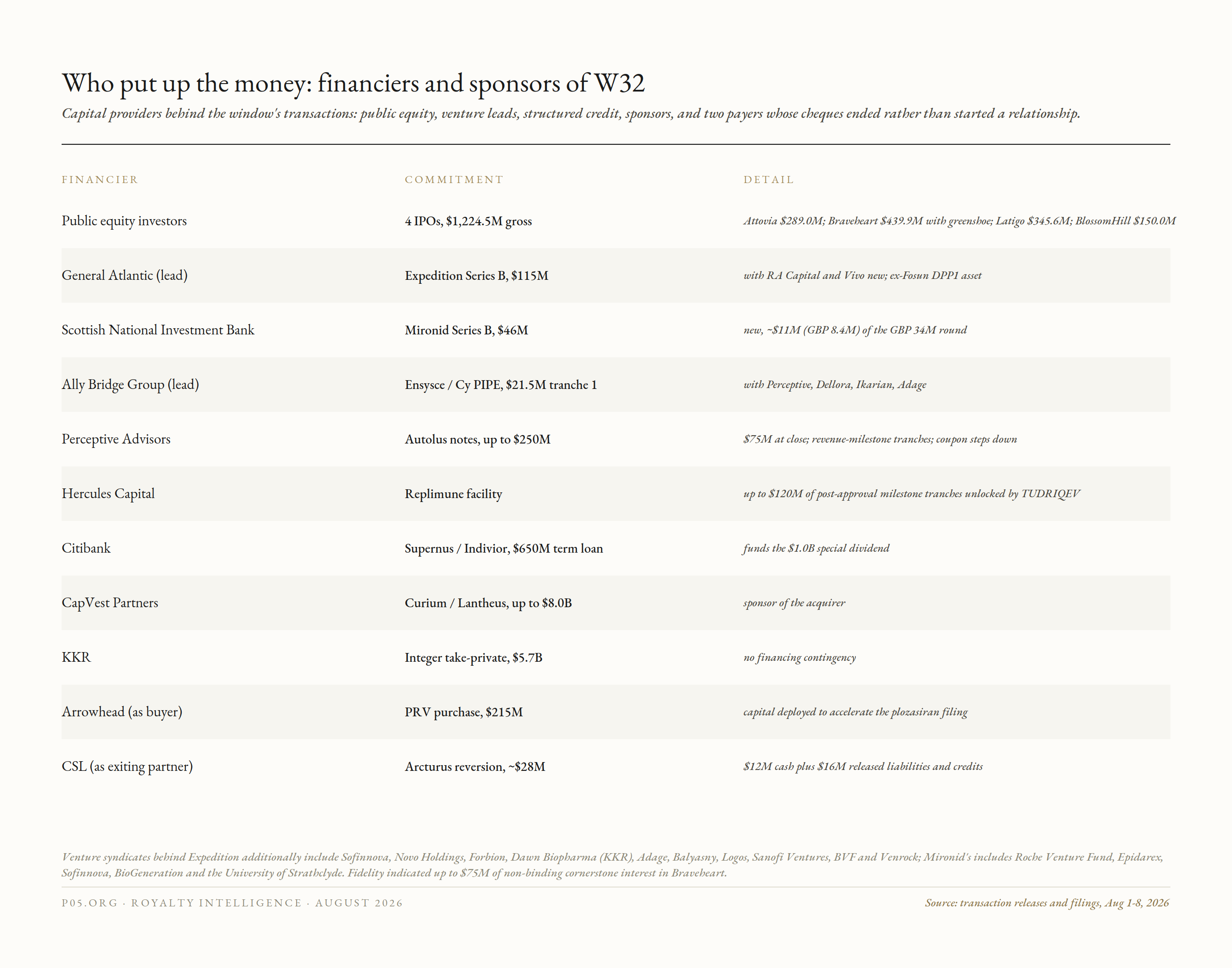
Financiers and sponsors of the window: public equity, venture leads, structured credit, and two payers whose cheques ended a relationship.
Vedanta Biosciences: A $60M Headline Where None of the Capital Is New to the Window, and a Board Appointment That Says More Than the Money (Wed Aug 5)
Vedanta Biosciences announced $60M in funding alongside a Phase 3 clinical update and two board appointments (Businesswire).
- Read the composition before the headline. The $60M is $40M of equity plus $20M from BARDA, and neither tranche is in-window capital:
- The $40M round was led by existing investors only, AMR Action Fund and BNP Paribas Asset Management Alts, and the release states it consists of approximately $18M in Q1 and $22M in Q2. This is money already taken, disclosed on 5 Aug
- The $20M from BARDA is additional funding under an existing contract (75A50120C00177, dating to 2020), so an incremental drawdown or option exercise rather than a new award
- Logged as a disclosure event, not a financing event. The announcement date is in window; the capital formation is not. This is the third instance in this issue of a headline number whose underlying transaction sits outside the window, after Servier / IDEAYA and Aclaris, and the only one where the release itself supplies the evidence. Any tracker keyed to announcement dates will book $60M of August financing that was raised in the first half of the year
- The signal is the board, not the balance sheet. Andrew Davis joins as an independent director. His profile is purely transactional: Chief Business Officer at Dynavax, where he led the sale to Sanofi, CBO at Ironwood, Chief BD/M&A Officer at iNova, and SVP Business Development at Bausch Health where he led the Salix, Dendreon and Bausch + Lomb acquisitions. He sat on Utility Therapeutics' board through its sale to Alembic. Manos Perros joins as Executive Chairman, previously CEO of Entasis through Xacduro and Nuzolvence. Appointing a serial seller-side dealmaker to the board 12 to 18 months ahead of a registrational readout is a company preparing to transact, not a company preparing to launch
- The asset: VE303, an orally administered defined eight-strain live biotherapeutic for prevention of recurrent C. difficile infection, produced from clonal cell banks rather than donor faecal material. Orphan Drug (2017) and Fast Track (2023). RESTORATiVE303 is past 80% enrolment across more than 150 sites in roughly 20 countries, enrolment completing in 2H 2026, topline efficacy 1H 2027, and is intended to support a BLA. The DMC cleared the first prespecified interim analysis earlier this year with efficacy above the futility threshold
- The risk that is not in the release: VE202 missed its primary endpoint in the Phase 2 COLLECTiVE202 study in ulcerative colitis in August 2025. Vedanta is now a single-asset story into a 1H 2027 readout, funded by insiders and the US government
- Royalty, unconfirmed and worth pulling. Vedanta was founded out of PureTech Health, which retains an equity position, and the defined-consortium approach traces to academic work on commensal Clostridia strains. An institutional licence above VE303 is likely and nothing specific is in the accessible record. A BLA-track asset with a probable academic stream, held by a private company approaching a sale, is precisely the sub-$50M-scale profile that never reaches a Western royalty database
- Fund note: the AMR Action Fund leading here is the roughly $1B industry-backed antimicrobial resistance vehicle. Not a fund formation event, but the only appearance of a dedicated AMR pool in the window
- Date: Announced Wed Aug 5, 2026; underlying equity raised Q1 and Q2 2026
Autolus Therapeutics / Perceptive: $250M Senior Secured Notes Alongside a Raised AUCATZYL Guidance, Coupon Steps Down on Performance (Disclosed Mon Aug 3)
Autolus entered a five-year senior secured notes facility of up to $250M with Perceptive, agreement dated Jul 30.
- Structure: $75M at closing, $25M at Autolus's option (6 months), $150M on revenue milestones; interest one-month SOFR (3.50% floor) plus 7.25%, with margin reductions on hitting revenue milestones; no scheduled principal before maturity
- Warrants: up to 3,500,000 ADSs at $1.9314, struck at 125% of 30-day VWAP, expiry Jul 30, 2036
- Advisers: Jefferies International debt adviser to Autolus, Cooley legal; Latham & Watkins for Perceptive
- Commercial print, same disclosure: preliminary Q2 AUCATZYL revenue ~$45M; FY26 guidance raised to $140-150M from $120-135M; gross margin swung from ~-20% (H2 2025) to ~+35% (H1 2026); runway into Q2 2028
- Royalty: none; structured commercial-stage credit against the CAR-T ramp, revenue-milestone tranches function like synthetic-royalty gating with the coupon stepping down rather than up as the product performs
- Date: Disclosed Mon Aug 3, 2026 (8-K; agreement dated Jul 30)
Attovia Therapeutics: Upsized IPO Prices at $17.00 for $289M and Debuts Up About 30%, on a Platform Licensed From a Company With the Same Lead Shareholder (Priced Tue Aug 4, Traded Wed Aug 5)
Attovia (Nasdaq: ATTO) priced an upsized IPO of 17,000,000 shares at $17.00, $289.0M gross (release).
- Terms: upsized from a ~$100M filing target through 12.5M at $15-17 to 17.0M at $17.00; 30-day option for 2,550,000 more; bookrunners Morgan Stanley, Leerink, Citigroup, RBC
- Asset: ATTO-1310 (IL-31, chronic pruritic disease, Phase 1 complete); ATTO-2306, ATTO-1091
- Royalty, now pulled from the filing rather than inferred. The instrument is the Second Amended and Restated Platform License Agreement, Exhibit 10.10 to the Attovia S-1 (CIK 0002058707, accession 0001193125-26-303256). Originally executed 1 Jun 2023, amended and restated 9 Oct 2024 and again 22 Apr 2025. Signed by Tod White (Alamar CFO/CBO) and Zaneta Odrowaz (Attovia CBO)
- The economics, as disclosed:
- Consideration for the licence: 22,562,123 shares of Attovia common stock, issued at board-determined fair market value on the effective date. No cash upfront
- Milestones: up to $4.3M per Product in aggregate, split $0.8M development and $3.5M regulatory, payable whether achieved by Attovia, an affiliate or a sublicensee
- Royalty: tiered, low single digit percentages of net sales, product by product. The exhibit shows a two-tier structure keyed to a cumulative net sales threshold (one rate below, another above); both the threshold and the rates are redacted
- Royalty term: the later of a redacted period from first commercial sale and expiry of the last valid claim covering the product, on a product-by-product and country-by-country basis
- No-valid-claim step-down: where a product is not covered by a valid claim in a country, the rate falls to a redacted fraction of what would otherwise be due
- The clause worth the whole exercise (Section 4.4). The parties expressly acknowledge that the royalty and milestone payments are not solely a royalty on Alamar IP but consideration paid over time for access to the platform and the existing Attobodies, in lieu of upfront or annual access fees. That is a deliberate anti-Brulotte, anti-Kimble construction: it recharacterises the running payment as deferred licence consideration rather than a patent royalty, so it is drafted to survive patent expiry rather than terminate with it. Read alongside the no-valid-claim step-down in 4.3, which concedes a reduced rate rather than zero, this is a licensor building a stream that outlives its own patents. Directly relevant to the royalty-extinguishment work
- Structural features that matter to a buyer:
- Clean stack. Alamar warrants that Attovia's practice of the licensed IP will not require payment of any royalty or similar obligation to any third party. Nothing sits above
- Survives termination. On termination Attovia may continue to exploit products, subject to continuing compliance with the financial terms. Alamar will also grant direct licences to sublicensees on termination
- Exclusive even as to Alamar in the therapeutic field. Alamar and its affiliates are barred from exploiting the platform there, with an obligation to police its own instrument customers
- Licence-back. Alamar retains an exclusive, perpetual, irrevocable, worldwide, royalty-free licence back to platform improvements and related Attovia IP, and Attovia must use reasonable efforts to bind sublicensees and any acquirer to the same
- IP-challenge termination, audit rights with cost-shifting above a redacted underpayment threshold, California law, single-arbitrator ICC arbitration in San Francisco
- Neurology is carved out of the therapeutic field via a schedule of excluded targets, and the agreement defines a separate "SciNeuro Agreement". Alamar therefore appears to have at least one other therapeutic licensee, which is a second stream not visible in any coverage of this IPO
- Correcting the monetisation thesis, downward. On the pulled terms this is a small royalty. Low single digits on assets whose lead is entering Phase 2 in 1H 2027, with a $4.3M per-product milestone ladder that is immaterial to either party. Alamar's economics here are dominated by the equity: 7.5% of a $731.49M pricing-day market capitalisation is roughly $55M, against a royalty that is years from first dollar. A royalty-only monetisation would be too small to interest a large aggregator and probably too early to price. The value of this file is as a structural exemplar, not as an origination target
- Related-party depth, beyond the shared Qiming shareholding. Alamar is simultaneously Attovia's platform licensor, a 7.5% shareholder, its landlord (sublease rent of $1.7M), and a paid service provider ($25,000 monthly service fees and $211,500 of research payments to date). Attovia's board and executive team are heavily drawn from Frazier: CEO Tao Fu, CBO Zaneta Odrowaz, chairman James Topper, and directors Mitchell Gold, John Smither and Angie You. A related-person transactions policy requiring audit committee approval above $120,000 takes effect post-IPO. None of this is improper and all of it is disclosed, but the rate in this agreement is not an arm's-length comparable and must be tagged as related-party in the deal corpus
- Post-IPO cap table: Frazier Life Sciences 14.4%, venBio 9.8%, Alamar Biosciences 7.5%. Attovia raised $255.8M pre-IPO across a $60M Series A (Jun 2023, Frazier led, venBio and Illumina Ventures joining), later rounds, and a $90M Series C last year. Investors include Deep Track, Goldman Sachs Alternatives and Qiming Venture Partners, which led Alamar's 2020 Series A and held about 19.2% of Alamar pre-IPO
- Correction to earlier drafting: Alamar has not merely filed an S-1. It completed its IPO on 17 Apr 2026 (Nasdaq: ALMR), priced upsized at $17.00 on 11,250,000 shares for $191.3M gross, opened $22.60, roughly $1.5B implied. Net losses of $47.1M (2024) and $29.8M (2025); incorporated in Delaware 7 May 2018; 2024 was its first full year of commercialisation
- Attovia also out-licenses. In July 2025 it granted EndPath RadioTherapeutics (formerly Isotovia) an exclusive worldwide licence to ATTOBODY technology for radioligand products, with Attovia generating initial Attobodies against two targets and EndPath taking development onward. Attovia is therefore both a royalty payer to Alamar and a royalty holder against EndPath
- Founding date, minor discrepancy: variously described as founded 2022 and as commencing operations 2023. CEO Tao Fu's restricted stock awards date to April 2023 and the Series A and licence to June 2023. Read as 2022 incorporation, 2023 operations
- First day (5 Aug): opened $21.00 at 12:18 p.m. EDT, +23.5% on the $17.00 IPO price, on 672,648 shares in the opening trade; traded $22.05 (+29.7%) by ~1:20 p.m. on ~2.7M shares; day range $20.21 to $22.75; last trade ~$22.11, about +30%. Pricing-day market cap $731.49M. The close is a last-trade figure, not an exchange-settled official print
- Window context: biotech IPOs averaging ~55% returns in 2026; Apnimed priced at the top of range the prior week
- Date: Priced Tue Aug 4, 2026; first trade Wed Aug 5, 2026
Latigo Biotherapeutics and BlossomHill Therapeutics: Both Priced Upsized on the Evening of Thu Aug 6, First Trades Fri Aug 7 (Priced In Window)
- Latigo (LTGO) terms: 19,200,000 shares at $18.00, top of range, $345.6M gross, against 16M marketed at $16-18; 30-day option on 2,880,000 more; close 10 Aug; ~$1.15B market cap at pricing
- Latigo books and backers: Goldman Sachs, Jefferies, Leerink, Guggenheim; Westlake Village BioPartners ~22%, Foresite 15%, 5AM 12%, Blue Owl 5.2% post-deal; priced days after pivotal-quality Phase 2b abdominoplasty data in NEJM
- Latigo use of proceeds: LTG-001 Phase 3 (Nav1.8, acute pain, topline 2H 2027) and LTG-321 Phase 2 in osteoarthritis pain
- Latigo first trade (7 Aug): opened $21.00, up 16.7%, faded through the session, closed $18.25, up 1.4%; the soft print of the four
- BlossomHill (BLSM) terms: upsized 9,375,000 shares at $16.00, $150.0M gross, against 7.8M marketed at $15-17; 30-day option on 1,406,250 more; close 10 Aug
- BlossomHill books and backers: J.P. Morgan, Leerink, Guggenheim, LifeSci, H.C. Wainwright; ~$257M raised pre-IPO; Cormorant 15.5%, OrbiMed 9.8%; founded by J. Jean Cui (crizotinib, lorlatinib, repotrectinib) and Y. Peter Li of Turning Point
- BlossomHill assets: BH-30643, oral macrocyclic OMNI-EGFR inhibitor (Phase 1/2 SOLARA, C797S focus), plus the CLK inhibitor BH-30236 in r/r AML / HR-MDS
- BlossomHill first trade (7 Aug): opened $15.75, down 1.6%, recovered to close exactly flat at the $16.00 issue price
- Royalty: both pipelines internally discovered, no upstream stream identified in either prospectus; the two no-stream IPOs of the five-deal week
- Date: Both priced the evening of Thu Aug 6, 2026; both first traded Fri Aug 7
The Week in IPOs: Five Biotechs Marketed More Than $1B, Four Priced for $1.167B Gross, Three Carrying Disclosed or Confirmed Upstream Royalties
- Priced and traded, all four: Attovia $289.0M, +30% day one (Alamar royalty); Braveheart $382.5M, +66% day one, offering closed 7 Aug at $439.9M with full greenshoe (Hengrui 5-10% tiered); Latigo $345.6M top of range, debut close +1.4% after a $21.00 open (no upstream); BlossomHill $150.0M, debut flat at issue (no upstream). $1,167.1M gross at pricing, $1,224.5M with the Braveheart greenshoe
- The tape ranked the deals: the royalty-encumbered China-licence story held a 66% premium, the clean-cap Nav1.8 story round-tripped a 17% open, the founder-franchise oncology story closed at issue. Demand is selective inside a functioning window
- Delayed, not withdrawn: Vogenx ~$75M (Kissei royalty), scheduled for the evening of 5 Aug; EDGAR shows a Jul 29 S-1/A, no 424B4, no Form RW. A sole-bookrunner micro-deal with $251K of end-March cash failing to print in the strongest week of the year is itself a datapoint: the window is wide open at $150M+ and apparently closed one tier below
- The tally: four of five priced, all at or above range, all upsized. Three of five carry an upstream royalty, and the two that do not developed their assets in-house: the window is financing in-licensed assets at least as readily as home-grown ones, which is the condition that generates royalty supply
Thu Aug 6 Prints: All Four Reported by Window Close
Ligand Pharmaceuticals: First Print Since XOMA Closed, Royalties Up 32%, Royalty Guidance Unchanged, ~$700M Deployable (Thu Aug 6)
Ligand (Nasdaq: LGND) reported at 07:00 ET, its first print since completing the XOMA Royalty acquisition on 14 Jul; the deal, CVR and 2031 convertible were carried when they happened (release).
- Print: total revenues and income $63.7M, +34%; royalties $48.0M, +32% ($37.4M intangible, $10.7M financial royalty assets); GAAP net income $48.5M; adjusted net income $50.8M ($2.37 diluted, +48%); growth attributed to Filspari, Zelsuvmi and Ohtuvayre
- Guidance: revenue reaffirmed $270-310M; royalty revenue unchanged $225-250M; adjusted EPS raised at the low end to $9.00-9.50 on XOMA cost synergies, interest income and share count. The royalty line did not move
- Capacity: ~$700M deployable post-close against a reiterated appetite of $150-250M annually in royalty assets; per-deal sizing reiterated on the call at primarily sub-$100M, typically $25-75M, across royalty acquisitions, project financings and special situations, which is the band an originator should size to; XOMA now put at more than 120 assets, against the "more than 100" used at announcement, with accretion guided at ~$0.50 of adjusted EPS in 2H 2026 and $1.50 in 2027
- Footnotes: guidance excludes XOMA intangibles amortisation (purchase accounting not final) and post-June deal costs; $35.7M of the $55.7M non-operating income is a non-cash Pelthos mark; G&A up to $29.1M from $20.2M, partly origination and portfolio-management headcount
- Call detail: the one anticipated offset is Amgen's KYPROLIS, down 17% to $314M, described as within the royalty outlook (Ohtuvayre itself up 98%); ~229,000 shares repurchased for ~$60M; operating cash flow guided above $200M in 2026 and approaching $300M in 2027; the Orchestra BioMed royalty investment took a $12M one-time GAAP R&D charge despite being economically a royalty position
- Catalysts and tax, from the call: management framed the next 18 months as the most catalyst-rich in company history, with up to seven pivotal readouts and multiple potential approvals; more than $110M of Section 174 tax credits and NOLs to be used over three to five years for US cash tax savings; XOMA extends portfolio cash flow duration through 2040 and nearly doubles the late-stage clinical pipeline; the $700M zero-coupon convertible was framed as capacity for decisive action against an active BD pipeline
- Volixibat, upgraded on the call: portfolio strategy head Lauren Hay said the asset has potential for approval without another Phase 3 study, with the VANTAGE Phase 2b in PBC on track; a stronger statement than the BTD alone for a royalty that arrived with XOMA three weeks before it
- Portfolio events in-window: volixibat took a Breakthrough Therapy Designation in PSC pruritus with VANTAGE Phase 2b enrolment complete (5 Aug), three weeks after arriving with XOMA; Travere put Filspari US sales at $141M, +96%; Merck put Ohtuvayre at $204M and Capvaxive at $184M; Palvella confirmed a Q4 Phase 3 start (all 4 Aug). All royalty-bearing to Ligand
- Context: Ligand and Royalty Pharma both closed the week holding capital and buying nothing; in a window with zero conventional royalty acquisitions, two large buyers sitting on dry powder is the more interesting signal than either earnings line. Investor Day 8 Dec 2026
- Date: Reported Thu Aug 6, 2026, pre-market
Halozyme: Royalty Revenue Up 50% and the FY26 Royalty Guide Raised to $1.220-1.245B, the Royalty Print of the Window (Thu Aug 6)
Halozyme (Nasdaq: HALO) reported after the close (release).
- Print: total revenue $481.0M, +48%; royalty revenue $307.7M, +50%, roughly 64% of revenue; net income $229.9M, +39%; adjusted EBITDA $328.8M, +46%; non-GAAP EPS $2.28
- Guidance: all four FY26 ranges raised; royalty revenue to $1.220-1.245B (41-43% growth) from $1.130-1.170B; total revenue to $1.835-1.910B
- Drivers: DARZALEX SC and VYVGART Hytrulo, with OCREVUS ZUNOVO, Opdivo Qvantig and RYBREVANT SC now material
- New agreements: five ENHANZE and Hypercon deals signed YTD against a full-year goal of three, $35.5M of upfront revenue; partners named on the call as Vertex, Oruka, GSK, Incyte and one undisclosed; Hypercon first clinical studies 1H 2027, ~$1B Hypercon royalty target for the mid-2030s; the June statement of minimal IPAY 2029 impact through at least 2035 stands
- Merck litigation, from the call: injunctions being pursued in roughly eight countries ex-US against the infringing use of MDASE technology, with decisions affecting Merck's European launches expected before year-end; US patent-office proceedings continue, district-court timing expected later this year
- On Alteogen, from the call: management's rebuttal is that companies signing with Alteogen are doing so for targets Halozyme has exclusively licensed, and that many came to Halozyme first
- Implied step-up: the raised guide against $548M of H1 royalties implies $336-348M per quarter in the back half, up from Q2's $308M
- Context: A ~$1.23B midpoint royalty guide now sits at roughly a third of Royalty Pharma's $3.4-3.5B Portfolio Receipts guide, generated by one delivery platform rather than a purchased portfolio. The Alteogen licence the day before is the counterweight.
- Date: Reported Thu Aug 6, 2026, after close
Zoetis: The Bellwether's Second Guidance Cut of the Year, the Veterinary Item of the Window (Thu Aug 6)
Zoetis (NYSE: ZTS) reported pre-market (release).
- Print: revenue $2.47B, flat reported, -1% organic operational, a slight miss; net income $691M; adjusted EPS $1.87 against a $1.84 consensus
- Guidance: cut again; revenue to $9.120-9.320B from the $9.68-9.96B set at the May cut; adjusted EPS to $6.15-6.25 from $6.85-7.00
- Segment detail: the dermatology franchise fell 16% and US companion animal 11%, against livestock up 12% to $731M and companion-animal diagnostics up 12%; US revenue -7%, international +8%; generic competition is now hitting Cerenia and Convenia, and Librela sales fell; adjusted net income guided to $2.57-2.62B with a $60-65M FX headwind embedded
- Attribution: lower clinic visits, pet-owner price sensitivity and what CEO Kristin Peck called a changed nature of competition (aggressive discounting, rebates and cross-portfolio bundling); July trends had "not yet indicated market stabilization"; targeted investment and business development flagged as responses; ZTS entered the print down roughly 40% year to date
- Context: For the standing veterinary pass this is the item of the window: the bellwether cutting twice in a year and pointing to BD as a lever is the demand backdrop against which any animal-health royalty or licence origination now prices. The $160M Neogen animal genomics carve-out remains pending into 2H 2026.
- Date: Reported Thu Aug 6, 2026, pre-market
BioLife Solutions: Q2 Confirms the Preliminary Guide Exactly, Into the Pending Repligen Take-Private (Thu Aug 6)
BioLife Solutions (Nasdaq: BLFS) reported without a call, into Repligen's pending $1.5B acquisition (22 Jul, a W30 item).
- Print: revenue $28.5M, +21%, exactly the preliminary; GAAP gross margin 64%, adjusted 65%; GAAP net income $45.1M, inflated by a $42.4M non-cash tax benefit; adjusted EBITDA $7.4M (26% of revenue); EPS $0.04 against $0.03; cash $113.1M
- Deal: unchanged; Repligen at $31.00 per share ($11.25 cash plus 0.1442 RGEN), ~$1.5B enterprise value, expected close Q4 2026
- Date: Reported Thu Aug 6, 2026
Braveheart Bio: Priced Above Range at $18.00 for $382.5M, More Than 10x Subscribed, Debuted Up 66% at a $2.11B Market Value, Funding a Disclosed 5-10% Hengrui Royalty Through Phase 3 (Priced Wed Aug 5, First Trade Thu Aug 6)
Braveheart Bio priced 21,250,000 shares at $18.00 for $382.5M gross, above a marketed range of $15 to $17 on 18,750,000 shares (BioPharma Dive).
- Terms: 21,250,000 shares at $18.00, roughly 27% more shares at 6% above the top of range, against a $300M midpoint target; book more than 10x subscribed (Bloomberg); Fidelity had indicated up to $75M of non-binding cornerstone interest
- Books and backers: Goldman Sachs, Jefferies, TD Cowen, Stifel, Cantor; a16z, Forbion, OrbiMed, Enavate, Frazier; formed out of HI-Bio, CEO Travis Murdoch; Nasdaq: BRVE
- First trade (6 Aug): opened $30.20, closed $29.80, up 66%, ~$2.11B market value; the richest mark yet on a Hengrui out-licence stream, priced before Phase 3 starts
- Day two and close (7 Aug): held around $30.00 on light volume; offering closed at 24,437,500 aggregate shares for $439.9M gross with full greenshoe; three directors bought ~$2.6M at the $18.00 issue price into a stock trading 66% above it
- Royalty: BHB-1893 is Hengrui's HRS-1893, oral cardiac myosin inhibitor, worldwide ex-Greater China (Sept 2025); per the S-1, Hengrui receives tiered royalties of 5% to 10% of annual net sales, to the later of patent expiry, regulatory exclusivity or 10 years from first sale per country; upfront $32.5M cash plus 32.5M Series A preferred; up to ~$23M development and ~$1.0B commercial milestones. One of the few explicitly disclosed royalty bands in this issue
- Context: The 17th drugmaker public in 2026, the third cardiac developer, the second with a China-licensed portfolio; net loss $80.23M on no revenue for the 12 months to 31 Mar 2026.
- Vogenx (VOGX), the deal that did not price: ~6,250,000 shares at $11-13 (~$75.0M gross), JonesTrading sole bookrunner, scheduled the same evening; EDGAR shows an S-1/A of 29 Jul, no 424B4, no Form RW; not priced, not withdrawn. Lead asset mizagliflozin (oral SGLT1) carries a 2021 Kissei licence with milestones and running net-sales royalties, rate undisclosed
- Date: Braveheart priced Wed Aug 5, 2026; first trade Thu Aug 6; offering closed Fri Aug 7 ($439.9M gross)
Mironid: $46M Series B on an Allosteric PDE4 Activator for ADPKD, IP Assigns Direct to the Company (Wed Aug 5)
Mironid (Newhouse, North Lanarkshire) raised $46M (GBP 34M) for its ADPKD programme.
- Raise: Scottish National Investment Bank new at about $11M (GBP 8.4M), joining Roche Venture Fund, Epidarex, Sofinnova, BioGeneration, and the University of Strathclyde
- Origin: spun out of Strathclyde and Heriot-Watt (2015-16) on PDE biology from Prof. Miles Houslay; LoAc compounds are allosteric activators of PDE4 long forms, lowering cAMP (the inverse of most PDE4 inhibitors)
- Royalty, corrected on review: the composition-of-matter patents (US10385027B2, US20210032231A1) assign directly from the named inventors to Mironid Limited, not from either university. Strathclyde's position reads as equity, not a running royalty
- Date: Announced Wed Aug 5, 2026
Expedition Therapeutics: $115M Series B on an Ex-China DPP1 Inhibitor In-Licensed From Fosun (Wed Aug 5)
Expedition Therapeutics closed an oversubscribed $115M Series B, led by General Atlantic, concurrent with dosing the first patient in a global Phase 2 COPD trial (release).
- Raise: led by General Atlantic; new RA Capital, Vivo Capital; existing Sofinnova, Novo Holdings, Forbion, Dawn Biopharma (KKR platform), Adage, Balyasny, Logos, Sanofi Ventures, BVF, Venrock. Follows a $165M Series A (Oct 2025); cumulative $280M
- Asset: EXPD-101, oral once-daily DPP1 inhibitor, COPD
- Upstream: in-licensed ex-China from Fosun Pharma (Aug 2025) for $17M upfront; Fosun retains China and runs a parallel Phase 2 in bronchiectasis there; no royalty rate disclosed on the ex-China licence, probable but unconfirmed
- Date: Announced Wed Aug 5, 2026
AdStandard disclaimer
This Weekly Term Sheet is provided for informational purposes only. It does not constitute investment advice, an offer to sell or a solicitation of an offer to buy any security, or a recommendation regarding any investment. Data and disclosures are sourced from public company filings, press releases, and credible secondary reporting. Capital for Cures AG does not warrant the accuracy or completeness of information presented. Readers are advised to consult primary source documentation before making any investment, partnership, or commercial decision. Capital for Cures AG and its principals may hold positions in companies referenced.