
The surrogate licence: royalty diligence when the licensee is the inventor's own company

Royalty diligence normally runs against a licence struck between a patent owner and an unaffiliated commercial party. The foundational CRISPR-Cas9 estates were licensed differently. Each institution with a claim to the technology granted its human-therapeutics rights to a company founded by, or built around, its own inventor, a model Jorge Contreras and Jacob Sherkow named surrogate licensing in Science in 2017.
Vertex's CASGEVY is the first marketed product sold under those licences. In October 2024 DRI Healthcare paid $57.0 million for up to 100 per cent of the annual licence fees that one of the surrogates, Editas Medicine, collects from Vertex on it.
The consent gate piece covered who has to approve a royalty sale, and the recourse ladder piece where the instrument sits between note and sale.
The DRI purchase and sale agreement, filed with Editas's 2024 annual report, sets out what a surrogate chain adds to both: a title representation that excludes a live patent interference, an upstream licence the institutions can terminate or convert by category, a seller with no patent to pledge, and infringement claims filed after the representations were given.
1. Three institutions, four surrogate companies
The Broad Institute, Harvard and MIT granted their Cas9 estate for human medicines to Editas Medicine, co-founded by Broad scientist Feng Zhang, under a 2014 worldwide licence. Broad kept research-tool licensing non-exclusive and later set up joint licensing frameworks with DuPont Pioneer for agriculture in 2017 and with MilliporeSigma for research use in 2019, as recorded in a 2022 Nature Biotechnology editorial.
The University of California and the University of Vienna gave one exclusive licence across all fields to Caribou Biosciences, co-founded by Jennifer Doudna, which sublicensed human therapeutics to Intellia Therapeutics. Emmanuelle Charpentier licensed her share of the same co-owned estate to two companies she founded: CRISPR Therapeutics for human therapeutics and ERS Genomics for every other field, with no clawback terms in either grant.
Contreras and Sherkow described the model as familiar from university technology transfer and argued that routing every therapeutic application through one small company could slow development. Contreras was quoted by Duke's SciPol that a company the size of Editas or Caribou could not fund an R&D plan across all known diseases. Broad's position, given in the same report, was that exclusivity was needed to attract the investment human therapeutics require.
No surrogate had a product on the market in 2017, and Sherkow wrote that their value rested largely on their intellectual property. After the PTAB's February 2017 no-interference-in-fact ruling, Editas shares rose more than 30 per cent within days, and Sherkow put the initial loss to Intellia investors at roughly $90 million.
2. CASGEVY pays into both chains
Vertex develops CASGEVY with CRISPR Therapeutics, the Charpentier surrogate. Under the 2021 amended and restated joint development and commercialisation agreement, Vertex leads the programme and holds decision-making control, net profits and losses split 60 per cent to Vertex and 40 per cent to CRISPR Therapeutics, and CRISPR Therapeutics exclusively licensed the relevant intellectual property to Vertex.
CRISPR Therapeutics deferred $221.8 million of its programme costs across 2022 to 2024. Vertex can recover that sum only as an offset against future CASGEVY profits, and none of it had been accrued at 30 June 2026.
Charpentier's rights reach CRISPR Therapeutics through the TRACR-Charpentier licence, under which sublicensing fees to Charpentier in immaterial amounts were triggered by the Vertex collaboration. Because the estate is co-owned, the UC Regents and the University of Vienna consented retroactively to that licence in a December 2016 Invention Management Agreement that also binds Caribou, Intellia and ERS Genomics.
The agreement shares patent maintenance, prosecution and defence costs; CRISPR Therapeutics' share was $1.2 million, $2.4 million and $2.9 million for 2017, 2018 and 2019. The counterparties to its in-licences, not named individually in the filings, are eligible for low single-digit royalties on net sales payable by CRISPR Therapeutics.
Vertex also took a non-exclusive licence from the Broad surrogate. On 12 December 2023, days after CASGEVY's first FDA approval, it licensed Editas's Cas9 technology for ex vivo editing of BCL11A in sickle cell disease and transfusion-dependent beta thalassaemia. The 8-K and the 2024 10-K's description of the Vertex agreement put the annual fees at $10 million to $40 million through 2034.
The DRI documents describe the purchased fees as $5 million to $40 million, and from the 2025 10-K Editas describes the Vertex agreement itself as $5 million to $40 million, with no explanation of the lower floor. Editas owes Broad and Harvard a mid-double-digit percentage of what it receives.
In the same month, CRISPR Therapeutics and Vertex amended their agreement to allocate costs arising from a licence agreement with a third party, which produced a $20.0 million payment from CRISPR Therapeutics to Vertex on a specified event. The filing does not name the third party.
| Chain | Patent owners | Surrogate on CASGEVY | Position | Disclosed economics |
|---|---|---|---|---|
| Broad | Broad Institute, Harvard, MIT, Rockefeller | Editas Medicine | Non-exclusive licensor to Vertex since December 2023 | $50m upfront; $50m contingent; $5m to $40m a year to 2034; mid-double-digit share to Broad and Harvard |
| CVC | UC Regents, University of Vienna, Charpentier | CRISPR Therapeutics (TRACR) | Co-developer with 40 per cent profit share | Low single-digit royalties to unnamed in-licensors; cost sharing under the Invention Management Agreement |
Section 4.09(n) of the DRI agreement confirms that CASGEVY is a Licensed Product under both Editas's licence to Vertex and its own upstream licence from the institutions.
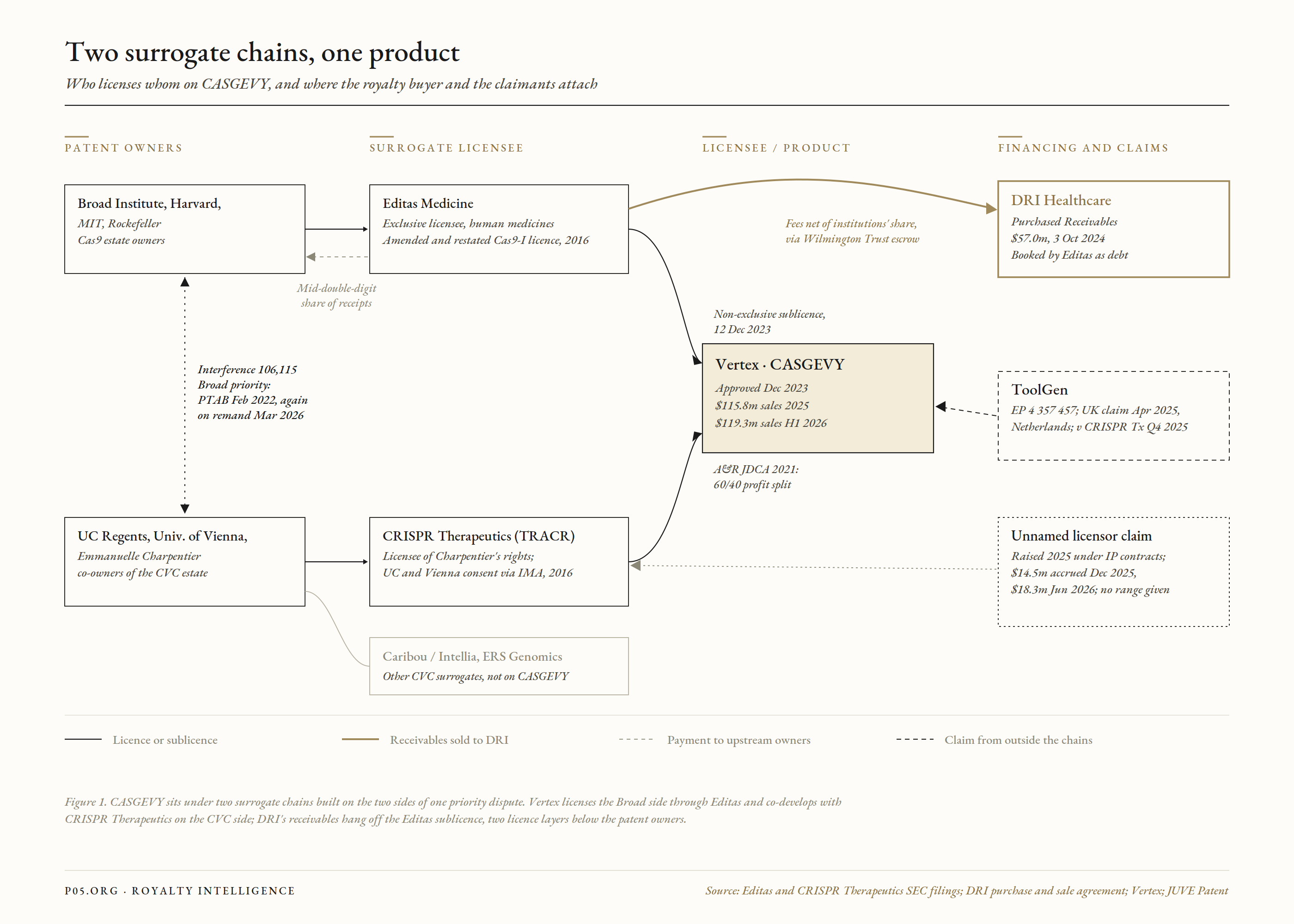
Figure 1. CASGEVY sits under two surrogate chains built on the two sides of one priority dispute. Vertex licenses the Broad side through Editas and co-develops with CRISPR Therapeutics on the CVC side; DRI's receivables hang off the Editas sublicence, two licence layers below the patent owners.
3. What DRI bought
The purchase and sale agreement of 3 October 2024 defines Editas's licence to Vertex as the "Sublicense Agreement". Editas's own licence from Broad, Harvard, MIT and Rockefeller is the "Upstream Agreement": an amended and restated Cas9-I licence dated 16 December 2016, amended in March 2017, by a further entry redacted in the filing, and by an omnibus amendment on 5 February 2024, eight weeks after the Vertex deal.
DRI bought 100 per cent of the Receivables other than the Retained Payments. The Receivables are the contingent upfront payment, the base annual fee, the sales-based additional annual fee, interest under section 3.4 of the sublicence, a redacted item, anything Vertex pays in lieu of those amounts, and the same payments made under section 365(n) of the Bankruptcy Code after a rejection of the sublicence, whether paid to Editas or to any later owner of the licensed patents.
Editas kept the 2024 base fee in full and redacted percentages of the later base fees, of two sales-tier additional fees and of the contingent payment. The institutions' share comes off before DRI is paid: Editas's 2024 10-K describes the purchased fees as measured after amounts owing to Broad and Harvard.
Vertex pays everything into an escrow account at Wilmington Trust under a Licensee Instruction Letter. Section 4.05 names two consents, the instruction letter and a letter agreement with Vertex signed the same day, plus a catch-all for consents already obtained; the institutions are not named.
Section 2.04(a) states a true-sale intent. Section 2.04(b) adds a back-up security interest over the Purchased Receivables and their proceeds, then expressly excludes the licensed patents and every other asset from any lien. Editas booked the $57.0 million as debt under ASC 470, at an effective interest rate of 15.7 per cent at 31 December 2024.
In 2025 the liability rose from $57.4 million to $58.6 million, with $5.0 million paid to DRI against $5.8 million of non-cash interest and $0.4 million of amortised issuance costs. Interest of $5.8 million on the opening balance is about 10 per cent (derived).
The seller's own sickle cell programme changed inside the first quarter of the deal. Section 4.09(q) excludes from Editas's exclusivity representation its contracts relating to a Competing Product from the reni-cel or in vivo programmes, and the agreement defines a Competing Product as anything developed for sickle cell disease or transfusion-dependent beta thalassaemia. Editas's board discontinued reni-cel on 11 December 2024, ten weeks after closing.
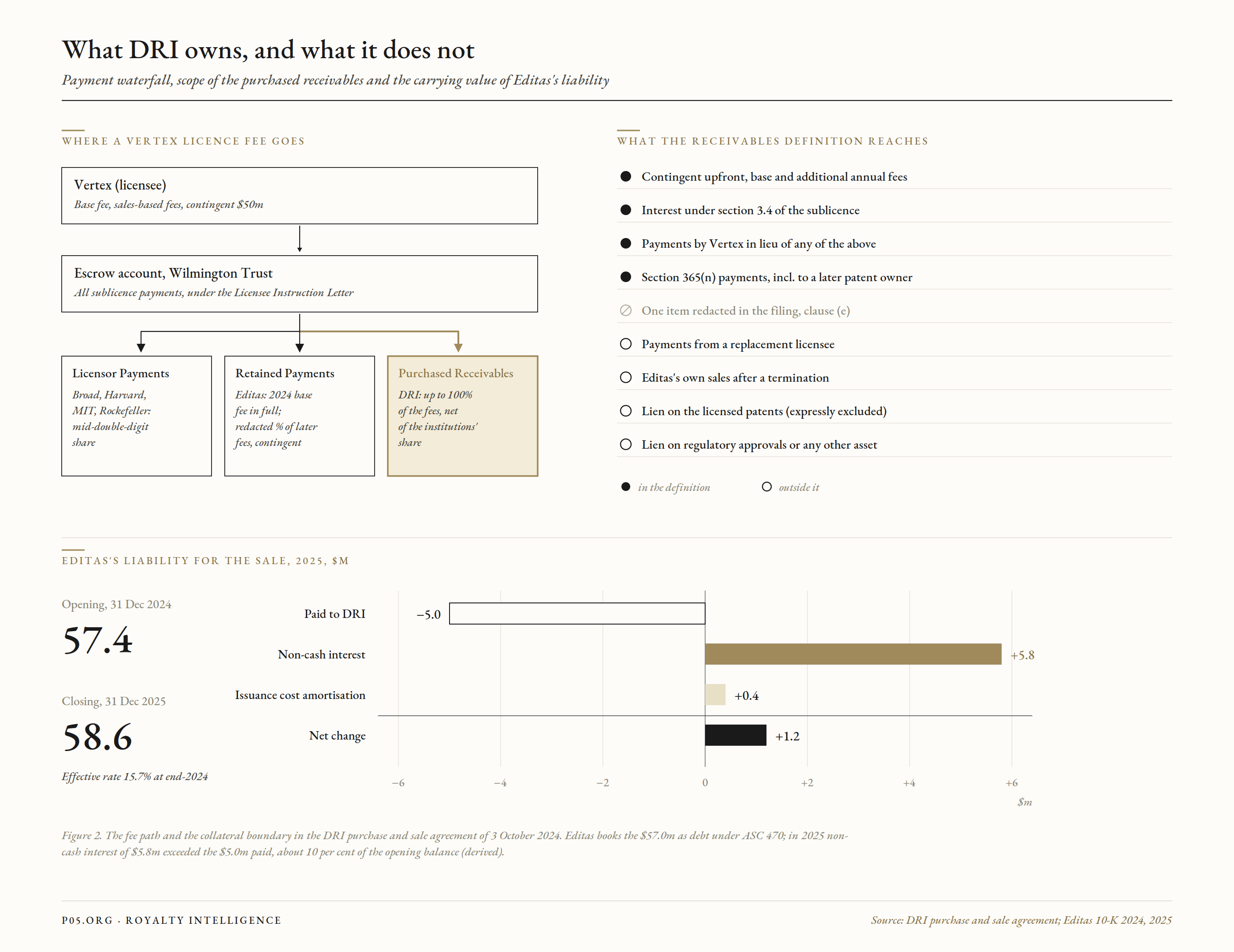
Figure 2. The fee path and the collateral boundary in the DRI purchase and sale agreement of 3 October 2024. In 2025 non-cash interest of $5.8m exceeded the $5.0m paid to DRI, about 10 per cent of the opening balance. Derived from Editas's 10-K filings.
4. The patent representations DRI took
In section 4.11(c) of the DRI agreement Editas represents that, to its knowledge, the institutions are the sole owners of the licensed patents, and that it knows of no facts precluding their clear title "other than the assertions contained in the UC/Broad Patent Proceedings". The agreement defines those proceedings as Interference No. 106,115 plus every European Patent Office opposition against the licensed patents listed on Schedule D of the Vertex sublicence.
The priority contest is outside the title representation by definition. Every Article IV representation is also qualified by disclosure schedules that are not part of the filing. Any recourse DRI has for an adverse outcome sits in covenants such as section 6.23, whose heading reads "Specified [**] Termination Fee", and section 6.24 on liquidated damages; the index also defines a Termination Triggering Event.
For the Bayh-Dole, lien and maintenance representations, Editas's knowledge is extended to reasonable inquiry of the institutions. Section 4.11(h) confirms all licensed patents are subject to the Bayh-Dole Act. Section 4.11(j) states that no institution has given notice under section 3.1 of the upstream licence to terminate its licence for licensed patents in a "Non-Achieved Category", a term defined in the upstream licence and not reproduced in the agreement.
Editas knows of no basis for such a termination or conversion. The Cas9-I licence therefore lets the institutions terminate or convert rights category by category. Editas dropped reni-cel ten weeks after giving the representation, and the filed agreement does not show which category, if any, reni-cel sat in.
Institutional control also runs through the covenants. Under section 6.13 Editas will stop the institutions abandoning a licensed patent only to the extent the upstream licence gives it that right. Under section 6.06(b) Editas alone communicates with the institutions about any breach, after consulting DRI.
Sections 6.15 and 6.16 address challenges to the licensed patents and defence of third-party infringement claims.
XOMA's 2021 royalty purchase agreement with Kuros, on royalties from a Checkmate licence, is the comparable document where the seller owns the patents. Kuros moved the product IP into a US parent, which granted XOMA a first-priority security interest over that IP and the related regulatory approvals and documentation, limited to what it could pledge without breaching third-party agreements.
The purchased royalties cover payments under any New License Agreement with a replacement licensee and, if a terminated product were developed in-house, royalties at the original rate on the seller's own net sales. Editas owns none of the Cas9 patents. The DRI Receivables are defined only as payments made by or on behalf of Vertex, and the back-up security interest stops at those receivables.
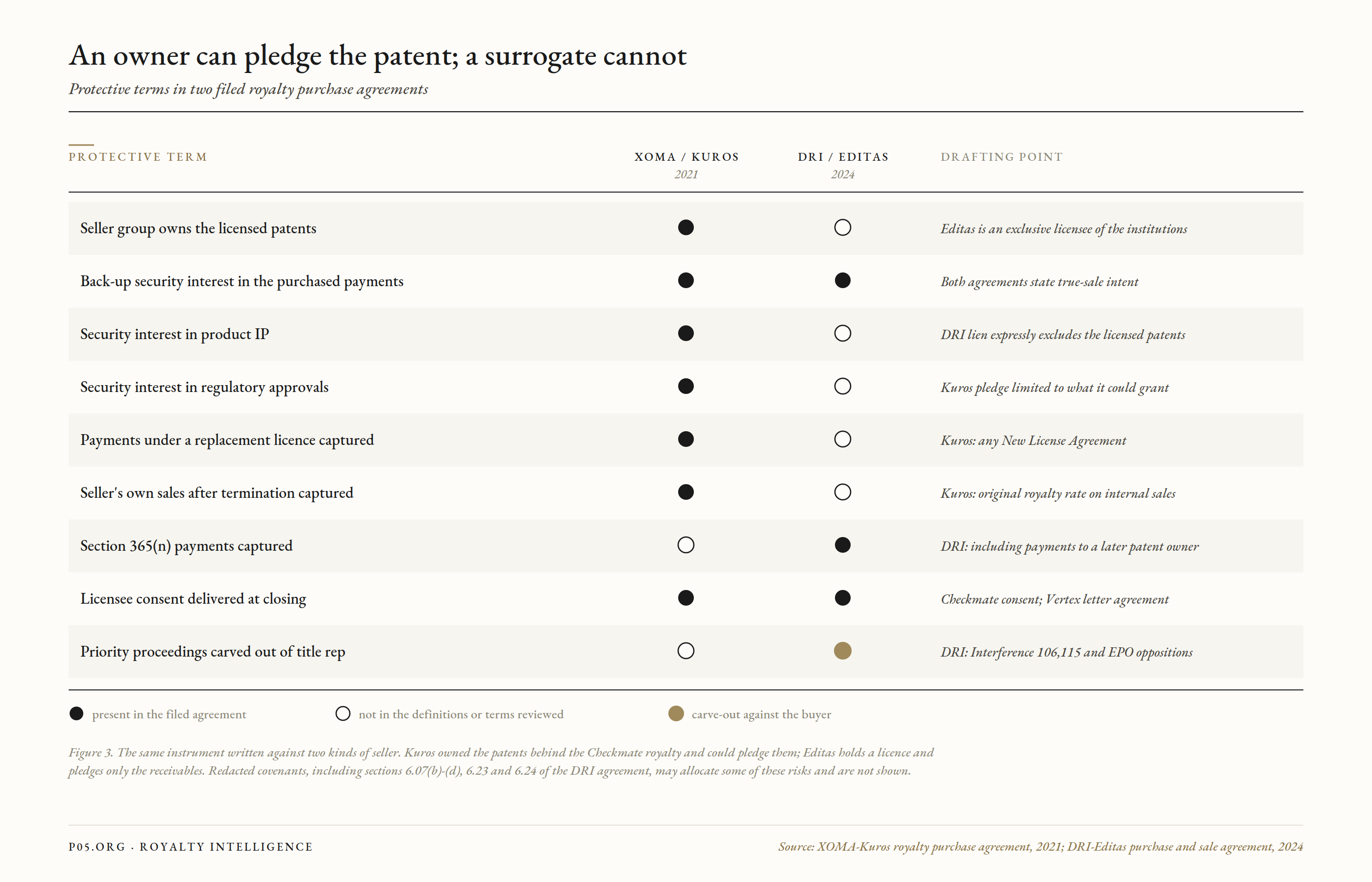
Figure 3. The same instrument written against two kinds of seller. Kuros's group owned the patents behind the Checkmate royalty and pledged them; Editas holds a licence and pledges only the receivables. Redacted covenants in sections 6.07(b) to (d), 6.23 and 6.24 of the DRI agreement are not shown.
5. The interference under the upstream licence
A PTAB panel found in 2017 that Broad's issued claims and CVC's application did not interfere in fact, and the Federal Circuit affirmed in September 2018. A second interference, No. 106,115, was limited to a single-guide RNA CRISPR-Cas9 system that edits DNA in eukaryotic cells.
| Date | Event |
|---|---|
| 26 March 2026 | PTAB, on remand, again awards priority to Broad in a 51-page decision (Paper 2915), preserving Broad's 13 issued patents and one application against UC's 14 applications |
| 12 May 2025 | Federal Circuit, in Nos. 22-1594 and 22-1653, affirms the PTAB's framework but vacates and remands on conception, holding that the Board conflated conception with reduction to practice |
| 3 October 2024 | DRI agreement closes with the interference and the EPO oppositions carved out of the title representation |
| August 2024 | An EPO technical board of appeal holds that CVC's original filing did not adequately disclose how to use the invention, weakening CVC's European patents |
| 12 December 2023 | Vertex licenses the Broad estate through Editas |
| 28 February 2022 | PTAB rules on the merits for Broad |
| September 2020 | PTAB makes Broad senior party and denies CVC the benefit of its two earliest provisional applications |
The remand decision applied the corrected test, whether CVC's inventors held a definite and permanent idea of the complete and operative invention, and found that adapting CRISPR-Cas9 to eukaryotic cells was not routine for the art at the time. Morrison Foerster's note on the decision observes that Sigma-Aldrich and ToolGen, which also claim early CRISPR rights, can now renew their own challenges to Broad. The decision favours the upstream licensor behind the Editas receivables and is, for CRISPR Therapeutics, the second adverse PTAB merits ruling on the co-owned estate it licenses from Charpentier.
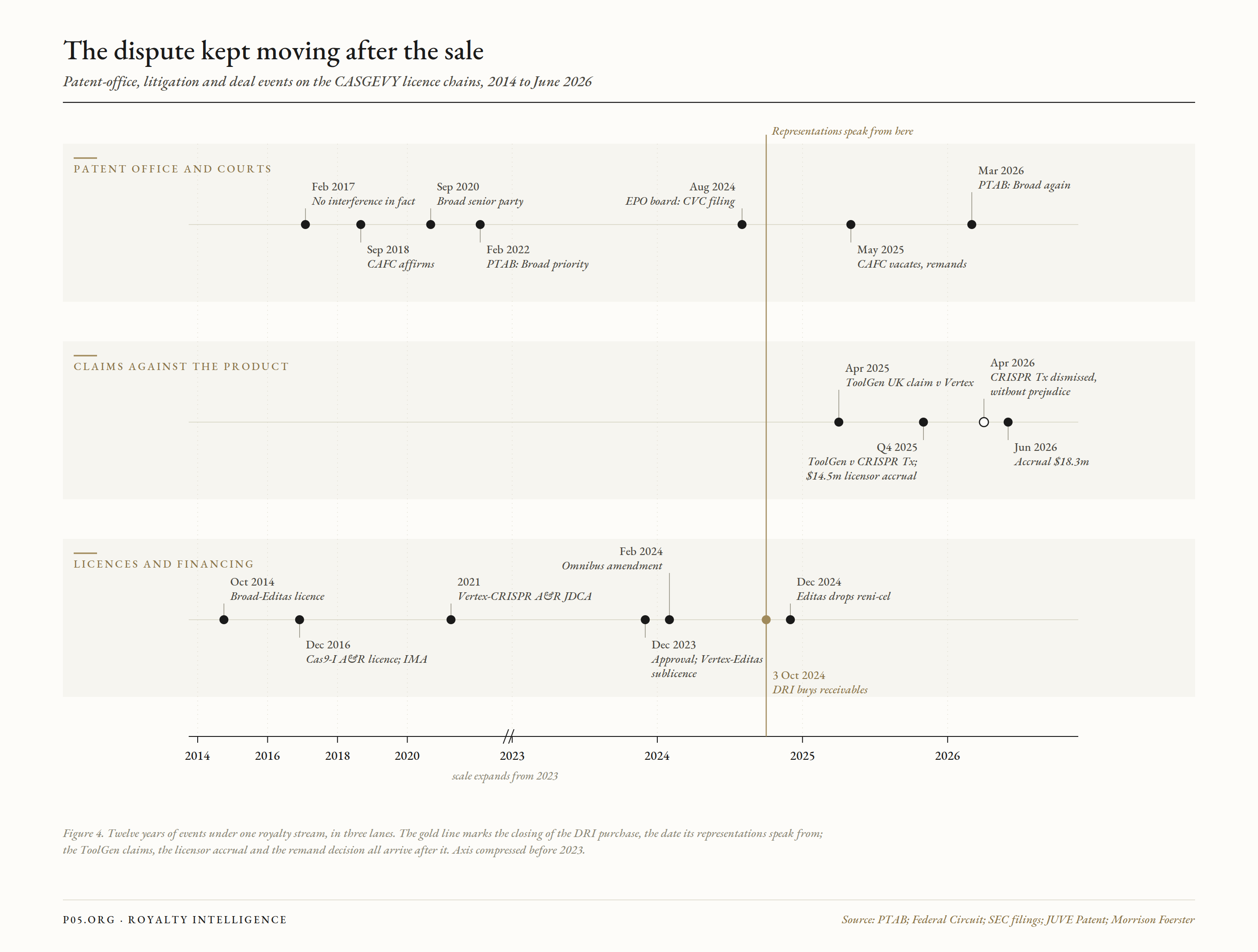
Figure 4. Patent-office, litigation and deal events in three lanes, 2014 to June 2026. The gold line marks the closing of the DRI purchase, the date its representations speak from; the ToolGen claims, the licensor accrual and the remand decision all fall after it. Axis compressed before 2023.
6. ToolGen, outside both chains
ToolGen issued a claim in the UK High Court in April 2025 (HP-2025-000013) against Vertex and its manufacturing partners, alleging CASGEVY infringes European patent EP 4 357 457 and seeking an injunction. Its chief executive said the aim was an appropriate licence.
Vertex is opposing the patent at the EPO through Carpmaels & Ransford, and by September 2025 proceedings were also running in the Netherlands.
In the fourth quarter of 2025 ToolGen sued CRISPR Therapeutics and other parties over CASGEVY in a further action, and CRISPR Therapeutics was dismissed without prejudice in April 2026.
Editas's section 4.11(f) representation, that it had no notice or knowledge of any claim that a Licensed Product infringes third-party rights, speaks as of closing on 3 October 2024. The UK claim was issued six months later. A licence or damages Vertex pays ToolGen would fall on CASGEVY's profit, and so on CRISPR Therapeutics' 40 per cent share and on the profit out of which Vertex recovers the $221.8 million deferral.
It reaches the Editas fees only if the sublicence's Net Sales definition, which the DRI agreement incorporates by reference, allows such a payment to be deducted before the sales-based fee tiers are measured.
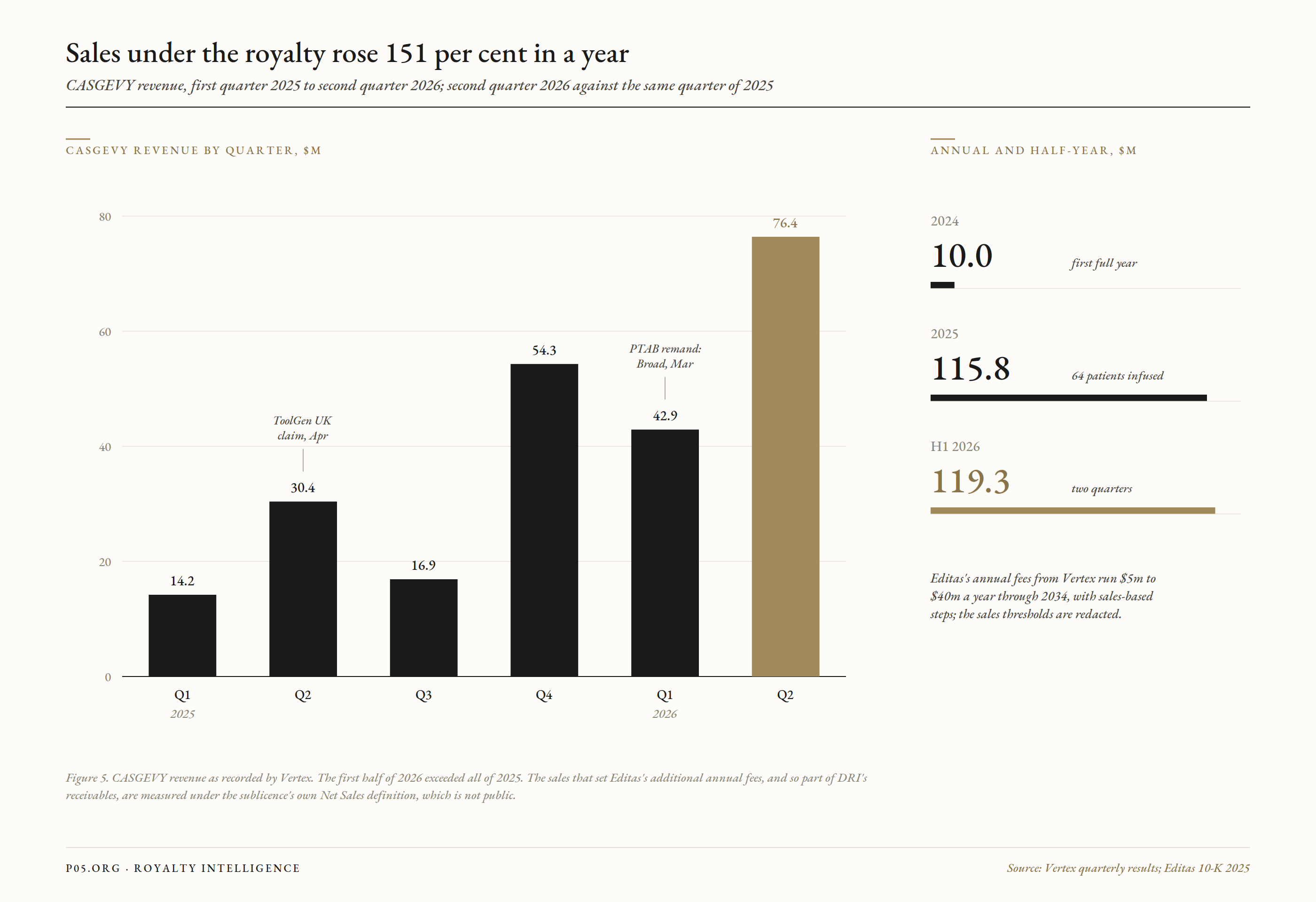
Figure 5. CASGEVY revenue as recorded by Vertex, $14.2m in the first quarter of 2025 to $76.4m in the second quarter of 2026. The first half of 2026, at $119.3m, exceeded all of 2025.
7. A licensor claim inside the CVC chain
CRISPR Therapeutics disclosed in its second-quarter 2026 10-Q that during 2025 a third-party licensor formally raised matters under its intellectual property contracts with the company, which could lead to further amounts being owed.
The company judged a loss probable at 31 December 2025 and recorded $13.0 million of research and development expense in the fourth quarter, taking the liability to $14.5 million. A reassessment at 30 June 2026 added $3.8 million, for $18.3 million, held mainly in other current liabilities. The company gives no range of loss and says the final amount could exceed the accrual.
The filing names no licensor, contract, patent or proceeding. CRISPR Therapeutics' disclosed CRISPR-Cas9 in-licensing comes from Charpentier, with the UC Regents and the University of Vienna party to the Invention Management Agreement as co-owners of the estate, and from the unnamed licensors in its generic royalty disclosure.
The Broad chain has a disclosure route for a comparable claim. Section 6.03 of the DRI agreement requires Editas to pass DRI any correspondence from the institutions relating to the Purchased Receivables within a redacted period, and section 6.09(f) lets the institutions disclose Editas's royalty reports and notices to DRI directly.
What moves the position on a surrogate-licensed royalty, and what only appears to
Terms that move it:
- The defined patent proceedings carved out of the title representation, and the covenant, termination fee or indemnity, if any, that allocates the loss when those proceedings go against the upstream owners.
- Termination or conversion by field or category in the upstream licence, such as the Non-Achieved Category mechanism in the Cas9-I licence, read against programmes the seller drops after closing.
- Ownership of the patents by the seller. Kuros could pledge its product IP and regulatory approvals to XOMA; Editas holds only a licence, and DRI's back-up security interest stops at the receivables.
- A receivables definition that reaches a replacement licensee, the seller's own sales after termination, and section 365(n) payments to a later owner of the patents. The DRI definition covers the last of these and ties the rest to Vertex, subject to the redacted parts of section 6.07.
- The date the representations speak from, measured against the filing dates of claims from parties outside both chains.
- Contingent liabilities accrued at a co-owner or development partner for licensor claims that have not reached any court.
Terms that only appear to:
- An upstream share disclosed as mid-double-digit, which gives the order of magnitude without the rate, any step-down or the base it applies to.
- Exclusivity in a licence whose priority has gone through two interferences and a federal appeal and remains open to challenge by third parties.
- A dismissal without prejudice, which removes one defendant and leaves the claim against the product in place.
- True-sale language in an agreement the seller books as debt under ASC 470.
What each side should ask
For the fund buying the receivables
- Which patent proceedings are excluded from the title representation, and which covenant, termination fee or indemnity responds if they are lost?
- Can the institutions terminate or convert rights by field or category under the upstream licence, and which of the seller's programmes in the licensed field are still running?
- Do the purchased receivables reach a replacement licensee, internal sales after termination and section 365(n) payments to a later patent owner?
- Is any licensor or co-owner in either chain carrying a claim, accrued or disclosed, against a party to the product?
- What does the Net Sales definition in the sublicence allow the licensee to deduct before sales-based fees are measured, including royalties paid to a third-party claimant?
For the surrogate selling the stream
- Does the price reflect the carve-out from the title representation, or was the carve-out conceded without a price?
- Which of your own programmes fall inside the buyer's definition of a competing product, and what does continuing or dropping them do to your diligence position upstream?
For the institution granting the surrogate licence
- Would an unaffiliated licensee have accepted the same field, royalty and diligence terms?
- Who controls prosecution, defence and abandonment decisions once the surrogate has sold its receivables, and does the buyer acquire any consultation right?
CASGEVY recorded $116 million of revenue in 2025 from 64 infused patients and $43 million in the first quarter of 2026. DRI paid $57.0 million for fees drawn from those sales through Editas, whose title representation excludes an interference its upstream licensor has now won twice at the PTAB, and whose own licence the institutions can terminate or convert by category.
On the other chain, CRISPR Therapeutics carries $221.8 million of deferred programme costs recoverable by Vertex out of CASGEVY profit and an $18.3 million accrual for a licensor it has not named. ToolGen's claims against the product sit outside both chains and were filed after the representations DRI received.
All information in this article was accurate as of the research date and is derived from publicly available sources including SEC filings, issuer press releases, court and patent-office decisions, and legal and financial commentary. Information may have changed since publication. This content is for informational purposes only and does not constitute investment, legal, accounting, tax, or financial advice. The author is not a lawyer, accountant, tax adviser, or financial adviser.