
The Rate Is the Strike: Staged Royalties on Unapproved Platforms

On 24 September 2026 Ligand committed up to $41 million to AvenCell Therapeutics, a private allogeneic CAR-T developer, in exchange for a royalty on worldwide net sales of every current and future AvenCell product. The rate sits somewhere between mid-single digits and low double digits, "with the applicable rate determined based on the total amount ultimately funded."
The money comes in four tranches, the first at closing and the other three on "certain predetermined clinical milestones and other specified financing conditions." A further $6 million goes into AvenCell's Series C, on terms not yet announced. Hogan Lovells Cadwalader acted for Ligand.
AvenCell's lead asset, AVC-201, is an anti-CD123 switchable CAR-T in a Phase 1b expansion for relapsed or refractory AML. AVC-203, a CD19/CD20 programme for B-cell malignancies, is in Phase 1a. No AvenCell product has been partnered or filed for approval.
The agreement is a synthetic royalty with an unusually early entry point. Its terms can also be read as a strip of call options on a platform, priced in royalty points and struck against clinical data and a third-party equity close. Read that way, it connects to an older question: whether explicit calls on early drug assets have ever been written and whether anyone has been able to sell one.
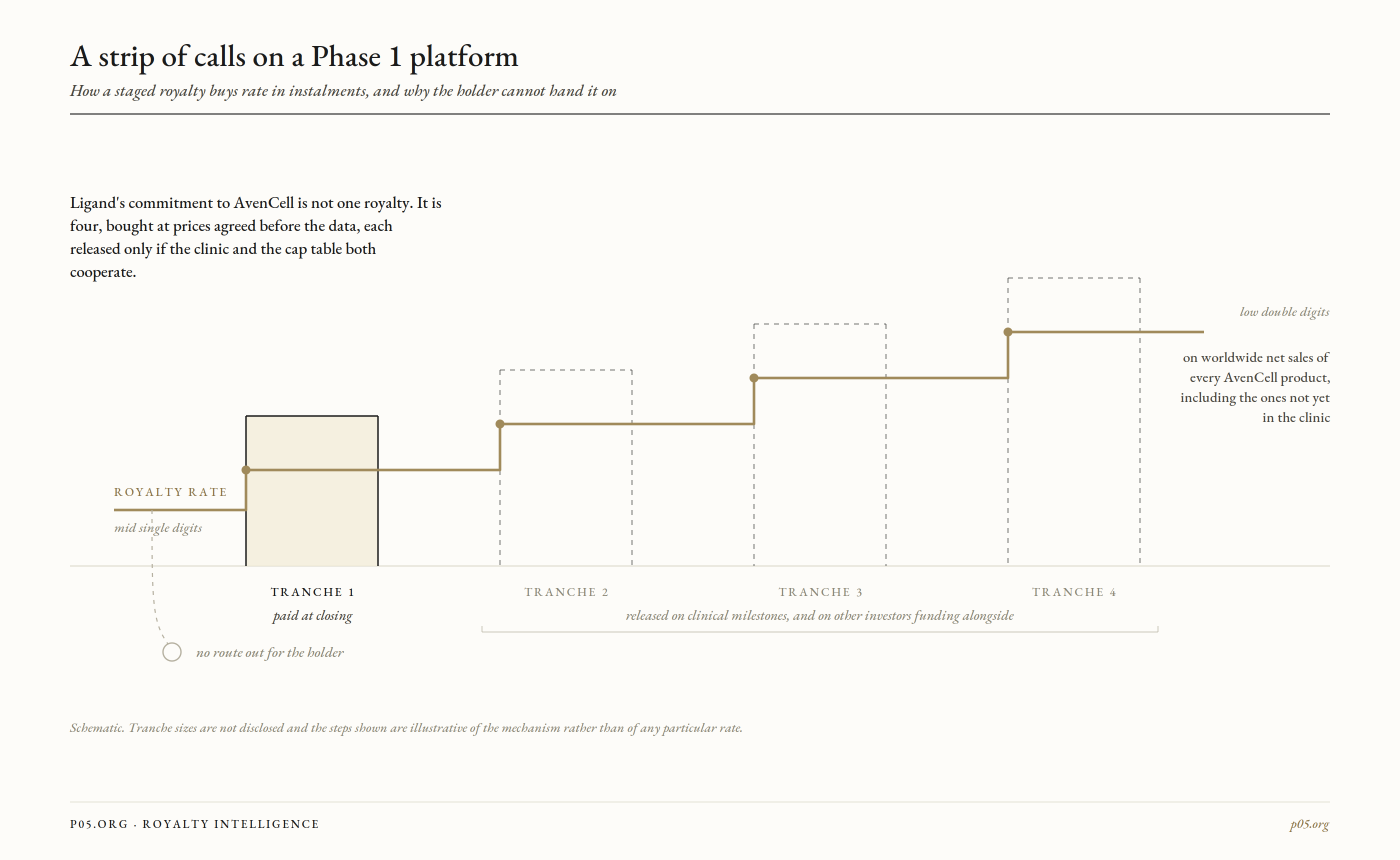
A staged royalty buys rate in instalments, at prices agreed before the data, and the holder has nowhere to pass it on.
The company behind the royalty
AvenCell was launched in June 2021 with $250 million from Blackstone Life Sciences as sole founding investor. Cellex contributed GEMoaB's switchable UniCAR and RevCAR platforms, and Intellia contributed its CRISPR allogeneic engineering in return for a one-third equity stake, with Blackstone and Cellex holding equal shares.
Andrew Schiermeier, previously Intellia's COO, has run the company since launch. In October 2024 AvenCell raised a $112 million Series B led by Novo Holdings, with F-Prime, Eight Roads Ventures Japan, Piper Heartland Healthcare Capital, NYBC Ventures and Blackstone participating.
The clinical case behind the royalty is small and recent. The completed Phase 1a portion of RevSTAR-123 was a late-breaking oral at EHA on 13 June 2026. In GlobalData's reading of the presentation, 17 heavily pretreated patients were dosed, ten of them after a prior allogeneic transplant.
Cytokine release syndrome occurred in 13, one case at grade 3. Neither ICANS nor graft-versus-host disease was reported, and there were no treatment-related deaths. Three of eight evaluable patients at the two highest dose levels reached CR or CRh, two of them MRD-negative.
CD123 has sunk earlier CAR-T programmes on toxicity, and the switch, which lets the treating physician turn CAR activity on and off through a separately dosed targeting module, is AvenCell's answer to that history. Eight evaluable patients at active doses is the dataset a $41 million royalty is being written against.
How rare this is in 2026
The disclosed royalty market in 2026 has continued to buy risk at Phase 2b or later, or on approved products, or with a large pharmaceutical company as counterparty. Among the 2026 transactions with public terms, the only other one that put pre-Phase 2b clinical risk on the funder at signing was Royalty Pharma's TEV-'408 agreement with Teva, and even there the counterparty is Teva and the committed money funds a defined Phase 2b trial.
| Date (2026) | Funder | Counterparty and asset | Stage at signing | Structure |
|---|---|---|---|---|
| 11 Jan | Royalty Pharma | Teva, TEV-'408 | Phase 1b vitiligo, Phase 2a celiac | $75M Phase 2b co-funding, $425M Phase 3 option |
| Feb | XOMA | Generation Bio | Wind-down platform | Whole-company purchase plus CVR |
| 30 Jun to 7 Jul | Oberland | MeiraGTx, three gene therapy programmes | Late-stage plus one Phase 2 | Up to $400M, later tranches at the company's option |
| 2026 | DRI Healthcare | AbbVie's tavapadon | Phase 3 complete, filing pending | $316M royalty purchase |
| 24 Sep | Ligand | AvenCell, all current and future products | Phase 1b and Phase 1a | Up to $41M in four tranches, up to $6M equity |
AvenCell is the only one on this list where a royalty buyer took a synthetic royalty from a private company whose most advanced asset is in Phase 1, and the only one whose royalty reaches products that do not yet exist. Ligand's own boilerplate in the AvenCell release still describes the company as partnering "to finance and advance late-stage clinical development programs."
Gibson Dunn's 2026 market report notes that clinical funding has split into large-pharma co-investment and development-stage biotech deals, with the second group typically milestone-heavy and capped. AvenCell belongs to the second group by counterparty and to neither by stage.
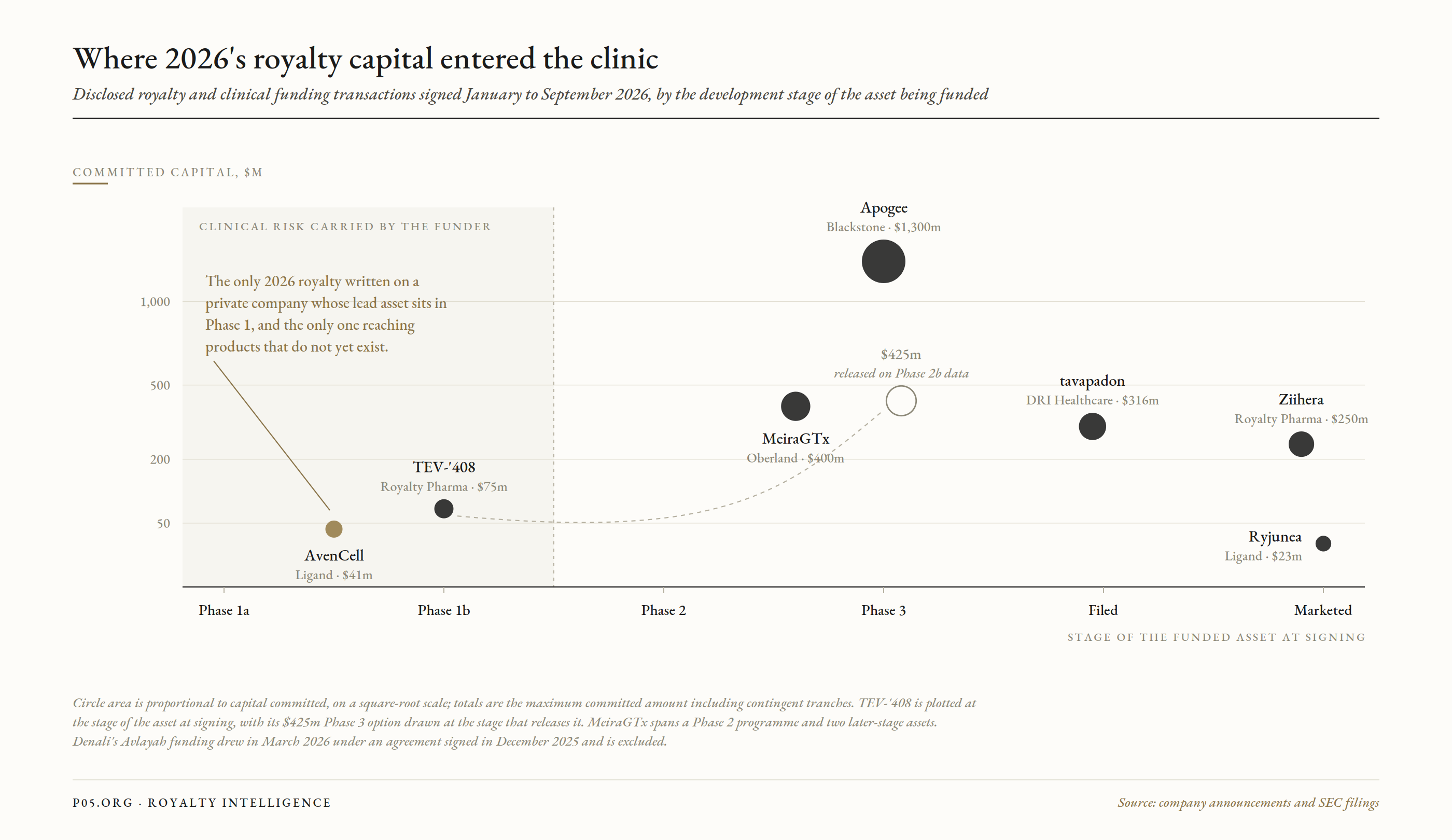
Only two 2026 transactions put pre-Phase 2b clinical risk on the funder at signing, and one of them has a large pharmaceutical counterparty.
Reading the structure as options
Take the terms one at a time and each has a different economic character. The first tranche, whose size is not disclosed, is a premium. It buys the minimum royalty rate, a seat in AvenCell's capital structure and, through the $6 million of Series C equity, presumably the information rights that come with being a shareholder.
Tranches two to four are conditional commitments. Each is released only when a clinical milestone has been met and a financing condition has been satisfied. The press release does not say what those financing conditions are.
The most natural reading is a requirement that other investors fund alongside, typically a Series C close of a minimum size. Conditions of that kind protect the funder: Ligand pays more only in the states of the world where the data has worked and new equity has arrived to carry the burn.
The rate schedule is where the option character is clearest. Because the royalty rate rises with cumulative funding, each tranche buys a further increment of royalty at a price agreed in September 2026. That is a set of contingent forwards on the royalty rate, knocked in by data. Nobody can value a Phase 1 CAR-T royalty with confidence, so the parties have agreed a price per point and left the number of points to the trial.
Covering "all current and future" products turns a binary on one molecule into a position on the switch itself. AvenCell's materials point to autoimmune indications for the platform. None of those programmes is in the clinic. Ligand now has a royalty on them if they get there.
One term decides who holds the optionality, and it is not public. The risk factors in Ligand's release refer to "the possibility that conditions to future funding are not satisfied or that optional investments are not made." Something in the package is discretionary. The release does not say whose discretion it is.
The difference matters because the same architecture has been written in 2026 with the option on opposite sides. In Royalty Pharma's TEV-'408 agreement the buyer holds the call: $75 million funds Phase 2b, and Royalty Pharma may commit a further $425 million to Phase 3 once it has seen the data. In Oberland's MeiraGTx facility the company holds it.
The later $50 million tranches, one of them triggered by positive Phase 2 AQUAx2 data, are drawn "at the Company's option," and MeiraGTx may buy back the entire funded royalty note at any time. A buyer-held call and a seller-held put on further financing can produce identical cash flows in the good case and very different ones in the middle case, where data is mixed and one side would like to walk away. Until Ligand files the agreement or discusses it at its Investor Day on 8 December 2026, AvenCell cannot be placed on that spectrum.
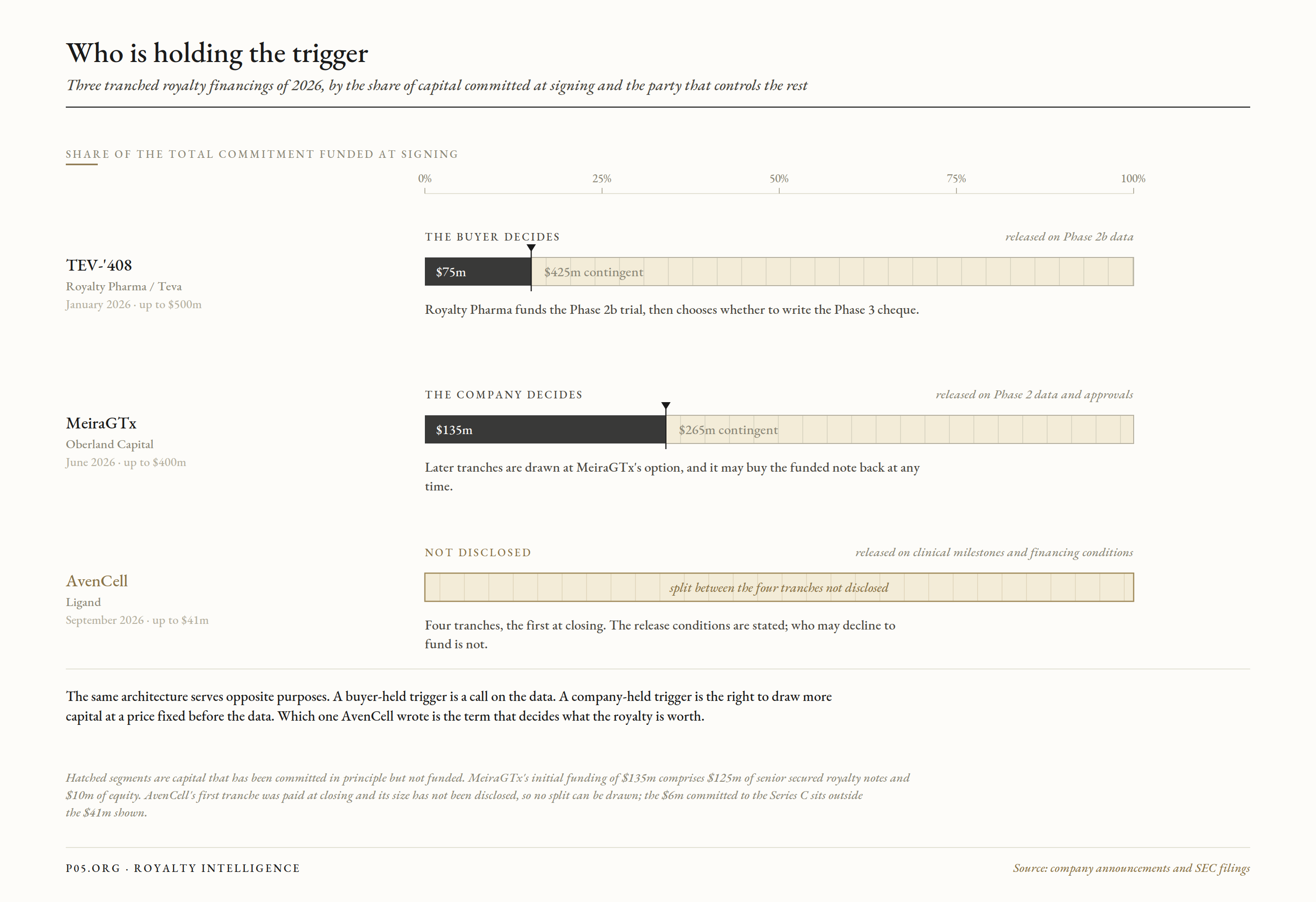
The same architecture serves opposite purposes, and AvenCell's release terms are stated while the party that controls them is not.
Explicit options on early assets: the record
Calls on early-stage drug assets with a stated premium and a stated strike do exist. Almost all of them were written by pharmaceutical companies buying the right to license or acquire, and a handful by royalty investors buying the right to fund.
| Signed | Holder / writer | Stage at signing | Premium | Strike | Outcome |
|---|---|---|---|---|---|
| Mar 2018 | Celgene / Prothena | Preclinical (three programmes) | $100M upfront plus about $50M equity | About $80M per programme for US rights at IND; $55M for global rights after Phase 1 | PRX005 US rights exercised for $80M in 2021 |
| May 2020 | Gilead / Arcus | Phase 1 to 2 | $175M upfront plus $200M equity | $200M to $275M per clinical programme | Three programmes exercised in 2021 |
| Jun 2020 | Gilead / Pionyr | Early clinical | $275M for 49.9% | $315M plus milestones | Waived in March 2023; Pionyr later sold to Ikena |
| Jul 2020 | Gilead / Tizona | Phase 1 about to start | $300M for 49.9% | Exercise fee plus milestones up to $1.25B | Not exercised |
| 2016, amended 2018 | Merck / Moderna, mRNA-4157 | Preclinical | Upfront in collaboration | $250M | Exercised October 2022, in Phase 2 |
| Oct 2022 | Royalty Pharma / Merck, MK-8189 | Phase 2b | $50M | $375M Phase 3 co-funding | Not exercised |
| May 2024 | Ligand / Agenus | Partnered clinical programmes plus BOT/BAL | $75M | Further $25M on the same terms | Exercise status not disclosed |
| Jan 2026 | Royalty Pharma / Teva, TEV-'408 | Phase 1b / 2a | $75M | $425M Phase 3 co-funding | Open |
The premium-to-strike ratios split cleanly by type of holder. Royalty Pharma's two calls cost 13 percent (MK-8189, $50 million against $375 million) and 18 percent (TEV-'408, $75 million against $425 million) of the strike.
Those premiums are not dead money if the option lapses, because the Phase 2b funding itself carries a milestone and royalty position on that trial. On MK-8189 the position was all Royalty Pharma kept: its Q1 2026 presentation records that "following the Phase 2b, Royalty Pharma will not be making any further investment."
Pharmaceutical premiums run far higher against the strike. Gilead paid $300 million for half of Tizona to hold a right whose exercise fee was a fraction of that. A pharma option reserves control of the asset and a place ahead of competitors. A royalty investor's option reserves the right to deploy more capital at a fixed price. The first is a strategic reservation and the second is a financed look at the data, and the pricing reflects the difference.
Measured against the table, AvenCell is closer to the royalty-investor pattern than to the pharmaceutical one. Ligand gets no control over AVC-201 and no right to acquire AvenCell. It gets a pre-priced right, or obligation, to buy more royalty after the data. The feature with no precedent in the table is the rate grid, which lets the size of the exercise vary continuously with the amount funded rather than as a single all-or-nothing strike.
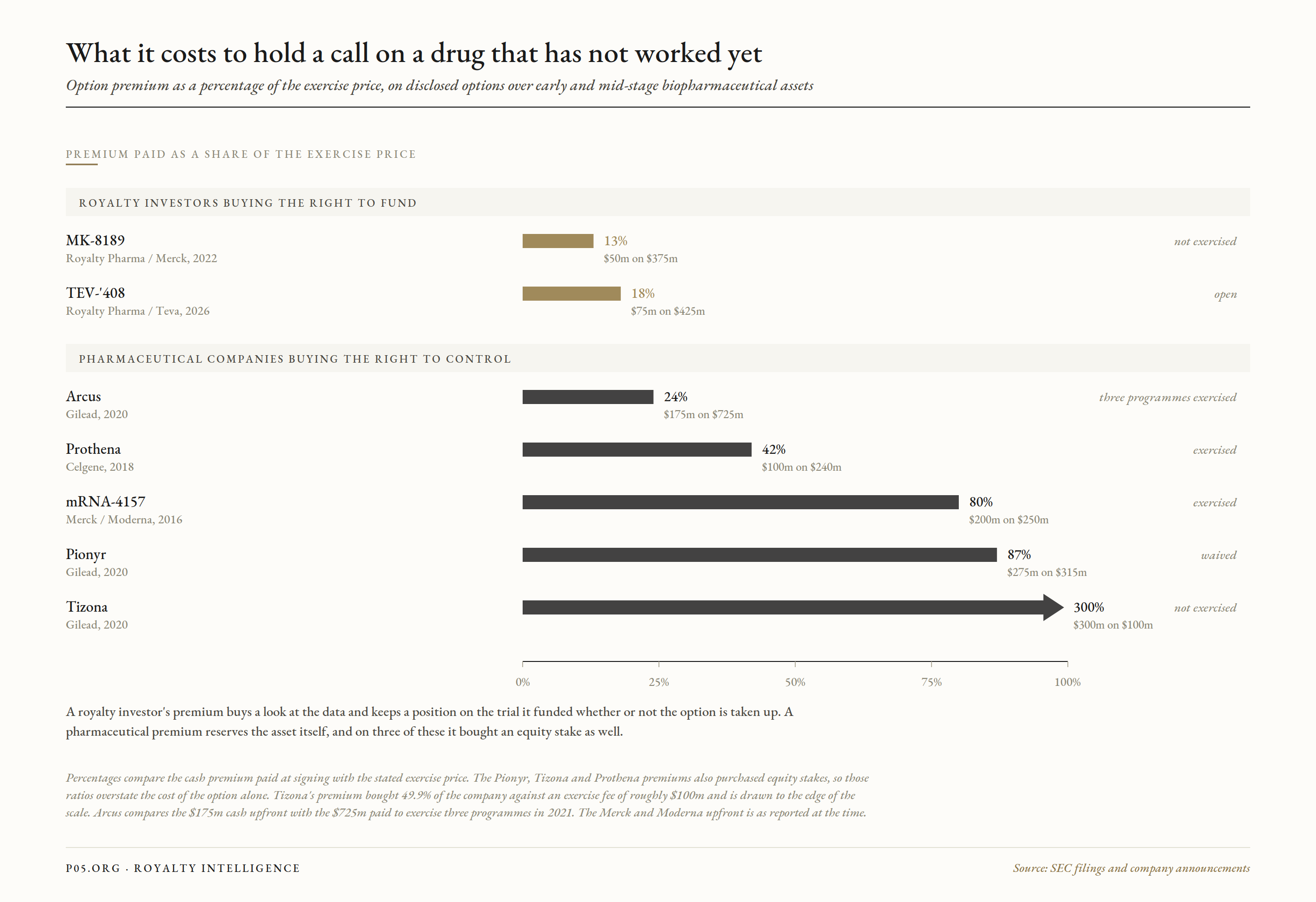
A royalty investor's premium buys a look at the data. A pharmaceutical premium reserves the asset.
Can options like these be traded?
In listed markets, an option is valuable partly because the holder can sell it before expiry. That requires a standard contract, an observable trigger, a counterparty able to perform, and a venue. Early-stage drug options have produced at most one of those at a time.
Contingent value rights, the one listed precedent
The only contingent instrument on drug outcomes to have traded at scale on a US exchange is the contingent value right. The largest was Bristol Myers Squibb's CVR from the Celgene acquisition, listed on the NYSE as BMY-RT. It paid $9 per right if ozanimod and liso-cel were approved by 31 December 2020 and ide-cel by 31 March 2021.
Liso-cel was approved on 5 February 2021, about five weeks late, and the CVR terminated automatically on 1 January 2021 and stopped trading. UMB Bank, as trustee, sued for $6.4 billion on the argument that the approval had been delayed to avoid the payment. The suit was dismissed on standing and then revived by a unanimous Second Circuit panel on 13 August 2026. The instrument traded for about fourteen months and has been in litigation for most of the time since.
Since that episode the market has moved the other way. Sidley Austin's survey of life sciences public M&A from January 2018 to April 2023 found that of 31 CVR deals, only one provided for transferable CVRs. The reasons given are the cost of SEC registration, listing and continued compliance, and the observation that "hedge funds and other market participants often become the holders of a significant percentage of registered CVRs and may even hedge their CVR exposure with the buyer's stock, resulting in unnatural trading activity in a buyer's stock."
Recent agreements permit transfers only on death, by court order, by operation of law, or to beneficial owners through nominees.
Volume has risen sharply while transferability has not returned. Sidley's September 2026 survey records 28 of 59 announced public life sciences transactions in 2025 carrying a CVR, the highest annual share on record, and 24 of 43 biopharma deals. Maximum potential payouts averaged 39 percent of upfront consideration in 2025 against a 34 percent average since 2021, and 2025 alone accounted for about 64 percent of all deals whose payout ratios exceeded 100 percent of the upfront.
Sales and regulatory milestones together account for 74 percent of milestone types, and about 75 percent of CVRs carry only one or two milestones. The CVR attached to Ligand's own acquisition of XOMA, on 75 percent of net proceeds from the Janssen litigation, is non-transferable.
The terms have also moved against the holder. Sidley finds that the objective efforts standard, generally read as favouring the payee, fell from about 48 percent of life sciences CVRs in 2021 to 2023 to about 38 percent in deals from 2024 through June 2026, while formulations disclaiming efforts obligations entirely rose from about 4 percent to about 16 percent.
A contingent claim on a drug outcome is worth what the counterparty is obliged to do to reach it, which is the question at issue in the Bristol Myers Squibb litigation. That obligation is being drafted looser as the instruments get larger.
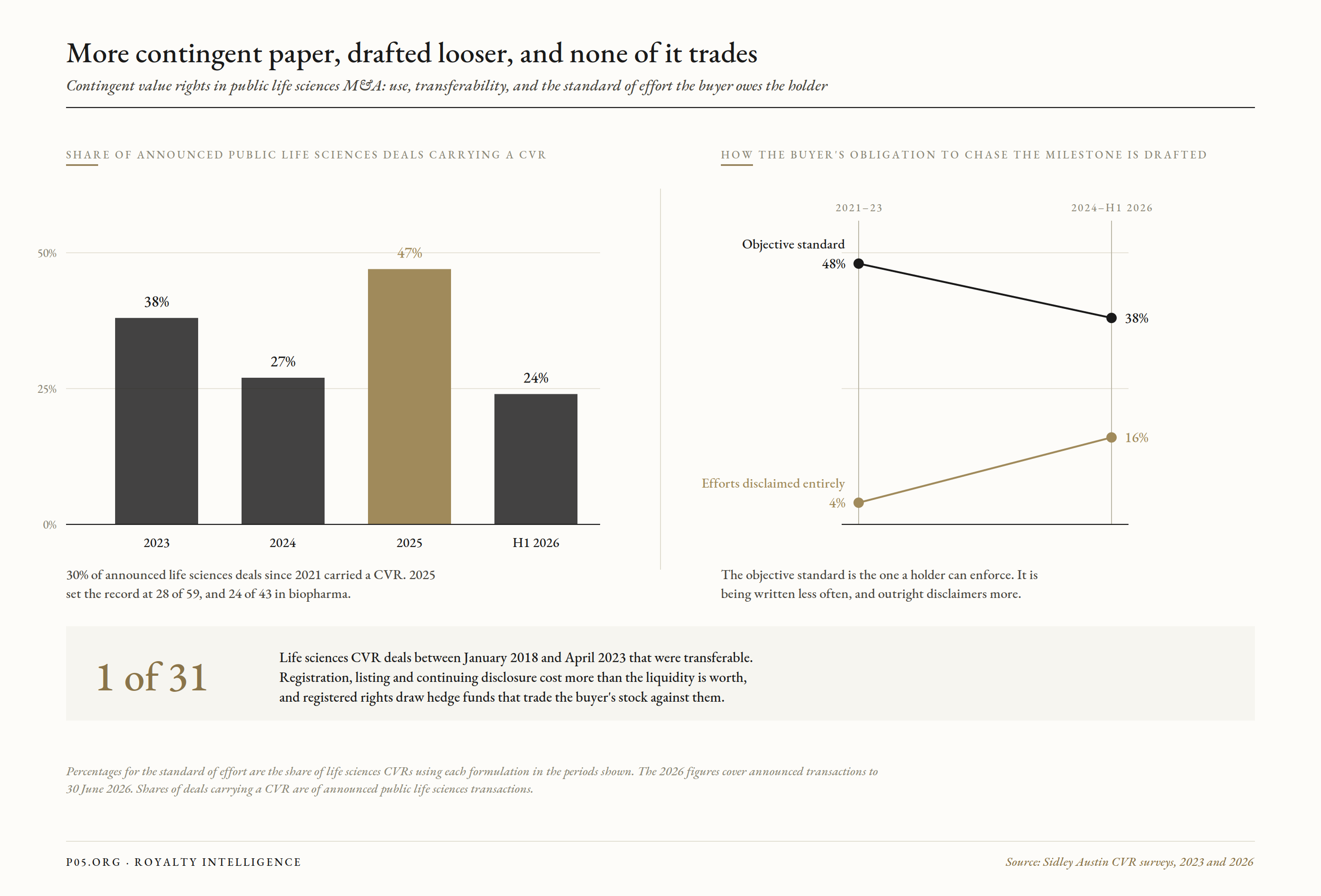
Contingent drug-outcome paper is being written more often and in larger size, with weaker performance obligations attached, and it does not change hands.
Prediction markets, which stop at Phase 3
The nearest thing to a listed binary option on a single trial arrived in July 2026. Kalshi, a CFTC-designated contract market, launched contracts on clinical trial outcomes and FDA decisions on 16 July, with AppliedXL as the settlement source. The pilot is limited to late-stage trials, and contracts list only after enrolment closes.
Early phases were excluded deliberately, on the grounds that exploratory endpoints and small investigator networks make insider trading harder to police. Position accountability is $25,000 per strike per member, and the list of barred traders runs from sponsor staff and FDA reviewers to CRO personnel, expert-network consultants and their households.
For a royalty holder, a $25,000 position cannot hedge a $41 million commitment. The contracts also do not exist for Phase 1, and the reasons given for excluding it (subjective endpoints, active enrolment, a small number of people who know the data) describe AvenCell's trial closely. The one listed venue for single-trial binaries has been built to exclude early phases.
The academic designs that were never built
The idea of trading R&D outcome risk has a literature. Fernandez, Stein and Lo proposed research-backed obligations in 2012, tranched debt issued against a large pool of development-stage assets. Jørring, Lo, Philipson, Singh and Thakor proposed FDA hedges in 2017: binary options paying on approval outcomes, sold by developers and bought by investors, justified by the low correlation of approval risk with the market and across drug classes. Neither has produced a traded instrument.
The low correlation that makes FDA risk attractive to hold is the same property that leaves no natural hedger on the other side, apart from the developer who already owns the risk.
Why the private options cannot move
Pharmaceutical options sit inside collaboration or licence agreements, and exercising one creates obligations: diligence covenants, development plans, milestone and royalty payments, sometimes co-commercialisation. An option to license AVC-201 is worth something only to a company that can develop AVC-201. A financial buyer cannot step into it, and the grantor has every reason to withhold consent to a transfer that would hand its asset to an unknown party.
Royalty-investor options carry a milder version of the same problem. Exercising TEV-'408's option means writing $425 million of Phase 3 funding cheques to Teva over several years. Teva agreed to that obligation from Royalty Pharma, with its balance sheet behind it, and the public terms say nothing about assignment. Whatever the paper says, a holder whose value depends on the counterparty's continued cooperation cannot sell it without that cooperation.
AvenCell's tranches combine both frictions. The later tranches depend on financing conditions tied to AvenCell's other investors, the Series C equity carries information rights that a third party would need to value the remaining tranches, and any transfer would presumably require AvenCell's consent.
On the evidence, an early-stage option has every transfer problem a royalty interest has, plus a funding obligation that follows whoever holds it and no cash yield to value it against.
How the royalty world distributes early risk instead
The workaround is to syndicate at origination rather than sell later. Ligand's 2024 purchase agreement with Agenus permitted additional sales of the purchased assets to third parties on substantially similar terms on a pro rata basis, up to $200 million. In the February 2025 Castle Creek financing Ligand wrote $50 million and co-investors wrote $25 million on the same instrument. In both cases the distribution happens once, on day one, on identical paper, between parties who each did their own diligence. The secondary market that listed options depend on is replaced by a primary syndicate.
Listed equity options on small-cap biotechs are the other place the market prices early drug assets, and those do trade around binary readouts. They price the whole company, including its cash and cost base, and they exist only for listed companies. AvenCell is private, so for this asset there is no traded proxy at all.
A tradeable early-stage option would need a cash-settled payoff so that exercise creates no development or funding obligation, a trigger defined by reference to a third-party settlement source, a registered or Rule 144A form, and a disclosure package that does not depend on board observer rights. Each of those exists somewhere in the market. No one has yet combined them on a pre-Phase 2 asset, and the regulatory choices made in 2026, Kalshi's exclusion of early phases and the universal move to non-transferable CVRs, run the other way.
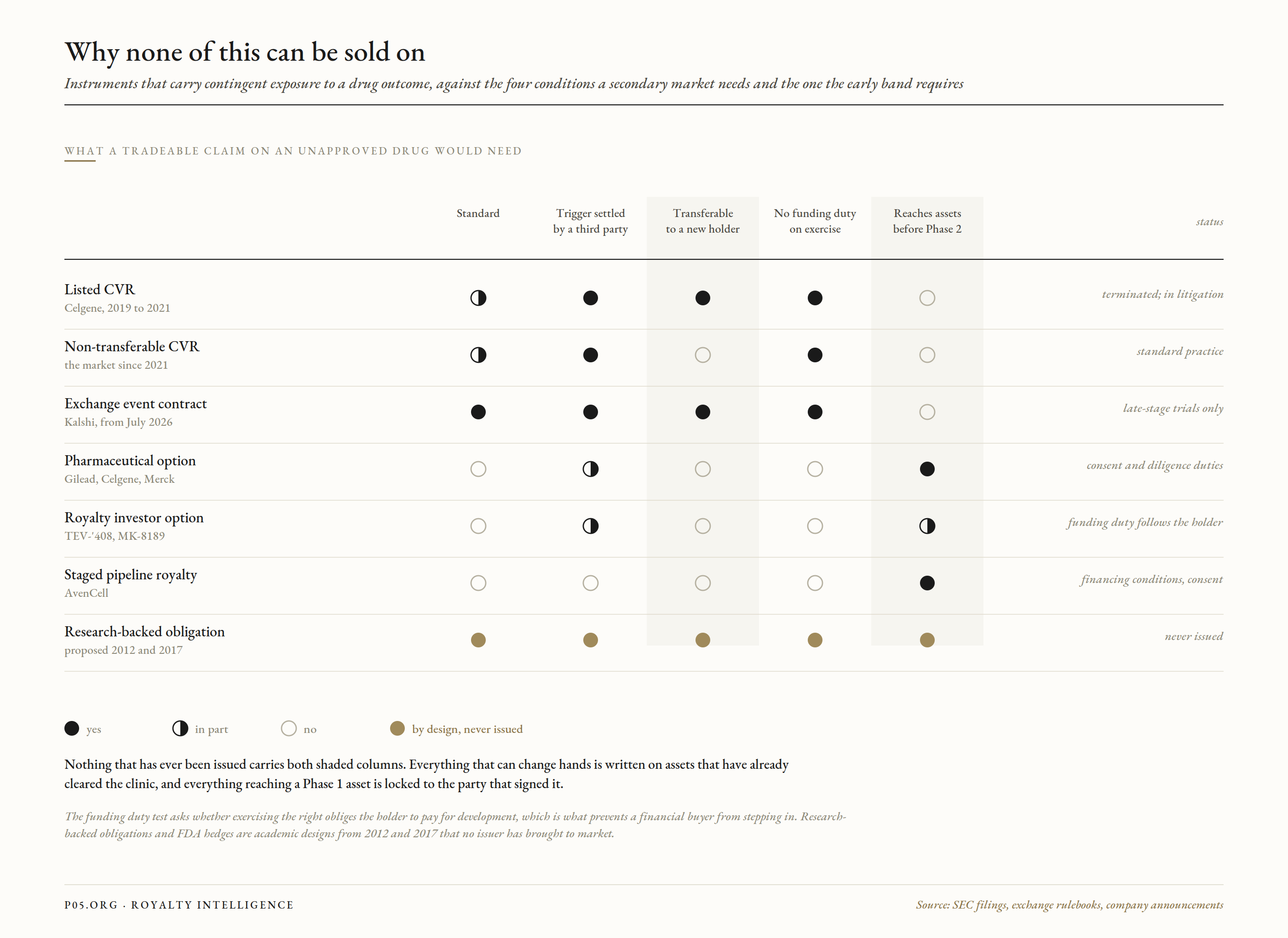
Everything that can change hands is written on assets that have already cleared the clinic.
What is the play
On Ligand's side, the post-XOMA portfolio holds more than 200 assets, and Ligand reported $779.4 million of cash and investments at 31 March 2026 before paying for XOMA. A $41 million position whose larger tranches are deployed only after positive data is small against that base.
The entry point also differs from a venture investor's. AvenCell's equity holders price a company that carries all of its burn. Ligand prices a revenue interest that, on success, is paid ahead of equity and ignores the company's cost base. If the Series C is priced cautiously, as sentiment on allogeneic cell therapy suggests it will be, the royalty buyer enters on better terms than the equity buyer for the same outcome.
The relationship with Blackstone adds a further angle. Blackstone founded AvenCell and is, on Gibson Dunn's count, the leading clinical funding partner in the royalty market. It did not take this royalty itself. One reading is that an insider-written royalty would raise a conflict inside its own fund. Another is that an outside royalty gives Blackstone's equity a third-party mark. Neither has been stated.
On AvenCell's side, the royalty extends runway through the Phase 1b expansion and AVC-203's Phase 1a without pricing a larger equity round at a depressed valuation. Because the tranches are funded on success, AvenCell sells only a small amount of rate if the data disappoints and can draw more capital at a pre-agreed price if it does not.
The cost is permanence. A royalty of up to low double digits on everything the company ever sells will be inherited by any licensee or acquirer and priced into every negotiation. MeiraGTx secured a buyback right exercisable at any time and a change-of-control payment that varies with timing and the identity of the acquirer. Whether AvenCell has anything equivalent is the most important undisclosed term for its future partners.
Set against a pharmaceutical option on the same asset, the trade-off is control against cost. A Gilead-style option would pay a premium in the hundreds of millions and reserve AVC-201 for the pharma partner at a fixed strike.
The royalty leaves control of AVC-201 with AvenCell and its equity holders, who remain free to partner or sell later, and takes a slice of revenue on every product in exchange. For a platform company whose value sits in targets it has not yet chosen, a royalty costs more in the tail and constrains strategy less.
What these deals need
The AvenCell terms, read against the 2026 precedents, point to the conditions an early-stage royalty needs to be financeable.
- Gating on data and on financing together. Clinical milestones address asset risk. Financing conditions stop the royalty buyer becoming the last source of money for a company whose other investors have left. MeiraGTx gates on data and approval only, with the company choosing when to draw.
- A rate that scales with capital. A pre-agreed price per royalty point replaces a valuation negotiation that neither side can win at Phase 1.
- Scope wide enough to carry the binary. Covering the platform and its future products gives the buyer something to hold if the lead programme fails. The cost falls on the seller's future partners.
- Equity alongside the royalty. Oberland took $10 million of MeiraGTx equity and a right to buy $15 million more; Ligand is taking up to $6 million of AvenCell's Series C. The equity buys information flow for the tranche decisions.
- Change-of-control and buy-down mechanics agreed at signing. Gibson Dunn describes early buyback options as becoming a key deal point. On a pipeline-wide royalty they decide whether the company remains saleable.
- A funder that can lose the first tranche without consequence to its own balance sheet.
- Security suited to pre-revenue IP. Oberland used senior secured royalty notes. Gibson Dunn found that 71 percent of 2024 to 2025 synthetic royalties by count were true sales, but those were overwhelmingly on marketed or near-approval products. For an unpartnered Phase 1 platform a secured note is the more natural form. Ligand's choice for AvenCell has not been disclosed.
Who writes this risk after XOMA
XOMA's model bought the milestone and royalty economics of early assets already licensed to someone else, whose licensee paid for the trials. Its October 2024 Twist deal paid $15 million for half of the economics on more than 60 partnered programmes. AvenCell is a different risk: a synthetic royalty on unpartnered assets whose trials the seller funds itself. The listed specialist for the first kind of deal is gone, and it never did much of the second kind.
Ligand has absorbed XOMA's development book, but not much of its team. Todd Davis said at announcement that Ligand would "probably bring a couple to a few employees over," and described the available royalty capital as over $12 billion, the "very significant majority" of it focused on commercial-stage deals. No vehicle launched by XOMA alumni has been announced as of September 2026.
| Funder | Evidence of early-stage appetite | Gating device |
|---|---|---|
| Ligand | AvenCell; XOMA's development portfolio; Agenus top-up option | Milestone and financing gates, capital-scaled rate, paired equity |
| Royalty Pharma | MK-8189 and TEV-'408, both with large pharmaceutical sponsors | Buyer-held option after Phase 2b data |
| Blackstone Life Sciences | Founded AvenCell; corporate partnerships and pre-commercial royalties | Company creation and approval-gated milestones |
| Oberland | MeiraGTx Phase 2 tranche inside a late-stage package | Company-held tranches, capped secured notes |
| Pharmaceutical companies | Gilead, Celgene/BMS, Merck precedents | Option to license or acquire |
DRI, HealthCare Royalty, Sagard and the other institutional buyers continue to state commercial or near-commercial mandates. The AvenCell structure also depends on a party the table does not show: the equity syndicate. The financing conditions in tranches two to four almost certainly point to AvenCell's venture investors. Without Novo Holdings, F-Prime and the Series C lead continuing to fund the company, the royalty does not draw.
What to watch
Almost every term that would let an outsider value the AvenCell royalty is undisclosed: the size of the first tranche, the rate at each funding level, the milestone definitions, the financing conditions, whose discretion governs the "optional investments", any buy-down or change-of-control terms, and whether the royalty is a true sale or a secured note. AvenCell's Series C lead, size and valuation are also unannounced.
Ligand's third-quarter results and its Investor Day on 8 December 2026 are the next opportunities for disclosure. The question they would answer is whether AvenCell is a single position taken because the EHA data and Series C timing lined up, or the first entry in a line of business that replaces the part of XOMA's model Ligand chose not to keep.
A second platform-wide Phase 1 royalty from Ligand within the next twelve months would indicate a standing buyer for the structure. Without one, early-stage exposure in the royalty market returns to Royalty Pharma's Phase 2b options and pharmaceutical option-to-license deals.
All information in this article was accurate as of the research date and is derived from publicly available sources including SEC filings, court and regulatory materials, company press releases, law-firm market reports, academic literature, and financial news reporting. Clinical figures for AVC-201 are taken from published analyst commentary on the EHA 2026 presentation. Information may have changed since publication. This content is for informational purposes only and does not constitute investment, legal, or financial advice. The author is not a lawyer or financial adviser.