The tranche not taken: what a royalty option is worth after approval

On 10 October Revolution Medicines let a deadline pass. Under its revenue participation agreement with Royalty Pharma, the company had until that day to demand up to $250M in exchange for a further share of the sales of RASONQUE, its pancreatic cancer drug. It sent no notice.
Two days earlier a Royalty Pharma affiliate had lent it $250M under a separate loan agreement, and the company had paid a $5.0M fee for the money. Revolution Medicines reported both events in one current report filed on 13 October.
The company did not choose the loan over the royalty. The loan agreement required it to draw the first $250M within 45 days of approval and charged it for walking away as if the money had been lent. The royalty tranche could be declined, and nothing was owed when it lapsed.
Read together, the two contracts show how a royalty buyer prices an option it does not charge for. Royalty Pharma wrote the company a series of rights to sell more royalty at fixed rates, collected no fee for them, and tied them to a loan that had to be drawn on the day the largest of those rights fell due. The other royalty and loan facilities signed since 2020 and read for this piece follow the same design.
Undrawn royalty tranches carry no commitment fee in any of them. Funders protect the capital they set aside with forced first draws and termination charges, and only some lenders charge for undrawn loan commitments.
Two contracts signed on one day
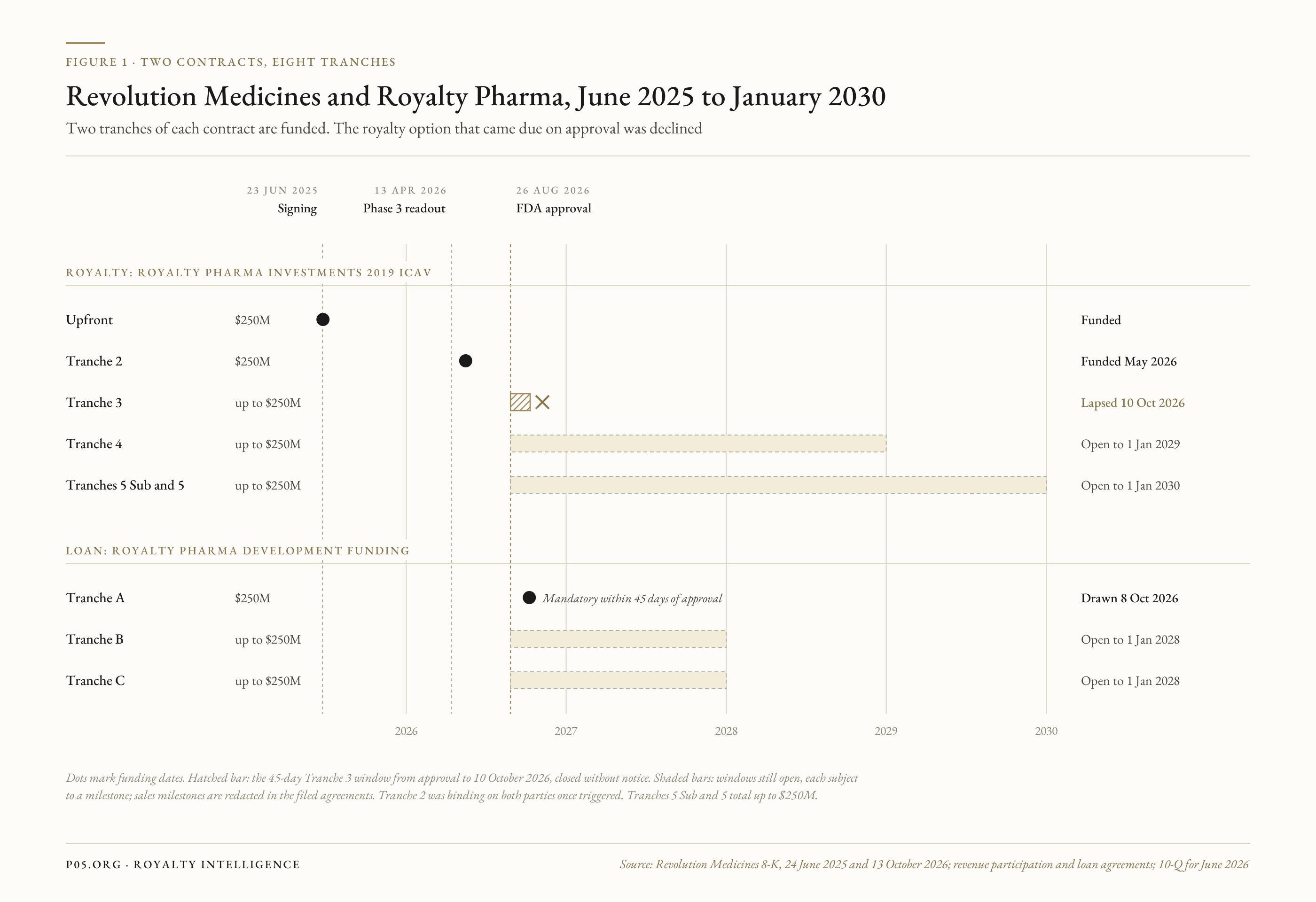
Revolution Medicines signed both agreements on 23 June 2025, for up to $2B in all. The royalty side, with Royalty Pharma Investments 2019 ICAV, runs to $1.25B in five tranches on worldwide net sales of daraxonrasib, now sold as RASONQUE, and of zoldonrasib if it is approved in an overlapping indication. The loan side, with Royalty Pharma Development Funding, LLC as lender and Wilmington Trust as agent, runs to $750M in three tranches of up to $250M each.
The upfront $250M was paid at signing. The second tranche, also $250M, was binding on both parties once the Phase 3 trial in previously treated pancreatic cancer succeeded and the company decided to file. That trial read out on 13 April 2026 with a median overall survival of 13.2 months against 6.7 months on chemotherapy, and Royalty Pharma paid the second $250M in May.
The company could have cancelled that tranche only if it had signed a sale of itself before the trigger. Merck had ended takeover talks in late January, after a valuation of about $30B had been discussed.
Every later royalty tranche is at the company's election. Section 3.7(b) of the agreement gave it 45 days from approval in second-line pancreatic cancer to require Royalty Pharma to pay up to $250M, in steps of $50M, for the Tranche 3 share. Tranche 4, of up to $250M, opens on a sales milestone reached before 1 January 2029. Tranche 5 and a smaller Tranche 5 Sub, of up to $250M between them, depend on a first-line Phase 3 trial reading out before 1 January 2030.
| Tranche | Amount | Trigger and deadline | Who decides | Status at 18 October 2026 |
|---|---|---|---|---|
| Royalty, upfront | $250M | Signing, 23 June 2025 | Neither party | Funded |
| Royalty, Tranche 2 | $250M | Phase 3 success and filing decision before 1 January 2028 | Binding on both | Funded May 2026 |
| Royalty, Tranche 3 | up to $250M | Approval in second-line pancreatic cancer before 1 July 2028, notice within 45 days | Company | Lapsed 10 October 2026 |
| Royalty, Tranche 4 | up to $250M | Sales milestone (redacted) before 1 January 2029 | Company | Open |
| Royalty, Tranches 5 Sub and 5 | up to $250M | First-line Phase 3 readout before 1 January 2030 | Company | Open |
| Loan, Tranche A | $250M | Approval in metastatic pancreatic cancer before 1 January 2028, draw within 45 days | Mandatory | Drawn 8 October 2026 |
| Loan, Tranches B and C | up to $250M each | Trailing four-quarter sales milestones (redacted) before 1 January 2028, 45-day windows | Company | Open |
Each royalty tranche adds a fixed set of rates on annual net sales in three bands. The two tranches already funded give Royalty Pharma 4.55 per cent of sales up to $2B, 2.50 per cent from $2B to $4B, 1.00 per cent from $4B to $8B, and nothing above $8B. Tranche 3 would have added 1.50, 0.80 and 0.40 per cent in the same bands, scaled down in proportion if the company had taken less than $250M. Payments on American sales run for 15 years from the first American sale.
Payments on sales elsewhere run for 15 years from the first sale in the European Union. The agreement has no cap and no buy-out price. It does allow higher rates in years from 2029 to 2040 that follow a year of low sales, but Exhibit E applies that adjustment only to the upfront and Tranche 2 rates.
A draw that could not be refused
The FDA approved RASONQUE on 26 August 2026 for previously treated metastatic pancreatic cancer, at a list price of $39,800 for 30 days. The same approval triggered two clocks of 45 days. One ran on the royalty option. The other ran on Tranche A of the loan, which section 2.2 of the loan agreement makes compulsory.
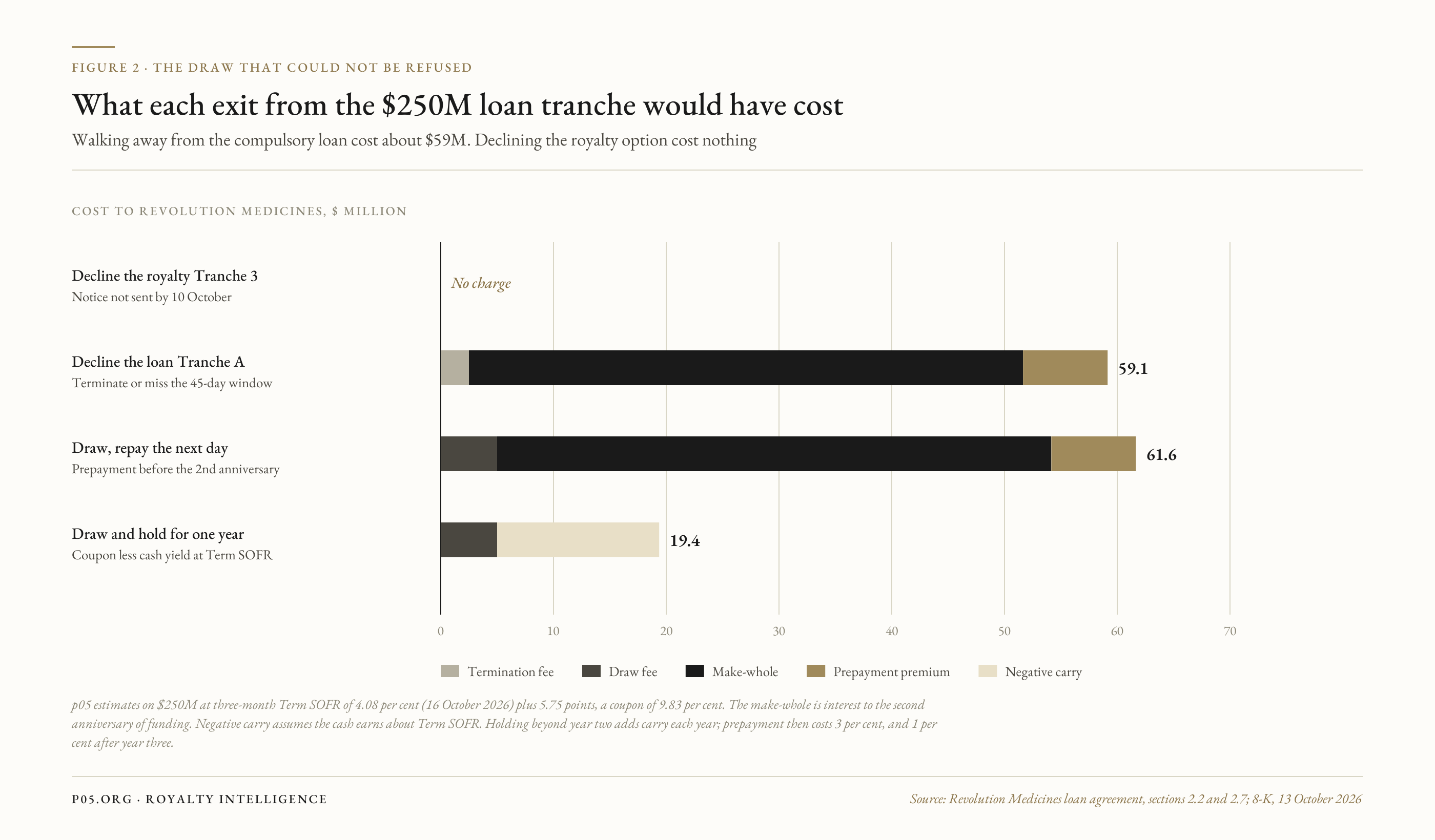
The loan agreement prices the exit from that obligation. A company that terminates the Tranche A commitment, or fails to draw within the window, pays a termination fee of $2.5M, which is 1 per cent of the commitment. It also pays a make-whole and a prepayment premium "calculated on the assumption that the Tranche A Loan was drawn in full".
The make-whole is the interest the lender would have earned on the full $250M up to the second anniversary of funding. The premium adds 3 per cent.
At the rate the loan now carries, three-month Term SOFR of 4.08 per cent on 16 October plus a margin of 5.75 points, two years of interest on $250M come to about $49M. Adding the 1 per cent and the 3 per cent gives about $59M, nearly a quarter of the tranche, for declining money the company did not need.
Repaying the loan the day after drawing it would have cost the same make-whole and premium. Drawing it and holding it costs the difference between the loan coupon and what the cash earns. If the cash earns about Term SOFR, that difference is 5.75 points, or about $14M a year, before the $5.0M draw fee.
The loan itself is plain senior debt. It is secured on substantially all of the company's assets, pays interest quarterly, has no scheduled amortisation and falls due on 8 October 2032. Each tranche carries a draw fee of 2.0 per cent, payable only on the day it funds. After the second anniversary the prepayment premium is 3 per cent, and after the third it is 1 per cent. The agreement has no financial covenants.
What the option was worth
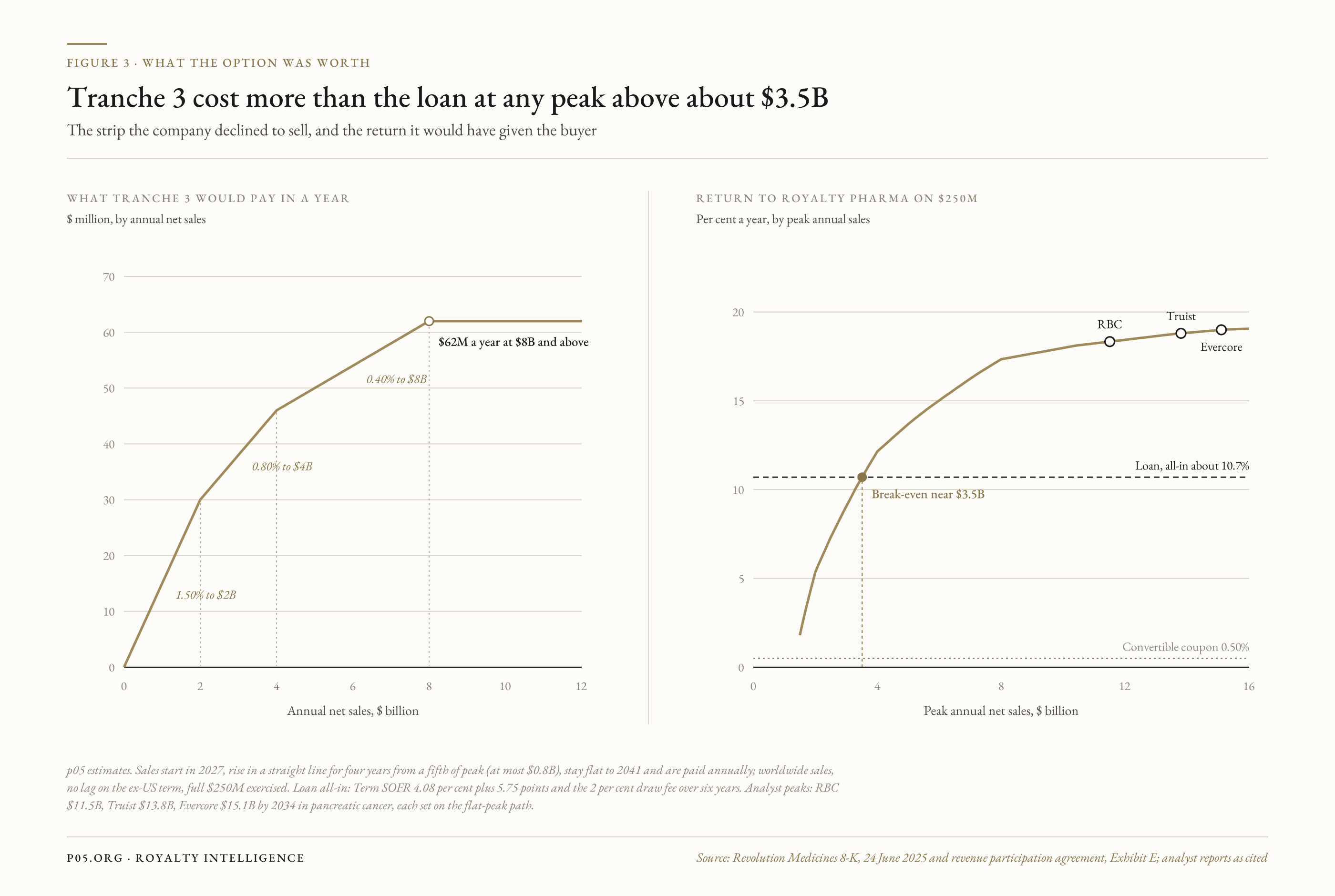
Tranche 3 gave Revolution Medicines the right to sell a fixed strip of its own sales for up to $250M. The strip pays 1.50 per cent of the first $2B of annual sales, 0.80 per cent of the next $2B and 0.40 per cent of the next $4B. It reaches its maximum of $62M a year once sales pass $8B and stays there. For the company, the value of exercising the right was the $250M of cash less the value of the payments it would give up, discounted at its own cost of money.
The arithmetic depends on how far the drug sells. Assume sales that start in 2027, rise in a straight line for four years, hold flat to 2041 and are paid once a year. On those assumptions, Tranche 3 would have returned Royalty Pharma about 12 per cent a year if sales levelled off at $4B and about 18 to 19 per cent if they reached $10B to $15B.
At about $3.5B of peak sales the return equals the cost of the loan, about 10.7 per cent once the draw fee is spread over six years. Below that level the royalty would have been the cheaper money.
The analysts who published after approval sit well above the break-even level. Evercore ISI forecast about $2.4B of sales in 2027 and $15.1B by 2034 in pancreatic cancer alone. RBC put peak sales at $11.5B, and Truist at $13.8B.
On a path like Evercore's, the Tranche 3 payments total about $880M, 3.5 times the price, and their value discounted at 10 per cent is about $430M. Selling them for $250M would have handed the buyer about $180M of value at the company's cost of debt.
The company also had cheaper money on hand. In April it sold $1.65B of shares at $142 and $500M of convertible notes due 2033 with a coupon of 0.50 per cent and a conversion price of about $198.80. It held $3.9B of cash and securities at the end of June. The same quarterly report shows the cost of the royalty already sold.
The liability for the two funded tranches grew from $268.4M to $548.5M in the first half of 2026, of which $250.0M was new money and $34.4M was non-cash interest.
The option had most value in the outcomes where the company would have used it. When the agreements were signed, the Phase 3 trial had not read out and approval was a year away. A drug approved into a slow launch, with sales that settle below $3.5B, would have made Tranche 3 cheaper than the loan, and the right to call on it would have been valuable.
A drug that the market expects to sell $10B or more makes the same right close to worthless.
How Royalty Pharma accounts for an option it cannot refuse
Royalty Pharma's quarterly report for June 2026 shows the other side of the trade. The upfront $250M was booked as research and development funding expense, because the drug was unapproved when the money went out. The second tranche became a financial royalty asset when it was funded. At 30 June, $750M of royalty tranches and $750M of loans remained unfunded.
The company records a reserve against those commitments. It explains that "because we have limited protective rights with respect to each unfunded portion once the committed funding is provided", it must recognise an allowance for expected credit losses based on the probability of future funding.
It booked a provision of $92.5M in the quarter in which it signed the agreements. The allowance stood at $89.0M at the end of 2025 and at $52.4M at 30 June 2026, after the second tranche funded.
Royalty Pharma committed capital for years, at fixed prices, to a company that could call on it at will, and it received no fee for holding it ready. Its compensation sits in the compulsory parts of the package.
The upfront and second tranches carry the highest rates in the schedule, 4.55 per cent of the first $2B, with an increase in weak years. The loan fixed a first draw of $250M at a coupon floor of 9.25 per cent, with a draw fee on top. Against that, the company holds the choice on every later tranche, and it will exercise one only when the price favours it.
Who pays for an undrawn tranche
Royalty facilities take their fee terms from the syndicated loan market. A commitment fee, called a ticking fee when it starts after a delay, accrues on the part of a facility that has not been drawn, at a rate below the coupon. A draw fee, or original issue discount, is a percentage of each tranche paid when it funds.
A third charge, the termination fee, applies when a borrower cancels a commitment before drawing it.
The filings show the first charge only on loans, and only from some lenders. Oaktree's 2022 credit agreement with BioXcel charges a ticking fee of 0.750 per cent a year on the daily undrawn amount, starting 120 days after the first draw. Blackstone's 2025 facility for MannKind charges 1.00 per cent a year on the unused delayed-draw commitment from the first anniversary.
Apellis pays "certain additional commitment and undrawn amount fees" on its Sixth Street loan, at rates kept in a fee letter. Royalty Pharma at Revolution Medicines, Pharmakon at Geron and Sagard at Nuvation charge nothing until a tranche funds.
None of the royalty agreements reviewed charges for capital held in reserve. The draw fees cluster at 2.0 to 2.5 per cent, and every one falls due on the closing date of its tranche. Pharmakon's loan to Geron sets "additional consideration" of 2.50 per cent of each tranche's commitment, payable "on the Tranche B Closing Date" and "on the Tranche C Closing Date". Geron closed neither tranche and paid no fee for either.
| Facility | Instrument with the option | Charge on undrawn amount | Charge to walk away | Source |
|---|---|---|---|---|
| Revolution Medicines / Royalty Pharma, 2025 | Royalty Tranches 3 to 5, loan Tranches B and C | None | Loan Tranche A: 1 per cent plus make-whole plus 3 per cent | Loan agreement |
| Verona / Oaktree and OMERS, 2024 | Royalty Tranche B | None | Royalty Tranche A: $12.5M | Revenue interest agreement |
| Cytokinetics / Royalty Pharma, 2024 | Loan Tranches 5 to 7 | None | Minimum draw of $50M | Third amendment |
| BridgeBio / Blue Owl and CPP Investments, 2024 | Royalty funding on approval | None | $25M on a change of control before funding | Funding agreement |
| Geron / Pharmakon, 2024 | Loan Tranches B and C | None | None disclosed | 10-Q, June 2026 |
| BioXcel / Oaktree, 2022 | Loan tranches | 0.75 per cent a year from day 120 | Ticking fee continues on terminated commitments | Credit agreement |
| MannKind / Blackstone, 2025 | Delayed-draw loan | 1.00 per cent a year from year 1 | Not disclosed | 10-K 2025 |
| Apellis / Sixth Street, 2024 | $100M loan option | In a private fee letter | Not disclosed | 10-K 2025 |
| Alnylam / Blackstone, 2020 | Loan tranches | 1 per cent exit fee on all commitments | Two years' interest regardless, then up to 5 per cent | 10-Q, June 2020 |
Forced first draws
Where funders do protect themselves, they make the first tranche compulsory. The Verona revenue interest agreement of May 2024, written by Oaktree and OMERS, made the $100M first tranche due on approval of ensifentrine. Section 2.05 treats a failure to request it within three business days as an event of default and sets a fee of $12.5M for it, against $3.0M for other defaults before funding.
The second tranche of $150M was "at the Company's option, and the Company has no obligation to request or accept" it. Verona took the first, never took the second, and bought the interest back in March 2025.
Royalty Pharma used a minimum draw in its 2024 amendment of the Cytokinetics loan. The restated section 2.2(b) requires the company to request "a Tranche 4 Advance of at least $50,000,000", up from $25M in 2022. BridgeBio's 2024 funding agreement with LSI Financing 1, a Blue Owl vehicle, and CPP Investments, a royalty that funded only on approval, charges a one-time $25M if the company is sold before the funding trigger, and releases both sides at no charge if approval missed its date.
Blackstone's 2020 facility for Alnylam is the earliest of these terms and the closest to Revolution Medicines'. Alnylam owed interest for two years from the first draw "without regard to the Term Loans being prepaid or an unfunded tranche being terminated", an exit fee of 1 per cent of all commitments, and up to 5 per cent of any unfunded tranche it cancelled in years two to five. It drew all three tranches.
Tranches left on the table
Lapsed tranches appear in several of the filings reviewed, and none of them records a fee. Geron's 2024 loan from Pharmakon offered a $75M Tranche B at its option and a $50M Tranche C on a revenue milestone for RYTELO. After an extension to 30 July 2026, the company reported that neither had been drawn and both were no longer available.
The same amendment moved the end of the make-whole period on the drawn $125M from November 2026 to May 2027. Apellis let a $100M option on its Sixth Street loan expire on 30 September 2025. It could draw only if trailing three-month sales of SYFOVRE reached $180M.
Nuvation Bio made the closest comparison to Revolution Medicines. Its 2025 package with Sagard joined a $150M royalty on IBTROZI to a loan of two $50M tranches, the second available at its option until 30 June 2026.
On that day Nuvation completed an offering of $250M of 0.75 per cent convertible notes due 2032, repaid the first $50M tranche for about $58.5M including interest and fees, and amended the royalty agreement to permit the notes. The royalty stayed in place. The second loan tranche lapsed.
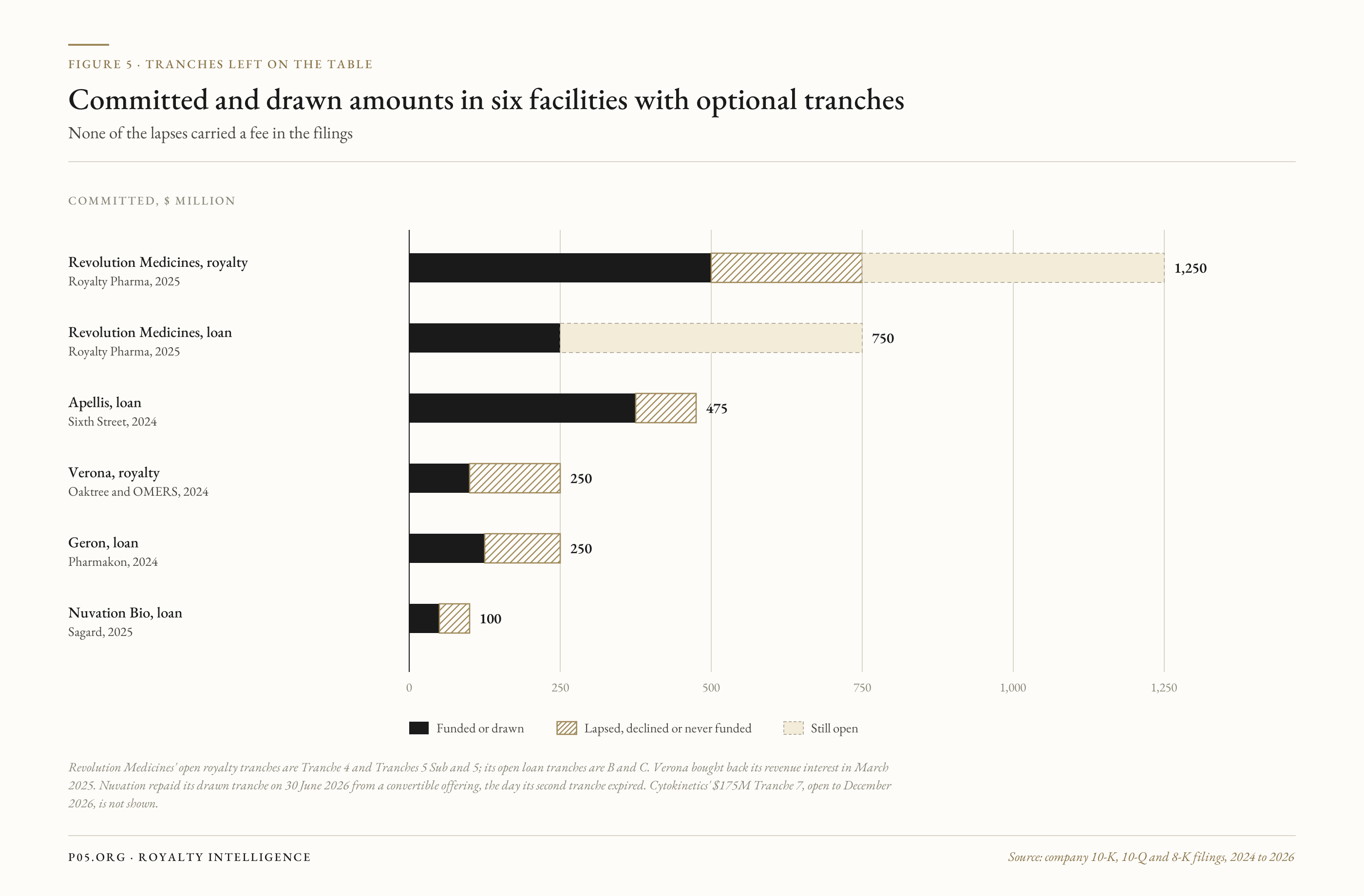
Cytokinetics holds the largest open option in the group. Its $175M Tranche 7 from Royalty Pharma is drawable at its discretion within one year of the FDA approval of MYQORZO, which came in December 2025. Royalty Pharma lists the same $175M among its commitments at 30 June 2026.
Choosing between the loan and the royalty
What separates the two instruments is their cost when sales disappoint. The Revolution Medicines loan costs the coupon whatever the drug sells, and the company can leave it at a known price after the make-whole period.
The royalty costs a share of sales for 15 years. It has no buy-out, and it cannot be repaid. Below about $3.5B of peak sales the royalty is the cheaper of the two, and the further sales fall short, the cheaper it becomes. Above that level the bands cap the royalty's take at $62M a year for Tranche 3, but the 15-year term keeps its cost above the loan's.
A company can run the test on the day it signs. It can compute from the rate schedule the peak sales at which each royalty tranche costs the same as the alternative debt, and set its own forecast against that number.
A company that expects to sell well above the break-even level, and can issue convertible notes at under 1 per cent, will leave the royalty options unused, as Revolution Medicines and Nuvation did. A company with one product, an uncertain launch and no access to the convertible market will use them.
The test has limits. The royalty is a sale, with a back-up security interest behind it, and it imposes no covenants on the rest of the company. The loan is senior debt over all assets, with events of default and restrictions on further borrowing. A company near its limit on secured debt may prefer a royalty that costs more, because it leaves the balance sheet freer.
Implications for the Pharmaceutical Royalty Market
Royalty buyers can read the Revolution Medicines contracts as a way to offer optional capital without a fee. Royalty Pharma priced the options into the compulsory parts of the package, and a termination charge of about a quarter of the loan tranche made the first draw certain. Verona's $12.5M charge and BridgeBio's $25M charge do the same job on a smaller scale.
The cost of the option falls on the funder's income statement before any money moves. Royalty Pharma reserved $92.5M against the Revolution Medicines commitments in the quarter it signed them. It reports the change in that reserve every quarter, and its third-quarter report will be the first to cover the lapse.
The lapse also fixes the size of the stream that Royalty Pharma holds. At 4.55 per cent of the first $2B of sales, the two funded tranches now set the payments on American sales for 15 years, unless the company exercises Tranche 4 or Tranche 5. The term on sales elsewhere has yet to start.
The European Medicines Agency's committee recommended authorisation on 15 October, and the 15 years begin at the first sale in the European Union.
Companies weighing the same structure face a different question. A royalty option is a right to sell a fixed strip at a fixed price, and it pays off only when sales fall short of the level at which the strip was priced. Revolution Medicines held that right on four tranches and paid for it with a compulsory loan of $250M, which it now carries at about 5.75 points over what its cash earns.
Conclusion
The second deadline in the Revolution Medicines package falls before 1 January 2028. If quarterly sales clear the redacted thresholds by then, the company will have 45 days to draw up to $250M more of the loan, at the same coupon and for a 2 per cent fee. Tranche 4 of the royalty opens on a sales milestone before 2029, at rates of 1.00, 0.75 and 0.50 per cent in the three bands.
On the evidence of 10 October, both will be tested against the same arithmetic. The company declined $250M of royalty money two days after it was required to borrow $250M from the same counterparty, and it held $3.9B of cash when it did so.
All information in this report was accurate as of the research date and is derived from publicly available sources including court opinions, regulatory guidance, academic literature, SEC filings, and financial news reporting. Information may have changed since publication. This content is for informational purposes only and does not constitute investment, legal, or financial advice. The author is not a lawyer or financial adviser.