
The Weekly Term Sheet (2026-W30)
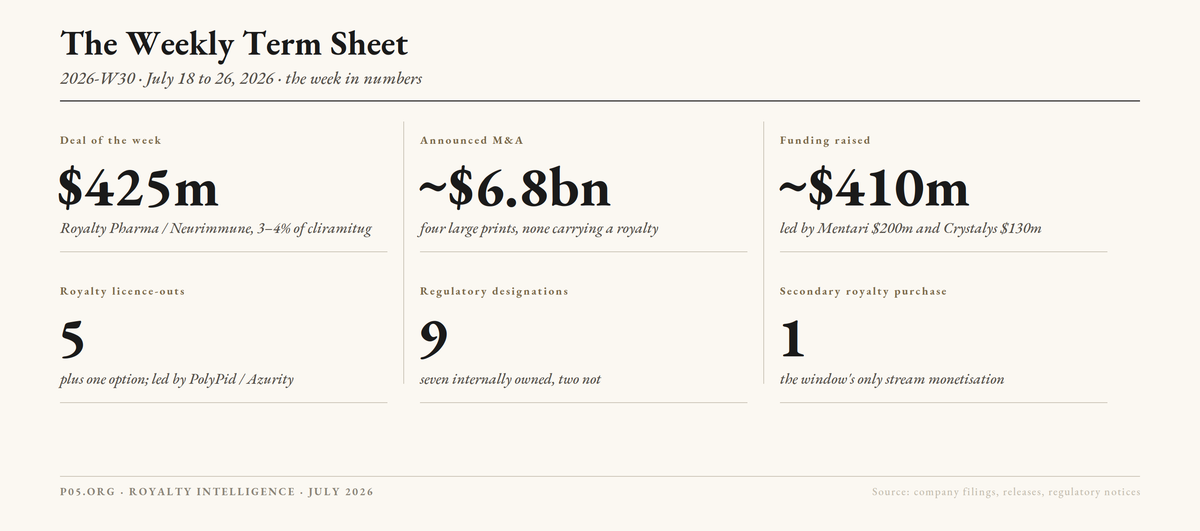
The week in numbers
Nine days, July 18 to 26 of W30. One secondary stream purchase: on July 22 Royalty Pharma bought a slice of Neurimmune's cliramitug royalty for up to $425M, a Swiss origination.
July 23 was the busiest day: Roche H1 results with Vabysmo a top-five growth driver (a royalty that changed hands nine days earlier), Dassault Systèmes / ArisGlobal at about $2.0B, Scancell taking Neuphoria to Nasdaq with CVRs, and Scribe pricing upsized. The July 24 to 26 tail added Kenvue's Tylenol with Naproxen OTC approval, Scribe's trading debut above its $15 IPO price, and CHMP positive opinions on obicetrapib, a catalyst on a pre-existing Menarini royalty rather than a new stream.
Announced M&A ran to about $6.8B across four large prints, none carrying a running royalty. Royalty origination ran to five licence-outs plus one option, led by PolyPid / Azurity at a mid-teen to mid-twenties tiered rate, over seven university-linked originations, none disclosing a rate; the most advanced, Azafaros, is Phase 3 fully enrolled with topline due early 2028.
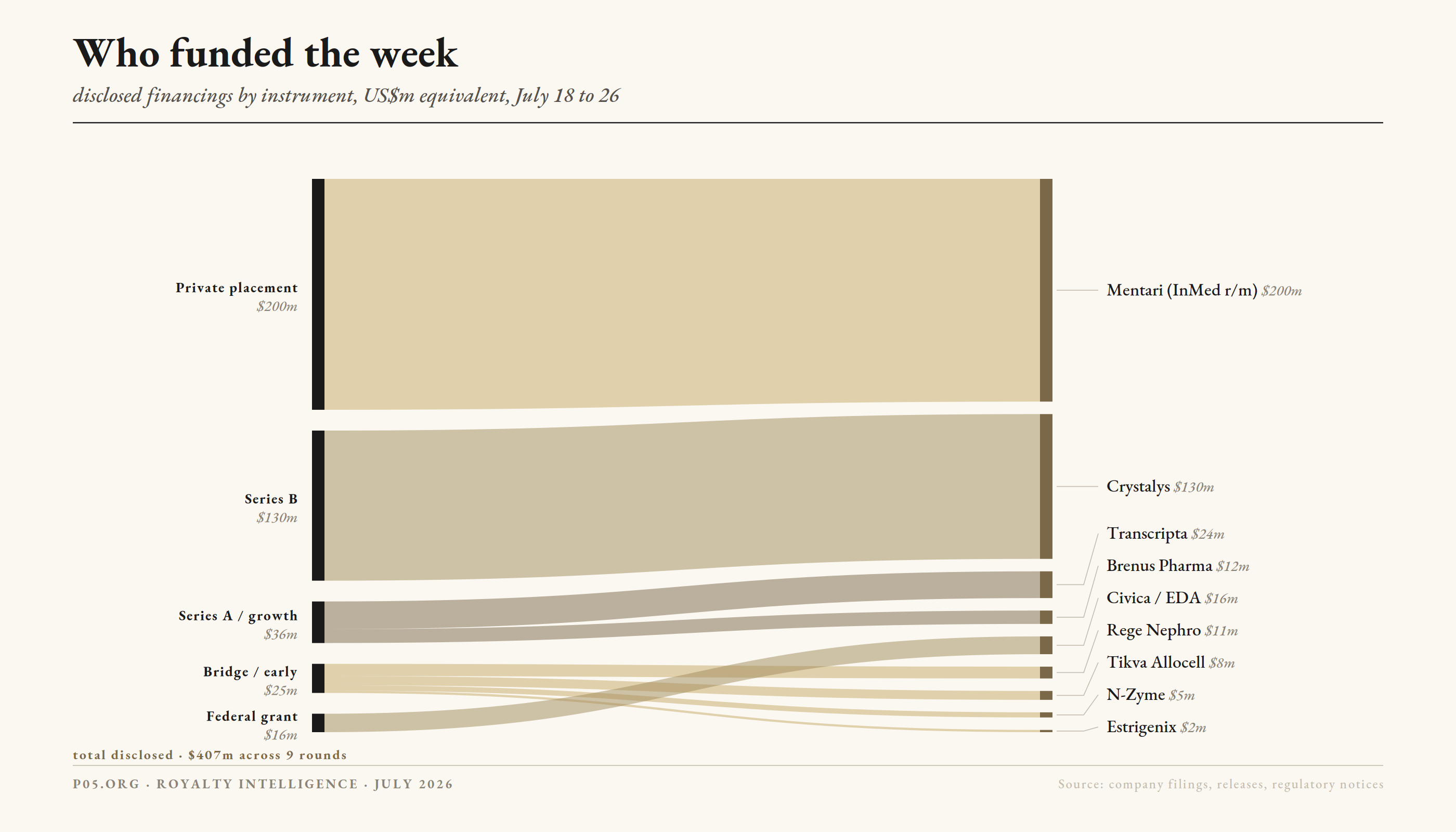
Funding ran to about $410M, led by Mentari's additional $200M into its InMed reverse merger and Crystalys' $130M on a gout asset carrying a 3% royalty. Two approvals, GSK's Jideytro and AstraZeneca's Etcamah, were internally originated with nothing travelling.
The largest royalty prints of the fortnight (Ligand / XOMA, Spero / HCRx, Avere / NextCure, Lilly / AtaiBeckley) landed in the prior window and are covered in W29; not restated here.
Highlights:
- Deal of the week: Royalty Pharma / Neurimmune. Up to $425M for a 3% to 4% royalty on AstraZeneca's cliramitug; the window's only stream purchase; 22 Jul.
- Licence-outs: 5 scored, 1 option, 1 reclassified. Led by PolyPid / Azurity (D-PLEX100, over $320M, mid-teen to mid-twenties tiered). Also Halozyme / Incyte, MaxCyte / Genentech, PharmAla / Jupiter, Lonza / Engitix; Tempest / Senlang option only.
- M&A: 4 large, 3 small, 1 failed. Tempus / Personalis (~$1.5B), Samsung Biologics / PolyPeptide (~CHF 1.46B), Repligen / BioLife (~$1.5B), Dassault / ArisGlobal (~$2.0B). None carry a running royalty. Marinomed filed Austrian restructuring; Kuva / Lisata tender failed to fund.
- Clinical re-rates: 4 negative, 4 positive. Positive: Arrowhead / plozasiran, Lilly / retatrutide, Dyne / z-rostudirsen, Ribo / Ribocure. Negative: Agios, Celldex, Kolon TissueGene, Novartis / 177Lu-NeoB.
- Royalty-bearing re-rates: 2. Curis / emavusertib (Aurigene high single digits up to 10%, 22 Jul); Lundbeck / bexicaserin (mid-single-digit to Pfizer via Arena, 20 Jul).
- Approvals: 2 internal. GSK / Jideytro (ROS1 NSCLC, two months early, 22 Jul); AstraZeneca / Etcamah (EU, ESR1 breast cancer, 23 Jul). Nothing travels.
- Designations: 9, seven internally owned; the two Atsena EMA orphans (University of Florida) are not, Nippon Shinyaku arrangement unconfirmed.
- Animal health: 2. Medgene's first Theileria orientalis Ikeda cattle vaccine (SDSU licence, rate undisclosed, 23 Jul); FDA CVM US-manufacturing review pilot (21 Jul).
- Funding: ~$410M. Led by Mentari (+$200M, InMed reverse merger, Paragon royalty) and Crystalys ($130M, 3% Urica / Fortress royalty). Plus Transcripta $24M and six smaller rounds.
- Fund formation: Fresenius Ventures, more than EUR 200M over five years, early-to-growth stage; 23 Jul.
- IPO: Scribe priced upsized at $128.7M (first disclosed Sanofi royalty, high single digits to low teens) and opened above its $15 IPO price; 23 to 24 Jul.
- Obicetrapib (Menarini / NewAmsterdam): CHMP positive opinion, a catalyst on a pre-existing European royalty; 24 Jul.
- Policy and legal: 2, both 21 Jul. US generic tariff schedule; D.C. Circuit 340B ruling. Both move the US net-sales base.
- Earnings: Roche H1 (Vabysmo a top-five driver, 23 Jul); Danaher Q2 (21 Jul).
- Watch list: Axiom Biosciences (HKEX listing intention, 21 Jul).
Royalty Monetisations
Royalty Pharma / Neurimmune: Up to $425M for 3% to 4% of Cliramitug Worldwide Net Sales, a Slice Rather Than the Stream (Wed July 22)
Royalty Pharma (Nasdaq: RPRX) acquired a portion of Neurimmune's royalty interest in AstraZeneca's cliramitug for up to $425M, including $125M upfront (Royalty Pharma release).
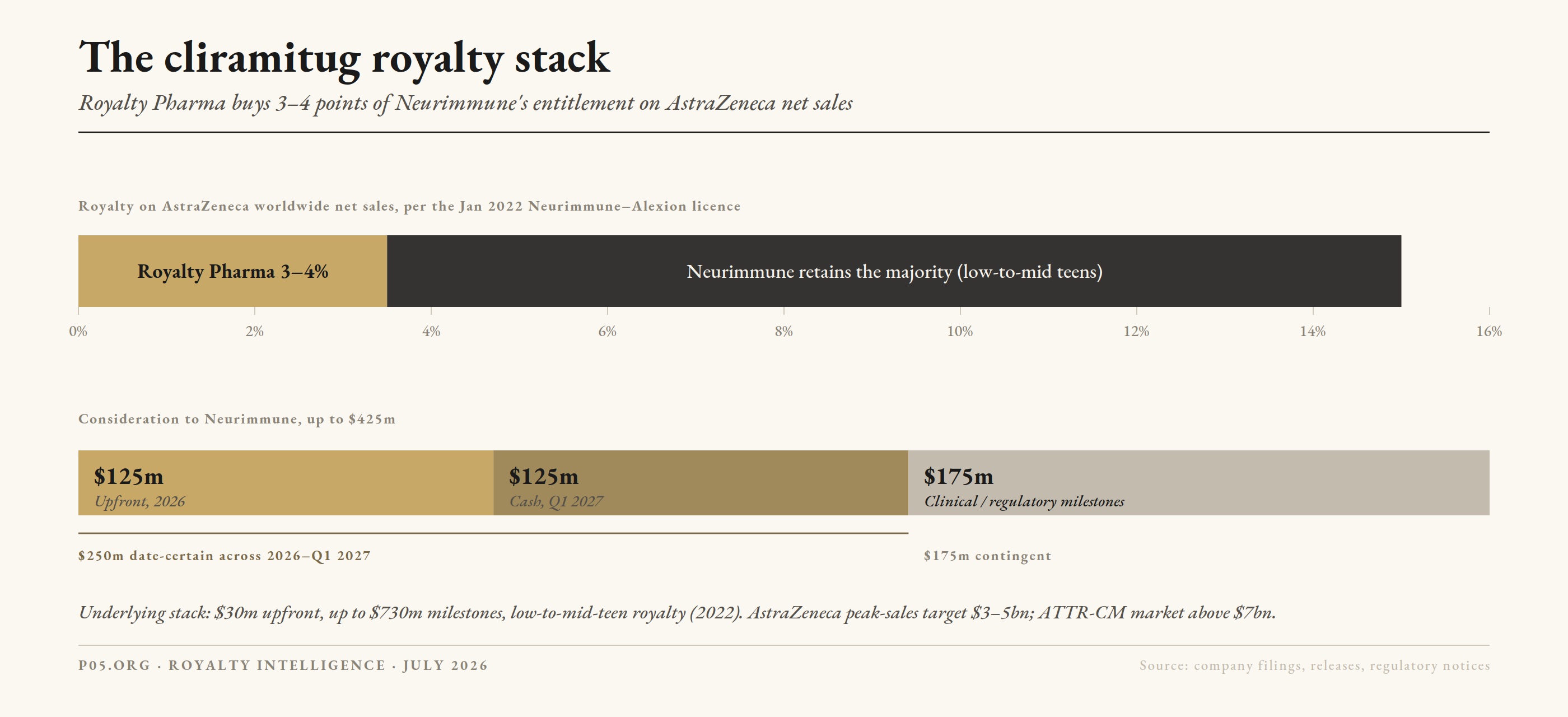
Under the terms Royalty Pharma provides Neurimmune up to $425M in exchange for a 3% to 4% royalty on worldwide net sales of cliramitug: $125M upfront, a further $125M in cash in the first quarter of 2027, and the remaining $175M payable on achievement of certain clinical and regulatory milestones.
Cliramitug is NI006, originated by Neurimmune AG (Schlieren, Zurich) using its Reverse Translational Medicine platform, the same discovery engine behind aducanumab. Neurimmune out-licensed it to Alexion, AstraZeneca's rare-disease group, under an exclusive global collaboration and licence signed January 7, 2022 and closed March 1, 2022, for $30M upfront, up to $730M in development, regulatory, and commercial milestones, and low-to-mid-teen royalties on net sales.
Royalty Pharma has now bought 3 to 4 points out of that low-to-mid-teen entitlement, on the order of a quarter to a third of the stream. Neurimmune's own framing is explicit: the transaction funds its internal R&D pipeline while it retains the majority of its royalty and milestone interests. The February 2026 expansion of the Alexion relationship to NI009 in AL amyloidosis, worth up to $780M plus tiered royalties, is untouched by this sale.
The asset is development-stage, not commercial. Cliramitug is a first-in-class TTR-fibril-depleting antibody designed to remove amyloid already deposited in the heart, as distinct from the approved ATTR-CM therapies that slow accumulation.
It is in the Phase 3 DepleTTR-CM trial with results expected in 2028 on AstraZeneca guidance, and AstraZeneca set a peak sales target of $3B to $5B at its May 2024 Investor Day. The ATTR-CM market grew more than 40% in 2025 to above $7B.
A comparable precedent: in December 2025 Compugen (Nasdaq: CGEN) monetised a portion of its rilvegostomig royalty for up to $90M ($65M upfront plus $25M added to the next BLA-acceptance milestone), retaining the majority of the stream and tiered royalties of up to mid-single digits plus up to $195M in further milestones.
The difference is the counterparty: Compugen sold to AstraZeneca itself, the payor, by amending its March 2018 licence, whereas Neurimmune sold to a third-party aggregator.
$250M is date-certain across 2026 and Q1 2027, with $175M contingent on milestones. Neurimmune is private, with no public filings, no sell-side coverage, and no listed royalty entitlement; the rate on the underlying stream is derivable only from the January 2022 licence terms.
- Buyer: Royalty Pharma plc (Nasdaq: RPRX; CEO and Chairman Pablo Legorreta)
- Seller: Neurimmune AG (private; Schlieren, Zurich, Switzerland; President and CEO Roger M. Nitsch)
- Payor / licensee: AstraZeneca (via Alexion, AstraZeneca Rare Disease)
- Asset: cliramitug (NI006 / ALXN2220), first-in-class TTR-fibril-depleting human monoclonal antibody; ATTR amyloidosis with cardiomyopathy (ATTR-CM); Phase 3 DepleTTR-CM, results expected 2028
- Consideration: Up to $425M; $125M upfront, $125M in Q1 2027, $175M contingent on certain clinical and regulatory milestones
- Royalty acquired: 3% to 4% of worldwide net sales of cliramitug
- Underlying stack: Neurimmune to Alexion exclusive global collaboration and licence, announced 7 Jan 2022 and closed 1 Mar 2022; $30M upfront, up to $730M development, regulatory, and commercial milestones, low-to-mid-teen royalties on net sales; expanded Feb 2026 to NI009 (AL amyloidosis) for up to $780M plus tiered royalties
- Retained: Neurimmune retains the majority of its royalty and milestone interests in cliramitug
- Market context: ATTR-CM market grew over 40% in 2025 to more than $7B; AstraZeneca peak sales target $3B to $5B (May 2024 Investor Day)
- Advisers: Chestnut Partners (financial) and Mintz and Schellenberg Wittmer (legal) to Neurimmune; Goodwin Procter and Maiwald (legal) to Royalty Pharma. No financial adviser disclosed for Royalty Pharma, which is its usual practice on royalty acquisitions
- Date: Announced Wed July 22, 2026
M&A and Restructuring
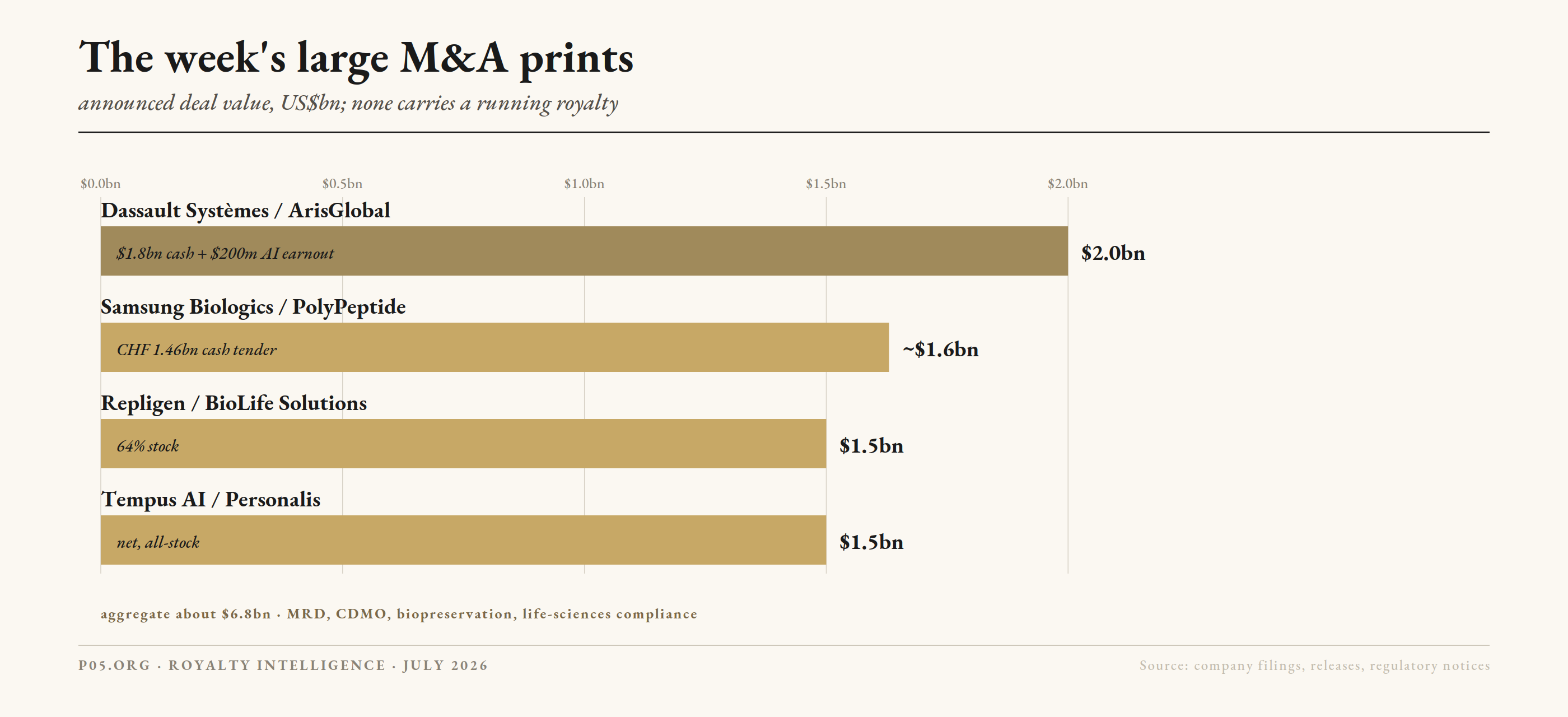
Tempus AI / Personalis: About $1.5B All-Stock Acquisition Consolidates Tumour-Informed MRD, No Pharmaceutical Royalty Travels (Mon July 20)
Tempus AI (Nasdaq: TEM) agreed to acquire Personalis (Nasdaq: PSNL), the tumour-informed minimal-residual-disease diagnostics company, in the largest print of the window (Tempus release).
Tempus will acquire all Personalis shares it does not already own at $16.25 per share, a total transaction value of about $1.7B, or about $1.5B net of Tempus's existing stake. The price is a 6% premium to the July 17 close and a 28% premium to the unaffected 30-day volume-weighted average price.
Consideration is a 100% stock transaction with a floating exchange ratio of Tempus common stock per Personalis share capped at a maximum 0.3356, and Tempus holds the option to pay up to 50% of the consideration in cash at its discretion. The two-step merger makes Personalis a wholly owned subsidiary and is expected to close in late 2026 or early 2027, subject to a Personalis stockholder vote and regulatory clearance.
The transaction builds on a partnership established in November 2023, when Tempus invested in Personalis and began commercialising Personalis's NeXT Personal MRD test; the existing stake is why the gross and net figures diverge.
The logic is data and reach: Tempus is fusing Personalis's tumour-informed MRD technology into its multimodal data and AI-enabled precision-oncology platform, targeting what it frames as a roughly $20B MRD opportunity and extending patient follow-up beyond diagnosis and treatment selection into recurrence monitoring. Personalis reported preliminary second-quarter revenue of $22.4M on 10,384 clinical tests, a 33% quarter-on-quarter volume increase.
MRD is consolidating as an intelligence layer, not a royalty layer. Personalis runs biopharma and clinical MRD testing as a service, so no running royalty, milestone ladder, or CVR travels with the target. It is the window's largest print.
- Acquirer: Tempus AI (Nasdaq: TEM; CEO Eric Lefkofsky)
- Target: Personalis (Nasdaq: PSNL; tumour-informed MRD, NeXT Personal; CEO Chris Hall)
- Structure: Two-step merger; 100% stock at $16.25 per share; floating exchange ratio capped at 0.3356 TEM per PSNL; Tempus option to pay up to 50% in cash; about $1.7B gross, about $1.5B net of Tempus's existing stake; 6% premium to the July 17 close and 28% to unaffected 30-day VWAP; expected close late 2026 or early 2027 subject to PSNL vote and regulatory clearance
- Background: Builds on the November 2023 partnership (Tempus invested in Personalis and commercialised NeXT Personal)
- Target metrics: Q2 2026 preliminary revenue $22.4M; 10,384 clinical tests; 33% quarter-on-quarter volume growth
- Deal protections: Merck, holding about 13% of Personalis voting power, signed a support agreement; $76.8M mutual termination fee; Personalis may terminate if Tempus Class A stock trades below $46.00; outside date April 20, 2027
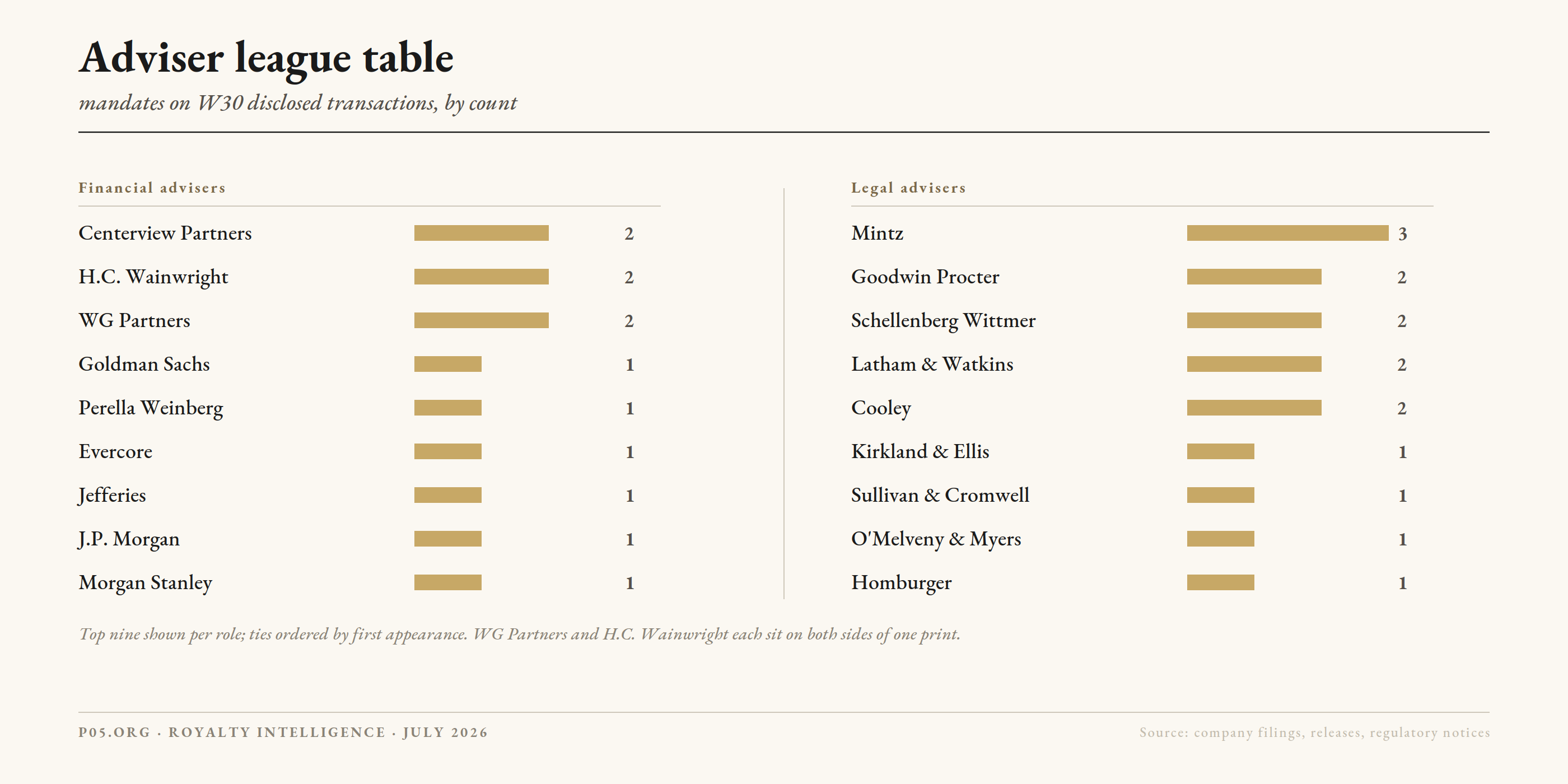
- Advisers: Centerview Partners and TD Securities (financial) and Cooley (legal) to Personalis; Latham & Watkins (legal) to Tempus. No financial adviser is named for Tempus. Which of Centerview or TD Securities signed the written fairness opinion to the Personalis board is not resolved by the release wording; treat the pairing as provisional until the Form S-4 opinion section and the Schedule 13E-3 land, the latter required here because of Tempus's existing stake
- Royalty: None; diagnostics and MRD consolidation, no pharmaceutical royalty, milestone, or CVR travels; logged for completeness and as an adjacent data-asset print
- Date: Announced Mon July 20, 2026
Samsung Biologics / PolyPeptide Group: About CHF 1.46B All-Cash Tender for a Swiss Peptide CDMO, Largest South Korean Biopharma M&A (Mon July 20)
Samsung Biologics (KRX: 207940) launched an all-cash public tender offer to acquire 100% of the fully diluted share capital of PolyPeptide Group (SIX: PPGN), a Baar-based global CDMO specialising in peptide-based active pharmaceutical ingredients (Samsung Biologics release).
Shareholders will receive CHF 44.31 in cash per share, an implied equity value of about CHF 1.46B (about $1.8B). The offer is a 40% premium to the undisturbed price of CHF 31.65 (the April 10, 2026 close, the last trading day before acquisition rumours emerged) and about an 11.6% premium to the 60-day volume-weighted average.
It carries a minimum acceptance threshold of 66 and two-thirds percent and an irrevocable tender undertaking from PolyPeptide's largest shareholder, Draupnir Holding, representing about 55.65% of outstanding shares excluding treasury. The independent and non-conflicted board members recommend it unanimously.
Samsung Biologics expects to publish the offer prospectus no later than August 31, 2026, with completion towards the end of 2026, subject to customary conditions and regulatory approvals. Reporting frames it as the largest biopharmaceutical M&A in South Korean history.
Samsung Biologics is moving beyond biologics into peptide APIs, including GLP-1, to serve the metabolic and obesity demand wave, and picks up PolyPeptide's multi-site network across the US, Europe, and India.
PolyPeptide updated full-year guidance the same day: 25% to 30% constant-currency revenue growth versus 2025, a high-teens EBITDA margin, and capex of 15% to 20% of revenue.
A services-and-manufacturing consolidation, not a royalty transaction: a CDMO's economics are tolling and capacity, not stream ownership, and no royalty, milestone, or CVR travels. It is the window's largest all-cash print, on a Swiss target.
- Acquirer: Samsung Biologics (KRX: 207940; CEO John Rim)
- Target: PolyPeptide Group (SIX: PPGN; Baar, Switzerland; peptide-API CDMO; Chairman Peter Wilden)
- Structure: All-cash public tender offer for 100% of fully diluted share capital; CHF 44.31 per share; about CHF 1.46B (about $1.8B) equity value; 40% premium to the undisturbed CHF 31.65 (April 10, 2026); about 11.6% premium to VWAP; minimum acceptance 66 and two-thirds percent; irrevocable undertaking from largest shareholder Draupnir Holding (about 55.65%); offer prospectus expected by August 31, 2026; expected close end 2026 subject to regulatory approval
- Rationale: Modality expansion into peptides including GLP-1; multi-site network across the US, Europe, and India
- Target guidance (FY2026): 25% to 30% constant-currency revenue growth; high-teens EBITDA margin; capex 15% to 20% of revenue
- Advisers: J.P. Morgan (financial), Ernst & Young Han Young (accounting and tax), and O'Melveny & Myers and Schellenberg Wittmer (legal) to Samsung Biologics; Morgan Stanley (financial) and Homburger (legal) to PolyPeptide, with an IFBC fairness opinion
- Royalty: None; CDMO services and manufacturing consolidation, no royalty, milestone, or CVR travels; logged for completeness
- Date: Announced Mon July 20, 2026
Repligen / BioLife Solutions: About $1.5B Cash-and-Stock for Cell-Therapy Biopreservation, No Royalty Travels (Wed July 22)
Repligen Corporation (Nasdaq: RGEN) agreed to acquire BioLife Solutions (Nasdaq: BLFS), the cell-processing and biopreservation supplier, for a total enterprise value of about $1.5B (Repligen and BioLife release, via BioSpace; Repligen Form 8-K exhibit).
BioLife stockholders receive $11.25 per share in cash plus 0.1442 Repligen shares, a total of $31.00 per share, split about 64% stock and 36% cash. That is a 24% premium to BioLife's 90-day VWAP through July 21, 2026 and about 6.2% to the last close.
Both boards approved unanimously; closing is expected in Q4 2026 subject to regulatory clearance, a BioLife stockholder vote, and customary conditions. The cash leg is funded from balance-sheet cash, with more than $300M of pro forma cash retained.
BioLife's CryoStor biopreservation media is used in 18 approved cell therapies and across most commercially sponsored US cell-therapy trials, and Repligen brings a larger global sales network, particularly in Asia-Pacific.
Repligen guides to at least $0.05 of adjusted EPS accretion in year one and $0.25 in year two, with at least $20M of cost synergies in year one and $30M in year two. Both pre-released Q2 2026 figures: Repligen at about 12% reported revenue growth (about 13% organic), BioLife at $28.5M, up 21% year on year.
Same read as Samsung Biologics and PolyPeptide earlier in the window: bioprocessing-tools consolidation, where the economics are consumables margin and installed-base pull-through, not stream ownership. No royalty, milestone, or CVR travels.
- Acquirer: Repligen Corporation (Nasdaq: RGEN; President and CEO Olivier Loeillot)
- Target: BioLife Solutions (Nasdaq: BLFS; Bothell, WA; Chairman and CEO Roderick de Greef); CryoStor biopreservation media, cryogenic storage, thawing, cell-processing tools
- Structure: Definitive merger agreement; about $1.5B total enterprise value; $11.25 cash plus 0.1442 RGEN per BLFS share, $31.00 total; about 64% stock and 36% cash; 24% premium to the 90-day VWAP through July 21, 2026 and about 6.2% to the last close; expected close Q4 2026 subject to regulatory and BLFS stockholder approval
- Economics: At least $0.05 adjusted EPS accretion in year one and $0.25 in year two; at least $20M and $30M of cost synergies in years one and two; over $300M pro forma cash
- Preliminary Q2 2026: Repligen about 12% reported revenue growth (about 13% organic); BioLife $28.5M, up 21% year on year (continuing operations)
- Background: BioLife divested its evo cold-chain logistics unit for $25.5M in October 2025, refocusing on biopreservation
- Advisers: Perella Weinberg Partners and Goldman Sachs (financial) and Goodwin Procter (legal) to Repligen; Centerview Partners (financial) and K&L Gates (legal) to BioLife. No fairness-opinion provider named for either board; backfill on the S-4
- Royalty: None; bioprocessing tools and consumables consolidation, no royalty, milestone, or CVR travels; logged for completeness
- Date: Announced Wed July 22, 2026
Dassault Systèmes / ArisGlobal: About $2.0B for the Life-Sciences Compliance Layer, With $200M of It Contingent on AI Revenue (Thu July 23)
Dassault Systèmes (Euronext Paris: DSY) signed a definitive agreement to acquire ArisGlobal, the Waltham-based enterprise compliance platform for life sciences, from Nordic Capital (Dassault Systèmes release).
Consideration is about $1.8B in cash at closing plus up to $200M linked to multi-year AI-related revenue milestones, roughly $2.0B in total, funded entirely from balance-sheet cash.
The transaction was unanimously approved by the Dassault board and is expected to complete in H2 2026, subject to regulatory clearance. It is Dassault's second-largest acquisition after the $5.8B purchase of Medidata Solutions in 2019, and the only sponsor exit in the window.
ArisGlobal serves more than 200 customers including half of the top 50 global biopharma companies, and its regulated core platform processes more than 12 million patient safety reports a year. Nordic Capital acquired the business in June 2019 at a reported valuation of about $700M including debt.
No stream travels. The entry is logged for the same reason as Tempus and Personalis: safety, regulatory, and medical-affairs systems are where net-sales reporting and submission timing live, and that layer concentrating under one owner alongside Medidata changes who holds the operational record royalty audits reconcile against.
- Acquirer: Dassault Systèmes SE (Euronext Paris: DSY)
- Target: ArisGlobal LLC (Waltham, Massachusetts; AI-native enterprise compliance platform; safety, regulatory, medical affairs, and quality; NavaX AI)
- Seller: Nordic Capital (invested June 2019 at a reported about $700M including debt; additional stake from the founding Abbhi family 2021; added Amplexor Life Sciences and Sporify in 2023)
- Structure: About $1.8B cash at closing plus up to $200M contingent on multi-year AI-related revenue milestones, about $2.0B total; all-cash from balance sheet; unanimous board approval; expected close H2 2026 subject to regulatory conditions
- Target metrics: More than 200 customers including half of the top 50 global biopharma; more than 12 million patient safety reports processed annually; reported revenue about EUR 150M (2025); marketed on EBITDA of roughly $70M to $80M
- Advisers: Evercore and Jefferies (financial) and Kirkland & Ellis (legal) to ArisGlobal and Nordic Capital; Sullivan & Cromwell (legal, Arnaud Berdou and Mimi Wu) to Dassault Systèmes. No financial adviser is named for Dassault
- Earnout: The release states up to $200M tied to multi-year AI-related revenue milestones; Dassault's Q2 2026 call put the same figure at EUR 200M over three years. The two are not the same number and the discrepancy is unresolved. Thresholds, measurement periods, and whether any portion is shared with management or the founding Abbhi family are not public. ArisGlobal is guided to about $175M of 2026 revenue, so the cash leg alone is roughly ten times forward revenue
- Royalty: No royalty or CVR. Contingent consideration does travel, in the form of the up to $200M earnout tied to multi-year AI-related revenue milestones, payable to Nordic Capital rather than to any originator. Enterprise software consolidation; logged as an adjacent data-and-systems print alongside Tempus and Personalis
- Date: Announced Thu July 23, 2026
Scancell / Neuphoria Therapeutics: All-Share Reverse Merger Into Nasdaq, With Contingent Value Rights on the Target's Partnered Assets (Thu July 23)
Scancell Holdings (AIM: SCLP), the Oxford immuno-oncology company, agreed to acquire Neuphoria Therapeutics (Nasdaq: NEUP), the Burlington, Massachusetts CNS company formerly known as Bionomics, in an all-share merger executed through a Delaware merger sub (Scancell and Neuphoria release).
Neuphoria stockholders receive 37.77199 Scancell ADSs per NEUP share, each ADS representing ten ordinary shares, plus CVRs tied to future payouts from Neuphoria's partnered assets. Pro forma ownership is 85.5% Scancell holders and 14.5% Neuphoria holders.
Secondary reporting puts the implied value at about $4.55 per NEUP share against Scancell's $0.1205 placement price, a derived figure rather than a disclosed one. Alongside the merger Scancell expects up to $89M in equity and debt, sized to fund the global registrational Phase 3 of iSCIB1+ in advanced melanoma.
The combined company keeps the Scancell name, retains the AIM listing, and applies to trade on Nasdaq under SCLT. The merger, the listing, and the financing are inter-conditional and expected to complete concurrently in late Q4 2026, subject to a Scancell EGM, a Neuphoria special meeting, Nasdaq admission and SEC review, and AIM admission of the consideration shares. The merger agreement is dated July 23, 2026.
The CVR is non-transferable and unlisted, carrying a pro rata right to 100% of net proceeds with no per-share or aggregate cap. Four sources feed it:
Neuphoria's research collaboration and licence with Merck Sharp & Dohme, for 15 years from completion; the Participants Agreement and associated CRC Commercialisation Licence Agreements, including an existing Pfizer licence over KAT6, also for 15 years; monetisation of certain Neuphoria IP; and an Australian R&D tax credit for the year ended 30 June 2026.
Neuphoria is a shell after AFFIRM-1 failed on BNC210 in October 2025, down to one employee and about $19.4M of cash at 31 March 2026, so the Merck and Pfizer legs are effectively its whole remaining value. The structure is at the aggressive end of the CVR range: Kuva and Lisata in this window was capped at $3.00 per share on two named milestones, and Avere and NextCure in W29 ran 90% of proceeds over two years.
What stays open is the upstream on iSCIB1+, the asset the $89M is raised to run. Backfill on the Form F-4 and the AIM admission document.
- Acquirer: Scancell Holdings plc (AIM: SCLP; Oxford Science Park; CEO Phil L'Huillier)
- Target: Neuphoria Therapeutics Inc. (Nasdaq: NEUP; Burlington, Massachusetts; formerly Bionomics)
- Structure: All-share merger via Scancell Merger Sub, Inc. (Delaware); 37.77199 Scancell ADSs per NEUP share, each ADS representing ten ordinary shares; pro forma 85.5% Scancell / 14.5% Neuphoria; plus CVRs on Neuphoria's partnered assets; merger agreement dated July 23, 2026
- Financing: Up to $89M, inter-conditional with the merger: a $39.1M private placement (about GBP 29.2M), a UK placing of about $12.0M (about GBP 9.0M) and a retail offer of up to $3.0M (about GBP 2.3M) via the Winterflood Retail Access Platform, and a non-binding BlackRock debt term sheet of up to $25M. Conditions include a minimum $75M concurrent financing and minimum $10M net cash at Neuphoria. Proceeds to the global registrational Phase 3 of iSCIB1+ in advanced melanoma
- Value: Deal equity value about $25M, with Neuphoria at about $24.6M and Scancell at about $144.6M per the DEFA14A. Neuphoria holders take about 13.7% of ordinary share capital, 14.5% on the stated pro forma basis
- Listing: Combined company named Scancell; AIM listing retained; Nasdaq application under SCLT
- Conditions and timing: Scancell EGM, Neuphoria special meeting, Nasdaq listing subject to SEC review, AIM admission of consideration shares; End Date 28 Feb 2027, extendable by 60 days; concurrent completion expected late Q4 2026
- Royalty: One non-transferable, unlisted CVR per NEUP share, carrying a pro rata right to 100% of net proceeds with no cap, from four sources: the Merck Sharp & Dohme research collaboration and licence (15 years from completion); the Participants Agreement and associated CRC Commercialisation Licence Agreements, including an existing Pfizer licence over KAT6 (15 years); monetisation of certain Neuphoria IP; and an Australian R&D tax credit for the year ended 30 June 2026. Payment mechanics, any percentage splits, and any diligent-efforts covenant on Scancell sit in the CVR Agreement (Exhibit 10.4 to the Neuphoria 8-K) and the Form F-4
- Advisers: Leerink Partners (financial), Panmure Liberum (NOMAD, joint broker, UK placement agent), WG Partners (joint broker) and Cooley (UK) (legal) to Scancell; H.C. Wainwright & Co. and WG Partners (financial) and Winston Taylor (legal) to Neuphoria. Private placement agents Leerink Partners, TD Cowen and H.C. Wainwright, with Mintz as placement agents' counsel. Note that WG Partners sits on both sides, as joint broker to Scancell and financial adviser to Neuphoria, which matters for league-table integrity
- Date: Announced Thu July 23, 2026
Three non-royalty prints: Avanos, Cardinal Health, Danaher
None creates or transfers a stream. Grouped so the royalty sections stay legible.
- Avanos Medical (NYSE: AVNS) / American Industrial Partners, 22 Jul. Stockholders approved the $1.272B take-private with about 99.75% of votes cast in favour, representing about 74.96% of shares outstanding at the June 18 record date. $25.00 per share cash; all regulatory approvals received July 2; closing expected no later than July 27. The deal itself was announced April 14 at a 72.1% premium and is a W16 print, so only the vote falls here. Latham & Watkins advised the AIP financing sources. Compare Kuva and Lisata in the same window: the same procedural step, cleared here with a funded sponsor at 99.75%, failed there for want of financing.
- Cardinal Health / AdaptHealth Diabetes Health and Strive Medical, 19 to 20 Jul. About $360M cash combined (AdaptHealth Diabetes Health $235M, signed July 19; both announced July 20). Diabetes supplies and urology services. A distribution-and-services consolidation: the economics are dispensing margin and patient-services scale, and no royalty, milestone, or CVR travels. A datapoint on the continued strategic bid for diabetes-supplies and durable-medical-equipment platforms.
- Danaher (NYSE: DHR) Q2 2026, 21 Jul. Revenue $6.3B, up 5.5%; net earnings $870M ($1.23 per diluted share, up 60%); non-GAAP adjusted diluted EPS $1.94, up 8.0% and about 4.9% above consensus. FY2026 adjusted EPS guidance raised to $8.45 to $8.60 following the $9.8B Masimo close. Shares fell on the beat. CEO Rainer Blair noted customer project timing weighed on bioprocessing revenue while bioprocessing orders grew mid-teens, which is the line that matters here: demand running ahead of the print, directly underneath the window's three tools consolidations.
Lupin / Kaveri Therapeutics: Two Oncology Programmes Spun Out for an 82.2% Equity Stake, With No Royalty Disclosed (Tue July 21)
Lupin (NSE: LUPIN; BSE: 500257), through its wholly owned US subsidiary Lupin Inc., spun two oncology programmes out into the newly formed US company Kaveri Therapeutics, granting Kaveri exclusive rights to LNP7457 (a PRMT5 inhibitor) and LNP8701 (a SOS1 inhibitor) in exchange for equity rather than cash (Lupin release).
In return for the licence, Lupin Inc. received 332,000 Kaveri common shares, an 82.2% ownership stake, with the two programmes valued at about $1.6M; Lupin also provides seed funding.
Kaveri, led by CEO Kristi Jones and CMO Dr Robert Pierce, will advance both assets through global solid-tumour trials (lung, pancreatic, ovarian, and CNS-relevant cancers) and raise external capital, diluting Lupin's majority over time. Both programmes reported positive early ASCO data (LNP7457 in 2025, LNP8701 in 2026), and LNP7457 is in Phase 1b.
The structure differs from the retained-royalty divestments recorded in W29), where a seller sheds an asset for a small upfront plus a running royalty, Lupin keeps its economics as majority equity in a standalone vehicle rather than as a stream. The two assets were internally originated by Lupin, so no upstream royalty stack sits beneath them either.
Lupin describes the consideration as a significant equity stake, seed funding, and the grant of exclusive rights, and is silent on whether any milestone or royalty leg travels back to the parent. Parent-to-NewCo spin-outs frequently carry one alongside the equity.
The 82.2% stake, the 332,000-share count, and the roughly $1.6M valuation come from Lupin's Indian exchange disclosure rather than the press release, and that filing is where a milestone or royalty leg would appear if one exists. Read as reported, the economics are equity.
It is a public-company oncology carve-out into a private, externally financed vehicle, the same shape as the Senti and Celadon carve-out in W29, and the royalty read is simply that none travels: value here is equity, not royalty.
- Parent / equity holder: Lupin (NSE: LUPIN; via Lupin Inc., USA); retains 82.2% of Kaveri (332,000 shares), diluting as Kaveri raises capital
- Vehicle: Kaveri Therapeutics (US clinical-stage oncology; CEO Kristi Jones, CMO Dr Robert Pierce)
- Structure: Grant of exclusive rights to two programmes into Kaveri for an 82.2% equity stake, 332,000 shares (assets valued about $1.6M), plus seed funding; consideration as disclosed is equity, not cash or royalty. Percentage, share count, and valuation are from the Indian exchange filing, not the company release
- Assets: LNP7457 (PRMT5 inhibitor; Phase 1b; positive ASCO 2025 data) and LNP8701 (SOS1 inhibitor; positive ASCO 2026 data); solid tumours including lung, pancreatic, ovarian, and CNS-relevant cancers
- Royalty: None. The NSE intimation discloses no milestone or royalty leg back to Lupin. The structure is an equity spin-out, not a royalty deal: Lupin's economics sit entirely in the 82.2% stake, diluting as Kaveri raises. Kaveri was incorporated on 20 May 2026. Internally originated by Lupin, so no upstream stack sits beneath the assets either. Backfill closed
- Advisers: None disclosed in the announcement
- Date: Announced Tue July 21, 2026
Kuva Labs / Lisata Therapeutics: Cash-Plus-CVR Tender Expires With the Minimum Met but the Acquirer Unable to Fund It, Deal in Jeopardy (Mon July 20 to Tue July 21)
Lisata Therapeutics (Nasdaq: LSTA) disclosed that the cash tender offer by Kuva Acquisition Corp., a wholly owned subsidiary of Kuva Labs, expired at 11:59 p.m. New York City time on July 20, 2026 with the minimum tender condition satisfied, but that Kuva was unable to obtain sufficient financing and did not accept the tendered shares for payment (Lisata SC 14D-9/A).
The offer was $4.00 per share in cash plus one contingent value right worth up to $3.00 per share ($1.25 on a glioblastoma Phase 2a proof-of-concept milestone, $1.75 on an NDA filing or acceptance for certepetide), structured for a Delaware Section 251(h) back-end merger with no stockholder vote.
At expiry roughly 6.10 million shares, about 66.8% of the 9.12 million outstanding, had been validly tendered, clearing the minimum. There was no financing condition in the merger agreement, yet Kuva had disclosed throughout that it lacked committed financing, missed an interim operating payment, and relied on a non-binding note indication; a shareholder-investigation firm had already opened a look at the disclosures.
First, this is not a completed W30 acquisition but a failed or stalled one: Lisata says it is evaluating its rights and remedies, and the outcome (salvage, termination, or litigation) is unresolved as of press time.
Second, the asset carries an upstream royalty. Certepetide (LSTA1, formerly CEND-1) is not internally originated: it is licensed from Sanford Burnham Prebys under an exclusive, worldwide, royalty-bearing agreement, granted to Cend Therapeutics in December 2015 and acquired by Lisata when it bought Cend in September 2022, rate undisclosed.
Any acquirer inherits that obligation, and the collapse of a funded exit leaves the SBP stream with Lisata.
- Would-be acquirer: Kuva Labs (private; via Kuva Acquisition Corp.)
- Target: Lisata Therapeutics (Nasdaq: LSTA); lead asset certepetide (LSTA1 / CEND-1), a CendR-peptide tumour-penetration enhancer
- Structure: Cash tender at $4.00 per share plus one CVR (up to $3.00: $1.25 GBM Phase 2a, $1.75 NDA), Section 251(h) back-end merger; no financing condition
- Status: Merger agreement dated 6 Mar 2026, amended 16 Jul to extend the outside date from 17 to 21 Jul. Offer expired 20 Jul with 6,095,868 shares, about 66.8% of 9,119,742 outstanding, validly tendered and the minimum met; Kuva was unable to fund and did not accept the shares. Its financing was a non-binding indication for up to $25M of 15% PIK senior secured convertible notes plus a $3.5M investor SAFE. Deal unconsummated, Lisata evaluating remedies; formal termination, any litigation, and any expense reimbursement not yet disclosed
- Advisers: H.C. Wainwright (financial adviser and fairness opinion) and Mintz (legal) to Lisata; Reed Smith (legal) to Kuva at commencement (Goodwin Procter at signing); no financial adviser disclosed for Kuva
- Royalty: Upstream exclusive, worldwide, royalty-bearing licence on certepetide from Sanford Burnham Prebys (rate undisclosed); stream stays with Lisata absent a funded close
- Date: Tender expired Mon July 20; failure disclosed Tue July 21, 2026
Marinomed Biotech: Court Restructuring Filing, Triggered by a Failed Earn-Out on a Prior Asset Sale (Wed July 22)
Marinomed Biotech (Vienna Stock Exchange: MARM) said it would apply for court restructuring proceedings without self-administration, an Austrian insolvency process, after earn-out payments due from the earlier sale of its Carragelose business to Unither failed to arrive and follow-on negotiations broke down (Marinomed ad hoc).
The instrument at the root is an earn-out, not a royalty, but the failure mode is the tracked one: contingent consideration on an asset sale carrying its own counterparty risk, leaving the seller unfunded when it does not pay.
Marinomed had booked part of the Carragelose price as deferred earn-out; when Unither did not pay and negotiations broke down, that receivable was the cash meant to carry the company. The formal warning was 16 July, outside the window; the filing update is 22 July.
- Company: Marinomed Biotech AG (Vienna: MARM; Korneuburg, Austria)
- Event: Application for court restructuring proceedings without self-administration under Austrian insolvency law
- Trigger: Non-payment of earn-out instalments owed by Unither Pharmaceuticals on the prior sale of the Carragelose business, and the breakdown of follow-on negotiations
- Royalty: None. The relevant instrument is a failed earn-out on an asset sale, not a royalty; logged as a contingent-consideration failure and the window's only transaction-linked distress event
- Date: Ad hoc warning 16 Jul (out of window); restructuring-filing update Wed July 22, 2026
Royalty-Bearing License-Outs and Collaborations
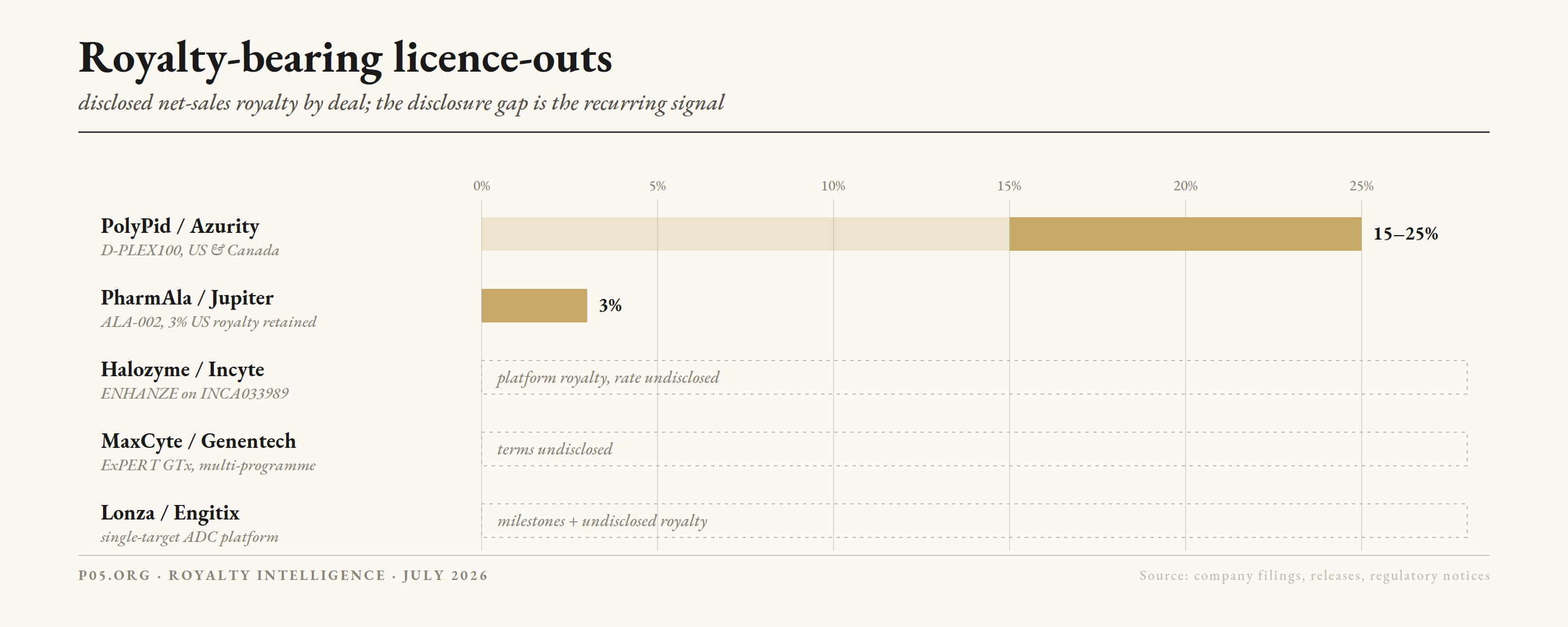
PolyPid / Azurity Pharmaceuticals: Over $320M Plus Mid-Teen to Mid-Twenties Tiered Royalties on D-PLEX100 in the US and Canada (Tue July 21)
PolyPid (Nasdaq: PYPD) granted Azurity Pharmaceuticals (private; Woburn, MA; QHP Capital-backed) exclusive commercialisation rights to D-PLEX100 in the United States and Canada, for the prevention of abdominal colorectal surgical site infections (PolyPid release, via BioSpace; Azurity release).
On disclosed royalty rate this is the largest origination in the window.
PolyPid receives $15M on signing and a further $15M on FDA acceptance of the D-PLEX100 NDA, expected August 2026. Up to about $300M in additional regulatory, development, and sales milestones takes the headline above $320M.
On commercialisation, PolyPid manufactures and supplies to Azurity at a transfer price and takes tiered royalties running mid-teen to mid-twenties percentages. Azurity separately funds development for label expansion beyond abdominal colorectal SSI.
Mid-teen to mid-twenties is well above the high-single to low-double-digit band typical of commercialisation licences. It also sits on top of a manufacturing margin rather than replacing it: PolyPid stays the sole worldwide manufacturer and keeps the transfer price on every US and Canadian vial. Two economic legs on the same unit.
PolyPid also keeps ex-US and Canada commercial rights, worldwide manufacturing rights, and full ownership of the PLEX platform, the Kynatrix technology, and the pipeline. Nothing structural has been given away.
The shape is a commercialisation licence, not an asset sale, which is what a pre-approval company with a January 2027 PDUFA and about $100M market cap can realistically transact. The over-$320M package is roughly three times that market cap before any royalty.
PolyPid ran the same play in Europe, licensing D-PLEX100 to ADVANZ PHARMA in August 2022 for potentially over $110M plus transfer price and royalties.
Azurity's second print in eight days. In W29 it agreed to buy Matinas BioPharma's MAT2203 and lipid-nanocrystal platform for $4M at closing plus up to $17.5M in milestones and a retained mid-single-digit royalty.
Same playbook both times: acquire or license de-risked, hard-to-formulate hospital assets from capital-constrained originators, and leave the seller a running royalty. But at opposite ends of the rate spectrum. Mid-single-digit buys control; mid-teen to mid-twenties buys commercialisation rights only.
- Licensor: PolyPid Ltd. (Nasdaq: PYPD; Petach Tikva, Israel; CEO Dikla Czaczkes Akselbrad)
- Licensee: Azurity Pharmaceuticals (private; Woburn, MA; CEO Ronald Scarboro; backed by QHP Capital)
- Asset: D-PLEX100, PLEX and Kynatrix prolonged-release doxycycline implant delivering about 30 days of local antibacterial activity; prevention of abdominal colorectal surgical site infections; FDA Breakthrough Therapy Designation
- Territory: United States and Canada (exclusive); PolyPid retains all other territories
- Structure: $15M upfront on signing; $15M on FDA NDA acceptance (expected August 2026); up to about $300M in further regulatory, development, and sales-based milestones; over $320M headline
- Royalty: Tiered royalties from mid-teen to mid-twenties percentages on US and Canadian net sales, plus a manufacturing transfer price to PolyPid as sole worldwide manufacturer
- Additional terms: Azurity funds clinical development for potential label expansion beyond abdominal colorectal SSI; PolyPid retains ex-US and Canada commercial rights, worldwide manufacturing rights, and full ownership of the PLEX platform, Kynatrix technology, and pipeline
- Timeline: NDA acceptance expected August 2026; PDUFA target Q1 2027; commercial launch targeted Q1 2027
- Precedent in stack: ADVANZ PHARMA European commercialisation licence (August 2022), potentially over $110M in upfront and milestones plus transfer price and royalties
- Advisers: None disclosed in the announcements
- Date: Announced Tue July 21, 2026
Halozyme / Incyte: Global ENHANZE Collaboration on Subcutaneous INCA033989, Adding an Upfront-Plus-Milestones-Plus-Royalty Leg to Halozyme (Mon July 20)
Halozyme Therapeutics (Nasdaq: HALO) entered a global collaboration and licence agreement with Incyte (Nasdaq: INCY) to apply Halozyme's proprietary ENHANZE drug-delivery technology to subcutaneous formulations of INCA033989, Incyte's first-in-class mutant-calreticulin (mutCALR)-targeted monoclonal antibody for mutCALR-expressing myeloproliferative neoplasms (Halozyme release).
This is the royalty-relevant origination of the window. The agreement grants Incyte rights to develop and commercialise ENHANZE (rHuPH20) with its mutCALR programme and an option to nominate up to two additional targets for use with the platform.
Under the terms, Halozyme receives an undisclosed upfront payment and is eligible for development, regulatory, and sales milestones plus royalties on net sales of any commercialised ENHANZE-enabled medicine. Specific figures were not disclosed.
INCA033989 is designed to selectively block mutCALR-driven activation of the thrombopoietin receptor, mutCALR being a driver mutation in an estimated 20% to 30% of MPN patients across essential thrombocythemia and myelofibrosis.
It carries FDA Breakthrough Therapy Designation in Type 1 CALR-mutated ET, with Incyte moving toward a registrational Phase 3 in 2026. The ENHANZE application is being layered onto a subcutaneous formulation already in development, not a preclinical one.
The structure follows Halozyme's standard ENHANZE template: one enabling technology licensed across multiple partners' assets, each agreement adding milestones and a royalty keyed to the partner's launch. It extends a 2026 ENHANZE run that already includes GSK, Takeda, and Skye Bioscience.
The royalty runs on ENHANZE-enabled net sales rather than the antibody's full economics, so it is a slice of a partner's product, diversified across uncorrelated launches.
- Licensor (platform): Halozyme Therapeutics (Nasdaq: HALO; ENHANZE / rHuPH20; CEO Helen Torley)
- Licensee: Incyte (Nasdaq: INCY)
- Asset: INCA033989, first-in-class mutCALR-targeted monoclonal antibody; mutCALR-expressing MPNs (ET, myelofibrosis); FDA Breakthrough Therapy Designation (Type 1 CALR-mutated ET); registrational Phase 3 planned 2026
- Structure: Global collaboration and licence; ENHANZE applied to subcutaneous INCA033989; Incyte option to nominate up to two additional ENHANZE targets
- Economics to Halozyme: Undisclosed upfront, plus development, regulatory, and sales milestones, plus royalties on net sales of ENHANZE-enabled medicines
- Royalty: New platform-royalty leg to Halozyme on ENHANZE-enabled net sales; extends the 2026 ENHANZE run (GSK, Takeda, Skye Bioscience); a diversified single-technology annuity, not full-asset economics
- Date: Announced Mon July 20, 2026
PharmAla Biotech / Jupiter Neurosciences: Exclusive US Licence to ALA-002 for Up to About $100M, PharmAla Retaining a 3% US Royalty (Signed Mon July 20, Announced Tue July 21)
PharmAla Biotech (CSE: MDMA; OTCQB: MDXXF) executed a definitive licence agreement granting Jupiter Neurosciences (Nasdaq: JUNS) an exclusive, perpetual, royalty-bearing US licence to develop, manufacture, and commercialise ALA-002, PharmAla's lead candidate and a next-generation, non-racemic MDMA new chemical entity; PharmAla retains all rights outside the US (PharmAla release).
Total consideration to PharmAla is up to about $100M. Upfront is about $3,333,333 (about $1,500,000 cash and about $1,833,333 in Jupiter stock, 120-day lock-up).
Then up to $23,333,333 in development and regulatory milestones, including $3,333,333 on first-patient-dosing in a Phase 3 trial and $20,000,000 on FDA NDA approval. And up to $73,333,333 in commercialisation milestones tied to cumulative US net sales of $333.3M, $1.0B, and $2.0B.
PharmAla also supplies GMP-grade ALA-002 under a separate supply agreement to be negotiated, adding a supply annuity on top of the royalty.
ALA-002 is PharmAla's own patented molecule, so no upstream licensor royalty sits beneath it: the full 3% on US net sales flows to PharmAla, commencing after the third commercialisation milestone. The second fresh royalty leg of the window after Halozyme, and unlike the Lupin carve-out a running royalty rather than an equity stake.
- Licensor: PharmAla Biotech (CSE: MDMA; OTCQB: MDXXF); ALA-002 (LaNeo, non-racemic MDMA NCE); retains ex-US rights (including the Cortexa JV in Australia)
- Licensee: Jupiter Neurosciences (Nasdaq: JUNS); US rights only
- Structure: Exclusive, perpetual US licence; total up to about $100M (about $3.33M upfront, up to $23.33M development and regulatory, up to $73.33M commercial); separate GMP supply agreement to be negotiated
- Royalty: 3% on US net sales to PharmAla, commencing after the third commercialisation milestone; internally originated, no upstream royalty
- Date: Definitive agreement signed Mon July 20; announced Tue July 21, 2026
Lonza / Engitix: Single-Target ADC Platform Licence, Milestones Plus Undisclosed Royalties to Lonza (Tue July 21)
Lonza (SIX: LONN) granted Engitix Therapeutics a single-target licence to its antibody-drug-conjugate technology platform, including the SYNtecan E linker-payload alongside the complementary GlycoConnect and HydraSpace technologies, for Engitix to develop ADCs against targets from its human extracellular-matrix discovery platform in fibrosis, oncology, and other diseases (Lonza and Engitix release).
Engitix is responsible for research, manufacturing, and commercialisation of the resulting ADCs, while Lonza manufactures components tied to its proprietary technologies. Per the release, Lonza, through an affiliate, is eligible for upfront, clinical, regulatory, and commercial milestone payments plus royalties on net sales of resulting products; dollar figures and the royalty rate were undisclosed.
This is a platform-royalty deal in the Halozyme mould, a CDMO or technology owner monetising an enabling toolkit across a partner's asset rather than owning the asset, adding a milestone-and-royalty annuity keyed to Engitix's eventual launches. The stream flows to Lonza.
- Licensor (platform): Lonza (SIX: LONN); ADC platform (SYNtecan E linker-payload, GlycoConnect, HydraSpace)
- Licensee: Engitix Therapeutics (private; human ECM discovery platform; fibrosis and oncology)
- Structure: Single-target ADC-technology licence; Engitix runs R&D, manufacturing, and commercialisation; Lonza manufactures proprietary components
- Royalty: Upfront plus clinical, regulatory, and commercial milestones plus royalties on net sales to Lonza (all undisclosed); a diversified platform annuity, not full-asset economics
- Date: Announced Tue July 21, 2026
Tempest / Senlang Biotechnology: China Development Collaboration on TPST-4003 With an Exclusive Option to Negotiate a China Licence (Tue July 21)
Tempest Therapeutics (Nasdaq: TPST) entered a strategic partnership with Hebei Senlang Biotechnology, a clinical-stage CD7-targeted CAR-T developer, to advance TPST-4003 into first-in-human study (Tempest release, via BioSpace).
Senlang will coordinate and support an investigator-initiated trial in China enrolling approximately 10 patients with myasthenia gravis or multiple sclerosis, with first patient enrolment and dosing expected in Q4 2026 and initial safety and pharmacodynamic data as early as H1 2027. The agreement grants Senlang an exclusive option to negotiate and enter into a definitive licence agreement for TPST-4003 in China.
TPST-4003 is preclinical, combining Tempest's CD7-targeted mRNA and LNP delivery with the CAR architecture from its TPST-2003 programme, disclosed as a platform on July 15. The collaboration is a route into the clinic on someone else's operational footprint, not a monetisation.
There is no royalty yet, but there is cash. Tempest pays Senlang a development fee of $1.5M to $2.0M per product, per the Form 8-K, so the collaboration is funded rather than free. No milestone or royalty economics were struck, and an option to negotiate is a materially weaker instrument than an option to licence at pre-agreed terms. Promote if and when a definitive China licence lands with terms.
- Originator: Tempest Therapeutics (Nasdaq: TPST; Brisbane, CA; President and CEO Matt Angel)
- Partner: Hebei Senlang Biotechnology Co., Ltd. (private; China; Founder and CEO Shengmin Guo); CD7 CAR-T developer, pivotal CD7 CAR-T trial in r/r T-LBL/ALL
- Asset: TPST-4003, preclinical in vivo dual-target CD19/BCMA CAR-T with CD7-targeted mRNA and LNP delivery; myasthenia gravis and multiple sclerosis initially
- Structure: Development collaboration; Senlang runs a roughly 10-patient investigator-initiated trial in China; Senlang receives an exclusive option to negotiate a definitive China licence
- Milestones: First patient dosed expected Q4 2026; initial safety and PD data as early as H1 2027
- Royalty: None struck. Tempest pays Senlang a development fee of $1.5M to $2.0M per product; no milestones or royalty disclosed, and China economics remain contingent on a future definitive licence
- Advisers: None disclosed
- Date: Announced Tue July 21, 2026
MaxCyte / Genentech: Multi-Platform, Multi-Programme Cell-Engineering Licence to Roche, Terms Undisclosed (Tue July 21)
MaxCyte (Nasdaq: MXCT), the Rockville-based cell-engineering platform company, licensed its ExPERT GTx platform and additional platform technologies to Genentech, a member of the Roche Group (MaxCyte release).
The grant is non-exclusive and spans select research, clinical development, and manufacturing workflows for ex vivo cell engineering, structured to support multiple Genentech programmes rather than a single candidate. Financial terms, agreement duration, and the identity of the covered programmes were all undisclosed. MXCT closed up 5.13% at $1.23 against a 52-week range of $0.60 to $2.37.
On disclosure: MaxCyte's reported revenue splits into two lines: core revenue and Strategic Platform Licence (SPL) programme-related revenue, which ran $6.2M and $3.4M respectively of $9.7M total in Q1 2026 against full-year guidance of $30M to $32M. SPL agreements carry programme milestones and royalties on commercial sales. The platform is already used in commercial manufacturing, including Legend Biotech's approved CAR-T, Carvykti.
Whether the Genentech agreement is structured as an SPL with a milestone-and-royalty ladder or as a flat multi-programme technology licence was not stated, The distinction determines whether a stream exists. Backfill on the 10-Q, where a shift in the SPL line would show it.
Same shape as Halozyme and Incyte a day earlier: an enabling-technology owner monetising one platform across many partners' assets, each agreement adding a claim on someone else's commercial launch.
MaxCyte is the smaller, less mature version, with a roughly $130M market cap against Halozyme's franchise. Whether a platform-royalty stack forms on a large-cap partner taking a multi-programme licence from a micro-cap licensor is not disclosed in the public record.
- Licensor: MaxCyte, Inc. (Nasdaq: MXCT; Rockville, MD; President and CEO Maher Masoud)
- Licensee: Genentech (member of the Roche Group; SIX: ROG)
- Technology: ExPERT GTx platform plus additional undisclosed platform technologies; Flow Electroporation for non-viral delivery of nucleic acids and other cargo; SeQure gene-editing characterisation
- Scope: Non-exclusive; select research, clinical development, and manufacturing workflows; ex vivo cell engineering; structured to support multiple programmes
- Terms: Upfront, milestones, royalty, and duration all undisclosed; covered programmes not identified
- Royalty: Potentially created, not confirmed. MaxCyte's Strategic Platform Licence agreements carry programme milestones and royalties on commercial sales, and SPL programme-related revenue was $3.4M of $9.7M total revenue in Q1 2026, but the release does not state whether this agreement is an SPL. Backfill on the 10-Q
- Platform precedent: Already used in commercial manufacturing including Legend Biotech's Carvykti; recent Adicet Bio platform licence (Aug 2025), PHC Holdings Japan distribution agreement, VectorBuilder non-viral delivery co-development
- Advisers: None disclosed
- Date: Announced Tue July 21, 2026
Two collaborations with no economics struck
Both announced 21 July, both real, neither creating a royalty. Logged so they are not mistaken for originations.
- Akari Therapeutics (Nasdaq: AKTX) / Whitehawk Therapeutics. Preclinical research collaboration pairing Akari's PH1 spliceosome-modulating ADC payload with Whitehawk's topoisomerase I inhibitor ADC platform. Akari leads design and execution; a joint data review decides on broader development. No upfront, milestone, royalty, or option disclosed, so economics get struck later or not at all. AKTX fell 14.17% to $9.15.
- Restore Vision (private; Tokyo) / Forge Biologics (Ajinomoto Bio-Pharma Services). AAV process development and cGMP manufacturing for RV-001, a GPCR-based optogenetic gene therapy for retinitis pigmentosa in Phase 1/2 in Japan. Fee-for-service CDMO engagement, terms undisclosed, no royalty travels. Logged as a Japanese-origination datapoint: a Tokyo developer reaching for US manufacturing capacity usually precedes a Western licensing process.
Center for Therapeutic Genetics: The Case With No Royalty Model At All (Tue July 21)
Broad Institute, Boston Children's Hospital, and The Jackson Laboratory launched the Center for Therapeutic Genetics, a non-profit effort to develop base- and prime-editing medicines for rare and ultra-rare disease as a repeatable practice, sharing methods, data, manufacturing processes, safety data, clinical protocols, and training openly (Broad Institute release).
Founders include David Liu, inventor of base and prime editing, Timothy Yu, who built the first drug tailored to a single patient's mutation in 2018, Cat Lutz, Wendy Chung, and director Winston Yan. It follows a July 9 ARPA-H THRIVE contract of up to $34.5M to JAX and Broad for the PERC pediatric-epilepsy editing platform.
No royalty attaches to this structure. Liu's base-editing IP at Broad already sits under commercial licences carrying real stacks, at Beam Therapeutics and Prime Medicine among others. The same institution and the same inventor are now building a platform explicitly designed not to generate one.
Fewer than one in twenty of roughly 8,000 rare diseases has an approved treatment, and an n-of-1 editing medicine has a commercial base of one patient. There is no net-sales line for a royalty to run on. Where a licence would normally sit, this structure puts philanthropy, federal contracts, and open method-sharing instead.
For anyone underwriting genetic-medicine royalties, that is the boundary of the asset class: above some population threshold the economics support a stream, and below it the field is being deliberately rebuilt without one.
- Parties: Broad Institute, Boston Children's Hospital, The Jackson Laboratory; non-profit collaboration
- Founders: David Liu (base and prime editing inventor, Broad), Timothy Yu (Boston Children's), Cat Lutz (JAX), Wendy Chung (Boston Children's), Winston Yan (director)
- Model: Platform strategy sharing design tools, disease models, manufacturing processes, safety data, and clinical protocols across programmes and with third parties
- Related funding: ARPA-H THRIVE contract up to $34.5M to JAX with Broad for PERC (9 Jul, out of window)
- Royalty: None. The ultra-rare and n-of-1 segment has no net-sales base to support a running royalty; the structure is funded philanthropically and federally instead
- Date: Announced Tue July 21, 2026
Ashlins Pharmaceuticals / Lee's Pharmaceutical: Exclusive Ex-Greater-China Licence and Supply on Interferon Alpha-2b for Up to $31M, With No Royalty Leg (Tue July 21)
Ashlins Pharmaceuticals, through its subsidiary Ashlins Ocular Pharmaceuticals, took an exclusive licence and supply agreement from Lee's Pharmaceutical Holdings (HKEX: 0950) for interferon alpha-2b active pharmaceutical ingredient in all territories outside Mainland China, Hong Kong, Macau, and Taiwan (Ashlins and Lee's release, via BioSpace).
The headline misleads. Lee's takes up to $31M in upfront, development, and annual commercial milestones and supplies the API, but no running royalty on net sales was disclosed. Milestones plus manufacturing margin is a materially different asset from a stream, and this one should not enter a royalty pipeline.
The asset is a repurposing play. Interferon alpha-2b is the molecule formerly marketed by Merck as Intron A and discontinued in 2022, and Ashlins is redirecting it into ocular rare disease.
Ashlins is early and thinly capitalised, having raised roughly $1.7M to date, primarily from Mythos Ventures, with a pre-IND meeting reported for early August and a targeted raise of about $50M in October 2026, per Fierce Biotech. CEO Jennifer Lin is a Thiel Fellow.
- Licensor: Lee's Pharmaceutical Holdings (HKEX: 0950); interferon alpha-2b API supplier
- Licensee: Ashlins Pharmaceuticals (private) via Ashlins Ocular Pharmaceuticals; CEO Jennifer Lin
- Asset: Interferon alpha-2b (formerly Merck's Intron A, discontinued 2022); repurposed into ocular rare disease
- Territory: All territories outside Mainland China, Hong Kong, Macau, and Taiwan (exclusive)
- Structure: Exclusive licence and supply agreement; up to $31M in upfront, development, and annual commercial milestone payments to Lee's, plus API supply
- Royalty: None disclosed; consideration is milestones and supply, not a running royalty on net sales; do not log as a royalty origination
- Company status: About $1.7M raised to date (primarily Mythos Ventures); pre-IND meeting reported for early August 2026; roughly $50M raise targeted October 2026
- Advisers: None disclosed
- Date: Announced Tue July 21, 2026
Regulatory and Clinical Read-Through
Arrowhead / Plozasiran: Both Phase 3 Severe-Hypertriglyceridemia Studies Hit, Taking an Approved Product Toward a Far Larger Label (Wed July 22)
Arrowhead Pharmaceuticals (Nasdaq: ARWR) reported topline results from the global Phase 3 SHASTA-3 and SHASTA-4 studies of plozasiran in adults with severe hypertriglyceridemia (Arrowhead release).
Both studies met the primary endpoint of triglyceride reduction versus placebo and all prespecified secondary endpoints, including a statistically significant reduction in the rate of acute pancreatitis. Patients on 25mg subcutaneously once every three months saw median triglyceride reductions of 79% in SHASTA-3 and 81% in SHASTA-4 at month 12, against roughly 27% on placebo.
Shares rose about 18%; Ionis, developing the competing olezarsen, fell nearly 5%. Arrowhead plans a US sNDA before the end of 2026 with further global filings to follow, and detailed data go to a HOT LINE late-breaker at ESC in Munich on August 30, 2026.
Plozasiran is already approved as REDEMPLO in the US, EU, China, Australia, and Canada, but only for familial chylomicronemia syndrome, the narrowest slice of the population. These two studies extend it to the broad severe-hypertriglyceridemia population, a step change in addressable patients on an asset that is already commercial.
Plozasiran is Arrowhead-originated with no upstream licence, so no third-party stream travels. What the readout does affect is Arrowhead's own stack: the $500M Sixth Street senior secured facility (August 2024, 15% coupon, maturing August 7, 2031) is serviced from upfronts, milestones, royalties, and commercial revenue, and a larger label strengthens that collateral without changing terms. A monetisation candidate on the sNDA.
- Company: Arrowhead Pharmaceuticals (Nasdaq: ARWR; President and CEO Christopher Anzalone)
- Asset: plozasiran (marketed as REDEMPLO), APOC3-targeted RNAi therapeutic, 25mg subcutaneous once every three months; severe hypertriglyceridemia
- Data: SHASTA-3 and SHASTA-4 both met the primary endpoint; median triglyceride reductions 79% and 81% at month 12 versus about 27% on placebo; all prespecified secondaries met, including a statistically significant reduction in acute pancreatitis; favourable safety and liver safety
- Existing approvals: REDEMPLO approved for familial chylomicronemia syndrome in the US, EU, China, Australia, and Canada
- Next steps: US sNDA before end-2026, further global filings thereafter; detailed data as an ESC HOT LINE late-breaker, Munich, August 30, 2026
- Market reaction: ARWR up about 18%; Ionis (olezarsen) down nearly 5%
- Royalty: None upstream; internally originated. Indirect read-through to Arrowhead's $500M Sixth Street senior secured facility (August 2024, 15% coupon, maturity August 7, 2031), serviced from upfronts, milestones, royalties, and commercial revenue
- Date: Announced Wed July 22, 2026
Revolution Medicines / Daraxonrasib: NDA Accepted in Second-Line Pancreatic Cancer and Selected for the FDA National Priority Voucher Pilot (Wed July 22)
Revolution Medicines (Nasdaq: RVMD) said the FDA accepted its NDA for daraxonrasib in previously treated metastatic pancreatic ductal adenocarcinoma, and that the application was selected for the FDA Commissioner's National Priority Voucher pilot.
Daraxonrasib is an oral RAS(ON) multi-selective inhibitor, supported by the Phase 3 RASolute 302 study, and already carries Breakthrough Therapy and Orphan Drug designations, with a phased EMA review under way. The asset is wholly owned and internally discovered, so no upstream licence, milestone ladder, or royalty travels.
The National Priority Voucher selection accelerates FDA review and pulls the first commercial date forward without creating a stream.
- Company: Revolution Medicines (Nasdaq: RVMD; CEO Mark A. Goldsmith)
- Asset: daraxonrasib (RMC-6236), oral RAS(ON) multi-selective inhibitor; previously treated metastatic PDAC; Phase 3 RASolute 302
- Event: FDA NDA acceptance and selection for the FDA Commissioner's National Priority Voucher pilot; existing Breakthrough Therapy and Orphan Drug designations; EMA phased review under way
- Royalty: None. Wholly owned and internally discovered; no upstream licence or royalty
- Verification: NDA acceptance and voucher selection from the company release; exact PDUFA date to be confirmed against FDA action
- Date: Announced Wed July 22, 2026
Curis / Emavusertib: Positive PCNSL Update on an Asset Carrying a High-Single-Digit to 10% Royalty Back to Aurigene (Wed July 22)
Curis (Nasdaq: CRIS) reported positive updated clinical data from the TakeAim Lymphoma study of emavusertib (CA-4948), an oral IRAK4 and FLT3 inhibitor, in its registrational programme in primary CNS lymphoma (Curis release).
CEO James Dentzer singled out the BTK-inhibitor-experienced population, for whom no approved therapies exist, where emavusertib reversed disease progression in patients progressing on a BTK inhibitor and produced objective responses. In the separate TakeAim CLL Phase 2, consented patients rose to 10 with the first five to be dosed by the end of July, and year-end data guidance was raised from 5 patients to 5 to 10 patients in December 2026.
The asset is royalty-bearing and the rate is disclosed. Curis holds its exclusive licence to emavusertib from Aurigene Discovery Technologies under a 2015 collaboration, amended since.
Curis owes Aurigene tiered royalties on annual net sales running from the high single digits up to 10%, subject to reductions, plus remaining milestone obligations of $42.5M per licensed programme tied to approval and commercial sales, with further payments for additional indications. Aurigene retains India and Russia; Curis holds the rest of the world.
The royalty holder is an Indian discovery house with no coverage as a royalty entity, and the entitlement appears only in Curis's 10-K. Curis's market capitalisation is in the tens of millions against a double-digit-capped royalty on a registrational asset. Emavusertib carries FDA Orphan Drug Designation in PCNSL, AML, and MDS, and EC Orphan Drug Designation in PCNSL.
- Company: Curis, Inc. (Nasdaq: CRIS; Lexington, MA; CEO James Dentzer)
- Asset: emavusertib (CA-4948), oral IRAK4 and FLT3 inhibitor; registrational TakeAim Lymphoma study in primary CNS lymphoma with ibrutinib; TakeAim CLL Phase 2 with zanubrutinib
- Data: Positive updated PCNSL data, with responses and reversal of progression in BTK-inhibitor-experienced patients where no approved therapies exist; CLL consented patients up to 10, first five dosed by end July; year-end CLL data guidance raised from 5 to 5 to 10 patients (December 2026)
- Upstream royalty: Exclusive licence from Aurigene Discovery Technologies under a 2015 collaboration as amended; tiered royalties to Aurigene at high single digits up to 10% of annual net sales, subject to specified reductions; remaining milestone obligations of $42.5M per licensed programme on regulatory approval and commercial sales, plus additional payments for further indications
- Territory: Curis holds worldwide rights except India and Russia, retained by Aurigene
- Designations: FDA Orphan Drug in PCNSL, AML, and MDS; EC Orphan Drug in PCNSL
- Date: Announced Wed July 22, 2026
Ribo / Ribocure: First Clinical Proof of Concept for siRNA-Mediated Factor XI Suppression in Coronary Artery Disease (Wed July 22)
Suzhou Ribo Life Science (HKEX: 06938) and its Swedish subsidiary Ribocure Pharmaceuticals AB (Molndal) reported positive Phase 2a results for vortosiran (RBD4059), an siRNA targeting coagulation Factor XI, in patients with chronic coronary artery disease, presented at the China Pharmaceutical Innovation Conference in Shanghai (Ribo release).
The randomised, double-blind, placebo-controlled European study (NCT06717074) enrolled chronic CAD patients with prior myocardial infarction on background aspirin.
Vortosiran was generally well tolerated and produced profound, dose-dependent, long-lasting FXI suppression, with roughly 92% maximum reduction in FXI activity on the high-dose regimen persisting several months, supporting dosing intervals of every three to six months. No treatment-related serious adverse events, no major bleeding, and no clinically relevant non-major bleeding were observed.
Ribo describes this as the world's first clinical proof of concept for siRNA-mediated FXI suppression in coronary artery disease. The Phase 1 first-in-human data were published in Blood Advances in April 2026, showing durable dose-dependent FXI suppression above 90%.
A second indication has been filed. Per Ribo's HKEX announcement of 14 April 2026, a Phase 2b clinical trial application for vortosiran in stroke prevention in atrial fibrillation went to the EMA, the world's first siRNA FXI inhibitor in clinical trial in AF.
Atrial fibrillation is where the commercial weight of the FXI class sits, the indication Bayer's asundexian and the BMS and J&J milvexian programme are chasing. Ribo lists vortosiran as a core product.
No royalty travels. Vortosiran is a GalNAc-conjugated siRNA built on Ribo's proprietary RIBO-GalSTAR liver-targeting delivery platform and described in the trial registry as independently developed by Ribo, with clinical work run through its own Swedish subsidiary rather than in-licensed. The reason to log it is positioning.
FXI is a contested class, with Bayer, Bristol Myers Squibb and Johnson & Johnson, and Anthos and Novartis all running small-molecule or antibody programmes. Vortosiran offers a quarterly-to-half-yearly dosing interval with no major or clinically relevant non-major bleeding observed. The programme runs a European Phase 2a through a Swedish subsidiary with an EMA Phase 2b application already filed. No ex-China licence has been announced.
- Sponsor: Suzhou Ribo Life Science Co., Ltd. (HKEX: 06938) and subsidiary Ribocure Pharmaceuticals AB (Molndal, Sweden; CEO Li-Ming Gan)
- Asset: vortosiran (RBD4059), siRNA targeting coagulation Factor XI; chronic coronary artery disease with prior myocardial infarction, on aspirin
- Data: Randomised, double-blind, placebo-controlled European Phase 2a (NCT06717074); about 92% maximum FXI activity reduction on high dose, persisting several months, supporting three to six month dosing intervals; no treatment-related serious adverse events, no major or clinically relevant non-major bleeding
- Claim: World's first clinical proof of concept for siRNA-mediated FXI suppression in CAD
- Next: Phase 2b clinical trial application submitted to the EMA (announced to HKEX 14 Apr 2026) for stroke prevention in atrial fibrillation, the world's first siRNA FXI inhibitor in clinical trial in AF; Phase 1 first-in-human published in Blood Advances (Apr 2026) showing over 90% FXI suppression
- Royalty: None; independently developed by Ribo on its proprietary RIBO-GalSTAR GalNAc delivery platform, no in-licence identified. Logged as an ex-China licensing candidate in a contested class, with the AF filing the leg most likely to attract a Western counterparty
- Date: Announced Wed July 22, 2026 at the China Pharmaceutical Innovation Conference, Shanghai; redistributed in French, Spanish, and Chinese across 22 to 23 July
Azafaros / Nizubaglustat: Phase 3 Fully Enrolled on a Leiden-Originated Molecule, With Three Rare Pediatric Disease Designations Attached (Thu July 23)
Azafaros B.V. (private; Leiden, Netherlands) completed patient recruitment in the GM1/GM2 gangliosidoses arm of its pivotal Phase 3 NAVIGATE programme evaluating nizubaglustat (Azafaros release, via Forbion).
The GM1/GM2 study enrolled a minimum of 75 patients across 25 sites in 13 countries, randomised, double-blind and placebo-controlled over an 18-month treatment period, with an open-label extension afterwards. Topline data are anticipated in early 2028.
The companion NPC study, recruiting 72 patients, is still enrolling. Principal investigator is Professor Roberto Giugliani. Both studies run across North America, Europe, Latin America, India, and Pakistan among others. No disease-modifying treatment is approved in these indications today.
On the regulatory stack: Nizubaglustat carries Rare Pediatric Disease Designations for GM1, GM2, and NPC, FDA Orphan Drug Designations for GM1/GM2 (Sandhoff and Tay-Sachs) and NPC, Fast Track, and IND clearance in both indications, plus EMA Orphan Medicinal Product Designation for GM1/GM2 and an MHRA Innovation Passport.
RPDD carries a commercial component: on approval it can yield a Priority Review Voucher, which is freely transferable and has repeatedly cleared $100M or more in the secondary market. That is a saleable, non-dilutive instrument sitting alongside the product.
The origination is academic. Azafaros was founded in 2018 on compound discoveries made by scientists at Leiden University and Amsterdam UMC, and earlier company disclosure describes an exclusive licence to a library of patented azasugar compounds discovered by Professors Hans Aerts, Hermen Overkleeft, and Stan van Boeckel at the Leiden Institute of Chemistry. Licence economics have never been disclosed.
Azafaros sits at a later stage than the other four university stacks in this window. Estrigenix is a $2M seed on a licence signed weeks ago, Tikva an $8M Series A pre-IND, Verismo and SKNV at binder and formulation stage. Azafaros is at Phase 3, fully enrolled, with topline in early 2028 and two institutions holding undisclosed entitlements. Terms are undisclosed at every stage.
Pictet Group, BioMedPartners, and Schroders Capital are Swiss. Asahi Kasei Pharma Ventures is a Japanese pharmaceutical corporate venture arm, the same structure noted under Fresenius Ventures above: strategic venture positions ordinarily carry options or rights of first negotiation, which convert into licences and royalties at a later stage.
- Company: Azafaros B.V. (private; Leiden, Netherlands; CEO Stefano Portolano; founded 2018)
- Asset: nizubaglustat, orally available, brain-penetrant azasugar with a dual mode of action; GM1 and GM2 gangliosidoses (Sandhoff, Tay-Sachs) and Niemann-Pick type C
- Event: Recruitment complete in the Phase 3 GM1/GM2 study; minimum 75 patients, 25 sites, 13 countries; randomised, double-blind, placebo-controlled over 18 months with open-label extension; topline anticipated early 2028; principal investigator Prof Roberto Giugliani
- Companion study: Phase 3 NPC study recruiting 72 patients, enrolment ongoing
- Regulatory stack: Rare Pediatric Disease Designation for GM1, GM2, and NPC; FDA Orphan Drug Designation for GM1/GM2 and NPC; FDA Fast Track; IND clearance in both indications; EMA Orphan Medicinal Product Designation for GM1/GM2; MHRA Innovation Passport
- Monetisable adjunct: RPDD can yield a transferable Priority Review Voucher on approval, historically clearing $100M or more in the secondary market; a saleable non-dilutive instrument alongside the product
- Upstream royalty: Founded on compound discoveries by scientists at Leiden University and Amsterdam UMC; earlier company disclosure describes an exclusive licence to a patented azasugar library from Profs Hans Aerts, Hermen Overkleeft, and Stan van Boeckel (Leiden Institute of Chemistry); terms undisclosed
- Investors: Forbion, Jeito Capital, Seroba, Pictet Group, BioGeneration Ventures, BioMedPartners, Asahi Kasei Pharma Ventures, Schroders Capital; oversubscribed EUR 132M Series B closed May 2025
- Royalty: Undisclosed academic stack, two institutional licensors, on the most clinically advanced university-originated asset in this issue
- Date: Announced Thu July 23, 2026
Lilly / Retatrutide: Two More Phase 3 Wins, and a Franchise Where the Biggest Asset Is the One That Pays a Royalty (Thu July 23)
Eli Lilly (NYSE: LLY) reported positive topline results from TRIUMPH-2 and TRIUMPH-3, two pivotal Phase 3 trials of retatrutide, a first-in-class GIP, GLP-1, and glucagon triple hormone receptor agonist (Lilly release).
In TRIUMPH-2 (1,152 participants with type 2 diabetes and obesity or overweight), retatrutide 12mg delivered 20.8% weight loss at 80 weeks, 49.6 lbs, with A1C reductions up to 1.6%. In TRIUMPH-3 (1,949 participants with severe obesity and established cardiovascular disease), the 12mg dose delivered 22.6%, 55.8 lbs, alongside a 37.0% triglyceride reduction and 51.2% drop in hsCRP.
MACE events were fewer than anticipated in both arms; the pre-specified MACE-5 hazard ratio was 0.82 (95% CI 0.55 to 1.22). That is five positive Phase 3 studies, and Lilly plans a BLA submission in Q1 2027.
Retatrutide carries no royalty. It was discovered internally at Lilly, runs under an LY compound code and J1I-MC protocol numbers, and has no in-licence. Nothing travels.
The interesting part is the release header, which describes Lilly as "the maker of Zepbound (tirzepatide) and Foundayo (orforglipron)." Those two plus retatrutide are the obesity franchise, and their origins diverge.
Tirzepatide and retatrutide are both Lilly-discovered and unencumbered. Orforglipron is not.
Lilly licensed it from Chugai Pharmaceutical, a member of the Roche Group, on September 26, 2018, when it was a preclinical Phase 1-ready asset called OWL833: $50M upfront, worldwide rights, milestones, and royalties. Lilly's 2024 Form 10-K put Chugai's remaining entitlement at up to $140.0M in regulatory and up to $250.0M in sales milestones, with the royalty rate undisclosed.
So the asset most likely to carry the largest volume in the franchise, the oral, is the one paying a Japanese royalty on a molecule bought for $50M when it had never been in a human. It is the third appearance of Roche in this issue, after the H1 results re-rating Vabysmo and Genentech taking the MaxCyte platform licence.
- Company: Eli Lilly and Company (NYSE: LLY); EVP and President, Lilly Cardiometabolic Health, Kenneth Custer
- Asset: retatrutide, once-weekly GIP, GLP-1, and glucagon triple hormone receptor agonist; obesity, type 2 diabetes, knee osteoarthritis pain, obstructive sleep apnea
- TRIUMPH-2 (NCT05929079, 1,152 participants): 12.7%, 19.1%, and 20.8% weight loss at 4mg, 9mg, and 12mg versus 4.0% placebo at 80 weeks; A1C reductions up to 1.6%
- TRIUMPH-3 (NCT05882045, 1,949 participants): 21.6% and 22.6% at 9mg and 12mg versus 3.2% placebo; triglycerides down 37.0%, non-HDL down 16.5%, systolic BP down 9.3 mmHg, hsCRP down 51.2%; MACE-5 hazard ratio 0.82 (95% CI 0.55 to 1.22), MACE-3 1.12 (0.64 to 1.96)
- Next: BLA submission planned Q1 2027 following CMC package completion; five positive Phase 3 studies to date
- Royalty on retatrutide: None. Internally discovered at Lilly, no in-licence, nothing travels
- Royalty elsewhere in the franchise: Foundayo (orforglipron) licensed from Chugai Pharmaceutical (Roche Group) on 26 Sep 2018 as OWL833; $50M upfront for worldwide rights, plus milestones and royalties. Per Lilly's 2024 Form 10-K, Chugai remains eligible for up to $140.0M in regulatory milestones and up to $250.0M in sales-based milestones; royalty rate undisclosed. Zepbound (tirzepatide) is internal and unencumbered
- Date: Announced Thu July 23, 2026
Zydus / Desidustat: Phase III Clearance in Sickle Cell Disease, Co-Developed With ICMR (Thu July 23)
Zydus Lifesciences (NSE: ZYDUSLIFE; BSE: 532321) received approval to begin a Phase III trial of desidustat in patients with sickle cell disease, to be conducted in collaboration with the Indian Council of Medical Research (Zydus statement).
The Phase III study will enrol 164 patients over 203 days, double-blind and placebo-controlled. It follows a Phase IIa proof-of-concept trial (CTRI/2024/06/068363) that met its primary endpoint, co-funded and co-monitored by ICMR's Indian National Clinical Trial and Education Network, with the protocol published in Trials in May 2026.
Desidustat holds US FDA Orphan Drug Designation in both sickle cell disease and beta-thalassaemia. Zydus shares traded at Rs 1,118.50, down 0.69%.
Desidustat is a hypoxia-inducible factor prolyl hydroxylase inhibitor that stimulates erythropoietin production. It is already approved in India for anaemia in chronic kidney disease, in both dialysis and non-dialysis populations, and received an equivalent approval in China earlier in 2026.
Zydus states it was discovered and developed at the Zydus Research Centre, so no upstream royalty attaches. The company has not disclosed whether the China approval runs through a partner licence.
The ICMR arrangement is a public-private co-funding structure rather than a licence. ICMR co-funded and co-monitored the Phase IIa; no economics, milestone terms, royalty, or pricing commitment have been disclosed for either phase, and the Memorandum of Agreement is not public.
Two sickle cell programmes moved in opposite directions in this window. Agios discontinued tebapivat on July 21 after a Phase 2 that did not differentiate from the pyruvate kinase activator class. Desidustat works through a different mechanism, targets anaemia in SCD rather than vaso-occlusive crises, and is entering Phase III two days later.
India carries roughly 20 million sickle cell patients with about 50,000 affected births a year, concentrated in tribal populations, against a standard of care limited to hydroxyurea and transfusion.
- Company: Zydus Lifesciences Limited (NSE: ZYDUSLIFE; BSE: 532321; Ahmedabad; Managing Director Dr Sharvil Patel; Chairman Pankaj Patel)
- Partner: Indian Council of Medical Research (ICMR), via the Clinical Studies and Trials Unit, Division of Development Research, and INTENT
- Asset: desidustat, oral hypoxia-inducible factor prolyl hydroxylase inhibitor; sickle cell disease; marketed in India for anaemia in chronic kidney disease and approved in China in 2026
- Event: Approval to initiate Phase III; 164 patients over 203 days; double-blind, randomised, placebo-controlled; follows a Phase IIa proof-of-concept study (CTRI/2024/06/068363) that met its primary endpoint
- Designations: US FDA Orphan Drug Designation in sickle cell disease and in beta-thalassaemia
- Origination: Discovered and developed at the Zydus Research Centre; no upstream licence disclosed
- Royalty: None identified on the molecule. ICMR participates as co-funder and co-monitor under a Memorandum of Agreement whose economic terms are not public; whether the China approval runs through a partner licence has not been disclosed
- Epidemiology: About 20 million sickle cell patients in India and about 50,000 affected births annually, concentrated in tribal populations
- Date: Announced Thu July 23, 2026
Agios Pharmaceuticals / Tebapivat: Phase 2 in Sickle Cell Disease Fails to Differentiate, Programme Discontinued (Tue July 21)
Agios Pharmaceuticals (Nasdaq: AGIO) reported topline results from the Phase 2 trial of tebapivat (AG-946), an oral pyruvate kinase activator, in patients aged 16 and over with sickle cell disease, and discontinued development in the indication (Agios release, via StockTitan).
The trial randomised 59 participants 2:2:2:1 across three once-daily doses (2.5mg, 5.0mg, 7.5mg) and placebo over a 12-week double-blind period. Haemoglobin responses were 43.8% at 2.5mg and 47.1% at 5.0mg, with safety consistent with prior sickle cell trials.
Agios concluded the data did not establish a sufficiently differentiated profile against other PK activators and stopped the programme. The shares fell roughly 7% to 11% intraday.
The competitive read is the substance. Novo Nordisk's etavopivat produced a 27% reduction in vaso-occlusive crises and a 48.7% haemoglobin response at 24 weeks, and Novo plans to file in H2 2026, which is the separation within the class that tebapivat could not match. This is the second termination for the asset following its May 2026 discontinuation in myelodysplastic syndromes.
Tebapivat is Agios-originated from its PK-activation platform and no external royalty travels. Agios's relationship with Royalty Pharma sits on a different asset: the vorasidenib royalty, which Agios monetised. Attention now moves to mitapivat, under FDA Priority Review via sNDA in sickle cell disease with a PDUFA goal date of November 1, 2026 and a Phase 3 haemoglobin response rate of 40.6%.
- Company: Agios Pharmaceuticals (Nasdaq: AGIO); CMO and Head of R&D Sarah Gheuens
- Asset: tebapivat (AG-946), oral pyruvate kinase activator; sickle cell disease
- Data: 59 participants randomised 2:2:2:1 across 2.5mg, 5.0mg, 7.5mg QD and placebo, 12-week double-blind period; haemoglobin responses 43.8% (2.5mg) and 47.1% (5.0mg); safety consistent with prior SCD trials
- Outcome: Development discontinued in SCD for lack of differentiation versus other PK activators; second termination after MDS (May 2026)
- Read-across: Novo Nordisk's etavopivat showed a 27% VOC reduction and 48.7% haemoglobin response at 24 weeks, filing expected H2 2026
- Next catalyst: Mitapivat sNDA under FDA Priority Review in SCD, PDUFA November 1, 2026 (Phase 3 haemoglobin response 40.6%)
- Royalty: None; internally originated on Agios's PK-activation platform, no external stream travels
- Date: Announced Tue July 21, 2026
Celldex / Barzolvolimab: Phase 2 in Prurigo Nodularis Misses Primary and Key Secondary Endpoints, Indication Discontinued (Tue July 21)
Celldex Therapeutics (Nasdaq: CLDX) reported that the Phase 2 study of barzolvolimab (CDX-0159) in prurigo nodularis missed its primary endpoint and key secondary endpoints, and discontinued development in the indication (Endpoints News).
In the randomised, double-blind, placebo-controlled parallel-group trial (NCT06366750), patients on barzolvolimab did not show a significant four-point improvement on the Worst Itch Numeric Rating Scale from baseline to week 12 versus placebo, and key secondaries including IGA-CPNG-S 0/1 did not separate.
The regimen (450mg loading then 150mg or 300mg every four weeks) produced rapid, profound, sustained reductions in circulating tryptase, confirming systemic mast-cell depletion. So the failure is mechanistic, not pharmacological: mast cells are not a key pathogenic driver in prurigo nodularis. Tolerability remained favourable.
This is the second indication cut for the asset after eosinophilic esophagitis in August 2025. The core value driver is unaffected: barzolvolimab retains Phase 2 proof of concept in chronic spontaneous urticaria, symptomatic dermographism, and cold urticaria, all progressed to Phase 3.
Barzolvolimab is Celldex-owned with no external running royalty identified; the asset entered the portfolio through Celldex's 2016 acquisition of Kolltan Pharmaceuticals.
- Company: Celldex Therapeutics (Nasdaq: CLDX; CEO Anthony Marucci)
- Asset: barzolvolimab (CDX-0159), humanised anti-KIT monoclonal antibody, mast-cell depleting; prurigo nodularis
- Data: NCT06366750; no significant four-point WI-NRS improvement at week 12 versus placebo; key secondaries including IGA-CPNG-S 0/1 did not separate; tryptase depletion confirmed; favourable safety
- Outcome: PN indication discontinued; second indication cut after eosinophilic esophagitis (August 2025); CSU, symptomatic dermographism, and cold urticaria programmes continue in Phase 3
- Royalty: None identified; internally owned (asset acquired via the 2016 Kolltan Pharmaceuticals acquisition), no external running royalty disclosed
- Date: Announced Tue July 21, 2026
Kolon TissueGene / TG-C: ACTiVION-II Phase 3 Misses Both Co-Primary Endpoints in Knee Osteoarthritis (Mon July 20)
Kolon TissueGene (KOSDAQ: 950160) reported that ACTiVION-II, the first of two US Phase 3 trials of TG-C (TissueGene-C), a cell and gene therapy for knee osteoarthritis, did not meet its co-primary endpoints of VAS pain score and WOMAC total score at month 12 (Kolon TissueGene release).
The 531-patient, 27-site study showed no statistically significant separation from placebo on pain or joint function at one year, with a higher-than-expected placebo response, and also missed its key secondary endpoints. No new safety concerns emerged, and total knee replacement was lower in the TG-C arm (0.6%, 2 of 310) than placebo (5.3%, 8 of 151).
Topline data from the second Phase 3 trial, ACTiVION-I, are anticipated in October 2026, and the company is holding on next steps until then. TG-C is internally owned; no external royalty travels. This is a negative re-rate on a KOSDAQ-listed asset with a chequered regulatory history, since Korean approval in 2017 was retracted in 2019 over a cell-identity mix-up.
- Company: Kolon TissueGene (KOSDAQ: 950160)
- Asset: TG-C (TissueGene-C), allogeneic chondrocyte plus a TGF-beta1-expressing cell line; intra-articular; knee osteoarthritis
- Result: ACTiVION-II (531 patients, 27 US sites) missed both co-primary endpoints (VAS pain, WOMAC total) at month 12 and key secondaries; TKR lower in TG-C (0.6%) versus placebo (5.3%); ACTiVION-I reads out October 2026
- Royalty: None; internally owned, negative read
- Date: Mon July 20, 2026
Belite Bio / Tinlarebant: Positive Secondary-Endpoint Update at ASRS Into a Completed NDA (Sat July 18, announced July 20)
Belite Bio (Nasdaq: BLTE) presented additional positive secondary-endpoint data from its Phase 3 DRAGON trial of tinlarebant (LBS-008), an oral RBP4 inhibitor, in Stargardt disease type 1, at the ASRS 2026 Annual Meeting in Montreal on July 18 (Belite release).
Quantitative autofluorescence, a marker of toxic bisretinoid accumulation, remained stable to slightly decreased (about 2%) at month 25 in treated subjects versus an about 20% increase on placebo, on top of the previously reported 35.7% reduction in retinal lesion growth (p=0.0033) in the 104-patient, 2:1 trial. Belite also confirmed its US NDA for tinlarebant is completed.
Tinlarebant is internally owned by Belite; no external royalty is identified. A positive re-rate into an approaching regulatory decision.
- Company: Belite Bio (Nasdaq: BLTE)
- Asset: tinlarebant (LBS-008), oral RBP4 inhibitor; Stargardt disease type 1; BTD, Fast Track, Rare Pediatric Disease (US), Orphan (US, EU, Japan, Switzerland)
- Data: qAF stable to about minus 2% at month 25 versus about plus 20% placebo; prior 35.7% lesion-growth reduction (p=0.0033); US NDA completed
- Royalty: None identified; internally owned; positive re-rate, monetisation candidate on approval
- Date: Presented Sat July 18, 2026 (ASRS, Montreal); announced Mon July 20, 2026
Dyne Therapeutics / Z-Rostudirsen: FDA Accepts the Exon 51 DMD BLA With Priority Review, PDUFA January 21, 2027 (Mon July 20)
Dyne Therapeutics (Nasdaq: DYN) said the FDA accepted for review its Biologics License Application for z-rostudirsen (zeleciment rostudirsen, DYNE-251), an exon-skipping therapy for Duchenne muscular dystrophy amenable to exon 51 skipping, and granted Priority Review with a PDUFA target action date of January 21, 2027 (Dyne release).
The submission seeks Accelerated Approval based on dystrophin as a surrogate endpoint, supported by the registrational expansion cohort of the Phase 1/2 DELIVER trial, which met its primary endpoint with a statistically significant increase in dystrophin and functional improvement across multiple endpoints. Dyne continues to guide to a potential US launch in Q1 2027, with the global confirmatory Phase 3 FORZETTO trial underway.
Z-rostudirsen is Dyne's own FORCE-platform asset (a PMO conjugated to a TfR1-binding antibody fragment), so it is internally owned and no external royalty is identified. This is the most material regulatory catalyst in the window: a first-approval pathway now on a defined clock, and a monetisation candidate should approval land.
- Company: Dyne Therapeutics (Nasdaq: DYN; CEO John Cox)
- Asset: z-rostudirsen (DYNE-251), PMO-Fab exon 51 skipping therapy; DMD amenable to exon 51 skipping; Breakthrough Therapy, Fast Track, Rare Pediatric Disease
- Event: FDA BLA acceptance with Priority Review; PDUFA January 21, 2027; Accelerated Approval on the dystrophin surrogate; DELIVER Phase 1/2 basis, FORZETTO Phase 3 confirmatory underway
- Royalty: None identified; internally owned; positive regulatory re-rate, monetisation candidate on approval
- Date: Mon July 20, 2026
Lundbeck / Bexicaserin: DEEp OCEAN Phase III Randomisation Complete, Re-Rating an Upstream Pfizer (ex-Arena) Royalty (Mon July 20)
H. Lundbeck A/S (CSE: LUN) said the last patient has been randomised in DEEp OCEAN (NCT06719141), a global Phase III trial of bexicaserin (LP352), an oral 5-HT2C receptor superagonist, for seizures associated with developmental and epileptic encephalopathies (DEEs) (Lundbeck release).
DEEp OCEAN is the broadest DEE pivotal to date, enrolling across multiple syndromes where no antiseizure medication is approved across all subtypes; headline results are expected at the end of Q4 2026 or in Q1 2027, with the second pivotal, DEEp SEA in Dravet syndrome, expected to complete randomisation within a few months. Bexicaserin holds Breakthrough Therapy Designation in the US and China.
Bexicaserin is not a Lundbeck-originated molecule. Longboard Pharmaceuticals licensed it from Arena Pharmaceuticals in October 2020 under an exclusive, worldwide licence carrying a mid-single-digit royalty on net sales. Arena was acquired by Pfizer in March 2022, so that upstream royalty now sits with Pfizer.
Lundbeck acquired Longboard in December 2024 (about $60.00 per share, roughly $2.5B) and assumed the licence, making Lundbeck the payer and Pfizer, via Arena, the upstream holder. Completing Phase III randomisation de-risks the programme and the Pfizer royalty behind it.
- Company / royalty payer: H. Lundbeck A/S (CSE: LUN)
- Asset: bexicaserin (LP352), oral 5-HT2C receptor superagonist; developmental and epileptic encephalopathies; US and China Breakthrough Therapy
- Event: Last patient randomised in DEEp OCEAN (NCT06719141), global Phase III; headline results end Q4 2026 or Q1 2027; DEEp SEA (Dravet syndrome) randomisation completing in a few months
- Upstream royalty: Licensed from Arena Pharmaceuticals (October 2020; exclusive, worldwide, mid-single-digit royalty on bexicaserin net sales); Arena acquired by Pfizer (March 2022), so the royalty now sits with Pfizer; Lundbeck assumed it via the December 2024 Longboard acquisition (about $60.00 per share)
- Royalty: Upstream mid-single-digit royalty to Pfizer (ex-Arena); the Phase III milestone re-rates it
- Date: Announced Mon July 20, 2026
Designations: eight, and only the last two carry a university stack
Eight designations landed in the window, none of which moves a stream. Six sit on internally originated assets with no external royalty identified. The two Atsena designations do not, and are set out separately below.
- Acadia / remlifanserin (ACP-204). FDA Fast Track in Alzheimer's disease psychosis; 20 Jul.
- AbelZeta / C-CAR168. EMA PRIME in refractory systemic lupus erythematosus; 20 Jul.
- Jacobio / JAB-8263. China CDE rare-disease pilot inclusion in myelofibrosis; 21 Jul.
- Carna Biosciences / monzosertib (AS-0141). FDA Orphan Drug in AML, on an internally discovered CDC7 inhibitor in Phase 1 in Japan; shares closed up 7.37%; 21 Jul. Worth noting against the Crystalys stack below: Fuji Yakuhin's dotinurad did get licensed out, and its terms are still not public, so the Japanese small and mid-cap discovery names cut both ways as a source of unlicensed and of undisclosed assets.
- Affinia Therapeutics / AFTX-201. FDA Orphan Drug in BAG3-associated dilated cardiomyopathy, adding to a recent Fast Track and an EMA Orphan Drug (Feb 2026); one-time IV AAV gene therapy on a proprietary cardiac-tropic capsid, Phase 2 UPBEAT recruiting; the window's only designation on a private company; 22 Jul.
- Lundbeck / Lu AH69593. FDA Fast Track for an oral orexin 2 receptor agonist in narcolepsy, in Phase 1b, entering a class where Takeda's oveporexton and Alkermes' alixorexton are already in Phase III; 23 Jul. Discovered by Lundbeck, so nothing travels. Lundbeck appears twice in this window on two CNS assets with opposite ownership: Lu AH69593 is internally originated and unencumbered; bexicaserin, whose DEEp OCEAN randomisation completed on 20 Jul, carries a mid-single-digit royalty out to Pfizer via Arena, assumed through the Longboard acquisition.
- Atsena Therapeutics / ATSN-101 and ATSN-201. EMA orphan designations in Leber congenital amaurosis type 1 (GUCY2D) and X-linked retinoschisis; 23 Jul. Not internally originated: both trace to the Boye laboratory at the University of Florida, the eighth university-linked origination in the window. Whether a running royalty attaches turns on licence versus outright assignment at spin-out, and Atsena is private, so neither is public. Nippon Shinyaku is reported to hold an arrangement over ATSN-201. Both points unconfirmed, neither scored.
CHMP July Meeting: Positive Opinions on GSK's Linerixibat, J&J's Icotrokinra and NewAmsterdam and Menarini's Obicetrapib, a Re-Examination for Omeros's Narsoplimab (July 20 to 24)
The CHMP recommended twelve medicines at its July meeting, and four of them carry a royalty read.
Linerixibat (Lynavoy), GlaxoSmithKline. Positive opinion on 23 July in cholestatic pruritus in primary biliary cholangitis, an IBAT inhibitor in the same mechanistic class as the odevixibat that failed for Ipsen one day later. Internally originated at GSK, no external royalty identified.
Leriglitazone (Nezglyal), Minoryx and Neuraxpharm. Positive opinion under exceptional circumstances in cerebral adrenoleukodystrophy, the EU counterpart to the licence already scored in this issue.
Obicetrapib (Ubeslo) and obicetrapib-ezetimibe (Evlarco), NewAmsterdam Pharma and Menarini. Positive opinions announced 24 July in primary hypercholesterolaemia, including heterozygous familial hypercholesterolaemia, and mixed dyslipidaemia. Not a new deal: the CETP inhibitor runs on the exclusive European licence NewAmsterdam signed with Menarini in June 2022, under which Menarini commercialises across most of Europe and NewAmsterdam holds a disclosed tiered double-digit royalty, from the low double-digits to the mid-twenties on net sales in the Menarini territory, plus up to EUR 833M in remaining clinical, regulatory, and commercial milestones. The opinion is a regulatory catalyst on a pre-existing royalty stream rather than an origination. EC decision expected in the second half of 2026.
Narsoplimab (Yartemlea), Omeros. The committee had issued a negative opinion; Omeros requested a re-examination, which leaves the EU royalty-base optionality on narsoplimab open rather than settled.
- Authority: EMA CHMP, July 2026 meeting; opinions adopted 20 to 24 July
- Royalty: Linerixibat and leriglitazone internally or partner originated; obicetrapib carries a disclosed tiered double-digit royalty (low double-digits to mid-twenties) to NewAmsterdam under its June 2022 Menarini licence, plus up to EUR 833M in remaining milestones; narsoplimab re-examination leaves Omeros's EU net-sales optionality open. Backfill on the EPARs for any partner royalty terms
- Date: Linerixibat and leriglitazone opinions Thu July 23, 2026; obicetrapib and obicetrapib-ezetimibe opinions announced Fri July 24, 2026
Roche H1 2026: Vabysmo Among the Top Five Growth Drivers, Nine Days After That Royalty Changed Hands (Thu July 23)
Roche (SIX: ROG) published half-year 2026 results before the Swiss market open, reporting group sales of CHF 30.4B, up 6% at constant exchange rates but down 2% as reported in Swiss francs and up 8% in US dollars (Roche ad hoc announcement pursuant to Art. 53 LR).
Pharmaceuticals grew 6% at CER (down 1% in CHF, up 8% in USD) and Diagnostics 3% at CER (down 3% in CHF, up 6% in USD). Core operating profit was CHF 11.9B, up 10% at CER and down 1% in CHF; core EPS rose 9% at CER and fell 2% in CHF. IFRS operating profit fell 6% in CHF to CHF 9.7B. The gap between the CER and CHF columns, roughly eight percentage points on sales, is the Swiss franc's appreciation against most currencies and notably the dollar.
Roche names Xolair, Hemlibra, Ocrevus, Phesgo, and Vabysmo as the top growth drivers in Pharmaceuticals. Vabysmo is one of the seven commercial royalty assets that transferred to Ligand Pharmaceuticals when its acquisition of XOMA Royalty closed on July 14, covered in W29.
The payor reported its licensed product as a top-five growth driver nine days after the royalty on it changed owner, with no disclosure from either counterparty.
A strong franc reduces the translated value of Swiss-domiciled royalty holders' receipts even when the underlying product is compounding in dollars. Swiss-originated streams paid in dollars and reported in francs carry an FX layer that dollar-based aggregators do not.
- Company: Roche Holding AG (SIX: ROG; Basel)
- Group: Sales CHF 30.4B, up 6% CER, down 2% CHF, up 8% USD; core operating profit CHF 11.9B, up 10% CER, down 1% CHF; core EPS up 9% CER, down 2% CHF; IFRS operating profit CHF 9.7B, down 6% CHF; IFRS diluted EPS down 8% CHF
- Pharmaceuticals: Up 6% CER, down 1% CHF, up 8% USD; top growth drivers Xolair, Hemlibra, Ocrevus, Phesgo, Vabysmo
- Diagnostics: Up 3% CER, down 3% CHF, up 6% USD; immunodiagnostics, clinical chemistry, pathology, and molecular
- FX: Swiss franc appreciation against most currencies, notably the US dollar, accounts for roughly eight percentage points between CER and CHF sales growth
- Royalty read-through: Vabysmo is one of seven commercial royalty assets acquired by Ligand Pharmaceuticals in the XOMA Royalty transaction that closed 14 July 2026 (W29); this is the first payor disclosure on that stream since the transfer
- Date: Published Thu July 23, 2026, before the Swiss market open
GSK / Jideytro (Zidesamtinib): FDA Approval Two Months Early, the First Product Out of the Nuvalent Acquisition (Wed July 22)
The FDA approved Jideytro (zidesamtinib), a ROS1-selective inhibitor, for adults with locally advanced or metastatic ROS1-positive NSCLC previously treated with a ROS1 kinase inhibitor (GSK release).
The approval landed ahead of the September 18, 2026 target action date and follows Breakthrough Therapy and Orphan Drug designations. It is GSK's first approved medicine in lung cancer and the first product to clear out of its roughly $10B acquisition of Nuvalent.
Approval rested on 117 previously treated ROS1-positive NSCLC patients in the single-arm Phase 1/2 ARROS-1 trial: 44% objective response rate, with 6- and 12-month duration-of-response rates of 82% and 69%, and activity in brain metastases and in tumours carrying resistance mutations including G2032R.
No royalty travels. Zidesamtinib was discovered internally at Nuvalent, so the economics moved wholesale with the equity in the acquisition and there is no third-party stream on the molecule.
A large-cap paid roughly $10B for a platform and collected its first approval, two months early, within months of closing. Two more Nuvalent assets follow: neladalkib (NVL-655) in ALK-altered NSCLC is under FDA review with a November 27, 2026 target date, and NVL-330 is in development for HER2-altered NSCLC.
Where GSK's oncology build does carry an upstream royalty is elsewhere in the same release: risvutatug rezetecan (Ris-Rez), a B7-H3-targeted ADC with recent positive Phase III data in relapsed small-cell lung cancer, is licensed from Hansoh Pharma, a live milestone-and-royalty ladder rather than an owned asset.
- Sponsor: GSK plc (LSE/NYSE: GSK)
- Asset: Jideytro (zidesamtinib), ROS1-selective kinase inhibitor, brain-penetrant, TRK-sparing; locally advanced or metastatic ROS1-positive NSCLC after a prior ROS1 inhibitor
- Event: FDA approval, ahead of the September 18, 2026 target action date; prior Breakthrough Therapy and Orphan Drug designations; NDA accepted November 2025
- Data: Single-arm Phase 1/2 ARROS-1; 117 previously treated patients; 44% ORR; 6- and 12-month DOR 82% and 69%; activity in brain metastases and in ROS1 resistance mutations including G2032R; common adverse reactions oedema, peripheral neuropathy, constipation, fatigue, dyspnoea (pooled safety population n=446)
- Origination: Discovered internally at Nuvalent; acquired by GSK in a recently completed transaction of about $10B; GSK's first lung cancer approval
- Follow-on assets: neladalkib (NVL-655), ALK-altered NSCLC, FDA target date November 27, 2026; NVL-330, HER2-altered NSCLC
- Royalty: None on zidesamtinib; internally originated at Nuvalent, economics transferred with the equity. Separately, GSK's Ris-Rez (B7-H3 ADC) is licensed from Hansoh Pharma and does carry an upstream milestone-and-royalty stack
- Date: Approved Wed July 22, 2026
AstraZeneca / Etcamah (Camizestrant): EU Approval on a ctDNA-Guided Switch Design, With Nothing Travelling (Thu July 23)
The European Commission approved Etcamah (camizestrant), AstraZeneca's next-generation oral selective estrogen receptor degrader, in ESR1-mutated ER-positive, HER2-negative locally advanced or metastatic breast cancer, on the Phase 3 SERENA-6 trial.
Camizestrant (AZD9833) came out of AstraZeneca's own medicinal chemistry, and no external royalty, milestone, or in-licence obligation is identified on the molecule.
SERENA-6 monitors patients on a first-line aromatase inhibitor plus CDK4/6 inhibitor for emergent ESR1 mutations using circulating tumour DNA, and switches them on molecular detection, before radiographic progression. If that becomes standard practice it moves revenue between lines of therapy earlier than the radiographic convention, which is a duration question for anyone holding a first-line stream.
- Company: AstraZeneca plc (LSE and Nasdaq: AZN; Cambridge, UK)
- Product: Etcamah (camizestrant, AZD9833), oral next-generation SERD
- Event: European Commission marketing authorisation in ESR1-mutated ER-positive, HER2-negative locally advanced or metastatic breast cancer, on SERENA-6
- Royalty: None identified. Internally discovered at AstraZeneca; no external royalty, milestone, or in-licence obligation on the molecule
- Design note: SERENA-6 is a ctDNA-guided treatment-switch trial, switching on detection of emergent ESR1 mutations rather than on radiographic progression
- Verification: Approval reported via trade feed; exact authorisation date and indication wording to be confirmed against the EC Union Register and the EMA EPAR
- Date: Reported Thu July 23, 2026
Nuvectis / Haisco: Ciprocopan Approved in China for PNH, Reported First Oral Factor B Inhibitor to Market, Royalty Terms Undisclosed (Thu July 23)
Nuvectis Pharma (Nasdaq: NVCT) announced NMPA marketing approval of ciprocopan (NXP100), an oral Complement Factor B inhibitor, in paroxysmal nocturnal haemoglobinuria in patients previously untreated with complement inhibitors, reported as the first oral Factor B inhibitor to reach any market (Nuvectis release).
In the registrational study ciprocopan outperformed eculizumab on the transfusion-free normal-haemoglobin endpoint, about 59.5% versus 8.3%, with a larger mean haemoglobin gain (5.0 versus 2.2 g/dL). Regional rights sit with Haisco under a June 2026 exclusive licence covering Greater China and certain other Asian markets, with Nuvectis retaining rights elsewhere. The China approval falls in Haisco's territory.
A licence exists and a stream is implied on China net sales, but rate, milestone, and term are not public. Royalty leg undisclosed, not scored.
- Company: Nuvectis Pharma (Nasdaq: NVCT); regional licensee Haisco Pharmaceutical
- Product: ciprocopan (NXP100), oral Complement Factor B inhibitor; PNH; NMPA marketing approval in China
- Data: Beat eculizumab head-to-head on transfusion-free normal haemoglobin (about 59.5% versus 8.3%; haemoglobin gain 5.0 versus 2.2 g/dL)
- Royalty: Implied on China net sales under a June 2026 Nuvectis to Haisco regional licence; rate, milestones, and term undisclosed. Flagged, not scored
- Verification: Approval, endpoint figures, and licence direction from the company release; any royalty rate to be confirmed against Nuvectis filings
- Date: Announced Thu July 23, 2026
Kenvue / Tylenol with Naproxen: FDA Approves the First OTC Acetaminophen and Naproxen Combination, No Stream Travels (Fri July 24)
Kenvue (NYSE: KVUE) said the FDA approved Tylenol with Naproxen, described as the first and only over-the-counter fixed-dose combination of acetaminophen 650mg and naproxen sodium 220mg (Kenvue release).
Both actives are long off patent and the product is internally developed, so no licence, milestone, or royalty attaches. It is the only FDA approval in the July 24 to 26 tail.
- Company: Kenvue (NYSE: KVUE)
- Product: Tylenol with Naproxen, OTC fixed-dose acetaminophen 650mg plus naproxen sodium 220mg; first and only OTC combination of the two
- Royalty: None. Off-patent actives, internally developed; no stream
- Date: Announced Fri July 24, 2026
Medgene / Theileria: First Cattle Vaccine Against Theileria orientalis Ikeda Reaches Market (Thu July 23)
Medgene (private; Brookings, South Dakota) made available the first and only prescription platform vaccine targeting Theileria orientalis Ikeda for US cattle (Medgene release).
Theileria is a tick-borne protozoan causing bovine infectious anaemia, with fever, jaundice, reduced milk production, abortion, and mortality of up to 50% per USDA. There is no approved treatment in the United States, and Cornell research indicates surviving cattle remain infected for life. Tick-borne pathogens account for over $13.9B in annual US losses. The vector, the Asian longhorned tick, survives up to two years in pasture and continues to spread.
The vaccine is a two-shot series targeting both the sporozoite and merozoite stages of the parasite lifecycle. It is built on Medgene's proprietary Spice bioinformatics system and is free of animal-origin ingredients.
This is a prescription platform biologic under the USDA route, dispensed only on veterinary prescription, and the release states that potency and efficacy of prescription platform biologics have not been established.
It reaches revenue without a full efficacy licensure, the veterinary analogue of the 503B compounding route behind SKNV's Kefunova logged above. Both generate sales in this window on a basis other than an approval.
On origination: the company was established with technology licensed from South Dakota State University. The licence exists and is on the record; its terms are not.
The prescription platform traces to 2010 research by Dr Alan Young, professor in SDSU's Department of Veterinary and Biomedical Sciences and named inventor of the Medgene technology.
Medgene Labs was co-founded in 2011 by Young together with South Dakota Innovation Partners, a venture firm established to move university research to market, where Young was Technology Lead from 2012 to 2019. He has held the SDSU chair since 2001 alongside the CTO role. The platform is marketed as ISPRIME, with Spice as the associated bioinformatics system.
Young's platform originated in DHS-supported research on emerging and zoonotic disease under grants including HSHQDC-16-A-B0006 and 2010-ST061-AG0001, and he was a principal investigator at CEEZAD at Kansas State University.
US 9,220,680 is assigned to South Dakota State University with Alan John Young named as inventor. US 7,998,487 B2, covering the nodavirus virus-like-particle platform, carries an NIH funding statement referencing grants P01AI056013 and R01GM066087 and reserved government rights, so Bayh-Dole obligations attach.
No rate, milestone structure, term, or field-of-use split has been published for the SDSU licence. SDSU operates a Technology Transfer Office but does not disclose deal terms, and historically executes only a handful of licences a year, which makes a licence supporting a commercial multi-species vaccine business an unusually concentrated position.
What is public is the institutional split, not the rate. Board of Regents Policy 4.9.1 allocates inventors 50% of net income from licensed IP and caps the Board's share at 15% where IP is released back to the inventor. That governs how SDSU divides what it receives, not what Medgene pays.
Two routes remain to the number. South Dakota is an open-records state and SDSU is public, so the executed licence is requestable under SDCL chapter 1-27, likely redacted. The commercial route is Elanco (NYSE: ELAN), which agreed in February 2025 to commercialise Medgene's H5N1 dairy-cattle vaccine on undisclosed terms; if material, those terms would surface in an Elanco 10-K or 10-Q.
Note separately that Medgene's statement that its technology is "licensed in multiple species" denotes USDA licensure, not commercial out-licensing.
- Company: Medgene (private; Brookings, SD); prescription platform vaccines
- Product: First and only prescription platform vaccine against Theileria orientalis Ikeda in US cattle; two-shot series (initial plus booster); targets sporozoite and merozoite stages; built on the proprietary Spice bioinformatics system; free from animal-origin ingredients; available now
- Regulatory route: Prescription platform biologic, veterinary prescription only; potency and efficacy of prescription platform biologics not established
- Market: Tick-borne pathogens over $13.9B in annual US losses; Theileria mortality up to 50% (USDA); no approved US treatment; surviving cattle infected for life (Cornell); vector Asian longhorned tick survives two years in pasture
- Origination: Medgene Labs was established with technology licensed from South Dakota State University, co-founded in 2011 by Dr Alan Young (SDSU professor, named inventor of the Medgene technology, CTO) and South Dakota Innovation Partners, a venture firm formed to commercialise university research. Platform marketed as ISPRIME, with the Spice bioinformatics system. Foundational work was supported by the US Department of Homeland Security and linked to the CEEZAD centre at Kansas State University
- Royalty: An SDSU licence is confirmed on the record; no rate, milestone structure, term, or field-of-use split is public, and SDSU's Technology Transfer Office does not disclose deal terms. Bayh-Dole obligations are established on the face of the patents: US 9,220,680 is assigned to South Dakota State University with Alan John Young as inventor, and US 7,998,487 B2 (nodavirus VLP platform) carries an NIH funding statement citing grants P01AI056013 and R01GM066087 with government rights reserved. DHS funding ran through grants including HSHQDC-16-A-B0006 and 2010-ST061-AG0001. South Dakota Board of Regents Policy 4.9.1 allocates inventors 50% of net licence income and caps the Board's share at 15% where IP is released to the inventor, which governs SDSU's internal split rather than the rate Medgene pays. Medgene's reference to technology "licensed in multiple species" denotes USDA licensure, not out-licensing
- Routes to the rate: South Dakota open-records request under SDCL ch. 1-27 for the executed licence, likely redacted; USPTO assignment records for chain of title; iEdison federally funded invention reports via FOIA to NIH, DHS, and USDA; and Elanco (NYSE: ELAN) filings, following its February 2025 agreement to commercialise Medgene's H5N1 dairy-cattle vaccine on undisclosed terms. An independent field evaluation of the Theileria vaccine is running at the University of Arkansas on a June 2026 USDA NIFA grant
- Date: Announced Thu July 23, 2026
Gilead and Merck / ISL-LEN: AIDS 2026 Press Programme, Not a Fresh Readout (Tue July 21, data June 8)
The once-weekly oral single-tablet regimen of islatravir 2mg (Merck) and lenacapavir 300mg (Gilead) featured in the AIDS 2026 conference press programme on July 21, ahead of late-breaking presentation of the detailed ISLEND-1 and ISLEND-2 results in Rio de Janeiro on July 29 (Gilead release, 8 June 2026).
On date-window discipline this is not a W30 readout. The Week 48 topline was announced on June 8, 2026: both trials met the primary endpoint, with ISL/LEN statistically non-inferior to BIKTARVY in the double-blind ISLEND-1 and to standard-of-care daily oral ART in the open-label ISLEND-2, and a comparable safety profile in each. Virologic failure was 0% and 0.3% in the ISL/LEN arms. The data will form the basis of regulatory submissions.
Both molecules are internally originated by their sponsors and the collaboration is a two-large-cap joint development, so no third-party stream is created or re-rated. Logged for the timing signal: the July 29 late-breaker is where the first long-acting oral HIV regimen becomes a filing-stage asset.
- Sponsors: Gilead Sciences (Nasdaq: GILD) and Merck (NYSE: MRK), MSD outside the US and Canada
- Asset: ISL/LEN, once-weekly oral single-tablet regimen; islatravir 2mg (NRTTI, Merck) plus lenacapavir 300mg (first-in-class capsid inhibitor, Gilead); virologically suppressed adults with HIV-1
- Data: ISLEND-1 (versus BIKTARVY, double-blind) and ISLEND-2 (versus SOC, open-label) both met the Week 48 primary endpoint on non-inferiority; 0% and 0.3% virologic failure; no new safety concerns
- Dates: Topline announced 8 June 2026 (W23); AIDS 2026 press programme 21 July 2026; late-breaking detailed data 29 July 2026, Rio de Janeiro
- Royalty: None identified; both molecules internally originated, no third-party stream created or re-rated
- Scoring: Not scored as a W30 readout; logged as a conference and timing item
Novartis / 177Lu-NeoB: GRPR Radioligand Discontinued Against a Reaffirmed Q2, Modality Commitment Unchanged (Q2 Tue July 21, Discontinuation Wed July 22)
Novartis (SIX: NOVN; NYSE: NVS) discontinued 177Lu-NeoB, a GRPR-targeted radioligand therapy, after early clinical data did not support advancing it (Fierce Biotech).
The asset entered Phase 1/2 in 2024 in breast cancer, prostate cancer, and GIST. Novartis stated the decision was not based on any new or unexpected safety concern and that enrolled patients continue on protocol, and CEO Vas Narasimhan said the commitment to radioligand therapy remains completely unchanged. The discontinuation lands against strong franchise numbers: Pluvicto grew 43% year on year to $651M in Q2 2026 and Lutathera 8% to $225M.
177Lu-NeoB came to Novartis through the 2018 acquisition of Advanced Accelerator Applications, so it is owned outright and no third-party stream is extinguished. Novartis's radioligand portfolio does contain in-licensed assets, including a January 2026 in-licence from Zonsen PepLib Biotech for $50M upfront, but this is not one of them.
Logged on watch pending identification of the asset. If it proves to be an in-licensed candidate, an upstream milestone-and-royalty stack is extinguished; if internally originated, nothing travels. Promote to the scored table on disclosure of the asset identity in the Q2 or interim pipeline update.
The discontinuation sits inside a Q2 2026 print delivered on July 21: net sales of $14.4B, core operating income roughly flat at $5.94B, and full-year guidance reaffirmed. On business development Novartis flagged the Myricx Bio agreement, completed acquisitions of Pikavation and Excellergy, and restated a bolt-on M&A strategy rather than large-cap consolidation.
The Myricx terms are now public and fall outside this window. Per the stock purchase agreement entered 5 July and announced 6 July, Novartis pays $1.1B at closing plus up to $0.4B in milestones, up to $1.5B total, closing expected H2 2026 (Novartis Form 6-K).
Myricx develops N-myristoyltransferase inhibitor payloads for ADCs, with two lead assets against B7-H3 and HER2, the third appearance of B7-H3 in this issue after Tikva's CAR-T and GSK's Hansoh-licensed Ris-Rez.
Myricx was spun out of Imperial College London and the Francis Crick Institute by Professor Ed Tate, Roberto Solari, and Andrew Bell with support from Cancer Research UK, seeded by Sofinnova Partners and Brandon Capital in 2019. It raised a GBP 90M Series A in mid-2024 led by Novo Holdings and Abingworth with British Business Bank, Cancer Research Horizons, and Eli Lilly.
Imperial records it as the highest-value acquisition of any of its spinouts. Whether Imperial, the Crick, or Cancer Research Horizons retain milestone or royalty entitlements alongside their equity has not been disclosed.
- Company: Novartis (SIX: NOVN; NYSE: NVS; CEO Vas Narasimhan)
- Event: 177Lu-NeoB (GRPR-targeted radioligand) discontinued after early clinical data did not support advancement; Phase 1/2 launched 2024 in breast cancer, prostate cancer, and GIST; no new or unexpected safety concern, enrolled patients continue on protocol
- Q2 2026 (21 Jul): Net sales $14.4B; core operating income about $5.94B, roughly flat; full-year guidance reaffirmed; completed acquisitions of Pikavation and Excellergy; bolt-on M&A strategy reaffirmed
- Myricx Bio (out of window, announced 6 Jul): Up to $1.5B, comprising $1.1B at closing and up to $0.4B in milestones; closing expected H2 2026. NMTi ADC payload platform, lead assets against B7-H3 and HER2. Spun out of Imperial College London and the Francis Crick Institute with Cancer Research UK support; seeded by Sofinnova Partners and Brandon Capital (2019); GBP 90M Series A mid-2024 led by Novo Holdings and Abingworth with British Business Bank, Cancer Research Horizons, and Eli Lilly. Any retained institutional milestone or royalty entitlement is undisclosed
- Franchise context: Q2 2026 Pluvicto $651M (up 43% year on year), Lutathera $225M (up 8%)
- Royalty: None extinguished; 177Lu-NeoB was acquired outright with Advanced Accelerator Applications in 2018 and is wholly owned
- Date: Q2 2026 results Tue July 21; discontinuation reported Wed July 22, 2026
CorestemChemon / Neuronata-R: MFDS Retains the Conditional Korean ALS Approval With a Label Update (Sun July 19)
CorestemChemon (KOSDAQ: 166480) said South Korea's Ministry of Food and Drug Safety retained the conditional approval of Neuronata-R (lenzumestrocel), its autologous bone-marrow-derived mesenchymal stem-cell therapy for amyotrophic lateral sclerosis, updating the label to reflect completed Phase 3 (ALSummit) data (CorestemChemon release).
The underlying MFDS product-licence modification was granted in May 2026; the July 19 release is the company's disclosure of it. Neuronata-R was first conditionally approved in Korea in 2013, and CorestemChemon is now working to resume manufacturing (full-scale production expected early next year) and plans a US BLA within 2026 on an accelerated-approval pathway.
The asset is internally owned; no external royalty travels. Logged as a regulatory-status read on a wholly owned cell therapy rather than a fresh in-window action.
- Company: CorestemChemon (KOSDAQ: 166480)
- Asset: Neuronata-R (lenzumestrocel), autologous MSC therapy; ALS; intrathecal
- Event: MFDS retained the conditional approval with a Phase 3 label update (MFDS decision May 2026; disclosed July 19); US BLA planned within 2026
- Royalty: None; internally owned
- Date: Announced Sun July 19, 2026
FDA Pharmacy Compounding Advisory Committee: Panel Backs Two Peptides for the 503A Bulks List, Over Staff Objection (Thu July 23)
At its meeting the FDA's Pharmacy Compounding Advisory Committee voted to recommend adding two peptides, BPC-157 and KPV, to the 503A bulks list, overriding FDA staff briefing documents that had recommended against the candidates under review; reporting indicates the panel also backed TB-500 and MOTS-c.
The vote is advisory and non-binding, and no transaction or royalty attaches. Compounded-peptide access bears on the 503A and 503B revenue base that several assets run on, the same net-sales-adjacent mechanic noted for SKNV's compounded route above; an expansion of the bulks list widens that base. The earlier read had placed the committee as likely to reject, which this reverses.
- Authority: FDA Pharmacy Compounding Advisory Committee (advisory, non-binding)
- Action: Recommendation to add BPC-157 and KPV to the 503A bulks list, against staff briefing recommendations; TB-500 and MOTS-c also reported as backed
- Royalty: None. Bears on the compounded-drug revenue base, not on any single stream
- Verification: Vote outcome from trade reporting (RAPS, STAT); final additions subject to FDA action on the committee's recommendation
- Date: Thu July 23, 2026
Policy and legal: two events on the same day that move the net-sales base (Tue July 21)
Neither creates or transfers a stream. Both change how US net sales are arrived at, and both landed on July 21.
The generic tariff schedule. President Trump set out a phased tariff on imported generic medicines: 0% from August 1, 2026 for two years, then 100% for one year, then 200% thereafter, framed as a penalty for manufacturers that do not build US plant and equipment inside the grace period (Reuters via CNBC). Patented, branded, and innovative medicines are unchanged. The April 2, 2026 Section 232 order had imposed a 100% tariff on patented pharmaceuticals and their ingredients while exempting generics, biosimilars, and associated ingredients; this closes that exemption on a two-year fuse.
Generics carry about 90% of US prescription volume, and India supplies close to half of it. The branded portfolio is untouched, so the read is narrower: authorised-generic and post-LOE tails that still pay a royalty sit on a cost base that steps up in 2028, and manufacturing location becomes a pricing input on the human side as the FDA CVM pilot made it one on the veterinary side four days earlier. The fuse lands in an election year.
The 340B rebate ruling. The D.C. Circuit affirmed the district court in Novartis Pharmaceuticals Corp. v. Kennedy, brought by Novartis, Eli Lilly, and Bristol Myers Squibb, holding that Section 340B requires the Secretary to provide for a rebate mechanism before manufacturers may implement one (opinion, USCA No. 25-5177). The court did not reach HRSA's own pilot, which the agency said in June 2026 it intends to reintroduce (91 Fed. Reg. 35,989).
Manufacturers wanted an after-the-fact rebate in place of the up-front 340B discount in order to police duplicate and ineligible claims. The ruling holds the discount at point of purchase, which keeps the reported net-sales base where it has been. The pilot, if it launches, reopens the question through a channel the court left untouched.
- Events: Phased US tariff schedule on imported generic medicines (0% from Aug 1, 2026 for two years, 100% for one year, 200% thereafter; patented and branded unchanged); D.C. Circuit affirmance in Novartis, Lilly and BMS v. Kennedy that 340B rebate models require prior approval by the Secretary
- Authority: Section 232 (tariffs, following the April 2, 2026 executive order); Section 340B of the Public Health Service Act and the APA (the ruling)
- Royalty: None created or transferred. Both bear on the calculation of US net sales: the tariff on the cost base of generic and post-LOE product from 2028, the ruling on gross-to-net treatment of 340B units from now
- Open: Whether HRSA's revised rebate pilot proceeds, and whether it is challenged; whether generic-heavy manufacturers with US royalty obligations announce reshoring inside the two-year window
- Date: Both Tue July 21, 2026
Funds and Capital
Rege Nephro: About $10.6M Bridge Financing for the RN-014 ADPKD Programme (Tue July 21)
Rege Nephro (private; Kyoto), an iPS-cell-based kidney company spun from CiRA at Kyoto University, closed a financing of about $10.6M through J-KISS (Japan Keep It Simple Security) instruments, a bridge toward an anticipated Series C (Rege Nephro release).
Proceeds support RN-014 (tamibarotene, an oral retinoic-acid-receptor agonist) for autosomal dominant polycystic kidney disease, where the Phase 2a trial has reached last-patient-last-visit and analysis is underway, plus the iPS-cell-derived regenerative programme RN-032.
RN-014 was acquired outright from Syros Pharmaceuticals in February 2025 (clinical and non-clinical data, CMO contracts, API, and drug product), so no retained Syros royalty was disclosed. The economics here are dilutive equity, and no royalty stack travels.
- Company: Rege Nephro (private; Kyoto; iPS-cell kidney medicine)
- Structure: About $10.6M financing via J-KISS instruments; bridge to an anticipated Series C
- Use of proceeds: RN-014 (tamibarotene; ADPKD; Phase 2a at LPLV) commercialisation work and RN-032 (iPS-cell regenerative)
- Royalty: None; RN-014 acquired outright from Syros (February 2025), no retained royalty disclosed; dilutive financing, no stream travels
- Date: Announced Tue July 21, 2026
N-Zyme Biomedical: About $4.6M Series A for a First-in-Class Pepsin Inhibitor Built on a Repurposed Off-Patent Molecule (Tue July 21)
N-Zyme Biomedical (private; Newark, DE and Wauwatosa, WI) closed a Series A of approximately $4.6M to advance its pepsin-inhibitor platform through Phase 2 (N-Zyme release, via BioSpace).
Proceeds fund the Phase 2 programme in laryngopharyngeal reflux, begun in June 2026, and planned development in proton-pump-inhibitor-refractory GERD.
The mechanism is the differentiator: rather than suppressing gastric acid, the candidate inhibits pepsin, the digestive enzyme increasingly implicated as the driver of tissue damage and persistent symptoms in reflux. The financing came from healthcare professionals, entrepreneurs, a venture group, and strategic investors.
The lead asset is a prolonged-release reformulation of fosamprenavir, developed with LGM Pharma as CDMO to increase mucoadhesion and prolong oesophageal delivery. Fosamprenavir is off-patent, so the value sits in formulation and method-of-use IP rather than composition of matter, and no upstream innovator royalty is disclosed.
This shape recurs in the sub-$50M segment: the eventual royalty, if the asset is out-licensed, gets struck against formulation patents with a shorter tail.
- Company: N-Zyme Biomedical (private; Newark, DE and Wauwatosa, WI; CEO and Co-Founder Franco Vigile; CSO and Co-Founder Nikki Johnston)
- Structure: Series A of approximately $4.6M; investors include healthcare professionals, entrepreneurs, a venture capital group, and strategic investors (not individually named)
- Asset: Oral fosamprenavir sodium alginate, prolonged-release pepsin inhibitor; Phase 2 in laryngopharyngeal reflux (initiated June 2026); planned development in PPI-refractory GERD
- IP position: Repurposed off-patent molecule; value in formulation and delivery IP developed with LGM Pharma as CDMO; no upstream innovator royalty disclosed
- Royalty: None; dilutive equity, no stream travels
- Date: Announced Tue July 21, 2026
Estrigenix Therapeutics: $2M Series Seed First Close on an ERb Portfolio Licensed From Three Universities on Milestones and Royalties (Tue July 21)
Estrigenix Therapeutics (private; Milwaukee, WI) announced the first closing of a $2M Series Seed financing led by Talents Fund I to advance its selective estrogen receptor-beta platform through translational preclinical development (Estrigenix release, via BioSpace).
On June 30, 2026 Estrigenix executed an exclusive worldwide licence with the University of Wisconsin-Milwaukee Research Foundation, Marquette University, and CU Ventures covering a portfolio of selective ERb small molecules, under which the three licensors are eligible for milestone payments and royalties tied to advancement and commercialisation (Estrigenix licence release). The lead compound, EGX-358, was discovered by researchers across Marquette, Concordia University Wisconsin, and UW-Milwaukee.
A sub-$50M academic origination, one of two in the window alongside Tikva Allocell's Baylor licence: three institutional licensors, an exclusive worldwide grant, consideration in milestones and royalties rather than equity, and a company whose entire asset base is the licence.
The rate is undisclosed; academic median royalties run near 3% against roughly 8% industry-to-industry. Proceeds fund lead optimisation toward IND-enabling studies, and Estrigenix reports pharma interest in the lead candidate.
- Company: Estrigenix Therapeutics, Inc. (private; Milwaukee, WI; CEO Victoria Zellmer; CSO Karyn Frick)
- Structure: First close of a $2M Series Seed, led by Talents Fund I (Managing General Partner Daniel Sem); no valuation disclosed
- Asset: Selective estrogen receptor-beta (ERb) small-molecule portfolio; lead compound EGX-358; women's health (menopause, vasomotor and cognitive symptoms) and neurodegenerative disease; preclinical
- Upstream royalty: Exclusive worldwide licence executed 30 June 2026 from the University of Wisconsin-Milwaukee Research Foundation, Marquette University, and CU Ventures; licensors eligible for milestone payments and royalties tied to advancement and commercialisation; rate undisclosed
- Use of proceeds: Lead optimisation and completion of the translational preclinical package toward IND-enabling studies
- Royalty: Upstream academic milestone-and-royalty stack, rate undisclosed; no downstream stream created by the financing
- Date: Announced Tue July 21, 2026
Transcripta Bio: About $24M to Advance an AI Drug-Discovery Platform in Neurology, No Royalty Leg (Tue July 21)
Transcripta Bio (private; Palo Alto) raised about $24M to advance its AI-enabled drug-discovery platform in neurological and neuromuscular disease (Transcripta release, via Morningstar).
New investors Mayo Clinic and Omnimed joined existing backers JAZZ Venture Partners and BlueYard. The round follows a $10M Series A closed in April 2024, taking total disclosed funding to about $34M, and funds IND-enabling work in autism spectrum disorder and FSHD. CEO Chris Moxham was previously CSO of Fulcrum Therapeutics. The financing is dilutive equity on an internal platform; no royalty stack travels.
- Company: Transcripta Bio (private; Palo Alto; AI drug discovery, neurology and neuromuscular)
- Structure: About $24M; new investors Mayo Clinic and Omnimed alongside JAZZ Venture Partners and BlueYard; total disclosed funding about $34M after a $10M Series A (April 2024)
- Royalty: None; dilutive equity on an internal platform, no stream travels
- Date: Announced Tue July 21, 2026
Brenus Pharma: EUR 11M Series A Extension, Taking Total Raised to EUR 38M (Tue July 21)
Brenus Pharma (private; Lyon, France) closed a EUR 11M (about $12.6M) Series A extension, bringing total capital raised since inception to EUR 38M (about $43.5M).
Existing backers Angelor, UI Investissement (managing FRAI), Credit Agricole (CACE Creation and CACF Capital Innovation), Noshaq, Orsa (formerly Investsud), BIO JAG, and Bpifrance (non-dilutive) followed on. New investors are Sambrinvest and Korea Omega Investment Corp, the company's first Asia-Pacific institutional backer.
Proceeds complete the Phase 1 programme for STC-1010 (NCT06934538), an in vivo immunotherapy in microsatellite-stable metastatic colorectal cancer.
No royalty, milestone, or licensing leg was disclosed, and the asset appears internally originated. Logged as a European sub-$50M datapoint and for the Korean investor: APAC capital entering a French Series A extension is usually a precursor to a territorial licensing conversation rather than the end of one.
- Company: Brenus Pharma (private; Lyon, France)
- Structure: EUR 11M (about $12.6M) Series A extension; EUR 38M (about $43.5M) raised since inception
- Existing investors: Angelor, UI Investissement (FRAI), Credit Agricole (CACE Creation, CACF Capital Innovation), Noshaq, Orsa, BIO JAG, Bpifrance (non-dilutive)
- New investors: Sambrinvest, Korea Omega Investment Corp (first APAC institutional backer)
- Asset: STC-1010 (NCT06934538), in vivo immunotherapy; microsatellite-stable metastatic colorectal cancer; Phase 1
- Royalty: None disclosed; asset appears internally originated
- Advisers: None disclosed
- Date: Announced Tue July 21, 2026
Mentari Therapeutics: Additional $200M Private Placement, Taking the InMed Reverse-Merger Financing to $490M (Wed July 22)
Mentari Therapeutics (private; Waltham, MA) announced a $200M private placement of common stock and pre-funded warrants, on top of the previously announced $290M initial placement, taking total financing around its reverse merger with InMed Pharmaceuticals (Nasdaq: INM) to about $490M (Mentari release; InMed Form 8-K exhibit).
Investors include Fairmount, ADAR1 Capital Management, Venrock Healthcare Capital Partners, Sirenia Capital Management, Janus Henderson Investors, Blackstone Multi-Asset Investing, RTW Investments, Deep Track Capital, Vivo Capital, Commodore Capital, and BB Biotech. The placement closes immediately prior to completion of the merger and concurrently with the initial placement.
The combined company keeps the Mentari name, moves to the Nasdaq Capital Market under a new ticker, and will have roughly 601.2 million shares on an as-converted and as-exercised basis. INM rose 15.26% to $1.77 on the day.
This is the largest financing in the window, ahead of Crystalys at $130M, and on the combined $490M it is larger than every other capital event logged here put together. Proceeds extend runway into 2029 and through Phase 2a readouts on both PACAP-targeted leads: MT-001, an anti-PACAP monoclonal antibody, and MT-002, an anti-CGRP and anti-PACAP bispecific aimed at patients with incomplete response to CGRP-targeted therapy.
The royalty question is the origination route, and the S-4 answers it. Mentari's pipeline was discovered at Paragon Therapeutics, and the InMed registration statement sets out the terms the placement release omitted (InMed Form S-4). Paragon takes a single-digit percentage royalty on net sales, subject to reductions, running country by country to the later of the last-to-expire patent or the twelfth anniversary of first commercial sale. Milestones run to up to $22.0M per programme, with a $1.25M research-initiation fee per programme; $1.5M was paid in January 2026 and again in June 2026 on candidate nominations.
The MT-001 and MT-002 licence was executed on 1 July 2026. A third programme, MT-003, sits under an unexercised option, so the royalty count on this platform can still rise.
The rate band holds across the Paragon estate: Oruka discloses a low-single-digit royalty on ORKA-001 and ORKA-002 with up to $12M development and $10M regulatory milestones, and the Korsana licence carries a low-to-mid single-digit royalty with up to $46.0M in milestones, a benchmark for pricing an unlisted hub-and-spoke stack.
- Company: Mentari Therapeutics, Inc. (private; Waltham, MA; board chair Julie Bruno), merging into InMed Pharmaceuticals (Nasdaq: INM)
- Structure: Additional $200M private placement of common stock and pre-funded warrants, on top of a previously announced $290M initial private placement; about $490M in total; closes immediately prior to merger completion
- Investors: Fairmount, ADAR1 Capital Management, Venrock Healthcare Capital Partners, Sirenia Capital Management, Janus Henderson Investors, Blackstone Multi-Asset Investing, RTW Investments, Deep Track Capital, Vivo Capital, Commodore Capital, BB Biotech
- Combined company: Retains the Mentari name, Nasdaq Capital Market, new ticker; about 601,195,812 shares as-converted and as-exercised; runway into 2029
- Assets: MT-001, anti-PACAP monoclonal antibody (Phase 2a data expected 2028); MT-002, anti-CGRP and anti-PACAP bispecific; migraine prevention
- Upstream royalty: Single-digit percentage of net sales to Paragon Therapeutics, subject to reductions, country by country to the later of last-to-expire patent or the twelfth anniversary of first commercial sale; up to $22.0M in milestones per programme plus a $1.25M research-initiation fee per programme; $1.5M paid January 2026 and June 2026 on development-candidate nominations. MT-001 and MT-002 licence executed 1 July 2026; MT-003 remains under an unexercised option. Terms from the InMed Form S-4, not the placement release. Benchmarks across the Paragon estate: Oruka low single digits with up to $12M development and $10M regulatory milestones; Korsana low-to-mid single digits with up to $46.0M in milestones
- Market reaction: INM up 15.26% to $1.77
- Advisers: None disclosed in the placement release
- Date: Announced Wed July 22, 2026
Fresenius Ventures: A New EUR 200M Strategic Pool Aimed at the Stage Traditional Venture Just Vacated (Thu July 23)
Fresenius (XFRA: FRE; OTC: FSNUY) established Fresenius Ventures, a corporate venture capital unit with an intended investment volume of more than EUR 200M over the next five years, investing from early financing rounds through to growth stage (Fresenius release).
The fund targets growth fields adjacent to Fresenius' existing platforms in (Bio)Pharma, MedTech, and Care Provision, with named areas including precision nutrition, microbiome research, new modalities, and digital care provision.
Dr. Thomas Michael Thestrup leads it as Managing Director, joining from Angelini Ventures and previously Director of Corporate Business Development and Strategy at Lundbeck, Global Business Development at UCB, and Life Science Ventures at Sunstone Capital. CEO Michael Sen frames the unit as a strategic instrument of the #FutureFresenius programme.
Seed and Series A funding fell to $4.4B in H1 2026, down 15% year on year and 47% from the 1H21 peak (BioCentury).
Fresenius commits EUR 200M from early rounds upward. Korea Omega Investment Corp separately took its first APAC position in Brenus Pharma's Series A extension in the same window.
Corporate venture is not neutral money. Strategic investors ordinarily take rights of first negotiation or refusal alongside their equity, and those options are the precursor to the licence that eventually carries the royalty.
A pool of this size aimed at Fresenius-adjacent white space is, in effect, a pipeline of future licence terms being written now at the seed and Series A stage, on companies too small and too private to disclose any of it. Fresenius Kabi already reaches around 450 million people a year, so the eventual counterparty scale is not in doubt.
- Sponsor: Fresenius SE & Co. KGaA (XFRA: FRE; OTC: FSNUY; Bad Homburg, Germany; CEO Michael Sen); EUR 22.6B revenue in 2025, more than 178,000 employees across 60-plus countries
- Vehicle: Fresenius Ventures, corporate venture capital unit; intended investment volume of more than EUR 200M over five years; early financing rounds through growth stage; investments made in line with Fresenius' capital allocation approach
- Leadership: Dr. Thomas Michael Thestrup, Managing Director and Head; previously Angelini Ventures, Lundbeck (Director, Corporate Business Development and Strategy), UCB (Global Business Development), Sunstone Capital (Life Science Ventures); PhD, Max Planck Institute of Neurobiology, Munich
- Focus: Adjacencies to (Bio)Pharma, MedTech, and Care Provision; named areas include precision nutrition, microbiome research, new modalities, digital care provision
- Operating platforms: Fresenius Kabi (medicines, clinical nutrition, medical technologies; around 450 million people reached annually) and Fresenius Helios (Europe's largest private hospital operator, around 27 million patients annually)
- Royalty: None created. Logged as capital formation with a forward royalty implication: strategic venture positions ordinarily carry options and rights of first negotiation that become the licences, and the royalties, of later windows
- Date: Announced Thu July 23, 2026
Crystalys Therapeutics: $130M Series B on a Gout Asset Carrying a 3% Royalty Back to a Fortress Biotech Subsidiary (Wed July 22)
Crystalys Therapeutics (private; San Diego) closed an oversubscribed $130M Series B to fund late-stage global development and commercialisation preparation for dotinurad, a once-daily oral URAT1 inhibitor for gout (Crystalys release).
Frazier Life Sciences led, with new money from Wellington Management, HBM Healthcare Investments, Soleus Capital, Cormorant Asset Management, Trails Edge Capital Partners, Pivotal bioVenture Partners, and KCap Biotechnology Fund. Existing investors including Novo Holdings, SR One, Catalys Pacific, Perceptive Xontogeny, Lightstone Ventures, AN Venture Partners, abrdn-managed funds, KB Investments, Pontifax, and Longwood participated.
More than 20 firms in total, many of them crossover accounts. CEO James Mackay has said the company is assessing public-market options and the raise extends runway past Phase 3 readouts expected in 2027.
The upstream chain is indirect. Dotinurad was invented by Fuji Yakuhin in Japan and is already approved in Japan, China, the Philippines, Taiwan, and Thailand. Global ex-Asia rights reached Crystalys by an indirect route: Urica Therapeutics, a subsidiary of Fortress Biotech (Nasdaq: FBIO), licensed the compound from Fuji Yakuhin, then sold dotinurad to Crystalys in 2024 in exchange for equity and a 3% royalty on future net sales.
A Nasdaq-listed holding company's private subsidiary holds a 3% royalty on a de-risked asset now running two registrational Phase 3 trials (RUBY against allopurinol, TOPAZ in tophaceous gout) plus a Phase 2 (AMETHYST), funded by $335M of venture capital across two rounds, with a presumed Fuji Yakuhin royalty sitting underneath.
The royalty holder is not the developer, is not covered as a royalty entity, and discloses the position only in passing inside a subsidiary's financing announcements. Rate, tiering, and term on the Fuji Yakuhin leg are not public at all.
The asset is approved in five markets, the Phase 3 programme is financed to readout, and the royalty is quantified at 3%, but the position is not disclosed in public filings or covered by sell-side research.
- Company: Crystalys Therapeutics, Inc. (private; San Diego; CEO James Mackay; co-founded by Catalys Pacific and Novo Holdings)
- Structure: Oversubscribed $130M Series B; follows a $205M Series A closed October 2025, so $335M raised to date; no valuation disclosed
- Lead investor: Frazier Life Sciences
- New investors: Wellington Management, HBM Healthcare Investments, Soleus Capital, Cormorant Asset Management, Trails Edge Capital Partners, Pivotal bioVenture Partners, KCap Biotechnology Fund
- Existing investors: Novo Holdings, SR One, Catalys Pacific, Perceptive Xontogeny Venture Funds, Lightstone Ventures, AN Venture Partners, abrdn-managed funds, KB Investments, Pontifax, Longwood Fund
- Asset: dotinurad, once-daily oral URAT1 inhibitor, second-line gout; approved in Japan, China, the Philippines, Taiwan, and Thailand; JEWEL programme comprises Phase 3 RUBY (versus allopurinol) and TOPAZ (tophaceous gout) plus Phase 2 AMETHYST; Phase 3 data expected 2027
- Upstream royalty: Invented by Fuji Yakuhin; licensed to Urica Therapeutics (a Fortress Biotech, Nasdaq: FBIO, subsidiary); Urica sold dotinurad to Crystalys in 2024 for equity plus a 3% royalty on future net sales; Fuji Yakuhin licence terms undisclosed
- Royalty: 3% running royalty to Urica/Fortress on a Phase 3 asset already approved in five Asian markets, plus an undisclosed Fuji Yakuhin leg; no new stream created by the financing
- Advisers: None disclosed
- Date: Announced Wed July 22, 2026
Tikva Allocell: $8M Series A on a Baylor-Licensed Allogeneic T-Cell Platform (Wed July 22)
Tikva Allocell Pte. Ltd. (private; Singapore) closed an $8M Series A led by Kantharos Capital to complete IND-enabling work on TAVST01, an off-the-shelf B7-H3-targeted CAR-T candidate (Tikva release).
This is Tikva's first institutional financing, funding a year-end 2026 IND and a planned Phase 1 at sites in Singapore and the United States. No other participants were disclosed.
The stack is academic, like Estrigenix earlier in the window. The ALLO SerpinB9 EBVST platform is licensed exclusively from Baylor College of Medicine under a March 2024 agreement, and the company was co-founded by the Baylor virus-specific T-cell group (Malcolm Brenner, Cliona Rooney, Helen Heslop) with CEO Ivan Horak.
Licence economics were not disclosed, but an exclusive institutional platform licence of this kind ordinarily carries milestones and a running royalty. Two sub-$10M rounds in this window, Estrigenix and Tikva, sit on undisclosed university licence terms.
Worth noting alongside the GSK approval below: B7-H3 appears three times in this issue, as Tikva's CAR-T target, as the target of GSK's Hansoh-licensed Ris-Rez ADC, and adjacent to Tempest's in vivo CAR-T work.
- Company: Tikva Allocell Pte. Ltd. (private; Singapore; CEO Ivan Horak)
- Structure: $8M Series A led by Kantharos Capital; first institutional financing; no other participants disclosed
- Asset: TAVST01, off-the-shelf allogeneic EBV-specific T-cell therapy engineered with a B7-H3-targeting receptor and an optimised SerpinB9 (granzyme B inhibitor) to resist rejection with minimal gene editing; B7-H3-positive solid tumours
- Upstream royalty: ALLO SerpinB9 EBVST platform licensed exclusively from Baylor College of Medicine (March 2024); economics undisclosed
- Milestones: IND submission targeted year-end 2026; Phase 1 planned in Singapore and the US subject to clearance
- Royalty: Undisclosed academic licence stack; no new stream created by the financing
- Advisers: None disclosed
- Date: Announced Wed July 22, 2026
Completions of W29 prints: REGENXBIO and Jasper / Kira
Two financings covered in W29 reached closing inside this window. Both are logged here as completions only; the structures, syndicates, and royalty read-throughs were scored last week and are not re-scored.
REGENXBIO (Nasdaq: RGNX) closed the $100M public offering priced on July 17 (REGENXBIO Form 8-K). The one detail that post-dates the W29 entry is the greenshoe: the 1,667,250-share option was exercised in full, taking net proceeds to about $107.8M rather than the roughly $93.7M base case. Closed Mon July 20, 2026.
Jasper Therapeutics (Nasdaq: JSPR) closed the about $132M private placement alongside its completed Kira Pharmaceuticals merger, on the July 20 timetable disclosed at announcement. No terms changed. Closed circa Mon July 20, 2026.
US EDA / Alliance for Building Better Medicine: $15.97M Federal Grant for a Domestic Essential-Medicines Commercialisation Pathway (Mon July 20)
The US Economic Development Administration awarded about $15.97M to the Civica-led Alliance for Building Better Medicine, the coalition behind Virginia's Advanced Pharmaceutical Manufacturing Tech Hub, to launch an End-to-End (E2E) Commercialisation Project connecting innovation, manufacturing, and patients (Alliance release).
The project is led by Civica, Inc. (Civica Rx) and supported by Phlow Corp. and Occam Systems, and builds on the region's prior $52.9M Build Back Better Regional Challenge grant. It is non-dilutive federal funding for domestic essential-medicines and API manufacturing capacity; no royalty leg is created.
- Funder: US Economic Development Administration (about $15.97M grant)
- Recipient: Alliance for Building Better Medicine (Civica-led; Richmond-Petersburg APM Tech Hub; supported by Phlow Corp. and Occam Systems)
- Scope: End-to-End Commercialisation Project for domestic essential-medicines and API manufacturing; builds on the prior $52.9M BBBRC grant
- Royalty: None; non-dilutive federal manufacturing grant
- Date: Announced Mon July 20, 2026
Nordic small caps: three prints, no royalty legs
Three Nordic financings in the window, all dilutive or convertible, none creating or transferring a stream. Logged for completeness as evidence of continued small-cap capital access at the bottom of the market.
- SynAct Pharma (Nasdaq Stockholm). Convertible facility of up to SEK 100M from Fenja Capital to bridge resomelagon toward Phase III partnering, SEK 50M drawn immediately; conversion at SEK 24.60, STIBOR 3M plus 8.0% on drawn amounts, 3.5% arrangement fee, 2,038,848 warrants at SEK 27.55, maturity 31 Dec 2027; 20 Jul.
- SpectraCure (Nasdaq First North). About SEK 34.2M partially secured rights issue; 21 Jul.
- Prostatype Genomics (Nasdaq First North). About SEK 47.4M rights issue of units, subscription closing 23 Jul; reminder notice 21 Jul.
Market context: IPO window open at the top, shut at the bottom
At least six biotechs filed for US IPOs during July, led by Scribe Therapeutics, with pricings expected into early August (Bloomberg, via Yahoo Finance). Biotech and pharma IPOs have returned about 55% on average in 2026 against a broader US IPO market down 4.4%, with sector proceeds past $5B and the listing count already above last year's eight.
Seed and Series A funding ran $4.4B in H1 2026, down 15% year on year and 47% from the 1H21 peak (BioCentury). This window shows both ends: a $200M placement and a $130M Series B alongside three sub-$10M rounds, all three of the small ones on undisclosed licence stacks.
- Filed in window: BlossomHill Therapeutics (17 Jul; Nasdaq Global Select, BLSM; terms unspecified; OMNI-EGFR inhibitor BH-30643 in Phase 1/2 SOLARA against AstraZeneca's Tagrisso, plus CLK inhibitor BH-30236; $257M raised privately; founder and CEO J. Jean Cui previously sold Turning Point Therapeutics to Bristol Myers Squibb for $4.1B). Latigo Biotherapeutics filed the same week on non-opioid pain.
- Priced on the window's closing night, upsized: Scribe Therapeutics (Nasdaq: SCTX) priced 8,580,000 shares at $15.00, the top of the range and up from the 7,150,000 marketed, for $128.7M gross against about $100.1M at the original midpoint. A 1,287,000-share greenshoe sits on top, plus a concurrent 500,000-share placement to Sanofi at $15.00. Trading opens 24 Jul, closing 27 Jul. Leerink Partners, Goldman Sachs, Guggenheim Securities, Wells Fargo Securities.
The 2023 Sanofi licence carries high-single-digit to low-teens tiered royalties on net sales, alongside $40M upfront received, about $15M in fees and milestones through 31 Mar 2026, up to $410M in nomination, research, development and regulatory payments and up to $825M in commercial milestones; it was amended on 17 Jul to extend Sanofi's nomination period by one target. The Lilly ladder, via Prevail, shows $10M paid against more than $110M outstanding. First disclosed rate on a Scribe partnership (Form FWP, 23 Jul). Shares opened for trading on 24 Jul well above the $15 IPO price and closed the debut session up about 44%, the sole equity event in the 24 to 26 tail.
- Royalty: No stream created. Relevant to supply: an open equity window substitutes for non-dilutive capital at the listed end, while the starved seed and Series A cohort continues to license.
Standard disclaimer
This Weekly Term Sheet is provided for informational purposes only. It does not constitute investment advice, an offer to sell or a solicitation of an offer to buy any security, or a recommendation regarding any investment. Data and disclosures are sourced from public company filings, press releases, and credible secondary reporting. Capital for Cures AG does not warrant the accuracy or completeness of information presented. Readers are advised to consult primary source documentation before making any investment, partnership, or commercial decision. Capital for Cures AG and its principals may hold positions in companies referenced.