
The Weekly Term Sheet (2026-W29)
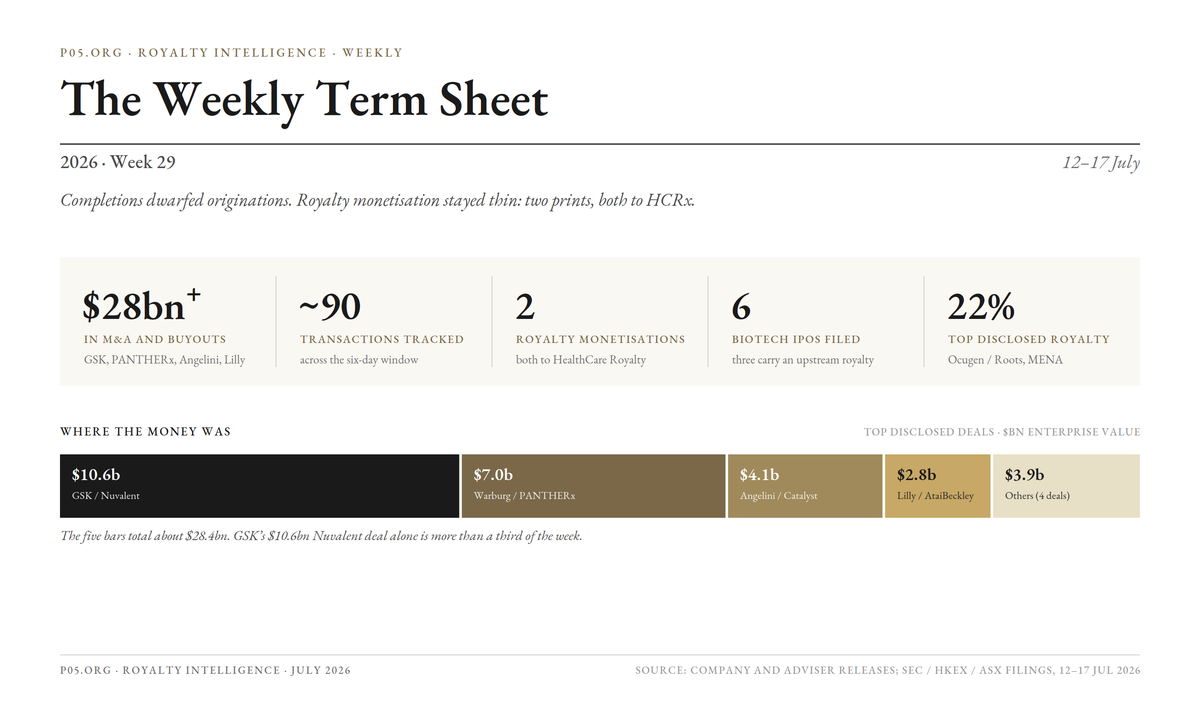
The week in numbers
Six days, July 12 to 17 of W29. The headline is Lilly's roughly $2.8B (up to $3.8B with CVRs) acquisition of AtaiBeckley for its psychedelic depression pipeline, announced July 16. The largest prints are completions, not originations: GSK / Nuvalent ($10.6B), Angelini / Catalyst ($4.1B), and Medtronic / SPR ($650M).
Royalty-relevant origination sits midweek and on July 17, led by Mission Therapeutics' USP30 kidney-asset divestment to Dimerix (up to about $292M, 8% to 10% royalty retained) and two structured-finance facilities (Inhibrx / Oxford to $500M, Mighty / K2 to $150M).
Royalty monetisation was thin but not zero: HCRx appears twice, in the Spero non-recourse financing and in its purchase of excess suprachoroidal royalties out of Clearside's Chapter 11, with no other secondary stream purchase in the window.
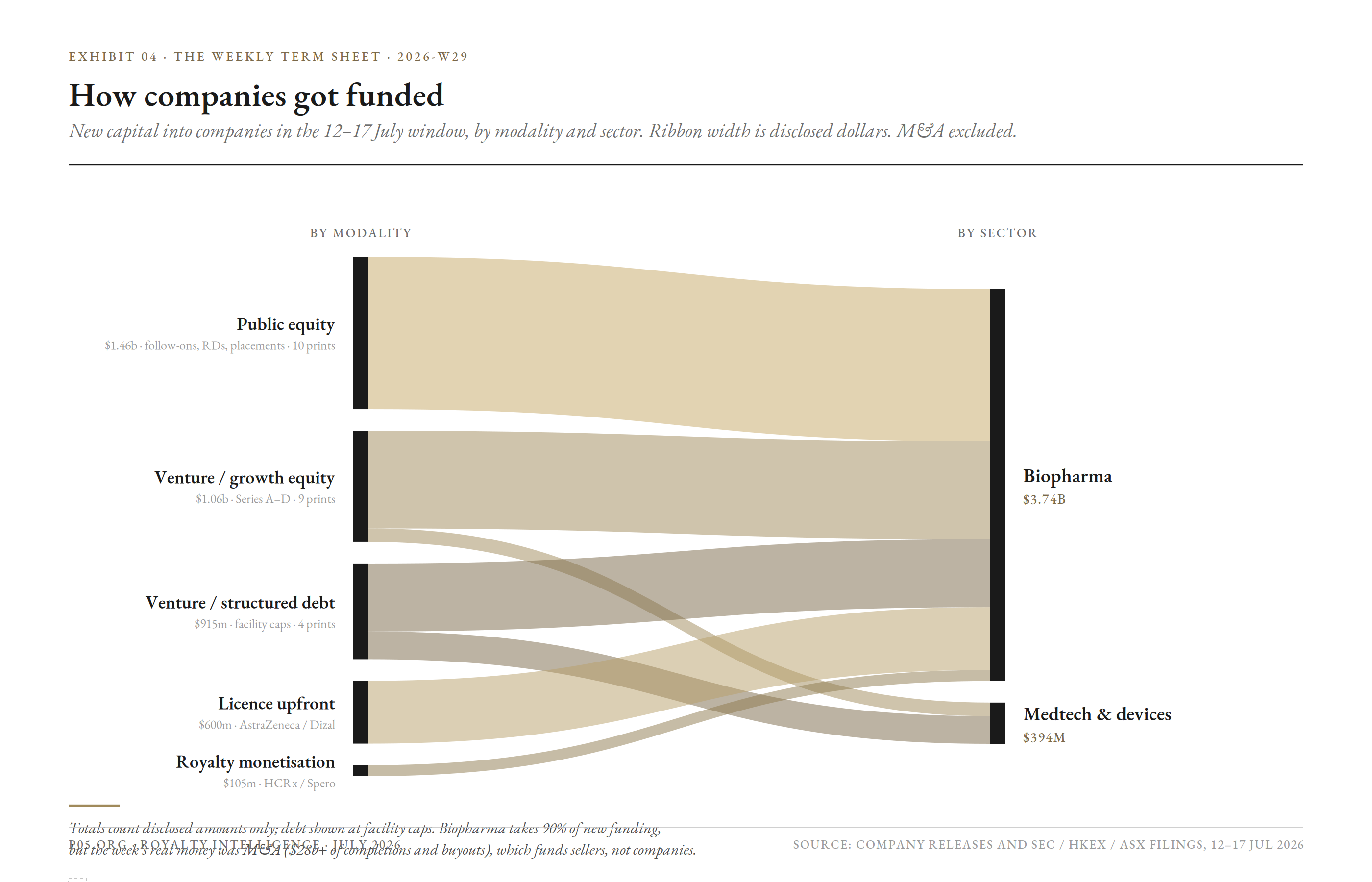
Highlights:
- Deal of the week: Lilly / AtaiBeckley. $6.75/share cash (about $2.8B) plus up to $2.50 in CVRs (about $3.8B all-in), roughly 40% premium, for the BPL-003 and VLS-01 psychedelic TRD pipeline; 16 Jul.
- M&A: 6 completions. GSK / Nuvalent ($10.6B), Angelini / Catalyst ($4.1B), Medtronic / SPR ($650M medtech), Ligand / XOMA ($739M), Servier / Edgewise ($1.55B), ARCHIMED / Esperion ($962M plus CVR).
- Largest announced deal: PANTHERx Rare. Warburg Pincus, with ADIA, to acquire the rare-disease specialty pharmacy for about $7B including debt (13 Jul); services and distribution, no royalty travels, flagged for completeness.
- Jasper / Kira (16 Jul). All-stock recap: $132M placement, KP-301 and KP-402 out-licence to Mirador ($12M upfront), and a $30M briquilimab PRV CVR.
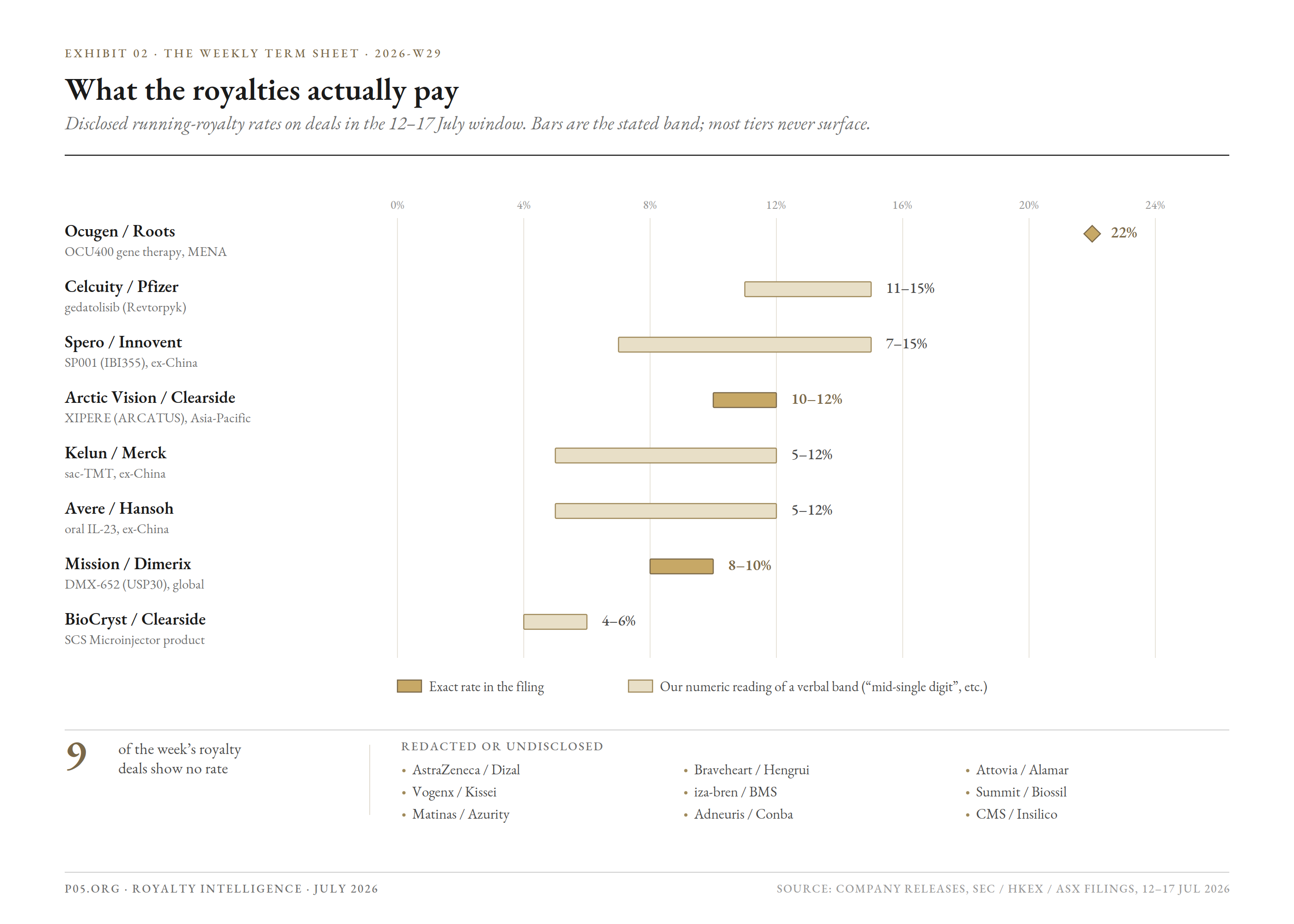
- Out-licences: 6 scored. AstraZeneca / Dizal (Zegfrovy, $600M upfront) plus a China-out cluster (Spero, Avere, Adneuris, CMS, Ocugen at 22% MENA royalty); Chai / Novartis and Insilico / Bora flagged.
- Structured finance: 5. HCRx / Spero ($105M royalty-backed), Inhibrx / Oxford (to $500M), Mighty / K2 (to $150M), Kestra / Pharmakon (to $200M), THINK Surgical / Symbiotic (to $65M).
- Retained-economics divestments: 4. Matinas / Azurity, Summit / Biossil, and Mission / Dimerix (USP30 AKI, up to about $292M, 8% to 10% royalty), plus Patrys / Yale (deoxymab IP assigned for a retained 50% of all future commercialisation revenue).
- Milestones and first approvals. UCB / Antengene ($60M booked), VivoSim / Lilly ($5M); Celcuity / Revtorpyk fires a Pfizer royalty and Leqembi Iqlik a BioArctic milestone; Fabhalta, Lipfendra, and invobenitug are internally owned, no royalty.
- Clinical re-rates. Kelun / sac-TMT (ex-China royalty), iza-bren (BL-B01D1, second China approval, de-risks the ex-China BMS royalty), GSK / Jemperli, Ipsen / Iqirvo, Q32 / bempikibart, and five AAIC reads.
- ECM (context, dilutive). Erasca ($632.5M), Crescent (about $143.7M at close), REGENXBIO ($100M, priced 17 Jul), Alto ($100M), Agenus ($85M PIPE), Q32 ($200M), Inhibikase ($50M), plus Asia and ANZ prints GenFleet (about $60M H-share placement) and Starpharma (about A$32M entitlement offer).
- Medtech equity. Xenter ($58.25M), RapidPulse ($48M, Medtronic-led), Endo Tools ($23M), Trellis ($9M), TytoCare ($25M).
- Royalty and IP litigation. Sanofi (Translate Bio) v Moderna and Pfizer (mRNA-LNP); Arbutus and Genevant escalate v Pfizer and BioNTech (UPC and Canada) and book the first about $178M of Moderna settlement cash.
- Royalty intelligence. Kalshi / AppliedXL open CFTC-regulated prediction markets on Phase 3 and FDA catalysts, a public probability-of-success signal for royalty pricing.
- Royalty monetisations, thin but not zero. Two HCRx prints: the HCRx / Spero non-recourse financing, and HCRx's purchase of excess suprachoroidal royalties out of Clearside's Chapter 11. No other secondary stream purchase, and no Royalty Pharma, Blackstone, Oberland, DRI, Sagard, OMERS, or Athyrium print.
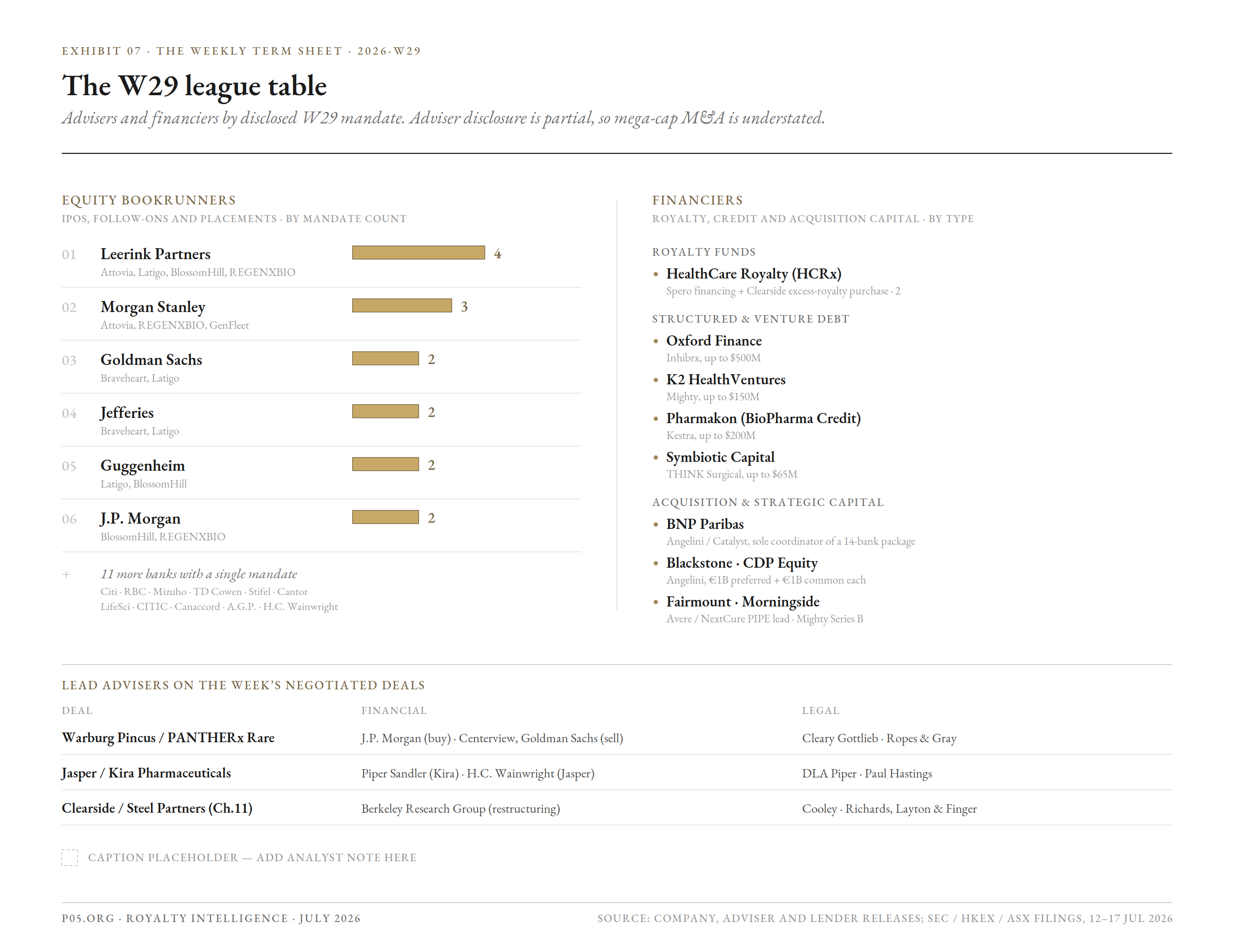
M&A and Restructuring
Lilly / AtaiBeckley: $2.8B Cash Plus Up to $1.0B in CVRs for a Psychedelic TRD Pipeline (Thu July 16)
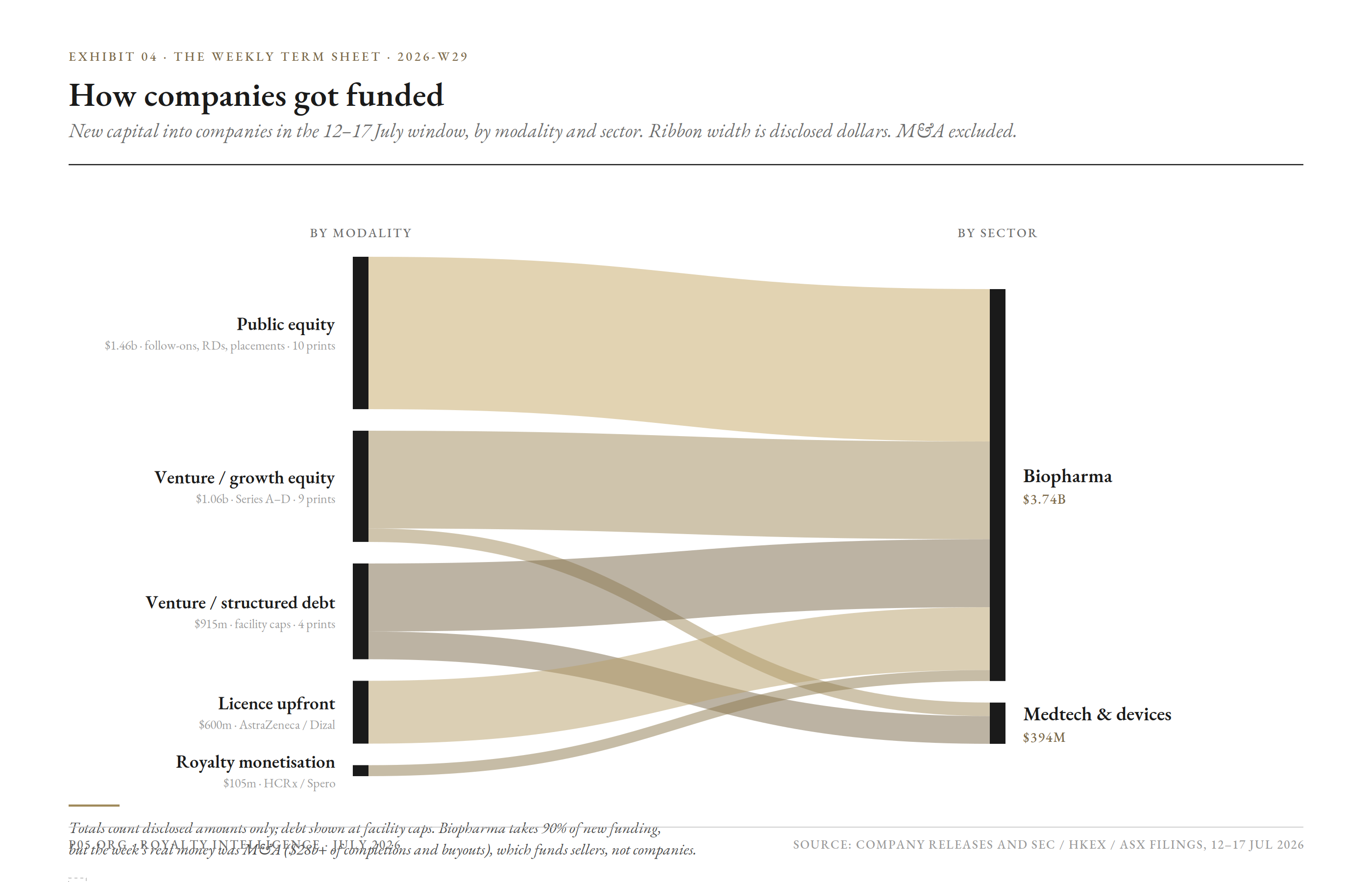
Eli Lilly (NYSE: LLY) agreed to acquire AtaiBeckley (Nasdaq: ATAI), the clinical-stage mental-health company formed from atai Life Sciences and Beckley Psytech, in the largest print of the window (AtaiBeckley release).
Lilly will pay $6.75 per share in cash at closing, an aggregate equity value of about $2.8B, plus a contingent value right of up to $2.50 per share (about $1.0B more, roughly $3.8B all-in). The cash consideration is a premium of about 40% to AtaiBeckley's 30-day volume-weighted average price through July 15. The CVR pays in three regulatory-gated tranches: $1.00 on initiation of a VLS-01 Phase 3 before the fourth anniversary of closing, $0.50 on US approval and DEA rescheduling of BPL-003 before the fifth, and $1.00 on US approval and DEA rescheduling of VLS-01 before the seventh.
The pipeline is built on rapid-acting neuroplastogens. Lead asset BPL-003 (mebufotenin benzoate) is an intranasal synthetic 5-MeO-DMT for treatment-resistant depression, carrying FDA Breakthrough Therapy Designation with Phase 3 activities initiated; VLS-01 is a DMT buccal film in Phase 2b, and EMP-01 ((R)-MDMA) is in Phase 2 for social anxiety.
The commercial logic is a competitive read on Johnson and Johnson's Spravato (esketamine), the dominant approved TRD option. In its Phase 2b, BPL-003 delivered statistically significant improvement in treatment-resistant depression as early as day two, sustained through day 57, with most patients ready for discharge within about 90 minutes, well inside the roughly two-hour post-dose monitoring that Spravato requires. That shorter in-clinic burden is the crux of the thesis: BPL-003 can slot into the interventional-psychiatry infrastructure already built around Spravato rather than requiring a new one.
The deal carries no financing condition and is expected to close in the third quarter, subject to an AtaiBeckley stockholder vote and regulatory clearances; Apeiron Investment Group and all directors and officers, about 15% of shares, have signed support agreements.
For structuring watchers the notable feature is the CVR itself: two of its three tranches are gated on DEA rescheduling, not just FDA approval, an unusually explicit controlled-substance milestone for a psychedelics asset and a template worth noting for future interventional-psychiatry deals. No running royalty travels.
- Acquirer: Eli Lilly (NYSE: LLY)
- Target: AtaiBeckley (Nasdaq: ATAI); interventional psychiatry (atai Life Sciences plus Beckley Psytech)
- Structure: All-cash merger at $6.75 per share (about $2.8B equity value) plus a CVR of up to $2.50 per share (about $1.0B; about $3.8B all-in); about 40% premium to the 30-day VWAP through July 15; no financing condition; expected close Q3 2026 subject to ATAI vote and regulatory clearance
- CVR ladder: $1.00 (VLS-01 Phase 3 initiation, under four years), $0.50 (BPL-003 US approval and DEA rescheduling, under five years), $1.00 (VLS-01 US approval and DEA rescheduling, under seven years)
- Assets: BPL-003 (intranasal 5-MeO-DMT, TRD, Breakthrough Therapy, Phase 3 initiated); VLS-01 (DMT buccal film, Phase 2b); EMP-01 ((R)-MDMA, Phase 2, social anxiety)
- Advisers: Goldman Sachs (financial) and Ropes & Gray (legal) to Lilly; Moelis and Centerview (financial) and Latham & Watkins (legal) to AtaiBeckley, with Citi advising the ATAI board
- Royalty: None; contingent value is milestone-based, not a running royalty
- Date: Announced Thu July 16, 2026
GSK / Nuvalent: $10.6B All-Cash Acquisition Closed, the Window's Largest Print by Value (Wed July 15)
GSK (LSE/NYSE: GSK) completed its acquisition of Nuvalent (Nasdaq: NUVL) in an all-cash tender-offer merger at $124.00 per share, a deal first announced on June 9, 2026 (GSK release).
Aggregate equity value is about $10.6B (£8.0B), or about $9.4B (£7.1B) net of Nuvalent's cash. The tender expired at 11:59pm ET on July 14 with about 91.3% of shares tendered, and Nuvalent delisted on July 15. This is a completion within the window of a deal originated in June, not a new origination, and it is the largest print of W29 by headline value. It brings GSK a targeted-oncology franchise in ROS1 and ALK-positive lung cancer: zidesamtinib (ROS1-positive NSCLC, PDUFA September 18, 2026), neladalkib (ALK-positive NSCLC), and NVL-330 (HER2-altered NSCLC, Phase 1). The consideration is entirely cash; no CVR or milestone travels.
- Acquirer: GSK (LSE/NYSE: GSK)
- Target: Nuvalent (Nasdaq: NUVL); ROS1 and ALK-selective targeted oncology
- Structure: All-cash tender-offer merger at $124.00 per share; about $10.6B equity value (about $9.4B net of cash); no CVR or milestone; announced June 9, closed July 15, 2026
- Assets: zidesamtinib (ROS1-positive NSCLC, PDUFA Sept 18, 2026), neladalkib (ALK-positive NSCLC), NVL-330 (HER2-altered NSCLC, Phase 1)
- Royalty: None; all-cash acquisition, no stream travels
- Date: Closed Wed July 15, 2026 (announced June 9, 2026)
Angelini Pharma / Catalyst Pharmaceuticals: $4.1B All-Cash Acquisition Closed (Thu July 16)
Angelini Pharma (privately held, Rome; part of Angelini Industries) completed its acquisition of Catalyst Pharmaceuticals (Nasdaq: CPRX), a US commercial-stage rare-disease and brain-health company, at $31.50 per share in cash, about $4.1B (about EUR 3.5B) equity value (Angelini release).
Announced May 7 and closed July 16, this is a completion, not a new origination, and Catalyst shares ceased trading on Nasdaq. The final terms are all cash, at a 21% premium to the April 22 unaffected close; an earlier March non-binding proposal ($27.00 plus a $1.50 CVR) was superseded by the higher straight-cash price, so no CVR travels.
It is Angelini's entry into the US market and brings Catalyst's in-licensed rare-disease portfolio: FIRDAPSE (amifampridine, Lambert-Eaton myasthenic syndrome), FYCOMPA (perampanel, epilepsy), and AGAMREE (vamorolone, Duchenne muscular dystrophy).
The buy-side financing is itself notable: funds managed by Blackstone are investing about EUR 1B in Angelini Pharma preferred equity (subject to regulatory clearance), and CDP Equity approved about EUR 1B for a 23.5% common-equity stake via a capital increase; BNP Paribas was sole global coordinator and underwriter of the financing, and Morgan Stanley advised Angelini.
Catalyst's model is built on in-licensed products, so upstream royalty and milestone obligations on FIRDAPSE, AGAMREE, and FYCOMPA now sit with Angelini; those streams are the royalty read-through worth tracking.
- Acquirer: Angelini Pharma (private; Rome; Angelini Industries)
- Target: Catalyst Pharmaceuticals (was Nasdaq: CPRX); US rare-disease and brain-health, commercial-stage
- Structure: All-cash merger at $31.50 per share, about $4.1B (about EUR 3.5B) equity value; 21% premium to the April 22 unaffected close; no CVR (the March $27.00 plus $1.50 CVR proposal was superseded); announced May 7, closed July 16, 2026
- Buy-side financing: Blackstone about EUR 1B preferred equity (subject to clearance); CDP Equity about EUR 1B for 23.5% of Angelini via capital increase; BNP Paribas sole global coordinator and underwriter; Morgan Stanley financial adviser to Angelini
- Assets: FIRDAPSE (amifampridine, LEMS), FYCOMPA (perampanel, epilepsy), AGAMREE (vamorolone, DMD)
- Royalty: Upstream in-licence royalty and milestone obligations on Catalyst's products transfer to Angelini; read-through worth tracking
- Date: Closed Thu July 16, 2026 (announced May 7, 2026)
Ligand / XOMA Royalty: $739M Aggregator Acquisition Closed, Portfolio Now 200-Plus Royalties (Tue July 14)
Ligand Pharmaceuticals (Nasdaq: LGND) completed its acquisition of XOMA Royalty Corporation, a biotechnology royalty aggregator, for $39.00 per share in cash (about $739M total equity value), plus one non-transferable CVR per share tied to a portion of 75% of net proceeds from certain pending XOMA litigation (Ligand release).
This is the close of a deal announced in April 2026 (covered in W18) and financed in June by Ligand's $625M zero-coupon convertible notes (W26), not a new origination. XOMA common stock ceased trading on Nasdaq on close.
The acquisition roughly doubles Ligand's portfolio to more than 200 commercial, clinical, and preclinical royalty assets. It adds seven commercial products, including Roche's VABYSMO (faricimab-svoa), Servier's OJEMDA (tovorafenib), and Zevra's MIPLYFFA (arimoclomol); 14 late-stage programmes, including Takeda's mezagitamab, osavampator, volixibat, and OHB-607; and more than 100 development assets.
Ligand expects the deal to be immediately accretive, adding about $0.50 and $1.50 to adjusted EPS in 2026 and 2027, and will give an updated five-year outlook at its December 8, 2026 Investor Day.
- Acquirer: Ligand Pharmaceuticals (Nasdaq: LGND; royalty aggregator; CEO Todd Davis)
- Target: XOMA Royalty Corporation (royalty aggregator; delisted from Nasdaq on close)
- Structure: All-cash acquisition; $39.00 per share (about $739M total equity value), plus one non-transferable CVR per share (a portion of 75% of net proceeds from certain pending XOMA litigation)
- Portfolio added: seven commercial products (Roche VABYSMO, Servier OJEMDA, Zevra MIPLYFFA, and others), 14 late-stage programmes (Takeda mezagitamab, osavampator, volixibat, OHB-607), plus 100-plus development assets; Ligand now holds 200-plus royalty assets
- Accretion: about $0.50 (2026) and $1.50 (2027) to adjusted EPS; updated five-year outlook at the December 8, 2026 Investor Day
- Prior coverage: announced April 2026 (W18); financed via Ligand's $625M zero-coupon convertible notes, June 2026 (W26)
- Advisers: Ligand: Stifel (lead) and Citi (financial), Paul Hastings (legal). XOMA: Leerink Partners (lead) and H.C. Wainwright (financial), Gibson Dunn (legal)
- Timeline: announced April 2026; closed July 14, 2026
- Date: Completion Tue July 14, 2026
Servier / Edgewise Therapeutics: $1.55B Cash Muscular Dystrophy Acquisition Closed, Up to $2.65B With Milestones (Mon July 13)
Servier, the foundation-governed French group, completed its acquisition of the muscular dystrophy business of Edgewise Therapeutics (Nasdaq: EWTX), including the fast skeletal myosin inhibitor sevasemten, for $1.55B in upfront cash plus up to $1.1B in regulatory and commercial milestones, up to about $2.65B total (Servier release; Edgewise 8-K exhibit).
The transaction was announced June 1, 2026 and closed July 13, following regulatory clearance and customary closing conditions, so the July 13 print is a completion rather than a fresh origination. On close, Servier takes all rights to sevasemten, related intellectual property, know-how, key agreements, regulatory filings, and clinical data, and Edgewise employees primarily supporting the muscular dystrophy business receive comparable offers at Servier to preserve continuity.
Sevasemten is an orally administered, potentially first-in-class fast skeletal myosin inhibitor designed to protect unstable muscle against contraction-induced damage. It is in a pivotal cohort in Becker muscular dystrophy (BMD) and in Phase 2 in Duchenne muscular dystrophy (DMD), and carries FDA Orphan Drug (BMD and DMD), Rare Pediatric Disease (DMD), and Fast Track designations, plus EMA Orphan Drug status. If approved, it would be the first therapy indicated for BMD.
No external running royalty travels: sevasemten was discovered in-house on Edgewise's platform, so the acquisition creates no third-party stream.
What it does create is an Edgewise receivable: up to $1.1B in regulatory and commercial milestones payable by Servier, the next of which sits on the BMD pivotal readout and first approval. Following the close, Edgewise becomes a cardiovascular-focused company (EDG-7500 in hypertrophic cardiomyopathy, EDG-15400 in HFpEF, EDG-003 undisclosed), with the $1.55B upfront positioned to fund EDG-7500 through potential approval.
- Acquirer: Servier (Suresnes, France; independent international group governed by a foundation)
- Target: Edgewise Therapeutics (Nasdaq: EWTX; Boulder, CO), muscular dystrophy business only
- Structure: Business acquisition; $1.55B upfront cash on close plus up to $1.1B in regulatory and commercial milestones (up to about $2.65B total); no CVR beyond the milestone ladder
- Asset: Sevasemten: oral fast skeletal myosin inhibitor; pivotal cohort in BMD, Phase 2 in DMD; Orphan Drug (BMD, DMD), Rare Pediatric Disease (DMD), Fast Track; EMA Orphan Drug
- Royalty: No external running royalty travels; sevasemten homegrown on the Edgewise platform. The $1.1B milestone ladder is an Edgewise receivable from Servier
- Edgewise post-close: Cardiovascular focus (EDG-7500, EDG-15400, EDG-003); upfront funds EDG-7500 toward approval
- Timeline: Announced June 1, 2026; closed July 13, 2026
- Date: Completion Mon July 13, 2026
ARCHIMED / Esperion Therapeutics: $962M Cash Take-Private (Up to $1.1B With CVR) on a Twice-Monetised Royalty Stack (Mon July 13)
ARCHIMED, the healthcare-focused private-equity firm, completed the take-private of Esperion Therapeutics (formerly Nasdaq: ESPR), the Ann Arbor cardiometabolic company behind the bempedoic acid franchise Nexletol and Nexlizet (ARCHIMED release).
The deal, announced late April and closed July 13, 2026, pays $3.16 per share in cash (a 58% premium to the April 30 close) plus a non-tradeable contingent value right worth up to $100M in aggregate, tied to future net-sales performance, for equity value of about $962M in cash, up to about $1.1B assuming full CVR achievement.
Esperion reported $403M of net revenue in 2025; CEO Sheldon Koenig and team stay on. The acquisition vehicle is ARCHIMED's MED Platform II fund; unitranche debt was provided by Pharmakon Advisors.
This is the richest royalty item of the window, because ARCHIMED does not simply inherit a clean franchise. It inherits a twice-monetised, reversionary royalty stack across two ex-US territories, and the reversionary interests are the assets that actually transfer.
Europe (Daiichi Sankyo Europe, monetised to OMERS). Daiichi Sankyo Europe holds exclusive commercialisation rights to bempedoic acid in Europe (marketed as Nilemdo and Nustendi), with Esperion entitled to tiered royalties of 15% to 25% on European net sales.
In June 2024 Esperion sold 100% of that royalty interest (subject to a cap) to OMERS Life Sciences for $304.7M upfront (Esperion 8-K).
OMERS collects the 15% to 25% royalty until it reaches 1.7x its investment, after which the European royalty reverts to Esperion, and now to ARCHIMED. Esperion separately retained up to $300M of potential future European commercial milestones from Daiichi Sankyo.
Japan (Otsuka, monetised to Athyrium). Otsuka holds exclusive Japanese rights under an April 2020 licence (Otsuka received Japanese approval for Nexletol in September 2025).
In April 2026 Esperion sold 100% of its Japan royalty interest, plus related milestones (subject to a cap), to Athyrium Capital for $50M (Esperion and Athyrium release).
Athyrium receives tiered royalties of 12% to 33% on Otsuka's Japan net sales from January 1, 2026 until it reaches 2.0x its investment, after which the Japan royalty reverts to Esperion, and now to ARCHIMED.
So the running product royalties on both ex-US legs currently sit with OMERS (Europe) and Athyrium (Japan), not with the target. What ARCHIMED acquires on those legs is the reversionary tail behind each aggregator's return cap, plus the retained Daiichi Sankyo European milestone ladder, plus 100% of US product economics (Nexletol and Nexlizet, US-marketed by Esperion directly), plus Enbumyst (bumetanide nasal spray, added March 2026 via the Corstasis acquisition).
A textbook case for this publication: a public-to-private where the visible royalty legs have already been sold forward and the buyer is underwriting the reversion.
- Acquirer: ARCHIMED (healthcare private equity; MED Platform II fund; $15B AUM; Partner Justin Bateman)
- Target: Esperion Therapeutics (formerly Nasdaq: ESPR; Ann Arbor, MI; delisted on close)
- Structure: Take-private; $3.16 per share cash (58% premium to April 30 close), about $962M cash equity value, plus a non-tradeable CVR of up to $100M tied to net-sales milestones (up to about $1.1B with the CVR); unitranche debt from Pharmakon Advisors
- Assets: Nexletol and Nexlizet (bempedoic acid and the ezetimibe combination); Enbumyst (bumetanide nasal spray, added via Corstasis, March 2026); $403M 2025 net revenue
- Royalty (Europe): Daiichi Sankyo Europe commercialises; 15% to 25% tiered royalty was sold to OMERS for $304.7M (June 2024), reverting to Esperion, now ARCHIMED, once OMERS reaches 1.7x; up to $300M of Daiichi Sankyo European milestones retained by the target
- Royalty (Japan): Otsuka commercialises; 12% to 33% tiered royalty plus milestones sold to Athyrium for $50M (April 2026), reverting to Esperion, now ARCHIMED, once Athyrium reaches 2.0x
- Read-through: No running ex-US product royalty travels to ARCHIMED today (held by OMERS and Athyrium to their caps); ARCHIMED acquires the reversionary tails plus US economics and retained European milestones
- Timeline: Announced late April 2026; closed July 13, 2026
- Date: Completion Mon July 13, 2026
Jasper Therapeutics / Kira Pharmaceuticals: All-Stock Merger With a $132M Private Placement, a Mirador Out-Licence, and a PRV-Linked CVR (Thu July 16)
Jasper Therapeutics (Nasdaq: JSPR) completed an all-stock acquisition of Kira Pharmaceuticals, a former Cayman complement-therapy company, and recapitalised the combined business around immunology (Jasper release; GlobeNewswire).
This is a three-part transaction. First, the merger: all of Kira's equity was exchanged for a combination of Jasper common stock and non-voting convertible preferred stock, with each preferred share converting into 61 common shares subject to a Jasper stockholder vote.
Second, a concurrent $132M private placement of about 4.7 million preferred shares, co-led by Affinity Asset Advisors and Ikarian Capital, with Columbia Threadneedle, Sirenia Capital, Brahma Capital, Balyasny, SilverArc, Squadron, Nazare Partners, and Mirador Therapeutics among the participants; the placement is expected to close July 20.
Third, the royalty-relevant leg: Kira out-licensed KP-301 (a long-acting anti-C5a monoclonal antibody) and KP-402 (a small-molecule C5a receptor antagonist) to Mirador Therapeutics for $12M on signing plus development and sales milestones.
The combined company keeps the JSPR ticker and concentrates on KP-104 (vensobafusp alfa, a bifunctional complement inhibitor for paroxysmal nocturnal haemoglobinuria and rare renal indications), briquilimab (the anti-KIT antibody, in severe combined immunodeficiency and mast-cell disease), and KP-701 (a preclinical anti-CD79BxCD32B bispecific).
Pro-forma cash, including the placement and the Mirador upfront but excluding milestones, is expected to fund operations through the second half of 2028.
For structuring watchers there are two royalty-shaped features. The Mirador out-licence is a milestone-and-royalty stream on two shed assets, letting the combined company monetise non-core molecules while it focuses capital on the retained pipeline.
And each pre-close Jasper common holder receives a non-transferable CVR entitled to an aggregate $30M tied to Jasper obtaining a priority review voucher for briquilimab by December 31, 2028, payable only on monetisation of the CVR or on an acquisition of the combined company after the PRV is received.
The PRV-linked CVR is the template worth noting: it converts a regulatory voucher, itself a saleable asset, into a defined contingent payout ring-fenced for legacy holders. Ownership splits roughly 6.68% legacy Jasper, 49.86% Kira, and 43.46% placement investors on a fully-diluted, as-converted basis, about 653.6 million shares in total.
- Acquirer: Jasper Therapeutics (Nasdaq: JSPR); combined company retains the JSPR ticker
- Target: Kira Pharmaceuticals (former Cayman complement-therapy company)
- Structure: All-stock merger; Kira equity exchanged for Jasper common and non-voting convertible preferred (each preferred converts into 61 common, subject to a Jasper stockholder vote)
- Concurrent financing: $132M private placement of about 4.7M preferred shares, co-led by Affinity Asset Advisors and Ikarian Capital (Columbia Threadneedle, Sirenia Capital, Brahma Capital, Balyasny, SilverArc, Squadron, Nazare Partners, and Mirador among participants); expected to close July 20, 2026
- Out-licence (royalty leg): Kira out-licensed KP-301 (long-acting anti-C5a mAb) and KP-402 (small-molecule C5a receptor antagonist) to Mirador Therapeutics for $12M on signing plus development and sales milestones
- CVR: Non-transferable CVR to pre-close Jasper common holders for an aggregate $30M, tied to a priority review voucher for briquilimab by December 31, 2028; payable only on CVR monetisation or on an acquisition after PRV receipt
- Pipeline: KP-104 (vensobafusp alfa; PNH and rare renal), briquilimab (anti-KIT; SCID and mast-cell disease), KP-701 (preclinical anti-CD79BxCD32B bispecific)
- Ownership and runway: about 6.68% legacy Jasper / 49.86% Kira / 43.46% placement investors, fully diluted (about 653.6M shares); pro-forma cash funds operations through the second half of 2028
- Advisers: Piper Sandler (financial) and DLA Piper (legal) to Kira; H.C. Wainwright (financial) and Paul Hastings (legal) to Jasper; Piper Sandler lead placement agent, LifeSci Capital co-placement agent
- Date: Announced Thu July 16, 2026 (private placement expected to close July 20, 2026)
Senti Biosciences / Celadon: Gene-Circuit Pipeline (SENTI-202) Carved Out for a Stockholder CVR of Up to $60M (Tue July 15)
Senti Biosciences Holdings (Nasdaq: SNTI) agreed to carve out its gene-circuit-enabled pipeline, including SENTI-202, into a new private company controlled by affiliates of Celadon Partners (its largest investor), in exchange for a contingent value right distributed to Senti equity holders (Senti release).
The CVR pays up to $60M over a seven-year period, tied to SENTI-202 development, regulatory, and commercial milestones (reported as $10M on BLA filing or acceptance, $20M on BLA approval, and $30M on $200M cumulative net sales).
Senti Holdings remains public with a streamlined structure, retaining its Regulator Dial controllable-genetic-medicines platform (the Retained Assets) and planning additional financing; the gene-circuit business (led by the logic-gated allogeneic CAR-NK SENTI-202 in AML) merges into the Celadon NewCo. The transaction follows Celadon's April 2026 convertible-note financing (up to $40M), after which Celadon could hold about 54.6% of Senti.
For structuring watchers this is a clean CVR carve-out: rather than sell or spin the asset for cash, the company hands shareholders a defined milestone-linked contingent instrument while shedding the burn, the same ring-fenced-CVR logic seen in the Jasper and ARCHIMED deals this week, applied to a divested pipeline rather than an acquisition.
- Divesting company: Senti Biosciences Holdings (Nasdaq: SNTI); retains the Regulator Dial platform, remains public
- Acquirer: NewCo controlled by affiliates of Celadon Partners (Senti's largest investor; potential about 54.6% holder)
- Structure: Carve-out and merger of the gene-circuit pipeline (including SENTI-202) into the Celadon NewCo; consideration is a stockholder CVR of up to $60M over seven years on SENTI-202 milestones ($10M BLA filing, $20M BLA approval, $30M on $200M cumulative net sales)
- Asset: SENTI-202: logic-gated (gene-circuit) allogeneic CAR-NK; AML
- Royalty relevance: None running; a milestone-linked CVR, tracked as a contingent-value structure
- Date: Announced Tue July 15, 2026 (agreement dated July 14)
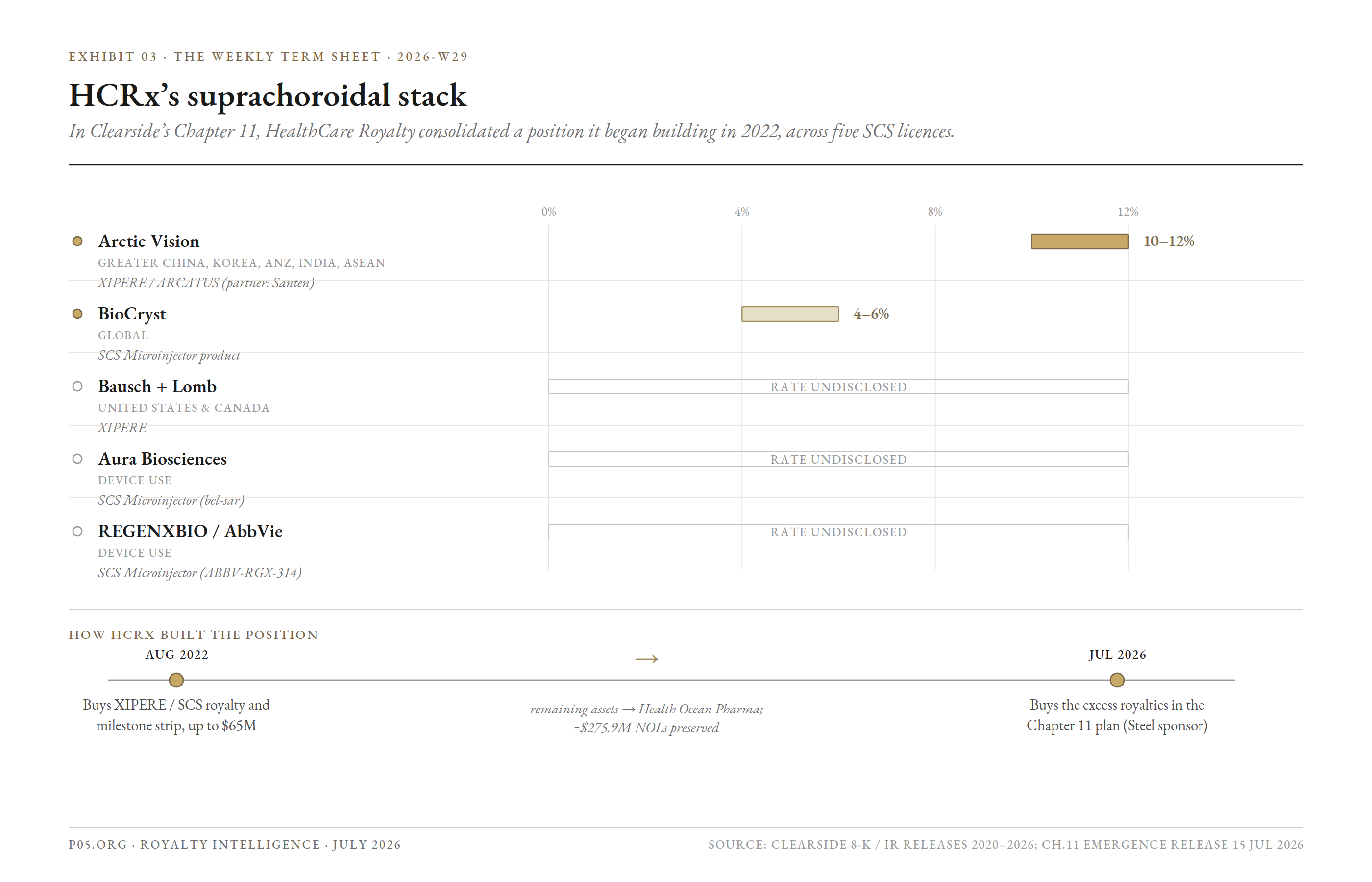
Clearside Biomedical / Steel Partners: Chapter 11 Emergence Funded by an HCRx Excess-Royalty Sale on the Suprachoroidal Estate (Effective mid-July)
Clearside Biomedical (formerly Nasdaq: CLSD) completed its financial restructuring and emerged from Chapter 11 with Steel Partners as plan sponsor, the plan having been confirmed July 1 and effective on the mid-July closing date (Clearside release).
The royalty content is the point here. Per the confirmed plan, the reorganisation is funded by three transactions: a sale of excess royalties to HealthCare Royalty Partners (HCRx), a sale of remaining assets to Health Ocean Pharma I Limited, and new equity from Steel Partners.
A Steel Partners affiliate took roughly 30% of the economics and about 80% of the voting power (as-converted, fully diluted) plus a $3M senior secured revolver, leaving a recapitalised, debt-free IP-holding vehicle around the SCS (suprachoroidal space) ocular-delivery platform, the SCS Microinjector, XIPERE, and five suprachoroidal licensing collaborations, with about $275.9M of federal NOLs preserved.
The important nuance for royalty underwriters is that HCRx is not new to this estate. Back in August 2022 HCRx bought a strip of Clearside's XIPERE and SCS Microinjector royalty and milestone rights for up to $65M (via a Clearside Royalty LLC purchase-and-sale structure), so the July 2026 sale of the residual, or excess, royalties consolidates more of the same estate into HCRx's book on distressed terms.
The underlying licence economics HCRx is now layered across: Arctic Vision (XIPERE as ARCATUS/ARVN001 in Greater China, South Korea, Australia, New Zealand, India, and ASEAN; commercial partner Santen) pays tiered royalties of 10% to 12% on net sales; BioCryst pays tiered mid-single-digit royalties on global net sales for an SCS Microinjector product ($5M upfront, up to $77.5M milestones); Bausch + Lomb holds US and Canada XIPERE rights ($20M of pre-launch payments plus sales milestones and royalties, rate undisclosed); and Aura Biosciences and REGENXBIO (with AbbVie) round out the five-collaboration SCS device franchise.
- Debtor / reorganised entity: Clearside Biomedical; IP-holding vehicle around the SCS suprachoroidal platform, SCS Microinjector, and XIPERE
- Plan sponsor: Steel Partners (about 30% economics, about 80% voting, plus a $3M senior secured revolver)
- Royalty buyer: HealthCare Royalty Partners (HCRx) purchased the excess royalties on the SCS estate, adding to a strip it first bought in August 2022 (up to $65M); remaining assets sold to Health Ocean Pharma I Limited
- Underlying rates HCRx now sits across: Arctic Vision 10% to 12% tiered (ARCATUS, ex-US Asia-Pacific, partner Santen); BioCryst tiered mid-single-digit (global, on an SCS Microinjector product); Bausch + Lomb US and Canada XIPERE (royalty rate undisclosed); plus Aura Biosciences and REGENXBIO/AbbVie SCS device collaborations
- Royalty relevance: A distressed royalty monetisation to HCRx (second in-window HCRx print) that consolidates a position dating to 2022; the surviving entity is a royalty-monetisation shell; about $275.9M of NOLs preserved
- Date: Plan confirmed July 1, 2026; emergence effective mid-July 2026
Warburg Pincus (with ADIA) / PANTHERx Rare: About $7B Rare-Disease Specialty-Pharmacy Buyout (Mon July 13)
A Warburg Pincus-led investor group, partnering with the Abu Dhabi Investment Authority (ADIA), agreed to acquire a controlling interest in PANTHERx Rare, a Pittsburgh rare-and-orphan-disease specialty pharmacy, for approximately $7B including debt (Warburg Pincus release).
The sellers are the General Atlantic, Nautic Partners, and Vistria consortium that bought PANTHERx from Centene in 2022. This is the window's second-largest healthcare deal by value, but it is a specialty-pharmacy dispensing, patient-support, and reimbursement business, not a drug-asset or royalty transaction, so no royalty, milestone, or CVR travels; it is included for completeness and flagged, in the same services-infrastructure bucket as the sheet's other non-royalty control deals. The one datapoint worth logging for royalty watchers is the buyer side: another PE-plus-sovereign (ADIA) pairing writing a large healthcare cheque, the same template as several 2026 deals.
- Acquirer: Warburg Pincus-led group with ADIA (Abu Dhabi sovereign)
- Target: PANTHERx Rare (private; Pittsburgh); rare and orphan-disease specialty pharmacy
- Structure: Controlling-interest acquisition, about $7B including debt; sellers General Atlantic, Nautic Partners, Vistria (2022 buyers from Centene)
- Royalty relevance: None; specialty-pharmacy services and distribution, no product economics; flagged for completeness, scope-perimeter (services)
- Date: Announced Mon July 13, 2026
Black Pearl Equities / Selectis Health: Post-Acute and Senior-Care Acquisition (Mon July 13)
Black Pearl Equities agreed to acquire Selectis Health, Inc., a provider of skilled nursing, assisted and independent living, post-acute care, and continuing-care retirement services. Terms were not disclosed in the sources reviewed in the window.
It is included for completeness as a healthcare-services control transaction. It is not a product-asset deal, carries no royalty, milestone, or contingent-value leg, and no stream travels. The feed carried this twice (as "Black Pearl" and "Black Pearl Equities"); it is a single transaction.
- Acquirer: Black Pearl Equities
- Target: Selectis Health, Inc.; skilled nursing, assisted and independent living, post-acute and continuing-care services
- Structure: Control acquisition; terms not disclosed
- Royalty: None; healthcare-services M&A, no product economics
- Date: Mon July 13, 2026
Matinas BioPharma / Azurity Pharmaceuticals: Sub-$50M MAT2203 Sale Carrying an Upstream Royalty Stack (Mon July 13)
Matinas BioPharma (NYSE American: MTNB) agreed to sell its subsidiary Matinas BioPharma Nanotechnologies, including the oral antifungal MAT2203 and the lipid-nanocrystal (LNC) delivery platform, to Azurity Pharmaceuticals (Matinas Form 425 and 8-K).
Matinas receives $4M at closing (subject to downward adjustment for indebtedness) and is eligible for up to a further $17.5M in milestones (up to $21.5M total), plus mid-single-digit royalties to Matinas on MAT2203 net sales and certain licensing proceeds. The agreement was announced on July 13, alongside two financing transactions that had closed July 10; close of the Azurity sale is expected in Q4 2026.
MAT2203 is an oral (encochleated) formulation of amphotericin B for invasive fungal infections.
The deal carries a disclosed upstream royalty stack. Under royalty-rights certificates issued to former Matinas Series A preferred holders, those holders are entitled in aggregate to 7.5% of the amounts Matinas receives from Azurity (upfront, milestones, and royalties).
Separately, Matinas' remaining shell entered a reverse business combination with GH Power, a clean-energy company, announced the same day.
- Seller: Matinas BioPharma (NYSE American: MTNB); retains a mid-single-digit royalty on MAT2203 net sales
- Buyer: Azurity Pharmaceuticals; acquires MAT2203 and the LNC delivery platform
- Structure: Subsidiary and asset sale; $4M at closing (subject to indebtedness adjustment) plus up to $17.5M in milestones (up to $21.5M total) and mid-single-digit royalties to Matinas and certain licensing proceeds
- Asset: MAT2203: oral (encochleated) amphotericin B for invasive fungal infections
- Upstream royalty: Former Matinas Series A holders entitled to 7.5% in aggregate of amounts Matinas receives from Azurity, via royalty-rights certificates
- Related: Matinas' remaining shell in a reverse merger with GH Power (clean energy); Matinas equityholders to hold about 9% of the combined entity
- Timeline: Announced July 13, 2026; expected close Q4 2026
- Date: Announced Mon July 13, 2026
Summit Therapeutics / Biossil: Ridinilazole Divested for $0.5M Upfront (Up to $105M With Milestones), Tiered Royalty Retained by Summit (Tue July 14)
Summit Therapeutics (Nasdaq: SMMT) agreed to sell ridinilazole, an investigational Phase III precision antibiotic for Clostridioides difficile infection (CDI), to Toronto-based Biossil, Inc., an AI-native biopharma (Summit release).
Summit receives $500,000 upfront and is eligible for up to $104.5M in regulatory and commercial milestones (up to about $105M total), plus tiered royalties on net sales. The divestiture lets Summit concentrate on its oncology strategy and the anti-PD-1 and VEGF bispecific ivonescimab, while Biossil takes ridinilazole forward on its AI-native development platform.
Ridinilazole is a highly selective, microbiome-sparing antibiotic. Prior Phase III data (Ri-CoDIFy) showed numerical advantages over vancomycin on recurrence and microbiome preservation but did not reach statistical superiority on the primary endpoint, so a further trial is required for a marketing pathway. Development was previously supported by a BARDA contract of up to $62M.
Structurally this is the window's second sub-$50M-upfront, royalty-retaining divestiture, alongside Matinas / Azurity: the near-term cash sits far below the sub-$50M band, but Summit keeps a running tiered royalty on any future net sales, so a new Summit-held royalty leg is created behind Biossil's development.
- Seller / royalty holder: Summit Therapeutics (Nasdaq: SMMT); retains tiered royalties on ridinilazole net sales
- Buyer: Biossil, Inc. (Toronto; AI-native biopharma); acquires ridinilazole and takes over development
- Structure: Asset sale; $500,000 upfront plus up to $104.5M in regulatory and commercial milestones (up to about $105M) and tiered royalties to Summit
- Asset: Ridinilazole: selective, microbiome-sparing antibiotic; CDI; Phase III (Ri-CoDIFy missed statistical superiority on the primary endpoint; a further trial is required)
- Royalty: New royalty leg created; tiered royalties to Summit on Biossil net sales
- Context: Summit exits a pre-ivonescimab legacy asset; ridinilazole previously carried a BARDA contract of up to $62M
- Date: Tue July 14, 2026
Mission Therapeutics / Dimerix: DMX-652 (MTX652) AKI Asset Divested for $5M Upfront (Up to About $292M Total), 8% to 10% Tiered Royalty Retained by Mission (Fri July 17)
Mission Therapeutics (Cambridge, UK), a clinical-stage developer working on the USP30 mitophagy platform, divested MTX652 (renamed DMX-652 by the buyer), a Phase 2-ready selective USP30 inhibitor for acute kidney injury (AKI), to Dimerix (ASX: DXB), an Australian renal specialist (Mission release; Dimerix release).
Dimerix takes sole ownership and development control of the oral small molecule (composition-of-matter patent family to 2041, open US IND, approved Phase 2 protocol, initially targeting cardiac surgery-associated AKI).
Mission receives $5M upfront (within 30 days of signing) and up to about $287M in development and commercial milestones (up to about $292M total), plus retained tiered royalties of 8% to 10% on Dimerix's global net sales, or 2.5% to 5% on any third-party sub-licensee's net sales.
This is the cleanest royalty-bearing print of the July 17 session and the mirror of the Matinas and Summit divestments above: the seller sheds a non-core asset for a small upfront and a milestone ladder while retaining a defined running royalty, and uses the proceeds (here alongside a debt facility) to focus on its lead, in Mission's case the USP30 CNS programme MTX325 in Phase 1 for Parkinson's. Mission is the royalty holder, Dimerix the payer. Dimerix funded the upfront and Phase 2 via a loan facility and is negotiating up to a further AU$40M of non-dilutive funding.
- Seller / royalty holder: Mission Therapeutics (private; Cambridge, UK); retains 8% to 10% tiered royalties (2.5% to 5% on sub-licensee sales)
- Buyer / royalty payer: Dimerix (ASX: DXB); takes sole ownership and development control of DMX-652 for all indications
- Structure: Asset divestment; $5M upfront (within 30 days) plus up to about $287M in development and commercial milestones (up to about $292M total) and retained tiered royalties to Mission
- Asset: DMX-652 (MTX652): selective USP30 inhibitor; Phase 2-ready; AKI, initially cardiac surgery-associated AKI; open US IND, approved Phase 2 protocol; composition-of-matter patents to 2041
- Royalty: Existing-style retained royalty leg; 8% to 10% (Dimerix sales) or 2.5% to 5% (sub-licensee sales) to Mission
- Context: Mission redeploys to its lead USP30 CNS asset MTX325 (Phase 1, Parkinson's); Dimerix funded the upfront via a loan facility, up to a further AU$40M non-dilutive funding in negotiation
- Date: Announced Fri July 17, 2026
Zydus Lifesciences / Sterling Biotech: About $150M Fermentation-API Asset Acquisition (Wed July 15)
Zydus Lifesciences (BSE: 532321; NSE: ZYDUSLIFE) agreed to acquire select assets of Sterling Biotech, adding fermentation-based active-pharmaceutical-ingredient capacity and niche therapeutic capabilities, in a deal reported at about $150M (per trade press; to confirm against a Zydus exchange filing).
The figure is single-sourced and sits well above the roughly Rs 84 crore (about $10M) Sterling API transfer Zydus disclosed in 2024, so treat the $150M as provisional until a Regulation 30 filing confirms it. This is a vertical, supply-side asset acquisition rather than a product or royalty deal; no royalty leg travels.
- Acquirer: Zydus Lifesciences (BSE: 532321; NSE: ZYDUSLIFE)
- Target: select assets of Sterling Biotech; fermentation-based APIs and niche therapeutic capabilities
- Structure: Asset acquisition; reported about $150M (single-sourced, to confirm); announced July 15, 2026
- Royalty: None; API and supply-side asset deal
- Date: Announced Wed July 15, 2026 (figure to confirm)
Septa Pharmaceuticals / Bristol Myers Squibb Canada: CeeNU (Lomustine) Supply-Continuity Acquisition (Tue July 15)
Septa Pharmaceuticals, a Mississauga, Ontario specialty group, acquired CeeNU (lomustine) from Bristol Myers Squibb Canada, effective June 29, 2026 (Septa release).
CeeNU is an established oral nitrosourea alkylating agent used in certain brain tumours, including recurrent glioblastoma, and Hodgkin's lymphoma. The asset had sat on Health Canada's Tier 3 drug-shortages list, the highest-severity designation, after BMS filed a discontinuation notice in 2024, with no generic manufacturer stepping in, so this reads as a supply-continuity acquisition of an off-patent oncology brand rather than a conventional franchise purchase. Financial terms were not disclosed and no third-party royalty leg travels.
- Acquirer: Septa Pharmaceuticals (private; Mississauga, ON); specialty oncology and critical care
- Seller: Bristol Myers Squibb Canada
- Structure: Product (asset) acquisition; terms not disclosed; effective June 29, 2026
- Asset: CeeNU (lomustine): oral nitrosourea alkylating agent; brain tumours (including recurrent glioblastoma) and Hodgkin's lymphoma; off-patent, on Health Canada's Tier 3 shortage list
- Royalty: None; supply-continuity brand acquisition, no product royalty travels
- Date: Announced Tue July 15, 2026 (effective June 29, 2026)
Medtronic / SPR Therapeutics: $650M All-Cash Medtech Acquisition Closed for the SPRINT Peripheral Nerve Stimulation System (Thu July 16)
Medtronic (NYSE: MDT) completed its acquisition of SPR Therapeutics, a privately held Cleveland medtech company in temporary percutaneous peripheral nerve stimulation (PNS) for chronic and acute pain, for $650M in upfront cash (Medtronic release).
Announced May 20 and closed July 16, this is a completion rather than a fresh origination. SPR's FDA-cleared SPRINT PNS System delivers a short-term, 60-day percutaneous therapy (sustained relief up to three months) and joins Medtronic's Neuromodulation unit, filling a minimally invasive, non-opioid gap ahead of permanent spinal-cord-stimulation implants. Consideration is entirely cash; no CVR or milestone travels, and no royalty leg is created. It is one of a run of 2026 Medtronic tuck-ins (CathWorks, Scientia Vascular) and the largest medtech M&A in this window.
- Acquirer: Medtronic (NYSE: MDT); SPR joins the Neuromodulation unit (Neuroscience portfolio)
- Target: SPR Therapeutics (private; Cleveland); temporary percutaneous PNS for chronic and acute pain
- Structure: All-cash acquisition; $650M upfront; announced May 20, closed July 16, 2026; no CVR or milestone
- Asset: SPRINT PNS System: FDA-cleared 60-day percutaneous peripheral nerve stimulation; non-opioid, non-implant
- Royalty: None; all-cash medtech acquisition, no stream travels
- Date: Closed Thu July 16, 2026 (announced May 20, 2026)
Leica Biosystems (Danaher) / StatLab Medical Products: Anatomic-Pathology Consumables Acquisition (Mon July 14)
Leica Biosystems, the Danaher (NYSE: DHR) diagnostics operating company, agreed to acquire StatLab Medical Products, a McKinney, Texas manufacturer of pre-analytical and analytical histology consumables, from Linden Capital Partners and Audax Private Equity (Leica release).
StatLab supplies specimen-collection, tissue-processing, slide-preparation, and staining products across the anatomic-pathology workflow. The rationale is to pair StatLab's consumables with Leica's computational and AI-enabled pathology, standardising upstream specimen preparation as laboratories adopt AI-assisted cancer diagnostics. It is a sponsor exit for Linden and Audax; the deal is expected to close by the end of 2026, and financial terms were not disclosed.
- Acquirer: Leica Biosystems (Danaher operating company; NYSE: DHR); anatomic and computational pathology
- Target and sellers: StatLab Medical Products (McKinney, TX; anatomic-pathology consumables), sold by Linden Capital Partners and Audax Private Equity
- Structure: Acquisition; terms not disclosed; expected close by end 2026
- Rationale: Consumables plus Leica computational and AI pathology to standardise specimen preparation for cancer diagnostics
- Royalty: None; diagnostics-tools M&A, no product royalty
- Date: Announced Mon July 14, 2026
BIOTRONIK Neuro / Soin Neuroscience: Spinal-Cord-Stimulation Patent-Portfolio Acquisition (Tue July 15)
BIOTRONIK Neuro, the Lake Oswego division of medical-device group BIOTRONIK, acquired a portfolio of spinal cord stimulation (SCS) patents from Soin Neuroscience (Dayton, Ohio; founded by pain physician Dr Amol Soin) (BIOTRONIK release).
The patents cover SCS waveform design, adaptive programming, and machine-learning approaches to neuromodulation for chronic pain, intended to inform a next-generation SCS programme within BIOTRONIK Neuro's Prospera platform. The deal builds on a December 2025 research collaboration and is limited to the SCS intellectual property; Soin Neuroscience continues as an independent company. Financial terms were not disclosed. This is a patent-portfolio (IP) acquisition, the device-side analogue to the asset sales elsewhere in this section, though no running royalty was disclosed on the transferred IP.
- Acquirer: BIOTRONIK Neuro (Lake Oswego, OR; division of BIOTRONIK); neuromodulation
- Seller: Soin Neuroscience (Dayton, OH; founder Dr Amol Soin); remains independent
- Structure: IP (patent-portfolio) acquisition; terms not disclosed; builds on a December 2025 research collaboration on the Prospera SCS System
- Asset: SCS patents (waveform design, adaptive programming, machine-learning neuromodulation) for chronic pain
- Royalty: IP transfer; no running royalty disclosed on the transferred patents
- Date: Announced Tue July 15, 2026
Raintree / Spike Technologies: Agentic-AI-Voice Acquisition for Revenue-Cycle Automation (Tue July 15)
Raintree, a Chandler, Arizona EHR and practice-management platform for rehabilitation and physical-therapy providers (backed by Serent Capital), acquired Spike Technologies, a developer of agentic AI voice for healthcare (Raintree release).
The technology is embedded natively in Raintree's platform to automate payer calls, claim follow-ups, eligibility, and prior-authorisation, a step toward autonomous revenue-cycle management. It extends the AI-in-healthcare M&A thread that runs alongside the discovery-platform deals elsewhere in the issue. Financial terms were not disclosed; no royalty leg travels.
- Acquirer: Raintree (Chandler, AZ; rehabilitation and physical-therapy EHR and practice management; Serent Capital-backed)
- Target: Spike Technologies; agentic AI voice for healthcare revenue cycle and patient engagement
- Structure: Acquisition; terms not disclosed
- Royalty: None; healthcare-IT M&A
- Date: Announced Tue July 15, 2026
NextPlat / Pensacola-Area Pharmacy: $1.5M PharmcoRx Bolt-On (Tue July 15)
NextPlat (Nasdaq: NXPL) agreed to acquire an independent pharmacy near Pensacola, Florida for $1.5M in cash, expanding its PharmcoRx retail footprint into a rural market (NextPlat release).
The target generated about $5.6M in 2025 sales at roughly 19% retail margin and the deal is expected to close in Q4 2026. It is a small drug-retail bolt-on rather than a provider-network transaction; no royalty leg travels.
- Acquirer: NextPlat (Nasdaq: NXPL); PharmcoRx pharmacy and healthcare services
- Target: independent pharmacy near Pensacola, FL (about $5.6M 2025 sales, about 19% retail margin)
- Structure: Bolt-on acquisition; $1.5M cash; expected close Q4 2026
- Royalty: None; drug-retail M&A
- Date: Announced Tue July 15, 2026
Royalty-Bearing License-Outs and Collaborations
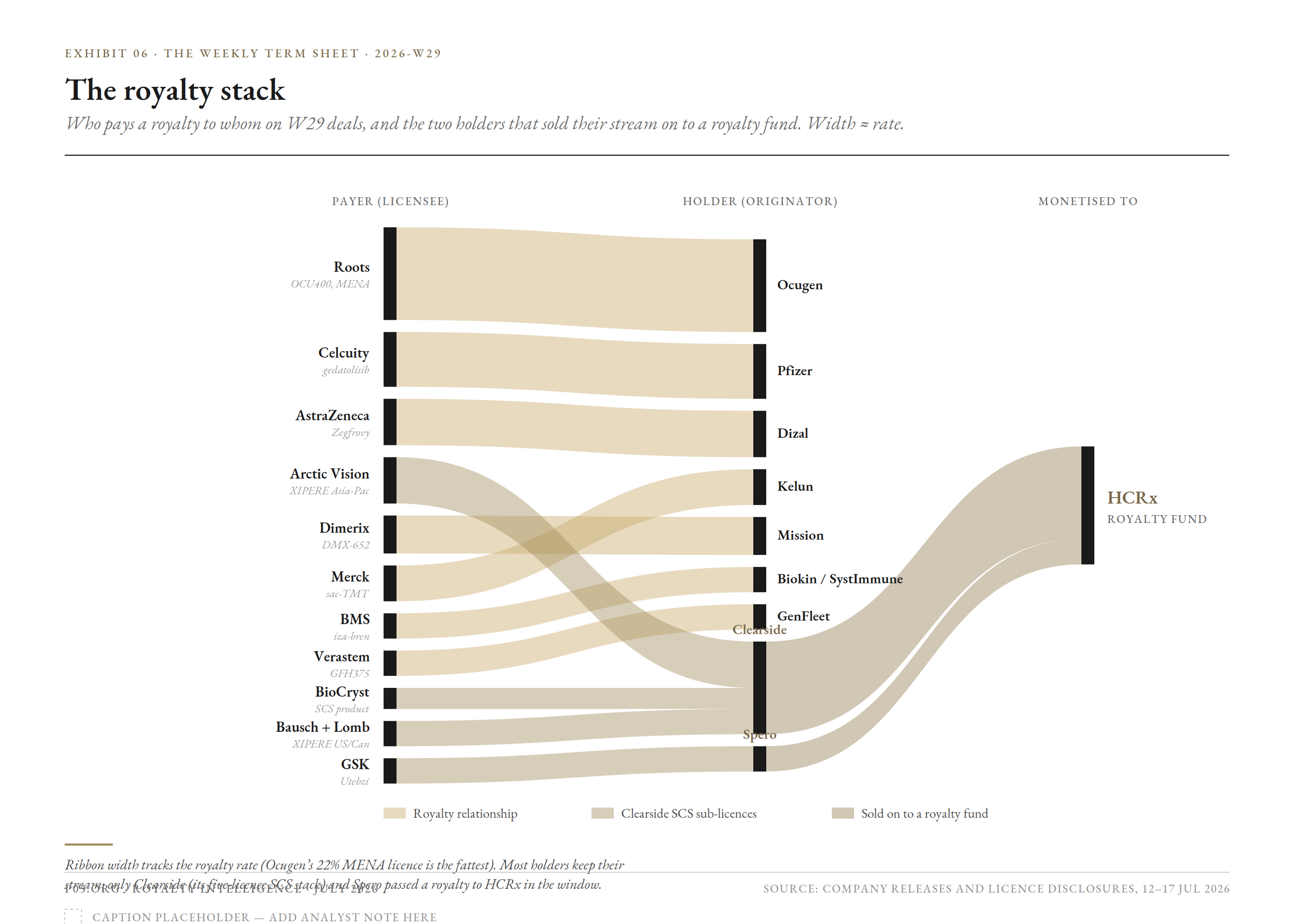
AstraZeneca / Dizal: Global Zegfrovy Licence on an Approved EGFR Inhibitor, Tiered Royalty to Dizal (Tue July 14)
AstraZeneca (LSE and Nasdaq: AZN) entered a global exclusive licence with Dizal (SSE: 688192; Jiangsu) for Zegfrovy (sunvozertinib), an oral irreversible EGFR inhibitor, taking worldwide rights to develop and commercialise the asset (Dizal release; Reuters).
AstraZeneca pays $600M upfront and up to $900M in development, regulatory, and sales milestones (up to about $1.5B total).
Dizal retains tiered royalties on global net sales. AstraZeneca's 6-K and the joint release disclose only "tiered royalties"; trade press (GEN) characterises them as tiered double-digit, so treat the double-digit read as reporting, not a filed figure. The transaction is expected to close in H2 2026, subject to customary conditions and regulatory clearances.
Zegfrovy is already approved in the US and China for locally advanced or metastatic NSCLC with EGFR exon 20 insertion mutations after platinum-based chemotherapy.
A first-line supplemental application is filed on the Phase 3 WU-KONG28 data (ASCO 2026; published in the New England Journal of Medicine). The asset holds Breakthrough Therapy designation in both markets.
Dizal was co-founded in part by AstraZeneca.
- Licensor / royalty holder: Dizal (SSE: 688192; Jiangsu, China); retains tiered royalty on global net sales
- Licensee: AstraZeneca (LSE and Nasdaq: AZN); worldwide development and commercialisation rights
- Structure: Global exclusive licence; $600M upfront plus up to $900M in development, regulatory, and sales milestones (up to about $1.5B total); tiered royalties to Dizal
- Asset: Zegfrovy (sunvozertinib): oral irreversible EGFR inhibitor; approved US and China in second-line NSCLC with EGFR exon 20 insertion mutations; first-line sBLA filed on WU-KONG28 Phase 3; Breakthrough Therapy (US and China)
- Royalty: Running tiered royalty retained by Dizal, live on an already-marketed asset; reported as double-digit (trade press), disclosed in filings only as "tiered"
- Context: China-out licence on an approved oncology asset; Dizal co-founded in part by AstraZeneca
- Timeline: Announced July 14, 2026; expected to close H2 2026
- Date: Tue July 14, 2026
Spero Therapeutics / Innovent Biologics: Ex-Greater China Anti-CD40L Licence, Tiered Royalty to Innovent (Tue July 14)
Spero Therapeutics (Nasdaq: SPRO) licensed SP001 (Innovent code IBI355), a third-generation Fc-silent anti-CD40L monoclonal antibody, from Innovent Biologics (HKEX: 01801), taking exclusive worldwide rights outside Greater China (Spero and Innovent release).
Innovent receives an upfront payment and is eligible for development, regulatory, and commercial milestones bringing total deal value to about $1.1B, plus tiered royalties on Spero's ex-Greater China net sales. The upfront is not separately disclosed.
SP001 is Phase 2-ready, with lead indications in IgG4-related disease and Sjögren's disease. The Phase 2-ready status rests on two healthy-volunteer Phase 1 trials run by Innovent (single ascending dose and multiple ascending dose) plus a Phase 1b multiple-ascending-dose study in Sjögren's patients, with the Phase 1b Sjögren's data presented at EULAR 2026. Spero plans a Phase 2 in IgG4-related disease in Q2 2027; Innovent plans a China Phase 2 in Sjögren's disease by early 2027.
The licence was announced alongside Spero's $105M royalty-backed financing (see Synthetic Royalty and Structured Finance).
- Licensor / royalty holder: Innovent Biologics (HKEX: 01801); retains Greater China rights and tiered royalties on ex-Greater China net sales
- Licensee: Spero Therapeutics (Nasdaq: SPRO); exclusive worldwide rights outside Greater China
- Structure: Exclusive ex-Greater China licence; undisclosed upfront plus development, regulatory, and commercial milestones to about $1.1B total, plus tiered royalties to Innovent
- Asset: SP001 (IBI355): third-generation Fc-silent anti-CD40L antibody; IgG4-related disease and Sjögren's disease; Phase 2-ready (Phase 1 SAD and MAD complete, plus a Phase 1b in Sjögren's; Phase 1b data at EULAR 2026)
- Royalty: Tiered royalties to Innovent on Spero territory net sales
- Date: Tue July 14, 2026
Avere Therapeutics / Hansoh Pharmaceutical: Ex-Greater China Oral IL-23 Licence, Royalties to Hansoh (Tue July 14)
Avere Therapeutics holds ex-Greater China rights to HS-20118 (Avere code AVR-001), a cyclic-peptide once-weekly oral IL-23 receptor antagonist, licensed from Hansoh Pharmaceutical (03692.HK) (Hansoh release; NextCure and Avere release).
Hansoh grants Avere exclusive rights to develop, manufacture, and commercialise the asset globally except the Chinese Mainland, Hong Kong, Macau, and Taiwan. Hansoh receives $120M in upfront payments and is eligible for up to $2.18B in development and sales milestones, plus mid-single to low-double-digit royalties on future sales.
The lead indication is moderate-to-severe plaque psoriasis, with Phase 1b data supporting once-weekly dosing; potential expansion covers ulcerative colitis, Crohn's disease, and psoriatic arthritis.
The asset reaches Nasdaq through an all-stock reverse merger of Avere into NextCure (Nasdaq: NXTC), announced the same day; the combined company will trade as AVRX, backed by a concurrent $320M private placement led by Fairmount (including about $251M of convertible notes exchanged into common stock). Hansoh subscribed convertible notes in the placement and is expected to hold more than 30% but less than 40% of the combined entity on a fully diluted basis. Close is expected in the second half of 2026.
Avere is run by the former Akero Therapeutics executive team (led by Andrew Cheng), which took Akero from pre-IPO through its sale to Novo Nordisk for up to $5.2B in December 2025.
- Licensor / royalty holder: Hansoh Pharmaceutical (03692.HK); retains Greater China rights, mid-single to low-double-digit royalties, and a 30% to 40% equity stake in the combined entity
- Licensee: Avere Therapeutics (to trade as Nasdaq: AVRX on close); ex-Greater China rights; run by the former Akero Therapeutics team
- Structure: Ex-Greater China licence; $120M upfront, up to $2.18B in milestones, plus mid-single to low-double-digit royalties to Hansoh
- Asset: HS-20118 (AVR-001): cyclic-peptide once-weekly oral IL-23 receptor antagonist (half-life about 100 hours); psoriasis lead; Phase 1b positive
- Vehicle: All-stock reverse merger of Avere into NextCure (Nasdaq: NXTC), combined company AVRX, with a concurrent $320M PIPE led by Fairmount (about $251M in exchanged convertible notes); Hansoh subscribed convertible notes and is expected to hold 30% to 40% of the combined entity (fully diluted)
- Royalty: Mid-single to low-double-digit royalties to Hansoh on Avere territory net sales
- Timeline: Announced July 14, 2026; close expected H2 2026
- Date: Tue July 14, 2026
Adneuris Therapeutics / Zhejiang Conba: Greater China Cebranopadol Licence, Double-Digit Royalty to Adneuris (Tue July 14)
Adneuris Therapeutics (a subsidiary of Tris Pharma; Monmouth Junction, NJ) granted Zhejiang Conba Pharmaceutical (SSE: 600572) an exclusive licence to develop and commercialise cebranopadol for acute pain across Greater China (mainland China, Hong Kong, Macao, and Taiwan) (Adneuris release).
Conba pays $17.5M upfront plus development and commercial milestones and tiered royalties on net sales starting in the double digits to Adneuris. Adneuris characterises the milestone total as more than $100M; Conba's July 6 SSE disclosure puts the milestones at up to $94M and total consideration at up to about $111.5M, with triggers tied to US and China regulatory approvals and annual sales thresholds.
Cebranopadol is a first-in-class dual NOP and MOP receptor agonist that has completed Phase 3 for moderate-to-severe acute pain; Adneuris plans a US NDA later in 2026. This is Adneuris' first ex-US licensing transaction, and a clean instance of the China-inbound template running from a US originator: Adneuris, and Tris Pharma above it, keeps the royalty, while Conba pays and commercialises in territory.
- Licensor / royalty holder: Adneuris Therapeutics (Tris Pharma subsidiary; Monmouth Junction, NJ); retains tiered double-digit royalties plus milestones
- Licensee: Zhejiang Conba Pharmaceutical (SSE: 600572); exclusive Greater China development and commercialisation rights
- Structure: Exclusive Greater China licence; $17.5M upfront plus up to $94M in milestones (Adneuris: more than $100M; Conba SSE: total up to about $111.5M) and tiered royalties starting in the double digits to Adneuris
- Asset: Cebranopadol: first-in-class dual NOP and MOP receptor agonist; moderate-to-severe acute pain; Phase 3 complete; US NDA planned later in 2026
- Royalty: New royalty leg created; tiered double-digit royalty to Adneuris on Conba net sales
- Context: Adneuris' first ex-US licence; signed this month, Conba disclosed via SSE on July 6, Adneuris announced July 14
- Date: Tue July 14, 2026
Ocugen / Roots Pharmaceutical: OCU400 Gene-Therapy Licence for MENA, 22% Royalty (Mon July 13)
Ocugen (Nasdaq: OCGN; Malvern, PA) signed a binding term sheet to licence OCU400, a modifier gene therapy for retinitis pigmentosa, to Roots Pharmaceutical and its strategic partner Al-Dhow International Holding, granting exclusive rights across the Middle East and North Africa (MENA) (Ocugen release).
Per the release, Ocugen is expected to receive upfront licence fees and near-term development milestones totalling up to $4M, is entitled to up to $255M in sales milestones, and takes a 22% royalty on OCU400 net sales generated by the partner. Ocugen manufactures and supplies the product.
The economics are worth flagging on two counts. First, the 22% headline royalty rate is unusually high for a therapeutic out-licence and reflects a manufacture-and-supply structure into an emerging territory rather than a conventional development partnership.
Second, the leg is two-layered: OCU400 rides Ocugen's modifier gene therapy platform, which Ocugen licensed exclusively worldwide from the Schepens Eye Research Institute (SERI) at Mass Eye and Ear, so an upstream academic royalty and milestone entitlement to SERI sits beneath Ocugen's 22% MENA royalty.
The one caveat is stage: this is a binding term sheet, not a definitive licence, so terms may shift on final signing.
- Licensor / royalty holder: Ocugen (Nasdaq: OCGN; Malvern, PA); manufactures and supplies OCU400
- Licensee: Roots Pharmaceutical with Al-Dhow International Holding; exclusive MENA rights
- Structure: Binding term sheet; up to $4M upfront and near-term development milestones; up to $255M sales milestones; 22% royalty to Ocugen on partner net sales
- Asset: OCU400: modifier gene therapy; retinitis pigmentosa
- Royalty: New royalty leg created; 22% to Ocugen on MENA net sales
- Upstream royalty: OCU400's NR2E3 modifier gene therapy platform is exclusively licensed by Ocugen from the Schepens Eye Research Institute (SERI) at Mass Eye and Ear; an academic royalty and milestone entitlement to SERI sits above Ocugen's out-licence royalty
- Caveat: Term-sheet stage, not a definitive licence; terms may change on signing
- Date: Mon July 13, 2026
China Medical System / Insilico Medicine: AI-Discovery CNS Collaboration, Up to About RMB 1.2B (Sun July 12)
China Medical System Holdings (HKEX: 867; SGX: 8A8), through its open-platform commercialisation model, and generative-AI biotech Insilico Medicine (HKEX: 03696) entered an additional AI-empowered drug discovery collaboration targeting a mass-market central nervous system indication, on a mechanism of action identified by Insilico's PandaOmics platform (Insilico release).
The two parties co-develop the programme, combining Insilico's AI drug-discovery engine with CMS's R&D team and therapeutic and commercial capability.
Per the release, Insilico is eligible for up to about RMB 1.2B (roughly $165M to $168M at prevailing FX, which likely explains the "$180M" figure carried in the raw feed) in milestone payments plus royalties, with Insilico the royalty holder. The upfront is not separately disclosed.
Insilico Co-CEO Feng Ren noted the parties were "delighted to establish another collaboration with China Medical System just three months after" the initial multi-programme agreement.
This is Insilico's second CMS collaboration inside roughly three months, extending an AI-origination pattern this publication tracks: the discovery-platform owner retains the royalty leg while a commercialisation-capable partner takes the programme forward. The asset is preclinical, so no clinical or regulatory trigger is live.
- Discovery / royalty holder: Insilico Medicine (HKEX: 03696; Pharma.AI and PandaOmics platform; Co-CEO Feng Ren)
- Development and commercialisation partner: China Medical System Holdings (HKEX: 867; SGX: 8A8)
- Structure: AI-empowered discovery and co-development collaboration; up to about RMB 1.2B (roughly $165M to $168M) in milestones plus royalties to Insilico; upfront not disclosed
- Asset: PandaOmics-identified small molecule against an innovative CNS mechanism; mass-market indication; preclinical
- Royalty: Insilico retains the royalty leg; tier not disclosed
- Context: Second CMS and Insilico collaboration within about three months
- Date: Sun July 12, 2026
Samsung Bioepis / Organon: Australia Biosimilar Commercialisation Expansion, Terms Undisclosed (Thu July 16)
Samsung Bioepis and Organon (NYSE: OGN) expanded their existing development and commercialisation agreement to cover a new biosimilar in Australia (per trade press). Organon ANZ takes exclusive Australian commercial rights while Samsung Bioepis retains development, manufacturing, and regulatory responsibility. No financial terms were disclosed, and the specific molecule was not named; included for completeness, flagged not scored.
- Partners: Samsung Bioepis (developer and manufacturer) and Organon (NYSE: OGN; Organon ANZ takes exclusive Australian commercial rights)
- Structure: Expansion of an existing biosimilar development and commercialisation agreement; terms undisclosed; molecule not named
- Royalty: Not disclosed
- Date: Announced Thu July 16, 2026
Chai Discovery / Novartis: AI Antibody-Discovery Collaboration, Terms Undisclosed (Announced July 13 to 14)
Novartis (SIX: NOVN; NYSE: NVS) entered a collaboration with Chai Discovery, the AI molecular-design company, gaining access to Chai's latest models (including Chai-3) to support therapeutic antibody discovery across multiple programmes (Chai and Novartis release).
The agreement builds on more than a year of technical engagement, including Novartis' early access to Chai's next-generation folding model.
The thesis. Chai (San Francisco, founded early 2024; CEO Joshua Meier, ex-Meta AI ESM and ex-Absci) builds foundation models that predict and then design molecular structure and interactions at atomic resolution.
The premise is that a model which learns the physical and chemical rules of how molecules bind can generate new drug candidates computationally, skipping the high-throughput experimental screening that has defined early discovery.
Chai-1 (September 2024) is an open-sourced structure-prediction model spanning proteins, small molecules, DNA, RNA, and covalent modifications. Chai-2 (August 2025) added zero-shot de novo antibody and miniprotein design, reporting a 16% to 20% wet-lab hit rate from 20 or fewer designs per target across 52 novel antigens in a roughly two-week design-to-assay cycle. Chai-3 (2026), the generation now in the pharma deals, is reported to cut the antibody design failure rate about in half versus Chai-2.
The stated ambition is to generate IND-ready biologics in a single in silico pass.
On royalties. No financial terms, milestone ladder, upfront, or royalty rate were disclosed for the Novartis collaboration, nor for the earlier Pfizer and Lilly deals, so nothing here is scored. The 2026 arrangements are structured as model access, not product out-licences: Lilly (January 2026) exposes Chai's models through Lilly's TuneLab platform plus a bespoke model trained on Lilly data; Pfizer (June 2026) is a licence granting early access to Chai-3 plus a custom model; Novartis (July 2026) is a multi-programme antibody-discovery collaboration on Chai-3; and argenx (July 2026) is a de novo antibody-discovery collaboration in immunology.
The only royalty figure in the public domain is an analyst estimate, not a disclosed term: Contrary Research pegs a typical Chai platform arrangement at an industry-standard 0.5% to 5% of net sales on molecules discovered with its models, against the 5% to 20%-plus a biotech would capture if it owned and out-licensed the asset itself.
That gap, platform royalty versus asset ownership, is the strategic question hanging over the model, and the reason these are tracked as potential-royalty origination rather than booked streams.
It lands the same week as Chai's $400M Series C at a $3.8B valuation (see Funds and Capital).
- Discovery platform / potential royalty holder: Chai Discovery (private; San Francisco; Chai-1, Chai-2, and Chai-3 models; CEO Joshua Meier, ex-Meta AI FAIR and Absci)
- Partner: Novartis (SIX: NOVN; NYSE: NVS); Chai-3 access for antibody discovery across multiple programmes
- Structure: AI antibody-discovery collaboration; financial, milestone, and royalty terms undisclosed
- Royalty: None disclosed. Analyst estimate (Contrary Research) of about 0.5% to 5% platform royalty on discovered molecules; not a company-confirmed term
- Other 2026 Chai deals: Lilly (TuneLab access plus bespoke model, January), Pfizer (Chai-3 licence plus custom model, June), and argenx (de novo antibody discovery in immunology, July 15), all terms undisclosed
- Treatment: Flagged as an AI-origination collaboration; not scored pending disclosed economics
- Date: Announced July 13 to 14, 2026
Insilico Medicine / Bora Pharmaceuticals: AI Drug-Discovery Framework, No Upfront Disclosed (Up to $2.5B Headline) (Announced July 14 to 15)
Insilico Medicine (HKEX: 3696) and Bora Pharmaceuticals (TWSE: 6472; OTCQX: BORAY) announced a multi-target strategic alliance combining Insilico's Pharma.AI platform (target discovery, generative chemistry, and molecule optimisation) with Bora's development, manufacturing, quality, and commercialisation capabilities (Insilico release).
If fully implemented, the alliance could exceed $2.5B in value. It is a framework rather than a signed deal: the parties describe a proposed alliance to be governed by definitive agreements still to be discussed and executed, spanning both proprietary-asset discovery and AI-driven manufacturing and quality efficiency. No upfront, milestone ladder, or royalty rate was disclosed.
For scoring purposes this is flagged, not scored. The royalty read-through is that jointly developed high-value proprietary assets would carry downstream economics to Insilico, but with definitive terms pending and much of the $2.5B tied to manufacturing and operational efficiency rather than a discrete royalty-bearing out-licence, no stream can be booked. It is Insilico's second in-window collaboration, after China Medical System (July 12), and follows its Takeda and SK Biopharmaceuticals alliances.
- Discovery platform / potential royalty holder: Insilico Medicine (HKEX: 3696); Pharma.AI platform
- Partner: Bora Pharmaceuticals (TWSE: 6472; OTCQX: BORAY); global development, manufacturing, and commercialisation
- Structure: Multi-target strategic alliance, potential value more than $2.5B if fully implemented; framework pending definitive agreements; financial and royalty terms undisclosed
- Royalty: Undisclosed; potential downstream economics to Insilico on jointly developed proprietary assets
- Treatment: Flagged as an AI-origination and development alliance; not scored pending definitive terms
- Date: Announced July 14 to 15, 2026
Patrys / Yale University: Deoxymab IP Assigned for a Retained 50% of All Future Commercialisation Revenue (mid-July)
Patrys (ASX: PAB), an Australian antibody developer, entered a binding agreement to assign its deoxymab intellectual property to Yale University in exchange for 50% of all future commercialisation revenue directly attributable to the portfolio (Patrys via Stockhead).
This is a royalty-restructuring rather than a classic out-licence, and a clean one. Patrys hands off the development burden and capital requirement entirely, and in return keeps a 50% share of all consideration Yale realises, explicitly including equity interests, licensing revenue, royalties, and milestone payments.
Yale intends to move the deoxymab assets (cell-penetrating antibodies that cross the blood-brain barrier) into a new venture, Nucleicon, founded by deoxymab inventor Dr James Hansen, in which Patrys will also hold a direct shareholding.
So Patrys converts a capital-hungry internal programme into a passive 50% revenue interest plus equity, the originator-side mirror of the shed-asset milestone structures elsewhere in this issue.
- Assignor / revenue holder: Patrys (ASX: PAB); retains 50% of all future commercialisation revenue (cash and non-cash: equity, licensing, royalties, milestones) plus a direct shareholding in the Yale venture
- Assignee: Yale University; plans to transfer deoxymab into a new start-up (Nucleicon, founded by inventor Dr James Hansen)
- Asset: Deoxymab: cell-penetrating antibody platform crossing the blood-brain barrier; multiple indications
- Royalty relevance: A retained 50% revenue share is a synthetic-royalty-like interest; materially reduces Patrys' development funding while preserving upside
- Date: Announced mid-July 2026
Three feed items reclassified on verification
Three items the raw feed carried as out-licences do not survive verification as new July royalty transactions. They are corrected here so they are not scored as originations.
- Boostimmune / University of Tokyo (patent, not licence): the July 13 announcement is a granted Japanese patent covering sequence-independent TCTP antibody technology, strengthening the IP behind BIO101 (Boostimmune release). BIO101 originated in the laboratory of Professor Tadatsugu Taniguchi at the University of Tokyo and was in-licensed by Boostimmune, but no new licence economics were announced on July 13. Reclassify from licence to IP or patent milestone.
- HDT Bio / Riboxx (Phase 1 launch, pre-existing licence): the July 12 announcement is the launch of HDT Bio Canada and a clinical-development partnership with McGill University and The Neuro to take HDT-401 into a Phase 1 glioblastoma trial (HDT Bio release). HDT-401 combines Riboxxim, a TLR3 and RIG-I agonist already licensed from Riboxx GmbH, with HDT Bio's LION delivery platform. No new Riboxx economics were disclosed; the licence is pre-existing.
- NIPRO / Linear Health Sciences (no verifiable new deal): no July 2026 NIPRO and Linear Health licence or distribution agreement with disclosed terms could be confirmed. NIPRO already distributes the Orchid Safety Release Valve (for example through Nipro Canada), indicating a pre-existing relationship with no public royalty economics. Treat as unverified; do not score.
Royalty Re-Rates and Milestone Cash
UCB / Antengene: $60M ATG-201 Upfront Booked on the March 2026 Licence (Mon July 13)
Antengene (HKEX: 6996) confirmed receipt of the $60M upfront payment under its March 3, 2026 global exclusive licence to UCB for ATG-201, a CD19-by-CD3 bispecific T-cell engager for B-cell-related autoimmune disease (Antengene release; UCB release).
This is a cash event on a live out-licence, not a new origination. Under the licence, Antengene is eligible for about $20M in additional near-term milestones (subject to conditions), and, per wider coverage of the March signing, more than $1.1B in success-based development, regulatory, and sales milestones plus tiered royalties on net sales, for a headline of up to about $1.18B (PharmExec).
UCB holds worldwide exclusive rights to develop, manufacture, and commercialise ATG-201 and access to the associated manufacturing technology.
Antengene planned to submit clinical trial applications in China and Australia in Q1 2026, complete first-in-human Phase 1, and then transfer development to UCB. The near-term milestone tranche is therefore tied to Phase 1 completion and the transfer, making the Phase 1 progression the next scheduled trigger, a receivable to Antengene from UCB.
- Royalty holder / originator: Antengene (HKEX: 6996; AnTenGager TCE platform; Founder, Chairman and CEO Jay Mei)
- Licensee: UCB (Brussels; worldwide exclusive rights plus manufacturing technology access)
- Event: Receipt of the $60M upfront under the March 3, 2026 global exclusive licence
- Asset: ATG-201: CD19-by-CD3 bispecific T-cell engager; B-cell-related autoimmune disease; Phase 1 (China and Australia)
- Remaining economics: About $20M near-term milestones; more than $1.1B in success-based milestones; tiered royalties to Antengene on net sales; up to about $1.18B headline
- Next trigger: Phase 1 completion and transfer to UCB, an Antengene receivable
- Date: Mon July 13, 2026
Q32 Bio / Bempikibart: Positive Phase 2a Re-Rates a BMS-Licensed Asset (Mon July 13)
Q32 Bio (Nasdaq: QTTB) reported positive 36-week topline results from Part B of the Phase 2a SIGNAL-AA trial of bempikibart (ADX-914), a fully human anti-IL-7R-alpha antibody, in severe and very severe alopecia areata (Q32 8-K; TipRanks).
In the 33 treated patients, the prespecified modified intent-to-treat analysis showed a 35.3% mean reduction in SALT score from baseline, with 40.0% of patients reaching a SALT-20 response at Week 36 (mITT) and 30.3% in the full ITT set, on a generally well-tolerated safety profile. Q32 intends to advance bempikibart into a registration-directed programme in alopecia areata in the first half of 2027. Note for the feed: this is a clinical data readout, not a financing.
The royalty read-through runs through Q32's licence. Bempikibart originated as BMS-986265 and is maintained under an exclusive licence from Bristol-Myers Squibb (signed September 2019, amended 2021 and 2022), so Q32 is the royalty payor (Q32 FY2025 10-K).
Per Q32's filings, the BMS stack comprises $8M upfront cash plus about $6.6M in Series A preferred (2019), per-indication development and regulatory milestones of about $32M to $49M on the first three indications, up to $215M in commercial milestones, tiered royalties from mid-single-digit up to 10% of net sales, and up to 60% of sublicence income; a $4M development milestone was paid to BMS in July 2024 (Q32 8-K, Nov 2023).
The positive Phase 2a positively re-rates that contingent BMS position; the larger defined triggers remain first approval and net-sales thresholds.
Importantly, the separate Amgen and Horizon milestone layer (up to $75.1M, inherited when Amgen acquired Horizon) was extinguished in November 2025 for a one-time equity grant of 553,695 shares, so no trigger accrues to Amgen. The sole surviving upstream stack is the BMS licence.
- Event: Positive 36-week Phase 2a SIGNAL-AA Part B topline in alopecia areata (35.3% mean SALT reduction, mITT)
- Royalty payor: Q32 Bio (Nasdaq: QTTB; Waltham, MA)
- Royalty payee / licensor: Bristol-Myers Squibb (exclusive bempikibart licence, ex BMS-986265; tiered royalties mid-single-digit up to 10%, plus per-indication and commercial milestones and up to 60% of sublicence income; $4M milestone paid July 2024)
- Asset: Bempikibart (ADX-914): anti-IL-7R-alpha antibody; Phase 2a; registration-directed programme planned 1H 2027
- Trigger status: Positive Phase 2a re-rates the contingent BMS position; defined triggers at first approval and sales thresholds. Amgen and Horizon layer extinguished November 2025 via equity swap
- Treatment: A licensed asset re-rating positive on Phase 2a; not a new origination
- Date: Mon July 13, 2026
GSK / Jemperli (dostarlimab): Positive Phase 2 Rectal-Cancer Readout Re-Rates the AnaptysBio and Sagard Royalty Stack (Mon July 13)
GSK (LSE and NYSE: GSK) reported positive interim results from the registrational Phase 2 AZUR-1 trial of Jemperli (dostarlimab), an anti-PD-1 antibody, in Stage II and III dMMR/MSI-H locally advanced rectal cancer (GSK release).
The single-arm trial (154 participants) met its primary endpoint of a sustained clinical complete response at 12 months (cCR12). GSK plans to share the data with regulators, including for accelerated review in the US.
The royalty read-through runs through a licensed and partly monetised stack. Jemperli was discovered by AnaptysBio (Nasdaq: ANAB) and licensed to TESARO in March 2014, now part of GSK.
GSK leads development and commercialisation. AnaptysBio holds milestones plus tiered royalties of 8% on annual global net sales below $1B, 12% from $1.0B to $1.5B, 20% from $1.5B to $2.5B, and 25% above $2.5B, running to composition-of-matter expiry (US 2035, EU 2036, Japan 2037).
AnaptysBio has monetised a large portion to Sagard Healthcare Royalty Partners. Under capped non-recourse monetisations totalling about $300M (2021 and 2024), Jemperli receivables are payable to Sagard until a cumulative $600M paydown (by March 31, 2031, or $675M thereafter). About $250M had accrued to Sagard by year-end 2025, with full paydown projected around mid-2027 to Q2 2028, after which the receivables revert to AnaptysBio (AnaptysBio partnerships).
AnaptysBio has announced plans to separate its royalty assets from its biopharma operations into two public companies by year-end 2026, with the Jemperli royalty the central asset.
A positive rectal-cancer readout extends Jemperli's indication runway (approved in endometrial cancer and dMMR pan-tumour) and re-rates the running royalty, first to Sagard to its cap, then to AnaptysBio.
- Event: Positive 12-month clinical complete response topline in Phase 2, Stage II and III dMMR/MSI-H locally advanced rectal cancer
- Royalty payer: GSK (LSE and NYSE: GSK); leads Jemperli development and commercialisation
- Royalty holder / originator: AnaptysBio (Nasdaq: ANAB); tiered royalties 8% to 25% by net-sales band plus milestones, to 2035 (US), 2036 (EU), 2037 (Japan)
- Monetisation: Sagard Healthcare Royalty Partners holds Jemperli receivables under about $300M of capped non-recourse monetisations, to a $600M cumulative paydown (by March 31, 2031); about $250M accrued by year-end 2025; full paydown projected mid-2027 to Q2 2028, then reverting to AnaptysBio
- Asset: Jemperli (dostarlimab): anti-PD-1 antibody; approved in endometrial cancer and dMMR pan-tumour; studied in rectal, colon, and head and neck cancer
- Structural note: AnaptysBio plans to separate its royalty assets into a standalone public company by year-end 2026
- Treatment: A clinical re-rate on a licensed and partly monetised royalty; no milestone triggered
- Date: Mon July 13, 2026
Ipsen / Iqirvo (elafibranor): Positive Phase IIIb ELSPIRE Readout Re-Rates the GENFIT Royalty, Monetised to HCRx (Mon July 13)
Ipsen (Euronext: IPN) reported that the registrational Phase IIIb ELSPIRE trial of Iqirvo (elafibranor), a first-in-class PPAR alpha and delta agonist, met its primary endpoint in primary biliary cholangitis (PBC) patients with alkaline phosphatase (ALP) of 1 to 1.67 times the upper limit of normal (Ipsen release).
The trial showed an ALP normalisation rate of 85% with Iqirvo versus 23% for placebo (p<0.0001) at Week 52, with a safety profile consistent with the known profile.
Ipsen plans to present the data at a medical meeting and submit to regulators. The read-through matters because it extends Iqirvo into an earlier, milder PBC population than the original accelerated approval (inadequate response or intolerance to UDCA), widening the commercial base on which the downstream royalty is paid.
The royalty read-through runs through a licensed and partly monetised stack. Elafibranor was discovered by GENFIT (Nasdaq and Euronext: GNFT) and licensed to Ipsen in December 2021 for worldwide rights (excluding China, Hong Kong, Taiwan, and Macau, where Terns Pharmaceuticals holds a prior licence). GENFIT took EUR 120M upfront and is eligible for up to EUR 360M in milestones plus tiered double-digit royalties of up to 20% on Ipsen net sales.
GENFIT has monetised a portion of that royalty to HealthCare Royalty (HCRx). Under a January 2025 non-recourse royalty financing (closed March 2025), HCRx provided up to EUR 185M (EUR 130M upfront plus up to EUR 55M in milestone-linked instalments) and is repaid from a portion of GENFIT's Ipsen royalties, which began accruing in October 2024, until it reaches a capped return (initially 155% of the subscribed amount, about EUR 277.5M, with step-ups and a March 2045 long-stop), after which the royalty reverts to GENFIT.
GENFIT retains all milestones. So a positive ELSPIRE readout re-rates the running royalty first to HCRx to its cap, then to GENFIT, and separately supports GENFIT's milestone ladder.
Note the second HCRx read-through in the window: HCRx is also the funder on the new Spero and Utebzi financing (see Synthetic Royalty and Structured Finance). One is a new print, the other a pre-existing monetisation surfaced by a positive readout, the same pattern as OMERS and Athyrium inside the Esperion take-private.
- Event: Positive Phase IIIb ELSPIRE primary-endpoint readout in earlier-stage PBC (85% versus 23% ALP normalisation, p<0.0001, Week 52)
- Royalty payer: Ipsen (Euronext: IPN); worldwide licence (ex China, Hong Kong, Taiwan, Macau) to develop, manufacture, and commercialise elafibranor
- Royalty holder / originator: GENFIT (Nasdaq and Euronext: GNFT); tiered double-digit royalties up to 20% plus up to EUR 360M milestones (EUR 120M upfront paid 2021)
- Monetisation: HealthCare Royalty (HCRx) holds a portion of GENFIT's Ipsen royalty under a January 2025 financing of up to EUR 185M (EUR 130M upfront), repaid to a capped return (about 155%, roughly EUR 277.5M, long-stop March 2045), then reverting to GENFIT; GENFIT retains all milestones
- Asset: Iqirvo (elafibranor): oral PPAR alpha and delta agonist; approved in PBC (US accelerated June 2024, EU conditional September 2024); ELSPIRE expands to milder ALP elevation
- Treatment: A clinical re-rate on a licensed and partly monetised royalty; no milestone confirmed triggered by the readout itself
- Date: Mon July 13, 2026
Kelun-Biotech / sac-TMT: Positive Phase 3 in First-Line PD-L1-Negative NSCLC Re-Rates the Merck ex-China Royalty (Tue July 14)
Kelun-Biotech (HKEX: 6990) reported that the Phase III OptiTROP-Lung06 study of sacituzumab tirumotecan (sac-TMT, SKB264/MK-2870; 佳泰莱), a TROP2-directed antibody-drug conjugate, in combination with MSD's KEYTRUDA (pembrolizumab) as first-line treatment for PD-L1-negative locally advanced or metastatic non-squamous NSCLC met its primary endpoint of progression-free survival at a prespecified interim analysis (Kelun-Biotech release).
Kelun frames this as the first Phase III of an ADC plus an immune checkpoint inhibitor to meet its primary endpoint in first-line driver-gene-negative, PD-L1-negative NSCLC, a population where chemo-immunotherapy remains standard but long-term benefit is limited. It follows the November 2025 OptiTROP-Lung05 readout in the PD-L1-positive setting. This is a clinical readout, not a financing.
The royalty read-through runs the opposite way to most items in this issue. In May 2022, Kelun-Biotech licensed exclusive rights to sac-TMT outside Greater China to MSD (Merck) for $47M upfront and up to about $1.36B in milestones, with Merck paying Kelun tiered royalties from a mid-single-digit to a low-double-digit rate on ex-China net sales.
So Kelun is the royalty holder, and Merck the payer, on all ex-China commercialisation, while Kelun retains full Greater China economics.
A positive China Phase 3 in a large first-line indication de-risks the 1L NSCLC opportunity that anchors the Merck ex-China programme (the Merck-sponsored TroFuse trials and global development) and supports a China sNDA in Kelun's own territory, re-rating both the Kelun-held Merck royalty and Kelun's domestic economics.
- Event: Positive Phase 3 OptiTROP-Lung06 primary-endpoint (PFS) readout at interim; first-line PD-L1-negative non-squamous NSCLC
- Royalty holder / originator: Kelun-Biotech (HKEX: 6990); holds tiered royalties (mid-single-digit to low-double-digit) on Merck's ex-Greater China sac-TMT net sales, plus full Greater China economics
- Royalty payer: MSD (Merck); exclusive ex-Greater China rights under the May 2022 licence ($47M upfront, up to about $1.36B milestones)
- Asset: Sac-TMT (SKB264/MK-2870): TROP2 ADC (belotecan-derivative topoisomerase I payload, DAR 7.4); already approved in China across TNBC and EGFR-mutant NSCLC
- Treatment: A clinical re-rate on a licensed royalty (held by the originator, paid by the licensee); no milestone confirmed triggered by the interim readout itself
- Date: Tue July 14, 2026 (logged July 15 in the raw feed)
SystImmune and Biokin / Bristol Myers Squibb (iza-bren): Second China Approval (ESCC) De-Risks the ex-China BMS Royalty (Fri July 17)
SystImmune and parent Sichuan Biokin Pharmaceutical won a second China NMPA approval for iza-bren (izalontamab brengitecan, BL-B01D1), a first-in-class EGFRxHER3 bispecific antibody-drug conjugate, in recurrent or metastatic oesophageal squamous cell carcinoma (ESCC) after platinum chemotherapy and a PD-1/PD-L1 inhibitor (SystImmune release).
The approval, the second in China after nasopharyngeal carcinoma in June, rests on the Phase III PANKU-Esophagus01 (BL-B01D1-305) study (median OS 9.8 versus 7.2 months, HR 0.64). The royalty read-through runs through one of the largest ADC licences on the board: outside China, iza-bren is jointly developed by Biokin/SystImmune and Bristol Myers Squibb under a 2023 collaboration worth up to about $8.4B ($800M upfront), with BMS paying tiered royalties and milestones on ex-China commercialisation.
This China approval falls in Biokin's retained territory, so it fires no BMS milestone directly (BMS's are ex-China), but each approval de-risks the ex-China asset and raises the probability that the BMS milestone-and-royalty stack pays out. Biokin and SystImmune are the ex-China royalty holders, BMS the payer.
- Originator / royalty holder: Sichuan Biokin Pharmaceutical and SystImmune; hold ex-China tiered royalties and milestones from BMS; retain full China economics (direct sales)
- ex-China licensee / payer: Bristol Myers Squibb (NYSE: BMY); 2023 collaboration up to about $8.4B ($800M upfront)
- Event: Second China NMPA approval of iza-bren (BL-B01D1; EGFRxHER3 bispecific ADC) in recurrent or metastatic ESCC; Phase III PANKU-Esophagus01 (median OS 9.8 versus 7.2 months, HR 0.64)
- Royalty relevance: No ex-China milestone fired by the China approval, but de-risks the BMS ex-China royalty and milestone stack; validates the platform ahead of ex-China filings
- Date: Fri July 17, 2026
VivoSim Labs / Eli Lilly: $5M Milestone Booked on First-Patient Dosing of a Divested Programme, Up to $45M Remaining (Wed July 15)
VivoSim Labs (Nasdaq: VIVS), an organ-on-a-chip and preclinical-modelling company, received a $5M milestone payment from Eli Lilly triggered by the dosing of the first patient in a Phase 2 study of a former inflammatory-bowel-disease programme VivoSim had previously divested to Lilly (VivoSim release).
VivoSim remains eligible for up to a further $45M in milestone payments on the programme. This is non-dilutive milestone cash on a shed asset, the mirror image of the licence-out items elsewhere in this issue: a small originator monetising a divested programme through the clinical ladder rather than a running royalty.
The company separately issued forward guidance of 500%-plus revenue growth in FY2027, which is a company projection rather than a realised result and is not scored here. No running royalty was disclosed; the economics are a defined milestone ladder.
- Recipient: VivoSim Labs (Nasdaq: VIVS); organ-on-a-chip and preclinical modelling
- Payer: Eli Lilly (NYSE: LLY)
- Structure: $5M milestone booked on first-patient dosing in a Phase 2 study of a divested IBD programme; up to $45M in further milestones remaining
- Royalty relevance: Non-dilutive milestone cash on a divested asset; no running royalty disclosed, a defined milestone ladder
- Date: Wed July 15, 2026
Synthetic Royalty and Structured Finance
HealthCare Royalty (HCRx) / Spero Therapeutics: $105M Non-Recourse Royalty-Backed Financing on Utebzi (Tue July 14)
HealthCare Royalty (HCRx, a KKR business) provided Spero Therapeutics (Nasdaq: SPRO) with $105M in non-recourse, non-dilutive royalty-backed financing, secured on a portion of the milestone and royalty payments owed to Spero by GSK on Utebzi (tebipenem pivoxil) (Spero release).
Under the agreement, HCRx receives a portion of the future milestone and royalty payments owed to Spero on Utebzi; Spero says the structure positions it to participate in potential long-term commercial upside. The financing extends Spero's cash runway into the second half of 2029.
Utebzi is the first approved oral carbapenem, for complicated urinary tract infections (FDA-approved June 2026); Spero has licensed it to GSK (all territories except certain Asia territories) and Meiji (those Asia territories).
This is the window's one royalty monetisation by a dedicated aggregator, announced alongside Spero's in-licence of SP001 from Innovent (see Royalty-Bearing License-Outs and Collaborations).
- Funder: HealthCare Royalty (HCRx), a KKR business
- Recipient / originator: Spero Therapeutics (Nasdaq: SPRO); retains participation in potential long-term Utebzi upside
- Structure: $105M non-recourse, non-dilutive royalty financing, structured as a non-recourse loan; HCRx pays $105M at closing (net of original issue discount and applicable fees) and takes quarterly principal and interest derived solely from the GSK payments until the balance is repaid, after which Spero retains 35% of subsequent GSK payments
- Underlying asset: Utebzi (tebipenem pivoxil): first approved oral carbapenem; complicated UTI; FDA-approved June 2026; licensed to GSK (ex certain Asia territories) and Meiji (certain Asia territories)
- Royalty relevance: Monetises a portion of Spero's GSK milestone and royalty stream; HCRx holds the acquired stream to repayment
- Advisers: J. Wood Capital and WilmerHale for Spero; Sidley Austin for HCRx
- Date: Tue July 14, 2026
Kestra Medical / Pharmakon (BioPharma Credit): Up to $200M Non-Dilutive Term Loan (Tue July 14)
Kestra Medical Technologies (Nasdaq: KMTS), a wearable cardiac medical-device company, entered a five-year term loan facility of up to $200M with funds managed by Pharmakon Advisors (manager of the BioPharma Credit funds) (Kestra release).
The facility funds in tranches: $75M at closing (part used to retire Kestra's existing $45M term loan and pay fees), a $25M tranche available at Kestra's option through July 2027, a $50M tranche available through June 2028 subject to a $150M trailing-12-month revenue test, and a $50M uncommitted acquisition tranche subject to Pharmakon's consent.
Terms are 48 months of interest-only payments (extendable by 12 months on a revenue milestone) at 3-month SOFR plus 5.5%, with a 3.25% SOFR floor.
This is non-dilutive structured debt rather than a royalty monetisation: repayment is principal and SOFR-linked interest on a corporate loan, not a pledged share of product revenue. It sits in scope as a non-dilutive financing print, with Pharmakon and BioPharma Credit a core lender in the universe, and is structurally distinct from the HCRx / Spero royalty-backed financing above. Kestra reported $262M in cash and investments as of April 30, 2026, and about $357M of total liquidity including undrawn committed tranches.
- Lender: Pharmakon Advisors (manager of the BioPharma Credit funds); about $12.7B committed across 81 investments since 2009
- Borrower: Kestra Medical Technologies (Nasdaq: KMTS); wearable cardioverter-defibrillator and cardiac monitoring
- Structure: Five-year senior term loan up to $200M: $75M at closing plus $25M (through July 2027), $50M (through June 2028, subject to $150M TTM revenue), and $50M uncommitted acquisition tranches; 48 months interest-only (extendable 12 months on a revenue milestone); SOFR plus 5.5%, 3.25% SOFR floor; provided within the BioPharma Credit funds (BioPharma Credit PLC up to $45M, BioPharma Credit Investments V up to $105M), maturing July 2031 (per the BioPharma Credit PLC RNS, July 14)
- Royalty relevance: Non-dilutive debt, not a royalty stream; scored as a structured-finance print, no royalty leg created
- Use of proceeds: Retires the prior $45M term loan, pays fees, funds growth
- Adviser: Armentum Partners (to Kestra)
- Date: Tue July 14, 2026
THINK Surgical / Symbiotic Capital: Up to $65M Non-Dilutive Debt Facility for the TMINI Knee Robot (Tue July 14)
THINK Surgical, a private US orthopaedic surgical-robotics company, entered a debt facility with Symbiotic Capital, a healthcare credit firm, providing up to $65M of non-dilutive growth capital (THINK Surgical release).
The facility funds in tranches: $25M at closing, a further $15M on achievement of certain milestones, and up to $25M of discretionary capital. Proceeds advance the dual-channel commercial rollout of the TMINI Miniature Robotic System, a handheld, wireless robot for total knee arthroplasty compatible with about 70% of the total-knee implant market and carried under a Zimmer Biomet exclusive distribution partnership. Piper Sandler advised THINK; management expects the facility to finance the company to profitability.
This is medtech non-dilutive debt, in the same category as the Kestra facility above: a milestone-gated growth loan rather than a royalty stream, so it is scored as a structured-finance print with no royalty leg created. Symbiotic Capital is a dedicated healthcare-credit lender. THINK has previously raised about $300M across venture, private equity, and equity.
- Lender: Symbiotic Capital; healthcare credit firm
- Borrower: THINK Surgical (private; Fremont, CA); orthopaedic surgical robotics, TMINI knee robot
- Structure: Up to $65M debt facility: $25M funded at closing, $15M milestone-based, and up to $25M discretionary
- Royalty relevance: Non-dilutive debt, not a royalty stream; scored as a structured-finance print, no royalty leg created
- Use of proceeds: Commercial rollout of TMINI (Zimmer Biomet exclusive distribution); path to profitability
- Adviser: Piper Sandler (to THINK Surgical)
- Date: Tue July 14, 2026
Inhibrx Biosciences / Oxford Finance: Second Amendment Expands the Term-Loan Facility to Up to $500M, Adding Up to $325M of New Capacity (Thu July 16)
Inhibrx Biosciences (Nasdaq: INBX), a clinical-stage biologics developer, signed a Second Amendment to its loan and security agreement with Oxford Finance, expanding the total facility to an aggregate principal amount of up to $500.0M (Inhibrx release; Inhibrx 8-K exhibit).
The amendment adds a new tranche of up to $325.0M in gross proceeds: a $100.0M Term C Loan funded on execution, and up to a further $225.0M Term D Loan available in increments of $50.0M or more at Inhibrx's request and the lenders' sole discretion.
That sits on top of the pre-existing facility, originally a five-year, up-to-$150M term loan struck in January 2025 ($100M funded, up to $50M discretionary). Inhibrx paid a one-time amendment fee of $1.1M, equal to the accreted final payment on the existing tranches, and issued Term C Warrants for 21,457 shares (2% of the Term C Loan divided by a $93.21 strike).
This is the window's most material new structured-finance print and, at up to $325M of fresh capacity, among the larger venture-debt expansions of the quarter.
It is a senior secured term loan, not a royalty stream, so no royalty leg is created; but it is a clean comparable for anyone structuring staged, milestone-and-consent-gated growth debt, and the warrant coverage (2% of funded principal, struck at $93.21 against the $14.21 strike on the January 2025 tranche) is a useful datapoint on how lender economics have moved with the equity. Inhibrx Biosciences was carved out of the legacy Inhibrx after Sanofi's acquisition of Inhibrx, Inc. and the INBRX-101 programme; its pipeline centres on ozekibart (INBRX-109) and INBRX-106.
- Lender: Oxford Finance (specialty life-sciences credit) and affiliates
- Borrower: Inhibrx Biosciences (Nasdaq: INBX); clinical-stage biologics
- Structure: Second Amendment expanding the facility to up to $500.0M total; new tranche of up to $325.0M gross ($100.0M Term C funded on execution, up to $225.0M Term D in $50M-plus increments at the lenders' discretion); $1.1M amendment fee; Term C Warrants for 21,457 shares at a $93.21 strike (2% of the Term C Loan)
- Background: Original Oxford facility a five-year, up-to-$150M term loan (January 2025); the amendment lifts total capacity to up to $500M
- Royalty relevance: None; senior secured term loan, no royalty stream created; scored as a structured-finance print and a comparable for staged venture-debt economics
- Pipeline: ozekibart (INBRX-109) and INBRX-106; carved out after Sanofi's acquisition of Inhibrx, Inc. and INBRX-101
- Date: Announced Thu July 16, 2026
Mighty Therapeutics (formerly Stealth BioTherapeutics) / K2 HealthVentures: Up to $150M Package, a $125M K2 Credit Facility Plus a $25M Series B First Close (Tue July 14)
Mighty Therapeutics (Needham, MA; formerly Stealth BioTherapeutics), a commercial-stage developer of mitochondrial-targeted medicines for rare and age-related diseases, closed transactions securing up to $150M in non-dilutive growth and equity capital (Mighty release).
The larger leg is a K2 HealthVentures (K2HV) credit facility of up to $125M, structured in tranches: a $30M term loan funded on signing; a $25M second term loan available through early 2028 on commercial, clinical, and regulatory milestones; a $20M third term loan available through early 2029 on commercial, clinical, regulatory, and financing milestones; and an additional $50M at Mighty's option and K2HV's discretion.
Alongside it, Mighty held a first close of its Series B with $25M from founding investor Morningside, taking the package to about $150M. The drawdowns are designed to carry the company to projected cash-flow positivity in early 2029.
This is a senior secured, milestone-gated venture-debt facility, not a royalty stream, so no royalty leg is created; it is scored as a structured-finance print. It sits alongside the Inhibrx / Oxford and Kestra / Pharmakon facilities in this issue as evidence of continued lender appetite for large, staged commercial-stage credit, and the tranche laddering (each drawdown gated on defined commercial and clinical milestones) is a clean comparable for structuring milestone-gated growth debt.
Mighty operates through its wholly owned subsidiary Stealth BioTherapeutics; the mitochondrial-dysfunction pipeline includes bevemipretide in neurodegeneration (Parkinson's) alongside rare-disease programmes.
- Lender: K2 HealthVentures (K2HV); life-sciences and healthcare credit
- Borrower: Mighty Therapeutics (private; Needham, MA; formerly Stealth BioTherapeutics); commercial-stage mitochondrial medicines
- Structure: Up to $150M total. K2HV credit facility up to $125M ($30M funded on signing; $25M through early 2028 on commercial, clinical, and regulatory milestones; $20M through early 2029 adding financing milestones; $50M at Mighty's option and K2HV discretion), plus a $25M Series B first close from Morningside
- Royalty relevance: None; senior secured milestone-gated venture debt, no royalty stream; scored as a structured-finance print
- Use of proceeds: Commercial and clinical development; runway to projected cash-flow positivity in early 2029
- Subsidiary and pipeline: Operates through Stealth BioTherapeutics; mitochondrial-dysfunction pipeline (bevemipretide in Parkinson's and rare-disease programmes)
- Date: Announced Tue July 14, 2026
Royalty and IP Litigation
Sanofi (Translate Bio) / Moderna and Pfizer: Two mRNA-Delivery Patent Suits Open a Royalty-Extraction Front (Tue July 14)
Sanofi (NYSE: SNY), through its Translate Bio subsidiaries, filed two separate infringement complaints in the US District Court for the District of New Jersey, one against Moderna and one against Pfizer, asserting patents on lipid-nanoparticle (LNP) delivery and mRNA purification (Endpoints; Fierce Pharma).
The Moderna complaint asserts 10 patents against Spikevax and mNexspike (COVID-19) and mResvia (RSV); the Pfizer complaint asserts eight of the same patents against Comirnaty. The asserted family (for example US 10,238,754 and US 10,413,618, both titled lipid-nanoparticle compositions and methods for mRNA delivery) traces to Translate Bio, the mRNA platform Sanofi bought for $3.2B in 2021.
Sanofi seeks damages and a running royalty on a large base of pandemic-era vaccine sales, even as current franchise revenue has shrunk (Comirnaty booked $232M in the first quarter of 2026, down 59%). The move reads as an IP-monetisation play: turning an acquired platform into a royalty claim on rivals' commercialised products.
For royalty underwriters the case matters less for its own size than for what the wider docket implies about who ultimately holds the mRNA-vaccine royalty stack. The field is crowded: Arbutus and Genevant settled their LNP litigation against Moderna on 3 March 2026, a live datapoint for LNP royalty pricing, while their parallel case against Pfizer and BioNTech continues after a September 2025 claim-construction ruling the plaintiffs viewed as favourable.
Moderna's own suit against Pfizer and BioNTech runs alongside (the EPO revoked one Moderna patent, EP'565, in January 2026), and GSK and Promosome maintain separate LNP and mRNA suits against the same defendants.
Each settlement or judgment reprices a slice of the same franchise, which is why the RNA-delivery litigation map is now an input to any synthetic-royalty or monetisation thesis on mRNA assets.
- Plaintiff: Sanofi (via Translate Bio subsidiaries); NYSE: SNY
- Defendants: Moderna (Spikevax, mNexspike, mResvia; 10 patents) and Pfizer (Comirnaty; 8 patents), in separate complaints
- Forum: US District Court, District of New Jersey; filed Tue July 14, 2026
- Subject IP: LNP delivery and mRNA purification patents (for example US 10,238,754 and US 10,413,618), from the $3.2B (2021) Translate Bio acquisition
- Royalty read-through: Adds to a crowded RNA-delivery docket (Arbutus and Genevant / Moderna settled March 2026; Arbutus and Genevant / Pfizer and BioNTech ongoing; Moderna / Pfizer and BioNTech; GSK and Promosome suits); outcomes reallocate the mRNA-vaccine royalty base and inform LNP royalty pricing
- Date: Filed Tue July 14, 2026
Arbutus and Genevant / Pfizer and BioNTech: International LNP Enforcement Escalates as the First Moderna Settlement Cash Lands (Thu July 16)
Arbutus Biopharma (Nasdaq: ABUS) and its exclusive licensee Genevant Sciences (a subsidiary of Roivant, Nasdaq: ROIV) filed three international lawsuits to enforce their lipid-nanoparticle (LNP) patents against Pfizer and BioNTech, and separately reported the first cash under the March 2026 Moderna settlement (Arbutus release; Arbutus 8-K exhibit).
The new actions, filed at the Unified Patent Court (covering 20 EU member states) and the Federal Court of Canada, expand the pair's existing enforcement proceeding in the US District Court for the District of New Jersey against Pfizer and BioNTech over five US patents. Arbutus and Genevant seek monetary relief and injunctions against Pfizer and BioNTech's mRNA-LNP COVID-19 vaccines and any other infringing products.
This is the same LNP estate that produced the roughly $2.25B Moderna settlement in March 2026 ($950M non-contingent plus up to $1.3B contingent on a favourable Section 1498 appellate ruling).
On the cash side, Arbutus received about $178M on July 8 as its share of the non-contingent Moderna payment, anticipates a Genevant dividend in the third quarter (Arbutus holds about 16% of Genevant's parent), and intends to return up to about $230M to its own shareholders through buybacks beginning in Q3.
This is the clean read on the LNP docket that the Sanofi and Translate Bio complaints in this same issue only gesture at. The LNP estate is now doing two things at once: realising cash (the Moderna settlement) and escalating enforcement across jurisdictions (Pfizer and BioNTech). Each settlement or judgment reprices a slice of the mRNA-vaccine royalty base, and the pair's willingness to press for injunctions, not just damages, raises the ceiling on what an LNP claim can be worth to a holder or a monetisation counterparty.
- Plaintiffs: Arbutus Biopharma (Nasdaq: ABUS) and exclusive licensee Genevant Sciences (Roivant subsidiary; Nasdaq: ROIV)
- Defendants: Pfizer and BioNTech (mRNA-LNP COVID-19 vaccines and affiliates)
- New actions: Three suits at the Unified Patent Court (20 EU member states) and the Federal Court of Canada, expanding the existing D.N.J. case over five US patents; monetary relief plus injunctions sought
- Settlement cash: About $178M received July 8 as Arbutus' share of Moderna's non-contingent payment under the March 2026 settlement ($950M non-contingent, up to $1.3B contingent on a Section 1498 appellate ruling)
- Capital return: Anticipated Genevant dividend in Q3 2026 (Arbutus holds about 16% of Genevant's parent); Arbutus to return up to about $230M via buybacks from Q3
- Royalty read-through: The LNP estate is realising cash and escalating enforcement at once; injunction-seeking, cross-jurisdiction actions reprice the mRNA-vaccine royalty base and set the ceiling for LNP royalty claims; pairs with the Sanofi and Translate Bio suits (this issue) in the crowded RNA-delivery docket
- Date: Announced Thu July 16, 2026
Market Infrastructure and Royalty Intelligence
Kalshi / AppliedXL: Public Prediction Markets Open on Phase 3 Readouts and FDA Decisions (Thu July 16)
Kalshi, the CFTC-regulated event-contracts exchange, launched a pilot suite of prediction markets on clinical-trial outcomes and FDA decisions in partnership with AppliedXL, a public-intelligence firm that tracks pharmaceutical data (Kalshi; STAT). It is not a deal, but it is the most directly royalty-relevant development of the week: for the first time a public, continuously updated probability is printed on the exact binary catalysts that set royalty values.
Thirteen contracts opened, deliberately narrow. The pilot covers only late-stage (Phase 3) trials at established companies and full FDA approval decisions, with launch examples including whether AriBio's AR1001 meets its POLARIS-AD Phase 3 primary endpoint in early Alzheimer's disease and whether the FDA approves Gilead and Arcellx's anito-cel in relapsed or refractory multiple myeloma. AppliedXL resolves each contract against a named public artifact fixed before trading opens: the primary endpoint registered on ClinicalTrials.gov, the FDA approval letter, or the advisory-committee vote record, so outcomes turn on the record rather than the sponsor's press release.
Safeguards include listing a contract only after a trial finishes enrolling (so a visible price cannot skew recruitment), limiting the pilot to late-stage endpoints (often pre-agreed with the FDA), employment verification for all traders, and Kalshi's standing prohibition on trading with material non-public information. Kalshi and AppliedXL published a joint whitepaper, Biopharma's Public Probability, alongside the launch.
The royalty read-through is the reason this earns a place. Probability of success is the central lever in every royalty discount model, and it has always come from private bank, consultant, and expert-network estimates; a public market-implied PoS on a named Phase 3 or approval decision gives underwriters a live external benchmark to plug in or argue against, and a way to sanity-check the implied PoS when reverse-engineering a deal at signing.
The exchange's own framing, that a contract prices the science on its own terms while a stock prices the whole company, is exactly the royalty investor's logic of isolating single-asset cash flows from corporate risk. In principle the same contracts could become a hedging or price-discovery layer for binary-event exposure in synthetic royalties, and for the approval-gated CVRs that increasingly sit beside deals:
the Lilly and AtaiBeckley CVR in this very issue is gated on FDA approval and DEA rescheduling, each an event a market like this could one day price. It also cuts the other way for origination, narrowing the information asymmetry between royalty buyer and seller that has historically favoured whoever held the better private PoS model.
The caveats are as important as the promise, and royalty desks should treat these prices as a nascent signal, not a PoS feed. Healthcare liquidity is tiny (about $3.6M across all science and technology in the last week of June against $5.4B on sports), the markets are openly exposed to insider trading and outcome manipulation, contracts list only after enrolment closes and only for late-stage assets (so nothing prices earlier-stage or still-recruiting programmes), and the format faces draft federal legislation and state gaming-regulator challenges. Worth watching closely; not yet worth underwriting against.
- What: Kalshi (CFTC-regulated event exchange) with AppliedXL (public-intelligence data partner); pilot prediction markets on Phase 3 primary-endpoint outcomes and full FDA approval decisions; 13 contracts at launch (for example AR1001 in Alzheimer's, anito-cel in multiple myeloma)
- Resolution: A named public artifact per contract (ClinicalTrials.gov primary endpoint, FDA approval letter, or advisory-committee vote), with criteria fixed before trading opens
- Safeguards: Late-stage only; listing only after enrolment closes; employment verification; standing prohibition on trading with material non-public information
- Royalty read-through: First public market-implied probability of success on named catalysts; a benchmark for royalty discount rates and deal reverse-engineering, a possible hedging and price-discovery layer for binary-event and CVR exposure, and a narrowing of buyer-seller information asymmetry; caveated by thin liquidity, manipulation risk, and regulatory uncertainty
- Date: Launched Thu July 16, 2026
Regulatory and Clinical Read-Through
The window's Alzheimer's volume is overwhelmingly AAIC 2026 (London, July 12 to 15). Five separately licensed assets re-rate through conference data without any capital moving, and are treated here as read-through rather than as originations.
Leqembi (lecanemab): Subcutaneous Autoinjector Data Re-Rates the BioArctic Royalty Stack (Sun July 12)
Eisai, with Biogen, presented AAIC data showing the subcutaneous autoinjector (SC-AI) formulation offers efficacy and safety comparable to IV, supporting a fully subcutaneous pathway from initiation through maintenance (BioArctic release).
Lecanemab is the product of the BioArctic and Eisai alliance. BioArctic carries no development costs and takes sales milestones plus royalties on global sales.
The data is not itself a trigger, but it feeds two live BioArctic triggers. The SC-initiation sBLA carries a PDUFA date of August 24, 2026, and an approval would fire a regulatory milestone. Eisai's FY2026 sales guidance of JPY 143.5B (up about 63%) puts the next sales-threshold milestone within the year; for reference, the EUR 500M threshold in Eisai FY2025 already fired a EUR 20M milestone to BioArctic.
- Royalty holder / originator: BioArctic (STO: BIOA-B); no development costs; sales milestones plus royalties on global sales
- Partners: Eisai (development and commercialisation); Biogen (co-commercialisation)
- Asset: Leqembi (lecanemab): anti-amyloid antibody; early Alzheimer's disease; SC autoinjector data at AAIC
- Live triggers: SC-initiation sBLA approved July 13, 2026 (regulatory milestone fired, see the separate item below), ahead of the previously flagged August 24, 2026 PDUFA; next sales-threshold milestone within FY2026
- Feed note: The three Leqembi rows (Eisai and BioArctic twice, Biogen and Eisai once) collapse to this single AAIC event
- Date: Sun July 12, 2026
Leqembi Iqlik: FDA Approves the Subcutaneous Initiation Dose, Firing a BioArctic Milestone (Mon July 13)
The FDA approved the sBLA for Leqembi Iqlik (lecanemab-irmb), a once-weekly subcutaneous autoinjector, as an initiation (starting) dose for early Alzheimer's disease, with Eisai leading and Eisai and Biogen co-commercialising (BioArctic release).
The approved initiation regimen is 500 mg once weekly (two 250 mg injections, each about 15 seconds), supported by sub-studies in the Phase 3 Clarity AD long-term extension showing subcutaneous exposure equivalent to IV. Iqlik was already approved for subcutaneous maintenance (360 mg weekly after 18 months) in August 2025, so subcutaneous administration is now approved across the full course, from initiation through maintenance. US launch is planned for late August 2026 via specialty pharmacy.
This is a harder regulatory event than, and distinct from, the July 12 AAIC subcutaneous data covered above, and it lands ahead of the previously flagged August 24, 2026 PDUFA. Lecanemab is the product of the Eisai and BioArctic alliance: BioArctic carries no development costs and takes sales milestones plus royalties on global sales, so first US approval of the initiation formulation fires a BioArctic milestone and broadens the base of the running BioArctic royalty. The specific milestone amount for this approval was not disclosed; for scale, the EUR 500M Eisai FY2025 sales threshold fired a EUR 20M milestone to BioArctic.
- Event: FDA approval of the subcutaneous initiation (starting) dose of Leqembi Iqlik; US launch planned late August 2026
- Royalty holder / originator: BioArctic (STO: BIOA-B); no development costs; sales milestones plus royalties on global sales
- Royalty payer / partners: Eisai (lead, final decision-making) with Biogen (co-commercialisation)
- Asset: Leqembi Iqlik (lecanemab-irmb): anti-amyloid antibody, subcutaneous autoinjector; early Alzheimer's disease; initiation 500 mg weekly
- Read-through: Approval fires a BioArctic milestone and broadens the running royalty base; distinct from the July 12 AAIC data item and ahead of the August 24 PDUFA
- Date: Mon July 13, 2026
Etalanetug (E2814): Tau Data Re-Rates the Eisai and UCL Academic Royalty (Mon July 13)
Eisai presented tau data at AAIC, including the relationship between etalanetug and the tau-tangle biomarker eMTBR-tau243 in dominantly inherited AD (Eisai release).
Etalanetug is an anti-MTBR tau antibody discovered through Eisai and University College London collaborative research. It is in the Tau NexGen Phase 2/3 trial in dominantly inherited AD under the DIAN-TU consortium led by Washington University School of Medicine, added to lecanemab.
- Royalty holder: University College London (UCL); academic royalty and milestone entitlement
- Developer: Eisai (discovered through Eisai and UCL research)
- Asset: Etalanetug (E2814): anti-MTBR tau antibody; dominantly inherited AD; Tau NexGen Phase 2/3 (DIAN-TU)
- Forward trigger: Pivotal readout or approval
- Feed note: The "Washington University / Eisai" pairing is the DIAN-TU academic trial platform; the July item is AAIC data, not a transaction
- Date: Mon July 13, 2026
LM11A-31: Network-Connectivity Data Re-Rates the UCSF and UNC Upstream (Mon July 13)
PharmatrophiX and Indiana University presented a brain functional-network-connectivity analysis at AAIC, showing statistically significant slowing of network-function decline versus placebo in mild-to-moderate AD, building on the completed 242-patient Phase 2a (Nature Medicine 2024) (release).
LM11A-31, an oral p75NTR modulator, is exclusively licensed by PharmatrophiX from UCSF and UNC (Stanford Medicine), so the upstream royalty sits with those universities. Phase 2b/3 planning is underway.
- Royalty holder: UCSF and UNC; exclusive licence to PharmatrophiX
- Developer: PharmatrophiX (founder Frank Longo)
- Asset: LM11A-31: oral p75NTR modulator; mild-to-moderate AD; 242-patient Phase 2a complete
- Forward trigger: Phase 2b/3 initiation
- Correction: The IP is UCSF and UNC, not Stanford, despite Longo's Stanford affiliation
- Date: Mon July 13, 2026
Diranersen (BIIB080): Phase 2 CELIA Tau Data at AAIC Re-Rates the Ionis Royalty, Commercialised by Biogen (Tue July 14)
Biogen (Nasdaq: BIIB) presented full Phase 2 CELIA data for diranersen (BIIB080, IONIS-MAPTrx), an antisense oligonucleotide targeting microtubule-associated protein tau (MAPT) mRNA, at AAIC 2026, expanding on the May 2026 topline and providing Phase 2 proof of concept of clinical benefit alongside robust tau reduction in early Alzheimer's disease (Ionis release).
CELIA is an 18-month randomised, placebo-controlled, dose-ranging study, presented as the first randomised Phase 2 of a tau-directed therapy to show both biomarker impact and cognitive benefit in early AD. Diranersen holds FDA Fast Track designation (2025).
The royalty read-through runs through the Ionis and Biogen alliance. In December 2019, Biogen exercised its option and took a worldwide, exclusive, royalty-bearing licence from Ionis Pharmaceuticals (Nasdaq: IONS) to develop and commercialise diranersen, so Ionis holds milestones plus royalties while Biogen leads development and commercialisation. A positive Phase 2 advances the asset toward a pivotal decision and re-rates the Ionis-held royalty; the specific rate is not disclosed.
- Royalty holder / originator: Ionis Pharmaceuticals (Nasdaq: IONS); milestones plus royalties under the December 2019 licence (rate undisclosed)
- Developer and commercialiser: Biogen (Nasdaq: BIIB); worldwide exclusive rights
- Asset: Diranersen (BIIB080, IONIS-MAPTrx): tau-targeting ASO; early Alzheimer's disease; Phase 2 CELIA positive; FDA Fast Track (2025)
- Forward trigger: Pivotal (Phase 3) decision, then first approval and sales thresholds
- Feed note: A fourth AAIC read-through alongside Leqembi, etalanetug, and LM11A-31
- Date: Tue July 14, 2026
Alzheon / ALZ-801 (valiltramiprosate): AAIC p-Tau217 Biomarker Data on an FB Health and Bellus-Licensed Asset (AAIC, July 12 to 15)
Alzheon presented prespecified plasma-biomarker analyses from the Phase 3 APOLLOE4 trial of ALZ-801 (valiltramiprosate), an oral anti-amyloid-oligomer agent, in APOE4/4 homozygotes with early Alzheimer's disease at AAIC 2026, reporting a roughly 36% decrease in plasma p-tau217 with ALZ-801 versus a roughly 17% increase on placebo in the MCI subgroup, a difference of about 53% (Alzheon release).
The royalty read-through is a layered academic chain: Alzheon licensed ALZ-801 in 2013 from FB Health S.p.A. (Italy), which holds a licence from BHI Limited Partnership, an affiliate of Bellus Health (formerly Neurochem), so an upstream royalty and milestone entitlement sits above Alzheon; the rates up the chain are not disclosed.
Two caveats keep this flagged rather than scored. The APOLLOE4 topline (April 2025) missed its primary cognitive endpoint (ADAS-Cog13) in the overall population, with only nominal subgroup signals, so ALZ-801 is a contested asset. And the same 53% p-tau217 figure was released in February 2026, making the AAIC item a conference presentation of expanded analyses rather than fresh news.
- Royalty holders (upstream): FB Health S.p.A. and, above it, BHI Limited Partnership (a Bellus Health affiliate); rates undisclosed
- Developer: Alzheon; exclusive worldwide licence (excluding Italy) via FB Health
- Asset: ALZ-801 (valiltramiprosate): oral tramiprosate prodrug, anti-amyloid-oligomer; APOE4/4 early Alzheimer's; Phase 3 APOLLOE4 complete (primary endpoint missed)
- Data: Plasma p-tau217 difference of about 53% (about 36% decrease versus about 17% increase) in the MCI subgroup at AAIC 2026
- Treatment: Flagged, not scored (pivotal primary endpoint missed; biomarker data re-presented from February 2026; upstream rates undisclosed)
- Date: AAIC 2026, London, July 12 to 15, 2026
Celcuity / Revtorpyk (gedatolisib): First FDA Approval Fires the Pfizer Milestone and Activates a Running Royalty (Tue July 14)
The FDA approved Revtorpyk (gedatolisib), from Celcuity (Nasdaq: CELC), for HR+/HER2-, PIK3CA wild-type locally advanced or metastatic breast cancer after progression on at least one line of endocrine therapy in the metastatic setting, the first approval of a class I PI3K (alpha, beta, delta, gamma) and mTORC1/2 inhibitor (Celcuity release).
Approval rests on the PIK3CA wild-type cohort of the Phase 3 VIKTORIA-1 trial, where Revtorpyk plus palbociclib and fulvestrant, and Revtorpyk plus fulvestrant, cut the risk of progression or death by 76% and 67% versus fulvestrant (triplet median PFS 9.3 versus 2.0 months, ORR 32% versus 1%). Celcuity anticipates commercial launch in late Q3 2026, with a PIK3CA-mutant sNDA planned for Q3 2026 and the Phase 3 VIKTORIA-2 first-line studies ongoing.
This is the window's one product approval that turns a contingent royalty into a running one. Celcuity licensed gedatolisib worldwide from Pfizer in April 2021 ($5M cash plus $5M in stock upfront), with Pfizer eligible for up to about $335M in milestones and tiered royalties in the low-to-mid-teens percent of net sales. A $5M milestone already went to Pfizer in January 2026 on NDA acceptance; first US approval now fires a further commercial milestone and, on first commercial sale (launch anticipated in late Q3 2026), starts the running Pfizer royalty, which runs country-by-country to the later of twelve years from first commercial sale, loss of regulatory or data exclusivity, or patent expiry.
- Event: First FDA approval (HR+/HER2-, PIK3CA wild-type advanced breast cancer, post-endocrine therapy), based on Phase 3 VIKTORIA-1
- Royalty payer / marketer: Celcuity (Nasdaq: CELC); first commercial product
- Royalty holder / originator: Pfizer (NYSE: PFE); up to about $335M in milestones plus low-to-mid-teens tiered royalties under the April 2021 licence
- Asset: Revtorpyk (gedatolisib): pan-PI3K and mTORC1/2 inhibitor; combined with fulvestrant, with or without palbociclib
- Trigger status: Approval fires a Pfizer commercial milestone; first commercial sale (launch anticipated late Q3 2026) activates the running royalty; the PIK3CA-mutant sNDA (Q3 2026) and VIKTORIA-2 are the next re-rates
- Treatment: A regulatory approval that converts the Pfizer royalty from contingent to running; not a new origination
- Date: Tue July 14, 2026
Halia Therapeutics / HT-4253: APOE4-Prevention Phase 2a, Internally Owned (with M42 and Abu Dhabi)
Halia's oral LRRK2 inhibitor HT-4253 advanced into a Phase 2a study for the prevention of Alzheimer's disease in APOE4 carriers, run in Abu Dhabi with M42's IROS, the Department of Health, and the Emirati Genome Programme using population-scale genomic screening (PharmaTimes; ClinicalTrials NCT07399171).
HT-4253 is internal to Halia's genetic-resilience platform, so no external royalty holder is implicated.
- Owner: Halia Therapeutics; internal to its genetic-resilience platform; no external royalty
- Partners: M42's IROS, Abu Dhabi Department of Health, Emirati Genome Programme
- Asset: HT-4253: oral LRRK2 inhibitor; Alzheimer's prevention in APOE4 carriers; Phase 2a
- Feed note: Recovers the counterparty the feed left as "Unknown"
- Date: Phase 2a initiation, July 2026
SOTIO / SOT109: FDA Fast Track for a CDH17 ADC Re-Rates the Synaffix Upstream (Tue July 14)
The FDA granted Fast Track Designation to SOT109, a CDH17-targeting antibody-drug conjugate from SOTIO Biotech (owned by PPF Group), for colorectal cancer (SOTIO release).
CDH17 is expressed in more than 90% of colorectal cancers and broadly across GI tumours. SOTIO expects to start a Phase 1/2 trial in 2026.
SOT109 pairs SOTIO's proprietary fully human anti-CDH17 antibody with Synaffix's ADC platform (the SYNtecan E linker-payload system, an exatecan payload at DAR 4). Synaffix, a Lonza Group company, is the disclosed upstream, holding a milestone and royalty entitlement on SOT109; the antibody is described as SOTIO's own, with no separate licensor disclosed.
- Event: FDA Fast Track Designation in colorectal cancer; Phase 1/2 start expected in 2026
- Developer: SOTIO Biotech (PPF Group; private); develops, manufactures, and commercialises
- Upstream royalty holder: Synaffix (a Lonza Group company); SYNtecan E linker-payload (exatecan, DAR 4); milestone and royalty entitlement on SOT109
- Asset: SOT109: CDH17-targeting ADC (exatecan payload); colorectal and other GI cancers; Phase 1/2-ready
- Date: Tue July 14, 2026
Merck / Lipfendra (enlicitide): First Oral PCSK9 Inhibitor Approved, Internally Owned (Thu July 16)
Merck (NYSE: MRK) received FDA approval for Lipfendra (enlicitide) tablets, the first and only once-daily oral PCSK9 inhibitor cleared to reduce LDL cholesterol in adults with hypercholesterolaemia (Merck release).
Approval rests on the CORALreef programme (LDL-C reduced about 56% versus placebo at week 24 in CORALreef Lipids, about 59% in CORALreef HeFH), and Merck set a list price of roughly $315 per 30-day supply. It is included for completeness as a notable first-in-class cardiometabolic approval, but enlicitide is a Merck internally developed asset: no third-party royalty or milestone trigger was identified, so no stream re-rates. Flagged, not scored as a royalty catalyst.
- Company: Merck (NYSE: MRK)
- Event: FDA approval of Lipfendra (enlicitide), first oral PCSK9 inhibitor, for LDL-C reduction in hypercholesterolaemia; CORALreef programme; list price about $315 per 30-day supply
- Royalty relevance: None identified; Merck-internal asset, no third-party royalty or milestone trigger; included for completeness and flagged
- Date: Thu July 16, 2026
Novartis / Fabhalta (iptacopan): FDA Traditional Approval in Primary IgAN, the Window's Only July 17 Print, Internally Discovered (Fri July 17)
Novartis (NYSE: NVS) received FDA traditional approval for Fabhalta (iptacopan) to slow kidney-function decline in adults with primary IgA nephropathy (IgAN) at risk of progression, converting the August 2024 accelerated approval (for proteinuria reduction) to a full label (Novartis release).
This is the only primary-sourced print dated July 17 in the window. The full approval rests on the Phase III APPLAUSE-IgAN two-year data (eGFR decline slowed by 48% versus placebo). Fabhalta, an oral Factor B inhibitor of the alternative complement pathway, was discovered at Novartis, so no third-party royalty travels; it is scored as a flagged, no-royalty regulatory item. The royalty read-through is competitive rather than direct: a first-in-class full IgAN approval raises the bar in a crowded IgAN field that does include royalty-bearing assets, notably Travere's FILSPARI (sparsentan), alongside Novartis's own Vanrafia (atrasentan) and investigational zigakibart. Included for completeness and because it anchors the July 17 date.
- Company: Novartis (NYSE: NVS)
- Event: FDA traditional approval of Fabhalta (iptacopan) to slow kidney-function decline in primary IgAN; converts the August 2024 accelerated approval; APPLAUSE-IgAN Phase III (eGFR decline slowed 48% versus placebo over two years)
- Royalty relevance: None direct; iptacopan discovered at Novartis, no third-party royalty; competitive read-through to royalty-bearing IgAN assets (Travere FILSPARI/sparsentan)
- Date: Fri July 17, 2026
4TEEN4 Pharmaceuticals / Invobenitug: FDA Fast Track in Cardiogenic Shock, Privately Held and Internally Owned (Thu July 16)
4TEEN4 Pharmaceuticals (private; Hennigsdorf and Berlin) received FDA Fast Track Designation for invobenitug (formerly procizumab, AK1967), its first-in-class humanised monoclonal antibody targeting circulating dipeptidyl peptidase 3 (cDPP3), in cardiogenic shock (4TEEN4 release, GlobeNewswire).
Invobenitug is in the PROCARD 2a Phase 1b/2a trial (NCT06832722) in cardiogenic-shock patients with elevated cDPP3, paired with Abingdon Health's DPP3 InvoSelect companion diagnostic; 4TEEN4 extended its Series C to $64M (EUR 55M) in November 2025. The asset is internally owned by a private company, with no third-party royalty disclosed, so this is a flagged, no-royalty regulatory designation, logged for completeness. Fast Track is a procedural designation, not an approval or milestone trigger.
- Company: 4TEEN4 Pharmaceuticals (private; Germany)
- Event: FDA Fast Track Designation for invobenitug (procizumab; anti-cDPP3 mAb) in cardiogenic shock; Phase 1b/2a PROCARD 2a; DPP3 InvoSelect companion diagnostic (Abingdon Health)
- Royalty relevance: None; internally owned, private; flagged designation, not a royalty or milestone trigger
- Date: Thu July 16, 2026
Funds and Capital
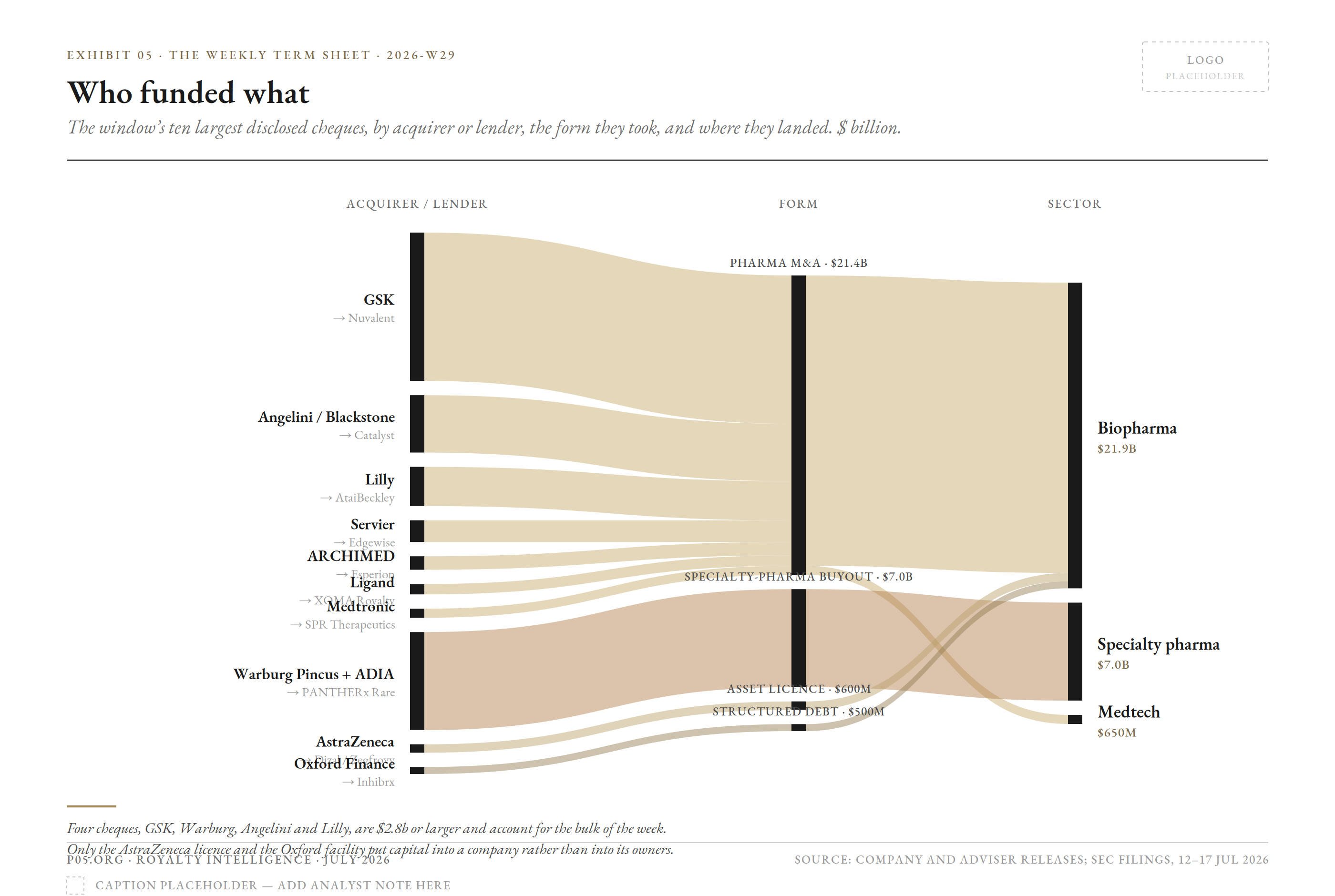
Public offerings
Research Alliance Corporation IV: $75M Healthcare SPAC IPO, the Fourth RA Capital Blank-Cheque Vehicle (Mon July 13)
Research Alliance Corporation IV priced its IPO of 7.5 million Class A ordinary shares at $10.00, raising $75M gross, and listed on the Nasdaq Capital Market under RACD on July 13, 2026, with the offering expected to close July 14 (pricing).
The SEC declared the registration effective July 10, and Leerink Partners acted as sole bookrunning manager. The SPAC is sponsored by an affiliate of RA Capital Management and will search for a target in healthcare or healthcare-related industries. It is the fourth in the Research Alliance series: Research Alliance I merged with POINT Biopharma (later acquired by Eli Lilly for about $1.4B), Research Alliance II liquidated in 2022, and Research Alliance III raised $75M in May 2026 and is still hunting. No royalty leg exists until a business combination is completed.
- Vehicle: Research Alliance Corporation IV (Nasdaq: RACD); healthcare-focused blank-cheque SPAC
- Sponsor: affiliate of RA Capital Management (since 2012, over $6.4B invested across 326 private companies)
- Structure: 7.5M Class A ordinary shares at $10.00; $75M gross, held in trust pending a business combination
- Leadership: CEO Matthew Hammond (PhD, MBA); CBO and COO Henry Stusnick
- Adviser: Leerink Partners (sole bookrunning manager)
- Royalty relevance: None until a target is acquired; a shell at pricing
- Timeline: SEC effective July 10; priced and listed July 13; offering closes July 14, 2026
- Date: Mon July 13, 2026
Erasca: $632.5M Upsized Follow-On (Full Overallotment) on ERAS-0015 Pan-RAS Data (Mon July 13)
Erasca (Nasdaq: ERAS), a clinical-stage RAS/MAPK precision-oncology company, priced an upsized public offering of 31,428,572 shares at $17.50 (about $550.0M base), and on full exercise of the 4,714,285-share overallotment the offering closed on July 15 at about $632.5M gross (36,142,857 shares) (Erasca 8-K, Ex-99.2).
The raise, upsized from a proposed $500M, was catalysed by updated Phase 1 AURORAS-1 data for ERAS-0015, an oral pan-RAS molecular glue, which showed a 57% unconfirmed objective response rate at eight weeks in seven second-line-plus KRAS G12X pancreatic cancer patients at the 32 mg recommended dose, alongside registrational plans. J.P. Morgan, Morgan Stanley, Jefferies, and Evercore ISI ran the books.
This is dilutive equity, tracked as context; the offering itself creates no royalty stream. It is the window's largest single equity print, ahead of Chai ($400M) and AdvanCell ($315M).
- Company: Erasca (Nasdaq: ERAS); clinical-stage RAS/MAPK precision oncology
- Raise: Upsized follow-on, 31,428,572 shares at $17.50 ($550.0M base); closed July 15 at about $632.5M gross (36,142,857 shares) on full overallotment exercise
- Catalyst: ERAS-0015 (oral pan-RAS molecular glue) Phase 1 AURORAS-1 update, 57% unconfirmed ORR at eight weeks in seven KRAS G12X pancreatic patients at 32 mg; registrational plans outlined
- Book-runners: J.P. Morgan, Morgan Stanley, Jefferies, Evercore ISI
- Royalty relevance: None from the offering (dilutive equity); any upstream in-licence economics on ERAS-0015 or ERAS-4001 not confirmed here
- Date: Mon July 13, 2026 (priced); closed July 15
Q32 Bio: $200M Public Offering on the Bempikibart Alopecia Data (Tue July 14)
Q32 Bio (Nasdaq: QTTB) priced a $200M public offering of common stock and pre-funded warrants (about 6.0M shares plus pre-funded warrants for about 4.93M shares, with a 30-day option for up to about 1.64M more), on the back of the positive SIGNAL-AA Part B bempikibart Phase 2a data in alopecia areata, the re-rate covered above (Q32 release). The offering closes on or about July 16.
Morgan Stanley, Jefferies, and Cantor are joint book-runners, with Oppenheimer also book-running and H.C. Wainwright as lead manager. Proceeds fund bempikibart's advance into future trials and broader autoimmune and inflammatory programmes.
This is dilutive equity, tracked as context; the offering itself creates no royalty stream. It is the financing arm of the bempikibart re-rate, converting the SIGNAL-AA read directly into capital, and follows Q32's $55M PIPE in May 2026.
- Company: Q32 Bio (Nasdaq: QTTB); clinical-stage autoimmune and inflammatory disease
- Raise: About $200M gross; about 6.0M shares plus pre-funded warrants for about 4.93M shares; 30-day option for up to about 1.64M more; closes about July 16
- Catalyst: Positive SIGNAL-AA Part B bempikibart Phase 2a data in alopecia areata (see the Q32 re-rate above); upstream BMS licence
- Book-runners: Morgan Stanley, Jefferies, and Cantor, with Oppenheimer; H.C. Wainwright lead manager
- Royalty relevance: None from the offering (dilutive equity); the underlying bempikibart royalty to BMS is unchanged
- Date: Tue July 14, 2026 (priced); closes about July 16
Crescent Biopharma: $125M Public Offering, Upsized to About $143.7M at Close on Full Option Exercise, on the CR-001 PD-1 by VEGF Bispecific (Tue July 14)
Crescent Biopharma (Nasdaq: CBIO), a Waltham clinical-stage oncology company, priced an underwritten public offering of 8,094,793 ordinary shares plus, in lieu of shares to certain investors, pre-funded warrants for up to 525,897 shares, at $14.50 (warrants at $14.499), for gross proceeds of about $125.0M, with a 30-day option for up to 1,293,103 more shares (Crescent 8-K, Ex-99.2). Net proceeds on the base offering are about $115.9M. At close on July 16 the underwriters exercised their option in full, taking the deal to 9,387,896 ordinary shares plus the 525,897 pre-funded warrants, about $143.7M gross and about $133.5M net.
Jefferies, TD Cowen, Guggenheim Securities, and Cantor ran the books, with LifeSci Capital as passive book-runner. Crescent's lead asset is CR-001, a tetravalent PD-1 by VEGF bispecific antibody in solid tumours, alongside the CR-002 and CR-003 topoisomerase-inhibitor ADCs.
This is dilutive equity, tracked as context; the offering itself creates no royalty stream.
- Company: Crescent Biopharma (Nasdaq: CBIO); clinical-stage oncology (PD-1 by VEGF bispecific and ADCs)
- Raise: Priced at about $125.0M gross (8,094,793 shares plus pre-funded warrants for 525,897 shares at $14.50, warrants $14.499); option for 1,293,103 more exercised in full at close, taking the total to 9,387,896 shares plus the 525,897 warrants and about $143.7M gross (about $133.5M net)
- Book-runners: Jefferies, TD Cowen, Guggenheim Securities, Cantor; LifeSci Capital passive
- Royalty relevance: None from the offering (dilutive equity)
- Date: Tue July 14, 2026 (priced); closed upsized Thu July 16, 2026
Alto Neuroscience: $100M Registered Direct on the ALTO-207 Phase 3 Push (Mon July 13)
Alto Neuroscience (NYSE: ANRO), a precision-neuropsychiatry company, priced an underwritten registered direct offering of 3,776,436 shares at $26.48, for gross proceeds of about $100.0M (net about $93.9M) (Alto release). The offering closed July 14.
BofA Securities led, with Stifel, William Blair, and Baird as joint book-runners and JonesTrading and H.C. Wainwright as co-managers. Proceeds fund an additional planned Phase 3 trial of ALTO-207 as monotherapy for treatment-resistant depression. It follows Alto's $120M Commodore Capital-led PIPE in March 2026.
This is dilutive equity, tracked as context; the offering creates no royalty stream.
- Company: Alto Neuroscience (NYSE: ANRO); precision neuropsychiatry
- Raise: About $100.0M gross (net about $93.9M); 3,776,436 shares at $26.48; registered direct; closed July 14
- Catalyst / use: Additional planned Phase 3 of ALTO-207 in treatment-resistant depression
- Book-runners: BofA Securities (lead); Stifel, William Blair, Baird; JonesTrading and H.C. Wainwright co-managers
- Royalty relevance: None from the offering (dilutive equity)
- Date: Mon July 13, 2026 (priced); closed July 14
Agenus: $85M Upfront PIPE (Up to $340M) for the ROBBIN Phase 3 in MSS Colon Cancer (Mon July 13)
Agenus (Nasdaq: AGEN), the immuno-oncology company, entered an oversubscribed private placement for about $85M upfront, plus up to a further $255M on exercise of purchase warrants (up to about $340M total), priced at a premium to the July 10 close (Agenus 8-K, Ex-99.1). The PIPE closes on or about July 15.
Commodore Capital led, with RA Capital Management, TCGX, Invus, and Ligand Pharmaceuticals participating, the latter closing its XOMA acquisition the same day (see M&A and Restructuring). Proceeds fund ROBBIN, Agenus' FDA-aligned registrational Phase 3 of neoadjuvant botensilimab plus balstilimab (BOT+BAL) in high-risk Stage II and III microsatellite-stable (MSS) colon cancer (n=850, event-free survival primary); Agenus is discontinuing the BATTMAN Phase 3 to concentrate resources, and two Commodore-designated directors join the board.
This is dilutive equity, tracked as context; the offering creates no royalty stream, though BOT+BAL carries the company's own economics.
- Company: Agenus (Nasdaq: AGEN); immuno-oncology
- Raise: About $85M upfront plus up to $255M on warrant exercise (up to about $340M total); premium to the July 10 close; closes about July 15
- Lead investor: Commodore Capital; with RA Capital Management, TCGX, Invus, and Ligand Pharmaceuticals
- Use: ROBBIN registrational Phase 3, neoadjuvant BOT+BAL in MSS colon cancer (n=850, EFS primary); BATTMAN Phase 3 discontinued
- Royalty relevance: None from the offering (dilutive equity)
- Date: Mon July 13, 2026 (priced); closes about July 15
Inhibikase Therapeutics: $50M ATM Placed Entirely with RA Capital (Tue July 14)
Inhibikase Therapeutics (Nasdaq: IKT) sold 25,000,000 shares to RA Capital Management through its at-the-market facility for gross proceeds of $50M (Inhibikase release).
The tranche, an ATM placed entirely with a single institutional buyer, supports IKT-001 (a prodrug of imatinib) through the topline readout of Part B of the global Phase 3 IMPROVE-PAH study in pulmonary arterial hypertension, subject to full exercise of the outstanding Series A and B warrants. RA Capital also sponsors the Research Alliance IV SPAC and joined the Agenus PIPE in the same window.
This is dilutive equity, tracked as context; the offering creates no royalty stream.
- Company: Inhibikase Therapeutics (Nasdaq: IKT); clinical-stage cardiopulmonary
- Raise: $50M gross; 25,000,000 shares to RA Capital Management via ATM
- Use: IKT-001 (imatinib prodrug) in PAH; funds through Phase 3 IMPROVE-PAH Part B topline (with warrant exercise)
- Royalty relevance: None from the offering (dilutive equity)
- Date: Tue July 14, 2026
GEM Global Yield / Senhwa Biosciences: Up to NT$500M ($15.5M) Equity Purchase Facility (Tue July 14)
GEM Global Yield executed a share purchase agreement with the existing shareholders of Taiwan-listed Senhwa Biosciences (TPEx: 6492), committing up to NT$500M (about $15.5M) to purchase shares over the next three to five years, drawn at the election of certain shareholders (GEM and Senhwa release).
The committed equity facility supports Senhwa's oncology pipeline, led by CX-5461 (pidnarulex) and CX-4945 (silmitasertib), and its AI-enabled discovery work; GEM agreed not to short Senhwa shares during the life of the agreement. This is a dilutive equity facility, tracked as context; no royalty leg.
- Company: Senhwa Biosciences (TPEx: 6492; Taiwan); clinical-stage oncology (CX-5461, CX-4945)
- Provider: GEM Global Yield LLC SCS; committed equity purchase facility
- Structure: Share purchase agreement; up to NT$500M (about $15.5M) drawn over three to five years at certain shareholders' election; no short-selling by GEM during the term
- Royalty relevance: None; dilutive equity facility
- Date: Tue July 14, 2026
Cardiff Oncology: $10M Registered Direct on the Onvansertib PLK1 Programme (Wed July 15)
Cardiff Oncology (Nasdaq: CRDF), a San Diego clinical-stage company built around PLK1 inhibition, entered into definitive agreements for a registered direct offering of 8,571,429 shares plus accompanying warrants for up to 8,571,429 shares at $1.05 per share and warrant, with certain officers and directors buying a further 731,707 shares and warrants at $1.435, for gross proceeds of about $10M (Cardiff release). The warrants carry a $1.31 exercise price and the offering closes on or about July 16.
H.C. Wainwright acted as placement agent. Proceeds support onvansertib, a third-generation PLK1 inhibitor in KRAS-mutated colorectal cancer, castration-resistant prostate cancer, and AML. Onvansertib is in-licensed from Nerviano Medical Sciences (NMS); a mid-2026 dispute over that licence, alongside related patent-rights litigation, is an open royalty-chain question worth tracking. This is dilutive equity, tracked as context.
- Company: Cardiff Oncology (Nasdaq: CRDF); PLK1 inhibition (onvansertib)
- Raise: About $10M gross; 8,571,429 shares plus warrants at $1.05 (insiders 731,707 at $1.435); warrant strike $1.31; closes about July 16
- Placement agent: H.C. Wainwright
- Royalty read-through: Onvansertib in-licensed from Nerviano Medical Sciences (NMS); a 2026 licence-termination dispute and patent-rights litigation remain unresolved
- Date: Announced Wed July 15, 2026
GenFleet Therapeutics: About HK$471.8M (About $60M) H-Share Placement (Tue July 14)
GenFleet Therapeutics (HKEX: 2595), a Shanghai clinical-stage oncology and immunology developer, signed a placing agreement to issue 13.6 million new H-shares at HK$34.69 (a 9.71% discount to the HK$38.42 last close), for gross proceeds of about HK$471.8M and net proceeds of about HK$467M (about $60M) (GenFleet placement coverage). Morgan Stanley and CITIC Securities advised.
Dilutive equity, tracked as context, but with a royalty angle on the issuer: GenFleet holds ex-China royalty exposure on GFH375 (VS-7375), a KRAS G12C/D inhibitor it out-licensed to Verastem Oncology, and is also partnered with Innovent (its marketed KRAS G12C drug Dupert). So the raise recapitalises a China originator that sits on the holder side of an ex-China royalty stream, even though the placement itself creates no new royalty.
- Company: GenFleet Therapeutics (HKEX: 2595); China oncology and immunology
- Raise: 13.6M new H-shares at HK$34.69 (9.71% discount); about HK$471.8M gross, about HK$467M net (about $60M); Morgan Stanley and CITIC Securities
- Royalty read-through: None from the placement; GenFleet holds an ex-China royalty on GFH375 (out-licensed to Verastem), plus an Innovent partnership
- Date: Placing agreement Tue July 14, 2026 (after hours)
Starpharma: About A$32M Fully Underwritten Entitlement Offer (Wed July 15)
Starpharma (ASX: SPL), an Australian dendrimer-technology developer, launched a fully underwritten renounceable pro-rata entitlement offer of about A$32M at A$0.57 per new share (1-for-7.5, a discount to market, with an oversubscription facility), underwritten by Canaccord Genuity (Australia) (Starpharma coverage).
Proceeds support the DEP oncology pipeline (dendrimer-conjugated cytotoxics) and early-stage radiopharmaceutical assets. Dilutive equity, no royalty leg; tracked as context and the window's ANZ rights-issue print.
- Company: Starpharma (ASX: SPL); dendrimer technology (DEP oncology, radiopharma)
- Raise: About A$32M; 1-for-7.5 renounceable entitlement at A$0.57; Canaccord Genuity (Australia) underwriter; offer booklet dispatch July 23
- Royalty relevance: None (dilutive equity)
- Date: Announced Wed July 15, 2026
VivoSim Labs: About $4.0M PIPE Priced At-the-Market (Thu July 16)
VivoSim Labs (Nasdaq: VIVS) priced a private placement of 4,705,883 shares (or common-stock equivalents) with warrants for up to 4,705,883 shares at a combined $0.85, for gross proceeds of about $4.0M, with a single healthcare-focused institutional investor (VivoSim release). Priced July 16 and expected to close on or about July 17, with A.G.P./Alliance Global Partners as sole placement agent under Regulation D. Dilutive equity, no royalty leg.
- Company: VivoSim Labs (Nasdaq: VIVS)
- Raise: About $4.0M gross; 4,705,883 shares or equivalents plus warrants for up to 4,705,883 shares at a combined $0.85; single healthcare-focused institutional investor; Regulation D; A.G.P./Alliance Global Partners sole placement agent
- Royalty relevance: None (dilutive equity)
- Date: Priced Thu July 16, 2026; expected to close on or about July 17
REGENXBIO: About $100M Follow-On Priced at $9.00, Over a Partly-Monetised Zolgensma Royalty and a Pending $100M AbbVie Milestone (Fri July 17)
REGENXBIO (Nasdaq: RGNX), a late-stage gene-therapy developer, priced an underwritten public offering of 10,003,889 shares at $9.00 and 1,111,111 pre-funded warrants at $8.9999, for gross proceeds of about $100.0M before the option (REGENXBIO release).
The deal priced July 17 into weakness (the stock fell sharply on the print) and closes July 20, with a 30-day underwriters' option on a further 1,667,250 shares. Morgan Stanley, J.P. Morgan, Leerink Partners, and Mizuho are joint book-runners. The royalty read-through is indirect but worth logging: REGENXBIO sold part of its Zolgensma royalty to HealthCare Royalty in 2020 (a $200M purchase, capped return) and is due a $100M AbbVie milestone triggered by first-patient dosing in the Phase IIb/III NAAVIGATE trial (surabgene lomparvovec, ABBV-RGX-314, wet AMD), expected in July. The signal: with a royalty stream already partly monetised and a large milestone imminent, the issuer still chose dilutive equity at $9.00 rather than a further royalty sale, a datapoint on relative cost of capital at these levels. Dilutive equity, no new royalty leg.
- Company: REGENXBIO (Nasdaq: RGNX); late-stage gene therapy (Duchenne, wet AMD, MPS I and II)
- Raise: About $100.0M gross; 10,003,889 shares at $9.00 plus 1,111,111 pre-funded warrants at $8.9999; 30-day option on 1,667,250 more shares; closes July 20, 2026
- Book-runners: Morgan Stanley, J.P. Morgan, Leerink Partners, Mizuho
- Royalty relevance: None new (dilutive equity); background is a partly-monetised Zolgensma royalty (HCRx, $200M, 2020) and a pending $100M AbbVie NAAVIGATE milestone
- Date: Priced Fri July 17, 2026 (US hours); closes July 20
Other in-window prints logged from the deal-flow sweep (to confirm)
Compiled from the W29 sweep and not yet verified against primary sources; listed for completeness, flagged not scored. None carries a royalty leg.
- Aeon Biopharma: about $13.75M upsized underwritten offering (Lake Street sole book-runner); ABP-450 botulinum-toxin biosimilar; priced July 13 to 14, closed July 15.
- Poolbeg Pharma (AIM: POLB): £3.5M placing at 6p via OAK Securities; POLB 001; July 14.
- Autonomix Medical: about $2.6M warrant-inducement exercise (428,731 shares at $6.00); July 13.
- PharmaCorp Rx (TSXV: PCRX): about C$11.5M bought deal (22,549,200 units at C$0.51); closed July 14; Canadian pharmacy platform, peripheral to therapeutics.
- Pearl Health / Trinity Capital: about $60M debt facility (part of a roughly $110M package with a $50M a16z-led equity round); value-based-care platform; week of July 13. In scope as non-dilutive debt, healthcare services rather than pharma.
- Lone Peak Dental / TCW (Steel City): about $170M private-credit recapitalisation; dental-services platform; peripheral healthcare services.
- Paradigm Biopharmaceuticals (ASX: PAR): US$3.0M convertible-note tranche (PARAAD at US$1.00) drawn July 13, part of a previously announced US$27M facility (up to a further US$10M subject to shareholder approval); Phase 3 osteoarthritis.
- Marksans Pharma (NSE: MARKSANS): about EUR 0.89M (about $0.97M) all-cash acquisition of ABCnow GmbH, a German OTC wholesaler; disclosed July 12, close expected by end July; small distribution bolt-on.
- AMT Medical (Netherlands): about EUR 25M (about $25M) financing from Bender Analytical Holding for the ELANA anastomotic system (sutureless coronary anastomosis for CABG); July 16 per the deal-flow sweep; medtech, primary terms to confirm.
- Tvardi Therapeutics (Nasdaq: TVRD): ATM shelf capacity of up to about $9.69M via JonesTrading (3% commission), 424B5 filed July 17 (supersedes a prior $12.5M programme under which about $11.0M had been sold); STAT3 inhibitor TTI-101; capacity, not a raise, no royalty leg.
- NanoViricides (NYSE American: NNVC): ATM shelf capacity of up to about $4.02M via D. Boral Capital (2% commission), 424B5 filed July 17; broad-spectrum antiviral NV-387; capacity, not a raise, no royalty leg.
IPO registrations filed in the window (pipeline, not priced)
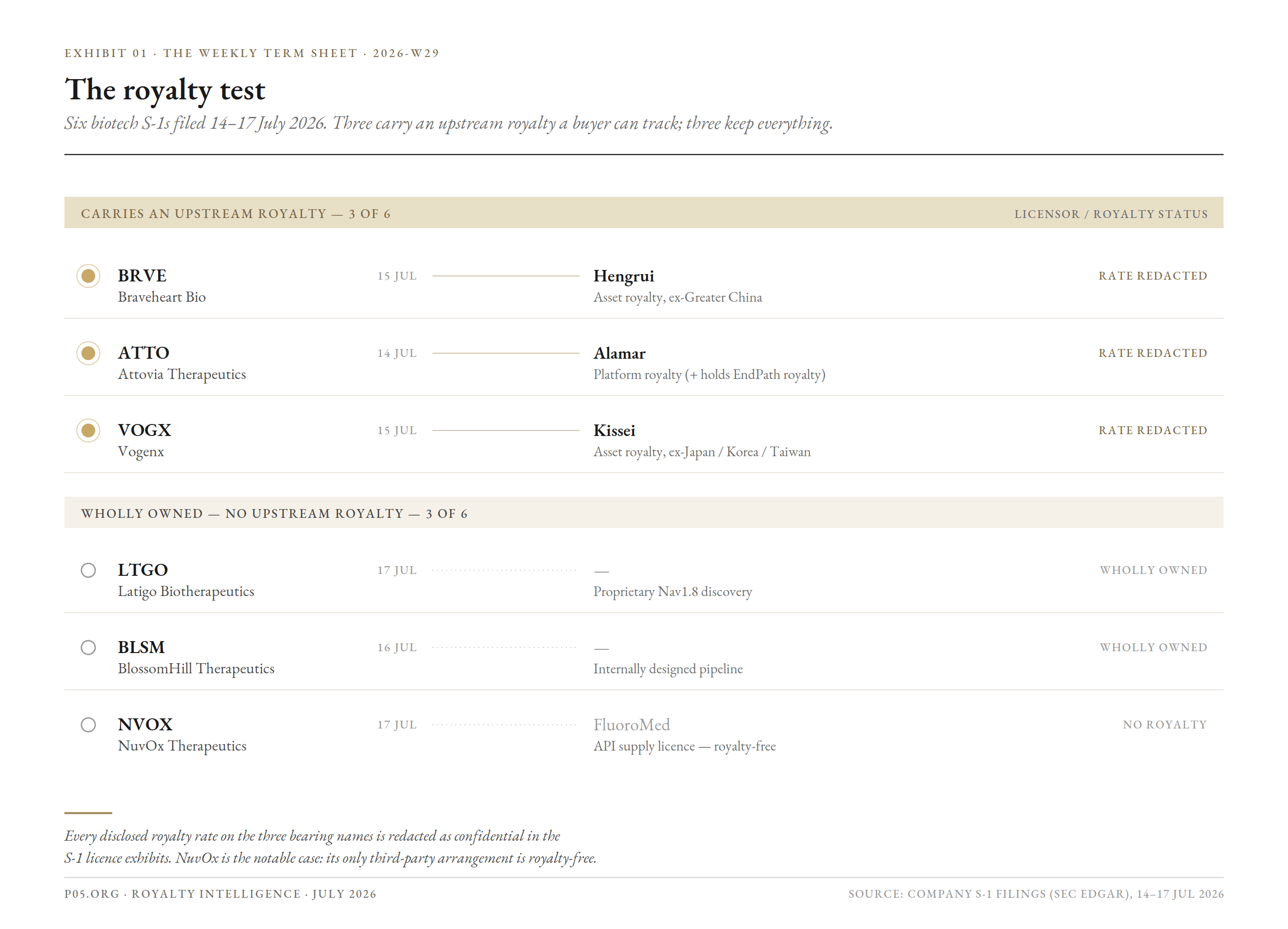
Registration statements, not closed offerings; the targets are placeholders and no proceeds are locked in. Flagged, not scored.
On the royalty lens, three of the six carry an upstream royalty a stream investor could track: Braveheart (an asset royalty to Hengrui), Attovia (a platform royalty to Alamar, plus a downstream royalty it holds from EndPath), and Vogenx (an asset royalty to Kissei, ex-Japan, Korea, and Taiwan); Latigo, BlossomHill, and NuvOx are internally owned with no product royalty (NuvOx's only third-party arrangement, an API supply-and-licence with FluoroMed, is explicitly royalty-free).
The exact royalty rates on the three royalty-bearing names are redacted as confidential in every S-1 licence exhibit, so the obligations and structures below are confirmed but the precise tiers are not public.
- Attovia Therapeutics (Nasdaq: ATTO): S-1 filed July 14, up to $100M target; lead ATTO-1310, an anti-IL-31 antibody for chronic pruritus and atopic dermatitis (Phase 1 complete, 65% week-4 itch-responder rate). Morgan Stanley, Leerink Partners, Citigroup, RBC. About $165M raised pre-IPO including a $105M Series B (2024). Royalty note: the ATTOBODY platform is in-licensed exclusively worldwide (therapeutic field) from Alamar Biosciences (Attovia's co-founder) in exchange for equity plus milestones and royalties, so the pipeline carries an upstream platform royalty and milestone obligation to Alamar even though the assets are Attovia-discovered; separately, Attovia holds a downstream royalty via an exclusive out-licence of radioligand applications to EndPath. Rates redacted in the S-1.
- Braveheart Bio (Nasdaq: BRVE): S-1 filed July 15, up to $100M target; lead BHB-1893 (HRS-1893), an oral cardiac myosin inhibitor licensed from Jiangsu Hengrui for hypertrophic cardiomyopathy. Goldman Sachs, Jefferies, TD Cowen, Stifel, Cantor. Launched November 2025 with a $185M Series A (Forbion, OrbiMed). Royalty note: the Hengrui licence (ex-Greater China) runs $65M upfront ($32.5M cash plus $32.5M in equity), up to $10M in technology-transfer milestones, up to $13M in development milestones per compound, and up to $1.0B in commercial milestones, plus tiered royalties on net sales to Hengrui (rate table redacted as confidential in the S-1); royalty term runs to the later of patent expiry, regulatory exclusivity, or 10 years from first commercial sale. Hengrui is the royalty holder; another Hengrui NewCo-model out-licence, in the vein of Kailera (GLP-1).
- Latigo Biotherapeutics (Nasdaq: LTGO): S-1 filed July 17, non-opioid pain; lead LTG-001, an oral (IV in development) Nav1.8 inhibitor for moderate-to-severe acute pain (positive 343-patient abdominoplasty study, met SPID48), plus LTG-305 for chronic pain. Goldman Sachs, Jefferies, Leerink Partners, Guggenheim Securities. Blue Owl-backed; incubated by Westlake Village BioPartners (with 5AM Ventures, Foresite Capital, Corner Ventures); about $135M Series A (2024). Royalty note: proprietary in-house Nav1.8 discovery, wholly owned; no upstream licence royalty disclosed.
- BlossomHill Therapeutics (Nasdaq: BLSM): S-1 filed July 16 (up to $100M target; confidential filing April 24), San Diego oncology; lead BH-30643, an oral macrocyclic OMNI-EGFR inhibitor for EGFR-mutant NSCLC (Phase 1/2 SOLARA), plus BH-30236 (CLK inhibitor, AML/MDS, orphan-drug) and a preclinical pan-KRAS programme. J.P. Morgan, Leerink Partners, Guggenheim Securities, LifeSci Capital, H.C. Wainwright. Founded by J. Jean Cui (inventor of Xalkori, Lorbrena, and Augtyro); about $257M raised to date. Royalty note: wholly-owned, internally designed pipeline; no upstream licence royalty disclosed.
- Vogenx (Nasdaq: VOGX): S-1 filed July 15 (Durham, NC), clinical-stage metabolic disease; lead mizagliflozin, a selective SGLT1 inhibitor for post-bariatric hypoglycaemia (Phase 2b EMERGE) and gastroparesis. Royalty note: mizagliflozin (KWA-0711/KGA-3235) is exclusively in-licensed from Kissei Pharmaceutical for territories outside Japan, Korea, and Taiwan (rights optioned in 2017, assigned from Avolynt to Vogenx in 2021), so Vogenx pays Kissei milestones and royalties and Kissei is the royalty holder; rate redacted in the S-1.
- NuvOx Therapeutics (Nasdaq listing sought): S-1 filed July 17 (Tucson, AZ; small-cap, offering size and price not yet set), clinical-stage oxygen therapeutics; lead NanO2 (dodecafluoropentane emulsion, DDFPe) across recurrent high-grade glioma (Phase IIb REBORN radiosensitiser), acute ischaemic stroke (Phase IIb NOVEL, UK-government-funded), and respiratory distress and ARDS (Phase Ib EXTEND, BARDA-supported); Orphan Drug status in glioblastoma and sickle cell, with safety data cited across about 2,000 subjects and an IP estate of 11 patent families (11 issued US patents, 31 foreign equivalents). Royalty note, and the interesting one: NanO2 is internally discovered and owned (founder Evan Unger, previously ImaRx and Definity), so no upstream product royalty travels, and, unusually for a clinical-stage biotech dependent on a third-party API, even the API arrangement is structured royalty-free. Under the FluoroMed Supply and Licensing Agreement (signed October 2018, renewed August 2024 for a five-year term), FluoroMed grants NuvOx an exclusive, royalty-free, perpetual, worldwide, and fully transferable licence to reference FluoroMed's FDA Drug Master File for the dodecafluoropentane API, in exchange for only a one-time $125K regulatory-support fee and a minimum-purchase supply commitment of 30 kg per year, totalling about $358K over 2026 to 2029 (about $133K in 2026, then about $75K a year through 2029). The upshot for a royalty reader: NuvOx would retain effectively 100% of NanO2's product economics with no upstream royalty drag, the mirror image of the China-in-licensed IPO names above. Non-dilutive support adds a USC and NIH SBIR stroke subaward (up to $150K a year) and an FYR grant-funded scope of work (about $407K and $484K across two funding periods).
Venture and growth equity
AdvanCell: $315M Oversubscribed Series D for Lead-212 Targeted Alpha Therapy (Wed July 15)
AdvanCell (Boston and Brisbane), a clinical-stage radiopharmaceutical company developing targeted alpha therapies, closed an oversubscribed and upsized $315M Series D (AdvanCell release).
The round was led by Ally Bridge Group and co-led by Alpha Wave, with new investors including Bain Capital Life Sciences, Fidelity, T. Rowe Price, a sovereign wealth fund, Eventide, and Velosity Capital, and existing backers Morningside, Eli Lilly, SV Health Investors, Sanofi Ventures, Abingworth, SymBiosis, and others. Proceeds advance ADVC001, a Lead-212 PSMA-targeted radioligand therapy for metastatic prostate cancer (Phase 2, NCT05720130), toward Phase 3, and expand AdvanCell's vertically integrated isotope supply and US manufacturing.
This is dilutive growth equity, not a royalty or non-dilutive financing: internally owned assets, no upstream licence disclosed, so no royalty leg. It is tracked as context and is the window's only July 15 capital print. Andrew Lam (Ally Bridge) and Nik Economopoulos (Alpha Wave) join the board.
- Company: AdvanCell (private; Boston and Brisbane; CEO Philina Lee); clinical-stage radiopharmaceuticals, proprietary Lead-212 platform
- Raise: $315M oversubscribed, upsized Series D
- Lead investors: Ally Bridge Group (lead) and Alpha Wave (co-lead); new backers Bain Capital Life Sciences, Fidelity, T. Rowe Price, a sovereign wealth fund, Eventide, and Velosity Capital; existing Morningside, Eli Lilly, SV Health Investors, Sanofi Ventures, Abingworth, SymBiosis, Tenmile, Brandon Capital, Catalio, and others
- Lead asset: ADVC001, a Lead-212 (212Pb) PSMA-targeted alpha therapy; metastatic prostate cancer; Phase 2 (NCT05720130)
- Royalty read-through: None disclosed; internally developed on AdvanCell's own platform, no upstream licence flagged
- Date: Wed July 15, 2026
Nava Therapeutics: About $89M Launch Financing for In Vivo Cell and Gene Therapy (Wed July 15)
Nava Therapeutics launched with about $89M from RA Capital Management, Leaps by Bayer, and PureTech Health, alongside an undisclosed US healthcare fund and a sovereign wealth fund (per trade reporting; primary release to confirm). The Cambridge and Philadelphia company is building a lipid-nanoparticle platform that routes mRNA to CD8 T cells (in vivo CAR-T) and to the kidney (in vivo gene editing), with kidney data shown at ASGCT 2026. Dilutive launch equity, tracked as context; no royalty leg.
- Company: Nava Therapeutics (private; Cambridge and Philadelphia); in vivo LNP cell and gene therapy
- Raise: About $89M launch financing
- Lead investors: RA Capital Management, Leaps by Bayer, PureTech Health, plus an undisclosed US healthcare fund and a sovereign wealth fund
- Royalty read-through: None disclosed; dilutive equity
- Date: Announced Wed July 15, 2026
Draig Therapeutics: $65M Oversubscribed Series B for a Cardiff Neuropsychiatry Pipeline (Tue July 14)
Draig Therapeutics raised a $65M oversubscribed Series B to advance its neuropsychiatry pipeline, led by DT-101, an AMPA receptor positive allosteric modulator for major depressive disorder now in Phase 2 (British Business Bank; Endpoints News).
The round was led by new investor Deep Track Capital, with Janus Henderson, Marshall Wace, and Jefferson Life Sciences, and included the British Business Bank's British Growth Partnership Fund I, the fund's first life sciences investment and a channel for UK pension capital (Aegon, Cushon, M&G). Draig is a Cardiff University spin-out founded in 2024 with SV Health Investors, so an upstream academic licence to Cardiff University likely sits beneath the programmes, though royalty terms are not disclosed.
- Company: Draig Therapeutics (private; Cardiff, Wales; CEO Ivana Magovcevic-Liebisch); founded 2024 with SV Health Investors
- Raise: $65M oversubscribed Series B (follows a $140M Series A, June 2025)
- Lead investor: Deep Track Capital (new); with Janus Henderson, Marshall Wace, Jefferson Life Sciences, and the British Business Bank's British Growth Partnership Fund I (deploying Aegon, Cushon, and M&G pension capital)
- Lead asset: DT-101, an AMPA receptor positive allosteric modulator; major depressive disorder; Phase 2
- Royalty read-through: Likely upstream academic licence to Cardiff University; terms not disclosed
- Date: Tue July 14, 2026
Chai Discovery: $400M Series C at $3.8B for AI Molecular Design (Tue July 14)
Chai Discovery raised a $400M Series C at a $3.8B valuation, led by Index Ventures alongside Kleiner Perkins, Sequoia Capital, and Dimension, taking total funding above $600M (Business Wire).
New investors include Bain Capital Ventures, Battery Ventures, Baillie Gifford, BDT & MSD, and Sapphire Ventures, alongside existing backers Thrive Capital, OpenAI, Oak HC/FT, Menlo Ventures, and General Catalyst. Proceeds fund Chai's molecular-design models (Chai-3), already deployed at Eli Lilly and Pfizer. The royalty relevance is indirect: Chai's pharma collaborations carry potential downstream royalties on molecules designed with its platform, including the Novartis antibody collaboration disclosed the same week (see Royalty-Bearing License-Outs and Collaborations).
- Company: Chai Discovery (private; San Francisco; AI molecular-design; CEO Joshua Meier)
- Raise: $400M Series C at a $3.8B valuation; total funding now above $600M
- Lead investors: Index Ventures, with Kleiner Perkins, Sequoia Capital, and Dimension; new backers Bain Capital Ventures, Battery Ventures, Baillie Gifford, BDT & MSD, and Sapphire Ventures; existing Thrive Capital, OpenAI, Oak HC/FT, Menlo Ventures, and General Catalyst
- Platform: Chai-3 molecular-design models; deployed at Eli Lilly and Pfizer; Novartis collaboration the same week
- Royalty relevance: Indirect and undisclosed; analyst estimate (Contrary Research) of about 0.5% to 5% platform royalty on partner molecules designed with the platform (see the Chai / Novartis item for detail)
- Date: Tue July 14, 2026
Lyora Therapeutics: $2.5M Pre-Seed to Revive Stalled Editas and Biogen Eye Gene Therapies (Tue July 14)
Lyora Therapeutics (Providence, RI) launched with $2.5M pre-seed to develop genetic medicines for inherited retinal diseases, reviving advanced pre-clinical assets originated at Editas and Biogen and targeting a first IND within 18 months (Endpoints News; Lyora release).
The lead programme, LYA-101, augments PRPF31 expression for retinitis pigmentosa caused by PRPF31 variants; the second, LYA-102, uses optimised CRISPR to address exon 13 mutations in USH2A for Usher Syndrome Type 2, with possible extension to hearing loss. The royalty read-through is now concrete: Editas granted Lyora an exclusive option to license certain USH2A gene-editing rights, so an upstream Editas licence with milestone and royalty economics (undisclosed) would sit over LYA-102 if exercised. The raise sits well below the sub-$50M royalty band, so it is flagged, not scored.
- Company: Lyora Therapeutics (private; Providence, RI; CEO Pam Stetkiewicz, ex-Editas and Arbor Biotechnologies)
- Raise: $2.5M pre-seed; first IND targeted within 18 months
- Assets: LYA-101 (PRPF31 augmentation; retinitis pigmentosa) and LYA-102 (optimised CRISPR on USH2A exon 13; Usher Syndrome Type 2, possible hearing-loss extension)
- Upstream royalty: Editas granted Lyora an exclusive option to license certain USH2A gene-editing rights; milestone and royalty terms undisclosed; Biogen-origin assets also in the mix
- Treatment: Flagged, not scored (below the sub-$50M band; terms undisclosed)
- Date: Tue July 14, 2026
Trellis Bioscience: $9M Series C to Complete a Phase 2 in Prosthetic Joint Infection (Thu July 16)
Trellis Bioscience (Redwood City, CA), a clinical-stage developer of native human monoclonal antibodies for intractable infections, closed a $9M Series C to finish the Phase 2 trial of calpurbatug (TRL1068), a biofilm-disrupting mAb for chronic prosthetic joint infections (PJI) (Trellis release).
Existing backers New Science Ventures and Easton Capital were joined by the AMR Action Fund, The Doctor Group of Dallas, and PJI-focused orthopaedic surgeons; total equity funding is now near $35M, matched by NIAID and CARB-X non-dilutive grants. The fully-enrolled Phase 2 (DAIR-based, retaining the original prosthesis) reads out topline in Q2 2027. TRL1068 carries Fast Track, QIDP, and orphan-drug designations for PJI and infective endocarditis. Small venture round, no royalty leg disclosed; the AMR Action Fund participation is the notable feature in an antimicrobial-resistance asset.
- Company: Trellis Bioscience (private; Redwood City, CA); native human mAbs for infectious disease
- Raise: $9M Series C; New Science Ventures and Easton Capital (existing), AMR Action Fund, The Doctor Group, and PJI surgeons (new); total equity now near $35M plus NIAID and CARB-X grants
- Asset: Calpurbatug (TRL1068): biofilm-disrupting mAb; chronic PJI; Phase 2 fully enrolled, topline Q2 2027; Fast Track, QIDP, orphan-drug designations
- Royalty relevance: None disclosed (venture equity); flagged for the AMR-focused syndicate
- Date: Thu July 16, 2026
Xenter: $58.25M Series B for a Wireless Medical-Device and Clinical-AI Platform (Thu July 16)
Xenter (Draper, UT), a "TechMed" company building wireless medical devices and a clinical-AI data platform, disclosed a $58.25M Series B, with participation from existing shareholders, family offices, and healthcare investors (no lead named), and appointed Linda Vega to its board (Xenter release).
Founded in 2020 by CEO Richard J. Linder, Xenter will use the proceeds to launch the Guru dual-sensor physiology guidewire and run its clinical testing in transcatheter aortic-valve replacement (TAVR), plus manufacturing and regulatory work. The round closed June 30 and was publicly disclosed July 16, so it is an in-window disclosure rather than an in-window close. Medtech venture financing, no royalty leg.
- Company: Xenter (private; Draper, UT); wireless medical devices and clinical-AI platform
- Raise: $58.25M Series B; existing shareholders, family offices, and healthcare investors (no lead disclosed); closed June 30, disclosed July 16
- Use of proceeds: Commercial launch and TAVR clinical testing of the Guru physiology guidewire; manufacturing and regulatory
- Royalty relevance: None (medtech equity)
- Date: Disclosed Thu July 16, 2026 (round closed June 30, 2026)
RapidPulse: Oversubscribed $48M Series B for Next-Generation Stroke Aspiration (Thu July 16)
RapidPulse (Miami), developing next-generation aspiration technology for acute ischaemic stroke, closed an oversubscribed $48M Series B co-led by Medtronic, TechWald Next S.p.A., and S3 Ventures (RapidPulse release).
SBI Investment and Florida Opportunity Fund joined, alongside existing backers Santé Ventures, Syntheon, Hatteras Venture Partners, and Epidarex Capital. Proceeds fund the IDE TURBO pivotal study. A strategic co-lead by Medtronic is the notable feature, positioning a potential acquirer or distribution partner ahead of pivotal data. Medtech venture financing, no royalty leg.
- Company: RapidPulse (private; Miami); stroke aspiration technology
- Raise: $48M oversubscribed Series B; co-led by Medtronic, TechWald Next, and S3 Ventures; SBI Investment, Florida Opportunity Fund, Santé Ventures, Syntheon, Hatteras, Epidarex
- Use of proceeds: IDE TURBO pivotal study
- Royalty relevance: None (medtech equity); strategic Medtronic co-lead worth tracking for downstream M&A or distribution
- Date: Thu July 16, 2026
Endo Tools Therapeutics: $23M Series C for the Endomina Endoscopic Obesity Platform (Thu July 16)
Endo Tools Therapeutics (Gosselies, Belgium), a developer of advanced endoscopic devices, closed an oversubscribed $23M (EUR 20M) Series C led by Capricorn Partners (Capricorn Healthtech Fund II), with MGFO and existing investors (Endo Tools release).
Proceeds fund US, European, and Middle East commercialisation of the endomina platform, including the recently FDA-cleared endomina EZFuse system, and the clinical evidence needed for a US weight-loss indication. Endomina is an endoscopic suturing platform positioned as a minimally invasive alternative or adjunct to chronic GLP-1 therapy for Class I and II obesity. Medtech venture financing, no royalty leg.
- Company: Endo Tools Therapeutics (private; Gosselies, Belgium); endoscopic obesity devices
- Raise: $23M (EUR 20M) oversubscribed Series C; led by Capricorn Partners (Capricorn Healthtech Fund II), with MGFO and existing investors
- Use of proceeds: US, EU, and Middle East commercialisation of the endomina platform (FDA-cleared EZFuse); clinical evidence for a US weight-loss indication
- Royalty relevance: None (medtech equity)
- Date: Thu July 16, 2026
TytoCare: $25M-Plus Growth Round for AI Remote Physical Exams (Wed July 15)
TytoCare (New York and Netanya), a remote physical-examination company, closed an oversubscribed growth round of more than $25M led by Insight Partners, with HOOP, OliveTree, OrbiMed, Qumra Capital, and Qualcomm Ventures participating, and named Adam Pellegrini chief executive (TytoCare release).
TytoCare pairs an FDA-cleared handheld diagnostic device with FDA-cleared AI SaMD algorithms; proceeds fund expansion of those algorithms and deeper health-system and payer integration across chronic and complex disease (congestive heart failure, COPD, oncology, cardiometabolic). This is dilutive medtech growth equity, tracked as context; no royalty leg.
- Company: TytoCare (private; New York and Netanya); remote physical examination, FDA-cleared device plus AI SaMD
- Raise: More than $25M oversubscribed growth round; new CEO Adam Pellegrini
- Lead investor: Insight Partners; with HOOP, OliveTree, OrbiMed, Qumra Capital, and Qualcomm Ventures
- Royalty read-through: None disclosed; dilutive medtech equity
- Date: Announced Wed July 15, 2026
410 Medical: $12M Growth Financing for the LifeFlow Rapid Infuser (Tue July 14)
410 Medical (Durham, NC), a critical-care device company, closed an oversubscribed $12M round led by Orlando Health Ventures, with Hatteras Venture Partners, Ballad Health, OSF Healthcare, Rex Health Ventures, CU Healthcare Innovations Fund, Sarnova, Catalyst by Wellstar, Tampa General, and an undisclosed strategic investor (410 Medical release).
Its FDA-cleared LifeFlow rapid infuser is used across more than 500 hospitals and EMS agencies for sepsis and haemorrhagic shock; proceeds scale commercial operations and fund a next-generation infuser planned for 2027. Dilutive medtech growth equity, no royalty leg.
- Company: 410 Medical (private; Durham, NC); critical-care resuscitation devices (LifeFlow)
- Raise: $12M oversubscribed growth financing
- Lead investor: Orlando Health Ventures; with Hatteras Venture Partners, Ballad Health, OSF Healthcare, Rex Health Ventures, CU Healthcare Innovations Fund, Sarnova, Catalyst by Wellstar, Tampa General, and an undisclosed strategic
- Royalty read-through: None disclosed; dilutive medtech equity
- Date: Announced Tue July 14, 2026
Auxilium Health: $3.4M Seed for the Aer Bioaerogel Platform (Tue July 14)
Auxilium Health (Cleveland), a biomaterials company based at the Cleveland Clinic Global Innovation Center, closed an oversubscribed $3.4M seed round, roughly doubling its prior pre-seed, from returning and new regional and strategic investors (Auxilium release).
Its Aer bioaerogel platform spans wound repair, bone regeneration, and localised delivery, advancing toward FDA clearance and first-in-human studies. Dilutive medtech seed, no royalty leg.
- Company: Auxilium Health (private; Cleveland; CEO Isaiah Kaiser); bioaerogel biomaterials
- Raise: $3.4M oversubscribed seed (about double the prior pre-seed)
- Asset: Aer platform: wound repair, bone regeneration, and localised delivery; toward FDA clearance and first-in-human
- Royalty read-through: None disclosed; dilutive medtech equity
- Date: Announced Tue July 14, 2026
Grants and non-dilutive research funding
Alzheimer's Association / PROTECT-Cog: $100M Global Prevention Trial (Mon July 13)
The Alzheimer's Association launched the PROTECT-Cog Study, a $100M, three-year global prevention trial building on the Association's U.S. POINTER and Latin American FINGERS studies, announced at AAIC 2026 in London (Alzheimer's Association release).
The trial compares two multidomain lifestyle-intervention approaches (intensive versus lighter-touch) and tests adding a metabolism-targeting drug, such as a GLP-1 agonist, to reduce cognitive decline, mild cognitive impairment, and dementia risk in at-risk older adults, with evaluations every six months. It is an Association-run academic prevention trial; no royalty leg travels.
- Sponsor: Alzheimer's Association; builds on U.S. POINTER and LatAm FINGERS
- Funding: $100M, three-year, global prevention trial
- Design: Two multidomain lifestyle arms (intensive versus lighter-touch) plus a metabolism-targeting drug arm (for example a GLP-1 agonist); endpoints in cognitive decline, MCI, and dementia risk; evaluations every six months
- Royalty relevance: None; Association-run prevention trial
- Date: Announced at AAIC 2026, London, Mon July 13, 2026
Pulsenmore: About $1M Israel AI Regulatory Sandbox Project for Home Ultrasound (Mon July 13)
Pulsenmore was selected for a roughly $1M project under Israel's Healthcare AI Regulatory Sandbox (Israel Innovation Authority and Ministry of Health) to develop and clinically validate AI for its home ultrasound platform (Pulsenmore release).
The work draws on a dataset of more than 250,000 home scans and is being developed with Beilinson Hospital (Clalit), at a clinical-validation stage. It is a non-dilutive medtech grant with no royalty leg.
- Company: Pulsenmore (medtech; home ultrasound platform)
- Funding: about $1M under the Israel Innovation Authority and Ministry of Health Healthcare AI Regulatory Sandbox
- Scope: develop and clinically validate AI for the home ultrasound platform; dataset of more than 250,000 home scans; with Beilinson Hospital (Clalit); clinical-validation stage
- Royalty relevance: None; non-dilutive medtech grant
- Date: Mon July 13, 2026
NeuroTherapia / NTRX-07: Phase 2a Alzheimer's Data on a Cleveland Clinic-Licensed Asset (Mon July 13)
NeuroTherapia presented Phase 2a data for NTRX-07, an oral CB2 agonist for Alzheimer's, at AAIC 2026: a 48-participant, 28-day study (90 mg/day versus placebo) in mild cognitive impairment or mild-to-moderate AD, run across sites in Hungary, Poland, and the Czech Republic (CRU Global), reporting diffusion-MRI and CSF biomarker signals consistent with reduced neuroinflammation, with a Phase 2b planned (NeuroTherapia release).
The study was funded in part by the Alzheimer's Association Part the Cloud programme, and imaging analysis continues with Oxford Brain Diagnostics. NTRX-07 is a Cleveland Clinic spin-out: Cleveland Clinic holds the upstream licence and the inventors are entitled to a share of its revenue, so a positive Phase 2a re-rates that upstream position.
- Company: NeuroTherapia; Cleveland Clinic spin-out
- Funding: in part by the Alzheimer's Association Part the Cloud programme; imaging analysis with Oxford Brain Diagnostics
- Asset: NTRX-07, oral CB2 agonist; Alzheimer's; 48-participant, 28-day Phase 2a (90 mg/day versus placebo); Phase 2b planned
- Data: Diffusion-MRI and CSF biomarker signals consistent with reduced neuroinflammation; sites in Hungary, Poland, and the Czech Republic (CRU Global)
- Upstream royalty: Cleveland Clinic holds the upstream licence; inventors entitled to a revenue share; positive Phase 2a re-rates it
- Date: Mon July 13, 2026
Capital markets (non-royalty)
Viatris / Biocon: $363M Secondary Block Trade, No Royalty Travels (Tue July 14)
Mylan Inc, part of Viatris (Nasdaq: VTRS), launched a secondary block deal to sell up to 92 million shares of Biocon Ltd (NSE: BIOCON), about 5.64% of the company, for up to Rs 34.81 billion (about $363M) (Business Standard / Reuters; BusinessToday).
The floor price is Rs 378.50 per share, a 7.9% discount to the July 13 close of Rs 410.95, with Citigroup and Jefferies as joint bookrunners. This is a pure equity divestment, not a royalty transaction: Viatris is exiting the residual Biocon Ltd stake it received when it sold its Biocon Biologics preferred equity to Biocon for $815M ($400M cash plus $415M in listed Biocon shares; December 2025, closed Q1 2026, six-month lock-up now expiring), which itself traces back to the 2022 contribution of Viatris's biosimilars portfolio to Biocon Biologics (about $3B). No royalty, milestone, or contingent-value leg travels.
- Seller: Mylan Inc, part of Viatris (Nasdaq: VTRS); exiting its residual 5.64% Biocon holding
- Target: Biocon Ltd (NSE: BIOCON); Biocon receives no proceeds (secondary sale)
- Structure: Block deal, up to 92M shares (about 5.64%) for up to Rs 34.81 billion (about $363M); floor Rs 378.50, a 7.9% discount to the Rs 410.95 July 13 close
- Bookrunners: Citigroup and Jefferies (joint)
- Background: Stake received in the $815M Biocon Biologics monetisation ($400M cash plus $415M Biocon shares; December 2025, closed Q1 2026, six-month lock-up now expiring); traces to the 2022 biosimilars contribution (about $3B)
- Royalty relevance: None; pure equity divestment, no royalty, milestone, or contingent-value leg travels; included for completeness
- Timeline: Term sheet Mon July 13; block Tue July 14, 2026
- Date: Tue July 14, 2026
ChrysCapital / Novartis India: About $159M Secondary Stake Sale (Mon July 13)
Novartis AG sold its residual holding in Novartis India to a consortium led by ChrysCapital (WaveRise, ChrysCapital Fund X, Two Infinity Partners) for about $159M (about Rs 1,446 crore) (per trade reporting; primary filing to confirm). The consortium already held 70.68% via a share purchase agreement, and the mandatory 26% open offer at Rs 860.64 per share drew almost no tenders (182 shares), so the transaction is effectively the completed SPA stake sale rather than an open-offer accumulation. Like the Viatris block above, this is a pure equity divestment, included for completeness; no royalty, milestone, or contingent-value leg travels.
- Seller: Novartis AG; exiting its Novartis India holding
- Buyer: ChrysCapital-led consortium (WaveRise, ChrysCapital Fund X, Two Infinity Partners)
- Structure: Secondary stake sale via SPA, about $159M (about Rs 1,446 crore); mandatory 26% open offer at Rs 860.64 undersubscribed
- Royalty relevance: None; equity divestment
- Date: Mon July 13, 2026
Standard disclaimer
This Weekly Term Sheet is provided for informational purposes only. It does not constitute investment advice, an offer to sell or a solicitation of an offer to buy any security, or a recommendation regarding any investment. Data and disclosures are sourced from public company filings, press releases, and credible secondary reporting. Capital for Cures AG does not warrant the accuracy or completeness of information presented. Readers are advised to consult primary source documentation before making any investment, partnership, or commercial decision. Capital for Cures AG and its principals may hold positions in companies referenced.