
The Weekly Term Sheet (2026-W34)
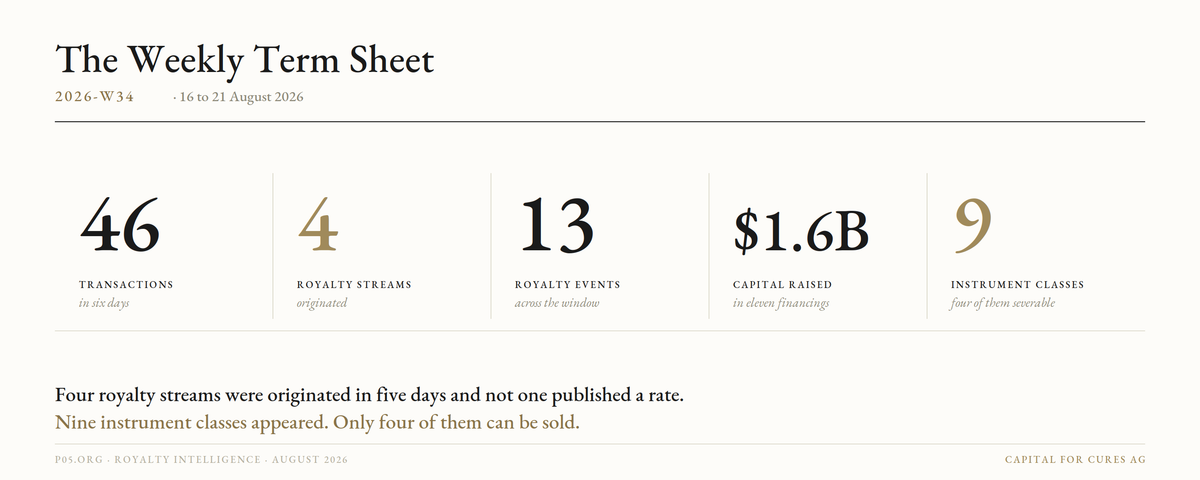
Four royalty streams were originated in five days and not one published a rate. The largest was LEO Pharma taking worldwide rights to dersimelagon from Bain-owned Tanabe Pharma, up to $435M in upfront and near-term milestones plus tiered royalties, on an asset whose NDA has been with the FDA since June. OmniAb, Chugai and NeoImmuneTech granted the other three.
Three existing streams moved on clinical news with nothing signed. SAFFRON put the first positive global Phase III behind a savolitinib royalty HUTCHMED has held since 2011 and that has never earned outside China, where a fixed 30% applies instead. argenx widened Halozyme's ENHANZE base with a fourth indication. EyePoint missed its primary and went the other way.
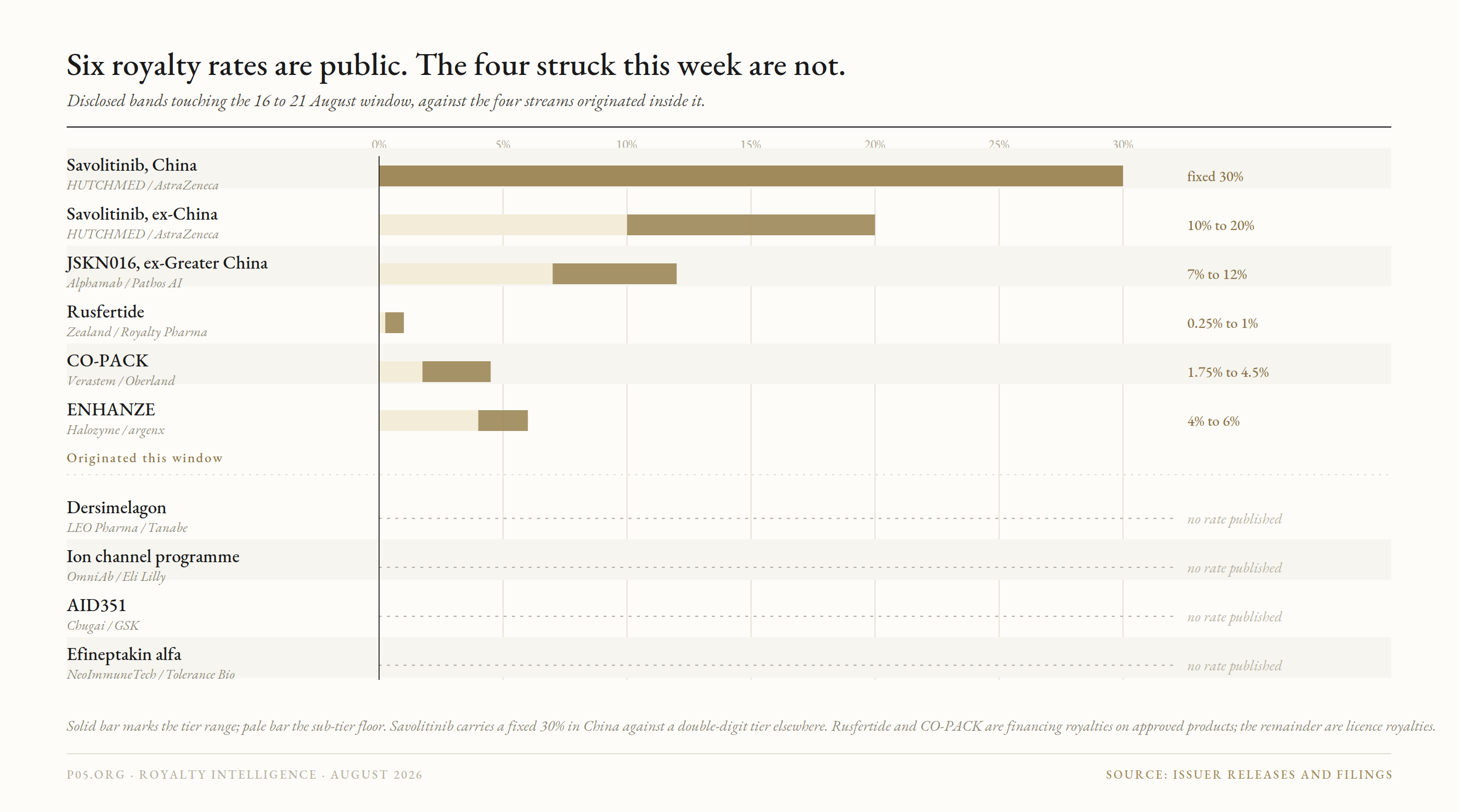
Six royalty rates touching the window are public. The four struck inside it are not.
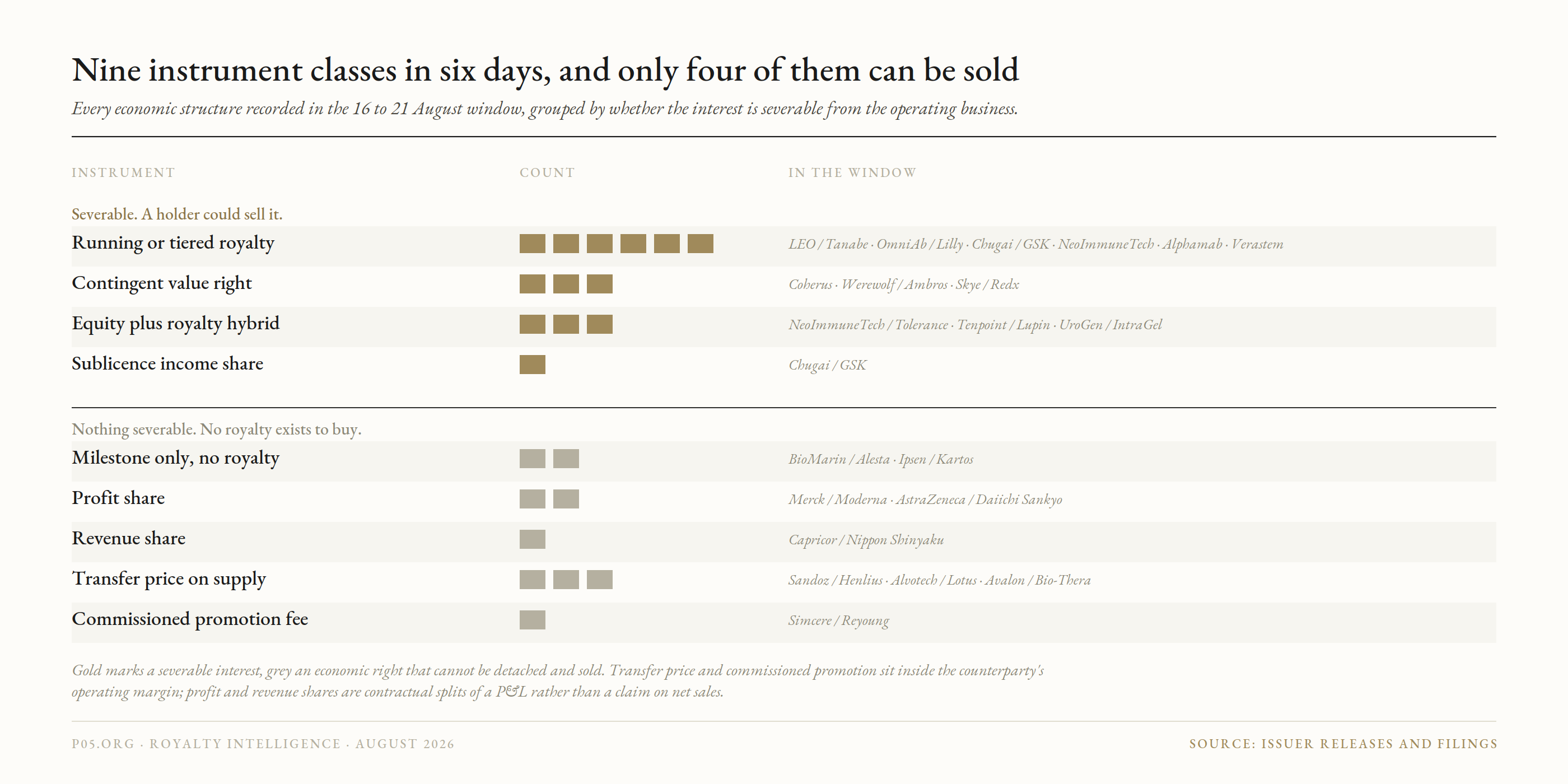
Nine instrument classes, grouped by whether the interest can be detached from the operating business and sold.
M&A ran to two acquisitions and one completion at $450M upfront against up to $1.3B in milestones, none carrying a contingent value right, and in both the asset being bought had itself been licensed in on terms never published. Coherus went the other way, carving an existing royalty out of a listed company into a two-year CVR with a lender already ahead of it on the same collateral.
Funding split six private events against seven public transactions, the larger and more geographically spread of the two. Regulatory produced seven actions, one of them four days early with a priority review voucher attached.
Highlights
Royalty events: 13. Four originated, one carved out, one assigned inbound, one terminated, one milestone invoiced, one turned earning, three re-rated up, one down. No royalty was bought, sold or pledged for cash anywhere in the week.
- LEO Pharma / Tanabe (18 Aug): up to $435M near term, plus downstream milestones and tiered royalties. NDA under FDA review.
- OmniAb / Lilly (17 Aug): tiered on global net sales, up to $370M. Target undisclosed.
- Chugai / GSK (17 Aug): royalties plus a share of sublicensing income. No upfront disclosed.
- NeoImmuneTech / Tolerance Bio (19 Aug): up to $260M, equity and tiered royalties.
- Coherus (17 Aug): an existing royalty carved into a non-tradable CVR, two years to 7 Oct 2028.
- HUTCHMED / AstraZeneca (17 Aug): SAFFRON positive. The ex-China double-digit tier gets a registration path.
- argenx / Halozyme (17 Aug): ALKIVIA positive. A fourth indication on the ENHANZE base.
- Teva / Paragon (19 Aug): Priority Review re-rates the royalty former Emalex holders kept.
- EyePoint / Equinox (17 Aug): LUGANO missed. De-rates an undisclosed vorolanib royalty.
- Oncolys / Fujifilm Toyama Chemical (NHI-listed 5 Aug, reimbursed 13 Aug, rollout 21 Aug): Telomelysin at $21,000 (JPY 3.1M) per vial. Milestone plus supply, no royalty rate disclosed.
- Genexine / NeoImmuneTech (21 Aug): Genexine invoiced a $3.0M (KRW 4.2B) non-refundable milestone on Phase 2 completion of efineptakin alfa, revealing an upstream above the Tolerance Bio licence struck two days earlier.
- Amgen / TScan (notice 12 Aug, disclosed 18 Aug): Amgen terminates the 2023 Crohn's collaboration. Tiered single-digit royalties and over $500M of milestones lapse, subject to a survival clause. Effective 10 Nov.
- Apimeds / FreeT (signed 19 Aug, filed 21 Aug): assignment to Apimeds of a 25% royalty entitlement on US Apitox economics, a 25% share of overseas rights income, and Korean clinic rights. No consideration disclosed.
Rate disclosure. Four in-window items carry a public rate, and every one pre-dates the window.
- Savolitinib publishes a fixed 30% in China against double-digit tiered outside it. An unusually wide split on one asset.
- ENHANZE publishes tiered mid-single digit, with a US step-down at 2029.
- None of the four licences signed this week publishes anything. OmniAb names the instrument and stops. Chugai names two and quantifies neither. LEO caps the near term and leaves the royalty open. NeoImmuneTech discloses tiered royalties plus equity without a number against either.
- The W33 finding that numeric disclosure tracks regulatory proximity holds here in the negative.
M&A and restructuring: 6 prints, 2 completions, 1 carve-out.
- BioMarin / Alesta (approved 17 Aug, announced 18 Aug): $275M upfront, up to $215M in development and regulatory milestones. No sales milestones, no royalty, no CVR. Non-ALE1 assets spun out.
- Werewolf Therapeutics / Ambros Therapeutics (21 Aug): all-stock reverse merger on implied values of $500M and $47.5M. 71.7% to Ambros holders, 21.5% to the placement, 6.8% to Werewolf holders plus a CVR over disposals of the legacy assets. Closing by Q1 2027.
- Fulcrum / Slate Medicines (agreement 16 Aug, announced 17 Aug): all-stock reverse merger, 5.0% against 95.0%. Estimated $270.0M pre-close cash dividend in place of a CVR. Closing Q4 2026.
- Ipsen / Kartos Therapeutics (announced 29 Jun, completed 21 Aug): $450M upfront, up to $1.3B in regulatory and sales milestones. Navtemadlin, oral MDM2 inhibitor, Phase III POIESIS.
- Advent International / NZCR Group (21 Aug): majority stake in New Zealand Clinical Research, expanding an early-phase trial site footprint across Australasia. No terms.
- Kyungnam Pharm / Ascendio (19 Aug): 44.5% stake, 16.2m shares, $9.8M (KRW 13.1bn), settled by in-kind contribution of land and buildings rather than cash.
- Alivus Life Sciences (19 Aug): 76% of IQGEN-X Pharma for $1.05M (Rs 9.12 crore). Formulation development.
- Piramal Pharma / Yapan Bio (19 Aug): completion of an incremental 40.67% stake in a Hyderabad vaccines and biologics CDMO.
- Coherus Oncology (17 Aug): CVR special dividend, record 30 Sep, distribution 7 Oct. Expires worthless absent proceeds. Subject to the 12 Aug Innovatus loan.
All four rest on an in-licensed asset with an undisclosed upstream: SLTE-1009 from DartsBio, ALE1 from 1cBio, navtemadlin from Amgen, where it carried the designation AMG 232 and where Amgen also sits on the target's share register, and neridronate from Abiogen Pharma.
Licence-outs and collaborations: 22.
- LEO Pharma / Tanabe (18 Aug): worldwide rights to dersimelagon. NDA filed Jun 2026.
- OmniAb / Lilly (17 Aug): ion channel discovery.
- Chugai / GSK (17 Aug): exclusive worldwide with sublicence rights over AID351, flavivirus infections.
- NeoImmuneTech / Tolerance Bio (19 Aug): efineptakin alfa, Americas and Europe.
- Sandoz / Henlius (17 Aug): up to ten mAb and ADC biosimilars, up to $322M, up to $100.5M invoiced in 2026. No royalty instrument.
- Evaxion / Duke (17 Aug): EVX-05 glioblastoma vaccine, EVX-03 discontinued. No terms.
- UroGen / IntraGel Therapeutics (executed 18 Aug, disclosed 20 Aug): research licence plus exclusive worldwide options over up to three oncology programmes and a separate option on TumoCure after Phase II. Up to $7M of equity into IntraGel. Option economics not fully disclosed.
- Silo Pharma / Columbia University (18 Aug): exclusive global licence to Columbia intellectual property covering SPC-15, a selective 5-HT4 receptor agonist, for stress-induced fear, PTSD and anxiety disorders. No terms.
- Daré Bioscience / University of Manchester (19 Aug): exclusive licence over lopinavir and ritonavir soft gel vaginal insert formulations for DARE-HPV, with a direct university stand-by licence framework attached. No terms.
- Jocasta Neuroscience / UCSF (19 Aug): exclusive licence to alpha-klotho intellectual property, superseding the earlier Unity Biotechnology route to the same technology. No terms.
- Akiram Therapeutics / ITM (20 Aug): supply of no-carrier-added lutetium-177 for AKIR001 clinical development. No terms.
- Avalon Pharma / Bio-Thera Solutions (18 Aug): exclusive licence and commercialisation for BAT2406, a proposed dupilumab biosimilar, across Saudi Arabia and MENA. Bio-Thera retains development and manufacturing. No terms.
- Simcere / Reyoung Bio (20 Aug): exclusive Greater China commercialisation rights to kuleveibaimab, a long-acting anti-RSV antibody with its NDA under CDE priority review. No terms.
- Oblenio Bio / Leads Biolabs (20 Aug): option exercised over LBL-051, taking exclusive worldwide development and commercialisation rights.
- Kiora Pharmaceuticals / Chong Kun Dang (20 Aug): exclusive South Korean licence for KIO-301, completing global coverage for the asset.
- BioArctic / Mesenkia Therapeutics (19 Aug): BrainTransporter paired with a KITAIbodies anti-HVEM antibody in glioblastoma. No terms. BioArctic's fifth BrainTransporter collaboration and its first outside neurodegeneration.
- Genprex / undisclosed US CDMO (18 Aug): development and manufacturing scale-up for a diabetes gene therapy programme. No terms.
- Alvotech / Lotus Pharmaceutical (21 Aug): AVT34 and AVT87, proposed durvalumab and emicizumab biosimilars. Up to $150M in upfront and milestones, plus supply revenue. No royalty rate.
- BMS / Chai Discovery (20 Aug): AI antibody discovery. No economics disclosed at all.
- Tenpoint / Lupin (20 Aug): European rights to YUVEZZI in presbyopia licensed to Lupin's VISUfarma. Up to $81M (EUR 75M) to Tenpoint and Visus, plus tiered royalties on net sales.
- Eli Lilly / Amplitude Therapeutics (19 Aug): trans-amplifying RNA vaccine candidates in infectious disease, option over two further targets. No terms disclosed.
- Mankind Pharma / Chongqing Chenan (20 Aug): exclusive Indian rights to insulin degludec and a degludec-aspart combination. No terms disclosed.
Private funding: 11 events, $706M funded plus two non-dilutive awards.
- Slate Medicines (17 Aug): $245M placement, Frazier lead. No placement agent named.
- Ambros Therapeutics (21 Aug): $150M oversubscribed placement co-led by RA Capital and Janus Henderson. Five placement agents named.
- Gossamer Bio (agreement 20 Aug, announced 21 Aug): up to $250M, of which only $25.0M funds now. $125M releases on FDA acceptance of the seralutinib NDA, up to $100M of warrants on approval.
- Abcuro (18 Aug): $66M Series D, New Leaf lead.
- Kynexis (19 Aug): $45M / EUR 40M Series A extension to EUR 97M, Novartis Venture Fund lead.
- Leal (17 Aug): $30M Series A second close, Lilly joining.
- Aston Sci. (20 Aug): $28M / KRW 39.6bn Series D.
- KaliVir (19 Aug): $14M Series A extension to $25M.
- Basilea Pharmaceutica (18 Aug): non-dilutive. New CARB-X funding starting Phase 1 for the anti-infective BAL2420, alongside additional BARDA funding for the fosmanogepix and ceftibuten-ledaborbactam Phase 3 programmes. Amounts not stated in the summary.
- Xunming Life Sciences (19 Aug): $100M Series B, Suzhou. Follows the open-source release of its AuraIDE biological foundation model.
- Dermata Therapeutics (17 Aug): $3.4M placement of shares and pre-funded warrants plus Series E and F warrants, a further $6.7M if exercised in full.
Four of the six are extensions or insider second closes rather than fresh rounds.
Public capital: 9 transactions, four priced or closed.
- Ingenia Therapeutics (18 Aug): KOSDAQ debut at $42M (KRW 60bn), 5m KDRs. Closed 49.9% above the KRW 12,000 offer. First US-headquartered company to list on KOSDAQ.
- Zentalis Pharmaceuticals (closed 17 Aug): $92.6M underwritten offering, 26.45m shares at $3.50 including full exercise of the underwriters' option. Funds azenosertib through the pivotal DENALI Part 2 readout by end 2026.
- OS Therapies (21 Aug): $75M at-the-market facility established with Jefferies. 3.0% commission.
- NurExone Biologic (21 Aug): C$1.07M non-brokered placement closed, 1,938,326 units at C$0.55. TSXV.
- Hansa Biopharma (21 Aug): confidential draft registration statement filed with the SEC for an ADR offering and Nasdaq listing. Size and pricing undetermined. Funds a US launch of imlifidase against a 19 Dec PDUFA.
- Amylyx (launched 18 Aug, priced 19 Aug): launched at $350M, priced upsized at $500M, 14,090,000 shares at $35.50. Leerink, Morgan Stanley, Guggenheim, LifeSci.
- Symbiotec Pharmalab (19 Aug): Indian IPO at roughly $200M / INR 17.57bn, band INR 938 to 988. Subscription 24 to 27 Aug.
- Edesa Biotech (19 Aug): $25.0M priced. Warrants at $7.50 expiring 30 days after EB06 topline. Guggenheim sole book-runner.
- TheraCryf (20 Aug): GBP 1.05M at 0.18p, a 5% discount. Turner Pope lead bookrunner, Singer Capital Markets Nomad. GM 7 Sep.
Clinical: 6 wins, 2 failures.
- Merck and Moderna / intismeran (19 Aug): INTerpath-001 met RFS and DMFS. First positive Phase 3 for an mRNA cancer therapy. 50/50 profit share, not a royalty.
- HUTCHMED and AstraZeneca / ORPATHYS plus TAGRISSO (17 Aug): SAFFRON met PFS and OS, 338 patients.
- argenx and Zai Lab / VYVGART Hytrulo (17 Aug): ALKIVIA met primary at p=0.0011, a 15.4-point TIS delta.
- AstraZeneca and Daiichi Sankyo / Enhertu (17 Aug): DESTINY-Lung04 met PFS. Profit share.
- AstraZeneca / volrustomig (17 Aug): eVOLVE-Lung02 discontinued on IDMC recommendation. Three Phase IIIs continue.
- Amylyx / avexitide (18 Aug): Phase 3 LUCIDITY positive in post-bariatric hypoglycaemia. Funded a same-day offering that priced upsized at $500M.
- Brii Biosciences / BRII-179 plus elebsiran (21 Aug): Phase 2b ENRICH in hepatitis B reported HBsAg loss of 42.9% and 40.0% across two dosing schedules at end of treatment.
- EyePoint / Duravyu (17 Aug): LUGANO missed primary BCVA. 42% injection reduction at p<0.0001. LUCIA Q4 2026.
Regulatory: 11, and one came early.
- Ultragenyx / GENGLYCOS (19 Aug): accelerated approval four days ahead of a 23 Aug PDUFA, with a priority review voucher awarded.
- Regeneron / Pasatru (19 Aug): approval in fibrodysplasia ossificans progressiva.
- Teva / ecopipam (19 Aug): NDA accepted, Priority Review. PDUFA late Q1 2027.
- CSPC and Alphamab / anbenitamab (18 Aug): NMPA accepts the NDA in first-line advanced HER2-positive breast cancer. Distinct from the 4 Aug neoadjuvant filing.
- Acurx / ibezapolstat (17 Aug): brand name CIFBEZY, plus Type C guidance contemplating an NDA off a single Phase 3.
- Nuvation / safusidenib (20 Aug): Fast Track in IDH1-mutant glioma. Asset in-licensed from Daiichi Sankyo.
- Rein / LTI-03 (20 Aug): Fast Track in IPF.
- Leads Biolabs / opamtistomig (21 Aug): NMPA accepts the NDA for a PD-L1/4-1BB bispecific in extrapulmonary neuroendocrine carcinoma, an indication with no approved therapy worldwide. First of its class to reach NDA review.
- AstraZeneca and Daiichi Sankyo / Enhertu (17 Aug): China NMPA approval with pertuzumab in first-line HER2-positive unresectable or metastatic breast cancer. Expands a profit share, not a royalty.
- OncoSil Medical / OncoSil (17 Aug): Humanitarian Device Exemption approval in unresectable non-metastatic distal cholangiocarcinoma. First and only FDA-approved Class III device in the indication. Roughly 1,000 US patients a year.
- Implantica / RefluxStop (21 Aug): FDA Premarket Approval, the most demanding device pathway, on five years of safety and efficacy data. The only medtech approval in the window.
Fund formation: 2, after a category that had returned nothing all week.
- Fresenius Ventures (17 Aug): corporate venture fund committing over $231M (EUR 200M) across five years to early and growth-stage companies in advanced therapies, life science tools, medtech and digital care delivery.
- Value Partners / Insilico Medicine (19 Aug): RMB-denominated corporate venture fund with Shanghai Pudong Development and Shanghai Pudong Construction, targeting the AI and life sciences ecosystem.
M&A and Restructuring
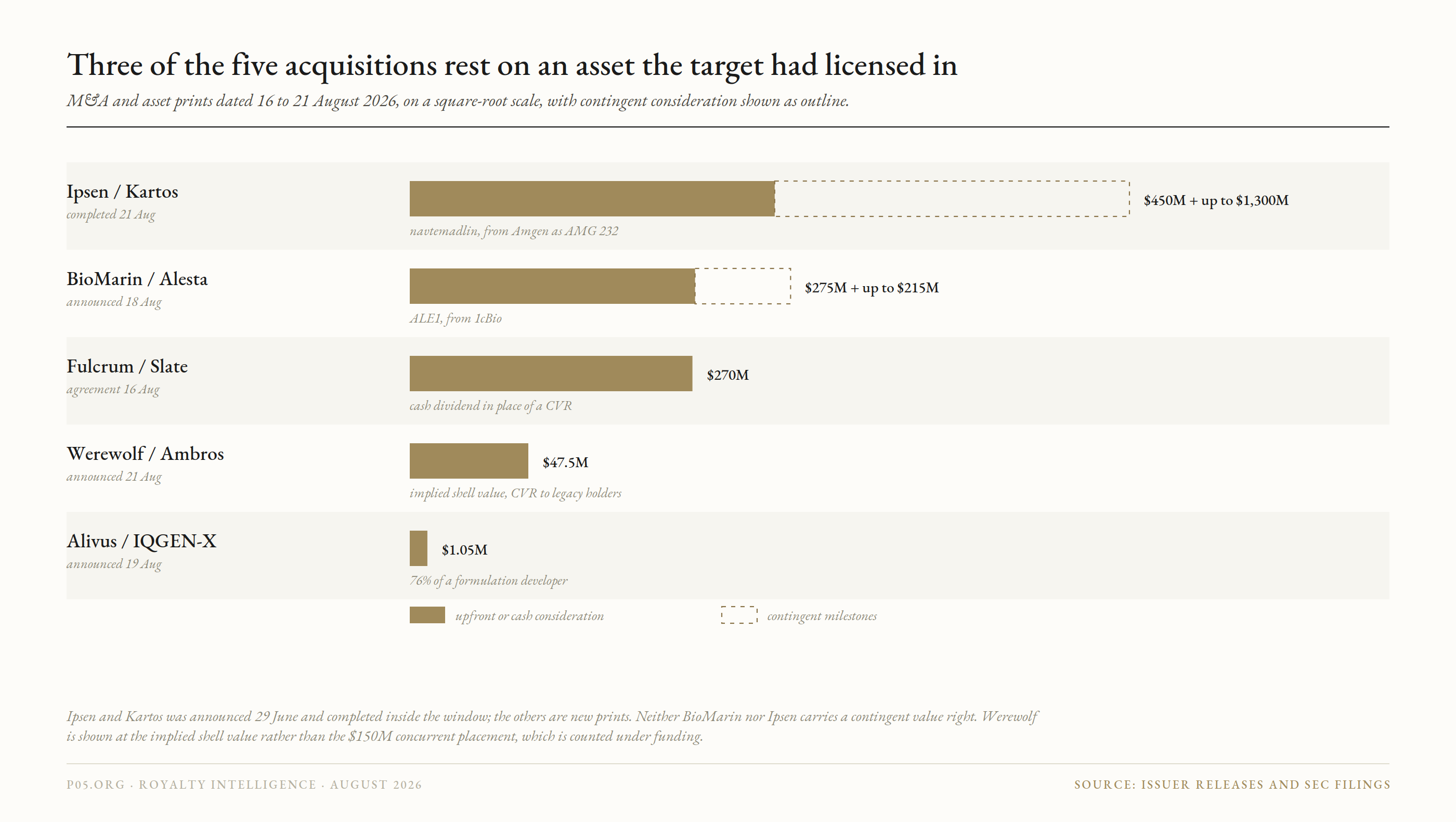
M&A and asset prints on a square-root scale, contingent consideration as outline.
Coherus Oncology: A CVR Carved Over Legacy Biosimilar Assets, With an Existing Royalty Stream Inside It (Declared Fri Aug 14; Announced Mon Aug 17)
Coherus Oncology, Inc. (Nasdaq: CHRS) declared a special dividend of contingent value rights over its remaining biosimilar assets, distributed pro rata to holders of record at 5:00 p.m. New York time on 30 Sep 2026, with a distribution date of 7 Oct 2026 (release; 8-K).
- Instrument: one CVR per common share, governed by a contingent value rights agreement with Equiniti Trust Company, LLC as rights agent. Holders receive their pro rata share of net cash proceeds if the company sells, licenses, receives license royalty payments including under existing licenses, or otherwise disposes of the Legacy BioSim Assets (CVR agreement)
- What sits inside it: biosimilar patents and intellectual property, a royalty stream, cell lines, and related materials including laboratory notebooks, regulatory filings and product samples. Management describes the package as a bolt-on for an existing biosimilars company or a foundation for a new one
- Stack: this is a royalty interest being carved out of a listed company and handed to a fixed shareholder register, in the same family as the Redx CVR in W33 but tighter in every dimension. Term is two years, running 7 Oct 2026 to 7 Oct 2028, and the CVRs expire without payment if no net proceeds arrive
- Not tradable. The CVRs cannot be transferred, which forecloses any secondary market in them and means the only route to the underlying economics is a transaction with Coherus itself before October 2028
- Encumbrance: the Loan and Security Agreement dated 12 Aug 2026 with Innovatus Life Sciences Lending Fund I, L.P. as collateral agent contains restrictions on both the disposition of the Legacy BioSim Assets and payments under the CVR. A lender sits ahead of the CVR holders on the same collateral
- Process: Coherus has retained an investment bank as capital markets adviser on the sale process. The bank is not named in the release, the 8-K or the CVR agreement. The lenders under the Innovatus facility are likewise unnamed, with only the collateral agent identified
- Timing: the dividend was authorised by the board's Strategic Financing Transaction Committee on 14 Aug 2026 and announced 17 Aug
- Date: Declared Fri Aug 14, 2026; announced Mon Aug 17, 2026, 17:33 ET
Ipsen / Kartos: $450M Upfront and Up to $1.3B, on an Asset Amgen Both Licensed Out and Holds Equity In (Announced Mon Jun 29; Completed Fri Aug 21)
Ipsen (Euronext: IPN; ADR: IPSEY) completed its acquisition of Kartos Therapeutics, adding the late-stage MDM2 inhibitor navtemadlin (completion; announcement).
- Terms: $450M upfront at closing, paid through a wholly owned Ipsen subsidiary, plus up to $1.3B in milestones including a significant regulatory approval milestone and sales-based milestones. Total consideration up to $1.75B, disclosed at announcement on 29 Jun (terms) and restated in H1 results on 30 Jul (H1). The completion release repeats none of it
- Economics: expected accretive to Ipsen's core operating income from 2029, with limited dilution to 2026 guidance. Conditional on expiry of the Hart-Scott-Rodino waiting period
- Asset: navtemadlin, an investigational oral MDM2 inhibitor developed as an add-on to ruxolitinib in myelofibrosis patients with a suboptimal response. The Phase III POIESIS study tests whether adding navtemadlin improves outcomes against ruxolitinib alone in intermediate and high risk TP53 wild-type disease
- Stack, and Amgen sits on both sides of it: navtemadlin originated at Amgen as AMG 232. Kartos was founded in 2016 by Wayne Rothbaum expressly around the in-licence of that asset (Kartos), and Amgen also appears on the Kartos shareholder register, alongside Quogue Capital, OrbiMed, SR One, Fidelity, BlackRock, T. Rowe Price, Invus and Soleus Capital. Licence terms have never been published. On a $450M upfront, Amgen is paid twice: once on its equity, once on whatever milestone and royalty tail survives the change of control
- Pattern: the third single-asset acquisition this week built on an in-licensed asset with an undisclosed upstream, after SLTE-1009 from DartsBio and ALE1 from 1cBio. Rothbaum has run the structure repeatedly, founding Kartos on the Amgen licence in 2016 and Telios Pharma on a Merck KGaA licence in 2019, having earlier co-founded Acerta Pharma
- Market: myelofibrosis affects roughly 1.5 per 100,000 in the US and Europe, with a median age at diagnosis of 67 to 69. Between 75% and 89% of patients are intermediate or high risk at diagnosis and more than 95% are TP53 wild-type. Ruxolitinib is first-line standard of care, but 50% to 75% discontinue within three years, and median overall survival after discontinuation is one to two years
- Trial: POIESIS is designed to enrol more than 600 patients across more than 250 sites, with topline expected in 2027. It builds on the Phase Ib/II KRT-232-109 study and the completed Phase III BOREAS in relapsed or refractory disease
- Advisers: none named on either release
- Context: Ipsen's second completed acquisition in a month, after Memo Therapeutics AG on 22 Jul at EUR 200M upfront and total consideration above EUR 700M, where assets and employees unrelated to potravitug went to a new vehicle owned by Memo's own shareholders (Memo), also announced without terms
- Date: Announced Mon Jun 29, 2026. Completed Fri Aug 21, 2026
BioMarin / Alesta: $275M Upfront and Up to $215M for a Single Phase 1/2a Asset That Alesta Itself Licensed In (Approved Mon Aug 17; Announced Tue Aug 18)
BioMarin Pharmaceutical Inc. (Nasdaq: BMRN) entered a definitive agreement to acquire Alesta Therapeutics to gain ALE1, an orally active small molecule for hypophosphatasia (release; 8-K exhibit).
- Terms: $275M upfront to Alesta shareholders plus up to $215M on achievement of certain development and regulatory milestones. Funded with cash on hand. Expected to be modestly dilutive to 2026 results excluding the upfront
- Consideration structure: milestones are development and regulatory only. No sales milestones and no royalty to Alesta shareholders. A clean bolt-on with the whole contingent tail sitting before commercialisation, which is unusual at this stage and leaves nothing behind for a seller to monetise later
- Stack, upstream: ALE1 was in-licensed from 1cBio, with the 1cBio team continuing to support Alesta, disclosed when Alesta emerged from stealth on a $67M raise in January 2025 (launch). Terms were not published then and are not restated now. BioMarin is paying $275M in cash for an asset carrying an unquantified third-party licence above it
- Asset: ALE1 inhibits a novel target to reduce inorganic pyrophosphate, the metabolite central to HPP pathology, and is in an ongoing Phase 1/2a assessing safety, tolerability and pharmacokinetics and pharmacodynamics in healthy volunteers and adults with HPP. It has the potential to be the first oral therapy in the indication. HPP is a rare genetic bone disease caused by mutations in the ALPL gene, affecting more than 9,000 diagnosed patients in the United States and understood to be underdiagnosed
- Structure: Alesta will spin out all non-ALE1 assets to a new entity prior to closing, and all Alesta employees transfer to the spinout rather than to BioMarin. ALE1 joins BioMarin's Skeletal Conditions Business Unit. The same asset-carve shape as Jazz and Actio in W33, where the target spun out everything other than the acquired programme, though here the buyer takes no stake in the spinout
- Context: the transaction follows within a week of BioMarin discontinuing development of a rare disease programme acquired in an earlier $270M transaction (coverage)
- Conditions: approved by both boards on 17 Aug; completion of the non-ALE1 spinout; customary closing conditions and regulatory clearance. Structured as a cash-free, debt-free share purchase. Closing expected in Q3 2026
- Advisers: Morgan Stanley exclusive financial adviser and Jones Day legal counsel to BioMarin; J.P. Morgan Securities exclusive financial adviser and Goodwin Procter with NautaDutilh legal counsel to Alesta
- Date: Board approval Mon Aug 17, 2026; announced Tue Aug 18, 2026
Werewolf / Ambros: The Same Structure as Fulcrum Four Days Later, With a CVR Instead of a Cheque (Fri Aug 21)
Werewolf Therapeutics, Inc. (Nasdaq: HOWL) and privately held Ambros Therapeutics, Inc. entered a definitive all-stock merger agreement. The combined company will operate as Ambros Therapeutics from San Diego and is expected to trade as AMBX (release).
- Terms: exchange ratio set on an implied value of $500M for Ambros against $47.5M for Werewolf. Pre-merger Ambros holders take 71.7%, placement investors 21.5%, and pre-merger Werewolf holders 6.8%, subject to adjustment on Werewolf's closing net cash
- Stack, downstream: Werewolf holders other than placement participants also receive a contingent value right over payments from net proceeds on disposals of Werewolf's pre-transaction legacy assets, the PREDATOR platform and the WTX-124 and WTX-330 INDUKINE molecules. The direct inverse of Fulcrum and Slate four days earlier, where legacy holders took an estimated $270.0M in cash and no contingent claim. Same structure, opposite treatment of the legacy pipeline, and the difference is that Fulcrum had the cash to pay and Werewolf does not
- Stack, upstream: neridronate was developed by Abiogen Pharma S.p.A. and is approved and marketed in Italy. Licence terms are not disclosed. The fourth transaction this week built on an in-licensed asset whose upstream is unpublished
- Financing: oversubscribed concurrent private placement of $150M, co-led by RA Capital Management and Janus Henderson Investors, with Aberdeen, Adage, ADAR1, Affinity Asset Advisors, Arkin Bio Capital, Balyasny, Patient Square Capital's Enavate Sciences, SilverArc, Sphera Healthcare and Woodline Partners. Common stock and pre-funded warrants. Funds the combined company through CRPS-RISE topline and a planned NDA, with runway into 1H 2029
- Asset: neridronate, a bisphosphonate for Complex Regional Pain Syndrome Type 1, carrying Breakthrough Therapy, Fast Track and Orphan Drug designations and FDA alignment that a single successful pivotal trial could support approval. Approximately 600,000 patients have been treated in Italy across approved indications including CRPS-1, osteogenesis imperfecta and Paget's disease
- Trial: CRPS-RISE, roughly 270 patients randomised 1:1 to intravenous neridronate or placebo, primary endpoint change in pain intensity at week 12 on an 11-point scale, topline 2028
- Exclusivity: the company states its intellectual property position supports potential US market exclusivity through 2045, against 65,000 newly diagnosed US patients a year and no approved therapy
- Advisers: Piper Sandler exclusive financial adviser and Sidley Austin legal to Werewolf. Cooley legal to Ambros. Leerink Partners, Piper Sandler, Cantor, Wells Fargo Securities and LifeSci Capital as placement agents, with Latham and Watkins counsel to the agents
- Why it belongs here: a shell at a $47.5M implied value, a marketed Italian bisphosphonate repositioned into a US orphan indication, a single-trial regulatory path and an exclusivity claim running to 2045. The value sits in the regulatory and intellectual property construction rather than in the molecule, which has been in clinical use for decades
- Date: Announced Fri Aug 21, 2026
Fulcrum / Slate Medicines: An All-Stock Reverse Merger on a $245M Placement, With the Legacy Pipeline Cashed Out Rather Than Held in a CVR (Agreement Dated Sun Aug 16; Announced Mon Aug 17)
Fulcrum Therapeutics (Nasdaq: FULC) and privately held Slate Medicines entered a definitive agreement to combine in an all-stock transaction, with the combined company operating as Slate Medicines, Inc. and expected to trade on Nasdaq as SLTE (release; 8-K exhibit).
- Terms: pre-merger Fulcrum stockholders expected to own 5.0% of the combined company and pre-merger Slate stockholders, inclusive of financing participants, 95.0%, subject to adjustment on Fulcrum's closing net cash. The investor presentation filed with the 8-K decomposes that 95.0% into 55.9% legacy Slate and 39.1% private placement investors (EX-99.2), a split the press release aggregates and does not give
- Cash mechanics: Fulcrum contributes approximately $20.3M in net cash and, immediately prior to closing, pays a cash dividend of an estimated $270.0M to pre-merger Fulcrum stockholders, equal to net cash above $20.3M
- Stack, upstream: SLTE-1009 is in-licensed from DartsBio Pharmaceuticals (Guangdong), Ltd., where it is designated DS009. Slate took the licence alongside its $130M Series A in February 2026 and financial terms were not disclosed (launch release; coverage). The lead asset of a company about to hold roughly $265M in cash therefore runs back to an undisclosed Chinese royalty, and nothing in the merger release restates it. The obligation will surface in the Form S-4
- Stack, downstream: no contingent value right. Legacy Fulcrum economics are extinguished in cash rather than carried forward in a contingent instrument. Fulcrum discontinued pociredir in sickle cell disease on 1 Jun 2026 and opened a strategic review at that time (discontinuation). Where a legacy pipeline is written off rather than parked in a contingent instrument, there is nothing left for a royalty buyer to underwrite later
- Asset: SLTE-1009, a half-life extended subcutaneous anti-PACAP/VIP monoclonal antibody for migraine prevention, engineered for potential quarterly administration, cleared to enter Phase 1 in Australia with initial PK and safety data anticipated mid-2027. SLTE-2100, a PACAP/VIP and CGRP bispecific, is in lead optimisation, expected to enter the clinic in 2H 2027 and funded through a Phase 2a study. One further undisclosed migraine programme
- Financing: concurrent oversubscribed private placement of $245M, closing concurrently with the merger. Combined cash balance expected to fund operations into 2029
- Backers: led by Frazier Life Sciences, with Forbion, RA Capital Management, Deep Track Capital, Foresite Capital, OrbiMed, RTW Investments and Mingxin Capital
- Board: Slate's board serves the combined company, expected to include Peter Kolchinsky (RA Capital), Tim Lohoff (Forbion), Michael Rome (Foresite) and Mark Hahn, former CFO of Verona Pharma
- Advisers: Wedbush Securities exclusive financial and Cooley legal to Slate; Leerink Partners exclusive financial and Goodwin Procter legal to Fulcrum. No placement agent is named on the $245M financing, which is consistent with an insider-led round taken up by the existing Series A syndicate rather than one marketed
- Conditions: both stockholder votes, effectiveness of a Form S-4, and expiry or termination of the HSR waiting period. Closing expected Q4 2026
- Note on dating: three dates attach. The merger agreement is dated 16 Aug. The Slate company page carries a 16 Aug post date and a publish timestamp of 20:59:37 that evening, consistent with pre-staging on the day of signing. The body dateline and wire distribution both read 17 Aug, 07:00 ET, and the release announces a conference call for 17 Aug at 8:00 a.m. ET (company page)
- Date: Agreement dated Sun Aug 16, 2026; announced Mon Aug 17, 2026, 07:00 ET
Royalty-Bearing Licence-Outs and Collaborations
Bristol Myers Squibb / Chai Discovery: An Antibody Discovery Collaboration With No Economics Disclosed At All (Thu Aug 20)
Chai Discovery announced a collaboration with Bristol Myers Squibb (NYSE: BMY) to advance the discovery of therapeutic antibodies using artificial intelligence (release).
- Terms: none disclosed. No upfront, no milestone schedule, no royalty, no equity, no option fee. The release describes the work and quantifies nothing
- Structure: BMS will use Chai's AI models and platform, including its molecular folding and design models, to support the discovery of antibody candidates across its portfolio and to build what it describes as a continuously learning discovery system. Chai's models predict and reprogram molecular interactions to design biomolecules against defined criteria
- Stack: unknown, and the omission is the finding. Compare the shape of the same buyer's antibody-platform deals. BMS and Harbour BioMed signed in December 2025 for $90M in payments, up to $1.035B in development and commercial milestones, and tiered royalties should BMS advance all programmes (Harbour terms). BMS and Hengrui in May 2026 ran to $950M near term against a $15.2B ceiling plus tiered royalties outside the Hengrui territory
- Why it belongs here: antibody-platform licensors publish royalties; AI-model providers so far do not. Either Chai has taken economics it has chosen not to disclose, or it has been paid as a software vendor on a services fee. Those are very different businesses, and from outside they are indistinguishable. The distinction determines whether an AI discovery company is a future royalty holder or a cost line, and this window offers no way to tell
- Date: Announced Thu Aug 20, 2026
NeoImmuneTech / Tolerance Bio: Efineptakin Alfa Licensed for Up to $260M Plus Equity and Tiered Royalties, in Indications the Licensor Was Not Pursuing (Wed Aug 19)
Tolerance Bio licensed the clinical-stage long-acting interleukin-7 therapy efineptakin alfa (NT-I7) from NeoImmuneTech, Inc. (KRX: 950220) for certain thymus-related indications (release).
- Terms: up to $260M in development and sales milestone payments, equity consideration, and tiered royalties on net sales. No upfront cash figure disclosed and no royalty rate published
- Territory and scope: certain thymus-related indications across the Americas and Europe (coverage). NeoImmuneTech retains the asset elsewhere and in its own oncology indications
- Asset: efineptakin alfa is a next-generation fusion protein with two IL-7 moieties stabilised by N-terminal engineering and fused to the hyFc long-acting platform. NeoImmuneTech and its partners have studied it primarily in blood cancers, including checkpoint inhibitor combination trials with Merck, BMS and Roche
- Stack: the licensor takes three instruments at once: milestones, equity in the licensee, and a running royalty. Equity alongside a royalty is a hybrid worth separating in any model, because the two behave differently on an exit. An acquisition of the licensee converts the equity and may extinguish or accelerate the royalty depending on drafting
- Upstream, disclosed two days later: Genexine holds economics above NeoImmuneTech on the same molecule, which it carries as GX-I7. On 21 Aug Genexine invoiced a $3.0M (KRW 4.2B) non-refundable milestone on Phase 2 completion. So efineptakin alfa now has three visible layers: Genexine above NeoImmuneTech above Tolerance Bio, and only the middle one published anything this week
- Counterparty: Tolerance Bio launched in October 2024 with $17.2M in seed funding, is based in Philadelphia, and is backed by Columbus Venture Partners, Criteria Bio Ventures, Pacific 8 Ventures and BioAdvance Capital. A $260M ceiling against a seed-stage balance sheet means the consideration is almost entirely back-ended and the royalty is the substantive economics
- Why it belongs here: a Korea-listed licensor monetising indications outside its own development plan, taking equity and royalty rather than cash, while retaining the oncology programme. The retained-indication structure keeps the asset on NeoImmuneTech's own pipeline while creating a second, separable economic interest above someone else's development spend
- Date: Announced Wed Aug 19, 2026
LEO Pharma / Tanabe Pharma: Worldwide Rights to Dersimelagon for Up to $435M Near Term, Plus Downstream Milestones and Tiered Royalties on an Asset Already Under FDA Review (Tue Aug 18)
LEO Pharma A/S, privately held and co-owned by the LEO Foundation and Nordic Capital, agreed to acquire worldwide rights to dersimelagon from Tanabe Pharma, which Bain Capital carved out of Mitsubishi Chemical Group in a JPY 510bn ($3.3bn) transaction and renamed with effect from 1 Dec 2025 (coverage).
- Terms: up to $435M in upfront and near-term milestone payments, together with potential downstream milestones and tiered royalties on net sales. The split between upfront and near-term milestones is not disclosed, nor is the royalty rate, nor the downstream milestone schedule
- Asset: dersimelagon, an investigational once-daily oral melanocortin 1 receptor agonist for erythropoietic protoporphyria and X-linked protoporphyria, rare genetic disorders causing severe sunlight-induced skin pain. The mechanism increases skin melanin, reducing light penetration and protecting against phototoxic reactions
- Stage, and this is what distinguishes it from the window's other originations: the Phase III (NCT05005975) read out positively earlier in 2026 and an NDA was submitted to the FDA in June 2026 and is under review. Fast Track and Orphan Drug designations granted. LEO plans a 2027 launch. If approved it would be the first oral therapy in either indication
- Stack: Tanabe retains tiered royalties on net sales plus downstream milestones on an asset it no longer develops or commercialises. The $435M ceiling covers upfront and near-term milestones only; the downstream milestones and the royalty sit outside it. The other two licences originated in this window sit at preclinical and undisclosed-target stage; this one sits at NDA-under-review, which is where royalty risk collapses from clinical to regulatory
- Ownership matters here: a private-equity-owned pharma is a different counterparty from a listed subsidiary. Bain has stated Tanabe will pursue business development, licensing and acquisitions as an independent company, and a sponsor operates on a fund clock. Selling worldwide rights while retaining a royalty is precisely how a PE-owned pharma converts a development asset into a financeable stream
- Why it belongs here: a listed Japanese pharma holding a tiered royalty on a near-registration rare disease asset, with the development and commercial burden transferred entirely to the counterparty, is the clearest monetisation profile the window produced. The rate is unpublished, which is the only thing standing between this and a sizing exercise
- Buyer context: follows LEO's July 2025 acquisition of rights to Boehringer Ingelheim's Spevigo (spesolimab) for $105M and its 2026 acquisition of Replay's gene therapy platform. LEO reported H1 2026 revenue of $1.12B (DKK 7.26B), up 10% at constant exchange rates, in results published the same week, and is exploring a potential stock market listing (H1 results)
- Date: Announced Tue Aug 18, 2026
UroGen / IntraGel: Options Over Three Programmes and Up to $7M of Equity, With the Option Economics Unpublished (Executed Mon Aug 18; Disclosed Thu Aug 20)
UroGen Pharma (Nasdaq: URGN) entered a research licence with IntraGel Therapeutics carrying exclusive worldwide options over up to three oncology programmes, alongside a separate option over TumoCure in head and neck cancer, exercisable after Phase II (release). IntraGel is Israel-based.
- Terms: up to $7M of equity in IntraGel, tied to option execution rather than paid up front. The economics of the programme options are not fully disclosed, so what UroGen pays on exercise, and what IntraGel retains behind it, are both unpublished
- Instrument: an option, licence and equity hybrid. The third structure of the week pairing equity with a licence, after NeoImmuneTech taking equity in its licensee and Lupin taking a SAFE in its licensor's parent. Here the optionholder takes equity in the company whose programmes it may later license
- Asset: IntraGel's SRGel sustained-release platform and its oncology programmes. UroGen's own business is built on a sustained-release intravesical technology, so the option set sits directly adjacent to what it already commercialises
- Why it belongs here: an option is a royalty that has not been struck yet. Three programmes plus a fourth contingent on Phase II data means four potential future licences, each of which will carry economics that do not exist today. The equity is the visible half and the options are the half that matters
- Date: Agreement executed Mon Aug 18, 2026. Disclosed Thu Aug 20, 2026
BioArctic / Mesenkia: A Fifth Licence on a Delivery Platform, From the Company That Already Holds the Lecanemab Royalty (Wed Aug 19)
BioArctic AB (Nasdaq Stockholm: BIOA B) and Mesenkia Therapeutics AB signed a research collaboration pairing BioArctic's BrainTransporter delivery technology with an anti-HVEM antibody generated on Mesenkia's KITAIbodies platform, for glioblastoma (release).
- Terms: none disclosed. No upfront, no milestones, no royalty, no equity
- Structure: BioArctic generates the combined drug candidate. Both parties then run preclinical validation and decide on next steps from the data. A research collaboration with an implicit option rather than a licence, so the economics are deferred to a decision point that has not been reached
- Why it belongs here, and it is not this deal: this is BioArctic's fifth external collaboration on BrainTransporter and its first outside neurodegenerative disease (coverage). A delivery platform licensed five times is a royalty book being assembled the same way Halozyme built ENHANZE and Alteogen is building ALT-B4. BioArctic is doing this while already holding the Eisai royalty on lecanemab, so it runs a marketed royalty and a platform-licensing programme side by side
- The technology: BrainTransporter uses transferrin receptor-mediated transcytosis to carry antibody payloads across the blood-brain barrier. Preclinical data from 2024 indicated up to a 70-fold increase in antibody brain exposure without apparent haematologic safety cost (detail)
- The target: HVEM sits on glioblastoma tumour cells including tumour stem cells, the population associated with recurrence and treatment resistance, and is overexpressed in aggressive, mesenchymal and IDH-wild-type subtypes where prognosis is worst
- The counterparty: Mesenkia is preclinical, built on science from Uppsala University and the University of Tokyo. Two academic institutions across two countries sit beneath the antibody, and what either retains is not disclosed
- Market reaction: BIOA B rose 7.2% on the day on 12.3 times average volume. For a preclinical research collaboration with no disclosed terms, that is the market pricing platform validation rather than the transaction
- Date: Announced Wed Aug 19, 2026, 11:15 CET
Alvotech / Lotus: Up to $150M on Two Biosimilars, With the Recurring Economics in Supply Rather Than a Royalty (Fri Aug 21)
Alvotech (Nasdaq: ALVO) entered a licensing and commercialisation agreement with Lotus Pharmaceutical (TWSE: 1795) covering AVT34, a proposed biosimilar to Imfinzi (durvalumab), and AVT87, a proposed biosimilar to Hemlibra (emicizumab) (release).
- Terms: potential value to Alvotech of up to approximately $150M in upfront and milestone payments, in addition to ongoing revenues from the supply of commercial product. The split between upfront and milestones is not disclosed
- Stack: no royalty rate and, on the structure described, no running royalty. Alvotech's recurring economics come from transfer price on supply, as exclusive supplier for all markets, plus a direct commercialisation share in the US. That is the same shape as Sandoz and Henlius earlier in the week, with the roles reversed: here the Western manufacturer keeps the factory and the Asian partner commercialises
- Territory: United States on a semi-exclusive basis, with Alvotech retaining the right to commercialise directly alongside Lotus, which sells through its US subsidiary Alvogen. Exclusive rights for Lotus across eight Asian markets: South Korea, Taiwan, Thailand, Vietnam, the Philippines, Singapore, Hong Kong and Malaysia
- Reference products: Imfinzi recorded roughly $6.1B of global sales in 2025 and Hemlibra roughly $5.8B (CHF 4.8B). Neither faces a marketed biosimilar
- Why it belongs here: the second biosimilar framework of the week to produce nothing acquirable. Where a manufacturer retains supply, the economics sit in transfer price, which is not severable from the operating business. Two frameworks in five days, on opposite sides of the world, both structured so that no royalty exists to buy
- Advisers: none named
- Date: Announced Fri Aug 21, 2026
Tenpoint / Lupin: Tiered European Royalties Retained by a Private US Licensor, With the Payer Taking Equity in It (Thu Aug 20)
VISUfarma B.V., a wholly owned subsidiary of Lupin Limited (BSE: 500257; NSE: LUPIN), entered an exclusive licence with Visus Therapeutics Inc., a wholly owned subsidiary of Tenpoint Therapeutics Holding Limited, covering regulatory activity, commercialisation, marketing, distribution and sale of YUVEZZI (carbachol and brimonidine tartrate ophthalmic solution 2.75%/0.1%) in the European Union, United Kingdom, Switzerland, Norway and Iceland (release).
- Who holds what: Tenpoint and Visus retain the economics. Per the release, they are eligible for regulatory and commercial milestone payments "as well as tiered royalties based on net sales," and VISUfarma will make a strategic investment in Visus. Lupin is the payer and the licensee
- Terms: Lupin's exchange filing puts the consideration at up to $81M (EUR 75M) through first commercial sales, comprising a $22M (EUR 20M) strategic investment in Visus or its parent via a Simple Agreement for Future Equity, plus up to $59M (EUR 55M) in regulatory and commercial milestones. The tiered royalty sits on top and the rate is not disclosed
- Instrument: the licensee has taken equity in its own licensor while agreeing to pay it a royalty. The mirror of the NeoImmuneTech structure earlier in the week, where the licensor took equity in the licensee, and an unusual alignment: Lupin's SAFE converts on a future Visus or Tenpoint financing, so its value rises with the counterparty it is also paying
- Asset: already FDA-approved and described as the first and only once-daily dual-agent eye drop for presbyopia. Carbachol constricts the pupil to aid near focus while brimonidine prevents over-dilation. Tenpoint is commercialising in the US and has filed a UK marketing authorisation through the MHRA International Recognition Procedure
- Why it belongs here: an approved product, a private US licensor, a tiered royalty over five European jurisdictions, and a listed Indian pharma as payer. Tenpoint holds a royalty on a product it no longer commercialises in Europe, against a counterparty with published accounts. That is a cleaner underwriting proposition than most development-stage streams, and Tenpoint is private, so there is no public-market route to the same exposure
- Market: presbyopia affects roughly 128 million people in the United States and about 2 billion globally
- Context: builds on Lupin's earlier acquisition of VISUfarma, its specialty ophthalmology platform. CEOs quoted are Vinita Gupta at Lupin and Henric Bjarke at Tenpoint
- Date: Announced Thu Aug 20, 2026
OmniAb / Eli Lilly: An Ion Channel Programme for Up to $370M and Tiered Royalties on Global Net Sales (Mon Aug 17)
OmniAb, Inc. (Nasdaq: OABI) entered a global collaboration and license agreement with Eli Lilly and Company (NYSE: LLY) for a new ion channel programme, leveraging OmniAb's platform and its ion channel discovery and screening expertise (release).
- Terms: an undisclosed upfront payment, eligibility for up to $370M in research, development and commercial milestone payments, and tiered royalties on global net sales
- Asset: the therapeutic target and the modality are both undisclosed
- Stack: the only new royalty stream originated anywhere in the window with cash at signing. The rate band, the tier breakpoints and the term are unpublished, and with no named target there is no way to size the base. What is disclosed is the instrument class: a tiered running royalty on global net sales held by the platform rather than by a developer
- Guidance: OmniAb raised its 2026 cash outlook to $49M to $53M from $37M to $41M, citing recent business development and licensing activity
- Portfolio context: OmniAb was spun out of Ligand Pharmaceuticals in 2022 and runs a royalty-aggregation model rather than a development model. Partnered programmes include Johnson & Johnson's Tecvayli, already approved, and ramantamig, a Phase 3 trispecific in multiple myeloma; Boehringer Ingelheim's BI 3802876 in liver disease; Merck KGaA's anti-CEACAM5 ADC precemtabart tocentecan; and Teva's anti-IL-15 antibody TEV-'408 in vitiligo (coverage)
- Why it belongs here: a platform whose entire revenue model is milestones and royalties on partner-run programmes is the closest listed analogue to a royalty book assembled organically rather than bought. Each new licence adds an unencumbered stream at zero development cost to the holder, which is the structure royalty funds pay multiples to replicate
- Date: Announced Mon Aug 17, 2026
Chugai / GSK: An Exclusive Worldwide Licence on AID351 Paying Royalties and a Share of Sublicensing Income, With No Upfront Disclosed (Signed Mon Aug 17; Announced Tue Aug 18)
Chugai Pharmaceutical Co., Ltd. (TOKYO: 4519), a member of the Roche group, signed an exclusive licence agreement with GSK for the anti-dengue virus antibody AID351 on 17 Aug 2026, announced the following morning (release).
- Terms: GSK obtains an exclusive, worldwide licence to develop, manufacture and, if successful, commercialise AID351, with the right to sublicense. Chugai is eligible for tiered royalties based on future product sales by GSK and a percentage of any sublicensing income received by GSK from third parties
- Not disclosed: no upfront, no milestone schedule, no royalty rate, no sublicence income percentage. The consideration published is entirely back-ended and entirely unquantified, which is the characteristic shape of a neglected-tropical-disease licence and should be read as a structure rather than as incomplete disclosure
- Scope: flavivirus infections including dengue fever, broader than the dengue-only framing the asset has carried to date
- Structure: GSK takes clinical development, including Phase I trials, and manufacturing
- Stack, four parties deep: the antibody was discovered in 2017 by A*STAR Singapore Immunology Network and the National University of Singapore, which is the lead. Chugai Pharmabody Research, the group's Singapore base, optimised it using Chugai's proprietary antibody engineering. The joint development project received GHIT Fund grants on two occasions (2019 grant). GSK Global Health now sits on top. Economics flowing to the academic originators, and any access or affordability covenants attached to the GHIT grants, are not disclosed
- Upgrade from: the collaboration agreement of 30 Jan 2025, under which GSK Global Health held a non-exclusive licence while performing activities and evaluating potential funding toward clinical studies (Jan 2025). The move is from evaluation rights to a full exclusive commercial licence
- Asset: preclinical. Dengue has four serotypes and the originating antibody showed high neutralising activity against all four. WHO estimates about half the world's population is now at risk, with 100 to 400 million infections a year and no effective treatment
- Why it belongs here: the sublicence income share is the more interesting of the two instruments. A product royalty captures value only from GSK's own sales, and in a neglected-tropical-disease context the realistic commercialisation route runs through regional or endemic-market manufacturers under sublicence. Chugai has taken a second instrument specifically to reach a distribution channel a straight royalty would miss
- Date: Signed Mon Aug 17, 2026; announced Tue Aug 18, 2026
Sandoz / Henlius: Up to Ten Biosimilars for Up to $322M, With the Economics in Transfer Price Rather Than a Royalty (Mon Aug 17)
Sandoz (SIX: SDZ; OTCQX: SDZNY) and Shanghai Henlius Biotech (HKEX: 2696) entered a strategic collaboration covering up to ten proposed monoclonal antibody and antibody-drug conjugate biosimilar products or components developed by Henlius, with terms signed for three initial products and an option over a fourth (release).
- Terms: an upfront payment, milestone payments and a non-refundable option fee totalling up to $322M. The amount invoiced to Henlius in 2026 is expected to reach up to $100.5M. The ceiling attaches to the initial arrangements, meaning the three agreed products plus the option, and is not the value of all ten
- Assets: HLX05-N, a proposed cetuximab biosimilar; HLX16, a proposed evolocumab biosimilar; and a proposed belimumab biosimilar. Sandoz separately holds an option on HLXTE-HAase1001, a recombinant human hyaluronidase. The remaining assets under the framework are unnamed capacity, most at early development stage
- Territory: for HLX05-N, exclusive in the United States, Canada, the European Union, certain other European countries including the United Kingdom and Switzerland, Japan, Australia and New Zealand, with semi-exclusive rights across parts of Asia and other markets. For HLX16 and the belimumab candidate, exclusive worldwide outside China
- Structure: Henlius develops and manufactures; Sandoz commercialises. Sandoz states the framework takes its biosimilar pipeline from 39 to a potential 46 assets
- Stack: no royalty instrument. Consideration is upfront, milestones, a non-refundable option fee and transfer price on supply. Where a Chinese originator retains development, manufacture and commercial supply, the recurring economics sit in manufacturing margin, which is not severable from the operating business and not a monetisation candidate. The option fee on the hyaluronidase is the one line in the deal that behaves like a discrete purchasable right
- Reference product: Erbitux (cetuximab) recorded $1.7B in global sales in 2025, up 6.6%. Its core patents expired some time ago and no biosimilar has been marketed, on account of the molecule's structural complexity (coverage)
- Context: extends the April 2025 Sandoz and Henlius agreement on HLX13, a proposed ipilimumab biosimilar, worth up to $301M including a $31M upfront (2025 terms)
- Date: Announced Mon Aug 17, 2026, by Sandoz as an ad hoc release under art. 53 of the SIX Swiss Exchange Listing Rules and by Henlius the same day
Evaxion / Duke: An Off-the-Shelf Glioblastoma Vaccine Added and EVX-03 Discontinued, on a Portfolio Already Carrying an MSD Royalty (Mon Aug 17)
Evaxion A/S (Nasdaq: EVAX) expanded and refocused its R&D pipeline with EVX-05, an off-the-shelf therapeutic glioblastoma vaccine developed with Duke University School of Medicine, and simultaneously discontinued EVX-03 (release).
- Terms: none disclosed. No upfront, no milestones, no royalty and no cost split published on the Duke arrangement
- Asset: EVX-05 targets endogenous retrovirus (ERV)-derived antigens shared across glioblastoma patients, identified from patient tumour samples using the AI-Immunology platform. Lead candidate optimisation is underway. Initial clinical testing is expected to be carried out by Professor Mustafa Khasraw and his team at Duke, which the company describes as a cost-efficient route into a Phase 1
- Stack: the Duke economics are the open question and are not in the public record. Where an academic medical centre contributes target biology and runs the first clinical study, an institutional licence with milestones and royalties is the normal outcome, and none is disclosed
- Portfolio: EVX-05 uses the same ERV-targeting concept as EVX-04 in acute myeloid leukaemia. EVX-03 has been discontinued and removed from the pipeline as portfolio management, with both surviving programmes drawing on its learnings. Costs sit inside existing budgets, so cash runway is unchanged into 2H 2027
- The live royalty elsewhere: Evaxion out-licensed EVX-B3 to MSD in September 2025 for a $7.5M cash payment, up to $592M in development, regulatory and sales milestones, and royalties on net sales, with MSD assuming full responsibility and all costs (6-K). MSD declined its option on EVX-B2, the gonorrhoea candidate, in December 2025, returning global rights to Evaxion, which is seeking another partner (update). The rate on EVX-B3 is not published
- Why it belongs here: a nano-cap platform holding an unencumbered royalty entitlement on a preclinical vaccine that Big Pharma is funding in full, with runway to 2H 2027 and no product revenue, is the standard profile for a vaccine royalty monetisation. The entitlement prices as an option rather than a stream, but the seller-side conditions are present
- Date: Announced Mon Aug 17, 2026
Regulatory and Clinical
Merck / Moderna: INTerpath-001 Meets RFS and DMFS in Resected Melanoma, the First Positive Phase 3 for an mRNA Cancer Therapy, on a Profit Share (Wed Aug 19)
Merck (NYSE: MRK) and Moderna (Nasdaq: MRNA) reported positive topline results from the Phase 3 INTerpath-001 trial of intismeran autogene (V940, mRNA-4157), an mRNA-based individualised neoantigen therapy, in combination with KEYTRUDA (pembrolizumab) as adjuvant treatment in completely resected stage IIB-IV cutaneous melanoma (release).
- Result: at a pre-specified interim analysis, the combination met its primary endpoint of recurrence-free survival and the key secondary of distant metastasis-free survival, both statistically significant and clinically meaningful against KEYTRUDA alone. Safety consistent with prior reports, no new signals. The study continues to evaluate overall survival
- Firsts: the first positive Phase 3 readout for an individualised neoantigen therapy, the first for any mRNA-based cancer therapy, and the first Phase 3 to show clinically meaningful improvement over KEYTRUDA alone in the adjuvant resected melanoma setting
- Design: 1,137 patients randomised 2:1 to intismeran (1 mg every three weeks, up to nine doses) plus KEYTRUDA (400 mg every six weeks, up to nine cycles) against KEYTRUDA alone, for approximately one year or up to 56 weeks. Each therapy encodes up to 34 neoantigens selected from the patient's own tumour sample
- Stack: intismeran is jointly developed by Merck and Moderna. Merck exercised its option in October 2022 for $250M, and the parties share development costs and any profits equally. A 50/50 cost and profit share, not a royalty. A profit share is a separate instrument class, so a positive read expands a shared profit and loss account rather than a royalty base and should not be modelled as royalty upside. The second such case in this window after DESTINY-Lung04
- Programme: INTerpath comprises nine Phase 2 and Phase 3 trials across melanoma, non-small cell lung cancer, bladder cancer and renal cell carcinoma, plus Phase 1 work in adjuvant pancreatic ductal adenocarcinoma and perioperative gastric and NSCLC. The Phase 2b KEYNOTE-942 five-year follow-up presented at ASCO 2026 showed a 49% reduction in risk of recurrence or death (HR 0.51) and 59% in distant metastasis or death (HR 0.411)
- Next: data to be presented at an international medical meeting; both companies will engage regulators on filing submissions
- Date: Announced Wed Aug 19, 2026
HUTCHMED / AstraZeneca: SAFFRON Meets Both PFS and OS, Putting a Registration Path Behind an Ex-China Royalty That Has Never Earned (Mon Aug 17)
HUTCHMED (Nasdaq/AIM: HCM; HKEX: 13) and AstraZeneca (LSE/STO/Nasdaq: AZN) reported positive high-level results from the SAFFRON Phase III trial, in which ORPATHYS (savolitinib) plus TAGRISSO (osimertinib) demonstrated a statistically significant and clinically meaningful improvement in both progression-free survival and overall survival against doublet platinum-based chemotherapy, in EGFR-mutated non-small cell lung cancer patients with MET-driven disease after progression on TAGRISSO (release).
- Result: the first global Phase III to show significant PFS and OS benefit in this setting. Second and third line. Patients were prospectively selected on the high MET cut-offs identified in the SAVANNAH Phase II, determined by immunohistochemistry and fluorescence in situ hybridisation. Reported enrolment of 338 patients across 29 countries
- Stack, two instruments on one asset: under the licence and collaboration agreement, HUTCHMED receives a fixed 30% royalty on all China sales and double-digit tiered royalties on all sales outside China (partnership terms). HUTCHMED leads development, manufacture and supply in China; AstraZeneca leads and funds development for the rest of the world and commercialises
- Why it belongs here: the ex-China stream has existed on paper since 2011 and has earned nothing, because savolitinib's only approval is Chinese, where the separate fixed rate applies. SAFFRON is the trial built to support registration outside China and it is the first positive global Phase III behind that entitlement. No rate moves and no money changes hands, so this is not a transaction. What changes is the discount on a stream that was carrying a full clinical risk weighting. A blended rate assumption across the two territories would be wrong in both directions
- Milestone ladder to date: $25M on first China commercial sale (Jul 2021); $15M on initiation of SAFFRON start-up activities (Mar 2022); $11M on the China second-line EGFRm sNDA approval (Jun 2025). A global filing and approval ladder should be assumed above these; the schedule is not public
- Context: the combination is already approved in China on the SACHI Phase III. SAFFRON was guided for H2 2026 topline in HUTCHMED's own late-stage development schedule (6-K)
- Date: Announced Mon Aug 17, 2026
argenx / Zai Lab: ALKIVIA Meets Its Primary in Autoimmune Myositis, a Fourth Indication on an ENHANZE-Bearing Asset (Mon Aug 17)
argenx (Euronext & Nasdaq: ARGX) and Zai Lab (Nasdaq: ZLAB; HKEX: 9688) reported positive topline results from the ALKIVIA Phase 3 study of VYVGART Hytrulo (efgartigimod alfa and hyaluronidase-qvfc) in adults with autoimmune myositis (release).
- Result: primary endpoint met at p=0.0011. In the combined immune-mediated necrotising myopathy and dermatomyositis population, efgartigimod delivered a 15.4-point greater improvement in mean Total Improvement Score at week 52 against placebo, 47.95 against 32.56. Separation emerged at week 4 and was sustained through the full year under a protocol-mandated corticosteroid taper, with a consistent effect across IMNM and DM
- Design: 264 patients with active disease on background treatment, randomised 1:1 to weekly efgartigimod PH20 SC or matched placebo. Two-stage design, with a Phase 2 analysis after the first 89 patients completed and a 175-patient Phase 3 thereafter. Conducted across North America, Europe, the Middle East and Asia-Pacific including China and Japan. Safety consistent with the known VYVGART profile
- Stack: Halozyme holds a tiered mid-single-digit royalty on annual net sales of ENHANZE-enabled argenx products under the six-target global collaboration, payable for the longer of ten years from first commercial sale or expiry of the last valid co-formulation patent claim, with a step-down on expiry of ENHANZE-related patents (expansion terms). Halozyme's own disclosure projects the US rate running at mid-single digits to 2029, with a reissue application pending (royalty summary). Zai Lab holds Greater China rights under exclusive licence from argenx and enrolled the Chinese patients
- Royalty read-through: each new efgartigimod indication widens the base on which the ENHANZE royalty runs, without any new agreement being signed. Whether a fourth indication is worth much to the royalty holder turns on the 2029 step-down and the pending reissue rather than on the trial result
- Market: approximately 100,000 people in the United States live with autoimmune myositis, including roughly 20,000 with IMNM and 40,000 with DM. No therapy is approved in IMNM
- Date: Announced Mon Aug 17, 2026
EyePoint / Equinox Science: LUGANO Misses Its Primary Endpoint, De-Rating an Undisclosed Royalty on Vorolanib (Mon Aug 17)
EyePoint Pharmaceuticals (Nasdaq: EYPT) reported topline data from LUGANO, the first of two pivotal Phase 3 trials of Duravyu (vorolanib intravitreal insert, 2.7mg) in wet age-related macular degeneration (release).
- Result: the primary endpoint, change in best corrected visual acuity against on-label aflibercept, was not met in the full dataset. EyePoint attributes the miss to an asymmetric cohort of 9 of 211 patients, roughly 4%, with vision loss unrelated to wet AMD. An ad hoc analysis excluding that cohort showed non-inferiority at a nominal p=0.0096
- Secondaries: superiority against on-label aflibercept on treatment burden, a 42% reduction equal to two fewer injections on average, at p<0.0001. 54% of Duravyu patients were supplement-free and 79% received no more than one supplement to week 56. Supplement-free BCVA was non-inferior at a nominal p=0.0035
- Stack: vorolanib is in-licensed. Under the February 2020 exclusive licence from Equinox Science, LLC, EyePoint paid $1M upfront and owes development and regulatory milestones plus post-commercialisation royalties, with EyePoint responsible for development and commercialisation worldwide excluding China, Macau, Hong Kong and Taiwan (licence terms). The rate is not published
- Why it belongs here: the mirror image of SAFFRON. A positive global Phase III put a registration path behind a royalty that had never earned; a missed primary on the first of two pivotals lengthens the odds on one that has also never earned. No rate moves in either case. The asymmetry is that Equinox is a private counterparty with no disclosure obligation, so this de-rate is invisible from outside in a way the HUTCHMED one is not
- Next: LUCIA topline expected Q4 2026, with a potential NDA in 1H 2027
- Date: Announced Mon Aug 17, 2026
AstraZeneca / volrustomig: eVOLVE-Lung02 Discontinued on IDMC Recommendation, Three Phase III Programmes Continue (Mon Aug 17)
AstraZeneca discontinued the Phase III eVOLVE-Lung02 trial of volrustomig in metastatic non-small cell lung cancer, following a planned data review at which the Independent Data Monitoring Committee concluded the combination was unlikely to meet either of its dual primary endpoints (coverage).
- Result: unlikely to meet progression-free survival or overall survival in the primary analysis population of PD-L1 negative patients. Volrustomig plus chemotherapy was compared against pembrolizumab plus chemotherapy in tumours expressing low PD-L1. Reported enrolment of 895 patients across 25 countries
- Safety: consistent with the known profiles of the individual medicines, with no new signals identified
- Asset: volrustomig is designed to deliver simultaneous PD-1 and CTLA-4 blockade on the same T cell. AstraZeneca-originated
- Stack: no third-party royalty counterparty identified. A pipeline event rather than a stack event
- Remaining: Phase III programmes in cervical cancer, head and neck squamous cell carcinoma and mesothelioma continue as planned, so this is not an asset termination
- Date: Announced Mon Aug 17, 2026
AstraZeneca / Daiichi Sankyo: DESTINY-Lung04 Meets PFS in First-Line HER2-Mutant NSCLC, on a Profit Share Rather Than a Royalty (Mon Aug 17)
AstraZeneca and Daiichi Sankyo (TSE: 4568) reported positive topline results from the Phase III DESTINY-Lung04 trial of Enhertu (trastuzumab deruxtecan) as first-line treatment in HER2-mutant non-small cell lung cancer (coverage).
- Result: statistically significant and clinically meaningful improvement in progression-free survival against platinum-based chemotherapy in combination with pembrolizumab. The first and only HER2-directed medicine to improve PFS in this treatment setting in a Phase III. Reported enrolment of 454 patients across Asia, Europe and North America
- Stack: economics between AstraZeneca and Daiichi Sankyo run through a profit share, not a royalty. A profit share is a separate instrument class. A positive read expands a shared profit and loss account rather than a royalty base, and should not be modelled as royalty upside
- Next: the trial continues to evaluate secondary endpoints including overall survival
- Date: Announced Mon Aug 17, 2026
Ultragenyx / OMERS: GENGLYCOS Approved Four Days Early With a Priority Review Voucher, on a Launch Funded by a Royalty Sold on a Different Asset (Wed Aug 19)
Ultragenyx Pharmaceutical Inc. (Nasdaq: RARE) announced that the FDA granted accelerated approval for GENGLYCOS (pariglasgene brecaparvovec-opnr), previously DTX401, in adult and paediatric patients eight years and older with glycogen storage disease type Ia (release; FDA announcement).
- Timing: granted 19 Aug against a PDUFA target of 23 Aug, four days early. Ultragenyx's first gene therapy approval and its fifth FDA approval overall
- Indication: to reduce daily cornstarch intake as an adjunct to nutritional management, approved under accelerated approval on the basis of that reduction. The first therapy directly targeting the underlying cause of GSDIa
- Evidence: the 48-week randomised, double-blind, placebo-controlled Phase 3 GlucoGene study treated 46 participants, 44 in the modified intention-to-treat population, showing a statistically significant mean reduction from baseline in daily cornstarch intake of 31% against placebo, p<0.001. Post-marketing commitment to two years of safety and efficacy data from 50 commercially treated patients and 20 controls through the existing GSDIa Disease Monitoring Program
- Priority review voucher awarded on approval. Against the 2026 comparable set, six disclosed transactions have cleared between $180M and $215M: Rocket at $180M in April, Denali at $195M closing in July, Jazz at $200M in January, Fortress and Cyprium at $205M in March, and Arrowhead's $215M purchase agreement in July
- Stack, and it runs backwards: no royalty encumbers GENGLYCOS. What exists is two monetisations of the Crysvita royalty from Kyowa Kirin, sold to OMERS: $500M for 30% of the North American interest in Jul 2022 capped at 1.45x (2022), and a further 25% for $400M in Nov 2025 capped at 1.55x with payments running from Jan 2028 (2025)
- Why it belongs here: the November 2025 tranche was raised expressly to fund four expected launches, with a payment holiday to January 2028 opening a cash-flow window across the launch period. This is the first of those four to land. A mature royalty on one product was sold twice to fund the commercialisation of others, and the structure has now produced its first approved product plus a saleable voucher. A treasury structure rather than a distress structure, and the cleanest worked example of the mechanic on record
- Epidemiology: GSDIa affects 1,500 to 2,500 patients in the United States
- Date: Announced Wed Aug 19, 2026
Teva / Paragon: Ecopipam Accepted With Priority Review, Re-Rating a Royalty the Seller Kept When Teva Bought the Company (Wed Aug 19)
Teva Pharmaceuticals, the US affiliate of Teva Pharmaceutical Industries Ltd. (NYSE and TASE: TEVA), announced that the FDA has accepted the New Drug Application for ecopipam and granted Priority Review, with a target action date in late Q1 2027 (release).
- Asset: ecopipam, also carried as EBS-101, a first-in-class selective dopamine D1 receptor antagonist for paediatric Tourette syndrome, with Orphan Drug designation. Originally SCH-39166, discovered at the Schering-Plough Research Institute in the late 1980s. Supported by the Phase 3 D1AMOND study, published in JAMA Neurology, and Phase 2b data. NDA submitted 18 Jun 2026
- Stack, and this is the reason the item is here: Teva did not license ecopipam. It acquired Emalex Biosciences, a company created by Paragon Biosciences, in a transaction announced 29 Apr and closed 10 Jun 2026 (announcement; closing). Per Teva's closing release, it paid $700M at closing with up to a further $200M in commercial milestone payments, as well as net sales-based royalties, on commercialisation and subject to regulatory approval
- Who holds it: the milestone and royalty tail sits with the former Emalex shareholders, principally Paragon Biosciences. Paragon has been explicit about where it thinks the value is, describing the upfront and near-term milestones as meaningful but the long-term royalty as where its conviction lies. The rate is undisclosed and the royalty is global
- Why it belongs here: no rate moves and no money changes hands, so this is not a transaction. What moves is the probability weighting on a private company's royalty over an asset that has just cleared filing acceptance and drawn Priority Review, with a Teva commercialisation covenant behind it. The same shape as SAFFRON, one layer further from public view
- Counterparty note: Emalex raised $285M in total before the sale, with Bain Capital Life Sciences and Paragon among its backers
- Date: Announced Wed Aug 19, 2026
Regeneron / Pasatru: First Approval With No Royalty Above It, Checked Rather Than Assumed (Wed Aug 19)
Regeneron Pharmaceuticals, Inc. (Nasdaq: REGN) announced FDA approval of Pasatru (garetosmab-grts), a fully human anti-Activin A monoclonal antibody, to reduce the formation of new heterotopic ossification lesions and clinician-assessed flare-ups in adults with fibrodysplasia ossificans progressiva (release; FDA).
- Evidence: the Phase 3 OPTIMA trial in 63 adults. The 10 mg/kg and 3 mg/kg doses delivered 90% and 94% reductions in new heterotopic ossification lesions against placebo at 56 weeks on CT assessment, 2 and 1 lesions respectively against 19. Clinician-assessed flare-ups fell to 9 events on 10 mg/kg, an 88% reduction, and 53 on 3 mg/kg, against 66 on placebo
- Dosing: 10 mg/kg intravenously monthly, reducible to 3 mg/kg, with home infusion permitted where appropriate
- Stack: none, and this was verified rather than inferred. Garetosmab is a VelocImmune-derived antibody discovered and developed wholly in-house, with Regeneron scientists having identified the role of Activin A in FOP. It is not a Sanofi collaboration asset and not a Bayer asset, so there is no partner profit share and no third-party royalty or milestone interest disclosed
- Why the check mattered: Regeneron runs two large partnered antibody franchises, so a Regeneron approval is not automatically unencumbered. Confirming that this one is takes it off the origination list on evidence rather than assumption
- Regulatory history: Breakthrough Therapy, Fast Track, Orphan Drug and Priority Review designations. Orphan designation also Orphan designation also in the EU and Japan. An EU submission is under review and a Japanese filing is planned. OPTIMA 2, in paediatric patients, is planned to begin later in 2026
- Market: roughly 900 people worldwide are diagnosed with FOP, and most are wheelchair-bound by age 30 against a median survival of 56 years. Second to market behind Ipsen's Sohonos (palovarotene), approved in 2023
- Date: Announced Wed Aug 19, 2026
OncoSil: A Humanitarian Device Exemption, Which Is a Different Approval From the One a Royalty Would Assume (Mon Aug 17)
OncoSil Medical (ASX: OSL; OTC: OCMLF) received Humanitarian Device Exemption approval from the FDA for the OncoSil device in adults over 21 with unresectable, non-metastatic distal cholangiocarcinoma, as an adjunct to systemic chemotherapy (coverage).
- The pathway is the point. An HDE is not a premarket approval. It does not require a demonstration of reasonable assurance of effectiveness, only that probable benefit outweighs risk, and it is available solely for conditions affecting no more than 8,000 people a year in the United States. Implantica's RefluxStop, four days later, came through full PMA. Two device approvals in one week on two entirely different evidentiary standards, and the word approval covers both
- What it constrains: an FDA-mandated post-approval study, an initial rollout limited to five treatment centres, and a launch expected in the second half of fiscal 2027. The commercial ramp is regulated, not just commercially gradual
- Asset: phosphorus-32 microparticles delivering targeted beta radiation, injected directly into the tumour under endoscopic ultrasound guidance. First and only FDA-approved Class III device for dCCA
- Market: roughly 1,000 US patients a year fall within the approved indication, which OncoSil puts at about A$80M of annual addressable market. Around 8,000 people are diagnosed with cholangiocarcinoma in the US annually, of which dCCA accounts for 30% to 40%. Median overall survival in unresectable non-metastatic disease is approximately 6.7 months
- Why it belongs here: an HDE product is a poor royalty underwriting candidate and a good illustration of why the pathway has to be read. A capped population, a mandated study, a five-centre launch and an A$80M ceiling produce a stream that is small, slow and administratively constrained. A model built from the word approval alone would materially overstate it
- Context: the device received European clearance in 2020 for locally advanced pancreatic cancer
- Date: Announced Mon Aug 17, 2026
Implantica / RefluxStop: A PMA on the Only Medtech Asset in the Window (Fri Aug 21)
Implantica (Nasdaq Stockholm) received Premarket Approval from the FDA for RefluxStop, an implant-based treatment for acid reflux and gastroesophageal reflux disease (coverage).
- Pathway: PMA is the FDA's most demanding device route, meaning the agency reviewed the full clinical evidence rather than clearing on substantial equivalence. Granted on five years of safety and efficacy data
- Asset: RefluxStop restores the natural anatomy of the oesophageal-gastric junction without enclosing or constricting the food passage, addressing the cause rather than managing acid
- Installed base: close to 1,800 patients treated in Europe, across more than 60 Centres of Excellence in nine countries, with published five-year data
- Launch: deliberately narrow. Management is targeting a selected group of leading US clinics and reflux surgeons rather than a broad rollout, with revenue building as surgeons are trained and clinics activated. US revenue is expected to accrue gradually
- Why it belongs here: the only device approval in the window, and a PMA on a founder-originated implant is also a stack question: Implantica's intellectual property traces to founder and CEO Peter Forsell, and whether any of it sits under licence to the listed company rather than inside it is not established here
- Date: Reported Fri Aug 21, 2026
Nuvation Bio / Daiichi Sankyo: Fast Track for Safusidenib, on the Second Divested Daiichi Small Molecule in This Issue (Thu Aug 20)
Nuvation Bio Inc. (NYSE: NUVB) received FDA Fast Track designation for safusidenib in IDH1-mutant glioma (Japan rights for the underlying Daiichi Sankyo licence).
- Asset: an oral, brain-penetrant, selective inhibitor of mutant IDH1, in the pivotal Phase 3 SIGMA study as maintenance therapy after standard of care in IDH1-mutant astrocytoma with high-risk features. Phase 3 data anticipated 2029
- Stack: safusidenib originated at Daiichi Sankyo as DS-1001. Daiichi divested its small molecule programmes after generating its antibody-drug conjugate data, licensing the asset to AnHeart Therapeutics, which Nuvation acquired in an all-stock transaction in 2024. Nuvation amended the Daiichi licence in April 2026 to add Japan rights, securing exclusive global development and commercialisation (amendment). Consideration was undisclosed at every step
- The same applies to Nuvation's commercial product: taletrectinib, now marketed as IBTROZI, was also Daiichi-originated and licensed to AnHeart for an undisclosed amount. Daiichi therefore holds undisclosed economics on two Nuvation assets, one of them already generating revenue
- Why it belongs here: the third Japanese licensor this week holding retained downstream economics on an asset it no longer develops. Tanabe on dersimelagon and on the Kynexis asset, Daiichi on safusidenib and taletrectinib, and Daiichi again on Enhertu through a profit share with AstraZeneca. Japanese pharma divesting assets while retaining economics is not three coincidences in one week; it is a disposal pattern, and the terms are almost never published
- Date: Announced Thu Aug 20, 2026
CSPC / Alphamab: NMPA Accepts the Anbenitamab NDA in First-Line Advanced HER2-Positive Breast Cancer (Tue Aug 18)
CSPC Pharmaceutical Group (HKEX: 1093), through subsidiary JMT-Bio, and co-developer Alphamab Oncology (HKEX: 9966) announced by HKEX voluntary announcement that China's National Medical Products Administration has accepted the new drug application for anbenitamab (KN026) in combination with albumin-bound docetaxel (HB1801) for the first-line treatment of unresectable or metastatic HER2-positive breast cancer (announcements).
- Step and indication: NDA acceptance, not a priority review grant and not an approval. First-line advanced breast cancer. This is a distinct filing from the neoadjuvant breast cancer NDA accepted on 4 Aug and from the second-line gastric cancer marketing approval granted in May 2026
- Asset: anbenitamab is a HER2 bispecific antibody built on Alphamab's CRIB platform
- Stack: under the August 2021 agreement, Alphamab granted JMT-Bio exclusive rights to develop and commercialise KN026 in breast and gastric or gastroesophageal junction cancer in Mainland China excluding Hong Kong, Macau and Taiwan. The rate is not public. The May 2026 gastric approval means the entitlement is already earning, with three breast cancer indications now filing behind it
- Why it belongs here: a live China royalty on an approved product, held by a small listed Hong Kong biotech and licensed to a large domestic pharma, with the indication stack widening. Diligence on an interest of this shape turns on Mainland royalty enforcement and currency control rather than on the science
- Date: Announced Tue Aug 18, 2026
Acurx / ibezapolstat: A Brand Name Accepted, and FDA Guidance Contemplating an NDA Off a Single Phase 3 (Mon Aug 17)
Acurx Pharmaceuticals (Nasdaq: ACXP) announced that the FDA has conditionally accepted the proposed proprietary name CIFBEZY for ibezapolstat, and that the USPTO has issued a trademark allowance for the same name (release).
- The substance, further down the release: Acurx also disclosed guidance received in meeting minutes from a 13 Jul 2026 Type C meeting on the Phase 3 programme. The FDA stated it is open to further discussion on the totality of evidence at a pre-NDA meeting after completion of a single Phase 3 trial and any other trials conducted beforehand, particularly where clinical efficacy results are robust. The contemplated design supports indications for both acute treatment and reduction of recurrence of Clostridioides difficile infection
- Brand name mechanics: conditional acceptance only. A request for final FDA review and approval of the name is submitted at the time of the marketing application
- Asset: ibezapolstat (ACX-362E), an oral first-in-class DNA polymerase IIIC inhibitor. Qualified Infectious Disease Product designation granted Jun 2018, carrying GAIN Act incentives including a five-year exclusivity extension on approval, and Fast Track granted Jan 2019 (pipeline)
- Stack: unpartnered. No licensee, no royalty counterparty and no disclosed economics on the asset. An unpartnered late-stage anti-infective with a shortened registration path is the profile that produces a royalty-bearing licence, and the funding mechanism selected for an international Phase 3 by a company of this size will itself be the origination event
- Context: second-quarter results were reported 14 Aug, pre-window (Q2)
- Date: Announced Mon Aug 17, 2026
Funding
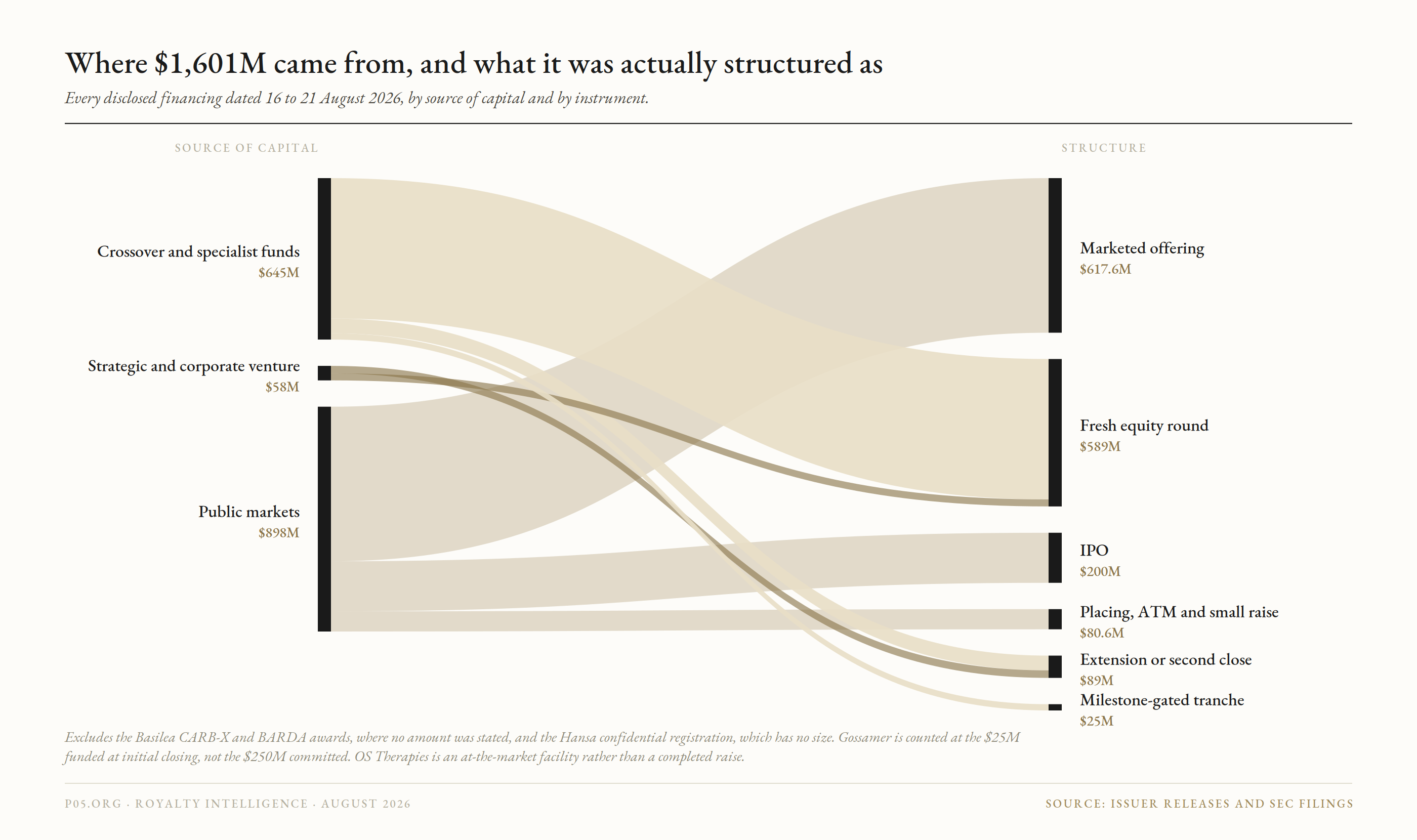
Where $1,601M came from, and what it was structured as.
TheraCryf: A $1.4M Placing to Reach the Clinic on a Model Built to Licence Out (Thu Aug 20)
TheraCryf plc (AIM: TCF) announced a proposed placing and subscription to raise $1.4M (GBP 1.05M) gross (RNS 5659R).
- Terms: GBP 1.05M in two parts. A placing of GBP 0.75M (416,388,888 shares) placed by Turner Pope and Singer as agents, and a subscription of GBP 0.3M (166,944,440 shares), both at 0.18 pence, a 5% discount to the 0.19 pence close on 19 Aug
- Advisers: Turner Pope Investments joint broker and lead bookrunner; Singer Capital Markets nominated adviser and joint broker
- Conditions: conditional on resolutions at a general meeting convened for 11 a.m. on 7 Sep 2026 at Singer's offices, 1 Bartholomew Lane. A share subdivision is proposed alongside
- Use of proceeds: completing the activities required to commence a Phase 1 programme in Australia, and extending cash runway to the end of Q1 2027. The company targets regulatory approval to begin its first human volunteer study in Australia by the end of 2026
- Why Australia: management frames it as a faster and more capital-efficient route into the clinic that still generates human safety and pharmacokinetic data recognised by major global regulators
- Assets: Ox-1, an orexin-1 antagonist for addiction spanning food, alcohol and drugs, funded through final pre-clinical work to clinical readiness; a dopamine transporter modulator programme in fatigue of brain origin, including fatigue associated with multiple sclerosis, chemotherapy and narcolepsy; and a legacy grant-funded oncology programme in glioblastoma with SFX-01
- Why it belongs here: TheraCryf runs an explicitly capital-light virtual development model, advancing programmes to early clinical or proof-of-concept and then partnering with commercially focused pharmaceutical and biotechnology companies. Proceeds are directed at completing the clinic-enabling programme for its Ox-1 addiction asset, in the company's words with the aim of securing a partnering or out-licensing deal. That is a royalty-origination business model stated plainly, at the smallest scale the public markets support
- Why it belongs here: the smallest transaction in the window, and the clearest statement of intent to originate a royalty that any of them contains. A company raising GBP 1.05M to reach first-in-human, on a declared plan to licence out from there, is where the sub-$50M band begins
- Location: headquarters and registered office at Alderley Park, Cheshire
- Date: Announced Thu Aug 20, 2026
Edesa Biotech: A $25M Offering With Warrant Expiry Tied to a Clinical Readout (Wed Aug 19)
Edesa Biotech, Inc. (Nasdaq: EDSA), a clinical-stage biopharmaceutical company headquartered in Toronto and focused on immuno-inflammatory disease, priced a $25.0M underwritten public offering (pricing; launch).
- Terms: 3,870,500 common shares with accompanying warrants over the same number, at a combined public offering price of $5.50, plus pre-funded warrants over up to 675,000 shares at $0.0001 with accompanying warrants, for investors electing them. A 30-day underwriters' option covers up to 681,825 further shares and warrants, roughly 15%
- The warrant structure is the interesting part: the accompanying warrants carry a $7.50 exercise price, are immediately exercisable, and expire on the earlier of the eighteen-month anniversary or thirty days after Edesa publicly announces topline Phase 2 vitiligo data for EB06. Warrant life is pegged to a clinical catalyst rather than to a fixed calendar, which ties the dilution schedule directly to the readout the money is funding
- Bank: Guggenheim Securities as sole book-running manager. No legal counsel named. Off an existing Form S-3 shelf, effective September 2025. Not conditional on a shareholder vote. Closing expected about 21 Aug
- Use of proceeds: general corporate purposes including working capital, capital expenditure, and research, development and manufacturing
- Assets: EB06, an anti-CXCL10 monoclonal antibody in vitiligo; EB01, a 1.0% daniluromer cream described as Phase 3-ready in chronic allergic contact dermatitis; and paridiprubart, an anti-TLR4 antibody in acute respiratory distress syndrome, which has drawn two Government of Canada funding awards and is being evaluated in a US government-funded platform study
- Stack: assets appear to originate in-house. No third-party royalty, milestone or revenue-share obligation is disclosed in the offering release, and no royalty entitlement over any previously out-licensed asset is stated
- Partnering read: the release notes only that the company is pursuing additional uses for paridiprubart. That is soft language and falls well short of the declared licence-out model in the TheraCryf item below. Watch rather than target
- Date: Announced and priced Wed Aug 19, 2026
Ingenia Therapeutics: A $42M KOSDAQ Debut, and a Royalty Already Sitting With Merck (Tue Aug 18)
Ingenia Therapeutics, headquartered in Watertown, Massachusetts and founded in Boston in 2018, listed on KOSDAQ on 18 Aug, raising approximately $42M (KRW 60bn) through 5 million Korean Depositary Receipts (release). Shares closed at KRW 17,990 against an offer price of KRW 12,000, up 49.9% on debut.
- First of its kind: the first US-headquartered company to list on KOSDAQ
- Origin: built on technology from KAIST and the Institute for Basic Science, across two platforms, TIE-body and LCIDEC. Lead asset IGT-303 in chronic kidney disease is in Phase 2a across Australia, New Zealand and South Korea, with global out-licensing targeted for 2027. IGT-532 in solid tumours is heading to the clinic, with preclinical work in glaucoma and pulmonary arterial hypertension alongside research partnerships with Harvard Medical School and Emory
- Stack: the company's ophthalmology asset IGT-427 was previously out-licensed to EyeBio, which Merck subsequently acquired. Ingenia therefore holds a royalty entitlement against a large pharma payer, established before the listing and undisclosed as to rate
- Why it belongs here: a company listing in one market, incorporated in another, built on academic technology from a third, already holding one royalty against Merck and openly preparing to originate a second. The KDR structure also means the tradable security and the operating company sit in different jurisdictions, which matters for any security interest taken over the royalty
- Carryover: this closes the Ingenia first-trade line carried on the W33 watch list
- Date: Listed Tue Aug 18, 2026
Hansa Biopharma: A US Listing to Fund the Territory It Kept, Three Months After Selling the One It Could Not (Fri Aug 21)
Hansa Biopharma (Nasdaq Stockholm: HNSA) has filed a confidential draft registration statement with the SEC for a potential offering of American Depositary Receipts and a Nasdaq listing in the United States (coverage).
- Terms: the number of depositary receipts and the pricing are undetermined. Any offering is subject to SEC review and market conditions. A confidential draft is a preparatory filing, not a launch
- What it funds: a US launch of imlifidase. The FDA accepted the application in February and set a PDUFA date of 19 Dec 2026, for desensitisation of highly sensitised adults awaiting a deceased-donor kidney transplant. The company expects to be launch-ready at the PDUFA date, with product available in Q1 2027 subject to approval
- The transaction underneath it: in May, Hansa licensed development and commercialisation of Idefirix, the same molecule under its European name, to SERB Pharmaceuticals for Europe and the MENA region, at a total value of EUR 115M. That deal completed on 1 Jul
- Why it belongs here: this is a geographic carve-out run in the deliberate direction. Hansa sold the territory where the product is conditionally approved but commercially hard, and is now raising in the territory it kept, ahead of an approval it can sell into itself. Most geographic carve-outs are distressed disposals of an inconvenient territory. This one funds the retained territory with the proceeds of the disposed one, and the listing is the second half of the same move
- Market: Hansa puts the US desensitisation opportunity above $2B, against a target group of 17,000 to 25,000 patients out of roughly 170,000 on the kidney transplant waiting list
- Trading: Q2 revenue of SEK 48.1M, flat year on year but 39% ahead of Q1, with Spain strong after Catalonia granted a subsidy
- Not disclosed: the split of the EUR 115M between upfront, milestones and royalty
- Date: Reported Fri Aug 21, 2026
Amylyx: Launched at $350M and Priced at $500M the Next Day, on a Phase 3 Win Two Days Earlier (Launched Tue Aug 18; Priced Wed Aug 19)
Amylyx Pharmaceuticals, Inc. (Nasdaq: AMLX) commenced an underwritten public offering of $350.0M on 18 Aug (launch) and priced an upsized $500M the following day (pricing).
- Terms: 14,090,000 shares at $35.50, against a close of $35.11 on 18 Aug. Upsized from the $350.0M launched, with a 30-day option over a further $52.5M at launch. Expected to close on or about 21 Aug
- Why it upsized: Amylyx reported positive topline Phase 3 LUCIDITY results for avexitide in post-bariatric hypoglycaemia on 18 Aug, and took the offering to market the same day. Avexitide is a first-in-class GLP-1 receptor antagonist carrying Breakthrough Therapy, Rare Pediatric Disease and Orphan Drug designations
- Use of proceeds: pre-commercial activities for avexitide including additional manufacturing capacity, research and development, and working capital
- Banks: Leerink Partners, Morgan Stanley, Guggenheim Securities and LifeSci Capital as joint bookrunning managers. Off a Form S-3ASR shelf effective 3 Mar 2026
- Why it belongs here: a pivotal readout on the Monday, a launch the same day and an upsized pricing on the Tuesday. The sequence is the point: a company with a positive Phase 3 and no approved product raised half a billion dollars in roughly thirty hours, which is the alternative to selling a royalty and the reason origination competes with equity markets rather than with other credit
- Royalty: none; equity only
- Date: Launched Tue Aug 18, 2026. Priced Wed Aug 19, 2026
Symbiotec Pharmalab: An Indian Pharmaceutical IPO Launched at Roughly $200M (Wed Aug 19)
Symbiotec Pharmalab announced the price band and launch terms for its Indian initial public offering (anchor round and terms). The red herring prospectus is dated 18 Aug.
- Terms: total issue of approximately $200M (INR 17.57bn) at a band of INR 938 to 988, split $17M (INR 150 crore) fresh issue against $183M (INR 1,607 crore) offer for sale, so the company receives only the fresh-issue proceeds, earmarked for debt repayment and general corporate purposes. Subscription runs 24 to 27 Aug, after this window closes (anchor round)
- Anchor: $60M (INR 526.20 crore) from 34 investors at the INR 988 upper band on 21 Aug, with 40% of the anchor portion reserved for domestic mutual funds and insurers. Registrar MUFG Intime India. Promoter selling shareholder Satwani Holdings LLP, alongside investor sellers Rosewood Investments and India Business Excellence Fund III
- Note on the RHP addendum: a supplement dated 18 Aug disclosed $83M (INR 730 crore) of off-market secondary sales between 17 and 19 Aug, under which the two investor sellers transferred stock to institutions ahead of the issue
- Banks: JM Financial, Avendus Capital, Motilal Oswal Investment Advisors and Nomura Financial Advisory and Securities (India) as book-running lead managers
- Legal: Khaitan and Co for the issuer, Talwar Thakore and Associates for the managers in India, and Hogan Lovells as international counsel to the managers
- Note on sizing: the earlier draft prospectus contemplated INR 150 crore of fresh issuance against INR 2,030 crore of offer-for-sale stock. The announced total is INR 1,757 crore, so the earlier offer-for-sale figure should not be carried forward; the live offer document governs the final split, which is not yet established
- Status: launch and terms announcement. Not subscribed and not completed as at the window close
- Royalty: none; equity only
- Date: Announced Wed Aug 19, 2026
Aston Sci.: A $29M Series D at Half the Prior Valuation, on an Asset Licensed From a US University (Thu Aug 20)
Aston Sci. Inc. closed an oversubscribed Series D of approximately $29M (KRW 39.6bn) (coverage).
- Terms: a third-party allotment of convertible preferred and Class 2 convertible preferred shares at KRW 8,000 per share, on a round valuation of approximately $44M (KRW 60bn). That is less than half the KRW 150bn carried at the 2021 pre-IPO, so this is a down round despite being oversubscribed
- Use of proceeds: clinical development, expansion of out-licensing activity, and preparation for a renewed KOSDAQ technical listing, with NH Investment and Securities as listing manager
- Asset: AST-301 (pNGVL3-hICD), a HER2 intracellular-domain plasmid DNA cancer vaccine, in the Phase 2 CORNERSTONE-003 study in gastric cancer. FDA Orphan Drug Designation granted 17 Jun 2026
- Stack, and it is the reason this item matters: AST-301 is in-licensed from the University of Washington Cancer Vaccine Institute, where the Phase 1 was run by Professor Mary L. Disis, and was transferred to Aston Sci. on Phase 1 completion in 2020 alongside AST-201 and AST-302. Financial terms to the university, including any royalty, are undisclosed. The sixth undisclosed academic upstream in the window
- Not disclosed: the Series D syndicate. Prior rounds involved G&Tech Venture Investment, Timefolio, Mirae Asset Venture Investment and Mirae Equity Partners
- A separate arrangement that does not apply here: the $148M (KRW 203.1bn) technology transfer between CHA Vaccine Institute and Aston Sci. runs the other way, with Aston as licensee of the L-pampo adjuvant for AST-021p and AST-023, carrying development milestones and sales royalties payable by Aston. It does not cover AST-301
- Date: Reported Thu Aug 20, 2026
KaliVir: A $14M Series A Extension Taking the Round to $25M, With the Lead Asset Retained (Wed Aug 19)
KaliVir Immunotherapeutics, Inc. closed a $14M extension of its Series A financing, bringing total Series A capital to $25M (release).
- Terms: an extension of the existing Series A, not a new round
- Backers: led by Company K Partners, with participation from SV Investment and Flexus Partners, alongside continued support from existing investors including affiliates of Nextrans and Quad Investment Management
- Use of proceeds: continued enrolment in STEALTH-001 (NCT06444815), the first-in-human Phase 1/1b dose-escalation and expansion study of VET3-TGI in advanced unresectable or metastatic solid tumours, as monotherapy and in combination with atezolizumab
- Asset: VET3-TGI, an oncolytic vaccinia virus built on KaliVir's proprietary Vaccinia Enhanced Template platform, expressing IL-12 and a TGF-beta inhibitor
- Stack: VET3-TGI is retained. No in-licence from an academic institution or from Astellas is disclosed on this asset. Astellas holds a worldwide exclusive licence to VET2-L2, a different KaliVir candidate, and Roche has a clinical trial collaboration and supply agreement covering the atezolizumab combination plus an earlier licence over other oncolytic viruses. The distinction matters: a platform company with three partner relationships can still hold its lead asset clean, and here it does
- Royalty: none on this financing; equity only
- Date: Announced Wed Aug 19, 2026
Abcuro: $66M Series D to Fund a Second Registrational Attempt in Inclusion Body Myositis After a Missed Primary (Tue Aug 18)
Abcuro, Inc., a Newton, Massachusetts clinical-stage company modulating cytotoxic T cells, closed a $66M Series D financing (release).
- Terms: $66M, led by existing investor New Leaf Venture Partners, with Rock Springs Capital joining as the only new name
- Backers: abrdn, Bain Capital Life Sciences, Samsara BioCapital, Redmile Group, Mass General Brigham Ventures, RA Capital Management, Pontifax, Sanofi Ventures, Foresite Capital, NEA, Eurofarma Ventures, Kaitai Capital, Soleus Capital, Nancy Chang and Shang Bay. Fifteen existing holders and one new one, so an insider round in substance, and the third of four financings this window with that shape
- Use of proceeds: a new potentially registrational study of ulviprubart (ABC008), a first-in-class monoclonal antibody targeting killer cell lectin like receptor G1, in patients with less severe inclusion body myositis. Study start targeted Q4 2026, topline 2H 2028, with a BLA contemplated on favourable data
- Why the round exists: the Phase 2/3 MUSCLE study missed its primary and key secondary endpoints in the overall population, presented at the 6th Global Conference on Myositis in March 2026. In a pre-defined analysis of patients with baseline IBMFRS above 29, decline was 1.3 points over 76 weeks against 2.6 on placebo, a 50% slowing. Management states it has FDA alignment on a path forward. Capital raised to re-run a trial in a narrower population after a failure carries a different risk profile from a first registrational attempt
- Stack: no upstream disclosed. Mass General Brigham Ventures sits on the register, the usual signature of an institutional licence behind a first-in-class antibody, though none is in the public record
- Indication: no approved therapy exists in inclusion body myositis
- Date: Announced Tue Aug 18, 2026
Oncolys / Fujifilm Toyama: A Royalty That Turned Earning on 13 August, Not on the Rollout (Approved Mon Jun 8; NHI-Listed Wed Aug 5; Reimbursed Thu Aug 13; Rollout Fri Aug 21)
Oncolys BioPharma (TSE: 4588) and FUJIFILM Toyama Chemical advanced the Japanese rollout of Telomelysin (suratadenoturev, OBP-301), an oncolytic adenovirus for oesophageal cancer in patients ineligible for curative resection or chemoradiotherapy (NHI listing).
- The date architecture matters more than the rollout. MHLW marketing approval came on 8 Jun 2026. Chuikyo cleared NHI listing on 5 Aug at $21,000 (JPY 3.1M) per vial, reimbursed from 13 Aug. The commercial expansion in this window follows reimbursement; it is not a fresh regulatory event, and the royalty turned earning on 13 Aug rather than on the rollout
- Economics: MHLW approval triggered a milestone payment from FUJIFILM Toyama Chemical to Oncolys, recorded as revenue in the year to 31 Dec 2026. Oncolys also expects the balance of a product-supply-related payment, held initially as contract liabilities and recognised progressively after launch. So the structure is milestone plus supply. No royalty rate, no milestone amount and no profit share is disclosed
- Rollout scale: management has stated a target of making Telomelysin available at around 300 hospitals in Japan over time
- Stack: Telomelysin is a joint invention of Professors Noriaki Tanaka and Toshiyoshi Fujiwara of Okayama University, with investigator-initiated clinical research conducted there. Any residual obligation to the university is undisclosed. Two prior third-party licences have lapsed: Chugai's exclusive Japan licence, signed April 2019 and terminated in 2021 with rights returned and no milestones exchanged, and a Jiangsu Hengrui China licence terminated in 2020
- Why it belongs here: the moment a development-stage royalty becomes an earning one is the most important transition in the life of any stream, and here it is precisely datable to the reimbursement start. Twice licensed out and twice returned, then commercialised domestically through a partner on milestone-plus-supply economics, is a complete arc, and the asset carries no royalty anyone could have bought at any point in it
- Date: Approved Mon Jun 8, 2026. NHI-listed Wed Aug 5. Reimbursed from Thu Aug 13. Rollout reported Fri Aug 21, 2026
Amgen / TScan: A Tiered Single-Digit Royalty Terminated, With a Survival Clause Attached (Notice Wed Aug 12; Disclosed Tue Aug 18)
TScan Therapeutics, Inc. (Nasdaq: TCRX) disclosed that Amgen had elected to terminate, in its entirety, the Research Collaboration and License Agreement of 8 May 2023 (8-K).
- What lapses: the original agreement carried a $30M non-refundable upfront, received in 2023, over $500M in success-based preclinical, clinical, regulatory and commercial milestones, and tiered single-digit royalties on net sales (2023 terms). Amgen held an exclusive, worldwide, sublicensable licence over anything the research produced; TScan retained the platform
- Mechanics: exercised under a 90-day notice provision, no early termination penalty, effective 10 Nov 2026. Amgen told trade press it acted following a strategic review
- The survival clause is the part that matters: TScan does not expect further milestone or royalty payments unless Amgen, its affiliates or sublicensees continue to exploit product candidates, in which case the applicable milestones and royalties survive under the agreement's terms
- Why it belongs here: the only royalty terminated anywhere this week, against four originated. A terminated stream is rarely a clean zero. What remains is a contingent residual that pays only if the counterparty keeps developing something it has just walked away from, which is worth close to nothing and is not the same as nothing. Anyone holding a book of platform-derived royalties has some proportion of exactly this: live on paper, dead in practice, and not written down
- Counterparty note: Amgen's third appearance this week, after retaining undisclosed economics on navtemadlin as AMG 232 and sitting on the Kartos share register. It is originating royalties in one direction and terminating them in another inside five days
- Context: the termination follows TScan's November 2025 restructuring, which cut 30% of staff and halted a solid tumour trial, and a wider retreat from T-cell receptor commitments in which AstraZeneca and Genentech both stepped back from assets they had paid nine figures for
- Date: Notice received Wed Aug 12, 2026. Disclosed Tue Aug 18, 2026. Effective 10 Nov 2026
Apimeds / FreeT: A 25% US Royalty Assigned Inbound, With No Consideration Disclosed (Signed Wed Aug 19; Filed Fri Aug 21)
Apimeds Pharmaceuticals US, Inc. (NYSE American: APUS) disclosed an Assignment and Transfer Agreement under which FreeT Inc. of South Korea irrevocably assigned it certain rights over Apitox, originally acquired under a 2015 rights transfer agreement (8-K).
- What was assigned: a 25% royalty entitlement on economic proceeds from the development, licensing, sale or commercialisation of Apitox in the United States; a 25% revenue participation right on net proceeds from overseas rights agreements; and 100% of the rights to the Apitox market for Korean medicine clinics in Korea
- Consideration: none disclosed. The 8-K describes an irrevocable assignment and states no purchase price
- Direction: this is a royalty moving to the issuer, not a monetisation by it. The counterparty is FreeT, successor to CNP Roen and then Inscobee, which held the interest from the original 2015 transfer
- Why it belongs here: almost every royalty transaction runs one way, a holder selling a stream for cash. Here a stream is consolidated back into the operating company that develops the asset, and the price is not stated. An issuer cleaning a 25% claim off its own product before a financing or a partnering process is doing the opposite of origination, and the absence of a disclosed price is the part worth understanding
- Asset: Apitox, a bee-venom-derived injectable, clinical stage
- Governing law: Republic of Korea, Seoul Central District Court
- Date: Agreement dated Wed Aug 19, 2026. Filed Fri Aug 21, 2026
Gossamer Bio: Up to $250M Where Only $25M Funds Now, the Rest Gated on FDA Milestones (Agreement Thu Aug 20; Announced Fri Aug 21)
Gossamer Bio, Inc. (Nasdaq: GOSS) entered a securities purchase agreement for a structured private placement of up to $250M, including $150M of committed capital, to support seralutinib in pulmonary arterial hypertension (8-K).
- Structure, and it is the point: $25.0M funds at the initial closing, expected 24 Aug, through pre-funded warrants at $0.1399. A further $125.0M releases on FDA acceptance of the seralutinib NDA, subject to that occurring in 2026. Up to a further $100.0M of warrants become exercisable only on FDA approval, at $0.187
- Instrument: convertible preferred in three series alongside pre-funded and milestone-contingent warrants. Equity, not royalty, but the tranching behaves like a regulatory-contingent commitment: the investor is paid to wait and the company draws capital as risk retires. The closest equity analogue in the window to a milestone-based royalty structure
- Backers: EcoR1 Capital, 683 Capital Partners, RA Capital Management, Coastlands Capital, Samsara BioCapital and Rock Springs Capital, alongside existing shareholders and certain directors and officers
- Advisers: Leerink Partners and Cantor Fitzgerald as placement agents, Latham and Watkins as counsel
- Date: Agreement dated Thu Aug 20, 2026. Announced Fri Aug 21, 2026
Kynexis: A $45M Series A Extension With Novartis Venture Fund Leading, and a Business Development Build Three Months Before Phase 2 Topline (Wed Aug 19)
Kynexis, a clinical-stage biotechnology company in Naarden, closed a $45M (EUR 40M) Series A extension, bringing total Series A financing to $110M (EUR 97M) (release).
- Terms: EUR 40M extension of the existing Series A rather than a new round, closing the round at EUR 97M
- Backers: led by new investor Novartis Venture Fund, with participation from existing investors Forbion, Ysios Capital and Sunstone Life Science Ventures. Novartis Venture Fund's Marianne Uteng joins the board and Mathias Frederiksen joins as board observer
- Use of proceeds: close-out activities for the Phase 2 proof-of-concept study, preparation for registrational clinical development in cognitive impairment associated with schizophrenia, and advancement into further cognitive disorders including Alzheimer's disease
- Asset: KYN-5356, an oral small molecule inhibitor of kynurenine aminotransferase II, described as the most advanced clinical-stage programme specifically targeting CIAS. KAT-II is the primary enzyme producing kynurenic acid in the brain; elevated KYNA is understood to disrupt NMDA and alpha-7 nicotinic receptor signalling
- Trial: enrolment is complete in the randomised, double-blind, placebo-controlled Phase 2 in approximately 150 adults across 13 US sites, 28-day treatment period, NCT07191483. Topline expected by the end of 2026 (trial start)
- Stack: KYN-5356 was licensed from Mitsubishi Tanabe Pharma, which granted Kynexis exclusive worldwide rights to develop and commercialise at the company's formation in November 2023 (launch). Terms were not disclosed then and are not restated now. Tanabe therefore holds undisclosed downstream economics on an asset approaching a registrational decision
- Why it belongs here: the hiring disclosed alongside the money is the more informative half. Kynexis appointed Neil Swami as Chief Business Officer and added John McDonald, former head of M&A at Novo and now operating partner for business development and M&A at Forbion, as an adviser. A company builds that bench before a transaction, not after one. Read against a Phase 2 topline due within four months and an undisclosed Tanabe royalty sitting above the asset, the financing looks like preparation for a partnering or sale process in which that royalty would be crystallised
- Date: Announced Wed Aug 19, 2026
Slate Medicines: $245M Oversubscribed Placement, Conditional on the Fulcrum Merger (Mon Aug 17)
Slate Medicines secured commitments for an oversubscribed concurrent private placement of $245M from a syndicate of healthcare investors, in support of its merger with Fulcrum Therapeutics (release).
- Terms: $245M, oversubscribed, closing concurrently with the merger and subject to customary closing conditions
- Backers: led by Frazier Life Sciences, with Forbion, RA Capital Management, Deep Track Capital, Foresite Capital, OrbiMed, RTW Investments and Mingxin Capital
- Use of proceeds: SLTE-1009 through a Phase 1 healthy volunteer study and a Phase 2 dose-range finding study in migraine patients, plus broader pipeline advancement. Combined cash balance at closing expected to fund operations into 2029
- Prior round: Slate launched in February 2026 with a $130M Series A co-led by RA Capital Management, Forbion and Foresite Capital with an additional undisclosed biotech investor, taken down alongside the DartsBio in-licence. The company was co-founded by Neil Buckley and Sera Medicines, RA Capital's biologics accelerator (Forbion). Four of the eight participants in this placement are Series A holders, so the round is substantially insider-led
- Management: CEO Gregory Oakes, previously a venture partner at Raven, RA Capital's healthcare arm, and before that Celgene, Landos Biopharma, Vifor Pharma and Novartis. Neil Buckley is President and COO. CMO Roger Cady, formerly vice president of neurology at Alder Biopharmaceuticals
- Royalty: none on the placement itself; equity only. The DartsBio licence economics sit above the asset and are undisclosed
- Date: Announced Mon Aug 17, 2026
Leal Therapeutics: $30M Second Close of Series A With Lilly Joining, and the LTX-001 Phase 1b/2a Underway (Mon Aug 17)
Leal Therapeutics, Inc., a clinical-stage company developing neuro-metabolic therapeutics, announced a second close of $30M of its Series A financing and the initiation of a Phase 1b/2a trial of LTX-001 in adults with schizophrenia (release).
- Terms: $30M, a second close and extension of the existing Series A rather than a new round
- Backers: new investor Eli Lilly and Company, alongside existing investors OrbiMed, Newpath Partners, Euclidean Capital, SV Health Investors' Dementia Discovery Fund, Chugai Venture Fund, Alexandria Venture Investments and PhiFund Ventures
- Use of proceeds: LTX-001 through an initial readout of the Phase 1b/2a in schizophrenia, and LTX-002 through additional dosing cohorts in the ongoing Phase 1/2 NeurALS trial in ALS
- Assets: LTX-001, a first-in-class brain-penetrant oral GLS1 inhibitor, which has completed single and multiple ascending dose Phase 1 trials with a favourable safety and tolerability profile and dose-dependent CNS target engagement. LTX-002, an intrathecally delivered antisense oligonucleotide targeting SPTLC1
- Trial: Phase 1b/2a in schizophrenia, NCT07734493, now initiated, with initial data expected by year end
- Royalty: none; equity only
- Date: Announced Mon Aug 17, 2026
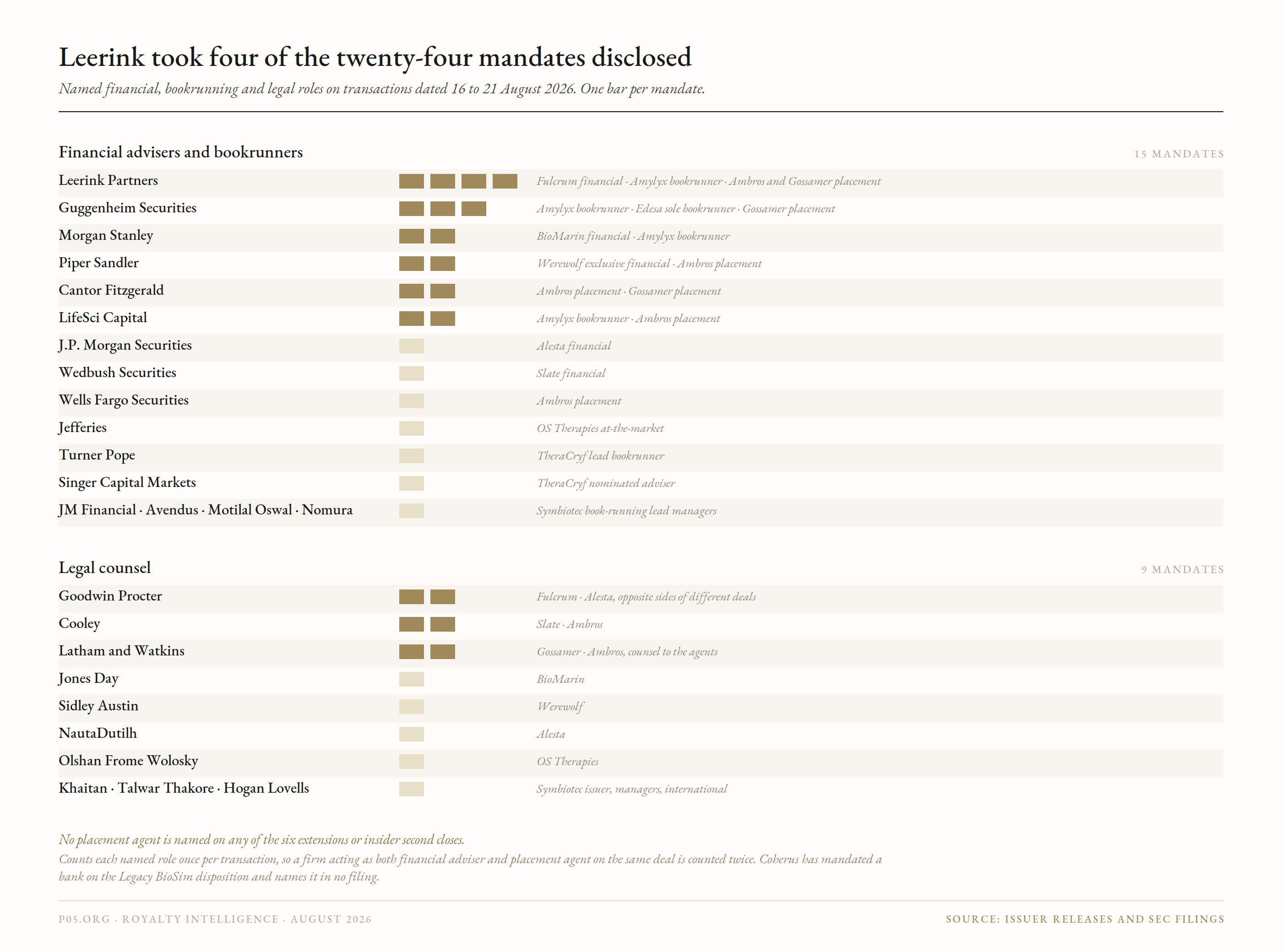
Adviser league table: Leerink took four of the twenty-four mandates disclosed.
Standard disclaimer
This Weekly Term Sheet is provided for informational purposes only. It does not constitute investment advice, an offer to sell or a solicitation of an offer to buy any security, or a recommendation regarding any investment. Data and disclosures are sourced from public company filings, press releases, and credible secondary reporting. Capital for Cures AG does not warrant the accuracy or completeness of information presented. Readers are advised to consult primary source documentation before making any investment, partnership, or commercial decision. Capital for Cures AG and its principals may hold positions in companies referenced.