
First lien, second lien, split lien: priority order and worked recoveries in royalty finance

Priority in a royalty financing breaks into two questions.
One is vertical. Within a single pool of collateral, who stands on which rung.
The other is horizontal. How many pools there are, and where each party sits in each of them.
Most practitioners answer the first fluently and skip the second. That is where royalty deals part company with leveraged loans. A term lender and a royalty investor can each hold a genuine first-priority perfected security interest in the same borrower without either being wrong, because they are first on different assets.
The same investor is routinely first on the receivable and second on the patents that produce it. A third party can own one pool outright, share a second rateably, and have no claim at all on the third.
What follows is the full ladder, the split structures currently documented in the market, and five worked recoveries with the arithmetic on the page. The illustrations are hypothetical and marked as such. The structures are taken from filings.
Related: perfection basics and the post-Mallinckrodt security norm are in the liens piece. Insolvency treatment is in the insolvency liens piece. The economic queue ahead of a royalty is in the encumbrances piece.
Primary documents
| Parties | Document | Date |
|---|---|---|
| Annexon / Oxford Finance | Loan and security agreement | 30 July 2026 |
| Esperion / Athyrium | Royalty purchase agreement | 2 April 2026 |
| Esperion / GLAS | First amendment, with marked credit agreement | 2 April 2026 |
| Gossamer Bio | Secured convertible notes indenture | 4 June 2026 |
| Adaptive / OrbiMed | Waiver and payoff agreement | 15 June 2026 |
| Gamida Cell / Highbridge | Loan and security agreement | 12 Dec 2022 |
1. The ladder
Within one pool of collateral in a US chapter 11, claims are satisfied in the order below. Not every rung exists in every capital structure. Every rung that does exist sits here.
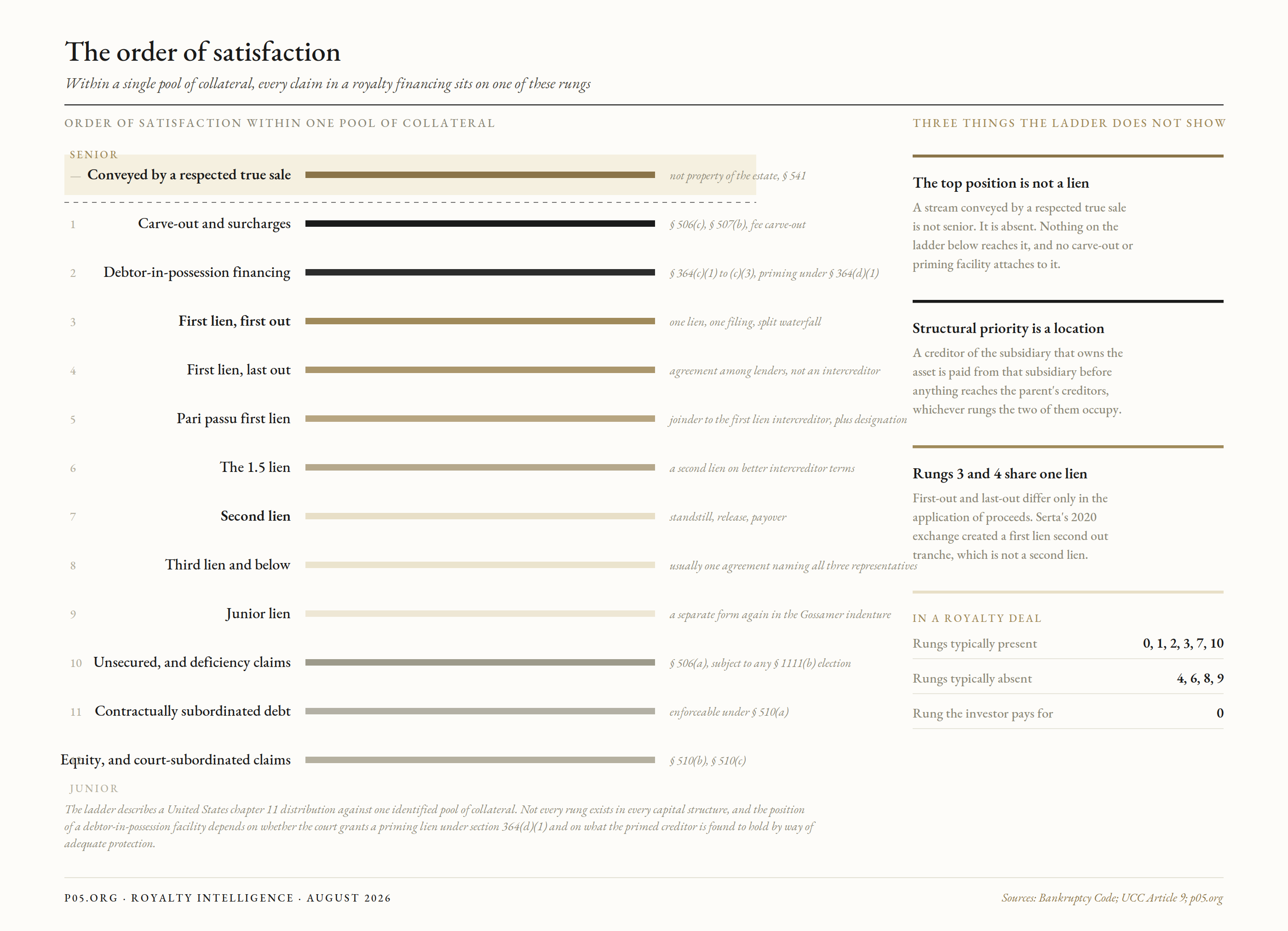
Figure 1. The order of satisfaction within a single pool of collateral, with the statutory hook for each rung. The position above the dashed line is not a lien.
Rung 0. Off the ladder. A stream conveyed by a respected true sale is not property of the estate under § 541 and is not distributed at all.
Absent, rather than senior. This is the most valuable position available in a royalty financing and it is not a lien position at all, so the drafting effort goes into protecting a characterisation rather than a rank.
Rung 1. Off the top of the collateral. The professional fee carve-out agreed in the cash collateral or DIP order, surcharges under § 506(c) where not waived, and superpriority administrative claims under § 507(b) when adequate protection turns out to have been inadequate. Everything below is reduced by these.
Rung 2. Debtor-in-possession financing. Superpriority administrative status under § 364(c)(1), liens on unencumbered property under § 364(c)(2), junior liens under § 364(c)(3), and priming liens under § 364(d)(1) where the court finds the primed creditor adequately protected. A priming DIP outranks the pre-petition first lien on the same collateral.
Rung 3. First lien, first out. A single first-lien tranche can split its waterfall without splitting the lien.
First-out and last-out share one security interest and one filing. Only the application of proceeds differs, and it is governed by an agreement among lenders rather than an intercreditor agreement.
Serta's 2020 exchange created first lien first out and first lien second out tranches, both superpriority, both above the legacy first lien loans. Neither was a second lien, which is worth being precise about because the shorthand runs the other way.
Rung 4. First lien, last out.
Rung 5. Pari passu first lien. Debt secured equally and rateably with the first lien, admitted by a pari passu intercreditor agreement.
Gossamer Bio's indenture is exact about the machinery. Future first lien indebtedness qualifies only if its representative joins the first lien intercreditor agreement and the company designates the debt as additional pari passu obligations. Two documents and a designation, or the debt is not pari passu whatever the credit agreement recites.
Rung 6. The 1.5 lien. A tier inserted between first and second by its own intercreditor agreement, usually in a liability management exercise. It is a second lien on better terms, and it primes an existing second lien only to the extent that lien's documents permitted the layer.
Rung 7. Second lien.
Rung 8. Third lien and below. Uncommon in life sciences, routine in industrials. Where it exists there is usually one agreement naming a first, second and third priority representative rather than a chain of bilaterals.
Rung 9. Junior lien. Gossamer treats this as a category of its own, with a separate filed form of junior lien intercreditor agreement, and a third form again for debt that is contractually subordinated in right of payment. Three forms in one indenture, for three relationships that lawyers often collapse into one word.
Rung 10. Unsecured, including deficiency claims. A secured creditor whose collateral falls short holds a secured claim to the value of the collateral and an unsecured claim for the balance under § 506(a), subject to any § 1111(b) election.
Rung 11. Contractually subordinated unsecured debt. Enforceable in bankruptcy under § 510(a).
Rung 12. Equity, and claims subordinated by the court under § 510(b) or § 510(c).
Cutting across all of it is structural priority, which is a location rather than a rung. A creditor of the subsidiary that owns the asset is paid from that subsidiary before anything reaches the parent's creditors.
Esperion's credit agreement deals with this in advance. Securitisation subsidiaries are excluded subsidiaries and their equity is excluded property, so a future royalty vehicle sits outside both the guarantee and collateral packages by the terms of the facility as signed.
2. Why one creditor sits on several rungs at once
A conventional leveraged structure has one collateral pool, substantially all assets, and each creditor occupies one rung in it.
Royalty finance rarely looks like that, for reasons that are commercial rather than legal.
A senior lender underwrites the enterprise and forecloses on the product. The royalty investor underwrites one revenue line and would never foreclose on anything. Each wants absolute priority over a different asset and is close to indifferent about the other's.
Splitting the collateral gives both what they need and neither what it does not. The output is a matrix.
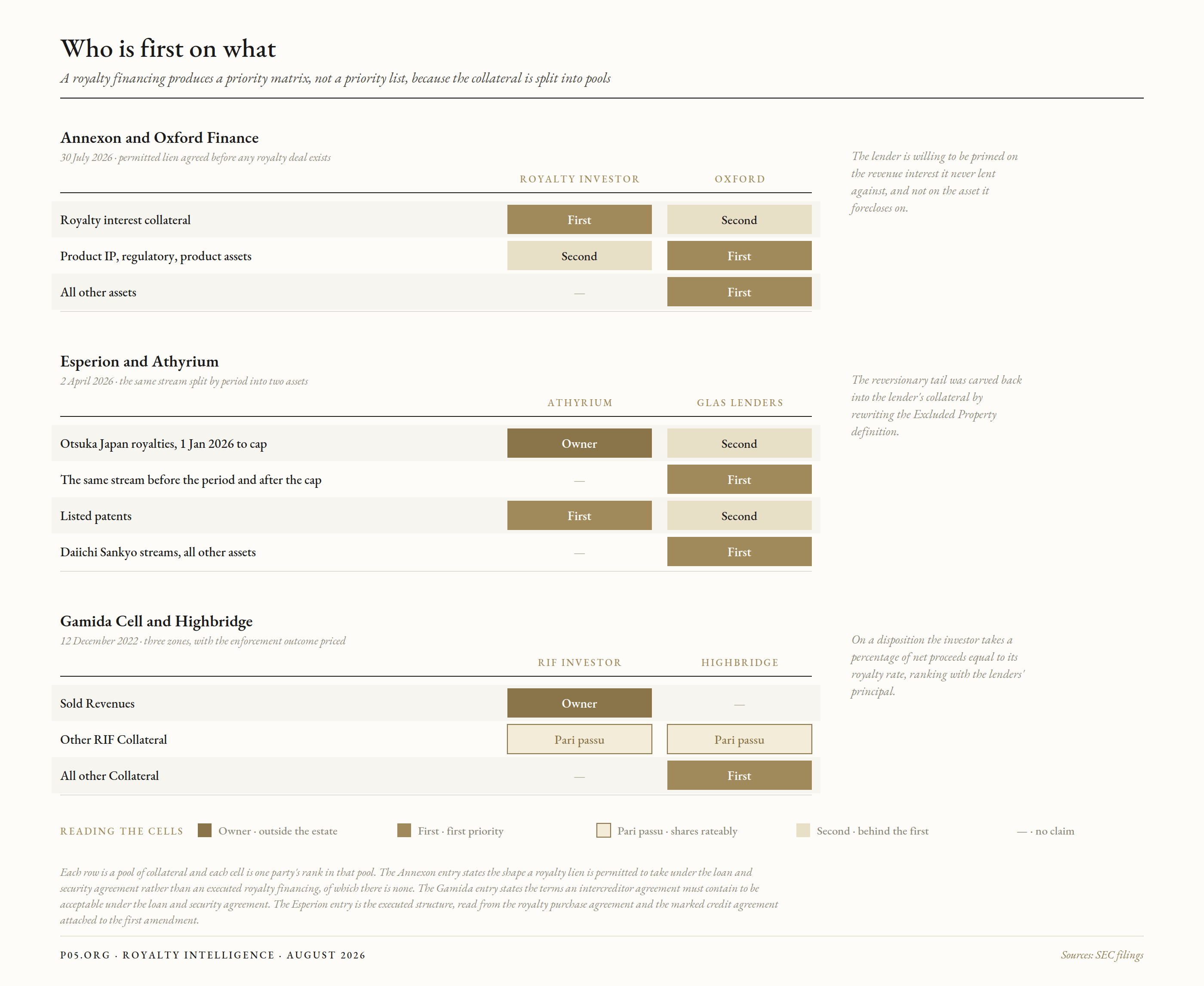
Figure 2. Three documented split structures. Each row is a pool of collateral; each cell is one party's rank in that pool.
2.1 Annexon and Oxford Finance, 30 July 2026
The facility is $50M of Term A loans at closing, stepping through Term B, C and D and a discretionary Term E to roughly $200M. Oxford Finance LLC holds a first-priority perfected interest in substantially all assets, subject to permitted liens.
The permitted-lien limb dealing with royalty financings admits liens on the royalty interest collateral and, for a synthetic royalty, "a first priority Lien on the Royalty Interest Collateral" together with a second-priority lien on the intellectual property and other assets material to research, development, manufacture, commercialisation, marketing, distribution and regulatory approval of the product.
Two programmes are named: vonaprument in geographic atrophy and tanruprubart in Guillain-Barré syndrome. The permission is conditioned on a customary intercreditor agreement acceptable to the collateral agent in its sole discretion.
Three provisions make that permission operative rather than decorative.
Loss of lien priority is a standalone event of default, carved back only for the agent's own failure to file or continue a financing statement. A breach by any intercreditor counterparty is itself an event of default.
And the encumbrance covenant prohibits not only new liens but any arrangement whose effect is to stop the borrower granting security over its own intellectual property. A royalty investor asking for a broad negative pledge on product IP is negotiating against that clause as well as against the lender's collateral.
2.2 Esperion and Athyrium, 2 April 2026
Athyrium Opportunities IV Acquisition LP paid $50M for 100% of the royalties and milestones payable by Otsuka Pharmaceutical on Japanese net sales of bempedoic acid products under the April 2020 licence.
The purchased receivables period runs from 1 January 2026 to a cap date set at $100M, a 2.0x participation, with a put back to Esperion at the shortfall if the cap is unreached by the fifteenth anniversary.
On the same day Esperion drew $25M of additional term loans at 9.75%, taking the GLAS-agented facility to $175M, and closed the Corstasis acquisition.
The subordination is on the face of the credit agreement. The marked Amended Credit Agreement attached to the First Amendment carries a legend recording that the lenders' obligations are subject to, and the liens securing them subordinated under, a Subordination and Intercreditor Agreement of the same date between Athyrium, designated First Lien Purchaser, and GLAS USA LLC and GLAS Americas LLC, designated Second Lien Agent, binding each holder by acceptance.
Then comes the temporal carve, which is the part to read twice.
Purchased receivables are the royalties and milestones inside the period, plus anything standing in their place, including under § 365(n). Retained receivables are everything else: royalties on sales before the period, royalties after the cap date when the stream reverts, and related proceeds.
The amendment then rewrites the credit agreement's Excluded Property definition so that retained receivables "shall not be Excluded Property and shall be Collateral". One quarterly payment obligation, cut into two assets by date, with a different party first on each.
Three further amendments finish the job.
A named-document carve-out was added to the Permitted Transfers limb of the Disposition definition, referring to the royalty purchase agreement as in effect on the amendment date. Amend that agreement later and the sale falls outside the permission.
The Otsuka regulatory, sales, data, submission, approval and pricing milestones were cut out of the Extraordinary Receipts definition that drives mandatory prepayment. A new limb makes post-default royalty receipts under other licence agreements an Extraordinary Receipt while expressly excluding Otsuka, so the sweep reaches the Daiichi Sankyo streams and not the sold one.
Both parties' receipts obligations are drafted as trusts, with no right, title or interest and a ten business day remittance, rather than as covenants to pay over.
Who took the junior position. The signature pages answer a question the March announcement left open.
That $25M of First Amendment Term Loans was funded equally by HCR Stafford Fund II, L.P. and HCR Potomac Fund II, L.P., $12.5M each, with the fee letter running to the HCR affiliates. Athyrium Opportunities IV Co-Invest 1 LP signed as an existing lender under the December 2024 facility.
So HealthCare Royalty came in as a second-lien term lender behind Athyrium's purchased receivables, and Athyrium sits on both sides of the intercreditor agreement through different funds.
Entry into that agreement was a condition precedent. A separate lender direction section authorised the agent to execute it. The amendment recites that the consenting lenders constituted all lenders, not required lenders. Subordinating a whole class's collateral position costs that many consents.
Fourteen weeks was all it lasted. On 13 July 2026, in connection with the ARCHIMED take-private, Esperion repaid and terminated the facility. The purchased receivables were sold rather than lent, and were unaffected.
2.3 Gamida Cell and Highbridge
For the most fully specified split regime on the public record, go to the definition of Acceptable Intercreditor Agreement in Gamida Cell's loan and security agreement with Highbridge. It pre-agrees the terms of a royalty financing that had not been done.
It creates three zones rather than two.
The lenders take a first-priority lien on the collateral other than the sold revenues. The royalty investor takes "a pari passu lien on any RIF Collateral" other than sold revenues. The lenders agree not to contest the investor's rights in either category.
What makes the clause unusual is that it goes on to price the enforcement outcome. Section 3 works the arithmetic.
The debt basket around it carries two separate caps, which is the right way to size a synthetic royalty in a credit agreement: sold revenues capped at $150M, and the amount invested, or the put price if higher, capped at $45M outstanding before FDA approval. Cap one and not the other and the basket does not bind.
A second limb permits royalty financings on other products only after 1 January 2024 and after approval, and only if any liens stay off the lead product and do not impair its commercialisation.
3. Worked recoveries
Common facts throughout. A single-product company, one senior facility, one royalty financing. Every figure is illustrative and chosen to be tractable.
| Item | Value |
|---|---|
| Product IP and regulatory approvals | $120M |
| Royalty receivable pool, present value | $60M |
| Other assets | $15M |
| Total enforcement value | $195M |
| Senior term facility claim | $175M |
| Royalty investor's remaining entitlement | $80M |
| Other unsecured claims | $40M |
Example A. One pool, first and second lien
The conventional structure. A lender first on substantially all assets, an investor second on the same pool.
| Step | Amount |
|---|---|
| Collateral available | $195M |
| First lien, $175M claim | $175M, 100% |
| Residual to the second lien | $20M |
| Second lien, $80M claim | $20M, 25% |
Twenty-five cents. The second lien is perfected and close to worthless, because the senior claim nearly exhausts the pool.
Example B. Two pools, split priority
Same assets, same claims, Annexon shape. The investor is first on the royalty pool and second on product IP. The lender is first on product IP and other assets and second on the royalty pool.
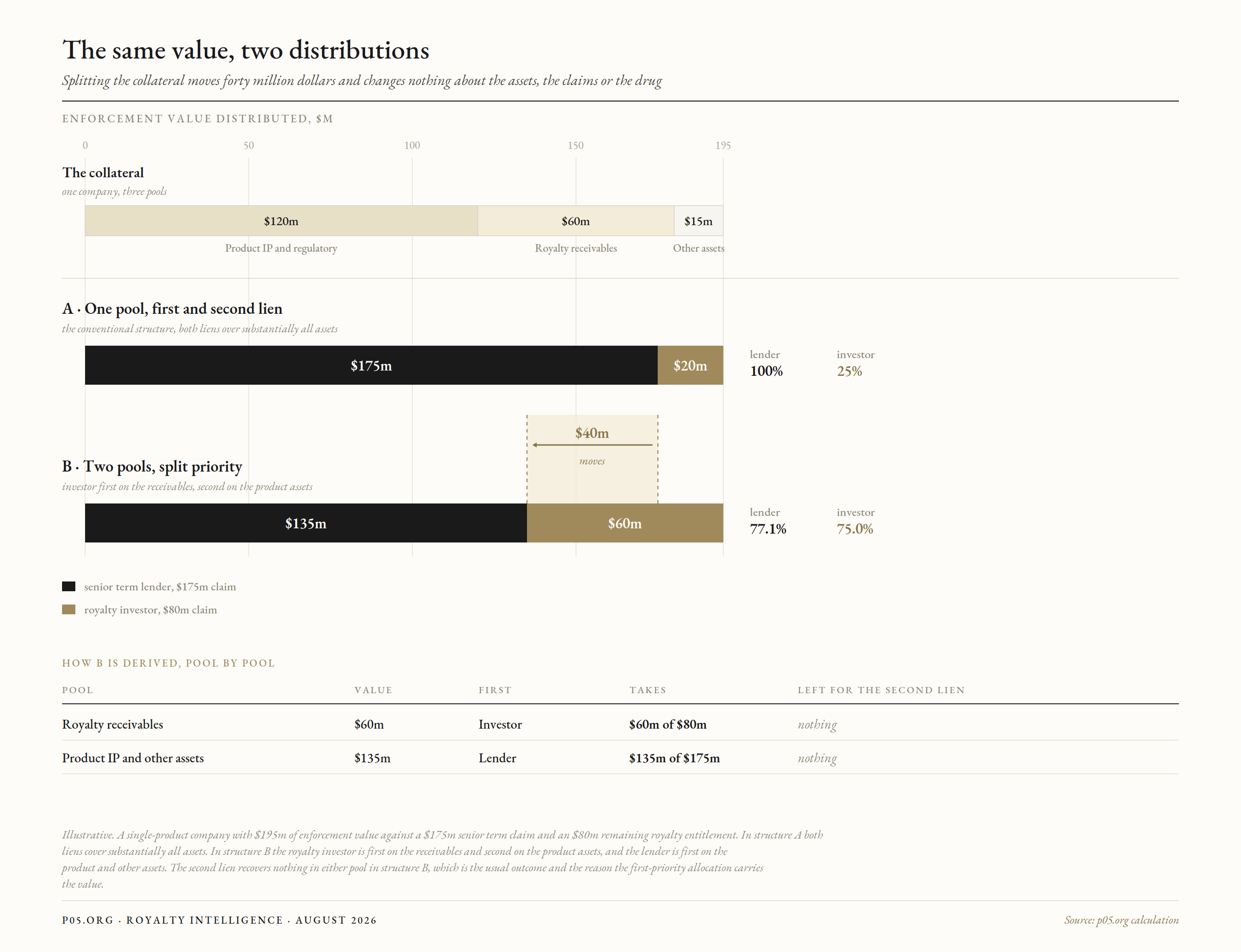
Figure 3. The same $195M distributed under structures A and B.
| Pool | Value | First | Takes |
|---|---|---|---|
| Royalty receivables | $60M | Investor | $60M of $80M |
| Product IP and other | $135M | Lender | $135M of $175M |
Neither second lien recovers anything, which is the usual outcome.
| Party | Recovery | Rate | Versus A |
|---|---|---|---|
| Lender | $135M | 77.1% | −$40M |
| Investor | $60M | 75.0% | +$40M |
The same $195M is distributed either way. Splitting the collateral moves $40M and takes the investor from 25 cents to 75.
Nothing about the assets, the claims or the drug has changed. The only variable is which pool each party is first on, and that was fixed in a permitted-lien definition at signing.
This is the entire commercial content of the split-lien structure. It also explains why the incumbent lender's consent is free if written in at the outset and expensive if bought later.
Example C. Three zones, and the proceeds formula
Gamida shape. The stream is a true sale and sits outside the collateral. The product IP is RIF collateral held pari passu. The royalty rate payable to the investor is 8% of revenues.
Lenders enforce and sell the product assets for $120M gross, with $5M of costs.
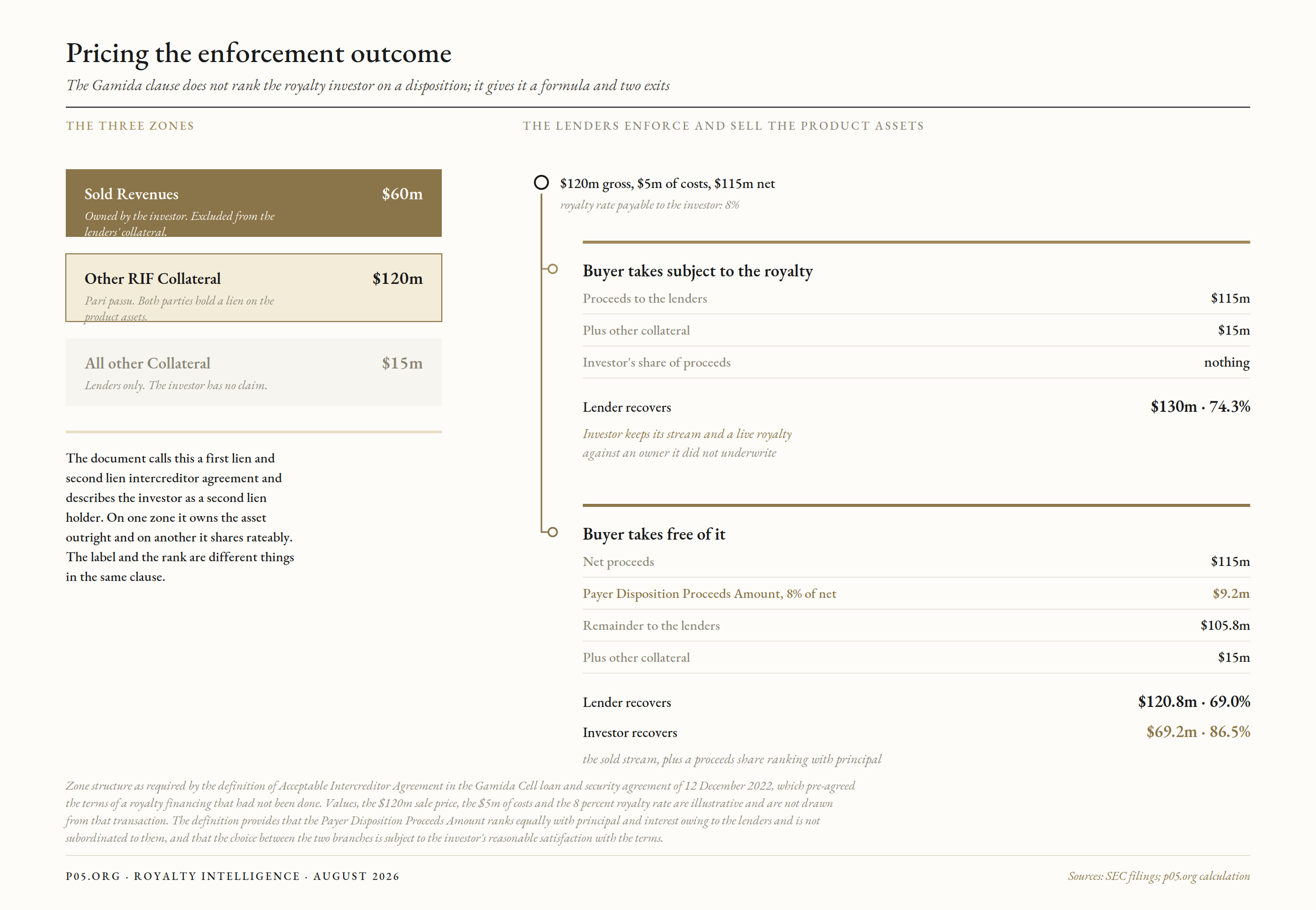
Figure 4. Two exits from the same disposition, with the arithmetic for each.
If the buyer does not take subject to the investor's rights, the clause routes $9.2M to the investor, being 8% of $115M net, concurrently with or ahead of the lenders.
| Party | Recovery | Rate |
|---|---|---|
| Lender | $105.8M + $15M = $120.8M | 69.0% |
| Investor | $60M owned + $9.2M | 86.5% |
Two features drive that outcome, and they are independent. The stream was sold, so no lien contest touches it. And the investor's participation in the asset it does not own is a formula rather than a rung: 8% of net proceeds, ranking with the lenders' principal instead of behind it.
The other branch produces a different answer. If the buyer takes the product subject to the royalty, the investor gets nothing from the proceeds and keeps a live royalty against the new owner. The lenders then take the whole $115M plus $15M of other collateral, or 74.3%.
Which branch applies is the lenders' election, constrained by the investor's reasonable satisfaction with the terms. An investor negotiating this clause is choosing between a cash-out percentage and a continuing claim against a stranger, and needs to have modelled both before it signs.
Example D. What a priming DIP does to a split
Example B facts, plus a chapter 11 with an $8M professional fee carve-out and a $30M DIP priming all liens under § 364(d)(1). The $38M comes off the top, allocated across the pools pro rata to their values.
| Pool | Allocated off the top | Net pool |
|---|---|---|
| Royalty receivables, $60M | $11.69M | $48.31M |
| Product IP and other, $135M | $26.31M | $108.69M |
| Party | Recovery | Rate | Versus B |
|---|---|---|---|
| Lender | $108.69M | 62.1% | −$26.31M |
| Investor | $48.31M | 60.4% | −$11.69M |
An investor that consented in advance to DIP financing without a cap on senior obligations consented to that $11.69M. Capping the facility is worth roughly a third of every capped dollar in this configuration.
The larger point sits underneath. Had the stream been conveyed by a respected true sale rather than pledged, it would not be estate property, no part of the carve-out or the DIP could attach to it, and the full $60M would survive.
Same cash flow, same counterparty, same drug. The characterisation is worth $11.69M here and more as the facility grows.
Example E. Recharacterisation, with and without the filing
Our investor bought the stream as a payment intangible, relied on automatic perfection under § 9-309(3), and filed nothing.
| Scenario | Position | Recovery |
|---|---|---|
| Sale respected | Outside the estate | $60M, 75.0% |
| Recharacterised, UCC-1 filed | Perfected first lien | $60M, 75.0% |
| Recharacterised, nothing filed | Primed under § 544(a) | $13.33M, 16.7% |
In the third case the trustee's strong-arm power avoids the unperfected interest. The royalty pool falls into the lender's collateral, the lender takes its full $175M, and $20M remains for $120M of unsecured claims.
The precautionary financing statement is worth $46.67M here. It costs a filing fee.
That gap exists because § 9-309(3) perfects the sale of a payment intangible and does nothing at all for a security interest in one. On recharacterisation, that is what the position becomes.
Example F. Diversion
Same facts. The stream pays $6M a quarter. Between petition and confirmation, fourteen months, $28M arrives.
If the licensee has been directed to pay an escrow agent under an authenticated notification the seller cannot revoke, that $28M never enters an account of the debtor. It is not cash collateral. No adequate protection motion is needed to get at it.
If the same money lands in an operating account subject to the lender's control agreement, it is cash collateral, its use requires consent or an order, and the royalty investor is a movant rather than a recipient.
Two provisions decide this. Under § 9-327(1) the party perfected by control of a deposit account outranks the party perfected by filing, whenever filed. Under § 9-332(b) a transferee of funds from a deposit account takes free of a security interest in that account absent collusion, so money that has already left is gone.
Fourteen months of diverted collections, on these numbers, beats the entire second lien in Example A.
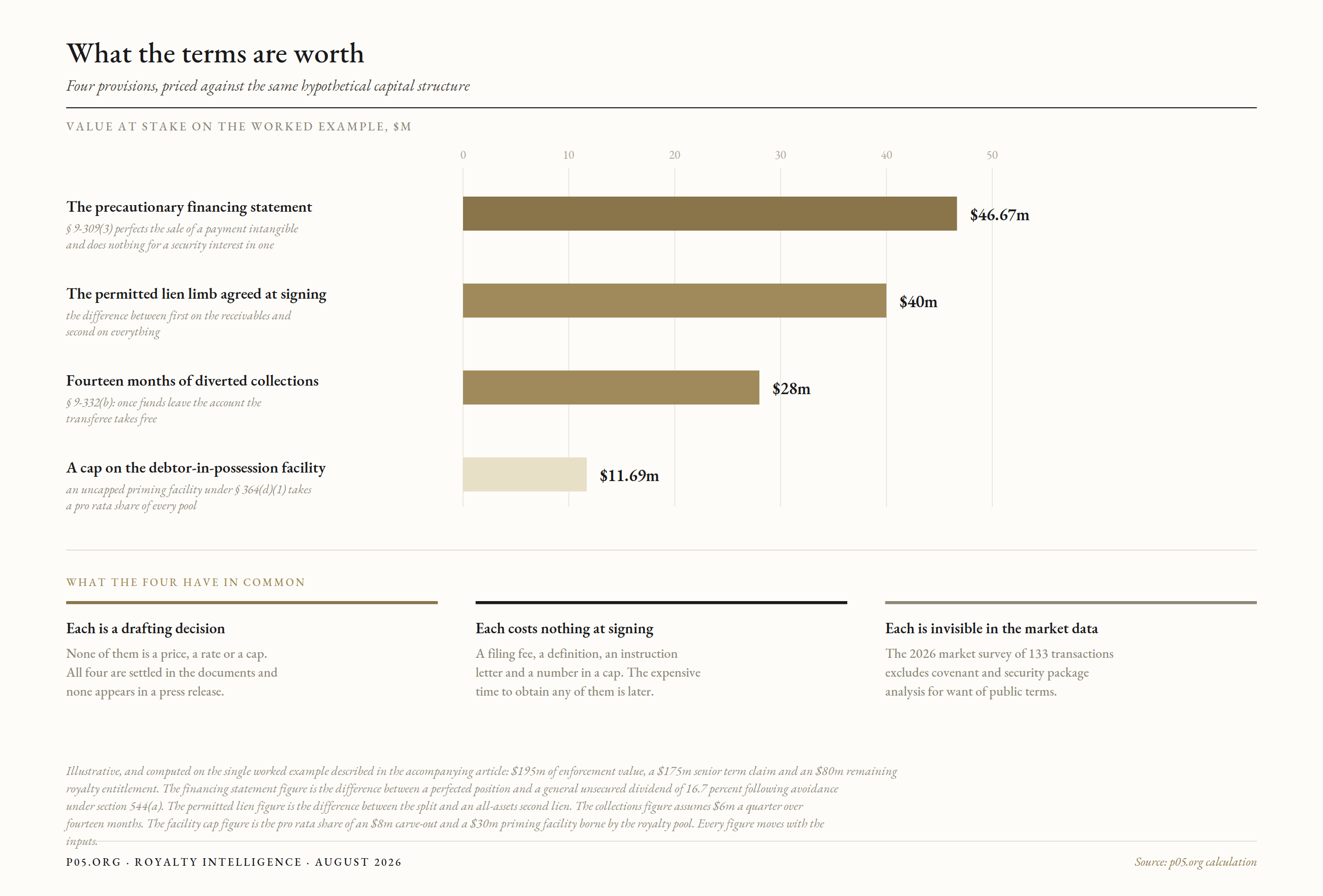
Figure 5. Four drafting decisions, priced against the same capital structure.
4. Building the grant so the ladder holds
Everything above assumes the liens attach and perfect. That assumption fails component by component, and each component fails differently.
4.1 Classification decides whether anything must be filed
A royalty payable under a licence is either an account under § 9-102(a)(2) or a payment intangible under § 9-102(a)(61). Article 9 reaches sales of both under § 9-109(a)(3), so a buyer is a secured party for perfection purposes whether or not it is a lender for characterisation purposes.
Classification decides the filing question. Under § 9-309(3) the sale of a payment intangible perfects automatically on attachment. The sale of an account does not, and a security interest in either requires a filing under § 9-310(a).
Esperion and Athyrium document around the ambiguity instead of arguing about it. The agreement states the parties' intention that the transfer is a sale and not a financing, treats it as a sale of accounts under the UCC, and authorises the purchaser to file financing statements naming the seller and purchaser as such.
Characterising as accounts obliges a filing, the filing is made, and automatic perfection is never the basis of the position. Example E is the reason.
4.2 The back-up grant, and what it leaves out
The conditional grant provides that if the transfer is held not to be a sale, the agreement constitutes a security agreement, and grants a security interest in the purchased receivables and their proceeds, defined as the back-up collateral, securing an amount equal to those receivables up to the cap.
Two drafting points, both easy to miss.
The secured amount is capped at the transaction cap. That works for a capped deal and leaves a hole in an uncapped one, where the grant should secure the obligations as they arise.
And the back-up grant reaches the receivables and proceeds only. Not the patents, not the approvals, not the licence.
An investor whose whole security position is the back-up grant holds, on recharacterisation, a lien on a payment stream and nothing on the assets that generate it. A lien on product assets has to come from a separate security agreement. Esperion and Athyrium executed one on the same day.
4.3 Patents, trademarks and copyrights perfect by different routes
Security interests in patents and trademarks perfect by UCC filing in the debtor's location under §§ 9-301(1) and 9-307(e). Federal recordation with the Patent and Trademark Office is not required to defeat a lien creditor or trustee, per In re Cybernetic Services, 252 F.3d 1039 (9th Cir. 2001), which read the Patent Act's recording provision as addressed to ownership transfers.
Registered copyrights are the exception. In re Peregrine Entertainment, 116 B.R. 194 (C.D. Cal. 1990), held the Copyright Act preempts Article 9 filing, so Copyright Office recordation is the perfection step.
Annexon's covenant package encodes that distinction rather than leaving it to a closing checklist.
For patents, trademarks and service marks the borrower notifies through its quarterly compliance certificate and executes IP security agreements on request. For copyrights and mask works it must execute an IP security agreement and record it with the Copyright Office contemporaneously with the application, then evidence the recording.
One regime is remedial. The other is same-day or unperfected.
Working checklist for an investor taking product IP: file in the state of organisation; record the patent security agreement at the USPTO for notice and priority against later purchasers, even though it is not required against lien creditors; and treat any registered copyright, including software and label content, as needing Copyright Office recordation.
4.4 Approvals do not transfer on foreclosure alone
A marketing authorisation is a general intangible and a lien attaches by filing. Transfer is a regulatory act, and the FDA requires notification from both the former and the new owner.
So a foreclosing secured party holds a lien over an approval whose transfer depends on a step the debtor takes.
A power of attorney plus a licence answers it. Annexon appoints the collateral agent attorney-in-fact on default, with authority to transfer collateral into its own name or a third party's, and grants a non-exclusive royalty-free licence over the borrower's patents, trade secrets, trademarks and know-how for use in preparing and selling the collateral.
An investor taking an IP lien without both has a lien it cannot realise.
4.5 Deposit accounts: control is the only method
Under § 9-312(b)(1) a security interest in a deposit account as original collateral perfects only by control, defined in § 9-104. Under § 9-327(1) control beats filing whenever filed.
Annexon treats this as structural. Control agreements over all collateral accounts other than excluded accounts are a condition precedent, subject to a post-closing letter.
Five days' notice is required before opening any account. The control agreement must be in place before the account is established and cannot be terminated without consent. Maintaining an account outside that regime is both a covenant breach and an event of default.
Excluded accounts are held to payroll, escrow, trust, employee benefit and zero balance accounts plus a small basket.
Section 9-332(b) is why turnover covenants are drafted as trusts. Once funds leave a deposit account the transferee takes free absent collusion, and the disappointed party is left with a contract claim and a tracing argument under the § 9-315(b)(2) lowest intermediate balance rule.
4.6 The anti-assignment override, and the limit that makes the notice letter matter
Two overrides, doing different work.
Under § 9-406(d) a term prohibiting or requiring consent to assignment of an account, chattel paper, payment intangible or promissory note is ineffective. The assignment happens and the account debtor is bound.
Under § 9-408(a) a restriction on assignment of a general intangible, which includes the licence itself, is ineffective to prevent attachment or perfection. Then § 9-408(d) provides that the security interest is unenforceable against the obligated person, imposes no duty on it, does not entitle the secured party to performance and does not require recognition.
A lien on the licence therefore attaches and perfects over the licensor's objection, and gives the holder no right to make anyone do anything.
Under § 9-406(a), meanwhile, the licensee may keep discharging its obligation by paying the seller until it receives an authenticated notification.
Which is why the notice and instruction letter is the operative document rather than a closing formality. Esperion must establish the Wilmington Trust escrow within thirty days and deliver the notice to Otsuka within five business days of doing so, in annexed form, and may not amend or revoke it without consent.
The same statutory point appears from the lender's side. The credit agreement's Excluded Property definition excludes contracts whose encumbrance would trigger termination rights only to the extent the prohibition is not rendered ineffective by the UCC.
Gossamer's indenture makes a choice worth flagging. Its excluded-assets limb for contracts expressly gives effect to the §§ 9-406 to 9-409 overrides.
Its separate limb for intellectual property excludes restricted IP irrespective of whether the restriction would be rendered ineffective by those sections. The same document takes the override for contracts and declines it for IP.
5. What the junior tier actually holds
First lien and second lien architecture was built for leveraged loans against operating assets. Several of its standard provisions behave oddly against a payment stream.
Turnover. Enforceable, and the part a junior party can rely on. Section 510(a) gives effect to payment subordination and courts enforce turnover of proceeds received in breach.
Standstill. Typically 90 to 180 days from notice of default in the leveraged market. The Gamida clause leaves the period to be agreed.
That provision assumes the junior party's remedy is foreclosure and that waiting costs it option value. Against a royalty, the senior party collects throughout and the junior position amortises while it waits.
Responses: a materially shorter period, tolling while the senior applies collections, or turnover of collections received during the standstill above scheduled amounts.
Automatic release. The junior lien releases when the senior disposes of common collateral. Add § 363(f) and the product IP is sold free and clear, leaving a claim on proceeds the senior has already drawn from.
This is the provision the Gamida clause answers head-on, by requiring either a sale subject to the investor's rights or a defined percentage of net proceeds ranking with the lenders' principal. Without something equivalent, condition the release on the disposition being an enforcement action or otherwise permitted, attach the released lien to proceeds at the same relative priority, and keep a credit bid right.
DIP and cash collateral. Advance consent lets the senior admit a priming claim ahead of both tiers. Example D prices it.
Responses: a cap on aggregate senior obligations including any DIP, a right to object on grounds other than priority, and a preserved right to seek adequate protection by replacement lien on post-petition receivables.
Section 552. Under § 552(a) a prepetition lien does not reach property acquired post-petition, except under § 552(b) for proceeds, products, offspring, profits and rents of prepetition collateral, subject to the equities of the case.
Whether royalties on post-petition sales are proceeds of prepetition collateral turns on what the grant describes. A grant over the licence agreement, the accounts arising under it and all proceeds supports the argument. A grant over "royalties" alone is thinner.
That is decided years before it matters. Put it in an express recital.
Plan voting. Section 510(a) does not settle it, and the case law splits.
Courts have enforced assignments of a junior creditor's vote: In re Curtis Center, 192 B.R. 648 (Bankr. E.D. Pa. 1996), and In re Aerosol Packaging, 362 B.R. 43 (Bankr. N.D. Ga. 2006). Others have held that § 1126(a) governs and a prepetition agreement cannot displace it, notably In re 203 North LaSalle Street Partnership, 246 B.R. 325 (Bankr. N.D. Ill. 2000).
Decisions declining enforcement tend to separate an express silent-second waiver from a general covenant not to hinder remedies. Assume the waterfall binds. Do not assume litigation rights were signed away, or preserved, by implication.
Recharacterisation. If a true sale is recharacterised, the buyer becomes a secured lender whose rank is fixed by an intercreditor agreement drafted on the assumption it was an owner.
Draw the definitions of senior obligations and common collateral to include the back-up grant and any deemed loan expressly, so the fallback position inherits the priority the ownership position was given.
6. Rank can move after closing
Everything above is negotiated at signing. It can also be rearranged afterwards by a lender group the royalty investor does not sit in, and 2026 produced the first quantified consequence.
Serta Simmons Bedding. Under a November 2016 first lien term loan agreement of $1.95B, section 2.18(c) contained a pro rata sharing provision requiring a lender receiving more than its share to purchase participations at face value. It was amendable only with unanimous consent, subject to an exception in section 9.05(g) for open market purchases.
In June 2020, of roughly $1.887B outstanding, holders of $992M, or 52.6%, exchanged into $734M of face value of new first lien second out superpriority debt and put in $200M of new money. A new intercreditor agreement created a waterfall paying the superpriority debt well ahead of the legacy loans. The remaining $895M was not offered the trade.
The Fifth Circuit held on 31 December 2024 that this was not an open market purchase and breached the pro rata sharing provision.
On the same day the New York Appellate Division upheld a comparable uptier at Mitel Networks, where the credit agreement let the borrower purchase loans by ordinary assignment and imposed no open-market requirement. Same structure, opposite results, different words.
After certiorari was denied and summary judgment was granted to Serta in November 2025 on plan-discharge grounds, the bankruptcy court tried the claims against the participating lenders in March 2026 and issued its damages opinion on 7 July 2026.
| Step | Amount |
|---|---|
| Ratable share, $895M / $1.887B of $734M | $348M |
| But-for: that cash plus $547M at $0.25 | $484.88M |
| Actual: $895M at $0.25 | $223.75M |
| Damages | $261.13M |
Mandatory New York prejudgment interest at 9% ran from 22 June 2020 to the opinion. The court also held that a majority-vote amendment purporting to ratify the transaction had no effect on a provision requiring unanimity.
For a royalty investor, three things follow from that record.
Its rank frequently lives in documents it cannot amend. The intercreditor agreement is with an agent for a class, and the permitted-lien and permitted-disposition treatment sits in a credit agreement with a required-lender threshold it does not vote in.
One fix: draft the provisions defining the royalty collateral, its disposition carve-out and the intercreditor agreement as rights of each affected party rather than class rights. Esperion managed it through Athyrium's consent covenant over encumbrances on the listed patents. Annexon's facility did not: the intercreditor agreement is acceptable in the collateral agent's sole discretion, which protects the lender and nobody else.
The remedy, second, is damages rather than restored priority. The Serta plaintiffs prevailed and hold an unsecured judgment six years after the breach.
Third, an uptier moves the waterfall and a drop-down moves the asset. For an investor whose position depends on named product IP, transfer of that IP to a non-guarantor subsidiary is the more direct threat, and no lien tier answers it.
Gossamer's indenture shows the current response: express covenants against double dip transactions and against liability management transactions, the latter defined to capture anything contractually, structurally or temporally senior, including through amendments or through a person that is not a note party and owns no assets.
7. What first priority is worth in cash
Adaptive Biotechnologies and OrbiMed. Adaptive received $125.0M under a revenue interest purchase agreement dated 12 September 2022, secured against core platform technology.
In June 2026 it financed the exit. It announced $250M of convertible senior notes due 2031 on 15 June with a $37.5M option, priced an upsized $300M of 0% notes on 17 June, and reported the offering at $345M after the option, with net proceeds of roughly $334.5M and about $25.0M repurchasing 1,451,800 shares alongside a capped call at a 100% premium.
Payoff mechanics sit in the waiver agreement of 15 June 2026, which is void from the outset unless, by the earlier of the notes closing and close of business on 23 June 2026, each purchaser receives its pro rata portion of an agreed repurchase amount of $156,892,013.94 and the purchaser agent's expenses are paid. It refers to a payoff letter and lien release documentation.
Unsecured convertible buyers will not sit behind a secured revenue interest on core technology, and the holder had no obligation to subordinate. The only route to cheaper capital was to buy the position out at its contractual number.
Roughly four years into a long-dated instrument, priority converted into $157M of cash.
Gossamer's indenture prices the same problem prospectively and more bluntly. Its permitted licence limb allows an exclusive licence or monetisation of IP to a third party only on ten business days' notice and payment in full of the notes with simultaneous termination of the indenture. Royalty monetisation is not restricted there. It is conditioned on a full takeout.
Annexon solved the identical problem in the opposite direction and for nothing, by writing the split-priority permission into the credit agreement at signing.
That is the question every permitted-lien definition is answering: whether the next financing has to purchase the incumbent's position or can be documented around it.
8. Where the market data stops
Gibson Dunn's 2026 royalty finance update covers 133 life sciences transactions from January 2020 through December 2025, roughly $32.7B of value.
It reports $7.1B in 2025, a median 2025 deal size of $221M, true sales at 71% of synthetic deals and 91% of synthetic value in 2024 and 2025, capped synthetics at a median 1.9x within a 1.43x to 4.0x range, and Royalty Pharma at 38 deals and 54% of six-year value.
Its stated methodology then excludes covenant and security package analysis for "limited public availability of definitive agreement terms".
That exclusion is accurate, and it locates the work. Prices, caps and rates are announced. Priority is not.
It sits in the security agreement, in an intercreditor agreement that is usually unfiled, and in the permitted-lien definition of somebody else's credit agreement. Every structure in section 2 was reconstructed from a lender's or issuer's exhibit rather than a royalty press release.
9. Provisions that fix rank, and provisions that describe it
Fix rank
- Characterisation as a sale of accounts plus a filed financing statement, in place of reliance on § 9-309(3). Worth $46.67M in Example E.
- A back-up grant covering the receivables, the licence, the product IP and all proceeds, securing obligations as they arise, and expressly inside the intercreditor definitions of senior obligations and common collateral.
- An authenticated notice to the licensee under § 9-406(a), in agreed form, irrevocable without consent, with an escrow agent holding the receiving account.
- Control agreements over every account collections could pass through, given §§ 9-312(b)(1) and 9-327(1).
- Turnover drafted as a trust with an express disclaimer of right, title and interest, so the claim survives § 9-332(b).
- A permitted-lien limb naming the royalty collateral and fixing the split, agreed at signing. Worth $40M in Example B.
- An express carve-back putting the reversionary tail into the lender's collateral, as Esperion's amended Excluded Property definition does.
- A named-document carve-out from the disposition covenant, frozen at the effective date.
- Two caps on the royalty basket: one on revenues sold, one on amount invested or put price if higher.
- A defined proceeds-sharing formula on a senior disposition, expressly unsubordinated to the senior's principal and interest.
- A cap on aggregate senior obligations including any DIP. Worth roughly a third of every capped dollar in Example D.
- Copyright Office recordation contemporaneous with any copyright application.
- A power of attorney and an IP licence in favour of the secured party.
- Consent rights over further encumbrances on the specified IP, requiring juniority and an acceptable intercreditor form.
- Amendment provisions making royalty-related permissions rights of each affected party.
- Entity-level investment and asset-transfer covenants, plus a liability management and double dip blocker of the Gossamer type.
Describe rank without fixing it
- First priority over collateral the senior lender never valued.
- A back-up grant limited to receivables in a deal whose real exposure is the product assets.
- Automatic release on a senior disposition with no proceeds formula behind it.
- A standstill in days against a stream that pays in quarters.
- Advance DIP consent without a senior obligations cap.
- A negative pledge on product IP from a borrower whose senior facility prohibits agreements restricting its ability to encumber that IP.
- A bankruptcy rights waiver drafted as a general no-hinder covenant rather than an express assignment.
- Equal priority without a deadlock rule.
- A permitted-lien limb subject to an intercreditor agreement acceptable to the incumbent in its sole discretion, which is permission to negotiate later from a worse position.
- The label on the intercreditor agreement. Gamida's is called first lien and second lien, and gives the investor a pari passu lien on one zone and an unsubordinated proceeds claim on another.
10. What each side should ask
For the company raising royalty capital
- Does every existing facility already permit the lien in the shape the buyer requires, and if the permission runs through the incumbent's sole discretion, what does that consent cost at signing?
- Is the carve-out from the disposition covenant a basket or a named-document reference, and does a later amendment of the royalty agreement fall outside it?
- Which milestone and royalty lines have been removed from the mandatory prepayment sweep, and does that match what was actually sold?
- Is the royalty basket capped on revenues sold, on capital invested, or on both?
- If the buyer takes first priority on product assets, can the next financing be documented behind it, or does the model assume a buyout at the contractual number?
For the royalty investor
- Draw the priority matrix before reading the rate. Which pools exist, what is each worth on enforcement, and which rung do I hold in each?
- Run Example B against my own numbers. What does the split move relative to an all-assets second lien, and is that the number I am paying for?
- Where does the cash physically go, who has control of that account, and is the licensee's instruction letter irrevocable?
- On a senior disposition, do I get a formula, a continuing royalty against the buyer, or a released lien and a proceeds claim behind the party that already collected?
- Is the DIP capped, and have I modelled the pro rata haircut to my pool if it is not?
- Is the precautionary UCC-1 filed, and does the intercreditor definition of common collateral capture the back-up grant?
- Which provisions defining my position are amendable by a required-lender majority I do not vote in?
For the senior lender
- Is the royalty collateral genuinely severable, or does releasing it hollow out the enforcement case? Example B is the cost of getting that wrong.
- Does my second-priority position on product IP deliver a real objection right, given automatic release on disposition?
- Once collections are diverted to an escrow the borrower cannot redirect, what does my blanket lien on accounts and proceeds still reach?
- Does my own subsidiary and securitisation architecture already let the collateral leave the credit group?
Priority in royalty finance is a matrix. The vertical order runs from the carve-out and the DIP down through first, pari passu, 1.5, second, junior, subordinated and unsecured. The most valuable position is not on it at all, because a respected true sale is never distributed.
Horizontally, the order decides which of those rungs each party occupies in each pool. That is where the money moves.
On the numbers above, the same $195M produces a 25% recovery for an investor holding an all-assets second lien and 75% for the same investor holding a split. A precautionary financing statement is worth $46.67M. An uncapped DIP costs $11.69M. Fourteen months of diverted collections beats the entire second lien in the first structure.
Oxford wrote the split into a credit agreement in July, before any royalty deal existed. Athyrium took first position on a Japanese stream in April and put the incumbent agent, and HealthCare Royalty as the incoming term lender, behind it. Gamida's lenders priced the enforcement outcome as a percentage four years in advance. Adaptive paid $156,892,013.94 to remove a lien it could not finance around.
Serta's excluded lenders won on the merits and hold an unsecured judgment instead of the rank they contracted for.
The economics are announced at signing. The rank is in the exhibits.
All information in this article was accurate as of the research date and is derived from publicly available sources including SEC filings, issuer press releases, court decisions and dockets, statutory and regulatory materials, and legal and financial commentary. All recovery examples are illustrative and hypothetical. Information may have changed since publication. This content is for informational purposes only and does not constitute investment, legal, accounting, tax, or financial advice. The author is not a lawyer, accountant, tax adviser, or financial adviser.