
The Weekly Term Sheet (2026-W37)
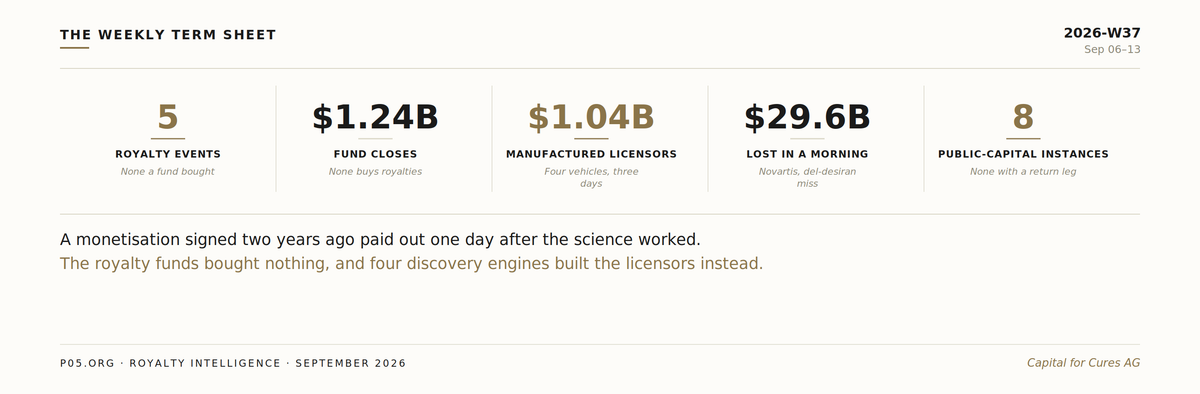
Five royalty events this week and not one was a fund buying a stream. A monetisation signed two years ago paid out one day after the science worked: Pharvaris reported an 83% reduction in hereditary angioedema attacks on 8 September, and on the 9th BRAIN Biotech received EUR 11.51M ($13.4M) from Royalty Pharma under a contract dated 20 September 2024, with EUR 96.65M ($112.4M) still to come. Neither Pharvaris's release nor any coverage of it mentions that its lead asset carries an originator, a monetisation and a fund.
The one royalty book that changed hands was priced by a bankruptcy court. Eli Lilly took Sangamo's AAV capsid, zinc-finger and Modular Integrase platforms, the ST-506 prion programme and Sangamo's rights to future milestone and royalty payments under certain of its out-licences, for $50M in cash and assumed liabilities, in a Section 363 sale completed 4 September. No tracked royalty fund bought anything, and EDGAR carries no filing containing the words synthetic royalty in the window.
Four discovery engines ran the same structure in four days. Harbour BioMed licensed WIN378 to Windward Bio of Basel and porustobart to Solstice Oncology of Boston, keeping Greater China and taking equity in the second. Paragon stands behind Korsana, which closed $380M five days after AbbVie completed Apogee at $10.9B out of the same engine, and Paragon's low single-digit royalty on that programme is now AbbVie's to pay. Schrödinger co-founded Tectora with NEA and RA Capital for equity, milestones and royalties. In Copenhagen the same syndicate launched CaMaRa, which inverts the model and buys clinical-stage candidates rather than licensing them out. RA Capital appears in four of the five vehicles, Forbion in three.
Assembly Bio did the opposite. It read Gilead's development budget for its herpes programme and took 40% of United States profits instead of United States milestones and royalties, giving up a published band of high single digits to low teens in the largest market in the world. The structure is reversible, with conversion rights on both sides, so the royalty was parked rather than sold. Alligator Bioscience went further and stopped being a drug developer altogether, funding itself to 2029 against a royalty that starts paying around 2030.
Three assets lost value to somebody else's mechanism rather than their own data. Alligator abandoned mitazalimab after a positive Phase 2 because Revolution Medicines' RAS(ON) results will remove the patients its Phase 3 was designed for. Beam's one-time correction in alpha-1 antitrypsin deficiency cleared the protective threshold at 60 mg, which threatens the base partnered chronic therapies are paid on. Pharvaris put a daily tablet into the indication behind $225M of milestone tranches under Intellia's OrbiMed facility. None of the three shows up in a trial that failed.
Switzerland produced the largest loss and both of the wins. Novartis lost roughly $29.6B (CHF 24bn) in a morning when del-desiran missed in myotonic dystrophy type 1, the centrepiece of a $12B acquisition and its third setback in seven days. Windward of Basel took a Chinese-origin anti-TSLP into Phase 3. Pharvaris of Zug met every endpoint it had. Meanwhile three funds closed $1.24B between them and none of them buys royalties.
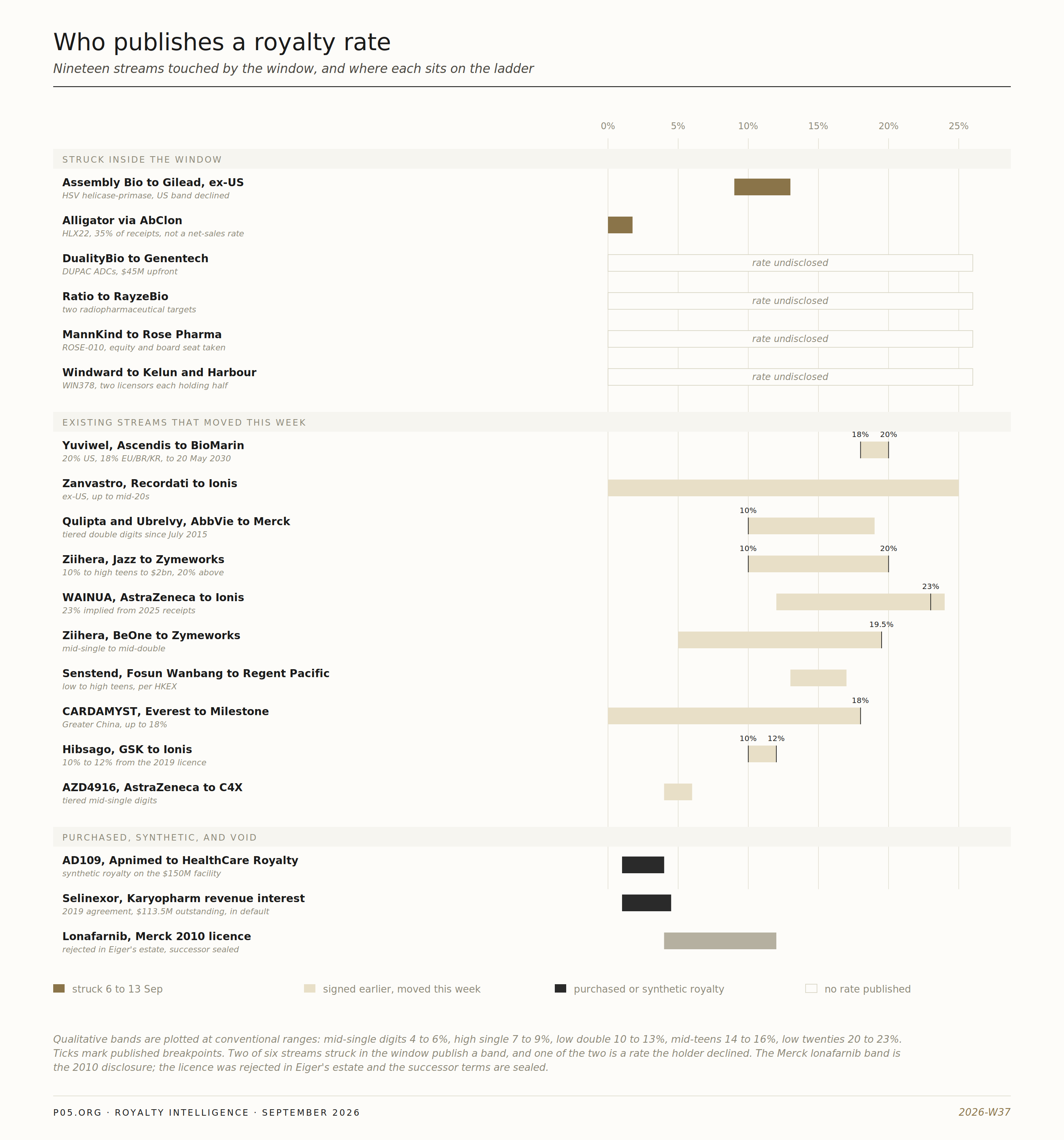
Nineteen streams touched by the window, grouped by how each got onto the ladder. Two of the six struck inside the window publish a band, and one of the two is a rate the holder declined: Assembly Bio gave up high single digits to low teens in the United States for a 40% profit share. Alligator's up to 1.75% is a share of AbClon's receipts and not a rate on net sales. The Merck band on lonafarnib is the 2010 disclosure and the licence was rejected in Eiger's estate.
Currency note: figures are converted to US dollars with the original in brackets, at approximately EUR 0.86, SEK 9.50, NOK 10.30, CHF 0.885, DKK 6.40, GBP 0.74, JPY 146, KRW 1,370 and INR 88 per US dollar, being September 2026 rates. Where a source published its own conversion, that figure is used.
Highlights
Royalty events: 5. A royalty book sold in a bankruptcy court, a licensor electing out of its own rate, a monetisation paying out on a Phase 3 result, a synthetic royalty disclosed at a launch, and a revenue interest in default.
- Apnimed / HealthCare Royalty Partners / Shionogi (disclosed 8 Sep): in its second-quarter results Apnimed set out the two financings behind its commercial build-out: an upsized IPO raising $220.8M gross, and a senior secured credit facility of up to $150M with funds managed by HealthCare Royalty Partners, under which Apnimed pays a synthetic royalty equal to a low single-digit percentage of net sales of AD109. The facility dates to 2 April 2026, with $50M drawn at close and two further $50M tranches contingent on FDA approval and a sales milestone. Separately Apnimed monetised its interest in Shionogi-Apnimed Sleep Science for $100M upfront, with up to $50M in further milestones and tiered royalties. The balance sheet carries a revenue interest liability at fair value.
- The only disclosed synthetic royalty of the window, and the rate band is published (Apnimed)
- Karyopharm Therapeutics (10 Sep): a forbearance agreement and limited waiver entered with its credit agreement lenders, holders of 100% of its convertible notes, and the investor representative under its revenue interest financing agreement dated 14 September 2019. Karyopharm did not pay a roughly $15.8M principal instalment due on the day and does not expect to pay cash interest due 30 September, triggering events of default across all three instruments. Future royalty obligations under the revenue interest agreement stood at $113.5M as of 10 September. Forbearance consideration of $20.0M in newly created zero-coupon convertible perpetual preferred stock, issued at $1,000 a share with a $1,000 liquidation preference and a $1.62 conversion price, expected to issue 17 September.
- The period ends on the earlier of 15 October 2026 or a termination event, one of which is the FDA refusing to file the selinexor and ruxolitinib myelofibrosis sNDA.
- The company states its liquidity funds operations only to that date and that it cannot continue as a going concern without new funding or a strategic transaction. A revenue interest written in 2019 is now a creditor in a restructuring (Karyopharm)
- BRAIN Biotech / Royalty Pharma / deucrictibant (9 Sep): BRAIN Biotech AG received a EUR 11.51M ($13.4M) milestone payment from Royalty Pharma, triggered by development progress on deucrictibant under the royalty monetisation the two signed on 20 September 2024. Up to EUR 4.6M ($5.3M) in further regulatory payments and EUR 92.05M ($107.0M) in commercial payments remain potentially due, EUR 96.65M ($112.4M) in total. Disclosed as inside information under EU market abuse rules.
- BRAIN warns that remeasurement of the monetisation liability under IFRS 9 may produce a substantial non-cash charge in its financial result, so the cash receipt and the accounting outcome are not the same thing. Block below (BRAIN Biotech)
- Assembly Biosciences / Gilead Sciences (8 Sep): Assembly Bio exercised its option to share 40% of United States development costs and profits for the HSV helicase-primase inhibitor programme in recurrent genital herpes, in lieu of receiving US milestones and royalties. It retains up to $280M in regulatory and commercial milestones and tiered royalties on net sales outside the United States. The profit share is reversible: opt-out and conversion rights held by either party may transition the programme back to up to $330M in milestones and tiered royalties on net sales running from the high single digits to the low teens. Block below (Assembly Biosciences)
- Sangamo Therapeutics / Eli Lilly (completed 4 Sep, disclosed 8 Sep): a Section 363 sale in which Lilly, through Merope Acquisition Sub, LLC, took the AAV capsid engineering platform including the STAC-BBB capsid, the zinc-finger protein platform, the Modular Integrase genome-editing platform, the ST-506 prion programme, and Sangamo's rights to receive future milestone and royalty payments under certain of its out-licensing agreements, for $50M in cash and the assumption of specified liabilities. The streams are not identified and no rate is disclosed. Block below (Sangamo)
No royalty was bought by a royalty fund in the window. Two were disclosed, one paid out, and one defaulted. Royalty Pharma discharged an obligation under a two-year-old contract, HealthCare Royalty's April facility surfaced in a quarterly filing, and a 2019 revenue interest became a party to a forbearance agreement.
Priority review vouchers: 2 issued, 0 sold. Scholar Rock took a Rare Pediatric Disease voucher on the ISEMBYLD approval and Ionis took one on Zanvastro, recorded in W36. Neither has been sold. No voucher changed hands in the window. For context, disclosed 2026 prints cluster between $180M and $215M: Arrowhead buying at about $215M (disclosed 4 Aug), Fortress and Cyprium at $205M, Immedica and Jazz at $200M, Denali and SPARC at $195M, Ascendis at $187.5M, Rocket at $180M. The programme is reauthorised to 30 September 2029, which is what supports the band. A transferable asset with no clinical risk, an observable price and a legislated expiry is the most liquid instrument any approval in this issue produced, and this publication has not been tracking it
Royalty-bearing licence-outs: 8, and only one publishes a rate.
- DualityBio / Genentech (28 Aug, W36 window, not recorded there): a global collaboration and licence for next-generation antibody-drug conjugates on DualityBio's DUPAC payload platform. DualityBio generates ADCs against Genentech-selected oncology targets and leads discovery and early global clinical development; Genentech takes exclusive worldwide rights and sole responsibility after Phase 1a. $45M upfront, more than $1B in aggregate development, regulatory and commercial milestones across programmes, and tiered royalties on annual net sales with the tiers undisclosed. Goodwin advised DualityBio. The firm names the team: Wenseng Pan, Kevin Guan, Longfei Xu, Justin Pierce, Gozde Guckaya and Kuwabo O'Brien. No Genentech adviser is publicly identified (DualityBio)
- Ratio Therapeutics / RayzeBio (9 Sep): a research collaboration and licence on next-generation radiopharmaceutical candidates against two undisclosed targets. RayzeBio takes exclusive worldwide rights and assumes downstream development, manufacturing and commercialisation. Development, regulatory and commercial milestones and royalties on net sales, all amounts and rates undisclosed (Ratio)
- MannKind / Rose Pharma (9 Sep): a worldwide licence for ROSE-010 Technosphere, an inhaled rapid-acting GLP-1. Rose takes exclusive worldwide rights to MannKind's Technosphere technology for the programme; MannKind supports formulation, development and manufacture through Phase 1b. No cash upfront. MannKind takes an equity interest in Rose, board representation, and royalties on future net sales, rate undisclosed (MannKind)
- Andarta Therapeutics / Teva / Michael J. Fox Foundation (8 Sep): Andarta takes rights to Teva's fatty-acid synthase inhibitor programme, lead compound included, for Parkinson's disease. Cash consideration undisclosed; an MJFF Therapeutic Pipeline Program grant supports development. Teva receives an equity stake in Andarta and retains a right of first negotiation to reacquire the rights (Teva)
- 1cBio / Lee's Pharmaceutical Holdings (9 Sep): exclusive rights to OC-3, a preclinical PARP1 inhibitor, in China and specified Southeast Asian territories. Lee's runs GLP safety work and manufacturing for those territories; 1cBio may use the data for its US IND. Up to $27M across upfront, development and sales milestones, plus royalties at an undisclosed rate (1cBio)
- Cipla / InvaGen / Qilu Pharmaceutical (8 Sep): an exclusive US licence and supply arrangement for QL2107, Qilu's pembrolizumab biosimilar candidate. Qilu develops, files and manufactures; Cipla's US operation commercialises. All economics undisclosed and no exchange filing retrieved (Cipla)
- Exegenesis Bio / Modalis Therapeutics (11 Sep): a research collaboration and licence agreement on MDL-201, a preclinical epigenome-editing therapy for Duchenne muscular dystrophy that upregulates utrophin in muscle tissue, delivered by AAV. Economics undisclosed. The agreement takes effect on 14 September, the day after this window closes. Modalis is Japanese-listed; Exegenesis is an AAV developer with Chinese and US operations. The second Japanese item of the window and the first Sino-Japanese licence this publication has recorded (Exegenesis Bio)
- Menarini / Gan & Lee / bofanglutide (3 Sep, W36 window, not recorded there): a 39-country European licence at $72M (EUR 62M) upfront, up to $772M (EUR 664M) in milestones and double-digit royalties (Menarini)
- Klaria / RTHS (8 Sep): a collaboration on early detection and treatment of migraine. No economics disclosed, and the release does not say whether it runs as a licence or a joint development [LINK PENDING: MFN release]
- Windward Bio / Kelun-Biotech / Harbour BioMed / WIN378 (8 Sep): positive Phase 2 interim in asthma and initiation of the Phase 3 portion of POLARIS-1. SKB378 began as a 50/50 co-development between Kelun-Biotech and Harbour BioMed (HKEX: 02142), the two holding global rights equally, and Windward licensed rights outside Greater China and several Southeast and West Asian countries from both. A Basel company therefore pays two separately listed licensors on one molecule. Three releases, one from each party, all on the day. No economics disclosed in any of them. Block below
- Exegenesis Bio / Modalis Therapeutics (11 Sep): a research collaboration and licence agreement on MDL-201, a preclinical epigenome-editing therapy for Duchenne muscular dystrophy that upregulates utrophin in muscle tissue, delivered by AAV. Economics undisclosed. The agreement takes effect on 14 September, the day after this window closes. Modalis is Japanese-listed; Exegenesis is an AAV developer with Chinese and US operations. The second Japanese item of the window and the first Sino-Japanese licence this publication has recorded (Exegenesis Bio)
- Menarini / Gan & Lee / bofanglutide (3 Sep, W36 window, not recorded there): a 39-country European licence at $72M (EUR 62M) upfront, up to $772M (EUR 664M) in milestones and double-digit royalties (Menarini)
- Klaria / RTHS (8 Sep): a collaboration on early detection and treatment of migraine. No economics disclosed, and the release does not say whether it runs as a licence or a joint development [LINK PENDING: MFN release]
- Windward Bio / Kelun-Biotech / Harbour BioMed / WIN378 (8 Sep): positive Phase 2 interim in asthma and initiation of the Phase 3 portion of POLARIS-1. SKB378 began as a 50/50 co-development between Kelun-Biotech and Harbour BioMed (HKEX: 02142), the two holding global rights equally, and Windward licensed rights outside Greater China and several Southeast and West Asian countries from both. A Basel company therefore pays two separately listed licensors on one molecule. Three releases, one from each party, all on the day. No economics disclosed in any of them. Block below
Rate disclosure: two numbers across ten transactions touching royalties. Alligator publishes 35% of what AbClon receives from Henlius, an effective up to 1.75% of HLX22 net sales. Assembly Bio publishes the band it declined, high single digits to low teens. Everyone else describes royalties as tiered, or says nothing: DualityBio and Genentech, Ratio and RayzeBio, MannKind and Rose, 1cBio and Lee's, Windward with Kelun and Harbour, Sangamo and Lilly, Schrödinger and Tectora. Ten transactions, two numbers, and one of the two is a rate somebody turned down.
M&A and restructuring: 8, and the largest strategic buyer in fertility just bought the thing that would replace its own injectables.
- Sernova Biotherapeutics / Seraxis Holdings (8 Sep): a definitive merger creating BetaNova Biotherapeutics, combining Sernova's Cell Pouch with Seraxis's stem cell-derived pancreatic islets and cGMP capability in Type 1 diabetes. Valuation not disclosed; each side's shareholders expected to hold approximately 50%. SR-02 holds an FDA-cleared IND with Phase 1/2 dosing targeted for Q1 2027. Closing targeted November 2026, Nasdaq listing thereafter. A 50:50 combination rather than a cash acquisition, funded by $10M of insider convertible notes (Sernova)
- AddLife / Unicam Sistemas Analíticos Lda (10 Sep): acquisition of the Portuguese analytical instruments distributor, strengthening AddLife's position in the category. Terms undisclosed. No royalty (Pharma Equity Group)
- Sudarshan Pharma / MedTherapy Biotechnology (board approval 5 Sep, disclosed 9 Sep): acquisition of 2,423,675.64 shares of $0.0001 par value, a 9.5% equity stake in the US cell and gene therapy company, for cash. Chairman and Managing Director Hemal Mehta and Joint Managing Director Sachin Mehta each acquire 382,685.63 shares, 1.5% apiece, taking promoter co-investment to 3.0%. Consideration undisclosed. Disclosed under SEBI Regulation 30. The stated rationale is access to MedTherapy's US customer base and clinical trial infrastructure. The second Indian transaction of the window, and the second to reach the record through an exchange filing rather than a wire (Sudarshan Pharma)
- Barinthus Biotherapeutics / Clywedog Therapeutics / Beacon Topco (9 Sep): the UK scheme of arrangement became effective when the court order was delivered to the Registrar, Beacon Topco acquiring the entire issued and to-be-issued share capital at 0.111 Topco shares per Barinthus share with fractions cashed out. The High Court sanctioned the scheme and capital reduction on 1 September. The merger agreement dates to 29 September 2025 and was amended 22 February 2026, so this is a completion, not a signing. Nasdaq ADSs suspended for delisting, Form 25 filed 9 September (Barinthus)
- EMD Serono / PostEra (9 Sep): EMD Serono, the North American biopharma business of Merck KGaA, acquired PostEra's FSHR and LHCGR agonist programmes and will assume sole responsibility for development and commercialisation worldwide. No economics are disclosed, and the release describes an acquisition rather than a licence. PostEra generated both series on its Proton AI platform: FSHR agonists for ovarian stimulation in IVF, and LHCGR agonists for male infertility and as an ovulation trigger, where preclinical work suggests an oral alternative to injectable hCG.
- Taken together the two could convert the IVF protocol from injections to an all-oral regimen (PostEra) Merck KGaA, through Serono, is the incumbent in fertility, marketing Gonal-f, Ovidrel and Ovitrelle, and Luveris, all of them injectable gonadotropins.
- It has bought the small molecules that would make its own franchise obsolete, and it has bought them outright rather than licensing them. For anyone holding economics on injectable fertility products, the incumbent has just told the market where it thinks the modality goes
- Novartis India / Pfizer / Minipress (7 Sep): the board approved and the parties executed an asset purchase agreement and trademark assignment deeds the same day, signing and closing simultaneous, for the Minipress and Minipres trademarks registered in India and related intellectual property, at $142M (INR 1,250 crore). Minipress XL is prazosin, in hypertension and benign prostatic hyperplasia, at $26.0M (INR 228.6 crore) of revenue on IQVIA MAT July 2026 and 6.3% compound growth against 9% for its category. Pfizer discontinues marketing, distribution and sale in India from 7 September, and its India-listed entity takes $13.9M (INR 131.38 crore) from its US parent for the discontinuation. 5.5 times trailing brand revenue, outright, no stream left behind. Block below (Novartis India)
- Alligator Bioscience (8 Sep): discontinuation of independent development of mitazalimab and reorganisation around the HLX22 sublicence interest, funded by a rights issue of units of approximately $13.2M (SEK 125.6M) running 4 to 18 September. Block below
Clinical: 5, of which two reach a royalty, one erodes three, and the largest destroyed more value than every transaction in this issue combined.
- Novartis / del-desiran / HARBOR (8 Sep): the Phase 3 in myotonic dystrophy type 1 missed its primary endpoint against placebo. Novartis will review the full dataset and consult regulators, citing some evidence of clinical activity. Shares fell about 9 to 10% in Zurich on the worst trading day in the company's record, roughly $29.6B (CHF 24bn) of market capitalisation. Guidance of 5 to 6% average annual revenue growth to 2030 reiterated. Del-desiran was the centrepiece of the $12B Avidity Biosciences acquisition; sell-side peak sales had been modelled at $3.1B at 60% probability and management had spoken of more than $5B in July. Del-zota, from the same platform, holds FDA priority review in Duchenne. Third Novartis setback in seven days, after the rap-cel pause and pelacarsen.
- Whether del-desiran or the wider AOC platform carries a licensor or a milestone obligation is not on the public record. Block below
- Pharvaris / deucrictibant XR / CHAPTER-3 (8 Sep, Zug): 83% reduction in mean monthly HAE attack rate against placebo, p<0.0001, and 87% in types 1 and 2. Eighty-five adolescents and adults across 21 countries, randomised 2:1 to 40 mg once daily or placebo over 24 weeks, all secondary endpoints met. The first prophylaxis Phase 3 to enrol all three HAE types. Applications from H1 2027; the immediate-release capsule is under FDA review with a PDUFA of 23 April 2027. PHVS rose 7.35%. No licensor named. The read-through is to the Intellia facility. Block below
- Beeline Medicines / afimetoran / Bristol Myers Squibb (9 Sep): the Phase 2 in systemic lupus erythematosus met its primary endpoint, all three dose groups showing higher SRI-4 response at week 48 than placebo. Afimetoran is BMS-986256, one of five programmes Beeline in-licensed from Bristol Myers Squibb on formation in July 2025, against a $300M Series A led by Bain Capital extended to $426.3M in June. BMS is both licensor and equity investor. Terms undisclosed (Beeline Medicines)
- AbbVie / Qulipta / Merck (10 Sep): the Phase 3 LUNA study showed a significant reduction in menstrual migraine days. The base it widens is one Merck & Co is paid on: Allergan took exclusive worldwide rights to Merck's oral CGRP programme on 7 July 2015 for $250M upfront plus milestones and tiered double-digit royalties, and AbbVie inherited the obligation in 2020 (Merck)
- Structure Therapeutics (10 Sep): positive data on both lead obesity candidates. Structure is one of the four companies Schrödinger names in the $750M its platform model has returned (Structure Therapeutics)
- Beam Therapeutics / BEAM-302 (8 Sep, ERS Barcelona): at 60 mg, total AAT reached a mean of 14.4 µM against 5.0 at baseline in Part A and 13.5 against 4.7 in Part B, both above the 11 µM protective threshold, with an 84% reduction in circulating mutant Z-AAT and corrected M-AAT at 93% of circulating AAT at steady state. Twenty-nine dose-escalation patients of 38 dosed, up to 18 months of follow-up, cutoff 24 June. Infusion-related reactions in 41%; one transient Grade 3 transaminase elevation. Accelerated approval sought on a 12-month biomarker endpoint, global pivotal cohort dosing since July.
- No licensor named in the release, which is not the same as none existing; base editing rests on institutional intellectual property disclosed in the 10-K rather than in a data release (Beam Therapeutics)
- Stoke Therapeutics / Biogen / zorevunersen (3 Sep, W36 window; the 48-month open-label extension poster was presented at the European Epilepsy Congress in Athens on 8 September): long-term Dravet syndrome data showing sustained reductions in seizure frequency with gains in cognition and behaviour. Biogen holds rights outside the United States and Stoke takes milestones and royalties on ex-US sales, so the readout supports a stream and not only a share price (Stoke and Biogen)
- Amgen / IMDELLTRA plus Imfinzi (8 Sep): the Phase 3 in first-line maintenance extensive-stage small cell lung cancer showed an overall survival benefit. Tarlatamab is already marketed, and first-line maintenance is a far larger population than the later-line label it holds. Whether it carries any royalty obligation from the BiTE platform's institutional and acquisition history is not established here (Amgen)
The modality read: five oligonucleotide events in seven days, and two of them sit on disclosed streams. Apazunersen misses on 2 September, Zanvastro is approved on 3 September, pelacarsen misses on 4 September, zorevunersen posts positive long-term data on 7 September, del-desiran misses on 8 September. Three misses, one approval and one positive readout across antisense and antibody-oligonucleotide conjugates, spanning Ultragenyx, Ionis, Novartis, Stoke and the Avidity platform. Pelacarsen carries a Royalty Pharma interest and zorevunersen pays Stoke ex-US. Ionis sits on two sides of it.
The competitor read: three assets repriced this week by somebody else's mechanism. Alligator abandoned a successful Phase 2 because of Revolution Medicines. Beam's one-time correction threatens the base under partnered chronic therapy in alpha-1. Pharvaris put a daily tablet into the indication behind Intellia's milestone tranches. None of the three is visible in a trial that failed.
Regulatory: 5, and they run in both directions: two approvals create marketed bases and a priority review voucher, one complete response letter stops a royalty switching on for the second time.
- Bayer / HYRNUO (sevabertinib) (9 Sep): a second FDA accelerated approval, expanding the label into first-line HER2-mutant locally advanced or metastatic non-squamous non-small cell lung cancer, on SOHO-01 Cohort F: 69 treatment-naive patients, 75% objective response rate (95% CI 64 to 85), 6% complete and 70% partial. The first accelerated approval, in previously treated patients, came on 19 November 2025. The second HER2 tyrosine kinase inhibitor approved in the indication, after Boehringer Ingelheim's zongertinib Sevabertinib derives from Bayer's strategic research alliance with the Broad Institute of MIT and Harvard. No inbound royalty is disclosed in the approval materials and none is asserted, but the asset should be mapped as collaboration-derived rather than wholly internal.
- The Broad appears twice in this issue: as the science partner behind CaMaRa, and as the alliance behind a drug that just took its second US approval (FDA) (FDA)
- Scholar Rock / ISEMBYLD (11 Sep): FDA approval of apitegromab-mstn for spinal muscular atrophy in adults and children two years and older already receiving an SMN2-targeted treatment. The first muscle-targeted treatment in the indication, and the first approval to come out of myostatin inhibition. On SAPPHIRE: a 2.2-point improvement on the Hammersmith Functional Motor Scale-Expanded at one year on 10 mg/kg, nominal p=0.0121, with 34.2% gaining three points or more against 13.5% on placebo, odds ratio 3.8. Fractures in 9% of treated patients against 2% on placebo, carried as a warning. US launch underway (Scholar Rock)
- The approval switched on a $150M tranche. Scholar Rock holds a facility of up to $550M from funds managed by Blue Owl Capital, maturing February 2032: $100M at closing to retire the prior Oxford Finance facility, $100M drawn in the first quarter of 2026, up to $150M available on FDA approval, and $200M optional at mutual consent. Whether it carries a revenue participation alongside the coupon is not stated and the credit agreement settles it
- Apitegromab is internally discovered, carried as SRK-015, with no inbound academic licence on the filings reviewed. Scholar Rock is instead a licensor to Gilead under a December 2018 fibrosis collaboration on latent TGFβ. Roughly 35,000 SMA patients globally are already on SMN-targeted therapy and ISEMBYLD is indicated on top of it, so the denominator is identified and reimbursed. The Rare Pediatric Disease voucher awarded with the approval is the most liquid thing the day produced. The first application drew a complete response over Catalent Indiana's fill-finish, with no concern on safety or efficacy
- Sobi / pacritinib (10 Sep): FDA Fast Track designation in VEXAS syndrome. Pacritinib reached Sobi by acquisition rather than discovery; any surviving royalty obligation is not established here (Sobi)
- Ascelia Pharma / Orviglance (10 Sep): completion of an FDA Type A meeting on the NDA. Orviglance did not originate at Ascelia and the chain of title is not established here (Ascelia Pharma)
- Seikagaku / Ferring / condoliase (10 Sep): a second FDA complete response letter on the biologics licence application for SI-6603, for radicular leg pain associated with lumbar disc herniation. The royalty consequence. Seikagaku developed the molecule and licensed it to Ferring Pharmaceuticals in August 2016, giving Ferring rights to develop, register and commercialise worldwide excluding Japan. In Japan it has been marketed as HERNICORE since August 2018 through Seikagaku's sales partner Kaken Pharmaceutical. So a Japanese licensor's ex-Japan stream has now failed to switch on twice. The first CRL raised no concerns on efficacy or safety and required no additional clinical studies, citing manufacturing facility and control of drug substance and drug product.
- An asset that works and a plant that does not is the most recoverable form of this failure (Seikagaku)
- Obecabtagene autoleucel (9 Sep): FDA RMAT designation in systemic lupus erythematosus and lupus nephritis, on Phase 2 data. An approved oncology CAR-T moving into autoimmune disease while two large-cap autoimmune CAR-T programmes sit paused. Obe-cel is owned by Autolus Therapeutics and in-licensed from UCL Business PLC, dated April 2018, so an academic royalty runs underneath it. Above that sits Blackstone Life Sciences, which committed up to $250M under a 2021 collaboration and financing agreement, $150M of it as product financing alongside equity, carrying a revenue participation back to Blackstone. Milestone payments have been made against it, including a final $30M development payment on FDA approval in December 2024.
- A university licence at the bottom, a product financing in the middle, an approved product at the top, and a designation that widens the base all three are paid on. Rates on neither participation are disclosed (Autolus)
Regulatory, carried: 1, from the W36 window. No FDA action, designation or CHMP opinion printed on 6, 7 or 8 September, and the next CHMP meeting opens 14 September, outside this window.
- AstraZeneca / ETCAMAH (4 Sep, W36 window, not recorded there): FDA accelerated approval of camizestrant with a CDK4/6 inhibitor in HR-positive, HER2-negative advanced breast cancer upon detection of an emergent ESR1 mutation by circulating tumour DNA during first-line aromatase inhibitor plus CDK4/6 therapy, before radiographic progression, with Guardant360 CDx as companion diagnostic. SERENA-6, 315 patients, median PFS 16.0 against 9.2 months, a 56% reduction in the risk of progression or death.
- Both earlier conflicts are settled: the approval date is 4 September, and the indication is a first-line switch on a molecular signal rather than a post-progression label. AstraZeneca discovery; no licensor and no royalty (FDA, AstraZeneca) On 30 April 2026 ODAC voted 6 to 3 against, finding that the SERENA-6 switching strategy had not demonstrated a clinically meaningful benefit. The FDA granted accelerated approval anyway, four months later.
- The first oncology approval triggered by a ctDNA resistance signal ahead of imaging progression cleared a committee that had rejected the premise
Public capital and debt: 5.
- Teva Pharmaceutical Industries (7 Sep): launch of a multi-tranche senior notes offering, euro notes due 2033 and 2036 and dollar notes due 2032, 2034 and 2037, through Teva Pharmaceutical Finance Netherlands II, III and IV and guaranteed by Teva. The preliminary 424B5 carried blank amount and coupon fields at the time of review, so no total is stated here. Proceeds are to fund conditional redemption of existing debt including all outstanding 6.750% senior notes due 2028, 7.875% sustainability-linked notes due 2029 and 7.375% sustainability-linked euro notes due 2029, plus specified 2027 maturities. BNP Paribas is named in prospectus distribution information; the full syndicate was not established (Teva)
- Newron Pharmaceuticals (8 Sep): a second tranche of $6.4M (EUR 5.5M) under the February financing framework, 433,070 new shares, following an initial tranche of about $17.4M (EUR 15M). A further $6.4M (EUR 5.5M) is expected by 30 November and $14.0M (EUR 12M) is conditional on positive ENIGMA-TRS results, for up to $44.2M (EUR 38M) in total. A drawdown under an existing agreement, not a new financing. SIX Swiss Exchange and German venues (Newron)
- NeOnc Technologies (9 Sep): a $15M registered direct offering, 3,571,430 shares or pre-funded warrants with accompanying warrants at a combined $4.20. Roth Capital Partners and A.G.P./Alliance Global Partners as placement agents (NeOnc)
- Sernova / Seraxis (8 Sep): $10M of non-brokered convertible notes committed by existing insider shareholders of both parties, converting automatically into non-voting BetaNova common stock on completion of the merger, with the round open to further qualified investors (Sernova)
Public capital and debt, continued: the PIPE with a licence option.
- PDS Biotechnology (8 Sep): a PIPE of up to $22.55M led by Nant Capital, in two tranches. An initial closing of about $11.55M expected on or about 11 September, and a milestone closing of $11M, $10M from Nant and $1M from AB Group, triggered by submission of a registrational Phase 3 protocol for PDS0301 to the FDA. Units at $0.2825, one share and half a warrant. As additional consideration, PDS granted NantWorks a one-year exclusive right to negotiate an exclusive licence to PDS0101, its HPV16-targeted therapeutic cancer vaccine. Patrick Soon-Shiong joins the board; Nant may appoint two directors while holding 15% or more. A right to negotiate is not a licence and carries no rate.
- It is licence optionality bought with equity, against a second tranche drawn on a regulatory milestone (PDS Biotechnology)
Private funding: 10.
- Encoded Therapeutics (9 Sep): a $275M Series F co-led by GV and a further healthcare fund, with ARCH Venture Partners, Braidwell, Farallon, Illumina Ventures, Invus, Janus Henderson, Matrix Capital Management, Nolan Capital, RTW Investments, SoftBank Vision Fund 2 and Venrock, to fund pivotal Phase 3 work on ETX101, an AAV gene therapy for SCN1A-positive Dravet syndrome, a commercial-scale AAV manufacturing build-out, and ETX301, a vectorised microRNA for neuroma pain, toward an IND in 2027. The second-largest private round of the window and the second Dravet asset in it, after Stoke and Biogen's zorevunersen data on 7 September.
- A precision genetic medicine and an antisense oligonucleotide competing in the same rare epilepsy, one of them carrying a disclosed ex-US royalty to Stoke (Encoded)
- TwoStep Therapeutics (9 Sep): a $62.5M Series A with Insight Partners, Medical Excellence Capital, M Ventures and Pfizer Ventures among the leads, and NFX, 2048 Ventures and Stanford University participating, alongside FDA clearance of the IND for TS-104, a peptide-drug conjugate targeting five tumour-associated integrins. Stanford appears on the cap table, which usually means it also appears on the licence (TwoStep)
- Cloverleaf Bio (8 Sep): a $33M seed led by 4BIO Capital, with AbbVie Ventures, Eli Lilly, Boehringer Ingelheim Venture Fund, Draper Associates, Mission BioCapital and American Cancer Society BrightEdge. Engineered tRNA therapeutics, lead liver cancer programme to early clinical and antibody-tRNA conjugate work in colorectal cancer. Three strategic pharma venture arms in one seed round (Cloverleaf Bio)
- Navion Neurosciences (9 Sep): a $10.8M seed first closing led by the Angelini Lumira Biosciences Fund, with 3B Future Health Fund, UVA LVG Seed Fund, Virginia Innovation Partnership Corporation and VTC Innovation Fund (Navion Neurosciences)
- Cytonics (9 Sep): $4.8M gross from roughly 1,500 investments, about 900 of them new, through Regulation A and Regulation Crowdfunding rather than an institutional syndicate. CYT-108, an engineered alpha-2-macroglobulin biologic for osteoarthritis. $47M raised to date, $27M of it through retail channels (Cytonics)
- Allogenetics (9 Sep): a $4.4M (EUR 3.8M) pre-Series A for ALG-115, an ex vivo gene therapy targeting MHC class I and II to prevent graft rejection in lung transplantation. Preclinical. Below any floor, recorded for the map (Allogenetics)
- Kura Oncology / Caspian Therapeutics (9 Sep): Kura Oncology, Inc. (Nasdaq: KURA) launched Caspian Therapeutics, Inc. with a $50M financing led by BVF Partners, with the T1D Fund, Invus, Montanova, Eli Lilly and Company, Kura itself, members of Kura's leadership and several biotech entrepreneurs. Caspian is built around KO-7246, a next-generation selective menin inhibitor for Type 1 and Type 2 diabetes, where preclinical work showed selective expansion of pancreatic beta cells, increased endogenous insulin production and improved glycaemic control. Data selected for oral presentation at EASD on 29 September. Kura retains approximately half of Caspian on a fully diluted basis with board representation, under an intercompany services arrangement giving Caspian access to Kura's R&D and corporate capabilities.
- Kura's own menin inhibitor Komzifti, ziftomenib, co-developed with Kyowa Kirin, was approved in AML and recorded nearly $15M of sales in the first half of 2026 Where Harbour, Paragon and Schrödinger take licence economics out of their vehicles, Kura took equity and shared services. A listed company carved an indication out of its own asset, financed it separately, and held half. Same structural problem, four different answers to it in one window
- CaMaRa / Broad Institute (9 Sep, Copenhagen): launch with backing from Forbion, Novo Holdings, NEA and RA Capital Management, alongside a scientific collaboration with the Broad Institute of MIT and Harvard, in cardiometabolic and renal disease. The round size is not disclosed. Human genetics identifies causally validated targets, a proprietary AI-driven Target Assessment Framework prioritises them, and CaMaRa then acquires advanced drug candidates designed to act on those targets. Block below (CaMaRa)
- Tectora Therapeutics / Schrödinger (9 Sep): a $55M Series A from NEA and RA Capital Management, closed concurrently with the formation of the company, which Schrödinger co-founded with them. Schrödinger contributed two early-stage small molecule programmes, SDGR-4594 and SDGR-8139, and received an equity stake plus eligibility for future milestones and royalties. Immunology and inflammation, oral small molecules. Block below
- Solstice Oncology / Harbour BioMed / porustobart (9 Sep): Solstice launched with a $225M Series A led by RA Capital Management, with Canaan Partners, Forbion and others. Porustobart, known as HBM4003 in Harbour BioMed's pipeline, was discovered and developed by Harbour BioMed, and in February 2026 Harbour entered into a licence agreement and equity partnership with Solstice for exclusive development and commercialisation outside Greater China. Harbour therefore holds both a licensor position and equity in its own licensee. Block below (Harbour BioMed)
- Korsana Biosciences / Cyclerion Therapeutics (8 Sep): completion of the reverse merger, with a $380M private placement closing immediately prior, led by Fairmount and Venrock Healthcare Capital Partners with fifteen further named participants. Post-transaction cash of approximately $475M, funding operations into 2029. Trading on Nasdaq as KRSA from 9 September. The lead asset, KRSA-028, runs on the THETA shuttle platform, which the release states was developed in partnership with Paragon Therapeutics. Block below (Korsana)
- BrainChild Bio (8 Sep): a $116M Series A led by an undisclosed private family fund and foundation, with founding investor Seattle Children's and WRF Capital, the venture arm of the Washington Research Foundation. Funds the pivotal Phase 2 ILLUMINATE trial of BCB-276, a B7-H3 CAR-T in diffuse intrinsic pontine glioma. BCB-276 is exclusively licensed from Seattle Children's; no terms disclosed (BrainChild Bio)
- Moonwalk Biosciences (8 Sep): an oversubscribed $70M Series B co-led by Alpha Wave Ventures and YK Bioventures, with Eli Lilly, Gaorong Ventures, ARCH Venture Partners, Khosla Ventures and Future Ventures. Funds MW101, an siRNA targeting adipose tissue in obesity, toward first-in-human studies in late 2027. In preclinical work MW101 produced weight loss and fat reduction while maintaining muscle mass and without reducing food intake, which is the differentiation being sold against the GLP-1 class. Discovery runs on an AI platform combining genetics, epigenomics and other omics. Follows a $57M seed in early 2024 backed by Feng Zhang.
- No licence and no royalty is disclosed in the coverage. (Moonwalk) Moonwalk launched in 2024 as a precision epigenetic medicines company and now leads with an siRNA asset, so the platform sold to seed investors and the platform funding this round are not the same one. A discovery engine that changes modality between rounds is a different origination proposition: what a licensor would grant rights to has moved
- Vaxdyn (7 Sep): a $12.9M (EUR 11M) Series A for the Seville vaccine company, led by Biovance Capital of Lisbon at $4.7M (EUR 4M), joined by the European Innovation Council Fund and by Arcano Partners as financial intermediary and manager of public money through Impacto Andalucía Innovación y Desarrollo. Funds a Phase 1 of K-VAX against Klebsiella pneumoniae and Acinetobacter baumannii. Non-dilutive support from the EIC Accelerator and CARB-X complements the round and sits outside it. Biovance's third investment from Fund I and its second in southern Europe, on a holding first taken in 2021 through a predecessor fund. Tickets other than the lead are not disclosed, and no licence or royalty appears on the record.
- Every disclosed source of the EUR 11M is public, public-managed or public-backed: the EIC Fund is the Commission's, Arcano manages Andalusian public money, and Biovance Capital Fund I is itself a $70M (EUR 60M) vehicle backed by the European Investment Fund and the Commission through Portugal Tech and InvestEU and by Banco Português de Fomento. Fourth financing in two windows where a state or supranational body supplies the capital a specialist fund would otherwise supply, after Elekta at the EIB, Amyl at the Walloon Region and Brandon at the NRF, and the first on a vaccine (Biovance Capital)
Government and non-dilutive funding: 2, and between them they take the count to eight instances in two windows.
- Ethris / European Investment Bank / DG HERA (10 Sep, Munich): a $34.9M (EUR 30M) financing agreement under HERA Invest, to advance Ethris's portfolio of respiratory mRNA products. Funds ETH47 from its current Phase 2a into Phase 2b in asthma and COPD, alongside ETH52 and ETH53, mucosal influenza vaccines for pandemic preparedness. The EIB financing is backed by DG HERA as part of the European Commission's action on health emergency preparedness.
- ETH47 is a first-in-class mRNA encoding interferon lambda, delivered to the respiratory tract by inhalation or nasal spray on the company's stabilised non-immunogenic RNA and nanoparticle platforms, and designed to work on the host rather than the pathogen, which is what gives it activity across virus families (Ethris) HERA Invest is a $151M (EUR 130M) top-up to InvestEU, financed by the EU4Health programme, directed at small and mid-sized companies at clinical stage developing countermeasures against pandemic pathogens, chemical, biological, radiological and nuclear threats, antimicrobial resistance and vector-borne disease.
- A dedicated European public facility for exactly the assets a private specialist would otherwise fund The company has previously announced up to $172M (EUR 148M) from the EU for a pandemic influenza vaccine, a $11.6M (EUR 10M) EU4Health grant for ETH47, and a $5M CEPI grant for spray-dried mucosal vaccines, alongside industrial collaborations with Evonik, Lonza and Thermo Fisher. A private German company has assembled the better part of two hundred million euros almost entirely from public and supranational sources, and no royalty or warrant is disclosed against any of it , after the $117M (EUR 100M) facility to Elekta. In neither case is a warrant or revenue-linked component disclosed. The EIB is lending against European health policy objectives, not against a return participation, and that makes it the cheapest capital in the market for anyone who qualifies
- Orexo / BARDA (10 Sep): Orexo's US subsidiary received an expanded contract from the Biomedical Advanced Research and Development Authority worth an additional $2.99M, extending the first development stage for OX390 from March to the end of 2027 and funding the preclinical safety and product testing the FDA requires. The potential total contract value rises to $53.8M, from $50.9M when the original multi-stage, milestone-tied award was made in September 2025.
- The adjustment follows agreement with the FDA on changes to the development programme (Orexo, via BioStock) OX390 is an intranasal rescue medicine for respiratory depression in opioid overdoses involving alpha-2 agonists, against which naloxone and nalmefene are, on the company's account, insufficient.
- It is built on AmorphOX, Orexo's proprietary powder-based delivery technology, and contains atipamezole, a substance not currently approved for human use in the United States. Xylazine's share of opioid overdose deaths rose from 8.3% to 12.6% over 2024 while total opioid deaths fell, and medetomidine, estimated at more than a hundred times xylazine's potency, was the most common alpha-2 agonist in illicit opioids in the Philadelphia area that year No royalty and no equity.
- A government agency is funding a delivery-platform company's programme against agreed milestones, up to $53.8M, in stages. That is a milestone ladder written by a public buyer, and it is the sixth financing in two windows where a state body supplies capital a specialist fund would otherwise supply, after Elekta at the EIB, Amyl at the Walloon Region, Brandon at the NRF, Vaxdyn at the EIC Fund and Oxcia's EIC Transition grant. Orexo carries a royalty position of its own and did not need to sell any part of it
Fund formation: 3, $1.24B raised, and public money anchors the smallest of them.
- CEECAT Capital (10 Sep): first close of CEECAT Capital Fund III at $157M (EUR 135M), against a $233M (EUR 200M) target and a $291M (EUR 250M) hard cap. Fund II closed at $179M (EUR 154M) in 2022. Cornerstone commitments from the European Investment Fund, which has committed $46.5M (EUR 40M) in total, part of it through Romania's National Recovery and Resilience Plan, and from the EBRD. About 65% majority transactions, tickets of $17.4M to $23.3M (EUR 15M to 20M), five-year deployment. Funded by the European Union through NextGenerationEU with the backing of the Government of Romania (CEECAT Capital)
- Fund III adds a dedicated healthcare vertical, led by Didem Ilgaz Anil. CEECAT has invested across central and eastern Europe and Türkiye since 2005, from London, Luxembourg, Bucharest, Belgrade and Istanbul, with Poland new for this fund. Fund II holds nine companies and completed its first exit in early 2026, selling La Cocos to companies of the Schwarz Group
- CEECAT has also signed a definitive agreement to sell Hermann Müller Medizintechnik GmbH of Tuttlingen to STERIS plc (NYSE: STE), a sterilisation container and surgical device maker, subject to customary conditions and regulatory approvals. CEECAT invested in 2021 alongside founder Mehmet Aygün; under CEO Benjamin Mietz the company took FDA clearance, added a German surgical-motor line, more than tripled revenues and sells into over 90 countries. Consideration, advisers and closing are undisclosed, no STERIS filing was issued, and the announcement date is not stated, so it is recorded and not placed in this window (CEECAT Capital)
Fund formation, continued: the two larger closes are structured to compete with a royalty on duration.
- Luma Group (9 Sep, New York): final close of LumaBio I LP at $410M in committed capital, the firm's inaugural life sciences vehicle. The fund is structured over fifteen years, with a stated plan to support companies through milestones from discovery to commercialisation. More than ten biotechs already backed, including Character Biosciences, Coultreon Biopharma, the rebranded Belgian company that took on rescued Galapagos candidates for $125M, and Altos Labs. Founded 2023 by Joshua Fink. A company Luma co-founded, Vaccine Company, was acquired by Eli Lilly earlier this year for up to $1.55B (Luma Group) A conventional venture fund runs ten years and needs an exit.
- Fifteen years reaches commercialisation, which means it reaches the royalty, and a fund that can hold that long has no structural need to sell a stream to a specialist. Claret raised $669M of senior debt against dilution; Luma has raised $410M against the clock
- Claret Capital Partners (7 Sep): final close of Claret European Growth Capital Fund IV at $512M (EUR 440M), taking the total to $669M (EUR 575M) with $157M (EUR 135M) of affiliated discretionary mandates, against a $581M (EUR 500M) target. Total raised since inception $1.51B (EUR 1.3bn), with more than $1.74B (EUR 1.5bn) deployed across 210 companies across successive vintages. 32% of Fund IV is already deployed across 27 companies. Fund III closed at $345M (EUR 297M) in 2022. LPs are pension plans, insurers, family offices and institutional investors, with private wealth admitted through an ELTIF, alongside discretionary co-investment partnerships. Paris staffed, Berlin next.
- Block below (Claret Capital)
Biovance Capital Fund I enters the record at $70M (EUR 60M), described as Portugal's first and only biotech-dedicated fund, backed by the European Investment Fund and the European Commission through Portugal Tech and InvestEU, by Banco Português de Fomento, by BIAL and by Caixa Capital, Ageas Pensões and Fundo de Pensões EDP. Three investments made.
Animal health: 0 in window, and four comparables carried from outside it.
- CVC Capital Partners / dsm-firmenich Animal Nutrition & Health (announced 9 February 2026, outside this window, carried as the sector comparable): a carve-out divestment at an enterprise value of $2.56B (EUR 2.2bn), with an earnout of up to $581M (EUR 500M). The unit turns over roughly $4.07B (EUR 3.5bn) in annualised net sales, putting the headline at approximately 7x EV to adjusted EBITDA. dsm-firmenich retains a 20% equity stake. The business separates into two standalone entities headquartered in Kaiseraugst: a Solutions company covering performance solutions, premix and precision services, and an Essential Products company covering vitamins, carotenoids and aroma ingredients. EY-Parthenon and Valcon advised dsm-firmenich; CVC Advisory acted for the buyer.
- No royalty. Total Animal Nutrition and Health enterprise value including the earlier Feed Enzymes sale to Novonesis reaches $4.30B (EUR 3.7bn). The transaction is not in this window and is carried only because it is the only published EBITDA multiple on a large animal health asset this year, and this publication writes about animal health royalties without one (dsm-firmenich)
- Boehringer Ingelheim / Evax AG (announced 11 August 2026, outside this window): acquisition of 100% of the Swiss equine health company, a University of Zurich spin-out,, which develops therapeutic vaccines for chronic equine allergies and inflammatory skin conditions. Consideration undisclosed. Builds on Boehringer's earlier acquisition of Saiba Animal Health into a companion and equine vaccine platform. A therapeutic vaccine platform in horses is an unusual asset class and a small one, and it has now been bought twice by the same acquirer. Out of window; carried for the map (Boehringer Ingelheim)
- Merck Animal Health / TARGAN Inc. (definitive agreement announced 11 June 2026, outside this window): acquisition of 100% of the Raleigh, North Carolina animal agtech company. TARGAN builds poultry biodevices including WingScan, automated vision-based gender sorting at up to 160,000 chicks an hour, and high-speed precision ocular spray systems for respiratory and coccidiosis vaccines. Consideration undisclosed. An animal health major buying the administration layer for its own vaccines. Out of window; carried for the map (Merck Animal Health)
- Vaxinano / Vétoquinol (licence standing; the EUR 10M raise does not exist and is withdrawn): the only financing on the record is $7.0M (EUR 6M), announced 29 October 2024, led by TCD Capital with Captech Santé, Nord France Amorçage and Wiseed, with Bpifrance support. The EUR 10M figure carried in earlier drafts could not be confirmed to any source and is not published. What stands is the licence: Vaxinano holds an exclusive worldwide arrangement with Vétoquinol on the canine leishmaniasis vaccine from its Stellar-NP platform, under which Vétoquinol funds downstream clinical trials and global marketing against sales milestones and tiered royalties, rates undisclosed. Vaxinano's most recent 2026 activity on the record is a sheep vaccine licence with Eco Animal Health, around 12 August.
- A private French licensor with two listed veterinary payers and no disclosed economics (Vaxinano)
Animal health, in-window count: 0. The four transactions above are all out of window on their announcement dates. The sector produced nothing between 6 and 11 September that this sweep could date inside it.
Vaccines and procurement: 2.
- Ghana National Vaccine Institute / Africa CDC (7 Sep): a memorandum of understanding securing access for Ghanaian manufacturers to supply under the African Pooled Procurement Mechanism, across a market of about 1.4 billion people, for tetanus and diphtheria vaccines, anti-tetanus serum and snake venom antiserum. No royalty. Recorded because pooled procurement sets the price at which a net sales base is calculated, and a continental mechanism is a demand-side structure worth tracking (Ghana National Vaccine Institute)
- Novavax / Matrix-M (9 and 10 Sep, Cantor and Citi conferences): management restated its intention to out-license the Matrix-M saponin adjuvant for third-party infectious disease and immuno-oncology candidates against upfront fees, milestones and royalties. These were fireside chats, not a transaction, and no new release was issued. The reference point is the Pfizer licence of 20 January 2026: $30M upfront, up to $500M in milestones, and high mid-single-digit royalties, which is the only published Matrix-M rate. An adjuvant is a component licensor: not the active, not the device, paid on somebody else's net sales (Novavax)
Enforcement and proceedings: 1, and the counterparty is not named in the headline.
- Pharma Equity Group (7 Sep): a challenge to an arbitral award. Awards in this sector routinely concern licence terms, milestone triggers or termination, and a challenged award is a disclosed dispute over contract economics. Terms and counterparty not established (Pharma Equity Group)
Carried from W36.
- HUTCHMED / GSK, closing on antitrust clearance. Not announced as at 11 September.
- BioMarin / Ascendis, the definitive agreement due by 24 September. Not signed as at 11 September; the binding term sheet stands either way. The primary documents now read consistently at 20% in the United States and 18% in the EU, South Korea and Brazil, through 20 May 2030 across all four territories, which resolves the earlier conflict in Ascendis's favour.
- Yuviwel at the EMA, decision anticipated Q4 2026. None issued, so the 18% European leg has not switched on. Ascendis presented first reACHin sentinel cohort data in infants at ESPE on 8 to 10 September, which widens the base the settlement runs against.
- Intellia / OrbiMed, whether the synthetic-royalty restriction is a prohibition or a consent right. Still needs the credit agreement exhibit. The collateral has moved and the Pharvaris block says how.
- Elekta / EIB, partly answered. No warrant and no revenue-linked component is disclosed in EIB release 2026-274 and the tenor tracks the 2026 to 2029 programme. Pricing and drawdown conditions unpublished.
- Revolution Medicines, the mandatory first $250M term-loan tranche, which triggers on FDA approval of daraxonrasib in metastatic pancreatic cancer if it lands by 1 January 2028. No draw in the window. Royalty on the funded synthetic tranches runs 4.55% to $2B, 2.50% to $4B, 1.00% to $8B and nil above.
- Novartis and BMS, both CAR-T pauses company-initiated and neither a confirmed FDA hold. Oncology continues in both: BMS-986393 met its primary ORR endpoint in Phase 2 on 8 September.
- Zymeworks, the bands now on the record and wider than carried: 10% to the high teens on Ziihera sales up to $2.0B and 20% above, from Jazz; mid-single to mid-double digits from BeOne. Royalty Pharma's $250M note is repaid from 30% of those royalties and stops collecting at 1.65x by 31 December 2033. HERIZON-GEA-01 hazard ratios held for a Q4 meeting.
- Samsung / PolyPeptide, offer period opening 15 September. Dimerix, 50% drawdown due 18 September. Aqilion, no bidder and no price. Innovad / Cinergis, no closing confirmation through three windows. Cape Fear BioCapital, fund size still undisclosed. ARCH, no capital closed against the $3.0B Fund XIV Form D.
Carried from W35. Norwich v Kennedy, the scope of the remand and FDA's response. No docket movement located. Unresolved through three windows.
Resolved this week on items carried from earlier issues.
- Merck's lonafarnib royalty did not survive Eiger's estate. The 2010 licence was rejected by order entered 5 September 2024, not assumed and assigned, so the original mid-single to low-double-digit band does not run against the debtor. A non-public Side Letter executed 3 September 2024 replaced it and its economics are sealed. Merck holds rejection-damages claims.
- The most-favoured-nation signatories are named. Nine manufacturers signed on 31 August: Alcon, Astellas, BeOne, BridgeBio, CSL, Kyowa Kirin, Sun Pharma, Teva and UCB, taking the total to 26 covering 89% of the branded market. No royalty holder has quantified the effect on the denominator.
- Superluminal / Eli Lilly, the August 2025 GPCR collaboration runs to $1.3B and carries milestones and tiered royalties on top of Lilly's equity.
- Merck & Co / Alteogen, for a rate comparable on the same enzyme class: Merck's 10-Q states that after all sales-based milestones a 2% royalty on net sales is payable to Alteogen on subcutaneous Keytruda.
Open in the remainder of the window.
- The World Conference on Lung Cancer opens in Seoul on 12 September and the first two days fall inside this window. BioNTech presents the first global data for pumitamig with elfetabart drozuntecan, partnered with Bristol Myers Squibb and DualityBio respectively.
- Implantica holds a Capital Markets Day in Stockholm on 9 September.
- Oxcia, a reported notice of an extraordinary general meeting three weeks after the EMA orphan designation on OXC-201. No primary notice could be located.
- Ultragenyx / UX111, PDUFA 19 September, six days outside the window.
- Not yet worked, all dated 8 or 9 September: TwoStep at $62.5M on a variant approach to antibody-drug conjugates; Sernova and Seraxis merging on stem cell islet replacement in Type 1 diabetes; NodThera rebranding to Rezera with a 2027 Phase 3 of ruvonoflast in peripheral artery disease; Sanofi and AstraZeneca detailing asthma and COPD data at ERS.
M&A and Restructuring
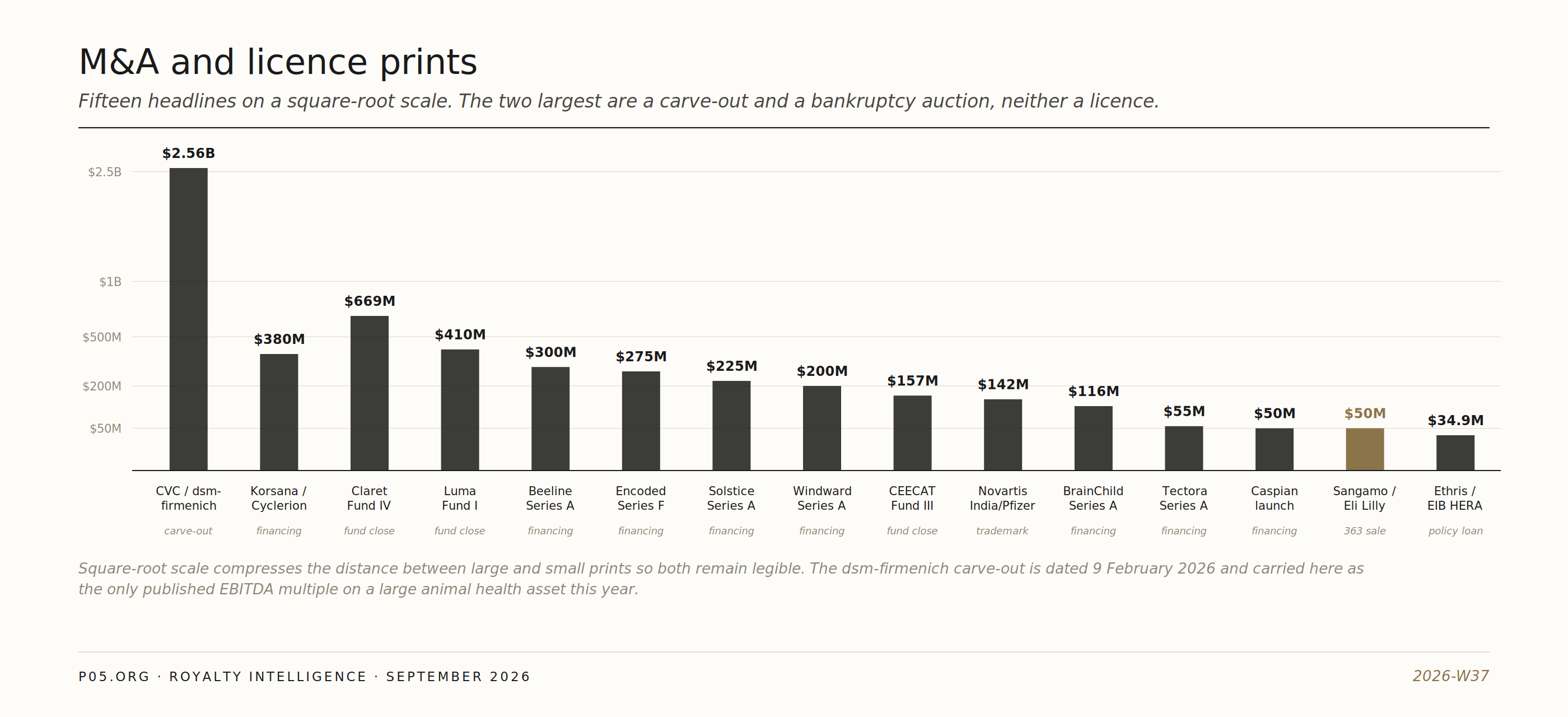
Fifteen headlines on a square-root scale. The largest is a carve-out dated outside the window and the second is a bankruptcy auction. The only print that moved a royalty book is the $50M Sangamo estate sale, marked in gold.
BRAIN Biotech / Royalty Pharma: A Monetisation Signed in 2024 Pays Out One Day After the Phase 3 Reads, and the Accounting Goes the Other Way (Wed Sep 9)
BRAIN Biotech AG of Zwingenberg announced receipt of a milestone payment from Royalty Pharma plc under the royalty monetisation agreement the two entered on 20 September 2024, triggered by development progress on deucrictibant (BRAIN Biotech).
- The payment: EUR 11.51M ($13.4M), received. Disclosed as inside information under the EU Market Abuse Regulation
- What remains: up to EUR 4.6M ($5.3M) in further regulatory payments and EUR 92.05M ($107.0M) in commercial payments, EUR 96.65M ($112.4M) in total potential consideration still outstanding under the same contract
- The trigger: Pharvaris reported topline results from the pivotal Phase 3 CHAPTER-3 study of deucrictibant on 8 September, with an 83% reduction in hereditary angioedema attack rate. The milestone was announced on the 9th. A monetisation signed two years earlier converted a clinical result into cash inside twenty-four hours
- The chain: BRAIN Biotech originated the economics, sold them to Royalty Pharma in 2024 against staged consideration, and now collects that consideration as the asset advances. Pharvaris develops and will commercialise. Royalty Pharma holds the stream. BRAIN holds a receivable that behaves like a milestone ladder. Three parties, three different exposures to the same molecule, and the topline release names none of them
- On the accounting. BRAIN states that remeasurement of the monetisation liability under IFRS 9 may produce a substantial non-cash charge in its financial result. A seller of a royalty books the proceeds as a liability and remeasures it as the underlying asset succeeds, so good news on the drug produces a worse reported result. This is the standard consequence of a monetisation structured as debt-like consideration rather than a true sale, and it is why a monetisation's headline number and its income-statement effect diverge
- Instrument: the only royalty-fund activity in the window, and it is a payment obligation being discharged rather than a stream being acquired. Royalty Pharma bought this in 2024 and is paying for it now, on schedule, because the science worked
- Origination read-through: BRAIN Biotech is an industrial biotechnology company, not a drug developer, and it held a royalty on a clinical-stage hereditary angioedema asset good enough for Royalty Pharma to buy. Licensors are not always where the therapeutic area suggests. The map should include industrial and platform companies with legacy therapeutic economics, and it does not
- Date: Announced Wed Sep 9, 2026
Assembly Bio / Gilead: A Licensor Reads the Development Budget, Prices Its Own Royalty Against 40% of Profits, and Gives the Royalty Up (Tue Sep 8)
Assembly Biosciences, Inc. (Nasdaq: ASMB) of South San Francisco exercised its option to participate in a 40% United States cost and profit share with Gilead Sciences, Inc. on the HSV helicase-primase inhibitor programme, in place of US milestones and royalties (Assembly Biosciences).
- The election: 40% of US development costs and 40% of US profits, in lieu of receiving milestones and royalties in the United States. Gilead retains sole responsibility for development and commercialisation. The decision followed Assembly Bio's receipt and review of Gilead's complete development plan and budget, which is to say the licensor priced the choice against the actual spend
- What is given up, and the band is published: the US milestones forgone run to $330M, alongside a royalty on US net sales. The collaboration's headline band is high single digits to high teens; the band on a reversion out of the profit share is high single digits to low teens. The October 2023 agreement carried $85M upfront in cash and $15M in equity, 13,073,668 shares at $1.16 (Form 8-K)
- What is retained: up to $280M in regulatory and commercial milestones and tiered royalties on net sales outside the United States. The company now holds a royalty in every territory except the one it believes matters most
- The instrument is reversible. Participation in the profit share is subject to opt-out and conversion rights of either party, which may transition the programme back to the milestone and royalty structure. This is not a royalty that was sold. It is a royalty held in one of two states, with both parties holding the switch
- The trade being made: 40% of United States profits against roughly a tenth of United States sales. A licensor has publicly valued its own royalty, against a budget it has read, and concluded the royalty is the worse of the two. For a market that prices streams, a counterparty declining a high-single-digit-to-low-teens rate in the largest pharmaceutical market is a data point on what those rates are worth when the holder can see the commercial plan
- The asset: GS-1179, formerly ABI-1179, a long-acting helicase-primase inhibitor with potential for once-weekly oral dosing, selected on Phase 1b results, entering Phase 2 in recurrent genital herpes by the end of 2026, with possible evaluation in combination with HIV pre-exposure prophylaxis. GS-5366 is also in the programme. The mechanism is distinct from the nucleoside analogues in current use
- The balance sheet behind the decision: cash runway into 2029, including a $75M collaboration extension fee from Gilead payable in the fourth quarter of 2026 on the third anniversary of the October 2023 collaboration. A licensor that can fund 40% of a Phase 3 budget is a licensor that does not need to sell a royalty, and this is what that looks like
- Royalty read-through: the reversibility is the origination point. A convertible royalty is a different asset from a fixed one, and any purchaser of the ex-US stream would be buying alongside a US structure either party can flip. Read the collaboration agreement before treating the ex-US royalty as clean
- Date: Announced Tue Sep 8, 2026
Sangamo / Eli Lilly: A Royalty Book Sold at Auction, Inside a $50M Platform Package, Priced by a Delaware Court (Completed Fri Sep 4, disclosed Tue Sep 8)
Sangamo Therapeutics, Inc. completed the sale of the Lilly Assets to Merope Acquisition Sub, LLC, a subsidiary of Eli Lilly and Company (NYSE: LLY), under Section 363 of the Bankruptcy Code (Sangamo).
- Terms: $50M in cash and the assumption of certain specified liabilities
- The assets: the AAV capsid engineering platform including the STAC-BBB capsid and next-generation variants, the zinc-finger protein platform, the Modular Integrase genome-editing platform, the ST-506 prion disease programme, related intellectual property, and the Company's rights to receive certain payments on account of certain of its out-licensing agreements, including the right to receive future milestone and royalty payments thereunder
- Process: asset purchase agreement dated 22 June 2026; court-supervised auction 10 August; sale order entered 20 August at Docket No. 362, Case No. 26-10989 in the District of Delaware; completion 4 September and the Form 8-K filed 8 September, reporting under Items 1.03 and 2.01
- The wider auction: roughly $163.55M in cash at closing plus up to $100M in milestones across all lots. PTC Therapeutics took the ST-920 Fabry gene therapy programme for $111M plus up to $100M in milestones; tools and equipment realised a further $2.55M
- What is not disclosed: which out-licences carried the streams, what rates they run at, what the milestone ladders are, and what portion of the $50M was ascribed to the royalty rights as against the three platforms and the prion programme. The 8-K names the category and nothing inside it
- Instrument: passive out-licence economics sold as a component of an asset package. This is the only route by which a royalty book changes hands without a competitive royalty process, because the price is set by a bankruptcy auction and approved by a judge rather than negotiated against a discount rate. A buyer of the platforms took the streams because they were in the same lot
- Comparable: every royalty fund tracked by this publication was silent in the window. The one stream that moved was bought by a strategic, in a Chapter 11 estate, at a price that also bought three platforms and a clinical asset. Where a royalty desk would have underwritten the rate and the term, an acquirer of platform technology took the economics as an attachment
- Royalty read-through: Lilly now holds Sangamo's licensor position on an undisclosed set of agreements, adding to a book that already includes the Nxera OX2R obligation inherited through Centessa and the Merida deferred consideration. The bankruptcy docket is where royalty books get repriced, and it is not covered by any wire.
- Date: Completed Fri Sep 4, 2026; disclosed Tue Sep 8, 2026
Novartis India / Pfizer: $142M for a Trademark, Signed and Closed the Same Day, at 5.5x Brand Revenue (Mon Sep 7)
Novartis India Limited approved and executed the acquisition of the Minipress and Minipres trademarks registered in India, and certain related intellectual property, from Pfizer Inc. and Pfizer Products Inc. (Novartis India).
- Terms: $142M (INR 1,250 crore). An asset purchase agreement and trademark assignment deeds were executed on the date of board approval, with signing and closing simultaneous
- The asset: Minipress XL is prazosin, prescribed in hypertension and for the urinary symptoms of benign prostatic hyperplasia. $26.0M (INR 228.6 crore) of revenue on IQVIA MAT July 2026 data, growing at 6.3% compound over four years against 9% for its category
- The seller's side: Pfizer discontinues marketing, distribution and sale of Minipress XL in India with effect from 7 September, and Pfizer's India-listed entity receives a lump sum of $13.9M (INR 131.38 crore) from its US parent in connection with that discontinuation
- Related parties: Novartis India states that the Pfizer entities are unrelated to its promoter or promoter group
- Multiple: 5.5 times trailing brand revenue, paid outright, for a mature and slow-growing trademark with no ongoing stream to either side
- Instrument, and it is the comparable the ladder needs: every rate in this publication prices a share of net sales. This prices the asset that share would run against. A holder deciding whether to monetise a royalty on a mature brand is choosing between a discount rate applied to a percentage and 5.5x applied to the whole line, and only one of those two numbers is usually observable. An Indian trademark assignment publishes both
- What must be settled before the parties are printed: the coverage refers to a change in Novartis India's controlling shareholding, and Dr Reddy's has terminated its February 2022 distribution and promotion agreement for selected Novartis India brands on the back of it, commercialising the covered brands until 30 September. If Novartis AG no longer controls the entity, this is not Novartis buying a brand from Pfizer
- Royalty read-through: none created, none extinguished. Recorded as the largest certain cash transaction of the window and as a rare published sale multiple on a marketed brand
- Date: Announced Mon Sep 7, 2026
Royalty-Bearing Licence-Outs and Collaborations
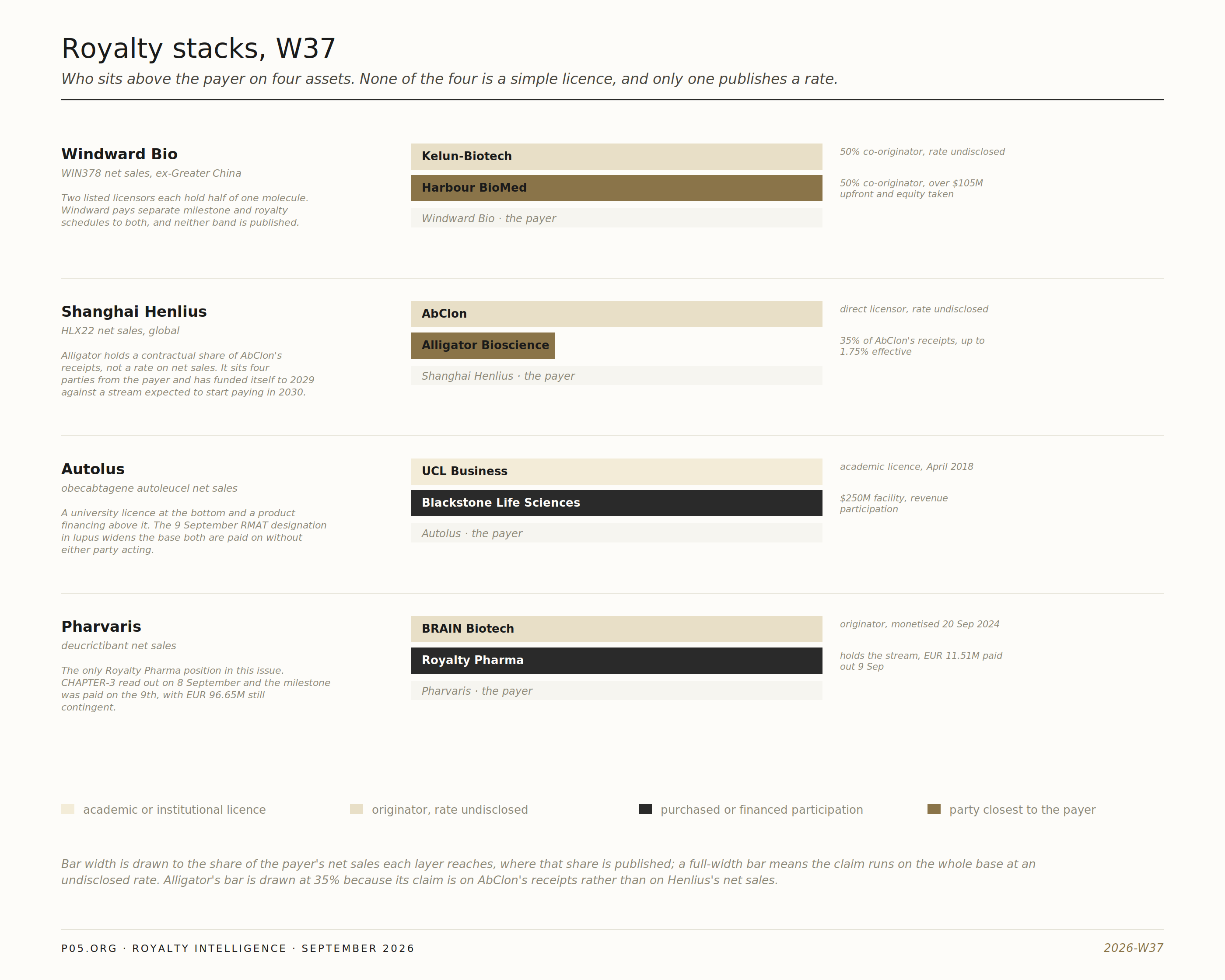
Four stacks, drawn to the share of the payer's base each layer reaches. Alligator's bar is short because its claim runs on AbClon's receipts rather than on Henlius's net sales. Royalty Pharma appears once, and its leg is a payment discharged rather than a stream bought.
Alligator Bioscience: A Drug Developer Converts Into a Royalty Vehicle, and Funds Itself Exactly to the Year the Royalty Starts (Tue Sep 8)
Alligator Bioscience AB (Nasdaq Stockholm: ATORX) of Lund is discontinuing independent development of mitazalimab and reorganising around a sublicence interest in HLX22, funded by a rights issue of units running 4 to 18 September.
- The instrument: HLX22 is a HER2-targeted monoclonal antibody originating in a research collaboration between Alligator's subsidiary Atlas Therapeutics and AbClon of South Korea. AbClon sublicensed it to Shanghai Henlius Biotech, which carries development and funding. Alligator takes 35% of the milestone and royalty payments AbClon receives from Henlius, with no cost responsibility of its own. The company puts the effective rate at up to 1.75% of HLX22 net sales
- What the rate implies: Alligator estimates peak receipts of $15.8M to $47.4M (SEK 150M to 450M) a year, which at up to 1.75% requires HLX22 peak sales of roughly $0.95B to $2.7B (SEK 9bn to 26bn). The top of the range exists only if the asset is a blockbuster, and the company says so
- The chain, four deep: Atlas and AbClon originate, AbClon licenses, Henlius develops and pays, Alligator takes a share of what AbClon receives. Alligator does not hold a royalty on net sales. It holds a contractual share of somebody else's royalty, which is a different instrument for anyone pricing it and a different set of counterparty risks
- The asset: global Phase 3 in first-line HER2-positive gastric and gastro-oesophageal junction cancer with trastuzumab and chemotherapy, enrolling across the US, Europe, China, Japan, Korea, Latin America and Australia, with Phase 2/3 studies in recurrent and neoadjuvant HER2-positive breast cancer alongside. Orphan designation in both the US and the EU for gastric cancer. Alligator's own addressable estimate is about 100,000 patients a year
- The timeline is the design: topline from the first Phase 3 in the second half of 2027, first NMPA approval around 2029 with FDA and EMA near it, and first royalty income around 2030. The rights issue is sized to cover operating costs and lease obligations through 2029. The company has funded itself to the royalty and not one year beyond it
- The terms: up to 3,140,534,240 units at SEK 0.04 per unit, five unit rights per existing share, each unit carrying two shares and warrants TO 15 and TO 16. About $13.2M (SEK 125.6M) gross against issue costs of roughly $1.8M (SEK 17M), secured to about 47% by subscription undertakings of $0.2M (SEK 2M) and guarantees from Vator Securities and Mangold Fondkommission of $6.0M (SEK 56.8M). The warrants could add about $6.6M (SEK 62.8M) each in January 2027 and January 2028. A holder standing entirely aside is diluted by approximately 95.2%
- The warrant timing is not incidental. TO 15 expires January 2027, TO 16 January 2028, and the Phase 3 topline sits between them in the second half of 2027. TO 15 funds the wait and TO 16 is exercisable only if the data is good. The financing plan is contingent on the readout by construction
- Where the money goes, and it is a wind-down schedule: repayment of $2.0M (SEK 19M) of bridge loans; contractual obligations to manufacturers of clinical material; salaries through notice periods; repayment of a renegotiated loan from Fenja Capital; lease commitments to 2029; and operating costs through 2029
- Why the development stopped, and it connects to an instrument this publication already carries. Mitazalimab is a CD40 agonist that read out positively in OPTIMIZE-1 with mFOLFIRINOX in metastatic pancreatic cancer. Alligator stopped it anyway. After Revolution Medicines' RAS(ON) data the company took soundings from opinion leaders and concluded that the patient population its planned Phase 3 was designed for will not exist in three to four years, as chemotherapy is displaced from first-line treatment. A licensee or buyer is sought during 2026; investigator-initiated studies continue, including a randomised Phase 2/3 in biliary tract cancer, funded elsewhere
- Instrument: a listed company with a defined cost base to 2029 and a defined royalty from 2030 is the textbook monetisation candidate. It took 95% dilution from retail through Vator and Mangold instead. Either nobody offered, or the interest is not financeable, and the structure argues for the second: diligence means reading an AbClon to Henlius agreement Alligator may not be able to hand over, and enforcement means a jurisdiction of somebody else's choosing. The structure of the interest, not the quality of the drug, determined the instrument
- Royalty read-through: the correct counterparty on this asset is AbClon, which holds the direct rate from Henlius and sits one step closer to the payer. Alligator holds 35% of what AbClon receives. Same asset, cleaner instrument, direct privity. Separately, mitazalimab is for sale during 2026 with positive Phase 2 data behind it, and a sale would very likely carry a royalty back to Alligator, originated at the point of sale rather than bought afterwards
- The terms and estimates above are the company's own, drawn from a sponsored article and the rights-issue material. Verify against the prospectus before the rate goes on the ladder.
- Date: Announced Tue Sep 8, 2026, 07:31 CEST
Paragon Therapeutics: The Template Is in the Filings, the Rate Is Low Single Digits, and AbbVie Now Pays It
Korsana's release names Paragon Therapeutics as the partner behind the THETA platform and discloses nothing else. It does not need to. Paragon's counterparties are listed companies, and three of them have filed the licence.
- The Korsana terms, now on the record. The licence is dated 8 June 2026 and covers Research Programs 001 and 002. Korsana owes Paragon non-refundable milestones of up to $46.0M, reduced by 50% for independently developed products directed to the same target combination, and tiered royalties in the low to mid single digits from first commercial sale of each product. A $5.0M milestone was paid to Paragon in March 2026 on nomination of KRSA-028 as the development candidate for programme 002, and is not owed again. A separate Platform Option Agreement gives Korsana exclusive options on THETA antibodies; as at the proxy date only the KRSA-028 option had been exercised (Form S-4/A)
- Korsana is the seventh company built on Paragon assets. Founded in 2024 on a $25M seed from Fairmount and Venrock, then a $150M Series A in September 2025 co-led by Wellington Management and TCGX, then $380M at the merger. Paragon is a joint venture of Fairmount Funds and FairJourney Biologics
- The Apogee terms, and the rate is lower than Korsana's. The OX40L licence is dated 28 April 2023: an exclusive, worldwide, royalty-bearing, sublicensable licence against royalties equal to a low single-digit percentage of net sales, running per product and per country until the later of twelve years after first commercial sale in that country or expiry of the last valid patent claim there. Apogee granted Paragon a reciprocal non-exclusive licence on OX40L multispecifics, with royalties running the other way. The asset is APG990
- What Paragon collected on the AbbVie deal. AbbVie agreed to acquire Apogee on 22 June 2026 at $135.11 per share, about $10.9B. Paragon beneficially owns more than 5% of Apogee, and Fairmount holds board seats and interests in both, so Paragon received merger consideration on its equity at closing. An Omnibus Amendment was negotiated to take effect immediately before the AbbVie closing to address terms across the Paragon and Apogee agreements. The running royalty is a net-sales obligation that survives the change of control, but APG990 is not commercial, so no royalty income has accrued (Apogee DEFM14A)
- The model. Paragon takes no upfront cash, a capped milestone ladder and a single-digit royalty with a twelve-year tail, and funds none of the development. The vehicles raise the money and spend it. Korsana raised $380M on 8 September against a platform Paragon co-developed, for a $46.0M milestone cap and a low-to-mid single-digit royalty. Seven companies, seven sets of economics, no development cost
- Origination read-through: this is the most legible version of the manufactured-licensor model in the market, because the counterparties are public and had to file the agreements. A private platform holding single-digit royalties with twelve-year tails across at least seven programmes, one of which has just been bought for $10.9B, is a counterparty worth knowing. The rates are small, the count is not, and the diligence is already on EDGAR
- Date: Korsana licence dated Tue Jun 8, 2026; Apogee OX40L licence dated Fri Apr 28, 2023; AbbVie acquisition agreed Mon Jun 22, 2026 and completed Thu Sep 3, 2026
CaMaRa: The Same Syndicate Builds a Buyer Instead of a Licensee, and Every Asset It Acquires Will Carry a Royalty Out (Wed Sep 9)
CaMaRa launched in Copenhagen with backing from Forbion, Novo Holdings, New Enterprise Associates and RA Capital Management, alongside a scientific collaboration with the Broad Institute of MIT and Harvard (CaMaRa).
- Terms: the round size is not disclosed, which is unusual for a launch of this syndicate quality and should be treated as a gap rather than an absence
- The model, and it inverts every other structure in this issue. CaMaRa uses human genetics with the Broad to identify causally validated targets in obesity, diabetes and kidney disease, prioritises them through a proprietary AI-driven Target Assessment Framework, and then acquires advanced drug candidates designed to act on those targets, as a faster route to clinical evaluation and proof of concept
- Which makes it a manufactured payer rather than a manufactured licensor. Harbour, Paragon and Schrödinger build vehicles that pay them. This syndicate has built a vehicle whose stated business is to go out and buy clinical-stage assets, and an acquirer of advanced candidates is a counterparty on the other side of every in-licence it signs. Each acquisition CaMaRa makes should create a royalty running back to whoever sold it
- The origination consequence. A well-capitalised, target-led buyer in cardiometabolic and renal, with a defined thesis and an institutional science partner, is a destination for assets sitting on the shelves of companies that cannot fund them. Those are the companies on the origination map. CaMaRa is where their assets go, and the royalty is what they keep
- The institution: the Broad already licenses into large pharma in this exact area, having run a cardiometabolic and precision cardiology alliance with Bayer since 2013 that was extended by a further five years in 2025. An academic institution supplying target biology to both a global pharmaceutical company and a venture-built acquirer in the same field is a licensor position worth understanding in its own right
- Royalty read-through: none created at launch. Recorded because the transactions that follow from it will create them, and because the syndicate is the same one funding three other vehicles in this window
- Date: Announced Wed Sep 9, 2026
Schrödinger / Tectora: A Platform Puts Two Programmes Into a Company It Co-Founded, Takes Equity and Royalties, and Publishes What the Model Has Paid (Wed Sep 9)
Schrödinger, Inc. (Nasdaq: SDGR) announced the formation of Tectora Therapeutics, co-founded with New Enterprise Associates and RA Capital Management, in immunology and inflammation (Schrödinger).
- Terms, and they are the clearest statement of this structure in the window: Tectora concurrently closed a $55M Series A from NEA and RA Capital. Schrödinger contributed two early-stage small molecule programmes, SDGR-4594 and SDGR-8139, and in exchange received an equity stake in Tectora and is eligible to receive future milestones and royalties. Neither the size of the stake nor the value of the milestones and royalties is disclosed
- What Schrödinger keeps doing: Tectora will use Schrödinger's computational platform at scale and work with its discovery team to advance both programmes to clinical candidates. The licensor supplies the science and the tools and holds equity, milestones and royalties. It funds none of the development
- What sits inside the $750M. Schrödinger names Nimbus, Morphic, Structure and Ajax and states that it has realised over $750M from therapeutics activities since 2020. It does not publish a breakdown, and the disclosed components account for a fraction of it.
- What is on the record: the Morphic equity stake was disposed of on 15 August 2024 for $47.588M when Lilly acquired Morphic for about $3.2B, and Schrödinger retains low single-digit royalties on selected Morphic programmes including MORF-057; a $10M collaboration milestone from Ajax was recorded in the second quarter of 2026, ahead of Lilly's agreement to acquire Ajax for up to $2.3B; the Nimbus holding carried at $2.436M at the end of 2025, with milestone and royalty eligibility on selected programmes but no separately disclosed rate on the TYK2 asset Takeda bought; and Structure realisations run through 3,260,495 ordinary shares plus ADSs bought at the IPO. Drug discovery revenue was $56.4M in 2025 against $27.2M the year before
- The $750M is a mix of equity sales, milestones and buyout proceeds, weighted to equity. The royalty tail is mostly still ahead, and the headline figure is not a royalty number
- Instrument: the release contrasts with Schrödinger's own large-pharma deals, where cash comes up front. Here the return is weighted to equity appreciation, milestones and royalties instead of an upfront, which is the same trade every licensor in this issue has made
- Royalty read-through: two preclinical programmes now carry an undisclosed royalty to a Nasdaq-listed computational platform, and the platform has told the market what four earlier versions of the same arrangement were worth
- Date: Announced Wed Sep 9, 2026
Harbour BioMed: The Same Licensor Appears Twice in Two Days, on Two Continents, With Two Newly Built Companies Paying It (Tue Sep 8 and Wed Sep 9)
Harbour BioMed (HKEX: 02142) of Cambridge, Rotterdam and Shanghai is the licensor behind two separate transactions in this window, and the pattern is more interesting than either of them alone.
- The second structure: Solstice Oncology, of Boston, founded in February 2026 and led by Caroline Loew, launched on 9 September with a $225M Series A led by RA Capital Management, with Canaan Partners, Forbion and other investors unnamed (Forbion). Solstice's own launch release names Harbour BioMed as "the Company's licensor" and states that porustobart is licensed from Harbour BioMed. Harbour separately describes a licence agreement and equity partnership entered in February 2026 for exclusive development and commercialisation outside Greater China. Porustobart is HBM4003 in Harbour's pipeline, a second-generation Fc-enhanced CTLA-4 antibody that Harbour discovered and developed
- What Harbour holds, and the numbers are now partly on the record: upfront cash and equity consideration in excess of $105M, eligibility for up to $1.1B in clinical, regulatory and commercial milestones, and tiered royalties on net sales, for global rights outside Greater China. Goodwin Procter acted for Harbour BioMed. The composition is on Harbour's own disclosure: $50M in upfront payments, $5M in near-term cash and over $50M of equity in Solstice (Harbour BioMed). Neither Solstice's launch release nor Forbion's carries any economics, which is normal for a licensee announcement. The HKEX filing remains the source of record and has not been read. Solstice launched, raised $225M and cleared an IND within seven months of incorporation
- What that reprices. If the $105M holds, Harbour took more than $105M in cash and equity on one of two out-licences in this window while bearing no development cost on either. The engine is not taking small money for optionality; it is taking front-end consideration comparable to a mid-size licensing deal and keeping a royalty behind it
- The clinical case: in a Phase 2 conducted by Harbour BioMed itself, porustobart with tislelizumab produced a 30% objective response rate, 7 of 23 patients, in late-line, heavily pretreated microsatellite-stable metastatic colorectal cancer without liver metastases, with a median duration of response of 8.4 months and a safety profile the parties describe as supportive of later-stage development. Solstice is taking it into the neoadjuvant setting with pembrolizumab in clinical stage II-III MSS colon cancer, the largest segment of colon cancer and one that has not benefited from immunotherapy. Enrolment opens early in the fourth quarter of 2026 (NCT07808151), data in the second half of 2027. A second indication is undisclosed
- The molecule carries its licensor's platform in its structure. Porustobart works through CTLA-4 checkpoint blockade and regulatory T cell depletion by antibody-dependent cellular cytotoxicity, and its engineered heavy-chain-only architecture gives it a half-life of four to five days against roughly two to three weeks for first-generation CTLA-4 antibodies. Heavy-chain-only is what Harbour Mice produce. The property that differentiates the asset belongs to the engine that made it, not to the vehicle that licensed it
- The model, and this is the block: Harbour discovers antibodies on its Harbour Mice platform, retains Greater China, and out-licenses the rest of the world to newly formed Western companies capitalised by crossover funds. WIN378 went to Windward Bio of Basel, founded 2024, on a $200M Series A led by OrbiMed, Novo Holdings and Blue Owl. Porustobart went to Solstice Oncology of Cambridge, founded February 2026, on a $225M Series A led by RA Capital. Two molecules, two vehicles, $425M of other people's money deployed against assets Harbour originated, and Harbour carries no development cost on either
- Comparable, and it is in this same issue. Korsana Biosciences closed $380M on 8 September on a platform developed in partnership with Paragon Therapeutics, five days after AbBvie completed its $10.9B acquisition of Apogee, which came from the same engine. Two discovery engines, on two continents, running the identical structure in a single week: originate the molecule, license it into a purpose-built vehicle, let crossover capital fund the clinic, keep the economics. One is a Hong Kong-listed company, the other a private US platform. Neither is a royalty fund and both are manufacturing royalties
- Origination read-through: a licensor that produces a new out-licence every few months, with a listed currency and no development cost, is a counterparty with recurring streams and a public balance sheet. Harbour was also added to Stock Connect this month. The economics of both licences sit in HKEX filings, and those filings are where this publication should have been looking
- Date: Solstice financing announced Wed Sep 9, 2026, 07:12 ET; the underlying licence dated February 2026
Windward Bio / Kelun-Biotech / Harbour BioMed: One Molecule, Two Listed Licensors Each Holding Half, and Three Releases in a Day (Tue Sep 8)
Windward Bio AG of Basel reported positive interim Phase 2 results for WIN378 in asthma and initiated the Phase 3 portion of the same study, with Sichuan Kelun-Biotech Biopharmaceutical Co., Ltd. and Harbour BioMed (HKEX: 02142) each publishing their own account the same day, each naming itself first in the licence sentence and each using its own designation for the molecule (Windward Bio).
- The licence, and the shape is unusual: SKB378 began as a 50/50 co-development between Kelun-Biotech and Harbour BioMed, the two sharing global rights equally. Windward licensed global rights excluding Greater China and several Southeast and West Asian countries from both parties. A Basel-domiciled private company therefore pays two separately listed licensors on a single molecule, each holding half of what it gave up. The molecule carries three designations: WIN378 at Windward, SKB378 at Kelun, HBM9378 at Harbour
- Economics: none disclosed in any of the three releases. The original out-licence announcements on HKEX are where any upfront, milestone ladder or royalty band would sit
- The data, and the interim is on a subset: the Phase 2 portion of POLARIS-1 (NCT07120503) is a 48-week randomised double-blind study of three dose levels against placebo. It enrolled 147 patients with uncontrolled moderate-to-severe asthma against an initial target of 120, and the interim analysis was conducted on the first 98. At week 24 after a single dose: dose-dependent mean FEV1 increases of up to 174 mL, placebo-adjusted up to 256 mL at p=0.033; mean FeNO reductions of up to 24 ppb, a 43% change at p=0.006; and mean blood eosinophil reductions of up to 200 cells/µL, a 51% change at p<0.0001. Near-maximal effects by week 2 and sustained through week 24
- The number that carries the commercial case: a half-life of up to 75 days. Population pharmacokinetic modelling on that basis is what supports twice-yearly dosing, against the fortnightly and monthly standards in the class. The efficacy is competitive; the dosing interval is the differentiation, and it rests on a PK parameter rather than on an endpoint
- Safety: no treatment-related serious adverse events, withdrawals or discontinuations as at the cutoff, adverse events balanced against placebo, injection-site reactions in under 1% and antidrug antibodies in 2%, with no impact on pharmacology
- The asset: a fully human ultra-long-acting anti-TSLP monoclonal antibody engineered for improved potency, extended half-life and silenced effector function, described as the only known investigational drug blocking TSLP signalling at two sites and interfering with binding to both co-receptors. It was generated from Harbour BioMed's H2L2 Harbour Mice platform, which is the origination layer under the whole structure: a discovery platform produced the molecule, a co-development split the rights, and a licence moved them west
- Instrument: a Phase 3 initiation is ordinarily a milestone event. If the Kelun and Harbour agreements carry development milestones, one was probably triggered on 8 September, and none of the three releases says so. Watch the HKEX filings
- Who is funding the payer: Windward's $200M Series A was led by OrbiMed, Novo Holdings and Blue Owl Healthcare Opportunities, with SR One, Omega Funds, RTW Investments, Qiming Venture Partners, Quan Capital and Pivotal bioVenture Partners alongside. Two of the three leads are royalty and credit houses, funding the licensee rather than the licensors
- Royalty read-through: in a window whose other late-stage readouts failed, this one widens two licensors' streams rather than closing them. Harbour BioMed was separately included in Stock Connect this month, so a licensor with a de-risked Phase 3 asset has just widened its own shareholder base. The asset is Chinese in origin, the developer is Swiss, the capital is American, and the royalty runs back to Hong Kong
- Date: Announced Tue Sep 8, 2026
Clinical and Regulatory
Novartis / del-desiran: A $12B Acquisition's Centrepiece Fails, and Roughly $29.6B Comes Off in a Morning (Tue Sep 8)
Novartis AG (SIX: NOVN, NYSE: NVS) announced that the Phase 3 HARBOR trial of del-desiran in myotonic dystrophy type 1 missed its primary endpoint against placebo.
- The result: the primary endpoint, which coverage describes as the speed at which patients could open their hands, was not met. Novartis says it will review the full dataset and consult regulators before deciding whether and how to continue, noting some evidence of clinical activity
- The market: shares fell about 9 to 10% in Zurich, the worst trading day on record for the company, erasing roughly $29.6B (CHF 24bn) of market capitalisation. Guidance of 5 to 6% average annual revenue growth to 2030 was reiterated
- What was paid for it: del-desiran was the centrepiece of the $12B Avidity Biosciences acquisition, one of three antibody oligonucleotide conjugates that came with it. Barclays had modelled peak sales of $3.1B at a 60% probability of success; the chief executive had put peak potential above $5B in July
- What survives: del-zota, also from Avidity, holds FDA priority review in Duchenne muscular dystrophy. The platform is not written off on one readout
- The week: the third Novartis setback in seven days, after the rap-cel pause on three deaths from immune effector cell-associated haemophagocytic lymphohistiocytosis and the pelacarsen HORIZON miss on 4 September
- Royalty content: not established. Pelacarsen carries a Royalty Pharma interest that W36 recorded. Whether del-desiran or the wider AOC platform carries a licensor, a milestone obligation or an inbound royalty is not on the public record. Avidity ran partnered programmes with large pharma before the takeover, and those obligations are now Novartis's. The Avidity 10-K and the merger filings are where it settles
- Instrument: none. Recorded as the largest single-day destruction of value this publication has covered, and because a $12B acquisition whose lead asset misses is the counterfactual every development-funding and synthetic-royalty proposal is priced against
- Date: Announced Tue Sep 8, 2026
Pharvaris / CHAPTER-3: An Oral Tablet Removes 83% of Attacks, in the Indication Behind Intellia's Milestone Tranches (Tue Sep 8)
Pharvaris N.V. (Nasdaq: PHVS) of Zug announced topline results from the pivotal Phase 3 CHAPTER-3 study of deucrictibant extended-release tablet for the prevention of hereditary angioedema attacks (Pharvaris).
- The result: the primary endpoint was met with an 83% reduction in mean monthly HAE attack rate against placebo, p<0.0001, rising to 87% among participants with HAE type 1 or type 2. All secondary efficacy endpoints were met with statistical significance. Well tolerated, with mild to moderate treatment-related adverse effects
- The study: 85 adolescents and adults across 21 countries, randomised 2:1 to 40 mg once-daily deucrictibant XR (n=55) or placebo (n=30) for 24 weeks. The first and only prophylaxis Phase 3 to evaluate all three types of HAE, including patients with normal C1 inhibitor
- What follows: marketing authorisation applications from the first half of 2027. The immediate-release capsule is already under FDA review with a PDUFA date of 23 April 2027 for on-demand treatment. CREAATE, a pivotal Phase 3 in acquired angioedema due to C1 inhibitor deficiency, is running. Shares rose 7.35%
- Royalty content, not stated in the release. Deucrictibant carries a royalty that originated with BRAIN Biotech AG of Zwingenberg, which monetised it to Royalty Pharma on 20 September 2024. The CHAPTER-3 result triggered a EUR 11.51M ($13.4M) milestone payment from Royalty Pharma to BRAIN on 9 September, one day after the topline. See the BRAIN block below. A German industrial biotechnology company holds the origination position on a Dutch-domiciled, Zug-headquartered, Nasdaq-listed company's lead asset, and neither the topline release nor any coverage of it says so
- The read-through, and it reaches an instrument arranged in the last window. The $400M OrbiMed facility to Intellia, recorded in W36, carries $225M in milestone tranches tied primarily to lonvo-z in hereditary angioedema, against first-priority security including intellectual property. A once-daily oral prophylactic removing 83% of attacks is now the comparator a one-time gene edit in the same indication has to beat, and it has a Phase 3 result and a 2027 filing path. The credit was underwritten before that number existed
- Instrument: none created. Recorded because the collateral behind a royalty-adjacent credit facility was repriced by a competitor's readout four days after the facility was announced
- Comparable: third instance this week of an asset repriced by somebody else's mechanism, after Alligator against Revolution Medicines and Beam against partnered chronic therapy in alpha-1
- Date: Announced Tue Sep 8, 2026, 06:50 ET
Funding
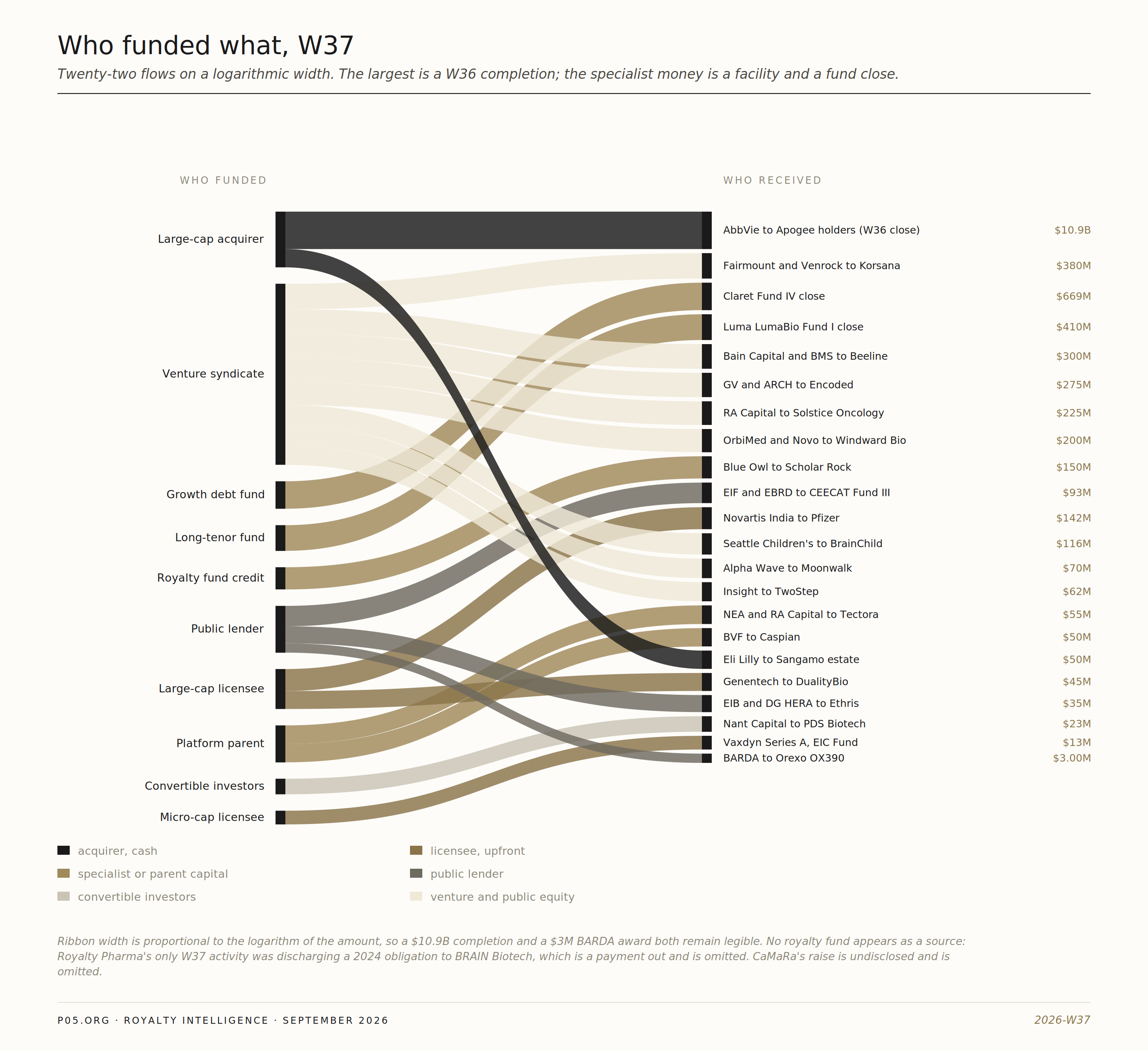
Twenty-two flows on a logarithmic width, coloured by the kind of capital. The venture syndicate band is the widest on the left and no royalty fund appears as a source at all.
Korsana / Cyclerion: $380M Into a Shell, and the Antibody Engine Underneath It Has Just Had a $10.9B Exit (Tue Sep 8)
Korsana Biosciences, Inc. completed its merger with Cyclerion Therapeutics, Inc., having closed a $380M private placement immediately beforehand (Korsana).
- The financing: $380M in gross proceeds from a syndicate of new and existing investors led by Fairmount and Venrock Healthcare Capital Partners, with General Atlantic, TCGX, Forbion, Wellington Management, Commodore Capital, RA Capital Management, RTW Investments, Vivo Capital, Janus Henderson Investors, Foresite Capital, J.P. Morgan Life Sciences Private Capital, SR One, Sanofi Ventures, Kalehua Capital and Spruce Street Capital. Common stock and pre-funded warrants
- The balance sheet: post-transaction cash and equivalents of approximately $475M on a pro-forma basis at 30 June 2026 including the PIPE and net of projected deal costs, expected to fund operations into 2029, through multiple clinical milestones for the lead programme
- The mechanics: each Korsana share converted into approximately 0.2074 shares of the combined company, adjusted for a 1-for-7 reverse stock split of Cyclerion's common stock effected immediately prior. Approximately 55.1 million shares and common stock equivalents outstanding after the reverse split, placement and merger, including shares underlying pre-funded warrants and Series B convertible preferred stock. Shares begin trading on the Nasdaq Capital Market as KRSA on 9 September; new CUSIP 23255M303
- The asset: KRSA-028, a next-generation shuttled antibody targeting amyloid beta in Alzheimer's disease, built on the Therapeutic Targeting (THETA) platform combining transferrin receptor and Fc engineering for brain delivery. Phase 1 healthy volunteer data expected mid-2027, with interim proof-of-concept data on amyloid plaque clearance in patients by the end of 2027 or the first quarter of 2028
- The licensor question, and it is the reason this is in the issue. The release states that THETA was developed in partnership with Paragon Therapeutics, and discloses nothing further. Paragon's template is public, because three of its counterparties are listed and filed the agreement: a low single-digit royalty on net sales for a single-antibody product, mid single-digit for multi-antibody products, a capped milestone ladder, and a royalty term running twelve years past first sale. Whether the Korsana agreement follows it, and on what ladder, sits in the Form S-4, File No. 333-295175, declared effective 24 July 2026. See the Paragon block below
- Comparable, and it is in the last issue. AbbVie completed its acquisition of Apogee Therapeutics at $10.9B on 3 September, recorded in W36 as the largest transaction of that window. Apogee came out of the same discovery engine and the same investor orbit. Five days later the next company from that orbit closes $380M and lists. A model that recycles a single antibody platform into serially capitalised single-asset vehicles produces, if the upstream terms hold, a portfolio of royalty positions on assets the licensor never develops
- Instrument: none disclosed. Recorded as the largest financing of the window, at more than five times the next private round, and as the origination question the S-4 answers
- The shell's own history is worth a look: Cyclerion was itself a spin-out with out-licensed assets, and whether any residual royalty or milestone entitlement of Cyclerion's survived into the combined company is not addressed in the release
- Date: Announced Tue Sep 8, 2026, 16:05 ET
Claret Capital: $669M of Non-Dilutive European Growth Capital, Closed Against the Same Pitch and the Same Borrowers (Mon Sep 7)
Claret Capital Partners Limited of London announced the final close of Claret European Growth Capital Fund IV (Claret Capital).
- Size: $512M (EUR 440M) of Fund IV commitments, plus $157M (EUR 135M) of affiliated discretionary mandates, for $669M (EUR 575M) in total against a $581M (EUR 500M) target. Total raised since inception $1.51B (EUR 1.3bn); more than $1.74B (EUR 1.5bn) deployed across 210-plus companies, reflecting capital recycled across vintages
- Pace: 32% of Fund IV already deployed across 27 companies. The second close was above $407M (EUR 350M) in September 2025, so the final close took twelve months. Fund III closed at $345M (EUR 297M) in 2022, so the platform has roughly doubled in a vintage
- Investors: pension plans, insurance companies, family offices and other public and institutional investors, plus private wealth admitted through an ELTIF structure, alongside discretionary co-investment partnerships. Teams now in Paris, with Berlin next
- Track record cited: Fund III exits include Endomag to Hologic, Cytora to Applied Systems, Logpoint to Summa Equity, Lyst to ZOZO and Tiqets to Expedia, plus the Abivax listing on Nasdaq
- Why a growth-debt close is in a royalty publication: managing partner Johan Kampe frames the opportunity as equity markets remaining selective while founders look for ways to grow without unnecessary dilution, and expects demand for flexible, non-dilutive capital to keep accelerating. That is the sentence a royalty monetisation is sold with, to the same companies, at the same point in their financing. $669M of European non-dilutive capital has just closed and will be deployed as senior debt rather than as stream sales
- And the borrowers are on this publication's own map. Fund IV's disclosed portfolio includes Cinclus Pharma, which appears in these pages as a listed European licensor with a stated funding gap, alongside Inventiva and Swiss medtech SIS Medical. A company identified here as a royalty origination candidate has already taken growth debt from the fund that just closed
- Instrument, and the consequence for origination: approaching a company that has drawn senior secured debt is a different conversation, with a different security position ahead of any stream. More usefully, Claret's portfolio page is a public screening list of European life sciences companies that have demonstrably chosen non-dilutive capital over dilution
- Royalty read-through: none created. Recorded as the largest capital event of the window and as the competing instrument
- Comparable: Luma Group closed LumaBio Fund I at $410M on 9 September over a fifteen-year term. Between them the two funds raised $1.08B in three days, and neither will buy a royalty. One competes on dilution and the other on duration. A fifteen-year vehicle reaches commercialisation on its own account, which removes the reason a holder sells a stream in the first place
- Date: Announced Mon Sep 7, 2026
League tables
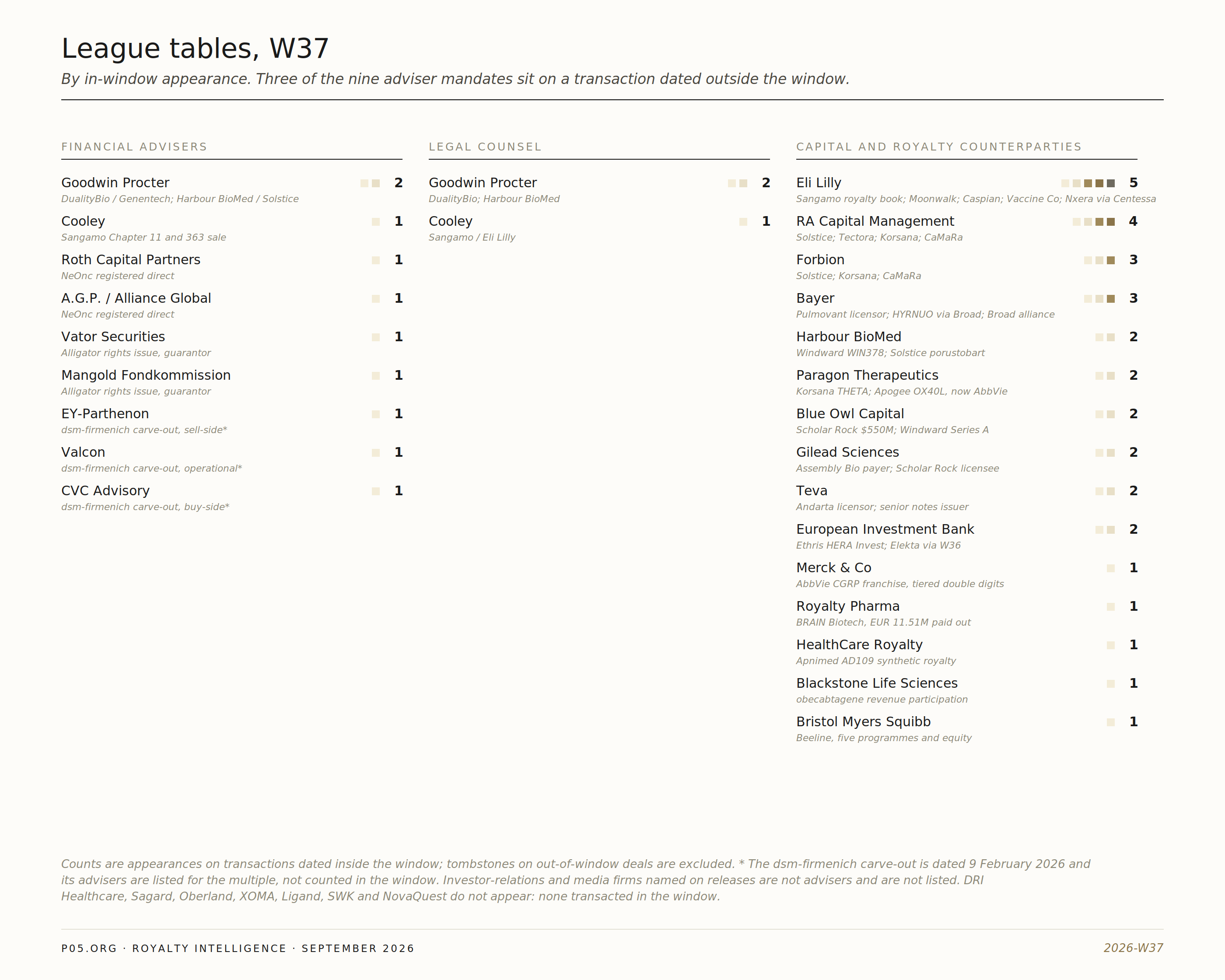
Advisers and counterparties by appearance on transactions dated 6 to 13 September. Appearances, not fee rank. Eli Lilly appears five times in four different roles.
Financial advisers and placement agents. Disclosure was thin against the transaction count. Roth Capital Partners and A.G.P./Alliance Global Partners appear as joint placement agents on NeOnc's registered direct. Vator Securities and Mangold Fondkommission appear as guarantors rather than advisers on the Alligator rights issue, at $6.0M (SEK 56.8M) between them. EY-Parthenon and Valcon advised dsm-firmenich and CVC Advisory acted buy-side on the animal nutrition carve-out, which is dated outside this window and is carried for the multiple. BNP Paribas appears in the distribution information on Teva's notes and no mandate is inferred from it. The Sangamo estate sale, the Novartis India trademark purchase, the Sernova and Seraxis merger, the Korsana closing, the PDS PIPE and every private round in this issue name no financial adviser. LifeSci Advisors appears on the PDS release as investor relations, and Meru Advisors and Sam Brown on Assembly's as investor relations and media; none of the three is an adviser and none is counted.
| Adviser | Mandates | On |
|---|---|---|
| EY-Parthenon | 1 | dsm-firmenich, sell-side (out of window) |
| Valcon | 1 | dsm-firmenich, operational (out of window) |
| CVC Advisory | 1 | CVC, buy-side (out of window) |
| Roth Capital Partners | 1 | NeOnc registered direct |
| A.G.P. / Alliance Global Partners | 1 | NeOnc registered direct |
| Vator Securities | 1 | Alligator rights issue, guarantor |
| Mangold Fondkommission | 1 | Alligator rights issue, guarantor |
Legal counsel. Goodwin Procter appears twice and on both sides of the window's structural theme: for DualityBio on the Genentech ADC collaboration, and for Harbour BioMed on the Solstice licence. It disclosed the DualityBio mandate itself and named the team of Wenseng Pan, Kevin Guan, Longfei Xu, Justin Pierce, Gozde Guckaya and Kuwabo O'Brien. Cooley acted for Sangamo on the Chapter 11 and the Section 363 sale. No counsel is identified for Genentech, for Solstice or for Lilly, and none is inferred. Counsel reported on the Korsana merger is held pending confirmation in the filings.
| Counsel | Mandates | On |
|---|---|---|
| Goodwin Procter | 2 | DualityBio / Genentech; Harbour BioMed / Solstice |
| Cooley | 1 | Sangamo Chapter 11 and 363 sale |
Capital and royalty counterparties. Eli Lilly appears five times and in four different roles: buyer of Sangamo's royalty book out of a bankruptcy estate, investor in Moonwalk and in Caspian, acquirer of Luma's Vaccine Company at up to $1.55B, and inherited payer to Nxera through Centessa. RA Capital Management appears four times and every one of them is the licensee side of a manufactured-licensor structure: lead at Solstice, co-founder at Tectora, participant at Korsana, backer of CaMaRa. Forbion three times, NEA and Novo Holdings twice each.
Harbour BioMed appears twice as licensor, on two continents, in two days. Paragon Therapeutics appears twice: as the named partner behind Korsana's platform and as the holder of a low single-digit royalty on Apogee's OX40L programme that AbbVie now pays. Merck & Co appears once and it is the largest passive position in the issue: tiered double-digit royalties on AbbVie's oral CGRP franchise, held since July 2015.
Royalty Pharma appears once, paying. HealthCare Royalty and Blackstone Life Sciences appear only through positions taken earlier and surfaced in filings this week.
| Counterparty | Appearances | Role |
|---|---|---|
| Eli Lilly | 5 | buyer of a royalty book, investor, acquirer, inherited payer |
| RA Capital Management | 4 | lead, co-founder and investor across four vehicles |
| Forbion | 3 | Solstice; Korsana; CaMaRa |
| Bayer | 3 | licensor to Pulmovant; Broad alliance behind HYRNUO; Broad partner |
| Harbour BioMed | 2 | licensor to Windward and to Solstice, ex-Greater China |
| Paragon Therapeutics | 2 | Korsana platform partner; Apogee royalty now payable by AbbVie |
| New Enterprise Associates | 2 | Tectora; CaMaRa |
| Novo Holdings | 2 | Windward; CaMaRa |
| Blue Owl Capital | 2 | $550M facility to Scholar Rock; Windward Series A |
| Gilead Sciences | 2 | payer to Assembly Bio; licensee of Scholar Rock |
| Teva | 2 | licensor to Andarta for equity; senior notes issuer |
| Goodwin Procter | 2 | counsel to DualityBio and to Harbour BioMed |
| Merck & Co | 1 | tiered double-digit royalty on AbbVie's CGRP franchise |
| Royalty Pharma | 1 | payer of the EUR 11.51M deucrictibant milestone |
| HealthCare Royalty Partners | 1 | low single-digit synthetic royalty on AD109 |
| Blackstone Life Sciences | 1 | revenue participation on obecabtagene autoleucel |
| UCL Business | 1 | academic licensor of obecabtagene autoleucel |
| Schrödinger | 1 | two programmes to Tectora for equity, milestones and royalties |
| Kelun-Biotech | 1 | 50% licensor of WIN378 |
| AbClon | 1 | direct licensor of HLX22; Alligator holds 35% of its receipts |
| European Innovation Council Fund | 1 | equity investor in Vaxdyn |
| European Investment Bank | 2 | lender to Elekta and to Ethris, no participation in either |
| Seattle Children's | 1 | licensor and investor, BrainChild Bio |
| Nant Capital | 1 | PIPE lead, right to negotiate on PDS0101 |
| Bristol Myers Squibb | 1 | licensor of five programmes to Beeline, and equity investor in it |
This Weekly Term Sheet is provided for informational purposes only. It does not constitute investment advice, an offer to sell or a solicitation of an offer to buy any security, or a recommendation regarding any investment. Data and disclosures are sourced from public company filings, press releases, and credible secondary reporting. Capital for Cures AG does not warrant the accuracy or completeness of information presented. Readers are advised to consult primary source documentation before making any investment, partnership, or commercial decision.