
After the cap: selling the royalty that comes back
A capped royalty sale conveys the first tranche of a stream. The buyer collects until a multiple, a dollar figure or a date, and the entitlement then reverts to the seller. The recourse ladder piece dealt with what sits between the buyer and the cash. This one deals with what sits after the cap: whether the reverted stream can be sold a second time, what it fetches, and how often the reversion arrives at all.
The second sale turns out to be routine. The reversion itself is rare, because the tail gets monetised before it reverts, and it goes to someone already inside the stream.
1. The reversion is an asset from the day the first deal signs
Arbutus sold its LNP royalty on Alnylam's Onpattro to OMERS in 2019 for $20M gross, with OMERS retaining the entitlement until it has received $30M, at which point 100% of the royalty reverts. Every 10-Q since has carried the same sentence: if the entitlement reverts, it has the potential to provide an active royalty stream or to be otherwise monetised again in full or in part. A platform royalty sold once is on the shelf for a second sale.
The cap comes in several forms, and the form decides what the residual is worth.
- A dollar cap. OMERS collects $30M on Arbutus and stops. Royalty Pharma's Spinraza purchase from Ionis reverts at $475M or $550M of aggregate royalties, depending on the timing and occurrence of certain events.
- A multiple with a time step. OMERS bought 54.5% of Enanta's Mavyret royalty at a 1.42x cap, through June 2032. Sagard's Jemperli purchase from AnaptysBio expires at 125% by end-2026, 135% during 2027 or 165% after, amended in 2024 to $600M by March 2031 or $675M after. HCR's Zolgensma purchase from REGENXBIO was capped at 1.3x until November 2024, rising to 1.5x on a miss. Ultragenyx's Crysvita EU sale to Royalty Pharma runs to 1.9x before end-2030, 2.5x after.
- A multiple set by early performance. OMERS bought BioCryst's Orladeyo royalty for $150M in 2021 with the cap ratcheting on a 2023 sales test, which resolved at 155.0% of the purchase price.
- An annual cap inside an aggregate cap. HCR's vadadustat purchase from Akebia carries a $13M annual cap and a $150M aggregate cap, after which the royalty interest payments revert back to the Company.
- A cap on the base. Royalty Pharma's Prevymis interest pays only on the first $300M of annual net sales; the threshold was reached in the third quarter of 2022 and RPI received no royalty on the balance of the year. That reversion resets every January.
- A partial reversion. PDL bought Depomed's diabetes royalties for $240.5M in 2013 and took everything until 2x, then a 50/50 split.
- A date. Royalty Pharma's Trelegy purchase pays 85% of ex-US royalties back to Theravance after June 30, 2029 and 85% of US royalties after December 31, 2030, whatever sales do.
Royalty Pharma's first Evrysdi purchase from PTC combined a rate and a cap: 42.933% of the royalty, terminating 60 days after the earlier of Roche's obligation ending or RPI receiving $1.3 billion. Zymeworks's Ziihera note with Royalty Pharma repays from 30% of the royalty at 1.65x through 2033 and 1.925x after, with the full royalty reverting on repayment.
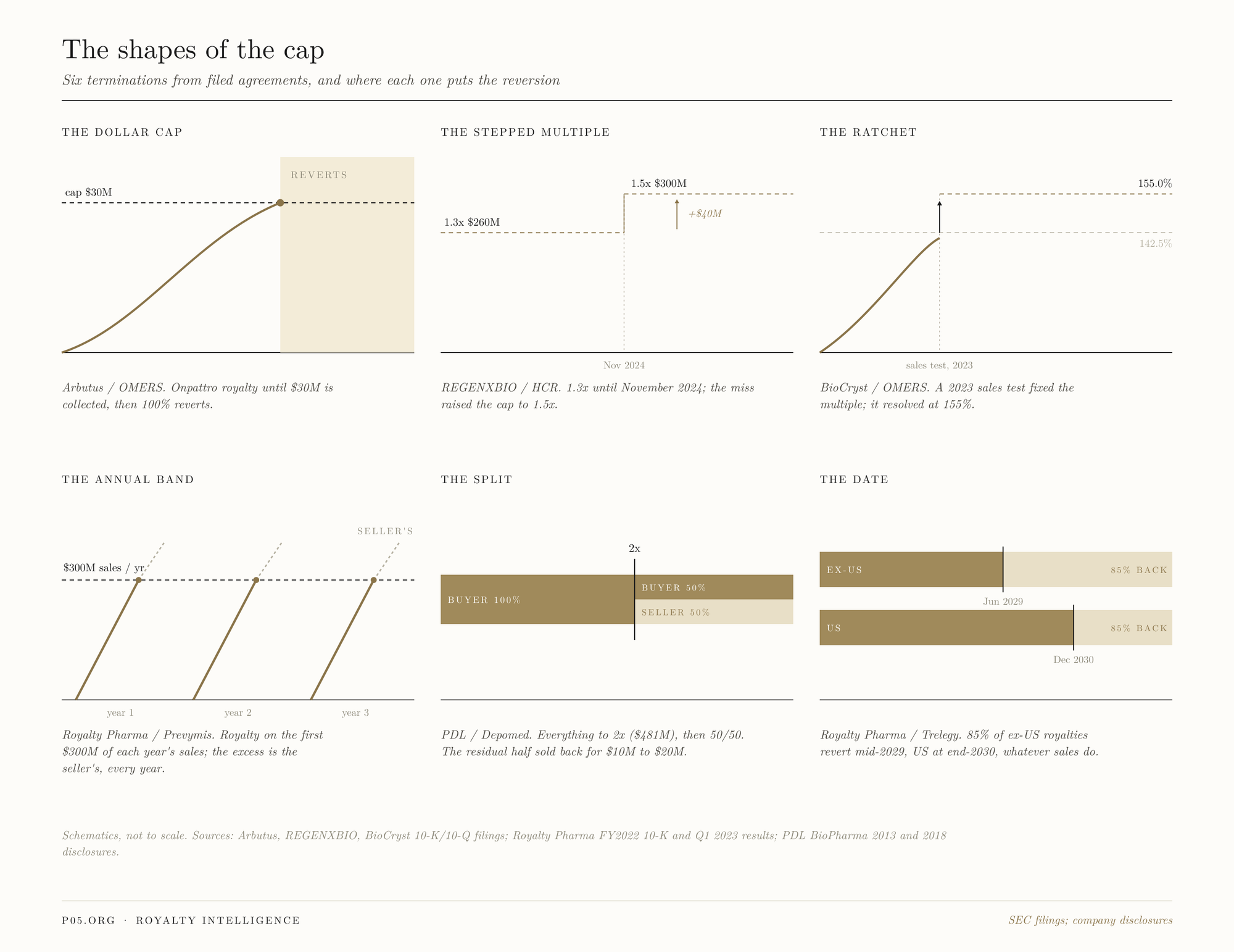
Figure 1. Six cap species from filed agreements. The dollar cap and the stepped multiple end on a payment total, the ratchet fixes its own level off early sales, the annual band resets every January, and the split and the date hand part of the stream back on a schedule the product cannot move.
In each case the purchase agreement has priced the residual by exclusion. The gap between that and a price by inclusion is where the second deal lives.
2. Can it be sold again
Yes, and the contracts anticipate it. Two provisions govern the second sale.
The first is the assignment prohibition in the original purchase agreement, backed by a security interest. Syndax's Niktimvo agreement with Royalty Pharma carries, alongside its $822.5M cap, a back-up security interest in the purchased royalties and certain product assets, and restrictions on additional indebtedness and liens on assets related to the product. A second sale of the tail needs the first buyer's waiver, and the first buyer knows it.
The security package exists because the seller-side options cut against sale treatment. A seller repurchase right is one of the factors courts weigh in recharacterising a sale as a secured loan, the line of cases running through In re Shoot the Moon, and the drafting guidance on true sales says limit or prohibit repurchase rights. The market writes the calls anyway, prices them, and papers over the tension with non-recourse language and the back-up lien.
The second is the licensor's consent right. Many licences give the paying party a negotiation window or approval over royalty assignments, and it has to be cleared twice.
Both are visible in the largest reversion sale on record. When Royalty Pharma paid the Cystic Fibrosis Foundation $3.3 billion for the Kalydeco royalty in November 2014, it was buying a stream CFFT had already sold twice in capped tranches.
The recitals to the amended and restated purchase agreement record the two prior sales, in May 2012 up to a Fixed Amount and in May 2013 up to an Additional Fixed Amount, and a Reversion Royalty of 25% of the stream once the Fixed Amount was satisfied and a second-generation corrector approved. Payments to RPI would begin on the earlier of the prior purchasers being paid out or the Reversion Royalty reverting.
Section 3.15 has the earlier purchasers waiving their assignment prohibitions. Section 3.14 has Vertex waiving its 60-day negotiation right. The $3.3 billion bought a claim that sat, on closing day, entirely behind two undisclosed buyers and a reversion condition.
So the reversion trades, and has traded at the very top of the market. What the record lacks is a trade after the reversion has occurred.
3. How often does the reversion arrive
Rarely on schedule. The cap is set against a sales forecast, and the forecast is the thing that moves.
Arbutus is the cleanest case because the cap is a dollar figure and the disclosure is quarterly. From inception through June 2026, OMERS had received $26.9M of its $30M. Non-cash royalty revenue on Onpattro was $0.4M in the first half of 2026 against $1.0M a year earlier, because Alnylam has moved the hATTR franchise onto Amvuttra, which carries no Arbutus LNP royalty.
At that run rate the cap is four or five years away, and what reverts around 2030 will be a 1.00% to 2.33% royalty on a product its owner has been retiring since 2022.
REGENXBIO shows the time step doing its work. The first cap of $260M was not achieved by November 7, 2024, so the agreement continues until HCR has received $300M. Novartis reported $1.23 billion of combined Zolgensma and Itvisma sales in 2025 and the cap was still missed. The miss cost REGENXBIO $40M of royalties it would otherwise have kept.
AnaptysBio is four and a half years in and Sagard has received $249.3M against the $600M threshold. The company's separation materials need Jemperli growing roughly 10% a quarter to clear it before the step to $675M in 2031.
BioCryst is on schedule: cumulative royalties paid and payable to OMERS were $103.4M at March 31, 2026 against the $232.5M cap, on a product still growing into its label.
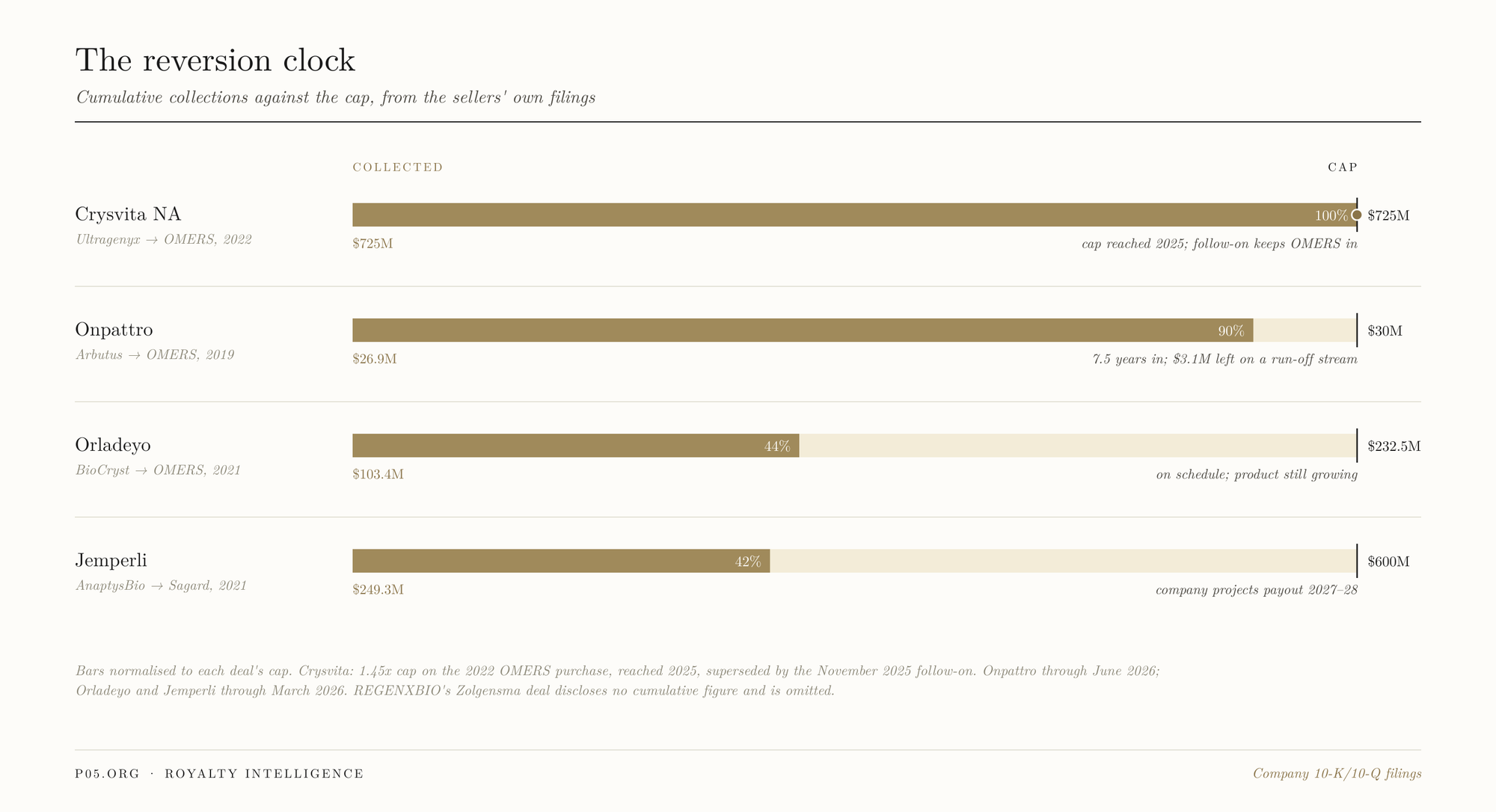
Figure 2. Progress to cap from the sellers' filings. Crysvita reached its 1.45x cap in year three; Onpattro is $3.1M short after seven and a half years; Orladeyo and Jemperli sit near 40% at the four-and-a-half-year mark.
PDL ran ahead. Glumetza royalties spiked after Valeant's 2015 price increases, and PDL had anticipated reaching the $481M milestone in 2023 but had returned more than $343M by June 2018. Generics had launched in 2016, and PDL took a $57.6M fair-value write-down the same year. The reversion was arriving early on a stream already in decline.
The pattern: the cap is reached fastest on products about to lose exclusivity, because price rises and peak-year sales front-load the buyer's recovery, and slowest on products being succeeded by the licensee's own follow-on. Neither is the product the seller modelled when it accepted the cap.
4. Where the tail goes
It is sold forward, before the reversion condition is met, and the counterparty is usually already in the stream.
PTC's second Evrysdi deal in October 2023 says so in terms. Royalty Pharma paid $1.0 billion for approximately 67% of both the outstanding 57% of the royalty and the outstanding royalty over the existing cap from the previous agreement.
The reversion was bought three years before RPI's first tranche had paid out, by the holder of the first tranche. The June 2024 amendment then priced the crossing itself: PTC holds put options, the first at $250M for 9.5112% of the royalty, increasing to 16.6667% once the 2020 cap has been met. The strike schedule states what the reversion is worth on either side of the cap.
Ultragenyx ran the same play with OMERS on Crysvita. The 2022 sale took 30% of the North America royalty for $500M against a 1.45x cap, and the $725M cap was reached in 2025. The November 2025 follow-on took a further 25% from January 2028 for $400M at 1.55x, with OMERS keeping the original 30% past the first cap. A reversion that had been earned in full was written back out of the contract, for consideration.
REGENXBIO layered debt behind its cap. Six months after the miss, it closed a limited-recourse royalty bond of up to $250M with HCR, serviced from Zolgensma and Itvisma royalties along with other licence proceeds. HCR holds the front of the stream as purchaser and the tail as lender, and the reversion, when it comes, will service the bond.
Theravance's tail went to the licensor. Having sold 85% of its Trelegy royalty to Royalty Pharma in 2022 while keeping the post-2029 and post-2030 date reversions, it sold that retained tail to GSK in June 2025 for $225M in cash, plus up to $150M of milestones still owed by RPI. GSK writes the royalty cheques and priced the tail off its own ledger.
Coherus paid to leave early. It sold a hard-capped interest in Udenyca and Loqtorzi royalties to Coduet for $37.5M in May 2024 and paid $49.1M seven months later to extinguish it, because the Udenyca divestiture to Intas could not close over the encumbrance. A 1.31x exit inside a year, priced by the divestiture.
Depomed sold its half-share reversion outright. In August 2018 PDL acquired Depomed's remaining rights for up to $20M, of which $10M was paid at signing and $10M was conditional. A stream that had returned $343M in under five years priced its post-cap residual at $10M to $20M, because the products underneath were generic by then.
AnaptysBio kept the tail and is marketing it as equity. The royalty spin-off piece covered the mechanics; the entity being separated is, at separation, a claim on everything after $600M, and Sagard collects first.
CFFT is the exception that confirms the shape. RPI was a new buyer and paid $3.3 billion, because the prior tranches were fixed amounts against a stream about to add VX-809 and VX-661, the product was Kalydeco, and the reversion condition was a regulatory approval RPI could assess. Take away any one of those and the tail goes to the incumbent at the incumbent's price.
5. Why the insiders win
Three reasons, each contractual.
The incumbent holds the consent. The assignment prohibition means the seller needs a waiver to sell the tail elsewhere, and the party granting the waiver can bid. The CFFT exhibit shows the waivers being obtained; it does not show what they cost.
The incumbent holds the information. Under a capped purchase the buyer receives the licensee's quarterly royalty reports and audit rights directly, as the CFFT agreement provides at section 2.1(a)(ii). A third-party bidder sees the seller's non-cash royalty revenue line. The incumbent sees the invoices, and knows to the dollar how far it is from payout and whether it will miss the next step.
The one counterparty with better information is the licensor, which is who bought Theravance's tail. Royalty Pharma has told its own investors that of roughly $15.5 billion of transactions announced since 2020, close to $6 billion was with repeat partners.
The result is a series of bilateral extensions: the residual is sold, lent against, deleted by a follow-on tranche or spun off, and it lands with the incumbent buyer or the licensor. The buyer taxonomy piece separated the royalty funds by where they enter a product's life. A reversion is entered from inside one.
6. How common the cap is
Gibson Dunn's survey of 133 royalty transactions totalling $32.7 billion between 2020 and 2025 finds 57% of synthetic deals capped against 28% of traditional sales, with every debt-structured synthetic in the sample capped. Medians sit near 1.9x for synthetics, in a 1.43x to 4.0x range, and near 1.65x for traditional deals, in a 1.3x to 2.5x range. In 95% of capped synthetics the entire stream reverts at the cap.
Covington's study adds the risk gradient: 52% of deals on approved products carry a cap against 13% struck pre-approval, since a buyer funding development risk demands uncapped upside. A seller buy-out or call right appears in 47% of capped deals and 5% of uncapped ones, so the reversion is usually priced twice at signing, as a boundary and as a strike.
Neither survey covers secondary trading of reversion interests, and no arm's-length sale of an already-reverted stream to a new buyer appears in the record examined here.
7. Pricing the residual
The reversion is a deferred, subordinated claim on the cash flows the first buyer is collecting. Three things follow.
The timing and the level are the same variable. Higher sales pay the buyer out sooner, which brings the reversion forward and enlarges what it reverts onto. A slower product delays it and shrinks it. The residual is long the product twice, and it has no floor: Arbutus's 10-Q states that OMERS bears the collection risk and Arbutus owes nothing on a shortfall, so the reversion is worth zero in the states where the buyer loses money.
Reata is that state from the buyer's side: Blackstone's $300M bardoxolone funding carried a security interest in substantially all of Reata's assets and minimum cumulative payments from 2025 through 2033 until an internal rate of return target, bardoxolone was discontinued in 2023, and Blackstone was left with a low single-digit royalty on Skyclarys. Akebia's $150M aggregate cap sits far above plausible Vafseo Japan royalties, so its residual is mostly notional.
The duration is longer than it looks. A conventional royalty book has, per the duration piece, a modified duration near five years. A reversion pays its first cash at the cap date, so on a stream where the cap is five years out and the patents run to year twelve, it is a seven-year annuity beginning in year five. Discounted at the seller's cost of capital, since the seller is the one holding it, the present value can be a small fraction of the face amount the 10-Q implies.
The discount rate is sitting in the seller's own footnotes. Under ASC 470 the royalty liability amortises at an imputed rate re-estimated each quarter against forecast royalties, so the disclosure is a running mark on the stream. Arbutus started near 16% in 2020 and was at approximately 1.5% by June 2026 as the stream decayed toward its cap. AnaptysBio moved from 8.1% at the end of 2023 to 30.5% at September 2025 as Jemperli forecasts rose.
Between the two sit Cytokinetics at 24.8% on the aficamten funding, BioCryst at 21.7% on its 2020 Royalty Pharma tranche against 10.1% on the OMERS tranche, Ionis at 12.4% on Spinraza and Syndax at 13.0% on Niktimvo. That is the bracket for a tail: low single digits for run-off, 10 to 14% mid-life, above 20% for early high-growth streams, and a second buyer should sit at or above the incumbent's rate because the tail carries less patent life than the tranche it sits behind.
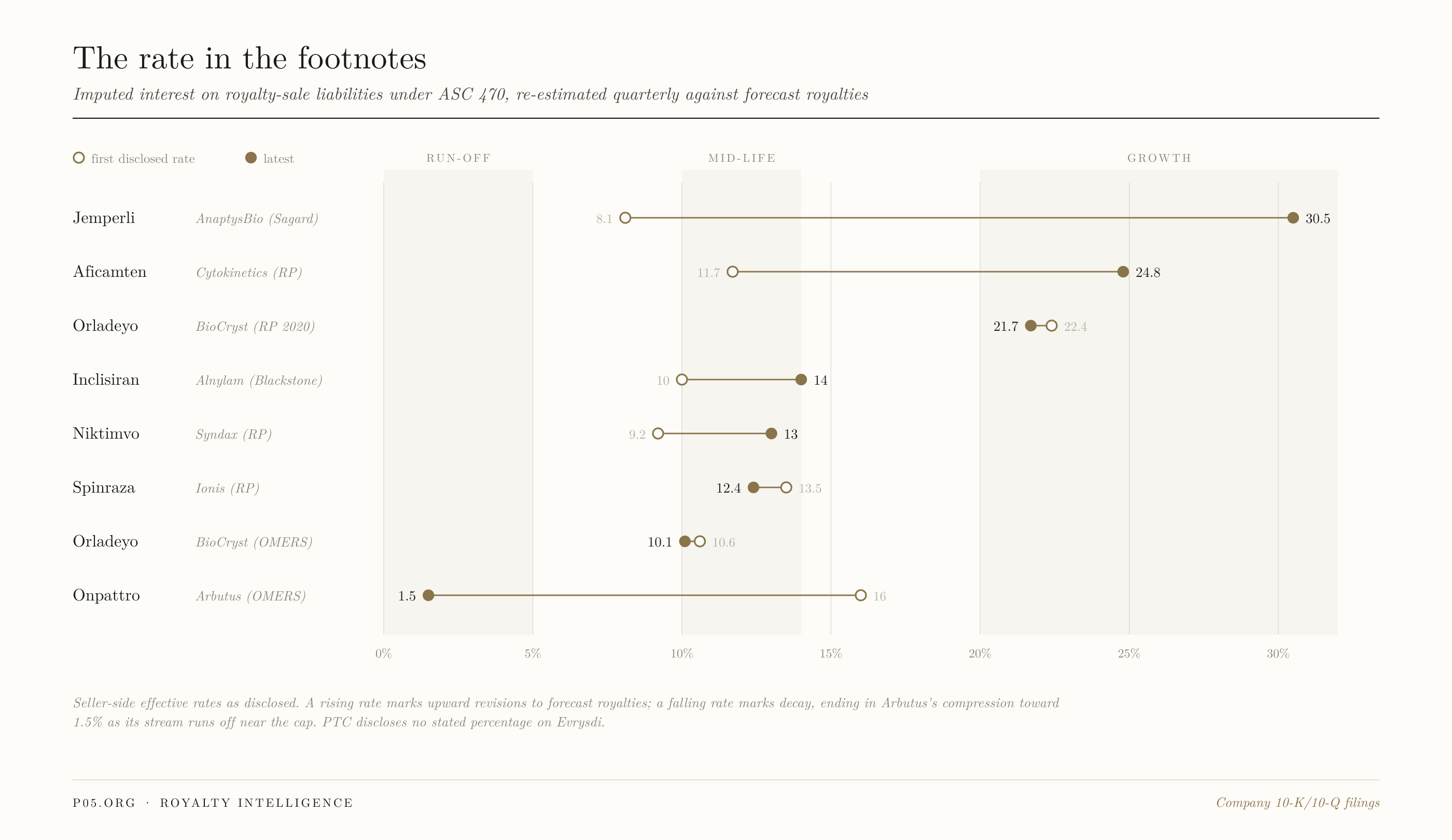
Figure 3. Imputed rates on royalty-sale liabilities. The re-estimated ASC 470 rate marks the stream each quarter, rising with upgraded forecasts and compressing toward zero as a capped stream runs off.
The tail can also die before the cap does. REGENXBIO's licensed US patents on Zolgensma expired in January 2026 with the $300M cap still unmet; quarterly royalties dropped from $18.4M to $1.8M year on year, and what remains behind the cap is an ex-US royalty in roughly 20 countries.
Berotralstat runs the other way, with US composition-of-matter protection to 2039, so BioCryst's post-cap tail holds more years than the capped tranche in front of it.
The step-up is a put the seller has written. Where the cap escalates on a missed date, the buyer holds an option to extend at a higher strike, exercised automatically by the calendar. REGENXBIO's miss converted $260M to $300M, taking $40M off the residual's face value on a single date with no change to the product. Modelling the residual at the first cap is modelling the seller's best case.
8. The open positions
Where the disclosed capped deals stand, and what option, if any, sits on each tail.
| Stream (seller / buyer) | Cap | Collected | Option on the tail | What survives the cap |
|---|---|---|---|---|
| Onpattro (Arbutus / OMERS) | $30M | $26.9M, Jun 2026 | none; automatic reversion | a run-off royalty; the licensee has moved the franchise to Amvuttra |
| Mavyret (Enanta / OMERS) | 1.42x ($284M) or 30 Jun 2032 | not disclosed | none disclosed | whatever royalty term outlives the 2032 window |
| Jemperli (AnaptysBio / Sagard) | $600M by Mar 2031, else $675M | $249.3M, Mar 2026 | seller call at a specified amount, live since 1 Dec 2024 | royalties and milestones into the 2030s; payout projected 2027 to 2028 |
| Orladeyo (BioCryst / OMERS) | 155% ($232.5M) | $103.4M, Mar 2026 | none disclosed | composition-of-matter protection to 2039 |
| Zolgensma (REGENXBIO / HCR) | $300M (1.5x after the 2024 miss) | not disclosed | none; 2025 HCR bond sits behind | ex-US royalties only; US licensed patents expired Jan 2026 |
| Crysvita NA (Ultragenyx / OMERS) | 2022: $725M, reached 2025 | full | seller repurchase of the 2025 tranche at 1.35x, to Nov 2027 | US patents 2028 to 2035 |
| Niktimvo (Syndax / RPI) | $822.5M (2.35x) | launch phase | change-of-control repurchase at the full cap | a launch-phase product with its patent life ahead of it |
| Spinraza (Ionis / RPI) | $475M or $550M, event-set | not disclosed | none disclosed | Ionis's share steps from 25% to 45% in 2028 |
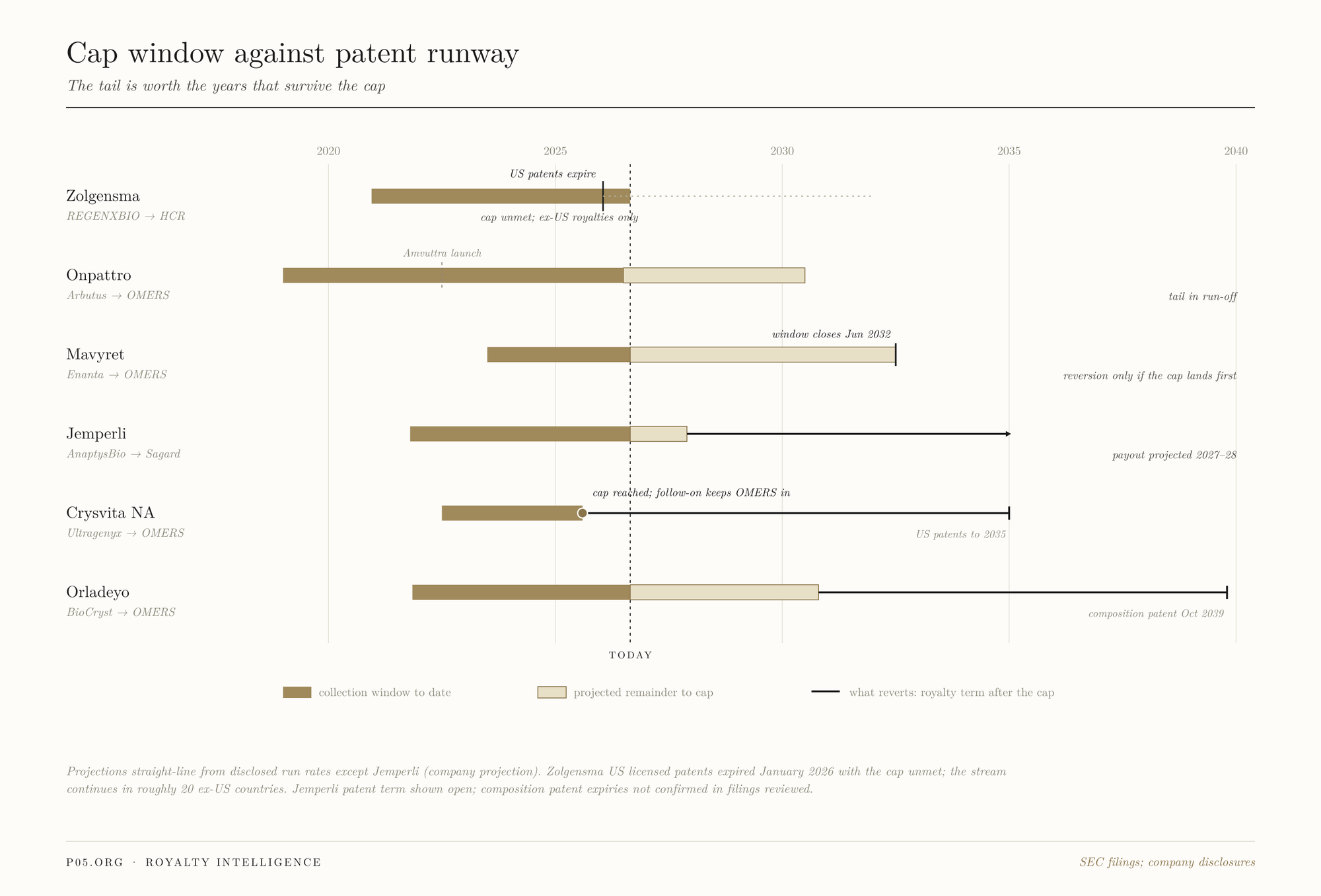
Figure 4. Collection windows against what survives them. Zolgensma's US patents ran out before the cap; Mavyret's window closes with the 2032 term; Orladeyo's tail runs to the October 2039 composition patent, years past its projected cap.
The options run on three triggers. Discretionary seller calls with a window: AnaptysBio may reacquire its interest at any time after December 1, 2024 by paying Sagard a specified amount, at its sole discretion, and Ultragenyx holds its 1.35x repurchase on the 2025 tranche until November 2027.
Event triggers, dominated by change of control: Syndax may repurchase Royalty Pharma's revenue participation right on a change of control at a repurchase price equal to the Royalty Cap, all $822.5M of it, which prices the royalty into any takeover of Syndax at 2.35x whatever remains uncollected.
PDL's Iclusig financing gave PDL a put on specified events including change of control and ARIAD a call at any time, both at pre-determined prices, with a make-whole if PDL had not recovered each tranche by its fifth anniversary. And buyer-side or seller-side options to enlarge rather than end the position: BeOne holds an option to sell Royalty Pharma an additional Imdelltra portion for up to $65M within twelve months, unexercised as of September 2025.
The runway column carries the returns. A cap crossed while composition-of-matter protection runs to 2039 hands back a tail worth underwriting; a cap still open when the US patents have already expired hands back one that is mostly geography. The Jemperli call is the live trade in the set: Sagard is at 42% of its threshold, the call has been exercisable for over a year, and the strike was fixed when the forecast was smaller.
9. What each side should ask
The seller. Is the cap a dollar figure, a multiple, a date or a sales test, and which is the product most likely to miss? Is the multiple fixed at signing or ratcheted by early performance? What will the incumbent charge to waive the assignment prohibition, and does the licensee's consent run again on a second sale?
If a call is being offered alongside the cap, does the strike schedule state the reversion's value on both sides of the crossing, as PTC's does, and does the window outlast the point where exercising it makes sense?
The first buyer. Do your information rights cover things the seller cannot share with a third party? Is there a right of first refusal on the tail, and if not, is the assignment consent doing that job? When the seller comes back with the reversion, are you pricing it as a purchaser, a lender, or the only party in the room?
The second buyer. Are you buying a reversion or a reversion condition? Is the cap aggregate, annual or on the sales base, since only the first reverts once?
Who holds the first tranche, how far are they from payout, and will they tell you? If they will not, you are buying an option on someone else's payout date, written by the party who knows it. The exception is the licensor, which prices the stream off its own ledger.
The capped sale creates a residual by construction and prices it by omission. The filings then carry that residual for years while the product moves in whichever direction the forecast missed. When it finally trades, it trades forward, to a party inside the stream, at a price the seller cannot benchmark.
Arbutus has spent the past year $3M short of its reversion on a product being retired by its own licensee. REGENXBIO missed its cap by a date and now owes the tail to a bond. PTC sold its reversion to the party it was reverting from.
Ultragenyx reached its first cap and sold a second tranche that keeps the buyer in anyway. Theravance sold its date reversion to the licensor for $225M. Depomed's fetched ten million dollars, conditionally twenty. CFFT's fetched $3.3 billion, once, with waivers from everyone.
Two of those seven got a price from outside the deal, and one of the two came from the licensor. The rest got an extension.
All information in this article was accurate as of the research date and is derived from publicly available sources including SEC filings and filed contract exhibits, company press releases and investor materials. Contract provisions cited are from the specific executed agreements filed by the named parties and are not representative of any standard form. Information may have changed since publication. This content is for informational purposes only and does not constitute investment, legal, accounting, tax, or financial advice. The author is not a lawyer, accountant, tax adviser, or financial adviser.