
Waived, not litigated: what a forbearance does to a revenue interest

On 7 October 2025, HealthCare Royalty gave Karyopharm Therapeutics a year off. The Sixth Amendment to their revenue interest financing agreement waived the company's obligation to pay royalties on revenue recognised between 1 April 2025 and 31 March 2026. The price was a permanent increase in the Applicable Tiered Percentage, from 7 per cent to 8 per cent, beginning the day the holiday ended.
A lender would call that a payment deferral priced with a rate step-up. HealthCare Royalty is not a lender. It bought a revenue interest, and the entire architecture of the instrument depends on that purchase being a sale.
Six revenue interest financings carry a multi-amendment record on EDGAR. Across them the number of amendments signals little and the consideration in each one signals a great deal. Each accommodation also answers a question the purchase agreement was drafted to foreclose: whether the buyer took the risk a purchaser takes.
Why the characterisation carries the structure
A revenue interest financing is documented as a purchase. The buyer acquires a defined percentage of future net sales; the obligor books proceeds and keeps operating. The characterisation is the point. If the transfer is a true sale, the stream is not property of the seller's estate under section 541 should the seller file, and the buyer holds an asset, not a claim.
If the transfer is recharacterised as a disguised financing, the purportedly sold asset becomes collateral, is owned by the seller, and is property of the estate, with the buyer reduced to a secured creditor inside the case.
The obligors' own accounting sits awkwardly beside the sale label. Rhythm carries a deferred royalty obligation on its balance sheet. Humacyte carried a revenue interest liability until settlement. Liquidia, on amending its agreement in September 2024, recognised a gain on extinguishment of debt of 7.2 million dollars. Accounting characterisation does not decide the legal question. It is the sort of fact a party seeking recharacterisation puts in front of a court.
One manager, three outcomes
HealthCare Royalty is the counterparty in half the set, which makes its book the cleanest available comparison. The same firm, the same instrument, three companies, three endings.
Rhythm Pharmaceuticals behaved as designed. Rhythm took a revenue interest financing on 29 June 2022 for up to 100 million dollars against IMCIVREE sales, drawn in three tranches on US approval, EMA approval and a net-sales milestone, at 11.5 per cent on the first 125 million dollars of annual net revenue stepping down to 2.5 per cent above 300 million dollars. Two amendments in four years.
The First Amendment of 27 March 2024 moved a collection account between banks and relaxed a lockbox requirement. The Second Amendment of 29 June 2026 carved out room to pay up to 21 million dollars of dividends on preferred stock. Neither touched rate or cap. The obligation stood at 106.1 million dollars at 30 June 2026 against 51.5 million dollars of cumulative payments.
Liquidia Corporation was amended repeatedly with no default waived on the record. Its agreement of 9 January 2023 for up to 100 million dollars against YUTREPIA was amended six times in twenty-six months, on 17 April 2023, 28 June 2023, 27 July 2023, 3 January 2024, 11 September 2024 and 17 March 2025. The Fifth Amendment released the final 32.5 million dollars, completing the 100 million originally contemplated, held Liquidia to a fixed payment schedule instead of converting to a tiered royalty, and extended the expected termination from 2029 to 2031 as the consideration.
The Sixth Amendment, filed with terms bracketed out under the competitive harm standard, defines the investor's IRR True-Up Payment Amount.
Karyopharm broke. The agreement of 14 September 2019 was structured as 75 million dollars up front with up to 75 million more available, tiered at 7, 2.625 and 1 per cent across revenue bands, with a hard cap at 185 per cent of the invested amount. It also carried a minimum return: if the investors had not received 0.65 times the investment amount by 31 December 2022, or 1.00 times by 31 December 2024, the company was required to make a cash payment grossing them up to those figures. Six amendments followed.
The acceleration cap tracked the company's condition, from 138.8 million dollars at signing to 249.8 million after 2021, 263.3 million after August 2023, then reset to 128.3 million in May 2024 in the same transaction that introduced a senior term loan ranking ahead of the revenue interest. In July 2025 the position was assigned to a KKR affiliate. Then the payment holiday, and after it two forbearances.
The other three
ImmunityBio runs the instrument in the opposite direction. Its agreement with Oberland Capital of 29 December 2023 drew 200 million dollars at closing and 100 million more on FDA approval of ANKTIVA, against 4.5 to 10 per cent of worldwide net sales outside China and a termination cap at 195 per cent.
The Second Amendment of 30 March 2026 added 75 million dollars, taking committed capital to 375 million and the rate range to 5.625 to 12.50 per cent. The rate went up because the buyer was buying more of a working product.
Humacyte shows an exit that never reached its own test. Its agreement with Oberland of 12 May 2023 drew 40 million dollars at closing against a 7.5 per cent royalty, and carried a mechanism intended to make renegotiation unnecessary: if cumulative payments had not reached 100 per cent of the amount funded by the end of 2028, the rate would step up automatically to whatever would have produced that return from inception, with a true-up payment for any shortfall.
The parties amended it anyway, in May 2024 and September 2025. By 15 December 2025 the structure was gone: a 50 million dollar partial call and a 22.9 million dollar settlement took the liability to zero.
BioXcel Therapeutics is the shortest history in the set. It signed paired facilities with Oaktree and the Qatar Investment Authority on 19 April 2022, a credit agreement and a revenue interest of up to 120 million dollars capped at 1.75 times invested.
A waiver came on 13 November 2023. Three weeks later the structure was terminated and folded into the credit agreement. The revenue interest lasted twenty months, and the parties resolved the question of what it was by converting it into debt themselves.
The six deals
| Obligor / counterparty | Signed | Original terms | Amendments | Position as of 13 Sep 2026 |
|---|---|---|---|---|
| Karyopharm / HealthCare Royalty, then KKR | 14 Sep 2019 | Up to $150M; 7% / 2.625% / 1%; 185% cap; minimum return 0.65x by 2022, 1.00x by 2024; second-priority security | Six, to Oct 2025; two forbearances Feb and Sep 2026 | Standstill to 15 Oct 2026; going-concern disclosure |
| Liquidia / HealthCare Royalty | 9 Jan 2023 | Up to $100M in tranches; fixed payment schedule; IRR true-up | Six, Apr 2023 to Mar 2025 | Fully funded; nothing waived |
| Rhythm / HealthCare Royalty | 29 Jun 2022 | Up to $100M; 11.5% / 7.5% / 2.5%; 185-250% cap | Two, both administrative | Performing; rate and cap untouched |
| ImmunityBio / Oberland Capital | 29 Dec 2023 | Up to $300M; 4.5-10%; 195% cap | Two; second added $75M | Scaled to $375M committed |
| BioXcel / Oaktree and QIA | 19 Apr 2022 | Up to $120M; 0.375-7.75%; 1.75x cap | Waiver Nov 2023; terminated Dec 2023 | Converted to debt by agreement |
| Humacyte / Oberland Capital | 12 May 2023 | Up to $150M; 7.5%; auto step-up and true-up by 2028 | Two, to Sep 2025 | Settled Dec 2025; liability zero |
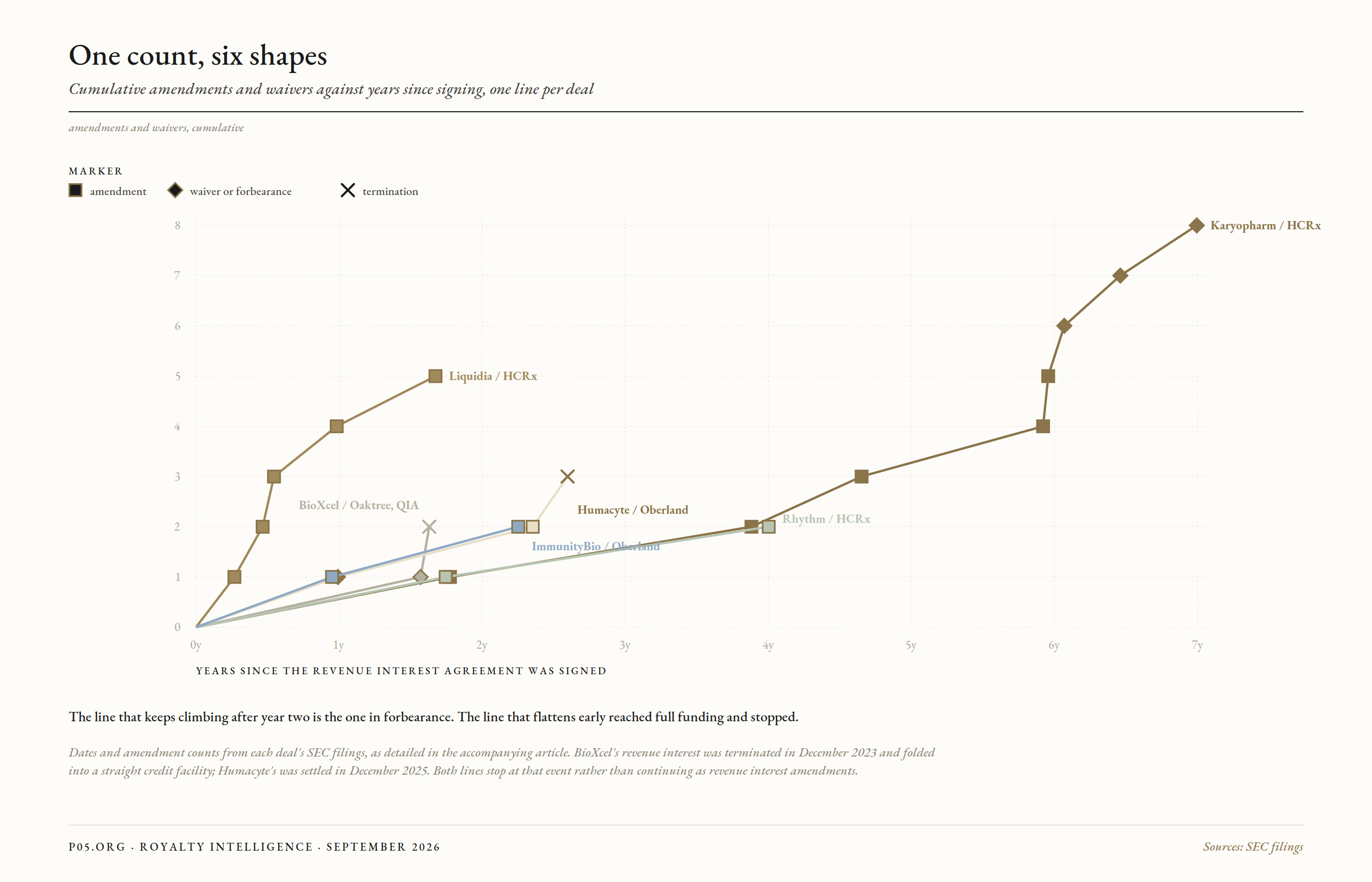
Figure 1. Cumulative amendments and waivers against years since signing, one line per deal.
What was exchanged
An earlier piece in this series proposed the amendment count as a screen a reader could run off an exhibit index in a few minutes, on the evidence of the Karyopharm sequence alone. Six deals do not support it. Liquidia and Karyopharm have each been amended six times, one without a default and one through a collapse. The count finds the file. It does not price it.
| Consideration given by the buyer | Consideration taken by the buyer | Deal |
|---|---|---|
| Twelve-month royalty holiday | Permanent rate increase, 7% to 8% | Karyopharm, Oct 2025 |
| $75M of new capital | Rate range raised to 5.625-12.50% | ImmunityBio, Mar 2026 |
| Final $32.5M tranche released | Termination extended 2029 to 2031 | Liquidia, Sep 2024 |
| Covenant waiver | Structure terminated three weeks later | BioXcel, Nov-Dec 2023 |
| Lockbox relaxed, dividend carve-out | Nothing | Rhythm, 2024 and 2026 |
| Early exit from the position | $50M call plus $22.9M settlement | Humacyte, Dec 2025 |
A buyer who gives time and takes rate is repricing a position it expects to struggle. A buyer who gives capital and takes rate is buying more of something working. A buyer who gives nothing and takes nothing has a position that needs no attention.
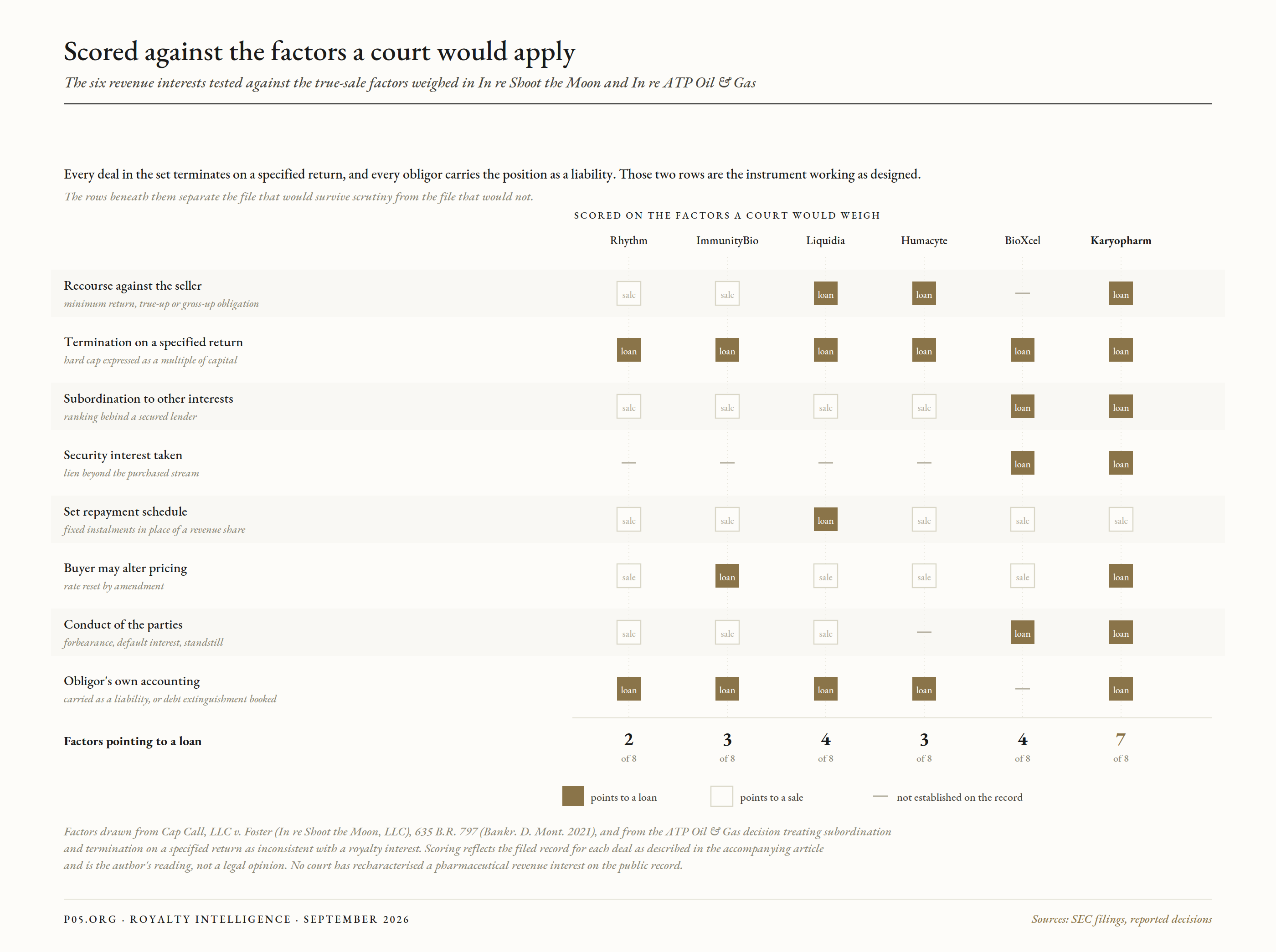
Figure 2. The six revenue interests scored against the true-sale factors a court would weigh.
The conduct of the parties
What a buyer gives in an amendment is also a legal record, and the body of law it speaks to did not develop in pharmaceutical royalties.
Courts assessing whether a purported sale of future receipts is a true sale or a disguised loan apply a multi-factor test. In Cap Call, LLC v. Foster (In re Shoot the Moon, LLC), 635 B.R. 797 (Bankr. D. Mont. 2021), the court worked through eight: whether the buyer has recourse against the seller; whether the seller continues to service and commingles receipts; whether the buyer independently investigated the account debtor; whether the seller has a right to excess collections; whether the seller retains a repurchase option; whether the buyer can unilaterally alter pricing; whether the seller can compromise the underlying asset; and the language of the agreement together with the conduct of the parties.
The court held the transactions were secured loans notwithstanding contractual language stating they were not intended as loans.
One consideration unites the factors. As the court put it, a sale occurs when the risk of loss from the purchased assets passes to the buyer; in a disguised loan the seller remains exposed. Commentary on the decision notes that it was the conduct of the parties that revealed a debtor-creditor relationship, whatever the documents called it.
Among the facts weighing toward a loan was that the financier took a perfected security interest in substantially all of the debtors' assets, well beyond the receivables purchased.
The closer precedent on a royalty is older. In the ATP Oil & Gas bankruptcy, a Texas bankruptcy court held that term overriding royalty interests could be recharacterised as debt, and identified two features as pointing that way: subordination of the interest to other interests, and termination of the interest upon a specified return on investment.
Both of those are standard revenue interest terms. Every deal in this dataset terminates on a specified return: 185 per cent at Karyopharm and Rhythm, 195 per cent at ImmunityBio, 1.75 times at BioXcel. Karyopharm's revenue interest is subordinated by construction, secured by a second-priority interest in selinexor assets behind a first-priority term loan.
On the risk-allocation question the set divides badly. Karyopharm's 2019 agreement required the company to make a cash payment if the investors had not reached 0.65 times by the end of 2022 and 1.00 times by the end of 2024, which places the risk of underperformance on the seller. Humacyte's automatic step-up and true-up did the same by formula.
Liquidia's Sixth Amendment of 17 March 2025 defines an IRR True-Up Payment Amount, being what the investor would need to receive to yield a stated internal rate of return on the amount invested, on a deal already running to a fixed payment schedule. Rhythm is the only deal in the set carrying no top-up mechanism this research identified.
Then the conduct. Karyopharm's revenue interest holder appears as a consenting party in a forbearance agreement of 27 February 2026 alongside every term lender and noteholder, and again in a second forbearance of 10 September 2026 after the company failed to pay a 15.8 million dollar term loan instalment. The 2026 forbearances waive nothing.
They restrain remedies for a defined period while the overdue amounts stay overdue and accrue interest at the default rate, and the consideration was 20 million dollars satisfied in convertible perpetual preferred stock. The second runs to 15 October 2026, and Karyopharm has disclosed that its liquidity funds operations only to that date, after which it expects it would be unable to continue as a going concern absent new capital or a strategic transaction. A holder doing all of that is behaving as a creditor and creating the record that says so.
No court has recharacterised a pharmaceutical revenue interest on the public record. The factors above are imported from merchant cash advance and oil and gas cases, and a court could distinguish them. What the filings establish is narrower: the factors a court would apply are known, the amendment record speaks to several of them, and the parties are writing that record in real time.
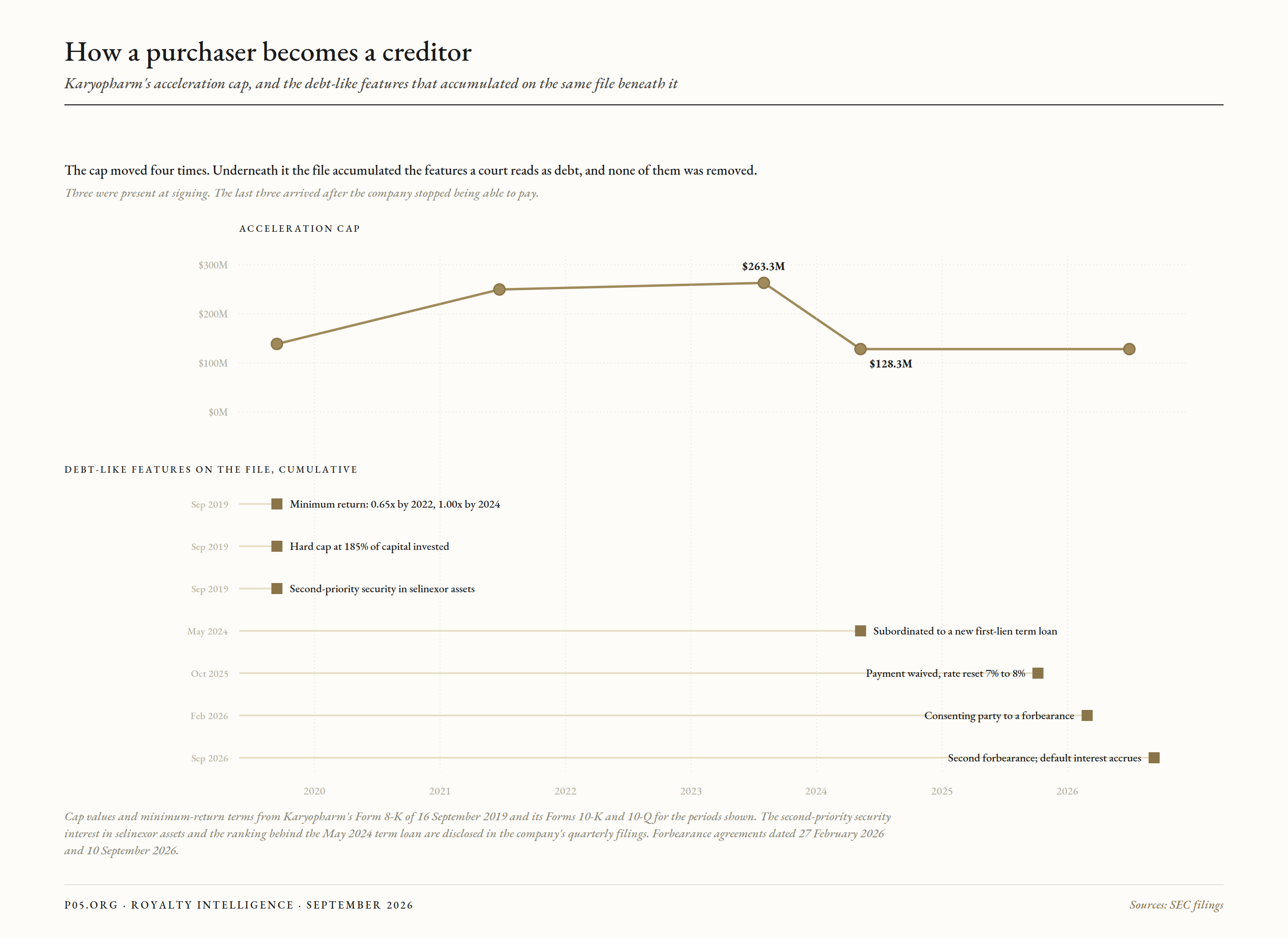
Figure 3. Karyopharm's acceleration cap, and the debt-like features that accumulated on the same file beneath it.
What recharacterisation would cost
If a revenue interest were recharacterised in the seller's bankruptcy, the consequences are not marginal. The stream becomes property of the estate under section 541 and is subject to the automatic stay, so collections stop on the petition date. The buyer holds a secured claim to the extent of its collateral and an unsecured deficiency claim beyond it, in place of owning the asset outright.
The hard cap ceases to be an entitlement and becomes a claim amount to be allowed, subordinated or crammed down under a plan. Payments received in the preference period become candidates for avoidance. And the usury exposure that follows recharacterisation in the merchant cash advance line of cases is a live question wherever the implied rate is high.
Where this leaves a desk
Count amendments to find the file, then read the consideration to price it. The count identifies positions worth examining and ranks them badly, as the Liquidia and Karyopharm sequences show at six amendments each. What the buyer gave in each amendment is the part that carries information, and it sits in the same exhibit.
Treat the amendment file as recharacterisation evidence, because a debtor's counsel will. Under the Shoot the Moon factors the language of the agreement is one item on a list of eight, and the conduct of the parties sits in the same item. A sequence of accommodations documents a relationship that adjusts for the seller's inability to pay, which is what lenders do.
Underwrite the top-up mechanisms as the thing that decides the characterisation. A minimum return, a true-up, an automatic rate step-up to a guaranteed multiple: each of these keeps the risk of underperformance with the seller, and risk allocation is the consideration the Montana court said unites the factors.
The protections that make a revenue interest financeable are the same protections that make it look like a loan.
Read a forbearance as a change in what you hold, not a pause. A waiver adjusts the contract. A forbearance suspends remedies while the default stands and default interest runs. Once the holder is signing standstills alongside term lenders and taking fee consideration in preferred stock, the position is being administered as credit whatever the purchase agreement calls it.
Ask what the obligor's accounts call it. A deferred royalty obligation carried as a liability at an effective interest rate, or a gain on extinguishment of debt recognised on an amendment, is the counterparty's own characterisation. It does not decide the legal question and it is admissible on it.
For a secondary buyer, diligence the cap against the estate, not against the model. A cap is an entitlement if the transfer was a sale and a claim amount if it was not. The difference is worth more than the rate, and it is determined by documents and conduct that accumulated before the position was offered.
All information in this report was accurate as of the research date and is derived from publicly available sources including court opinions, regulatory guidance, academic literature, SEC filings, and financial news reporting. Information may have changed since publication. This content is for informational purposes only and does not constitute investment, legal, or financial advice. The author is not a lawyer or financial adviser.