
The Weekly Term Sheet (2026-W39)
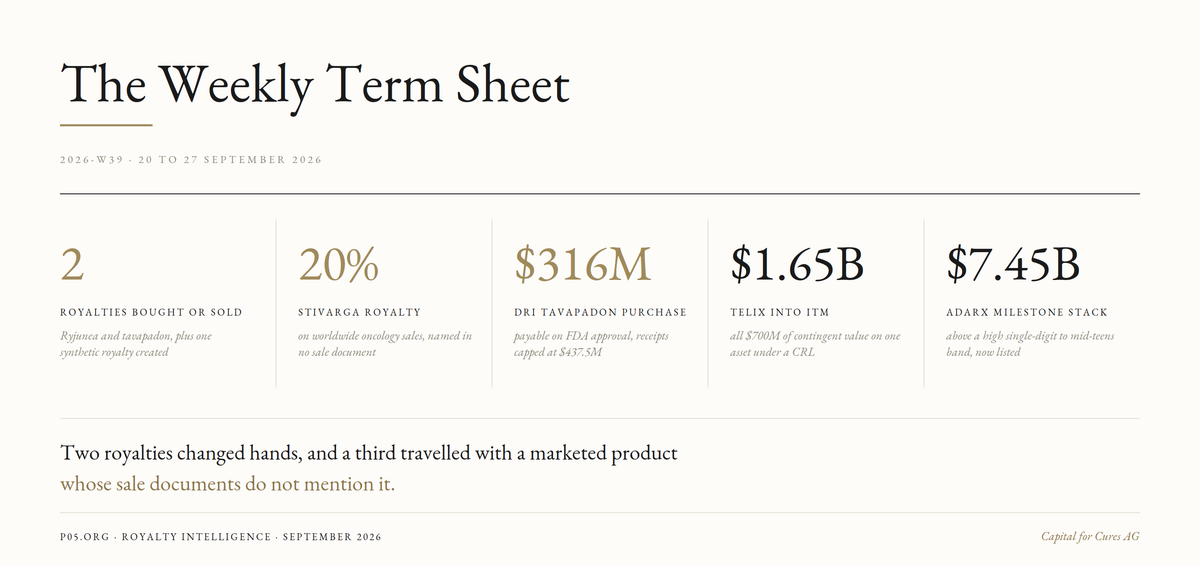
Two royalties changed hands this week and a third travelled with a marketed product whose sale documents do not mention it.
Bayer is selling Stivarga to Grünenthal for up to $436.05M (EUR 375M), global rights on a product approved in more than ninety markets that did $393M (EUR 338M) of net sales in 2025. Regorafenib carries a 20% royalty on worldwide net sales in human oncology, created in an October 2011 settlement with Onyx Pharmaceuticals, acquired by Amgen with Onyx in 2013, and stated in identical terms in three separate filings.
Neither company's announcement refers to it. The royalty term is redacted in the filed contract, and no document says who bears the obligation after closing.
DRI Healthcare agreed to pay $316M for royalty participation rights in US net sales of tavapadon, from the two funds that created the position in 2021. The 2021 facility caps total repayments at $531.3M and the 2026 purchase caps DRI's receipts at $437.5M.
Nothing has ever been paid against the earlier ceiling. The $93.8M difference is almost exactly the first half of the $187.5M approval milestone, the tranche falling due within thirty days of approval.
Ligand paid $23M to Sydnexis for a tiered low-double-digit to high-teens royalty on Ryjunea in EMEA. The 2021 licence that created that rate disclosed no upfront, no milestone total and no royalty.
The band entered the public record in the document announcing the sale.
Roche and Ionis reported a Phase 3 hit on sefaxersen in IgA nephropathy. Ionis's annual report puts the rate at tiered royalties from the high teens to 20 per cent of net sales.
Roche runs and funds the programme in full.
Two of the week's financings sit on unpriced obligations. ViferaXS took up to $14.0M (EUR 12M) into a Phase II and owns none of the patents behind its lead asset, which sit with a founder personally and with Immatics.
And ADARx priced an upsized $446.3M offering on a registration statement disclosing $7.45bn of contingent milestones from AbbVie above a high single-digit to mid-teens band, with AbbVie itself taking up to $100M of the company alongside it.
Variant Bio expanded a Boehringer Ingelheim collaboration for over $250M in licence and milestone payments, disclosing no royalty of its own, and has committed since 2020 to pay 4% of total net revenue and 4% of equity value to the communities whose genetic data built its platform. Its revenue definition expressly captures upfronts, milestones and running royalties.
It is the only percentage published anywhere in these eight days that is payable to a non-commercial claimant.
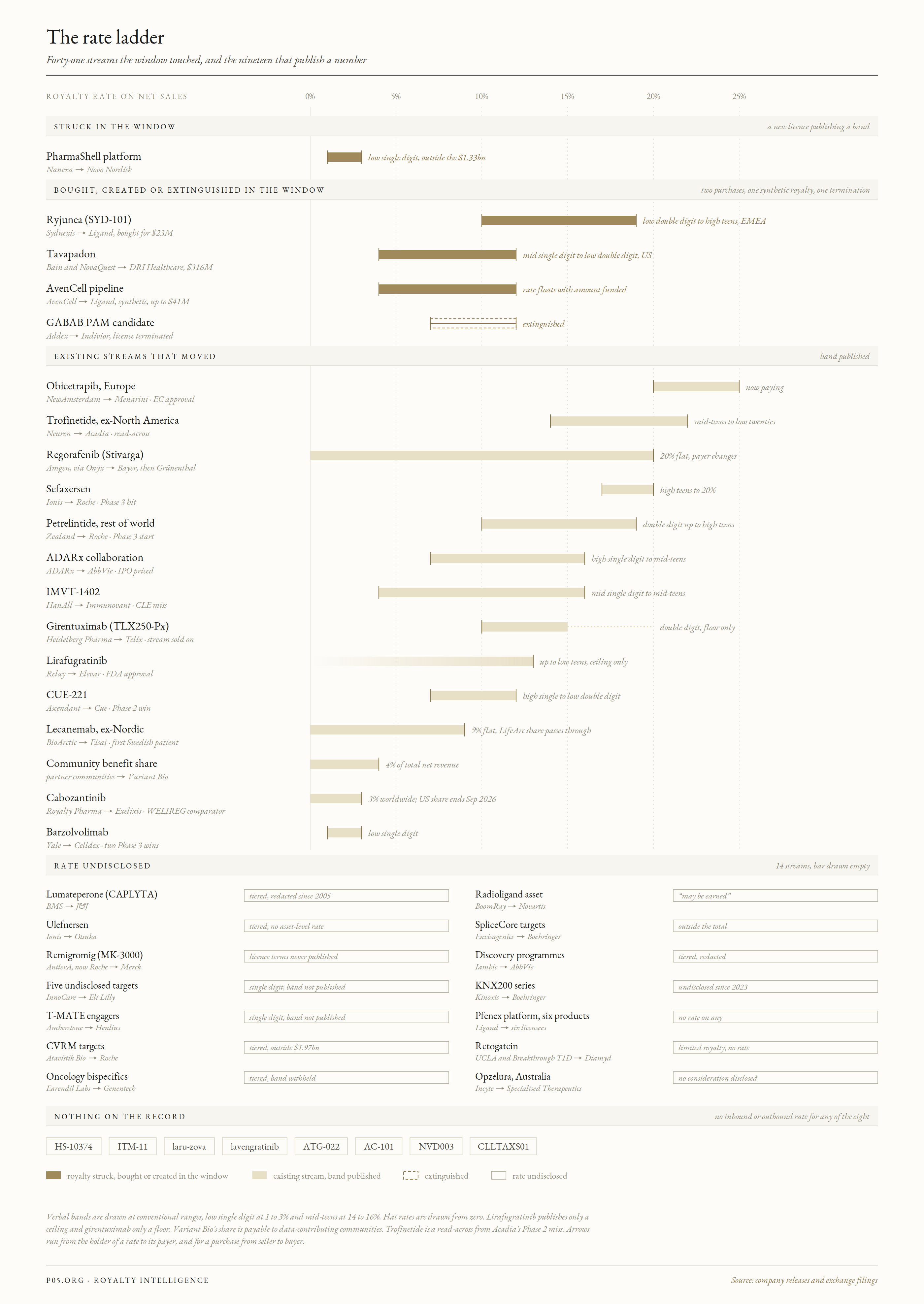
Streams touched by the window, grouped by how each reached the ladder. Nanexa's licence to Novo Nordisk is the one new band struck. Ryjunea and tavapadon changed hands, AvenCell's pipeline royalty was created and Addex's GABAB band was extinguished. Fourteen further streams publish a band, including the cabozantinib royalty that WELIREG's approval was won against, fourteen publish none and eight assets have nothing on the record. Verbal bands are drawn at conventional ranges and flat rates from zero.
Currency note: figures are converted to US dollars with the original in brackets, at approximately EUR 0.86, SEK 9.50, NOK 10.30, CHF 0.885, DKK 6.40, GBP 0.74, JPY 146, KRW 1,370, CNY 7.10, AUD 1.41 and INR 88 per US dollar, being September 2026 rates. Where a source published its own conversion, that figure is used. The Telix consideration uses the company's own stated AUD/USD rate of 0.71.
Highlights
Royalty events: 9, two of them outright purchases, one a newly created portfolio-wide synthetic royalty, one a royalty-like instrument created at closing, one a tiered band switched into payment by an FDA approval and one a published band extinguished by a licence termination. Ligand buys a published low-double-digit to high-teens band on an approved paediatric myopia drug for $23M, from a licensor whose own 2021 licence disclosed no rate at all.
Bayer sells a marketed oncology product to Grünenthal for up to $436M and neither party's announcement mentions the 20% royalty on its worldwide oncology sales. A scrip acquisition puts a Blue Owl facility secured on the acquired process patent inside the buyer's perimeter.
A Phase 2 beats an active comparator on a stream whose band is published. DRI Healthcare buys a royalty created in a 2021 non-dilutive financing, from the two funds that created it, ahead of the approval that triggers payment.
And Addex takes back a candidate carrying a published high single-digit to low double-digit band, because its licensee's parent is being acquired.
M&A and restructuring: 5. One is a $929M all-cash acquisition of a company whose principal royalty had already been sold twice, carrying a non-transferable CVR over a discontinued asset.
One is a scrip acquisition whose contingent consideration is a milestone earn-out on a single asset. One is a completed Nordic debt restructuring that hands bondholders majority control.
The two small ones sit at opposite ends of disclosure: Arcturus names no consideration for myNEO at any level, and Lexeo files every limb of its Mantle acquisition, whose $13.0M of development and regulatory milestones is larger than its $8.3M upfront.
Licence-outs and asset acquisitions: 10, and not one publishes a rate to its counterparty. Three characterise it as single-digit and stop there, two call it tiered and stop there, and one publishes a rate to somebody else.
Regulatory: 8, and one puts a European royalty stream into force on a licence signed in 2022.
Clinical: 18, of which fifteen are readouts, two are first dosings and one is the initiation of three registrational trials at once. Two of the readouts are failures and one narrowly missed its primary endpoint.
Seven sit on royalty-bearing licences.
Structured capital: 3, and one of them is new: the window's only synthetic royalty, struck on 24 September. Private funding: 11. Public capital and debt: 7 confirmed and one in progress, six of them Nordic and one a US convertible, alongside four US pricings pending closing, one of them the largest of the window, and one registration statement carrying no price range.
Not one of the seven carries a royalty, a revenue share or a milestone-linked repayment. Capital formation: 1 announcement covering two funds, one committed and one agreed. Animal health: 0. Crops and seeds: 0. Priority review vouchers: 0 issued, 0 sold, 1 anticipated, Novadip on NVD003, against a marketing authorisation targeted for 2028.
The EDGAR record for the window. A full-text search of filings dated 20 to 26 September returns nothing for synthetic royalty or royalty-backed.
Royalty purchase agreement returns AnaptysBio's 10-KT and a metals royalty company's F-1, and royalty monetization returns AnaptysBio alone. Priority review voucher returns Rezolute's 10-K of 24 September, which describes eligibility on a future BLA and no voucher.
Revenue interest returns only real-estate, energy and mineral filings. Of 58 8-K and 6-K filings dated 23 to 26 September that mention royalty, three healthcare filings create or trigger a term inside the window: Ligand's AvenCell 8-K, and the Zymeworks and Theravance 8-Ks carrying the ampreloxetine CVR.
Nanobiotix, Quantum Biopharma and QTREX restate existing positions (EDGAR full-text search).
Rate disclosure across the window: three hard numbers, thirteen bands, three of them disclosed only because a company was raising money, four rates redacted in the contract itself, ten transactions naming a total and no rate at any level, five of those characterising it without a band, and eight assets with nothing on the record. Bayer pays 20% of worldwide net sales of regorafenib in human oncology, stated in identical terms in Onyx's 2011 8-K, in the filed contract and in Amgen's FY2013 10-K. The royalty term, any cap and any step-down are redacted, and Onyx's narrative describes the term only as running until royalties cease.
Three transactions by tracked royalty buyers inside the window, from two names: DRI Healthcare on 21 September, and Ligand twice, buying a published band on 22 September and creating a synthetic royalty on 24 September. Royalty Pharma's most recent transaction remains the Zealand rusfertide funding agreement of 12 August, and this is the month its US cabozantinib royalty ends: "the royalty on U.S. sales of cabozantinib products is expected to expire in September 2026 with the final royalty payment in the fourth quarter of 2026" (Royalty Pharma).
Halozyme issued no press release in the window. Its one filing is the 22 September closing of $1.5bn of 1.50% convertible senior notes due 2033 (Halozyme 8-K).
Zymeworks, which said in November 2025 it was becoming "a royalty-driven organization", closed a $929M whole-company acquisition in the window; in March 2026 it sold 30% of its Ziihera royalties into a $250M note with Royalty Pharma.
Open in the remainder of the window. The BioMarin and Ascendis definitive agreement has not appeared, and its own deadline fell inside this window and passed.
BioMarin's 8-K records a binding term sheet executed 30 August, under which the parties were to negotiate and execute the final settlement and licence agreement by 24 September (BioMarin 8-K). The term sheet already carries the economics: Ascendis pays BioMarin 20% of annual net sales of licensed products in the United States and 18% in the European Union, Brazil and South Korea, from first commercial sale in each territory and running through May 2030, with no upfront and no milestones disclosed, against dismissal of the ITC investigation and of all claims in Brazil, Denmark, Germany, South Korea and the Northern District of California.
The definitive document is late, and the rates do not depend on it: the 8-K provides that if no agreement is executed by 24 September, "all provisions in the Term Sheet will continue to be binding on the parties." Two of the highest headline royalty rates on the public record are already fixed by a term sheet, and as of 26 September neither company has filed anything since: BioMarin's last filing is 15 September, Ascendis's 14 September.
The two sides do not even state the end date the same way, BioMarin's 8-K saying "until May 2030" and Ascendis's release "through May 20, 2030".
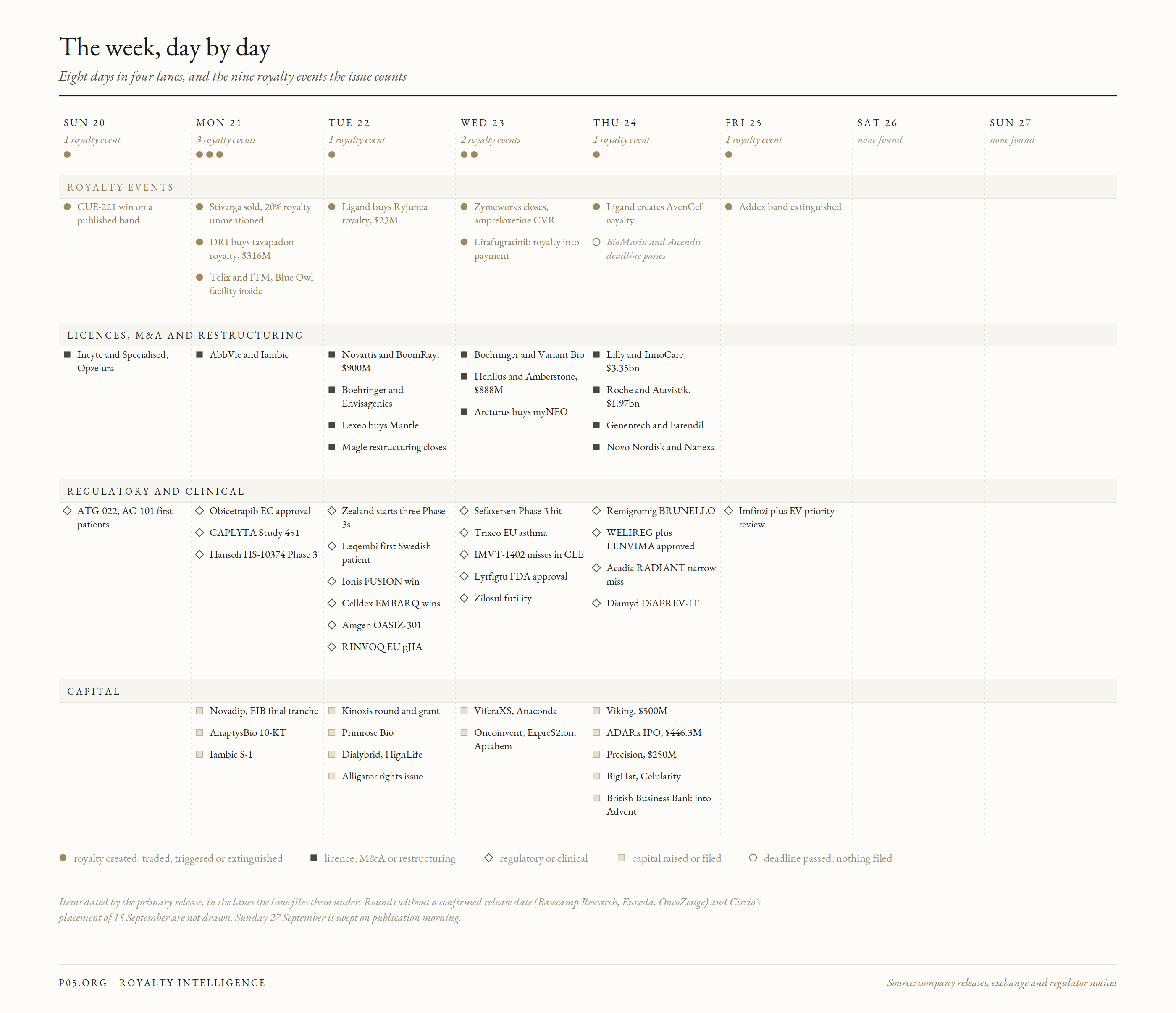
The window day by day, dated by primary release and filed in four lanes. The nine royalty events are drawn in gold; the BioMarin and Ascendis deadline of 24 September passed with nothing filed.
M&A and Restructuring
Zymeworks / Theravance Biopharma / Royalty Pharma / GSK: A Royalty-Driven Buyer Acquires a Company Whose Royalty Was Already Sold Twice (Wed Sep 23)
Zymeworks completed its $929M all-cash acquisition of Theravance Biopharma (Zymeworks). What it bought on TRELEGY is not a royalty but the residue of two disposals: a milestone entitlement payable by Royalty Pharma.
The contingent value right issued at closing sits on a different asset entirely, one whose Phase 3 has been discontinued.
- The transaction: $17.00 per share in cash, an equity value of approximately $929M, a 22% premium to the 3 March 2026 close and 10% to the volume-weighted average price since. Announced 29 June 2026, closed 23 September 2026.Financed in part by $350M of non-recourse capital from OMERS Life Sciences (Theravance 8-K), issued at closing as 8.25% senior secured notes due 2036 by Clover Finance to OCM IP Healthcare Portfolio LP (Zymeworks 8-K)
- The CVR, and it is not on TRELEGY: the agreement executed 22 September 2026 defines the CVR Product as "any therapeutic product that contains ampreloxetine". Holders receive 80% of net proceeds from any future licence, divestiture or other monetisation of ampreloxetine over ten years, a first-commercial-sale milestone of $0.93 per CVR in "the United States, United Kingdom, Spain, France, Germany and Italy", and 10% of aggregate net sales.It expires ten years after closing (CVR Agreement)
- And it cannot be traded: "The CVRs may not be sold, assigned, transferred, pledged, encumbered, or in any other manner transferred or disposed of, in whole or in part, other than through a Permitted Transfer. Any attempted sale... shall be void ab initio and of no effect." Computershare is rights agent
- The asset underneath it: ampreloxetine's Phase 3 CYPRESS trial in neurogenic orthostatic hypotension in multiple system atrophy has been discontinued. Royalty Pharma holds a $15M regulatory milestone and a low- to mid-single-digit royalty on worldwide sales of it, taken as a side term in 2022
- Chain of title on TRELEGY, first disposal: in July 2022 Royalty Pharma bought "all of the equity interests in Theravance Respiratory Company, LLC" for $1.31bn plus up to $300M in sales milestones. Theravance took approximately $1.1bn; Innoviva took approximately $282M for a 15% economic stake.GSK pays "an upward tiering royalty of 6.5% to 10% on annual worldwide Trelegy sales". Royalty Pharma acquired 85% of ex-US royalties after 30 June 2029 and 85% of US royalties after 31 December 2030 (Royalty Pharma)
- Second disposal: on 2 June 2025 Theravance sold its "remaining royalty interest in net sales of Trelegy Ellipta" to GSK for $225M cash, retaining only "rights to up to $150 million in milestones from Royalty Pharma on Trelegy Ellipta net sales in 2025 and 2026" (Theravance)
- What Zymeworks actually acquired on TRELEGY: those milestones. $50M was triggered by FY2025 global net sales of roughly $3.9bn and received in February 2026. $100M requires FY2026 net sales of roughly $3.5bn, against roughly $1.0bn reported by GSK in the second quarter, and Zymeworks expects it in the first quarter of 2027.The payer is Royalty Pharma, not GSK, and the entitlement is capped at $150M
- The other commercial asset: YUPELRI (revefenacin), on which "Viatris is leading the commercialization... under a profit and loss sharing arrangement (65% to Viatris; 35% to the Company)" in the United States, a tiered ex-US royalty "ranging from low double-digits to mid-teens", and "tiered royalties ranging from 14% to 20% on net sales of nebulized revefenacin" in the China region. US net sales were $70.7M in the second quarter of 2026; Zymeworks puts the asset at approximately $60M of annualised cash flow
- The buyer's own position: Zymeworks stated in November 2025 that it had "made the strategic decision to evolve from a traditional biotechnology company into a royalty-driven organization differentiated by in-house R&D capabilities". In March 2026 it sold 30% of its worldwide tiered Ziihera royalties from Jazz and BeOne into a $250M non-recourse royalty-backed note with Royalty Pharma, capped at 1.65x to 31 December 2033 and 1.925x thereafter.It is a Royalty Pharma counterparty on both sides of this issue
- The ladder, from Theravance's own filings: the 2022 "$1.5bn" was $1.1bn upfront, up to $250M of sales milestones for 2023 to 2026, and roughly $200M of retained outer-year royalties (Theravance 8-K, 13 Jul 2022). $50M was paid for each of 2024 and 2025, and $100M remains for 2026 (Theravance, 10 Aug 2026); the FY2023 results put the remaining entitlement at $200M, so nothing was earned for 2023.Royalty Pharma's $1.31bn and $300M are its own figures, and no filing reconciles them to Theravance's. Zymeworks discusses final deal details on 28 September, after the window closes
- Instrument: a contingent value right over ampreloxetine, non-transferable, carrying 10% of net sales and 80% of monetisation proceeds for ten years
- Royalty read-through: a self-described royalty-driven acquirer paid $929M for a company whose headline royalty it does not receive. TRELEGY's economics now sit with Royalty Pharma and GSK; what transferred is a capped $150M milestone entitlement, $100M of it still outstanding and payable by a royalty fund rather than the marketer.The genuine streams in the transaction are YUPELRI's profit share and its two published royalty bands. The CVR is the window's only newly created royalty-like instrument, and it is written over an asset whose pivotal trial was stopped
British Business Bank / Advent Life Sciences: $182M (£135M) of State Capital Into Two Funds, and Only $101M (£75M) of It Is Closed (Thu Sep 24)
The British Business Bank agreed to commit up to $182M (£135M) to two new Advent Life Sciences funds (British Business Bank). The two halves are not in the same state, and the headline total counts money that has not yet been committed.
- The split, verbatim: "The British Business Bank has agreed to commit £60m to Advent Life Sciences Fund IV and committed £75m to Advent Life Sciences Growth Fund, bringing its total commitment across these two strategies to £135 million." The headline says "agrees to commit up to £135m"
- What that means: the $101M (£75M) to the Growth Fund is committed, past tense, and the Bank's own fund page records it as having "completed full British Business Bank due diligence and received Investment Committee approval". The $81.1M (£60M) to Fund IV is agreed, not committed. No conditions precedent, no signing date and no longstop are disclosed
- The Growth Fund: target $270M (£200M) to $405M (£300M), an on-shore English limited partnership, managed from London, focused "mainly on the UK market, supporting companies progressing through clinical development as well as the commercial scale-up of non-therapeutic assets with initial market traction". It is listed as open to investors and no first or final close has been announced (British Business Bank)
- Fund IV: will "support the development of early-stage companies developing products addressing significant clinical needs across the full breadth of the healthcare and life sciences sector". No target size is published anywhere, and no close has been announced
- Who else is in: no other limited partner is named for either fund. Advent has published no release of its own
- The relationship: "The Bank has been a close partner of Advent since 2019 having made a commitment to Advent Life Sciences Fund III." It co-invested alongside Advent into Proximie in 2022 and Cyted Health in 2025
- The running total: "more than £745m across 17 life sciences funds", which the release states includes agreed commitments, so it counts the $81.1M (£60M) that has not closed. Those commitments are said to have "collectively leveraged over £3bn from private sector investors"
- The ownership: British Business Bank plc is wholly owned by HM Government, with the shareholding held by the Department for Business and Trade, and British Patient Capital Limited is its wholly owned commercial subsidiary
- Instrument: ordinary limited partnership commitments. No revenue-linked, royalty-linked or turnover-linked return feature, no preferential return, no downside protection and no first-loss tranche is disclosed.British Patient Capital's published basis is investment "on fully commercial terms". No binding UK-investment covenant appears in any primary source
- Royalty read-through: the United Kingdom enters this issue's public-money map as a clean negative, and at a different layer from the others. Wallonia, France, Spain and Germany were tested at company level, where a state body funds a company directly and may attach a levy.Here the state is a limited partner in a fund, two steps from any asset, taking ordinary carry-and-hurdle economics. No instrument in the commitment carries a royalty
Viking Therapeutics / Ligand Pharmaceuticals: A $500M Raise for the One Asset Ligand Has No Royalty On (Thu Sep 24)
Viking priced an upsized $500M offering of common stock and convertible senior notes (Viking Therapeutics). The proceeds go chiefly to VK2735.
Viking was built on assets licensed from Ligand, and VK2735 is not one of them.
- The equity: 7,857,143 shares at $35.00, approximately $275M gross, with a 30-day option over a further 1,178,571 shares. Net proceeds approximately $258.2M, or $297.0M on full exercise
- The notes: $225.0M of 2.00% convertible senior notes due 15 October 2032, conversion rate 19.7044 shares per $1,000, a conversion price of approximately $50.75 and a premium of approximately 45%, with a 30-day option over a further $33.75M. Net proceeds approximately $218.0M, or $250.8M on full exercise
- The upsize: both legs were launched on 23 September at $200M each and priced on 24 September at $275M and $225M. The final prospectus supplements of 25 September give settlement on or about 25 September (424B5). No closing announcement or 8-K had followed by 26 September, and neither option is recorded as exercised
- Use of proceeds, verbatim: "for the continued clinical development, advancement and commercialization of its VK2735 program, the continued clinical development and advancement of its VK3019 program and for other general research and development, working capital and general corporate purposes"
- The syndicate: Morgan Stanley and J.P. Morgan as joint book-running managers on both legs at launch, joined at pricing by Jefferies, Leerink Partners and William Blair on the notes and those plus Raymond James on the stock. Latham & Watkins advised the underwriters, not the company (Latham & Watkins)
- The licence, and what it does not cover: the Master License Agreement of 21 May 2014 with Ligand and Metabasis covers "(i) the DGAT-1 Program, (ii) EPOR Program, (iii) SARM Program, (iv) TR-Beta Program, and (v) the FBPase Program" (the agreement). VK2735 is a GLP-1 and GIP agonist and falls under none of the five.Viking's FY2025 10-K grant clause names VK2809, VK0214 and VK5211 and does not name VK2735, and Ligand's own royalty portfolio omits it
- The rates that do exist: Viking's 10-K gives bands: upper single digit on SARM compounds, low-to-middle single digit on TR-Beta, upper single digit on FBPase, middle-to-upper single digit on EPOR and low-to-middle single digit on DGAT-1. The exact percentages are redacted as "[***]" in the filed agreement.Ligand publishes numbers on its own site, 3.5% to 7.5% on VK2809 and 7.25% to 9.25% on VK5211, which are the licensor's figures rather than the filing's
- And the largest of them is being fought over: Ligand gave Viking a termination notice on 24 April 2026 over the TR-Beta programme, asserting Viking "materially breached its obligation to use Commercially Reasonable Efforts to develop and commercialize the TR-Beta Program", effective 4 May 2026. Viking disputes Ligand's right to terminate.On termination Viking would grant Ligand a non-exclusive worldwide licence at low single-digit royalties, reversing the direction of payment (Ligand 8-K). The current status of the dispute is not disclosed
- The asset being funded: VK2735 is in the VANQUISH Phase 3 programme, two 78-week randomised placebo-controlled studies in obesity and in obesity with type 2 diabetes, with VANQUISH-1 enrolment completed in November 2025. The oral Phase 3 has moved from the third quarter to the fourth: "We expect to initiate Phase 3 oral dosing studies in the fourth quarter of 2026", per the 25 September prospectus supplement
- Instrument: registered common stock and convertible senior notes. No capped call or bond hedge is described in either release.No royalty created
- Royalty read-through: Ligand appears three times in this issue, buying a published band on Ryjunea, holding the platform royalties under Primrose Bio, and here as the licensor whose royalties sit on Viking's legacy hepatology and musculoskeletal assets. It captures nothing from VK2735, the asset absorbing this $500M, and the one Viking programme where its band is published is the one it is trying to terminate
Ligand / AvenCell Therapeutics / Blackstone: The Window's Only New Synthetic Royalty, and It Is Written Over a Whole Pipeline (Thu Sep 24)
Ligand committed up to $47M to AvenCell for a royalty on every asset the company has or will have (Ligand). It is the only royalty created rather than traded in these eight days, and no cap, term or buy-out is disclosed anywhere.
- The instrument, verbatim: "Ligand has committed up to $41 million in exchange for a mid single-digit to low double-digit royalty on worldwide annual net sales of all current and future AvenCell pipeline assets, including AVC-201 and AVC-203, with the applicable rate determined based on the total amount ultimately funded."
- The scope: all current and future pipeline assets. AVC-201 and AVC-203 are named as inclusions, not limits.This is not an asset-level royalty. It is a claim on a company's entire future output
- The rate floats with deployment: the applicable rate is "determined based on the total amount ultimately funded", so Ligand's percentage rises or falls with how much of the $41M it actually puts in
- The tranching: "The capital will be funded in four tranches: with the first payable at closing, and the remaining three tranches payable upon achievement of certain predetermined clinical milestones and other specified financing conditions." The milestones are not named, and the release does not say whether the four tranches cover the $41M or the full $47M
- The equity leg: "Ligand has also committed up to $6 million in concomitant Series C financing, details of which will be announced separately." $41M plus $6M is the $47M headline
- What is not disclosed, and it is everything a buyer would want: no cap, no return multiple, no buy-out or call right, no step-down and no term or expiry. The only base given is worldwide annual net sales, with no geographic or durational limit.The 8-K is furnished under Items 7.01 and 8.01 and no definitive agreement is filed as an exhibit, so none of those terms are on the public record. Ligand's Q3 10-Q is the next realistic source
- The counterparty: AvenCell Therapeutics, founded 2021, headquartered in Watertown, Massachusetts with European operations in Dresden as AvenCell Europe GmbH. Blackstone Life Sciences was sole founding investor with a $250M commitment, alongside Cellex, which contributed the switchable CAR-T technology through GEMoaB, and Intellia, which contributed the CRISPR/Cas9 allogeneic platform.Novo Holdings led a Series B in October 2024, with F-Prime Capital also on the register
- The platform: AvenCell's clinical assets use RevCAR, the second-generation Dresden architecture, not the original UniCAR. The engineered T cell carries no tumour specificity of its own.It expresses a short peptide epitope, E5B9 or E7B6, both cryptic sequences taken from the nuclear autoantigen La, and is inert until a soluble bispecific adapter is infused, a Targeting Module that binds the peptide at one end and the tumour antigen at the other. Specificity, dose and duration therefore sit in a separately dosed protein, not in the cell
- The switch: the targeting module's half-life was preclinically determined at 0.45 hours, so the therapy is given by continuous infusion and stopping it turns the cells off. AvenCell claims "T cell silencing in less than 4 hours".The mechanism has human evidence from the earlier UniCAR programme: in the 2021 Blood first-in-human, on-target myelosuppression "immediately recovered after withdrawal of TM123 on day 24 in all patients, providing evidence for a rapid off-switch"
- Two epitopes: with two peptide tags, two receptors can be run against two adapters, with full activation only when both antigens are present. That AND-gate logic is the architecture behind AVC-203's CD19 and CD20 dual targeting
- The allogeneic half: licensed from Intellia. "Knock-out (KO) of TCR prevents GvHD", and "KO of HLA class II expression in combination with KO of an HLA Class I protein aim to create allogeneic T cells capable of escaping from recognition by host T and NK cells".Note they do not remove class I wholesale, one class I protein plus class II, retaining enough to avoid natural-killer missing-self recognition
- The platform logic, in the company's words: Of AVC-203: "A RevCAR receptor dimerized to the CD19/CD20 CAR enables flexible targeting of additional tumor antigens through bi- or tri-specific bridging proteins, allowing future target expansion beyond CD19/CD20." The Dresden literature has redirected the same receptor to more than ten antigens: CD123, PSMA, PSCA, EGFR, GD2, CD19, FAP, Fn14, PD-L1, sialyl-Tn, by changing only the adapter. The expensive, gene-edited, regulated component is common across assets; new targets are unlocked by a comparatively cheap bispecific protein.AvenCell has not said a single manufactured cell lot will serve multiple INDs, and AVC-201 and AVC-203 are distinct products, so the modularity is at the receptor and adapter level rather than the lot level
- The IP sits with the borrower: the UniCAR family, EP3186275A1 and US10766943B2, priority 29 August 2014, and the RevCAR family, EP3581200A1 and WO2019238722A1, priority 13 June 2018, inventor Michael Bachmann, are all now assigned to AvenCell Europe GmbH rather than to Cellex or TU Dresden. US10766943B2 claims a receptor binding "a tag derived from any human nuclear protein", which is a platform-wide claim rather than an E5B9-specific one.No patent is assigned to the US parent, AvenCell Therapeutics, Inc.
- The stage: Ligand calls AVC-201 "currently in a Ph1b expansion trial". AvenCell's own most recent statement, of 2 June 2026, calls it Phase 1a, and the EHA abstract is titled "Results from the Phase Ia RevSTAR-123 (AVC-201-01) Study".AvenCell has published nothing since 2 June, with no July, August or September items, so the Phase 1b characterisation is Ligand's, dated three months after the issuer last spoke, and unconfirmed by AvenCell. The 2024 protocol allows for it, at up to 37 patients against 17 treated at the readout, but the Phase 1b stage rests on Ligand's word alone
- AVC-203 is a Phase I/II trial, QUADvance, currently in Phase Ia dose escalation, first patient dosed in late 2025 and announced 2 April 2026, at sites in the US and Europe with planned expansion to Japan, part-funded by an up-to-$40M AMED grant. There is no conflict on this one: a Phase Ia portion of a Phase I/II protocol
- What else is inside the royalty: AVC-202 in multiple myeloma and a further undisclosed heme and solid-tumour programme, both preclinical with no target, no IND and no timing disclosed, and the pipeline lists AVC-203's indication as "DLBCL and autoimmune diseases". The 2014-priority patent is titled for the treatment of cancer, infections "and autoimmune disorders"; there is no named autoimmune programme, no autoimmune IND and no timeline.The legacy autologous assets AVC-101 and AVC-102 no longer appear on the pipeline page
- How far it is from paying: no registrational study is open on any asset and none has been announced. AvenCell says AVC-203's Phase Ia "is expected to be followed by a Phase Ib dose expansion study and a Phase II pivotal trial", none of which has started, and no registrational path has been stated for AVC-201 at all.No approval timeline, launch date or projected first commercial sale appears in any Ligand or AvenCell document, and none is estimated here. This is a pre-pivotal royalty
- The clinical data: a late-breaking oral presentation at EHA in June 2026, reporting 17 treated patients with a median of four prior therapies, ten with prior allogeneic transplant and nine at adverse risk. Three of eight evaluable patients at the top two dose levels achieved complete remission or complete remission with partial haematologic recovery, two of them MRD-negative.Cytokine release syndrome in 13 patients with one grade 3, one dose-limiting toxicity at the highest dose, and no ICANS, no graft-versus-host disease and no treatment-related mortality. These figures come from analyst coverage rather than the abstract
- Upstream: AvenCell was built on an exclusive licence from Intellia and technology contributed by Cellex. No royalty, milestone or fee payable by AvenCell to Intellia is on the public record, and Intellia's own filings disclose an equity interest reduced below 10% and a $30M co-development option rather than a stream.The founding licence terms are undisclosed, so this is an unquantified risk above Ligand's position, not an established one
- The advisers: "Hogan Lovells Cadwalader served as legal advisor to Ligand." The sentence names two firms and one client, and no adviser is named for AvenCell. It is reproduced as published.No financial adviser is named for either party
- Instrument: a synthetic royalty, funded in four tranches, portfolio-wide, rate sliding with deployment
- Royalty read-through: Ligand appears four times in this issue. It bought a published band on Ryjunea for $23M, it holds unpriced platform royalties under Primrose Bio, it is a licensor in a termination fight with Viking, and here it creates the only new royalty of the window.AvenCell issued no release of its own, so a portfolio-wide claim on a Blackstone-founded cell therapy company reaches the record solely through the buyer's announcement.
Telix / ITM Isotope Technologies Munich: A $1.65bn Scrip Acquisition Whose Entire Earn-Out Rests on One Asset Under a Complete Response Letter (Mon Sep 21)
Telix is acquiring ITM for $1.65bn upfront with $700M of contingent consideration (Telix). Every dollar of that contingent consideration is keyed to a single product, and that product took an FDA complete response letter six weeks before signing.
- The target: ITM was founded in 2004 and operates two GMP manufacturing sites in the Munich area, supplying customers in more than 65 countries (BioM)
- The earn-out: all $700M is keyed to ITM-11 (n.c.a. 177Lu-edotreotide). Regulatory tranches of $100M on FDA approval in G1-G2 GEP-NETs no later than 31 December 2027, $100M in G2-G3 GEP-NETs by 31 December 2030 and $50M in Lung NETs by 31 December 2031
- The sales tranche: up to $450M on ITM-11 net global sales in FY2030 above $150M. The slope between the threshold and the cap is not disclosed (Telix)
- The complication: ITM took an FDA complete response letter on ITM-11 on 7 August 2026, on chemistry, manufacturing and controls and a third-party commercial facility inspection, with no clinical concerns and no resubmission timeline stated (ITM)
- Advisers: Morgan Stanley Australia was exclusive financial adviser to Telix with Sidley Austin and Herbert Smith Freehills Kramer as counsel; Centerview Partners was exclusive financial adviser to ITM with Latham & Watkins as counsel. Latham confirms its own role at source and puts the transaction at up to $2.35bn (Latham & Watkins)
- Instrument: none created. A Blue Owl facility secured on the acquired process patent, and a royalty Telix itself pays that HealthCare Royalty and Soleus have already bought, both move inside the combined perimeter.All were signed before the window opened
- Royalty read-through: no royalty is created, priced or transferred by the transaction documents. Latham and Telix both describe it as a combination rather than an acquisition
Magle Group: A Completed Debt Restructuring That Hands Bondholders the Company, and Prices Nothing Against Revenue (Tue Sep 22)
Magle Group completed a restructuring of its outstanding debt and capital structure (Magle Group). Bondholders now hold more than half the equity.
Nothing in the package is linked to sales.
- The package, verbatim: "the issuance of super senior bonds with a total nominal amount of up to approximately SEK 203 million, a debt-for-equity swap whereby part of the Company's initial bonds were written down and cancelled with the holders receiving new shares, the restatement of remaining bond debt as reinstated bonds, and directed share issues to existing shareholders and board members"
- The super senior bonds: up to $21.4M (SEK 203M) nominal, being $8.05M (SEK 76.5M) of new cash, $2.63M (SEK 25M) by set-off and up to $10.7M (SEK 101.5M) rolled from the initial bonds. Term "three (3) years from the issue date", carrying "a fixed interest rate of 5 per cent per annum payable in cash plus 4 per cent per annum payable in cash or 6 per cent per annum payable in kind".The PIK election costs 200 basis points
- The reinstated bonds: approximately $17.9M (SEK 170.5M) of initial bonds plus $0.13M (SEK 1.25M) of "bonus bonds", running "five (5) years from the issue date" at "9.00 per cent per annum, payable in kind". Fully PIK
- The swap: approximately $4.00M (SEK 38M) of initial bonds written down and cancelled, converted at $0.11 (SEK 1.00) per share
- The directed issues: all at $0.11 (SEK 1.00), to PRS1 ApS and MB Holding Køge ApS by set-off, a further issue to PRS1 ApS, and one to board members Stig Løkke Pedersen, Søren Skjold Mogensen, Mats Pettersson and Sven-Christer Nilsson. $5.35M (SEK 50.83M) raised across the equity legs
- The outcome: bondholders hold "more than 50 per cent of the total number of shares and votes". Dilution to legacy shareholders is approximately 80.5%.The deal was driven by a Bondholder Committee whose members are not named
- Instrument: super senior bonds, reinstated PIK bonds, a debt-for-equity swap and directed share issues
- Royalty read-through: no royalty, revenue share, earn-out, milestone-linked repayment or cash sweep appears anywhere in the package. The only non-vanilla economics are the PIK toggle, the fully-PIK reinstated paper and a $0.13M (SEK 1.25M) consent fee in bonus bonds.$42.1M (SEK 400M) of obligations were restructured with no term priced against sales
Royalty-Bearing Positions
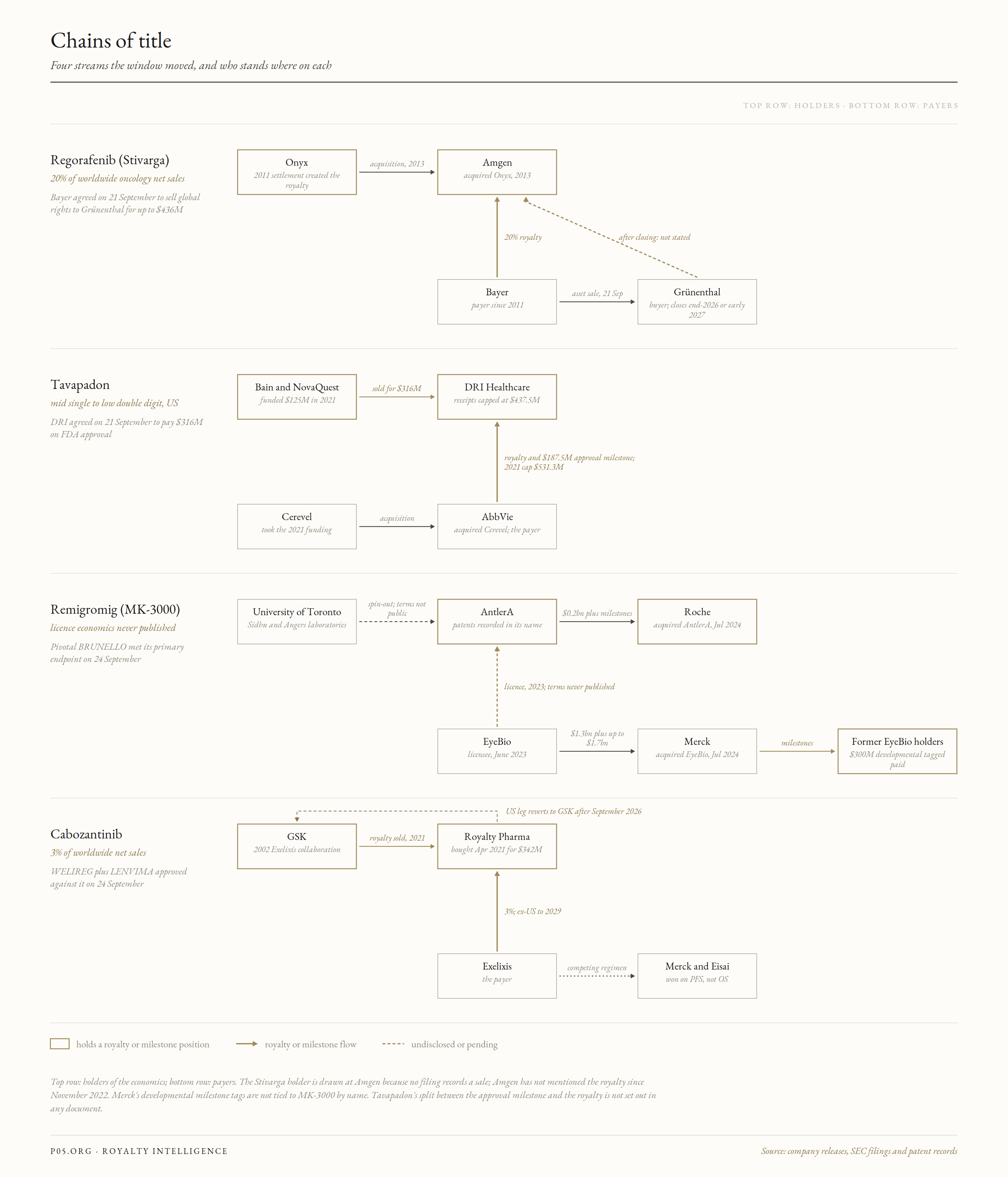
Four streams the window moved, drawn as chains of title: holders of the economics above, payers below. Gold links carry a royalty or milestone; dashed links are undisclosed or pending.
Bayer / Grünenthal / Amgen: A Marketed Oncology Product Changes Hands Carrying a 20% Royalty, and No Transaction Document Mentions It (Mon Sep 21)
Grünenthal is acquiring global rights to Stivarga (regorafenib) from Bayer for up to $436.05M (EUR 375M) (Grünenthal). Stivarga carries a 20% royalty on worldwide net sales in human oncology, stated in three separate filings and in none of the sale documents.
- The rate: Onyx Pharmaceuticals' 8-K of 12 October 2011, settling its claim that regorafenib fell inside the Nexavar collaboration: "Bayer will pay Onyx a royalty of 20% of future worldwide net sales of regorafenib in human oncology" (Onyx 8-K). The contract, Agreement Regarding Regorafenib, filed as exhibit 10.1(vi) to Onyx's FY2011 10-K: "twenty percent (20%) of Net Sales of all Products worldwide in human oncology" (the contract).Amgen's FY2013 10-K, after acquiring Onyx: "as part of the acquisition we acquired the right to receive a 20% royalty on Stivarga global net sales from Bayer" (Amgen 10-K)
- Other 2011 terms: Onyx had no obligation to pay past or future development or commercialisation costs. It took US co-promotion on a fee-for-service basis.Development sat under the same joint governance bodies as Nexavar with Bayer holding final decision rights
- The term: the Royalty Term, any cap and any step-down appear as "[ * ]" in the filed contract. Onyx's FY2011 and FY2012 10-Ks describe the term only as running "on a country-by-country basis when we are no longer entitled to receive royalties in a particular country" (Onyx 10-K).The FY2012 licence footnote gives the rate and 2012 royalty revenue of $8.3M and is silent on duration
- Amortisation proxy: Amgen's purchase price allocation for Onyx assigns an estimated useful life of twelve years to finite-lived intangible assets of $5,910M. The figure is blended across mixed Onyx assets including Kyprolis and the Nexavar rights, is not broken out by asset, and is not this royalty's term
- Change of control: Onyx's FY2011 10-K states that Bayer could terminate the co-promotion on a change of control of Onyx, but that "Onyx or its successor's right to receive royalties for regorafenib would survive" (Onyx 10-K). The provision addresses a change of control of the holder, not of the payer
- Current holder: Stivarga last appears in an Amgen filing in a 10-Q of November 2022, and Amgen has neither restated the position nor disclosed selling it since; post-2022 mentions of regorafenib are LUMAKRAS comparator references. A full-text search across all filers from 2023 to 2026 returns no Royalty Pharma, DRI Healthcare, HealthCare Royalty, Sagard, Blackstone, OMERS, Ligand or XOMA mention of Stivarga
- Timing: Grünenthal expects closing at the end of 2026 or early in 2027, and its release names no royalty, Amgen or Onyx (Grünenthal)
- Instrument: none created this week. Recorded as a change in the identity of the payer on an existing 20% stream
- Royalty read-through: 20% of $393M (EUR 338M) of 2025 sales (Bayer Annual Report 2025) is $78.6M (EUR 67.6M) a year, against a purchase price of up to $436.05M (EUR 375M). No document states who bears the royalty after closing, whether it transfers with the marketing authorisations, or whether Grünenthal's $116M (EUR 100M) EBITDA guidance is struck before or after it.Exclusivity runs to 2029 in Europe and 2030 in the United States
Ligand / Sydnexis / Santen: A Band Withheld for Five Years Becomes Public in the Document Selling the Stream (Tue Sep 22)
Ligand paid $23M for Sydnexis's economic interest in Santen's EMEA licence to Ryjunea (Ligand). Neither party to that licence had disclosed the rate.
- What was bought: a 100% interest in certain payments and related rights under the Sydnexis licence to Santen: a tiered low-double-digit to high-teens royalty on Ryjunea net sales in EMEA, plus certain milestone payments. No aggregate cap on receipts and no royalty term or expiry is disclosed in the 8-K or its exhibit
- What was not bought: verbatim from the exhibit: "Sydnexis retains commercial rights to Ryjunea in the U.S. and all other non-Santen licensed territories." The 8-K frames the purchase as rights relating to Santen's product rather than to Ryjunea at large
- The product: Ryjunea (SYD-101) is a once-nightly low-dose atropine sulphate 0.1 mg/ml eye drop formulated with deuterated water, to slow myopia progression in children aged 3 to 14 at initiation. European Commission approval 5 June 2025, MHRA October 2025, first European launch Germany, July 2025.The registrational STAR study showed a 30% reduction in annual progression over two years against placebo
- The underlying licence: Sydnexis licensed EMEA rights to Santen SA on 10 August 2021, and neither party disclosed an upfront, a milestone total or a royalty rate then or since (Sydnexis)
- US status: the FDA issued a complete response letter on 23 October 2025, concluding the evidence did not demonstrate effectiveness despite the STAR primary endpoint having been met, and citing no safety or manufacturing deficiency (Sydnexis)
- Chain of title: roughly twenty US patents in two families, earliest US9421199 filed 29 May 2015, all assigned to Sydnexis alone, inventors Ostrow, Widder, Baker and Takruri, with no university or hospital co-assignee despite low-dose atropine's academic history in the ATOM trials. An unrecorded in-licence would not appear in assignee data
- Open: Santen has reportedly filed in China and holds a Philippines approval as Ryjusea. Whether those territories sit inside the EMEA licence or under a separate Santen agreement is not established
- Instrument: a royalty and milestone purchase for $23M, payable at a closing conditional on FDA approval having occurred
- Royalty read-through: EMEA is approved and launched; the US carries a complete response letter and stays with Sydnexis. The band is the highest published rate in the window after regorafenib, and the purchase price the smallest
DRI Healthcare / Bain Capital / NovaQuest: A Royalty Created in 2021 Is Resold Ahead of the Approval That Triggers It, and the Two Caps Do Not Match (Mon Sep 21)
DRI Healthcare Trust agreed to pay $316M at closing, conditional on FDA approval, for royalty participation rights in US net sales of tavapadon (DRI Healthcare), a figure the sell-side counsel's own tombstone states as "payable upon U.S. Food and Drug Administration approval" (Ropes & Gray). The position was created in 2021 by the two funds selling it.
- The 2021 origin: on 13 April 2021 Bain Capital Life Sciences and NovaQuest provided Cerevel Therapeutics with $125.0M, $62.5M from each fund, drawn in four tranches of $31.1M, $37.5M, $31.3M and $25.0M between April 2021 and April 2024 and fully drawn before AbbVie closed. Against it: an FDA approval milestone of $187.5M, being 1.5 times the funding commitment, half payable within 30 days of approval and half in four equal annual installments; the same tiered royalty; and an aggregate cap of $531.3M, being 4.25 times the commitment (Cerevel 8-K)
- The caps: Cerevel's 10-Q for the quarter ended 31 March 2024 states that "no regulatory or commercial approval milestone payments or royalty payments have been made or become due under this agreement" (Cerevel 10-Q), and no approval has occurred since. $93.8M is almost exactly the first half of the $187.5M approval milestone, being $93.75M, the tranche payable within 30 days of approval. The four annual payments of $23.4375M that DRI does buy are the second half of that same milestone.The arithmetic is exact to the rounding and consistent with DRI describing what it bought as "royalty participation rights" without stating a portion. No document sets out the split
- The buy-out option: Cerevel held an early buy-out at a multiple rising from 3.00x to 4.25x, exercisable by the earlier of FDA approval or 1 May 2025, and net of amounts previously paid. Cerevel's Q1 2024 10-Q describes it in the present tense and AbbVie's Q3 2024 10-Q confirms it survived the change of control.No document records its exercise, and 1 May 2025 passed with tavapadon unapproved
- The payer: AbbVie's 10-Q for the quarter ended 30 September 2024: "Cerevel Therapeutics received funding to support development of tavapadon and agreed to repay regulatory milestones, sales milestones and royalties contingent upon approval of tavapadon," carried at a $246M acquisition-date fair value, valued on a probability-weighted expected payment model for the regulatory milestone and a Monte Carlo simulation for the sales milestones and royalties. The same filing states that "in all circumstances, total repayments under the funding agreements will not exceed $531 million in aggregate" (AbbVie 10-Q)
- Fair value since: AbbVie's Level 3 financing liability, carried under the fair value option, stood at $378M at 31 December 2025 and $403M at 30 June 2026 (AbbVie 10-Q, Q2 2026)
- A caution on that line: the Q2 2026 filing does not name tavapadon, Cerevel or the funding agreement anywhere in its financial-instruments disclosures. The identification rests on the Q3 2024 10-Q, which describes the arrangement and the $531M cap in terms.AbbVie has never named NovaQuest, Bain or DRI in any filing, and since 2025 it has stopped naming tavapadon against this liability at all. Intermediate marks reported in earlier passes sit in filings not re-verified here and are not carried
- The clinical base: AbbVie submitted the NDA on 26 September 2025 on three Phase 3 trials: TEMPO-1 (n=529, MDS-UPDRS Parts II+III at Week 26 of -9.7 at 5mg and -10.2 at 15mg against +1.8 on placebo, both p<0.0001), TEMPO-2 (n=304, -10.3 against -1.2, p<0.0001) and TEMPO-3 (adjunctive to levodopa, n=507, ON time without troublesome dyskinesia +1.7 hours against +0.6 hours, p<0.0001, published in JAMA Neurology on 20 March 2026 (JAMA Neurology)), plus the TEMPO-4 open-label extension
- Instrument: a royalty and milestone purchase, payable on approval, capped at $437.5M of receipts
- Royalty read-through: the retained half of the approval milestone falls due within thirty days of the approval that is also the buyer's closing condition. The sold tail runs to a June 2039 loss of exclusivity.
Menarini / NewAmsterdam Pharma / Amgen: A European Royalty Goes Into Payment, and the Stack Above It Turns Out Not to Exist (Mon Sep 21)
The European Commission approved obicetrapib on 21 September, putting into payment a royalty NewAmsterdam has held since June 2022 (NewAmsterdam Pharma). The Amgen position above it is equity, not a stream.
- The approval: Ubeslo (obicetrapib 10mg monotherapy) and Evlarco (obicetrapib 10mg with ezetimibe 10mg) for primary hypercholesterolemia in heterozygous familial and non-familial or mixed dyslipidemia, following a CHMP positive opinion of 24 July 2026. Obicetrapib's first approval anywhere
- The licence: Menarini took European rights from NewAmsterdam on 28 June 2022: $134M (EUR 115M) upfront plus $32.0M (EUR 27.5M) in committed R&D funding, milestones stated as up to $1.00bn (EUR 863M) in the original release and up to $969M (EUR 833M) in the 2026 materials, and tiered royalties on European net sales described as low to mid-twenties percent. NewAmsterdam retains rights outside Europe
- The milestone gap: the FY2024 and FY2025 10-K revenue notes tag contingent payments of $1.00bn (EUR 863.0M) at contract inception and a milestone payment received of $34.9M (EUR 30.0M), the latter already reflected by the FY2024 filing. No filing performs the subtraction and there is no evidence of a restatement, currency revision or change of scope
- The tier table: the contract is exhibit 10.8 to the Form F-4 of 4 August 2022, dated 23 June 2022. Section 5.1's EUR 115,000,000 upfront is unredacted; section 5.7.1 is a five-tier royalty table on aggregate annual net sales with every rate and every breakpoint redacted, as are all four milestone sections (licence agreement)
- Upstream: NewAmsterdam took obicetrapib from Amgen in 2020 by share purchase of Dezima Pharma B.V., under a Share Sale and Purchase Agreement dated 9 April 2020 with Saga Investments Coöperatief U.A. Consideration was a redacted closing payment plus a "Profit Right" and an "IPO Share Right", both keyed to an exit or listing, not to product sales. There is no royalty on obicetrapib sales and no milestone payable to Amgen anywhere in the agreement, and the FY2025 commitments note carries no Amgen obligation (share purchase agreement)
- Settlement: the FY2025 10-K records the derivative earnout liability settled in full with 1,743,136 ordinary shares at 31 March 2025. The closing cash amount remains redacted, and a separate profit-right agreement of the same date with Mitsubishi Tanabe Pharma is also redacted and was not exhaustively tested
- Instrument: none created this week. An existing tiered royalty moves from contingent to paying
- Royalty read-through: a low-to-mid-twenties band on a first-in-class approved product in Europe, no upstream sales royalty above it, no US leg. Five tiers, every breakpoint and every rate redacted
Addex Therapeutics / Indivior / Supernus: A Published Royalty Band Is Extinguished Because the Licensee's Parent Is Being Acquired (Fri Sep 25)
Addex has regained full global rights to all GABAB positive allosteric modulator assets discovered under its research collaboration with Indivior (Addex 6-K). The termination ends a royalty interest whose band Addex published two years ago, and the reason given is corporate rather than clinical.
- What came back: "full global rights to all GABAB positive allosteric modulator (PAM) assets discovered under its research collaboration with Indivior UK Limited", including "the returned candidate for substance use disorders", now in Addex's "full ownership"
- Why: "Indivior's rationalization of its research and development activities and the announcement of the planned merger of Indivior's parent company with Supernus Pharmaceuticals, Inc."
- What was extinguished: when the candidates were selected on 27 August 2024, Addex became eligible for "payment of up to USD 330 million on successful achievement of prespecified regulatory, clinical and commercial milestones" and "tiered royalties on the level of net sales from high single digits up to low double-digit" (Addex, 27 Aug 2024)
- Stage at return: Addex announced in May 2025 that Indivior had advanced the programme through IND-enabling studies (Addex, 12 May 2025)
- What the termination discloses: no termination fee, no payment, no reversion royalty and no financial term of any kind
- What Addex will do: "evaluate a range of strategic options, including seeking new partnerships in the near term or advancing the programs further before partnering". Addex separately holds a proprietary GABAB PAM candidate in development for chronic cough
- Instrument: a licence termination. A royalty interest extinguished; no royalty created
- Royalty read-through: a published high single-digit to low double-digit band and up to $330M of milestones stop being anyone's obligation, and a change of control at the licensee's parent ended them, not a trial result. The candidate returns past IND-enabling studies, and the last published price for it is the 2024 band
Kinoxis Therapeutics / Boehringer Ingelheim / University of Sydney: $6.75M and a State Grant Are Raised Against a Large-Pharma Royalty the Release Does Not Mention (Tue Sep 22)
Kinoxis Therapeutics closed a $6.75M round led by Main Sequence, CSIRO's venture fund, alongside a $2.5M CUREator+ grant (Kinoxis). It holds a royalty-bearing out-licence to Boehringer Ingelheim on a separate programme, and the university that assigned it its founding patents is in the round.
- The round: $6.75M, led by Main Sequence at $5M, with existing shareholders participating. Dr Elaine Stead joins the board for Main Sequence.No Series letter is assigned by the company. Main Sequence was founded by CSIRO and invests as an ordinary venture equity investor; no public-money return condition at investee level was found, though its terms are not disclosed
- The currency: the release carries no currency marker on any figure, and neither does the grantor's announcement, the programme guidelines or the Australian trade coverage. An Australian company, an Australian fund and a Commonwealth appropriation put these figures in Australian dollars on substance, but no document says so, and they are carried unconverted
- Who else is in it: the release names only Main Sequence and "existing shareholders". Australian trade coverage additionally names Uniseed, UniSuper, the University of Sydney, Stoic VC and Avicella Capital, and unnamed sophisticated investors.Those names are secondary-source only. The University of Sydney assigned Kinoxis its founding patents in 2021 and, on that reporting, is now funding the company that holds them
- The grant: a $2.5M CUREator+ Dementia and Cognitive Decline grant, Round 2, funding KNX101, announced by the grantor the same day within a $15.6M award to seven recipients (Brandon BioCatalyst). This is not the December 2024 CUREator+ grant, which funds the CARES-X Phase 2a of KNX100 and is a separate award. Applications for this round did not open until 22 May 2025. Both the equity and the grant are in-window events
- The assets: KNX100, a rapid short-acting ALOX15 inhibitor for acute agitation and aggression in dementia, in the Phase 2 CARES-X trial; and KNX101, long-acting, for chronic pain and chronic agitation, with IND-enabling studies planned by the end of 2026
- The out-licence: on 5 May 2023 Kinoxis signed what it called a strategic partnership and licensing agreement with Boehringer Ingelheim over its oxytocin receptor targeting molecules, the KNX200 series, against up to US$181M (A$266M) in research, preclinical, clinical, regulatory and commercial milestones plus royalties on future Boehringer Ingelheim product sales (Kinoxis, 5 May 2023). The upfront, the royalty rate, the territory and the exclusivity scope are all undisclosed. KNX100, the asset this round funds, is expressly not part of that licence
- Status: no termination notice exists, but Kinoxis's current pipeline and science pages name no partner and the September 2026 release is silent on it
- Origin: Kinoxis was founded in February 2018 as a University of Sydney spin-out seeded by Uniseed. KNX100 is the compound formerly designated SOC-1; its ALOX15 mechanism was only elucidated in January 2026, so no Kinoxis patent is framed around ALOX15.The core family runs from priority AU2015902659 of 6 July 2015 through US11033555B2, inventors McGregor, Kassiou, Bowen, Hicks and Jorgensen
- Chain of title: USPTO legal events show the inventors assigning to the University of Sydney on 20 April 2018 and the university assigning to Kinoxis on 5 May 2021. Kinoxis is the legal owner today.What it gave the university is not on the public record. The university is a shareholder, and its own May 2023 release still describes the compounds as licensed to Kinoxis
- The state money: CUREator is run by Brandon BioCatalyst with ANDHealth, funded through the Medical Research Future Fund. Its guidelines state that "all funding provided is non-dilutive" and that CUREator "makes no claims on the background intellectual property or intellectual property rights resulting from CUREator supported project work"
- Instrument: none created this week. Recorded as equity raised by the holder of an unpriced large-pharma royalty
- Royalty read-through: an undisclosed royalty and up to US$181M of milestones from Boehringer Ingelheim, over a university position of unknown value, under a $6.75M round. Neither appears in the financing release.The university sits on both sides of this company, as the assignor of the patents and, on trade reporting, as an investor in the round, and what it took for the assignment remains the unpriced item
BoomRay / Novartis: A $900M Licence Whose Royalty Sits Outside the Headline and Is Stated Conditionally (Tue Sep 22)
Novartis took an exclusive global licence to a preclinical, undisclosed radioligand therapy asset from BoomRay (PR Newswire). The headline number covers the upfront and the milestones; the royalty is additional and is written as something that may happen.
- The licence: exclusive, worldwide, no carve-outs, on a preclinical asset whose target is not named
- The economics, verbatim: BoomRay is "eligible to receive up to USD 900 million, including an upfront payment as well as development, regulatory, and sales milestone payments. In addition, royalties may be earned on future global net sales."
- What that means: the $900M covers the upfront and the milestones only. No amount is disclosed for any individual component, and no rate is published at any level
- Advisers: BFC Group advised BoomRay. No adviser is named for Novartis and no legal counsel for either side (PR Newswire)
- Instrument: an out-licence carrying an unpriced sales royalty
- Royalty read-through: the royalty is stated conditionally, "royalties may be earned", and no rate is published at any level
AbbVie / Iambic Therapeutics: A Discovery Collaboration Signed Three Days Before the Licensor's IPO Filing, Every Term Redacted (Mon Sep 21)
AbbVie and Iambic entered a multi-year discovery collaboration across immunology, neuroscience and oncology (AbbVie). The same contract appears in Iambic's registration statement filed the same day, with every economic term blacked out.
- The work: Iambic applies its Enchant v3 and NeuralPLexer platforms to identify small-molecule candidates; AbbVie contributes therapeutic-area expertise and its discovery scientist teams
- The economics, verbatim: Iambic "will receive an upfront payment and is eligible to receive success-based milestone payments and tiered royalties on net sales from products generated from the collaboration."
- What is withheld: no upfront figure, no milestone total, no royalty rate, no territory and no target count (AbbVie)
- The dating: the agreement is effective 18 September 2026 and was announced on 21 September, the same day Iambic filed its S-1, where it appears as exhibit 10.17 with every economic term redacted. Dated to the announcement, per the standing rule
- Instrument: an out-licence carrying tiered royalties, rate redacted
- Royalty read-through: a tiered royalty is fixed in the filed agreement and its rate is redacted
Boehringer Ingelheim / Envisagenics: A Billion-Dollar Collaboration Where the Royalty Is Explicitly Outside the Total (Tue Sep 22)
Boehringer Ingelheim took a multi-target research collaboration with an option to license over Envisagenics's RNA-splicing platform (Envisagenics). The release says "more than" a billion, not "up to" it, and puts the royalty outside that figure on the word "plus".
- The work: the SpliceCore platform identifies tumour-specific targets derived from RNA splicing in solid tumours. Boehringer takes modality selection, development and commercialisation across antibody-drug conjugates, T-cell engagers and multispecific antibodies
- The economics, verbatim: Envisagenics "is eligible to receive more than US$1 billion in potential payments, including an upfront payment, research funding, option fees and development, regulatory and commercial milestones, plus royalties on future product sales."
- What is withheld: no component is quantified: no upfront, research funding, option fee, milestone amount or royalty rate at any level. The target count is not given, and the release does not say whether the total is aggregate or per target (Envisagenics).Trade coverage rendered it as "up to $1B", which the release does not say
- The structure: Boehringer funds the research and, following successful completion of the research phase, has the option to exclusively license selected targets. No fixed number of targets or options is disclosed anywhere in the release
- Upstream: founded 2014 by Maria Luisa Pineda and Martin Akerman, with prior collaborations named for Biogen, Bristol Myers Squibb and Johnson & Johnson. The visible patent estate, including application US2023/0263872, is assigned to Envisagenics alone, with no Cold Spring Harbor or other institutional co-assignee.The estate is thin and an unpublished in-licence cannot be excluded
- Instrument: an option-to-license collaboration carrying an unpriced sales royalty
- Royalty read-through: two of the four licence-outs in the window place the royalty outside the headline figure. Neither prices it
Boehringer Ingelheim / Variant Bio: A Collaboration That Publishes No Royalty Rate, Sitting Under a Company That Publishes One to Communities (Wed Sep 23)
Variant Bio expanded its Boehringer Ingelheim target-discovery collaboration into cardiovascular disease, for an additional upfront and over $250M in licence and milestone payments (Variant Bio). The deal discloses no royalty at all.
The company behind it has published, since 2020, a commitment to pay 4% of total net revenue and 4% of equity value to the communities whose DNA built its platform.
- The expansion: verbatim, "Variant Bio will receive an additional upfront payment and is eligible for potential license and milestone payments totaling over $250 million." It is "over", not "up to", and the additional upfront sits outside that figure.No target or programme count is disclosed
- No royalty is disclosed: the word royalty does not appear in the release. The $250M is licence and milestone payments only.This is not a royalty placed outside the headline, as with the two other Boehringer-adjacent licences in this window. There is no royalty on the record at any level
- The original: the first agreement, 6 January 2026, covered cardiorenal and kidney disease for an upfront and "potential license and milestone payments totaling over $120 million" (Variant Bio). Also royalty-silent.Neither release states that the $250M is incremental to the $120M or gives a combined total
- The published rate, and who it is payable to: "Variant Bio will share 4% of revenue plus 4% of our equity value with partner communities" that contributed genetic and health data. The pledge: "In the first half of each calendar year, Variant Bio will donate 4% of the Total Net Revenue it received during the previous calendar year", alongside a per-study commitment of 10% of the study budget, capped at $100,000 per project (Variant Bio)
- The revenue base is defined, and it is wide: Total Net Revenue means "all payments received by Variant Bio from a Third Party... including any upfront payments, annual fees, maintenance payments, milestone payments or running royalties or profit share payments", plus product sales. Research funding, cost reimbursement, loans, securities sales and pass-through payments are expressly excluded (the pledge)
- The governance: no named trust or foundation. Funds go as grants to organisations selected annually with partner communities.Once annual benefit-sharing reaches $5M, a Benefit-Sharing Committee of Variant Bio representatives and experts is established to oversee distribution. It is internally constituted, and no third-party audit is published
- Binding or not: the 4% limb is written in mandatory terms, "will donate". The affordable-medicines limb is "reasonable best efforts".No sentence states that the pledge is legally binding, irrevocable or non-amendable. Peer-reviewed work records that Variant "established agreements with Indigenous Peoples", so contractual implementation at community level is likely, but those terms are not public
- Open: neither the expansion release nor the original says whether benefit-sharing applies to money received from Boehringer. On the pledge's own definition, upfronts and milestones from a third party appear to fall inside the base and research funding outside it.That is a reading of the definition, not a company statement, and it is recorded as unresolved. The Novo Nordisk partnership of 7 January 2025 is the one case where a release does connect a deal to community distributions
- Instrument: a discovery collaboration expansion. No royalty created and none disclosed
- Royalty read-through: Across Novo Nordisk, Evotec and both Boehringer agreements, Variant Bio has never published a royalty rate payable to itself. The only percentage it publishes runs the other way, to the populations that supplied the data, and its revenue definition expressly contemplates the running royalties its own deal announcements never mention
Zealand Pharma / Roche: Three Registrational Trials Start at Once on an Asset Whose Development Milestones Are Keyed to Exactly That (Tue Sep 22)
Zealand Pharma initiated the registrational Phase 3 ZUPREME programme of petrelintide in overweight and obesity (Zealand Pharma). The Roche agreement ties $1.2bn of development milestones primarily to this event class.
The release quantifies none of it.
- The programme: three trials, ZUPREME-3 at approximately 3,900 participants without type 2 diabetes, ZUPREME-4 at approximately 600 with type 2 diabetes, and ZUPREME-5 at approximately 2,500 with established cardiovascular disease. Roughly 7,000 participants in total, all randomised, double-blind and placebo-controlled
- The endpoint: "Percentage change in body weight from baseline to week 64". A Phase 2 combination trial with Roche's enicepatide (CT-388) is planned for initiation in the second half of 2026
- The licence: the 12 March 2025 collaboration pays Zealand "upfront cash payments of USD 1.65 billion, including USD 1.4 billion due upon closing and USD 250 million over the first two anniversaries", against "development milestones of USD 1.2 billion, primarily linked to initiation of Phase 3 trials with petrelintide monotherapy, and sales-based milestones of USD 2.4 billion, for a total consideration to Zealand Pharma of up to USD 5.3 billion" (Roche)
- The rate, and it is split by territory: "Profits and losses for petrelintide and petrelintide/CT-388 will be shared on a 50/50 basis in the U.S. and Europe", and "Zealand Pharma is eligible to receive tiered double-digit royalties up to high teens % on net sales in the rest of the world", where Roche holds exclusive commercialisation rights
- The payment out: Zealand pays Roche $350M, offsettable against the development milestones, for the petrelintide and CT-388 fixed-dose combination
- What the release does not say: it names Roche as partner three times and discloses no economics at all. No milestone is stated to have been triggered and none is quantified
- Instrument: none created. An existing collaboration advancing into registrational trials
- Royalty read-through: the milestone pool is described in the 2025 agreement as "primarily linked to initiation of Phase 3 trials with petrelintide monotherapy", and three monotherapy Phase 3 trials began at once. Whether that draws on the $1.2bn, and by how much, is nowhere on the record.Beyond it sits a 50/50 profit share across the two largest markets and a published double-digit to high-teens royalty everywhere else
BioArctic / Eisai / LifeArc: A First Patient in the One Territory Where the 9% Royalty Does Not Apply (Tue Sep 22)
The first patient in Sweden was treated with Leqembi outside a clinical study, at a private clinic in Stockholm (BioArctic). BioArctic earns a flat 9% on global sales of lecanemab, and the Nordic region is carved out of that base entirely.
- The event: first Swedish patient treated outside a study. Sweden's NT-rådet recommended in April 2026 against inclusion in publicly funded care, so this is private-pay volume.EU approval came in April 2025
- What the release says on economics: "BioArctic has no development costs for lecanemab in Alzheimer's disease and is entitled to payments in connection with sales milestones as well as royalties on global sales", and "BioArctic has the right to commercialize lecanemab in the Nordic region together with Eisai". No rate is given in the release
- The rate: "royalty income to BioArctic of 9% on global sales excluding the Nordic region, as well as compensation of 1% of sales in the US and 1.5% of sales in the rest of the world, which BioArctic passes on to LifeArc" (BioArctic interim report, Apr–Jun 2026). Flat, not tiered, and it is a gross figure: the LifeArc leg passes straight through
- The Nordic carve-out: "BioArctic has a co-promotion agreement with Eisai regarding the commercialization of lecanemab in the Nordic region, under which the companies jointly allocate resources with the aim of selling Leqembi in the Nordic countries. The net result from the collaboration is shared equally between the parties"
- Upstream: the development and commercialisation agreement with Eisai was signed in 2007, with a backup antibody agreement in 2015. Milestone entitlement is confirmed and specific amounts and thresholds are not disclosed
- Scale: first-quarter 2026 royalty was $16.9M (SEK 161M), up approximately 68% on the first quarter of 2025
- Instrument: none created
- Royalty read-through: the first Swedish patient falls in the one territory excluded from the 9%, where BioArctic instead takes half the net result of a co-promotion, and where public reimbursement was declined in April
AstraZeneca / Pearl Therapeutics: A Twelfth-Year Approval on a Product Still Carrying Deferred Consideration From a 2013 Acquisition (Wed Sep 23)
The European Commission approved Trixeo for maintenance treatment of asthma (AstraZeneca). The release names no licence or partner.
The triple combination behind it was bought in 2013 with up to $590M of consideration still contingent on approvals and sales.
- The approval: "maintenance treatment for asthma in patients 12 years of age and older who are not adequately controlled by a combination of a medium dose inhaled corticosteroid (ICS) and long-acting beta2-agonist (LABA)". The first triple-combination maintenance therapy approved in the EU for asthma
- The evidence: the KALOS and LOGOS Phase 3 trials, showing statistically significant lung-function improvement and a significant reduction in the annualised rate of severe exacerbations against combined ICS and LABA comparators
- Chain of title: AstraZeneca acquired Pearl Therapeutics in June 2013 for "initial consideration of $560 million payable on completion", plus "deferred consideration of up to $450 million... if specified development and regulatory milestones in respect of any triple combination therapies and selected future products" are met, plus "sales-related payments of up to a further $140 million... if pre-agreed cumulative sales thresholds are exceeded", for a total of up to $1.15bn (AstraZeneca, 2013)
- What that is, and is not: capped, threshold-based deferred consideration to former Pearl shareholders. It is not a running royalty and not a listed CVR. The mechanism is live: AstraZeneca paid a $150M milestone on Breztri Aerosphere's US approval in 2020, confirming the triple combination as the qualifying product
- Open: whether an EU asthma approval triggers a further regulatory milestone, and how much of the $450M and $140M remains unpaid, is not disclosed anywhere. AstraZeneca has never broken out the residual.No estimate is made here
- Instrument: none created
- Royalty read-through: the release names no third-party economics and none exists as a royalty. What does exist is a thirteen-year-old earn-out on a product now taking its second major indication, with the remaining balance invisible.
InnoCare Pharma / Eli Lilly: Up to Five Unnamed Targets, $3.25bn of Milestones, and a Royalty Described Only as Single-Digit (Thu Sep 24)
InnoCare entered a research collaboration and licence agreement with Lilly across up to five targets (InnoCare). The headline figure is milestones only, the royalty sits outside it, and the company attaches an unusual warning to its own numbers.
- The scope: verbatim, InnoCare "will leverage its proprietary drug discovery platform and extensive research experience to discover and advance compounds against up to five targets to address critical unmet medical needs." The targets are not named, no modality is given, and the research term is not stated
- The economics: "InnoCare will be eligible to receive up to $100 million in upfront and near-term payments, and up to approximately $3.25 billion in development and commercial milestone payments. In addition, InnoCare will be eligible to receive single-digit tiered royalties based on annual net product sales." The royalty limb opens on "In addition", which places it outside both figures on the face of the sentence
- What the headline figure is: the $3.25bn is milestones alone. The $100M of upfront and near-term payments sits on top, and the royalty is a separate limb outside both.It is "up to", not "more than"
- The rate: single-digit and tiered. No band, no tier breakpoints, no numbers
- The company's caveat: "The payments in this research collaboration and license agreement are subject to certain conditions. There is still uncertainty regarding the final payment."
- Territory: not stated. The release does not divide rights, does not carve out China, and does not say who leads development or commercialisation.None is asserted here
- A one-sided announcement: the disease areas are given only as cancer and autoimmune diseases, with no modality and no research term. Only InnoCare's co-founder and chief executive Jasmine Cui is quoted. No Lilly executive is quoted and no Lilly-issued release could be found
- Instrument: a discovery collaboration and out-licence carrying an unpriced single-digit tiered royalty
- Royalty read-through: $3.25bn of milestones against a royalty the licensor will only call single-digit, on targets it does not name, with a warning from the licensor that the payments may not arrive
Henlius / Amberstone Biosciences: A Chinese Licensee Pays a US Licensor, and the Upfront Is 0.45% of the Headline (Wed Sep 23)
Shanghai Henlius licensed up to two conditionally activated T-cell engager programmes from Amberstone Biosciences of Irvine, California (Henlius). Henlius pays Amberstone, and takes worldwide rights.
- The direction: Amberstone is the licensor and Henlius the licensee. Henlius takes worldwide exclusive rights across all human indications, including ex-China, and leads research, development, manufacturing, translational and clinical work and global commercialisation.This is a China-in-licensing-from-the-United-States deal, the reverse of the usual flow
- The assets: up to two T-cell engager programmes against two tumour-associated antigen targets designated by Henlius, built on Amberstone's T-MATE platform, a pH-sensitive switch intended to activate the engager only in the acidic tumour microenvironment. The targets are not named.Amberstone generates the preclinical candidates
- The economics: $4M upfront for worldwide exclusive rights, against up to $884.16M of milestones, comprising up to $232.16M in research fees and development and regulatory milestones and up to $652M in sales milestones, plus "single-digit royalties" on product sales
- How the headline is built: $4M plus $884.16M is the $888M figure. The royalty is outside it.The rate is single-digit with no band and no tiers
- The shape of it: the upfront is 0.45% of the headline, and sales milestones are 73% of it.
- The source: the $4M, $232.16M and $652M split is confirmed in Henlius's HKEX voluntary announcement of 23 September, which states the royalty as single-digit and reducible in certain cases (Henlius, HKEX). Amberstone's own release gives "up to US$440 million ... for each target", which does not match the HKEX split
- Instrument: an in-licence carrying an unpriced single-digit royalty payable by a Chinese licensee to a US licensor
- Royalty read-through: three licence-outs in this window place the royalty outside the headline figure and decline to price it. This one also runs from a US licensor to a Chinese licensee
Roche / Atavistik Bio: A $70M Upfront and $1.9bn of Milestones, With the Royalty Outside Both and Unpriced (Thu Sep 24)
Roche entered a research collaboration with Atavistik Bio to discover small molecules against multiple CVRM targets (Atavistik Bio). It is the first Atavistik partnership with any disclosed economics, and the royalty is the one term it does not price.
- The economics, verbatim: "Atavistik Bio will receive an upfront payment of $70 million and may be eligible to receive additional research, development, and commercial milestone payments of up to $1.9 billion, and tiered royalties on future net sales of any approved medicines resulting from the collaboration."
- How the headline is built: $70M plus $1.9bn is $1.97bn, which trade coverage rounds to two billion. It is "up to", not "more than".The royalty sits after the milestone figure and is on future net sales, so it is additive to both
- The rate: "tiered royalties" and nothing further. No percentage, no band, no tier thresholds
- What is not there: no separate research funding, FTE funding or cost reimbursement is disclosed. The word research appears only as a milestone category.The $70M is an upfront, not a funded research budget
- The scope: "discover and develop novel small molecule therapeutics against multiple targets for cardiovascular, renal, and metabolic (CVRM) diseases". The number of targets is not stated, and CVRM sits outside Atavistik's own haematology pipeline
- The platform: the AMPS metabolite-protein screening platform, used to "identify novel functional binding pockets" and, by "uncovering cryptic, biologically relevant binding pockets", to reach targets "that have historically been challenging to modulate"
- The division of labour: "Atavistik Bio will be responsible for discovery and research activities for the collaboration targets, with Roche responsible for further preclinical and clinical development, regulatory, and commercialization activities." No territory is stated, and no option fee, opt-in or co-promotion right is disclosed.Beyond milestones and royalties, Atavistik has no downstream role
- The counterparty: private, backed by The Column Group, Nextech Invest, Lux Capital, Regeneron Ventures and RA Capital Management, with a $60M Series A in August 2021. Its lead asset is ATV-1601, an oral allosteric AKT1-selective inhibitor in hereditary haemorrhagic telangiectasia.No Atavistik entity appears in EDGAR, so no filing counterparty discloses these terms
- Priced against its own precedent: Atavistik's January 2025 Pfizer collaboration over two undisclosed targets stated that "the financial terms of the collaboration are undisclosed". This is the first time the platform has carried a public number, and the number stops short of the rate
- No Roche-issued release could be found. Roche is quoted inside Atavistik's release
- Instrument: a discovery collaboration carrying an unpriced tiered royalty
- Royalty read-through: the eighth licence-out in this window to name a total and decline to price the royalty, and the fourth to place it outside the headline figure by construction. A tiered royalty on Roche net sales is payable to a private venture-backed company with no public filings.Roche appears twice in this issue, here and funding sefaxersen in full
Genentech / Earendil Labs: The Same Licensor Published a Band in January and Withholds One in September (Thu Sep 24)
Earendil Labs licensed multiple bispecific antibody programmes in oncology to Genentech for $55M upfront against a total in excess of $1.5bn (Earendil Labs). Royalties are disclosed and unpriced.
Eight months ago the same company gave a band to Sanofi.
- The economics, verbatim: "Earendil Labs will receive a $55 million upfront payment. The total potential value of the collaboration, including upfront, development, regulatory and sales milestone payments, is in excess of $1.5 billion. Earendil Labs is also eligible to receive tiered royalties on net product sales."
- Three things in that construction matter. It is "in excess of", which is a floor rather than a cap and the opposite of the "up to" convention.The $1.5bn expressly includes the upfront, so milestones alone are below it. And the royalty sits in its own sentence on the word "also", outside the headline figure
- The rate: "tiered" and nothing else. No percentage, no band, no tier count
- The comparison: on 5 January 2026 the same licensor told the market that under its Sanofi collaboration it would "also receive tiered royalties on net product sales up to low double-digit percent", against up to $160M in upfront and near-term payments and a total up to $2.56bn (Earendil Labs). Same licensor, same year, same sentence construction, and the band has gone
- The scope: "multiple therapeutic bispecific antibody programs in oncology" directed at "certain pre-agreed target combinations". No programme count and no targets are named
- The division of labour, verbatim: "Earendil Labs will lead antibody discovery and research through the early clinical development stage... Genentech will assume responsibility for subsequent global clinical development and commercialization." No territory is reserved, and no opt-in, co-development or profit-share right is disclosed, though the release is silent rather than exclusionary
- Not yet done: "The transaction is subject to customary closing conditions."
- The counterparty, and where it actually operates: all three Earendil releases carry a Wilmington, Delaware dateline, which is an incorporation address. The company's own boilerplate names an affiliate, "Earendil Labs and its affiliate Helixon", and Helixon is a Beijing-based AI protein-design company founded by the same chief executive.The word China appears in no Earendil release. It raised $787M in March 2026 from Dimension Capital, DST Global, INCE Capital, Luminous Ventures, Miracle Capital, Sanofi, and the Biotech Development Fund created by Hillhouse and Pfizer
- Sanofi is both a licensee and a shareholder, and the counterparty that received a published band
- No Genentech or Roche release exists. Roche's head of corporate business development is quoted inside Earendil's announcement
- Instrument: a discovery and early-development out-licence carrying an unpriced tiered royalty
- Royalty read-through: the ninth licence-out in this window to name a total and decline to price the royalty. The same licensor priced one eight months earlier.Roche appears three times in this issue: funding sefaxersen in full, buying allosteric chemistry from Atavistik, and taking bispecifics here, and has issued its own release for none of them
Novo Nordisk / Nanexa: A Micro-Cap Licenses Its Platform for up to $1.33bn, and the Upfront Is Not Disclosed (Thu Sep 24)
Nanexa granted Novo Nordisk a global exclusive licence to its PharmaShell platform across up to five long-acting injectable programmes (Nanexa). The shares more than doubled.
The headline figure is widely mis-reported, and the royalty sits outside it.
- The economics, verbatim: "EUR 615 million in upfront payment and development and regulatory milestones", within a headline of "up to EUR 1.165 billion", plus "low single-digit royalties on global net sales". In dollars that is $1.33bn headline, $700M of upfront and development and regulatory milestones, and $626M of sales milestones (Fierce Biotech)
- What that means: the $700M (EUR 615M) is a combined bucket of upfront and development and regulatory milestones. The upfront alone is nowhere disclosed. Trade renderings describing it as an upfront are wrong.The remaining $626M (EUR 550M) is sales milestones, and the total includes the upfront
- The rate: "low single-digit" and nothing further, outside the $1.33bn (EUR 1.165bn)
- The scope: a global exclusive licence to PharmaShell, Nanexa's atomic layer deposition platform, across up to five development programmes in obesity, type 2 diabetes and cardiometabolic disease, targeting once-monthly and once-quarterly dosing. Novo Nordisk leads global development and commercialisation; Nanexa takes milestones and royalties
- The market reaction: the shares rose between 114% and 122% on the announcement, to their highest in more than five years
- When the royalty could start running: Novo's chief scientific officer Martin Holst Lange says that "over the next one year, I would say, we actually expect to see at least three or four first human doses with once-monthly GLP-1" (Fierce Biotech). That is the only public timing on any programme inside this licence, and it comes from the licensee rather than from Nanexa
- Priced against its own precedent: Nanexa's Moderna licence and option agreement of 10 December 2025 carried a $3M upfront, up to $500M in option fees and milestones, and tiered single-digit royalties, on one undisclosed compound with options over four more. This deal is more than twice that headline on a platform-wide grant.For a market comparator, Lilly paid $870M for Camurus' long-acting delivery technology
- Three days earlier, the same platform: on 22 September Nanexa and Forge Nano signed a joint development agreement to "develop large scale GMP-compliant ALD manufacturing equipment" for PharmaShell, disclosing no economics and referring to "other undisclosed collaborations with pharmaceutical companies". Neither party states whether that was groundwork for this licence
- Upstream: PharmaShell is described as Nanexa's own proprietary platform and no inbound licence, university origin or inbound royalty obligation is disclosed.
- The counterparty: the release headline says only "Novo". The body identifies Novo Nordisk, the operating company rather than Novo Holdings, though the precise legal entity is not named in the retrievable text
- Instrument: a global exclusive platform out-licence carrying an unpriced low single-digit royalty
- Royalty read-through: the tenth licence-out in this window to name a total and decline to price the royalty, and the largest of them. The one number that would let anyone value the resulting stream, the split between upfront and milestones inside the $700M (EUR 615M), is the number the release withholds
Incyte / Specialised Therapeutics: An Australian Territory Licence With No Consideration Disclosed at Any Level (Sun Sep 20)
Incyte expanded its partnership with Specialised Therapeutics to add ruxolitinib cream 1.5% in Australia (Specialised Therapeutics). Nothing about the economics is on the record.
- The licence: Opzelura for non-segmental vitiligo and mild-to-moderate atopic dermatitis in Australia. Specialised Therapeutics takes regulatory submissions, medical affairs, marketing and distribution; Incyte retains development, manufacturing and worldwide rights
- Status: Australian regulatory approval is pending
- The economics: no upfront, milestone or royalty term is disclosed (Specialised Therapeutics)
- Instrument: a territory licence, unpriced
- Royalty read-through: none available. The print is drawn at zero in the prints figure
AnaptysBio / Sagard Healthcare: A 2021 Monetisation Reports Roughly Half Its Cap Earned (Mon Sep 21)
AnaptysBio's transition-period Form 10-KT for the period ended 30 June 2026 updates an existing royalty monetisation (AnaptysBio 10-KT). No new transaction was entered.
- The original: Sagard bought an interest in AnaptysBio's royalties on Jemperli (dostarlimab) under its GSK collaboration for $250M in October 2021, amended in May 2024 for a further $50M (AnaptysBio 10-KT)
- The caps: Sagard's return is capped by a threshold of $600M if reached by 31 March 2031, rising to $675M thereafter (AnaptysBio 10-KT)
- Progress: roughly $302.5M had been earned toward that threshold as of 30 June 2026 (AnaptysBio 10-KT)
- Instrument: none created. A status update on a 2021 royalty purchase
- Royalty read-through: at roughly half the lower cap after five years, the instrument is tracking to the later, higher threshold rather than the 2031 one
Novadip Biosciences / European Investment Bank / UCLouvain: $12.1M (EUR 10.4M) Releases a Final Venture-Debt Tranche, and the Founding Patents Belong to the Universities (Mon Sep 21)
Novadip raised $12.1M (EUR 10.4M) of convertibles, which releases the final tranche of an $20.9M (EUR 18M) European Investment Bank facility (Novadip). The company was spun out of two Louvain institutions that still hold the founding patent family, and no licence between them is public.
- The round: led by New Science Ventures, with Fund+, Wallonie Entreprendre, VIVES Fund, ORSA Tech, Sambrinvest, Noshaq and Invest.BW. It follows a $11.2M (EUR 9.6M) convertible loan of June 2025, for $23.3M (EUR 20M) of convertibles since that date (Novadip)
- The EIB facility: signed 19 July 2023, operation 20220801, classified by the bank as quasi-equity venture debt against a $69.8M (EUR 60M) total project cost and guaranteed under InvestEU (EIB). The tranche count, tranche sizes, conditions precedent and participation terms are not published at operation level.The facility is not a royalty instrument on any published document
- The state money: Novadip has taken Walloon Region money twice. A $2.33M (EUR 2M) repayable advance alongside the 2015 Series A and $18.6M (EUR 16M) described as non-dilutive alongside the November 2022 round.The repayment terms of neither are disclosed (Novadip)
- Chain of title: a 2013 spin-off of Université catholique de Louvain and Cliniques universitaires Saint-Luc. US9713656B2, filed 4 June 2010 and granted 25 July 2017, is assigned to the two institutions, not the company, as are US10857264 and US11203785.Patents filed after the spin-out are assigned to Novadip. No licence between company and institutions is on the public record, and no royalty, milestone or institutional equity interest is disclosed
- The clinical base: proceeds complete the registrational Phase 3 of NVD003 in congenital pseudarthrosis of the tibia and prepare a US BLA. Marketing authorisation targeted for 2028 in CPT and 2031 in adult critical size bone defects.NVD003 holds FDA Orphan Drug and Rare Pediatric Disease designations from 23 December 2020, Fast Track from 2023, RMAT from 23 June 2025 and EU orphan designation EU/3/24/2912
- Instrument: convertible equity releasing a venture-debt tranche. No royalty created
- Royalty read-through: three separate layers of public and institutional money sit under this company, being Walloon advances, an EIB quasi-equity facility and two university patent families, and not one of them publishes a rate, a levy or a repayment schedule
ViferaXS / University of Tübingen / Immatics: A $14.0M (EUR 12M) Round Into a Company That Owns None of Its Own Patents (Wed Sep 23)
ViferaXS secured up to $14.0M (EUR 12M), including grant support, led by the German federal breakthrough-innovation agency SPRIND and by Huma (ViferaXS). No patent on the public record is assigned to the company, and the two families behind its lead asset sit with a founder personally and with a third-party commercial holder.
- The round: a Series A of "up to EUR 12 million, including grant support", led by SPRIND, the Bundesagentur für Sprunginnovationen, and Huma, with unnamed private investors participating. The equity and grant split is not disclosed (European Biotechnology).Patrick Rose for SPRIND and Dan Vahdat for Huma are quoted. ViferaXS has published nothing on its own site; the release reaches the record through corporate-news wires only
- The asset: CLLTAXS01, a warehouse-derived multi-peptide therapeutic cancer vaccine adjuvanted with XS15, a synthetic TLR1/2 ligand, emulsified in Montanide ISA 51 VG and given on top of BTK-inhibitor therapy. Proceeds fund a randomised Phase II in chronic lymphocytic leukemia and Phase I read-outs in acute myeloid leukemia and fibrolamellar carcinoma
- The clinical base: the precursor Phase 1, iVAC-XS15-CLL01 (NCT04688385), n=20, completed 17 October 2024, was sponsored by University Hospital Tübingen and funded by a DFG grant and the Medical Faculty AKF programme, not by the company. 19 of 20 patients developed T-cell responses
- Chain of title, and the finding: no patent on the public record is assigned to ViferaXS GmbH. The XS15 composition-of-matter right, DE102016005550B4, filed 9 May 2016 and granted 26 September 2024, was applied for by EMC Microcollections GmbH and now records co-founder Prof. Hans-Georg Rammensee personally as assignee, not the university and not the company.The CLL tumour-antigen family, US10364271B2, names Walz, Kowalewski, Rammensee and Stevanović as inventors and is assigned to Immatics Biotechnologies GmbH
- What is not disclosed: no licence between ViferaXS and the University of Tübingen, University Hospital Tübingen, EMC Microcollections or Immatics is on the public record, and no royalty, milestone or institutional equity interest is disclosed anywhere. Whether CLLTAXS01's specific peptide set draws on the Immatics family is not established; the protocol describes a premanufactured CLL warehouse (Frontiers in Oncology)
- The state money: SPRIND's published instrument set is "Validierungsaufträge, Beteiligungen, Mezzanine-Finanzierungen oder Zuwendungen", and equity and mezzanine rounds require that 30% come from independent private capital. Proceeds from selling shareholdings or exploiting intellectual property are split half to SPRIND and half to the federal budget (SPRIND FAQ).That is a rule on how the agency splits its own realised proceeds, not an obligation of the company. SPRIND has published no announcement of this round and does not list ViferaXS as a project, so the instrument used here is not determinable
- Instrument: equity and grant in undisclosed proportions. No royalty created
- Royalty read-through: SPRIND is not a royalty instrument. Unlike the Walloon repayable advances and the Bpifrance contracts, German federal breakthrough money carries no turnover-linked repayment on any published document.A company running a Phase II owns none of the patents behind its lead asset, and two inbound licences that ought to exist are nowhere on the record
Anaconda Biomed / CDTI / COFIDES: Two Spanish State Vehicles Co-Invest, and Neither Carries a Turnover Levy (Wed Sep 23)
Anaconda Biomed closed a $56M financing led by Omega Funds, with two Spanish state vehicles in the round (Anaconda Biomed). Both are equity co-investors, the company owns its own patents, and the only non-equity capital in its history is an EIB venture debt whose status is not stated.
- The round: $56M, no Series letter given and the instrument never named in any version of the release. Led by Omega Funds, with new investor FOCO, the Spanish Co-investment Fund managed by COFIDES, and continued participation from Asabys, Ysios Capital and CDTI through its SICC Innvierte.The company's release says Sabadell Asabys II; Asabys's own release says Sabadell Asabys I (Asabys)
- Use of proceeds: completion of the ATHENA pivotal IDE study, a prospective randomised 327-subject trial of the ANA Funnel Catheter. The ANA5 Funnel Catheter is CE marked; the platform is an investigational device in the United States
- The state money, one: CDTI participates through Innvierte Economía Sostenible SICC S.M.E., S.A., a wholly state-owned closed-ended collective investment company. CDTI describes Innvierte as promoting innovation "mediante el apoyo a la inversión de capital riesgo" (CDTI).It is equity. CDTI exits by selling shares and the company owes it nothing
- The state money, two: "FOCO's investments will consist primarily of equity contributions. In addition, hybrid equity or debt instruments may be used", and each operation requires foreign co-investment at least equal to FOCO's own (COFIDES). Which of equity or hybrid applied here is not disclosed, and neither is the ticket
- The CDTI negative: CDTI's repayable lines are "ayudas parcialmente reembolsables" carrying a non-repayable tranche of 10% to 33%, repayment over 10 or 15 years with a 2-to-3-year grace period, at a fixed one-year Euribor rate (CDTI). No CDTI instrument computes repayment as a percentage of sales, licensing income or profit.The partially repayable label describes a soft loan with a grant element, not a revenue participation
- Chain of title: co-founded by Dr Marc Ribó, of Hospital Vall d'Hebron, and Dr Ofir Arad. The founding family, priority 13 January 2015, is assigned to Anaconda Biomed SL and names Arad as sole inventor (CA2973514A1).The company states 17 issued patents across eight jurisdictions, all in its own name (Anaconda Biomed). Vall d'Hebron's documented relationship is clinical, not proprietary: VHIR ran the first-in-human study. No licence, royalty, milestone or institutional equity is on the public record
- Upstream: the EIB signed a venture debt of up to $11.6M (EUR 10M) on 29 July 2021, guaranteed under the European Guarantee Fund, with "long-term funding at favourable rates with flexible repayment" and no published tranching, warrants or revenue-linked component (EIB). The 2026 release does not mention it, and nothing states whether it is outstanding, repaid or converted
- Instrument: not named. No royalty created
- Royalty read-through: Spain is a clean negative. Both state vehicles are equity, the founder-held patents sit with the company, and CDTI's repayable aid is a Euribor soft loan rather than a turnover levy.The map now reads Wallonia and France yes, Germany, Spain, Italy and Australia no
Primrose Bio / Signet Healthcare / Ligand: An Undisclosed Round Whose Lead Investor Is Not the One Holding the Royalty Book (Tue Sep 22)
Primrose Bio raised growth capital led by Signet Healthcare Partners (Primrose Bio). One investor in the round already owns all the commercial royalties on the company's core platform.
- The round: led by Signet, with 1315 Capital, Ligand Pharmaceuticals, LDV Partners and Agent Capital. The amount is not disclosed.James Gale joins the board. Proceeds expand the Pfenex Expression Technology, Prima RNApols and PeliCRM197 (Primrose Bio)
- Origin: Ligand spun Pelican Technology Holdings into a merger with Primordial Genetics on 18 September 2023, taking 49.9%
- What Ligand retained: all existing commercial royalties from the expression technology, on Jazz's RYLAZE, Merck's VAXNEUVANCE and CAPVAXIVE, Alvogen's teriparatide and the Serum Institute's Pneumosil and MenFive (Ligand)
- Current holding: Ligand's stake was 31.4% at 31 December 2024 (Ligand 10-K)
- Instrument: none created. Equity into a company whose platform royalties sit with a minority holder
- Royalty read-through: no rate is public for any of the six products. Ligand appears twice in this issue, as a royalty buyer on Tuesday and as an equity holder here, and discloses a band in the first case and nothing in the second
ADARx Pharmaceuticals / AbbVie: The Largest Milestone Stack in the Window Prices Its IPO, and the Counterparty Above the Band Buys Into the Book (Mon Sep 21 to Thu Sep 24)
ADARx priced an upsized $446.3M initial public offering on 24 September, three days after an amended S-1 put the first price range on it (ADARx S-1/A). The registration statement publishes its outbound royalty band rather than redacting it.
- The filing: the initial S-1 of 4 September carried the customary $100M placeholder with no price range. The 21 September amendment adds 21,875,000 shares at an expected $15.00 to $17.00, with a 30-day option over a further 3,281,250 shares.At the $16.00 midpoint that is $350.0M gross, and $402.5M fully exercised. The filing-fee exhibit puts the maximum aggregate offering price at $427,656,250 (filing fees)
- Priced, and upsized: on 24 September ADARx priced 26,250,000 shares at $17.00, the top of the range and 4,375,000 shares above the launch size, for approximately $446.3M gross, with a 30-day option over a further 3,937,500 shares. Trading opened on 25 September under ADRX and closing is expected 28 September (ADARx, 24 Sep 2026)
- The counterparty buys the book: AbbVie is buying roughly 4.9% of the company post-offering in a concurrent private placement capped at $100.0M, with combined gross proceeds stated at about $535.2M before the option, which puts the placement near $88.9M. The party owing the $7.45bn milestone stack and the royalty above it is now also a shareholder
- The syndicate: J.P. Morgan, Morgan Stanley, TD Cowen and UBS Investment Bank as lead book-running managers, with LifeSci Capital as book-running manager
- The collaboration: in May 2025 ADARx entered a discovery-stage Collaboration and License Option Agreement with AbbVie across multiple therapeutic areas, for which it "received an upfront cash payment of $335.0 million"
- The rate: ADARx is eligible for up to $385.0M in option extension and option exercise payments, up to $7.45bn in additional contingent milestone payments, and "tiered royalties at rates in the high single digits to mid-teens". The band is published. The tier boundaries and the exact percentages are not
- The pipeline: the most advanced programme is onvuzosiran, targeting prekallikrein for prevention of hereditary angioedema attacks, in the Phase 3 STOP-HAE trial in 90 adults. Agazisiran, the complement factor B programme, is in three Phase 2 trials.Both are wholly owned
- Open: whether ADARx owes any inbound royalty is not established. No inbound rate, band or named licensor appears for the siRNA platform or either lead asset, both described as wholly owned, though the filing uses the term "in-license"
- Instrument: a priced initial public offering and a concurrent private placement. No royalty created
- Royalty read-through: $7.45bn of contingent milestones against a high single-digit to mid-teens band, on a discovery-stage collaboration that has already paid $335M in cash. It is the largest disclosed milestone stack in the window by an order of magnitude, and the band above it is one of only seven published anywhere in these eight days
Iambic Therapeutics: An S-1 That Converts Three Private Collaborations Into Dated, Exhibit-Filed Agreements (Mon Sep 21)
Iambic filed a Form S-1 for a Nasdaq Global Select listing under IAM (Iambic S-1). The filing discloses no inbound royalty obligation of any kind.
- The filing: underwritten by J.P. Morgan, Jefferies, BofA Securities and Citigroup, with share count and price range blank (Iambic S-1)
- The numbers: collaboration revenue of $9.426M in FY2025 against net losses of $77.3M in 2025 and $47.9M in 2024, with $207.9M of cash at 30 June 2026
- Open: the bands in the three collaboration exhibits, including the AbbVie agreement above, are redacted and remain unresolved
- Instrument: a registration statement, not priced
- Royalty read-through: Iambic is a royalty recipient on three outbound collaborations and an obligor on none. The tombstone on the four underwriters is provisional and comes off if the listing does not complete
Clinical and Regulatory
Roche / Ionis: A Phase 3 Hit on a Programme Roche Funds in Full, Carrying a Published High-Teens to 20% Band (Wed Sep 23)
IMAgINATION met its primary endpoint in IgA nephropathy (Roche). Ionis runs none of it and states the rate in its own annual report.
- The trial: Phase 3, multicentre, randomised, double-blind, placebo-controlled, n=459 randomised 1:1 over 105 weeks, on the complement factor B antisense oligonucleotide sefaxersen (RO7434656, formerly IONIS-FB-LRx)
- The result: met the primary endpoint of change from baseline in urine protein-to-creatinine ratio at Week 37, described as statistically significant and clinically meaningful against placebo, safety consistent with prior data. Neither party quantifies the effect size or gives a p-value; both are held for a future medical meeting.The study continues blinded, evaluating kidney function by eGFR at Week 105 over two years; this is an interim readout, not a final one (Roche)
- The licence: the release states it in terms, "Roche licensed sefaxersen from Ionis for the treatment of complement mediated diseases", and gives no economics. Roche took the programme on 10 October 2018 for $75M upfront against up to $684M in licence fees and development, regulatory and sales milestones, worldwide.Roche is responsible for all global development, regulatory and commercialisation activity and costs (Ionis, 2018)
- The rate: Ionis's FY2025 10-K, in its own words: "We are also eligible to receive tiered royalties from the high teens to 20 percent on net sales" (Ionis 10-K)
- Instrument: none created. An existing out-licence advancing toward payment
- Royalty read-through: a fully funded, fully out-licensed Phase 3 asset on a published high-teens to 20% band. It is the only position in the window that is fully funded by the licensee, fully out-licensed and published at a band
Otsuka / Ionis: A Phase 3 Win Whose Rate Cannot Be Attributed to the Asset (Tue Sep 22)
FUSION met its primary endpoint in FUS-mutated ALS (Ionis). The only rate in Ionis's filings covers two programmes at once and cannot be read onto this one.
- The trial: global Phase 1-3 randomised, double-blind, placebo-controlled study of ulefnersen (ION363, formerly jacifusen), an antisense oligonucleotide targeting FUS pre-messenger RNA
- The result: met the primary endpoint on a joint rank analysis of ALSFRS-R, time to rescue and ventilation at Week 72, p=0.0005, in a primary analysis population of n=73, with most adverse events mild or moderate (Ionis)
- The licence: the counterparty is Otsuka Pharmaceutical Development & Commercialization, Inc., which took exclusive worldwide commercialisation rights on 22 November 2024 for $10M upfront, against regulatory-approval and sales milestones whose totals neither party disclosed. Ionis retains responsibility for ongoing development (Otsuka)
- The royalty exists and is asset-specific: the release states it in terms, "Ionis received an upfront payment and is eligible to receive additional regulatory and sales milestone payments as well as tiered royalties on net sales of ulefnersen"
- The rate does not: no ulefnersen-specific rate is disclosed anywhere. Ionis's 10-K describes tiered royalties up to 30 per cent in an Otsuka section covering both this programme and donidalorsen in Europe and Asia-Pacific, written across the collaborations in the plural (Ionis 10-K).The figure is not attributable to this asset
- Next: Otsuka "plans to move with urgency" in taking the results to the FDA and is pursuing potential expedited submission pathways. No filing date is given
- Instrument: none created
- Royalty read-through: a tiered royalty on this asset is confirmed by both parties and the rate is nowhere on the record. A collaboration-level band in a 10-K is not an asset-level rate, and the two programmes under that heading have different territories and different development obligations
Celldex / Yale: Two Phase 3 Wins, a Safety Table That Is Not in the Release, and a Milestone Carried at Nil (Tue Sep 22)
EMBARQ-CSU1 and EMBARQ-CSU2 both met their primary and all key secondary endpoints (Celldex). The shares fell anyway, and the licence underneath carries an approval milestone the company values at zero.
- The trials: two identical global Phase 3 studies in chronic spontaneous urticaria, 1,939 patients in total, n=963 in CSU1 and n=976 in CSU2, randomised to 150mg every four weeks, 300mg every eight weeks or placebo, over a 24-week placebo-controlled period within 52 weeks of treatment
- The result: change in UAS7 at Week 12 of -20.2 and -20.5 in CSU1 against -10.7 on placebo from a baseline of 30.9, and -20.2 and -19.7 in CSU2 against -11.4 from a baseline of 29.3, all p<0.00001
- Complete response: UAS7 of zero at Week 12 in 42.4% and 42.1% against 9.3% in CSU1, and 45.7% and 44.0% against 12.6% in CSU2. At Week 24 it rises to 49.0% and 45.1% against 15.4%, and 54.0% and 48.4% against 17.6%
- The omalizumab-refractory subgroup: UAS7 of zero at Week 12 in 55.3% (p<0.00001) and 44.3% (p=0.00017) against 9.3% in CSU1, and 41.7% (p=0.0089) and 46.4% (p=0.0036) against 15.1% in CSU2. These are not the primary endpoint's p-values and are an order of magnitude weaker
- Angioedema: among patients with baseline AAS7 above zero, AAS7 of zero at Week 12 in 62.7% and 66.3% against 33.8% in CSU1, and 74.3% and 66.2% against 33.7% in CSU2
- Next: BLA anticipated in 2027 (Celldex)
- Safety, which is not in the press release: the release says only that barzolvolimab was "well-tolerated and demonstrated a favorable safety profile consistent with prior experience". The adverse-event table appears in the call deck, and it records three events adjudicated as probable Grade 4 anaphylaxis across the pooled placebo-controlled period: zero on placebo (n=645), two on 150mg every four weeks (n=648), and one on 300mg every eight weeks (n=641), that one occurring after a placebo dose.Separate Grade 3 events adjudicated as "unlikely" are excluded from that row (Celldex call deck, 22 Sep 2026)
- The market: the shares closed down 11.56% at $33.51 on Tuesday 22 September, and fell a further 7.13% to $31.12 the next day (StockAnalysis.com, CLDX). Same-day coverage put the move anywhere between 10.4% and 20% intraday, so the close is the only figure worth printing.Attribution is contested: the trade press reads it as safety (BioPharma Dive), while others point to the efficacy step-down, a placebo-adjusted UAS7 delta of roughly ten points against the thirteen seen in Phase 2 (Investing.com)
- The rate: Celldex states it may owe Yale a low single-digit royalty on annual worldwide net sales of barzolvolimab, expiring no later than May 2038. The rate is redacted in the filed licence exhibit (Celldex 10-K)
- The milestone gap: a $52.5M approval milestone to former Kolltan holders is outstanding and carried at nil. It was reduced from $172.5M by a settlement agreement in July 2022, and Celldex measures contingent consideration liabilities at $0 at both 31 December 2025 and 31 December 2024 (Celldex 10-K)
- Instrument: none created
- Royalty read-through: a low single-digit university royalty and a nil-carried $52.5M milestone now sit under a product with two positive Phase 3s and a 2027 BLA. The milestone remains carried at nil
Amgen / AstraZeneca: A Phase 3 Win on a Molecule That Has Changed Hands Three Times With No Royalty on the Record (Tue Sep 22)
OASIZ-301 met its primary endpoint in Sjögren's disease (Amgen). The molecule originated at MedImmune, and the consideration for it was taken as equity, not as a stream.
- The trial: Phase 3 randomised, double-blind, placebo-controlled study of the CD40 ligand antagonist fusion protein dazodalibep (VIB4920), approximately 621 patients with ESSDAI of 5 or above
- The result: met the primary endpoint of change from baseline in ESSDAI at Week 48, with improvement from Week 4 sustained thereafter. Amgen discloses neither the effect size nor a p-value, reserving both for a future medical meeting.Adverse events occurring in 5% or more of patients and at a higher rate than placebo were nasopharyngitis, urinary tract infection, hypertension and infusion-related reactions, generally mild to moderate, with discontinuation rates low and balanced. There was no imbalance in thromboembolic events or opportunistic infections, which is the historic class concern for a CD40 ligand antagonist (Amgen)
- The programme: OASIZ 303, in moderate-to-severe symptomatic disease with low systemic activity, is expected to complete in Q4 2026; OASIZ 304 is an open-label long-term extension. No regulatory filing timing is stated
- Chain of title: originated at MedImmune and AstraZeneca as MEDI4920, went to Viela Bio in February 2018 as one of six molecules for approximately $142.3M, then to Horizon Therapeutics for roughly $3.05bn, announced 1 February 2021 (Horizon Therapeutics), and to Amgen with Horizon in October 2023
- How AstraZeneca was paid: it financed the 2018 purchase by subscribing for Viela's Series A preferred, held 26.7% of the company and divested in 2021 for stated proceeds and profit of around $760M to $780M (AstraZeneca)
- Instrument: none created
- Royalty read-through: no royalty, band or milestone payable to AstraZeneca or MedImmune appears in Viela Bio's S-1 (Viela Bio S-1), its FY2019 or FY2020 10-K, or its 2020 quarterlies. The underlying MedImmune licence was never filed unredacted, so the finding is that none is on the public record, not that none exists
Johnson & Johnson / Bristol Myers Squibb: A Pivotal Win on a Product Acquired for $14.6bn, on a 2005 Licence the Release Does Not Mention (Mon Sep 21)
Study 451 met its primary endpoint in bipolar I-associated manic episodes (Johnson & Johnson). CAPLYTA reached J&J by acquisition, and the licence underneath it is twenty-one years old.
- The trial: Study 451 (NCT06462586), randomised, double-blind, placebo-controlled Phase 3 of CAPLYTA (lumateperone) 42mg over three weeks
- The result: a 4.8-point greater reduction in Young Mania Rating Scale total score than placebo at Week 3, effect size -0.69, p<0.0001, separating as early as Day 3. Key secondary CGI-S least-squares mean difference -0.5, p<0.0001; 45.8% achieved at least a 50% YMRS reduction against 20.9% on placebo.Study 452 has completed and is in analysis (Johnson & Johnson)
- Chain of title: CAPLYTA reached J&J through its $14.6bn acquisition of Intra-Cellular Therapies, announced 13 January 2025 and closed 2 April 2025 (Johnson & Johnson)
- The underlying licence: Intra-Cellular licensed lumateperone from Bristol Myers Squibb under a 31 May 2005 agreement carrying tiered royalties, the rate redacted (the contract)
- Instrument: none created
- Royalty read-through: the release mentions none of it. A label expansion on a $14.6bn acquisition advances a stream whose rate has been redacted for twenty-one years
AbbVie: A Twelfth EU Indication on the Largest Revenue Base in the Window, and Nothing Is Owed on It (Tue Sep 22)
The European Commission approved RINVOQ for active polyarticular juvenile idiopathic arthritis in patients aged two and older (AbbVie). Upadacitinib is AbbVie-originated, and the expansion enlarges a base the company owes nothing on.
- The approval: as monotherapy or with methotrexate, in patients with inadequate response or intolerance to one or more DMARDs. The twelfth EU indication for the product
- The evidence: SELECT-YOUTH (M15-340), a Phase 1, open-label, single-arm global study in patients aged 2 to under 18. ACR Pediatric 70 of 66.4% at Week 12 (n=122) rising to 79.5% at Week 48; JADAS27-CRP remission at or below 1 of 23.0% at Week 12 rising to 43.4% at Week 48.Mean C-HAQ change of -0.46 and -0.64, mean pain change of -26.2 and -30.8 at the same timepoints
- Safety: no new risks identified; serious adverse events at 10.2 per 100 patient-years, with no major cardiovascular events, thrombotic events, malignancies or deaths (AbbVie)
- The scale: RINVOQ did $4.644bn in the first half of 2026, up 24.0% reported, against roughly $10.2bn expected for the year (AbbVie Q2 2026 results)
- Instrument: none created
- Royalty read-through: no licence, royalty, milestone or third-party partner is named in the release, and none appears on the public record. It is the largest revenue base touched by anything in the window and the only one with no stream attached to it at all
Elevar Therapeutics / Relay Therapeutics / HLB: An FDA Approval Switches On a Tiered Band, and the Licensor Is Not in the Headline (Wed Sep 23)
The FDA approved Lyrfigtu (lirafugratinib) for second-line cholangiocarcinoma with FGFR2 fusion or other rearrangement (Elevar Therapeutics). The molecule is Relay Therapeutics' RLY-4008, and the approval is a regulatory milestone under a December 2024 licence that carries a published band.
- The approval: lirafugratinib, "a potent, selective oral small molecule inhibitor of FGFR2", in second-line cholangiocarcinoma with FGFR2 fusion or other rearrangement. Priority Review was granted in March 2026.US availability is expected in the fourth quarter of 2026
- The data: the ReFocus Phase 1/2 study, confirmed ORR 46%, median duration of response 11.8 months, median progression-free survival 11.3 months (95% CI 9.2 to 14.8), 12-month PFS rate 49.2%. Safety population 385 patients, serious adverse reactions 32%
- Chain of title: verbatim, "Elevar has an exclusive license to lirafugratinib from Relay Therapeutics, Inc. for worldwide commercialization." Elevar is a majority-owned subsidiary of HLB Co., Ltd.
- The rate: the licence of 3 December 2024 makes Relay "eligible to receive up to $75 million in upfront and regulatory milestones, plus up to $425 million in potential commercial milestone payments, as well as tiered royalties up to the low-teens percentage" (Relay Therapeutics)
- What Elevar took on: "global development and commercialization rights", with "full responsibility for all further development activities, including submission of the NDAs, all subsequent clinical development, and global commercialization"
- Upstream: lirafugratinib was discovered internally by Relay on its Dynamo platform. No upstream third-party royalty was found, and no monetisation or sale of the lirafugratinib stream by Relay is on the record
- Not to be confused: rivoceranib is a separate Elevar and HLB asset, a VEGFR2 inhibitor originating at Advenchen Laboratories and partnered with Jiangsu Hengrui. The Advenchen royalty is untouched by this approval
- Instrument: none created. An existing out-licence switched into payment
- Royalty read-through: an approval that the announcing company's own release attributes to a licensor named only once. Relay now holds a regulatory milestone under a $75M tranche and a tiered royalty up to the low teens on worldwide net sales of an approved product.It is the second royalty in this window to go into payment on an approval, after obicetrapib in Europe
Merck / Eisai / Peloton / Royalty Pharma: An Approval Won Against Cabozantinib in the Month Royalty Pharma's US Cabozantinib Royalty Ends (Thu Sep 24)
The FDA approved WELIREG (belzutifan) with LENVIMA (lenvatinib) for advanced clear-cell renal cell carcinoma after a PD-1 or PD-L1 inhibitor (FDA). The comparator was cabozantinib, and Royalty Pharma's share of the US cabozantinib royalty ends this month.
- The dates: the FDA dates its approval 24 September. Merck and Eisai announced it on 25 September (Merck)
- The trial: LITESPARK-011, Phase 3, 747 patients, against cabozantinib monotherapy
- The result: median progression-free survival 14.6 against 10.6 months (HR 0.74, p=0.001) and objective response 53% against 40% (p=0.0002). Overall survival, 33.7 against 28.6 months (HR 0.85), did not reach statistical significance (FDA)
- Belzutifan's chain of title: Merck acquired it with Peloton Therapeutics in 2019. The June 2026 adjuvant approval "triggered a $50 million regulatory milestone payment to former Peloton Therapeutics, Inc. (Peloton) shareholders, which was made in July 2026", and Merck judged a further $100M sales-based milestone probable (Merck 10-Q, Q2 2026)
- What Peloton's holders keep: "Former Peloton shareholders remain eligible to receive up to $900 million of sales-based milestones." No regulatory milestone is stated to remain, so this approval triggers none
- LENVIMA: "Merck and Eisai share applicable profits equally." $2.3bn of potential sales-based milestones is unaccrued, and "there are no regulatory milestone payments remaining under the agreement" (Merck 10-Q, Q2 2026)
- The comparator's royalty: Royalty Pharma bought GSK's 3% royalty on worldwide net sales of cabozantinib products on 1 April 2021 for $342M upfront and up to $50M on regulatory approvals, with US royalties running "through September 2026, after which U.S. royalties will remain with GSK" (Royalty Pharma, 2021)
- The expiry, in Royalty Pharma's words: "The royalty on U.S. sales of cabozantinib products is expected to expire in September 2026 with the final royalty payment in the fourth quarter of 2026." Non-US royalties continue to 2029 (Royalty Pharma)
- Instrument: none created
- Royalty read-through: three contingent positions sit around one label. Former Peloton holders keep up to $900M of sales milestones on belzutifan, Eisai and Merck split LENVIMA profit equally, and the comparator's US royalty passes from Royalty Pharma back to GSK after September
Immunovant / Roivant / HanAll Biopharma: A Failed Proof of Concept Narrows a Royalty Base Without Impairing It (Wed Sep 23)
IMVT-1402 missed its primary endpoint in cutaneous lupus erythematosus and development in that indication stops (Immunovant). The asset is licensed from HanAll Biopharma on a published band, and five other indications are unaffected.
- The trial: randomised, double-blind, placebo-controlled and global, n=57, with a 12-week Period 1 of IMVT-1402 against placebo
- The result: verbatim, "The study did not achieve statistical significance on its primary endpoint of percent change from baseline in the Cutaneous Lupus Erythematosus Disease Area and Severity Index Activity (CLASI-A) score at Week 12." The companies report "numerical trends favoring IMVT-1402 over placebo... across multiple endpoints" and a favourable safety profile.No point estimates are published
- The decision: verbatim, "Immunovant plans to stop development in CLE"
- What is unaffected: the release states all other timelines are on track, across Graves' disease, difficult-to-treat rheumatoid arthritis, myasthenia gravis, CIDP and Sjögren's disease
- The rate: Immunovant's 10-K discloses "Tiered royalties ranging from the mid-single digits to mid-teens percentage of net sales of licensed products, subject to standard offsets and reductions" payable to HanAll, against "up to an aggregate of $420.0 million" in remaining development, regulatory and sales milestones (Immunovant 10-K)
- The grant: the exclusive, royalty-bearing right to batoclimab and certain back-up and next-generation antibodies, including IMVT-1402, across the United States, Canada, Mexico, the European Union, the United Kingdom, Switzerland, the Middle East, North Africa and Latin America
- Instrument: none created
- Royalty read-through: a failure that narrows a royalty base without impairing it. One of six indications comes off a mid-single-digit to mid-teens band held by HanAll; the other five continue.It is the clearest case in the window of a negative readout leaving a stream intact
Merck / EyeBio / AntlerA / Roche: A Pivotal Hit on an Antibody Licensed From a Company Roche Now Owns, on Terms Never Published (Thu Sep 24)
Remigromig met its primary endpoint in the pivotal Phase 2b/3 BRUNELLO study in diabetic macular edema (Merck). Merck bought the developer, not the licensor.
The antibody platform came from AntlerA Therapeutics, which Roche acquired two weeks after Merck closed on EyeBio.
- The asset: remigromig, "MK-3000, formerly EYE103", a tri-specific agonist of the Wnt pathway, developed under the name Restoret
- The trial: BRUNELLO, a "randomized, double masked pivotal Phase 2b/3 trial", 984 participants randomised 1:1:1
- The result, verbatim: "At 52 weeks, both doses of remigromig (0.5 mg and 0.8 mg) independently demonstrated non-inferiority to active control 0.5 mg ranibizumab for mean change from baseline in best-corrected visual acuity (BCVA) in patients with DME." The non-inferiority margin, the per-arm letter gains and the confidence intervals are not disclosed
- And the part that matters commercially: "Higher rates of proliferative diabetic retinopathy (PDR), vitreous hemorrhage, and treatment discontinuations due to adverse events were observed in the remigromig treatment arms compared with ranibizumab."
- Where the molecule came from: AntlerA's release of 15 June 2023 says clinical testing was "initiated through a strategic collaboration and licensing agreement with EyeBio" and that, "Derived from ANT-Pharm platform, EYE103 is a Norrin/Wnt-agonist clinical antibody molecule developed by EyeBio in close collaboration with AntlerA" (AntlerA). No upfront, milestone or royalty was disclosed by either party
- The patents: the tetravalent FZD and Wnt co-receptor antibody families remain recorded in AntlerA's name, inventors including Sachdev Sidhu and Stephane Angers, with no assignment to EyeBio or Merck on the public record (WO2022130342, WO2023250402). Sidhu and Angers co-founded AntlerA out of their University of Toronto laboratories (University of Toronto).Whether the university retains any economics is not public
- The licensor's owner: "On 26 July 2024 the Group completed the acquisition of AntlerA Therapeutics, Inc. ... The initial cash consideration was USD 0.2 billion and additional contingent payments may be made based upon the achievement of performance-related milestones." Roche names the asset it bought as ANT-638, a preclinical Wnt agonist, and does not mention EyeBio or EYE103 (Roche Finance Report 2024)
- The comparator: ranibizumab is marketed in the United States by Roche's Genentech as Lucentis (Genentech)
- The acquisition: Merck announced on 29 May 2024 a price of "$1.3 billion in cash" plus "up to $1.7 billion in developmental, regulatory and commercial milestone payments" (Merck) and completed on 12 July 2024 (Merck). SV Health Investors, which seeded the company, put the total as "including upfront and near-term milestone payments" (SV Health Investors).Merck's FY2025 10-K tags developmental milestones to EyeBio's former holders as triggered and paid: $100M at each of 30 September and 31 December 2024, and $200M at 31 December 2025. It gives the caps as up to $1.0bn developmental, $200M regulatory and $500M sales-based, and consideration transferred as $1.2bn (Merck 10-K, XBRL).None of the payments is tied to MK-3000 by name, and none is disclosed on this readout
- Who held EyeBio: SV Health Investors led the Series A with Samsara BioCapital, Jeito Capital and MRL Ventures Fund, and Bain Capital Life Sciences, Omega Funds and Vertex Ventures HC joined the extension, $130M in total (EyeBio). MRL Ventures Fund is Merck's own venture fund (Merck)
- One thing not to conflate: EyeBio stated on 6 March 2023 that it "has also in-licensed a second bispecific agonist antibody asset" (SV Health Investors). That is a different, bispecific molecule, licensor and terms not public.Roche's ANT-638 is also a different molecule from EYE103
- Not Merck KGaA. This is Merck & Co of Rahway, New Jersey
- Instrument: none created
- Royalty read-through: two contingent positions sit behind this readout. One is Merck's milestone ladder to EyeBio's former holders, $300M of it tagged as paid and none tied to this result.The other is whatever AntlerA kept under the 2023 licence, which now belongs to Roche, the company whose ranibizumab was the active control. No royalty rate is on the public record, and whether the licence carries one is not disclosed either way
Cue Biopharma / Ascendant Health Sciences: A Phase 2 Beats an Active Comparator on a Stream Whose Band Is Published (Sun Sep 20)
CUE-221 beat both placebo and omalizumab in chronic spontaneous urticaria (Cue Biopharma). It is the only readout in the window on an in-licensed asset, and the licence behind it publishes a band.
- The trial: randomised, double-blind, placebo- and active-comparator-controlled Phase 2 in chronic spontaneous urticaria run in China, n=145 randomised 2:2:2:1:1
- The result: the 4 mg/kg Q4W arm reached HSS7=0 in 54% at Week 12 against 11% on placebo and 41% on omalizumab 300 mg (p<0.005), with UAS7=0 in 46% (p<0.05). At Week 28, twelve weeks off treatment, it held 60% complete hive resolution against 24% for omalizumab (p<0.05).No treatment-related serious adverse events. Phase 2b/3 planned in CSU and Phase 2 in food allergy (Cue Biopharma)
- The licence: Cue took rights outside mainland China, Hong Kong, Macau and Taiwan from Ascendant Health Sciences Ltd on 30 April 2026 for $15.0M upfront against up to $676.5M in milestones (Form 8-K)
- The rate: tiered royalties at percentages ranging from high single-digit to low double-digit on net sales, with step-downs for patent expiry, biosimilar entry and third-party IP stacking, running to the later of ten years post-launch, patent expiry or regulatory exclusivity (Form 8-K)
- Instrument: none created. An April 2026 in-licence advancing on published terms
- Royalty read-through: the asset beat the standard of care head to head on a band that is already public. It is the only readout in the window where both the data and the rate are on the record
A priority review on a combination whose two halves belong to different owners. The FDA granted Priority Review on 25 September to perioperative Imfinzi with neoadjuvant enfortumab vedotin for "patients with muscle-invasive bladder cancer (MIBC) who are ineligible for or have declined cisplatin-based chemotherapy", with a decision anticipated in the fourth quarter of 2026, on the VOLGA Phase 3 in which the combination "demonstrated statistically significant and clinically meaningful improvements in event-free survival (EFS) and overall survival (OS) versus radical cystectomy" (AstraZeneca).
Imfinzi is AstraZeneca's own. Enfortumab vedotin is not: it is commercialised by Pfizer, through Seagen, and Astellas, who "equally share in any profits realized in the U.S." and, outside it, pay each other "a royalty rate applied to net sales of the product based on a rate intended to approximate an equal profit share". That is an internal balancing mechanism between two partners, not a third-party stream, and no external royalty on enfortumab vedotin is disclosed in any filing.
The AstraZeneca release does not mention Pfizer, Astellas, Seagen or any collaboration, cost-share or supply arrangement at all, and no arrangement governing the combination is stated.
A prevention result on an asset whose Phase 3 already failed. Diamyd Medical reported on 24 September that in the DiAPREV-IT long-term follow-up, "retogatein significantly delayed time to Stage 3 Type 1 Diabetes (p=0.018), with an estimated median time of 9.0 years compared to 3.4 years with placebo" in the HLA DR3-DQ2 positive subgroup, across 50 at-risk children with a median follow-up of 12.9 years (Diamyd Medical).
Retogatein is the international non-proprietary name assigned in January 2026 to the GAD65 antigen-specific immunotherapy previously called Diamyd. The context the result needs: the company's Phase 3 DIAGNODE-3 reported negative interim results in March 2026 and was discontinued for futility in April, with a strategic review initiated.
This is a positive long-term prevention signal on a different route, subcutaneous and earlier-stage, arriving after the failure of the intralymphatic programme. Two inbound obligations sit on it.
US patent protection to 2032 comes "as part of an exclusive license from the University of California, Los Angeles" (Diamyd annual report 2024/25), terms undisclosed. And "if Diamyd Medical obtains commercial approval for retogatein and sales of the drug are commercially successful, Breakthrough T1D will receive limited royalties", carried as a long-term liability of $4.74M (SEK 45.05M) at 30 November 2025 (Diamyd Q1 2025/26).
There is no commercial partner.
Four further regulatory and clinical items, none carrying a disclosed stream. BONESUPPORT filed the complete additional data package for the CERAMENT V De Novo submission with the FDA on 21 September, with no decision timeline disclosed (BONESUPPORT).
The FDA granted Infant Bacterial Therapeutics a Type B pre-BLA meeting on 21 September (IBT). Antengene dosed the first patient in the registrational Phase 3 CLINCH-3 study of ATG-022 on 20 September (Antengene), and Accro Bioscience dosed the first patient in a Phase 2b of AC-101 in moderate-to-severe ulcerative colitis the same day (Accro).
A narrow miss on an unencumbered asset, with a read-across to somebody else's stream. Acadia Pharmaceuticals reported topline Phase 2 RADIANT results for remlifanserin in Alzheimer's disease psychosis on 24 September.
On the primary endpoint, 60mg "demonstrated a change of -12.6 versus a -10.4 change for placebo at week 6, yielding a standardized effect size of 0.26 (p=0.0603)", and Acadia's own summary calls it "Narrowly missed primary endpoint of SAPS H+D (p=0.0603)". The key secondary reached an effect size of 0.37 with p=0.0077, which the release marks as nominal, and "the 30 mg dose showed minimal improvement across endpoints compared to placebo".
Acadia "plans to continue enrolling its two ongoing Phase 3 studies... while implementing amendments to the Phase 3 program, including removing the 30 mg dosage arm" (Acadia). Remlifanserin is unencumbered: Acadia's 10-K describes it as "a new chemical entity that we discovered and developed", and no royalty or milestone obligation on it, or on pimavanserin, appears in that filing.
The stream this item reaches belongs to someone else. Acadia does owe outbound obligations on other assets: trofinetide to Neuren, at "tiered royalties from the mid-teens to low-twenties percent" outside North America and an unquantified "tiered, escalating, double-digit percentage" within it, plus one-third of the net proceeds of the $150M priority review voucher sale, and ACP-711 to Saniona on "tiered royalties of mid-single digits to low double digits".
Neuren has never sold, monetised or borrowed against the trofinetide royalty, and took $46.1M (A$65M) of royalty income in 2025 against $204M (A$287M) of cash and no debt. Recorded as a read-across, not as a royalty event.
Two further readouts on wholly owned or unlicensed assets, one of them a failure. ImmuneOnco reported Phase Ib/IIa data for IMM0306 (amulirafusp alfa), a CD47 and CD20 bispecific, with lenalidomide: ORR 92.3% and complete response 53.8% in relapsed or refractory marginal zone lymphoma at n=13, and ORR 88.6% with a 70.5% complete response rate in relapsed or refractory follicular lymphoma at n=44 evaluable (ImmuneOnco).
The asset is described as independently developed, with no partner, no in-licence and no out-licence. Its Instil Bio agreement covered IMM2510 and IMM27M only and was terminated in January 2026.
Paradigm Biopharmaceuticals' Phase 3 of Zilosul in knee osteoarthritis, 538 patients, fell below its pre-specified interim continuation threshold and met futility; a funding update was promised by 28 September, and on 24 September Paradigm agreed to return US$2M drawn on 11 September under its Obsidian facility and cancel 2,000,000 convertible notes with no additional fees or premiums payable. Paradigm's ASX announcement of 23 September, "Phase 3 Interim Result Below Continuation Threshold", puts the interim at roughly half of the 538 treated participants reaching Day 112, gives no effect size and cites "a significant amount of missing data" (Paradigm, ASX).
The shares were halted on 21 September and suspended on 22 September, and the funding update had not been released by 26 September. Zilosul is injectable pentosan polysulfate sodium held under an exclusive supply agreement with bene pharmaChem of 11 November 2014, amended in September 2020 to cover all major markets except Japan for 25 years from marketing approval.
No royalty or payment obligation to bene pharmaChem is disclosed, and Obsidian is a note-holder, not a royalty counterparty.
Three wholly owned readouts. Hansoh's Phase 3 of the selective allosteric TYK2 inhibitor HS-10374 in moderate-to-severe plaque psoriasis met both co-primary endpoints at Week 16, PASI 75 and sPGA 0/1, with response rates the company calls significantly higher than placebo but does not quantify; over half of treated patients reached PASI 90 and nearly one-third PASI 100 (Hansoh, HKEX, 21 Sep).
Patient numbers, doses and arms are not disclosed, and a China NDA follows discussions with the regulator. Hansoh calls HS-10374 "self-developed by the Group" and names no licence.
Beacon Therapeutics' Phase 2/3 VISTA trial of laruparetigene zovaparvovec in X-linked retinitis pigmentosa, n=85 males, met its primary endpoint of at least 15 additional letters read under low light at 12 months in 24.1% on low dose and 31% on high dose against 0% of controls; Beacon will start and complete a rolling BLA before end-2026 and is open to partners for ex-US infrastructure, with no partner and no financing disclosed (Fierce Biotech). Abbisko's open-label dose-escalation ABSK061-202 study of lavengratinib in achondroplasia reported seven participants aged 6 to 12 completing six months at the lowest dose of 0.064 mg/kg once daily, with a mean 2.4 cm per year improvement in annualised height velocity at Week 27 and a 100% responder rate, no serious adverse events and no discontinuations; six-month data are expected by end-2026 and the asset is wholly owned (Abbisko).
Nordic capital in the window, six confirmed and one in progress, none carrying a stream. Alligator Bioscience closed a rights issue of units on 22 September raising approximately $6.19M (SEK 58.8M) gross before costs and before repayment of a $2.00M (SEK 19M) bridge loan, at a weak 17.1% subscription with a further 29.7% taken under guarantee.
Vator Securities and Mangold Fondkommission guaranteed, for 13.6% of the guaranteed amount in cash or 15.6% in units, up to 213,000,000 units if taken in kind (Alligator). Circio Holding registered the capital increase from its approximately $19.4M (NOK 200M) private placement of 15 September, issuing 16,865,000 shares; the registration notice names no allocatees (Circio).
Oncoinvent launched and completed a placement overnight on 22 and 23 September, raising $14.4M (NOK 148.5M) gross at $8.74 (NOK 90.00) across 1,531,000 placement shares and 119,000 retail shares, with Linc AB at approximately $1.69M (NOK 17.4M) and Hadean Ventures and associated parties at approximately $1.68M (NOK 17.3M), managed by ABG Sundal Collier and DNB Carnegie, under a 180-day lock-up; a repair offering of up to 200,000 further shares is in progress (Oncoinvent). OncoZenge closed a rights issue at approximately $3.23M (SEK 30.7M) gross, 92.0% subscribed at $0.32 (SEK 3.00), diluting non-participants by 40.8%, guaranteed by Vator Securities for 14% in cash or 15% in shares plus 2% in cash (OncoZenge).
Aptahem opened subscription on 23 September on a unit issue of approximately $1.64M (SEK 15.6M) at $0.13 (SEK 1.20) per unit, three shares and one TO9 warrant, running to 7 October, with a further $0.68M (SEK 6.5M) available on exercise; the TO9 exercise window is itself contingent on the subscription level achieved, March, June or September 2027 at below 40%, 40 to 70% and above 70% respectively (Aptahem). ExpreS2ion Biotech announced the outcome of its TO 13 warrant series on 23 September: 222,953 warrants exercised at $0.17 (SEK 1.60), approximately 1.1% of the maximum.
Gross proceeds of approximately $2.03M (SEK 19.3M) came overwhelmingly from a 60% guarantee undertaking with Vator Securities, which was activated and triggered a directed issue of 11,869,138 shares to the guarantor. Total dilution across the three transactions is approximately 39.8%.
Chair Martin Roland Jensen: "The very limited exercise of TO 13 reflects the difficult market circumstances we have faced." Proceeds advance ES2B-C001 toward its Phase I readout while the company pursues a partnership (ExpreS2ion).
Two structural points across the set. Share-settled guarantee fees are doing the underwriting at Alligator, OncoZenge and ExpreS2ion, and Vator Securities is the guarantor in all three. At ExpreS2ion the guarantee delivered almost the entire raise, with holders taking up 1.1%.
And Aptahem's warrant terms are performance-linked rather than calendar-linked. Neither is a royalty, and no Nordic issuer in this window sold, monetised or created one.
An acquisition with no price on it. Arcturus Therapeutics announced on 23 September that it "has entered into a definitive agreement to acquire myNEO, subject to customary closing conditions", with the transaction "expected to close in October", adding that "Arcturus has been working closely with myNEO since 2024" and that the acquisition brings "a differentiated computational engine, supported by proprietary intellectual property" (Arcturus Therapeutics). myNEO Therapeutics is a Ghent-based AI antigen and immune-target discovery company.
No consideration is disclosed at any level: no total, no cash or stock split, no earn-out, no milestone, no royalty and no revenue share. Two disclosure facts carry the item.
The announcement appears only as a bullet inside a release about interim Phase 2 data in OTC deficiency and a delivery-platform update, not as an announcement of its own. And the 8-K is furnished under Item 7.01 alone, with no Item 1.01 and no acquisition agreement filed as an exhibit.
The prior relationship since 2024 is stated and nowhere described: no release, filing or contract setting out its scope or economics could be found, and myNEO's own news page carries no Arcturus item and no announcement of the acquisition. The seller's adviser discloses no value either: Van Lanschot Kempen's tombstone records a "Sale of myNEO to Arcturus Therapeutics" in September 2026, names itself "Sole Financial Adviser to myNEO and its reference shareholder Novalis Biotech", and gives the deal value as "Undisclosed" (Van Lanschot Kempen).
An acquisition priced mostly in milestones. Lexeo Therapeutics announced on 22 September that it will acquire Mantle Therapeutics for $8.3M upfront in cash and stock, with up to $13.0M in "success-based milestone payments, payable in a combination of cash and equity upon the achievement of future clinical and regulatory milestones" (Lexeo).
The 8-K splits the upfront as $5.3M in cash and $3.0M in Lexeo stock, and the contingent limb as a $1.0M one-time cash payment "payable only upon the achievement of certain events" plus up to $12.0M of development and regulatory milestones over a 12-year milestone term, partly in stock valued at a thirty-day trailing VWAP, under a commercially reasonable efforts standard (Lexeo 8-K). The merger agreement was signed on 16 September and first announced on the 22nd; holders of about 76.1% of Mantle's stock have signed support agreements and the outside date is 16 November.
Mantle brings four Friedreich ataxia programmes: one clinical-stage oral frataxin-expression therapy, LX3010, and three pre-clinical or discovery-stage. No royalty and no sales-based earn-out appear anywhere. The contingent limb is development and regulatory only, it is larger than the upfront, and it makes Mantle's former holders milestone participants for twelve years.
Capital in the window without a stream attached. BigHat Biosciences closed a $75M Series C on 24 September, co-led by DFJ Growth and Premji Invest, with Catalio Capital Management, LG Technology Ventures, Sigmas Group and existing investors including 8VC, Alexandria Venture Investments, Amgen Ventures, Andreessen Horowitz, Discovery Ventures, GRIDS Capital, Intermountain Ventures, Eli Lilly and Company, the Merck Global Health Innovation Fund, Quadrille Capital and Section 32, taking the San Mateo company to $223M raised (BigHat Biosciences).
Three of those investors are also its collaboration counterparties. Proceeds advance BHB810, a CDH17-directed antibody-drug conjugate dosed in Phase 1 from September 2026, and BHB299, a CEACAM6 T-cell engager.
No debt, convertible or royalty component is disclosed, and no valuation is given. Of six disclosed pharma collaborations, namely AbbVie, two with Lilly, Amgen, Merck & Co. and a Johnson & Johnson agreement that completed in October 2025, only the AbbVie deal of December 2023 mentions royalties at all, as "tiered royalties on net sales" outside a roughly $325M research and development milestone figure, with no rate, band or threshold anywhere.
BigHat states it "retains full global rights and control" to the ADC. Basecamp Research raised $140M in an oversubscribed Series C led by S32, with NVIDIA through NVentures, Anthropic's Anthology Fund, Catalio Capital Management, European Tech Collective, Firebrand River Capital, Inception Fund, King Philanthropies, the NATO Innovation Fund, PostScriptum, Redalpine, The Rockefeller Foundation, Singular, Sovereign AI and True Ventures, and André Hoffmann, vice-chairman of Roche, in a personal capacity (Basecamp Research).
Proceeds advance in vivo cell therapy using large serine recombinases for genome integration, across a six-programme pipeline. The company states that its data comes from "access and benefit-sharing partnerships in more than 30 countries across all seven continents", and its biodiversity page lists "monetary benefits, which includes up-front funding and royalties from successful commercialisation" among what partner countries receive. No percentage, rate, formula or agreement is published anywhere. It has no disclosed pharma partnership and no royalty rate payable to it either. Roche is present only through an individual and is not a corporate partner.
Enveda Biosciences raised $311M in a Series E led by Catalio Capital Management, with Durable Capital Partners, ICONIQ, Lightspeed, Surveyor Capital, accounts advised by T. Rowe Price Investment Management, Digitalis Ventures, an unnamed sovereign wealth fund and Alderline Group joining existing investors, taking capital raised since inception to "more than $845 million" (Enveda). It is the largest private round of the window.
ENV-294 is in Phase 2 in atopic dermatitis and asthma, ENV-308 and ENV-6946 in Phase 1, and all three are wholly owned. Enveda has no out-licence, no in-licence and no royalty obligation on the public record; Sanofi's involvement is as a Series C equity investor only. Its patents are company-assigned with no institutional co-assignee. Dialybrid raised $17.44M (EUR 15M) in a Series A led by XGEN Venture with CDP Venture Capital, announced alongside the first-in-human implant of its Silkothane Arteriovenous Graft by Prof. Matteo Tozzi at ASST Sette Laghi, Varese; the study is open-label, single-arm, 18 patients across four Italian centres with 60-month follow-up.
No royalty, licence, milestone or earn-out is disclosed. The patent family, priority EP 16425100.1 of 28 October 2016, is assigned to Dialybrid, with the 2019 publication assigned to Bioengineering Laboratories S.r.l., whose founder is Dialybrid's chairman and chief executive (Dialybrid).
HighLife Medical raised $90M+ (EUR 80M) with no Series letter and no single lead. Andera Partners, Sofinnova Partners, Supernova Invest and Mérieux Equity Partners through Mérieux Innovation 2, with the European Investment Bank, BNP Paribas Développement, Capricorn Partners, Critical Path Ventures, Pro Benefis Familiae and SPRIM Global Investments, and USVP, Sectoral and VI Partners are all in it, funding European commercial expansion and a US pivotal study of the HighLife TMVR System and the Clarity Valve.
CE mark came in January 2026 and July 2026 respectively; neither is US-approved. Founded 2010, not a spin-out, with roughly eighteen filings assigned to HighLife SAS alone.
The EIB is in the round and the release does not say whether as equity or venture debt (HighLife).
Precision Neuroscience closed an oversubscribed $250M Series D on 24 September, co-led by Pershing Square Inc., the Ackman Oxman Institute and an unnamed life sciences investment fund, with Duquesne Family Office, B Capital, ARK Invest, Invus, Mubadala Capital, Mirae Asset Capital, Korea Investment Partners, Hitachi Ventures and JSL Health Capital, taking total funding to $430M (Precision Neuroscience). No valuation, debt, licence or royalty term is disclosed.
Celularity closed an initial $10M-plus of an up-to-$28M recapitalisation on 24 September: senior secured convertible notes at 10% a year, compounded annually, convertible at $1.50 per share and maturing in 24 months, with five-year warrants at $1.50 (Celularity). The only named investor, Philip A. Barach, joins the board, and his family trust bought $3.21M of the notes on 23 September (Form 4).
Odeon Capital Group was placement agent. No royalty or revenue-share term appears.
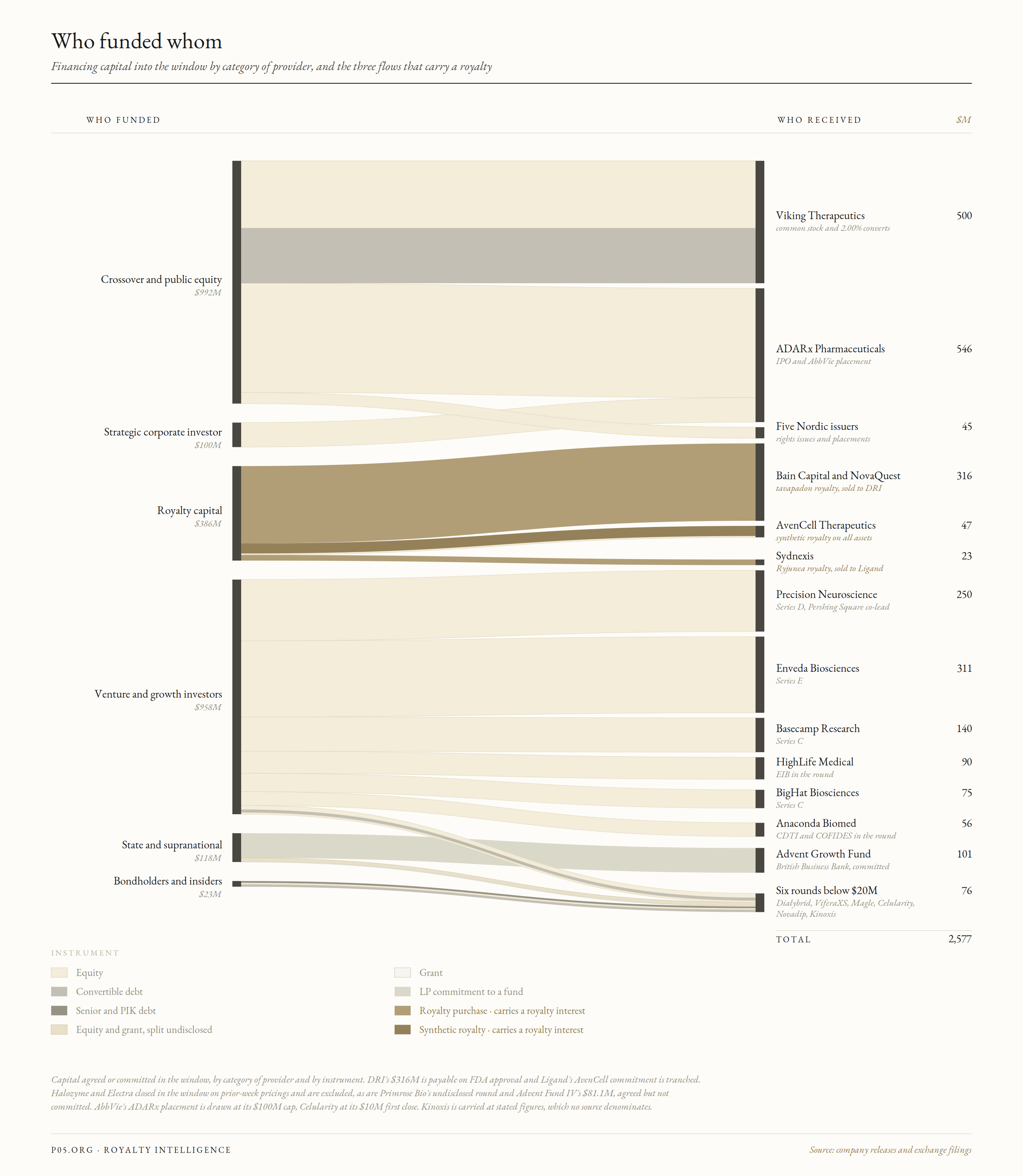
Financing capital agreed or committed in the window, by category of provider and by instrument. Three flows carry a royalty: DRI's $316M for tavapadon, payable on FDA approval, Ligand's $23M for Ryjunea and Ligand's tranched $41M synthetic royalty on AvenCell. M&A consideration is in the prints figure.
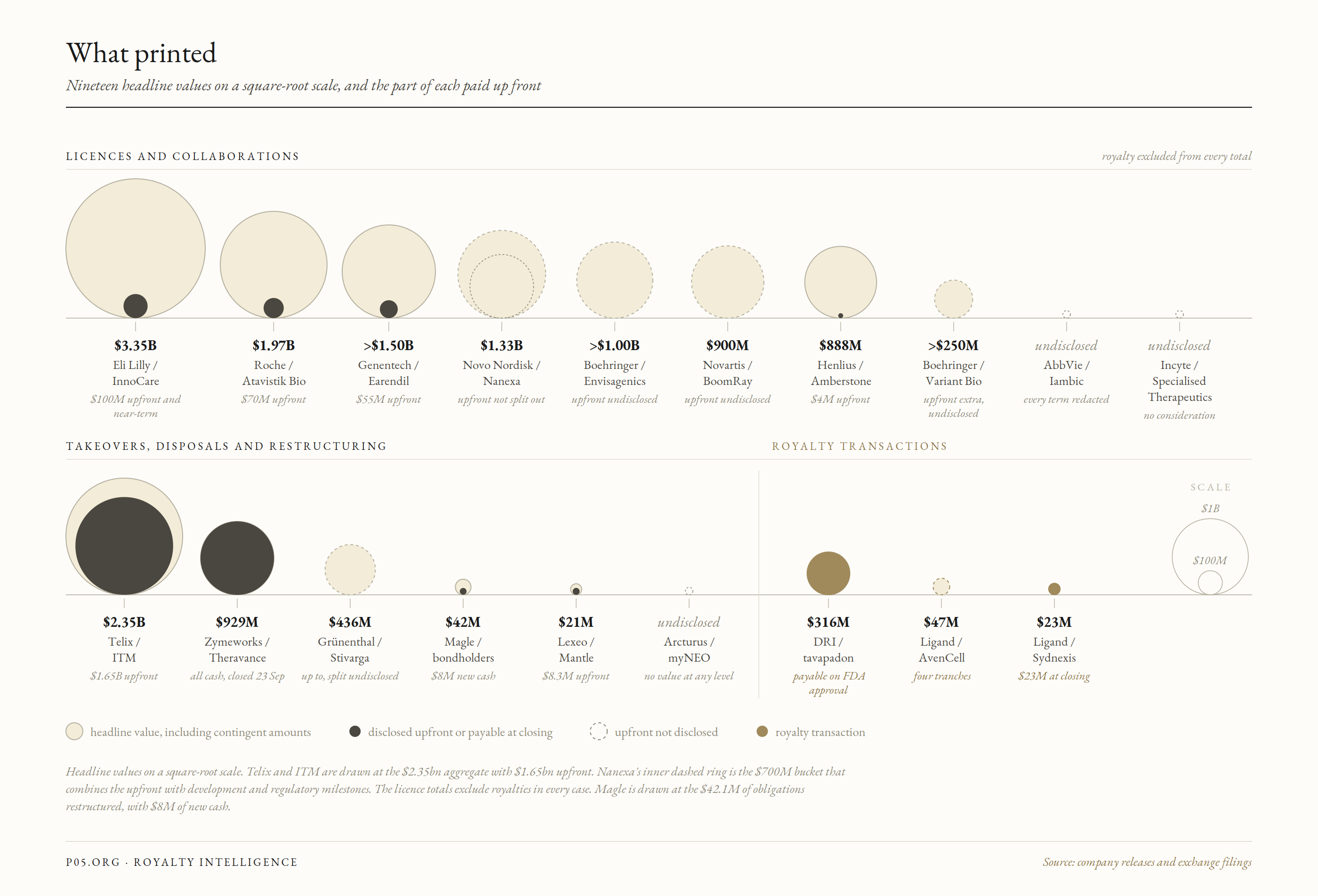
Nineteen headline values on a square-root scale, grouped as licences, takeovers and restructuring, and royalty transactions. The outer ring is the headline including contingent amounts; the filled disc is the amount disclosed as upfront or payable at closing; a dashed ring means the upfront is not disclosed. Licence totals exclude royalties in every case.
League Tables
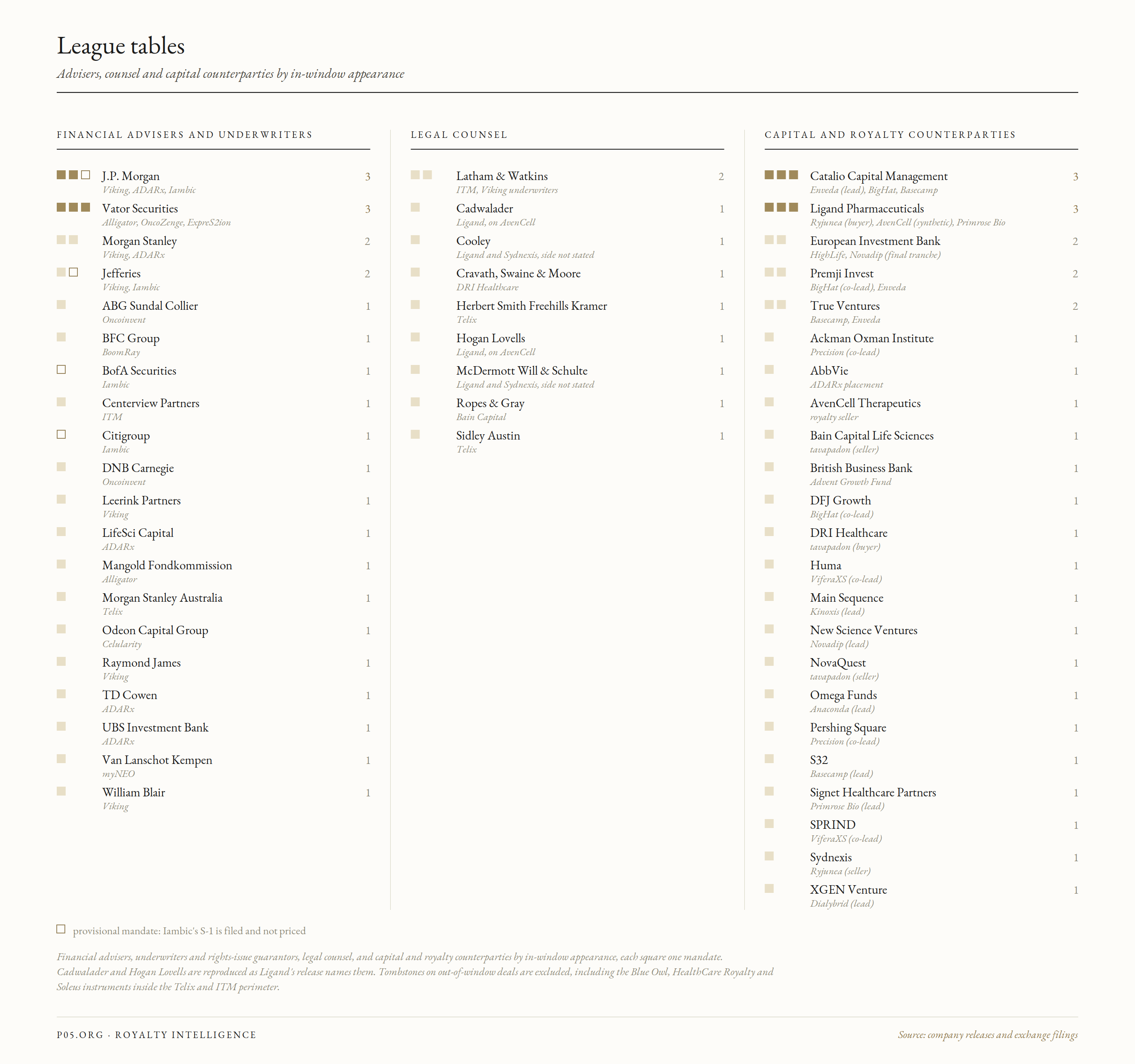
Financial advisers, underwriters and rights-issue guarantors, legal counsel, and capital and royalty counterparties by in-window appearance, each square one mandate. Outlined squares are provisional. Tombstones on out-of-window deals are excluded.
Financial advisers. Morgan Stanley Australia (1: Telix, exclusive). Odeon Capital Group (1: Celularity, placement agent). Centerview Partners (1: ITM, exclusive). Van Lanschot Kempen (1: myNEO and its reference shareholder Novalis Biotech, sole, confirmed by the firm itself). BFC Group (1: BoomRay).
Legal counsel. Cadwalader and Hogan Lovells (1: Ligand, on AvenCell. The release names both firms for one client and none for the counterparty, and is reproduced rather than resolved). Sidley Austin (1: Telix). Herbert Smith Freehills Kramer (1: Telix). Latham & Watkins (2: ITM, and the underwriters on Viking Therapeutics, both confirmed by the firm itself). Cravath, Swaine & Moore (1: DRI Healthcare). Ropes & Gray (1: Bain Capital, confirmed by the firm itself). McDermott Will & Schulte (1: Ligand and Sydnexis, side not attributed). Cooley (1: Ligand and Sydnexis, side not attributed). Latham, Ropes & Gray and Herbert Smith Freehills Kramer confirm their roles on their own sites (HSF Kramer). Sidley Austin, Morgan Stanley Australia and Centerview rest on Telix's release, and NovaQuest's counsel on the tavapadon sale is named nowhere.
Capital and royalty counterparties. Ligand Pharmaceuticals (2: Ryjunea, buyer; AvenCell, synthetic royalty). DRI Healthcare Trust (1: tavapadon, buyer). Bain Capital Life Sciences (1: tavapadon, seller). NovaQuest Capital Management (1: tavapadon, seller). Sydnexis (1: Ryjunea, seller). AvenCell Therapeutics (1: seller of a portfolio-wide royalty). Blue Owl Capital, through LSI Financing LLC, and HealthCare Royalty and Soleus Capital hold instruments inside the Telix and ITM perimeter, all signed before the window opened. The tombstone rule excludes them.
Underwriters. J.P. Morgan (3: Iambic, ADARx, Viking). Morgan Stanley (2: ADARx, Viking). Jefferies (2: Iambic, Viking). Leerink Partners (1: Viking). William Blair (1: Viking). Raymond James (1: Viking, stock leg only). BofA Securities (1: Iambic). Citigroup (1: Iambic). TD Cowen (1: ADARx). UBS Investment Bank (1: ADARx). LifeSci Capital (1: ADARx). ABG Sundal Collier (1: Oncoinvent). DNB Carnegie (1: Oncoinvent). Iambic's S-1 is filed and not priced, so its three mandates are provisional. ADARx and Viking both priced on 24 September, and their tombstones stand subject to closing.
Rights-issue guarantors. Vator Securities (3: Alligator, OncoZenge, ExpreS2ion). Mangold Fondkommission (1: Alligator).
Investors, by lead. Pershing Square Inc. and the Ackman Oxman Institute (1: Precision Neuroscience, co-led with an unnamed life sciences fund). Catalio Capital Management (1: Enveda, and a participant at BigHat and Basecamp). DFJ Growth and Premji Invest (1: BigHat, co-led). S32 (1: Basecamp). Omega Funds (1: Anaconda Biomed). New Science Ventures (1: Novadip). Signet Healthcare Partners (1: Primrose Bio). XGEN Venture (1: Dialybrid). Main Sequence (1: Kinoxis). SPRIND and Huma (1: ViferaXS, co-led). HighLife names no lead and no Series letter across a thirteen-investor round and is not tabled by lead.
Investors, other named participants. Fund+, Wallonie Entreprendre, VIVES Fund, ORSA Tech, Sambrinvest, Noshaq and Invest.BW (Novadip). CDP Venture Capital (Dialybrid). 1315 Capital, Ligand Pharmaceuticals, LDV Partners and Agent Capital (Primrose Bio). Andera Partners, Sofinnova Partners, Supernova Invest, Mérieux Equity Partners, the European Investment Bank, BNP Paribas Développement, Capricorn Partners, Critical Path Ventures, Pro Benefis Familiae, SPRIM Global Investments, USVP, Sectoral and VI Partners (HighLife). FOCO through COFIDES, Asabys, Ysios Capital and CDTI through Innvierte (Anaconda Biomed). Durable Capital Partners, ICONIQ, Lightspeed, Surveyor Capital, accounts advised by T. Rowe Price Investment Management, Digitalis Ventures, Alderline Group, Baillie Gifford, Premji Invest, FPV Ventures, True Ventures, Kinnevik, Dimension, Lifeforce Capital and Lux Capital (Enveda).
Two notes on the investor table. Catalio appears twice on different footings: as lead of the largest private round in the window, and as a 5%-or-greater holder disclosed in Iambic's S-1.
Only the first is a tombstone. And one participant in the Enveda round is unnamed, described only as "a notable Sovereign Wealth Fund".
Iambic's other disclosed holders, Nexus Ventures, Q Healthcare Holding, NVIDIA Corporation and Coatue Ventures, reach the record through the S-1 rather than an in-window financing and are recorded, not tabled.
State and supranational participants. Four in the window, and not one of them lends against turnover. SPRIND, through an instrument it does not name (ViferaXS). CDTI, through Innvierte Economía Sostenible SICC, as equity (Anaconda Biomed). COFIDES, through FOCO, as equity or a hybrid, undisclosed (Anaconda Biomed). The European Investment Bank, side undisclosed (HighLife), with a separate $20.9M (EUR 18M) facility releasing its final tranche at Novadip. Wallonie Entreprendre, Sambrinvest, Noshaq and Invest.BW are Walloon public vehicles in the Novadip round, and the two Walloon repayable advances behind that company remain the only turnover-linked public instruments anywhere in this issue.
All information in this report was accurate as of the research date and is derived from publicly available sources including SEC filings, Hong Kong Stock Exchange announcements, European Medicines Agency and Food and Drug Administration records, United States patent assignment records, company press releases and financial news reporting. Information may have changed since publication. This content is for informational purposes only and does not constitute investment, legal, or financial advice. The author is not a lawyer or financial adviser.