
The Weekly Term Sheet (2026-W40)
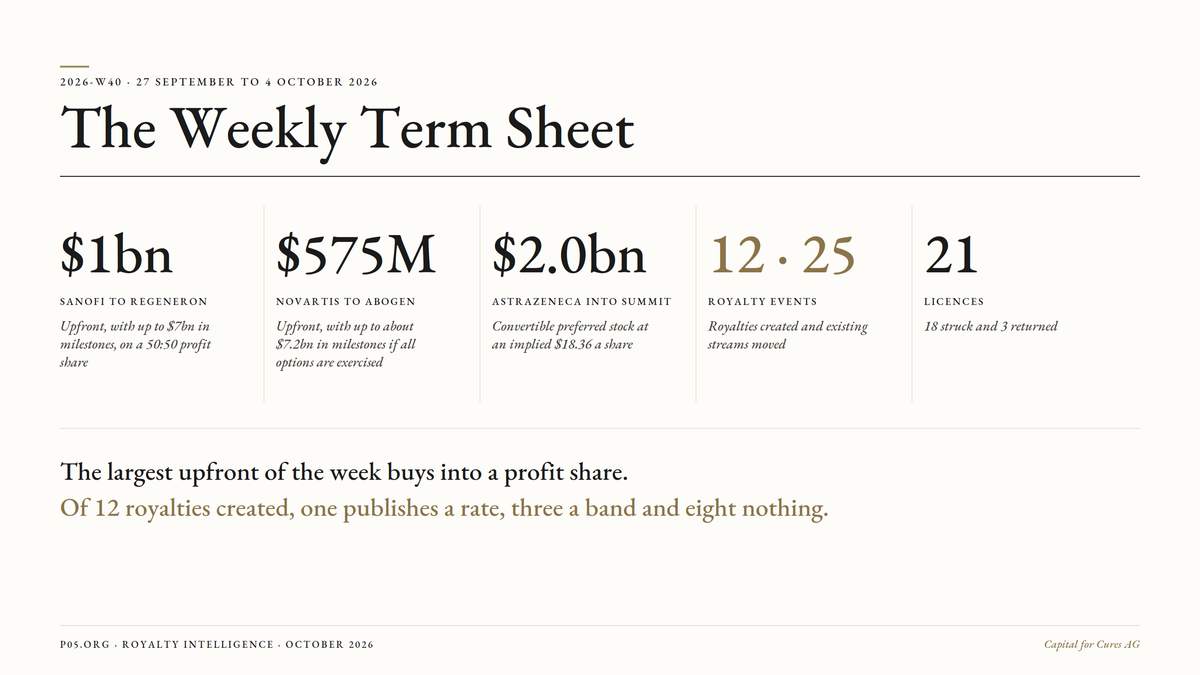
The largest upfront of the week, $1bn from Sanofi to Regeneron, buys into a 50:50 profit share, and of the 12 royalties created in the window one publishes a rate, three publish a band and eight publish nothing.
Sanofi paid Regeneron $1bn upfront against up to $7bn in milestones to add four long-acting immunology antibodies to their alliance, and Novartis paid Abogen $575M upfront against up to approximately $7.2bn in milestones for an mRNA-encoded T-cell engager. The one published rate is BioMarin's on Yuviwel, 20% of US net sales and 18% in the European Union, Brazil and South Korea.
Merck took exclusive global rights to SciBrunch Therapeutics' oral KRAS G12D inhibitor SPR2015 for $400M upfront against $2.13bn in total potential value, closed on signing. Sun Pharma took exclusive rights to manufacture and commercialise lerodalcibep worldwide outside the United States and China from LIB Therapeutics, against an upfront, milestones and royalties on net sales, none of them quantified.
Lerodalcibep is approved in the United States as Lerochol since December 2025 and in the European Union as Lyrokaul since 21 September 2026. It now carries three royalty layers: Sun to LIB, unpriced; Hasten to LIB on Greater China, unpriced since 2023; and Everest Medicines to Hasten on the same territory, tiered from a high single-digit percentage to a low- to mid-teen percentage, published in a Hong Kong filing in December 2025.
The only band on the asset sits on the sublicence, one layer removed from the licensor.
JCR Pharmaceuticals announced a Japanese orphan designation and priority review for givinostat in Duchenne muscular dystrophy, on a licence from Italfarmaco signed in December 2025 that disclosed no upfront, no milestones and no royalty. Leads Biolabs took the same designation on LBL-024, an asset it has never licensed.
Hansoh disclosed on Sunday that the European Commission had revoked the marketing authorisation for aumolertinib granted in February, on a procedural ground, with no sales having been made under it.
Two readouts on Monday landed on published streams, and both met their primary endpoints. Mirum's Phase 3 AZURE-1 on brelovitug reached 56% and 45% against 0% on the combined endpoint, under a mid-single-digit royalty to Novartis and up to $200M of sales milestones to former Bluejay holders.
Kodiak's pivotal DAYBREAK showed non-inferiority to aflibercept for tarcocimab tedromer at p=0.0007, the product on which Baker Bros holds a 4.5% royalty on annual net sales, bought in 2019 and capped at 4.5 times the amount funded.
Zymeworks disclosed that 75% of the Yupelri profit-share cash flows acquired with Theravance are assigned to OMERS to service a $350M note. Roche returned all rights to emugrobart to Chugai after an interim obesity analysis. CTTQ licensed its pembrolizumab biosimilar to STADA for Europe against a double-digit profit share.
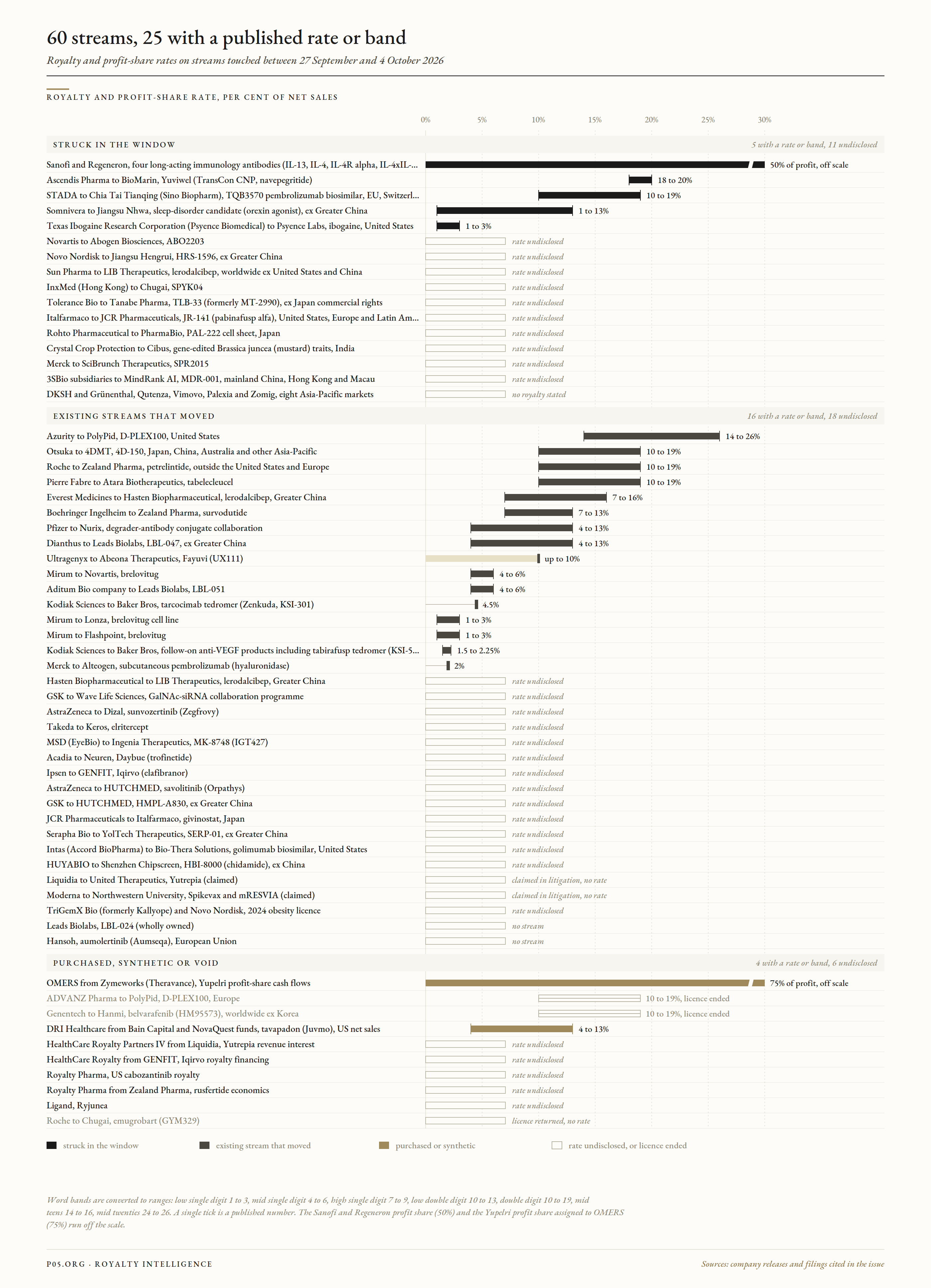
Royalty and profit-share rates on the 60 streams touched between 27 September and 4 October, in three groups, with word bands converted to ranges. Twenty-five publish a rate or band and 35 are drawn as empty bars. The Sanofi and Regeneron profit share (50%) and the Yupelri profit share assigned to OMERS (75%) run off the scale.
Currency note: figures are converted to US dollars with the original in brackets, at approximately EUR 0.86, SEK 9.50, NOK 10.30, CHF 0.885, DKK 6.40, GBP 0.74, JPY 146, KRW 1,370, CNY 7.10, AUD 1.41 and INR 88 per US dollar, being late September 2026 rates. Where a source published its own conversion, that figure is used.
Highlights
Royalty events: 12 created and 25 existing streams moved. Of the 12 created, one publishes a rate, BioMarin's 20% of US net sales and 18% in the European Union, Brazil and South Korea on Yuviwel, three publish a band and eight publish nothing.
Four of the 25 moves were payments or receipts: $12M from GSK to Wave Life Sciences, $600M from AstraZeneca to Dizal, $20M from Takeda to Keros and $7M from Pfizer to Nurix.
Three streams ended. Roche returned emugrobart to Chugai, and the ADVANZ licence on D-PLEX100 in Europe and the Genentech licence on Hanmi's belvarafenib were terminated.
Two sit with royalty funds: the HealthCare Royalty revenue interest on Yutrepia, under a Delaware ruling of 30 September, and the tavapadon rights DRI Healthcare agreed to buy, with closing unconfirmed. The other 16 moved on a readout, a filing, an approval, a milestone or a disclosure.
M&A and restructuring: 14. Two publish a full price: Webster Equity Partners' take-private of Lifecore Biomedical at $6.28 a share plus a contingent value right, for up to $663.7M, and Axogen's $200M cash purchase of BioCircuit Technologies.
Two are asset sales, at $13M and $5.5M. One is a spin-off, Corteva's seed business as Vylor, and one a voluntary administration, Paradigm Biopharmaceuticals.
Beam Therapeutics' trade-secrets suit against YolTech and Serapha Bio puts a licence carrying over $2bn in milestones in dispute. BioNTech confirmed four site closures after a sale process ended without a buyer.
The other six publish no total consideration.
Licence-outs and asset acquisitions: 21, of which 18 struck and three returned. Six of the 18 publish an upfront: $1bn from Sanofi to Regeneron, $575M from Novartis to Abogen, $400M from Merck to SciBrunch, $300M from Novo Nordisk to Hengrui, $21M (RMB 150M) from 3SBio to MindRank and $10.5M from Somnivera to Jiangsu Nhwa.
Three publish a milestone total and no upfront: Tolerance Bio at up to approximately $560M, STADA at up to $62M (EUR 53M) and Psyence at about $1.3M. Nine publish no figure at all.
The three returns are D-PLEX100 in Europe to PolyPid, belvarafenib to Hanmi, with $830M of milestones lapsing unpaid, and emugrobart to Chugai.
Regulatory: 27. Seven are approvals: Emcitate, the Autus paediatric heart valve and Degevma at the FDA, ensitrelvir in the European Union, subcutaneous pembrolizumab and pirtobrutinib in China, and Optune Pax in Japan.
The European Commission revoked one marketing authorisation, Hansoh's aumolertinib. The FDA extended its review of Novo Nordisk's denecimig on 2 October, without a complete response letter.
Four actions sit on a published rate or band: Fayuvi, on Abeona's royalty of up to 10%; D-PLEX100, on PolyPid's mid-teen to mid-twenties royalty from Azurity; tabelecleucel, on Atara's tiered double-digit royalty from Pierre Fabre; and subcutaneous pembrolizumab, on Alteogen's 2%.
Clinical: 23. Three Phase 3 readouts landed on a royalty-bearing stream: Mirum's AZURE-1 on brelovitug, Kodiak's DAYBREAK on tarcocimab tedromer and Boehringer Ingelheim's SYNCHRONIZE-2 on survodutide.
One Phase 3 missed its primary endpoint, Rafael Holdings' Trappsol Cyclo in Niemann-Pick type C. One interim analysis ended a licence, Roche's on emugrobart.
Structured capital: 0 new and 1 closing due. DRI Healthcare's $316M purchase of tavapadon royalty rights, signed before the window, was due to close on 29 September, and no confirmation had been published by 4 October. The Zymeworks note to OMERS was signed on 23 September and is carried in W39.
Private funding: 12. The three largest are Varda Space Industries at $251M, TriGemX Bio at $94M and Breye Therapeutics at $79.0M (EUR 67.5M). Three carry a state investor: EIFO in Breye, CDP Venture Capital in Aptadir and Industrifonden in AnaCardio.
Public capital and debt: 18. The four largest are AstraZeneca's $2.0bn of convertible preferred stock in Summit Therapeutics, Grünenthal's $988M (EUR 850M) of 2032 bonds, Integra LifeSciences' $600M term loan B and the ADARx offering at $513.2M with the option exercised.
Seven are Nordic issues or restructurings, each under $7M.
Capital formation: 2. Hatteras Venture Partners held a first closing of Hatteras Opportunity Fund II, which targets $100M, and Sofinnova Partners closed Sofinnova MD Start IV at $96M (EUR 82M).
Animal health: 2. Zenex Animal Health completed its purchase of Sava Healthcare's companion-animal business in India, and BiomEdit received a USDA conditional licence for an engineered probiotic biologic for broilers.
Crops and seeds: 5, one of them, the Vylor spin-off, also counted under M&A. India's competition authority cleared Crystal Crop Protection's $252M purchase of FMC India, and American Vanguard agreed to buy four Syngenta brands in the United States.
Cibus licensed gene-edited mustard traits to Crystal Crop Protection, and Corteva settled its trait suit against Inari, both on undisclosed economics.
Courts: 11. Three Delaware rulings on 30 September concern Liquidia's Yutrepia, a golimumab biosimilar from Accord and Bio-Thera, and Moderna's government-licence defence against Northwestern University.
The Federal Circuit denied Eli Lilly rehearing en banc, leaving Teva's $177M verdict on Emgality in place. Sanofi and Regeneron settled their collaboration litigation inside the 1 October alliance expansion.
Priority review vouchers: 1 issued, 0 sold. The voucher went to Egetis on Emcitate, and Egetis says it will explore monetisation. Atossa plans a contingent value right on a future voucher.
Revenue interest returns four filings, none in life sciences. Priority review voucher returns one amended S-4 for a SPAC merger with OHB Pediatrics, which describes no voucher sale.
Rate disclosure across the window: five hard numbers and 15 bands. BioMarin's definitive licence to Ascendis, filed on 30 September, sets 20% of US net sales and 18% in the European Union, Brazil and South Korea.
Two existing streams in the window publish bands: Roche's royalty to Zealand on petrelintide outside the US and Europe, "tiered double-digit royalties up to high teens", and Genentech's terminated royalty to Hanmi on belvarafenib, "tiered double digit". Nurix's Pfizer licence adds a band of mid-single-digit to low-double-digit tiered royalties, and Nhwa's Somnivera licence a band of single-digit to low double-digit.
The other hard numbers are the Baker Bros royalty of 4.5% on tarcocimab tedromer, the 75% of the Yupelri profit share assigned to OMERS and Alteogen's 2% on subcutaneous pembrolizumab.
The further bands:
- The Novartis royalty on brelovitug at a mid-single-digit percentage
- The Otsuka royalty to 4DMT at a tiered double-digit percentage
- The STADA profit share to CTTQ at a double-digit percentage
- The Psyence royalty at a low single-digit percentage
- The Everest Medicines royalty to Hasten on lerodalcibep from a high single-digit to a low- to mid-teen percentage
- Zealand's royalty from Boehringer Ingelheim on survodutide at high-single to low-double digits
- Atara's tiered double-digit royalty from Pierre Fabre
- PolyPid's royalty from Azurity at mid-teen to mid-twenties percentages
- The terminated ADVANZ royalty on D-PLEX100 at double-digit percentages
- Abeona's royalty on Fayuvi of up to 10%
- The tavapadon royalty rights bought by DRI Healthcare at mid-single to low-double digits
The Merck licence on SPR2015, the Sun Pharma licence on lerodalcibep, the 2023 Hasten licence above Everest, the JCR licence on givinostat, the GSK licence on HMPL-A830, the Ingenia licence on MK-8748, the LIB in-licence from Bristol Myers Squibb, and the new licences to Novartis, Novo Nordisk, InxMed, Tolerance Bio, Italfarmaco, Rohto and Crystal Crop all publish no rate.
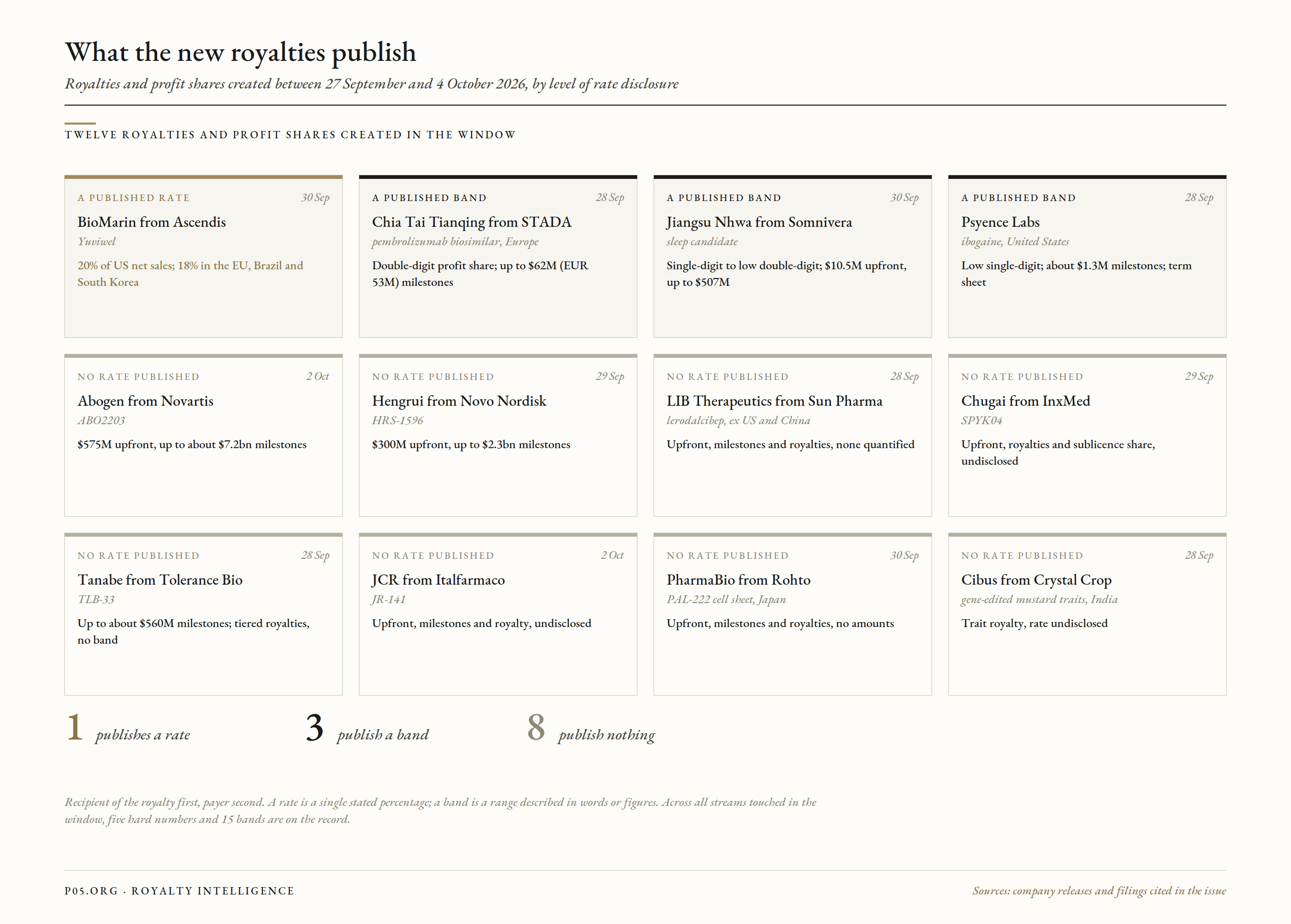
The 12 royalties and profit shares created in the window, by what each publishes: one a rate, three a band and eight nothing.
Tracked royalty buyers inside the window: none announced a new transaction between 27 September and 4 October. DRI Healthcare's $316M purchase of tavapadon royalty rights was conditional on FDA approval; the FDA approved tavapadon as Juvmo on 25 September, and DRI stated on 28 September that closing "is expected to occur on September 29, 2026", funded from cash and its credit facility (DRI Healthcare).
The acquired rights carry four annual fixed payments of $23.4M on the first four anniversaries of FDA approval from 25 September 2027, tiered royalties on US net sales "at combined tiered, mid-single digit to low-double digit royalty rates" and sales milestones, with aggregate receipts under a contractual hard cap of $437.5M.
The sellers of the "royalty participation rights in U.S. net sales of tavapadon" are funds managed by Bain Capital and NovaQuest Capital Management, with Ropes & Gray advising Bain Capital (Ropes & Gray).
No closing confirmation had been published by 4 October. Royalty Pharma has issued no release since 15 September and no filing since 19 August, and its own guidance puts the expiry of its US cabozantinib royalty in September 2026 with the final payment in the fourth quarter (Royalty Pharma).
Open at the close of the window. The AstraZeneca investment in Summit, with closing due by 5 October and no notice published.
The DRI Healthcare closing on tavapadon, due 29 September and unconfirmed. The Novo Nordisk and Hengrui licence, under Hart-Scott-Rodino, in the fourth quarter.
The Lifecore go-shop, to 28 October. The final judgment in United Therapeutics v. Liquidia, expected about 7 October.
The Paradigm deed of company arrangement, with creditors meeting on 9 October. The Surrozen second closing, on or about 20 October.
The PolyPid PDUFA date on D-PLEX100, 28 November. The Psyence definitive agreement, due by 30 November.
The Egetis voucher. The Tolerance Bio financing.
The Serapha and Boundless Bio merger closing, with Beam's suit pending. Electra Therapeutics' 3,500,000-share option.
Genentech and Earendil's closing under Hart-Scott-Rodino. HUTCHMED and GSK's closing on HMPL-A830.
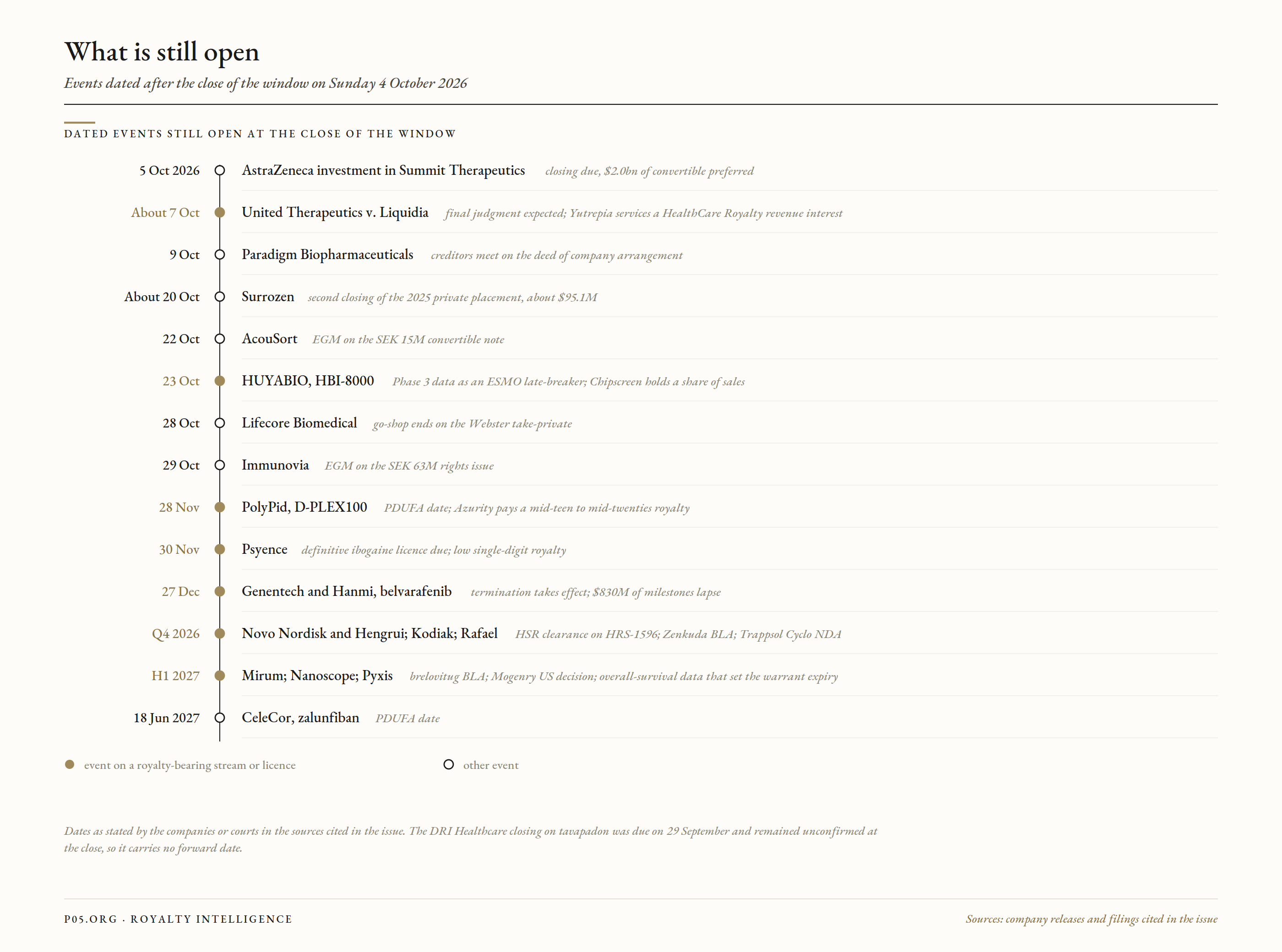
Dated events still open at the close of the window, from the AstraZeneca and Summit closing due on 5 October to the zalunfiban PDUFA date of 18 June 2027. Gold marks an event on a royalty-bearing stream or licence.
M&A and Restructuring
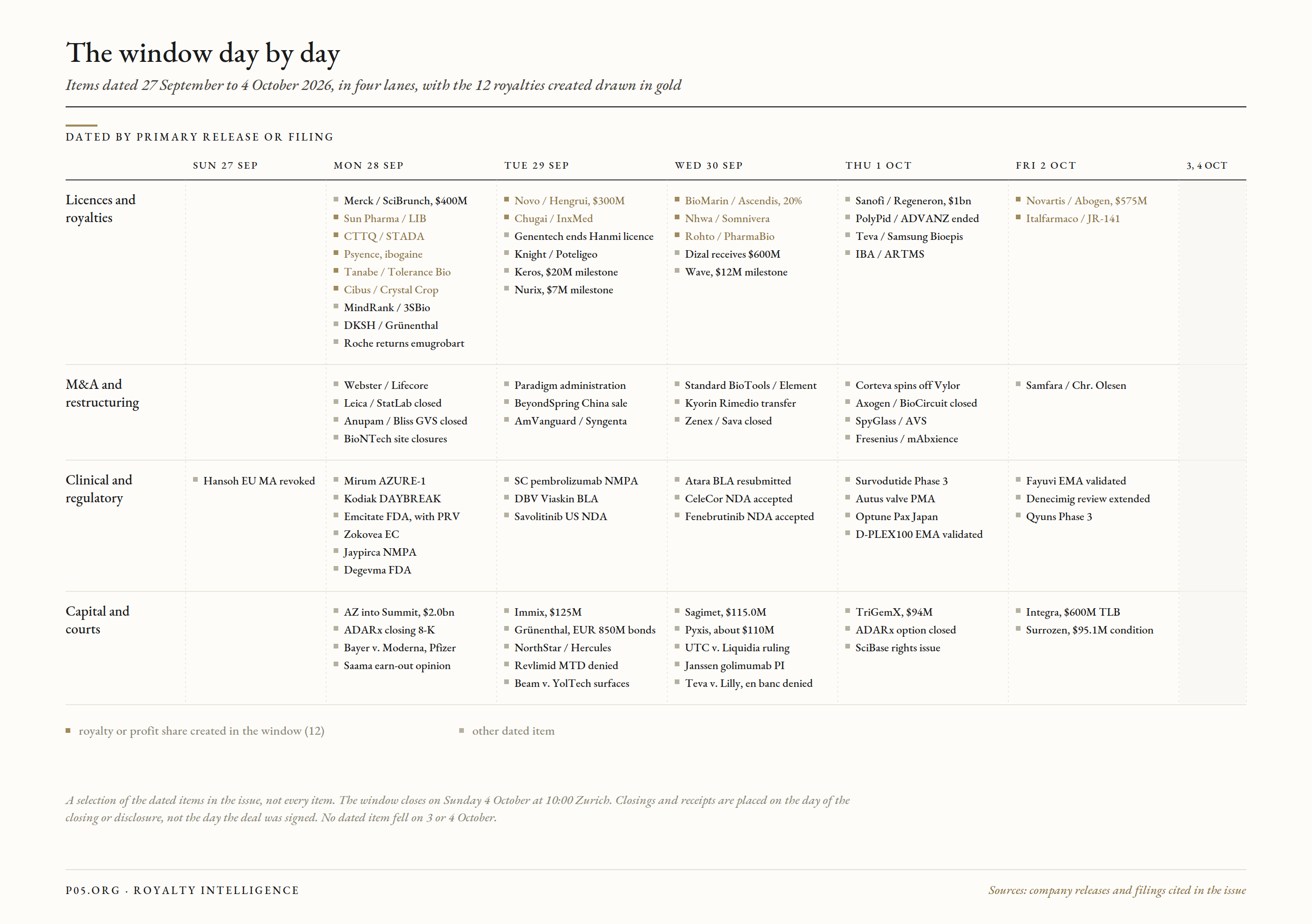
The window day by day, dated by primary release or filing and filed in four lanes. The 12 royalties created are drawn in gold; no dated item fell on 3 or 4 October.
Webster Equity Partners / Lifecore Biomedical: A Take-Private With a $160M CVR on Revenue and EBITDA Tests Through 2030 (Mon Sep 28)
Webster Equity Partners agreed on 27 September to acquire Lifecore Biomedical, a sterile-injectable contract manufacturer, for $6.28 a share in cash and one non-tradeable contingent value right per share (Lifecore). The cash price is a premium of approximately 49.5% to the 25 September close, and cash plus the maximum CVR reaches $9.67 a share.
- The value: up to $663.7M in total including the full CVR. Series A preferred receives its conversion amount in cash, approximately $6.53 per common equivalent at 30 June 2026, plus CVRs
- The CVR, verbatim: "$30 million for achievement of the 2028 performance milestone, $45 million for achievement of the 2029 performance milestone, and $85 million for achievement of the 2030 performance milestone", $160M in aggregate.
- The 2028 and 2029 tests are non-Alcon revenue of at least $120M and $175M, together with Alcon revenue of at least $54M and $53M or total revenue of $174M and $228M; the 2030 test is consolidated EBITDA of $120M, with a 2029 catch-up on a missed 2028 payment and a scaling factor under the CVR agreement, which is Exhibit C to the merger agreement
- The financing: $400M of committed equity from Webster funds; a $115M term loan and $30M revolver from third-party lenders including MidCap Financial Trust and MSD Partners; and $35M from Alcon Research, which is also a principal customer. No financing condition (Lifecore 8-K)
- The protections: a go-shop ending 28 October with a termination fee of $7.47M; a company termination fee of $9.96M; a reverse termination fee of $16.18M; voting support from holders affiliated with Wynnefield Capital and Legion Partners
- The advisers: Bourne Capital Partners and Craig-Hallum Capital Group for Lifecore, with Ballard Spahr and Zukerman Gore Brandeis & Crossman as counsel; Morgan Stanley for Webster, with Goodwin Procter as counsel
- Next: closing expected by the end of the fourth quarter of 2026, subject to shareholder and regulatory approval
- Instrument: a cash merger with a non-tradeable, milestone-based CVR
- Royalty read-through: no royalty-bearing asset. The CVR is a deferred-consideration instrument on a CDMO's revenue and EBITDA, with a customer as lender
A closed diagnostics acquisition with no terms. Leica Biosystems, part of Danaher, completed its acquisition of StatLab Medical Products, a supplier of pre-analytical pathology consumables and equipment, from Linden Capital Partners and Audax Private Equity on 28 September (Leica Biosystems). Price, signing date and advisers are not disclosed.
A biosimilars minority bought out. Fresenius completed its acquisition of the remaining 45% of mAbxience from Insud Pharma on 1 October, taking full ownership of the biosimilars developer and manufacturer in which it bought 55% in 2022 (Fresenius). No price and no advisers are disclosed.
An intraocular lens maker bought from Santen. SpyGlass Pharma acquired Advanced Vision Science, the maker of Eternity intraocular lenses, from Santen for approximately $13M in cash, subject to customary adjustments, closing on signing on 1 October, to secure lens manufacturing for its Phase 3 BIM-IOL System (SpyGlass Pharma).
Santen keeps exclusive rights to sell the lenses in Japan under an amended supply and distribution agreement, with non-exclusive cross-licences both ways.
Gitkin & Co. and Wilson Sonsini advised SpyGlass; MTS Health Partners and Squire Patton Boggs advised Santen.
A nerve-repair device acquisition closed. Axogen completed its acquisition of BioCircuit Technologies, maker of the FDA-cleared NerveTape sutureless nerve-repair device, on 1 October, under the $200M cash agreement announced on 10 September, and guided to approximately $6M of NerveTape revenue in the fourth quarter of 2026 and $34M in 2027 (Axogen). No earn-out, royalty or adviser is disclosed.
A controlled-substance API maker sold to private equity. Samfara completed its acquisition of Chr. Olesen Synthesis, a Danish manufacturer of controlled-substance active ingredients, from Chr. Olesen and funds managed by Signet Healthcare Partners on 2 October, with chief executive Thomas Moestrup investing alongside (Samfara). Terms are not disclosed. Stifel advised the sellers, with Moalem Weitemeyer, Nielsen Nørager and Sheppard Mullin as counsel; Addleshaw Goddard and Nivaro Law acted for Samfara.
A controlling stake closed on an earlier agreement. Anupam Rasayan completed its acquisition of a 48.2% controlling stake in Bliss GVS Pharma on 28 September at $3.40 (INR 299) a share, under a share purchase agreement of 23 May 2026 and a completed open offer, financed by a $34.1M (INR 3bn) term loan and approximately $165M (INR 14.5bn) of non-controlling, non-voting instruments led by Bain Capital, Trust Group and Investec (Anupam Rasayan, NSE).
A China subsidiary sold for a trial-funding obligation. BeyondSpring sold BeyondSpring Ltd, which holds the majority of its China operating company, to Biolin Investment, against Biolin's obligation to fund the China portion, approximately 221 of 442 patients, of the Phase 3 DUBLIN-4 trial of plinabulin in post-checkpoint non-squamous lung cancer; BeyondSpring keeps rights outside Greater China and access to the China data (BeyondSpring). No cash or royalty is disclosed. The FDA granted plinabulin Fast Track the same day.
A Phase 3 miss into administration.
Paradigm Biopharmaceuticals appointed Hayden White and Chris Pattinson of FTI Consulting as voluntary administrators on 29 September, six days after the interim analysis of its Phase 3 PARA_OA_012 of Zilosul in knee osteoarthritis fell below the continuation threshold, citing the need to resolve "the mismatch between current liabilities payable in the short term and the inherent long term value of the intellectual property portfolio" (Paradigm, ASX).
Obsidian Global, the secured convertible-note lender to which Paradigm returned $2M on 24 September, supports the board and will work with the administrators on a deed of company arrangement. The ASX has suspended the shares under Listing Rule 17.3.
The first creditors' meeting is on 9 October. No funding figure is disclosed.
A sale process that ends in closures.
BioNTech confirmed on 28 September that it will close its manufacturing sites at Tübingen at the end of 2027, Marburg at the start of 2028 and Idar-Oberstein at the end of 2028, and its Singapore plant in the first quarter of 2027, affecting up to 1,800 positions.
A spokesperson stated that "despite the intensive efforts of all parties involved and a broad-based sales process, it was unfortunately not possible to realize a sale" (Fierce Pharma).
The exit plan was announced on 5 May 2026 with up to 1,860 positions and approximately $581M (EUR 500M) of recurring annual savings by 2029.
The one unit sold, JPT Peptide Technologies, went to a fund advised by DUBAG Group on 27 August, before the window.
BioNTech has issued no release or filing on the closures.
A Japanese generics carve-out into a three-party vehicle.
Kyorin Pharmaceutical resolved on 30 September to transfer the shares of its generics subsidiary Kyorin Rimedio, together with the Takaoka and Inami plants, to Pharmatech Co-creation Platform, a joint venture of Daito Pharmaceutical, Meiji Seika Pharma and the Development Bank of Japan, after two company splits that leave the authorised-generic business with Kyorin (Kyorin). Kyorin publishes no price and no gain or loss.
Daito's disclosure puts the holdings at 49.1%, 36.0% and 14.9%, with capital of $0.7M (JPY 100M) and implementation planned for 1 April 2027 (Zaikei Shimbun).
A divestiture re-cut under a superior proposal.
Standard BioTools terminated its 28 July agreement with Multiplex Bio and agreed on 30 September to sell its mass-cytometry business, including the CyTOF, Hyperion and Maxpar lines, to Element Biosystems, an acquisition vehicle of GMT Venture Partners, for "$5.5 million in cash payable at closing, subject to customary adjustments", after the board found GMT's unsolicited 29 August proposal superior; closing is expected by the end of 2026, substantially concurrently with the Treeline transaction and subject to stockholder approval (Standard BioTools, 8-K).
Maynard Nexsen and DPO&Co advised GMT.
No royalty or earn-out is disclosed.
Royalty-Bearing Positions
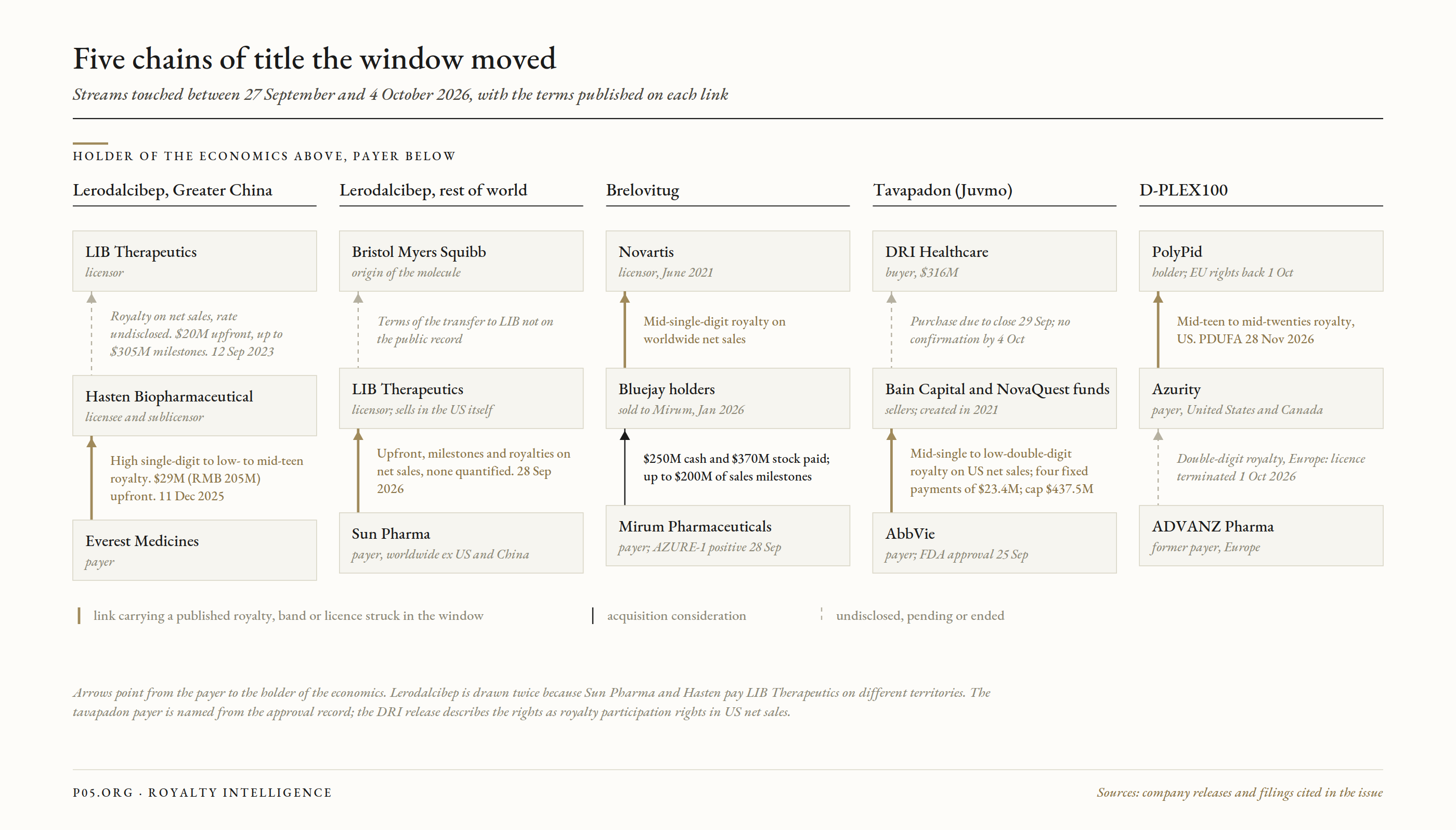
Five chains of title the window moved, holders of the economics above and payers below. Gold links carry a published royalty or a licence struck in the window; dashed links are undisclosed, pending or ended.
Merck / SciBrunch Therapeutics: $400M Upfront for a Preclinical KRAS G12D Inhibitor, Closed on Signing, With No Royalty Named (Mon Sep 28)
Merck took an exclusive global licence to develop, manufacture and commercialise SPR2015, an oral KRAS G12D (ON) inhibitor, from SciBrunch Therapeutics of Shanghai (Merck). The upfront is $400M on a preclinical molecule, and the release states that the transaction has closed.
- The consideration: $400M upfront, and SciBrunch is "eligible to receive payments associated with the achievement of certain milestones related to development, commercialization and other activities across multiple indications", for an aggregate potential value of $2.13bn, leaving up to $1.73bn in milestones. The split by type and any royalty are not disclosed
- The accounting: Merck records a pre-tax charge of $400M, approximately $0.13 per share, in its third-quarter 2026 GAAP and non-GAAP results
- The licensor: SciBrunch Therapeutics Co., Ltd., Shanghai, founded in late 2024 by Tao Hu, its chairman and chief executive, and Yang Zhang. Its investors are not named
- The asset: preclinical, with xenograft data presented at AACR 2026
- The adviser: BofA Securities as exclusive financial adviser to SciBrunch. No adviser or counsel is named for Merck
- Status: closed on 28 September, with no antitrust condition stated
- Instrument: an exclusive worldwide licence with development and commercial milestones
- Royalty read-through: a $400M upfront sits on an asset with no clinical data and a licence that names no royalty. SciBrunch's economics beyond the $2.13bn total are not on the record
Novo Nordisk / Hengrui Pharma: $300M Upfront for a Phase 1-Ready Oral GLP-1/GIP Agonist, Against $2.3bn of Milestones and an Unpublished Royalty (Tue Sep 29)
Novo Nordisk took exclusive rights to HRS-1596, a once-weekly oral GLP-1 and GIP dual receptor agonist, worldwide outside mainland China, Hong Kong, Macau and Taiwan, from Jiangsu Hengrui Pharmaceuticals (Novo Nordisk). The upfront is $300M on a molecule that has not entered the clinic, and the licence carries royalties with no band.
- The consideration: "an upfront payment of US $300 million" and "development, regulatory and commercial milestone payments of up to US $2.3 billion", for a potential total of up to $2.6bn (Hengrui Pharma, HKEX). Hengrui's press release describes milestones of up to $2.6bn; its exchange filing and Novo's release both put the upfront inside the $2.6bn
- The royalty, verbatim: "Hengrui is eligible to receive royalties based on the net sales of HRS-1596 within the licensed territory." No tier or percentage is given in the filing
- The asset: phase 1-ready, with no clinical data disclosed. Hengrui keeps Greater China
- Status: subject to Hart-Scott-Rodino clearance, with closing expected in the fourth quarter of 2026
- Not disclosed: the royalty band, the milestone split, and advisers or counsel on either side
- Instrument: an exclusive ex-Greater China licence with upfront, milestones and royalties of undisclosed rate
- Royalty read-through: a second Chinese-originated obesity asset licensed in the window, after MindRank's oral GLP-1 to 3SBio in China. No royalty band is published by either party
Beam Therapeutics / YolTech / Serapha Bio: A Trade-Secrets Suit Against the Licensor and Licensee of a Base Editor Carrying Over $2bn in Milestones (Surfaced Tue Sep 29)
Beam Therapeutics sued a former scientist, YolTech Therapeutics and Serapha Bio under the Defend Trade Secrets Act, alleging that its base-editing work in alpha-1 antitrypsin deficiency was taken to found YolTech (Beam Therapeutics v. Wang et al, D. Mass.). The complaint was filed on 25 September and reported on 29 September, and the asset at issue is licensed ex-China to Serapha against over $2bn in milestones and tiered royalties.
- The case: Beam Therapeutics Inc. v. Wang et al, No. 1:2026cv14414, US District Court for the District of Massachusetts, under 18 U.S.C. § 1836(b), with a jury demand. Beam is represented by Anita Spieth and Eric Marandett
- The defendants: Zi Jun (Emma) Wang, a former Beam scientist; Yuxuan (Jensen) Wu, YolTech's chief executive; Shanghai Yaotang Biotechnology, trading as YolTech Therapeutics; and Serapha Bio
- The allegation: Wang "secretly founded a Chinese biotechnology company called YolTech while still working at Beam" and retrieved "dozens of Beam records she had never opened before", relating to base-editing methods for AATD (BioPharma Dive). Beam seeks to stop use of the information and to recover the value it alleges was extracted
- The response: Serapha "categorically refutes Beam's claims and will vigorously defend the company"
- The asset: SERP-01, YolTech's AATD base editor, with a Phase 2/3 planned for late 2026 or early 2027
- The licence under dispute: YolTech keeps Greater China and licensed the rest of the world to Serapha for an undisclosed cash upfront, "regulatory and commercial milestones totaling over $2 billion" and "tiered royalties on net sales of SERP-01", with no band (Boundless Bio and Serapha Bio)
- The licensee's capital: Serapha is merging into Nasdaq-listed Boundless Bio, with Serapha holders to own approximately 96.3%, alongside a $230M private placement led by RTW Investments and RA Capital, of which $138M is funded and $92M is due at closing, expected in the fourth quarter of 2026 under the ticker AATD. Wedbush advises Serapha, with Gibson Dunn and Goodwin Procter as counsel; Lucid Capital Markets and Latham & Watkins advise Boundless
- Instrument: none created. A licence with milestones and royalties whose chain of title is contested in a US federal court
- Royalty read-through: the stream from Serapha to YolTech, over $2bn in milestones and tiered royalties, rests on an asset whose origin Beam claims in court. The merger closing and the $92M second tranche fall due while the suit is pending
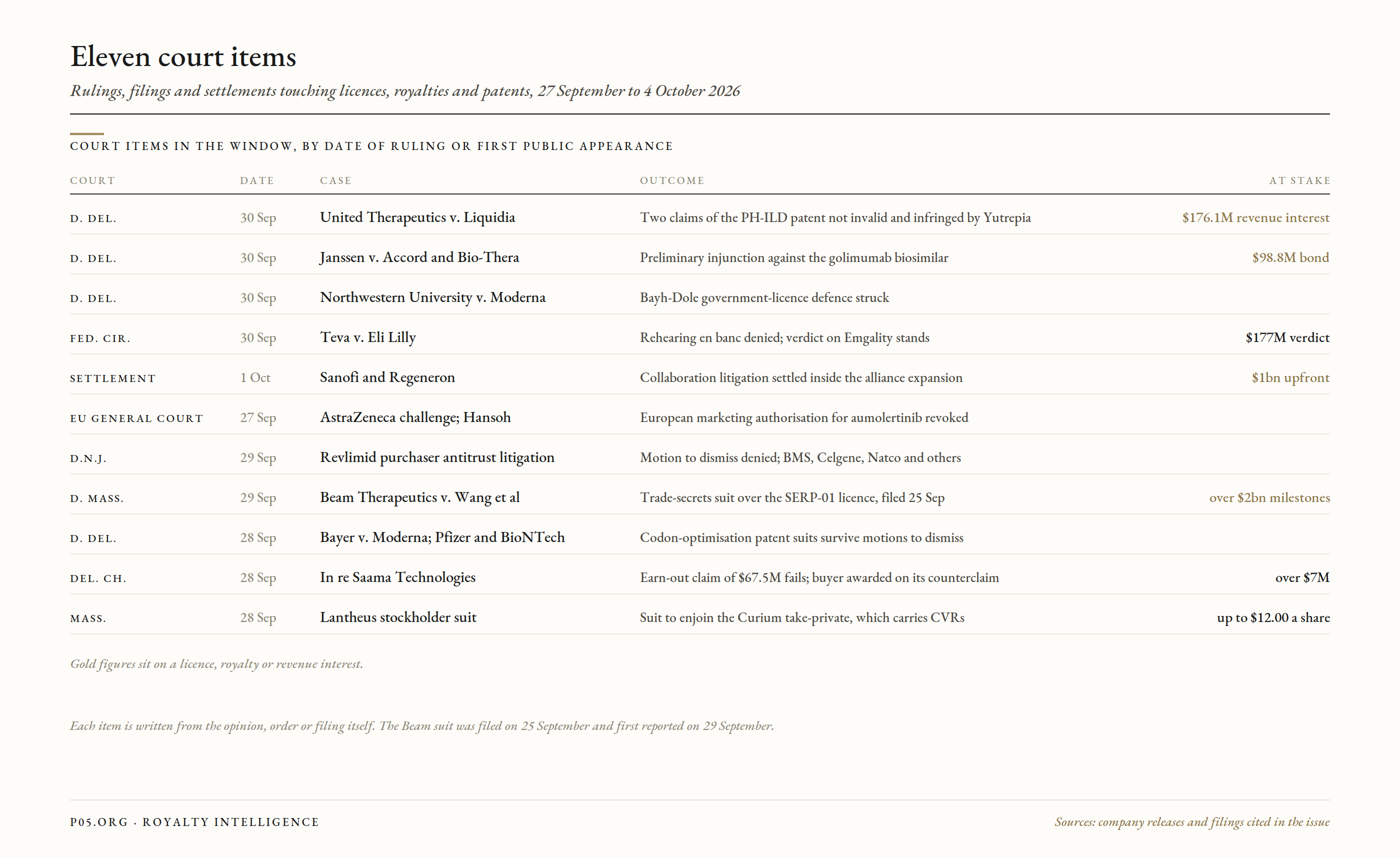
The 11 court items in the window, by court, date, outcome and amount at stake.
A Section 101 challenge to a vaccine patent case denied. Judge William Bryson, sitting by designation in the District of Delaware, denied Moderna's and Pfizer and BioNTech's motions to dismiss Bayer CropScience's suits over US 7,741,118, a Monsanto-origin codon-optimisation patent, as applied to Spikevax and Comirnaty, holding that the method "requires more than simply reciting or relying on an abstract concept or a law of nature" (Bayer CropScience v. Moderna, D. Del. 1:26-cv-00012).
No damages figure or royalty rate is stated at this stage.
An earn-out claim lost, and the buyer awarded damages. Vice Chancellor Will ruled on 28 September in In re Saama Technologies Litigation, C.A.
No. 2022-1045-LWW, that Carlyle's objection to the earn-out statement after its 2021 purchase of Saama, a clinical-data platform, was made in good faith, with audited 2021 revenue of $67.4M against a $72M threshold, and at least $1.5M short even crediting the full AbbVie contract; founder Suresh Katta, who sought the maximum $67.5M earn-out, proved no entitlement, and the buyer was awarded more than $7M on its counterclaim (Delaware Court of Chancery).
Abrams & Bayliss and Selendy Gay acted for Katta; Potter Anderson and Paul Weiss for the buyer.
Pay-for-delay claims on Revlimid survive dismissal. Judge Farbiarz in the District of New Jersey denied motions to dismiss by Bristol Myers Squibb, Celgene, Natco, Teva, AbbVie and other defendants in In re Revlimid & Thalomid Purchaser Antitrust Litigation, No. 2:19-cv-07532, on 29 September, finding plausible the purchasers' claims that patent settlements delayed generic lenalidomide (Law360). No damages figure is stated at this stage.
A $177M patent verdict on a marketed antibody left standing. The Federal Circuit denied Eli Lilly's petition for panel rehearing and rehearing en banc in Teva Pharmaceuticals v. Eli Lilly, No. 24-1094, on 30 September, leaving in place the panel decision that reinstated Teva's $177M jury verdict on its anti-CGRP method-of-use patents against Emgality (galcanezumab), on appeal from the District of Massachusetts (Federal Circuit). Judge Dyk dissented. No petition for certiorari has been reported.
United Therapeutics / Liquidia / HealthCare Royalty: Two Claims of the PH-ILD Patent Held Not Invalid and Infringed by Yutrepia, a Product Whose Revenue-Interest Financing Carried a $176.1M Balance (Wed Sep 30)
Judge Andrews held after a bench trial that claims 1 and 14 of United Therapeutics' US 11,826,327 are not invalid and are infringed by Liquidia's Yutrepia in pulmonary hypertension associated with interstitial lung disease. The four other asserted claims, 5, 6, 9 and 17, were given no patentable weight as identical in scope to claim 1. No remedy has been ordered, and the parties have one week to submit a form of final judgment (Liquidia 8-K).
- The case: United Therapeutics Corp. v. Liquidia Technologies, No. 1:23-cv-00975-RGA, District of Delaware; a 55-page trial opinion and a memorandum order denying Liquidia's motion to strike, both dated 30 September, after a bench trial on 23 to 26 June 2025
- Infringement: "Defendant stipulated to both direct and indirect infringement of claims 1 and 14", leaving validity as the contested issue
- Validity: the court rejected obviousness over Faria-Urbina 2018, the on-sale bar based on off-label Tyvaso use before April 2019, and inherent anticipation by the 2017 INCREASE protocol
- Common ownership: United Therapeutics' own US 10,716,793 was excluded as prior art under 35 U.S.C. 102(b)(2)(C), the court finding that the company "owned the '793 patent since January 31, 2020", before the '327 patent's effective filing date of 17 April 2020
- The judgment: "The parties should submit an agreed upon form of final judgment within one week." The opinion does not address remedy
- The remedy sought: outside the opinion, United Therapeutics seeks an order under 35 U.S.C. 271(e)(4)(A) requiring the FDA to withdraw approval of the Yutrepia NDA until a label without PH-ILD is approved, and "intends to seek monetary damages for past infringement, which could include a royalty on past sales of Yutrepia" (United Therapeutics)
- Liquidia's response: a supplemental NDA to remove PH-ILD from the label, an appeal, and a statement that it "cannot currently estimate the financial exposure"
- The asset: Yutrepia (treprostinil inhalation powder), with net sales of $170.4M in the second quarter of 2026 and $300.3M in the first half; the pulmonary arterial hypertension indication is outside the patent
- The revenue interest: Liquidia's revenue interest financing agreement with HealthCare Royalty Partners IV of 9 January 2023, as amended, carried a balance of $176.1M at 30 June 2026, with fixed quarterly payments, a $15.0M minimum cash covenant and a term expected to end in 2033 (Liquidia 10-Q)
- Counsel: Morris Nichols, Goodwin Procter and McDermott Will & Schulte for United Therapeutics; Shaw Keller and Cooley for Liquidia
- The market: Liquidia closed on 30 September at $30.26, down 57.2%; United Therapeutics closed at $541.89, up 12.6%
- Instrument: none created. A patent judgment on a product securing a revenue interest
- Royalty read-through: a marketed product whose revenue-interest financing from HealthCare Royalty carried a balance of $176.1M at 30 June 2026 faces removal of one of its two indications, with a royalty on past sales claimed by the patent holder
A preliminary injunction against the first interchangeable golimumab biosimilars. Judge Williams granted Janssen's motion for a preliminary injunction against Accord BioPharma and Bio-Thera Solutions in No. 1:26-cv-00222, barring their biosimilar of Simponi (golimumab) pending the patent suit, on a bond of $98.8M due by 14 October; the opinion is under seal (Bloomberg Law).
Immgolis and Immgolis Intri were approved on 15 May 2026 as the first interchangeable biosimilars to Simponi and Simponi Aria, with launch planned for the fourth quarter. Bio-Thera licensed US rights to Intas, Accord's parent, in February 2025 for $21M upfront and up to $143.5M in milestones, with the royalty or profit share undisclosed (Pearce IP).
A Bayh-Dole licence defence struck. Judge Barker granted Northwestern University's motion in No. 1:24-cv-01151 on 30 September, dismissing with prejudice Moderna's declaratory-judgment and breach-of-contract counterclaims based on the government's licence and striking its licence, exhaustion, third-party-beneficiary and unclean-hands defences, in the suit over Spikevax and mRESVIA: the Bayh-Dole Act, or a licence created under it, "does not create a cause of action or defense for third parties" (D. Del.).
Northwestern seeks "at least a reasonable royalty plus enhanced damages for willful infringement" on three nanostructure patents, with 500,001,540 Spikevax doses sold to the US government under one contract. Moderna's separate defence under 28 U.S.C.
1498(a) is not decided; it waits for the Federal Circuit in Arbutus v. Moderna, No. 26-1581, with a joint report due seven days after that decision or by 7 April 2027.
A stockholder suit against a take-private carrying sales-based CVRs. A Lantheus stockholder sued in Massachusetts state court on 28 September to enjoin Curium's approximately $8bn acquisition, alleging the deal is "fundamentally unfair" (Law360).
The consideration is $102.50 a share in cash and up to $12.00 in non-transferable CVRs, paying on 2030 prostate-cancer diagnostics sales between $950M and $1.75bn, neurology diagnostics above $300M and $350M in any year from 2028 to 2030, and Definity above $400M in 2030.
Closing is expected in the first half of 2027.
Sanofi / Regeneron: $1bn Upfront to Add Four Long-Acting Immunology Antibodies to the Dupixent Alliance, With $7bn in Milestones and a Litigation Settlement (Thu Oct 1)
Sanofi and Regeneron expanded their alliance to cover four next-generation long-acting antibodies against IL-13, IL-4, IL-4Rα and an IL-4xIL-13 bispecific, with Sanofi paying Regeneron $1bn upfront (Regeneron and Sanofi). The companies also state that they "have settled their prior collaboration-related litigation".
- The assets: REGN20423, an IL-13 antibody in Phase 1 in atopic dermatitis, and long-acting antibodies against IL-4, IL-4Rα and IL-4xIL-13, plus an option for Sanofi's lunsekimig, a TSLP and IL-13 bispecific, on completion of its Phase 3 in COPD
- The consideration: $1bn upfront from Sanofi to Regeneron and up to $7bn in development, regulatory and commercial milestones
- The economics: global co-development and co-commercialisation with 50:50 cost and profit sharing on future products; Regeneron leads research and development and Sanofi leads commercialisation. The existing Dupixent profit share is unchanged
- The settlement: prior litigation between the partners over the collaboration is settled; terms are not disclosed
- Not disclosed: advisers, counsel and any closing condition
- Instrument: a co-development and co-commercialisation agreement with upfront, milestones and a global profit share
- Royalty read-through: a 50:50 profit share on four successor antibodies to Dupixent, with no royalty. Up to $8bn in total consideration flows to Regeneron
Novartis / Abogen Biosciences: $575M Upfront for an mRNA-Encoded CD19xCD3 T-Cell Engager, With Up to $7.2bn in Milestones and Options on Further RNA Assets (Fri Oct 2)
Novartis took an exclusive worldwide licence to ABO2203, Abogen's clinical-stage mRNA-encoded CD19xCD3 T-cell engager, and an exclusive option to license further assets from Abogen's RNA platform. Abogen, of Suzhou, announced the agreement at 00:42 ET on 2 October (Abogen).
- Upfront: $575M
- Milestones: "if all options on all programs are exercised, Abogen is eligible to receive up to approximately USD 7.2 billion in potential milestone payments", for a headline total of approximately $7.8bn. The share of the $7.2bn attached to ABO2203 alone is not stated
- The royalty, verbatim: "Abogen may be eligible to receive potential royalties on future product sales". No rate or band is published
- The asset: ABO2203 uses mRNA to direct production of a T-cell engager in vivo to reset B cells, in autoimmune disease
- The option: an exclusive option over "a number of next-generation therapeutic assets developed on Abogen's RNA platform", with the number and the option fees not stated
- Territory: worldwide
- Status: subject to customary closing conditions, including regulatory clearances
- Advisers: none named
- Instrument: licence and option, with an upfront, milestones and a royalty
- Royalty read-through: a royalty created on a clinical-stage asset, payable by Novartis to a private Chinese licensor, with the rate undisclosed
Italfarmaco / JCR Pharmaceuticals: a second licence between the two, on a product approved in Japan since 2021 (Fri Oct 2). Italfarmaco took an exclusive licence to develop and commercialise JR-141 (pabinafusp alfa) for Hunter syndrome in the United States, Europe and Latin America (Italfarmaco and JCR).
JCR will receive "upfront, milestone and royalty payments, in addition to revenues associated with product supply", with no amount or royalty band published; JCR states that the upfront is already in its forecast for the year to 31 March 2027, and it retains manufacturing.
JR-141 has been approved in Japan since May 2021 as Izcargo and in the United Arab Emirates in 2026, and is in a global Phase 3 trial (NCT04573023); the companies name the FDA, EMA, MHRA and ANVISA as the agencies for filing.
The release does not mention Takeda, which took ex-US rights to the product in 2021. No advisers are named.
JCR licensed givinostat for Japan from Italfarmaco in December 2025, so each company now pays the other a royalty.
BioMarin / Ascendis Pharma: The Definitive Licence on Yuviwel Is Filed, at 20% of US Net Sales and 18% in the EU, Brazil and South Korea to May 2030 (Wed Sep 30)
BioMarin filed the definitive settlement and licence agreement with Ascendis Pharma on TransCon CNP (navepegritide, Yuviwel) on 30 September, replacing the binding term sheet of 30 August (BioMarin 8-K). The rates are hard numbers, retroactive to first commercial sale, and run to May 2030.
- The grant: a non-exclusive, worldwide, transferable licence to Ascendis under BioMarin's patents covering TransCon CNP in achondroplasia, hypochondroplasia and combinations
- The royalty, verbatim: "20% of annual net sales of Licensed Products in the United States and 18% of annual net sales of Licensed Products in the European Union, Brazil and South Korea", retroactive to first commercial sale in each territory, until May 2030
- The settlement: litigation dismissed with prejudice, Ascendis agrees not to challenge BioMarin's patents, and BioMarin releases past infringement claims. No upfront payment is stated
- The dates: the agreement is dated 24 September, the filing day of the original deadline, with an effective date of 28 August; the 8-K was filed on 30 September
- Instrument: a non-exclusive patent licence with a fixed-rate royalty and a settlement
- Royalty read-through: a royalty at 20% and 18% on a marketed product, payable by Ascendis to BioMarin for under four years from first sale. The rates and term are now in a filed agreement rather than a term sheet
Sun Pharma / LIB Therapeutics / Hasten / Everest Medicines: A Royalty Created on a Product Approved Seven Days Earlier, and Only the Sublicence Below It Publishes a Band (Mon Sep 28)
Sun Pharmaceutical Industries took an exclusive licence to manufacture and commercialise lerodalcibep worldwide outside the United States and China from LIB Therapeutics (Sun Pharma, NSE intimation). The product was approved in the European Union on 21 September, and the licence discloses no figure of any kind.
- The grant, verbatim: "An exclusive licensing agreement granting Sun Pharma rights to commercialize and manufacture lerodalcibep worldwide, excluding the United States and China." And: "Certain other excluded territories, limited in number, will be covered through separate agreements between Sun and LIB." The excluded territories are not named
- The consideration, verbatim: "LIB will receive an upfront and future milestone payments, together with royalties based on net sales in the licensed territories." No upfront, no milestone total, no royalty rate and no term is disclosed. Sun filed the release as a press-release intimation under Regulation 30, without a consideration figure
- Regulatory responsibility: "Sun Pharma will be responsible for pursuing regulatory approvals in licensed territories where approval has not yet been obtained." Sun also takes manufacturing rights; LIB's current manufacturer is not named
- The market framing, from the licensee: Sun cites an ex-US, ex-China PCSK9 market of $3.7bn for the twelve months to the second quarter of 2026, Europe alone at $2.9bn, and a 38% compound growth rate over the prior two years
- The adviser: "LIB was advised and assisted by Greenhill & Co investment bank UK." No adviser is named for Sun Pharma, and no legal counsel is named for either side
- The product: lerodalcibep, an adnectin fused to human serum albumin, 300 mg in 1.2 mL once monthly by subcutaneous injection, with six months of storage at up to 25°C.
- Approved by the FDA as Lerochol in December 2025 (LIB Therapeutics), launched in the United States on 11 May 2026 at a direct-to-patient cash price of $199 a month (LIB Therapeutics), with an autoinjector and an updated indication approved on 17 August 2026 (LIB Therapeutics).
- CHMP positive opinion 23 July 2026, European Commission approval 21 September 2026 as Lyrokaul, with LIB Therapeutics B.V. as marketing-authorisation holder (EMA).
- The wholesale acquisition cost in the United States is not disclosed
- Chain of title, upstream: the molecule descends from BMS-962476, the adnectin PCSK9 inhibitor whose Phase 1 was sponsored by Bristol Myers Squibb and run at Evan Stein's Cincinnati research centre in 2012 and 2013 (PubMed). LIB was founded in 2015 by Stein and August Troendle of Medpace with assets taken from Bristol Myers Squibb. Whether LIB bought the programme outright or licensed it, and whether any royalty or milestone is owed to Bristol Myers Squibb, is nowhere on the public record
- Chain of title, Greater China, first layer: on 12 September 2023 LIB licensed Greater China to Hasten Biopharmaceutical for $20M upfront, up to $305M in clinical, regulatory and commercial milestones, and "royalties as a percentage of net sales in Greater China", rate undisclosed (LIB Therapeutics)
- Greater China, second layer, and the only band on the asset: on 11 December 2025 Hasten sublicensed the same territory to Everest Medicines (China) for $29M (RMB 205M) upfront, up to $30M (RMB 212M) in development and regulatory milestones on the first indication, up to $280M (RMB 1,977M) in sales milestones, and "a tiered royalty rate which ranges from a high single digit percentage to a low- to mid-teen percentage", payable quarterly and region by region, running to the later of twelve years from first commercial sale, patent expiry or regulatory exclusivity (Everest Medicines, HKEX).
- The band is public because Hasten is a connected party: C-Bridge Healthcare Fund V holds 54.07% of Hasten and its general partner is controlled by an Everest substantial shareholder.
- The announcement says nothing about Hasten's continuing obligations to LIB or any pass-through
- China status: the NMPA accepted Everest's biologics licence application on 26 June 2026 (Everest Medicines), with approval targeted for 2027
- Other LIB licences: none found before Sun. LIB's own releases through August 2026 refer only to "additional regulatory submissions in other markets". The "certain other excluded territories" in Sun's release are not identified in any document
- The licensor's capital: LIB is privately held and describes itself as self-funded by its founders. No venture round, no venture debt and no royalty financing on lerodalcibep is on the public record. Medpace, whose chief executive co-founded LIB, discloses it as a related party and reports revenue from LIB of $11.8M in 2021 and $3.9M in the first half of 2025 (Medpace)
- Instrument: an exclusive licence with manufacturing rights, carrying an unpriced royalty on net sales outside the United States and China
- Royalty read-through: an approved product now carries three royalty layers, and the only published band belongs to a sublicensee paying a fund-controlled intermediary. The company that owns the molecule has published none. LIB holds direct US sales, a Greater China royalty of undisclosed rate under a $325M package, and from this week an ex-US, ex-China royalty of undisclosed rate under a package with no figure at all. No royalty financing, venture debt or sale of either stream appears on the record
Rohto Pharmaceutical / PharmaBio: a distribution licence with a royalty on a cell-sheet product heading for conditional approval (Wed Sep 30). Rohto took exclusive distribution rights in Japan to PAL-222, a human allogeneic adipose-derived mesenchymal stromal cell sheet for myopic chorioretinal atrophy, whose Phase 1/2a PAMyCA study met its primary endpoints (PharmaBio).
PharmaBio, of Nagoya, will file for conditional and time-limited approval as manufacturer and receives an upfront payment, development milestones tied to regulatory progress and reimbursement listing, and sales milestones and royalties after launch; no amount or rate is published.
Kyowa Kirin / Knight Therapeutics: Latin American distribution of an approved antibody (Tue Sep 29). Knight took exclusive distribution of Poteligeo (mogamulizumab) in Brazil, Mexico, Colombia and Argentina and "will be responsible for obtaining regulatory approval and commercializing mogamulizumab" in those countries (Knight Therapeutics). The product is approved in the United States and Europe for mycosis fungoides and Sézary syndrome. No upfront, milestone, transfer price or royalty is disclosed.
Samsung Bioepis / Teva: a third biosimilar agreement, covering up to six candidates (Thu Oct 1). Teva took commercialisation rights in the United States, Europe and Canada, with an option on further territories, to SB41, a candidate referencing Fasenra (benralizumab), and SB44, referencing Ilaris (canakinumab), with options on four further assets; Samsung Bioepis keeps development, registration and manufacture (Samsung Bioepis and Teva).
The release publishes no upfront, milestone, profit share or royalty.
The two companies already partner on Epysqli (eculizumab) in the United States and Opuviz (aflibercept) in Canada.
Sino Biopharm / Chia Tai Tianqing / STADA: A Pembrolizumab Biosimilar Licensed for Europe on a Double-Digit Profit Share (Mon Sep 28)
Chia Tai Tianqing, Sino Biopharm's subsidiary, granted STADA Arzneimittel exclusive commercialisation rights to TQB3570, its pembrolizumab biosimilar candidate, in the European Union, Switzerland, the United Kingdom and the Commonwealth of Independent States (Sino Biopharm, HKEX). The economics run through a profit share, and no royalty is stated.
- The consideration, verbatim: an upfront payment of undisclosed amount, "potential development, regulatory and sales milestone payments of up to €53 million", or approximately $62M (EUR 53M), and a "double-digit profit share for the pembrolizumab biosimilar candidate in the Licensed Territory"
- The options: STADA holds options on the United States and the Gulf Cooperation Council states, and "options to add up to three additional biosimilar molecules across oncology and immunology indications"
- The split of roles: CTTQ leads "the development, manufacturing and commercial supply"; STADA holds the marketing authorisations and exclusive sales and marketing rights
- Not disclosed: the upfront, the term, and TQB3570's development stage
- Instrument: an exclusive commercialisation licence with milestones and a profit share
- Royalty read-through: a double-digit profit share paid to the developer and manufacturer by the marketing-authorisation holder, on a biosimilar with no disclosed stage. The US and Gulf options carry no price in the announcement
A profit-share note, with its split published for the first time.
Zymeworks disclosed on 28 September that the $350M non-recourse note from OMERS used to fund the Theravance acquisition is serviced from "75% of the YUPELRI profit-share cash flows", contractually assigned to OMERS, with Zymeworks keeping 25% during the term and 100% after repayment (Zymeworks).
The closing 8-K of 23 September sets the notes at 8.25% fixed, maturing 31 December 2036, secured on Yupelri-related assets only and prepayable at 105, 105, 103, 102 and 101 before par (Zymeworks slides), issued by Clover Finance Trust to OCM IP Healthcare Portfolio LP (Zymeworks 8-K).
The $17.00 per-share price was funded by the note and approximately $217.5M of Zymeworks cash. The release also puts a $100M Trelegy Ellipta milestone in the first quarter of 2027, conditional on thresholds met by 31 December 2026, and Theravance's second-quarter release names Royalty Pharma as its payer, on 2026 global net sales thresholds (Theravance Biopharma).
Zymeworks sets 2026 revenue guidance at $278M to $292M. Yupelri sales were $133.1M in the first half of 2026.
A licence returned after an interim analysis. Roche handed back all rights to emugrobart (GYM329) to Chugai on 28 September, after an interim analysis of the Phase 2 GYMINDA study in obesity found clinically meaningful weight loss "unlikely", with no new safety signal (Chugai). Chugai will restart development in spinal muscular atrophy in-house and explore out-licensing to third parties. No financial term is stated, and Chugai expects no effect on its 2026 forecast.
A milestone earned on a Phase 3 start. Ingenia Therapeutics filed on 28 September that it expects a $5M (KRW 6.8bn) milestone, invoiced on 25 September, from MSD's EyeBio unit on the start of a global Phase 3 of MK-8748 (IGT427) in diabetic macular oedema (Hankyung). The asset was licensed to EyeBio in 2022, and MSD acquired EyeBio in 2024. The upfront, total deal value and royalty are not disclosed in any source retrieved.
A low single-digit royalty on a binding term sheet between related parties.
Psyence Labs granted Texas Ibogaine Research Corporation, a subsidiary of Psyence Biomedical, an exclusive US licence to pharmaceutical-grade ibogaine and related know-how, against "development and regulatory milestone payments totaling up to approximately US$1.3 million for the first drug candidate", "a low single-digit percentage royalty on net sales of each drug candidate" and an annual exclusivity fee from first FDA approval, creditable against royalties (Psyence Biomed). Psyence Labs keeps ex-US rights and supplies exclusively.
"The term sheet is binding on the parties" and lapses if no definitive agreement is signed by 30 November 2026. Psyence Labs is a significant shareholder of Psyence Biomedical, which holds an ownership interest in Psyence Labs, and the release states that "the terms agreed may differ from those that would be agreed between unrelated parties".
An oral GLP-1 in Phase 3, licensed for commercialisation in China. MindRank AI granted two 3SBio subsidiaries, Zhejiang Sunshine Mandi and Zhejiang Wansheng, exclusive commercialisation services for MDR-001, an oral small-molecule GLP-1 agonist in a pivotal Phase 3 in China, across mainland China, Hong Kong and Macau, for $21M (RMB 150M) upfront and up to $225M (RMB 1.6bn) in milestones, a total of up to $246M (RMB 1.75bn) (MindRank AI).
MindRank stays marketing-authorisation holder and keeps the IP, development, manufacturing and supply.
No royalty or sales share is disclosed.
A clinical-stage antibody in-licensed with equity and tiered royalties. Tolerance Bio took worldwide development rights and commercialisation rights outside Japan to TLB-33 (formerly MT-2990), an anti-IL-33 antibody tested in more than 150 subjects across five studies, from Tanabe Pharma, which keeps Japan (Tolerance Bio).
Consideration is an undisclosed upfront, equity in Tolerance on undisclosed terms, "development and sales milestone payments of up to approximately $560 million" and "tiered royalties on net sales", with no band.
A Phase 2 is planned for 2027, and Tolerance expects to announce a financing round.
A patent allowance on a stream already paying. Acadia received a US notice of allowance on 28 September for weight-banded dosing of trofinetide (Daybue), with expected protection "through March 28, 2041", against the method-of-use patent expiring in July 2036 (Acadia). Neuren holds the royalty on Daybue sales; the release does not mention it.
A royalty paying down a royalty financing. GENFIT reported first-half 2026 royalty revenue of $24.4M (EUR 21.0M), against $8.0M (EUR 6.9M) a year earlier, "virtually all" from Ipsen's worldwide sales of Iqirvo (elafibranor), at a rate the release does not state (GENFIT). $21.7M (EUR 18.7M) of that was repaid under the HealthCare Royalty financing, whose $34.9M (EUR 30M) second tranche was activated in January 2026, with a third optional instalment still undrawn. Cash was $132.3M (EUR 113.8M) at 30 June.
A milestone on a non-exclusive platform licence. Cyprumed of Innsbruck said on 29 September that MSD has started a Phase 1 trial using its oral peptide-delivery technology, triggering a milestone of undisclosed amount under a non-exclusive licence and option agreement of April 2025 worth "up to $493 million in upfront, development, regulatory and net sales milestones" (Cyprumed). No royalty is mentioned.
A European licence ended by mutual agreement. PolyPid and ADVANZ Pharma terminated their August 2022 exclusive European licence, distribution and supply agreement for D-PLEX100 on 1 October, returning European rights to PolyPid on the day the EMA validated its marketing authorisation application (PolyPid).
The 2022 agreement paid $2.6M upfront, up to $20.9M in development milestones and up to $89M in sales milestones, with royalties at "double-digit percentages" of net sales (ADVANZ Pharma).
Termination terms are not disclosed.
Azurity keeps the US and Canada.
A licence returned after ten years. Genentech notified Hanmi Pharmaceutical on 29 September that it is terminating the September 2016 licence of belvarafenib (HM95573), an oral pan-RAF inhibitor, worldwide outside Korea, effective 27 December 2026 (Hanmi Pharmaceutical, DART). Hanmi keeps the $80M upfront; the remaining $830M of the $910M package lapses unpaid, along with "tiered double digit royalties on sales". Hanmi will continue its Korean Phase 2 in melanoma and seek a new global licensee.
A programme selection with a milestone. GSK selected a GalNAc-siRNA programme from Wave Life Sciences in a hepatology indication, triggering a $12M milestone, with "up to $330 - $375 million in development, launch, and commercial milestones for each collaboration program, plus tiered royalties on net sales", band undisclosed (Wave Life Sciences).
Two milestones on licences with royalties.
Keros will receive a $20M development milestone from Takeda on the first patient dosed in the Phase 3 ELRiSE trial of elritercept in myelofibrosis, under a February 2025 licence of $200M upfront, milestones "with the potential to exceed $1.1 billion" and "tiered royalties on net sales", with no band; Keros plans to distribute 25% of net proceeds to stockholders (Keros).
Nurix earned a $7M research milestone from Pfizer on its degrader-antibody conjugate collaboration, taking receipts to $82M against $60M upfront and up to $3.4bn in total, with "mid-single-digit to low-double-digit percentage tiered royalties on future product sales" and an option on a US profit share for up to two products (Nurix).
An upfront received. Dizal disclosed in a Shanghai filing dated 30 September that it has received the $600M upfront from AstraZeneca for worldwide rights to sunvozertinib (Zegfrovy), under a licence signed on 14 July and effective 31 August, with milestones of up to $900M and "全球销售额阶梯式比例的特许权使用费", tiered royalties on global sales, at undisclosed rates (Dizal, SSE).
A contingent value right on a voucher not yet issued. Atossa Therapeutics plans a stapled CVR paying "25% of net proceeds from a qualifying voucher monetization event", capped at $50M, on the first rare paediatric disease priority review voucher from its (Z)-endoxifen programmes in Duchenne muscular dystrophy and McCune-Albright syndrome, expiring 31 December 2036 (Atossa). No product is approved and no voucher has been issued.
A China licence into a new US company, with equity and a published band.
Jiangsu Nhwa Pharmaceutical licensed a Class 1 clinical-stage sleep-disorder candidate, described as an orexin agonist, to Somnivera, formed by ARCH Venture Partners, Population Health Partners and F-Prime, for all territories outside mainland China, Hong Kong, Macau and Taiwan (Endpoints).
Nhwa's Shenzhen filing sets $10.5M upfront, up to $507M in development, regulatory and sales milestones, tiered royalties at a single-digit to low double-digit percentage of net sales, a share of any sublicensing income, and 15% of Somnivera's equity through Hong Kong Nhwa (Jiangsu Nhwa, SZSE).
A Japanese molecular glue licensed to a Hong Kong company. Chugai granted InxMed (Hong Kong) an exclusive worldwide licence to develop, manufacture and commercialise SPYK04, a Chugai-discovered RAF-MEK molecular glue in development for solid tumours, against "an upfront payment as well as royalties based on sales following product launch" and a portion of sublicensing income (Chugai). The upfront, milestones and royalty rate are not disclosed.
A commercialisation partnership with no terms at any level.
Grünenthal and DKSH's healthcare unit extended their partnership on 28 September to cover Qutenza, Vimovo, Palexia and Zomig across eight Asia-Pacific markets, being Hong Kong, Indonesia, Malaysia, the Philippines, Singapore, Taiwan, Thailand and Vietnam (Grünenthal). DKSH commercialises on Grünenthal's behalf, seeks the local marketing authorisations and runs marketing, medical affairs, market access, sales and distribution; Grünenthal keeps manufacturing.
The partnership dates from 2023, when DKSH took over commercialisation of Nebido, Zomig and Tramal (DKSH).
No fee, margin, term, start date or royalty is disclosed by either party. It is drawn at zero in the figure above for that reason.
A radiopharmaceutical equipment distribution agreement with no terms. IBA will distribute the QUANTM Irradiation System (QIS) solid-target cyclotron technology of ARTMS, a Telix company, to new and existing cyclotron customers worldwide, under an agreement announced on 1 October (IBA). QIS is referenced in FDA filings for multiple approved products and produces gallium-68 and zirconium-89. ARTMS continues to serve its existing customers directly, and QIS remains compatible with other cyclotron platforms. No financial terms, term or exclusivity are disclosed.
Newbury Pharmaceuticals took exclusive ten-year rights to a 40-product hospital portfolio in Iraq from an unnamed Chinese manufacturer, with no financial terms.
Clinical and Regulatory
CeleCor Therapeutics: the FDA accepts zalunfiban for review (Wed Sep 30). The FDA accepted the new drug application for zalunfiban (Disaggpro), a subcutaneous platelet GPIIb/IIIa inhibitor given at first medical contact in ST-elevation heart attack, under standard review with a target date of 18 June 2027, on the Phase 3 CeleBrate trial (CeleCor). CeleCor is private; the release names no partner and no financing.
Merck: subcutaneous pembrolizumab approved in China (Tue Sep 29). Merck announced that China's National Medical Products Administration approved the subcutaneous formulation of pembrolizumab across 19 solid-tumour indications, the first subcutaneous PD-1 inhibitor approved in China (Merck, via Jiemian).
The announcement gives no trial basis and names no formulation partner. The formulation uses a hyaluronidase licensed from Alteogen, under terms Merck reports as regulatory milestones "of up to $51 million", "annual and cumulative sales-based milestone payments of up to $1.0 billion in the aggregate" and, "after the achievement of all sales-based milestones, a 2% royalty on net sales" (Merck 10-Q).
Novocure: Japan approves Optune Pax in pancreatic cancer (Thu Oct 1). Japan's Ministry of Health, Labour and Welfare approved Optune Pax for adults with unresectable locally advanced pancreatic cancer, with gemcitabine and nab-paclitaxel, on the Phase 3 PANOVA-3 trial, which met its primary endpoint of overall survival (Novocure, 8-K). The release gives no reimbursement date and names no partner or royalty.
Novo Nordisk: the FDA review of denecimig runs past its goal date on a facility issue (Fri Oct 2). Novo stated that "the BLA review of denecimig for the treatment of haemophilia A is still ongoing", with no new date, that "the ongoing facility remediation activities are the cause for extension of the Agency's review", and that the FDA has identified no deficiency in the efficacy or safety data (Novo Nordisk).
No complete response letter was issued. Novo now aims for a US launch in the first half of 2027 and leaves 2026 guidance unchanged.
The CHMP gave a positive opinion on 17 September and the European Commission decision is pending. The release names no licensor and no royalty.
Ultragenyx / Abeona: the EMA validates Fayuvi fifteen days after FDA approval (Fri Oct 2). The EMA validated the marketing authorisation application for Fayuvi (rebisufligene etisparvovec, UX111) in mucopolysaccharidosis type IIIA, with PRIME and orphan designations, and Ultragenyx has opened discussions with the MHRA and Saudi Arabia's SFDA (Ultragenyx).
The FDA approved the product on 17 September 2026. Ultragenyx licensed it from Abeona Therapeutics in 2022 on "tiered royalties of up to 10%" plus commercial milestones; the release does not mention the licence, and gives no date for an EMA opinion.
Biosplice Therapeutics: a first European filing for lorecivivint (Fri Oct 2). The EMA validated the application for lorecivivint in knee osteoarthritis, an intra-articular injection given once or twice a year, on eleven trials including the Phase 3 OA-07 study of medial joint space width; the MHRA validated the same application on 28 August 2026 (Biosplice). No US application has been submitted. Biosplice is private; the release names no partner and no financing.
JCR Pharmaceuticals / Italfarmaco: A Japanese Orphan Designation and Priority Review on a Licence That Disclosed No Consideration (Mon Sep 28)
JCR announced that Japan's Ministry of Health, Labour and Welfare has granted orphan drug designation to givinostat in Duchenne muscular dystrophy in patients aged six and older, alongside priority review (JCR Pharmaceuticals). The licence beneath it, signed nine months ago, published no upfront, no milestone total and no royalty.
- The designation: JCR's release does not print the designation date. Pharma Japan reports the ministry's batch as dated 25 September, which also carried Scholar Rock's apitegromab (Pharma Japan). The ministry's own published list has not yet been updated past May
- Next: JCR plans a Japanese new drug application within 2026, on overseas data plus a small Japanese pharmacokinetic and safety study, and puts the Japanese patient population at approximately 3,500
- The licence: Italfarmaco granted JCR an exclusive licence to develop and commercialise givinostat in Japan on 24 December 2025, with JCR responsible for local development and regulatory submissions, inside a broader rare-disease collaboration whose scope is unspecified (JCR Pharmaceuticals). Upfront, milestones and royalty are all undisclosed. At its January 2026 briefing JCR declined to state the contract value and said only that the clinical trial cost is borne by Italfarmaco up to an agreed cap (JCR briefing)
- The product: Duvyzat (givinostat), an oral HDAC inhibitor, FDA approved 21 March 2024, European Commission approved June 2025, and approved by the MHRA. Italfarmaco's other channels are distribution agreements, with Medis across seventeen Central and Eastern European countries and with Multicare in Brazil, both without financial terms (Italfarmaco)
- Upstream: Italfarmaco is private and Milan-based. The oral-suspension patent, US10688047B2, priority 3 November 2015, is assigned to Italfarmaco SpA with no co-assignee visible. No royalty above Italfarmaco and no monetisation of givinostat is on the record
- Instrument: none created. An existing in-licence advancing toward a Japanese filing
- Royalty read-through: a regulatory step on a licensed, approved product, on a stream whose existence the licensee has never confirmed in a number. The one economic term either party has stated is who pays for the trial
Hansoh Pharma: An EU Marketing Authorisation Granted in February Is Revoked in September, on a Data-Protection Ground (Sun Sep 27)
Hansoh disclosed that the European Commission revoked the marketing authorisation for aumolertinib on 25 September (Hansoh, HKEX). The authorisation had been granted on 12 February 2026, and no product had been sold under it.
- The challenge: the revocation followed AstraZeneca's challenge in the EU General Court to the authorisation's reliance on Tagrisso FLAURA data (Fierce Pharma)
- The ground, verbatim: "certain TAGRISSO clinical results contextually referenced by the Company in the Data Package were at the time still within the data protection period." That period expired in 2024. The Commission's decision raises no question of quality, safety or efficacy
- The product: Aumseqa (aumolertinib), a third-generation EGFR inhibitor, authorised in the European Union for first-line EGFR-mutant non-small cell lung cancer and for T790M-positive disease, with SFL Pharmaceuticals Deutschland as marketing-authorisation holder (EMA)
- What Hansoh will do: resubmit "as soon as possible" on the same data package, with the EMA having indicated a willingness to shorten its assessment. Hansoh reserves the right to challenge the decision in the European courts
- The financial statement: no ex-China sales to date, and no material financial impact
- The stream: the announcement names no commercial partner in Europe and no economic term. No third-party royalty on aumolertinib outside China is disclosed on any current document
- Instrument: none
- Royalty read-through: a marketed Chinese oncology product loses its European authorisation seven months after receiving it, with no sales made under it and no third-party stream disclosed. Nothing on the record is impaired by the revocation, and the resubmission timeline is unstated
A third orphan designation on an unlicensed bispecific.
Leads Biolabs disclosed a Japanese orphan drug designation for LBL-024 (opamtistomig), its PD-L1 and 4-1BB bispecific, in extrapulmonary neuroendocrine carcinoma, following the FDA's in November 2024 and the European Commission's in January 2026 (Leads Biolabs, HKEX). The Chinese new drug application was accepted in August 2026 under priority review, a confirmatory Phase 3 in first-line disease was cleared in May, and pivotal data are slated for ESMO in October.
LBL-024 is wholly owned and has never been partnered. The company's published out-licences run on other assets: LBL-047 to Dianthus at $30M upfront and near-term against up to $962M in milestones and "tiered royalties from mid-single digits up to a low double-digit on ex-Greater China net sales" (Dianthus), and LBL-051 to an Aditum Bio company at up to $614M plus a mid-single-digit royalty and equity.
No rate exists on LBL-024, and it is drawn at zero in the figure above.
A first dosing on a licence that has not closed.
HUTCHMED dosed the first patient on 24 September in a global Phase 1 of HMPL-A830, an anti-EGFR antibody conjugated to a KRAS-inhibitor payload, and announced it on 28 September (HUTCHMED, HKEX).
The asset was licensed to GSK on 3 September 2026 for all territories outside mainland China, Hong Kong, Macau and Taiwan, for $110M upfront, up to $1.185bn in development, regulatory and commercial milestones and "tiered royalties on net sales" with no band, HUTCHMED running the Phase 1 and GSK taking later development and commercialisation.
The announcement restates that the licence remains subject to antitrust review and has not closed.
A European approval with no partner. The European Commission approved Shionogi's Zokovea (ensitrelvir) on 28 September for post-exposure prophylaxis of COVID-19 in people aged twelve and over, on the SCORPIO-PEP trial of 2,387 participants (Shionogi).
No European commercial partner and no royalty is disclosed. The NMPA approved Lilly's Jaypirca (pirtobrutinib) on 28 September for adult CLL and SLL across all lines of therapy, regardless of prior covalent BTK inhibitor treatment, on the BRUIN CLL-313 and CLL-314 trials (Innovent, HKEX).
Innovent commercialises the product in mainland China on terms that are not disclosed. The FDA accepted Bayer's supplemental application for Lynkuet (elinzanetant) in moderate-to-severe vasomotor symptoms caused by endocrine therapy for hormone-receptor-positive breast cancer, on the Phase 3 OASIS-4 study, and granted priority review (Bayer).
The action date is not stated. The FDA accepted Roche's NDA for fenebrutinib in relapsing and primary progressive multiple sclerosis under priority review, on FENhance 1 and 2, which cut annualised relapse rates by 51.1% and 58.5% against teriflunomide, and FENtrepid, which met non-inferiority against Ocrevus (Roche).
Orexo resubmitted its NDA for Izipry in opioid overdose and Unicycive resubmitted for oxylanthanum carbonate.
Invivyd reported a positive Phase 3 LIBERTY topline for VYD2311.
Lilly's 367-patient Phase 2b of EloraTZP, eloralintide with tirzepatide, reached 23.3% weight loss at 48 weeks on the 9 mg and 15 mg combination against 14.8% on tirzepatide 15 mg alone, with adverse-event discontinuations of 10.8% to 27.0% against 2.9%; a Phase 3 of a co-formulation starts in the fourth quarter (Lilly).
AbbVie's 346-patient Phase 2 APEX Part B of zumilokibart (APG777) met the Week 16 EASI-75 endpoint on all three regimens, with the mid dose taken into Phase 3 (AbbVie).
Merck's Phase 2b of tulisokibart in hidradenitis suppurativa reached a HiSCR50 response of 72% on 480 mg every two weeks against 35% on placebo (Merck).
Rafael Holdings' 94-patient Phase 3 TransportNPC of Trappsol Cyclo in Niemann-Pick type C slowed progression by 64% against placebo at Week 96 and missed significance (p=0.19), with a prespecified subgroup on background miglustat or leucine at 71% (p=0.046); Rafael still plans an NDA in the fourth quarter (Rafael Holdings).
Connect Biopharma's 159-patient Phase 2 of rademikibart in acute COPD exacerbations cut treatment failures through Week 4 by 81% against control (p=0.0122), and Highlight Therapeutics reported a 61% response rate in 46 patients on BO-112 in basal cell carcinoma.
Vanda's 43-patient Phase 3 of Hetlioz (tasimelteon) in delayed sleep-wake phase disorder advanced sleep onset by 37.1 minutes against placebo (p=0.022), and Vanda plans an sNDA (Vanda).
DBV Technologies submitted its BLA for Viaskin Peanut in children aged 4 to 7 on the 654-patient VITESSE study, requesting priority review (DBV). At EASD, Lilly's 80-week TRIUMPH-2 of retatrutide in 1,152 adults with obesity and type 2 diabetes reported weight loss of up to 20.8% against 4.0% on placebo, with a US submission planned for the first quarter of 2027 (Lilly).
Zealand and Roche presented the 42-week Phase 2 ZUPREME-1 of petrelintide in 493 adults, with mean weight loss of up to 10.7% against 1.7% on placebo, published in The Lancet Diabetes and Endocrinology (Zealand Pharma).
Roche licensed petrelintide in March 2025 for $1.65bn upfront, up to $1.2bn in development and $2.4bn in sales milestones, a 50/50 profit share in the US and Europe and "tiered double-digit royalties up to high teens % royalties on net sales" elsewhere (Roche).
HUYABIO's 404-patient Phase 3 of HBI-8000 with nivolumab against nivolumab in advanced melanoma met progression-free survival, with the data as an ESMO late-breaker on 23 October; HUYABIO holds HBI-8000 (chidamide) outside China under a 2007 licence from Shenzhen Chipscreen that carries a share of sales at an undisclosed rate (HUYABIO).
The FDA approved Egetis Therapeutics' Emcitate (tiratricol) on 28 September for peripheral thyrotoxicosis in MCT8 deficiency in adults and children, and granted a rare paediatric disease priority review voucher, which Egetis will "explore" monetising, possibly in the fourth quarter (Egetis).
AstraZeneca submitted a US NDA for Orpathys (savolitinib) with Tagrisso in EGFR-mutant lung cancer with MET overexpression or amplification after an EGFR inhibitor, on the 338-patient Phase 3 SAFFRON, which met progression-free and overall survival (HUTCHMED, HKEX). HUTCHMED holds the royalty and milestone stream from AstraZeneca on savolitinib; the announcement states no milestone on submission.
The FDA approved Teva's Degevma (denosumab-adet), a biosimilar to Xgeva developed in-house, with US launch in the coming months (Teva).
Two FDA designations on 1 October: Rare Pediatric Disease for MavriX Bio's MVX-220, an AAV gene therapy for Angelman syndrome (MavriX Bio), and Fast Track for Trethera's dCK inhibitor TRE-515 with KRAS G12C inhibitors in non-small cell lung cancer.
The FDA approved the Autus Size-Adjustable Valve, a surgically implanted pulmonary valve for children that is expanded by balloon catheter as the child grows, under a PMA on 1 October, on a 62-patient study at 12 US sites; the FDA names Edwards Lifesciences as sponsor and Autus Valve Technologies as developer (FDA). Edwards acquired Autus on 6 February 2026 for total consideration of $128.9M, with up to $132.5M more payable on regulatory approval milestones and net sales thresholds (Edwards 10-Q).
Taiho began a rolling NDA under real-time oncology review for zipalertinib with chemotherapy in first-line EGFR exon 20 insertion lung cancer on 1 October, to complete by year-end; Cullinan Therapeutics is eligible for $30M and $100M on second-line and first-line US approvals (Cullinan Therapeutics).
The EMA validated PolyPid's marketing authorisation application for D-PLEX100 in surgical site infection prevention on 1 October; in the US, where the NDA has priority review and a PDUFA date of 28 November, D-PLEX100 is licensed to Azurity, which pays "tiered royalties ranging from mid-teen to mid-twenties percentages" (PolyPid).
Japan's PMDA accepted Nanoscope Therapeutics' application for Mogenry (sonpiretigene isteparvovec) in inherited retinal dystrophies under Sakigake priority review on 1 October, with no Japanese partner named; the US BLA in retinitis pigmentosa with severe vision loss remains under FDA review, with approval targeted for the first half of 2027 (Nanoscope Therapeutics).
Atara Biotherapeutics resubmitted its BLA for tabelecleucel in EBV-positive post-transplant lymphoproliferative disease on 30 September, with no PDUFA date yet, under a licence to Pierre Fabre paying Atara $31M on approval and "significant double-digit tiered royalties" (Atara).
XVIVO Perfusion filed a PMA application with the FDA for its Heart Assist Transport system, on the 141-patient PRESERVE study.
Clear Scientific's CS-1103, an injectable sequestrant, accelerated urinary fentanyl excretion 25-fold against control in a 16-subject Phase 2 in healthy adults, funded by the US National Institute on Drug Abuse, with a Phase 3 planned for the first half of 2027 (Clear Scientific).
Qyuns Therapeutics' oturkibart, an IL-4Rα antibody, met the primary endpoint of a 412-patient Chinese Phase 3 in prurigo nodularis, with 74.5% against 29.0% reaching a four-point itch reduction at Week 24 (P<0.0001), and an NDA expected within 2026 (Qyuns, HKEX).
Boehringer Ingelheim's survodutide, licensed from Zealand Pharma, reached up to 13.1% weight loss against 3.1% on placebo over 76 weeks in the 755-patient SYNCHRONIZE-2 Phase 3 in obesity with type 2 diabetes, with HbA1c down up to 1.21 points and gastrointestinal discontinuations of 18% against 1.2% (Zealand Pharma); Zealand is eligible for up to $366M (EUR 315M) in outstanding milestones and "high-single to low-double digit percentage royalties on global sales", and its shares fell 11% to DKK 241 by midday (Fierce Biotech).
Mirum Pharmaceuticals / Novartis / Bluejay: Phase 3 AZURE-1 Meets Its Primary Endpoint on Both Doses, Under a Mid-Single-Digit Novartis Royalty and $200M of Merger Milestones (Mon Sep 28)
Mirum reported that brelovitug met the primary endpoint of the Phase 3 AZURE-1 study in chronic hepatitis delta at both doses, with no response in the delayed-treatment arm (Mirum). A BLA is planned for the first half of 2027, on an antibody carrying a Novartis royalty and a $200M sales-milestone ladder to former Bluejay holders.
- The result: combined virologic response and ALT normalisation at Week 24 of 56% on 300 mg weekly (n=59) and 45% on 900 mg every four weeks (n=65), both p<0.0001, against 0% on delayed treatment (n=29), in 153 patients
- Secondary endpoints, weekly and four-weekly: virologic response 86% and 85%; ALT normalisation 63% and 54%; HDV RNA below the limit of quantification 25% and 26%; all 0% on delayed treatment
- Safety: no grade 3 or higher adverse event and no serious adverse event on either brelovitug arm, and no discontinuation for adverse events; injection-site reactions in 10.2% to 18.5%
- Phase 2b at 48 weeks: combined response of 55% on both doses (n=20 per arm), up from 45% and 35% at Week 24
- Next: AZURE-4 topline in the fourth quarter of 2026, a BLA in the first half of 2027, and a potential US launch in the fourth quarter of 2027
- The upstream licence: Novartis licensed the antibody to Bluejay in June 2021 for $2.0M cash and preferred shares, against development milestones of $8.0M per programme, sales milestones of $27.0M per programme, a $4.0M business milestone earned at the Mirum closing, and royalties "at percentages in the mid-single digits on worldwide net sales" (Bluejay financial statements, Mirum 8-K). Lonza holds a low single-digit royalty on the cell line, and Flashpoint a low single-digit royalty capped at $1.6M
- The acquisition: Mirum bought Bluejay for $250M in cash and $370M in stock, closed 23 January 2026, plus "milestone payments in an aggregate amount of up to $200 million in cash" on net sales thresholds set out in a schedule that is not public (Mirum 8-K). The milestones are merger-agreement obligations to former holders; no contingent value right was issued, and none of them is tied to this readout. Holdback liabilities stood at $24.8M current and $61.2M non-current at 30 June 2026 (Mirum 10-Q)
- The market: Mirum closed on 28 September at $87.96, down 1.9%, and filed no offering
- Instrument: none created. An existing mid-single-digit royalty and a $200M sales-milestone ladder under a positive Phase 3
- Royalty read-through: three streams sit under the result: Novartis at a mid-single-digit percentage, Lonza and Flashpoint at low single digits, and former Bluejay holders on $200M of sales milestones. No royalty on brelovitug has been sold or monetised by Mirum
Kodiak Sciences / Baker Bros: Both DAYBREAK Arms Meet Non-Inferiority to Aflibercept, on the Royalty Baker Bros Bought in 2019 (Mon Sep 28)
Kodiak reported that Zenkuda (tarcocimab tedromer) and tabirafusp tedromer (KSI-501) both met the primary endpoint of the pivotal DAYBREAK study in wet age-related macular degeneration (Kodiak). Kodiak plans a multi-indication BLA for Zenkuda in the fourth quarter of 2026, on the product carrying the 2019 Baker Bros royalty.
- The result: non-inferiority to aflibercept on best-corrected visual acuity change to the mean of Weeks 40, 44 and 48, at p=0.0007 for Zenkuda and p=0.0036 for tabirafusp tedromer, with the anatomical key secondary for tabirafusp tedromer at p<0.0001.
- Kodiak closed on 28 September at $89.92, up 178% from $32.35, and filed no offering (Kodiak slides).
- The results slides give 220 patients on Zenkuda, 223 on tabirafusp tedromer and 224 on aflibercept, and a non-inferiority margin of 4.5 letters.
- Zenkuda gained 6.1 letters against 6.9 on aflibercept, a difference of -0.8 (95% CI -2.93 to 1.32); tabirafusp tedromer gained 5.3 against 6.6, a difference of -1.3 (95% CI -3.45 to 0.87) (Kodiak slides)
- The design: Zenkuda on an individualised interval of four to twenty-four weeks after four monthly loading doses; tabirafusp tedromer on a fixed eight-week interval with individualised dosing up to monthly; aflibercept on its label; retreatment on any detectable fluid
- Durability and safety: 54% of Zenkuda patients on a 24-week interval at Year 1; intraocular inflammation 0 of 220 on Zenkuda and 1 of 223 on tabirafusp tedromer, with no occlusive retinal vasculitis or endophthalmitis in either arm; cataract 0.5% on Zenkuda, 0% on tabirafusp tedromer and 0.9% on aflibercept
- Next: a Zenkuda BLA covering wet AMD, diabetic retinopathy and retinal vein occlusion in the fourth quarter of 2026; KSI-101 PEAK Phase 3 topline in December 2026. Cash was $125.9M at 30 June 2026
- The royalty sale: on 2 December 2019 Kodiak sold Baker Bros. Advisors a royalty of 4.5% on annual net sales of KSI-301 worldwide, with follow-on anti-VEGF products at 1.5% to 2.25%, total payments capped at 4.5 times the amount funded, for $100M at closing and $125M conditional on enrolment of a retinal vein occlusion pivotal, and a Kodiak repurchase right at the same multiple less amounts paid (Kodiak)
- What was funded: Kodiak's balance sheet carries a liability related to the sale of future royalties of $100.0M at 31 December 2025 and at 30 June 2026 (Kodiak 10-Q), consistent with the $125M tranche never having been drawn. KSI-501 would fall under the 1.5% to 2.25% follow-on band
- Upstream: no third-party licence beyond Lonza manufacturing is disclosed. The release makes no reference to the royalty
- Instrument: none created. A 2019 royalty purchase under a positive pivotal
- Royalty read-through: a fund holds 4.5% of a product with a BLA planned for the fourth quarter of 2026, bought for $100M and capped at $450M. Kodiak's repurchase right at the same multiple, less amounts paid, has not been exercised
A second Phase 3 on a licensed gene therapy. 4DMT opened the Phase 3 4SIGHT study of 4D-150 in diabetic macular oedema, 514 patients against aflibercept 2 mg every eight weeks, on non-inferiority in visual acuity at Week 52 (4DMT).
Otsuka holds Japan, China, Australia and other Asia-Pacific rights under an October 2025 licence of $85M upfront, up to $336M in regulatory and commercial milestones and "tiered double-digit royalties depending on net sales in Otsuka's territories", with at least $50M of global development cost-sharing (4DMT).
A Phase 2, a Phase 1 and a proof-of-concept.
MediciNova reported the 40-patient Phase 2 NATG-202 of MN-001 (tipelukast) in hypertriglyceridaemia with fatty liver disease in type 2 diabetes: triglycerides fell 30.96 mg/dL against placebo at Week 4 (p=0.015), and liver fat did not separate (p=0.24) (MediciNova). The Kyorin in-licence terms are not disclosed.
Adicet reported a 50% complete renal response at twelve months in 16 lupus nephritis patients on prula-cel, a wholly owned cell therapy, with a pivotal start-up in the fourth quarter (Adicet).
Ascletis reported a placebo-adjusted PASI reduction of 48.9% at Day 28 on ASC50, a wholly owned oral IL-17A inhibitor, at 200 mg once daily in a 28-day US study in plaque psoriasis (Ascletis, HKEX).
A $2.0bn strategic equity investment.
AstraZeneca agreed on 28 September to buy approximately 108,955 shares of Summit Therapeutics convertible preferred stock, each convertible into 1,000 common shares, for $2.0bn, an implied $18.36 a common share set at the prior week's five-day volume-weighted average price plus 10% (AstraZeneca). The companies also signed a binding, non-exclusive clinical collaboration combining ivonescimab with AstraZeneca's sonesitatug vedotin in gastrointestinal cancers, each supplying its own drug, and a non-binding memorandum on further combinations with AstraZeneca antibody-drug conjugates.
No royalty, milestone, board right or standstill is disclosed. Summit's 8-K sets the preferred as non-voting beyond protective provisions, convertible only after Hart-Scott-Rodino expiry and shareholder approval of additional authorised shares, and representing approximately 12% of common on conversion; closing is within five business days, with resale registration within 60 days (Summit 8-K).
Summit holds ivonescimab under licence from Akeso. On 2 October AstraZeneca and Daiichi Sankyo announced a clinical collaboration with Summit to test Datroway with ivonescimab, starting with a Phase 3 in first-line triple-negative breast cancer, with each company supplying its own medicine, all three contributing to trial costs and each keeping the rights to its own product (AstraZeneca).
Other public capital and debt.
Sagimet Biosciences priced, and closed on 1 October, 8,750,010 shares at $10.00 and 2,750,010 pre-funded warrants for $115.0M, led by Commodore Capital with RA Capital, Spruce Street, BVF and others, with Leerink, TD Cowen, Guggenheim and Oppenheimer as bookrunners, for the US Phase 3 AURORA of denifanstat in acne, the same day its China licensee Ascletis reported 52-week open-label Phase 3 extension data of 57% IGA success in 240 patients, and ended its at-the-market programme, with net proceeds of $107.5M and Goodwin Procter as company counsel (Sagimet).
NorthStar Medical Technologies took a growth facility of up to $185M from Hercules Capital, $100M at closing, for actinium-225 production and radiopharmaceutical CDMO capacity, announced on 29 September (NorthStar).
Arecor Therapeutics placed 7,352,941 shares at 68p for $6.8M (GBP 5.0M) through Singer Capital Markets (Arecor).
Pyxis Oncology priced 36,047,919 shares at $2.90 and 1,883,121 pre-funded warrants at $2.899, with accompanying warrants to purchase 49,310,352 shares at $3.50, for approximately $110M gross and up to $172.6M more on exercise (Pyxis Oncology).
The warrants become exercisable only on stockholder approval of a charter amendment, and expire on the earlier of five years from that amendment or 30 days after publication of overall-survival data expected in the first half of 2027. OrbiMed, GordonMD Global Investments, BVF Partners, Coastlands Capital and RTW Investments are among the buyers, and the proceeds fund the Phase 3 Headliner trial of MICVO.
Leerink Partners, Guggenheim Securities and Wells Fargo Securities are bookrunners, and the offering closed on 1 October.
Immix Biopharma priced 11,363,637 shares at $11.00 for $125M, with J.P. Morgan as sole bookrunner and Eventide, Janus Henderson, Ridgeback and Wellington among investors, which closed on 30 September for approximately $117.1M net, on the day it reported an 89% complete response rate in its NEXICART-2 interim (Immix).
Grünenthal closed $988M (EUR 850M) of senior notes due 2032, $465M (EUR 400M) fixed at 5.375% and $523M (EUR 450M) floating at Euribor plus 275 basis points, both at par, rated BB+, BB- and Ba3, to redeem most of its 2028 notes and all of its 2030 notes, leaving its $785M (EUR 675M) 2031 secured notes in place (Grünenthal).
HBM Healthcare Investments disclosed on 28 September that it bought $15.3M of stock in the ADARx Pharmaceuticals initial public offering, taking its total investment to $19.3M for a stake of approximately 1.2% valued at $25.4M at the first close (HBM Healthcare Investments). ADARx priced on 24 September at $17.00 for $446.3M gross and filed its closing 8-K on 28 September; AbbVie bought 5.255M shares, $89.3M, in the concurrent placement.
The underwriters exercised their option in full for 3,937,500 further shares, closed on 1 October, taking the offering to 30,187,500 shares and approximately $513.2M gross, and to approximately $602.5M with the AbbVie placement (ADARx).
Integra LifeSciences launched on 2 October a $600M senior secured term loan B with a seven-year term, to refinance existing debt together with other financing sources, on the day it cut 2026 revenue guidance to $1.634bn to $1.654bn after flooding at its Cincinnati plant (Integra); no arrangers or pricing are published.
Surrozen stated on 2 October that FDA clearance of the SZN-8141 investigational new drug application satisfied the condition for the second closing of its March 2025 private placement, approximately $95.1M in shares, pre-funded warrants and Series E warrants, expected on or about 20 October (Surrozen).
Lianya Pharmaceutical, a Nantong maker of modified-release generics sold mainly in the United States, opened subscription on 28 September for its Shenzhen ChiNext listing: 133,739,563 shares at CNY 7.00 for $131M (CNY 936M) gross and CNY 870M net, sponsored by CICC, with a Jointown-affiliated fund taking CNY 30M as a strategic investor (Phoenix Finance); the listing date follows the National Day holiday.
Senzime replaced its credit line on 28 September with a $3.7M (SEK 35M) non-dilutive facility from the Segulah and Crafoord groups, drawn in tranches, with interest payable only on drawn amounts at an undisclosed rate, no warrants and no increase in total borrowing capacity (Senzime).
Immunovia announced on 28 September a rights issue of units of approximately $6.6M (SEK 63M), each unit two shares and one TO 4 warrant exercisable at 110% of the subscription price in April and May 2027, priced at approximately 25% below the theoretical ex-rights price, with $5.2M (SEK 49M) guaranteed by Vator Securities for a fee of 10% in cash or 14% in units, and board and management commitments of approximately SEK 1M (Immunovia).
The EGM is on 29 October and subscription runs 9 to 23 November.
APREA Partners and Carlsquare are bookrunners, with Setterwalls as counsel.
Alligator Bioscience issued 187,795,097 free warrants of series 2026/2031, exercisable at SEK 0.028 to 31 October 2031 with full anti-dilution protection, to Fenja Capital II on the restructuring of its June 2024 loan, for approximately $0.5M (SEK 5M) on full exercise and about 5% dilution (Alligator Bioscience).
Faron Pharmaceuticals agreed with Heights Capital Management to defer the $1.6M (EUR 1.4M) amortisation due 2 October on its $17.4M (EUR 15M) and $11.6M (EUR 10M) convertible bonds to their 2028 maturities, and the $0.19M (EUR 0.16M) interest to 2 December, with other terms unchanged (Faron).
OncoZenge issued 1,452,331 shares at SEK 3.00, settling Vator Securities' rights-issue guarantee fee and a $0.21M (SEK 2.0M) bridge loan carrying a 5% fee and 1.5% monthly interest (OncoZenge).
SciBase closed its rights issue on 1 October 73.4% subscribed, with Bergs Securities taking up 1,020,286 shares as guarantor, raising approximately $6.0M (SEK 57.5M) at SEK 15 a share before costs of about $0.5M (SEK 4.8M), with Bergs Securities and Birchtree Advisory as financial advisers and BAHR as counsel (SciBase).
AcouSort issued a $1.6M (SEK 15M) convertible note on 1 October to Calyrex Biosystems, its new OEM supply partner, at 5% a year capitalised, maturing in 30 months and convertible at 80% of the next financing price or the VWAP between SEK 3.04 and SEK 10.00, for up to approximately 22.9% dilution, subject to an EGM on 22 October, with Redeye as financial adviser and Fredersen as counsel (AcouSort).
No other Nordic issuer announced a rights issue, unit issue, directed issue or warrant outcome on 27 to 30 September, beyond a SEK 134,000 warrant exercise at Modus Therapeutics, and no S-1 or F-1 in life sciences was filed on either day.
Animal health: a conditional licence for an engineered bacterial biologic.
BiomEdit received USDA Center for Veterinary Biologics conditional licensure for CPerf LLV, with the licence held by its manufacturing partner Diamond Animal Health, to be sold as Optavant, an engineered probiotic against necrotic enteritis in broiler chickens that reduced mortality by 48.7%, and opened a Series C of undisclosed size with backers including Anterra, Viking Global, Nutreco, AgriZeroNZ and Betagro Ventures (BiomEdit). No licence or royalty is disclosed.
Zenex Animal Health, backed by Multiples Alternate Asset Management, completed on 30 September the acquisition of Sava Healthcare's companion-animal business, the Savavet franchise of about 70 brands in parasiticides, antibiotics, cardiac care, pain and dermatology, sold through about 165 stockists to more than 6,000 veterinarians; no price is disclosed, and Sava continues to manufacture the products under contract (Zenex, via Pharmabiz). Ernst & Young and Cyril Amarchand Mangaldas advised Zenex; PwC and Legalogic advised Sava.
It is Zenex's third acquisition under Multiples, after Ayurvet and VievePharm.
Crops and seeds: a seed spin-off, a product-line purchase, a trait licence and a trait settlement.
American Vanguard, through AMVAC Chemical, agreed on 29 September to acquire from Syngenta Crop Protection the US end-use registrations and trademarks of four brands, Caparol, Evik, Prime+ and Agri-Flex, "projected to deliver over $7 million of annual net sales"; the price is not disclosed and the registration transfers are pending (American Vanguard). No royalty or supply term is disclosed.
Crystal Crop Protection received Competition Commission of India approval for its purchase of 100% of FMC India from FMC Netherlands Holdings II and affiliates (Indian Chemical News), a transaction FMC values at $252M (FMC) and which carries a licence to FMC's brands in India and preferred supply of its active ingredients; Shardul Amarchand Mangaldas advised Crystal, with Khaitan and Davis Polk for FMC.
Corteva completed the separation of its seed business as Vylor on 1 October, distributing one Vylor share per Corteva share to holders of record on 24 September, with trading on the NYSE as VYLR, after the district court on remand denied California's motion to enjoin the distribution and Corteva's board waived the no-legal-restraint condition on 30 September (Corteva).
Vylor, which expects approximately $5.7bn of indebtedness at separation, issued $1.1bn of senior notes in August, $550M at 5.125% due 2031 and $550M at 5.625% due 2036, to fund a cash distribution to EIDP, Inc., and exchanged $1.44bn of EIDP notes for Vylor notes, with 86.97%, 95.24% and 87.93% of the 2030, 2032 and 2033 series tendered (Vylor).
Its Vylor One licensing business targets more than $500M of gross licensing income in 2027 (Vylor).
Cibus licensed gene-edited Brassica juncea traits to Crystal Crop Protection, which "will evaluate and commercialize the traits under an exclusive license in India", under Cibus's model of licensing trait improvements back to customers "in exchange for royalties" (Cibus). The traits, rate and any upfront are not disclosed.
Corteva settled its 2023 Delaware suit against Inari Agriculture: Inari destroys the Corteva material it obtained from seed depositories and its derivatives, assigns to Corteva the IP in its edited versions of Corteva events, and the parties "agreed to negotiate future licensing arrangements" (Corteva). Other terms are confidential.
An Indian growth-equity round with a secondary. Linux Laboratories, a domestic branded-formulations company with more than 125 brands, a field force above 1,400 and a WHO-GMP plant, raised $70M in primary and secondary equity from ChrysCapital, which takes a significant minority stake, and Tata Capital Healthcare Fund III; Tata Capital Healthcare Fund II exits in full at approximately four times its investment, and Avendus Capital advised the company (Linux Laboratories, via Pharmabiz).
No valuation is disclosed.
Proceeds go to brand acquisitions, capacity, research and export markets.
A strategic note. Natco Pharma disclosed on 28 September a follow-on investment of $16.7M in eGenesis through convertible promissory notes at 8% compounded annually, split $13.7M through its Canadian subsidiary and $3.0M through its US subsidiary, taking its total to $24.7M with completion indicated by 31 October (Natco Pharma, NSE). No commercial right or royalty is disclosed.
Two further rounds.
AnaCardio of Stockholm raised $70.9M (EUR 62.5M) in a Series B co-led by Novo Holdings and the Ljungström family office, with Helsinn, Pureos Bioventures, Sound Bioventures, the Swedish state-owned Industrifonden, Flerie, LLD Nybohov Invest and new investor Innovestor Life Science, to fund GOAL-HF2, a 400-patient Phase 2b of the oral ghrelin receptor agonist AC01 in heart failure with reduced ejection fraction across 12 countries, with a Phase 3-ready dataset targeted for 2028 and a runway into 2029 (KDventures).
Astrocyte Pharmaceuticals raised a $9.5M Series B on 30 September led by DeepWork Capital, with MintPharma Capital, Waterstar Capital, Dynagrow Capital and Angel Star Ventures, to complete the Phase 2 STARFAST trial of AST-004 in sports-related concussion (Astrocyte). ai3Bio of Watertown, led by Steven Altschuler, launched with a $48M Series A co-led by UPMC Enterprises and Ziff Capital Partners, with Cockrell Interests and Tanis Ventures, for LNP-mRNA and antibody platforms that deplete Th17 cells in autoimmune disease (ai3Bio).
A Danish Series A with a state co-investor.
Breye Therapeutics of Copenhagen raised $79.0M (EUR 67.5M) in an oversubscribed Series A co-led by Mission BioCapital and Novo Holdings, with Sound Bioventures, the Ljungström family office, Innovestor, EIFO, Catalyze, Modi Ventures and Pappas Capital, for danegaptide, an oral small molecule in non-proliferative diabetic retinopathy that has completed Phase 1b, with a randomised Phase 2 from 2027, and for a P2X7 antagonist in intermediate AMD and glaucoma candidates (Breye Therapeutics).
Robert Blazej of Mission BioCapital and Lukas Ljungström join the board.
Mission BioCapital, the Ljungström family office, Innovestor, EIFO, Catalyze, Modi Ventures and Pappas Capital are new investors; Novo Holdings and Sound Bioventures are existing. Breye in-licensed danegaptide from Zealand Pharma (Breye Therapeutics).
The terms of that licence, including any royalty to Zealand, are not disclosed, and danegaptide does not appear in Zealand's 2022 or 2023 annual reports. Royalty Pharma's $100M purchase of Zealand economics on 12 August 2026 covers rusfertide only (Zealand Pharma).
A Phase 3 migraine round after a rebrand. TriGemX Bio, formerly Kallyope, raised $94M co-led by The Column Group, TCGX and Viking Global Investors on 1 October to run the Phase 3 programme of elismetrep, an oral TRPM8 blocker for acute migraine acquired from Mitsubishi Tanabe in 2024, with a second pivotal study starting in October and first Phase 3 data expected in mid-2027 (TriGemX Bio).
The company also holds a 2024 Novo Nordisk obesity licence carrying milestones and worldwide royalties, with no amounts disclosed.
A Series D for pharmaceutical processing in orbit.
Varda Space Industries raised $251M in a Series D at a reported $1.6bn valuation, led by Lux Capital with Natural Capital as co-lead, with Founders Fund, Khosla Ventures, Caffeinated Capital, General Catalyst, 8090 Industries, Giant Step and Also Capital, taking total funding to approximately $598M since 2021 (Varda); the valuation is reported, not stated in the release.
Former Pfizer chief scientific officer Mikael Dolsten joins the board, alongside new chief revenue and chief financial officers, and the W-8 and W-9 capsules are scheduled on SpaceX Transporter-18.
Varda crystallises pharmaceutical ingredients in microgravity and returns them in re-entry capsules; approximately 70% of 2026 revenue is from government customers, and no pharmaceutical licence or royalty is disclosed.
An Italian seed round with a state fund. Aptadir Therapeutics of Milan raised $45M (EUR 40M) in a seed round led by 4BIO Capital, with EXTEND, CDP Venture Capital through its Digital Transition Fund, Indaco Venture Partners, XGEN Venture, CE-Ventures, Angelini Ventures, Kerna Ventures, Italian Angels for Biotech and Club degli Investitori, for CAP1-FMR1, a preclinical RNA demethylating candidate in Fragile X syndrome (Aptadir).
The science comes from Beth Israel Deaconess Medical Center, Italy's CNR and the Cancer Science Institute of Singapore; licence and royalty terms are not disclosed.
Two China subsidiary rounds. Mabwell moved its T-cell engager assets, valued at $116.3M (RMB 826M), into a subsidiary that raised $22.5M (RMB 160M) from five investors including a Huatai and General Atlantic vehicle, with Mabwell keeping 71.21% (Mabwell, HKEX). ImmuneOnco completed a $7.0M (RMB 50M) capital increase in ImmuneCare Biopharmaceutical, its metabolic and rare-disease subsidiary, keeping approximately 68.34% (ImmuneOnco, HKEX).
Capital formation: one medtech venture fund and one follow-on fund.
Hatteras Venture Partners held the first closing of Hatteras Opportunity Fund II, which is "targeting $100 million in capital commitments" for concentrated follow-on investments in portfolio companies approaching clinical and regulatory milestones, taking capital under management above $1bn; it named Sir Andrew Witty chairman and Norman Sharpless managing director of Hatteras Discovery Innovation (Hatteras). The amount raised at the first closing is not stated.
Sofinnova Partners announced the final close of Sofinnova MD Start IV at $96M (EUR 82M) on 28 September, oversubscribed and above the $74M (EUR 63M) of its predecessor, to create six to eight medtech companies over five years, led by Anne Osdoit, Cecile Dupont and Mano Iyer (Sofinnova Partners). No limited partners are named.
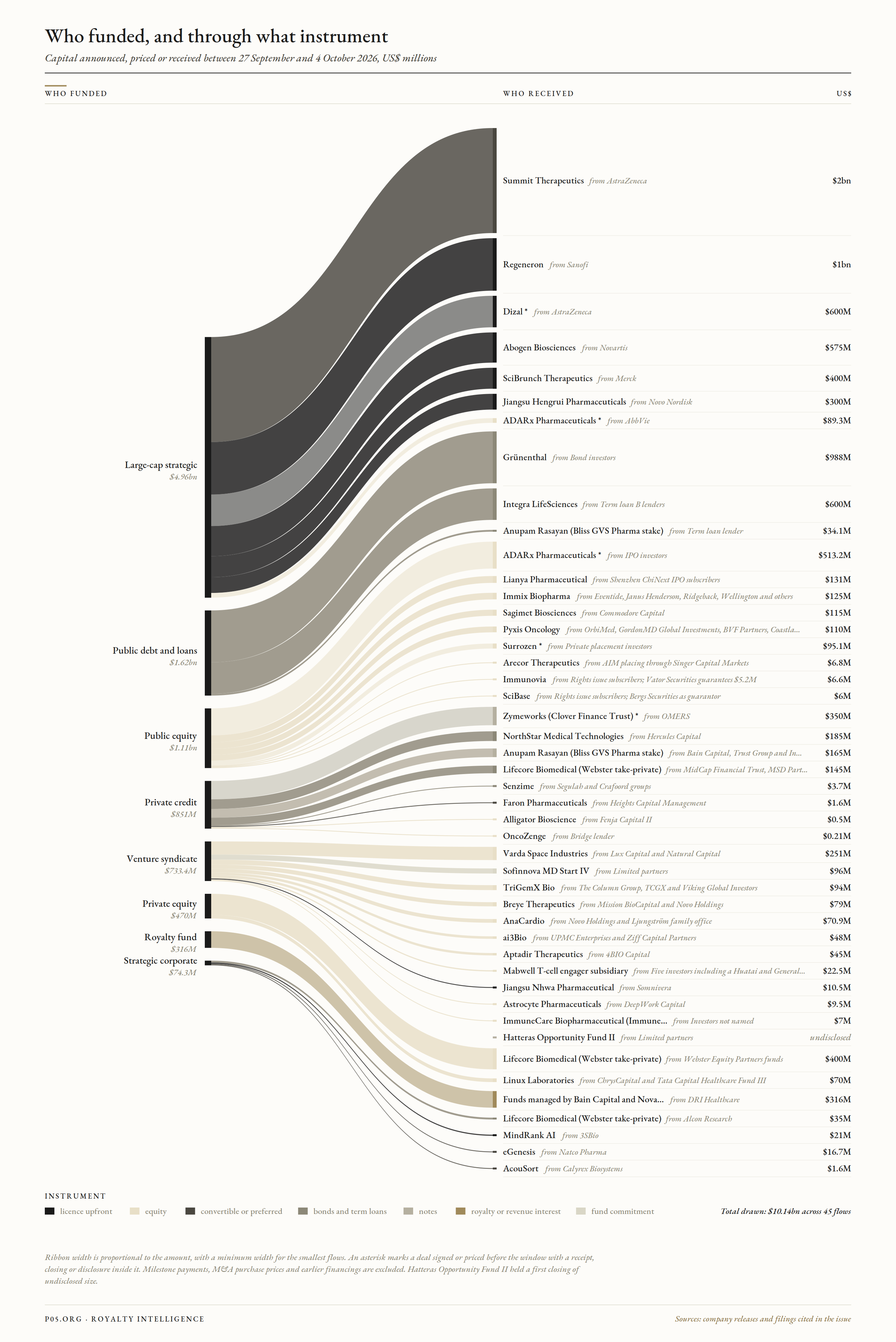
Who funded, and through what instrument, between 27 September and 4 October: 45 flows totalling $10.14bn, grouped by capital category and coloured by instrument. An asterisk marks a deal signed or priced before the window with a receipt, closing or disclosure inside it.
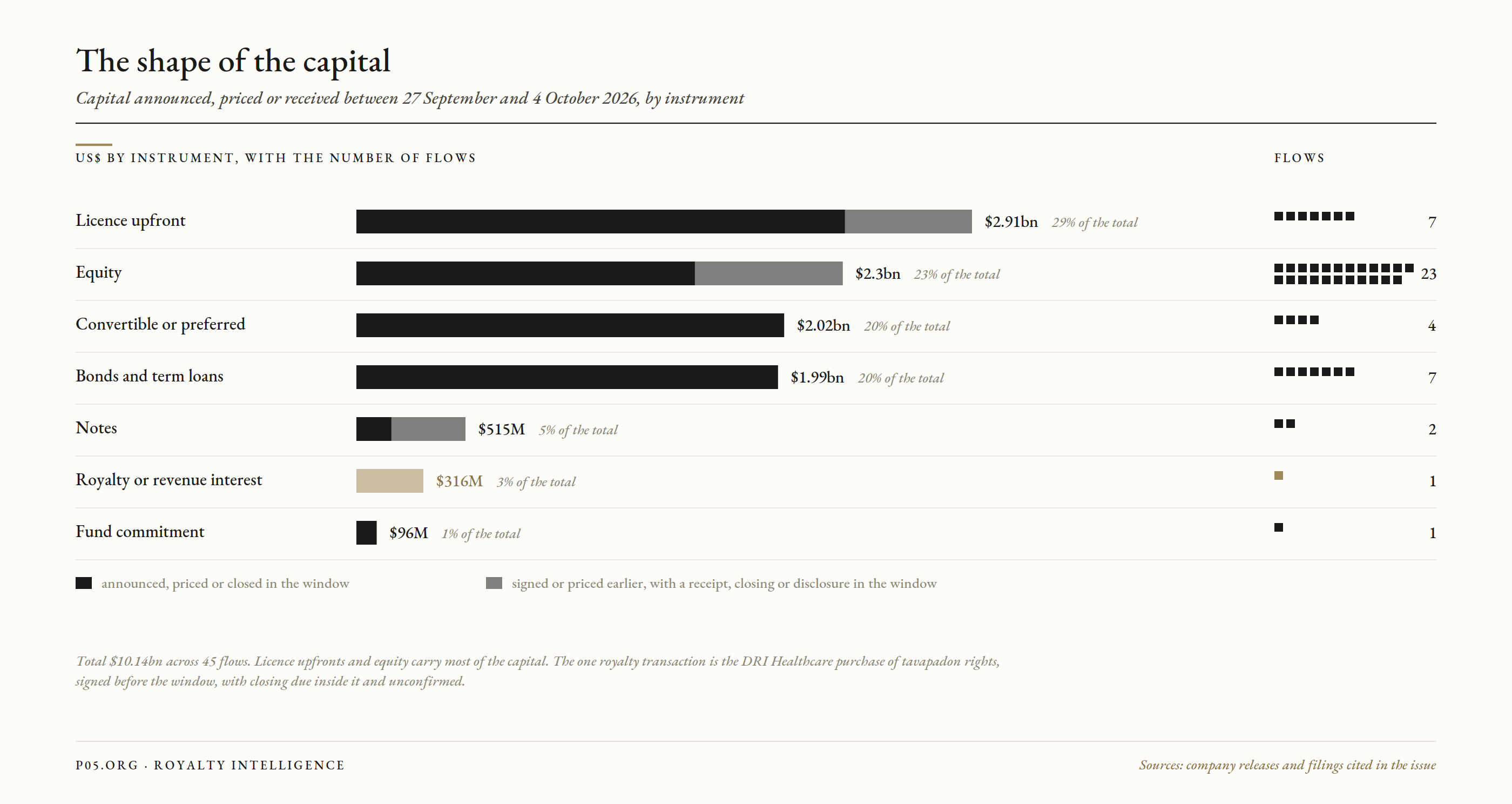
The same capital by instrument, with the number of flows. Lighter segments are deals signed or priced before the window with a step inside it.
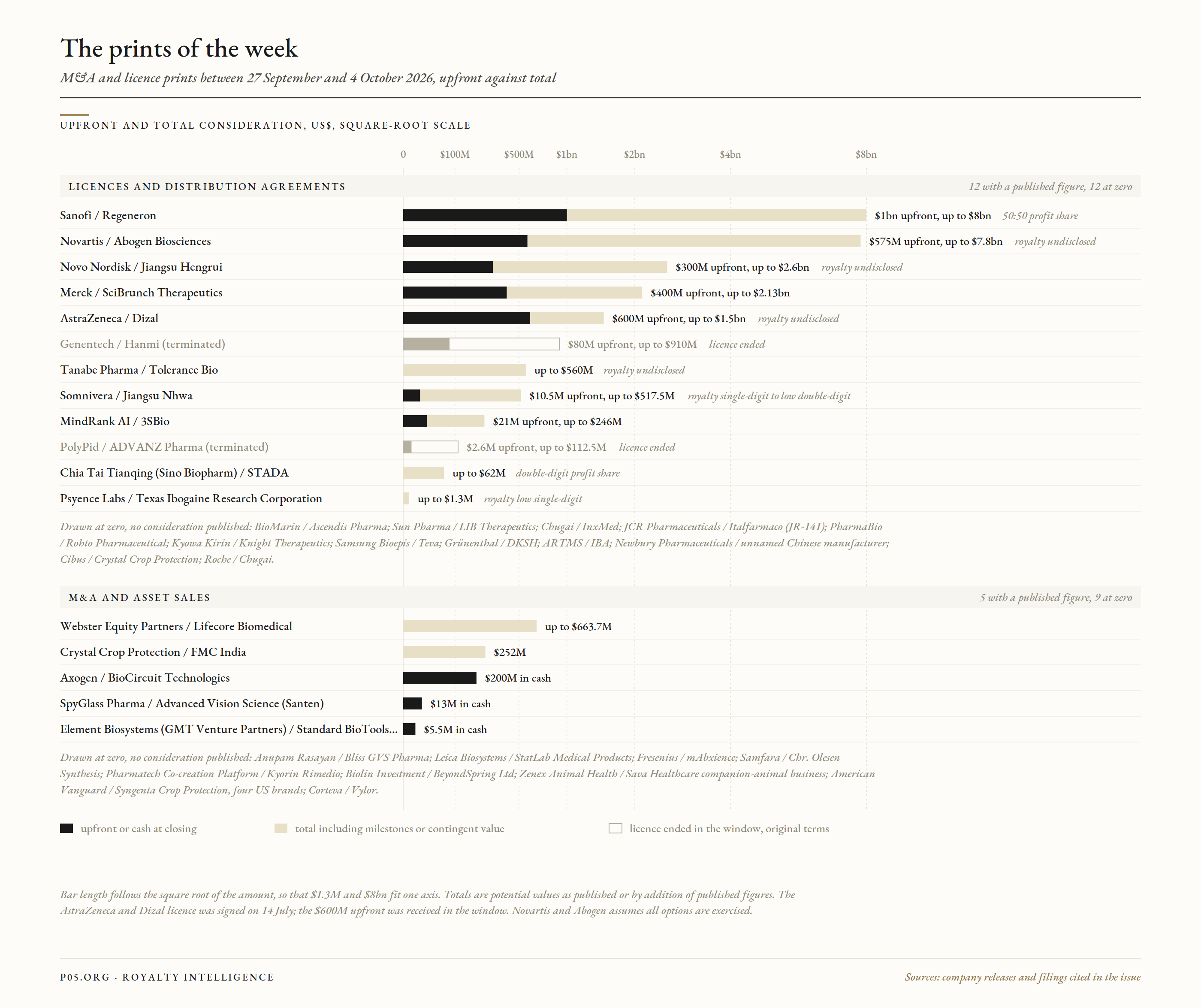
M&A and licence prints between 27 September and 4 October on a square-root scale, upfront against total. Seventeen publish a figure; 21 publish no consideration and are listed at zero. The two terminated licences are drawn in outline at their original terms.
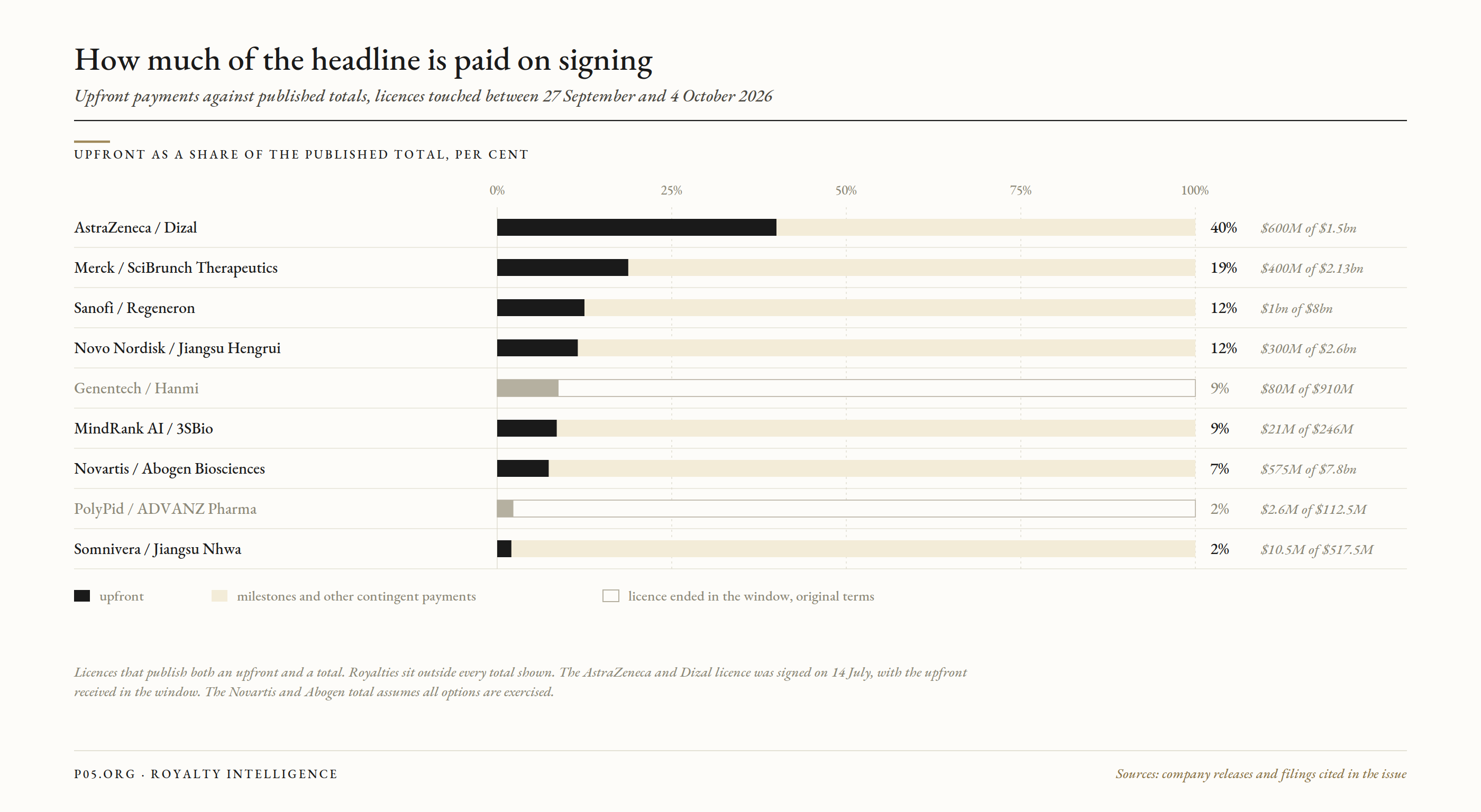
Upfront as a share of the published total, for the nine licences that publish both. Royalties sit outside every total.
League Tables
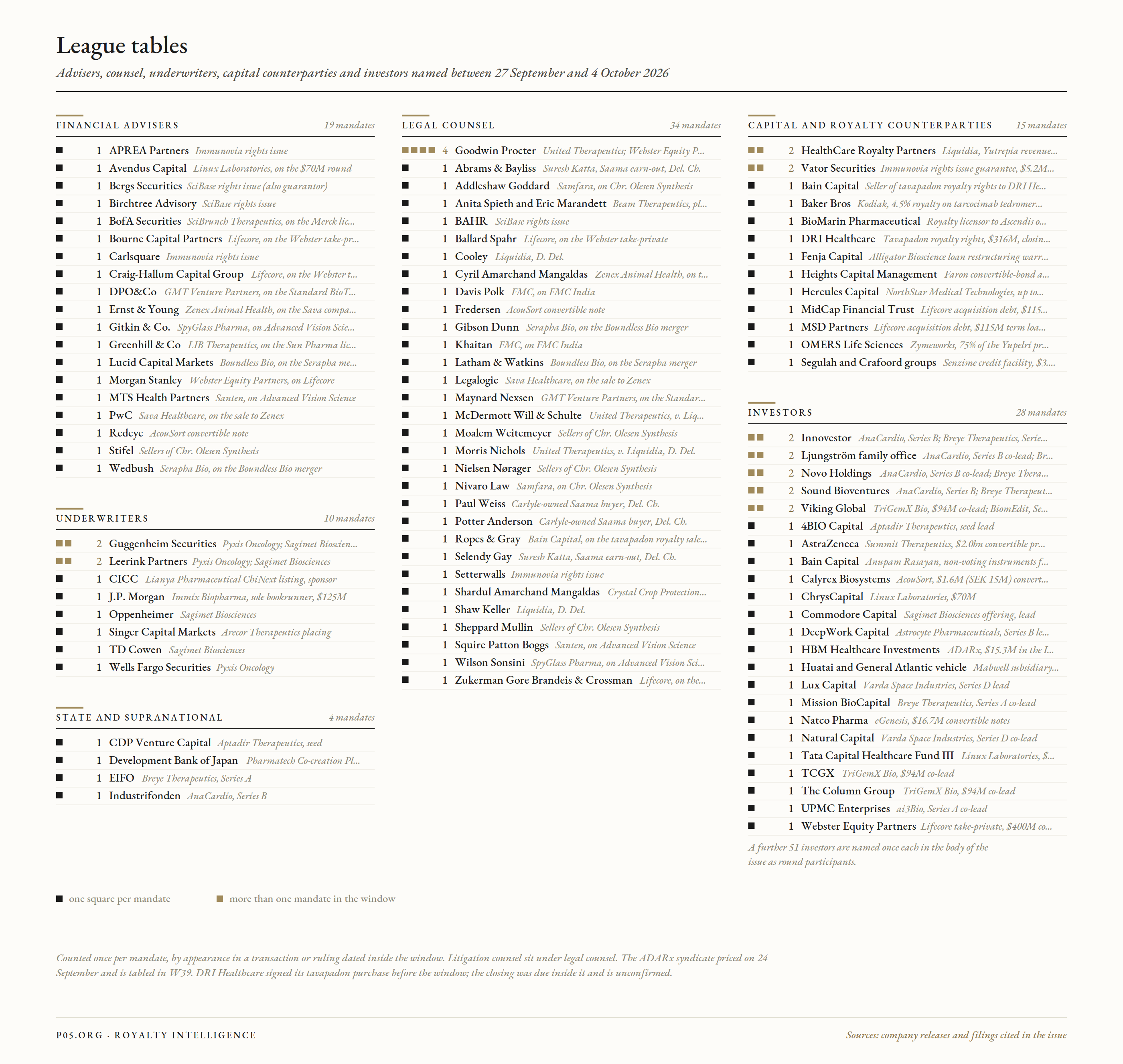
Financial and legal advisers, underwriters, capital and royalty counterparties and investors named in the issue for 27 September to 4 October, counted once per mandate. Goodwin Procter leads legal counsel with four; HealthCare Royalty and Vator Securities each appear twice among capital counterparties.
Financial advisers.
- Stifel (1: sellers of Chr. Olesen Synthesis)
- Gitkin & Co. (1: SpyGlass Pharma, on Advanced Vision Science)
- MTS Health Partners (1: Santen, on Advanced Vision Science)
- Redeye (1: AcouSort convertible)
- APREA Partners (1: Immunovia rights issue)
- Carlsquare (1: Immunovia rights issue)
- Morgan Stanley (1: Webster Equity Partners, on Lifecore)
- Bourne Capital Partners (1: Lifecore)
- Craig-Hallum Capital Group (1: Lifecore)
- BofA Securities (1: SciBrunch Therapeutics, on the Merck licence)
- Greenhill & Co (1: LIB Therapeutics, on the Sun Pharma licence, named in the licensee's release)
- Wedbush (1: Serapha Bio, on the Boundless Bio merger)
- Lucid Capital Markets (1: Boundless Bio)
- Avendus Capital (1: Linux Laboratories)
- Ernst & Young (1: Zenex Animal Health, on Sava)
- PwC (1: Sava Healthcare)
- Bergs Securities and Birchtree Advisory (1: SciBase rights issue)
- DPO&Co (1: GMT Venture Partners, on the Standard BioTools mass-cytometry business; role not specified in the filing)
Legal counsel.
- Goodwin Procter (4: United Therapeutics, D. Del.; Webster Equity Partners, on Lifecore; Serapha Bio, on the Boundless Bio merger; Sagimet Biosciences, on its offering)
- Morris Nichols and McDermott Will & Schulte (1: United Therapeutics, D. Del.)
- Shaw Keller and Cooley (1: Liquidia, D. Del.)
- Addleshaw Goddard and Nivaro Law (1: Samfara, on Chr. Olesen Synthesis)
- Moalem Weitemeyer, Nielsen Nørager and Sheppard Mullin (1: sellers of Chr. Olesen Synthesis)
- Wilson Sonsini (1: SpyGlass Pharma, on Advanced Vision Science)
- Squire Patton Boggs (1: Santen, on Advanced Vision Science)
- Abrams & Bayliss and Selendy Gay (1: Saama founder, Del. Ch.)
- Potter Anderson and Paul Weiss (1: Carlyle-owned Saama buyer, Del. Ch.)
- Anita Spieth and Eric Marandett (1: Beam Therapeutics, plaintiff, D. Mass.)
- Setterwalls (1: Immunovia rights issue)
- Ballard Spahr (1: Lifecore board)
- Zukerman Gore Brandeis & Crossman (1: Lifecore transaction committee)
- Gibson Dunn (1: Serapha Bio)
- Latham & Watkins (1: Boundless Bio)
- Ropes & Gray (1: Bain Capital, on the tavapadon royalty sale to DRI Healthcare)
- Maynard Nexsen (1: GMT Venture Partners, on Standard BioTools)
- Cyril Amarchand Mangaldas (1: Zenex Animal Health)
- Legalogic (1: Sava Healthcare)
- Shardul Amarchand Mangaldas (1: Crystal Crop Protection, on FMC India)
- Khaitan and Davis Polk (1: FMC)
- BAHR (1: SciBase rights issue)
- Fredersen (1: AcouSort convertible)
Capital and royalty counterparties.
- HealthCare Royalty Partners (2: holder of the Yutrepia revenue interest, balance $176.1M at 30 June 2026, Liquidia; financing against the GENFIT royalty on Iqirvo)
- BioMarin Pharmaceutical (1: royalty licensor to Ascendis on Yuviwel, 20% and 18%)
- Hercules Capital (1: NorthStar Medical Technologies, up to $185M)
- Vator Securities (2: Immunovia rights issue guarantee, SEK 49M; OncoZenge guarantee settled in shares)
- Heights Capital Management (1: Faron convertible deferral)
- Fenja Capital (1: Alligator loan restructuring warrants)
- MidCap Financial Trust and MSD Partners (1: Lifecore acquisition debt, $115M term loan and $30M revolver)
- Segulah and Crafoord groups (1: Senzime credit facility)
- OMERS Life Sciences (1: Zymeworks, 75% of the Yupelri profit share assigned, disclosed 28 September on a note signed 23 September)
- DRI Healthcare (1: tavapadon royalty rights, $316M, signed before the window, closing due 29 September and unconfirmed)
- Calyrex Biosystems (1: AcouSort convertible note, SEK 15M)
- Baker Bros' position on tarcocimab tedromer sits on a transaction signed in 2019
Underwriters.
- J.P. Morgan (1: Immix Biopharma, sole bookrunner, $125M)
- Leerink Partners (2: Pyxis Oncology; Sagimet Biosciences)
- Guggenheim Securities (2: Pyxis Oncology; Sagimet Biosciences)
- Wells Fargo Securities (1: Pyxis Oncology)
- TD Cowen and Oppenheimer (1: Sagimet Biosciences)
- Singer Capital Markets (1: Arecor Therapeutics)
- CICC (1: Lianya Pharmaceutical, sponsor)
- The ADARx syndicate, J.P. Morgan, Morgan Stanley, TD Cowen, UBS Investment Bank and LifeSci Capital, priced on 24 September and is tabled in W39; the closing falls in this window and does not create a second tombstone
Investors.
- Lux Capital and Natural Capital (1: Varda Space Industries, Series D co-leads)
- 4BIO Capital (1: Aptadir Therapeutics, seed lead)
- Novo Holdings (2: AnaCardio, Series B co-lead; Breye Therapeutics, Series A co-lead)
- Ljungström family office (2: AnaCardio, Series B co-lead; Breye)
- Sound Bioventures and Innovestor (2 each: AnaCardio; Breye)
- UPMC Enterprises and Ziff Capital (1: ai3Bio, Series A)
- Mission BioCapital (1: Breye Therapeutics, Series A co-lead)
- AstraZeneca (1: Summit Therapeutics, $2.0bn convertible preferred)
- Huatai and General Atlantic vehicle (1: Mabwell subsidiary, Pre-A)
- Bain Capital (1: Anupam Rasayan, non-voting instruments for Bliss GVS)
- Natco Pharma (1: eGenesis, convertible notes)
- HBM Healthcare Investments (1: ADARx, IPO participation, disclosed 28 September)
- The Column Group, TCGX and Viking Global (1: TriGemX Bio, co-leads)
- ChrysCapital and Tata Capital Healthcare Fund III (1: Linux Laboratories)
- Commodore Capital (1: Sagimet Biosciences, lead)
- DeepWork Capital (1: Astrocyte Pharmaceuticals, Series B lead)
State and supranational participants.
- EIFO (1: Breye Therapeutics, Series A)
- CDP Venture Capital (1: Aptadir Therapeutics, seed)
- Industrifonden (1: AnaCardio, Series B)
- Development Bank of Japan (1: Kyorin Rimedio joint venture, 14.9%)
All information in this report was accurate as of the research date and is derived from publicly available sources including SEC filings, Hong Kong Stock Exchange announcements, National Stock Exchange of India filings, European Medicines Agency and Food and Drug Administration records, United States patent assignment records, company press releases and financial news reporting. Information may have changed since publication. This content is for informational purposes only and does not constitute investment, legal, or financial advice. The author is not a lawyer or financial adviser.