
The Weekly Term Sheet (2026-W41)
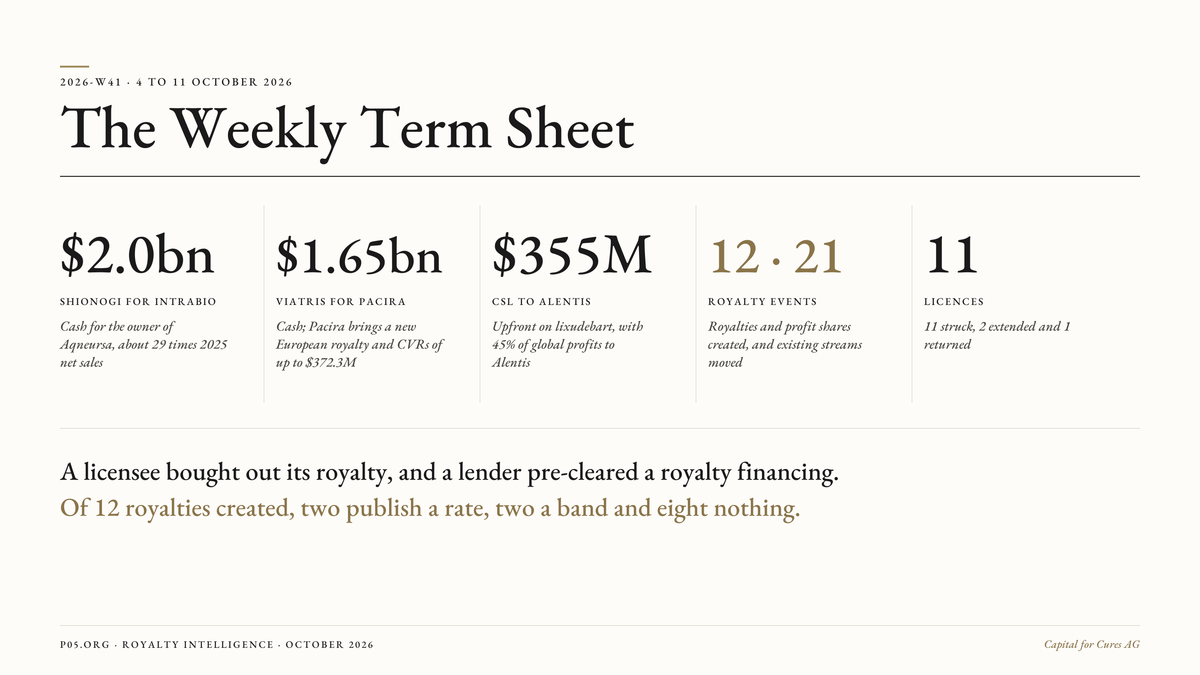
CSL paid Alentis USD 355m upfront for 45 per cent of global profits on lixudebart, the largest licence payment of the week, and of the 12 royalties and profit shares created in the window two publish a rate, two publish a band and eight publish nothing.
Shionogi agreed to pay USD 2.0bn for IntraBio, and Viatris USD 1.65bn for Pacira, which brings a new European royalty on Exparel and contingent value rights of up to USD 372.3m. Immunome paid Bristol Myers Squibb USD 20.0m and 4.4 million shares to remove the royalty on varegacestat, and Rocket's new lender agreed in advance to one royalty financing on RP-A501.
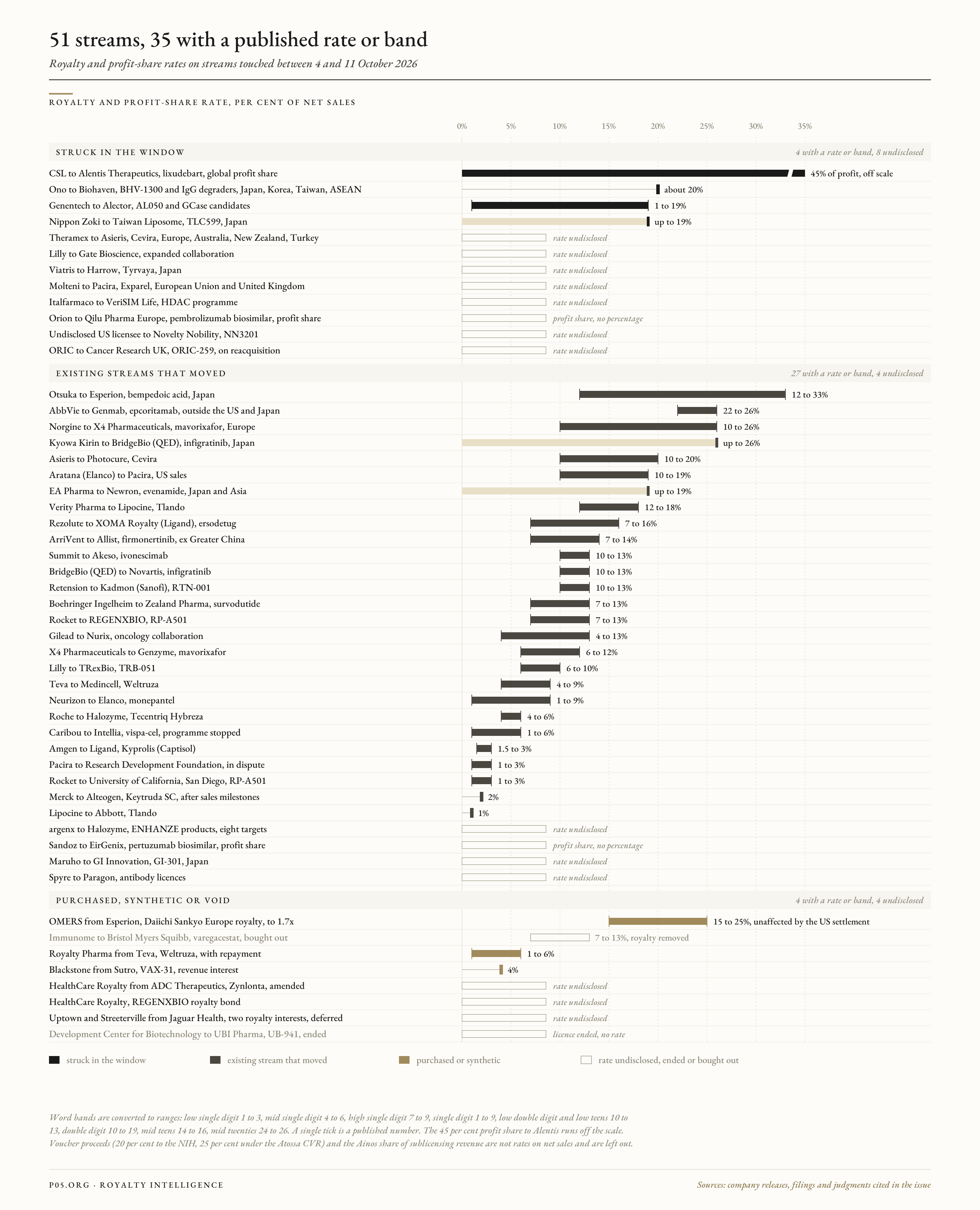
Royalty and profit-share rates on the 51 streams touched between 4 and 11 October, in three groups, with word bands converted to ranges. Thirty-five publish a rate or band and 16 are drawn as empty bars. The 45 per cent profit share to Alentis runs off the scale.
Currency and language note: all amounts are given in US dollars. Where a source uses another currency, the converted figure comes first and the original follows in brackets, at approximately EUR 0.86, SEK 9.50, NOK 10.30, CHF 0.885, DKK 6.40, GBP 0.74, JPY 146, KRW 1,370, CNY 7.10, TWD 32.0, AUD 1.41 and INR 88 per US dollar, being late September 2026 rates. Where a source published its own conversion, that figure is used. Quotations from sources in other languages are given in our English translation.
Highlights
Royalty events: 12 created and 21 existing streams moved. Eleven new agreements and one closing created a royalty or a profit share. A licensee bought out its licensor's royalty, and a pivotal readout moved a royalty held by a fund.
A second Phase 3 readout moved a royalty of 22 to 26 per cent that Genmab receives from AbbVie, and a third moved the royalty Zealand Pharma receives from Boehringer Ingelheim on survodutide.
Two royalty interests had their payments deferred, and a regulator reopened the filing route for a royalty-bearing antibody.
A filing acceptance with priority review moved the royalty BridgeBio owes Novartis on infigratinib, and Gilead paid Nurix USD 10m to extend a royalty-bearing collaboration.
A Phase 3 trial of firmonertinib missed its primary endpoint, which moves the royalty ArriVent owes Allist. Written regulatory feedback on a trial design moved the royalty Neurizon owes Elanco.
A European filing for a pertuzumab biosimilar moved the profit share Sandoz owes EirGenix.
A Canadian approval moved the royalty of 12 to 18 per cent that Verity owes Lipocine on Tlando. A sixth generic settlement on bempedoic acid, with entry no earlier than April 2040, bears on US sales of bempedoic acid; the European royalty Esperion sold to OMERS is unaffected.
An approval in stage III colon cancer for subcutaneous Tecentriq moved the royalty Roche pays Halozyme on that product. A US approval of a once-monthly olanzapine injection moved the royalties Teva pays Medincell and Royalty Pharma on it.
A Dutch court order against subcutaneous Keytruda in eight European countries bears on the royalty Merck owes Alteogen on that formulation. In Delaware, a claim construction fixed the meaning of the cyclodextrin claims in a Kyprolis patent, which bears on the generic timing behind Ligand's royalty of 1.5 to 3.0 per cent, and a licence dispute over a botulinum toxin stays in that court. The Third Circuit sent a USD 61.6m award under a Remodulin patent settlement back for trial.
Asieris licensed Cevira to Theramex for Europe, which brings Photocure's royalty of 10 to 20 per cent on the product into a second territory. A Phase 3 stopped for futility removes a potential indication for subcutaneous efgartigimod, on which argenx pays Halozyme a royalty.
Biohaven licensed its IgG degraders to Ono for Japan and other Asian markets at a royalty of about 20 per cent. Further claims sit underneath the week's deals: Viatris takes on Pacira's contingent value rights of up to USD 372.3m, ADC Therapeutics owes HealthCare Royalty 1.5 times the unrecovered part of USD 300m if it breaches a new USD 50.0m debt cap, and an approval of any Biohaven product in the United States or Europe triggers a payment to Oberland.
ADC Therapeutics and HealthCare Royalty removed a USD 150m change-of-control payment from a royalty financing, and Viatris agreed to buy Pacira, holder of the new European royalty on Exparel.
M&A and restructuring: 4 agreed, 5 closed and 2 strategic reviews. Shionogi agreed to pay USD 2.0bn for a private company with one marketed rare-disease drug, and GE HealthCare agreed to pay USD 945m for a radiopharmacy network and a Phase 3 tracer. Viatris agreed to pay USD 1.65bn in cash for Pacira BioSciences.
Standard BioTools agreed to sell its microfluidics business to ARCHIMED for an undisclosed price.
AstraZeneca closed its USD 2.0bn investment in Summit Therapeutics, and iRhythm closed its purchase of VitalConnect for USD 237.5m in cash. Repligen closed its purchase of BioLife Solutions for stock and cash, and Hepion closed a related-party purchase of two licensed programmes for cash and shares, taking over a seller note. AmyriAD bought Recognify, an atai portfolio company, in shares plus development milestones.
Caribou Biosciences is stopping its two cell therapy programmes and has begun a review of strategic alternatives. Cadrenal Therapeutics began a review that names licensing or sale of individual assets.
Licence-outs and asset acquisitions: 11 struck, 2 extended, 2 asset purchases closed, 1 voucher sale agreed and 1 returned. Four upfronts are stated, USD 355m, USD 100m, USD 80m and USD 15m. The other seven agreements give no upfront amount; four state a total, of more than USD 870m, USD 553m, USD 203m and more than USD 100m.
One extension carries a fee of USD 10m. The other, from argenx to Halozyme, states no amount.
Ultragenyx agreed to sell a priority review voucher for USD 210m, of which 20 per cent goes to the National Institutes of Health.
UBI Pharma ended its licence of a B-Raf inhibitor from Taiwan's Development Center for Biotechnology. GI Innovation is due a milestone from Maruho as a Japanese Phase 2 starts, and Avalon Pharma signed a memorandum with a Chinese manufacturer whose first project is inclisiran, a drug whose royalty Alnylam shares with Blackstone. MicuRx's board approved a licence and platform option for a Basel start-up, with USD 1m upfront against milestone caps of up to USD 973m.
Lilly's two-year evaluation of Peptron's long-acting injection platform ended without a commercial licence.
Regulatory: 8. The Food and Drug Administration approved an immunotherapy after surgery in stage III colon cancer, in an intravenous form and in a subcutaneous form on which a royalty is paid, and a once-monthly olanzapine injection that pays its developer a royalty. It also recommended a pre-submission meeting on a drug whose pivotal trial had missed its primary endpoint. A Taiwanese manufacturer filed a pertuzumab biosimilar with the European Medicines Agency, and Health Canada approved an oral testosterone.
The UK regulator revoked the licence of a chikungunya vaccine.
The Food and Drug Administration also accepted the application for infigratinib in achondroplasia with priority review, and set a target date of 4 February 2027. In written feedback it said a Phase 2/3 platform trial in amyotrophic lateral sclerosis may serve as the single registrational study.
Clinical: 9. A pivotal Phase 3 vaccine trial met its primary endpoints, and a Phase 3 lymphoma trial reported a 51 per cent reduction in the risk of progression or death.
A Japanese Phase 3 obesity trial reported weight loss of 13.1 per cent at 76 weeks.
A Phase 3 lung cancer trial of firmonertinib missed its primary endpoint, with a hazard ratio of 0.75 and a p-value of 0.0654. A US clinical hold stays in place on one of two Phase 3 schizophrenia trials of a partnered drug, after the regulator counted four deaths against one on placebo.
Structured capital: 2 new, 2 amended. Private funding: 5. Public capital and debt: 17 new, 2 closed. Capital formation: 4. Animal health: 0. Crops and seeds: 0. Courts: 1 injunction, 1 settlement, 3 District of Delaware rulings and 1 appeal. Priority review vouchers: 0 issued, 1 sale agreed.
The largest public financing is Vaxcyte's USD 1.0bn of stock and convertible notes, launched hours after its Phase 3 result and priced a day later at USD 64.00 a share and a coupon of 1.50 per cent. Spyre Therapeutics priced USD 350.0m of stock the same evening. Two initial public offerings priced late on 8 October: TRexBio at the bottom of its range and Retension, upsized, at the midpoint.
X4 Pharmaceuticals refinanced a USD 75m loan with a facility of up to USD 150m from K2 HealthVentures. Atossa Therapeutics will give its shareholders a contingent value right on a quarter of the proceeds of a priority review voucher it does not yet hold.
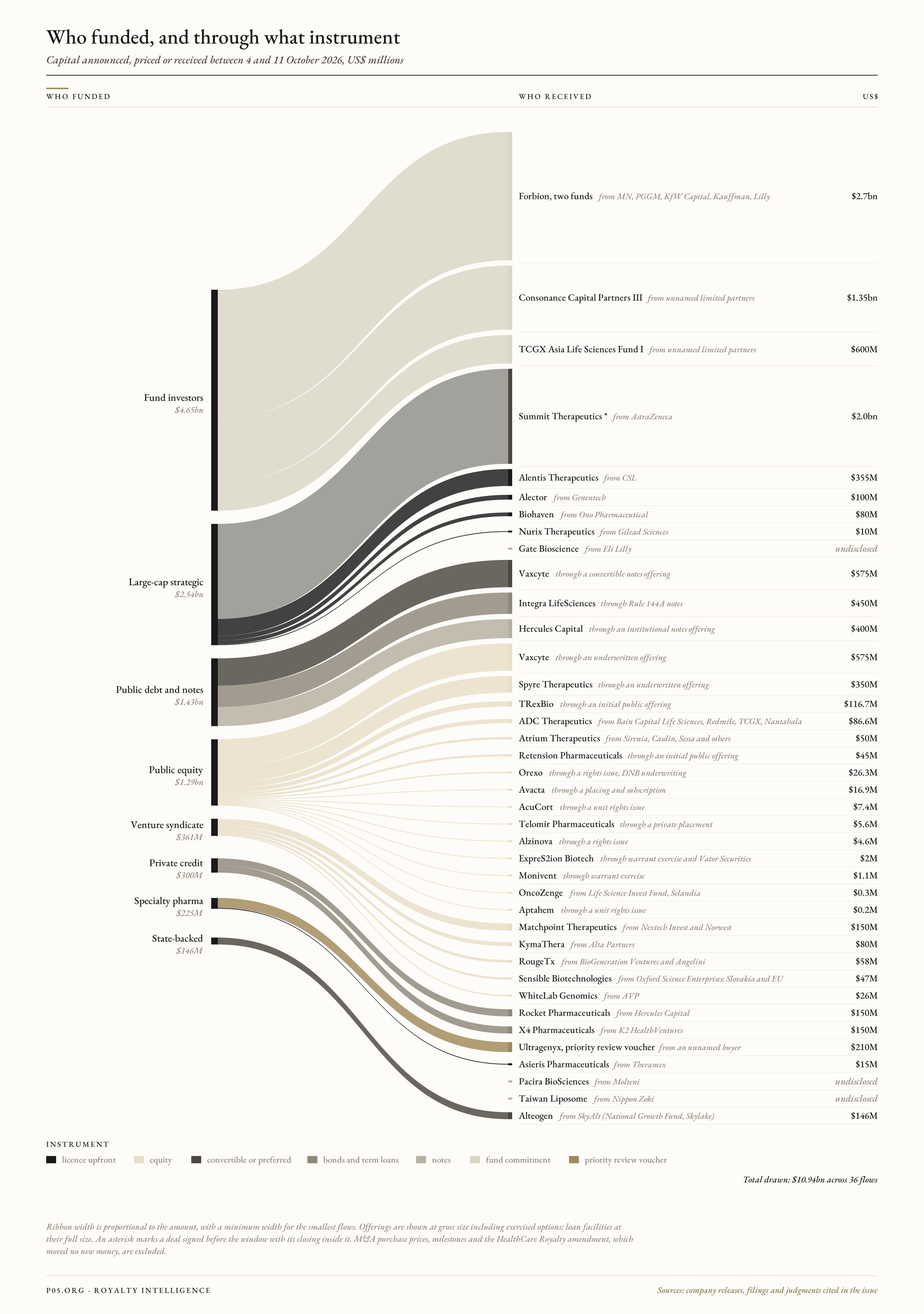
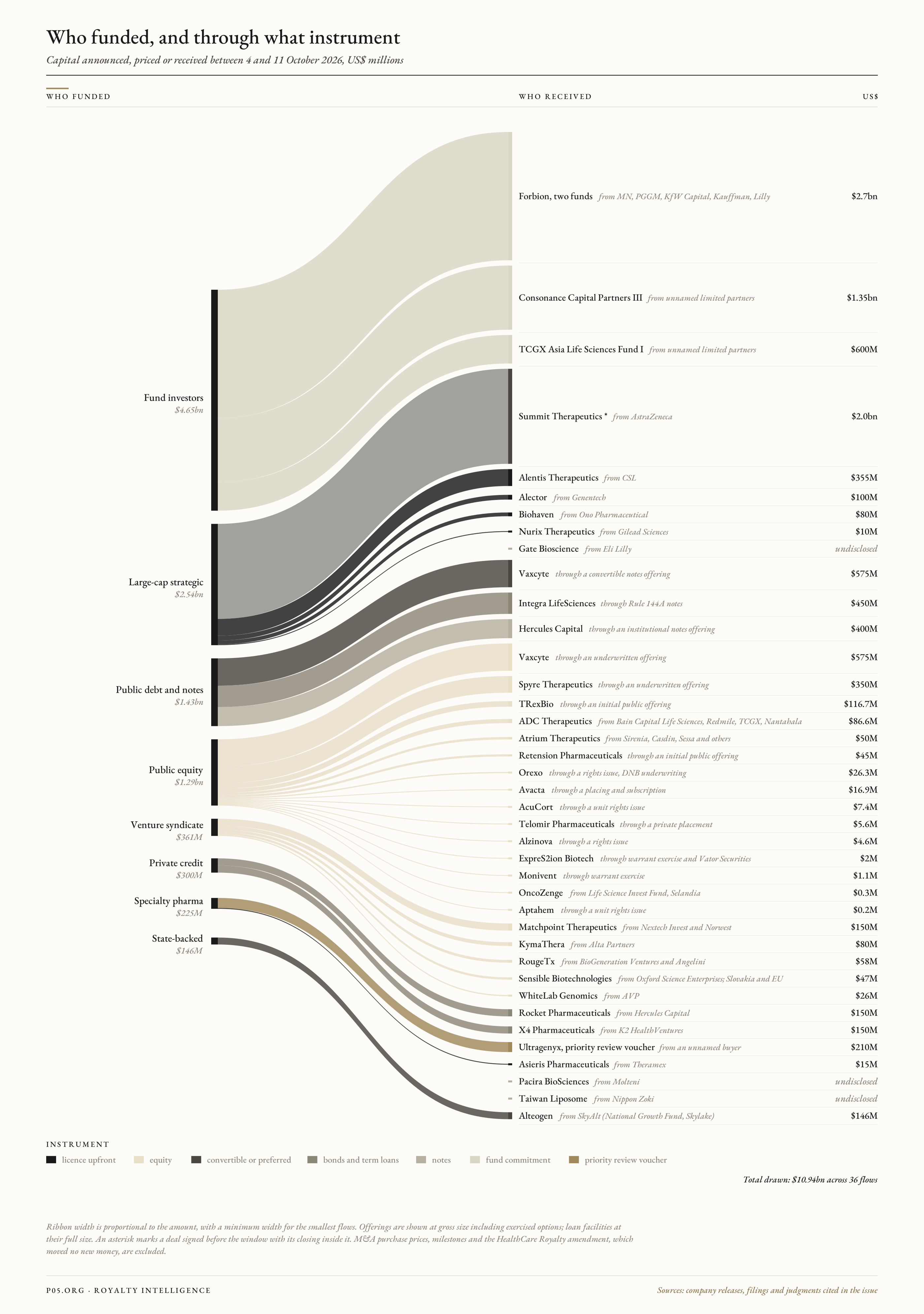
Forbion raised USD 2.7bn (EUR 2.3bn) across a growth fund and a venture fund, TCGX closed a USD 600m fund for Asian biotechnology companies, Consonance Capital Partners closed a USD 1.35bn healthcare buyout fund, and Hercules Capital, a lender to Rocket this week, raised USD 400m of notes. One private round of USD 47m includes up to USD 20m of public grant funding. Four further private rounds raised USD 150m, USD 80m, USD 58m and USD 26m.
Rocket Pharmaceuticals took a term loan of up to USD 150.0m whose terms permit one royalty financing on its lead asset.
No animal health item carries a stated royalty this week. The European Medicines Agency's veterinary committee recommended a lumpy skin disease vaccine for cattle under exceptional circumstances.
It also extended by one year the authorisation of an avian influenza vector vaccine under exceptional circumstances, backed a new indication for pimobendan in dogs by majority in a referral that now goes to the European Commission, approved a variation for transdermal mirtazapine in cats, and recommended Stemyca, an equine stem-cell product for chronic enteropathy in dogs. None of the opinions names a licence or royalty.
Alteogen, a licensor that receives milestones and royalties, is to issue USD 146.0m (KRW 200bn) of preferred shares to a vehicle backed by a Korean state fund.
Rate disclosure across the window: 7 hard numbers and 22 bands. The hard numbers are about 20 per cent from Ono to Biohaven, the 45 per cent profit share to Alentis, the 4 per cent royalty on VAX-31, the 2 per cent Merck owes Alteogen once sales milestones are paid, the 1 per cent Lipocine owes Abbott on Tlando and the 20 per cent of voucher proceeds Ultragenyx owes the National Institutes of Health.
Verity owes Lipocine 12 to 18 per cent. Daiichi Sankyo Europe owes Esperion 15 to 25 per cent and Otsuka 12 to 33 per cent. Asieris owes Photocure 10 to 20 per cent on Cevira.
The bands are single-digit to double-digit percentages to Alector, high single digits to low teens on the royalty Immunome bought out, high single digits to mid-teens on the royalty Rezolute owes XOMA Royalty, 22 to 26 per cent on the royalty AbbVie pays Genmab outside the United States and Japan, and high single to low double digits on the royalty Boehringer Ingelheim owes Zealand Pharma.
Three bands date from 5 and 6 October: mid-single digits to low teens from Gilead to Nurix, tiered low double digits from BridgeBio to Novartis on infigratinib, and up to the mid-twenties from Kyowa Kirin to BridgeBio in Japan. Three more date from 9 October: six to ten per cent from Lilly to TRexBio, a mid-single-digit percentage from Roche to Halozyme, and low teens from Retension to Kadmon.
Another, 1.5 to 3.0 per cent from Amgen to Ligand on Kyprolis, came with the Delaware claim construction, and two more with the approval of Weltruza: mid- to high-single digits from Teva to Medincell and low to mid-single digits from Teva to Royalty Pharma. Atossa adds a hard number: 25 per cent of voucher proceeds to its shareholders, capped at USD 50m.
Two more sit in licence chains behind events of 6 October: high single digits to low mid-teens from ArriVent to Allist, and tiered single digits from Neurizon to Elanco. Rocket owes REGENXBIO high single digits to low teens on RP-A501.
Eight new agreements state a royalty or a profit share with no rate: Asieris to Theramex, Lilly and Gate, Viatris to Harrow in Japan, Molteni to Pacira, Italfarmaco to VeriSIM Life, Orion to Qilu, the licence of NN3201 by Novelty Nobility, and ORIC to Cancer Research UK. The expanded licence from Halozyme to argenx also restates a royalty with no rate. One further band comes from a Taiwanese exchange filing: a tiered royalty of up to a double-digit percentage from Nippon Zoki to Taiwan Liposome.
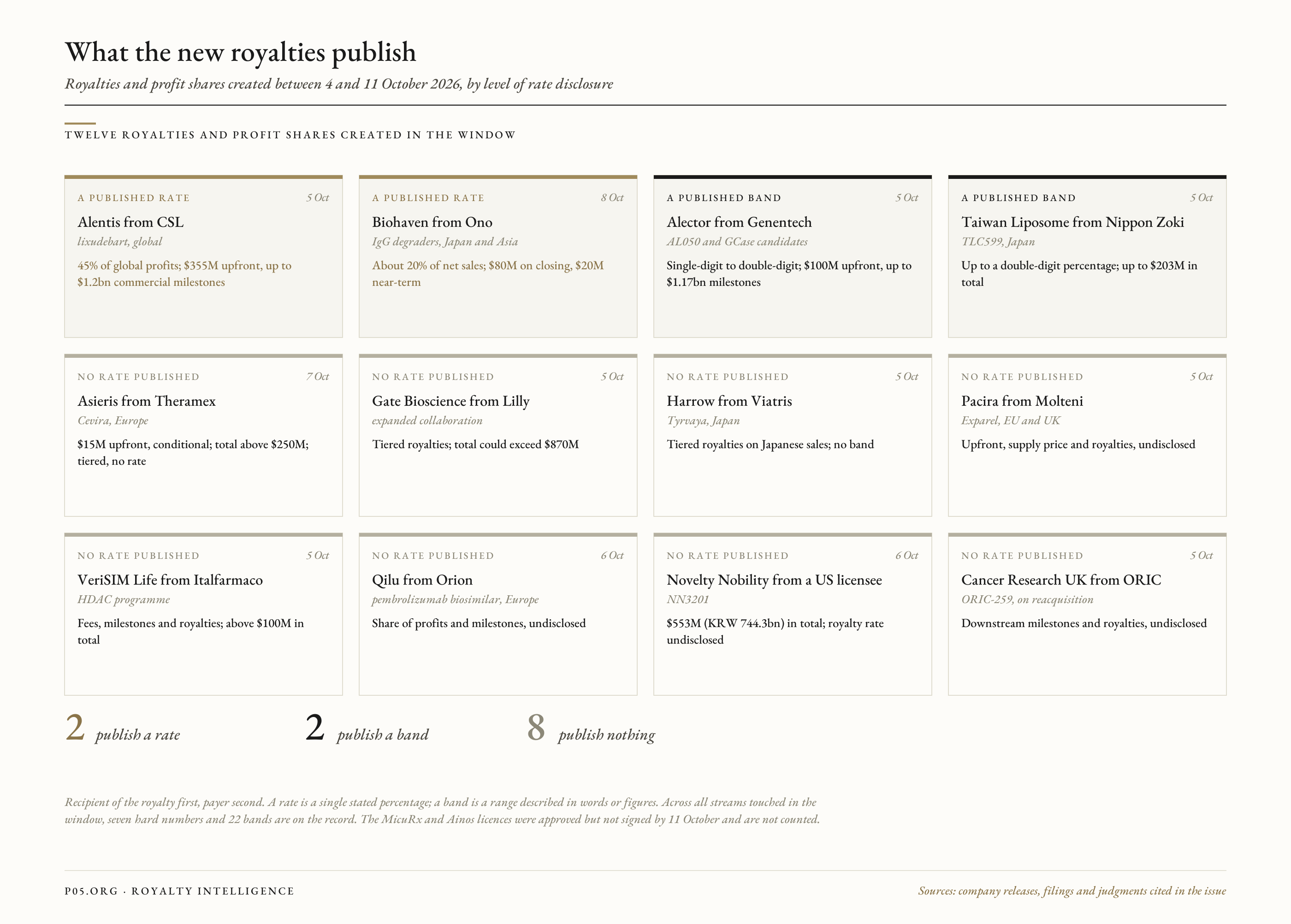
The 12 royalties and profit shares created in the window, by what each publishes: two a rate, two a band and eight nothing.
Tracked royalty buyers inside the window: no purchase. Blackstone holds the 4 per cent royalty on VAX-31, which read out on 5 October. XOMA Royalty, owned by Ligand since 14 July 2026, is the licensor of ersodetug, on which Rezolute reported a regulatory update the same day. Royalty Pharma's 2023 funding of Teva's olanzapine programme turns into repayment and a royalty with the approval of Weltruza on 9 October.
Open in the remainder of the window. The DRI Healthcare purchase of the tavapadon payment rights, scheduled to close on 29 September, with no closing confirmation published by 11 October.
The final judgment in United Therapeutics v. Liquidia, due about 7 October on the one-week order for a proposed form of judgment and remedies. A stipulation of 7 October and an order of 8 October appear on the docket under seal, per Investing.com; no remedy had been announced by 11 October.
The outcome of the first meeting of Paradigm's creditors on 9 October, where the administrators work towards a deed of company arrangement with the secured lender, Obsidian. Kalkine Media, citing Paradigm's exchange notice of 8 October, reports that a further 1,171,477 of Obsidian's convertible notes were redeemed for USD 1.4m in cash, leaving 3,125,708 outstanding. No outcome of the meeting had been published by 11 October.
The signing of the VELDONA licence between Ainos and a subsidiary of San Fu Chemical, set for 13 October. The closing of the initial public offerings of TRexBio and Retension, expected on 13 October.
The first sales of subcutaneous Tecentriq in stage III colon cancer, approved on 8 October.
The result of Sareum's raise under the AIM capital access window, opened on 8 October with its shares suspended, to fund SDC-1801; no size or price is disclosed, and no result had been announced by 11 October. Sareum receives "a net 63.5% of all future revenues" on the Chk1 inhibitor SRA737, under terms renegotiated with the CRT Pioneer Fund, per its March 2025 announcement.
The sale of BioXcel Therapeutics' assets in Chapter 11, with bids due on 9 October against Teva's stalking-horse offer of "upfront cash in the amount of $57.5 million" plus "up to $67.5 million" of development milestones and "up to $20 million" of commercial milestones, under an agreement that lapses if not completed by 30 October. The bidding procedures set an auction for 14 October if a rival qualified bid arrives, and a sale hearing for 21 October.
No notice of the outcome had been filed by 11 October, and the debtors have until 13 October to designate qualified bids.
The tender offer for Pacira, due to start within fifteen business days of 8 October.
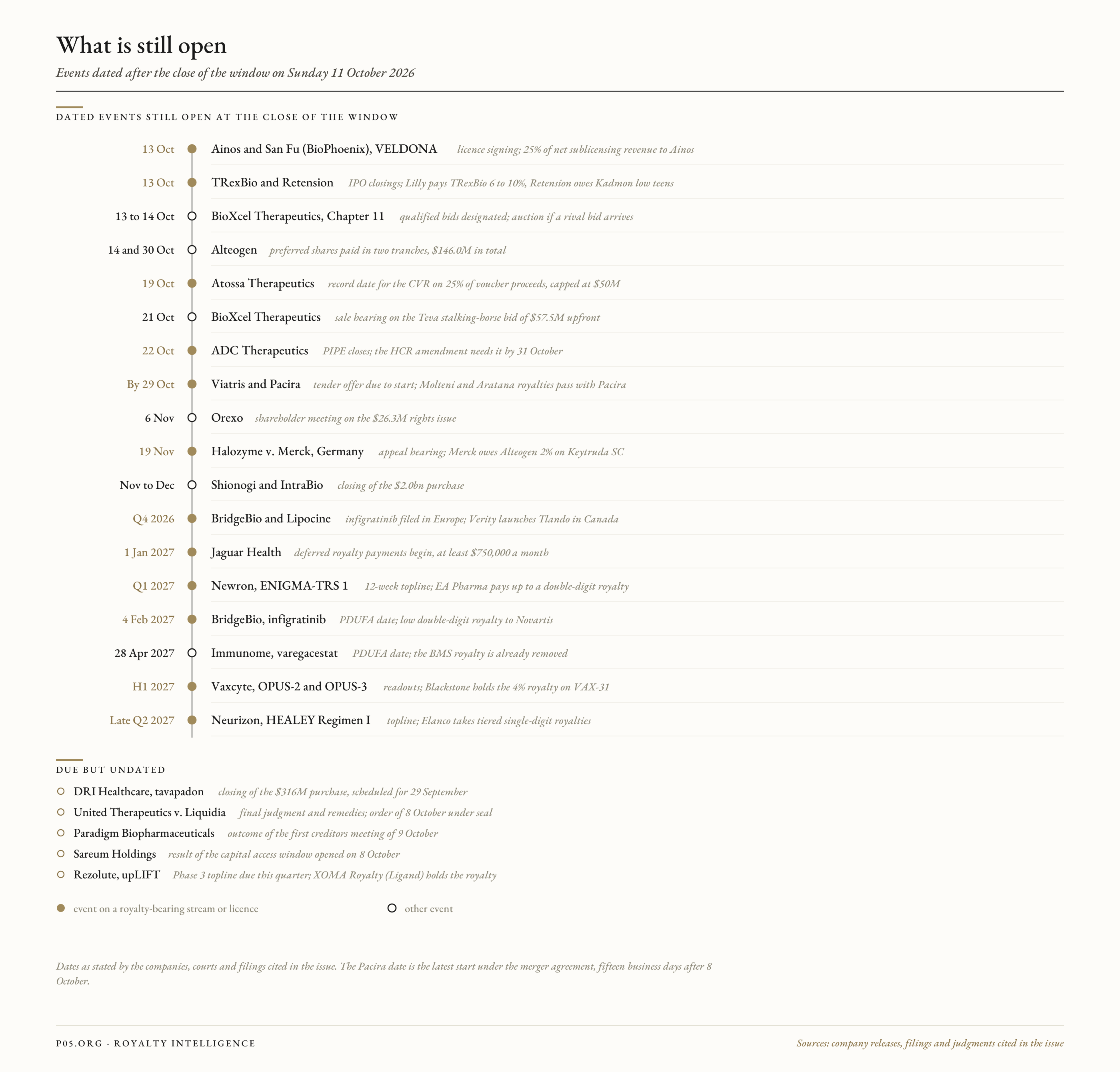
Dated events still open at the close of the window, from the VELDONA signing on 13 October to the HEALEY topline in the second quarter of 2027, with five items due but undated. Gold marks an event on a royalty-bearing stream or licence.
M&A and Restructuring
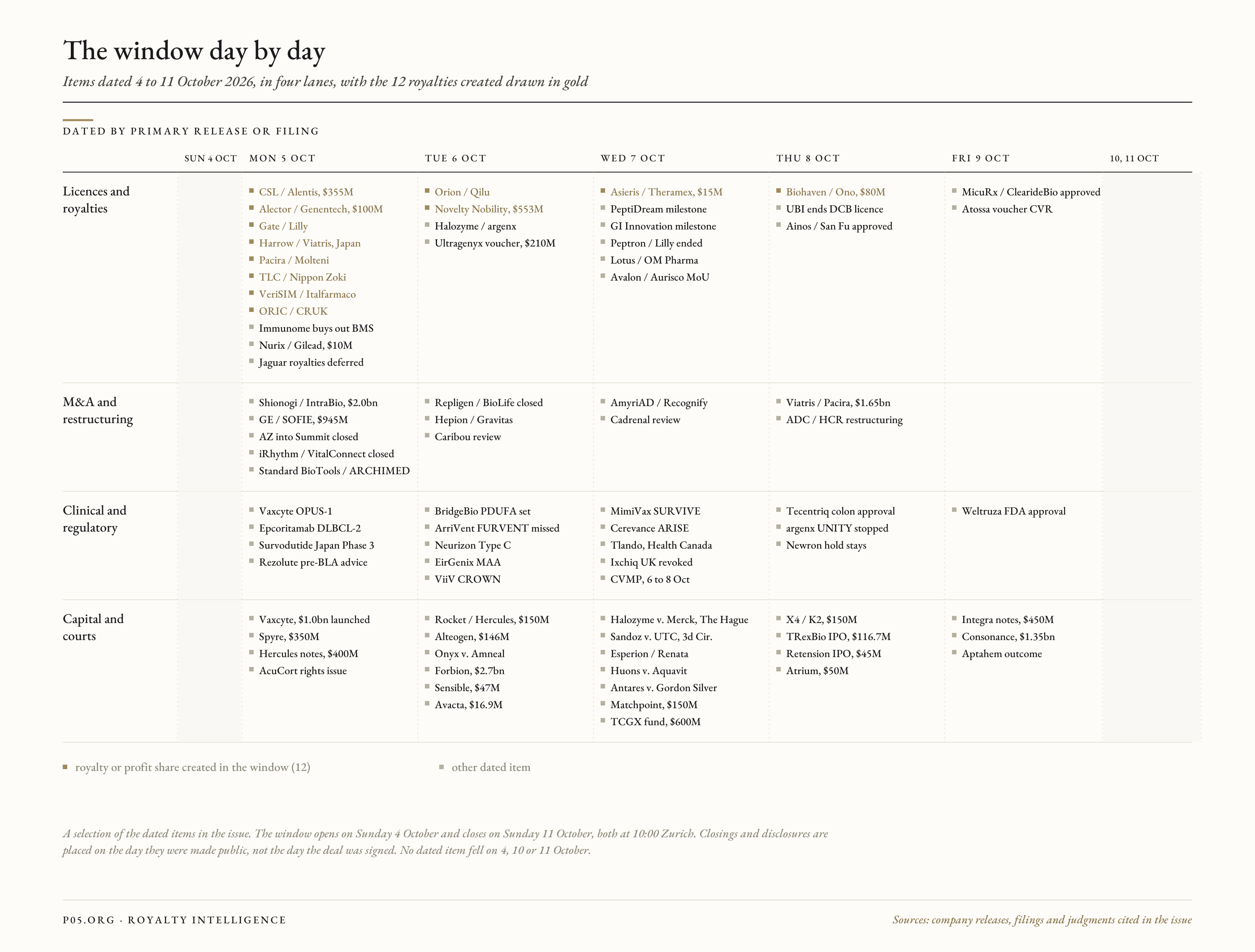
The window day by day, dated by primary release or filing and filed in four lanes. The 12 royalties created are drawn in gold; eight of them date from Monday 5 October.
Shionogi and IntraBio: USD 2.0bn in cash for the owner of Aqneursa (Monday 5 October)
Shionogi (TSE: 4507) agreed to acquire IntraBio, a private company in Austin, Texas, through its New Jersey subsidiary Shionogi Inc. The board resolution and the signing are both dated 5 October.
- The consideration: "Shionogi Inc. will acquire all outstanding shares of IntraBio for an upfront consideration of USD 2.0 billion payable to IntraBio shareholders." No milestone, contingent value right or earn-out is stated.
- The asset: Aqneursa (levacetylleucine), approved by the Food and Drug Administration in September 2024 for Niemann-Pick disease type C and by the European Medicines Agency in January 2026. A second US indication, ataxia-telangiectasia, was approved on 18 September 2026.
- The pipeline: "Clinical programs in Pompe disease, Fragile X syndrome, and Jordan's syndrome, as well as additional early-stage rare neurodegenerative disease programs", per the release on Shionogi's US site.
- The sellers: "The identities of such shareholders are not disclosed at their request."
- The target's accounts: net sales of USD 67.9m and an operating loss of USD 35.3m for the year to December 2025.
- Timing and conditions: closing is scheduled between November and December 2026, subject to competition-law waiting periods in each relevant country.
- Advisers: Goldman Sachs and Cleary Gottlieb for Shionogi. Centerview Partners and Morgan Stanley, with Kirkland & Ellis and DLA Piper, for IntraBio.
- Instrument: purchase of all outstanding shares for cash.
- Royalty read-through: the release names no licensor and no royalty on Aqneursa. The price is about 29 times 2025 net sales.
AstraZeneca and Summit Therapeutics (Monday 5 October). AstraZeneca (LSE: AZN) announced "the successful completion of its $2 billion equity investment in Summit Therapeutics", signed on 28 September.
Summit's closing release says "AstraZeneca purchased an aggregate of approximately 108,955 shares of preferred stock convertible into shares of common stock of Summit at a 1:1,000 ratio". "At the conversion ratio, the investment represents a common stock price equal to $18.36".
"Baker Hostetler LLP is serving as legal advisor to Summit." AstraZeneca's notice adds that "the companies have also entered into a clinical collaboration agreement to evaluate sonesitatug vedotin (Sone-Ve) in combination with ivonescimab". Summit's release says the parties "will jointly contribute to the costs of such studies" and "Each company will retain development and commercial rights to their respective molecules." It lists AstraZeneca's contractual rights, "including Third Party acquisition participation", among its risks.
Summit in-licensed ivonescimab from Akeso and owes it "royalty payments equal to low-double-digit percentage of annual revenues from ivonescimab in the Licensed Territory", plus approval and sales milestones, per its annual report.
The purchase agreement had set closing within five business days of signing.
iRhythm Technologies and VitalConnect (Monday 5 October). iRhythm (Nasdaq: IRTC) completed the acquisition of VitalConnect, a private maker of wearable cardiac and multi-vital monitors, announced on 6 August. "The purchase consideration consisted of $237.5 million in cash, subject to customary adjustments, funded from iRhythm's balance sheet and up to 423,334 shares issued in connection with closing."
"In addition, iRhythm provided $10.0 million of working capital funding to VitalConnect between signing and closing." The closing release states no earn-out, milestone or royalty. At signing in August, Goldman Sachs advised iRhythm, with Fenwick & West as its counsel and Goodwin Procter for VitalConnect, per the firms.
Hepion Pharmaceuticals and Gravitas (Tuesday 6 October). Hepion (Nasdaq: HEPA) bought Gravitas Life Sciences from Gravitas Collective on 6 October for "(i) $2,000,000 in cash and (ii) 25,000,000 shares of the Company's common stock", with the shares capped at 19.99 per cent of Hepion and any shortfall paid in cash. Ryan Valuation Services gave a fairness opinion on the related-party deal, and President Street Global advised Hepion, per the 8-K.
Gravitas Life Sciences holds licences to GV104, a buccal nalmefene film from Avior, and GV023, an oral infliximab from Intract. The original licensee, Tharimmune, agreed in 2023 to pay Avior milestones of "$24.25 million" and royalties that "range from low single digit percentages to mid-single digit percentages", plus "a high single digit percentage of any upfront payments" from sublicences, per its 2024 annual report.
Intract takes mid-single-digit royalties and "is eligible to receive additional payments upon an equity financing of the Company". Which of these obligations passed to Hepion is not stated. Hepion became sole obligor on the seller note Gravitas Collective issued to Canton Strategic Holdings on 17 July 2026, after a prepayment of USD 1.0m by Hepion and USD 0.125m by the acquired company. The note's balance, rate and maturity are not stated.
Sireesh Appajosyula becomes chief executive and Gary Stetz chief financial officer.
AmyriAD Therapeutics and Recognify Life Sciences (Wednesday 7 October). AmyriAD, a private Dutch company, acquired Recognify and its candidate RL-007 (inidascamine), making it a wholly owned subsidiary in an all-share deal with further consideration tied to development milestones, per the release as reported by AllSci. The sellers, atai Life Sciences, Catalio Capital Management and Sudhoff Family Office, become AmyriAD shareholders.
No milestone amount, share count or royalty is disclosed. RL-007 missed its primary endpoint in a Phase 2b trial of 242 patients in cognitive impairment associated with schizophrenia.
Standard BioTools and ARCHIMED (Monday 5 October). Standard BioTools (Nasdaq: LAB) agreed to sell its microfluidics business to ARCHIMED, a private healthcare investment firm. "The transaction is expected to close in approximately 30 days, subject to customary closing conditions."
No price is disclosed and no adviser is named. The release also refers to a proposed merger with Treeline Biosciences and a separate sale of the mass cytometry business to Element Biosystems.
Under the Treeline merger, holders receive one contingent value right per share, paid in shares and "based on the amount of net proceeds, if any, received by the combined company related to pre-merger legacy assets", which include the microfluidics business and up to USD 50m of earn-out payments from Illumina, per the June release. The ARCHIMED price feeds that contingent value right.
Repligen and BioLife Solutions (Tuesday 6 October). Repligen (Nasdaq: RGEN) reported that "On October 6, 2026, Repligen Corporation, a Delaware corporation ("Repligen"), completed its previously announced acquisition of BioLife Solutions, Inc." The merger agreement is dated 21 July 2026.
Each BioLife share converts into "0.1442 validly issued, fully paid and nonassessable shares of Repligen common stock" and "$11.25 in cash, without interest". The filing gives no total value. The closing release names Perella Weinberg Partners and Goldman Sachs as financial advisers and Goodwin Procter as counsel to Repligen, with Centerview Partners and K&L Gates for BioLife.
Caribou Biosciences (Tuesday 6 October). Caribou (Nasdaq: CRBU) said "it is exploring strategic alternatives to maximize stockholder value and plans to discontinue further development activities for its two allogeneic CAR-T cell therapy programs". The programmes are vispa-cel in B cell non-Hodgkin lymphoma and CB-011 in multiple myeloma.
"As of June 30, 2026, Caribou had $113.8 million in cash, cash equivalents, and marketable securities." "Wedbush Securities Inc. has been engaged as the company's exclusive financial advisor". The Form 8-K, with a report date of 2 October, estimates costs of USD 15m to USD 19m, of which USD 10m to USD 11m is severance for "a substantial reduction of the Company's workforce" and USD 5m to USD 8m winds down the two Phase 1 trials. The company also plans to "resolve various intellectual property licensing arrangements" and does not intend to give updates until its board approves a course of action. Its annual report says it must "pay UC/Vienna 50% of sublicensing revenues received under the sublicense" where its own patents are not included, and owes Intellia "low- to mid- single-digit percent royalties on net sales" of vispa-cel and up to USD 23.0m of milestones.
The release names no licence. The 2025 annual report says Caribou is "eligible to receive milestone payments from Pioneer" of "up to $22.4 million, related to specified row crops" and "low-single-digit percent royalties for defined agricultural products". It has "entered into over 30 sublicensing agreements" on its CRISPR patents.
Viatris and Pacira BioSciences: USD 1.65bn in cash for a non-opioid pain franchise (Thursday 8 October)
Viatris (Nasdaq: VTRS) agreed to acquire Pacira (Nasdaq: PCRX) "for $36.50 per share in cash, representing an aggregate equity value of $1.65 billion". Three days earlier Pacira had licensed Exparel to Molteni for Europe in return for royalties.
- The assets: Exparel (liposomal bupivacaine), Zilretta (extended-release triamcinolone) and the gene therapy PCRX-201. "Pacira generated approximately $746 million in total revenue" over the twelve months to 30 June 2026.
- Structure: a tender offer followed by "a second-step merger for the same consideration", subject to "the tender of a majority of the outstanding shares" and antitrust clearance. "The transaction is expected to close by the end of 2026."
- Protections: Viatris's 8-K states that "Pacira will be required to pay Viatris a termination fee of $62,000,000 under specified circumstances". The outside date is 8 April 2027, with one automatic extension to 8 July 2027. "The Minimum Condition may not be waived by Viatris or Purchaser without the prior written consent of Pacira."
- Funding: "primarily from excess cash with the remainder from short-term borrowings."
- Advisers: Morgan Stanley and Cravath, Swaine & Moore for Viatris, with Centerview Partners giving strategic advice; Goldman Sachs and Ashurst Perkins Coie for Pacira.
- Instrument: cash tender offer and merger, with no new contingent value right. "Consummation of the Offer is not subject to a financing condition." The merger agreement also refers to Pacira's contingent value rights agreement of 19 November 2021, from its purchase of Flexion. Pacira's annual report says those rights "could aggregate up to a total of $372.3 million if certain regulatory and commercial milestones are met."
- Upstream: Pacira paid the Research Development Foundation "a low single-digit royalty on the collection of revenues from certain products". "RDF asserted that the issuance of that patent extends our royalty obligations under the agreement until 2041." A court ordered RDF in June 2025 to repay USD 23.1m of Exparel royalties paid under protest, with USD 5.2m of interest, and "A consolidated appeal is pending."
- Downstream: besides Molteni, "Aratana pays us a tiered double-digit royalty on certain net sales made in the U.S.", under a licence from Elanco's Aratana that runs to July 2033.
- Royalty read-through: the licence to Molteni stays with Pacira, which becomes a Viatris subsidiary, so Viatris inherits the Molteni and Aratana royalties, the contingent value rights and the dispute with the foundation. Viatris also sold Tyrvaya to Harrow this week, keeping Japan and owing Harrow a royalty there.
Cadrenal Therapeutics (Wednesday 7 October). Cadrenal (Nasdaq: CVKD) said its board "has initiated a formal strategic process to evaluate opportunities to maximize the value of the Company". Tungsten Advisors is its exclusive strategic financial adviser.
The outcomes named are "licensing or sale of individual assets, development and commercialization partnerships, portfolio transactions, business combinations, or other strategic transactions". The assets are CAD-1005, the Phase 3-ready anticoagulant tecarfarin, frunexian and CAD-2000. Neither a cash figure nor a licence is mentioned.
GE HealthCare and SOFIE Biosciences: USD 945m in cash for a radiopharmacy network (Monday 5 October)
GE HealthCare (Nasdaq: GEHC) agreed to acquire SOFIE Biosciences from Trilantic North America. The release carries a Chicago dateline of 5 October.
- The consideration: "a purchase price of $945 million paid in cash". No earn-out is stated.
- The assets: US rights to FAPI-74, a Phase 3 PET radiotracer, a US network of 15 manufacturing sites operating 21 cyclotrons, and a theranostics development and manufacturing site.
- Existing rights: FAPI-74 is an asset "for which GE HealthCare already holds outside-of-U.S. rights". Under the licence of 11 October 2023, "GE HealthCare will take on global rights for [68Ga]FAPI-46 and outside-US rights for [18F]FAPI-74". "Financial terms were not disclosed."
- Chain of title: the compounds were "originally developed at Heidelberg University in Germany".
- Timing and conditions: closing is expected in the first half of 2027, subject to regulatory approvals.
- Advisers: BofA Securities, Consello Financial and Solomon Partners for GE HealthCare. Sidley Austin was counsel to GE HealthCare and Kirkland & Ellis to SOFIE, per the firms. No financial adviser to the seller is named.
- Instrument: acquisition of a private company for cash.
- Royalty read-through: the release states no royalty. The purchase puts the US rights to FAPI-74 alongside the rights outside the United States that GE HealthCare already held.
Royalty-Bearing Positions
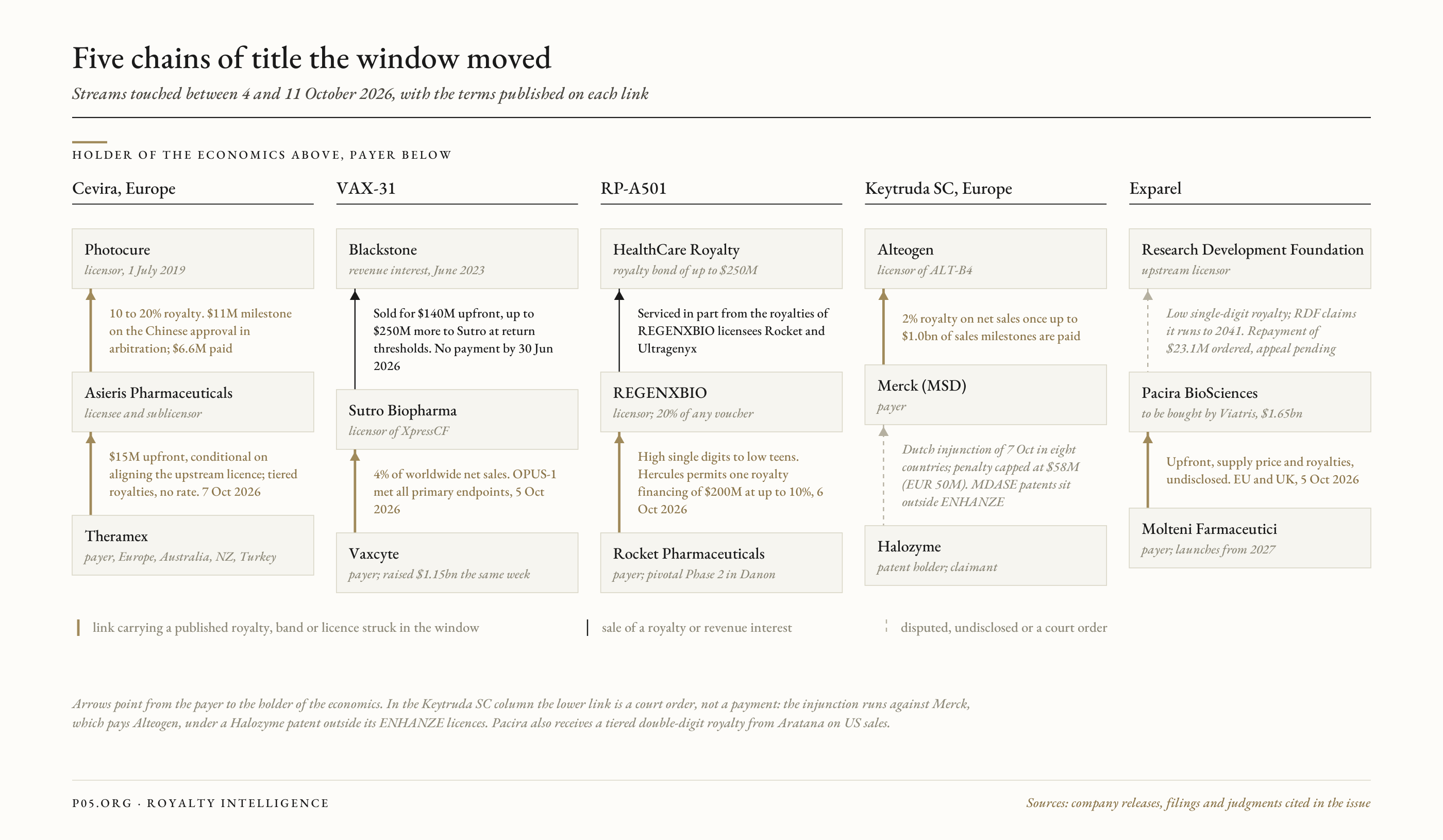
Five chains of title the window moved, holders of the economics above and payers below. Gold links carry a published royalty or a licence struck in the window; dashed links are disputed, undisclosed or a court order.
CSL and Alentis Therapeutics: USD 355m upfront and a 55 to 45 profit share on lixudebart (Monday 5 October)
CSL (ASX: CSL) and Alentis Therapeutics, a private Basel company, signed an exclusive global collaboration to co-develop and co-promote lixudebart. The announcement was lodged with the Australian Securities Exchange at 08:22 Sydney time and marked price sensitive.
- The asset: lixudebart, formerly ALE.F02, an anti-claudin-1 monoclonal antibody. The Phase 2 RENAL trial in ANCA-associated vasculitis with rapidly progressive glomerulonephritis is ongoing.
- The upfront: "CSL will make an initial payment to Alentis of US$355 million".
- The milestones: "up to an additional US$1.2 billion in commercial milestone payments". No development or regulatory milestone is stated.
- The profit share: "global profits will be shared 55 per cent to CSL and 45 per cent to Alentis".
- Development cost: CSL "will fully fund the completion of the ongoing Phase 2 RENAL trial and planned Phase 3 trial in AAV-RPGN, the Phase 2 trials in FSGS and PSC".
- The data: an interim analysis of 26 patients in RENAL, with kidney function assessed by eGFR and proteinuria at 24 weeks, and the Phase 1b FEGATO trial in 41 patients with advanced liver fibrosis. No figures are given.
- Retained by Alentis: ALE.P02 and ALE.P03, claudin-1 antibody-drug conjugates for oncology in Phase 1/2, per the Alentis copy of the release.
- Chain of title: Alentis was founded on research in the laboratory of Professor Thomas Baumert at the University of Strasbourg and Inserm. No payment to either is stated.
- Status: no closing condition, antitrust condition or closing date is stated. Goodwin Procter was counsel to Alentis, per the firm; no financial adviser is named.
- Instrument: exclusive global co-development and co-promotion agreement with an upfront payment, commercial milestones and a profit share.
- Royalty read-through: no royalty is payable. Alentis holds 45 per cent of global profits and the commercial milestones, and Alentis has no royalty financing on the asset on record.
Eli Lilly and Gate Bioscience (Monday 5 October). Gate Bioscience, a private company in Brisbane, California, expanded its collaboration and licence agreement with Lilly by one target, with an option on a second. Gate receives an upfront payment, a further payment on selection of the second target, and research funding.
Gate is also eligible for preclinical, clinical and commercial milestones "as well as tiered royalties on global net sales". "The total potential value of the agreement could exceed $870 million", and no upfront amount or royalty band is given. The original agreement of 24 July 2025 carried a total potential value of USD 856m.
Immunome and Bristol Myers Squibb: USD 20.0m and 4.4 million shares to remove the royalty on varegacestat (Monday 5 October)
Immunome (Nasdaq: IMNM) disclosed a fourth amendment to the 2017 licence it holds from Bristol Myers Squibb. The amendment is dated 2 October and was first made public in a Form 8-K on 5 October, with no press release.
- The asset: varegacestat, formerly AL102, a gamma secretase inhibitor for desmoid tumours. The Food and Drug Administration accepted the application in July 2026, with a target date of 28 April 2027, per the second-quarter release.
- The payment: Immunome "paid BMS $20.0 million in cash and issued 4,425,487 shares" of common stock. No value is given for the shares.
- What it buys: "The Amendment removes the Company's obligation to make any milestone and royalty payments". Bristol also assigns the patent rights to varegacestat and AL101.
- What was removed: a tiered royalty from high single digits to low teens on worldwide net sales, development and regulatory milestones of up to about USD 142m, and commercial milestones of up to USD 50m per product, per the 2025 annual report.
- The shares: issued under Section 4(a)(2), with a resale registration statement due by 16 November 2026.
- What remains: up to USD 27.5m of regulatory and commercial milestones to Ayala Pharmaceuticals under the 2024 asset purchase. No royalty to Ayala is described.
- Instrument: licence amendment, with a buy-out of milestones and royalty for cash and unregistered shares.
- Royalty read-through: the royalty is extinguished seven months before the target date. Immunome's filings show no royalty sale, revenue interest or debt.
Alector and Genentech: USD 100m upfront for a brain-penetrant GCase enzyme (Monday 5 October)
Alector (Nasdaq: ALEC) granted Genentech an exclusive worldwide licence to AL050 and related GCase candidates for Parkinson's disease. The agreement is dated 30 September and was announced on 5 October.
- The upfront: "Alector will receive a $100 million upfront payment from Genentech".
- The milestones: "up to an additional $1.17 billion in development, regulatory, and commercial success-related milestone payments". No split is given.
- The royalty: "tiered royalties on a specified percentage of net sales of the GCase Candidates at rates ranging from single-digit to double-digit percentages".
- Termination: "Genentech may terminate the Genentech License Agreement for convenience upon prior written notice."
- Chain of title: Alector exercised an option over patents of Spur Therapeutics on 30 September. It paid USD 0.5m for the option and "will pay Spur $15 million", "plus a percentage in the teens of any milestone and other non-royalty partnering income".
- The pass-through: Spur also receives "additional royalties calculated as a percentage of the royalties that Alector receives". The percentage is not stated.
- Cash: about USD 138.7m at 30 September, and about USD 223.7m pro forma, which the company expects to fund operations "into 2029".
- Instrument: exclusive worldwide licence with an upfront, milestones and a tiered royalty, above an upstream patent licence.
- Royalty read-through: a royalty is created with a band, and an undisclosed share of it passes to Spur. Alector reports no royalty financing on the asset.
Harrow and Viatris: Tyrvaya closes at USD 30.0m, with a Japan royalty back to Harrow (Monday 5 October)
Harrow (Nasdaq: HROW) completed the purchase of Tyrvaya from Viatris on 1 October and disclosed it on 5 October. The agreement of 3 August was amended and restated on the day of closing.
- The asset: Tyrvaya (varenicline solution) nasal spray for dry eye disease, an approved product, in all countries other than Japan.
- The change: "Viatris retains the rights to commercialize TYRVAYA in Japan". The working-capital adjustment was removed, and "the cash consideration paid at the Closing was fixed at $30.0 million".
- The earn-out: "up to $70.0 million in contingent milestone payments upon the achievement of specified net sales thresholds for TYRVAYA", measured over twelve-month periods ending by 31 December 2029.
- The new royalty: "Viatris is obligated to pay the Company tiered royalties on annual net sales of TYRVAYA in Japan". No band is stated.
- The release: the closing release puts "potential total consideration of up to $100 million" and says "Harrow expects TYRVAYA to contribute more than $30 million in revenue in 2027."
- Chain of title: the product was licensed from Pfizer by Oyster Point Pharma, which reported a tiered US royalty of 7.5 to 15 per cent in 2022. The filing says only that Harrow assumed "certain specified liabilities relating to the Acquired Assets".
- Instrument: amended and restated asset purchase agreement with sales milestones, and a side letter carrying a royalty.
- Royalty read-through: one royalty is created, from Viatris to Harrow on Japanese sales. Whether the Pfizer royalty passed to Harrow is not stated.
Pacira BioSciences and Molteni Farmaceutici (Monday 5 October). Pacira (Nasdaq: PCRX) licensed Exparel to Molteni for the European Union and the United Kingdom. "Pacira will receive an undisclosed upfront payment, a supply price, and royalties on future commercial sales by Molteni Farmaceutici in licensed territories."
The first commercial sale is expected in 2027, with launches planned first in Italy, Germany, Austria and Poland, and an approval to be sought in Switzerland. "Locust Walk acted as the exclusive financial advisor to Pacira in the transaction." Neither an amount nor a band is given.
Taiwan Liposome Company and Nippon Zoki Pharmaceutical (Monday 5 October). Taiwan Liposome, a subsidiary of TLC BioSciences, licensed TLC599 to Nippon Zoki, a private Osaka company, which takes "exclusive commercial and development rights for TLC599 in Japan". TLC599 is a sustained-release dexamethasone injection for knee osteoarthritis pain.
"Commercial terms of the agreement remain confidential in accordance with the parties' confidentiality arrangements." "A Phase 3 multi-regional clinical trial is underway in Japan and the United States."
The parent's exchange filing of the same day gives figures the release does not. Taiwan Liposome can receive up to USD 203m in total across the upfront payment and development, regulatory and sales milestones. After launch it receives tiered royalties on net sales in Japan of up to a double-digit percentage. The filing adds that some terms are trade secrets and are not disclosed. Some Taiwanese press reports give "high double digits"; the filing says a double-digit percentage.
Italfarmaco and VeriSIM Life (Monday 5 October). Italfarmaco, a private Milan company, and VeriSIM Life agreed to discover small molecules against one HDAC target. "VeriSIM Life is eligible to receive technology service fees, development, regulatory, and commercial milestone payments, and royalties on future commercial products."
"The collaboration has a total potential value exceeding US $100 million". The upfront and the royalty band are undisclosed.
Orion and Qilu Pharma Europe (Tuesday 6 October). Orion (Nasdaq Helsinki: ORNBV) took the "exclusive right to distribute, market and sell Qilu's IV pembrolizumab biosimilar in Europe". Qilu receives "a share of profits from Orion Pharma as well as certain development, regulatory and sales milestone payments".
Amount and percentage are undisclosed. The biosimilar is still in development, and no launch date is stated.
Novelty Nobility and an undisclosed US biotechnology company (Tuesday 6 October). Novelty Nobility, a private Korean company, licensed out NN3201, a c-Kit antibody-drug conjugate in a US Phase 1 trial, in an agreement signed on 30 September, per its release as carried by The Bio. The contract size is USD 553m (KRW 744.3bn) in total, and the partner takes worldwide exclusive development and commercialisation rights.
Commercial milestones and royalties are payable separately. The upfront, the royalty rate and the name of the partner are not disclosed.
Ainos and San Fu Chemical (Thursday 8 October). San Fu Chemical (TWSE: 4755) told the Taiwan exchange that the board of its biomedical subsidiary approved a global licence for VELDONA, a low-dose oral interferon, from Ainos (Nasdaq: AIMD), with signing set for 13 October. The filing states no amounts. Ainos's current report of 28 September names the licensee as BioPhoenix, a Taiwanese company, which is the English name of San Fu's subsidiary 三福生醫.
That company was set up to take over the drug development of San Fu Biotech, 89.59 per cent owned by San Fu Chemical, per Commercial Times. The licence covers Sjögren's disease and thrombocytopenia: "BioPhoenix will pay the Company an upfront license fee of $600,000", and Ainos "will receive twenty-five percent (25%) of BioPhoenix's net sublicensing revenue for the Licensed Indications". Total fees "would be approximately $10.0 million" if BioPhoenix licenses all further indications.
The report gives an effective date of 24 September, before the subsidiary's board vote.
Peptron and Lilly (Wednesday 7 October). Peptron (Kosdaq: 087010) told shareholders that Lilly's evaluation of its SmartDepot long-acting injection platform, signed in October 2024 and later extended, ended without a commercial agreement, per its letter as reported by Dealsite. In the letter, "the technical evaluation period for the SmartDepot platform conducted with Lilly has ended". Peptron says it has received all agreed payments and that commercial cooperation with Lilly remains possible.
The news went out as a shareholder letter on its website; there is no exchange filing. The shares fell 29.9 per cent, the daily limit, to USD 66.8 (KRW 91,500) in after-hours trading. The contract value was never disclosed.
PeptiDream and MSD (Wednesday 7 October). PeptiDream (TSE: 4587) said it will receive a milestone fee from MSD under their joint research, per its disclosure to the Tokyo Stock Exchange as reported by Nikkan Yakugyo. The amount is not disclosed under the contract with MSD.
UBI Pharma and the Development Center for Biotechnology (Thursday 8 October). UBI Pharma (TPEx: 6562), a Taiwanese public company, announced to the exchange at 15:41 Taipei time that it has terminated its technology licence from the Development Center for Biotechnology for UB-941, a B-Raf inhibitor for cancer. A press headline describes the termination as by mutual agreement.
UBI Pharma's half-year accounts for 2025 had already written UB-941 off in full at the end of 2024, because sublicensing had made no progress and the licence was due to end in August 2025. They put the expected licence fees at USD 6.3m (TWD 200m), of which USD 0.3m (TWD 10m) had been paid by 30 June 2025.
GI Innovation and Maruho (Wednesday 7 October). GI Innovation (Kosdaq: 358570) said it will receive a development milestone when the first patient is dosed in Maruho's Japanese Phase 2 trial of GI-301 in chronic spontaneous urticaria, expected in October, per Finance Scope. The amount is not disclosed. The 2023 licence of the Japanese rights is worth up to USD 221m (KRW 302.5bn) in total, with royalties on sales and no stated upfront or rate, per Biospectator.
The rights outside Japan sit with Yuhan under a 2020 licence of up to USD 1.03bn (KRW 1.409tn), including a USD 14.6m (KRW 20bn) upfront.
Lotus and OM Pharma (Wednesday 7 October). Lotus Pharmaceutical (TWSE: 1795) completed its purchase of the Korean rights to UroVaxom from OM Pharma of Geneva, after its subsidiary Alvogen Korea obtained the Korean marketing licence, per UAnalyze. Alvogen Korea has distributed the product since 1 July under an agreement announced in May, and Lotus plans a technology transfer towards making it itself. No price and no royalty are stated.
Avalon Pharma and Aurisco Pharma (Wednesday 7 October). Middle East Pharmaceutical Industries, which trades as Avalon Pharma (Tadawul: 4016), signed a memorandum of understanding with Aurisco Pharma of China on oligonucleotides and other complex products. The notice went to the Saudi exchange at 08:04 Riyadh time on 7 October.
Arabic press accounts of it describe the memorandum as signed on 6 October and running for six months, covering development, technology transfer and local manufacture in Saudi Arabia, with inclisiran as the first project. No financial value is set, and commercial and financial terms are left to later final agreements.
Inclisiran is Novartis's Leqvio, which pays a royalty to Alnylam; Alnylam's annual report states that "Blackstone provided us with $1.00 billion to acquire 50% of royalties and 75% of commercial milestones payable to us in connection with sales of Leqvio." Whether the Saudi product would be licensed from Novartis is not stated.
MicuRx and ClearideBio (Friday 9 October). MicuRx (SSE STAR: 688373) told the Shanghai exchange that its board approved two agreements it intends to sign with ClearideBio Therapeutics, a Basel company: a worldwide exclusive licence to MRX-23, a preclinical antibody-drug conjugate, and an option on up to six targets on its STOPIN conjugate platform, per Zhitong Finance's account of the announcement. MRX-23 carries USD 1m upfront and development, registration and sales milestones capped at USD 223m.
Each exercised platform programme is capped at USD 125m, or USD 750m if all six are exercised and every milestone is met. The press reports a share of sublicence income or a sales royalty, with no rate, and one director abstaining on the grounds that the company knew too little about the counterparty. ClearideBio was founded in December 2025, and Lotte Holdings led its pre-seed round in June, per BioSpectrum Asia.
Nurix Therapeutics and Gilead Sciences (Monday 5 October). Nurix (Nasdaq: NRIX) and Gilead extended the research term of one undisclosed oncology programme by two years, the second such extension under a collaboration "originally established in 2019". "Nurix will receive a $10 million research term extension fee under the amended collaboration agreement."
Nurix remains eligible for "up to approximately $1.3 billion in total payments" and for "mid-single-digit to low-teens percentage tiered royalties on annual net sales from any commercial products". No target is named.
Halozyme and argenx (Tuesday 6 October). Halozyme (Nasdaq: HALO) said it "has expanded its global collaboration and license agreement with argenx to develop and commercialize ENHANZE® with two additional exclusive targets", per the release. The agreement "increases argenx's exclusive access to ENHANZE® from six to eight targets".
"Halozyme is eligible to receive payments upon achievement of agreed upon milestones" and "will receive royalties on net sales of products using ENHANZE®". Amount and rate are undisclosed.
Atossa Therapeutics and a voucher it does not yet hold (Friday 9 October). Atossa (Nasdaq: ATOS) will issue "one stapled CVR for each share of Atossa common stock outstanding as of October 19, 2026 record date", entitling holders to "25% of the net proceeds from the sale or other monetization of the first qualifying PRV", subject to a "$50 million aggregate cap".
The voucher must be awarded "on or before December 31, 2036". Using the voucher or a change of control while holding it counts as a sale at a value set by an independent adviser. Atossa holds rare paediatric disease designations for (Z)-endoxifen in Duchenne muscular dystrophy and McCune-Albright syndrome, and "has not submitted a marketing application". VStock Transfer is rights agent.
Ultragenyx and a priority review voucher (Tuesday 6 October). Ultragenyx (Nasdaq: RARE) agreed to sell its rare paediatric disease priority review voucher. The buyer, which is not named, will pay "$210 million, payable in cash, upon the closing of the transaction".
The voucher was awarded on 19 August 2026 with the approval of Genglycos, a gene therapy for glycogen storage disease type Ia. "20% of the gross proceeds from the sale of the PRV will be payable by the Company to the NIH after the closing of the transaction", under a patent licence. That is USD 42m.
Closing depends on antitrust clearance in the United States. The agreement will be filed with the annual report for 2026. Ultragenyx's release names Jefferies as financial adviser and Gibson, Dunn & Crutcher as legal counsel.
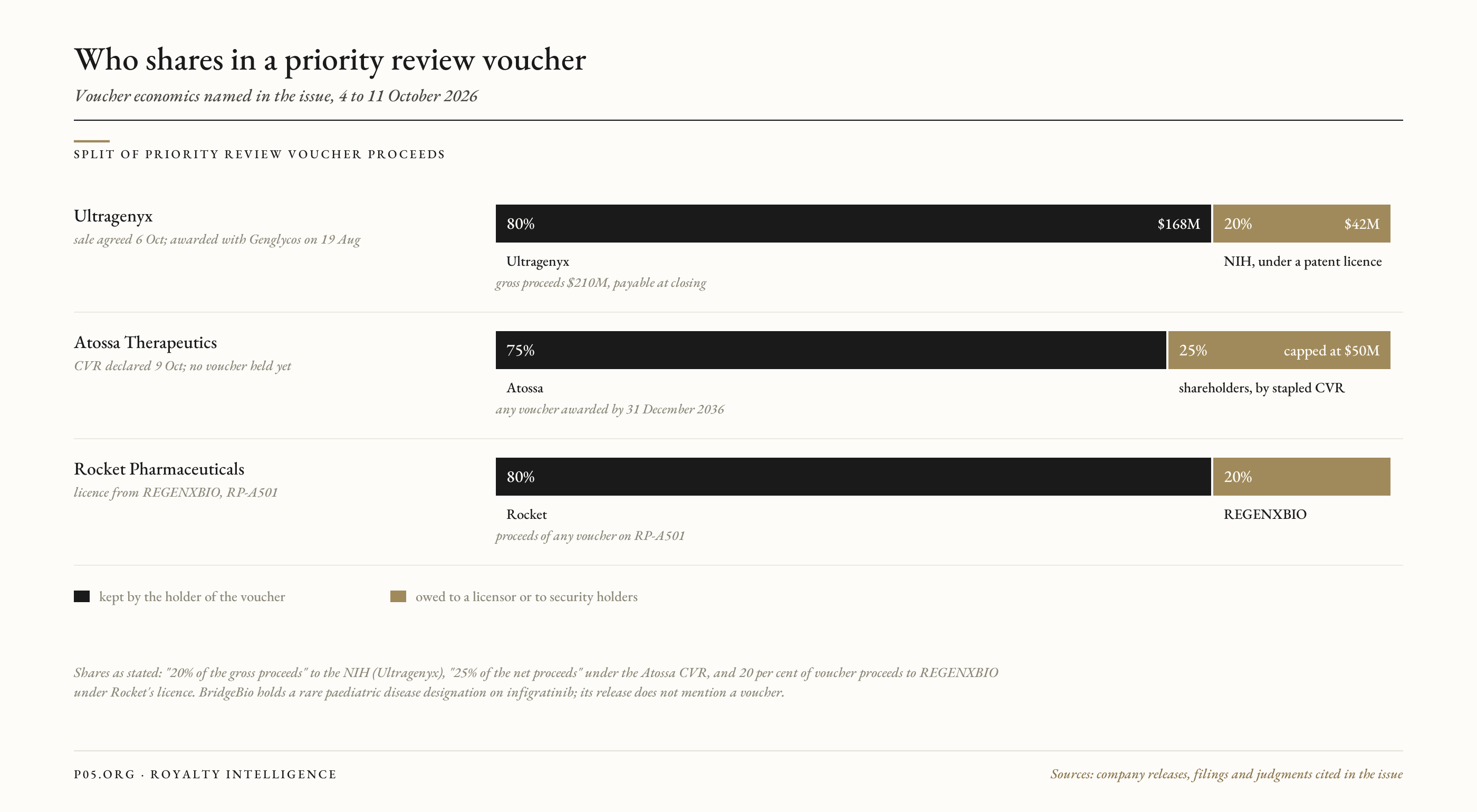
How the proceeds of the three priority review vouchers named in the window are split between the holder and a licensor or security holders.
Esperion and Renata (Wednesday 7 October). Esperion Therapeutics, owned by ARCHIMED since a take-private that closed on 13 July 2026, said it settled with a sixth generic filer on Nexletol and Nexlizet. "Renata has agreed not to market a generic version of either NEXLETOL or NEXLIZET in the United States prior to April 19, 2040", subject to customary exceptions.
No payment is stated. Litigation against Aurobindo, MSN and Sandoz continues. Esperion's report for the first quarter puts trial "no earlier than January 2027". It receives "tiered fifteen percent (15%) to twenty-five percent (25%) royalties on net DSE Territory sales" from Daiichi Sankyo Europe and 12 to 33 per cent from Otsuka in Japan.
In June 2024 OMERS Life Sciences, through OCM IP Healthcare Portfolio, paid USD 304.7m for "100% interest, subject to a cap" of Esperion's royalty on Daiichi Sankyo Europe's sales, per Esperion's second-quarter 2024 release. OMERS takes the tiered 15 to 25 per cent royalty "until it has received an aggregate amount equal to 1.7x its investment", after which it reverts to Esperion. The proceeds paid off Oberland's revenue interest facility. The Renata settlement concerns the United States only, so it does not touch the stream OMERS holds.
Halozyme and Merck (Wednesday 7 October). Halozyme (Nasdaq: HALO) said "the specialized Dutch patent court of the Hague has found Merck to be infringing one of its MDASE patents", EP 2,797,622. The order covers "Belgium, Denmark, France, Ireland, Italy, Sweden, Switzerland and the Netherlands".
Merck's Dutch subsidiary must "refrain from manufacturing, having manufactured, offering, placing on the market and using" subcutaneous Keytruda. The intravenous form is "not covered by Halozyme's patent or the court's injunction order".
Halozyme says the MDASE patents "are not included in Halozyme's ENHANZE® licensing program". Subcutaneous Keytruda uses "Alteogen's proprietary berahyaluronidase alfa" under a licence made exclusive in February 2024. Merck's quarterly report for the third quarter of 2025 gives "sales-based milestone payments of up to $ 1.0billion in the aggregate", and "a 2% royalty on net sales is payable to Alteogen" once those are paid.
A German preliminary injunction dates from 4 December 2025 and is under appeal, and "the appeal hearing is set for November 19, 2026". A suit is pending in New Jersey. Merck's report for the second quarter describes the Dutch case as Merck's own revocation action, in which Halozyme "counterclaimed for infringement including also Belgium, Denmark, France, Ireland, Italy, Sweden and Switzerland", heard at the end of July with a decision expected within three months.
The order is a judgment on the merits, after a preliminary injunction for Denmark and Sweden was refused in July. Merck's report adds that Halozyme consented in May 2026 to revocation of the patent in the United Kingdom.
The judgment of 7 October, case C/09/695432 / HA ZA 25-1075, dismisses MSD's claims and declares that Keytruda SC falls within the Belgian, Danish, French, Irish, Italian, Dutch, Swedish and Swiss parts of EP 622. It orders MSD to stop infringing "within seven days of service of this judgment", and not to facilitate infringement by other MSD companies, "in particular by approving the use of, or making available, its European marketing authorisation for Keytruda SC".
The penalty is USD 29,000 (EUR 25,000) a day or, at Halozyme's choice, per product, "with a maximum of (in total)" USD 58m (EUR 50m). The foreign parts of the order lapse if a national court invalidates the local patent, and revive if an appeal restores it. Costs of USD 331,000 (EUR 284,760) go to Halozyme. The judgment records that MSD buys ALT-B4 from Alteogen for Keytruda SC, and that Bristol Myers Squibb markets Opdivo SC in Europe under licence from Halozyme. It is enforceable pending appeal.
Merck told Reuters it strongly disagrees with the decision and is evaluating next steps. Neither side has said whether it will appeal.
Onyx Therapeutics and Amneal (Tuesday 6 October). In the District of Delaware, Judge Williams issued a claim construction in Onyx's suit over Amneal's application for a generic of Kyprolis (carfilzomib), Civil Action 25-1107. Onyx, an Amgen company, asserts U.S. Patent No. 7,737,112, on compositions of a proteasome inhibitor with a substituted cyclodextrin.
The court construed "a substituted cyclodextrin selected from hydroxypropyl beta-cyclodextrin and sulfobutyl ether beta-cyclodextrin (SBECD)" by its plain meaning, as "hydroxypropyl betacyclodextrin (HPBCD) or sulfobutyl ether betacyclodextrin (SBECD)". The opinion names no licence or royalty.
Ligand supplies the SBECD in Kyprolis as Captisol. Its 2025 annual report states that Amgen pays "a 1.5% to 3.0% royalty on annual net sales of Kyprolis", which ran to USD 35.5m in 2025, and that "Amgen's obligation to pay royalties does not expire until four years after the expiration of the last-to-expire patent" covering Captisol. Ligand's Captisol patents on Kyprolis run to "at least 2033". "Several generics have settled with Amgen on confidential terms", with at least one generic launch reported for 2027 or sooner.
Huons BioPharma and Aquavit Holdings (Wednesday 7 October). Judge Andrews denied a motion to dismiss in Huons's suit under a "License and Supply Agreement" of 12 April 2021, under which Aquavit agreed "to register, distribute, and commercialize" Huons's botulinum toxin type A in the United States. The court held it reasonable that the Nevada Aquavit entity, not a Bahamian one formed two days later, signed the agreement, so the contract claims stay in Delaware. No economics are stated.
Antares Pharma and Gordon Silver (Wednesday 7 October). Judge Williams overruled objections to a special master's discovery order in Antares's trade mark and contract suit over Tlando. Lipocine assigned a transition services agreement with Antares to Gordon Silver on 24 January 2024, and Antares alleges sales continued after the sell-off period. The court let stand Antares's damages theories, including "a royalty fee claim" added in May 2026. Verity, Lipocine's licensee, was dismissed from the case in November 2025.
Sandoz and United Therapeutics (Wednesday 7 October). The Third Circuit ruled in a precedential opinion by Judge Restrepo, Nos. 24-3067, 24-3116 and 24-3146, on Sandoz's claims over its 2017 generic of Remodulin (treprostinil). The 2015 patent settlement "granted Sandoz a license to market treprostinil" and obliged United Therapeutics "[n]ot to take any action directly or indirectly to prevent, delay, limit, or otherwise restrict the launch".
"Because the settlement agreement does not unambiguously establish the interpretation that Sandoz advances, we will reverse the grant of summary judgment in favor of Sandoz as to liability on the breach-of-contract claim and remand with instructions that the issue of liability proceed to trial." That vacates the district court's award to Sandoz of "$61,643,251 in damages". "As UTC demonstrated procompetitive justifications for its conduct, we will affirm the dismissal of the antitrust and state tort claims", while the tortious-interference claim goes back for separate analysis.
Liquidia's registration statement of March 2025 says its subsidiary Liquidia PAH shares the profits on Sandoz's generic, that "all proceeds from the litigation will be divided evenly between Sandoz and Liquidia PAH", and that Liquidia PAH's net share goes to its litigation funders, Henderson and PBM. It puts the November 2024 judgment at USD 70.6m, against the USD 61.6m of damages the court of appeals cites.
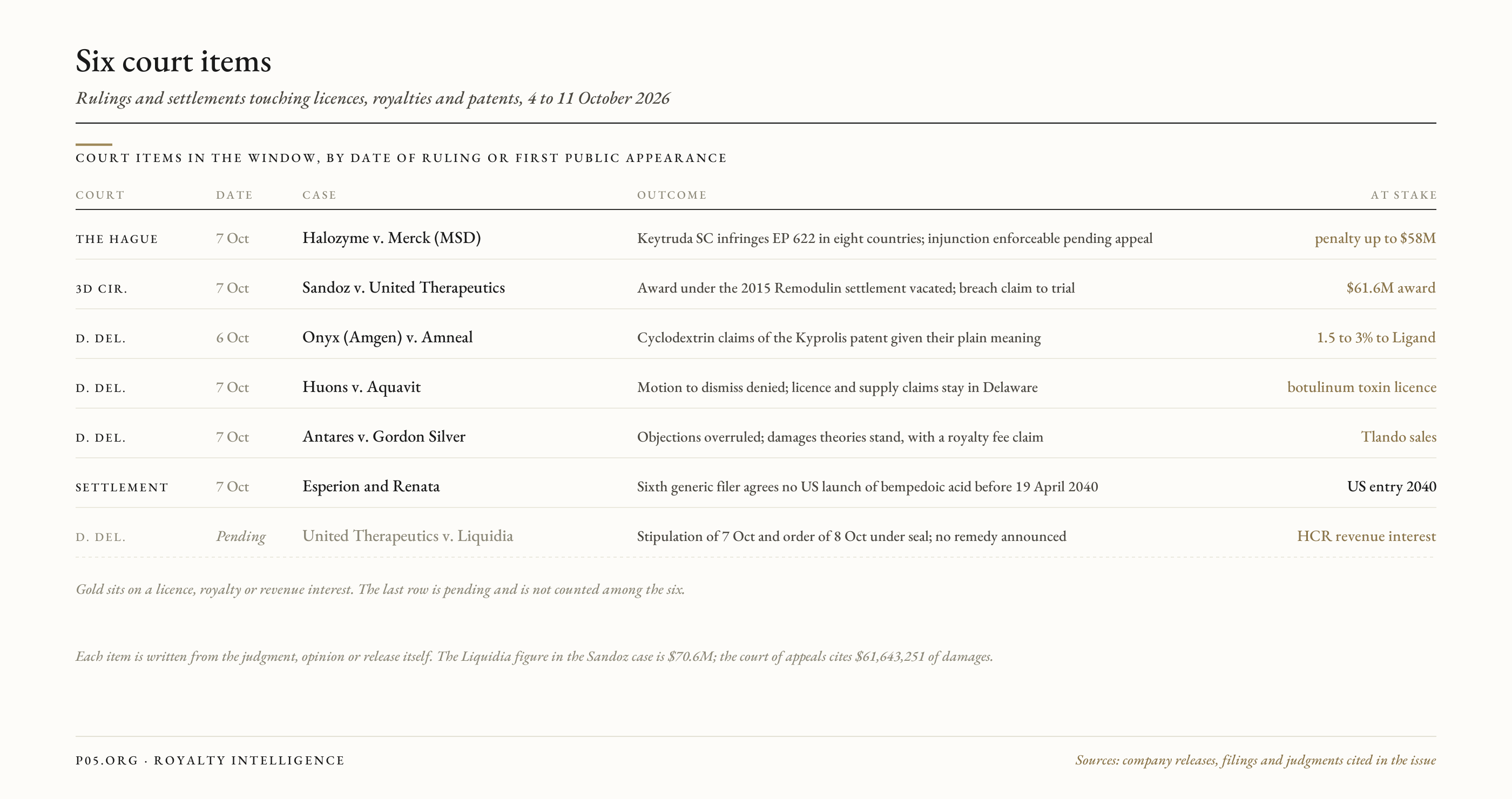
The six court items in the window and one pending, by court, date, outcome and what is at stake.
ORIC Pharmaceuticals and Cancer Research UK (Monday 5 October). ORIC (Nasdaq: ORIC) agreed that Cancer Research UK's Centre for Drug Development "will fully fund, sponsor, design, and execute CTA-enabling studies and early clinical development of ORIC-259", a preclinical degrader of CIP2A mRNA.
"ORIC retains an option to reacquire rights to ORIC-259 following Phase 1/2 data, with Cancer Research UK eligible to receive downstream milestone payments and royalties." Neither amount nor royalty band is given.
Biohaven and Ono: USD 80m upfront and a royalty of about 20 per cent on IgG degraders in Asia (Thursday 8 October)
Biohaven (NYSE: BHVN) licensed its extracellular IgG degraders to Ono Pharmaceutical (TSE: 4528) for "Japan, South Korea, Taiwan, and the ASEAN region". Biohaven "retains all rights outside of the licensed territory, including in the US, Europe, and China".
- The asset: "BHV-1300 is an investigational small-molecule IgG degrader currently in Phase 3 development for Graves' disease", with follow-on molecules BHV-1310 and BHV-1320.
- Consideration: "up to $100 million in near-term payments", "including $80 million upon closing and another $20 million upon a milestone achievement anticipated within a year".
- Royalty: "royalties of approximately twenty percent on net sales in the licensed territory".
- Ono's filing: Ono's disclosure to the Tokyo Stock Exchange of 8 October, filed after the close, gives the same USD 80m upfront and a royalty of about 20 per cent on sales, and ties the USD 20m to development progress rather than a date.
- Advisers: J.P. Morgan as exclusive financial adviser and Sullivan & Cromwell as legal adviser to Biohaven. Ono's advisers are not named.
- Instrument: exclusive territorial licence with an upfront, a near-term milestone and a royalty.
- Royalty read-through: a stated rate of about 20 per cent on a Phase 3 asset, owed by a Japanese licensee. Biohaven's 2025 note purchase agreement with Oberland gives the lender "a security interest in the Obligors' cash and equity interests and in specific assets related to troriluzole", and a payment of 35 per cent of the funded amount on approval by the Food and Drug Administration or the European Medicines Agency "of troriluzole or other Company products". A US or European approval of BHV-1300 would trigger a payment to Oberland. Whether the Asian royalty is pledged is not said.
ADC Therapeutics and HealthCare Royalty: the change-of-control payment removed, funded by a USD 86.6m PIPE (Thursday 8 October)
ADC Therapeutics (NYSE: ADCT) announced a restructuring of its royalty financing, its term loan and its equity.
- The royalty financing: the amendment is dated 7 October. "The HCR Amendment eliminates the $150 million payment otherwise required solely upon a change of control." HealthCare Royalty's warrants are repriced "from $3.8130 per share to $0.10 per share", and "the ongoing royalty obligations which will continue until the Royalty Cap" are unchanged. HealthCare Royalty has funded USD 300m under the 2021 agreement, per an earlier filing.
- The term loan: "the prepayment of $70.0 million principal amount of term loans", with USD 50.0m left due at maturity and a new covenant of "$65.0 million" of trailing four-quarter US Zynlonta sales.
- The PIPE: "12.9 million common shares at $1.42 per share" and "pre-funded warrants to purchase 48.1 million common shares at $1.32", about USD 86.6m before fees "assuming cash exercise of the pre-funded warrants", from "new investor Bain Capital Life Sciences and existing investors Redmile, TCGX, and Nantahala Capital". It is "expected to close on October 22, 2026".
- Conditions: "The effectiveness of the HCR Amendment is conditioned upon the completion of the PIPE by October 31, 2026".
- The debt cap: the amendment limits the third-party debt ADC Therapeutics and its subsidiaries may carry to "$50.0 million", the term loan left after the prepayment. "An uncured breach of this debt limitation covenant entitles HCR to elect to receive the non-performance payment", "equaling 1.5 times the difference between the $300 million aggregate purchase price" and the royalties and credited amounts HealthCare Royalty has received. The company must also "use its best efforts to become a Delaware corporation", subject to shareholder approval.
- The asset: Zynlonta, with third-quarter net product revenue of "approximately $21.0 million". Cash was USD 189.2m on 30 September.
- Advisers: Jefferies, Guggenheim Securities and Cantor as placement agents; Davis Polk & Wardwell and Homburger as legal advisers to ADC Therapeutics.
- Instrument: amendment of a royalty purchase agreement, term-loan amendment and private placement.
- Royalty read-through: removing the change-of-control payment takes a USD 150m liability off any sale of the company, while the royalty to HealthCare Royalty runs on to its cap.
Asieris and Theramex: USD 15m upfront for Cevira in Europe, conditional on the upstream licence (Wednesday 7 October)
Asieris Pharmaceuticals (SSE: 688176) licensed Cevira to Theramex for a territory "covering all countries in Europe, as well as Australia, New Zealand and Turkey". Asieris keeps "the rights for the rest of the world".
- The asset: Cevira (APL-1702) is "a photodynamic drug-device combination product being developed for the non-surgical treatment" of cervical precancerous lesions. China's regulator approved it in March 2026. European approval status is not given.
- Consideration: "The deal includes 15 million US dollars of upfront payment" and "a total of 11 million dollars of near-term regulatory milestone payments", with "commercial milestone payments as well as tiered royalties". "The total deal value is in excess of 250 million US dollars."
- Conditions: the upfront depends on a supply agreement, "successful audits of CEVIRA® manufacturing sites", a step to "streamline this agreement with the upstream licensing agreement", and a clarification with the European Commission on the clinical value assessment of the device.
- The licence upward: the release does not name the licensor. Photocure (Oslo: PHO) licensed Cevira to Asieris worldwide on 1 July 2019 for a USD 5m signing fee, milestones of USD 18m in China and "up to USD 36 million for certain clinical and regulatory milestones in USA and EU", and "exclusive royalties of 10 to 20 per cent".
- Instrument: an exclusive territorial sublicence with a conditional upfront, milestones and tiered royalties. No rate is stated.
- The licensor dispute: Photocure said in April it had invoiced a USD 11m milestone on the Chinese approval, of which Asieris paid USD 6.6m on the view that the Chinese label does not trigger the full amount. Photocure began arbitration in July, and Asieris counterclaimed on 3 August for return of the USD 6.6m. Photocure has not commented on the Theramex sublicence.
- Royalty read-through: two royalties now stack on European sales of Cevira, one to Asieris with no stated rate and one to Photocure at 10 to 20 per cent. The upfront does not fall due until the two licences are aligned.
Rocket Pharmaceuticals and Hercules Capital: a USD 150.0m term loan that permits a royalty financing on RP-A501 (Tuesday 6 October)
Rocket (Nasdaq: RCKT) announced "a credit facility agreement with Hercules Capital, Inc. (NYSE: HTGC) for up to $150 million". The loan agreement is dated 30 September and was first made public on 6 October.
- The tranches: USD 35.0m "funded in full on September 30, 2026", USD 20.0m and USD 15.0m at Rocket's option into 2027, USD 30.0m on a clinical milestone in Danon disease, and "up to $50.0 million", "subject to the Lenders' investment committee approval".
- The rate: "the sum of (x) the greater of (i) prime rate and (ii) 6.75%, plus (y) 2.40%".
- Term: "The Term Loans mature on October 1, 2030, subject to extension to October 1, 2031". They are interest-only "through April 1, 2029".
- Security: "a first-priority security interest in substantially all of the assets of Borrower, including its intellectual property".
- Warrants: "up to an aggregate of 1,755,853 shares" at "an exercise price of $2.99 per share".
- The royalty carve-out: the agreement permits "either a true royalty or synthetic royalty financing" on RP-A501 for "net cash proceeds of no less than Two Hundred Million Dollars ($200,000,000)".
- Its limits: payments may not exceed "ten percent (10.00%)" of worldwide net sales of RP-A501, or fees of "two (2) times the net cash proceeds". The figures scale down to USD 100m for 5 per cent of revenue.
- Its conditions: a synthetic royalty needs "an intercreditor agreement in form and substance satisfactory to Agent in its sole discretion". No "guaranteed minimum return payment or "true-up" payment" may fall "earlier than one hundred eighty (180) days after the Term Loan Maturity Date".
- One at a time: "Borrower shall not engage in more than one such transaction, for RP-A501, at any one time."
- The asset: RP-A501, a gene therapy in a "pivotal Phase 2 study" for Danon disease.
- The licences upward: Rocket's 2025 annual report describes a low single-digit royalty to the University of California, San Diego, and a royalty in the high single digits to low teens to REGENXBIO, which also takes 20 per cent of the proceeds of any priority review voucher. REGENXBIO's royalty bond of up to USD 250m with HealthCare Royalty is serviced in part from the royalties of its platform licensees Rocket and Ultragenyx, so the royalty Rocket owes upward is already financed.
- Cash: USD 283.7m at 30 June 2026. With the first USD 35m Rocket expects "to fund planned operations into the third quarter of 2028".
- Advisers: "LifeSci Capital served as financial advisor to Rocket on the term loan financing. PJT served as a capital markets advisor to Rocket." Latham & Watkins represented Hercules Capital, with a finance team led by Hai Pham and Haim Zaltzman.
- Instrument: senior secured term loan in up to five tranches, with warrants.
- Royalty read-through: the lender has agreed in advance to one royalty financing on RP-A501, sized at USD 200m against a 10 per cent royalty cap or USD 100m against 5 per cent. It caps the royalty at 10 per cent of sales and keeps its own lien ahead of any security given to the buyer.
Jaguar Health, Uptown Capital and Streeterville Capital (Monday 5 October). Jaguar (Nasdaq: JAGX) disclosed sixth amendments, dated 30 September, to two royalty interests of USD 12m each. In both, "the initiation of monthly payments shall be extended from October 1, 2026 to January 1, 2027".
The monthly payment is then "the greater of (a) $750,000.00, and (b) the actual Royalty Payment amount". The maturity of a USD 6.2m secured note held by Streeterville moves to the same date.
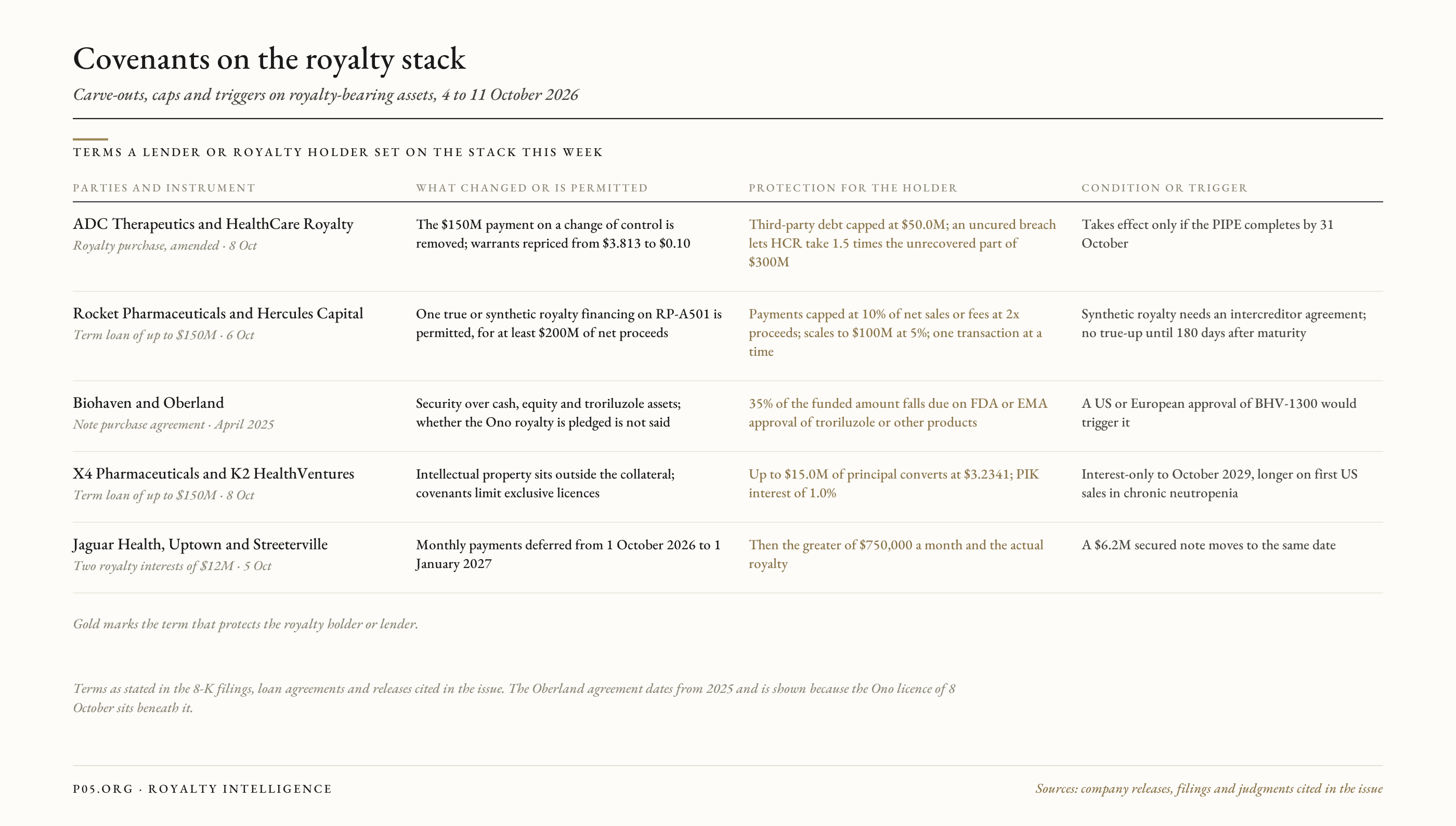
Five lenders and royalty holders that set terms on a royalty-bearing asset, by what changed, the protection for the holder and the condition attached.
Clinical and Regulatory
Vaxcyte: VAX-31 meets its primary endpoints in OPUS-1, with two serotypes short against Capvaxive (Monday 5 October)
Vaxcyte (Nasdaq: PCVX) reported topline data from OPUS-1, the pivotal adult Phase 3 trial of its 31-valent pneumococcal conjugate vaccine. The trial dosed 4,047 participants against Prevnar 20 and Capvaxive.
- The headline: "VAX-31 Met All Prespecified Primary Endpoints Across Age Groups Studied Compared to Prevnar 20® (PCV20) and/or Capvaxive® (PCV21)".
- Against Prevnar 20: non-inferiority on 20 of 20 shared serotypes.
- Against Capvaxive: non-inferiority on 17 of 19 shared serotypes. "Serotypes 3 and 12F missed the LBCI >0.667 noninferiority criterion and met the historical LBCI >0.5 threshold".
- Safety: "VAX-31 was well tolerated and demonstrated a safety profile similar to PCV20 and PCV21 across all ages studied".
- Next steps: results from OPUS-2 and OPUS-3 in the first half of 2027, and a planned application in the first half of 2028.
- The licence: the vaccine is made on XpressCF, "exclusively licensed from Sutro Biopharma, Inc." Sutro's annual report puts the royalty at 4 per cent of worldwide net sales of vaccines for human health.
- The royalty holder: Sutro sold a revenue interest in that royalty to Blackstone in June 2023 for USD 140.0m upfront, with up to USD 250.0m more payable to Sutro at return thresholds.
- Instrument: none in the release. Vaxcyte launched public offerings of stock and convertible notes later the same day, set out under public capital below.
- Royalty read-through: the 4 per cent royalty on VAX-31 sits with Blackstone. Sutro's quarterly report says the royalty on Vaxcyte products "other than Vaxcyte's PCV products reverted to the Company", and that "As of June 30, 2026, Blackstone has not received any royalty payment from Vaxcyte". Sutro keeps the threshold payments and the non-pneumococcal royalty.
Superiority: the three serotypes unique to VAX-31 and cross-reactive serotype 20B met the superiority criterion.
AbbVie and Genmab: epcoritamab with R-CHOP halves the risk of progression in first-line lymphoma (Monday 5 October)
AbbVie (NYSE: ABBV) and Genmab (Nasdaq: GMAB) reported topline results from the Phase 3 EPCORE DLBCL-2 trial. The trial tested fixed-duration epcoritamab with R-CHOP against R-CHOP alone in newly diagnosed diffuse large B-cell lymphoma.
- The primary endpoint: in patients with an IPI score of 3 to 5, "The risk of disease progression or death for the primary endpoint population was reduced by 51% (HR 0.49 [95% CI 0.35, 0.69]; p-value < 0.0001)", per Genmab company announcement no. 40.
- The total population: in patients with an IPI score of 2 to 5, "The risk of disease progression or death was reduced by 51% (HR 0.49 [95% CI 0.36, 0.67]; p-value < 0.0001)." No overall survival figure is given.
- The analysis: "This was the first planned efficacy interim analysis of the EPCORE DLBCL-2 study and, based on the significant benefit, the Independent Data Monitoring Committee (IDMC) recommended unblinding the study."
- Safety: the combination "was generally well tolerated and consistent with the previously reported safety profiles".
- Next steps: "Genmab and AbbVie will engage global regulatory authorities to determine next steps."
- The asset: epcoritamab, a subcutaneous CD3 and CD20 bispecific antibody already marketed in relapsed or refractory lymphoma.
- The licence: "The companies share commercial responsibilities in the U.S. and Japan, with AbbVie responsible for further global commercialization."
- The royalty: Genmab's 2024 annual report says it "receives tiered royalties between 22% and 26% on remaining global sales outside of these territories, subject to certain royalty reductions".
- Instrument: none. The release reports trial data only.
- Royalty read-through: a first-line label would widen the sales base on which AbbVie pays Genmab 22 to 26 per cent outside the United States and Japan. Genmab reports no royalty financing on epcoritamab.
BridgeBio: infigratinib accepted with priority review, with a target date of 4 February 2027 (Tuesday 6 October)
BridgeBio (Nasdaq: BBIO) said "the FDA has accepted for filing its New Drug Application (NDA) with Priority Review for oral infigratinib for the treatment of children with achondroplasia". The release is timed 07:30 Eastern on 6 October.
- The date: "The FDA has assigned a Prescription Drug User Fee Act (PDUFA) target action date of February 4, 2027".
- The data: PROPEL 3 "met its primary endpoint of change from baseline in annualized height velocity (AHV) at Week 52 (LS mean treatment difference of +1.74 cm/year; mean treatment difference of +2.10 cm/year; p<0.0001)".
- Designations: Breakthrough Therapy, Orphan Drug, Fast Track and Rare Pediatric Disease designations from the Food and Drug Administration. A priority review voucher is not mentioned.
- Europe: "BridgeBio intends to submit a Marketing Authorization Application (MAA) for achondroplasia to the European Medicines Agency (EMA) in the fourth quarter of 2026."
- The licence upward: the subsidiary QED Therapeutics licensed infigratinib from Novartis. The 2025 annual report says "QED also agreed to pay Novartis tiered low double-digit royalties on net sales of therapeutic products incorporating infigratinib".
- Milestones upward: the report states contingent payments to Novartis of USD 60.0m on regulatory milestones and USD 35.0m on sales milestones. It separately records a regulatory milestone payment of USD 20.0m after an approval in May 2021.
- The licence downward: Kyowa Kirin holds Japan under an agreement of 7 February 2024, for USD 100.0m upfront. "QED is entitled to receive royalties up to the mid-twenties percent on net sales of infigratinib in Japan."
- Instrument: none. The release reports a regulatory acceptance.
- Royalty read-through: a US approval would bring the low double-digit royalty to Novartis into payment on achondroplasia sales. BridgeBio has no royalty financing on infigratinib on record; its two royalty financings are on acoramidis.
ArriVent and Allist: firmonertinib misses its primary endpoint in FURVENT (Tuesday 6 October)
ArriVent (Nasdaq: AVBP) said the Phase 3 FURVENT trial of firmonertinib in first-line lung cancer with EGFR exon 20 insertion mutations "did not meet its primary endpoint of progression free survival (PFS) by blinded independent central review (BICR)". "The study enrolled 398 patients globally".
- The primary endpoint: median progression-free survival of 11.0 months on 240 mg against 9.5 months on "platinum-based chemotherapy with pemetrexed, the current first-line standard of care", a hazard ratio of 0.75 (95 per cent confidence interval 0.55 to 1.02) and a p-value of 0.0654.
- The lower dose: 8.4 months on 160 mg, a hazard ratio of 0.91 (0.67 to 1.25).
- Investigator assessment: 11.1 months, 8.3 months and 7.1 months in the three arms.
- Next steps: the company is "evaluating the full FURVENT dataset as we determine the most appropriate development path for firmonertinib". A second Phase 3 trial, ALPACCA, continues in first-line patients with EGFR PACC mutations.
- Cash: "Cash and investments of $373.1 million as of June 30, 2026 expected to fund operations into 2028", per the second-quarter release. The trial release gives no update.
- The licence: ArriVent holds firmonertinib from Allist for "all countries and territories (the Licensed Territory) other than greater China", per its 2025 annual report. It paid "$40.0 million to Allist on the Effective Date" and issued 1,276,250 shares.
- The royalty: "tiered royalties ranging from high single digits to low mid-teens percentages on an incremental aggregated net sales basis". Development and regulatory milestones run to USD 110.0m and commercial milestones to USD 655.0m.
- Instrument: none. The release reports trial data only.
- Allist's side: Allist (SSE STAR: 688578) reported the result on the evening of 7 October and said it had spent about USD 10.0m (CNY 70.82m) on the pivotal first-line trial by 30 September, already expensed, per Daily Economic News. The same announcement proposed a share buyback of USD 14.1m to USD 28.2m (CNY 100m to CNY 200m).
- The reverse licence: separately, on 11 August 2026 ArriVent granted Allist an "exclusive, sublicensable (through multiple tiers), royalty-bearing license" to ARR-002, an antibody-drug conjugate, for Greater China, with tiered royalties from mid-single to low-double digits and up to USD 80.6m in total payments, per its 8-K.
- Royalty read-through: the pivotal trial for the first-line indication missed in the territory on which the royalty to Allist is payable. No filing plan is stated.
Boehringer Ingelheim and survodutide in Japan (Monday 5 October). Boehringer Ingelheim reported results from SYNCHRONIZE-JP, a Phase 3 trial of weekly survodutide in 274 Japanese adults with obesity. Body weight fell by 12.5 per cent on 3.6 mg and 13.1 per cent on 6.0 mg at week 76, against 1.6 per cent on placebo.
Nausea was reported in 48.9 and 44.6 per cent of patients on the two doses. A Japanese filing date is not given.
Survodutide is licensed from Zealand Pharma (Nasdaq Copenhagen: ZEAL). Its 2025 annual report describes "high-single to low-double digit percentage royalties on global sales of survodutide" and up to USD 366m (EUR 315m) of outstanding milestones.
Rezolute and ersodetug (Monday 5 October). Rezolute (Nasdaq: RZLT) reported that the Food and Drug Administration "recommended a pre-BLA meeting with the Company as a precursor to submitting a biologics license application (BLA)" for ersodetug in congenital hyperinsulinism. The Phase 3 sunRIZE trial "did not meet the primary endpoint".
No meeting date and no filing date is given. Topline results of the Phase 3 upLIFT trial in tumour hyperinsulinism are due "this quarter", after which the company "will evaluate its overall BLA submission strategy for potentially both programs".
Ersodetug, formerly RZ358, is licensed from XOMA Royalty. Its 2025 annual report describes "royalties ranging from the high single digits to the mid-teens based on annual net sales" and milestones "of up to an aggregate of $232.0 million", of which USD 12.0m has been received.
Ligand (Nasdaq: LGND) completed its acquisition of XOMA Royalty on 14 July 2026 at USD 39.00 per share in cash. The Rezolute release does not mention the licence.
argenx and efgartigimod in Sjögren's disease (Thursday 8 October). argenx (Euronext: ARGX) said "The IDMC concluded that the UNITY study is unable to meet its primary endpoint" and that it "will discontinue the Phase 3 UNITY study of efgartigimod subcutaneous (SC)". The primary endpoint was change in systemic disease activity at week 48.
"Safety was consistent with efgartigimod's established profile and no new safety signals were identified." The subcutaneous product uses "Halozyme's ENHANZE® drug delivery technology". Rate and financial effect are not given.
Newron and evenamide (Thursday 8 October). Newron (SIX: NWRN) said the "FDA clinical hold remains in place at U.S. study centers" of ENIGMA-TRS 2, its second Phase 3 of evenamide in treatment-resistant schizophrenia. The agency's letter cites "four deaths among patients treated with evenamide across all clinical studies" against "one death among patients receiving placebo", and "a potential safety signal based on the possibility of a fatal arrhythmic mechanism".
Enrolment continues outside the United States, and "ENIGMA-TRS 1 enrollment is expected to be completed by mid-October, with topline 12-week data expected in Q1 2027". Newron has "development and commercialization agreements for evenamide with EA Pharma", an Eisai subsidiary, for Japan and other Asian territories, and with Myung In Pharm for South Korea. This week's release does not state their terms.
The 2024 EA Pharma agreement brought "an upfront payment of €44 million" (USD 51.2m), "up to a maximum total of €117 million" (USD 136.0m) and "tiered royalties up to a double-digit percentage of net sales for evenamide". EA Pharma also makes "financial contributions to its upcoming Phase III one-year study to be performed outside of the licensed territories", which is the programme the hold affects.
MimiVax and SurVaxM (Wednesday 7 October). MimiVax, a private Buffalo company spun out of Roswell Park, reported the Phase 2b SURVIVE trial in newly diagnosed glioblastoma. In 233 evaluable patients, median overall survival was 22.8 months with SurVaxM against 20.3 months with placebo, a hazard ratio of 0.75 and a p-value of 0.076.
The company calls this "a clinically meaningful result that did not quite reach the traditional threshold for statistical significance". In patients aged 65 and under the hazard ratio was 0.64 (p=0.019).
MimiVax plans to ask the Food and Drug Administration for a meeting and to discuss "Breakthrough Therapy Designation with the FDA, along with other expedited pathways". It holds an exclusive global licence to SurVaxM; the release names no licensor and gives no terms.
Cerevance and solengepras (Wednesday 7 October). Cerevance, a private Boston company, said "Solengepras 150 mg met the trial's primary endpoint, reducing average daily OFF time by 0.61 hours versus placebo at Week 12", with a p-value of 0.0350. The Phase 3 ARISE trial enrolled 341 people with Parkinson's disease on 75 mg, 150 mg or placebo for 12 weeks.
The company plans "to meet with FDA to discuss the path to a potential New Drug Application". No licence or financing is mentioned.
ViiV Healthcare and Cabenuva (Tuesday 6 October). ViiV Healthcare said the Phase 3b CROWN study met its primary endpoint. Cabenuva (cabotegravir and rilpivirine, long-acting) "achieved superior rates of viral suppression compared with standard-of-care oral antiretroviral therapy" at six months, in about 326 people with detectable virus despite daily oral treatment.
The release gives no figures and says data will go to health authorities. ViiV is majority owned by GSK, with Shionogi as a shareholder; rilpivirine was developed by Johnson & Johnson. No royalty is stated.
Neurizon Therapeutics and NUZ-001 (Tuesday 6 October). Neurizon (ASX: NUZ) reported written Type C feedback from the Food and Drug Administration on NUZ-001 (monepantel) in amyotrophic lateral sclerosis. The agency said "the HEALEY ALS Platform Trial may serve as the single registrational study for a NDA, subject to meeting the requirement for substantial evidence of effectiveness".
"HEALEY Regimen I is fully enrolled and remains on track, with topline results expected in late Q2 CY2027". A licence is not mentioned.
Monepantel is licensed from Elanco Animal Health under an agreement of 2 July 2025. The ASX announcement of that licence says "Elanco will receive tiered single-digit royalties on global net sales of licensed products", with sales milestones of up to USD 65m.
Development milestones total USD 9.75m for initial products and USD 5.2m for subsequent ones. The upfront fee is described as nominal.
Teva, Medincell and Weltruza (Friday 9 October). Teva (NYSE: TEVA) announced US approval of Weltruza, a once-monthly subcutaneous olanzapine injection for adults with schizophrenia, made with Medincell's copolymer technology. Teva says it needs no monitoring after each injection.
Medincell (Euronext Paris: MEDCL) said it "is entitled to mid- to high-single digit royalties on worldwide net sales of WELTRUZA", and to "up to $112 million in development and commercial milestones", "including a $4 million payment upon U.S. approval" and "up to $105 million in sales-based commercial milestones". A European application was accepted in May 2026.
Royalty Pharma agreed in November 2023 to fund up to USD 100m of the programme's development costs, to be repaid by Teva "over five years" after FDA approval, plus "low to mid-single digit royalties upon commercialization". The approval starts both. It is Medincell's second approved product with Teva after Uzedy, on which Medincell's second-quarter release reports US net sales of USD 77m and the same royalty range.
Lipocine and Tlando (Wednesday 7 October). Lipocine (Nasdaq: LPCN) said "Health Canada has approved TLANDO® (testosterone undecanoate) capsules for testosterone replacement therapy in adult males". Its licensee Verity Pharma plans a Canadian launch by the end of 2026.
No payment is stated. Lipocine's 2025 annual report describes "tiered royalty payments at rates ranging from 12% up to 18% of net sales" from Verity and sales milestones "of up to $259 million in the aggregate".
Upstream, "Lipocine will owe Abbott a perpetual 1% royalty on net sales of TLANDO".
Roche, Halozyme and Tecentriq Hybreza (Thursday 8 October). The Food and Drug Administration approved atezolizumab with a fluoropyrimidine and oxaliplatin after surgery in stage III mismatch repair deficient colon cancer, one day before its goal date. The approval covers intravenous Tecentriq and subcutaneous Tecentriq Hybreza, made with Halozyme's hyaluronidase.
The ATOMIC trial gave a hazard ratio for disease-free survival of 0.50. Halozyme's 2025 annual report states that "Roche will pay royalties to us if products under the collaboration are commercialized" and that "Roche announced the FDA approved TECENTRIQ HYBREZA with ENHANZE" in September 2024. No rate is stated there. Halozyme's earlier annual reports describe the Roche royalty as a mid-single-digit percentage of net sales, reduced once the relevant patent claims expire.
Genentech issued its own release early on 9 October, calling this the twelfth US indication for Tecentriq.
Valneva and Ixchiq (Wednesday 7 October). Valneva (Euronext Paris: VLA) said "the UK marketing authorization for IXCHIQ® has been revoked by the Medicines and Healthcare products Regulatory Agency" after a further benefit-risk assessment for travellers, "based on a review of previous safety data".
"It does not affect the product licenses for IXCHIQ® in the EU, Canada, Brazil, or other territories". Valneva will not appeal and "expects no expense related to product recall and only minimal impact on its overall sales revenue going forward".
EirGenix and Sandoz (Tuesday 6 October). EirGenix (TWSE: 6589) said in an exchange filing that it has submitted a marketing authorisation application to the European Medicines Agency for EG1206A, a pertuzumab biosimilar, as a 420 mg liquid injection. Phase 1 is complete and Phase 3 was waived.
Sandoz holds sales rights under a contract of November 2025, worldwide outside Taiwan, mainland China, Japan, Korea and eight other Asian markets. The filing restates the terms: up to USD 152m in upfront, development and sales milestone payments, potential sales incentives, and a share of profit after launch. No percentage is given.
EirGenix manufactures the product. In March 2026 the two companies settled with Genentech and Roche and took a patent licence for the United States and Europe.
Public capital and debt.
Vaxcyte (Monday 5 October). Vaxcyte (Nasdaq: PCVX) launched "underwritten public offerings of $500 million of its common stock and pre-funded warrants and $500 million aggregate principal amount of convertible senior notes due 2032". Each offering carries a 30-day option for a further USD 75m, and neither is contingent on the other.
Jefferies, Leerink Partners, BofA Securities, Evercore ISI, Goldman Sachs and Guggenheim Securities are joint book-running managers of the stock offering, with Mizuho as bookrunner and BTIG as lead manager. On the notes, Guggenheim Securities and Mizuho are bookrunners and Needham & Company is lead manager, alongside the other five.
The preliminary prospectus supplement gives a last sale price of USD 73.82 on 5 October and expected cash and investments of about USD 2.3bn at 30 September.
The offerings priced late on 6 October: "7,412,500 shares of common stock, pre-funded warrants to purchase 400,000 shares of common stock and $500 million aggregate principal amount of 1.50% convertible senior notes due 2032". "The shares of common stock are being sold at a public offering price of $64.00 per share".
The notes convert at "an initial conversion price of approximately $89.60 per share of common stock", "a premium of approximately 40.0% over the public offering price". Per an 8-K, both options were "exercised in full" on 7 October, taking the notes to USD 575m, and "The Concurrent Offerings closed on October 9, 2026", with net proceeds of about USD 544.3m from the stock and USD 558.7m from the notes. Skadden, Arps, Slate, Meagher & Flom gave the legality opinions.
Atrium Therapeutics (Thursday 8 October). Atrium (Nasdaq: RNA) raised about USD 50m in a private placement of "5,170,384 shares of its common stock, at a price of $7.93 per share" and pre-funded warrants for up to 1,134,930 shares. Investors include Sirenia Capital Management, Aberdeen Investments, Montanova, Sessa Capital and Casdin Capital; Leerink Partners was lead placement agent. The money funds operations "through 2028".
Spyre Therapeutics (Monday 5 October). Spyre (Nasdaq: SYRE) priced 4,117,648 shares at USD 85.00, for gross proceeds of about USD 350.0m, with a 30-day option for about USD 52.5m more. "The offering is expected to close on or about October 7, 2026". The final prospectus supplement estimates net proceeds of about USD 328.7m.
Jefferies, TD Cowen, Leerink Partners and Stifel are joint book-running managers, with LifeSci Capital as passive bookrunner. Proceeds go to its gastroenterology, rheumatology and dermatology programmes, and to SPY072 in hidradenitis suppurativa. Spyre's antibodies come from Paragon under "royalty-bearing, world-wide, exclusive licenses". Its annual report puts a USD 5m payment to Paragon "upon the first dosing of a human patient in a Phase 3 trial", within up to USD 22.0m of milestones for the first product under each licence.
TRexBio (Thursday 8 October). TRexBio priced its initial public offering of "8,333,334 shares of its common stock at an initial public offering price of $14.00 per share", for about USD 116.7m before costs. Trading on the Nasdaq Global Select Market begins on 9 October, and closing is expected on 13 October.
J.P. Morgan, Evercore ISI, Cantor and Stifel are lead book-running managers. The release names no product and refers only to "collaborations with leading pharmaceutical partners". Its registration statement describes tiered royalties of six to ten per cent from Lilly on TRB-051, after a USD 55.0m upfront payment in 2023 and a USD 15.0m milestone in July 2024. TRB-061 is wholly owned.
Retension Pharmaceuticals (Thursday 8 October). Retension priced an upsized initial public offering of "3,750,000 shares of its common stock" at USD 12.00, for USD 45.0m before costs. Leerink Partners, Guggenheim Securities and Oppenheimer & Co. are joint book-running managers, with Titan Partners as lead manager.
"RTN-001 is being developed under an exclusive worldwide license from Sanofi S.A." and "A Phase 2b trial of RTN-001 in hypertension is ongoing." No royalty is stated in the release. Its registration statement describes a sublicence from Redux Therapeutics of November 2023, under which Retension assumed royalties in the low teens on net sales and on sublicensing revenue owed to Kadmon, a Sanofi subsidiary since 2021. A polymorph patent running to at least 2044 may fall under the same royalty.
X4 Pharmaceuticals (Thursday 8 October). X4 (Nasdaq: XFOR) entered into a senior secured term loan facility of up to USD 150m with K2 HealthVentures. Per its 8-K, USD 80.0m was funded on 7 October and up to USD 70.0m more may be made available.
The loans "bear cash interest at a variable annual rate equal to the greater of (i) 8.55%" and prime plus 1.55 per cent, and "accrue paid-in-kind interest at a fixed rate of 1.0% per annum". Payments are interest-only to 1 October 2029, extended to maturity on 1 October 2030 if mavorixafor reaches first US sales in chronic neutropenia. The lenders may convert up to USD 15.0m of principal at USD 3.2341 a share.
The proceeds repaid Hercules Capital, with "The total payoff amount of approximately $78.7 million" including USD 75.0m of principal; Hercules's warrants remain outstanding. The covenants limit X4's ability to "enter into exclusive licenses". Mavorixafor is approved as Xolremdi for WHIM syndrome in the United States and the European Union, and its Phase 3 in chronic neutropenia reports in the first half of 2028.
X4 owes Genzyme a royalty at "a rate of 6% up to $150 million" of annual net sales, 10 per cent to USD 300m and 12 per cent above, per its annual report, and Norgine pays X4 "escalating double-digit royalties of up to mid-twenties" in Europe. The K2 loan is "secured by substantially all of the Borrowers' assets, other than their intellectual property".
Integra LifeSciences (Friday 9 October). Integra (Nasdaq: IART) priced "$450,000,000 aggregate principal amount of 9.500% senior secured notes due 2033" under Rule 144A, to be used "together with borrowings under a new credit facility", "to refinance its existing credit facilities". Closing is expected on or about 19 October. The term loan launched on 2 October is part of the same refinancing.
Avacta Group (Tuesday 6 October). Avacta (AIM: AVCT) raised USD 16.9m (GBP 12.5m) through 17,411,766 placing shares and 970,587 subscription shares at USD 0.92 (68 pence), "a discount of approximately 5.6 per cent to the closing mid-market price of 72 pence" (USD 0.97). Zeus Capital was sole broker and bookrunner, Beech Hill Securities the US placing agent and Strand Hanson the nominated adviser.
Admission is expected on 9 October. The company says the money extends its cash runway into the second quarter of 2027.
Nordic capital. Orexo (Nasdaq Stockholm: ORX) resolved on a rights issue of about USD 26.3m (SEK 250m), subject to a shareholder meeting on 6 November. Shareholder commitments of about USD 1.7m (SEK 16.0m) and an underwriting commitment of about USD 16.7m (SEK 159.0m) from DNB Bank cover 70 per cent of the issue.
DNB Carnegie is global coordinator and bookrunner, and Vinge is legal counsel. Cash stood at about USD 12.5m (SEK 118.7m) on 31 August, after the divestment of Zubsolv to Dexcel Pharma.
AcuCort (Spotlight: ACUC) resolved on a unit rights issue of about USD 7.4m (SEK 70.3m) on 5 October, about 75 per cent covered, with a bridge loan of USD 0.5m (SEK 5m). The warrants in the units become exercisable on a US approval of Zeqmelit.
ExpreS2ion Biotech (First North: EXPRS2) resolved on a directed issue and a compensation issue to Vator Securities at USD 0.17 (SEK 1.60) a share on 5 October. With the exercise of its TO 13 warrants, the company receives about USD 2.0m (SEK 19.3m) before costs.
Alzinova (First North) reported on 6 October that its rights issue "is subscribed to approximately 80.4 percent, and that the underwriting commitment will not be utilized". The final outcome of 7 October puts subscription at about 86.2 per cent after a correction to the preliminary count, raising about USD 4.6m (SEK 44.0m) before costs; the guarantee is not used. Mangold Fondkommission is financial adviser and Fredersen Advokatbyrå legal adviser.
OncoZenge (Spotlight) raised about USD 0.3m (SEK 3.3m) on 7 October in a directed issue at USD 0.32 (SEK 3.00) a share, a discount of about 9.5 per cent, from Life Science Invest Fund and Selandia Alpha Invest. The money goes "primarily for the continued execution of the BEAM-Pain Phase III trial" of its bupivacaine lozenge.
OncoZenge licensed the lozenge to Molteni, this week's Exparel licensee, for Europe in March 2025, for royalties of "15% to OncoZenge on cumulative, annual sales of BupiZenge™ in the territory of up to EUR 30 million" (USD 34.9m), 18 per cent to USD 69.8m (EUR 60m) and 20 per cent above, per its release. OncoZenge keeps 50 per cent of any sublicence upfront.
Aptahem (Spotlight) reported the final outcome of its unit rights issue on 9 October: it "was thereby subscribed to a total of about 14.5 per cent", 1,877,357 units, for about USD 0.2m (SEK 2.2m) before costs, after setting off about USD 5,300 (SEK 50,000) of debt. The share count rises from 25,933,116 to 31,565,187, and TO9 warrants are exercisable in March 2027. Aslan Prime Advisory and Fredersen Advokatbyrå advised. Its lead candidate, Apta-1, is in early clinical development.
Monivent (Spotlight) received about USD 1.1m (SEK 10.4m) on 6 October from the exercise of its TO3 warrants at USD 0.014 (SEK 0.13), an exercise rate of about 98.1 per cent.
Alteogen (Tuesday 6 October). Alteogen (Kosdaq: 196170) said it will issue USD 146.0m (KRW 200bn) of class shares to SkyAlt, a vehicle set up by Korea's National Growth Fund and Skylake. Half is convertible preferred stock and half redeemable convertible preferred stock, the latter priced at a premium of 10.3 per cent to the reference price.
The release omits the share count, price and payment date; Korean press, citing the company's filings, reports 348,132 redeemable convertible preferred shares at USD 209.7 (KRW 287,246) and 382,946 convertible preferred shares at USD 190.6 (KRW 261,133), paid in two tranches on 14 and 30 October (e-focus). Proceeds go to a new biologics plant and to buying products and platform technology. Alteogen licenses its ALT-B4 enzyme to Merck, AstraZeneca, Sanofi, Novartis and others, and says it expects sales milestones and royalty income to continue.
The same day the board resolved to absorb Alteogen Biologics, in which it holds 62.9 per cent, at a ratio of 1 to 0.1679581. Alteogen will issue 600,477 new shares, with a merger date of 29 December. Alteogen Biologics holds ALT-L9, an aflibercept biosimilar approved in Europe, per Financial News.
Telomir Pharmaceuticals (Tuesday 6 October). Telomir (Nasdaq: TELO) sold 4,843,300 shares at USD 1.16 in a private placement, for "aggregate gross proceeds of approximately $5.6 million, before deducting placement agent fees". "Alexander Capital, L.P. acted as placement agent for the financing".
Capital formation and private funding. Forbion raised USD 2.7bn (EUR 2.3bn) across Forbion Growth Opportunities Fund IV and Forbion Ventures Fund VIII, which "brings Forbion's assets under management to approximately €7.5 billion" (USD 8.7bn). No size is given for either fund, and the release says the fundraising "substantially exceeded its target".
The release names "MN, PGGM, KfW Capital, Kauffman Foundation and Eli Lilly and Company" among the investors. The two funds "will have the capacity to provide financing to approximately 30 high-potential portfolio companies".
Consonance Capital Partners (Friday 9 October). Consonance closed its third fund, Consonance Private Equity III, at its hard cap of USD 1.35bn within four months of launch, for lower and middle market US healthcare companies. Monument Group was placement agent and Latham & Watkins fund counsel. No investor is named.
Hercules Capital (Monday 5 October). Hercules (NYSE: HTGC), which lends to life sciences and technology companies, priced an upsized "$400.0 million in aggregate principal amount" of notes that "bear interest at a rate of 6.70% per year" and "will mature on October 8, 2029", settling on 8 October. Goldman Sachs, SMBC Nikko and MUFG were joint book-running managers.
TCGX (Wednesday 7 October). TCGX announced "the closing of the TCGX Asia Life Sciences Fund I, an oversubscribed $600 million" fund for "innovative biotechnology companies based in Asia". It "will invest across stages of company development" and is "backed by a diverse group of international institutional investors", none of them named.
The Palo Alto firm is opening offices in Shanghai and Hong Kong. Chen Yu is founder and managing partner, and Dandan Dong is managing partner in Asia.
Sensible Biotechnologies, a private Oxford company working on mRNA, secured USD 47m. "The financing includes a Series A and up to $20 million in non-dilutive funding from the Government of Slovakia and the European Union."
The round "includes Series A led by Oxford Science Enterprises", with OTB Ventures and In-Q-Tel as new investors. A separate size for the Series A is not given.
Matchpoint Therapeutics, a private company in Watertown, Massachusetts, raised a USD 150m Series B on 7 October, co-led by Nextech Invest and Norwest, with Invus, BB Biotech, T1D Fund and BOLD Longevity Growth as new investors. Its lead compound, MPT-062, is due in the clinic in 2027. "Matchpoint will also continue progressing an additional program funded by Novartis through their July 2025 agreement."
KymaThera, a private San Diego company, raised an "$80 million Series B financing led by Alta Partners, with participation from Venrock, Foresite Capital, J. Wood Capital and others". "The company expects to initiate patient dosing in a Phase 1 study in the fourth quarter of 2026".
RougeTx, "a spin-off from Leiden University Medical Center (LUMC)", launched with USD 58m. "The round was co-led by founding investor BioGeneration Ventures (BGV) with Angelini Ventures, together with EIB (European Investment Bank) co-investment facility Aurea, and Kurma Partners".
WhiteLab Genomics secured "a $26 million Series B financing round led by AVP, with participation from new investors Yaday Health and Blast Club, alongside its existing shareholders".
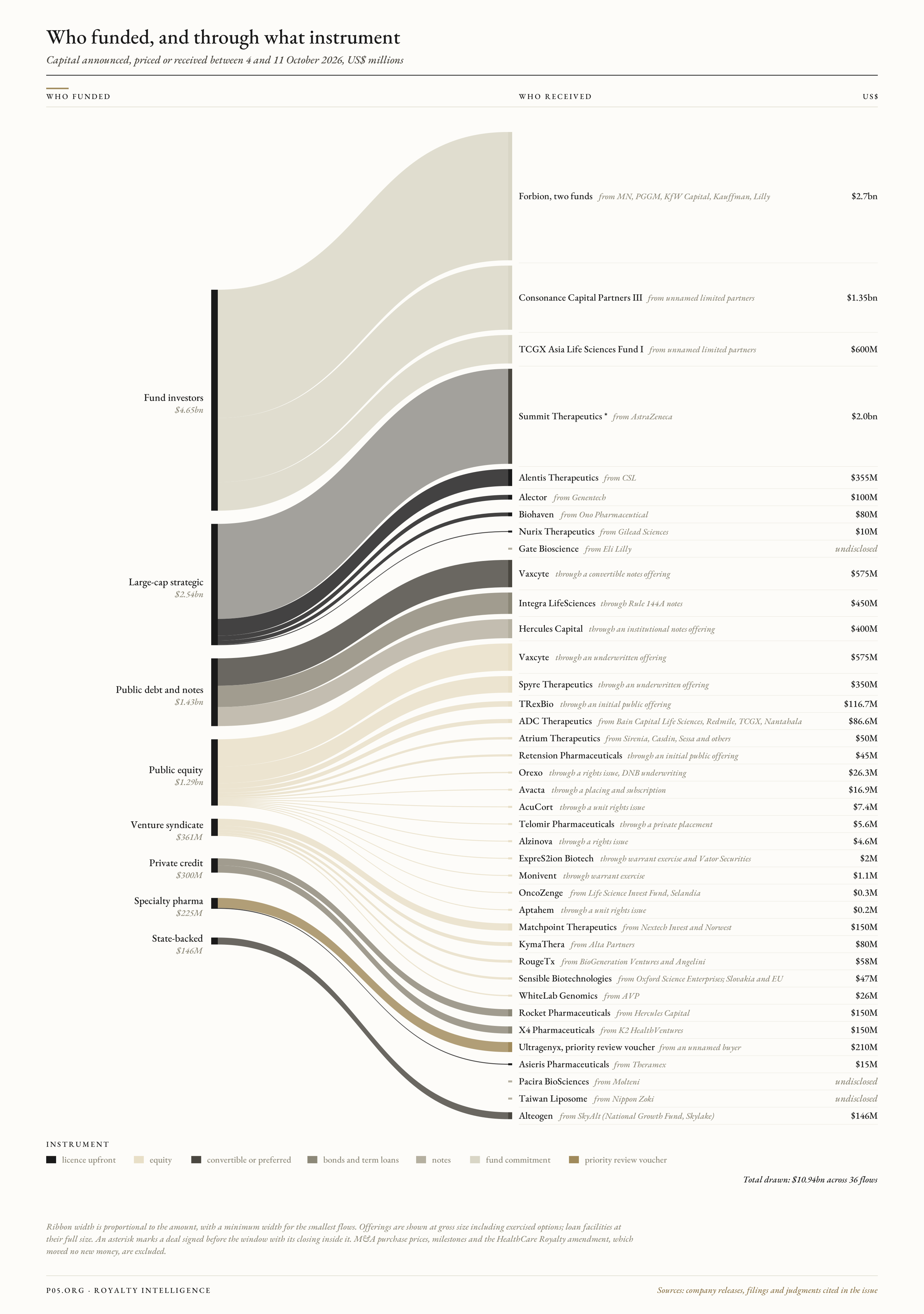
Who funded, and through what instrument, between 4 and 11 October: 36 flows totalling USD 10.94bn, grouped by capital category and coloured by instrument. An asterisk marks a deal signed before the window with its closing inside it.
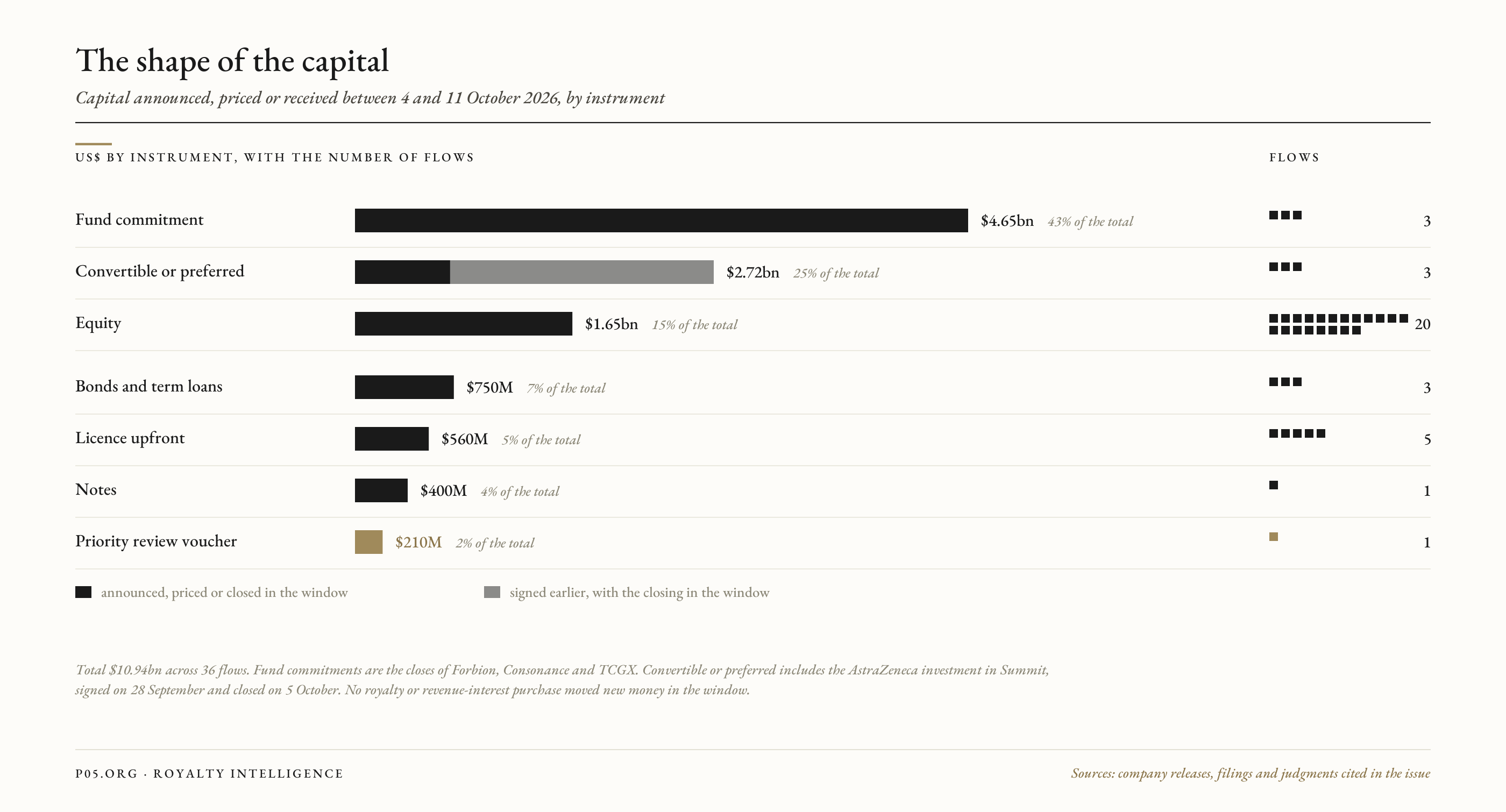
The same capital by instrument, with the number of flows. The lighter segment is the AstraZeneca investment in Summit, signed on 28 September and closed on 5 October.
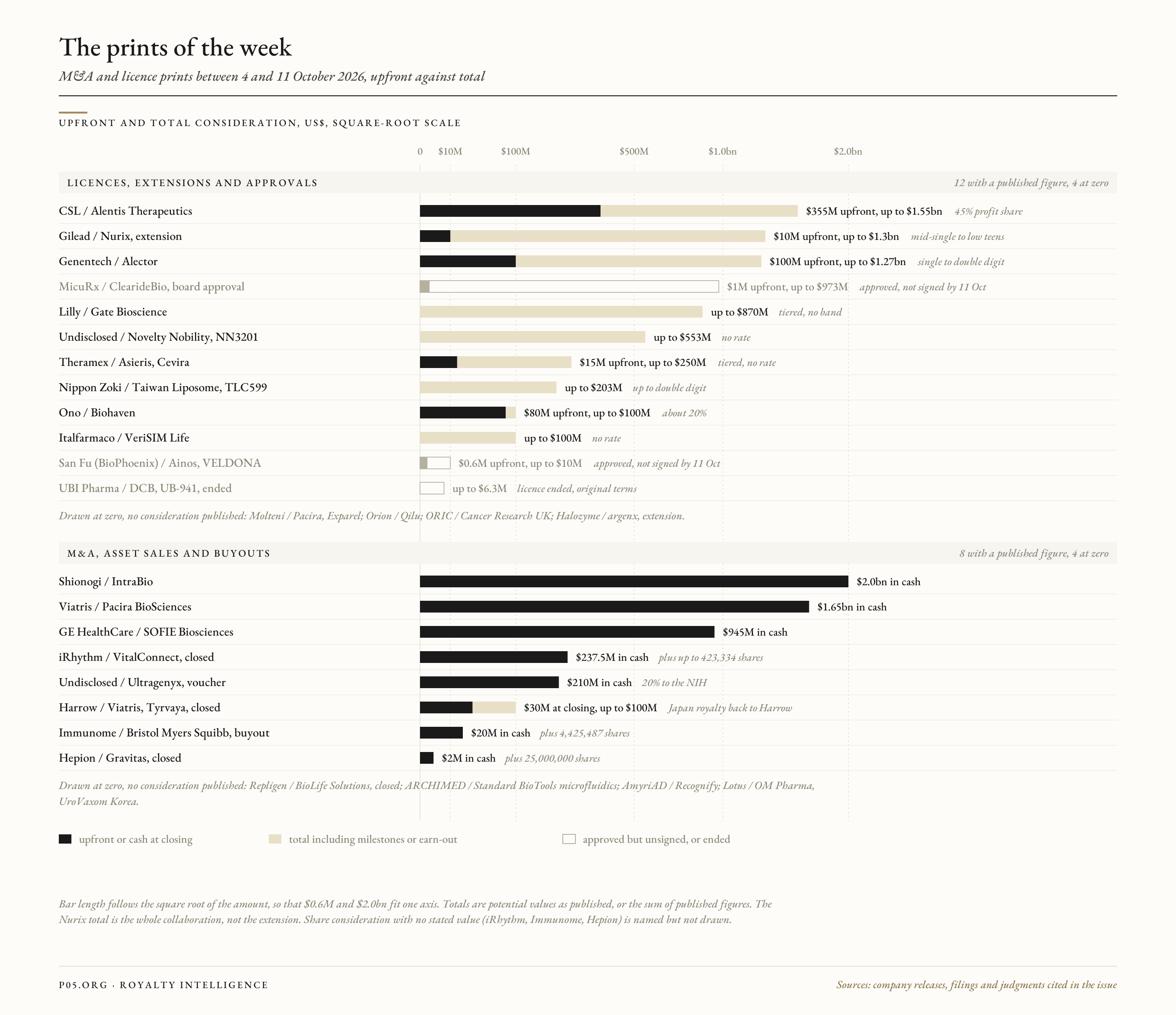
M&A and licence prints between 4 and 11 October on a square-root scale, upfront against total. Twenty publish a figure and eight publish no consideration; two approved but unsigned licences and one ended licence are drawn in outline.
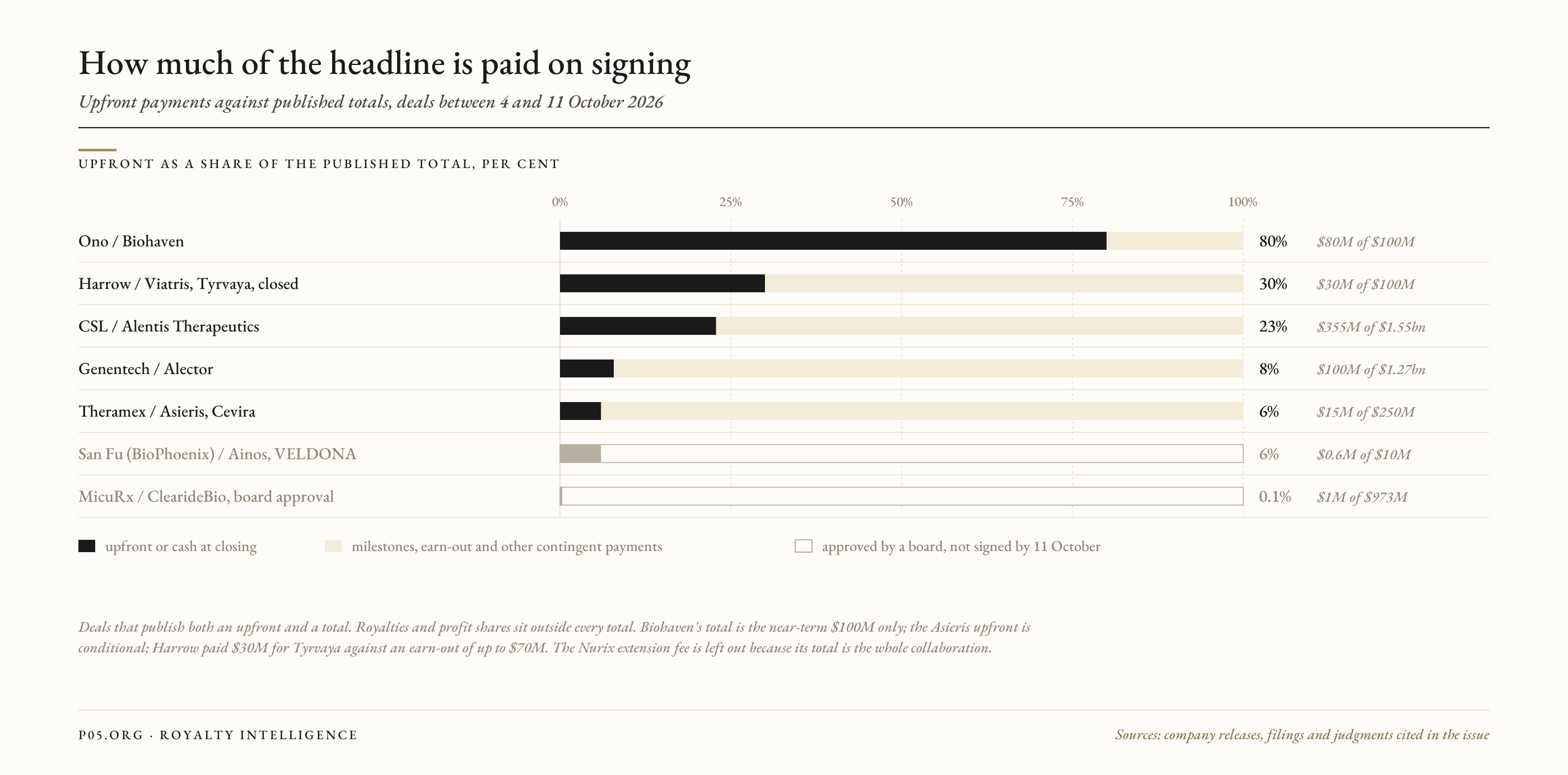
Upfront as a share of the published total, for the seven deals that publish both. Royalties and profit shares sit outside every total.
League Tables
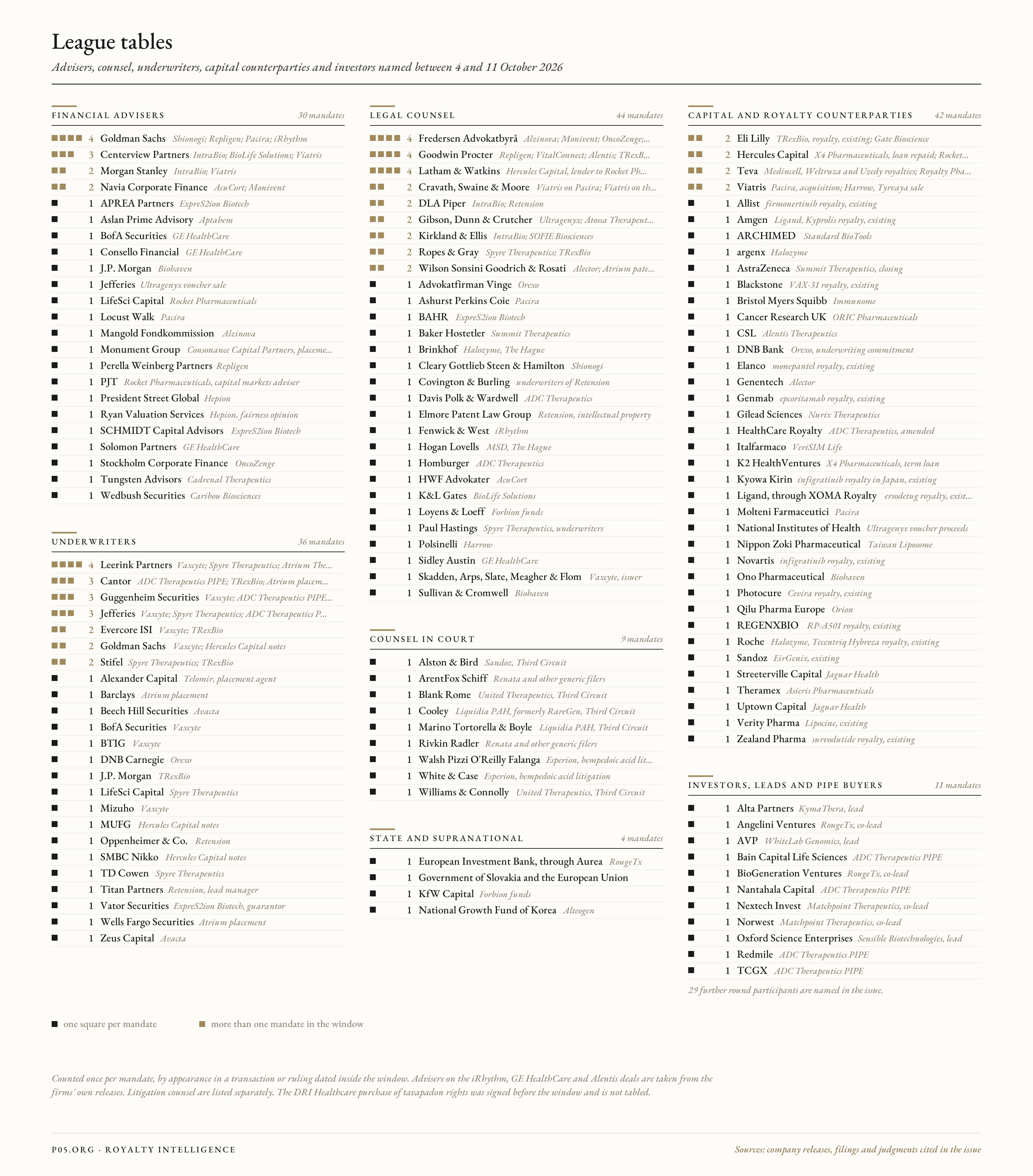
Financial and legal advisers, counsel in court, underwriters, capital and royalty counterparties and investors named in the issue for 4 to 11 October, counted once per mandate. Goldman Sachs leads financial advisers with four; Fredersen Advokatbyrå, Goodwin Procter and Latham & Watkins each have four among legal counsel.
Financial advisers. Goldman Sachs, 4 (Shionogi, Repligen, Pacira, iRhythm). Centerview Partners, 3 (IntraBio, BioLife Solutions, Viatris). Morgan Stanley, 2 (IntraBio, Viatris). Navia Corporate Finance, 2 (AcuCort, Monivent). APREA Partners, 1 (ExpreS2ion Biotech). Aslan Prime Advisory, 1 (Aptahem). BofA Securities, 1 (GE HealthCare). Consello Financial, 1 (GE HealthCare). J.P. Morgan, 1 (Biohaven). Jefferies, 1 (Ultragenyx voucher sale). LifeSci Capital, 1 (Rocket Pharmaceuticals). Locust Walk, 1 (Pacira). Mangold Fondkommission, 1 (Alzinova). Monument Group, 1 (Consonance Capital Partners, placement agent). Perella Weinberg Partners, 1 (Repligen). PJT, 1 (Rocket Pharmaceuticals, capital markets adviser). President Street Global, 1 (Hepion). Ryan Valuation Services, 1 (Hepion, fairness opinion). SCHMIDT Capital Advisors, 1 (ExpreS2ion Biotech). Solomon Partners, 1 (GE HealthCare). Stockholm Corporate Finance, 1 (OncoZenge). Tungsten Advisors, 1 (Cadrenal Therapeutics). Wedbush Securities, 1 (Caribou Biosciences).
Legal counsel. Fredersen Advokatbyrå, 4 (Alzinova, Monivent, OncoZenge, Aptahem). Goodwin Procter, 4 (Repligen, VitalConnect, Alentis, TRexBio intellectual property). Latham & Watkins, 4 (Hercules Capital, lender to Rocket Pharmaceuticals; underwriters of Vaxcyte; underwriters of TRexBio; Consonance Capital Partners fund). Cravath, Swaine & Moore, 2 (Viatris on Pacira, Viatris on the Tyrvaya sale to Harrow). DLA Piper, 2 (IntraBio, Retension). Gibson, Dunn & Crutcher, 2 (Ultragenyx, Atossa Therapeutics). Kirkland & Ellis, 2 (IntraBio, SOFIE Biosciences). Ropes & Gray, 2 (Spyre Therapeutics, TRexBio). Wilson Sonsini Goodrich & Rosati, 2 (Alector, Atrium patent matters). Advokatfirman Vinge, 1 (Orexo). Ashurst Perkins Coie, 1 (Pacira). BAHR, 1 (ExpreS2ion Biotech). Baker Hostetler, 1 (Summit Therapeutics). Brinkhof, 1 (Halozyme, The Hague). Cleary Gottlieb Steen & Hamilton, 1 (Shionogi). Covington & Burling, 1 (underwriters of Retension). Davis Polk & Wardwell, 1 (ADC Therapeutics). Elmore Patent Law Group, 1 (Retension, intellectual property). Fenwick & West, 1 (iRhythm). Hogan Lovells, 1 (MSD, The Hague). Homburger, 1 (ADC Therapeutics). HWF Advokater, 1 (AcuCort). K&L Gates, 1 (BioLife Solutions). Loyens & Loeff, 1 (Forbion funds). Paul Hastings, 1 (Spyre Therapeutics, underwriters). Polsinelli, 1 (Harrow). Sidley Austin, 1 (GE HealthCare). Skadden, Arps, Slate, Meagher & Flom, 1 (Vaxcyte, issuer). Sullivan & Cromwell, 1 (Biohaven).
Counsel in court. Williams & Connolly, 1 (United Therapeutics, Third Circuit). Blank Rome, 1 (United Therapeutics, Third Circuit). Alston & Bird, 1 (Sandoz, Third Circuit). Cooley, 1 (Liquidia PAH, formerly RareGen, Third Circuit). Marino Tortorella & Boyle, 1 (Liquidia PAH, Third Circuit). Walsh Pizzi O'Reilly Falanga, 1 (Esperion, bempedoic acid litigation). White & Case, 1 (Esperion, bempedoic acid litigation). Rivkin Radler, 1 (Renata and other generic filers). ArentFox Schiff, 1 (Renata and other generic filers).
Capital and royalty counterparties. Eli Lilly, 2 (TRexBio, royalty, existing; Gate Bioscience). Hercules Capital, 2 (X4 Pharmaceuticals, loan repaid; Rocket Pharmaceuticals, term loan). Teva, 2 (Medincell, Weltruza and Uzedy royalties; Royalty Pharma, Weltruza royalty and repayment, existing). Viatris, 2 (Pacira, acquisition; Harrow, Tyrvaya sale). Allist, 1 (firmonertinib royalty, existing). Amgen, 1 (Ligand, Kyprolis royalty, existing). ARCHIMED, 1 (Standard BioTools). argenx, 1 (Halozyme). AstraZeneca, 1 (Summit Therapeutics, closing). Blackstone, 1 (VAX-31 royalty, existing). Bristol Myers Squibb, 1 (Immunome). Cancer Research UK, 1 (ORIC Pharmaceuticals). CSL, 1 (Alentis Therapeutics). DNB Bank, 1 (Orexo, underwriting commitment). Elanco, 1 (monepantel royalty, existing). Genentech, 1 (Alector). Genmab, 1 (epcoritamab royalty, existing). Gilead Sciences, 1 (Nurix Therapeutics). HealthCare Royalty, 1 (ADC Therapeutics, amended). Italfarmaco, 1 (VeriSIM Life). K2 HealthVentures, 1 (X4 Pharmaceuticals, term loan). Kyowa Kirin, 1 (infigratinib royalty in Japan, existing). Ligand, through XOMA Royalty, 1 (ersodetug royalty, existing). Molteni Farmaceutici, 1 (Pacira). National Institutes of Health, 1 (Ultragenyx voucher proceeds). Nippon Zoki Pharmaceutical, 1 (Taiwan Liposome). Novartis, 1 (infigratinib royalty, existing). Ono Pharmaceutical, 1 (Biohaven). Photocure, 1 (Cevira royalty, existing). Qilu Pharma Europe, 1 (Orion). REGENXBIO, 1 (RP-A501 royalty, existing). Roche, 1 (Halozyme, Tecentriq Hybreza royalty, existing). Sandoz, 1 (EirGenix, existing). Streeterville Capital, 1 (Jaguar Health). Theramex, 1 (Asieris Pharmaceuticals). Uptown Capital, 1 (Jaguar Health). Verity Pharma, 1 (Lipocine, existing). Zealand Pharma, 1 (survodutide royalty, existing).
Underwriters. Leerink Partners, 4 (Vaxcyte, Spyre Therapeutics, Atrium Therapeutics placement, Retension). Cantor, 3 (ADC Therapeutics PIPE, TRexBio, Atrium placement). Guggenheim Securities, 3 (Vaxcyte, ADC Therapeutics PIPE, Retension). Jefferies, 3 (Vaxcyte, Spyre Therapeutics, ADC Therapeutics PIPE). Evercore ISI, 2 (Vaxcyte, TRexBio). Goldman Sachs, 2 (Vaxcyte, Hercules Capital notes). Stifel, 2 (Spyre Therapeutics, TRexBio). Alexander Capital, 1 (Telomir, placement agent). Barclays, 1 (Atrium placement). Beech Hill Securities, 1 (Avacta). BofA Securities, 1 (Vaxcyte). BTIG, 1 (Vaxcyte). DNB Carnegie, 1 (Orexo). J.P. Morgan, 1 (TRexBio). LifeSci Capital, 1 (Spyre Therapeutics). Mizuho, 1 (Vaxcyte). MUFG, 1 (Hercules Capital notes). Oppenheimer & Co., 1 (Retension). SMBC Nikko, 1 (Hercules Capital notes). TD Cowen, 1 (Spyre Therapeutics). Titan Partners, 1 (Retension, lead manager). Vator Securities, 1 (ExpreS2ion Biotech, guarantor). Wells Fargo Securities, 1 (Atrium placement). Zeus Capital, 1 (Avacta).
Investors. Access Biotechnology, 1 (Matchpoint Therapeutics). Alta Partners, 1 (KymaThera, lead). Angelini Ventures, 1 (RougeTx, co-lead). Atlas Venture, 1 (Matchpoint Therapeutics). AVP, 1 (WhiteLab Genomics, lead). Bain Capital Life Sciences, 1 (ADC Therapeutics PIPE). BB Biotech, 1 (Matchpoint Therapeutics). BioGeneration Ventures, 1 (RougeTx, co-lead). Blast Club, 1 (WhiteLab Genomics). BOLD Longevity Growth, 1 (Matchpoint Therapeutics). Casdin Capital, 1 (Atrium). Digitalis Ventures, 1 (Matchpoint Therapeutics). Eli Lilly, 1 (Forbion funds). Epidarex Capital, 1 (RougeTx). Foresite Capital, 1 (KymaThera). In-Q-Tel, 1 (Sensible Biotechnologies). Invus, 1 (Matchpoint Therapeutics). J. Wood Capital, 1 (KymaThera). Kauffman Foundation, 1 (Forbion funds). Kerna Ventures, 1 (RougeTx). Kurma Partners, 1 (RougeTx). MN, 1 (Forbion funds). Nantahala Capital, 1 (ADC Therapeutics PIPE). Nextech Invest, 1 (Matchpoint Therapeutics, co-lead). Norwest, 1 (Matchpoint Therapeutics, co-lead). OTB Ventures, 1 (Sensible Biotechnologies). Oxford Science Enterprises, 1 (Sensible Biotechnologies, lead). p53 Invest, 1 (RougeTx). PGGM, 1 (Forbion funds). Redmile, 1 (ADC Therapeutics PIPE). ROM Utrecht Region, 1 (RougeTx). Sanofi Ventures, 1 (Matchpoint Therapeutics). Sessa Capital, 1 (Atrium). Sirenia Capital Management, 1 (Atrium). Skylake, 1 (Alteogen). T1D Fund, 1 (Matchpoint Therapeutics). TCGX, 1 (ADC Therapeutics PIPE). Venrock, 1 (KymaThera). Vesalius Biocapital, 1 (RougeTx). Yaday Health, 1 (WhiteLab Genomics).
State and supranational participants. KfW Capital, 1 (Forbion funds). Government of Slovakia and the European Union, 1 (Sensible Biotechnologies, non-dilutive funding). European Investment Bank, through Aurea, 1 (RougeTx). National Growth Fund of Korea, 1 (Alteogen).
All information in this report was accurate as of the research date and is derived from publicly available sources including SEC filings, Hong Kong Stock Exchange announcements, National Stock Exchange of India filings, European Medicines Agency and Food and Drug Administration records, United States patent assignment records, company press releases and financial news reporting. Information may have changed since publication. This content is for informational purposes only and does not constitute investment, legal, or financial advice. The author is not a lawyer or financial adviser.