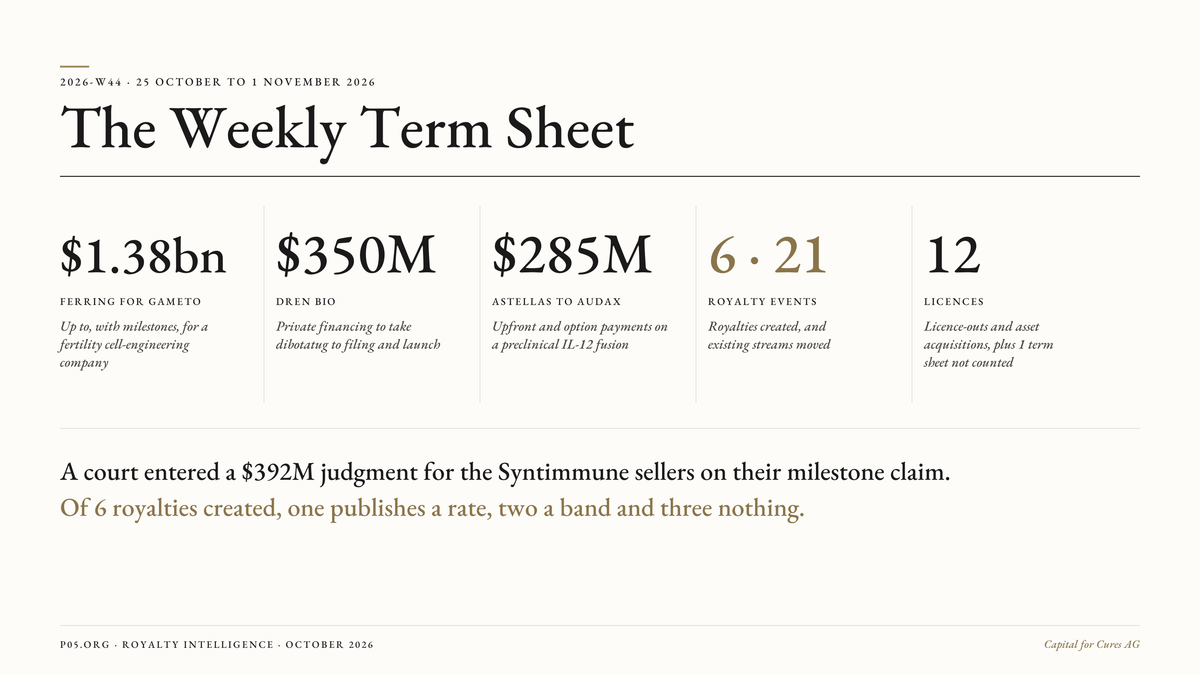
The Weekly Term Sheet (2026-W44)
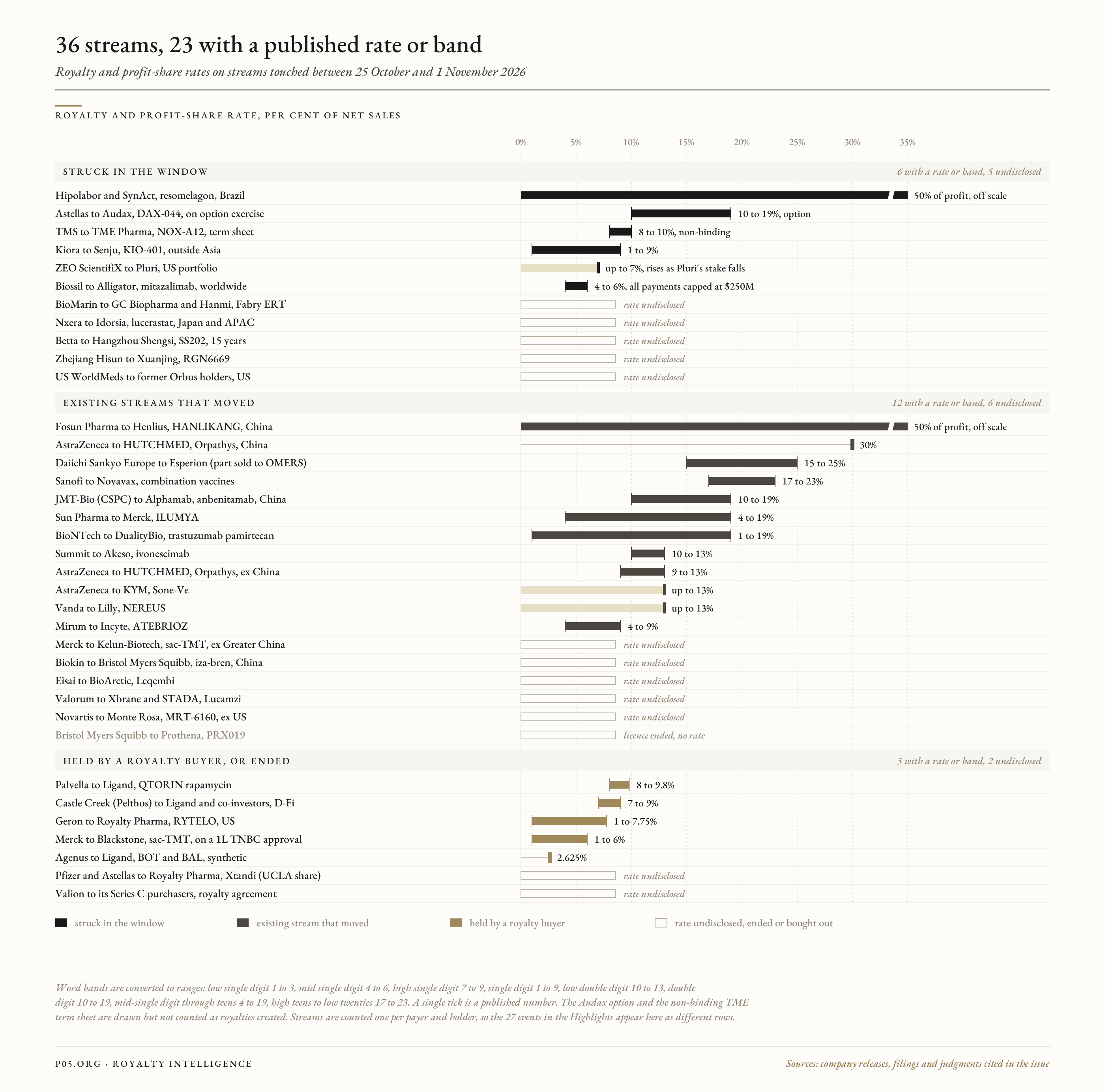
Royalty and profit-share rates on the 36 streams touched between 25 October and 1 November, in three groups, with word bands converted to ranges. Twenty-three publish a rate or band and 13 are drawn as empty bars; the PRX019 royalty, ended by Bristol Myers Squibb, is marked as ended.
Currency and language note: all amounts are given in US dollars. Where a source uses another currency, the converted figure comes first and the original follows in brackets, at approximately EUR 0.86, SEK 9.50, NOK 10.30, CHF 0.885, DKK 6.40, GBP 0.74, JPY 146, KRW 1,370, CNY 7.10, HKD 7.78, TWD 32.0, AUD 1.41 and INR 88 per US dollar, being late September 2026 rates. Where a source published its own conversion, that figure is used. Quotations from sources in other languages are given in our English translation.
Highlights
Royalty events: 6 created and 21 existing streams moved. Nxera exercised its option on lucerastat, so Idorsia now receives royalties on net sales in Japan and selected Asia Pacific markets. Pluri is to receive a royalty from ZEO ScientifiX on its regenerative medicine products in the United States, at a rate that rises as Pluri's stake in ZEO falls, to at most 7.0 per cent. Betta Pharmaceuticals agreed to pay Hangzhou Shengsi Biopharma royalties on net sales of the preclinical growth hormone SS202 for 15 years from launch.
BioMarin agreed to pay GC Biopharma and Hanmi tiered royalties on a Fabry enzyme replacement therapy outside Korea, and Kiora agreed to pay Senju single-digit royalties on KIO-401 outside Asia. Biossil agreed to pay Alligator Bioscience a mid-single-digit royalty on mitazalimab, within a total cap of USD 250m.
ESMO data moved the royalties AstraZeneca owes HUTCHMED on SAFFRON and on SANOVO in China, the royalty AstraZeneca owes KYM, the royalty and milestones Summit owes Akeso, Merck's licence from Kelun with Blackstone's royalty on sac-TMT, and Ligand's synthetic royalty on botensilimab and balstilimab.
The data also moved the royalty Bristol Myers Squibb receives on iza-bren in China, the double-digit royalty CSPC's JMT-Bio owes Alphamab on anbenitamab, and the royalties BioNTech owes DualityBio on trastuzumab pamirtecan. A wider US label for Talzenna with Xtandi moved the Xtandi royalty Royalty Pharma bought from UCLA's co-owners. Pivotal paediatric data on ATEBRIOZ moved the royalty Mirum owes Incyte.
FDA approval of Xbrane's ranibizumab biosimilar moved the royalties and milestones Valorum owes Xbrane and STADA, and Henlius raised the cap on the profit share it receives from Fosun Pharma on HANLIKANG in China.
BioArctic booked a Leqembi royalty of about USD 21.5m from Eisai for the third quarter, FDA priority review of QTORIN rapamycin moved the royalty Palvella owes Ligand, and the end of Geron's IMpactMF trial in myelofibrosis moved Royalty Pharma's synthetic royalty on RYTELO.
Bristol Myers Squibb ended its licence to Prothena's PRX019, removing milestones of up to USD 617.5m and tiered royalties, and FDA approval of ILUMYA in psoriatic arthritis moved the tiered royalty Sun Pharma owes Merck.
Pelthos's agreement to combine with Castle Creek Biosciences moved the royalty financing on D-Fi that Ligand originated.
Four milestones were announced: Boehringer Ingelheim notified AimedBio of a second milestone on the antibody-drug conjugate ODS025, with the amount withheld, AstraZeneca owes Daiichi Sankyo USD 75m on the EU approval of Enhertu in early breast cancer, and Novartis owes Monte Rosa USD 37.5m on the start of a Phase 2 study of MRT-6160 in psoriatic arthritis.
Novavax earned USD 125m from Sanofi on the start of a Phase 3 trial of a flu and COVID-19 combination vaccine.
M&A and restructuring: 12. Ferring agreed to buy Gameto, a fertility cell-engineering company, for up to about USD 1.38bn including milestones, and Teva completed its purchase of BXCL501 and IGALMI from BioXcel in Chapter 11 for USD 57.5m upfront and up to USD 67.5m in contingent payments.
Corxel agreed to take its oral GLP-1 programme public through a merger with Amanat Acquisition Corp, backed by a PIPE of about USD 300m. Invex agreed to buy Rekover Therapeutics for shares and milestone-linked performance rights, alongside a placement, and Zeria's Swiss subsidiary agreed to buy the German plant that makes most of its Asacol.
Senti Biosciences disclosed that the sale of its SENTI-202 subsidiary to a Celadon vehicle closed for contingent value rights worth up to USD 60m. US WorldMeds bought Orbus Therapeutics, developer of eflornithine in brain tumours, for an undisclosed upfront payment plus milestones and tiered US royalties.
Botanix, which sells Sofdra in the United States, said it is evaluating a sale of the company and seeking revised terms on its Kreos loan. DKSH bought the rights to Roche's antibiotic Rocephin in more than 80 markets, and ResoTher Pharma agreed a reverse listing on Spotlight through Hunter Capital RTO 1 with about USD 8.4m of financing.
Merit Medical disclosed that it bought the rest of Solo Pace, a maker of temporary pacing systems for heart valve procedures, for about USD 45m.
Mineralys ended its lorundrostat licence with Tanabe Pharma and took back the patents, while remaining liable for commercial milestones of up to USD 265m owed to Tanabe.
Pelthos agreed to combine with Castle Creek Biosciences, developer of the gene-modified cell therapy D-Fi, for 5.2m shares, up to USD 300m in milestones and 80 per cent of any voucher sale, alongside a preferred placement of up to USD 80m in which Ligand takes part.
Licence-outs and asset acquisitions: 12. Janssen licensed Biocon to sell its Stelara biosimilar Yesintek in nine further markets, with no terms disclosed. Zhejiang Hisun licensed in Xuanjing Biotech's siRNA platform and a preclinical candidate for about USD 1.4m upfront and up to about USD 138m in milestones, and SynAct agreed a 50/50 profit share with Hipolabor on resomelagon in dengue in Brazil.
Astellas took an option on a worldwide licence to Audax Biosciences' preclinical IL-12 fusion DAX-044, with USD 285m in upfront and option payments and tiered double-digit royalties. Nxera exercised its option to license Idorsia's Phase 3 Fabry drug lucerastat in Japan and selected Asia Pacific markets for about USD 7.9m upfront and royalties, and Betta took global rights to SS202 from Hangzhou Shengsi, whose chairman is Betta's chief financial officer, for about USD 1.4m upfront within about USD 5.6m of milestones.
MiMedx granted an unnamed wound care competitor a non-exclusive licence to its patents for USD 25m in five annual instalments, resolving allegations of infringement. Pluri licensed its regenerative medicine portfolio in the United States to ZEO ScientifiX for 41 per cent of ZEO and a variable royalty.
BioMarin licensed worldwide rights outside Korea to GC Biopharma and Hanmi's long-acting Fabry enzyme replacement therapy for USD 70m upfront and up to USD 405m in milestones.
Kiora licensed Senju's KIO-401, which has completed Phase 3 in Japan in retinal artery occlusion, for USD 3.5m upfront and up to USD 168.5m in milestones, and Tanabe Pharma granted Nippon Shinyaku an exclusive Japanese sublicence to sell loncastuximab tesirine, with no terms disclosed.
Alligator Bioscience agreed to sell mitazalimab, its CD40 agonist antibody, to Biossil for USD 0.75m upfront, up to USD 108m in milestones and a mid-single-digit royalty, with all payments capped at USD 250m.
TME Pharma also gave TMS six months of exclusivity, for about USD 175,000 (EUR 150,000), to negotiate worldwide rights to NOX-A12 on non-binding terms that include royalties of 8 to 10 per cent; it is not counted as a licence.
Regulatory: 13. The FDA approved Lucamzi, Xbrane's biosimilar to Lucentis licensed in the United States to Valorum, and AbbVie submitted its application for etentamig in myeloma. The FDA accepted Palvella's application for QTORIN rapamycin, which carries a Ligand royalty, under priority review.
The FDA accepted Orexo's resubmitted application for IZIPRY with an action date of 29 March 2027, and Rafael Holdings submitted its application for remibetadex in Niemann-Pick disease type C, which would make it eligible for a rare pediatric disease voucher on approval.
The EMA validated Daiichi Sankyo's applications for two single-pill combinations built on bempedoic acid, licensed from Esperion, and accepted EirGenix's application for its pertuzumab biosimilar, licensed to Sandoz.
China accepted for review a second-line lung cancer application for iza-bren, Biokin's bispecific antibody-drug conjugate; the FDA accepted Merck's application for sac-TMT, licensed from Kelun-Biotech, in endometrial cancer for priority review; the FDA widened the prostate cancer label of Pfizer's Talzenna with Xtandi; the European Commission approved Enhertu after surgery in HER2-positive early breast cancer with residual disease; and the FDA approved Sun Pharma's ILUMYA, licensed from Merck, in psoriatic arthritis.
The FDA extended its review of Agios's mitapivat in sickle cell disease by three months, to 1 February 2027.
Clinical: 13. AstraZeneca and HUTCHMED (SAFFRON and SANOVO), AstraZeneca and KYM Biosciences, Akeso, Kelun-Biotech and Merck, SystImmune and Bristol Myers Squibb, Alphamab, and Hansoh with GSK presented Phase 3 figures at ESMO after earlier toplines.
BioNTech and DualityBio reported a modest Phase 3 result with a lung safety signal, Agenus reported a Phase 2 cohort on an asset carrying a Ligand synthetic royalty, and Mirum reported pivotal paediatric data on ATEBRIOZ, licensed from Incyte.
Vanda reported a Phase III result for NEREUS, licensed from Lilly, in vomiting caused by GLP-1 therapy, and Geron stopped its Phase 3 trial of imetelstat in myelofibrosis, a label expansion for RYTELO, on which Royalty Pharma holds a synthetic royalty.
Structured capital: 2. Valion Bio agreed to deliver a royalty agreement on its drug assets to the buyers of its Series C preferred stock, in a closing that brought in USD 1.5m of new cash.
Idorsia proposed that the noteholders of its SPV fund the launch of TRYVIO with about USD 81m (CHF 72m) in return for new notes and a 12 per cent earn-out on three assets, while Idorsia contributes about USD 54m (CHF 48m) for a 30 per cent share of global net revenue of aprocitentan. The proposal is backstopped but still needs noteholder approval.
Private funding: 4. Formation Bio raised a USD 600m fund to buy 10 to 15 drug programmes and house each in its own company. Dren Bio closed a USD 350m private financing to take dibotatug to filing and launch, and StimCardio closed a USD 30m Series A for a wearable atrial fibrillation therapy. Setara Biosciences, formed when Jazz bought Actio Biosciences, completed a USD 90m Series A.
Public capital and debt: 22. Rapport priced about USD 200m of stock at USD 21.00, USD 150m of 2.25 per cent convertible notes and a private placement of about USD 30m, and closed all three on 30 October with both underwriter options exercised in full.
Morocco's market regulator cleared Laprophan's Casablanca listing of up to about USD 225m. Aclaris priced a USD 50m offering with TCGX, RA Capital and Invus taking part, and Actuate raised and closed USD 11m with warrants; Recipharm completed a refinancing that extends its maturities by seven years; BioInvent resolved on a rights issue of about USD 45.3m, 81 per cent covered by commitments and guarantees.
Sun Pharma allotted about USD 888m of debentures; Aspen Neuroscience priced its initial public offering at the bottom of its range for about USD 140.6m and Bambusa Therapeutics upsized its offering to about USD 168.9m; Ganzhou Hemay Pharmaceutical and Sichuan Neautus Traditional Chinese Medicine launched Hong Kong listings, and NEX-I priced its KOSDAQ offering about 24 per cent below the bottom of its range at about USD 27.9m; Equillium closed a USD 20m milestone tranche of its private placement; Sareum, which holds a revenue share on SRA737, raised about USD 4.5m.
In crops, the biocontrol company Amoéba raised about USD 11.3m in a rights issue, most of it by converting bonds; TME Pharma extended its debt to 2028; INmune Bio, Cizzle and Radiopharm raised smaller sums, and SanBio raised its bank commitment line to about USD 34m; SymBio borrowed about USD 3.5m interest-free from its chief executive and a family member.
Courts: 9. The FDA opened a public docket on VOQUEZNA's exclusivity, and the court allowed Phathom to intervene in BDR's suit. Harmony asked for a trial or an injunction hearing before the 30-month stay on generic pitolisant ends on 14 February 2027, and dropped a third suit on the drug.
A Delaware court awarded US WorldMeds its fees in its claim against Supernus over a USD 30m launch milestone and fixed the principal still owed at about USD 26.7m. AstraZeneca disclosed a final judgment of USD 392m plus interest for the former Syntimmune holders on their milestone claim, which it intends to appeal.
United Therapeutics and Liquidia had their YUTREPIA patent case in Delaware dismissed with prejudice on 28 October, a condition of the settlement under which Liquidia pays USD 175.0m and a further USD 145.4m in 2027, and filed stipulations of dismissal in their North Carolina case on 28 and 29 October.
A Delaware court held that Invitae's rejection of its asset purchase agreement in Chapter 11 relieved Natera of a milestone payment of up to USD 22.5m. Exelixis settled its CABOMETYX patent case with Azurity, licensing Azurity's product in the United States from 1 December 2030, and its trial against MSN was moved to 3 November; and the Unified Patent Court held invalid the Enanta patent asserted against Pfizer's Paxlovid. Johns Hopkins sued Labcorp for royalties on its prenatal tests under a licence it terminated on 5 October.
Priority review vouchers: 4. The FDA gave notice of the rare pediatric disease vouchers awarded to Scholar Rock on ISEMBYLD, to Incyte on ATEBRIOZ and to Egetis on EMCITATE, and of Gilead's use of a material threat medical countermeasure voucher on Bixlenvo.
Rate disclosure across the window: 7 hard numbers and 15 bands. The hard numbers are HUTCHMED's 9 to 13 per cent outside China and 30 per cent in China, Esperion's 15 to 25 per cent on certain sales by Daiichi Sankyo Europe, Ligand's 2.625 per cent on Agenus's assets and 8.0 to 9.8 per cent on QTORIN rapamycin, Royalty Pharma's 7.75, 3.0 and 1.0 per cent tiers on RYTELO, and the maximum of 7.0 per cent ZEO may pay Pluri.
The bands are KYM's up to low double digits, Akeso's low double digits, Blackstone's low-to-mid single digits, Alphamab's double digits and DualityBio's single to double digits, plus Audax's tiered double digits from Astellas, the low single digits Aspen Neuroscience and Bambusa owe their licensors, the up to low double digits Vanda owes Lilly, the 8 to 10 per cent in TME Pharma's non-binding term sheet with TMS, the single digits Kiora owes Senju, the high teens to low twenties Sanofi owes Novavax, the mid-single digit through teens Sun Pharma owes Merck on ILUMYA, Ligand's high single digits on D-Fi, and the mid-single digits Biossil owes Alligator on mitazalimab.
Two profit shares were stated at 50 per cent: Henlius on HANLIKANG and SynAct with Hipolabor. Idorsia's proposal states a 12 per cent earn-out for its SPV noteholders and a 30 per cent share of aprocitentan revenue for Idorsia.
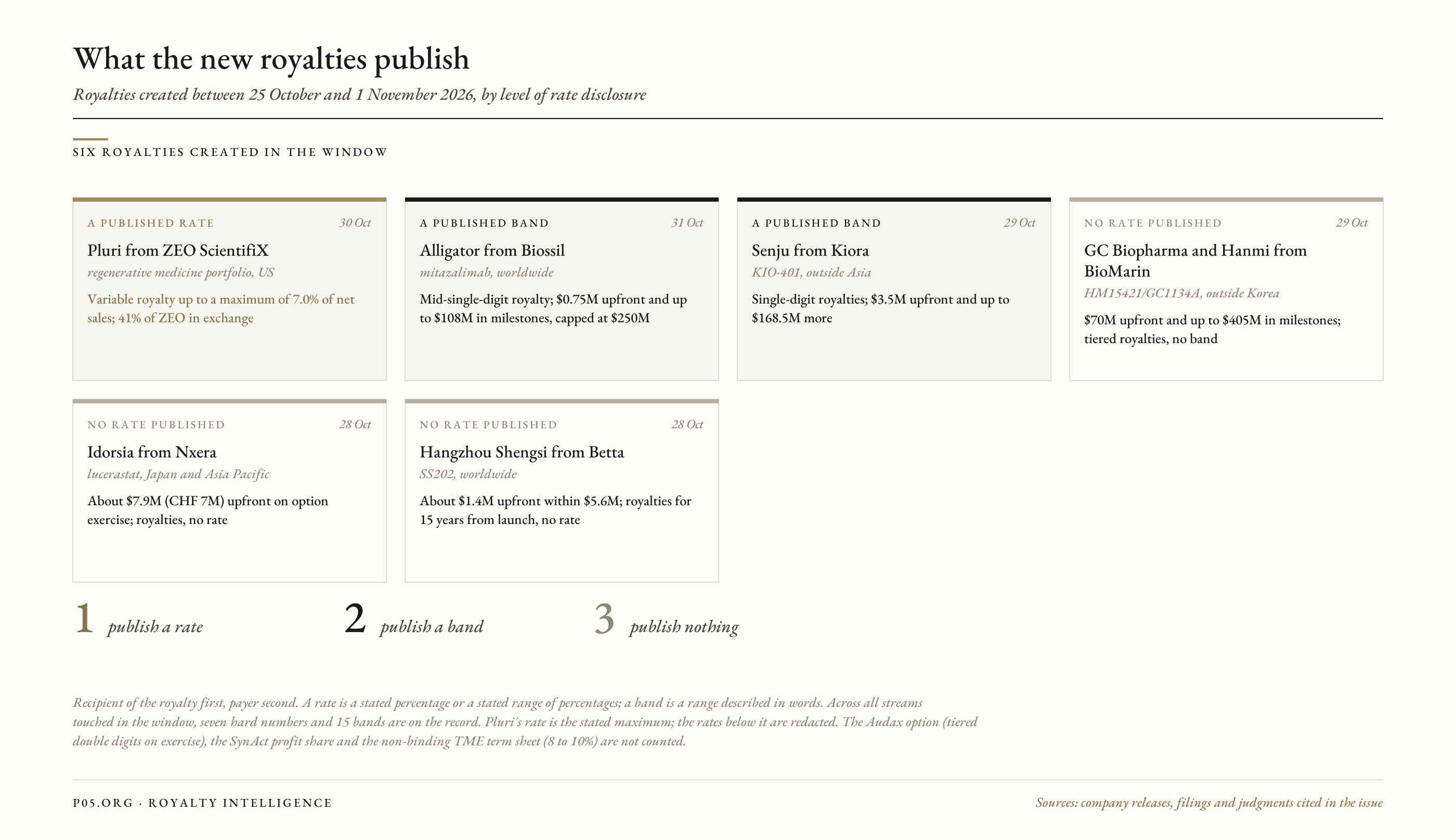
The six royalties created in the window, by what each publishes: one a rate, two a band and three nothing.
Tracked royalty buyers inside the window: no purchase. Data at ESMO touched Blackstone Life Sciences' royalty on sac-TMT and Ligand's synthetic royalty on Agenus's BOT and BAL, and the Talzenna label touched Royalty Pharma's Xtandi royalty.
Palvella's priority review touched Ligand's royalty on QTORIN rapamycin, and Geron's halted trial touched Royalty Pharma's royalty on RYTELO.
The EMA validation of Daiichi Sankyo's bempedoic acid combinations touched the share of Esperion's royalties sold to OMERS. Ligand invested in the preferred placement that accompanies Pelthos's combination with Castle Creek, whose D-Fi carries a royalty financing Ligand originated; the investment is equity, not a royalty purchase.
Ligand (Nasdaq: LGND) reported on 29 October "royalty revenue increasing 51% year-over-year to $70.3 million" for the third quarter, and "approximately $750 million of deployable capital available to pursue additional royalty acquisitions and strategic investments".
Its latest purchases, Santen's Ryjunea from Sydnexis for USD 23m upfront and the AvenCell financing of up to USD 47m, date from 22 and 24 September.
Open at the start of the window. The tender offer for Pacira started on 30 October. Peach Purchaser, a Viatris subsidiary, filed its offer to purchase at "$36.50 per Share, to the seller thereof in cash", expiring "one minute after 11:59 p.m., Eastern Time, on November 16, 2026", and Pacira's board recommended acceptance in its Schedule 14D-9.
"The Regulatory Condition has been satisfied by the expiration at 11:59 p.m., Eastern Time, on October 29, 2026 of the waiting period under the HSR Act". Viatris agreed to comply with Section 4.5(a) of the Flexion contingent value rights agreement of 19 November 2021, which gives the Independent Accountant access to books and records.
The closing of Bolt's USD 120m placement, expected on 26 October, which had not been filed by 14:57 UTC on 31 October.
Zai Lab said that "the Closing for the Private Placement of an aggregate of 11,340,000 ADSs took place on October 27, 2026 (U.S. Eastern time)", for gross proceeds of "approximately US$249,933,600". Rapport's three offerings closed on 30 October (see Public capital and debt).
Dogwood's investment closed on 26 October: Sealbond, a CK Life Sciences company, bought "4,098,360 shares of Common Stock at a purchase price of $1.22 per share, for aggregate consideration of approximately $5,000,000", per its Schedule 13D amendment of 27 October. Lycia closed its offering on 26 October: 20,286,000 shares at USD 18.00 with the underwriters' option "exercised in full", for gross proceeds of "approximately $365.1 million".
The final results of the Recordati offer were reported on 27 October: "129.976.519 Azioni, pari al 62,153% circa del capitale sociale dell'Emittente" were tendered, giving with other holdings "una partecipazione complessiva pari al 74,581% circa del capitale sociale di Recordati" (a total holding of about 74.58 per cent of the share capital).
Payment is due on 2 November, the terms reopen "nelle sedute del 3, 4, 5, 6 e 9 novembre 2026" (on 3, 4, 5, 6 and 9 November), with payment for the reopening on 17 November.
The joint status report due on 2 November in BDR Pharmaceuticals' suit against the FDA over VOQUEZNA exclusivity.
The Paradigm administrators said on 28 October that "the Supreme Court of Western Australia has approved a three (3) month extension of the convening period for the second meeting of creditors until 27 January 2027", after the hearing of 27 October; they expect to issue their report and convene the meeting "in the coming weeks".
Without the extension they would have had "no alternative other than to recommend to creditors that Paradigm be wound up", per their notice of 23 October.
Paradigm has redeemed further convertible notes, leaving "2,834,715 convertible notes remain outstanding", per a further notice.
The emergency motion connected to the BioXcel sale order and the appeal against the sale order, filed on 26 October, per the docket; the hearing of 30 October was cancelled by an agenda filed on 28 October, with no reason given in the docket text; the sale itself has completed (see M&A and Restructuring). The hearing on the plan is set for 3 December.
The closings of the offerings priced in W42 by Recursion and Alector and the clearance of Labcorp's purchase of BioReference testing businesses from OPKO Health.
None had been reported by 20:58 UTC on 28 October; Labcorp's results release of 28 October says its BioReference deal remains "subject to regulatory approvals and customary closing conditions", and its quarterly report of 30 October says it "is anticipated to close mid-2027", with up to USD 150.0m of the price "contingent upon revenue from the 4Kscore® Test".
The DRI Healthcare purchase of the tavapadon payment rights, scheduled to close on 29 September, with no closing confirmation on DRI's news page by 14:53 UTC on 31 October.
The scheme document for Silence, the QIAGEN offer document after clearance by BaFin, and the pricing of the initial public offering of Windward Bio.
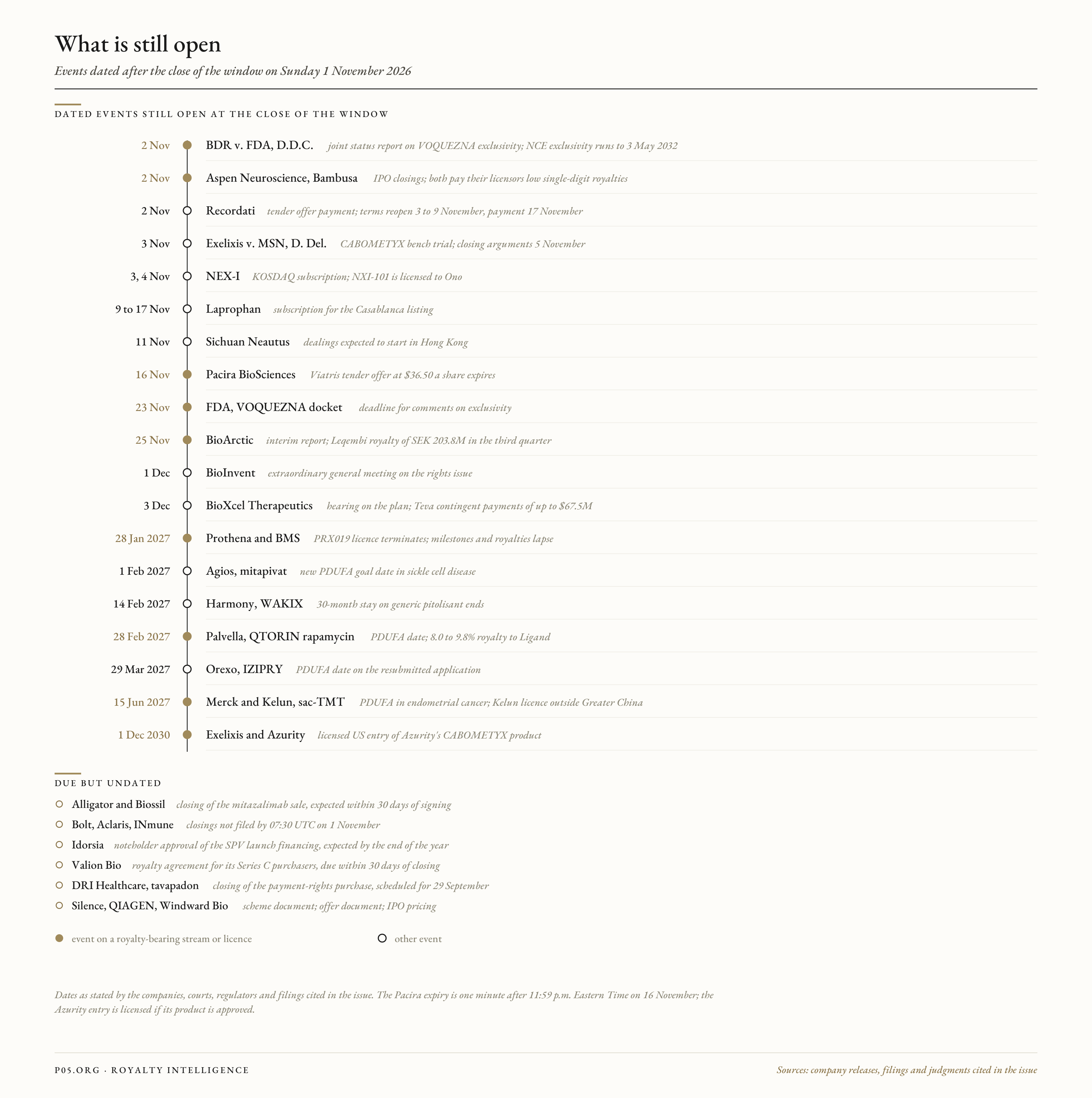
Dated events still open at the close of the window, from the BDR status report and the Aspen and Bambusa closings on 2 November to the licensed US entry of Azurity's CABOMETYX product on 1 December 2030, with six items due but undated. Gold marks an event on a royalty-bearing stream or licence.
M&A and Restructuring
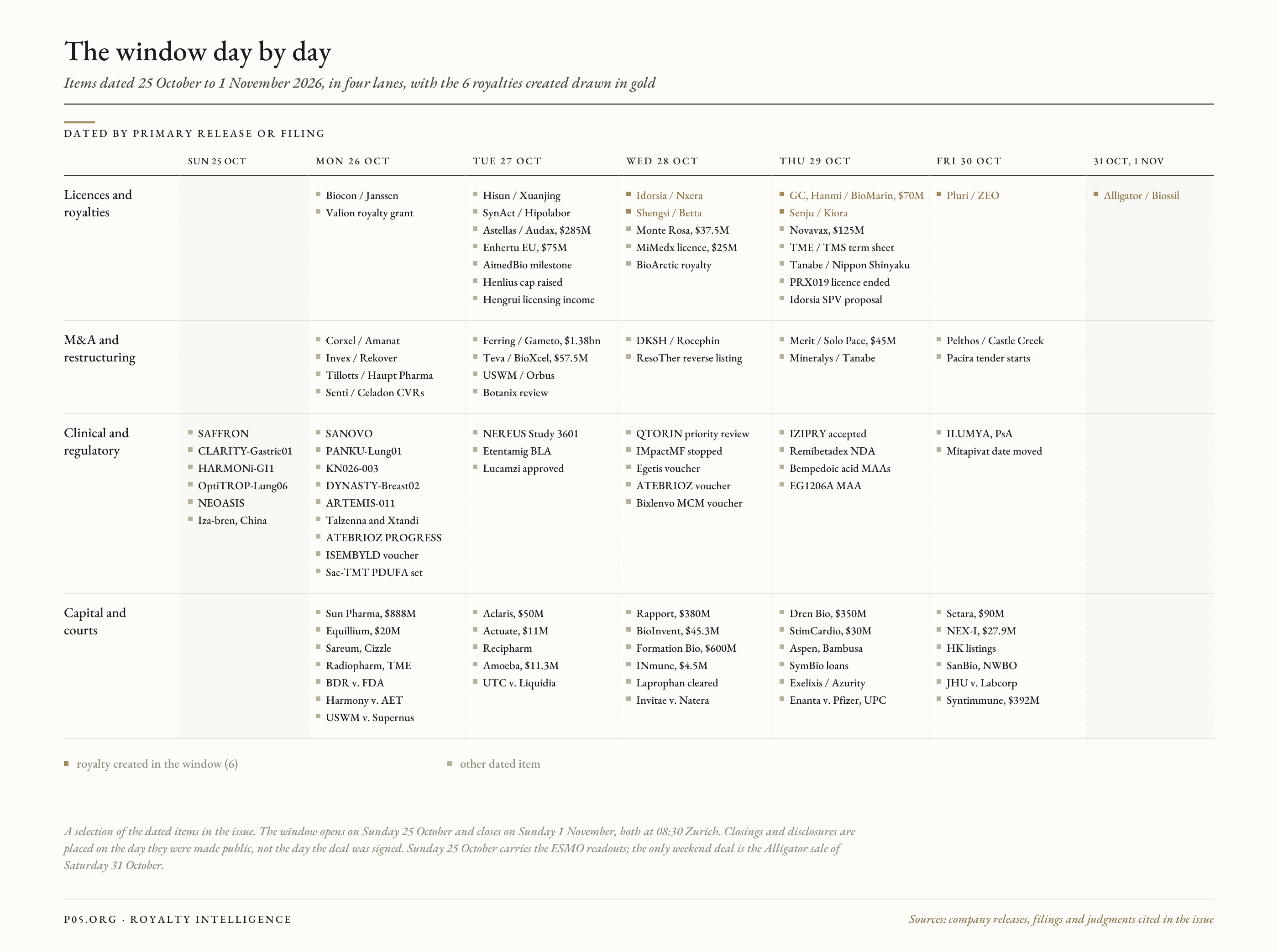
The window day by day, dated by primary release or filing and filed in four lanes. The six royalties created are drawn in gold; four of them date from Wednesday 28 and Thursday 29 October.
Corxel and Amanat Acquisition Corp: an oral GLP-1 developer goes public through a SPAC with a USD 300m PIPE (Monday 26 October)
Corxel Pharmaceuticals, the US arm of Corxel Pharmaceuticals Limited, and Amanat Acquisition Corp (Nasdaq: AMAN) announced a definitive business combination agreement, signed on 25 October, to create a listed obesity company.
The lead asset, CX11, is "a once-daily oral small-molecule GLP-1 receptor agonist that has completed Phase 2 clinical development in the United States and Phase 3 clinical development in Asia".
- The consideration: Corxel stockholders receive shares at an exchange ratio "based on an implied Corxel equity value of $200,000,000", per Amanat's current report; the parent "is expected to receive equity consideration in the combined company in the form of common stock and pre-funded warrants".
- The financing: "In addition to approximately $75 million held in Amanat's trust account", a "concurrent, oversubscribed PIPE" of "approximately $300 million" from investors including RTW Investments, NEA, SR One, HBM Healthcare Investments, TCGX and RA Capital Management. The transaction is "expected to provide approximately $377 million in gross proceeds (prior to the payment of transaction costs and assuming no redemptions by Amanat shareholders)".
- The use: "Proceeds expected to support the company through 2029, including funding the planned global Phase 3 development program for CX11 in obesity."
- The protection: on a superior offer Corxel pays "the greater of $10,000,000 and 1% of the aggregate upfront consideration payable in such alternative transaction (subject to a cap of $50,000,000)".
- The advisers: Leerink Partners is lead placement agent, with Evercore ISI, Guggenheim Securities, Cantor and LifeSci Capital; Cooley for Corxel, Goodwin Procter for Amanat and Latham & Watkins for the placement agents.
- Instrument: SPAC merger with a concurrent PIPE; closing "expected to be completed in the first half of 2027".
- Royalty read-through: the release and the agreement summary state no in-licence or royalty on CX11. Corxel acquired worldwide rights to CX11 (VCT220), excluding Greater China, "from Vincentage" in December 2024, per its release of the time, which states no terms.
Invex Therapeutics and Rekover Therapeutics: Invex buys a nalfurafine repurposing company for shares and raises about USD 7.1m (Monday 26 October)
Invex Therapeutics (ASX: IXC) agreed to buy all of Rekover Therapeutics, a New Zealand company repurposing nalfurafine for chronic optic neuropathy in multiple sclerosis. The consideration is "45,000,000 Shares and 91,250,000 Performance Rights in three classes", and "No cash consideration is payable."
- The asset: "Nalfurafine is an approved anti-itch drug used in Japan and Korea for patients on dialysis." Rekover has designed REVIVE, a Phase 2a study in relapsing remitting multiple sclerosis.
- The contingent consideration: the performance rights vest on milestones of the REVIVE study and the regulatory pathway, and all vest on a "Qualifying Transaction", which includes "an exclusive licence, partnering or other arrangement for the commercial development of nalfurafine in the United States, the European Union or the United Kingdom".
- The financing: two placements at AUD 0.08 a share "will together raise $10,000,000 (before costs)", about USD 7.1m (AUD 10.0m). Tenmile, an associate of Invex's shareholder Tattarang and a vendor of Rekover, "will subscribe for $4,500,000 under the Placement", about USD 3.2m (AUD 4.5m).
- The licence: "The intellectual property is in-licensed from Victoria University of Wellington." No royalty to the university is stated.
- Instrument: share acquisition with milestone-linked performance rights, and a two-tranche placement, subject to shareholder approval at a meeting expected in late November or early December.
- Royalty read-through: no royalty is disclosed. The performance rights work as an earn-out paid in shares, and a licence in the United States, Europe or the United Kingdom would vest them all.
Ferring and Gameto: Ferring agrees to buy a fertility cell-engineering company for up to about USD 1.38bn (Tuesday 27 October)
Ferring Pharmaceuticals and Gameto announced from Saint-Prex that they have signed "an agreement for a global transaction" under which Ferring would acquire Gameto. Gameto uses cell engineering for women's reproductive health, starting with infertility.
- The consideration: "a deal value of up to $1.3825 billion", subject to development, regulatory and commercial milestones. The upfront amount and the milestone split are not disclosed.
- The conditions: "Completion remains subject to customary and other closing conditions", and "Until closing, the companies will continue to operate independently." No closing date is given.
- The asset: Gameto's product is "investigational in the United States and has not been approved by the U.S. Food and Drug Administration".
- Instrument: acquisition of a private company with milestone-linked consideration; Ferring is private and files no report.
- Royalty read-through: no royalty is stated. The milestones are contingent consideration owed to Gameto's sellers, and their schedule is not public.
Teva and BioXcel Therapeutics (Tuesday 27 October). Teva said that it has completed the purchase of assets from BioXcel Therapeutics, in Chapter 11, including worldwide rights to BXCL501 and IGALMI (dexmedetomidine).
"Teva acquired the assets for $57.5 million upfront and up to $67.5 million in contingent payments", which include time-based payments linked to regulatory approval and "payments tied to the achievement of specified sales milestones".
"The transaction closed following Teva's selection as the successful bidder, approval by the U.S. Bankruptcy Court and satisfaction of other closing conditions." BXCL501 "has been submitted as a supplemental New Drug Application (NDA) to the IGALMI® NDA", and "The transaction does not involve the acquisition of BioXcel Therapeutics." No royalty is stated. BioXcel's own current report, filed on the evening of 30 October, states that "On October 26, 2026, the Debtors completed the Sale".
The report splits the contingent payments: "a development milestone payment of up to $67.5 million, contingent upon approval by the U.S. Food and Drug Administration of the pending supplemental new drug application for IGALMI® for at-home use, with the amount payable decreasing based on the timing of such approval", and, if that approval is not obtained by 28 February 2027, "commercial milestone payments of up to $20.0 million in the aggregate", paid as USD 10.0m at annual at-home net sales of USD 250m and USD 500m on or before 31 December 2035. BioXcel is to be renamed "BX Liquidation, Inc.".
Zeria and Aenova (Monday 26 October). Tillotts Pharma, Zeria's Swiss subsidiary, agreed on 23 October to buy all of Haupt Pharma Wülfing GmbH from Aenova Holding, per Zeria's notice to the Tokyo Stock Exchange. The German site carries "Tillotts の「アサコール®」製造の大部分" (most of the manufacture of Tillotts' Asacol).
The notice says "取得価額につきましては、非開示とさせていただきます" (the acquisition price is not disclosed), and the transfer is planned for "2027 年 1 月以降(予定)" (January 2027 or later). No royalty or licence terms are involved.
Tillotts announced the purchase from Rheinfelden on 26 October. About 280 people work at the Gronau site, which has made Asacol for Tillotts for many years, and Tillotts plans to invest about USD 27m (EUR 23m) there over the coming years. The deal is subject to customary conditions, including regulatory approvals.
Senti Biosciences and Celadon Partners (Monday 26 October). Senti Biosciences (Nasdaq: SNTI) reported that on 21 October it "completed the transactions" selling its SENTI-202 subsidiary to ST NewCo, a vehicle controlled by Celadon Partners, its largest stockholder. Senti equityholders receive contingent value rights paying
"A pro rata share of $10.0 million" on acceptance of a biologics licence application for SENTI-202, "A pro rata share of $20.0 million" on approval and "A pro rata share of $30.0 million upon the achievement of cumulative worldwide net sales" above USD 200m, within seven years.
"The aggregate amount payable under the CVR Agreement shall not exceed $60.0 million." A Celadon affiliate bought shares "at a price of $0.342 per share for aggregate proceeds of approximately $2.5 million", and USD 16.0m of the subsidiary's secured convertible notes are to be exchanged into Senti stock on 28 October.
The filing states no royalty. On 26 October the board "fixed the close of business on October 30, 2026 as the record date" for the distribution of the rights, per a further filing.
Botanix Pharmaceuticals (Tuesday 27 October). Botanix (ASX: BOT) said in its quarterly report that it is "Evaluating broader strategic transactions, including opportunities to transact the Company", and "Seeking revised debt terms, including an extension of the interest-only period", on its Kreos loan, of which USD 20m is drawn at 9.95 per cent; the further USD 10m tranche lapsed on 1 October.
Sofdra net revenue was flat at about USD 6.7m (AUD 10.1m) for the quarter, and cash fell to about USD 16.1m (AUD 24.4m) from AUD 36.6m. Botanix is cutting operating costs by about 50 per cent and is "Pursuing opportunities to out-license Sofdra in territories beyond the United States".
US WorldMeds and Orbus Therapeutics (Tuesday 27 October). US WorldMeds entered into "a definitive merger agreement under which US WorldMeds has acquired Orbus", a private developer of eflornithine for recurrent Grade 3 astrocytoma. US WorldMeds "made an undisclosed upfront payment to Orbus, which will also be eligible for development, regulatory, and sales-based milestone payments, plus tiered royalties on net sales in the U.S."
The Phase 3 STELLAR study (n=343) tested eflornithine with lomustine against lomustine alone, and the FDA granted the programme Breakthrough Therapy designation; US WorldMeds plans to develop it in IDH-mutant Grade 3 astrocytoma. No amounts or royalty rates are disclosed. US WorldMeds already sells eflornithine 192 mg tablets as IWILFIN "for a separate rare oncology use".
DKSH and Roche (Wednesday 28 October). DKSH (SIX: DKSH) acquired from Roche "the rights for Rocephin® (ceftriaxone), an antibiotic brand, across more than 80 markets spanning Asia Pacific, Europe, Africa, the Middle East, and Latin America". The brand "generated 2025 net sales of approximately CHF 61 million", about USD 69m.
The price is not disclosed. "DKSH is already a commercialization partner for Rocephin® in certain markets", and the purchase follows its acquisition of Meliane from Bayer announced in July. No royalty or earn-out is stated.
Roche had said in February that it would sell the brand because production "has become increasingly unprofitable due to rising manufacturing costs", with manufacturing at Kaiseraugst to end by the end of the decade, per a Keystone-SDA report of 18 February.
Roche had already sold the mainland China rights: Hasten Biopharma "acquired Roche's China mainland rights for Rocephin" in 2023, per BioSpectrum Asia's report of 5 May 2023.
Pelthos Therapeutics, Castle Creek Biosciences and Ligand: a cell therapy with a Ligand royalty joins a commercial dermatology company for stock, USD 300m of milestones and a voucher share (Friday 30 October)
Pelthos Therapeutics (NYSE American: PTHS), which sells ZELSUVMI, XEPI and XEGLYZE, agreed to combine with the private Castle Creek Biosciences, developer of D-Fi (dabocemagene autoficel, FCX-007), "an injectable, redosable, gene-modified cell therapy with a continued Phase 3 study planned" in dystrophic epidermolysis bullosa.
The deal "is expected to close by the end of the first quarter of 2027", subject to approval by Castle Creek's stockholders.
- The upfront consideration: "5,200,000 shares of Pelthos common stock at the closing of the transaction, representing approximately 32.5% of Pelthos' fully diluted shares", per the release; holders who controlled about 56.2 per cent of Pelthos's voting power, Ligand among them, approved the share issues by written consent, per the current report.
- The contingent consideration: up to 5.8m further shares on FDA approval of D-Fi and "up to a total of $300 million in milestone payments", made up of "$50.0 million upon achievement of a specified clinical milestone for D-Fi on or before June 30, 2029, (2) $50.0 million upon the first commercial sale of D-Fi in the United States, (3) $50.0 million upon D-Fi net sales first reaching $100.0 million in any trailing twelve-month period", and USD 75.0m each at USD 250.0m and USD 500.0m.
- The voucher: Castle Creek holders receive "80% of the net proceeds from the sale of any priority review voucher awarded upon FDA approval of D-Fi".
- The financing: investors including Ligand, Nomis Bay and Marshman Fund Trust II agreed to buy "57,500 shares of Series B Convertible Preferred Stock" with warrants "for an aggregate purchase price of approximately $57.5 million"; "The maximum potential size of the PIPE Financing, including the Bridge Financing, is $80.0 million." Proceeds go "to repay certain indebtedness of Castle Creek and for working capital and general corporate purposes".
- The debt: Pelthos's loan from Horizon Technology Finance was amended, with interest at "the prime rate plus 3.75%, with the prime rate subject to a floor of 6.75%", and its covenants permit "Castle Creek's existing royalty financing with Ligand and the Milestone Payments, Contingent Shares and PRV Interest".
- Instrument: stock-for-stock merger with milestone payments, contingent shares, a voucher interest and a convertible preferred placement with warrants.
- Royalty read-through: D-Fi carries an existing royalty financing in favour of Ligand, which survives the combination under an amended intercreditor agreement. Ligand's quarterly report of 30 October states that in February 2025 it and co-investors obtained, "for an aggregate purchase price of $75.0 million ($50.0 million paid by us and $25.0 million paid collectively by the other Purchasers)", "a high single digit royalty on worldwide sales of D-Fi" and a warrant on Castle Creek preferred stock.
- Ligand's new commitment: the same report says that on 30 October Ligand agreed to buy "33,750 shares of Pelthos's Series B Convertible Preferred Stock and warrants to purchase 291,688 shares of Pelthos common stock for aggregate consideration of approximately $33.8 million", paid in part with USD 3.7m of 8.5 per cent Castle Creek convertible notes it is buying, closing "immediately prior to the closing of Pelthos's acquisition of Castle Creek".
Hunter Capital RTO 1 and ResoTher Pharma (Wednesday 28 October). Hunter Capital RTO 1 (Spotlight) signed an agreement for the reverse acquisition of ResoTher Pharma, a private Danish company whose RTP-026 for heart attack patients has completed Phase 2a.
"ResoTher Pharma is valued at SEK 225 million before capital raises totaling approximately SEK 48 million", about USD 24m and USD 5.1m, for "a total pro forma valuation of approximately SEK 333 million", about USD 35m.
ResoTher holders are to own about 82 per cent. "ResoTher Pharma will have access to a SEK 32 million convertible loan facility provided by Hunter Capital AB (publ), bringing the total transaction-related financing to approximately SEK 80 million", about USD 3.4m and USD 8.4m.
The invention comes from Queen Mary University of London, "to which the company owns all rights"; no royalty is stated. Setterwalls advises ResoTher and Ardenne Advisory advises Hunter Capital RTO 1.
Merit Medical and Solo Pace (Thursday 29 October). Merit Medical (Nasdaq: MMSI) said that "on October 13, 2026, Merit acquired all remaining outstanding equity of Solo Pace for purchase consideration of approximately $45 million". Solo Pace makes temporary pacing systems for transcatheter aortic valve replacement.
Merit already owned about 18 per cent under agreements of January 2023 to December 2025, for which it paid USD 5m in total, covering shares, "an option to acquire all remaining outstanding equity of Solo Pace based on certain commercialization milestones" and exclusive distribution rights.
Mineralys Therapeutics and Tanabe Pharma (Thursday 29 October). Mineralys Therapeutics (Nasdaq: MLYS) disclosed that on 27 October it signed a Termination Agreement under which "the License Agreement was terminated and (ii) the Transferred Intellectual Property was assigned to the Company by Tanabe", for lorundrostat, which is under FDA review.
Under a Payment Obligation Agreement it still owes "commercial milestone payments of up to $255.0 million in the aggregate upon first commercial sale of lorundrostat and upon meeting certain annual sales targets", plus up to USD 10.0m for a second indication. Under the old licence, "$100.0 million in certain of the commercial milestone payments" would have become due at once on a change of control or an exclusive licence including US rights.
Tanabe keeps a right of first negotiation for Japan while any milestone is unpaid, and Mineralys "did not incur any material early termination penalties". The agreements are to be filed with the 2026 annual report.
Royalty-Bearing Positions
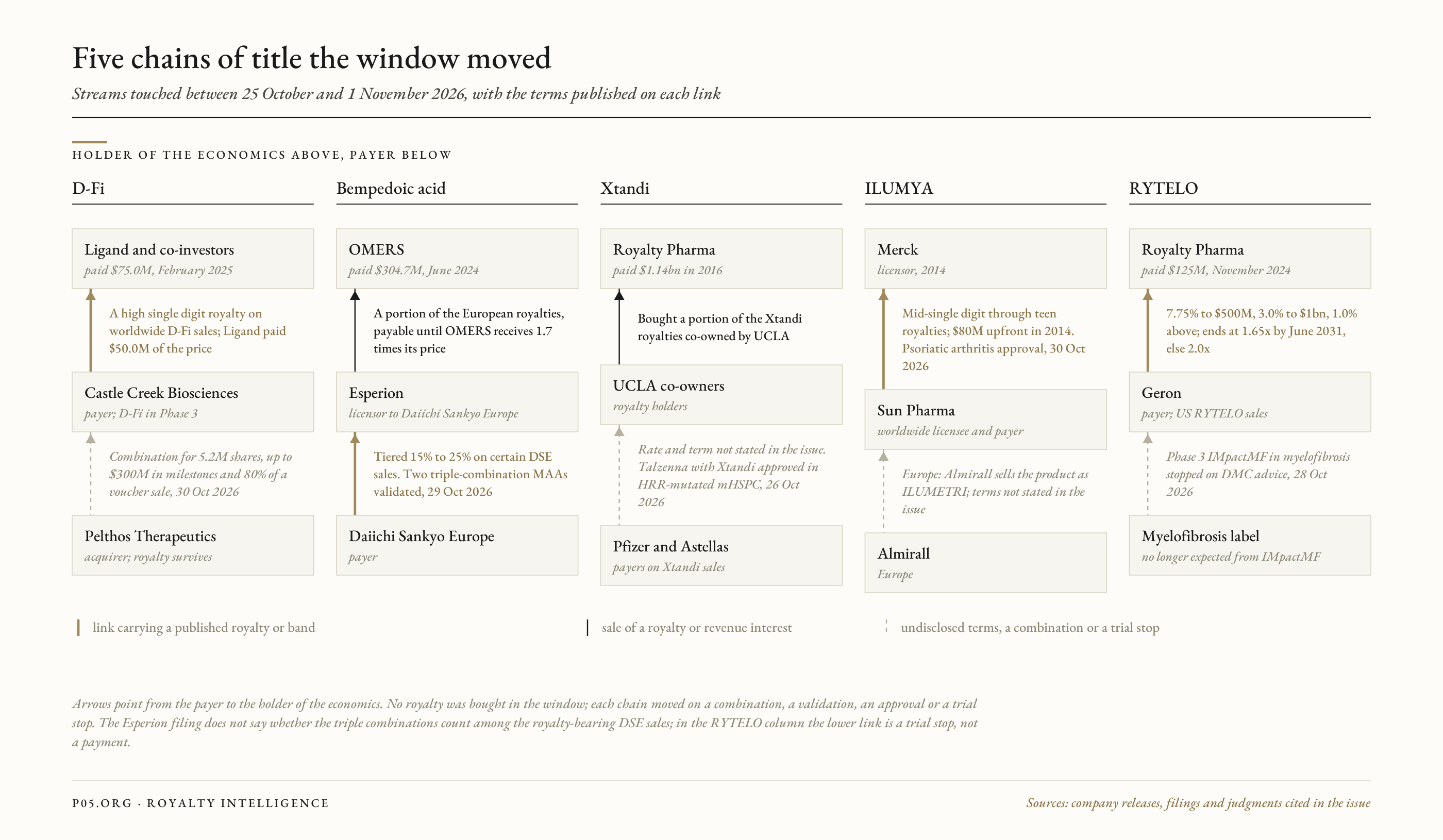
Five chains of title the window moved, holders of the economics above and payers below. Gold links carry a published royalty or band; dashed links carry undisclosed terms, a combination or a trial stop.
Phathom, BDR and the FDA: the agency opens a public docket on VOQUEZNA exclusivity and Phathom joins the suit as a second generic filer seeks to join the challenge (Monday 26 October)
Phathom Pharmaceuticals (Nasdaq: PHAT) said, and repeated in a current report to the Securities and Exchange Commission, that the FDA has established "a public docket (Docket No. FDA-2026-N-13038) to solicit comment on legal and regulatory questions" raised by BDR Pharmaceuticals, an ANDA filer referencing VOQUEZNA (vonoprazan) tablets.
"The deadline for comments submitted to the public docket is November 23, 2026."
- The case: BDR's suit against the FDA in the District of Columbia challenges "FDA’s June 6, 2025 decision granting Phathom’s Citizen Petition, which agreed with Phathom that VOQUEZNA benefits from 10 years of New Chemical Entity (NCE) exclusivity through May 3, 2032."
- The parties: "Phathom has also moved to intervene in the litigation filed by BDR to continue to enforce its statutory exclusivities." "A second purported ANDA filer, Saba Ilac Sanayii Ve Ticaret AS, has filed a notice in the BDR litigation claiming to have a pending related case, and that it intends to move to consolidate its case with BDR’s." On 26 October Chief Judge Boasberg ordered that "Phathom's 10 Motion to Intervene is GRANTED", held the scheduling conference and ordered "the parties shall submit a Joint Status Report by November 2, 2026", per the docket (1:26-cv-03679). Saba's own suit against the FDA, under the Administrative Procedure Act, was filed in the District of Columbia on 8 October, per the docket (1:26-cv-03513).
- The claim: Phathom names the risk that the challenge succeeds, "which would result in a reduction in the period of regulatory exclusivity and permit FDA to receive and potentially approve ANDAs referencing VOQUEZNA tablets earlier than currently anticipated".
- The asset: "Phathom has in-licensed the exclusive rights to vonoprazan" for the United States, Europe and Canada.
- The licence or royalty at issue: the release states no royalty terms. The length of exclusivity sets how long VOQUEZNA sales, and the payments that depend on them, are free of generic competition.
Biocon and Janssen (Monday 26 October). Biocon (NSE: BIOCON) "has signed a license agreement with Janssen Sciences Ireland clearing the way for the commercialization of Yesintek™, its proposed biosimilar to Stelara® (Ustekinumab), in Australia, Brazil, China, Hong Kong, Israel, Mexico, New Zealand, South Korea and Kazakhstan with immediate effect", per its statement to the exchanges. No financial terms are disclosed.
Zhejiang Hisun and Xuanjing Biotech (Tuesday 27 October). Zhejiang Hisun (SSE: 600267) agreed to license in Suzhou Xuanjing Biotech's siRNA platform and its candidate RGN6669, "处于临床前早期开发阶段" (at an early preclinical stage), with global rights, per its notice to the Shanghai Stock Exchange, approved by its board on 27 October and subject to a shareholders' meeting.
Hisun pays "不可撤销的首付款 1,000 万元" (a non-refundable upfront of RMB 10m), about USD 1.4m, development milestones "累计里程碑总和不超过 3.48 亿元" (not exceeding RMB 348m in total), about USD 49m, and sales milestones on the first targets and RGN6669 of up to RMB 630m, about USD 89m. "海正药业按照协议约定的比例向炫景生物支付销售权益金" (Hisun pays Xuanjing royalties at the agreed rate); the rate is not disclosed, and Xuanjing shares in any sublicence outside Greater China.
SynAct Pharma and Hipolabor (Tuesday 27 October). SynAct Pharma (Nasdaq Stockholm: SYNACT) signed "a strategic co-development and commercialization agreement with Hipolabor Farmacêutica LTDA" for resomelagon in dengue in Brazil. The licence provides "an equal (50/50) profit-sharing arrangement, alongside additional sales milestone payments linked to cumulative net sales of USD 200 million", and the partners share development costs equally.
No upfront or milestone amount is stated. Resomelagon is in Phase 2 in inflammation caused by infections, and a supply agreement is still to be negotiated.
AimedBio and Boehringer Ingelheim (Tuesday 27 October). AimedBio (KOSDAQ) disclosed that Boehringer Ingelheim International GmbH gave written notice on 26 October of a milestone under the licence for the antibody-drug conjugate ODS025 (BI 4060107), after the first patient was dosed in Phase 1. "수령금액은 비공개입니다" (the amount received is not disclosed); the claim is at least 10 per cent of 2025 operating revenue of about KRW 47.3bn, so at least about USD 3.3m (KRW 4.73bn).
Payment is due within 45 days of invoice and is not refundable if the licence ends. The licence was signed on 15 October 2025, before AimedBio's listing, and terms are withheld until it ends. This is the second milestone under it; no royalty band is disclosed.
AstraZeneca and Daiichi Sankyo (Tuesday 27 October). The European Commission approved Enhertu (trastuzumab deruxtecan) "as a monotherapy for the adjuvant treatment of adult patients with resected HER2-positive breast cancer who have residual invasive disease after neoadjuvant taxane-based and HER2-targeted treatment", per AstraZeneca's release. In DESTINY-Breast05 it reduced the risk of invasive disease recurrence or death "by 53% (based on a hazard ratio [HR] of 0.47; 95% confidence interval [CI] 0.34-0.66; p<0.0001) compared to trastuzumab emtansine (T-DM1)".
"Following this approval in the EU, an amount of $75 million is due from AstraZeneca to Daiichi Sankyo as a milestone payment for the adjuvant HER2-positive early breast cancer indication. Sales of Enhertu in most EU territories are recognised by Daiichi Sankyo." Daiichi Sankyo repeated the payment and called it the "first approval of Enhertu in early breast cancer in the EU". The two companies co-develop and co-commercialise Enhertu under their collaboration agreement of March 2019; no royalty band is stated.
Hengrui (Tuesday 27 October). Jiangsu Hengrui (HKEX: 1276; SSE: 600276) reported that "For the first three quarters of 2026, the Company recognized revenue of RMB2.781 billion from its innovative drug out-licensing business, representing a year-over-year increase of 31.12%", about USD 392m, "primarily comprising revenue recognized from GSK and BMS based on the progress of fulfillment of performance obligations, as well as the milestone payments for certain out-licensed products".
"The Company received a total of RMB4.343 billion in cash from upfront payments and milestone payments from out-licensing collaborations, which mainly consisted of the US$600 million upfront payment from BMS", about USD 612m in all. It gives the increase in out-licensing revenue as the reason for the rise in third-quarter profit.
Xbrane, STADA and Valorum (Tuesday 27 October). Xbrane Biopharma (Nasdaq Stockholm: XBRANE) announced at 15:40 CET that "the US Food and Drug Administration (FDA) approved Lucamzi™ (ranibizumab-blrz) as a biosimilar" to Lucentis, two days before its action date of 29 October. Xbrane plans to launch "the product during 2027 together with its partners".
Under the 2024 US licence, "Valorum will pay a license fee of up to US$45 million, which will include regulatory approval and sales-related milestones. This fee, plus royalties paid by Valorum on net sales of the product, will be shared equally by STADA and Xbrane", per the companies' release of 10 May 2024. The approval release names no milestone amount and no royalty band.
Henlius and Fosun Pharma (Tuesday 27 October). Shanghai Henlius (HKEX: 2696) proposed to raise the 2026 cap on payments under its HLX01 agreement with Fosun Pharma Industrial Development, a subsidiary of its controlling shareholder, from about USD 96m (RMB 682m) to about USD 101m (RMB 714m), subject to independent shareholders' approval.
Henlius grants "an exclusive license to Fosun Pharma Industrial Development" to commercialise its rituximab biosimilar HANLIKANG in China and receives "50% × Net profit of relevant products", plus supply payments at cost plus 10 per cent. It received about USD 68m (RMB 482.82m) in the nine months to 30 September 2026.
Astellas and Audax Biosciences (Tuesday 27 October). Astellas Pharma (TSE: 4503) and Audax Biosciences, a private Australian company, entered an exclusive option and licence agreement for DAX-044, an IL-12 antibody-cytokine fusion "currently in IND/CTN-enabling development", with a "Total potential transaction value of up to US$1.34 billion, excluding royalties".
"Audax will receive up front and potential future option exercise payment totaling US$285 million and continue development of DAX-044 into a Phase 1 study expected to commence in 2027." Audax "will be eligible to receive development and commercial milestone payments of up to US$1.05 billion, as well as tiered double-digit royalties on worldwide net sales of DAX-044, if approved".
On exercise Astellas takes sole responsibility for global development and commercialisation, and Audax keeps an option to co-fund and co-promote in Australia and New Zealand. The split between the upfront and the option fee is not stated, and exercise is subject to antitrust clearance.
Nxera Pharma and Idorsia (Wednesday 28 October). Nxera Pharma (TSE: 4565) "has exercised its option to license lucerastat for Japan, South Korea, Taiwan and selected other Asia Pacific markets (excluding China), paying Idorsia CHF 7 million upfront and contributing to the global Phase 3 program", per its release; the upfront is about USD 7.9m. "Idorsia is eligible to receive royalties on net sales in the Territory." No band or milestone is disclosed.
"Idorsia granted Nxera the option in July 2023, as part of the Company's (then Sosei Heptares) acquisition of Idorsia's Asia Pacific (ex-China) operations." Idorsia (SIX: IDIA) started the pivotal FAB-KLEAR study the same day, aimed at "a regulatory filing as early as 2029". Nxera's notice to the Tokyo Stock Exchange says the upfront was already in its forecast for 2026.
Betta Pharmaceuticals and Hangzhou Shengsi Biopharma (Wednesday 28 October). Betta Pharmaceuticals (SZSE: 300558) signed a technology transfer agreement under which it "取得 SS202 产品全球独占和专用的项目技术权利" (obtains global exclusive and dedicated technology rights to SS202), an ultra-long-acting growth hormone in preclinical development, per its announcement on the board approval of 28 October.
"里程碑付款总额合计人民币 4,000 万元,其中首付款为人民币 1,000 万元" (milestone payments total RMB 40m, of which the upfront is RMB 10m), about USD 5.6m and USD 1.4m. Betta pays royalties at an undisclosed agreed rate, with "提成期限为产品在中国正式上市销售之日起 15 年" (a royalty term of 15 years from the formal launch in China), and the same term outside China, or an agreed share of any sublicence income. Betta's chief financial officer chairs Shengsi, so the deal is a related-party transaction.
BioArctic, Eisai and Biogen (Wednesday 28 October). BioArctic (Nasdaq Stockholm: BIOA B) said that "sales of JPY 32.2 billion were recorded in the period", about USD 221m, for Leqembi in the third quarter. "This results in a royalty to BioArctic amounting to SEK 203.8 million", about USD 21.5m, "an increase of approximately 74 percent compared to the royalty recorded by BioArctic for the third quarter of 2025." Eisai leads Leqembi with Biogen; BioArctic reports in full on 25 November.
Monte Rosa and Novartis (Wednesday 28 October). Novartis started a second Phase 2 study of MRT-6160 (DDY391), a VAV1-directed molecular glue degrader, in psoriatic arthritis, and "In connection with the first patient visit of the study, Monte Rosa will receive a $37.5 million milestone payment from Novartis", per Monte Rosa's (Nasdaq: GLUE) release.
"Monte Rosa is eligible to receive up to $2.1 billion in development, regulatory, and sales milestones". It "will co-fund any Phase 3 clinical development and will share 30% of any profits and losses associated with the manufacturing and commercialization of MRT-6160 in the U.S., and is also eligible for tiered royalties on ex-U.S. net sales." No band is stated.
TME Pharma and TMS (Thursday 29 October). TME Pharma (Euronext Growth Paris: ALTME) and TMS Co. (TSE: 4891) signed "a binding exclusive negotiation agreement and a non-binding Term Sheet" for worldwide rights to NOX-A12 in glioblastoma. "TMS Co. will pay a non-refundable fee of €150,000 for a 6-month exclusive negotiation period", about USD 175,000, and will set up a Japanese subsidiary to finance the Phase 2 study.
Under the non-binding terms TME would receive "Near-term payments of approximately €10M in a combination of cash and an interest in the Subsidiary (through shares and debt)", about USD 11.7m, ">€100 million in regulatory and commercial sales milestones" and "Royalties of 8 - 10% on sales projected by TME Pharma to peak at approximately $1 billion". TMS's notice caps its payments under the term sheet at "最大で 30 万ユーロ" (up to EUR 300,000), about USD 350,000.
BioMarin, GC Biopharma and Hanmi (Thursday 29 October). BioMarin (Nasdaq: BMRN) licensed "worldwide rights (excluding Korea) to HM15421/GC1134A, a long-acting, subcutaneous, clinical-stage enzyme replacement therapy for Fabry disease", now in a Phase 1/2 study.
"BioMarin will make an upfront payment of $70 million. GC and Hanmi are also jointly eligible to receive up to an additional $405 million upon the completion of certain development and commercial milestones, and tiered royalties." GC and Hanmi keep Korea. Each licensor filed the same figures on 30 October: "총 US$ 237,500,000(약 3,174억원)" (USD 237.5m in total, about KRW 317.4bn), of which "계약금(Upfront): US$ 35,000,000" (USD 35m upfront, about KRW 46.8bn) and USD 202.5m in milestones, per the Hanmi and GC Biopharma disclosures.
Royalties follow "시판 후 연간 순매출액에 따라" (on annual net sales after launch), and "마일스톤 및 경상기술료의 세부사항은 공개불가" (details of milestones and royalties are not disclosed). No band is stated.
Kiora Pharmaceuticals and Senju (Thursday 29 October). Kiora (Nasdaq: KPRX) entered on 23 October, with effect from 5 October, into an exclusive licence from Senju Pharmaceutical to KIO-401, an oral calpain inhibitor in central retinal artery occlusion, "throughout the world except for certain specified countries, including countries in Asia". Senju has completed a Phase 3 trial in Japan.
"The Company will pay Senju an up-front payment of $3.5 million", "an amount in the low teen millions of dollars upon completion of the technology transfer, a portion of which may be credited against future milestone payments", and "additional payments of up to $168.5 million". "In addition, the Company will pay single-digit royalties based on a specified percentage of net sales of KIO-401 in the Territory".
Novavax and Sanofi (Thursday 29 October). Novavax (Nasdaq: NVAX) "has earned a $125 million milestone payment with the initiation (fifth patient dosed) of Sanofi's Phase 3 influenza-COVID-19 combination vaccine trial", per its release. A USD 75m milestone on the manufacturing technology transfer, "anticipated in mid-2027", and a USD 225m milestone on a US launch of the combination remain.
Novavax "is eligible to receive royalty payments in the high teens to low twenties percent on Sanofi's sales of such licensed products", per its quarterly report for the second quarter.
Tanabe Pharma and Nippon Shinyaku (Thursday 29 October). Tanabe Pharma said that on 22 October it granted Nippon Shinyaku (TSE: 4516) an exclusive sublicence to sell loncastuximab tesirine (MT-2111) in Japan, and that it filed for Japanese approval in relapsed or refractory diffuse large B-cell lymphoma on 29 October. Tanabe holds the Japanese rights from ADC Therapeutics under a 2022 licence. No terms are disclosed.
Prothena and Bristol Myers Squibb (Thursday 29 October). Prothena (Nasdaq: PRTA) said that Bristol Myers Squibb notified it on 28 October "that it has decided not to advance PRX019 further in the clinic", and that "The PRX019 License Agreement will terminate on January 28, 2027". Prothena received "an upfront payment of $80 million" under the licence of May 2024.
It was "eligible to receive further development, regulatory, and sales milestones of up to $617.5 million" and tiered royalties; "Bristol Myers Squibb will not owe any of the foregoing to the Company." Moponetug (PRX005), from the same 2018 collaboration, stays with Bristol Myers Squibb in Phase 2, with "up to $562.5 million in regulatory and sales milestones, as well as tiered royalties" still open to Prothena.
Alligator Bioscience and Biossil (Saturday 31 October). Alligator Bioscience (Nasdaq Stockholm: ATORX), whose "principal asset is a financial interest in the HER2-targeting antibody program HLX22", agreed to sell all rights and assets related to its CD40 agonist antibody mitazalimab to Biossil Inc., a private company. Biossil takes "worldwide rights to mitazalimab, including its derivatives, for all indications and uses".
"Alligator will receive USD 0.75 million upfront and is eligible for up to USD 108 million in milestone payments, as well as royalties on future sales." These are up to USD 3m on first approval in the US and EU and "up to USD 105 million linked to worldwide net sales, and mid-single-digit royalty on worldwide net sales, capped at USD 250 million in total".
If Biossil sells or licenses mitazalimab within two years of signing, Alligator receives a share of the proceeds. "Closing is expected within 30 days of signing."
Valion Bio (Monday 26 October). Valion Bio (Nasdaq: VBIO) closed the sale of 4,717.73 Series C preferred shares and warrants over 2,524,343 shares at USD 1.0092 for USD 4,717,717.61, of which USD 3,217,717.61 was "retained by the Purchasers to satisfy overdue cash true-up payments" and USD 1,500,000 was paid in cash; 3i bought a further USD 50,000 of Series B preferred.
Under the side letter of 26 October, "Within thirty (30) days after the date of the Closing, the Company shall execute and deliver to the Purchaser a royalty agreement relating to the Company's drug assets, in form and substance satisfactory to the Purchaser". The filing states no rate, term or asset list.
Idorsia and its SPV noteholders (Thursday 29 October). Idorsia (SIX: IDIA) proposed, in an ad hoc announcement, a launch financing for TRYVIO/JERAYGO (aprocitentan) through Idorsia Investments SARL, the SPV that holds aprocitentan, selatogrel and cenerimod. "SPV noteholders would provide CHF 72 million of launch capital in exchange new Notes and a 12% earn-out on the three SPV assets (aprocitentan, selatogrel, cenerimod), such earn-out will begin once the debt in the SPV has been fully paid off."
"Subject to applicable consent, Idorsia would contribute CHF 48 million over a two-year period to support market access, medical affairs, marketing, and sales activities, in exchange for a 30% share in global net revenue of aprocitentan as of effective date of the agreement and keep the other 88% of the upside value of the SPV assets after the SPV Notes has been fully paid off." The amounts are about USD 81m and USD 54m.
The proposal "is fully backstopped by a group of noteholders representing a significant majority of notes but remains subject to achieving the required noteholder approvals and completion of final documentation - anticipated by the end of the year." Idorsia's third-quarter release puts liquidity at about USD 96m (CHF 85m) on 30 September, excluding "the remaining CHF 100 million available under the secured term loan". No investor, cap or term for the earn-out is named.
Harmony Biosciences and AET (Monday 26 October). In a joint letter in the second WAKIX (pitolisant) case in the District of Delaware, Harmony and Novitium said that "with the 30-month stay expiring on February 14, 2027" they want a bench trial or a preliminary injunction hearing in early February 2027; the first case is under submission after closing arguments on 22 October.
The defendants answered that the patent asserted does not cover WAKIX and that the case "is, at best, a reasonable royalty case to be properly resolved after Sandoz has launched its generic pitolisant hydrochloride product". Harmony licenses pitolisant from Bioprojet; the royalty it pays is not stated in the documents read.
In a third WAKIX case against AET and Sandoz (1:26-cv-01191), filed on 23 September, Harmony and Novitium filed a notice of voluntary dismissal without prejudice on 26 October, and the case was closed on 27 October. No reason is given.
US WorldMeds and Supernus (Monday 26 October). In US WorldMeds Partners v. Supernus Pharmaceuticals (Del. Super. Ct., N25C-07-121), a letter decision recalls that under the 2020 agreement by which Supernus bought USWM Enterprises, when a milestone "was satisfied in April 2025, Supernus owed US WorldMeds a $30 million milestone payment", and Supernus withheld part of it under a claimed right of set-off; the court held in June that it had no such right.
The letter awards US WorldMeds fees and expenses of USD 2,053,663.60, applies "$864,175.83 of the $1,862,018.22 paid" in August 2025 to interest, and reduces "the principal balance to $26,707,399.41". It declines to order Supernus to pay: "If Supernus fails to pay the judgment, post-judgment interest will continue to accrue and US WorldMeds may pursue collection remedies." The milestone was tied to the launch of ONAPGO.
United Therapeutics and Liquidia (Tuesday 27 October). In United Therapeutics Corp. v. Liquidia Technologies (D. Del., 1:23-cv-00975), the parties filed a stipulation stating that they "have entered into a settlement agreement, and mutually agree to voluntarily dismiss all claims, counterclaims, and defenses asserted in the above-captioned case with prejudice"; Judge Richard G. Andrews granted it on 28 October and the case was terminated, per the docket (D.I. 487). The case concerns YUTREPIA (treprostinil inhalation powder).
Under the settlement of 13 October, Liquidia makes "a net payment to UTC of $175.0 million, due within thirty (30) business days of the Effective Date" and "an aggregate of $145.4 million, to be paid in two equal installments on or before January 31, 2027 and April 30, 2027", per its current report. Dismissal of the cases is one of the conditions for the releases; Liquidia's YUTREPIA revenue carries a revenue interest held by HealthCare Royalty.
On 28 October the parties also filed a stipulation of dismissal in their case in the Middle District of North Carolina (1:25-cv-00368), followed by a further stipulation of dismissal (D.I. 102) on 29 October; the documents themselves is not public on the docket, and no filing read confirms that the USD 175.0m has been paid.
Invitae and Natera (Wednesday 28 October). In Invitae Corporation v. Natera (Del. Super. Ct., N25C-10-310 PAW CCLD), the court granted Natera's motion to dismiss. Natera bought Invitae's women's health genetic testing assets under an agreement that closed on 17 January 2024 and "provided for contingent consideration of up to $22.5 million based on retention metrics measured over a period ending 120 days after closing".
Natera calculated the payment at USD 0 and Invitae claimed the full amount; Invitae then rejected the agreement under its Chapter 11 plan. The court held that "Plaintiff's material breach relieves Defendant of its contingent obligation to make the Milestone Payment."
Johns Hopkins University and Labcorp (Friday 30 October). In Johns Hopkins University v. Laboratory Corporation of America Holdings (D. Md., 1:26-cv-04566), JHU filed a complaint for infringement of its digital karyotyping patent, US 7,704,687, and in the alternative for breach of licence.
In 2011 JHU granted Personal Genome Diagnostics "an exclusive, royalty-bearing license to JHU's digital karyotyping patent rights", and Labcorp took over that licence when it acquired PGDx in 2022.
JHU states that Labcorp pays royalties on the elio cancer test but "has never paid JHU any royalties on" its MaterniT and GENOME-Flex prenatal tests, that "JHU thus formally terminated the license on October 5, 2026", and that the patent expired on 11 October 2026.
It seeks damages "no less than a reasonable royalty", enhanced for wilful infringement, or in the alternative the royalties owed under the licence; no amount is stated.
Syntimmune sellers and AstraZeneca (Friday 30 October). In the Delaware Court of Chancery case brought in 2020 by the stockholders' representative of Syntimmune against AstraZeneca and Alexion (C.A. No. 2020-1069-MTZ), AstraZeneca disclosed in its nine-month results that "In October 2026, the Court entered final judgment on its earlier decisions issuing a $392 million judgment, plus post judgment interest, against AstraZeneca."
The claim concerns milestone payments under the 2018 merger agreement by which AstraZeneca bought Syntimmune.
The court had concluded "that the first milestone was achieved, that AstraZeneca had breached its contractual obligation to use commercially reasonable efforts to achieve the milestones, and that sellers breached a material representation in the Merger Agreement regarding manufacturing of drug substance and product supply".
"AstraZeneca intends to appeal", and it treats the matter as a contingent liability; the date of the judgment is not stated beyond October 2026.
MiMedx (Wednesday 28 October). MiMedx (Nasdaq: MDXG) entered into a licence agreement "with a wound care competitor that resolves allegations of infringement of MIMEDX's patents". "The licensee will pay MIMEDX a total of $25 million in five equal installments of $5 million"; the first has been received and the rest are paid annually.
"MIMEDX has granted the licensee a non-exclusive license to the covered patents." The licensee is not named and "is not involved in either of MIMEDX's two ongoing patent infringement actions". No royalty is payable.
Pluri and ZEO ScientifiX (Friday 30 October). Pluri (Nasdaq: PLUR) disclosed that on 26 October it agreed to grant ZEO ScientifiX "an exclusive license solely to manufacture and commercialize its regenerative medicine product portfolio" in the United States, which "may also be expanded to Latin America", for "forty-one percent (41%) of ZEO's issued and outstanding share capital" and Series D preferred stock.
"The Partnership provides for a variable royalty mechanism based on Pluri's percentage of equity ownership in ZEO, with the applicable royalty rate increasing as Pluri's equity ownership decreases." The partnership agreement filed with it redacts the rates but sets the ceiling: after each further 10 per cent fall in Pluri's stake, the rate rises "up to a maximum royalty rate of seven percent (7.0%) of Net Sales".
The same filing says the EIB sold its loan to Pluri, with "an outstanding balance of approximately US$27.5 million, including accrued interest" at 30 September, to a vehicle of its chairman "at a negotiated discounted price".
Exelixis and Azurity (Thursday 29 October). Exelixis (Nasdaq: EXEL) said in its third-quarter release that "On October 28, 2026, we entered into a settlement and license agreement with Azurity" to resolve the Azurity litigation, under which "we will grant Azurity a license to market its proposed 505(b)(2) NDA product in the U.S. beginning on December 1, 2030, if approved by the FDA". The case is Exelixis v. Azurity Pharmaceuticals (D. Del., 1:25-cv-00478), on CABOMETYX (cabozantinib).
"The effective date for the proposed generic cabozantinib products where we have a settlement and license agreement remains January 1, 2031." No payment or royalty is disclosed. Exelixis "earned $51.8 million in royalty revenues" in the quarter on cabozantinib sales by Ipsen and Takeda.
Its quarterly report adds that within three business days "we and Azurity will jointly file a stipulated dismissal", which "will not affect our litigation with MSN, which remains pending in the Consolidated Litigation", with "the trial scheduled for November 2, 2026".
The court has since moved it: "The Bench Trial is now rescheduled to start on 11/3/2026", with "Closings arguments will be held on 11/5/2026", per an oral order of 29 October on the docket, where the stipulation dismissing Azurity and Slayback was entered on 30 October.
Enanta and Pfizer (Thursday 29 October). Enanta Pharmaceuticals (Nasdaq: ENTA) disclosed that it lost its infringement action against Pfizer in the Unified Patent Court over European Patent No. EP 4 051 265, which it had brought in respect of Paxlovid (nirmatrelvir; ritonavir) "in the 18 EU member states participating in the UPC".
"On October 29, 2026, the UPC released its decision concluding that the '265 Patent is invalid. The UPC also determined that the infringement action was unfounded in light of its decision on validity." The decision itself has not been published on the court's register, and Enanta does not say whether it will appeal.
Clinical and Regulatory
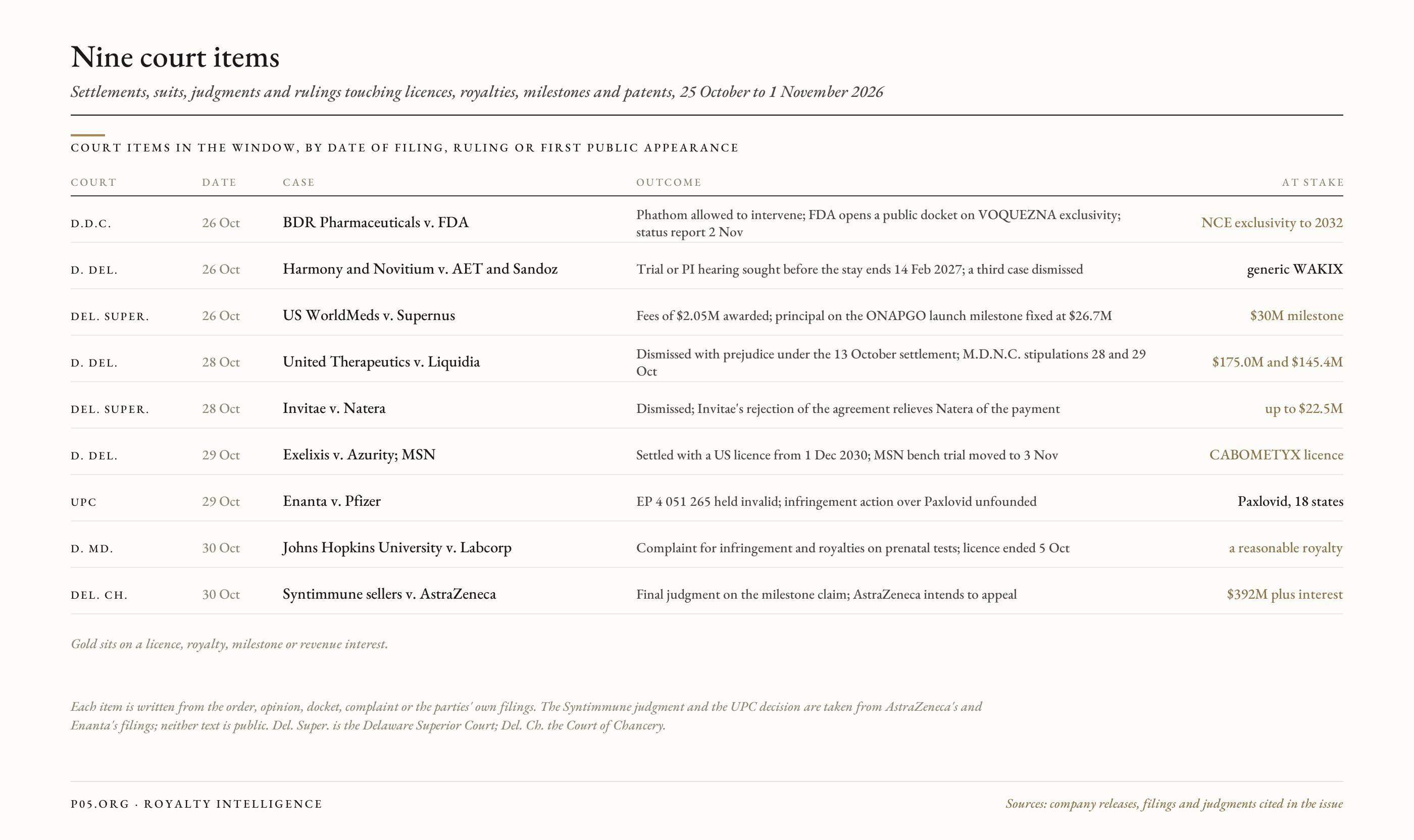
The nine court items in the window, by court, date, outcome and what is at stake: a suit against the FDA, two settlements and dismissals, two Delaware Superior Court decisions on milestone payments, a patent invalidity decision, a royalty complaint, a final judgment and a request for trial.
AstraZeneca and HUTCHMED: Tagrisso plus Orpathys cuts the risk of death by 32 per cent in MET-driven lung cancer (Sunday 25 October)
AstraZeneca presented the full SAFFRON Phase III results at ESMO, after a topline without figures in August. Tagrisso plus Orpathys (savolitinib) gave a PFS hazard ratio "of 0.55; 95% confidence interval [CI] 0.42-0.72", and "extended median OS by 4.9 months versus the comparator arm (17.8 versus 12.9 months)", with an OS hazard ratio of 0.68.
- The licence: HUTCHMED licensed savolitinib to AstraZeneca, which commercialises Orpathys; AstraZeneca submitted a US marketing application in September.
- The royalty: HUTCHMED "would receive from AstraZeneca tiered royalties from 9% to 13% on all sales outside of China", and "AstraZeneca is also obligated to pay us a fixed royalty of 30% on all sales made of any product in China", per its annual report for 2025.
- The milestones: "As of December 31, 2025, we had triggered $81.9 million of milestone payments", and HUTCHMED "may potentially receive future clinical development and first sales milestones payments". "In 2025, savolitinib triggered an $11.0 million milestone payment from AstraZeneca for securing China approval for its third lung cancer indication." No amount is stated for US acceptance or approval.
- Instrument: pivotal readout under an existing licence.
- Royalty read-through: the overall survival result supports the pending US application, whose approval would start the royalty of 9 to 13 per cent on sales outside China. No milestone was announced with the data.
AstraZeneca and KYM Biosciences: sonesitatug vedotin cuts the risk of death by 53 per cent in later-line gastric cancer (Sunday 25 October)
AstraZeneca reported the CLARITY-Gastric01 Phase III results, topline announced in July. In the third and later line, "Median OS doubled for patients treated with Sone-Ve (10.0 versus 5.0 months)" (HR 0.47), while PFS "did not reach statistical significance".
- The licence: AstraZeneca holds a global exclusive licence from KYM Biosciences, a joint venture of Keymed Biosciences and Lepu Biopharma.
- The terms: KYM received "an upfront payment of US$63 million with the potential for additional payments up to US$1,125 million subject to achievement of certain development, regulatory and commercial milestones", and "is entitled to receive tiered royalties on net sales from AstraZeneca", per Lepu's announcement of February 2023. AstraZeneca's completion notice puts the royalties at "tiered royalties up to low double digits".
- Instrument: pivotal readout under an existing licence.
- Royalty read-through: the result brings closer the regulatory milestones and the royalty of up to low double digits owed to KYM. No milestone schedule by event is public.
Akeso and Summit: ivonescimab extends survival against durvalumab in biliary tract cancer (Sunday 25 October)
Akeso (HKEX: 9926) presented HARMONi-GI1 in an ESMO Presidential Symposium, after a topline in August. "The median overall survival (mOS) was 14.9 months in the ivonescimab group versus 12.1 months in the durvalumab group, with OS HR 0.75 (95% CI: 0.61–0.92)", and the indication "has been proposed for Priority Review designation by China's National Medical Products Administration".
- The licence: Summit (Nasdaq: SMMT) holds ivonescimab outside Akeso's territory; HARMONi-GI1 was run in China.
- The royalty and milestones: "there are additional potential milestone payments of up to $4,555,000, as Akeso will be eligible to receive regulatory milestones of up to $1,050,000 and commercial milestones of up to $3,505,000. In addition, Akeso will be eligible to receive low double-digit royalties on net sales", in thousands of US dollars, per Summit's quarterly report to 30 June 2026. No amount is given per event.
- Instrument: pivotal readout in the licensor's territory.
- Royalty read-through: the China data trigger no payment under the Summit licence. The regulatory milestones of up to USD 1.05bn turn on approvals in Summit's territory.
Kelun-Biotech, Merck and Blackstone: sac-TMT data in lung and endometrial cancer, and a US filing under priority review (Sunday 25 and Monday 26 October)
Kelun-Biotech (HKEX: 6990) announced two Phase 3 results at ESMO, both from China. In OptiTROP-Lung06, first-line, median PFS "was 15.0 months (95% CI 9.9-not evaluable) vs 5.7 months" (HR 0.49), after a topline in July; the final analysis of OptiTROP-Lung04 gave median OS of "25.9 months vs 17.4 months" (HR 0.69).
- The US filing: in TroFuse-005, in previously treated endometrial cancer, "sac-TMT reduced the risk of death by 32% (HR=0.68; 95% CI, 0.55-0.84; P<0.0001)", with median overall survival of "19.0 months vs. 12.1 months" against chemotherapy in 776 patients, per Merck's release of 26 October. "The FDA has set a Prescription Drug User Fee Act (PDUFA), or target action date, of June 15, 2027" for the biologics licence application, accepted for priority review.
- The licence: "In May 2022, the Company licensed the exclusive rights to MSD" for sac-TMT "in all territories outside of Greater China". No royalty band is stated.
- The financing: under an October 2025 arrangement, "Blackstone will pay Merck $700 million in the fourth quarter of 2026" towards sac-TMT development. "Upon receipt of regulatory approval for an indication in the U.S. for first-line triple-negative-breast cancer (TroFuse-011 trial), Blackstone will be eligible to receive low-to-mid single-digit royalties on net sales of sac-TMT", and "The agreement between Merck and Kelun-Biotech with respect to sac-TMT is unchanged", per Merck's quarterly report to 30 June 2026.
- The China filing: on 27 October China's drug evaluation centre accepted an application for sac-TMT with pembrolizumab in first-line non-squamous lung cancer with PD-L1 below 1 per cent, based on OptiTROP-Lung06; "This marks the seventh indication application for sac-TMT accepted for review by the NMPA", per Kelun's announcement.
- Instrument: pivotal readouts and a filing in the licensor's territory, and a US filing by the licensee.
- Royalty read-through: the two lung trials sit in Kelun's own territory and trigger no payment from Merck. A US approval in endometrial cancer would add US sales under Merck's licence from Kelun; no milestone on the filing was announced. Blackstone's royalty switches on only with a US approval in first-line triple-negative breast cancer.
HUTCHMED and AstraZeneca: Orpathys plus Tagrisso extends survival in first-line EGFR-mutant lung cancer in China (Monday 26 October)
HUTCHMED (Nasdaq and AIM: HCM; HKEX: 13) presented the SANOVO Phase III results at ESMO, a trial in China whose topline was announced without figures in August. In the intention-to-treat population the combination "reduced the risk of disease progression or death by 44%", "based on a PFS hazard ratio [“HR”] of 0.56", with median PFS of 24.9 against 13.8 months.
- The survival data: the combination gave an "OS HR of 0.48", with median overall survival of 44.5 against 34.9 months, and "An estimated 67.4% of patients treated with the combination were alive at three years". The PFS data cut-off was 31 July 2026.
- The filing: "Based on data from the SANOVO Phase III trial, HUTCHMED plans to submit a supplemental New Drug Application in China for this first-line setting."
- The licence: "ORPATHYS ® is being jointly developed by AstraZeneca and HUTCHMED and commercialized by AstraZeneca." The release states no royalty or milestone.
- The royalty: "AstraZeneca is also obligated to pay us a fixed royalty of 30% on all sales made of any product in China", per HUTCHMED's annual report for 2025.
- Instrument: pivotal readout under an existing licence, ahead of a supplemental filing in China.
- Royalty read-through: a first-line approval in China would extend the indications that carry HUTCHMED's fixed 30 per cent royalty. No milestone was announced with the data.
Biokin, SystImmune and Bristol Myers Squibb: iza-bren doubles progression-free survival against chemotherapy in previously treated EGFR-mutant lung cancer (Sunday 25 and Monday 26 October)
Biokin said its marketing application for iza-bren (BL-B01D1) in EGFR-mutant non-squamous non-small cell lung cancer after failure of EGFR-TKI therapy, acceptance number CXSS2600168, "已获得正式受理" (has been formally accepted), per its announcement to the Shanghai Stock Exchange. On 26 October SystImmune and Bristol Myers Squibb (NYSE: BMY) presented the PANKU-Lung01 Phase 3 data behind the filing at ESMO.
- The data: "a median PFS by Blinded Independent Central Review (BICR) of 11.1 months for iza-bren vs. 5.7 months for PBC (HR: 0.40; 95% CI: 0.31-0.51; p<0.0001)", in 216 against 206 patients. For overall survival, "data were immature, though a favorable trend toward improved OS was observed".
- The licence: "Outside of China, iza-bren is jointly developed by SystImmune and Bristol Myers Squibb under a collaboration and exclusive license agreement."
- The terms: "Bristol Myers Squibb will pay SystImmune $800 million in an upfront payment", with "up to $500 million in contingent near-term payments"; "The companies will share certain global development expenses and profits and losses in the United States." "Outside the United States and Mainland China, SystImmune will receive a tiered royalty on net sales", and in Mainland China "Bristol Myers Squibb will receive a royalty on net sales", per the companies' release of 11 December 2023. No band is stated.
- Instrument: pivotal readout and filing acceptance under an existing licence, in the licensor's territory.
- Royalty read-through: approval of the China filing would start the royalty Bristol Myers Squibb receives on Mainland China sales. Two indications are approved in China and two breast cancer applications are under review.
Alphamab Oncology and CSPC: anbenitamab more than halves the risk of progression in first-line HER2-positive breast cancer (Monday 26 October)
Alphamab Oncology (HKEX: 9966) announced the KN026-003 Phase III results at ESMO, after a topline in June stating only that the study "successfully met its primary endpoint". Anbenitamab with HB1801 "significantly reduced the risk of disease progression or death by 54% compared with the THP Regimen (HR: 0.46; 95% CI: 0.37 to 0.56; P<0.0001)", against median PFS of 14.3 months for THP.
- The filing: "The NDA for this regimen has been accepted by the NMPA and granted priority review status." The confirmed objective response rate "was 87.6% in the Anbenitamab Group, significantly higher than 73.4% in the THP Group".
- The licence: "In August 2021, we entered into a licensing agreement with JMT-Bio, pursuant to which JMT-Bio was granted exclusive development and commercialization rights for Anbenitamab in BC and GC indications within Mainland China".
- The terms: JMT-Bio, a CSPC subsidiary, agreed "an upfront payment of RMB150,000,000", "development milestone payments of up to RMB450,000,000", "potential sales milestone payments of up to RMB400,000,000" and "tiered royalties of double-digit percent based on net sales of the Product for the Field in the Territory", per CSPC's announcement of 23 August 2021. That is about USD 21m (RMB 150m) upfront and up to USD 120m (RMB 850m) in milestones.
- Instrument: pivotal readout under an existing licence, with an application under priority review.
- Royalty read-through: approval in first-line breast cancer would add a second indication to the double-digit royalty Alphamab receives on China sales, after the gastric cancer approval of May 2026. No milestone was announced with the data.
BioNTech and DualityBio: trastuzumab pamirtecan gives a modest benefit in HER2-low breast cancer (Monday 26 October)
BioNTech (Nasdaq: BNTX) and DualityBio (HKEX: 9606) announced that the global DYNASTY-Breast02 Phase 3 trial "met its primary endpoint demonstrating a statistically significant, yet modest improvement in progression-free survival". The trial randomised 541 patients with HR-positive, HER2-low disease against chemotherapy.
- The safety data: "A higher rate of interstitial lung disease (“ILD”) was reported in this trial compared to prior trials with trastuzumab pamirtecan, with most cases being Grade 1 and 2", and "Severe and fatal events were reported in a small proportion of patients (Grade 3-5)."
- The companies' reading: the data "suggest that the potential benefit to patients would be limited", and "The companies will discuss the data and determine next steps." No hazard ratio was given.
- The terms: "DualityBio will receive upfront payments for both asset licenses totaling $170 million", with milestones "potentially totaling over $1.5 billion", and "DualityBio will be eligible to receive single-digit to double-digit tiered royalties on net sales for both ADC assets", per BioNTech's release of 3 April 2023. DualityBio retains Mainland China, Hong Kong and Macau.
- Instrument: pivotal readout under an existing licence.
- Royalty read-through: the result lowers the chance of a filing in this indication, and with it the milestones and royalties of single-digit to double-digit owed to DualityBio on it.
Hansoh and GSK (Monday 26 October). GSK reported that in ARTEMIS-011, run by Hansoh in relapsed osteosarcoma in China, risvutatug rezetecan "reduced the risk of disease progression or death by 67% compared with chemotherapy" (HR 0.33), with median PFS of "5.5 months with Ris-Rez versus 1.4 months with chemotherapy", after a topline in July.
"GSK holds exclusive rights to develop and commercialise Ris-Rez outside mainland China, Hong Kong, Macau and Taiwan"; the data "will support a regulatory submission by Hansoh in China", in Hansoh's own territory. No royalty band is stated.
Pfizer, Astellas and Royalty Pharma (Monday 26 October). The Food and Drug Administration approved "talazoparib (Talzenna, Pfizer Inc.) in combination with enzalutamide" for metastatic hormone-sensitive prostate cancer "with homologous recombination repair (HRR) gene mutations".
Enzalutamide is Xtandi, sold by Pfizer and Astellas; in 2016 "Royalty Pharma has acquired rights to a portion of the future Xtandi royalties co-owned by UCLA", for "a cash payment of $1.14 billion", per its release. The current rate and term are not stated.
Mirum and Incyte (Monday 26 October). Mirum (Nasdaq: MIRM) reported that in Cohort 2 of the pivotal PROGRESS study of ATEBRIOZ (zilurgisertib), in 25 children aged 6 to under 12 with fibrodysplasia ossificans progressiva, "mean total HO lesion volume decreased by 8.09 cm³ in patients receiving zilurgisertib, compared with an increase of 9.14 cm³ in patients receiving placebo (nominal p=0.003)". It plans a supplemental filing "in the first half of 2027".
Mirum licensed the drug from Incyte in April 2026 for "$16.0 million" upfront and is "obligated to pay royalties in the mid-to-high single digit percentage range and additional regulatory milestones of up to $48.0 million, including $25.0 million upon FDA approval, and commercial milestones of up to $15.0 million", per its quarterly report; Incyte's report adds that Incyte is "eligible to receive a Priority Review Voucher", and on the adult approval in September "the FDA also issued a Rare Pediatric Disease Priority Review Voucher (PRV) to Incyte", per the companies' release. On 28 October the FDA published its notice that ATEBRIOZ, "approved September 25, 2026, manufactured by Incyte Corporation meets the criteria for a priority review voucher". No sale of the voucher has been announced.
Agenus and Ligand (Sunday 25 October). Agenus reported that in the investigator-initiated Phase 2 NEOASIS study the colon cancer cohort "met its primary endpoint, with 83% of 18 patients achieving a major pathologic response (MPR)", and 72 per cent had a pathologic complete response. "Seventeen of 18 patients underwent surgery as planned"; one had surgery earlier than planned.
"All patients were alive at a median follow-up of 15 months, and 16 of 18 remained free of recurrence." Ligand holds "a 2.625% synthetic royalty on worldwide net sales of BOT and BAL", which "can increase by 1% based on the occurrence of certain future events", bought for "gross proceeds of $75.0 million", per Agenus's quarterly report to 30 June 2026.
Vanda and Lilly (Tuesday 27 October). Vanda Pharmaceuticals (Nasdaq: VNDA) reported that in Phase III Study 3601 NEREUS (tradipitant) reduced vomiting after a single dose of semaglutide: any vomiting occurred in 43.0 per cent of treated participants against 58.5 per cent on placebo (p=0.006), per its release. Vanda plans a supplemental application; NEREUS was approved in December 2025 for motion-induced vomiting.
Vanda licensed tradipitant from Lilly, which "is eligible to receive future payments based upon achievement of specified development, regulatory approval and commercialization milestones as well as tiered-royalties on net sales at percentage rates up to the low double digits", with "up to $80.0 million for sales milestones", per Vanda's annual report for 2024.
AbbVie (Tuesday 27 October). AbbVie submitted a biologics licence application to the FDA for etentamig (ABBV-383), a BCMA x CD3 bispecific antibody, in relapsed or refractory multiple myeloma, on the Phase 3 CERVINO data. AbbVie acquired the asset with TeneoOne in 2021; "The agreement also included additional payments of up to $ 250million upon the achievement of certain development, regulatory and commercial milestones", per its quarterly report of 2022.
Palvella Therapeutics and Ligand (Wednesday 28 October). The FDA "has accepted for filing and granted Priority Review to the Company's New Drug Application (NDA) for QTORIN™ 3.9% rapamycin anhydrous gel" in microcystic lymphatic malformations, with a target action date of 28 February 2027, per Palvella's (Nasdaq: PVLA) release. Palvella is preparing "a potential standalone U.S. commercial launch" in the first half of 2027.
Palvella "agreed to pay to Ligand tiered royalties ranging from 8.0% to 9.8% of any aggregate annual worldwide net product sales of any products based on QTORIN rapamycin", and "$5.0 million of potential future milestone payments remain", per its quarterly report for the first quarter.
Geron and Royalty Pharma (Wednesday 28 October). Geron (Nasdaq: GERN) is stopping its Phase 3 IMpactMF trial of imetelstat in relapsed or refractory myelofibrosis after "The independent DMC advised Geron that the trial was unlikely to meet its primary endpoint of overall survival", per its release.
The trial "evaluated 327 patients", per the release filed with Geron's current report. Imetelstat is sold as RYTELO in lower-risk myelodysplastic syndromes.
Royalty Pharma "will receive tiered royalty payments on U.S. net sales of RYTELO, ranging from 7.75% of annual net sales up to $500 million, 3.0% of annual net sales between $500 million and $1 billion, and 1.0% of annual net sales over $1 billion", after paying USD 125m, per its release of November 2024. Payments end at "a multiple of 1.65 its investment" if reached by 30 June 2031, otherwise at 2.0 times.
Orexo (Thursday 29 October). Orexo (Nasdaq Stockholm: ORX) said the FDA accepted its resubmitted application for IZIPRY (naloxone nasal powder): "The Prescription Drug User Fee Act (PDUFA) target action date is March 29, 2027." Orexo is seeking a US commercial partner; no third-party royalty is disclosed.
Rafael Holdings (Thursday 29 October). Rafael Holdings (NYSE: RFL) submitted a new drug application for remibetadex in Niemann-Pick disease type C, although its Phase 3 TransportNPC study "did not achieve statistical significance on its primary endpoint". The company says "an approval would make it eligible for a Priority Review Voucher, a potential source of non-dilutive capital".
Daiichi Sankyo and Esperion (Thursday 29 October). "The European Medicines Agency (EMA) has validated two marketing authorization applications (MAA) from Daiichi Sankyo (TSE: 4568) for oral, single-pill triple-combination therapies", per its release, combining bempedoic acid and ezetimibe with atorvastatin or rosuvastatin. Esperion gave Daiichi Sankyo Europe rights to a triple combination in its territory in January 2024.
Esperion "will receive significant commercial and regulatory milestone payments, as well as tiered fifteen percent (15%) to twenty-five percent (25%) royalties on certain net DSE Territory sales", per its annual report; the report does not say whether the triple combination is among those sales. In June 2024 Esperion sold a portion of those royalties to OMERS for USD 304.7m, payable until OMERS has received 1.7 times the price.
EirGenix and Sandoz (Thursday 29 October). EirGenix (TPEx: 6589) said that the EMA "has formally accepted the marketing authorisation application for the Company's biosimilar EG1206A (pertuzumab biosimilar) liquid injection 420 mg". Under their licence of November 2025, Sandoz sells the product worldwide outside Taiwan, mainland China, Japan, Korea and several other Asian markets.
EirGenix receives "signing fees, development and sales milestones totalling up to USD 152m", potential sales incentives and, after launch, a profit share.
In March 2026 the two companies reached a settlement and patent licence agreement with Genentech and Roche for the United States and Europe. The filing does not say whether the acceptance triggers a milestone.
Sun Pharma and Merck (Friday 30 October). Sun Pharmaceutical Industries (NSE: SUNPHARMA) said that "the U.S. Food and Drug Administration (FDA) has approved the supplemental Biologics License Application (sBLA) for ILUMYA® (tildrakizumab-asmn) for the treatment of adults with active psoriatic arthritis (PsA)", on the Phase 3 INSPIRE-1 and INSPIRE-2 studies. ILUMYA is "approved exclusively for healthcare provider-administered treatment".
Sun licensed tildrakizumab worldwide from Merck in 2014 for USD 80m upfront; Merck's release of the time gave "tiered royalties ranging from mid-single digit through teen percentage rates on sales". Almirall sells the product in Europe as ILUMETRI.
Agios (Friday 30 October). Agios Pharmaceuticals (Nasdaq: AGIO) said that the goal date for its application for mitapivat in sickle cell disease, filed for accelerated approval with priority review, "is now February 1, 2027".
On 9 October the FDA "requested additional information to evaluate whether a Risk Evaluation and Mitigation Strategy (REMS) is necessary", and it classified the response as a major amendment.
Agios says it is launch-ready; labelling discussions, including elements of a potential REMS, continue. Mitapivat was developed in-house; the release names no licence or royalty on it.
Scholar Rock (Monday 26 October). The Food and Drug Administration published a notice that ISEMBYLD (apitegromab-mstn), "approved September 11, 2026, manufactured by Scholar Rock, Inc., meets the criteria for a priority review voucher". The voucher is a rare pediatric disease voucher, and Scholar Rock has announced no sale of it.
Egetis Therapeutics (Wednesday 28 October). The FDA published a notice that EMCITATE (tiratricol), "approved September 28, 2026, manufactured by Rare Thyroid Therapeutics International AB meets the criteria for a priority review voucher".
Rare Thyroid Therapeutics is part of Egetis Therapeutics (Nasdaq Stockholm: EGTX), which has announced no sale of the rare pediatric disease voucher.
Gilead (Wednesday 28 October). The FDA published a notice of "the approval of a product redeeming a material threat MCM priority review voucher": Bixlenvo (bictegravir and lenacapavir), tablets, "approved August 27, 2026, meet the redemption criteria". The notice does not say how Gilead (Nasdaq: GILD) obtained the voucher.
Private funding.
Formation Bio (Wednesday 28 October). Formation Bio announced "the Formation Bio Drug Development Accelerator Fund (the "Fund"), with $600 million in capital commitments", to "acquire 10–15 drug programs over the next 3–5 years". "The Fund's limited partners include leading research foundations, institutional endowments, hospitals, and philanthropic organizations"; none is named.
Dren Bio (Thursday 29 October). Dren Bio announced "the closing of an oversubscribed $350 million private financing", co-led by Juvia Group and Lightspeed Venture Partners, to fund the "regulatory submission and planned commercial launch of dibotatug (DR-01)", which is in late-stage development in rare blood cancers. No series, instrument or valuation is stated.
StimCardio (Thursday 29 October). StimCardio closed an oversubscribed USD 30m Series A led by Metis Medtech, with Catalyst Health Ventures, to fund its NeuroPulse 2 pivotal trial and a De Novo submission for Rhyvive, a wearable atrial fibrillation therapy.
Setara Biosciences (Friday 30 October). Setara Biosciences announced "the completion of a $90 million Series A financing". It "was formed following the closing of Jazz Pharmaceuticals' acquisition of Actio Biosciences" and takes Actio's remaining pipeline, led by the TRPV4 inhibitor STAR-0871 in Charcot-Marie-Tooth disease type 2C and overactive bladder.
Deerfield, Canaan, Droia, EcoR1, Euclidean Capital and Regeneron Ventures took part, "along with new shareholder Jazz Pharmaceuticals as part of the Actio acquisition". No licence, royalty or milestone terms with Jazz are stated.
Public capital and debt.
Aclaris Therapeutics (Tuesday 27 October). Aclaris (Nasdaq: ACRS) priced "7,785,714 shares of its common stock at a price of $3.50 per share" and pre-funded warrants for 6,500,000 shares, for gross proceeds of "approximately $50.0 million". "The offering includes participation from TCGX, RA Capital Management, Invus and a large mutual fund."
Leerink Partners, Piper Sandler, Cantor and LifeSci Capital are joint bookrunners, and the offering is expected to close on 28 October. Aclaris "estimates that the net proceeds from the Offering will be approximately $46.7 million", per its current report of 27 October. It followed Phase 1b data on ATI-052 released the same morning.
Actuate Therapeutics (Tuesday 27 October). Actuate (Nasdaq: ACTU) priced "30,985,900 shares of its common stock and warrants to purchase up to an aggregate of 15,492,950 shares" at "$0.71 per set of securities", for gross proceeds of about USD 11.0m.
The warrants "have an exercise price of $0.45 per share", run five years, and "Newbridge Securities Corporation is acting as sole book-running manager".
"On October 28, 2026, the Company closed the Offering", with net proceeds of "approximately $9.96 million", per its current report.
Recipharm (Tuesday 27 October). Recipharm completed a refinancing that "extends Recipharm's debt maturity profile by seven years". Moody's assigned "a Corporate Family Rating (CFR) of B2, with a stable outlook"; the amount, instruments and lenders are not disclosed.
Rapport Therapeutics (Tuesday 27 and Wednesday 28 October). Rapport (Nasdaq: RAPP) proposed stock, convertible notes and a private placement on 27 October, and on 28 October priced "approximately $175.0 million of shares of its common stock at an offering price of $21.00 per share", pre-funded warrants for about USD 25.0m, and "$150.0 million aggregate principal amount of 2.25% convertible senior notes due 2032".
The conversion rate "will initially be 37.3483 shares of common stock per $1,000 principal amount of notes (equivalent to an initial conversion price of approximately $26.7750 per share of common stock)". An unnamed investor buys about USD 30.0m of shares at the offering price.
"The net proceeds from the common stock offering are expected to be approximately $187.5 million, the net proceeds from the concurrent private placement are expected to be approximately $28.2 million", with about USD 145.0m from the notes.
A further pricing term sheet sets settlement for "October 30, 2026 (T+2)" and says the proceeds, with existing cash, "will enable us to fund our operations through the end of 2029".
Morgan Stanley, Leerink Partners and Evercore ISI are joint bookrunners, with BTIG and Citizens Capital Markets on the stock. Its preliminary prospectus supplement states that "As of September 30, 2026, we estimate that we had cash, cash equivalents and short-term investments, excluding restricted cash, of approximately $395.0 million". Rapport reported Phase 2 topline results for RAP-219 in bipolar mania on 20 October.
"The Common Stock Offering closed on October 30, 2026", per Rapport's current report of that day; the underwriters "exercised their option in full to purchase 1,428,571 Option Shares", and net proceeds are "approximately $215.7 million".
The company "issued an aggregate of $172,500,000 principal amount of the Notes", including the over-allotment option in full, for net proceeds of "approximately $166.8 million"; the private placement of about USD 30.0m also closed.
Sun Pharma (Monday 26 October). Sun Pharmaceutical Industries (NSE: SUNPHARMA) allotted "rated, listed, unsecured, redeemable, non-convertible debentures" with an aggregate face value of about USD 888m (INR 7,816 crore), after "The base issue size of INR 7,000 crore was fully subscribed" and a greenshoe of INR 816 crore was exercised.
Series A, about USD 228m (INR 2,003 crore), pays 8.05 per cent with a put on 27 March 2028; Series B, about USD 661m (INR 5,813 crore), pays 8.20 per cent. Both are due on 27 October 2031. The filing states no use of proceeds.
Aspen Neuroscience (Monday 26 October). Aspen Neuroscience set the terms of its initial public offering in an amended registration statement: "We are offering 9,375,000 shares of our common stock. The initial public offering price is expected to be between $15.00 and $17.00 per share."
Net proceeds would be "approximately $134.5 million (or approximately $155.4 million" with the underwriters' option, at the midpoint, on Nasdaq under "ASPE".
Aspen's autologous cell therapy for Parkinson's disease, sasineprocel, is in Phase 1/2a. It pays iPS Academia Japan "a running royalty rate in the low single digits, of net sales of licensed products", and owes the California Institute for Regenerative Medicine "a low single-digit royalty on commercial sales of sasineprocel until such aggregate royalty payments equal nine times the total amount awarded".
Aspen priced the offering late on 29 October US time at the bottom of the range: 9,375,000 shares "at a price to the public of $15.00 per share", for gross proceeds of "approximately $140.6 million", with closing expected on 2 November.
Bambusa Therapeutics (Monday 26 October). Bambusa set its range in an amended registration statement: "We are selling 9,375,000 shares of our common stock. We expect the public offering price to be between $15.00 and $17.00 per share", for net proceeds of "approximately $134.9 million" at the midpoint, on Nasdaq under "BBTX".
Its lead bispecific antibodies came from "BioNTech (Zhuhai) Pharmaceuticals R&D, a subsidiary of BioNTech then known as Biotheus", which is owed milestones that "could reach" USD 6.9m in development, USD 57.5m on first commercial sales and USD 217.5m on sales, "as well as royalties in a low-single-digit percentage of net sales".
Bambusa priced an upsized offering of 10,555,555 shares at USD 16.00 late on 29 October US time, for gross proceeds of USD 168,888,880 and net proceeds of "approximately $152.4 million", with delivery of the shares expected on 2 November.
Equillium (Monday 26 October). Equillium (Nasdaq: EQ) dosed the first subject with EQ504, which triggered a milestone closing of its August 2025 private placement, bringing "the total equity private placement proceeds to approximately $50 million". Cash is expected to fund "currently planned operations into 2029".
The investors "waived the Price Threshold Requirement", and "the Company issued and sold 14,957,260 Shares at the Share Price and 20,130,457 pre-funded warrants at the Warrant Price", USD 0.57 and USD 0.5669, for "aggregate gross proceeds to the Company of $20.0 million", per its current report.
Sareum (Monday 26 October). Sareum Holdings (AIM: SAR) "has conditionally raised approximately £3.2 million (before expenses)", about USD 4.3m, through a subscription at 14 pence, per its announcement. "Each Subscription Share carries one warrant to subscribe for one new Ordinary Share at an exercise price of 20 pence", for three years.
The investors include "two new institutional investors which were introduced to the Company by Marex Financial", and a retail offer of up to GBP 100,000 runs alongside. Trading on AIM resumed on 26 October, and on 27 October Sareum closed the retail offer early "due to the level of demand received".
On 28 October it said that the retail offer raised "approximately £150,000" and that in total the subscription and retail offer "have raised gross proceeds of approximately £3.34 million", about USD 4.5m, with admission expected on or around 29 October.
Sareum receives "a net 63.5% of all future revenues" on SRA737, per its March 2025 announcement.
Amoéba (Tuesday 27 October). Amoéba (Euronext Growth Paris: ALMIB), which develops microbial biocontrol products for crops, completed a rights issue of 32,294,779 new shares with warrants at EUR 0.30, "soit un montant brut de 9 688 433,70 €" (gross proceeds of EUR 9,688,433.70), about USD 11.3m, with demand of 104.3 per cent.
"Les souscriptions ont été libérées à hauteur de 3 702 095,40 € en numéraire et de 5 986 338,30 € par compensation avec des créances obligataires détenues par Nice & Green" (EUR 3,702,095.40 was paid in cash and EUR 5,986,338.30 by set-off against bond claims held by Nice & Green), about USD 4.3m and USD 7.0m. Amoéba says its funding needs are covered to 30 September 2027, ahead of the expected monetisation of its cosmetics platform Willa.
TME Pharma (Monday 26 October). TME Pharma (Euronext Growth Paris: ALTME) extended "the maturity of all its outstanding debt by 13 months, from 28 May 2027 to 30 June 2028", about USD 2.8m (EUR 2.4m) nominal, and repays about USD 0.9m (EUR 760,000) to four external holders.
It took a bond of about USD 0.6m (EUR 500,000) from Hexagon Capital Fund, which "bear interest at 10% per annum, payable monthly, have a maturity of 24 months", with 2,000,000 warrants at EUR 0.15, and a straight bond of EUR 250,000 from its chief executive. "TME Pharma is currently engaged in concrete discussions regarding a licensing agreement for NOX-A12."
INmune Bio (Wednesday 28 October). INmune Bio (Nasdaq: INMB) priced a registered direct offering of 3,000,000 shares with warrants over 3,000,000 shares, for gross proceeds "expected to be approximately $4.50 million".
"The warrants will have an exercise price of $1.65", become exercisable after six months and run five and a half years. Its current report of 29 October dates the purchase agreement to 27 October and says "The Offering is expected to close on October 29, 2026"; A.G.P./Alliance Global Partners is the sole placement agent.
BioInvent (Wednesday 28 October). BioInvent International (Nasdaq Stockholm: BINV) resolved on a rights issue of about USD 45.3m (SEK 430m), subject to an extraordinary general meeting on 1 December, with net proceeds of about USD 40.0m (SEK 380m).
Redmile, Van Herk, Forbion and other shareholders committed about USD 8.4m (SEK 80m), and DNB Bank, Schonfeld and Anavio Capital Partners gave guarantees of about USD 28.4m (SEK 270m), so "the Rights Issue is covered by subscription commitments and guarantee undertakings up to approximately SEK 350 million, corresponding to approximately 81 percent".
Cash was about USD 23.7m (SEK 225m) at 30 September; the covered part is "expected to extend the Company's cash runway to the end of 2027", and up to 20 positions are to be cut.
Cizzle Biotechnology (Monday 26 October). Cizzle Biotechnology Holdings (LSE: CIZ) raised about USD 0.7m (GBP 500,000) from "Frazer Lang, an existing shareholder", in two tranches, and agreed the "Conversion of £250,000 of outstanding convertible loan notes".
On 15 October it had converted "all of the advanced royalty payments made to date to an upfront or milestone non-refundable payment" from its licensee, Cizzle Bio Inc.
Radiopharm Theranostics (Monday 26 October). Radiopharm (ASX: RAD; Nasdaq: RADX) received about USD 5.7m (AUD 8.0m) "from Rockford Capital under a funding facility secured against Radiopharm's anticipated FY26 Research and Development Tax Incentive", repayable by 26 October 2027.
SymBio Pharmaceuticals (Thursday 29 October). SymBio Pharmaceuticals (TSE: 4582) disclosed that it borrowed about USD 3.5m (JPY 515m) from its chief executive, Fuminori Yoshida (JPY 340m), and Ikuko Yoshida (JPY 175m), on 15 October, to fund "当社の運転資金、研究開発費その他当社の事業遂行に必要な資金" (working capital, research and development and other funds needed to run the business).
Both loans carry "年0.0%" (0.0 per cent a year), are "担保なし" (unsecured) and are repayable in one sum on 30 December 2026.
Ganzhou Hemay Pharmaceutical (Friday 30 October). Ganzhou Hemay Pharmaceutical (HKEX: 0054) launched the global offering for its Hong Kong listing with a prospectus dated 30 October: 55,210,000 H shares, of which 5,521,000 in Hong Kong, at a "Maximum Offer Price" of about USD 2.43 (HKD 18.90) per share, or about USD 1.80 (HKD 14.00) if the price is set at the minimum after a downward adjustment.
The prospectus estimates "net proceeds from this offering will be approximately HK$879.3 million", about USD 113m, at the HKD 17.30 mid-point. SDIC Securities Corporate Finance (Hong Kong) is sole sponsor, and dealings are expected to start on 9 November.
Sichuan Neautus Traditional Chinese Medicine (Friday 30 October). Sichuan Neautus Traditional Chinese Medicine (HKEX: 2206), which makes traditional Chinese medicine decoction pieces, launched the global offering for its Hong Kong listing: 6,517,300 H shares, of which 651,750 in Hong Kong.
"The Offer Price will not be more than HK$50.55 per Offer Share", about USD 6.50, and is expected to be not less than about USD 5.17 (HKD 40.20); dealings are expected to start on 11 November.
NEX-I (Friday 30 October). NEX-I fixed the terms of its KOSDAQ initial public offering in an amended registration statement: 5,000,000 new shares at about USD 5.58 (KRW 8,000), for about USD 27.9m (KRW 40.0bn), against an indicated range of about USD 7.33 to 9.07 (KRW 10,500 to 13,000). Korea Investment & Securities underwrites on a firm commitment basis; subscription runs on 3 and 4 November.
NEX-I licensed NXI-101 to Ono Pharmaceutical in March 2024. The filing plans about USD 89.2m (KRW 127.8bn) of spending in 2027 to 2029 and says that if licences are not concluded as planned it must cut research and development or "추가 자금조달을 추진하여야" (pursue additional financing).
SanBio (Friday 30 October). SanBio (TSE: 4592) replaced its commitment line with Resona Bank, raising the limit from about USD 6.8m (JPY 1bn) to about USD 34m (JPY 5bn), running from 30 October 2026 to 30 October 2028.
The line funds "アクーゴ®の国内販売に係る運転資金" (working capital for domestic sales of AKUUGO), the cell therapy SanBio has sold in Japan since May 2026 under conditional, time-limited approval. No rate or security is stated.
Northwest Biotherapeutics (Friday 30 October). Northwest Biotherapeutics (OTCQB: NWBO) disclosed a commercial loan agreement of 26 October with Streeterville Capital "in the amount of $5,505,000", with a maturity of 22 months and "no repayments for the first 8 months". Interest "accrues at a rate of 8% per annum", the loan "includes an original issue discount of ten percent", and from 26 June 2027 it amortises "in 14 equal monthly installments of principal at 110% of the pro rata amount".
Laprophan (Wednesday 28 October). Morocco's market regulator AMMC cleared the prospectus for the Casablanca listing of Laprophan, a Moroccan drug maker, for up to about USD 225m (MAD 2,222,535,700). "L'opération sera réalisée à travers une augmentation du capital et une cession d'actions" (the offering combines a capital increase and a sale of shares): 4,105,500 new shares and up to 2,412,200 existing shares at MAD 341 each.
Subscription runs "du 09/11/2026 au 17/11/2026 à 15h30 inclus" (from 9 to 17 November, until 15:30), on the Principal "A" compartment. The selling shareholders and the use of proceeds are not stated in the notice; no royalty or licence terms are involved.
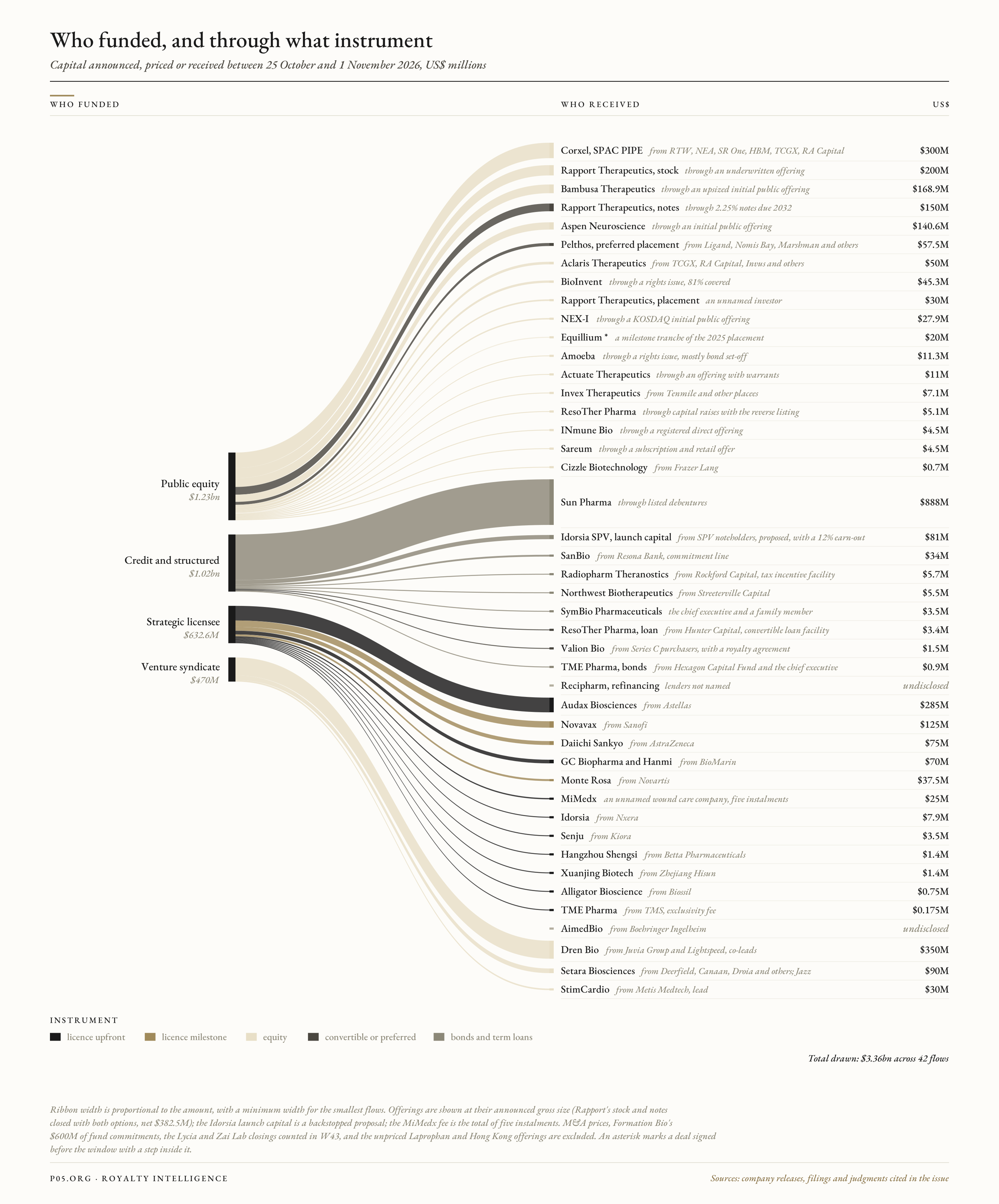
Who funded, and through what instrument, between 25 October and 1 November: 42 flows totalling USD 3.36bn, grouped by capital category and coloured by instrument. An asterisk marks a deal signed before the window with a step inside it.
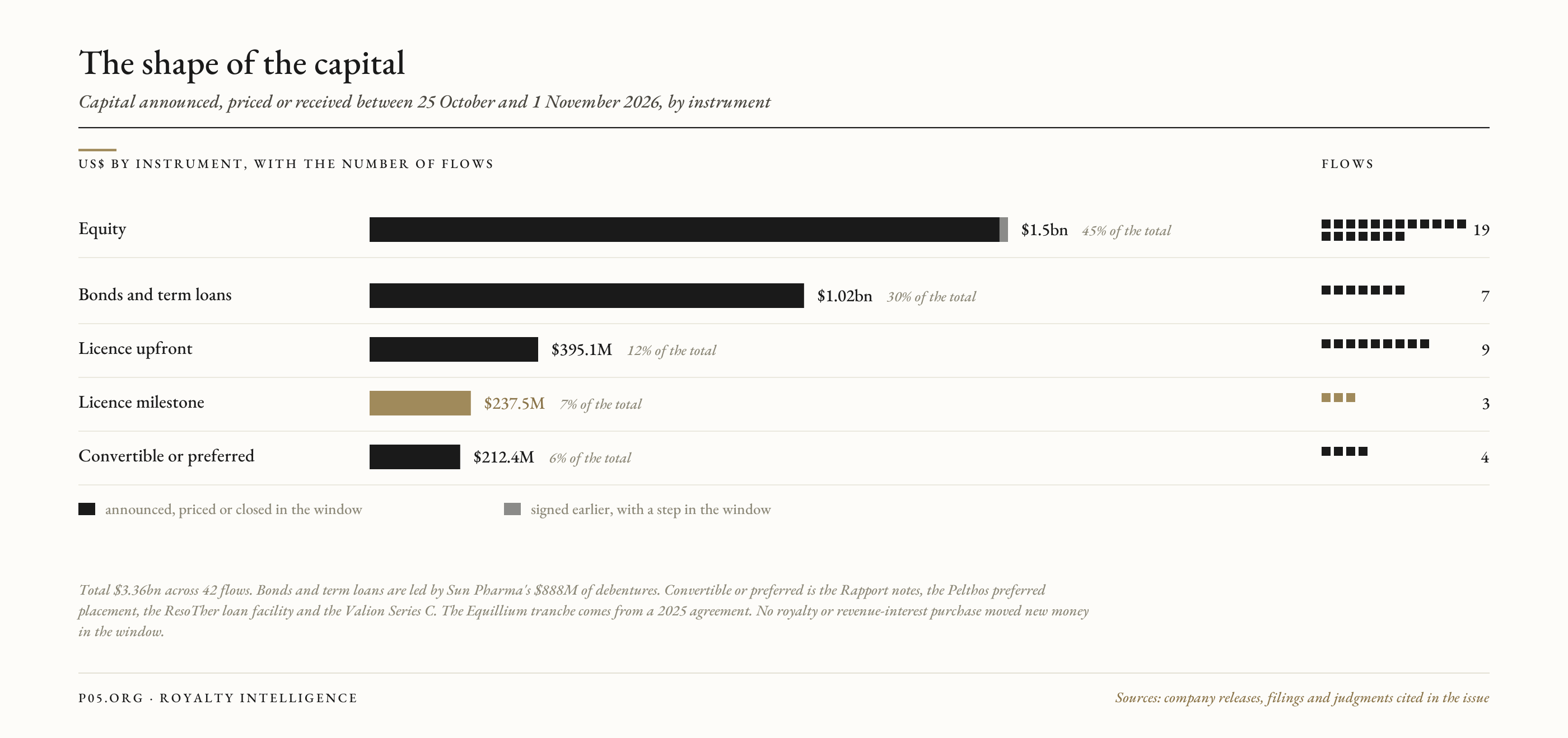
The same capital by instrument, with the number of flows. Equity is USD 1.5bn of the total and bonds and term loans USD 1.02bn, led by Sun Pharma's debentures; the lighter segment is the Equillium tranche, agreed in 2025.
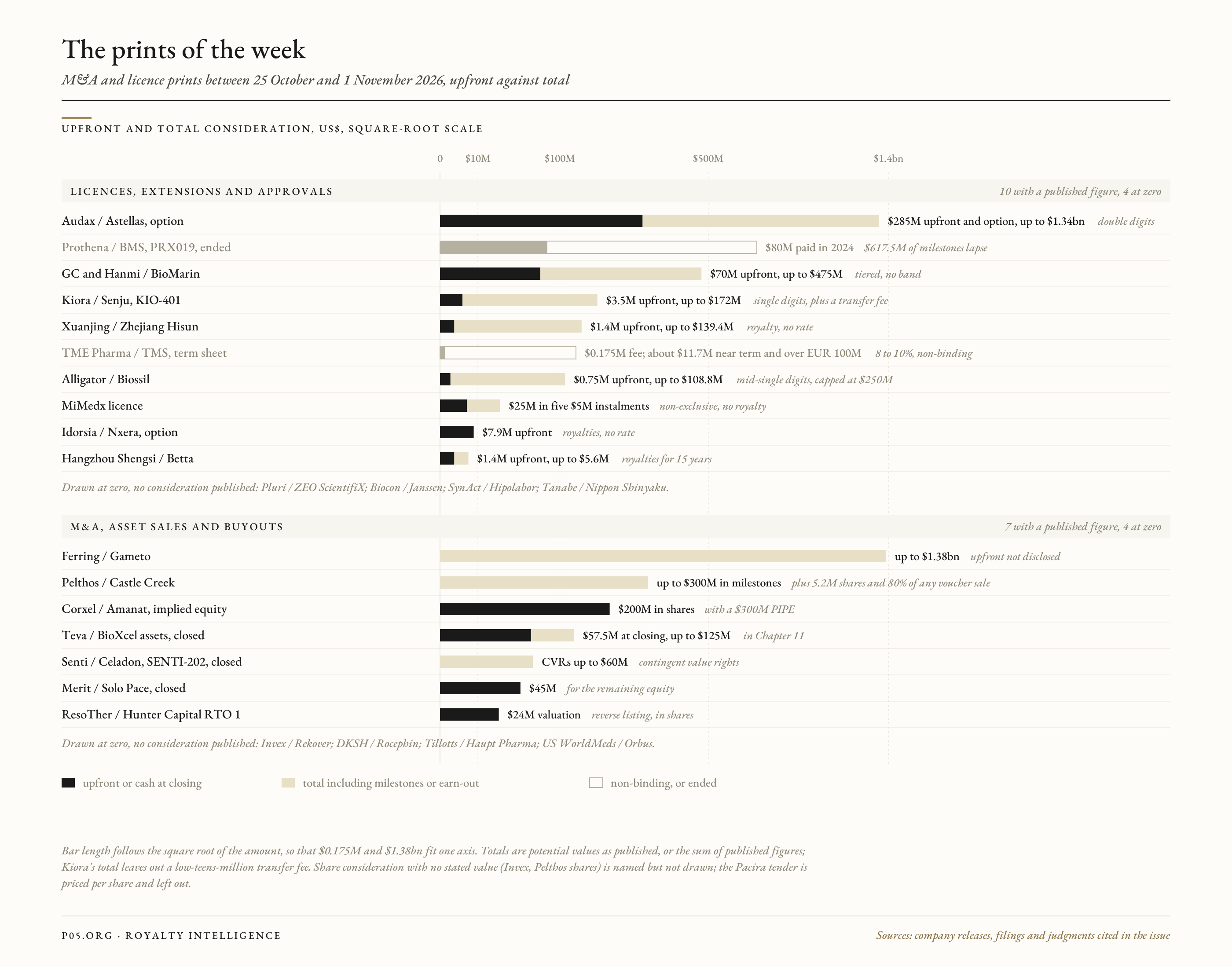
M&A and licence prints between 25 October and 1 November on a square-root scale, upfront against total. Seventeen publish a figure and eight publish no consideration.
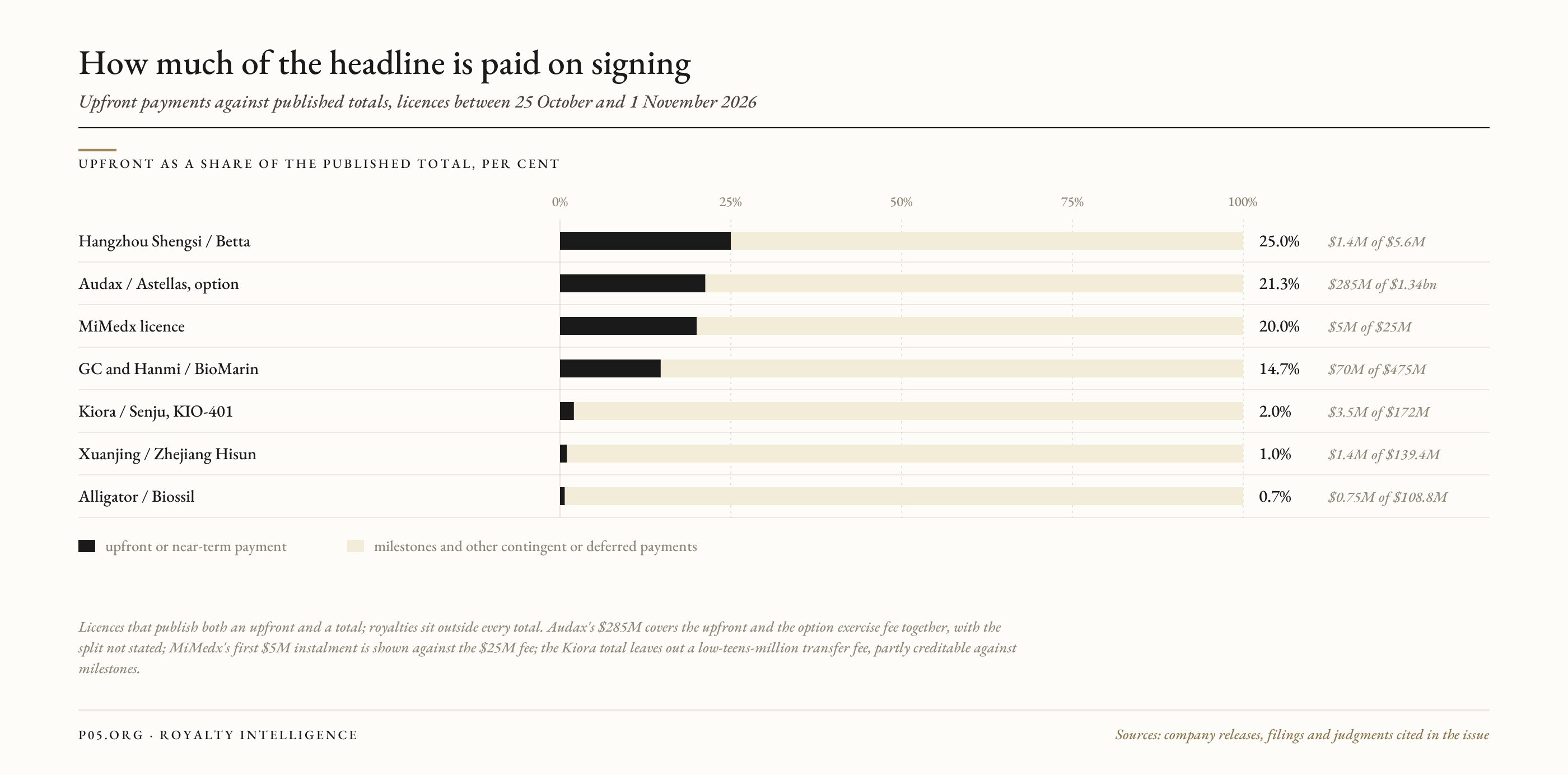
Upfront as a share of the published total, for the seven licences that publish both. Royalties sit outside every total.
League Tables
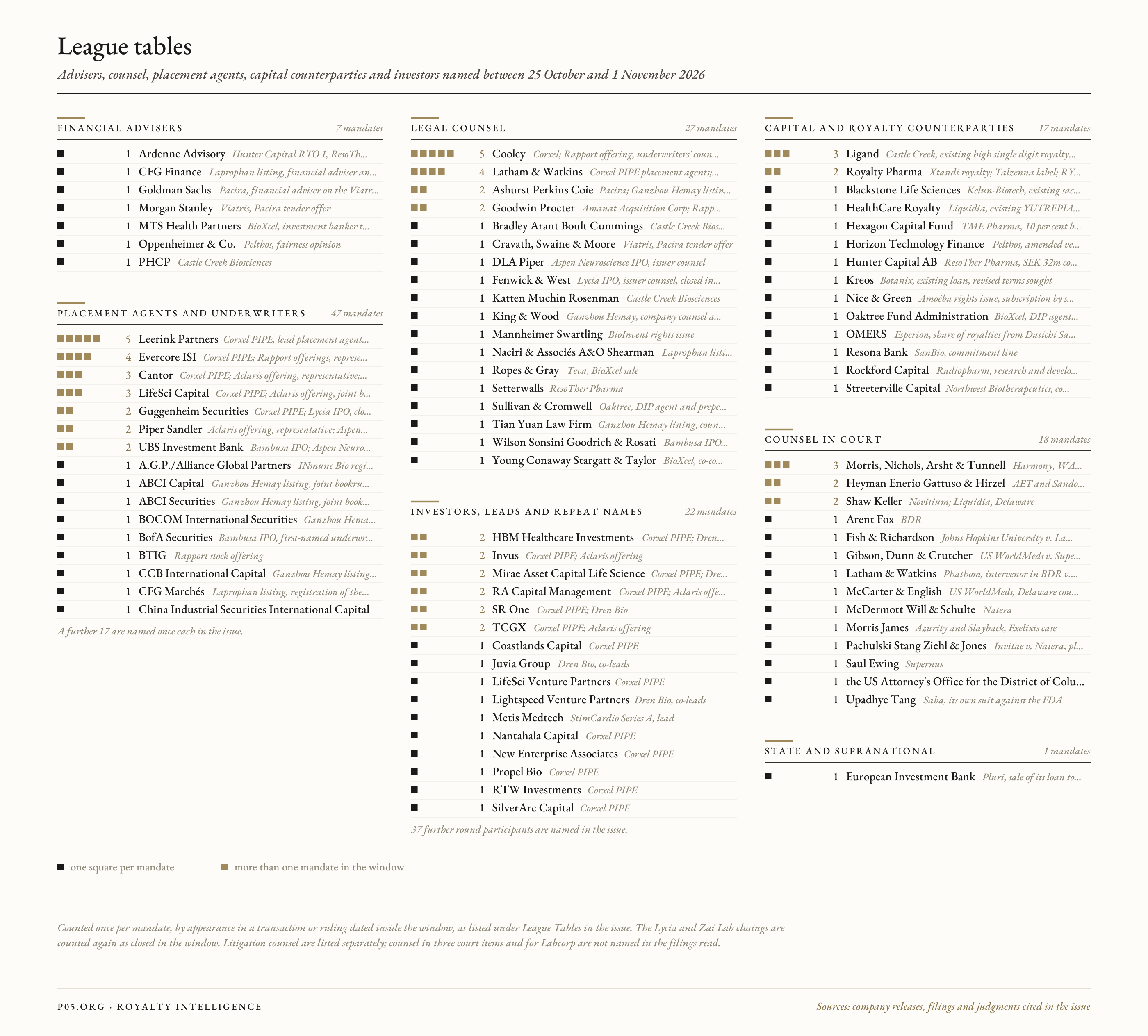
Financial and legal advisers, placement agents, counsel in court, capital and royalty counterparties and investors named in the issue for 25 October to 1 November, counted once per mandate. Leerink Partners leads placement agents with five, including the Corxel PIPE and the Rapport offerings, and Cooley leads legal counsel with five.
Financial advisers. Goldman Sachs, 1 (Pacira, financial adviser on the Viatris tender offer); Morgan Stanley, 1 (Viatris, Pacira tender offer); Oppenheimer & Co., 1 (Pelthos, fairness opinion); PHCP, 1 (Castle Creek Biosciences); MTS Health Partners, 1 (BioXcel, investment banker to the debtors; sale to Teva); CFG Finance, 1 (Laprophan listing, financial adviser and global coordinator); Ardenne Advisory, 1 (Hunter Capital RTO 1, ResoTher reverse acquisition).
Legal counsel. Cooley, 5 (Corxel; Rapport offering, underwriters' counsel; Aclaris offering, issuer counsel; BioXcel, lead counsel to the debtors; Lycia IPO, underwriters' counsel, closed in the window); Latham & Watkins, 4 (Corxel PIPE placement agents; Pelthos; Bambusa IPO, underwriters' counsel; Aspen Neuroscience IPO, underwriters' counsel); Goodwin Procter, 2 (Amanat Acquisition Corp; Rapport offering, issuer counsel); Ashurst Perkins Coie, 2 (Pacira; Ganzhou Hemay listing, counsel to the sole sponsor and underwriters as to Hong Kong and US law, through Ashurst Perkins Coie Hong Kong); Cravath, Swaine & Moore, 1 (Viatris, Pacira tender offer); Bradley Arant Boult Cummings and Katten Muchin Rosenman, 1 each (Castle Creek Biosciences); Wilson Sonsini Goodrich & Rosati, 1 (Bambusa IPO, issuer counsel); DLA Piper, 1 (Aspen Neuroscience IPO, issuer counsel); Fenwick & West, 1 (Lycia IPO, issuer counsel, closed in the window); Young Conaway Stargatt & Taylor, 1 (BioXcel, co-counsel to the debtors); Ropes & Gray, 1 (Teva, BioXcel sale); Sullivan & Cromwell, 1 (Oaktree, DIP agent and prepetition agent in the BioXcel case); King & Wood, 1 (Ganzhou Hemay, company counsel as to Hong Kong and PRC law); Tian Yuan Law Firm, 1 (Ganzhou Hemay listing, counsel to the sole sponsor and underwriters as to PRC law); Mannheimer Swartling, 1 (BioInvent rights issue); Setterwalls, 1 (ResoTher Pharma); Naciri & Associés A&O Shearman, 1 (Laprophan listing).
Placement agents and capital markets advisers. Leerink Partners, 5 (Corxel PIPE, lead placement agent, also capital markets adviser to Amanat; Aclaris offering, representative; Rapport stock, notes and private placement, representative and placement agent; Aspen Neuroscience IPO, lead underwriter; Zai Lab placement, exclusive placement agent, closed in the window); Evercore ISI, 4 (Corxel PIPE; Rapport offerings, representative; Bambusa IPO; Lycia IPO, closed in the window); Cantor, 3 (Corxel PIPE; Aclaris offering, representative; Bambusa IPO); LifeSci Capital, 3 (Corxel PIPE; Aclaris offering, joint bookrunner; Lycia IPO, passive book-running manager, closed in the window); Guggenheim Securities, 2 (Corxel PIPE; Lycia IPO, closed in the window); Piper Sandler, 2 (Aclaris offering, representative; Aspen Neuroscience IPO); UBS Investment Bank, 2 (Bambusa IPO; Aspen Neuroscience IPO); BofA Securities, 1 (Bambusa IPO, first-named underwriter); Morgan Stanley, 1 (Rapport offerings, representative and placement agent); BTIG and Citizens Capital Markets, 1 each (Rapport stock offering); Stifel and Oppenheimer & Co., 1 each (Aspen Neuroscience IPO); Jefferies and TD Cowen, 1 each (Lycia IPO, closed in the window); Newbridge Securities, 1 (Actuate offering, sole book-running manager); A.G.P./Alliance Global Partners, 1 (INmune Bio registered direct offering, sole placement agent); Marex Financial, 1 (Sareum subscription, introduced two new institutional investors); DNB Carnegie Investment Bank, 1 (BioInvent rights issue, sole global coordinator and sole bookrunner); Korea Investment & Securities, 1 (NEX-I KOSDAQ offering, firm commitment underwriter); SDIC Securities Corporate Finance (Hong Kong) and SDIC Securities (Hong Kong), 1 each (Ganzhou Hemay listing, sole sponsor and sole sponsor-overall coordinator); SPDB International Capital, 1 (Ganzhou Hemay listing, overall coordinator); China Industrial Securities International Capital, CMB International Capital, CCB International Capital, BOCOM International Securities, Guosen Securities (HK) Brokerage, uSmart Securities, Patrons Securities, ABCI Capital and ABCI Securities, 1 each (Ganzhou Hemay listing, joint bookrunners, joint lead managers and capital market intermediaries); CFG Marchés, 1 (Laprophan listing, registration of the sale side). The sponsors and coordinators of the Sichuan Neautus listing appear only as logos in the announcement read, and the Laprophan placement syndicate is not named in the notices read.
Capital and royalty counterparties. Ligand, 3 (Castle Creek, existing high single digit royalty on D-Fi, surviving the Pelthos combination; Palvella, existing royalty on QTORIN rapamycin; priority review; Agenus, existing 2.625 per cent synthetic royalty on BOT and BAL; Phase 2 data); Royalty Pharma, 2 (Xtandi royalty; Talzenna label; RYTELO synthetic royalty; IMpactMF stopped); Blackstone Life Sciences, 1 (Kelun-Biotech, existing sac-TMT royalty; ESMO data and US filing); OMERS, 1 (Esperion, share of royalties from Daiichi Sankyo Europe; EMA validation); HealthCare Royalty, 1 (Liquidia, existing YUTREPIA revenue interest; settlement with United Therapeutics); Horizon Technology Finance, 1 (Pelthos, amended venture loan, collateral agent); Kreos, 1 (Botanix, existing loan, revised terms sought); Oaktree Fund Administration, 1 (BioXcel, DIP agent and prepetition agent; sale to Teva); Hunter Capital AB, 1 (ResoTher Pharma, SEK 32m convertible loan facility); Rockford Capital, 1 (Radiopharm, research and development tax incentive facility); Streeterville Capital, 1 (Northwest Biotherapeutics, commercial loan); Resona Bank, 1 (SanBio, commitment line); Nice & Green, 1 (Amoéba rights issue, subscription by set-off of bond claims); Hexagon Capital Fund, 1 (TME Pharma, 10 per cent bond with warrants).
Investors. RTW Investments, New Enterprise Associates, Nantahala Capital, Coastlands Capital, LifeSci Venture Partners, Propel Bio and SilverArc Capital, 1 each (Corxel PIPE); TCGX, RA Capital Management and Invus, 2 each (Corxel PIPE; Aclaris offering); SR One, Mirae Asset Capital Life Science and HBM Healthcare Investments, 2 each (Corxel PIPE; Dren Bio); Juvia Group and Lightspeed Venture Partners, 1 each (Dren Bio, co-leads); General Catalyst, Cormorant Asset Management and OrbiMed, 1 each (Dren Bio, new); 8VC, Taiho Ventures, Mission BioCapital, BVF Partners, Aisling Capital and ArrowMark Partners, 1 each (Dren Bio, existing); Deerfield Management, Canaan, Droia Ventures, EcoR1, Euclidean Capital and Regeneron Ventures, 1 each (Setara Series A, existing); Jazz Pharmaceuticals, 1 (Setara, new shareholder as part of the Actio acquisition); Ligand, Nomis Bay and Marshman Fund Trust II, 1 each (Pelthos Series B preferred placement); Metis Medtech, 1 (StimCardio Series A, lead); Catalyst Health Ventures, 1 (StimCardio Series A); Redmile, Van Herk and Forbion, 1 each (BioInvent rights issue, subscription commitments); DNB Bank, Schonfeld and Anavio Capital Partners, 1 each (BioInvent rights issue, guarantors); GF Fund Management and GF International Investment Management, China Universal Asset Management and China Universal Asset Management (Hong Kong), Fullgoal Fund Management and Fullgoal Asset Management (HK), and E Fund Management, 1 each (Ganzhou Hemay listing, cornerstone investors); Tenmile, 1 (Invex placement, also a vendor of Rekover); a Celadon Partners affiliate, 1 (Senti Biosciences, share purchase with the SENTI-202 sale); 3i, 1 (Valion Bio, Series B preferred); Frazer Lang, 1 (Cizzle subscription). The investors in the Rapport private placement, the Equillium milestone tranche, the Sareum subscription and the Formation Bio fund, and the Idorsia SPV noteholders, are not named.
State and supranational participants. European Investment Bank, 1 (Pluri, sale of its loan to a vehicle of Pluri's chairman).
Courts. Morris, Nichols, Arsht & Tunnell, 3 (Harmony, WAKIX cases against AET and Sandoz; Exelixis v. MSN; United Therapeutics v. Liquidia, Delaware); Heyman Enerio Gattuso & Hirzel, 2 (AET and Sandoz; MSN); Shaw Keller, 2 (Novitium; Liquidia, Delaware); Morris James, 1 (Azurity and Slayback, Exelixis case); Latham & Watkins, 1 (Phathom, intervenor in BDR v. FDA); Arent Fox, 1 (BDR); the US Attorney's Office for the District of Columbia, 1 (FDA and HHS, BDR v. FDA); Upadhye Tang, 1 (Saba, its own suit against the FDA); Gibson, Dunn & Crutcher, 1 (US WorldMeds v. Supernus, lead counsel); McCarter & English, 1 (US WorldMeds, Delaware counsel); Saul Ewing, 1 (Supernus); Pachulski Stang Ziehl & Jones, 1 (Invitae v. Natera, plaintiff); McDermott Will & Schulte, 1 (Natera); Fish & Richardson, 1 (Johns Hopkins University v. Labcorp, plaintiff). Counsel in the North Carolina YUTREPIA case, in Enanta v. Pfizer at the Unified Patent Court and in the Syntimmune sellers' case against AstraZeneca are not named in the filings and releases read, and no counsel for Labcorp appears in the complaint.
All information in this report was accurate as of the research date and is derived from publicly available sources including SEC filings, Hong Kong Stock Exchange announcements, National Stock Exchange of India filings, European Medicines Agency and Food and Drug Administration records, United States patent assignment records, company press releases and financial news reporting. Information may have changed since publication. This content is for informational purposes only and does not constitute investment, legal, or financial advice. The author is not a lawyer or financial adviser.