Pre-agreed buyout prices: what ADC Therapeutics would pay to end its HealthCare Royalty stream

ADC Therapeutics expects to close an $86.6M private placement on 22 October. The same closing brings into force Amendment No. 2 to the company's 2021 royalty financing with HealthCare Royalty. From that day ADC can end the royalty on Zynlonta whenever it chooses.
It pays 1.75 times the $300M that HealthCare Royalty funded, or $525M, if it pays on or before 31 December 2029, and 2.50 times, or $750M, if it pays later. Royalties already received come off either figure. The amendment also deletes the $150M payment that a sale of the company would have triggered. The terms of the October package were set out in the Weekly Term Sheet for week 41.
ADC has paid HealthCare Royalty about $35M in royalties since 2022, by our count of the payments in its annual and quarterly reports. Ending the stream today would therefore cost about $490M. Zynlonta sold about $21.0M in the third quarter. The private placement prices ADC's shares at $1.42.
The Immunome piece last week dealt with a buyout that had no price in the contract, so the two companies had to set one. The ADC clause is the opposite case. It names the price years in advance, and a price fixed in advance works as a strike. The March piece set out how buybacks happen in general.
This piece prices the strike. ADC's is set at a level that only the company's own best case for Zynlonta would justify paying, and from 2030 it equals the cap itself.
Three versions of one clause
The 2021 purchase and sale agreement gave HealthCare Royalty 7 per cent of Zynlonta's net sales and of certain licence income, rising if sales missed targets, until it had received a cap of 250 per cent of the purchase price.
The cap fell to 225 per cent if royalties reached an amount redacted from the agreement by 31 March 2029, which ADC's later reports describe as a mid-nine-digit figure. The company paid $225M at closing in August 2021 and $75M more on Zynlonta's first European sale in 2023.
That agreement already let ADC leave. A change of control obliged it to pay the cap less the royalties received, with the cap set at 200 per cent if the sale closed within 36 months. From the 27th month ADC could also buy the stream out voluntarily for the same amount.
HealthCare Royalty could then take half of that payment and keep half of the royalty. Both exits cost the cap less what had been paid. The company's own model at signing put the effective interest rate on the liability at 10 per cent.
Amendment No. 1, signed on 18 February 2026, replaced the change-of-control exit with a fixed payment of $150M, or $200M after 2027, which was not reduced by royalties already paid. Its recital says the parties wanted "to provide the Seller with a buyout option".
The new option priced the stream at 1.75 times the purchase price until the end of 2029 and 2.50 times after. It could be exercised only after a change of control closed, and the change-of-control payment counted against it. HealthCare Royalty received warrants over 9,834,776 shares at $3.813.
Amendment No. 2, signed on 7 October, deletes the change-of-control payment and lets ADC "or its permitted successor in interest" exercise the option at any time. The price stays at 1.75 and 2.50 times. HealthCare Royalty's warrants are repriced to $0.10 a share and can now be transferred.
ADC's borrowing is capped at $50.0M, and an uncured breach of that cap lets HealthCare Royalty demand a non-performance payment of 1.5 times the part of its $300M not yet recovered. The amendment takes effect only if the placement closes by 31 October, unless HealthCare Royalty agrees a later date.
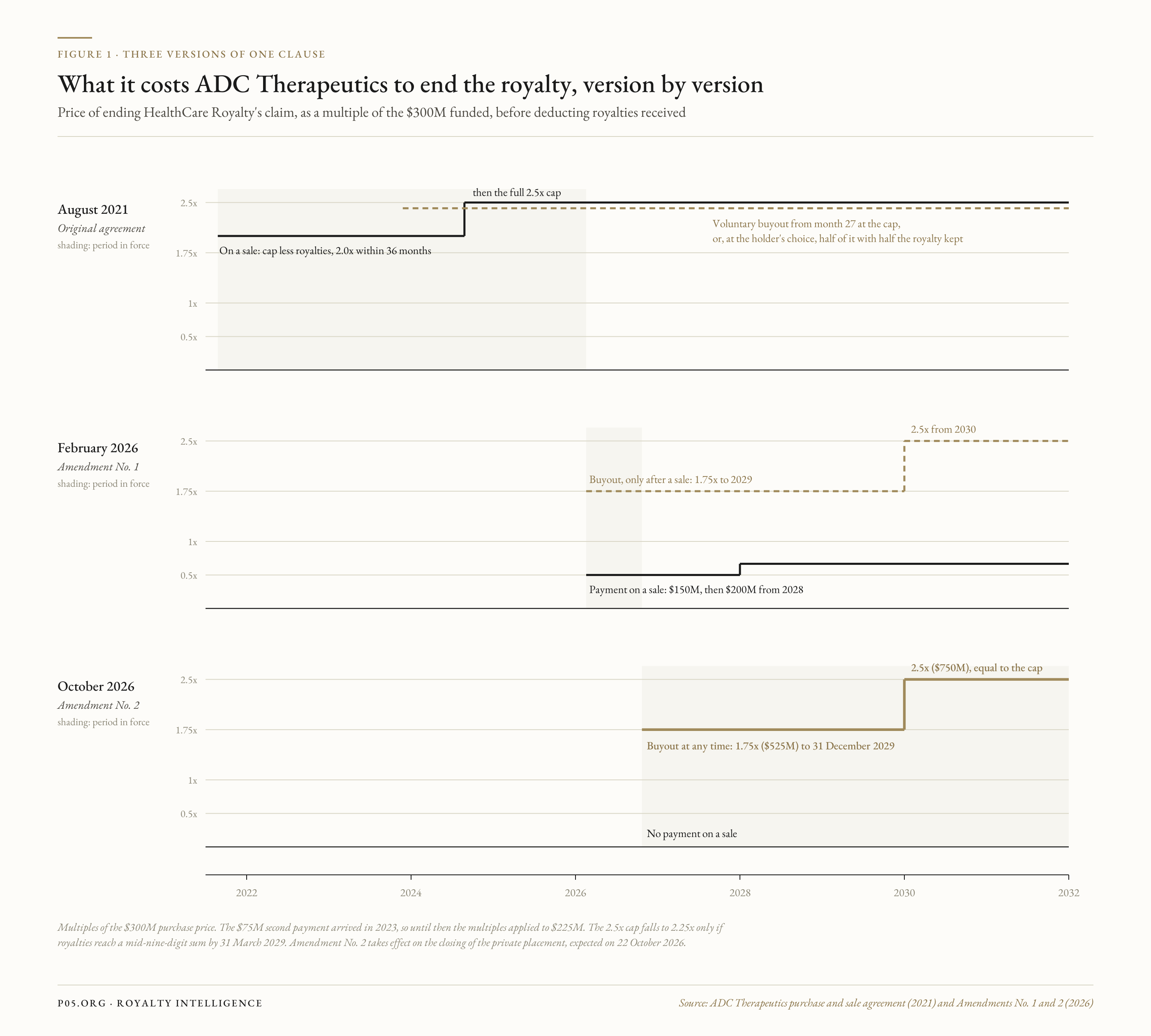
The price of ending HealthCare Royalty's claim under each version of the agreement, as a multiple of the $300M funded, before deducting royalties received.
What $490M buys
At Zynlonta's current revenue, the stream that $490M would end is small. Product revenue was $73.6M in 2025 and $69.3M in 2024, and the first nine months of 2026 brought about $59.7M.
The 7 per cent rate rises to a high single digit after 30 September 2026 and to 10 per cent after 30 September 2027 unless revenue in the preceding twelve months passes thresholds in the mid-nine digits. At about $80M of revenue and a 10 per cent rate, ADC pays HealthCare Royalty about $8M a year.
Discounted at 10 per cent, that stream is worth about $83M even if it runs until the $750M cap is reached. If exclusivity, and with it most of the revenue, ends in 2035, the figure falls to about $46M. These are p05.org calculations, on a constant revenue of $80M and the rate steps above.
The $490M buyout costs between six and eleven times what the stream is worth on today's sales.
The price begins to pay only at far higher revenue. On the same model, exercising the option now breaks even at constant annual revenue of about $700M at an 8 per cent discount rate, $870M at 10 per cent and $1.04B at 12 per cent.
These figures assume the higher revenue arrives at once and lasts until the cap is paid, which flatters the case for exercise.
ADC's own case for Zynlonta reaches that range. Its January presentation described a potential annual US peak revenue opportunity of $600M to $1B, built on moving the drug into earlier lines of lymphoma treatment. In June the LOTIS-5 trial met its primary endpoint of progression-free survival, with a hazard ratio of 0.73. In August, after a pre-submission meeting,
ADC said that "following FDA meeting feedback regarding the benefit-risk observed in the LOTIS-5 trial", it was assessing the best regulatory path forward.
The price changes character on 1 January 2030. From then the buyout costs 2.50 times the purchase price less royalties received, which is exactly what remains of the cap. Exercising it pays the cap in one sum when the same sum would otherwise arrive slowly from sales. On present value alone that is never worth doing.
Only a buyer that needed the royalty gone, for a licence or a sale of its own, would pay it.
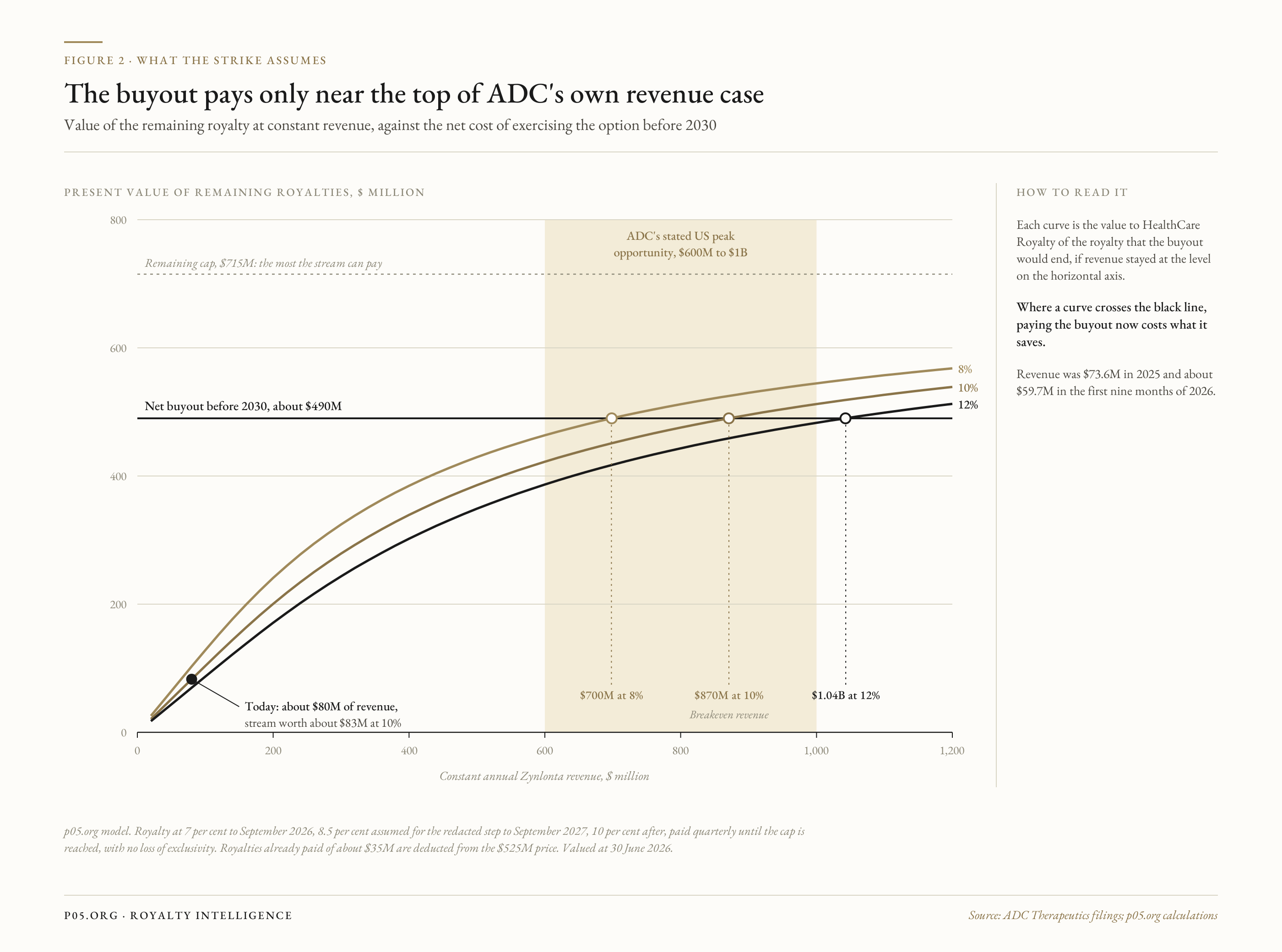
Present value of the remaining royalty to HealthCare Royalty at different levels of constant annual revenue, against the net cost of the buyout before 2030. p05.org model.
What the price pays HealthCare Royalty
The same clause sets HealthCare Royalty's best realistic return. If ADC, or a company that buys ADC, exercised the option late in 2026, HealthCare Royalty would earn an internal rate of return of about 13 per cent on its $300M. If the option were exercised on 31 December 2029, the return would be about 8 per cent, at 1.75 times its money.
The non-performance payment, if ADC breached the debt cap late in 2026 and HealthCare Royalty claimed it, would return about 8.5 per cent. If no exit came, sales stayed near $80M and the royalty ended in 2035, HealthCare Royalty would recover about 0.36 times its money. These figures are p05.org calculations on the payment history in ADC's filings and the revenue assumption above.
The October amendment moved value both ways. HealthCare Royalty gave up a $150M payment on a sale of the company, which would not have been reduced by royalties already received. It received warrants that now cost $0.10 a share to exercise, worth about $13M at the placement price.
It also received the debt cap, which keeps other lenders below $50.0M and gives it a route to 1.5 times its unrecovered money. ADC's balance sheet carried the obligation at $320.6M on 30 June, between the stream's value on current sales and the price of buying it out.
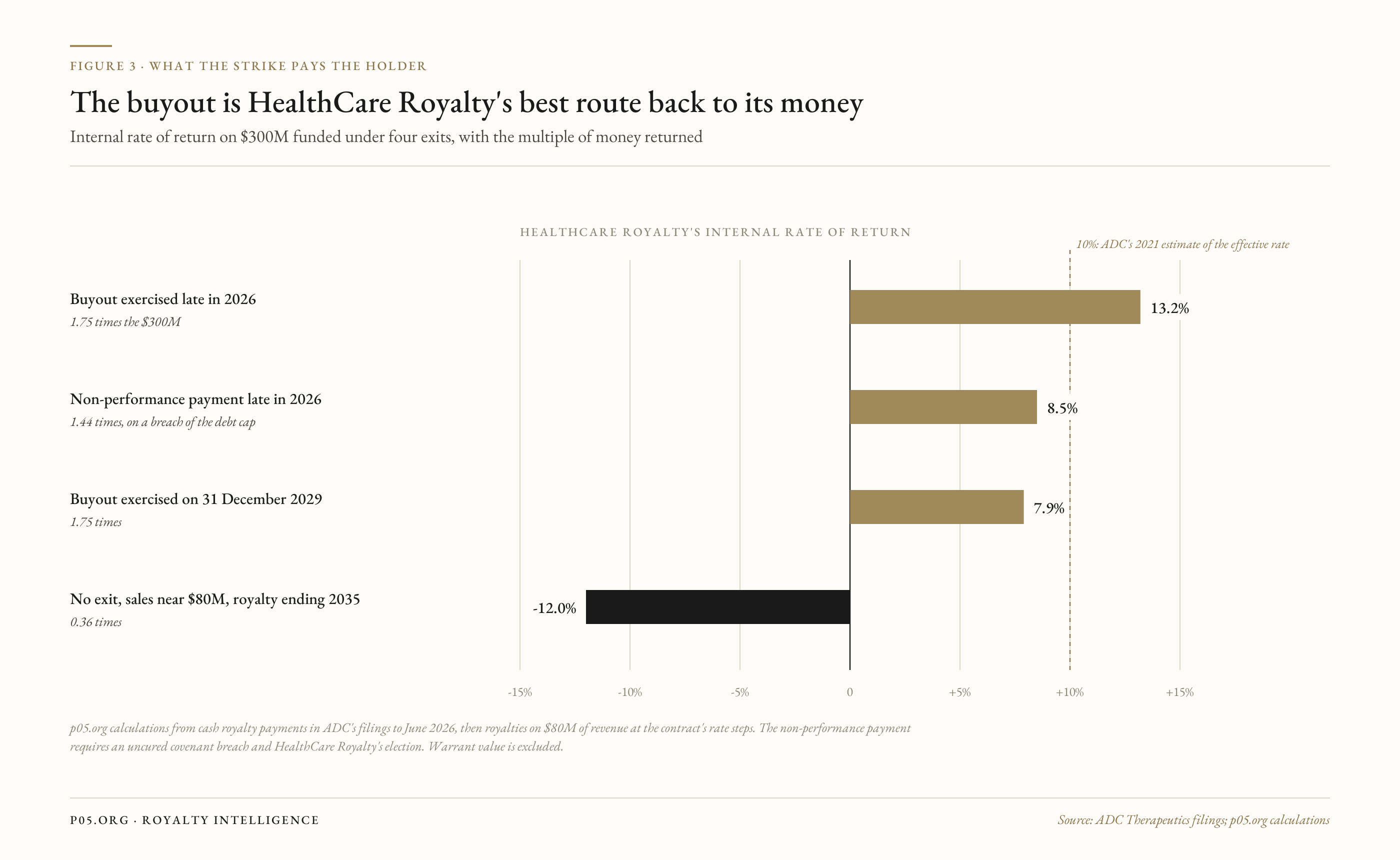
HealthCare Royalty's return on its $300M under four exits. p05.org calculations.
How others wrote the price
Other royalty financings filed with the SEC fix the buyout price in three further ways. Verona Pharma's revenue interest with Oaktree and OMERS, signed in May 2024, set the price as a multiple of the amount funded that rose each year: 1.20 times in the first year after funding, 1.40 in the second, 1.55 in the third and 1.75 after.
Ohtuvayre sold $71.3M in the first quarter of 2025, and on 25 March Verona bought the interest back at 1.17 times, paying $109.9M on $100M funded nine months earlier. Merck agreed to buy Verona in July 2025. The episode was covered in the Oaktree Fund of the Week.
Ascendis Pharma's two financings with Royalty Pharma grant the discount only after the holder has its money back. Under the Skytrofa agreement of September 2023, Ascendis may buy out at any time for 1.925 times the $150M purchase price less payments received.
The price falls to 1.65 times if notice is given by 31 December 2028 and Royalty Pharma has already received payments equal to the purchase price. The Yorvipath agreement of September 2024 uses 2.0 times, falling to 1.65 times on the same condition with a deadline of 30 September 2028.
Development funding uses a formula in place of a multiple. CymaBay's 2021 agreement with Abingworth let it make an approval buy-out payment equal to the present value of the remaining success payments at a discount rate set in the contract. The price then moves with time and with the schedule of payments.
ADC's discount carries no such condition. HealthCare Royalty has recovered about 12 per cent of its money, and the 1.75 times price is open to ADC until the end of 2029 regardless.
| Agreement | Funded | Cap | Buyout price | Condition on the discount | Outcome |
|---|---|---|---|---|---|
| ADC Therapeutics and HealthCare Royalty, 2021 | $300M | 2.50 times, or 2.25 times on early recovery | Cap less royalties received, from month 27, with the holder able to take half and keep half the royalty | None offered | Replaced in 2026 |
| ADC Therapeutics and HealthCare Royalty, October 2026 | $300M | Unchanged | 1.75 times to 31 December 2029, 2.50 times after, less royalties received | Time only | Effective on the placement closing |
| Verona Pharma and Oaktree with OMERS, 2024 | $100M | 1.75 times | 1.20, 1.40, 1.55, then 1.75 times by year after funding | Time only | Exercised March 2025 at 1.17 times |
| Ascendis and Royalty Pharma, Skytrofa, 2023 | $150M | 1.925 times, or 1.65 times by 2031 | 1.925 times less payments, or 1.65 times by end-2028 | Holder must have received 1.0 times | Outstanding at 30 June 2026 |
| Ascendis and Royalty Pharma, Yorvipath, 2024 | $150M | 2.0 times, or 1.65 times by 2029 | 2.0 times less payments, or 1.65 times by 30 September 2028 | Holder must have received 1.0 times | Outstanding at 30 June 2026 |
| CymaBay and Abingworth, 2021 | Development funding | Success payments | Present value of remaining payments at a contract rate | Exercisable after approval | Not applicable |
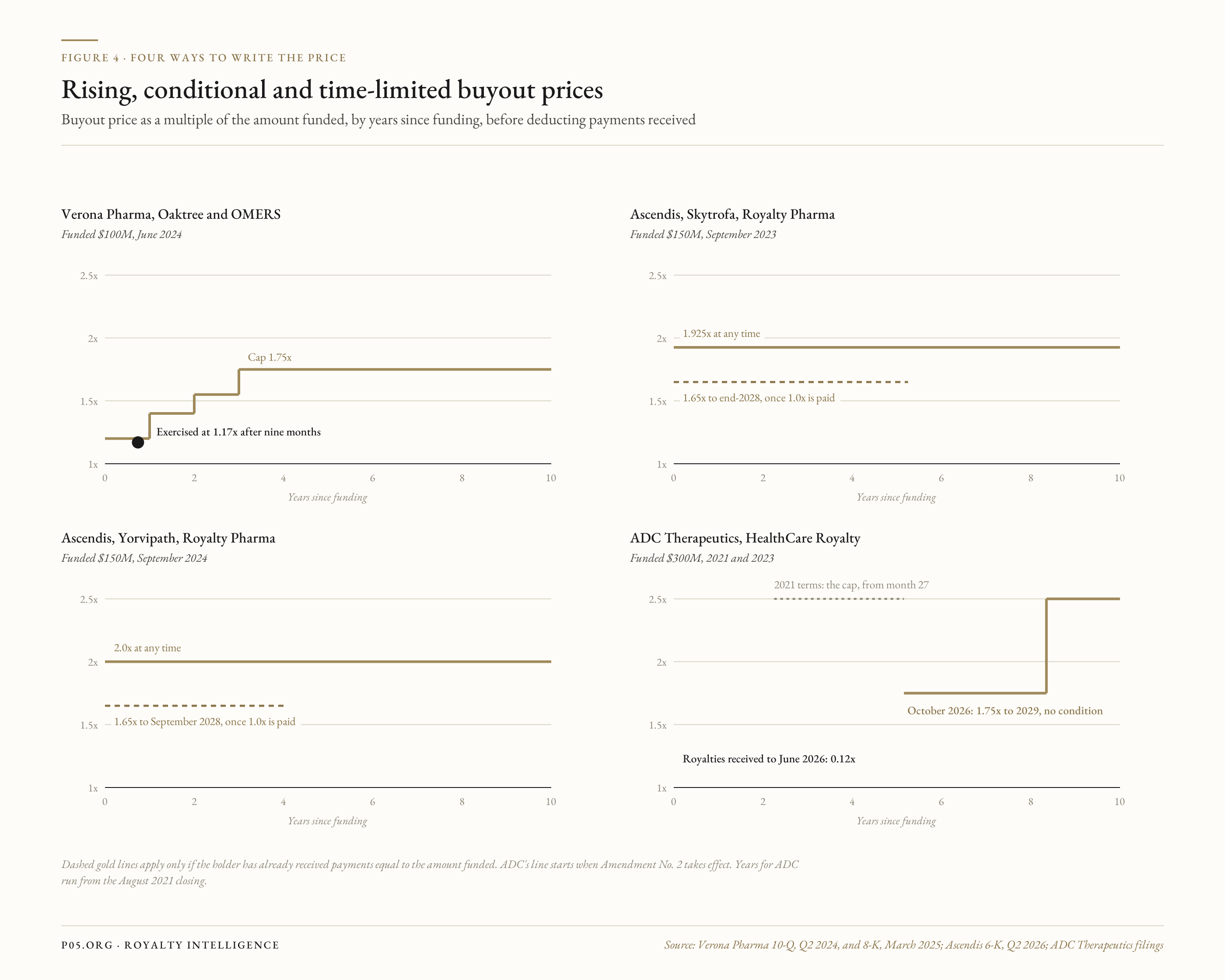
Buyout price as a multiple of the amount funded, by years since funding, in four royalty financings. Dashed segments apply only if the condition shown is met.
Implications for the Pharmaceutical Royalty Market
A pre-agreed buyout price caps the holder's return in the cases where the product succeeds. Verona's buyers were promised up to 1.75 times and received 1.17 times, because the drug sold well in the first year and the first-year price applied. A schedule that starts low rewards the company for fast success, and the holder pays for that out of its upside.
ADC's schedule runs the other way. The price before 2030 sits far above the stream's value on current sales and near it only in ADC's own best case.
The clause is valuable mainly to an acquirer that believes that case, and its deadline at the end of 2029 sets the timetable for any such buyer. After 2029 the option offers nothing that paying the cap does not, except speed.
For anyone who might buy HealthCare Royalty's position, the strike sets the ceiling. The position is worth the lower of the stream's value and the buyout price, less the chance that ADC breaches its debt cap and triggers the 1.5 times payment.
On current sales the stream's value is the binding figure. The buyout price matters only in the scenario the August regulatory update made less likely.
The Ascendis condition shows a holder protecting its downside inside a discount. The 1.65 times price opens only once Royalty Pharma has been repaid, so a cheaper exit cannot coincide with a loss. HealthCare Royalty's 2026 amendments carry no such link.
Its protection comes instead from the warrants, the debt cap and the non-performance payment, which the make-whole piece and the February warrant piece set out.
A buyer of a royalty with a buyout clause should model the clause as a call option written by the holder. That means reading the price schedule, whether it nets royalties already received, any condition on the discount, who may exercise it, and whether it survives a change of control. Each of the three versions of ADC's clause answered those questions differently.
How capital enters and returns
HealthCare Royalty's money went in as two cash payments, $225M in August 2021 and $75M in 2023, against a claim on Zynlonta's sales and certain licence income, secured by a back-up security interest and a pledged lockbox account that Amendment No. 2 reaffirms. It comes back in one of four ways.
Royalties are paid quarterly from sales. A buyout returns a fixed sum net of royalties. A non-performance payment, on a breach of the debt cap or of certain other covenants, including limits on licensing Zynlonta exclusively in the United States, returns 1.5 times the unrecovered principal. The warrants turn part of the claim into ADC equity, at $0.10 a share.
ADC's equity sits behind all of this. At the placement price, the shares outstanding at 30 June and those sold in the placement are worth about $268M, roughly half the price of the buyout before 2030. A buyer of ADC would take on the royalty and either keep paying it or exercise the option on the same terms ADC has.
Conclusion
When the placement closes on 22 October, ADC will hold a right it did not have in February. It can end HealthCare Royalty's claim alone and at a time of its choosing, for about $490M less any royalties paid in the meantime. On Zynlonta's revenue of about $21M a quarter that right is out of the money by a wide margin. It would come into the money only if Zynlonta's sales grew to the range ADC set out in January, before the deadline of 31 December 2029.
All information in this report was accurate as of the research date and is derived from publicly available sources including court opinions, regulatory guidance, academic literature, SEC filings, and financial news reporting. Information may have changed since publication. This content is for informational purposes only and does not constitute investment, legal, or financial advice. The author is not a lawyer or financial adviser.