The Gulf licence: what royalty from the Middle East might be worth

On 13 October Ocugen signed an exclusive licence with Roots Pharmaceutical Company WLL of Kuwait for OCU400, its gene therapy for retinitis pigmentosa, in "certain countries in the Middle East and North Africa".
Ocugen receives an upfront fee and development milestones of up to $4M, sales milestones of up to $255M and a royalty of 22 per cent on Roots' net sales. It also manufactures the product and supplies it to Roots under a separate agreement. The licence runs for the longest of 20 years from first sale, the last patent claim and regulatory exclusivity.
The binding term sheet of July and the definitive agreement were reported in the Weekly Term Sheet.
The rate is high by the standard of territorial licences. Licences into the Gulf and North Africa often pay the licensor between the mid-teens and 20 per cent of sales, and more where the licensor sets a supply price, because the partner registers and sells the drug and the licensor keeps nearly everything else.
What the stream is worth depends on four things the headline does not show: the supply agreement, the withholding tax of the country where the sale is made, the speed of registration after an American or European approval, and the price, which Saudi Arabia sets by reference to other markets.
Our earlier pieces covered Latin America, Japan and China. The Gulf's manufacturers and sovereign funds were profiled in January. This piece deals with the licence itself.
Two territories, one structure
Ocugen wrote the same deal a year earlier for Korea. On 11 September 2025 it licensed OCU400 to Kwangdong Pharmaceutical for $1M upfront, up to $6.5M of regulatory and development milestones, a sales milestone of $1.5M for every $15M of sales and a royalty of 25 per cent.
The milestone schedule adds about 10 per cent of sales to the royalty. Ocugen manufactures there too. Its annual report records the Korean upfront as "$0.8 million (net of tax)", so about a fifth of the first payment was withheld.
The China arrangement is different, and its rate shows why. CanSinoBIO develops and manufactures OCU400 for Greater China and pays Ocugen a royalty between mid- and high-single digits. Ocugen in turn pays CanSinoBIO a royalty between low- and mid-single digits on net sales in the rest of the world.
Where the partner manufactures, the licensor takes single digits. Where the licensor manufactures and the partner only registers and sells, it takes 22 to 25 per cent.
The term matters as much as the rate. As of February Ocugen held two issued American patents on OCU400 and one pending foreign application. The Gulf has had no regional patent since the GCC Patent Office stopped accepting new filings in January 2021, so protection has to be sought country by country.
In most of the territory the licence will therefore run on its 20-year clock from first sale. The first sale is some way off. Ocugen expects Phase 3 topline data in the first quarter of 2027 and a possible American approval in the fourth quarter.
Roots describes itself as founded in Kuwait in 2006, with "more than two decades of operating experience". The press releases name a strategic partner, Al-Dhow International Holding, which the 8-K does not mention. We found no public record of Al-Dhow's ownership.
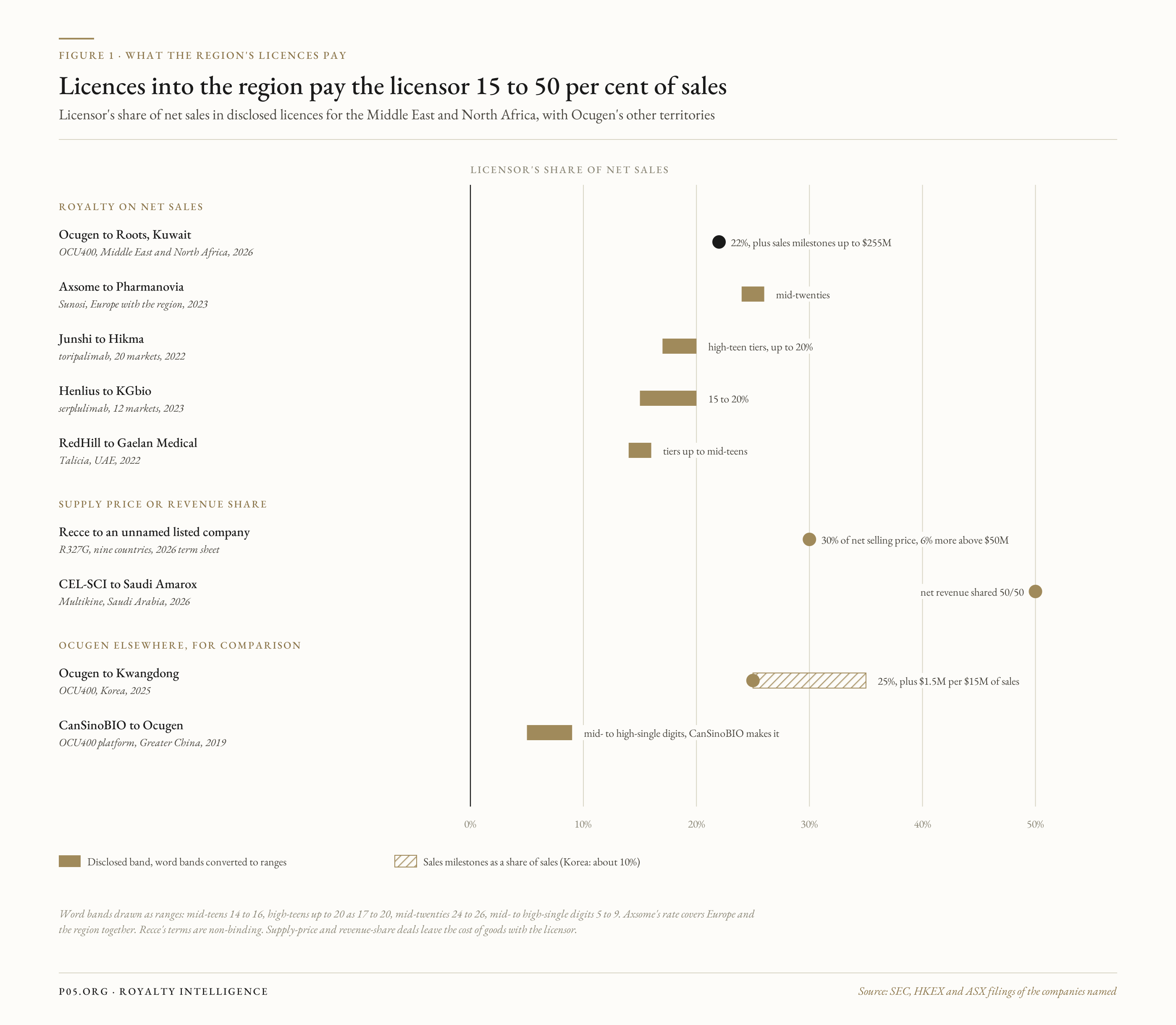
Licensor's share of net sales in disclosed territorial licences for the Middle East and North Africa, with Ocugen's Korean and Chinese licences for comparison.
What the region's licences pay
Filings with the SEC and the Hong Kong exchange give enough cases to see a pattern. Chinese developers of cancer antibodies licensed the region for royalties near 20 per cent. Junshi granted Hikma toripalimab in all 20 markets of the region for payments of up to $12M and "high-teen tiered royalties of up to 20% of net sales" in December 2022.
Henlius licensed serplulimab to KGbio for twelve countries, from Bahrain to Tunisia, for a $7M upfront and royalties of 15 to 20 per cent of cumulative net sales, for 10 years from launch with automatic five-year renewals.
Smaller American companies took similar or higher shares. RedHill licensed Talicia in the UAE to Gaelan Medical for $2M upfront and "tiered royalties up to mid-teens". Emmaus licensed Endari to taiba for a "high, double-digit royalty", with taiba bearing all commercial costs.
The highest royalty we found that reaches the region is Axsome's. Pharmanovia pays "a royalty percentage in the mid-twenties on net sales" of Sunosi after a $66M upfront, but the licence covers Europe as well, and the filing does not split it by territory.
Where the licensor supplies the product, the royalty gives way to a supply price or a revenue share. Recce's non-binding term sheet with an unnamed listed regional company proposes 30 per cent of the net selling price plus 6 per cent of net sales above $50M a year, on a price of $1,500 a treatment.
CEL-SCI's May 2026 agreement with Saudi Amarox for Multikine says the parties "shall share Net Revenue... equally, on a 50/50 basis", and caps Amarox's costs at half the registration fees. LENZ takes "a significant share of regional revenue through a pre-determined minimum product supply price" from its Middle Eastern distributor, and Marinus supplied Biologix for "a negotiated purchase price".
The upfront payments are small. Across the licences confined to the region they run from about $0.2M to $7M. The licensor's money comes from sales.
What the Gulf's own filings show
Licensees listed in Riyadh disclose in a different form, and in Arabic. Avalon Pharma's announcement on the Saudi Exchange for a dupilumab biosimilar licensed from Bio-Thera gives the term and the deal's size against its own revenue: "مدة العقد 15 عاماً قابلة للتجديد... قيمة العقد تمثل أقل من 5% من إجمالي إيرادات الشركة", a 15-year renewable contract worth less than 5 per cent of the company's revenue. It expects cumulative revenue of at least SAR 400M over the first seven years, from a launch in 2031.
Its pembrolizumab biosimilar licence from Bio-Thera, announced in February, follows the same template: 15 years, renewable, and worth more than 5 per cent of revenue, with at least SAR 500M of revenue expected from 2030.
Avalon's tirzepatide licence from One Source, announced on 11 October, runs for 10 years from commercial launch, and Avalon expects at least SAR 800M of revenue in the first five years.
None of these announcements gives a royalty, an upfront or a supply price. The Saudi template asks for value as a share of the listed company's revenue, the term and the date the financial effect begins.
It does not ask what the licensor is paid. The only absolute figure we found is Saudi Chemical's. Its AJA Pharma unit valued a five-year licence for three injectables from Dr. Reddy's at SAR 100M, and that is the revenue AJA expects to earn, not the sum Dr. Reddy's receives.
Many of these agreements give the licensee the right to move manufacturing into the Kingdom later.
The Arabic press reported the July term sheet from the English release. Al Bayan's headline had Ocugen betting on the Middle East "باستثمار 259 مليون دولار", with an investment of $259M, which adds the sales milestones to the upfront and calls the total an investment.
Its text described Ocugen's 22 per cent as "حقوق ملكية بنسبة 22% من صافي مبيعات", and Al-Ahram used the same words. The phrase is the Arabic press's usual term for royalties. Al-Ahram also used it for Gilead's royalty-free lenacapavir licence to EVA Pharma.
Read literally, though, it means ownership rights, and the legal term for a royalty is إتاوة. A reader of the Arabic coverage sees a stake in the region's sales where the filing describes a contractual payment.
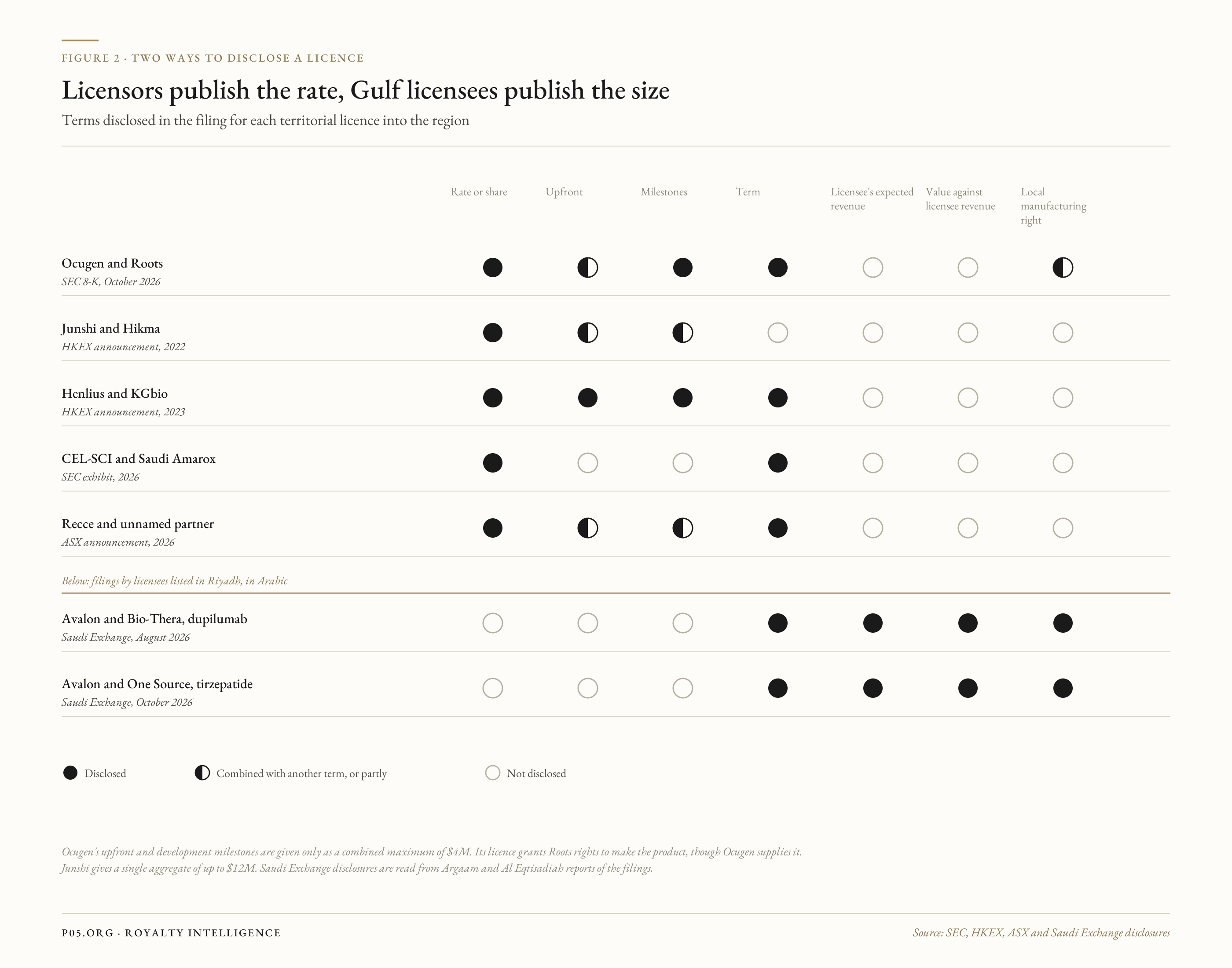
What each filing discloses about a territorial licence into the region. Filled circles show a term disclosed.
What the rate does not show
Withholding tax decides how much of the royalty leaves the region. Saudi Arabia withholds 15 per cent on royalties paid abroad, and Egypt 20 per cent. The UAE's rate is 0 per cent and Bahrain levies none. Qatar charges 5 per cent and Oman 10 per cent.
The United States has income tax treaties with Egypt, Morocco and Tunisia in the region and with none of the six Gulf states.
Kuwait, Roots' home, has no withholding tax in its law, but its tax authority taxes gross royalties earned from Kuwaiti customers at 15 per cent. KPMG's guide adds that the authority "considers that foreign companies have an embedded royalty in the product supply charged to the local distributor".
A licensor that moves its margin from the royalty into the supply price may find the margin taxed as a royalty anyway.
Registration in Saudi Arabia follows an American or European approval. The Saudi Food and Drug Authority's abridged pathway accepts a product approved by the FDA or the EMA and targets 60 working days, and its verification pathway, for products approved by both, targets 30.
The application must arrive within two years of the reference approval. The UAE has used a fast track for orphan products since a 2018 decree, and registered Luxturna, the first gene therapy for an inherited retinal disease, in June 2019.
Since 5 September the authority has also applied a rare disease framework that treats a disease as rare below 1 in 2,000 people, decides designation within 20 working days and offers conditional approval, priority review and rolling submission. For OCU400, Roots' clock starts with Ocugen's American approval.
The price is set from outside. Saudi Arabia prices against other countries and caps any later cut at 30 per cent of the original price in each five-year cycle, and government purchases run through NUPCO, the unified procurement company. Saudi prices are usually the lowest in the Gulf, and a new one leads to a new unified Gulf price within six to twelve months, so the Saudi decision sets the price for the whole bloc.
Data protection is short. Saudi exclusivity is generally five years, with patent linkage since January 2023, and the UAE granted eight years by a 2020 decree. Its 2024 medical products law leaves the period to executive regulations that had not been published by this year's survey.
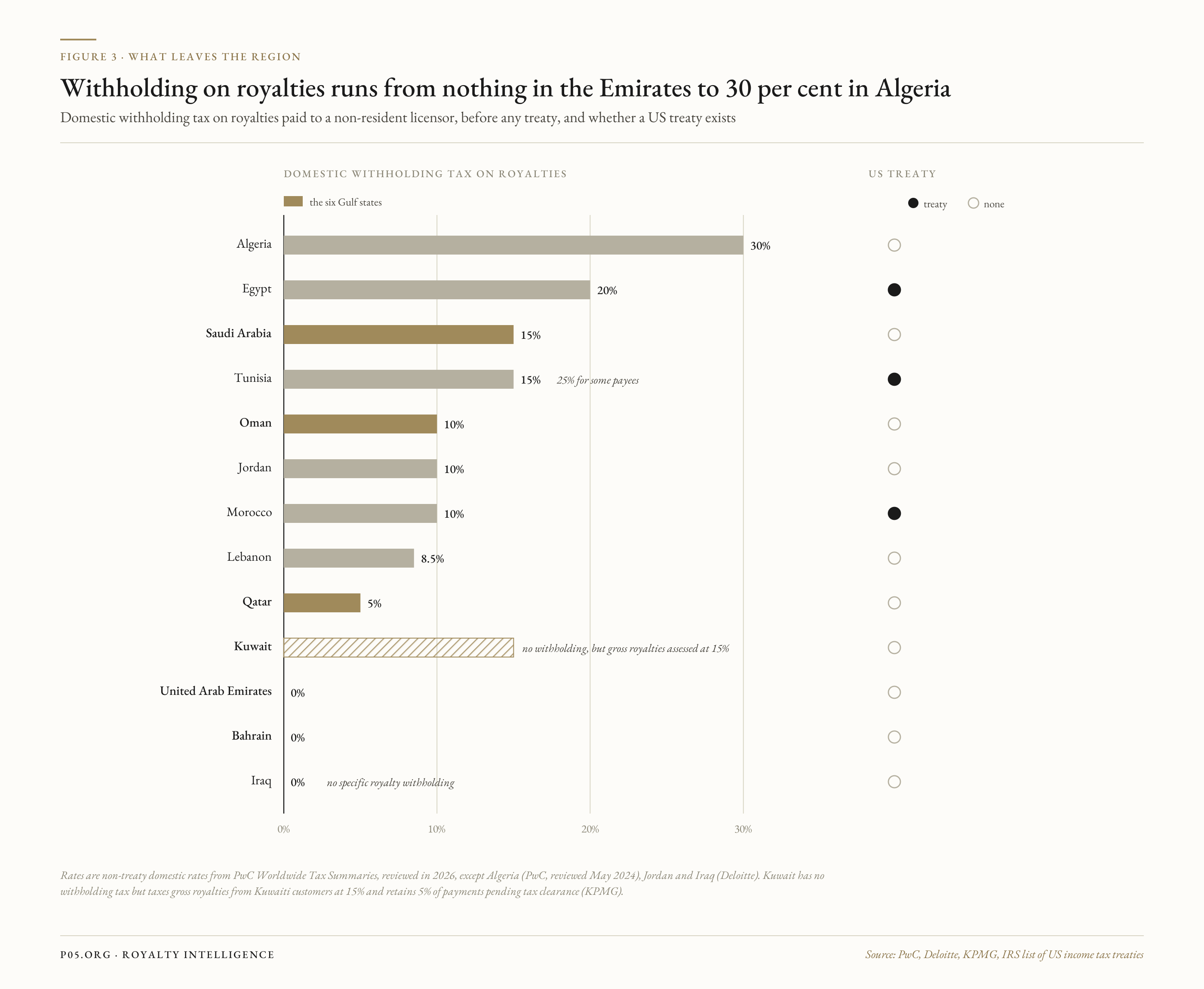
Domestic withholding tax on royalties paid to a non-resident licensor, and where the United States has a tax treaty.
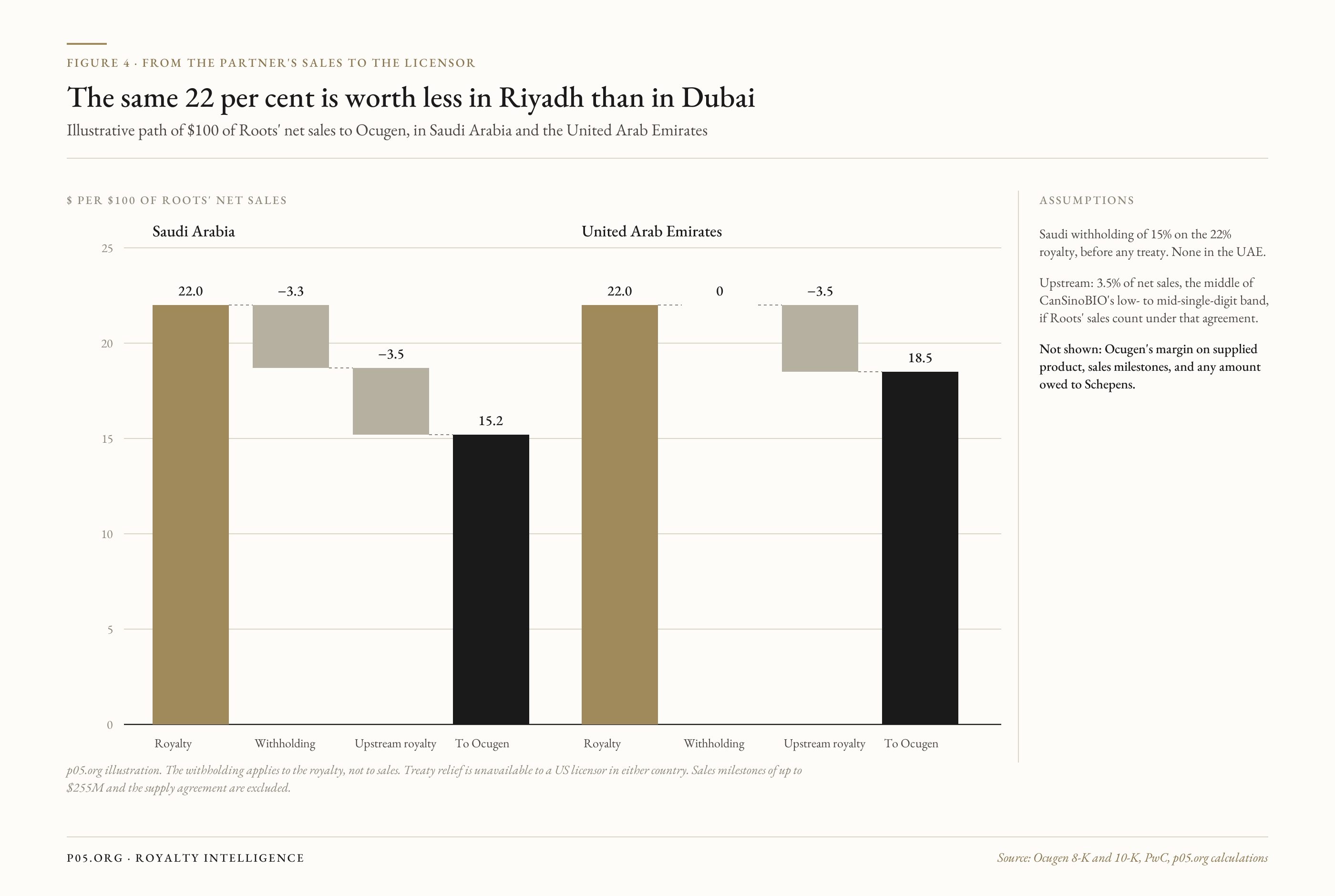
From $100 of Roots' net sales to Ocugen, in Saudi Arabia and the UAE, before the supply margin. Illustrative.
Implications for the Pharmaceutical Royalty Market
The 22 per cent is a distributor's arrangement in the form of a licence. The partner registers, prices and sells, and bears those costs. The licensor keeps manufacturing, the clinical data, the safety database and the trademark. Its return is the royalty plus whatever margin the supply agreement leaves it, and the supply agreement is the document a buyer of the stream has not seen.
Ocugen will file the licence with its 2026 annual report, and the supply terms may stay redacted.
Rates cluster by who does the work. The Chinese antibody licences sit at 15 to 20 per cent. Ocugen, which supplies the product, takes 22 and 25 per cent. The licensors that set a supply price or a revenue share take 30 to 50 per cent of sales but carry the cost of goods.
The same molecule licensed to a partner that manufactures pays single digits, as CanSinoBIO's terms show.
Country mix decides the net. On $100 of sales, 22 per cent in the UAE reaches the licensor whole. In Saudi Arabia, 15 per cent of the royalty is withheld.
A Swiss or British licensor can reduce that under a treaty. An American one cannot, because no treaty exists. A buyer modelling a regional royalty has to model it country by country and in the tax position of the entity that will hold it.
The stream also starts late. Saudi registration follows the reference approval, the price follows registration, and government tenders follow the price.
For a gene therapy that is not yet approved anywhere, the first royalty is several steps away, and the 20-year term runs from the first sale, so delay pushes the stream back without shortening it.
No sale of a royalty from the region to a royalty fund appears in the filings or the press we reviewed. The streams are small, the counterparties are private, and the region's listed licensees do not disclose what they pay.
The first buyer will have to price one from the licensor's side alone, which is how the geography of the deal has worked elsewhere.
How capital enters and returns
The money flows the other way from most royalty deals. The regional partner pays little upfront, here up to $4M for upfront and development milestones together, and funds registration, launch and sales itself. The licensor's capital went into the drug before the licence existed.
It returns as the royalty, as sales milestones and as the margin on each supplied unit, less the withholding tax of each country of sale and any royalties owed upstream. For OCU400 those include CanSinoBIO's low- to mid-single-digit royalty, if the regional sales count as net sales under that agreement, and Ocugen's obligations to the Schepens Eye Research Institute, which licensed it the NR2E3 gene.
A royalty fund could enter on either side. It could buy the licensor's regional stream, or it could finance a regional partner that needs capital to launch. Neither has happened in the region, as far as the public record shows.
A boomerang, in which an acquirer of the licensor buys the territory back, is the exit most likely to turn such a stream into cash.
Conclusion
The licence Ocugen signed on 13 October gives it 22 per cent of a market that does not yet exist. Phase 3 data are due in the first quarter of 2027. Approval in the United States would start Roots' two-year window to file in Saudi Arabia, and the 20-year term would start with the first sale after that. Until then the rate is the only number in the deal, and the supply agreement, the country mix and the tax will decide what it is worth.
All information in this report was accurate as of the research date and is derived from publicly available sources including court opinions, regulatory guidance, academic literature, SEC filings, and financial news reporting. Information may have changed since publication. This content is for informational purposes only and does not constitute investment, legal, or financial advice. The author is not a lawyer or financial adviser.