True Sale in Biotech Royalty Transactions: Meaning and Implications
Introduction
Biotech companies increasingly monetize their drug royalty streams to fund R&D or other needs. In these deals, a company may receive an upfront lump sum in exchange for rights to future royalty payments on a drug.
Such royalty financings can be structured either as an outright "true sale" of the royalty asset or as a secured financing (loan) using the royalties as collateral. Understanding what a true sale means in this context – and how it differs from a loan – is critical for biotech professionals and structured finance lawyers.
A true sale structure can offer significant legal and financial advantages (particularly regarding bankruptcy risk), whereas a loan-like structure might leave the royalty buyer exposed if the seller runs into financial trouble.
This in-depth article explains the concept of true sale in biotech royalty transactions, its implications, how to distinguish true sales from secured financings, and compares U.S. and international perspectives on the true sale doctrine. We also highlight real-world case studies (including Royalty Pharma deals) to illustrate these points in practice.
What Does "True Sale" Mean in Royalty Monetization?
In structured finance, a "true sale" occurs when assets are sold such that the seller retains no equitable interest or control over them – the buyer assumes the risks and rewards of ownership.
In a biotech royalty monetization, a true sale means the royalty stream (a right to payment from future drug sales) is legally transferred to the investor as an asset purchase, rather than merely pledged as security for a loan.
The distinction is more than semantics; it determines who truly owns the royalty and who bears the risk if things go wrong.
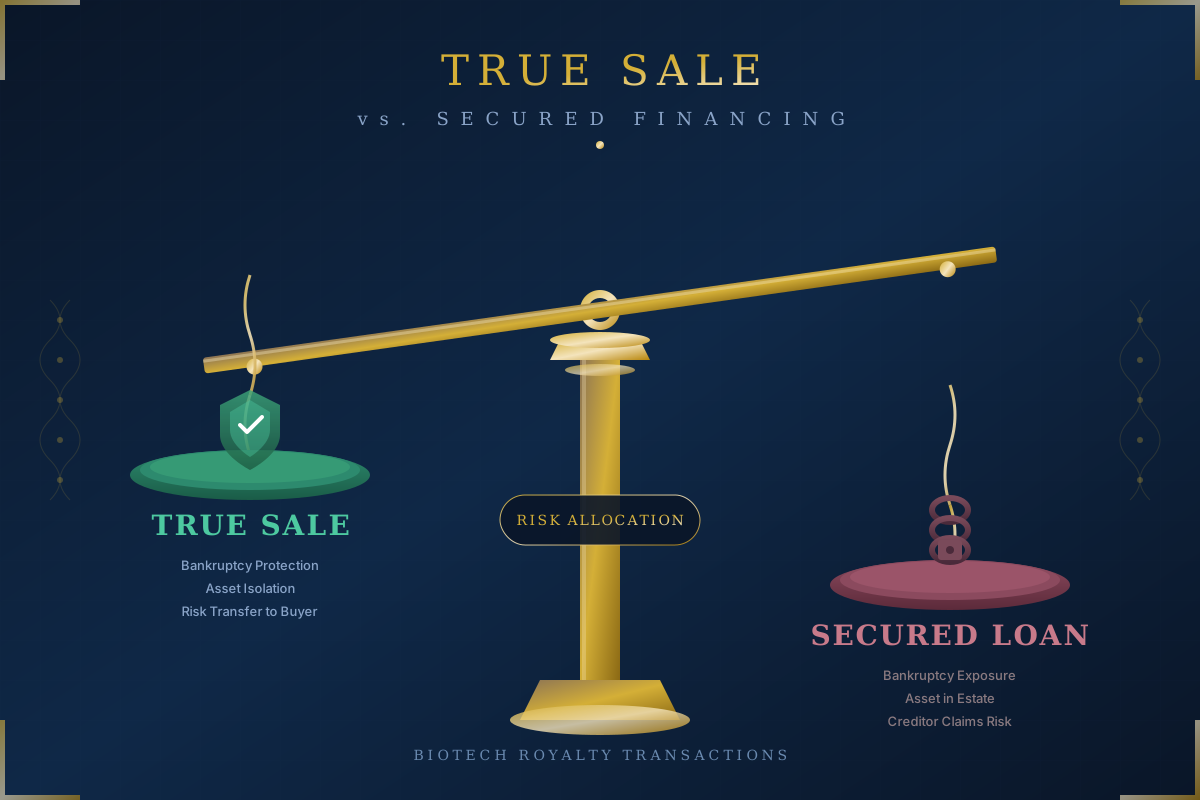
In a properly structured true sale, the royalty is removed from the seller's estate – so if the biotech company later files bankruptcy, the royalties should not be frozen under the automatic stay or seized to pay the company's creditors. Instead, the investor (royalty buyer) continues to "own" the revenue stream and collect payments directly, insulated from the seller's financial distress.
By contrast, if a deal is characterized as a secured financing (loan), the royalty payments remain property of the company/borrower's estate in bankruptcy and the investor is merely a creditor with a security interest – potentially subject to the automatic stay and competing creditor claims.
Achieving True Sale Treatment
Achieving true sale treatment typically requires specific structuring. The transfer must be absolute and irrevocable, with the buyer bearing the risk of non-performance of the royalties.
U.S. law (Uniform Commercial Code Article 9) explicitly allows sale of "payment intangibles" (like rights to future royalties) and provides that such sold receivables are not part of the seller's bankruptcy estate.
However, Article 9 does not define when a transaction is a sale versus a loan – that is determined by courts based on the substance of the deal rather than what the parties call it. Simply labeling an agreement a "sale" is not sufficient if the economic reality suggests it's a financing arrangement.
Courts will undertake a fact-intensive analysis (the "true sale doctrine") to decide if the seller truly parted with the asset or merely used it as collateral.
The key indicator is risk allocation: in a true sale, the investor assumes most of the risk of the royalty asset (for example, the risk that drug sales underperform), whereas in a loan the company effectively guarantees or secures a certain return to the investor. In other words, if the investor's return is fixed or protected, it looks like a debt; if the investor's return fluctuates with the royalty performance (with no recourse to the seller if royalties disappoint), it looks like a sale.
Why True Sale Matters: Legal and Financial Implications
Structuring a royalty monetization as a true sale has critical implications, particularly in a downside scenario like bankruptcy.
The foremost benefit is bankruptcy protection: by removing the royalty asset from the seller's estate, a true sale prevents the automatic stay from halting royalty collections and shields the royalty stream from claims of the seller's creditors.
The investor can continue to receive royalty payments even if the biotech company goes bankrupt, since the payments aren't the company's property anymore. In contrast, under a loan structure, royalty proceeds would be part of the bankruptcy estate and the lender's ability to get paid would be subject to bankruptcy court proceedings (often lengthy and uncertain).
The Mallinckrodt Case: A Cautionary Tale
A recent case illustrates the stakes.
In Mallinckrodt's bankruptcy (2020–2022), the company had an obligation to pay a perpetual royalty to a predecessor owner of a drug. Because Mallinckrodt had acquired the drug outright (the royalty was structured as part of the purchase price, not as a separate assigned asset or license), the royalty recipient was deemed an unsecured creditor rather than an owner of any asset.
The U.S. Third Circuit affirmed that future royalty payment rights under a non-executory contract were dischargeable in bankruptcy – meaning Mallinckrodt was allowed to shed that royalty obligation.
The royalty recipient, who had no ownership interest in the drug or IP (and no collateral securing the payments), was left with only an unsecured claim for a fraction of what was owed.
This outcome highlights that if a royalty investor doesn't obtain an ownership stake or true sale transfer of the royalty, they risk losing the benefit of their bargain in a bankruptcy. As a bankruptcy commentary put it, "deal structure matters" – had the counterparty structured the deal differently (for example, retained an interest in the IP or secured the royalty with collateral), they could have protected their rights.
Other Implications Beyond Bankruptcy
Even outside of bankruptcy, true sale vs. financing affects other areas:
Control and Enforcement
In a true sale, the investor often gains greater control over the royalty asset. For instance, the royalty payor (e.g. a big pharma company that owes royalties) can be directed to pay the investor directly once the sale is completed. The investor may even acquire the underlying license contract or patent rights associated with the royalty.
In a financing, the company typically remains the owner and licensor, so the investor's rights are indirect (through liens) unless and until a default occurs. True sale thus gives the investor more direct enforcement rights (and sometimes the ability to step in if the license is in jeopardy).
Off-Balance-Sheet Treatment
From an accounting perspective, a true sale might allow the biotech company to derecognize the royalty asset and not carry a corresponding liability – effectively treating the transaction as a sale of an asset rather than incurring debt. This can improve the balance sheet leverage ratios and avoid increasing liabilities.
However, in practice many royalty monetizations (especially "synthetic" royalty deals with caps or other features) are still accounted for as debt on the seller's balance sheet. Accounting standards are strict about when a transfer qualifies as a sale; any significant continuing involvement or obligation by the seller can lead to financing accounting even if legally structured as a sale.
Biotech companies not valued on near-term earnings may be less sensitive to this accounting treatment, but it can be a consideration for larger public companies.
Tax Treatment
True sale vs. loan also affects taxation.
In a true sale, the seller is essentially pulling forward income – the upfront payment is treated like proceeds from selling part of its asset/rights, which may trigger tax on any gain (or be treated as ordinary income acceleration of royalties) in the year of the sale.
In a loan scenario, by contrast, the upfront cash is a debt and not taxable immediately; royalty revenues, as they come in, would be used to service the debt (the company might deduct interest, etc.). Thus, sellers and investors must consider tax implications when choosing a structure.
Investor Return Profile
A true sale often gives the investor an uncapped upside (they get all future royalties, or a fixed percentage in perpetuity). The investor's return is uncertain – it could be lower or higher than expected depending on drug sales.
In a loan-like royalty financing, the investor's return is usually capped or fixed (for example, the investor gets 2x their invested amount, or payments stop after reaching a cap or after a term of years). While a cap limits upside, it also provides a target yield that makes the deal resemble a loan payoff.
Many biotech sellers prefer to cap the payments or include buy-back options so that if the drug wildly outperforms, they don't forego an unlimited upside – but this very feature can undermine true sale treatment, as discussed below.
Covenants and Restrictions
Debt financing typically comes with stringent covenants (e.g. leverage ratios, restrictions on additional debt or asset sales, etc.) to protect the lender. One attraction of royalty funding for biotech is the lighter covenant burden – especially in a sale structure.
In fact, market data shows that royalty monetization deals usually have very limited covenants and virtually no financial maintenance covenants, since investors rely on the royalty stream itself rather than the company's general creditworthiness.
For example, a Covington study of recent royalty deals found 0% included financial covenants, unlike traditional loans.
True sale transactions thus allow the biotech to receive capital without the operational restrictions that come with typical debt financings ("no covenants or debt-like repayments," as one industry survey noted). This flexibility is highly valued by companies seeking non-dilutive funding.
Summary: True Sale vs. Financing Trade-offs
| Aspect | True Sale | Secured Financing (Loan) |
|---|---|---|
| Bankruptcy Protection | Asset removed from estate; investor protected | Asset remains in estate; investor is creditor |
| Investor Risk | Bears full performance risk | Protected by recourse/guarantees |
| Seller Upside | Foregone entirely | May retain residual after cap |
| Balance Sheet | Potential off-balance-sheet | Recorded as debt liability |
| Covenants | Minimal (asset-focused only) | Extensive (financial & operational) |
| Control | Investor gains direct control | Seller retains ownership until default |
In summary, a true sale can enhance the investor's security and control (especially in insolvency scenarios) and keep the transaction off the seller's books as debt, at the cost of the seller giving up the future royalty stream entirely. A financing (loan) keeps the asset on the seller's books (with an obligation to repay), and may allow the seller to retain some future upside or flexibility (through caps or buybacks), but it exposes the investor to more risk if the company falters.
True Sale vs. Secured Loan: How to Tell the Difference
Determining whether a royalty transaction is a true sale or a disguised financing comes down to the fine print of the deal structure. There is a spectrum between a pure sale and a pure loan, and structured royalty deals can have hybrid features.
Courts and practitioners look at several key factors to differentiate true sales from secured loans in royalty monetizations:
Key Factor 1: Recourse and Guaranteed Returns
Perhaps the most important factor is recourse.
In a true sale, the investor generally has no recourse to the seller if the royalty payments are lower than expected – the investor's return rises or falls with the asset's performance.
If the deal includes recourse (e.g. the seller must make up shortfalls or repay the investor's principal in any scenario), it's indicative of a loan. Features like minimum return guarantees, "make-whole" provisions, or seller top-up obligations weigh heavily toward a financing rather than a sale.
For instance, if the contract says the seller will provide extra payments (a "top-up") or the investor can "put" the asset back to the company for a refund under certain conditions, that suggests the company is effectively guaranteeing a return, pointing to a loan-like risk allocation.
By contrast, if the investor's only source of repayment is the royalty stream itself with no fallback on the company, that supports true sale.
Key Factor 2: Cap on Investor Upside
Many royalty deals are structured with a cap (maximum amount) the investor will receive (e.g. 2x the investment or payments for X years), especially in "synthetic" royalty financings.
A cap can make the transaction look more like a loan being paid off over time, rather than an open-ended investment. In fact, a capped deal is particularly susceptible to recharacterization as a loan in bankruptcy, since it resembles a repayment of a fixed principal plus interest.
The presence of a cap doesn't automatically destroy true sale status, but it's a red flag. Deals with no cap (the investor shares in royalties indefinitely) are more "equity-like" and supportive of sale characterization, whereas heavily capped deals (especially with a short timeline to reach the cap or a guaranteed multiple) are viewed as more "debt-like."
Key Factor 3: Risk of Loss and Residual Interest
Who bears the downside risk if the product flops, and who retains any residual interest if it wildly succeeds?
In a true sale, all risks and rewards of the royalty are transferred to the buyer – if the drug's sales underperform, the buyer simply earns less, with no claim against the seller; if sales are huge, the buyer could earn more than expected, and the seller doesn't get that back.
In a loan, conversely, the seller typically retains the residual interest after the loan is repaid (once the investor has received the capped amount or the loan maturity passes, the remaining royalties revert to the company). Retention of a residual suggests the company hasn't truly sold the whole asset, only pledged it temporarily.
Additionally, if the seller is effectively insulating the investor from loss (through covenants that assure a certain payment or the ability to substitute another asset, etc.), that suggests a financing.
The economic "risk transfer" is central: one court noted that across all true sale factors, the underlying question is whether "the risk of loss [has] transfer[red] to the buyer" in substance.
Key Factor 4: Collateral and Security Interests
Paradoxically, in some royalty "sales" the investor also obtains a security interest as a backup – for example, a lien on the royalty stream and related IP, filed under the UCC.
While taking a security interest might seem to imply it's a loan, in practice many investors do this as a belt-and-suspenders measure in case a court later recharacterizes the deal as a financing. The security interest then gives the investor a secured creditor status.
However, if a purported sale grants an excessively broad security package (covering many other assets of the company, or includes guarantees), it starts to look like a typical loan.
For example, in one case a sale of receivables was recharacterized as a loan in part because the "security" extended beyond the sold assets (including all assets of the company and personal guarantees) – indicating the transaction was really a secured loan.
Bottom line: in a clean true sale, the investor shouldn't need collateral beyond the asset being sold (since they own the asset), and the seller shouldn't be guaranteeing payment.
Key Factor 5: Language and Documentation
How the transaction documents describe the parties and payments can be telling.
If the seller is termed "debtor" and payments to the investor are called "loan payments" or "debt service," that obviously leans toward a loan.
Truly selling the royalty usually involves an assignment agreement or purchase and sale agreement for the asset, rather than a loan or credit agreement.
That said, courts will look past euphemisms – calling the deal a "purchase" won't carry the day if the structure is functionally a financing. Consistency in the documentation (including UCC-1 filings, which in a sale should list the relationship as seller/buyer, not borrower/lender) bolsters the true sale position.
Key Factor 6: Covenant Package and Ongoing Obligations
In a pure sale, once the asset is sold, the seller ideally has minimal ongoing obligations to the investor (aside from perhaps forwarding any inadvertently received payments or refraining from impairing the asset).
A heavy covenant package (especially financial covenants or operational restrictions on the seller's behavior) is more typical of a loan, where the lender is concerned about the borrower's overall stability.
As noted, royalty true sales often have light covenants narrowly focused on protecting the royalty stream (e.g. no sale of the patent, no modification of the license without consent, perhaps requiring patent maintenance, etc.), but not general debt ratios or restrictions on incurring other debt.
The absence of traditional debt covenants and absence of a fixed payment schedule (payments vary solely with sales) point to a sale; conversely, if the agreement effectively requires the company to make fixed or minimum payments on set dates, it's behaving like a debt instrument.
Key Factor 7: Duration and Termination
A sale is usually permanent – the investor owns the royalty right for the life of the patent or the license term.
If the arrangement automatically terminates after a certain date or once a certain sum is paid (and then the royalty rights revert to the company), that has a financing flavor. Many "financings" are structured as royalty interests that end after the investor achieves a return or after X years.
True sales, by contrast, might only end if the underlying royalty naturally expires (e.g. patent expiry).
One caveat: sometimes companies negotiate buy-back options or call rights even in a sale (giving the company the right to repurchase the royalty later), which can complicate the analysis. A call option retained by the seller could be viewed as the seller not fully relinquishing the asset (potentially undermining true sale), though if it's truly optional and at fair market value, some sales still include that feature for flexibility.
Summary: True Sale Factors at a Glance
| Factor | True Sale Indicator | Loan/Financing Indicator |
|---|---|---|
| Recourse | No recourse to seller | Seller guarantees/makes up shortfalls |
| Cap | Uncapped (perpetual upside) | Capped at fixed multiple |
| Risk Transfer | Buyer bears all performance risk | Seller retains significant risk |
| Residual | No residual retained | Seller keeps excess after cap |
| Security | Limited to sold asset only | Broad security over other assets |
| Documentation | "Purchase," "assignment," "buyer/seller" | "Loan," "debt service," "debtor/lender" |
| Covenants | Asset-focused only | Financial maintenance covenants |
| Duration | Permanent (life of asset) | Fixed term or until cap reached |
In practice, these factors are weighed in totality – no single factor is absolutely determinative, but transfer of risk is paramount.
To maximize certainty, parties may structure very "clean" sales (no caps, no recourse, indefinite term) or, if they include features like caps, they may use an SPV or other mechanisms to buttress the sale characterization.
Often, lawyers will seek a formal "true sale opinion" from counsel in structured royalty deals, opining that a court should treat the transfer as a sale and not consolidate the assets with the seller in bankruptcy. Such opinions rely on the above factors and relevant case law.
As one legal summary noted, courts focus on whether the economic substance aligns with a sale – specifically, whether "risks (in particular credit risks) and rewards (excess profits) associated with the asset have truly been conveyed" to the purchaser. If yes, it's a sale; if the seller has retained significant risk or reward, it's likely a financing.
Case Studies: True Sale Royalty Deals in Action
Over the past decade, royalty monetization has become a mainstream financing tool in biotech, with numerous high-profile deals – many structured as true sales. Below are several real-world examples that shed light on how these transactions are executed:
Mass General Brigham (Entyvio Royalties)
In 2020, Massachusetts General Hospital (MGH, part of Mass General Brigham) monetized a portion of its royalty interest in the drug Entyvio (an antibody for ulcerative colitis and Crohn's).
The hospital, which had helped discover Entyvio, sold part of its royalty stream to Royalty Pharma for $94 million, in what was described as a "true sale roll-up" transaction.
By structuring it as an outright sale, the hospital received non-dilutive funding for research, and Royalty Pharma acquired the rights to those royalties moving forward.
This deal is a classic example of an academic institution executing a true sale of a royalty to free up immediate capital for its core mission (research), while transferring the long-term risk and reward on that drug to a financial investor.
ImmunoGen (Kadcyla Royalties)
ImmunoGen, a biotech company, entered a royalty deal in 2015 involving its rights to Kadcyla (a breast cancer drug).
ImmunoGen received $194 million in cash and in exchange assigned its right to certain Kadcyla royalties to an investor consortium led by TPG Special Situations Partners.
Essentially, ImmunoGen sold a chunk of its future royalty stream on Kadcyla, which provided a large upfront infusion to fund operations.
The assignment of royalty rights was a true sale structure – ImmunoGen gave up those royalty payments (no obligation to repay TPG out of other assets), and TPG assumed the risk (if Kadcyla sales had disappointed, TPG might not recoup its full investment). This deal helped ImmunoGen raise capital without issuing equity or taking on traditional debt.
Ligand Pharmaceuticals (Promacta Royalty Sale)
In 2019, Ligand Pharmaceuticals made headlines by selling its royalty rights to the drug Promacta (eltrombopag) to Royalty Pharma for a whopping $827 million in cash.
Promacta was a successful product (marketed by Novartis) for which Ligand held a royalty interest. Ligand decided to monetize this intangible asset at a high valuation and redeploy the cash into new investments.
The transaction was structured via an asset purchase agreement: Royalty Pharma acquired all of Ligand's Promacta-related intellectual property and the associated license agreement, effectively stepping into Ligand's shoes as the royalty recipient.
Royalty Pharma also assumed certain obligations related to the license, making it a clean transfer.
This true sale ensured that Royalty Pharma's right to the Promacta royalties was bankruptcy-remote – if anything had happened to Ligand post-sale, it wouldn't affect Royalty Pharma's royalty stream.
For Ligand, although it gave up a lucrative ongoing royalty, the immediate $827M (doubling their cash reserves) was used to fuel growth and acquisitions.
This case demonstrated how a mature biotech can unlock huge value from a royalty asset through a sale, and how investors like Royalty Pharma are willing to pay upfront for long-term royalty cashflows.
PTC Therapeutics (Evrysdi Royalty Financing)
Between 2020 and 2024, PTC Therapeutics entered into a series of royalty transactions with Royalty Pharma totaling up to $2.15 billion in funding.
These deals were tied to royalties from PTC's spinal muscular atrophy drug Evrysdi®. Notably, the arrangement included a mutual option for PTC to sell – and Royalty Pharma to buy – an additional portion of the remaining royalties at a later date.
PTC's CEO highlighted that this creative funding strengthened their balance sheet and added flexibility for strategic objectives.
The initial tranches functioned like a sale of a portion of PTC's Evrysdi royalties (providing immediate non-dilutive capital), while the option gave PTC the ability to unlock more value once certain milestones or needs arose.
This case study shows modern royalty deals can be quite bespoke, combining elements of sale and future financing options. The bulk of the funds PTC received were upfront payments in exchange for Royalty Pharma owning the specified royalty streams, which suggests those were treated as true sales.
Any future exercise of the option would likewise be a sale of the next slice of royalties. By structuring it in stages, PTC retained some optionality (and incentive) if the drug's sales grew larger, exemplifying how deals can be tailored while still aiming for true sale treatment on each tranche.
Academic and Non-Profit Institutions
Aside from MGH's deal, many universities and research institutions have monetized drug royalties.
For example, in prior years, Emory University famously sold its royalty rights to the HIV drug Emtriva for $525 million, and more recently, UCLA sold a royalty interest in Xtandi for $1.14 billion – both true sales.
These deals underscore that true sales are the norm when maximizing upfront value; the institution relinquishes future income in return for an immediate lump sum (often to reinvest in new research or fund endowments).
Synthetic Royalty Financing Gone Wrong: Clovis Oncology
Not every royalty deal is a pure sale – some are structured more like loans, and the Clovis case provides a cautionary example.
Clovis Oncology in 2019 raised funding from Sixth Street Partners, agreeing to pay Sixth Street a percentage of sales of its cancer drug Rubraca until Sixth Street received $350 million (twice the $175 million principal Sixth Street provided).
This was essentially a capped revenue interest deal – Clovis would eventually repay 2x the investment through royalties.
When Clovis later filed bankruptcy (in 2022), Sixth Street's arrangement was challenged by other creditors. The agreement had loan-like features: in a default or bankruptcy, Clovis's obligation accelerated to the full $350 million cap.
The unsecured creditors' committee argued that this "accelerated cap" was not truly a shared risk royalty, but a disguised debt claim – they contended the $350M cap looked like a payoff and even posited that Sixth Street's high returns and lack of a set interest rate made it akin to an equity investment (which would rank behind general creditors).
Although Clovis and the creditors settled without a definitive court ruling on recharacterization, the case highlights the grey zone: a heavily structured, debt-like royalty deal can invite litigation in bankruptcy.
It reinforces the lesson that to ensure true sale treatment, one should avoid excessive debt-like terms (like guaranteed multipliers or automatic acceleration).
The Clovis example contrasts with the cleaner true sales above – Clovis kept upside (and effectively treated the royalties as a means to repay a fixed amount), which undermined any argument that Sixth Street "owned" the royalty outright.
Market Prevalence of True Sales
In summary, most high-profile royalty monetizations (especially those involving Royalty Pharma and similar investors) are structured and documented as true sales, as this is what investors require to protect their interests.
In fact, a review of transactions from 2019–2023 found that over 95% of biotech royalty deals explicitly stated they were true sales of the payment rights.
The case studies above show how sellers ranging from biotechs (ImmunoGen, PTC) to pharma (Ligand) to hospitals (MGH) have leveraged true sales to unlock capital, while also illustrating how deviating from a true sale structure (Clovis) can raise risk.
U.S. vs. International Perspectives on True Sale Doctrine
While the fundamental goal of a true sale – legal isolation of assets from the seller's insolvency – is universal, the approach to achieving it can differ across jurisdictions. Here's how the concept compares in the United States and other countries (especially in the EU and other common markets):
United States
In U.S. law, true sale analysis largely comes from case law and state commercial law principles, since there's no single statute that defines a true sale.
As mentioned, U.S. courts consider the intent of parties and whether the transaction's economics are consistent with a sale or a secured loan. The presence of extensive case precedents (often from securitization of mortgages, receivables, etc.) provides guidance: U.S. lawyers will scrutinize factors like recourse, retention of risk, and control to opine on true sale.
Importantly, in the U.S. Bankruptcy Code, an asset that was sold prior to bankruptcy is generally not part of the bankruptcy estate (Section 541). However, if a bankruptcy court finds that a purported sale was actually a financing (a "disguised loan"), it will treat the asset as still belonging to the debtor.
Therefore, U.S. practitioners place heavy emphasis on obtaining a true sale legal opinion for significant transactions, and often also create bankruptcy-remote special purpose vehicles (SPVs).
In many royalty monetizations, the company may transfer the royalty into an SPV which then sells it to the investor – this two-step can further evidence the separation and provide another layer of bankruptcy insulation. (The SPV is an entity with no debts other than the transaction, so it shouldn't file bankruptcy itself.)
U.S. law firms also often perfect a backup security interest in the royalty and related IP as a precaution, as discussed.
Overall, the U.S. approach is a pragmatic, case-by-case one: it relies on substance over form, and a well-developed body of jurisprudence distinguishes true sales from secured loans (with the true-sale doctrine essentially being a state law doctrine often applied in bankruptcy courts).
Europe and International Perspectives
In many other countries, the concept of "true sale" can be more formalistic, and the legal framework varies by jurisdiction:
France
French law provides that a securitization transfer is a true sale if the sale to the SPV is "unconditionally and immediately valid and enforceable" against third parties and if the transfer cannot be later challenged in the originator's insolvency.
Essentially, if you follow the proper sale steps (often via a specific cession (assignment) mechanism or using a statutory securitization vehicle like the "fonds commun de créances"), the transfer will be respected as a sale and survive the seller's bankruptcy (apart from general clawback rules like suspect period if the sale was too close to insolvency).
French law thus builds in the concept of "bankruptcy remoteness" as a criterion for a true sale.
Germany
German law doesn't have an extensive true-sale case law for royalties, but German courts have indicated that the key test is whether the seller retained any substantial risk – German insolvency courts draw the line based on risk retention: if the seller keeps risk (like an agreement to repurchase or cover losses), the deal might be viewed as a secured loan; if not, it's an outright sale.
In practice, German transactions ensure the sale is "non-recourse" and at fair market value upfront, to meet the legal standard. True sale in Germany (and many civil-law countries) is also heavily about formalities – e.g., notifying the debtor of the assignment, and not violating any contractual anti-assignment clauses (though many countries override those for financial transfers).
If formal requirements are met and the seller doesn't retain control or a repurchase right, the sale is typically respected. Germany also has a well-known concept of isolating assets via an SPV and even a dedicated industry group called True Sale International, reflecting the importance of getting it right.
United Kingdom
The UK, as a common-law jurisdiction, shares some similarity with the U.S. in analyzing substance, but it also relies on the concept of an outright assignment vs. charge.
If a transaction is structured as an absolute assignment of the receivable (with notification to the payer), it is generally treated as a sale. If the "assignment" is equitable or subject to reassignment (or if there's an obligation to return excess collections), it might be deemed a charge (security interest).
UK law doesn't have a codified true sale definition, but courts look at whether the rights of the "buyer" are consistent with ownership or more like a secured creditor.
Notably, UK and many Commonwealth jurisdictions do not have the same bankruptcy code concept of an automatic stay capturing all assets – however, they do have insolvency laws that can set aside transactions intended to defraud creditors or done at undervalue, etc.
Ensuring a fair purchase price paid in cash (no hidden financing) at the time of transfer is thus important globally (in many countries, a sale can be unwound if it's for insufficient value shortly before bankruptcy as a preference or undervalue transaction).
Other International Points
Each country has its nuances.
For example, some jurisdictions require registration or notarization of assignments to be effective against third parties. Some (like certain Latin American countries) might treat a transfer of future receivables as valid only if notified or even approved by the obligor.
Many legal systems allow true sale of future receivables, but the documentation must clearly state the intent to sell and ensure that the seller's creditors have no claim.
It's often said that outside the U.S., the term "true sale" is less about a doctrinal test and more about meeting statutory requirements for a valid assignment. If those are met, typically the asset is out of the estate (subject again to any general clawback rules in bankruptcy for fraudulent transfers, etc.).
Lawyers working on cross-border royalty deals will typically obtain local law opinions in each relevant jurisdiction to confirm that a sale of the royalty is perfected and effective locally.
For instance, if a royalty arises from sales in Europe or is paid under a contract governed by, say, German law, the parties might use a Dutch or Luxembourg SPV to buy the royalty, and ensure the sale complies with that local law (those jurisdictions have securitization-friendly laws and tax neutrality, which is why many European securitization SPVs are based there).
U.S. vs. International: Key Differences
| Aspect | United States | European Union / International |
|---|---|---|
| Primary Test | Substance over form (case law) | Statutory/formal requirements |
| Key Focus | Economic risk transfer analysis | Meeting assignment formalities |
| Legal Opinion | True sale opinion critical | Local law opinion on validity |
| SPV Usage | Common for bankruptcy remoteness | Common, often in NL/LUX for tax |
| Regulatory Framework | State UCC + bankruptcy case law | Securitisation Regulation (if applicable) |
| Clawback Risk | Fraudulent transfer laws | Suspect period / undervalue rules |
Overall, the perspectives converge on the idea that the asset must be legally isolated from the seller and the seller's creditors.
The U.S. relies on nuanced judicial tests and typically demands a comprehensive true sale opinion for investor comfort. The EU and other jurisdictions often rely on ex ante structural features (like using an SPV, following securitization regulations, and fulfilling any notice or registration steps) to achieve the same end.
It's worth noting that the EU has a Securitisation Regulation which imposes certain rules (risk retention, transparency) on asset-backed transactions – however, one-off royalty sales usually are not "securitizations" in the regulatory sense (since there's typically no tranching of credit risk among multiple investors). Thus, a single investor royalty purchase may fall outside those rules, but if a royalty stream were pooled and securitized to multiple investors, compliance would be needed.
The concept of "true sale" itself, though, remains foundational even in Europe – for example, Italian and Spanish securitization laws explicitly require that transfers to securitization vehicles be true sales; and institutions like the European Central Bank and Basel accords assume true sale for off-balance sheet treatment.
In summary, U.S. vs. EU differences on true sale are largely about form vs. substance: U.S. law emphasizes substantive risk transfer backed by case law analysis, whereas many other jurisdictions rely on getting the formal legal mechanics right to ensure the sale is enforceable and final.
In practice, a well-structured biotech royalty monetization will consider both – making sure the contract and economic terms align with a sale (for U.S. bankruptcy robustness) and that all local legal requirements for assignment are satisfied (for international portions of the royalties).
Most deals, regardless of venue, end up at the same place: the parties stipulate it is a true sale in the contract and take all steps to corroborate that (nearly all recent royalty deals explicitly state the intent to be a true sale). This provides confidence to investors across borders that their interests will be protected.
Conclusion
True sale structures have become the gold standard for monetizing biopharma royalty streams due to the robust protection they afford to investors and the flexibility and upfront cash they provide to royalty sellers.
In a true sale, a biotech company can convert a future trickle of royalties into an immediate torrent of capital – all without incurring debt or diluting equity – while the investor gains a foothold in the drug's success (and bears the risk of its failure).
The implications of true sale status are far-reaching: from bankruptcy immunity (the difference between continuing to collect vs. having one's claim wiped out) to accounting and tax outcomes and the very allocation of risk and reward in the deal.
The Critical Distinction
It is crucial to differentiate a genuine sale from a disguised loan.
As we've discussed, factors like recourse, caps, retained rights, and control can tilt a deal one way or the other. Both biotech executives and legal advisors must navigate these nuances to ensure the transaction meets their goals.
A biotech seller will want to maximize immediate funding while possibly retaining some upside or control – but push too far with loan-like comforts and the deal could be deemed a financing, undermining off-balance-sheet goals and exposing the investor to credit risk.
The investor, on the other hand, will insist on structures (often via SPVs and true sale opinions) that make their rights bankruptcy-proof and clearly separate the asset from the company.
The delicate balance is to craft a deal that both parties can tout as a sale, yet still aligns with their economic interests (sometimes requiring creative solutions like the PTC "option" setup).
Lessons from Real-World Deals
Real-world deals show that with careful structuring, the true sale approach works.
Companies like Ligand and universities like MGH received upfront sums that would have been hard to achieve through any other financing method, and investors like Royalty Pharma have built a business on reliably acquiring royalties.
Of course, as the Mallinckrodt case taught, if a deal is not structured as a sale or license, a royalty obligation can vanish in bankruptcy – a stark reminder of why true sale matters. And the Clovis case warns that even in a purported financing, overly aggressive terms can be challenged; thus, clarity of structure is key.
The Global Perspective
Looking internationally, the concept of isolating assets has no borders, even if the legal pathways differ.
Whether under the U.S. true sale doctrine or via EU assignment laws, the aim is to separate "what's mine" from "what's thine" between seller and investor. Biotech firms and their counsel should keep abreast of both U.S. case law developments and local jurisdiction requirements when engaging in cross-border royalty transactions.
Final Takeaway
In conclusion, a "true sale" in biotech royalty deals means true transfer of ownership of royalty rights – and with it, a transfer of risk.
It implies a permanent change: the company gives up part of its future income, and the investor bets on the drug's success. When done right, it's a win-win: the company secures crucial funding to develop the next innovation, and the investor potentially earns alongside the drug's success without lending money in the traditional sense.
However, the distinction between a sale and a loan is not just academic – it can determine the fate of hundreds of millions of dollars if things go awry.
Therefore, all parties involved must diligently structure and document royalty monetization deals as true sales (or consciously accept the financing route), understanding the benefits and trade-offs of each.
With the continued surge in royalty funding (nearly $30 billion raised via royalty deals in 2020–2024 alone), the true sale versus financing question will remain at the forefront of biotech financing strategy.
By appreciating the implications and learning from past case studies, stakeholders can ensure these innovative funding deals stand on solid legal ground and support the life sciences innovation they are meant to finance.
Disclaimer: I am not a lawyer or financial adviser. This article does not constitute investment advice, legal advice, or financial advice of any kind. All information presented here is derived from publicly available sources including SEC filings, press releases, and industry reports. Details of specific transactions may have changed since publication. Readers should conduct their own due diligence and consult with qualified legal and financial professionals before making any investment or business decisions.
Member discussion