
Who buys a royalty, and where each one plays

A royalty is only worth what someone will pay for it, and not everyone who writes those cheques is buying the same thing.
The phrase "royalty fund" hides at least five different businesses. One buys finished, marketed royalties and clips the coupon. One funds the last year of a Phase 3 programme in exchange for a slice of a drug that does not yet exist. One lends senior and secured against an approved product and takes a capped royalty only as a backstop.
One lends against a launch and takes a revenue interest on top. One quietly aggregates milestone and royalty fragments across hundreds of small assets, most of which will never matter, betting that a handful will.
Each plays a different stage, writes a different cheque, and should be called at a different moment in a company's life. Confusing them is the most common and most expensive mistake a biotech makes when it goes looking for non-dilutive capital. A team that pitches a $30 million Phase 2 synthetic royalty to Royalty Pharma is wasting a meeting.
A team that takes the first term sheet from a commercial-stage buyer when three would have competed is leaving real money on the table.
This is the August 2026 revision of a map first published in June. Three things have moved enough to justify a rewrite rather than a correction. The consolidation wave that was still a list of announcements in June has largely closed, with Ligand and XOMA now a single company. Blackstone's Apogee financing has pushed the frontier of the synthetic royalty earlier than it has ever been. And a specific instrument, the non-recourse note repaid solely from a named royalty stream, has appeared often enough in five months to count as a category rather than a curiosity.
The rest of the map holds. It is sorted, as before, by where each buyer plays: by development stage, by cheque size, by therapeutic area, and by whether they will touch the awkward edges of the asset class, vaccines, medtech, animal health, and crops.
The short version
- The market is large, concentrated at the top, and better measured than it was. Gibson Dunn's royalty finance tracker counts more than $32 billion of royalty-linked transactions across 133 disclosed deals from 2020 through 2025. Annual deal value grew from $5.2 billion in 2020 to $7.1 billion in 2025, a 37 percent increase, with a temporary contraction to $3.9 billion in 2022 and deal count settling at 25 to 27 a year since 2023. Median deal size reached $221 million in 2025. Deloitte's parallel count of $29.4 billion for 2020 through 2024, more than double the preceding five years, tells the same story on a wider definition. A small number of buyers do most of the volume.
- There are five archetypes, not one. Dedicated royalty buyers (Royalty Pharma, DRI), royalty plus credit platforms (HCRx, OrbiMed, Sagard, Oberland), credit-led lenders that take a royalty as a backstop (Pharmakon / BioPharma Credit, Perceptive), diversified scale managers and institutions (Blackstone, Blue Owl, Sixth Street, OMERS, CPP Investments, and cross-sector allocators like Partners Group), and aggregators of small fragments (Ligand, which absorbed XOMA in July). They overlap, but their centres of gravity differ.
- Stage is the first filter, and the frontier moved again in May. Marketed and approved assets are crowded. The contested ground was Phase 3 and the launch window. Blackstone's up to $1.3 billion financing of Apogee's zumilokibart, signed on 27 May 2026 and billed by Blackstone as the largest royalty financing for a pre-Phase 3 programme to date, moved the boundary a full stage earlier.
- Cheque size is the second filter. Above roughly $300 million, the field narrows to Royalty Pharma, Blackstone, Sixth Street, Blue Owl, OMERS, CPP Investments and Pharmakon. Below $50 million, the giants mostly will not engage, and the long tail is served thinly by aggregators, smaller specialists, and in Europe and Asia by the EIB, IPF and CBC. SWK's exit from royalties and its absorption into Runway Growth, completed on 6 April 2026, thinned that tail further.
- Therapeutic coverage converges, but the edges are rare, and the count proves it. Almost everyone does oncology and rare disease, dozens of deals each. The edges are not a matter of who "covers" them but of how few deals exist: roughly fifteen disclosed medtech deals (concentrated in OrbiMed, Oberland, Perceptive, CBC), about four in vaccines, two or three in radiopharma (almost all Blue Owl), two in animal health, and zero in seeds and crops. The June to August window added nothing to any of those counts. Doing one deal is not a franchise.
- The 2025 to 2026 consolidation story has moved from announcement to closing. KKR controls HCRx. Ligand closed its acquisition of XOMA Royalty on 14 July 2026. Royalty Pharma and DRI have both internalised their managers. Blackstone closed the largest life-sciences fund ever raised. BlackRock owns Kreos and HPS. CVC completed its purchase of Marathon on 1 July 2026 and is rebranding it CVC-Marathon. Runway Growth has absorbed SWK. Two large transactions remain pending: CBC and GHO, combining into a roughly $21 billion healthcare platform, expected to close in early 2027, and Zymeworks' acquisition of Theravance Biopharma, expected in the second half of 2026. The capital is getting bigger and more permanent.
- For a company raising, the lesson is sequencing. The right buyer is a function of what you are monetising (your own product, or a third-party royalty you receive), at what stage, and for how much. Match those three and you get a competitive process. Miss them and you get one bad term sheet.
Five archetypes, one asset class
It helps to stop thinking of "royalty funds" as a single category and start thinking in archetypes. The boundaries are soft, and several of the largest players straddle two or three, but the centre of gravity is usually clear.
The dedicated royalty buyer exists to own royalties and little else. Royalty Pharma is the archetype and the giant. DRI Healthcare is the mid-market version. Their core skill is valuing a cash-flow stream and its patent tail, and their balance sheet is built to hold it. Both have now internalised their external managers, which tells you something about where the fee pressure in this asset class sits.
The royalty plus credit platform offers a menu. The same firm will buy a royalty, write a senior secured loan, or do a revenue-interest deal, and will pick the instrument that fits. HealthCare Royalty, OrbiMed, Sagard, Oberland and NovaQuest live here. The product is flexibility, and the client is usually a company that needs capital rather than an inventor selling a passive stream.
The credit-led lender comes at the same companies from the debt side. It writes a senior secured loan against an approved or near-approved product and treats a capped royalty, where it takes one at all, as a backstop rather than the main event. Pharmakon Advisors, through its listed BioPharma Credit vehicle, is the archetype, with Perceptive Credit alongside it. The instrument is closer to a loan than to a royalty sale, but the collateral is the same product cash flow, which is why these firms compete for assets the royalty buyers also want.
The diversified scale manager and institution is a private-markets house, or a pension, that has built a life-sciences book alongside its other businesses. Blackstone, Blue Owl and Sixth Street sit here, and so do the pensions that buy directly, OMERS and CPP Investments. They write the largest cheques, often blend royalty with debt, and can fund the development itself, not just buy the output of it.
The aggregator plays a different game entirely. Rather than concentrate into a few large, de-risked streams, it collects many small milestone and royalty fragments across a wide portfolio, accepting that most will disappoint and relying on a few to carry the book. Ligand built this model, and its completed acquisition of XOMA Royalty doubled down on it.
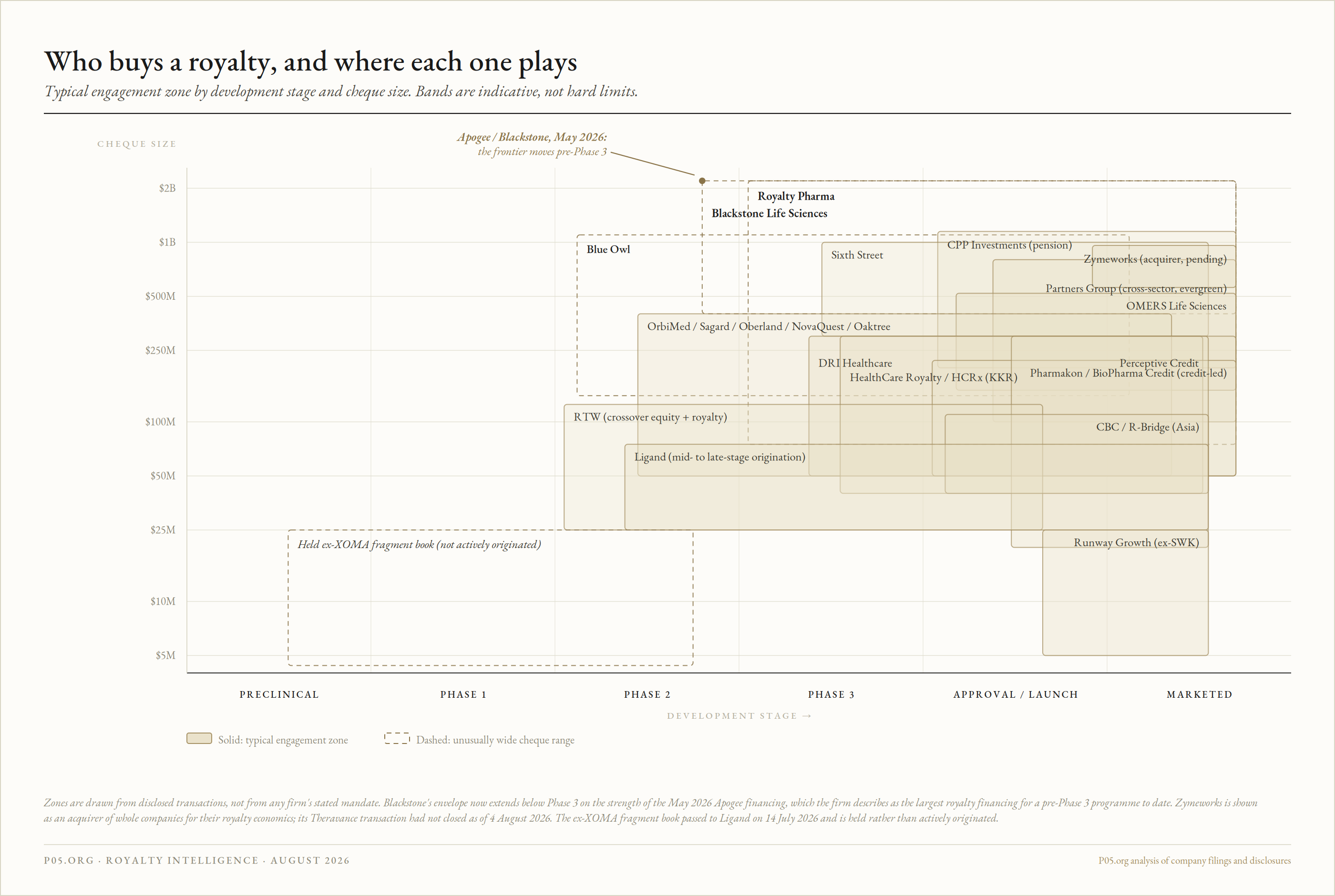
Who buys a royalty, and where each one plays. Typical engagement zone by development stage and cheque size. Bands are indicative engagement zones, not hard limits. Dashed envelopes span an unusually wide cheque range.
The dedicated buyers
Royalty Pharma is the centre of the entire market and has been since it was founded in 1996. It is the largest buyer of biopharmaceutical royalties in the world, and in 2025 it completed its internalisation, acquiring its external manager to become a fully integrated public company. It does two things. It buys existing royalties from inventors, academic institutions and biotech in true-sale transactions, and it co-funds late-stage development and launches in exchange for synthetic royalties on products that are not yet approved.
Its range is the widest in the field. Cheques run from under $100 million to over $2 billion. The 2025 Revolution Medicines arrangement, up to $2 billion combining a synthetic royalty of up to $1.25 billion on the Phase 3 cancer drug daraxonrasib with a senior secured loan of up to $750 million, remains the template for the new scale of these deals.
The 2026 tape shows the same range worked in every direction. In January it agreed up to $500 million with Teva to accelerate the anti-IL-15 antibody TEV-'408, a Phase 2b study with an option to continue into Phase 3.
In March it wrote a $250 million non-recourse royalty-backed note to Zymeworks, repaid from 30 percent of that company's worldwide royalties on the cancer antibody Ziihera. Also in March it agreed a $500 million research and development co-funding arrangement with Johnson & Johnson across 2026 and 2027 for the autoimmune candidate JNJ-4804, which is the clearest signal yet that royalty capital is now a portfolio-management tool for large pharma and not only a lifeline for small biotech.
And on 22 July it bought a portion of the Swiss biotech Neurimmune's royalty interest in AstraZeneca's cliramitug for up to $425 million, including $125 million upfront, a textbook third-party true sale by a licensor.
Its therapeutic reach spans oncology, rare disease, neuroscience, the cystic fibrosis franchise, immunology and respiratory. Its weight sits firmly at Phase 3, approval and marketed. It does not do animal health or crops.
The practical point for a company: Royalty Pharma is the buyer for your largest, most de-risked streams, and it is the one most able to write a single cheque that solves your whole problem. It is also the buyer least interested in anything small or early.
DRI Healthcare is the disciplined mid-market specialist, founded in 1989 and listed in Toronto. It has deployed more than $3 billion across 75-plus royalties on 45-plus drugs, names like Eylea, Stelara, Spinraza, Zejula and Orserdu. Its historic core is marketed, patent-protected royalties acquired in mid-sized transactions, with specialised expertise in oncology, rare disease, ophthalmology and immunology.
Two things about DRI have changed the read since June. First, it internalised its manager, DRI Capital, on 1 July 2025, terminating the management agreement for a $48 million payment and buying the relevant assets for $1 million.
It has since reported record numbers: total income of $198.6 million for 2025, an 88 percent normalised adjusted EBITDA margin, and a first quarter of 2026 with total income of $50.6 million, royalty income up 18 percent, and a company-record adjusted EBITDA margin.
Second, and more useful to a company deciding whom to call, DRI has told the market it holds a fully funded $800 million to $1 billion investment plan for 2026 through 2030 and that its roughly $3 billion pipeline is skewed toward pre-commercial opportunities. It had already stretched toward the development edge by financing Viridian's thyroid-eye-disease programme for up to $300 million with milestones tied to Phase 3 readouts, and by doing a synthetic royalty on a microbiome therapy.
When the most disciplined marketed-royalty buyer in the mid-market says its pipeline is now mostly pre-commercial, the crowding at the marketed end is no longer a theory.
DRI is still the firm to call when you hold a clean, marketed royalty of moderate size and want a buyer who will move quickly on a familiar structure. It is now also a plausible call one stage earlier than that.
The royalty plus credit platforms
HealthCare Royalty, known as HCRx and now presented as a business of KKR following KKR's majority acquisition in July 2025, has been among the most active names of 2026. Founded in 2006, it has committed over $7 billion and manages around $3 billion across more than 55 products and ten-plus therapeutic areas. Its focus is commercial and near-commercial assets, and its signature structure is the capped royalty: the company repays a defined multiple of invested capital, after which a reduced royalty-only tail kicks in.
The Nanobiotix deal of late 2025 is typical, up to $71 million with a return cap stepping from 1.75 times to 2.5 times depending on timing, then a capped tail.
Cheques range from around $40 million (Cara) to the low hundreds of millions (Genfit at up to roughly €208 million). Its July 2026 Spero Therapeutics financing shows the newer shape: $105 million at closing, net of original issue discount and fees, in exchange for the anticipated payments owed to Spero by GSK on sales of Utebzi, repaid as quarterly principal and interest solely out of those GSK payments, with Spero retaining 35 percent of subsequent GSK payments once the balance is retired.
That is a loan wearing a royalty's clothes, and it is becoming the standard instrument at this size (see below).
HCRx also does private debt and corporate financing, sometimes alongside a partner, as in the $250 million TG Therapeutics term loan it arranged with Blue Owl, the $300 million purchase with Blue Owl of BridgeBio's European Beyonttra royalties, and its participation in BridgeBio's up to $1 billion convertible preferred raise of July 2026 led by Sixth Street, where HCRx funded $133.9 million at closing.
Notably, it is one of the few human-pharma royalty buyers to have touched animal health, financing future royalties on a veterinary product commercialised by Elanco. With KKR behind it, its capacity has grown.
OrbiMed runs one of the longest-standing royalty-and-credit franchises, closing its fifth such fund at $1.86 billion in August 2025 against $17 billion in firmwide assets. Its non-dilutive book spans biopharmaceuticals, medical devices, diagnostics and tech-enabled services, which makes it one of the broader players on medtech.
Because OrbiMed also runs venture, growth and public-equity strategies, it can meet a company at almost any stage, though its royalty-and-credit cheques sit in the tens to low hundreds of millions.
Sagard Healthcare and Oberland Capital are the structured-finance specialists of the group. Sagard does revenue-interest financing and royalty acquisition, including a $400 million purchase of part of uniQure's Hemgenix royalty and the Nuvation taletrectinib financing capped at 1.6 to 2.0 times depending on how quickly sales ramp.
Oberland writes structured royalty and credit across both pharma and medtech, where it is more active than most. NovaQuest and Oaktree's life-sciences lending platform round out the cluster, the latter co-investing with OMERS on Verona Pharma's $650 million launch financing. These are the firms to approach when the answer is not a clean royalty sale but a tailored instrument sitting somewhere between debt and a revenue share.
The credit-led lenders
Pharmakon Advisors is the largest name most royalty maps leave off, and it should not be. Founded in 2009 by Pedro Gonzalez de Cosio and Royalty Pharma's Pablo Legorreta, it manages the BioPharma Credit funds, including the London-listed FTSE 250 closed-end fund BioPharma Credit PLC, and has committed more than $13 billion across roughly 78 transactions since inception, with about $3 billion under management today.
Its product is senior secured debt to commercial-stage biopharma, secured against product or royalty cash flows, with capped royalty features layered onto some deals. Cheques typically run from around $50 million to over $200 million, and recent borrowers include Lexicon, Precigen, BioCryst and Idorsia.
It is not a royalty buyer in the true-sale sense, and that distinction matters. A company that wants to sell a stream outright should look elsewhere, but a commercial-stage company that wants scale debt against its product cash flow, sometimes with a royalty kicker, is in exactly Pharmakon's lane.
Perceptive Advisors, through Perceptive Credit, plays the same game one size smaller, pairing senior secured term loans with capped revenue-interest financings of roughly $20 million to $300 million, and reaching into medtech and diagnostics as readily as drugs.
Its 2024 scPharmaceuticals financing, a $75 million term loan plus a $50 million revenue interest capped at up to two times, is the template. These lenders are the right call when the need is debt-like capital against a product that is already selling, rather than the sale of a royalty itself.
The scale players and institutions
Blackstone Life Sciences is the largest dedicated life-sciences investor in the world, with $15 billion under management and a 2026 flagship fund, BXLS VI, that closed at a record $6.3 billion. Its model, in the words of its leadership, is to finance the last mile of clinical development of late-stage products with blockbuster potential, then earn royalties on the sales.
The Apogee transaction of 27 May 2026 is the one to study, because it redefines what "last mile" means. Blackstone agreed to provide Apogee Therapeutics with up to $1.3 billion of non-dilutive capital: up to $800 million of synthetic royalty funding in exchange for low-to-mid single digit tiered royalties over a fifteen-year term on worldwide sales of the anti-IL-13 antibody zumilokibart, with royalty rates stepping down as sales rise and nothing owed above $8 billion of annual global sales, plus up to $500 million of senior corporate debt available by mutual consent.
The royalty money is tranched hard: $100 million at signing, $100 million on completion of Phase 3 enrolment, $200 million on positive Phase 3 data, and up to a further $400 million on FDA approval, of which $150 million is at Apogee's option. Blackstone's own description is that this is the largest royalty financing for a pre-Phase 3 programme to date. Apogee withdrew its cash runway guidance on the strength of it.
The rest of the Blackstone book is more familiar in scale if not in stage: $2 billion with Alnylam anchored on the inclisiran royalty, $750 million to Moderna for an mRNA influenza vaccine, $700 million to Merck on the antibody-drug conjugate sacituzumab tirumotecan, $400 million each alongside J&J and Teva.
In 2024 it added a $1.6 billion yield fund aimed at post-approval, commercial-stage royalty and structured-credit positions, giving it a second gear for steadier income. It has also shown it will trade the book: in late 2025 it sold its royalty interest in Alnylam's Amvuttra to Royalty Pharma for $310 million, one of the clearer signs that a secondary market in these positions now functions.
Blackstone is the buyer for a programme that needs hundreds of millions and is willing to share the upside of a potential blockbuster. It does not do small, and it does not do animal health or crops.
Blue Owl built its life-sciences book on the former Cowen Healthcare Investments team and invests across credit, royalty and growth equity, from mid-development through commercial. Its cheques span $140 million (XOMA, backed by Vabysmo royalties) to over $1 billion (BridgeBio), with royalty positions on radiopharmaceuticals like Pluvicto and on Tepezza.
It is comfortable earlier in development than most of the scale players, and its breadth of structure, from a $500 million Madrigal term loan to outright royalty purchases, makes it a flexible counterparty.
Sixth Street deploys long-dated, flexible capital and has done some of the larger structured deals in the sector, including the Blueprint Medicines financing (up to $1.25 billion combining a royalty on Ayvakit with senior secured credit) and a $475 million facility for Apellis. In July 2026 it led BridgeBio's raise of up to $1 billion of convertible preferred equity, with HCRx participating, at a 7.00 percent initial dividend payable in kind or cash and an initial conversion price representing more than a 100 percent premium to the thirty-day VWAP.
That is not a royalty, and it is worth noting precisely for that reason: the scale players increasingly compete for the same balance sheet with whichever instrument the borrower will accept.
OMERS Life Sciences is the outlier in the group, and an instructive one. It is not a fund. It is a programme inside one of Canada's largest pension plans, deploying directly from a balance sheet of roughly CAD 145 billion.
That permanent-capital structure means it does not face a fund clock and can hold an asset across its full commercial life. Since 2016 it has deployed more than $3 billion, almost entirely in commercial-stage, capped, tiered royalties and launch loans: Crysvita (in two tranches totalling around $900 million), ORLADEYO, Mavyret, Ultomiris, European bempedoic-acid royalties, the Verona launch financing with Oaktree, and the neffy facility with RA Capital.
Its structuring reach was on display again in June 2026, when it committed a $350 million non-recourse note to help fund Zymeworks' roughly $929 million acquisition of Theravance Biopharma, secured solely by the U.S. profit share on the COPD drug YUPELRI, with no recourse to the rest of the buyer's balance sheet. OMERS competes hardest for high-quality, marketed or about-to-launch streams, where its patient capital lets it offer a keen cost of capital.
CPP Investments is the larger and increasingly active Canadian pension at the table, managing the Canada Pension Plan's roughly CAD 715 billion. Through its credit arm it took $200 million of BridgeBio's acoramidis synthetic royalty alongside Blue Owl in 2024, a 5 percent royalty on global sales capped at 1.9 times invested capital, and years earlier it was the buyer behind LifeArc's roughly $1.3 billion monetisation of part of the Keytruda royalty, still the largest single-product royalty sale ever done by a non-profit. It is now one of the most consequential direct royalty buyers outside Royalty Pharma.
Sovereign and pension capital from GIC, Temasek, ADIA, Mubadala, PSP and CDPQ sits behind much of the rest of the market, usually as limited partners in the funds above but increasingly willing to write a direct cheque when the asset is large and clean enough. For a seller of a blue-chip marketed royalty, a patient pension can be the keenest bid in the room.
Partners Group approaches royalties from a different direction again, and it is scaling fast. The Swiss private-markets firm, with around $185 billion under management, added royalties in 2024 as a fifth asset class alongside private equity, private credit, infrastructure and real estate, and built what it bills as the first scaled cross-sector royalty strategy.
The team works across four structures: buying existing royalties, creating new ones (often with a step-down once a return threshold is reached), lending against royalties, and investing in third-party royalty funds.
As of mid-July 2026 the strategy held roughly $1.5 billion of assets under management, up 50 percent in six months, across more than fifty royalty investments, with eight transactions closed in 2026 to date. Pharma is one sleeve among several. The same evergreen vehicles hold music, film and television catalogues (Warner Bros, The Weeknd, South Park), sports and brand royalties, and energy-transition and natural-gas streams, including Appalachian Basin production.
Recent pharma activity includes a royalty on a treatment for arrhythmia, alongside an earlier commitment to a dedicated approved-product royalty fund and a royalty on an FDA-approved therapy for urothelial cancer.
For a biotech, Partners Group is less a specialist counterparty than a large, patient, cross-sector allocator whose pharma appetite sits at the approved, de-risked end and whose evergreen structure lets it hold and add over a 10 to 20 year horizon. It is also the clearest evidence that royalty risk is now being priced against music and gas rather than only against other drugs.
BlackRock belongs on the map differently from the rest. It is not a front-line royalty originator with a branded shop the way the others are. Its exposure runs through its private-credit and structured businesses and, since its 2025 acquisition of HPS Investment Partners, through one of the larger healthcare structured-credit platforms.
The more useful way to think of BlackRock, and of the sovereign funds, insurers and other pensions alongside it, is as the balance-sheet capital behind the asset class: the limited partners and co-lenders whose appetite ultimately sets how much royalty paper the market can absorb. That is a real and growing role, but it is not the same as being the team a biotech pitches.
Beyond the US
The asset class is no longer only American, and a company whose sales or cap table sit elsewhere has a different first call.
In Asia, CBC Group runs the royalty and revenue-interest specialist R-Bridge, whose second fund closed in 2025 at around $500 million, the largest healthcare private-credit fund raised by an Asian manager. It finances commercial-stage drugs and medtech on a global basis, with deals including Santhera, Mirxes and the Motiva aesthetics platform, and it is comfortable with synthetic-royalty and revenue-interest structures across Europe, Asia and beyond.
On 20 May 2026 CBC signed a definitive agreement to combine with Europe's GHO Capital, bringing roughly $10.8 billion and $10.5 billion of assets respectively into a platform of more than $21 billion, billed as the largest dedicated healthcare investment manager in the world, with more than 200 investment and operating professionals across thirteen offices. The transaction is expected to close in early 2027 and the two firms continue to operate independently and to their existing mandates until then. For a company raising now, that means CBC is still the counterparty, not the combined entity.
In Europe, IPF Partners writes smaller non-dilutive tickets of roughly €7 million to €33 million for commercial-stage pharma, medtech and diagnostics, BlackRock's Kreos does venture and growth lending at scale after closing a €1.25 billion seventh fund, and the European Investment Bank provides venture debt and royalty-style instruments to names like Nanobiotix. None of these is a Royalty Pharma, but for a European or Asian company they are often the most natural and best-informed counterparties.
The aggregators
Ligand runs the aggregator model at scale, and as of 14 July 2026 it runs it considerably larger. It originates, structures and finances late-stage programmes in exchange for long-term royalty interests, and on that date it completed its acquisition of XOMA Royalty for $39.00 per share in cash, about $739 million of equity value, plus one non-transferable contingent value right per share entitling holders to a portion of 75 percent of the net proceeds of certain pending XOMA litigation. XOMA's stock ceased trading on Nasdaq the same day.
The transaction more than doubled the portfolio, to over 200 commercial, clinical and preclinical royalty assets. It added seven commercial products, including Vabysmo, Ojemda and Miplyffa, fourteen late-stage development programmes, including Takeda's mezagitamab and externalised Takeda assets such as osavampator, volixibat and OHB-607, and more than a hundred earlier assets. Ligand expects the deal to be immediately accretive, adding roughly $0.50 and $1.50 per share to adjusted earnings in 2026 and 2027, and will publish a revised five-year outlook at its investor day on 8 December 2026.
Existing 2026 guidance calls for $200 million to $225 million of royalty revenue against total revenue of $245 million to $285 million, with a five-year royalty receipt growth rate management expects to meet or exceed 23 percent.
The XOMA book folded in the purest expression of the aggregator idea: royalty and milestone fragments bought across the lifecycle in very small cheques, sometimes by acquiring whole companies for their dormant royalty and contingent-value assets. The $15 million Twist Bioscience deal bought a share of economics across sixty-plus early-stage partnered programmes at once.
XOMA also completed a tender offer for Generation Bio in February 2026, months before it was itself acquired, which is worth noting because whole-company acquisition as a way of buying royalty economics is no longer a Zymeworks peculiarity.
Ligand's own active strategy remains deliberately mid- to late-stage: it buys royalty rights in development-stage or commercial products and avoids early-stage binary risk, so those inherited preclinical and Phase 1 fragments are a held book rather than a template it keeps adding to. Its own lead cheques are mid-sized and often syndicated. It wrote $50 million of a $75 million round for Castle Creek's Phase 3 gene therapy and brought co-investors for the rest, and it financed Orchestra BioMed's late-stage cardiology programmes.
It also earns organic royalties from its Captisol and NITRICIL formulation platforms, and its portfolio includes vaccines, through the Merck pneumococcal franchise, and rare-disease names like Qarziba.
A newer variant of the aggregator is the operating biotech that pivots toward royalty aggregation by buying whole companies and restructuring them. Zymeworks is the clearest current example, and how it got there is instructive. Founded in Vancouver with the ambition of becoming a fully integrated drug developer, it changed course in November 2025, days after its HER2 antibody zanidatamab (Ziihera) posted positive Phase 3 results in first-line gastroesophageal cancer. Rather than build out a commercial organisation, chief executive Kenneth Galbraith reframed the company as a royalty-driven organisation differentiated by in-house R&D.
The plan is to recycle the expected cash flows from partnered products, Ziihera with Jazz and BeOne and pasritamig with Johnson & Johnson, into acquired royalty streams, single assets and whole companies, while returning excess capital through buybacks and keeping the internal pipeline skewed to earlier-stage work that can be licensed out.
That model produced its first whole-company acquisition on 29 June 2026, when Zymeworks agreed to acquire Theravance Biopharma for $17.00 per share, roughly $929 million, plus a contingent value right entitling Theravance holders to 80 percent of net proceeds from any licence, divestiture or monetisation of ampreloxetine over the next ten years, with 20 percent to Zymeworks.
The target is Theravance's commercial cash flows: a 35 percent U.S. profit share on the COPD drug YUPELRI, ex-US royalties, a near-term $100 million TRELEGY milestone owed by Royalty Pharma and expected in the first quarter of 2027, a royalty on the antibiotic VIBATIV, and roughly $2.5 billion of Irish tax attributes. Theravance had already shut its R&D unit and cut half its staff before the deal; Zymeworks intends to complete that restructuring while preserving the hospital promotion infrastructure behind YUPELRI.
The transaction has not closed. It remains subject to Theravance shareholder and regulatory approval and is expected to complete in the second half of 2026. Anyone modelling the buyer universe should treat Zymeworks as a signed intention rather than a proven acquirer until it does.
The financing is the tell, and it runs in both directions. On the raising side, Zymeworks took a $250 million non-recourse royalty-backed note from Royalty Pharma in March 2026, repaid from 30 percent of the Ziihera royalties it earns from Jazz and BeOne, non-dilutive capital that expanded its capacity to acquire. On the buying side, the Theravance deal leans on the $350 million non-recourse note from OMERS secured only by the YUPELRI profit share, alongside roughly $219 million of Zymeworks cash and an expected $360 million of Theravance net cash at closing.
In both directions the same instrument lets an operating company route cash flows into and out of the business without putting the rest of its balance sheet at risk.
For a company, the aggregators matter at the small end. If what you hold is a single-digit-millions milestone stream or an early-stage royalty fragment, Ligand, now carrying the former XOMA book, is among the very few who will price it at all.
The note, not the sale, is the instrument of the moment
One structure has appeared often enough since March to deserve its own line on the map. It is the non-recourse note repaid solely from a defined royalty or profit-share stream, with the borrower retaining the residual once the balance is retired.
Four examples in the space of a year, three of them in five months:
- Blue Owl lent XOMA up to $140 million backed by Vabysmo royalties.
- Royalty Pharma lent Zymeworks $250 million in March 2026, serviced by 30 percent of the Ziihera royalties, with full rights reverting once repaid.
- HCRx advanced Spero $105 million in July 2026 against the GSK payments on Utebzi, repaid as quarterly principal and interest out of those payments, with Spero keeping 35 percent of what follows.
- OMERS committed $350 million in June 2026 against the YUPELRI U.S. profit share to fund an acquisition, with no recourse to the acquirer's balance sheet.
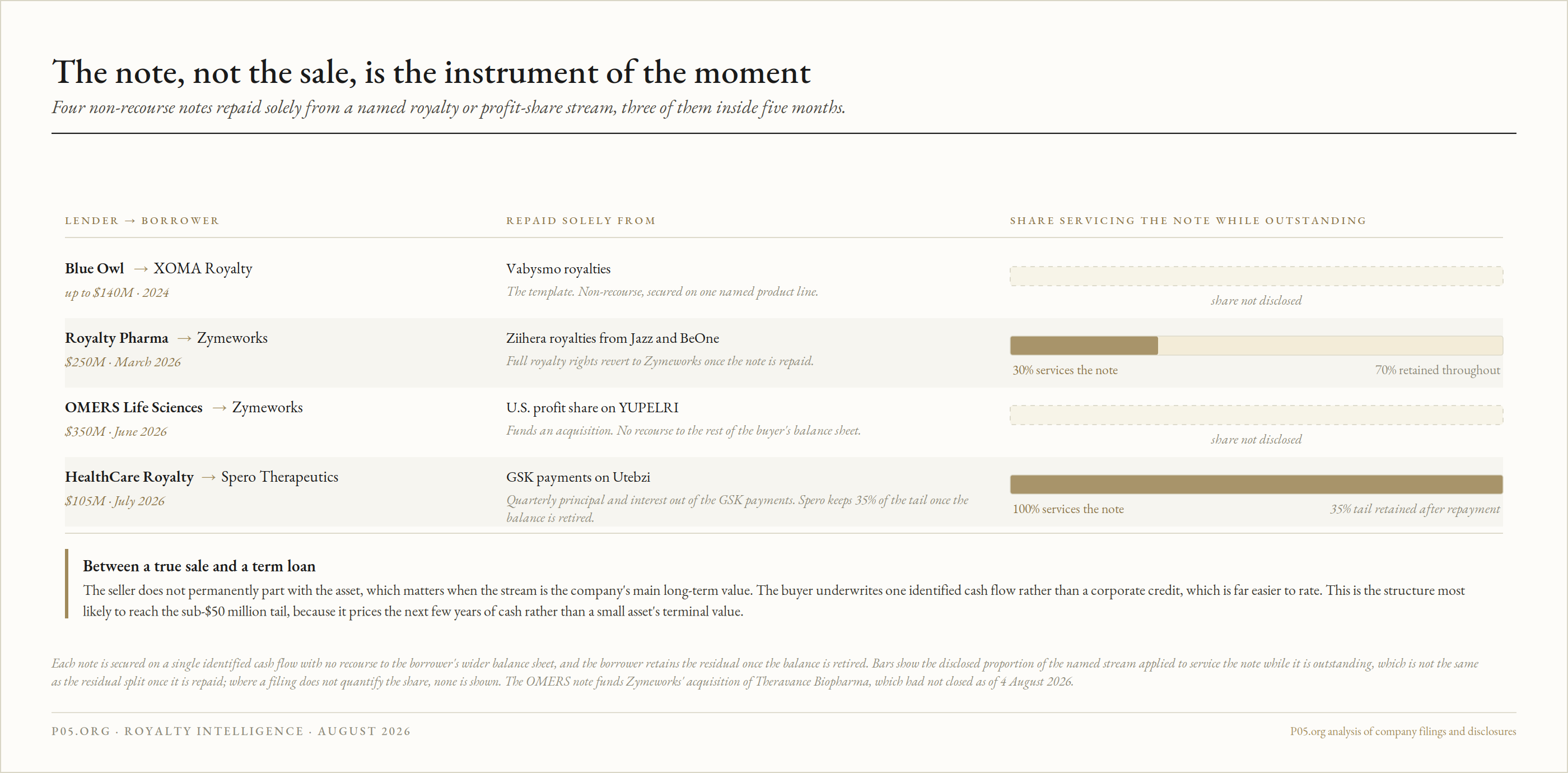
The note, not the sale, is the instrument of the moment. Four non-recourse notes repaid solely from a named royalty or profit-share stream, three of them inside five months.
Economically this sits between a true sale and a term loan, and it solves a problem both sides had. The seller does not permanently part with the asset, which matters when the stream is the company's main long-term value. The buyer gets a defined repayment profile secured on a single identified cash flow rather than a corporate credit, which is far easier to underwrite and, in principle, far easier to rate.
For anyone thinking about where securitised royalty paper eventually comes from, this is the instrument that gets there first. It is also the structure most likely to reach the sub-$50 million tail, because it does not require the buyer to underwrite the terminal value of a small asset, only its next few years of cash.
The full picture, in one table
The table below compresses the landscape into the variables a company actually weighs. Stage, cheque size, structure and reach. Ranges are indicative and drawn from disclosed transactions, not hard mandates.
| Buyer | Archetype | Typical stage | Cheque size | Structures | Therapeutic centre of gravity | Edge cases |
|---|---|---|---|---|---|---|
| Royalty Pharma | Dedicated buyer | Phase 2b to marketed | $75M to $2B+ | True-sale royalty, synthetic royalty, dev funding, royalty-backed notes | Broad: onco, rare, neuro, CF, I&I, respiratory | Some vaccines; no animal health or crops |
| DRI Healthcare | Dedicated buyer | Mostly marketed, pipeline now skewed pre-commercial | $50M to $300M | True-sale royalty, some synthetic | Onco, rare, ophthalmology, immunology | Minimal |
| HealthCare Royalty (KKR) | Royalty + credit | Near-commercial to commercial | $40M to $300M+ | Capped royalty, non-recourse notes, private debt | Broad, 10+ areas | Has touched animal health (vet via Elanco) |
| OrbiMed (R&C Fund V) | Royalty + credit | Phase 2 to commercial | $50M to $300M | Royalty, credit | Broad + devices, diagnostics | Strong on medtech |
| Sagard / Oberland / NovaQuest | Royalty + credit | Phase 3 to commercial | $50M to $400M | Revenue interest, structured royalty, credit | Broad | Oberland active in medtech |
| Pharmakon / BioPharma Credit | Credit-led lender | Near-commercial to commercial | $50M to $200M+ | Senior secured debt, capped royalty | Broad commercial | LSE-listed (BPCR); credit, not true-sale |
| Perceptive (Credit) | Credit-led lender | Commercial | $20M to $300M | Senior secured + revenue interest | Broad + medtech, diagnostics | Revenue-interest specialist |
| Blackstone Life Sciences | Scale manager | Pre-Phase 3 to marketed | $400M to $2B | Royalty, dev funding, structured credit, co-creation | Onco, I&I, cardio-metabolic | Vaccines (Moderna); no animal health or crops |
| Blue Owl | Scale manager | Phase 2 to commercial | $140M to $1B+ | Royalty, credit, growth equity, royalty-backed notes | Broad + radiopharma | Minimal |
| Sixth Street | Scale manager | Phase 3 to commercial | $300M to $1B | Royalty + senior secured credit, structured equity | Onco-led, broad | Minimal |
| OMERS Life Sciences | Institution (pension) | Approval to marketed | $150M to $500M | Capped tiered royalty, launch loans, non-recourse notes | Rare, respiratory, cardio-metabolic | Patient capital, holds long |
| CPP Investments | Institution (pension) | Approval to marketed | $200M to $1B+ | True-sale / synthetic royalty | Blue-chip, broad | Direct pension buyer (BridgeBio, Keytruda) |
| Partners Group | Cross-sector royalty platform | Approved / commercial (pharma sleeve) | Flexible, evergreen | Buy, create, lend, fund-invest | Pharma one of several: also music, film, sports, brands, energy | Swiss; ~$1.5B strategy AuM; 10 to 20 year hold |
| CBC Group / R-Bridge | Regional (Asia) credit + royalty | Approval to commercial | $40M to $100M+ | Royalty / revenue-interest financing | Broad + medtech | Asia-anchored, global; GHO combination closing early 2027 |
| Ligand | Aggregator / originator | Phase 1 to marketed | $25M to $75M lead | Royalty origination, syndication, milestones | Onco, rare, CNS, ophthalmology, vaccines | XOMA book folded in July 2026; 200+ assets |
| Zymeworks | Aggregator / acquirer (operating co.) | Commercial | Company acquisitions (~$0.9B Theravance, pending) | Company purchase, profit share, non-recourse royalty notes (RP, OMERS) | Onco (own pipeline) + acquired respiratory | Buys and restructures companies for royalty economics |
| RTW Investments | Crossover | Phase 2 to commercial | $25M to $125M | Equity, convertibles, dedicated royalty holdings | Science-led, broad | Royalty usually part of a wider package |
| Runway Growth (ex-SWK) | Small-ticket specialist | Commercial | $5M to $25M | Structured debt, some legacy royalty | Small and mid commercial | SWK exited royalties; absorbed April 2026 |
Vaccines, animal health, and the empty quadrant
The therapeutic question the table answers in summary deserves its own look, because it is where the asset class reveals its shape. The second chart treats the two halves of the market differently on purpose. For the mainstream categories it shows depth of coverage, because almost everyone plays and the question is how seriously. For the rarer edges it shows something more honest: a count of the disclosed deals each buyer has actually done. A shaded box that says a firm "does vaccines" on the strength of a single transaction flatters the category. A number does not.
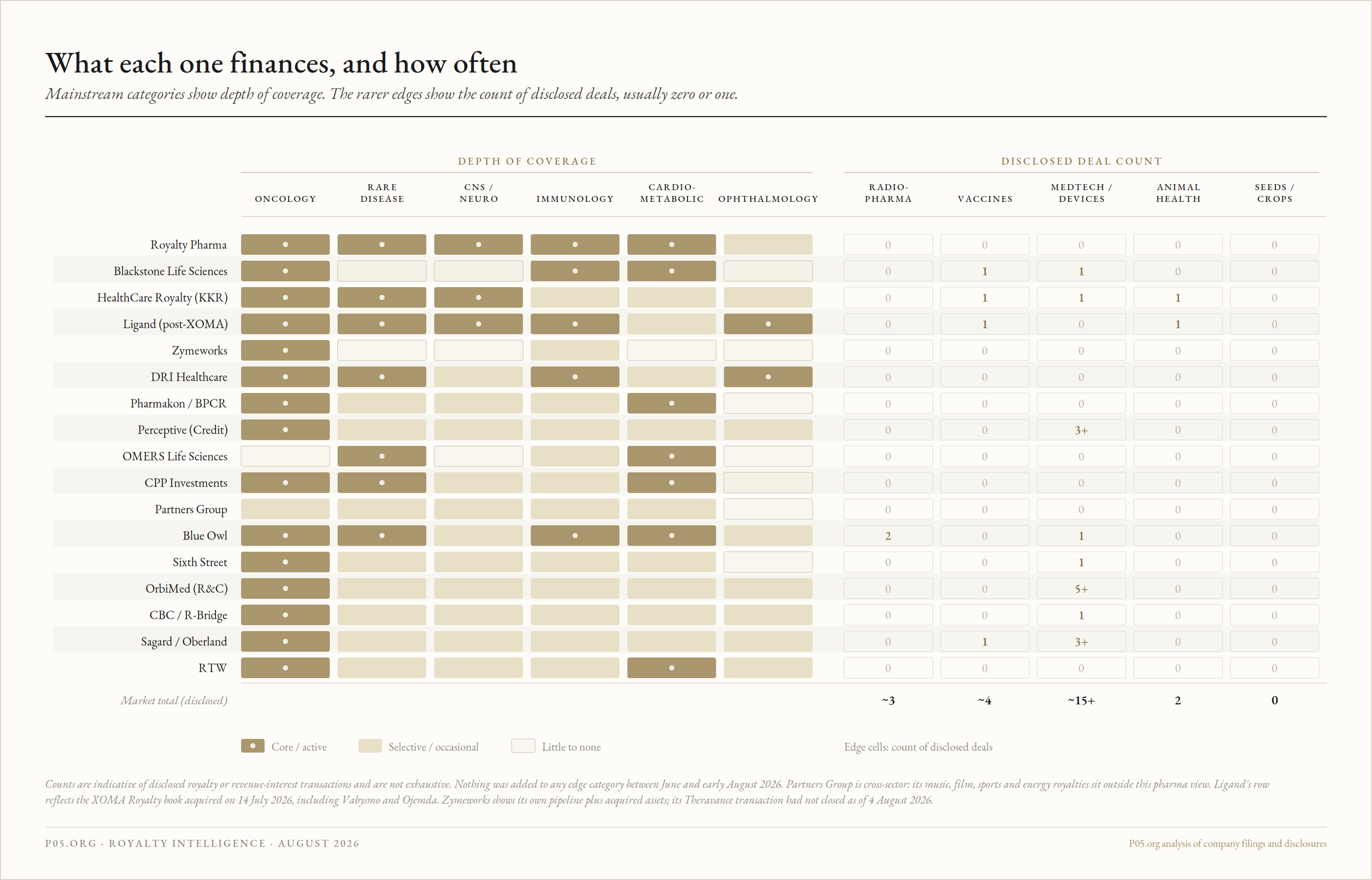
What each one finances, and how often. Mainstream categories show depth of coverage; the edges show the count of disclosed deals, which is almost always zero or one.
Three things stand out.
The middle is crowded. Oncology and rare disease are funded by essentially everyone, and each runs to dozens of disclosed deals over recent years. Immunology, neuroscience and cardio-metabolic disease are well covered by the larger and mid-sized players, and immunology in particular has become the most contested single category, carrying both the Apogee financing and the Royalty Pharma arrangements with J&J and Teva. A company with a marketed oncology or rare-disease royalty has the most buyers and the most leverage. This is the commodity centre of the market, and pricing there is competitive precisely because supply of capital is deep.
The edges are rare, and the count proves it. This is the point that a coverage map alone hides. Strip the mainstream categories away and the disclosed deal count in the rest collapses. Two months of additional tape, June through early August 2026, added nothing to any edge category. The chart below makes the scale explicit.
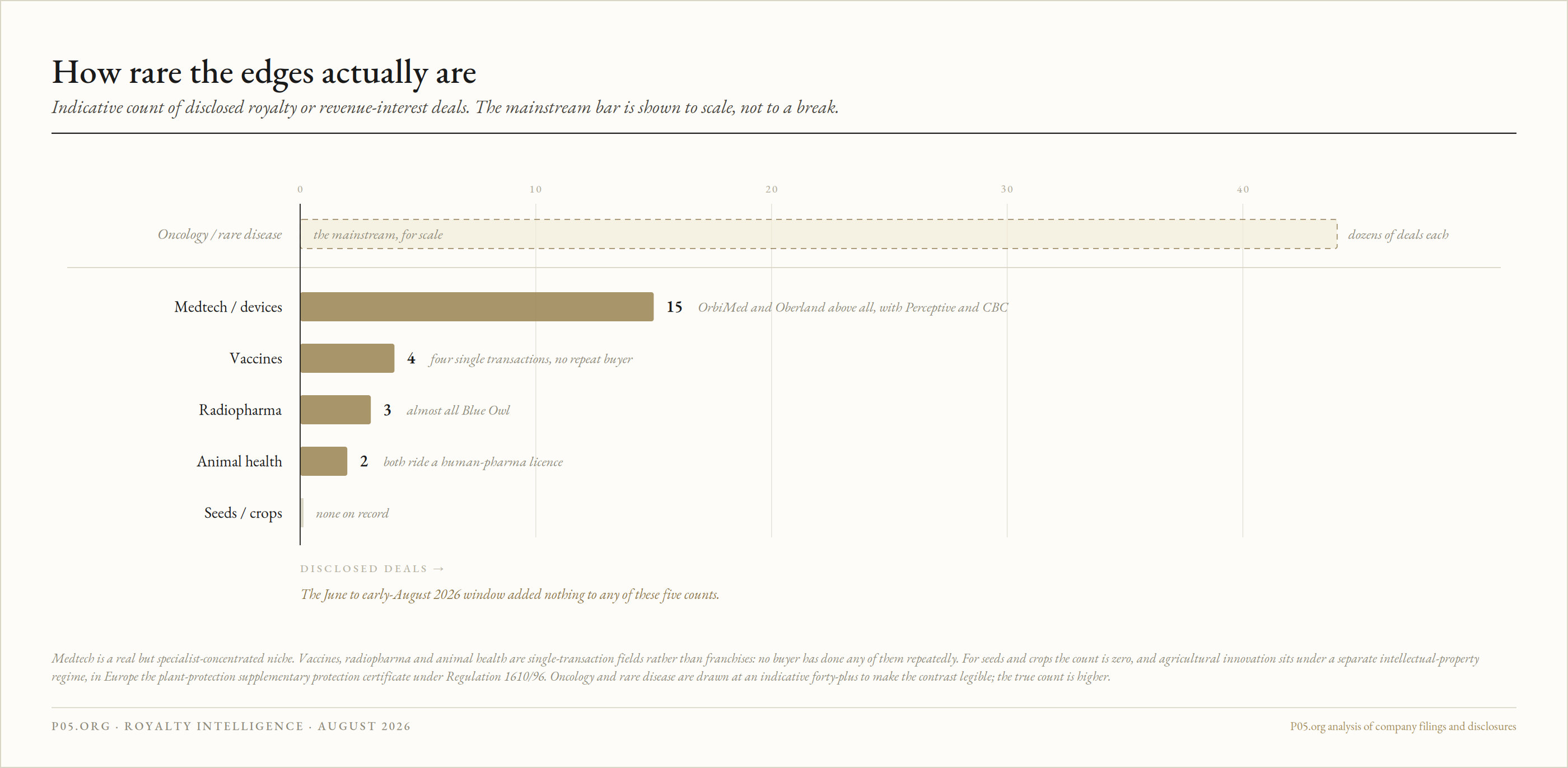
How rare the edges actually are. Indicative counts of disclosed royalty or revenue-interest deals, drawn to the same scale as the mainstream rather than to a break.
Radiopharma is hot in venture and cold in royalties. It is the cautionary case. The category is one of the most fashionable in oncology, with large equity rounds and multi-billion-dollar acquisitions, yet the number of disclosed royalty or revenue-interest deals is tiny, on the order of two or three, and almost all of them sit with one buyer, Blue Owl, through Pluvicto and ITM. Venture heat is not royalty depth, and conflating the two is exactly the error a frequency count corrects.
Vaccines are a minority sport, not a franchise. Across the whole market the disclosed count is roughly four, and it is built from single transactions: HealthCare Royalty's QS-21 and Shingrix royalty bought from Agenus, Blackstone's three-quarter-billion-dollar mRNA influenza cheque to Moderna, Ligand's pneumococcal holding, an Oberland vaccine bond. No buyer has done this repeatedly. A vaccine developer should read that as a thin, idiosyncratic field and target the two or three names that have actually transacted, not assume the category is bankable because a box is shaded.
Medtech is a real niche, but a concentrated one. It is the one edge category with genuine depth, perhaps fifteen disclosed deals, but it is not spread across the field. It lives with a handful of specialists, OrbiMed and Oberland above all, with Perceptive in devices and diagnostics and CBC's R-Bridge in aesthetics. A device or diagnostics company is not choosing among many royalty buyers; it is choosing among a few, and should know which ones before it starts.
Animal health and crops are the empty quadrant. The human-pharma royalty machine almost never reaches animal health, and when it does, it is because a veterinary product happens to ride a licence struck with a human-pharma counterparty, as in the Elanco-linked Bexacat deal HCRx financed. The disclosed count is two, full stop. For seeds and crops it is zero.
Agricultural innovation has its own intellectual-property regime (in Europe, the plant-protection supplementary protection certificate under Regulation 1610/96 sits parallel to the medicinal one) and its own, far thinner, financing world. For an originator, that absence is not only a gap. It is white space. The streams exist, they are patent-protected, and almost none of the large buyers are structured to look at them.
When a company should call whom
The most useful way to read all of this is backwards, from the company's situation to the right counterparty. Three questions decide it.
What are you monetising? There are two fundamentally different sales. If you receive a royalty from a partner who licensed your asset, you can sell that third-party stream outright. That is a true sale, and the natural buyers are the dedicated houses and patient-capital pools: Royalty Pharma, DRI, OMERS, CPP Investments. The Neurimmune sale to Royalty Pharma in July is the clean recent example. If instead you want to raise against your own product's future sales, you are creating a synthetic royalty or a revenue interest, and the field widens to the credit-and-royalty platforms, the credit-led lenders and the scale managers. And if you want capital now without giving up the stream permanently, the non-recourse royalty-backed note is now a live third option.
At what stage? This is the sharpest filter, and it maps cleanly onto the first chart.
- Preclinical and Phase 1. This is equity and venture territory. Royalty capital barely applies. The early-stage fragment book Ligand inherited from XOMA sits here, but Ligand does not actively originate at this stage, and fragment aggregation in any case monetises a sliver rather than funding the company. Do not expect a royalty solution to your cash runway here.
- Phase 2. Still early for pure royalty, but no longer empty. The realistic options are crossover investors who blend instruments (RTW), the broader royalty-and-credit platforms (OrbiMed, Blue Owl), a development-funding option from Royalty Pharma, and, for a genuinely large asset with strong Phase 2 data, Blackstone. The cost of capital reflects the risk, and the tranching will be severe.
- Phase 3. The single most contested stage, and the home of the modern synthetic royalty. A late-stage programme that needs scale can run a real process across Royalty Pharma, Blackstone, Ligand, Sixth Street, Blue Owl and the near-commercial end of HCRx. This is where competition is fiercest and where structure matters most.
- Approval and launch. Revenue-interest financing, launch loans and senior secured credit dominate, from OMERS, HCRx, DRI, Blue Owl, Sagard, Oberland, Pharmakon, Perceptive and, in Asia, CBC, frequently paired to fund the commercial build.
- Marketed and established. The classic true-sale royalty monetisation, where Royalty Pharma, DRI, OMERS and CPP Investments compete for clean, patent-protected streams.
For how much? Size sorts the field as bluntly as stage. Above roughly $300 million, the realistic counterparties are Royalty Pharma, Blackstone, Sixth Street, Blue Owl, OMERS, CPP Investments and, on the credit side, Pharmakon, and almost no one else. Between $50 million and $300 million, the field is at its deepest: HCRx, DRI, OMERS, OrbiMed, Sagard, Oberland, Perceptive, CBC and Blue Owl all live here.
Below $50 million, the giants mostly decline, and the company is left with the aggregators, the smaller specialists, syndicated structures, and in Europe and Asia the EIB, IPF and CBC. That band thinned further when SWK exited royalties and was absorbed into Runway Growth in April 2026, and it is the least intermediated and worst served part of the market, which is exactly why it is where origination, rather than capital, is the binding constraint.
What it means
For companies raising capital. Sequence the ask to the stage, and run a process rather than accept the first sheet. A marketed oncology royalty has many buyers and should be competed hard. A Phase 2 vaccine programme has few, and the work is in finding the two or three who will engage at all.
The single most common error is mismatching: taking a large-cap buyer's time with a small or early asset, or selling a clean marketed stream to the first caller when three would have bid. Know which archetype fits your situation before you send the first email. And do not assume the choice is sale or nothing: the note structure now lets a company raise against a stream it intends to keep.
For the buyers. The competitive ground has moved again. The marketed-royalty centre is crowded and priced accordingly, which is why almost every serious player has pushed earlier, first into Phase 3 development funding and the launch window, and now, on the Apogee evidence, into the pre-Phase 3 window where structure and tranching do the risk management that stage used to do.
When even DRI describes its pipeline as skewed pre-commercial, the migration is complete. The defensible edges are at the boundaries: the sub-scale long tail that the large funds cannot reach economically, and the categories, vaccines, medtech, animal health, that most of the field avoids. Whoever can originate and underwrite there competes on something other than cost of capital.
For investors in the asset class. Consolidation was the headline of 2025 and the first half of 2026, and by August it has largely been executed rather than merely announced. KKR controls HCRx. Ligand has closed on XOMA. Royalty Pharma and DRI have both internalised. Blackstone has raised the largest life-sciences fund on record. BlackRock has bought both Kreos and HPS.
CVC has completed Marathon. Runway Growth has completed SWK. Two remain outstanding: CBC and GHO, closing early 2027, and Zymeworks and Theravance, closing in the second half of 2026. A parallel move is operating companies acquiring whole businesses for their royalty economics, financed by ring-fenced, non-recourse royalty notes. The capital base is getting larger, more permanent and more concentrated.
That deepens the market for large, de-risked streams and compresses spreads there. It does not, on its own, solve the small-deal problem, which remains a question of origination and intermediation rather than of available capital.
The verdict
There is no such thing as a royalty fund in the singular. There is a layered market of buyers who each price a different risk at a different stage for a different cheque, and the skill, for anyone sitting on a royalty or trying to raise against one, is reading which layer the asset belongs to.
The centre of that market, marketed streams in mainstream therapeutic areas, is deep, liquid and competitive, and a seller there holds the leverage. The contested frontier has moved from Phase 3 to the window before it, where the synthetic royalty is now written in tranches against enrolment and data rather than against approval.
And the edges, the sub-$50 million long tail, vaccines, medtech, and the near-empty quadrant of animal health and crops, are where capital is thin not because the streams are bad but because almost no one is built to originate them.
The map is not static. It consolidated visibly over the last two years, the cheques got bigger, and in the last quarter the instrument set widened. But the underlying logic held: match what you are monetising, at what stage, for how much, to the buyer built for exactly that, and the asset class works the way it is supposed to. Miss the match, and you will conclude the market is broken when in fact you were simply talking to the wrong layer of it.
Reflects publicly available information as of August 2026, derived from company filings and disclosures, press releases, regulatory documents and financial news reporting. Transaction sizes and engagement ranges are indicative and drawn from disclosed deals; they are not statements of any firm's formal mandate and may have changed since publication. Pending transactions are identified as such. For informational purposes only; not investment, legal, or financial advice. The author is not a lawyer or financial adviser.