
Fund of the week: Binney Street Capital (Dana-Farber)
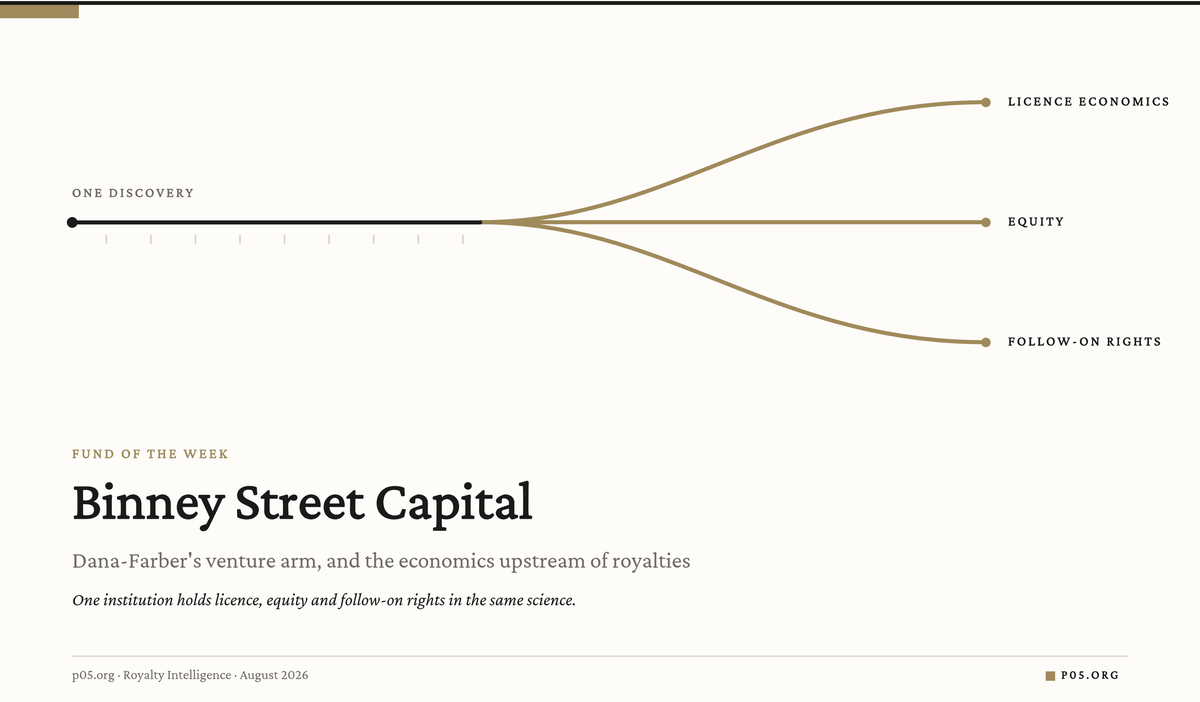
Binney Street Capital is the venture fund of Dana-Farber Cancer Institute, the Boston academic cancer centre.
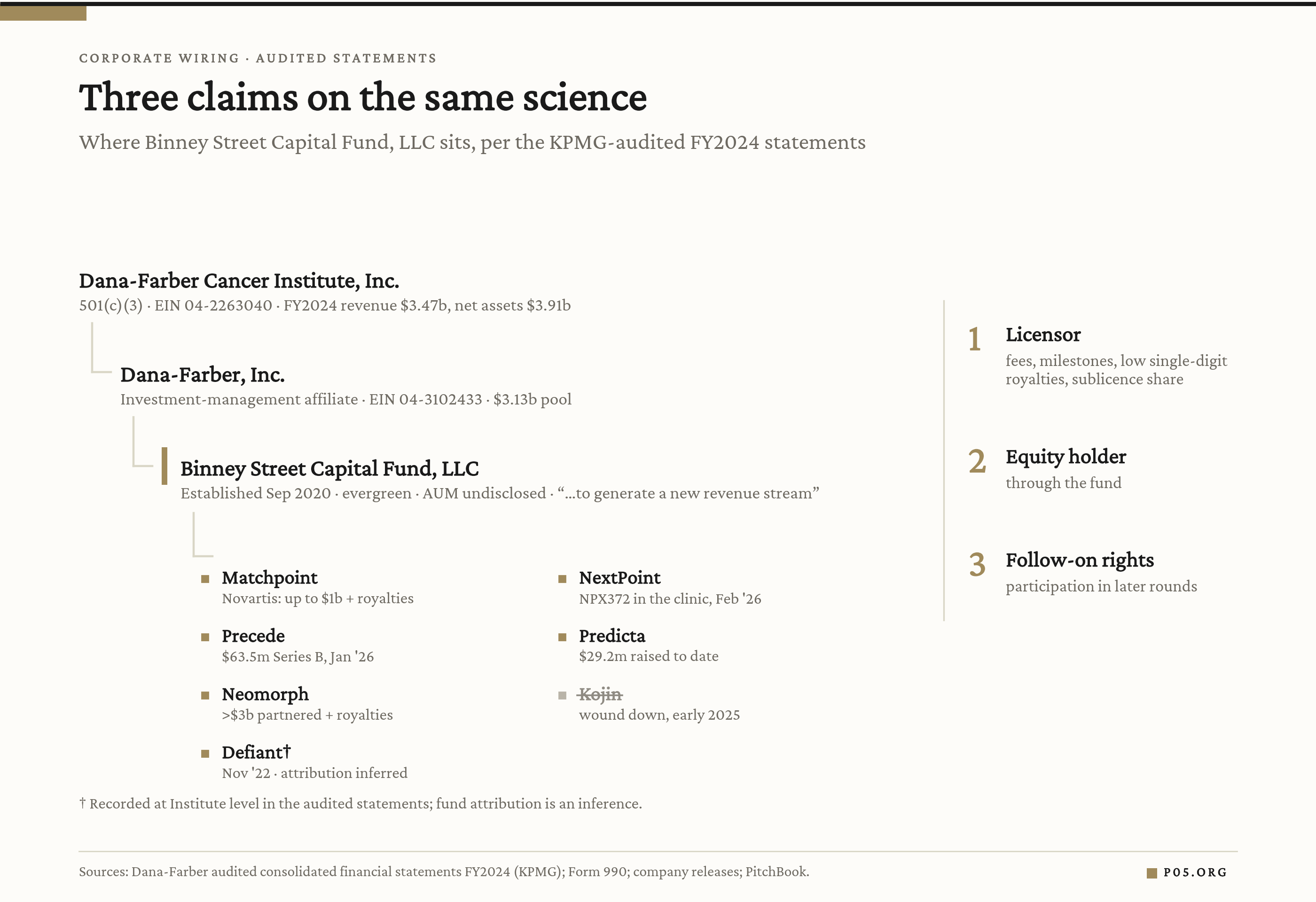
Established in September 2020 and publicly launched in January 2021 as the Institute's first venture fund, it invests in companies built on Dana-Farber intellectual property or co-founded by Dana-Farber investigators, from company creation through early clinical validation.
The primary focus is oncology therapeutics and diagnostics, with a stated willingness to pursue other disease areas and sectors. Luba Greenwood, formerly of Roche and Verily, built and leads the fund as Managing Partner.
The fund's equity book sits directly upstream of royalty creation: its portfolio companies have signed partnering deals carrying tiered royalties, including Matchpoint's up to $1B agreement with Novartis and Neomorph's more than $3B of aggregate partnering headroom with AbbVie, Biogen, and Novo Nordisk.
The parent, meanwhile, has been a central party in PD-1/PD-L1 patent litigation: the Honjo-Freeman patents, on which Dana-Farber's scientist was added as co-inventor after litigation with Ono and Bristol Myers Squibb, were licensed at 6.5 percent of worldwide Keytruda net sales and 8 percent of Libtayo sales, and the dispute was settled globally in April 2023.
The fund holds no purchased royalties.
At a glance
- What it is: the wholly owned venture fund of Dana-Farber Cancer Institute, investing institute capital in Dana-Farber spinouts and affiliated companies
- Parent: Dana-Farber Cancer Institute, Inc., Boston (450 Brookline Avenue, Longwood Medical Area); the fund is named after Binney Street, which borders the campus
- Structure: formally Binney Street Capital Fund, LLC, established September 2020 as a wholly owned subsidiary of Dana-Farber, Inc., the Institute's investment-management affiliate, "to develop novel therapies, improve patient outcomes, and generate a new revenue stream", per the audited financial statements; publicly launched January 2021 as Dana-Farber's first venture fund
- Parent scale: FY2024 (ending Sept) revenue of $3.47B, net assets of $3.91B, total assets of $5.35B, per Form 990
- Parent royalty income: $63.1M in FY2024, with a $328.2M figure in FY2023 (9.7 percent of total revenue), the fiscal year of the Ono/BMS settlement; the recent recurring range is roughly $40M to $111M per year
- Leadership: Luba Greenwood, Managing Partner since inception (prior: Roche, Verily); Steven Neier joined as Principal at launch
- Mandate: startups created with Dana-Farber IP or co-founded by a Dana-Farber investigator; therapeutics first, plus diagnostics, digital health, and services
- Initial sizing: $250,000 to $2M per investment, eight to ten companies over three years, per the launch plan
- Committed capital: undisclosed; funded by the Institute, with returns recycled into Dana-Farber research
- Disclosed investments: seven per data-vendor records: Matchpoint Therapeutics, NextPoint Therapeutics, Precede Biosciences, Predicta Biosciences, Neomorph, and Kojin Therapeutics (a $60M Series A participant in June 2021 that wound down in early 2025); a November 2022 non-controlling minority investment in Defiant, Inc., recorded at Institute level, is the likely seventh
- 2026 parent financing: roughly $1.4B of MassDevelopment Series Q and R bonds priced in late April 2026 for the Future Cancer Hospital and a near-total refinancing; Moody's moved the rating to A2 from A1 citing leverage, S&P affirmed A with the outlook revised to stable
- Adjacent structure: the 2020 alliance with MPM Capital, comprising the $100M MPM Oncology Innovations Fund and the $26M+ Dana-Farber Innovations Research Fund, with MPM holding a right of first offer on selected Dana-Farber technologies
- Royalty interests: none held directly by the fund; the parent receives licensing income across its patent estate, holds the confidential 2023 settlement economics of the Honjo-Freeman PD-1/PD-L1 dispute, and separately owns the Freeman PD-L1 (B7-4) patent family licensed to BMS, Merck, Roche, Novartis, Boehringer Ingelheim, Amplimmune, and Merck Serono
- Standard licence economics: Dana-Farber spinout and platform licences typically carry low single-digit royalties on net sales plus a share of sublicence fees; one disclosed Harvard/DFCI agreement runs to low single-digit royalties, up to mid-twenties percent of sublicence fees, and up to $7.7M in milestones per therapeutic product
A note on scope
Binney Street Capital is a captive, evergreen corporate venture unit with no external limited partners. The legal entity, Binney Street Capital Fund, LLC, sits under Dana-Farber, Inc., the Institute's investment-management affiliate, and is distinct from the MPM alliance funds, which are managed by MPM Capital.
Investment thesis and mandate
The stated approach is patient-centric investing across the innovation life cycle, from company creation through early clinical validation, in companies drawing on technologies or expertise from the Institute.
The fund describes an evaluation process weighing biological, technical, and translational risk, and positions itself as a long-term strategic partner offering clinical expertise and access to Dana-Farber's research base alongside capital.
The sourcing base is the Institute itself. Dana-Farber research and IP have enabled the creation of more than 51 startups, including more than 11 in the three years before launch, including targeted protein degradation.
Before Binney Street Capital, the Institute licensed technologies without holding equity in the resulting companies. The fund lets Dana-Farber invest in its own spinouts and exercise participation rights in subsequent rounds, per then Chief Innovation Officer Lesley Solomon.
There is no royalty, credit, or revenue-interest mandate.
How capital enters and returns
One vehicle, one capital source, three return paths.
Direct venture investing. The launch plan targeted eight to ten companies over three years at $250,000 to $2M per investment, a seed-to-Series-A cheque size that places the fund alongside institutional syndicates, not as round lead.
In practice the fund has participated from Series A through Series B. Kojin Therapeutics' $60M Series A in June 2021 came alongside Polaris Partners, Newpath Partners, and Cathay Health.
Precede Biosciences' $83.5M January 2026 financing ($63.5M Series B plus a $20M non-dilutive credit facility) included the fund as an existing investor, with Labcorp Venture Fund, UPMC Enterprises, Mirae Asset Capital, 28 Capital, and Alexandria Venture Investments joining.
Neomorph's $100M Series B in April 2026 was led by Deerfield Management with Regeneron Ventures, Longwood Fund, and Alexandria Venture Investments.
Kojin is the fund's first known write-off: the ferroptosis biotech wound down in early 2025 after it did not secure follow-on funding.
Licensing economics at the parent. Investments target companies built on Dana-Farber IP, so the Institute typically holds licence economics (fees, milestones, royalties) and equity in parallel. The fund's equity return and the technology transfer office's contractual return are two claims on the same science.
Recycling. Returns support ongoing discovery at the Institute, making the vehicle evergreen in intent: exits fund the next generation of Dana-Farber science instead of distributions to outside LPs.
Financial profile and assets
| Item | Amount | Source and date |
|---|---|---|
| Committed capital | undisclosed | Fund does not publish AUM |
| Parent revenue / net assets | $3.47B / $3.91B | Form 990, FY ending Sept 2024 |
| Parent royalty revenue | $63.1M (FY2024); $328.2M (FY2023); $42.4M (FY2022) | Form 990 filings |
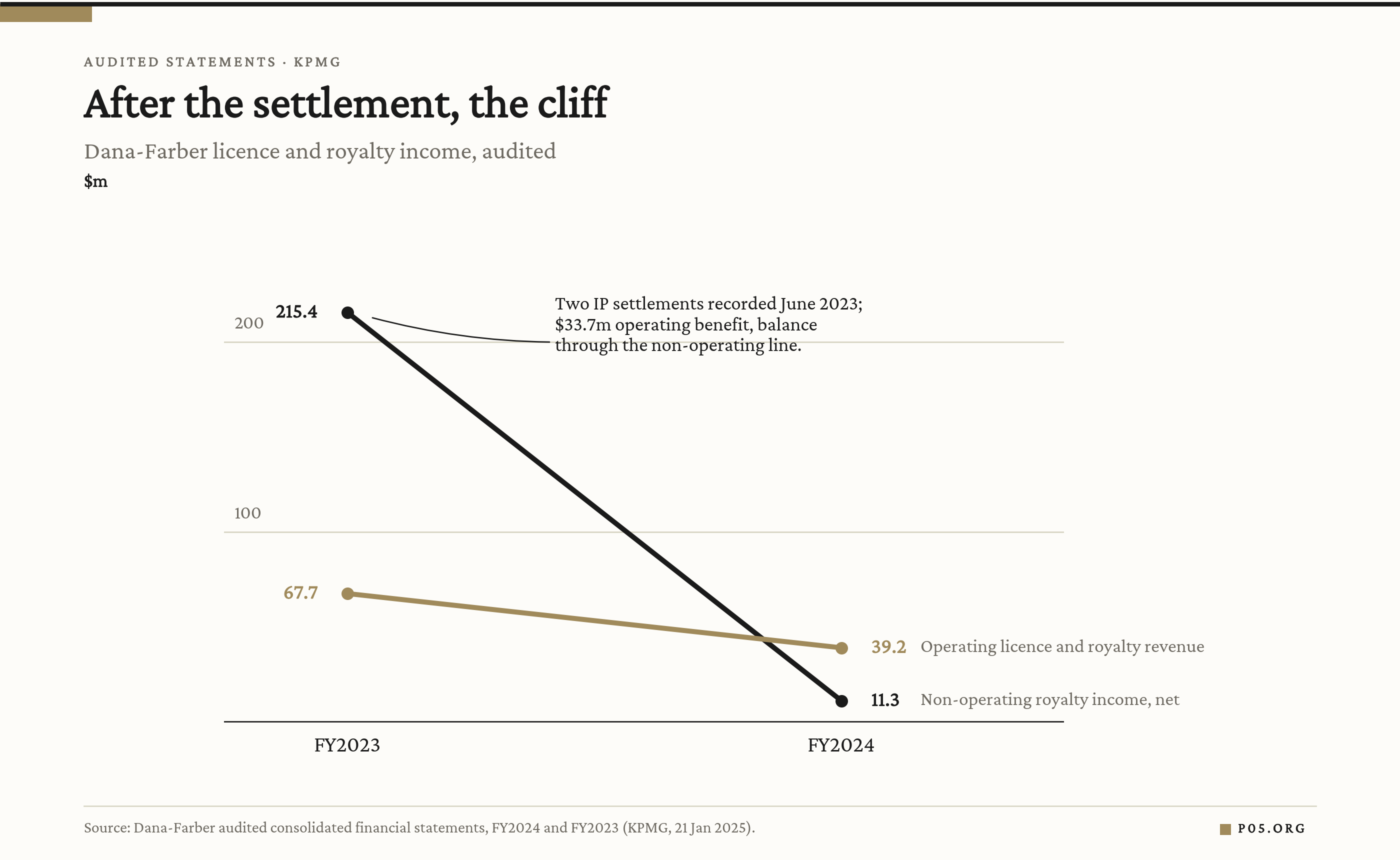
| Licence and royalty revenue, operating | $39.2M (FY2024); $67.7M (FY2023) | Audited statements, KPMG |
| Royalty income net of expenses, non-operating | $11.3M (FY2024); $215.4M (FY2023) | Audited statements, KPMG |
| Parent investment pool | $3.13B, incl. $1.53B hedge/PE at NAV; $292.0M unfunded commitments | Audited statements, 30 Sep 2024 |
| Per-investment sizing | $250,000 to $2M | Launch plan, Jan 2021 |
| Planned portfolio | 8 to 10 companies over 3 years | Launch plan, Jan 2021 |
| Disclosed investments | 7 | PitchBook, CB Insights, 2026 |
| MPM Oncology Innovations Fund (alliance) | $100M | Announcement, 2020 |
| Dana-Farber Innovations Research Fund (alliance) | more than $26M pledged | Announcement, 2020 |
| Neomorph Series B (participation) | $100M round | Press release, 13 Apr 2026 |
| Precede Series B (participation) | $63.5M equity plus $20M credit facility | Press release, 12 Jan 2026 |
| Kojin Series A (participation) | $60M round; company wound down early 2025 | Press releases, Jun 2021 and 2025 |
| Predicta funding to date (participation) | $29.2M total raised | PitchBook, 2026 |
| Parent Series Q and R bonds | approximately $1.4B ($1.304B Series Q; $91.98M Series R forward delivery) | Bond Buyer, priced late Apr 2026 |
| Matchpoint-Novartis agreement (portfolio) | up to $60M upfront and research funding; up to $1B total; tiered royalties | Press release, 24 Jul 2025 |
| Merck royalties to BMS/Ono on Honjo-Freeman patents (parent-adjacent) | more than $2B received by 2019; 6.5% then 2.5% through 2026 | Court filings, 2021 |
| Ono/BMS settlement to Dana-Farber (parent) | lump sum plus possible future payments, confidential | Settlement release, 7 Apr 2023 |
The portfolio book
The publicly displayed portfolio spans precision covalent chemistry (Matchpoint), immuno-oncology biologics (NextPoint), liquid-biopsy epigenomics (Precede), haematology diagnostics (Predicta), and molecular glue degraders (Neomorph).
Two further positions sit outside the website. Kojin Therapeutics, the ferroptosis platform, raised a $60M Series A in 2021 and wound down in early 2025. Defiant, Inc., an oncology symptom-management services company in which the Institute made a non-controlling minority investment in November 2022, is the likely seventh; the audit attributes Defiant to the Institute rather than to the fund by name.
Adjacent to the fund, Dana-Farber and Deerfield Management launched Riverway Discoveries in February 2021, with Deerfield committing up to $130M over ten years for translational research. Deerfield subsequently led Neomorph's 2026 Series B.

The parent's IP estate and the Honjo-Freeman royalty cascade
Dana-Farber's largest documented IP outcome is the PD-1/PD-L1 inventorship case.
After a 2019 bench trial, the Federal Circuit affirmed in 2020 that Dana-Farber's Gordon Freeman and Clive Wood must be added as co-inventors alongside Tasuku Honjo on six US patents underpinning Opdivo. The Supreme Court declined to hear the appeal in 2021, confirming Dana-Farber's ability to license the technology.
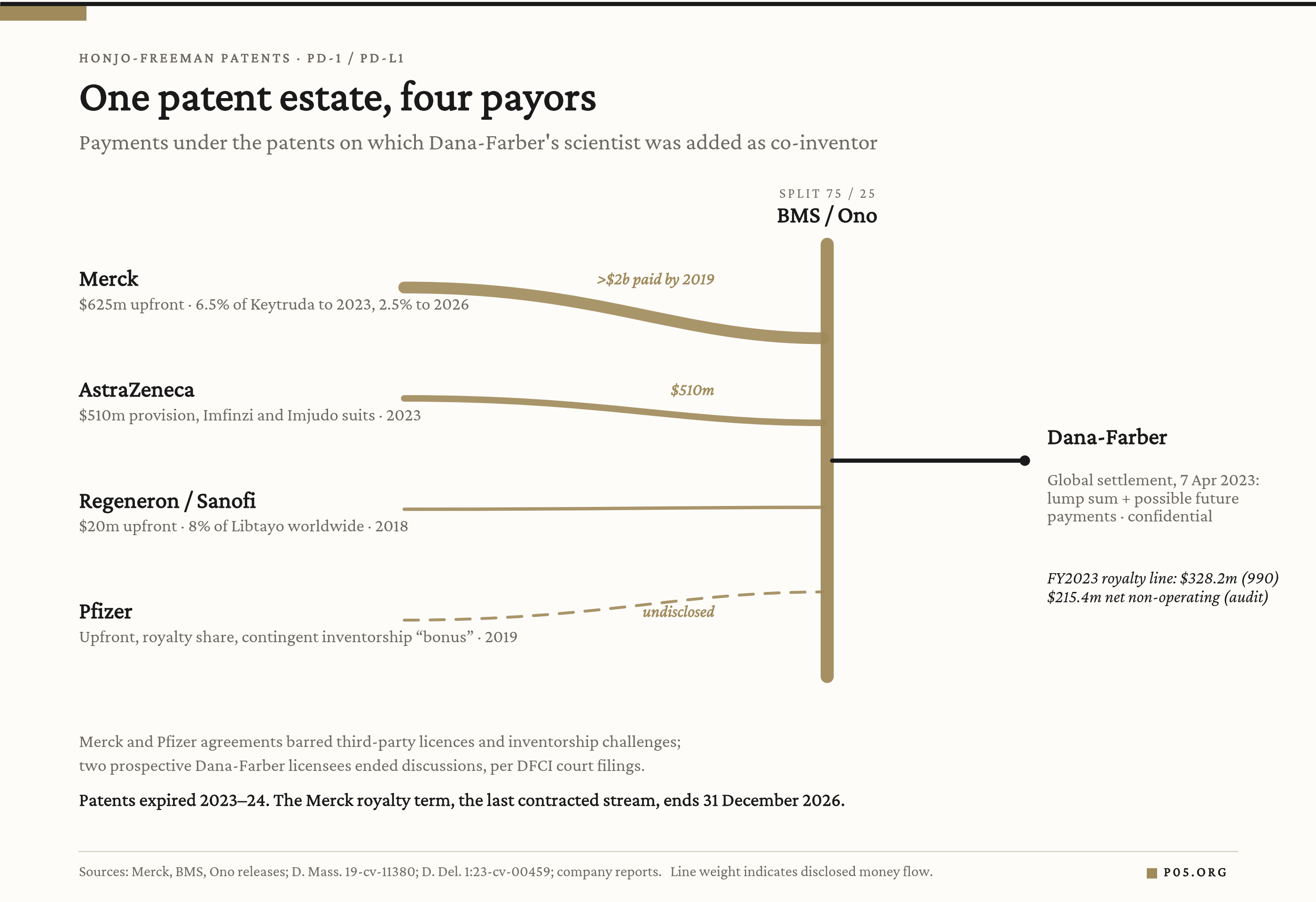
The patents at issue had already been licensed repeatedly. Under the January 2017 settlement, Merck paid Ono and BMS $625M upfront plus 6.5 percent of global Keytruda net sales from 2017 through 2023, stepping down to 2.5 percent from 2024 through 2026, the royalty split 75/25 between BMS and Ono.
Per Dana-Farber's own court filings, Merck had paid more than $2B in royalties by 2019 under that agreement alone. The same complaint records an August 2018 licence to Regeneron and Sanofi at $20M upfront plus 8 percent of worldwide Libtayo sales, and a February 2019 Pfizer settlement comprising an upfront payment, a share of the defendants' future royalties, and a contingent payment (a "bonus", in Dana-Farber's characterisation) if the defendants succeeded in keeping Freeman off the patents.
In 2023, AstraZeneca took a $510M provision to settle the related Imfinzi and Imjudo suits.
| Payor | Product | Terms | Date |
|---|---|---|---|
| Merck | Keytruda | $625M upfront; 6.5% of global net sales 2017 to 2023; 2.5% 2024 to 2026; BMS/Ono split 75/25 | Jan 2017 |
| Regeneron and Sanofi | Libtayo | $20M upfront; 8% of worldwide sales | Aug 2018 |
| Pfizer | (Genetics Institute claims) | Upfront plus royalty share plus contingent inventorship "bonus"; restrictive covenants | Feb 2019 |
| AstraZeneca | Imfinzi, Imjudo | $510M provision to settle | 2023 |
| Dana-Farber (recipient) | Settlement of all disputes | Lump sum plus possible future payments; confidential | Apr 2023 |
The cascade also carried licensing restrictions relating to Dana-Farber.
The Merck agreement obliged Merck never to seek a licence from any third party even if its own licence terminated, and not to challenge or support any inventorship challenge. The Pfizer agreement barred Pfizer from taking a third-party licence and from supporting Dana-Farber in litigation. Dana-Farber's unjust-enrichment complaint alleged these covenants reduced the licensing value of its inventorship ruling, with two prospective licensees ending discussions.
The April 2023 global settlement resolved all of it: a lump-sum payment to Dana-Farber with the possibility of additional future payments, terms confidential.
The underlying patents expired in 2023 and 2024, and the Merck royalty term runs through 31 December 2026, so the remaining contracted payments under the cascade end this year.
Investors
There is no limited-partner roster. The fund invests Dana-Farber Cancer Institute capital, and the Institute is the sole beneficiary of returns.
The structure gives the fund a single beneficiary; capacity is set by the Institute's balance sheet and board decisions rather than by fundraising.
The adjacent MPM alliance is the external-capital counterpart. The MPM Oncology Innovations Fund raised $100M from MPM's investor base to create and back companies drawing on Dana-Farber science, with roughly half expected to go to companies built on Dana-Farber research, while the philanthropic Innovations Research Fund channels donor capital into early-stage research.
Governance and compensation
Luba Greenwood has led the fund as Managing Partner since inception, having previously held senior corporate development and legal roles at Roche and business development at Verily. She concurrently co-founded and leads Gallop Oncology as CEO and became a Harvard Business School Executive Fellow in 2026.
She has also held operating roles in the portfolio: she served as CEO and Board Chair of portfolio company Kojin Therapeutics through its wind-down, with fund Principal Steven Neier as board observer there and at Matchpoint.
Neier, who joined as Principal at launch and previously managed the MPM alliance, remains the only other named team member. Data vendors continue to list a single senior professional, and no fund size, AUM, or performance figure has been disclosed.
Above the fund sits Dana-Farber Cancer Institute, whose President and CEO since October 2024 is Benjamin Ebert, himself a scientific co-founder of Neomorph alongside Phil Chamberlain, Eric Fischer, and Scott Armstrong, a direct link between institutional leadership and portfolio science. Laurie Glimcher, President and CEO at the fund's launch, championed its creation.
The Institute's FY2024 Form 990 discloses executive compensation at the parent (Glimcher at $2.1M plus benefits as outgoing CEO; Ebert at $209,100 in his prior role as Chair of Medical Oncology) and reports related-party transactions on Schedule L. The fund team's compensation is not separately reported, and Greenwood does not appear among the listed officers and key employees.
IP, royalties, and the economics of return
No purchased royalty and no revenue interest are attributable to the fund.
Return comes from equity appreciation in venture rounds, mark-ups when portfolio companies raise, partner, or exit, and, at the parent level, licence fees, milestones, and royalties contracted by Dana-Farber's technology transfer function on the same underlying IP.
Royalty creation in the portfolio
The portfolio companies have entered licensing agreements that create future royalty obligations.
Matchpoint signed an exclusive option and licence agreement with Novartis in July 2025: up to $60M in upfront payment and research funding, up to $1B in total potential payments, plus tiered royalties on future product sales.
Neomorph carries more than $3B in potential milestones across its collaborations: up to $1.64B plus tiered royalties on net sales from AbbVie (January 2025), and up to $1.45B from Biogen and up to $1.46B from Novo Nordisk (both 2024).
Each of these agreements creates future royalty streams payable to a private company, streams that do not appear in public-market disclosure.
What the charity filings show
Because Dana-Farber is a 501(c)(3), parts of its royalty economics are visible through mandatory public filings. The Institute's Form 990 filings (EIN 04-2263040, fiscal years ending September) report a dedicated royalties revenue line:
| Fiscal year (ending Sept) | Royalty revenue | Share of total revenue |
|---|---|---|
| FY2011 | $7.7M | 0.8% |
| FY2012 | $5.7M | 0.6% |
| FY2013 | $7.8M | 0.7% |
| FY2014 | $25.4M | 2.3% |
| FY2015 | $11.6M | 1.0% |
| FY2016 | $7.9M | 0.6% |
| FY2017 | $3.3M | 0.2% |
| FY2018 | $5.2M | 0.3% |
| FY2019 | $96.1M | 4.8% |
| FY2020 | $50.2M | 2.5% |
| FY2021 | $111.1M | 4.6% |
| FY2022 | $42.4M | 1.6% |
| FY2023 | $328.2M | 9.7% |
| FY2024 | $63.1M | 1.8% |
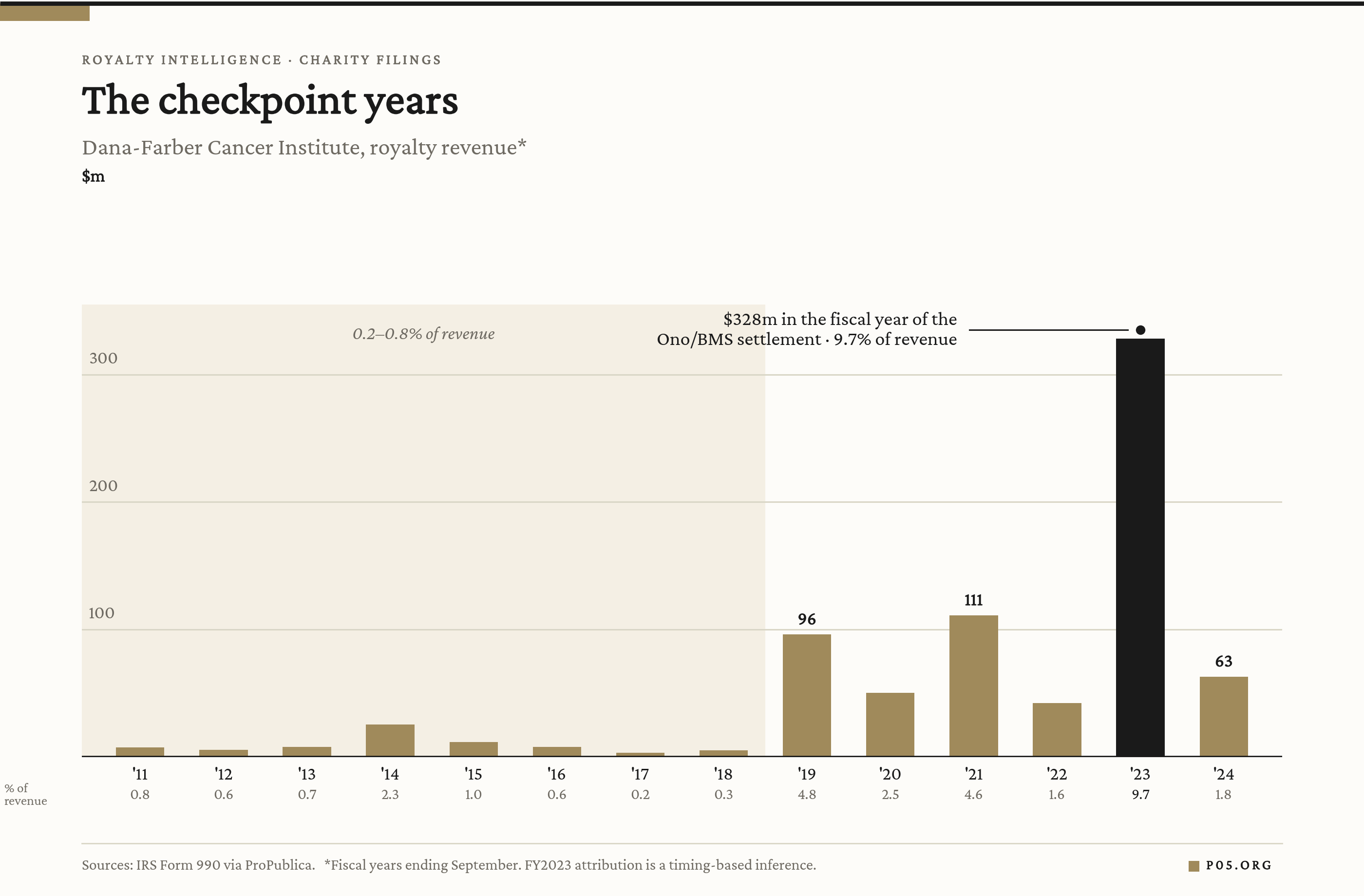
Setting the elevated years aside, royalty income sat at 0.2 to 0.8 percent of revenue for most of FY2011 to FY2018 ($3M to $25M per year), then stepped up to a recurring $40M to $65M range in recent filings, with the shift coinciding with the checkpoint-era licensing and settlement period.
Royalty revenue of $328.2M in FY2023, nearly 10 percent of total revenue and roughly $265M to $285M above the surrounding years, fell in the fiscal year containing the 7 April 2023 Ono/BMS settlement. It provides a public indication of the order of magnitude of that confidential lump sum, if the payment was booked through this line.
FY2019 ($96.1M) and FY2021 ($111.1M) also show one-off elevations against adjacent years, consistent with milestone and settlement-driven income rather than a level running-royalty stream.
The audited consolidated financial statements (KPMG, dated 21 January 2025) split the royalty economics in two. Within operating research revenues, licence and royalty revenue was $39.2M in FY2024 and $67.7M in FY2023. Below the operating line, the Institute reports royalty income, net of expenses, of $11.3M in FY2024 against $215.4M in FY2023, the board-designated portion earmarked for future research.
The notes add a detail not carried in the press releases: in June 2023 the Institute recorded two legal settlements, both relating to intellectual property, which benefited operating results by $33.7M ($26.4M of prior-year legal expense recoveries plus $7.3M of one-time royalty revenue), with the balance of the settlement impact flowing through the $215.4M non-operating royalty line.
The timing matches the April 2023 Ono/BMS global settlement and with the 2023 resolution of the AstraZeneca Imfinzi and Imjudo suits, in which Dana-Farber had joined the complaint as a party; the audit does not name the counterparties.
The statements also confirm the fund's corporate wiring and mandate. Binney Street Capital Fund, LLC was established in September 2020, four months before the public launch, as a wholly owned subsidiary of Dana-Farber, Inc., the controlled affiliate responsible for the Institute's investment management activities, and was formed "to advance the Institute's mission to develop novel therapies, improve patient outcomes, and generate a new revenue stream".
Dana-Farber, Inc. files its own return under EIN 04-3102433, reporting FY2024 revenue of $120.5M and total assets of $3.13B, matching the consolidated investment pool. As a single-member disregarded entity, the fund would appear on that return's Schedule R rather than the Institute's.
The fund therefore sits inside a $3.13B investment pool (FY2024), of which $1.53B is held in hedge funds and private equity funds valued at NAV, with $292.0M of unfunded commitments; the fund's own positions are not separately disclosed within it.
In 2026 the parent completed a large financing. Dana-Farber priced approximately $1.4B of MassDevelopment revenue bonds, Series Q ($1.304B) and Series R ($91.98M of forward-delivery bonds), in late April 2026, Goldman Sachs lead-managed.
The proceeds fund roughly half of the now approximately $1.8B Future Cancer Hospital with Beth Israel Lahey Health, refinance nearly all outstanding debt to fixed rate, and defer debt service until 2032. The Institute plans to fund roughly $800M of the project through philanthropy and announced its largest-ever gift in February 2026.
On the deal, Moody's moved the Institute's rating to A2 from A1, citing total leverage, with a stable outlook, and S&P affirmed its A rating while revising the outlook to stable. Neither agency's published commentary cited royalty income or the venture fund as a material credit factor.
The FY2024 return, filed August 2025 with a full Schedule R of related organisations, and the audited statements are the closest available fund-adjacent disclosure; the fund itself files nothing public.
Upstream rights: the Dana-Farber licence stack
The Honjo-Freeman cascade is the litigated half of Dana-Farber's checkpoint position.
The Institute also owns and co-owns the upstream Freeman PD-L1 (B7-4) patent family from the 1999 to 2000 discovery work, outlicensed by Harvard and Dana-Farber to BMS, Merck, Roche, Novartis, Boehringer Ingelheim, Amplimmune, and Merck Serono. Dana-Farber stated it wanted to extend this non-exclusive licensing posture to the Honjo-Freeman patents when it filed the inventorship case.
The rate architecture of that stack is partly visible in SEC filings. One public licensee under an amended and restated Harvard/DFCI agreement discloses royalties of low single-digit percentages on annual net sales, a share of sublicence fees of up to the mid-twenties percent, milestones of up to $7.7M per licensed therapeutic product, and annual maintenance fees of $110,000, payable product by product and country by country.
DFCI's licence templates in the public record show the same structure: royalty-bearing exclusive and non-exclusive grants with sublicensing rights and sublicence-fee sharing, with sublicence-fee carve-outs for royalties, bona fide R&D funding, and equity investment.
C4 Therapeutics holds its Degronimid platform under a 2015 exclusive licence from Dana-Farber with undisclosed rates, where standard academic spinout terms in the low single digits are expected. C4T re-licenses downstream at mid-single-digit to low-double-digit tiered royalties, a spread between the inbound academic licence and the outbound commercial licences.
Internally, the Institute's audited financial statements describe the destination of these streams: royalty and licence revenue is distributed among the inventor, the laboratory, the department where the research was performed, and the Institute, with the Institute's share designated for future research. Dana-Farber also maintains a public list of FDA-approved therapeutics and diagnostics from which it receives royalty income on its Innovations Disclosure page.
No evidence surfaced that Dana-Farber has ever sold or securitised a royalty stream. By comparison, LifeArc (then MRC Technology) monetised a portion of its own Keytruda royalty in 2016, and Massachusetts General Hospital monetised Entyvio royalty interests. Dana-Farber's checkpoint-era income appears directly in its own accounts.
At docket level, BMS filed in Delaware (1:23-cv-00459) on 25 April 2023 alleging Imfinzi infringed the '899 patent, Ono and Dana-Farber joined the complaint, and the parties filed a joint stipulation of dismissal with prejudice ordered 31 July 2023, backed by AstraZeneca's $510M provision.
The late-July dismissal sits after the audit's "June 2023" settlement-recording language, so whether the AZ resolution is one of the two recorded settlements or a separately timed event cannot be resolved from public sources; Dana-Farber's share of the $510M was not broken out.
Where the fund invests in a company built on Dana-Farber IP, the Institute typically stands three times over, as licensor (fees, milestones, low single-digit royalties, sublicence share), as equity holder through the fund, and as participant with follow-on rights. Neither royalty nor licence income sits inside the fund, but all three claims relate to the same science.
Portfolio, as of August 2026
Publicly displayed positions. Stakes and entry valuations not disclosed.
| Position | What it is | Royalty relevance |
|---|---|---|
| Matchpoint Therapeutics | Precision covalent small molecules, immunology (Watertown, MA) | Novartis option and licence: up to $1B, tiered royalties on future sales |
| NextPoint Therapeutics | B7-H7 precision oncology; NPX372 T cell engager entered the clinic Feb 2026 | Pre-partnering; Dana-Farber licence economics upstream |
| Precede Biosciences | Genome-wide liquid biopsy; launched Precede Bio Insight; $63.5M Series B plus $20M facility, Jan 2026 | Diagnostics; platform licensing potential |
| Predicta Biosciences | Molecular diagnostics for blood cancers; $29.2M raised to date; first myeloma prognostic launched; added Craig Tendler to its board May 2026 | Diagnostics; platform licensing potential |
| Neomorph | Molecular glue degraders; NEO-811 in Phase 1/2 for ccRCC; Robert Hugin appointed chairman 2026 | AbbVie, Biogen, Novo Nordisk collaborations, more than $3B potential milestones plus royalties |
| Kojin Therapeutics | Ferroptosis and cell-state biology; $60M Series A 2021; wound down early 2025 | None realised; first known write-off |
| Defiant, Inc. (likely) | Oncology symptom-management services; Institute minority investment Nov 2022 | None; services model |
Blue team and red team
Blue team
- Structural first look at Dana-Farber spinouts (research and IP linked to more than 51 startups), with participation rights in follow-on rounds
- Repeat institutional syndicates around the science: Deerfield (Riverway Discoveries, up to $130M over ten years, plus lead on Neomorph's Series B), Alexandria Venture Investments in two 2026 rounds, and the MPM alliance upstream
- Portfolio companies have signed royalty-bearing agreements: Matchpoint-Novartis and Neomorph's three billion-dollar-scale collaborations all carry tiered royalties
- The parent's IP position has been litigated and affirmed: the Honjo-Freeman inventorship ruling and the 2023 Ono/BMS settlement relate to patents licensed at 6.5 percent and 8 percent royalty rates
- Layered upstream rights: the Freeman PD-L1 estate is licensed to seven pharmaceutical companies, and standard Harvard/DFCI licence terms (low single-digit royalties plus up to mid-twenties percent of sublicence fees) sit under fund portfolio companies
- Evergreen single-LP structure removes fundraising cycles and LP-driven exit pressure
- Triple economics: fund equity, licence and royalty economics at the parent, and follow-on participation rights on the same science
Red team
- No purchased royalty, revenue interest, or structured credit; royalty exposure is indirect, through equity in future royalty payees and the parent's licensor position
- Dana-Farber's own share of the Honjo-Freeman value is a confidential lump sum plus unquantified future payments; the visible cascade rates accrued to Ono and BMS, and the FY2023 figures ($328.2M on the 990, $215.4M net in the audit, spanning two unnamed settlements) are an inference of scale, not a disclosed per-deal amount
- Parent royalty income is variable and settlement-driven ($328.2M in FY2023, $42.4M in FY2022, $63.1M in FY2024), not a recurring stream
- The Honjo-Freeman patents expired in 2023 and 2024 and the Merck royalty term ends 31 December 2026, ending the contracted payments under those patents
- Undisclosed committed capital, undisclosed stakes, no performance reporting; the vehicle is not independently verifiable from public sources
- Small cheque sizes ($250,000 to $2M at launch) mean limited ownership and limited governance in later rounds
- Key-person concentration around Greenwood, who simultaneously runs a clinical-stage biotech as CEO and served as CEO and chair of portfolio company Kojin through its wind-down, adding role overlap
- One realised loss has occurred: Kojin wound down in early 2025 after most of its largest initial backers declined to follow on
- Neither Moody's nor S&P cited royalty income or the venture fund as a material credit factor in the 2026 bond ratings
- Captive mandate limits diversification: sourcing is confined to one institution's science
- Institute executives have co-founded portfolio companies, creating related-party relationships
Implications for the pharmaceutical royalty and biotech capital markets
Binney Street Capital intersects royalty markets in three ways, none as a royalty buyer.
It applies the model in which an academic medical centre holds equity and licence economics side by side, connecting technology transfer and venture return; other cancer centres (MD Anderson's Focus Fund arrangement among them) use a similar design.
Its portfolio is generating private-company royalty streams (Matchpoint-Novartis, Neomorph's three pharma collaborations) that do not appear in public-market disclosure.
And the parent's Honjo-Freeman litigation shows that inventorship and licence chains behind marketed products can be re-opened and re-priced, with settlements carrying future-payment components, a point relevant to diligence on checkpoint-inhibitor era royalty stacks.
The cascade also supplies public rate reference points: 6.5 percent stepping to 2.5 percent for a litigated settlement licence on a large marketed product, 8 percent for a smaller launch-stage product, low single digits plus a mid-twenties sublicence share for the academic layer underneath. The Merck and Pfizer agreements included provisions restricting third-party licensing and inventorship challenges, with contingent payments tied to litigation outcomes, contract features relevant to royalty diligence.
Charity filings surface licensing economics with a lag: confidential settlement and licence income at academic medical centres appears in the Form 990 royalties line and in the audited statements' non-operating royalty income.
Here, a $328.2M 990 line and a $215.4M net audited line against a $40M to $65M baseline give an order-of-magnitude indication of two settlements whose terms were never announced, and the audit notes date their recording (June 2023) and itemise the operating-side components ($26.4M expense recoveries, $7.3M one-time royalty). The same approach applies to any US non-profit licensor in a royalty chain.
Recent developments, as of August 2026
- Precede Biosciences closed $83.5M in total financing on 12 January 2026 ($63.5M Series B plus a $20M non-dilutive credit facility) with Binney Street Capital participating as an existing investor, and launched Precede Bio Insight
- Neomorph closed a $100M Series B on 13 April 2026, Deerfield-led, with Binney Street Capital participating as a new investor; proceeds fund the Phase 1/2 trial of NEO-811 in clear cell renal cell carcinoma, with first patient dosed February 2026; Robert Hugin joined as chairman
- Dana-Farber priced approximately $1.4B of Series Q and R bonds in late April 2026 for the Future Cancer Hospital and a near-complete refinancing; Moody's moved to A2 from A1 and S&P affirmed A, both with stable outlooks; the Institute announced its largest-ever gift in February 2026
- NextPoint announced clinical entry of NPX372, a first-in-class B7-H7 targeted T cell engager for solid tumours, in February 2026
- Predicta Biosciences appointed Craig L. Tendler, formerly of J&J oncology development, as independent director on 20 May 2026
- No royalty or revenue-interest activity identified at the fund level; the parent's Merck royalty term expires 31 December 2026
Financial history and recent developments
| Date | Event |
|---|---|
| Sep 2015 | Dana-Farber files the inventorship case on the Honjo patents |
| Jan 2017 | Merck settles with Ono/BMS: $625M upfront, 6.5% then 2.5% Keytruda royalty through 2026 |
| Aug 2018 | Regeneron and Sanofi licence the patents: $20M upfront, 8% Libtayo royalty |
| Feb 2019 | Pfizer settles on the eve of trial; upfront, royalty share, contingent inventorship bonus |
| May 2019 | District court rules Freeman and Wood joint inventors; Federal Circuit affirms Jul 2020 |
| Early 2020 | Dana-Farber and MPM Capital announce the $100M MPM Oncology Innovations Fund and $26M+ Innovations Research Fund |
| Sep 2020 | Binney Street Capital Fund, LLC established as a wholly owned subsidiary of Dana-Farber, Inc. |
| Jan 2021 | The fund publicly launches as Dana-Farber's first venture fund; Greenwood Managing Partner |
| Feb 2021 | Dana-Farber and Deerfield launch Riverway Discoveries, up to $130M over ten years |
| May 2021 | Supreme Court declines Ono/BMS appeal; Freeman-Wood inventorship stands |
| Jun 2021 | Kojin Therapeutics raises a $60M Series A with fund participation |
| Nov 2022 | Institute makes a non-controlling minority investment in Defiant, Inc. |
| 2021 to 2024 | Fund builds positions in Matchpoint, NextPoint, Precede, Predicta, and others |
| 7 Apr 2023 | Global settlement of the Honjo-Freeman patent disputes: lump sum to Dana-Farber, possible future payments |
| Jun 2023 | Institute records two IP-related legal settlements; $33.7M operating benefit per audited statements |
| 2023 | AstraZeneca takes a $510M provision to settle the related Imfinzi/Imjudo suits, in which Dana-Farber was a party |
| FY2023 (ending Sept) | Royalty revenue of $328.2M on the Form 990; non-operating royalty income net of expenses of $215.4M in the audited statements, versus $11.3M the following year |
| 2023 to 2024 | The Honjo-Freeman patents expire; Merck royalty steps down to 2.5% from Jan 2024 |
| Oct 2024 | Benjamin Ebert becomes Dana-Farber President and CEO |
| 23 Jan 2025 | Neomorph-AbbVie collaboration, up to $1.64B plus tiered royalties |
| Early 2025 | Kojin Therapeutics winds down; the fund's first known write-off |
| 24 Jul 2025 | Matchpoint-Novartis option and licence, up to $60M upfront and research funding, up to $1B total, tiered royalties |
| 12 Jan 2026 | Precede closes $63.5M Series B plus $20M credit facility with fund participation |
| 3 Feb 2026 | First patient dosed in Neomorph's NEO-811 Phase 1/2 (ccRCC) |
| Feb 2026 | NextPoint's NPX372 enters the clinic; the Institute announces its largest-ever gift |
| 13 Apr 2026 | Neomorph $100M Series B closes; Binney Street Capital joins as new investor |
| Late Apr 2026 | Approximately $1.4B Series Q and R bonds priced for the Future Cancer Hospital; Moody's A2, S&P A, both stable |
| 20 May 2026 | Predicta adds Craig Tendler as independent director |
Conclusion
Binney Street Capital is a small, captive, evergreen venture fund with one LP, one sourcing engine, seven positions including one write-off, and no royalty holdings.
Its relevance to royalty markets is upstream and three-layered. Its portfolio companies are signing partnering agreements that create future private-company royalty streams. Its parent's standard licence stack (low single-digit royalties, mid-twenties sublicence shares, milestones) sits under those same companies. And the Institute holds the confidential settlement economics of the Honjo-Freeman PD-1/PD-L1 estate, a cascade licensed at 6.5 percent on Keytruda and 8 percent on Libtayo for Ono and BMS, with the final contracted royalty term expiring on 31 December 2026.
The charity filings provide figures not carried in press releases: a royalty line running $40M to $111M in ordinary years and $328.2M in the settlement year, a $215.4M net non-operating royalty result in the audited accounts, and a fund formally chartered "to generate a new revenue stream" for an institution that in 2026 priced $1.4B of bonds, was moved to A2 by Moody's, and has no recorded royalty sale or securitisation.
The fund's equity and the Institute's licence economics relate to the same science from multiple directions at once.
All information in this article was accurate as of the research date and is derived from publicly available sources including company press releases, court records, fund and institute websites, data-vendor records, and financial news reporting. Binney Street Capital does not publish committed capital, stakes, or performance; figures cited are launch-plan disclosures or third-party vendor snapshots and may be dated or incomplete. Settlement terms of the Ono/BMS/Dana-Farber agreement are confidential and the existence or size of any ongoing payments is not publicly known. Descriptions of the Merck, Regeneron/Sanofi, and Pfizer agreements and associated covenants are drawn from published settlement announcements and from allegations in Dana-Farber's court filings as summarised in the August 2021 memorandum of the District of Massachusetts, and characterisations such as the contingent "bonus" are Dana-Farber's as recorded by the court. Third-party licence terms described as typical or expected are estimates, not disclosed rates. Royalty revenue figures are drawn from the Institute's Form 990 filings as digitised by ProPublica Nonprofit Explorer and from the KPMG-audited consolidated financial statements for fiscal years 2024 and 2023; the 990 royalties line may not capture all licence-related income, which can also appear in programme services or other revenue, the audited statements do not name the counterparties to the two June 2023 settlements, and the attribution of the FY2023 elevation to the Ono/BMS and AstraZeneca resolutions is a timing-based inference, not a disclosed fact; the AstraZeneca dismissal was ordered in late July 2023 and may be distinct from the settlements recorded in June 2023. The identification of Defiant, Inc. as a Binney Street Capital position is an inference: the audited statements attribute the investment to the Institute, not to the fund by name. Fund-level participation amounts in the rounds cited are not disclosed; round sizes are totals across all investors. Holdings and royalty relationships described are as of the cited dates and do not constitute a recommendation. The fund holds no pharmaceutical royalties identified in this research. Information may have changed since publication. This content is for informational purposes only and does not constitute investment, legal, or financial advice. The author is not a lawyer or financial adviser.