
Company of the week: Anaptys
A listed royalty company whose lead royalty is pledged in full, whose second royalty pays its milestones to somebody else, and whose licensee it is suing for the drug back.
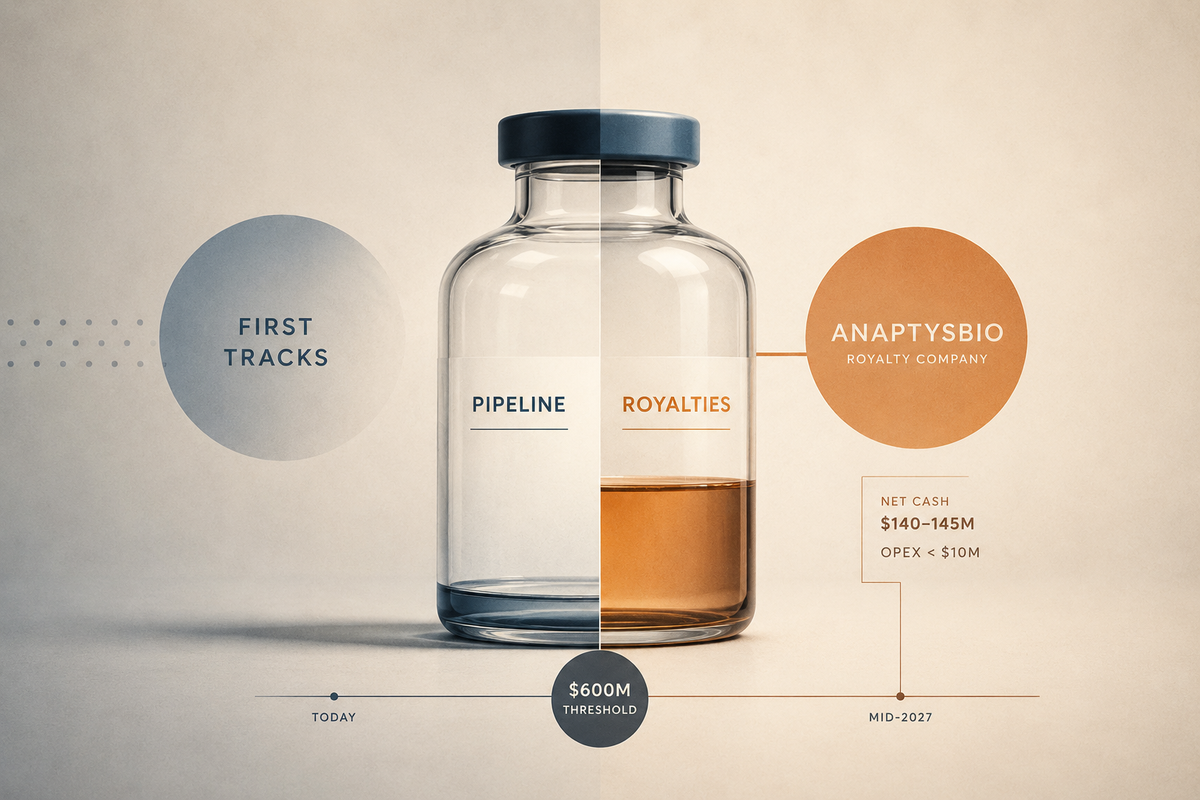
AnaptysBio (Nasdaq: ANAB) handed its drug business to shareholders on 20 April 2026 as First Tracks Biotherapeutics (Nasdaq: TRAX), one share for one. What kept the name and the ticker is a royalty company with fewer than ten contractors, guided operating expenses below $10 million a year, and opening net cash of $140 million to $145 million.
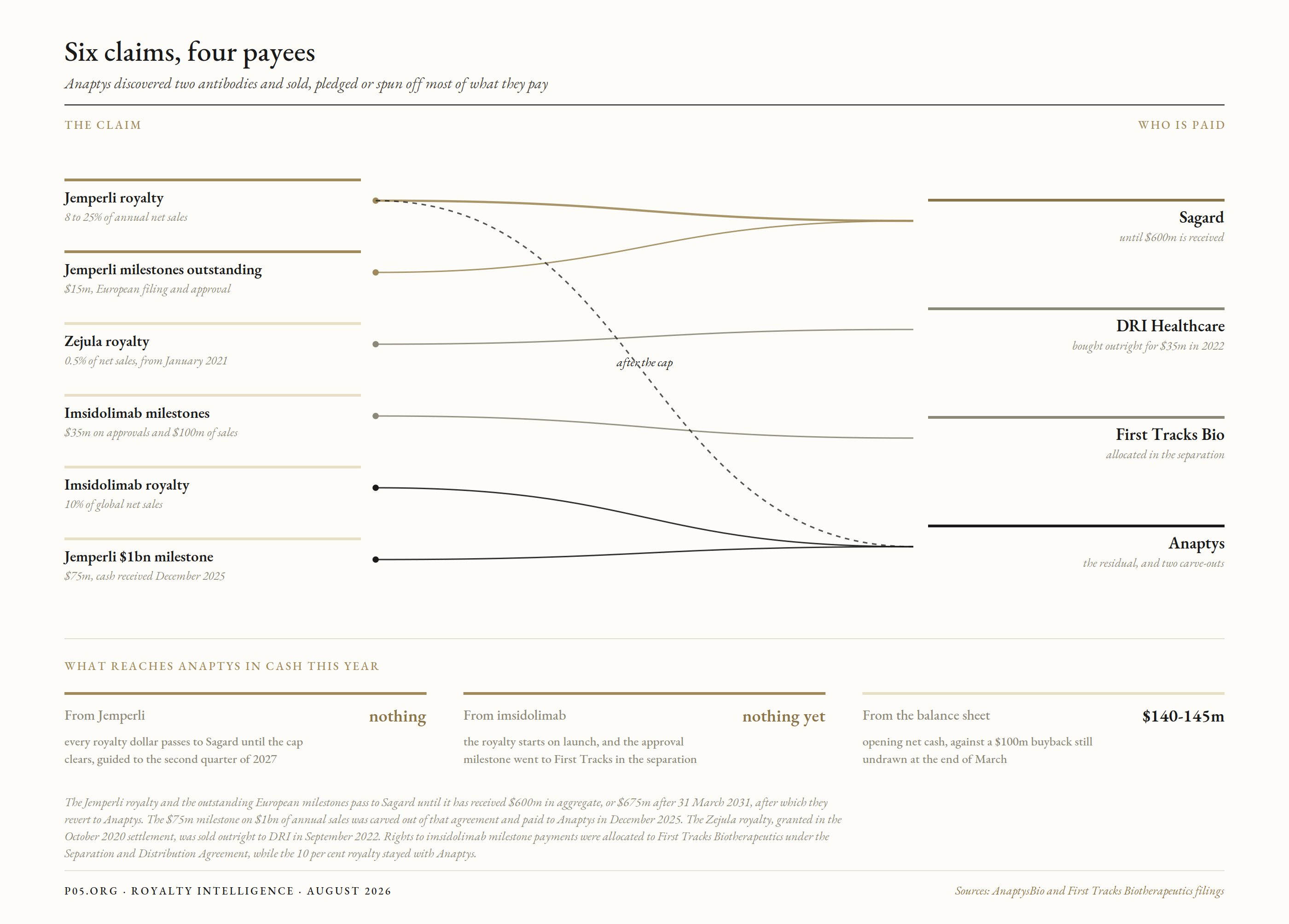
It also collects nothing on its principal asset. Every dollar of Jemperli royalty runs to a specialist fund until that fund has been paid $600 million, and the company's own guidance puts the clearing date at the middle of next year. On the disclosed schedule the date looks later than that.
The separation structure has a lineage, covered in The Royalty Spin-Off in July. What follows is the stack underneath it.
The GSK royalty
Tesaro signed a Collaboration and Exclusive License Agreement with Anaptys in March 2014 and was bought by GSK five years later. The agreement runs, product by product, to the later of the twelfth anniversary of first commercial sale or the expiry of the last patent. Composition of matter coverage lasts until 2035 in the United States, 2036 in Europe and 2037 in Japan, with extension possible into 2038, so patent life is the binding constraint.
The rates in force were set in 2020. Amendment No. 3, dated 23 October, let GSK develop and commercialise Zejula in combination with any third-party molecule. Anaptys sold that waiver of exclusivity for a cash payment, a 0.5 per cent royalty on GSK's Zejula sales from January 2021, and a step-up in the Jemperli ladder to 8 per cent on the first billion dollars of annual sales, 12 to $1.5bn, 20 to $2.5bn and 25 above.
Those bands are marginal, and they reset every January. GSK also reports sales to Anaptys a quarter in arrears, so cash trails accrual.
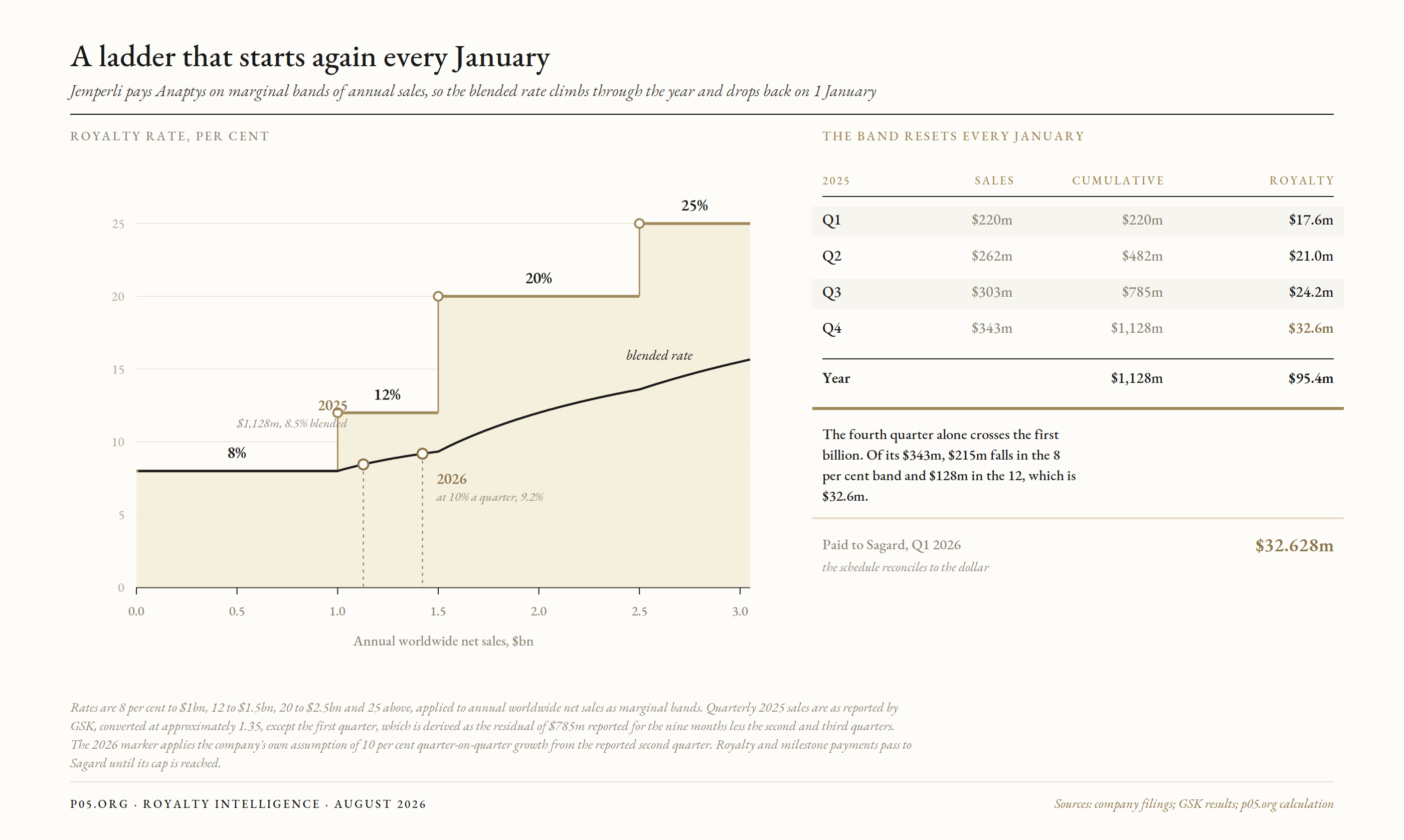
The mechanic can be checked against the filings. Jemperli sold $785 million in the first nine months of 2025 and $343 million in the fourth quarter, closing the year at $1,128 million. Of that fourth quarter, $215 million falls in the 8 per cent band and $128 million in the 12, which produces a royalty of $32.6 million and a 9.5 per cent effective rate for the quarter.
The liability roll-forward in the March 10-Q records payments to Sagard of $32,628 thousand. Q1 2026 then starts again at 8 per cent: $313 million (£232 million) of sales, $25.0 million on the schedule, $24.6 million recognised.
At GSK's peak target of more than $2.7bn the ladder blends to 14.4 per cent, or roughly $390 million a year, which is where the company's own headline figure comes from.
The Sagard layer
Anaptys sold the front of the stream twice, taking $250 million in October 2021 and $50 million in May 2024. The second tranche widened the definition to cover all Jemperli sales, including combination products.
Sagard takes the whole tiered royalty. The $32.6 million above includes dollars earned at 12 per cent, well above the headline 8. It expires once Sagard has received $600 million, or $675 million if that happens after 31 March 2031, and everything after that returns to Anaptys.
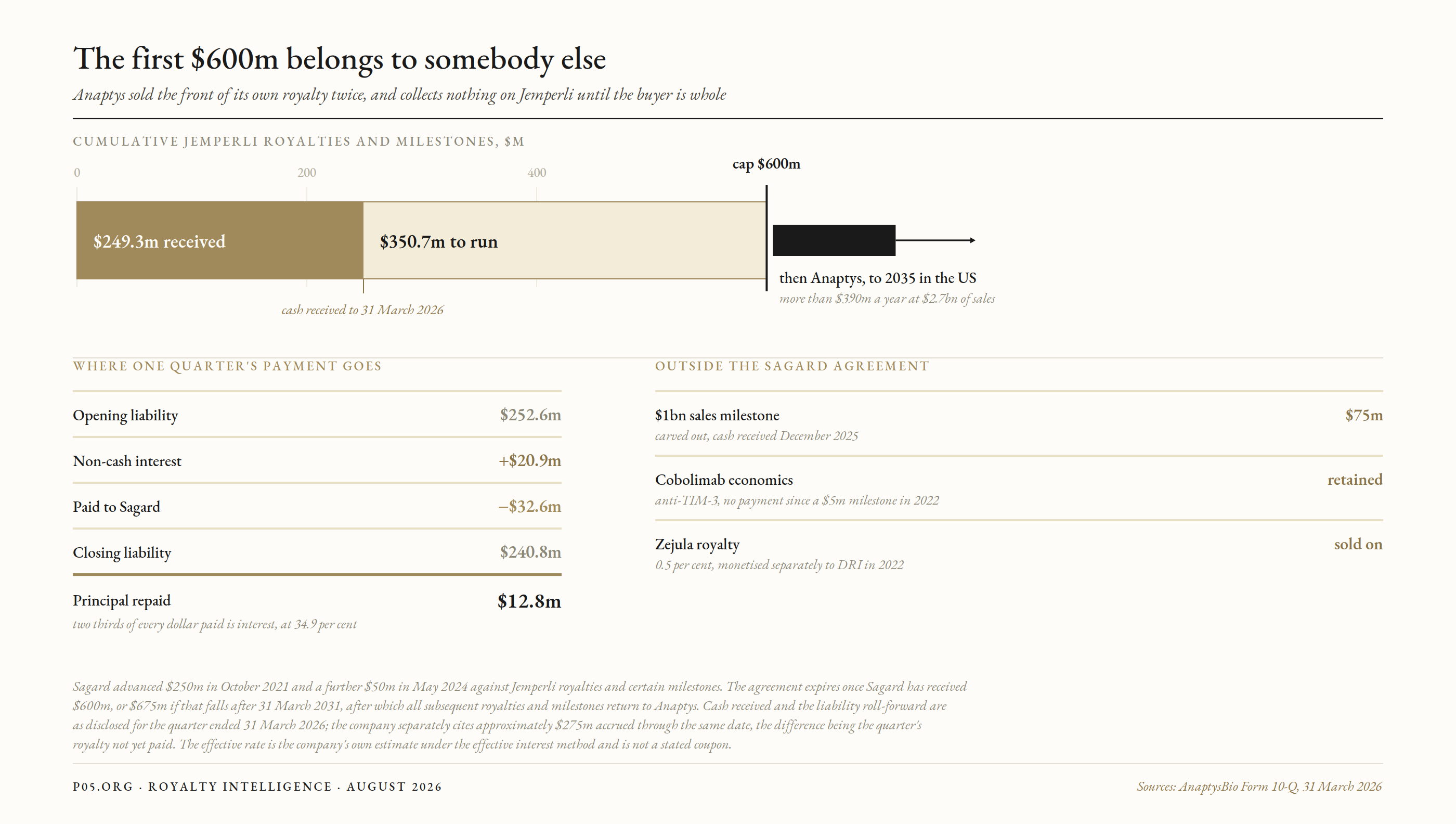
At the end of March, Sagard had received $249.3 million in cash. The company cites roughly $275 million accrued through the same date, and the two bridge cleanly once the quarter's unpaid royalty is added back.
The Jemperli liability stood at $240.8 million, against $22.9 million for a second, older monetisation described below.
The roll-forward shows how slowly a capped structure of this kind amortises. Sagard was paid $32.6 million in the quarter, of which $20.9 million was recognised as non-cash interest and $12.8 million reduced principal.
The liability fell from $252.6 million to $240.8 million in three months. Anaptys estimates the effective rate at 34.9 per cent, which is an artefact of a fixed multiple sitting on an asset that has outrun its 2021 forecast. Faster compounding fills the cap sooner and lifts the annualised return on Sagard's $300 million.
The paydown date is hard to reach
Anaptys guides to full repayment of the remaining $325 million by the end of the second quarter of 2027, assuming Jemperli compounds at about 10 per cent a quarter and European filing and approval milestones on dMMR rectal cancer land along the way. Guidance in November 2025 ran from Q2 2027 to Q2 2028.
Walk that assumption forward against the contracted bands and the arithmetic falls short. From the reported second quarter of 2026, the three remaining quarters of this year produce about $106 million, the European milestones add $15 million, and the first half of 2027 adds $75 million. Cumulative accruals reach roughly $469 million by 30 June 2027 against the $600 million required, leaving $131 million outstanding. On the same path the cap clears during the fourth quarter of 2027.
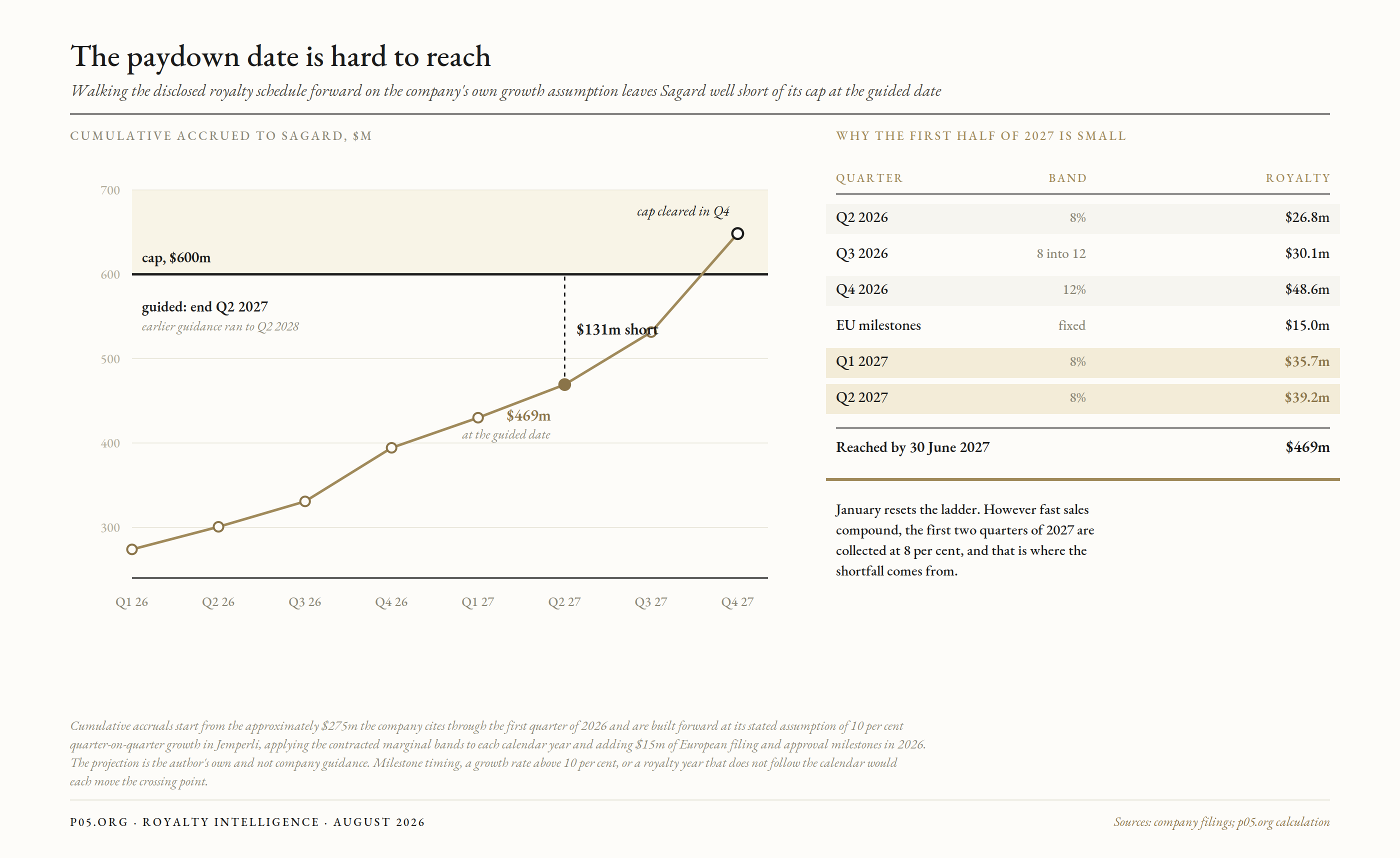
January is what causes it. However fast sales compound, the first two quarters of every year are collected at 8 per cent, and 2027 opens with two such quarters.
Three things would close the gap: growth materially above 10 per cent a quarter, milestone timing that is not visible in the public schedule, or a royalty year that does not follow the calendar. Any of them is possible, and none is disclosed.
The milestone ladder, and the second monetisation
GSK has paid $258.0 million of milestones since 2015, with $15.0 million outstanding on a European filing and approval in a second indication.
Where each payment lands is set out in the agreement, and the press releases do not say. The first three commercial sales milestones, $15 million in Q3 2024, $25 million in Q4 2024 and $50 million in Q3 2025, all went to Sagard, as will the remaining $15 million.
The fourth, worth $75 million on the first billion dollars of annual sales, was carved out of the Sagard agreement, paid to Anaptys in December 2025 and is the reason the company reported net income of $49.6 million that quarter.
The 0.5 per cent Zejula royalty from the 2020 settlement was sold outright to DRI in September 2022 for $35 million. It sits on the balance sheet under the same accounting, carried at $22.9 million in March against $24.0 million at year end, generating about $0.9 million a quarter of non-cash revenue and $1.0 million of payments to DRI.
Non-cash interest on it was negative in the quarter, which happens when the underlying disappoints. GSK reported Zejula down 34 per cent at constant currency in the second quarter, to $136 million (£101 million).
What left, and what stayed
The First Tracks 10-Q filed on 13 August sets out the separation from the other side, and it revises the picture the launch release gave.
Anaptys allocated $100 million of cash on the distribution date. The $180 million launch balance quoted at the time was that allocation plus roughly $80 million gross from a concurrent private placement of 5,791,479 shares at $13.81, alongside which EcoR1 Capital sold 4,705,575 secondary shares received in the spin. First Tracks held $168.0 million at the end of June.
Anaptys kept the liabilities. All accounts payable and accrued liabilities existing at separation stayed with the parent, and the transfer schedule shows $28.8 million of accrued liabilities moving back.
It also kept the imsidolimab economics only in part. Vanda licensed the antibody in January 2025 for $10 million upfront and $5 million for existing drug supply, a 10 per cent royalty and up to $35 million of milestones, with an FDA action date of 12 December 2026 in generalised pustular psoriasis.
The Separation and Distribution Agreement moved every milestone right to First Tracks. December's decision therefore pays $5 million to the spun-off company and nothing to the royalty vehicle until the product sells.
Then there is the building. Anaptys retained the 45,000 square foot San Diego lease, the right-of-use asset, the lease liability and the leasehold improvements. That lease carried $15.2 million of minimum payments to 2031 at the end of March, against a $13.6 million liability, with a single break on 30 April 2028 priced at $3.8 million plus fifteen months of operating expenses and taxes.
On 15 June the company subleased the same space back to First Tracks for 24 months at $4.87 per square foot per month against its own $4.20 starting base, worth $4.7 million in minimum payments, with a tenant break at the end of 2027. A virtual royalty company is now a landlord whose lease runs five years past its only tenant's committed term, and none of that appears in the sub-$10 million expense guidance.
What the royalty segment earns
The March quarter reports Royalty Management as a segment in its own right: $25.6 million of collaboration revenue, $7.4 million of operating expenses, $18.2 million of operating income, and $20.9 million of non-cash interest, for a segment net loss of $2.4 million. Revenue divides into $24.6 million of Jemperli, $0.9 million of Zejula and a small Vanda transition services item, all of it non-cash under the monetisation accounting. The operating margin is 71 per cent on a cost base guided down to under $10 million a year, and the loss below the line persists until the cap clears.
The overhang
Tesaro sued on 20 November 2025. Anaptys filed its own complaint the following day, alleging that Tesaro breached its exclusivity duty by running trials involving competing PD-1 antagonists including Keytruda, breached a diligence duty requiring it to seek Jemperli's "optimum commercial return" in all major markets, and breached notice duties, and that GSK induced those breaches by favouring its own antibody-drug conjugates alongside rival checkpoint inhibitors. The remedy sought is reversion of the drug on breach of any single provision.
Chancery dismissed Tesaro's anticipatory breach claim on 24 April and rejected its request for a rate reduction. Trial ran from 14 to 17 July. The opening post-trial brief is due on 21 August, the answering brief on 25 September and the reply on 9 October, with argument on 20 October. Royalty and milestone obligations run throughout.
There is history here. The 2020 dispute turned on the same exclusivity clause and settled into the ladder now in force, so both sides have already established what the provision is worth once.
How unusual is this
Most of the wrapper is ordinary. This is the fourth royalty separation of its kind since 2008, and Theravance used the same "Royalty Management Co" and "Biopharma Co" labels in 2013. A capped non-recourse monetisation at two times money is unremarkable; Zymeworks' note with Royalty Pharma caps at 1.65 then 1.925. Ascending tiers are standard, if 8 to 25 is a steep run.
Reversion-on-breach language appears in almost every modern licence, and royalty disputes are routine, from Xencor and Alexion over Ultomiris to Genentech's suits against Biogen on Tysabri and Millennium on Entyvio.
The loading is where it departs from precedent. PDL BioPharma launched its royalty company holding eight-plus licensed antibodies, Innoviva two or three inhalers, Ligand around a dozen assets. Anaptys has one that matters, and among the four vehicles created this way none started so concentrated. None of the other three was pledged at separation either. PDL went the other way and paid a $500 million special dividend before splitting, while Anaptys begins life collecting nothing from Jemperli and funding a $100 million buyback authorisation out of balance-sheet cash.
The vehicle also reports losses by construction, because non-cash interest at 34.9 per cent exceeds segment operating income until the cap is met, where Innoviva and Ligand generated cash from the first day.
The contract language is a period piece. "Optimum commercial return in all major markets" sets a higher bar than commercially reasonable efforts, and since Fortis Advisors v Johnson & Johnson, roughly $1bn affirmed on appeal in March, and Shareholder Representative Services v Alexion at $180 million, drafters have moved toward objective floors on headcount and spend. A superlative standard survives here because the agreement was signed in 2014.
The remedy is the rarest part. Those landmark efforts cases were merger earnouts and CVRs over programmes that had been terminated or deprioritised, and they were resolved in damages. Anaptys is arguing about a marketed product that is growing, and asking for the licence back.
The closest 2026 analogue is Ventis Pharma v Balanced Pharma in Chancery, which concerns a development-stage dental anaesthetic and is small. A licensor recovering a franchise of this size by this route has no obvious precedent, and neither does the position Sagard now occupies, holding receivables under an agreement whose survival its own seller is contesting with $351 million of cap unfilled.
Reversion is also hard to price. Winning hands a marketed oncology franchise to a company with ten contractors and $140 million of cash, which in practice means a renegotiated or resold licence.
Balance sheet, capital return, calendar
Cash and investments stood at $286.5 million at the end of March, before the $100 million allocation. Stockholders' equity of $12.7 million sits against an accumulated deficit of $825.4 million, thinned by $263.7 million of monetisation liabilities.
There were 29,030,784 shares outstanding at 31 March and 29,100,902 at 7 May. The 2025 repurchase programme, $75 million enlarged by $100 million in November, expired on 31 March with nothing bought in the first quarter. The 2026 programme of $100 million was fully undrawn at quarter end and runs to 31 December. A $100 million at-the-market facility with TD Cowen was terminated in March with no shares sold.
The hires describe an intended future. Susannah Gray spent fourteen years as chief financial officer of Royalty Pharma, Owen Hughes runs XOMA Royalty, Chris Murphy arrived as CFO in May, and Piper Sandler is exclusive financial adviser. That is a board assembled to buy and sell royalty paper, against a stated mandate to administer two contracts.
One line in the proxy has gone largely unremarked. KPMG audited the years to 31 December 2025 and 2024 and will audit the year ended 30 June 2026, with shareholders ratifying it on 11 August for the year ending 30 June 2027.
The fiscal year end has moved to June. No calendar second-quarter release appeared this month, the most recent filing is the annual meeting 8-K of 11 August, and a transition report covering the six months to 30 June is the next disclosure. From here the reporting calendar sits offset from GSK's, which prints Jemperli quarterly.
What moves it
Three things. How fast one drug compounds at one licensee, which sets when the cap clears and which band the residual lands in. A regulatory decision on 12 December that starts a 10 per cent royalty and pays its milestone to somebody else. And a Delaware ruling after 20 October on whether the licence stays where it is.
This note is informational only and is not investment, legal, tax or financial advice. The author is not a lawyer or a financial adviser. Figures are drawn from company disclosures and SEC filings as of August 2026. Sterling is converted at approximately 1.35, the basis used in the company's own investor materials. The forward arithmetic in the paydown section is the author's own, built on disclosed royalty terms and the company's stated growth assumption.