
The impairment is not the loss: what a 1.4 billion dollar write-down tells a royalty investor
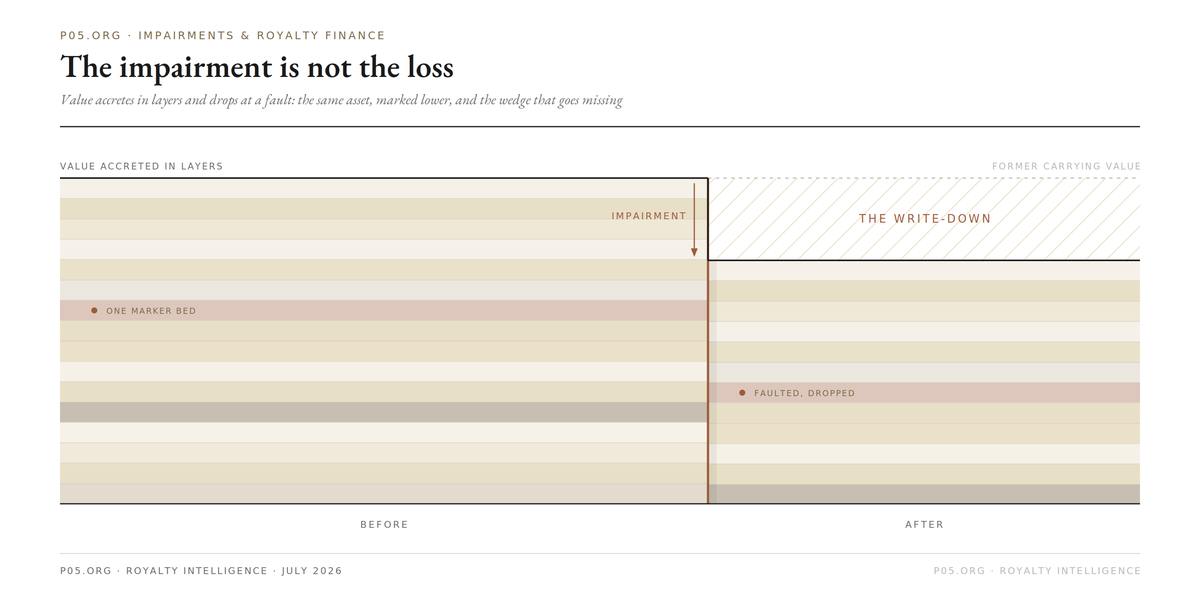
BMS wrote AUGTYRO down by 1.4 billion dollars. The charge is not the loss, it is the accounting noticing the loss. The same broken forecast lands as an intangible impairment on the acquirer, a provision for changes in expected cash flows on the royalty investor, and nothing at all on a guaranteed bond. Where you sit in the structure decides what you call it, and whether you feel it.
In November 2023 AUGTYRO looked like a clean win.
Repotrectinib had cleared the FDA for locally advanced or metastatic ROS1-positive non-small cell lung cancer on the strength of the TRIDENT-1 trial, and the durability data were the kind that sell a launch. In TKI-naive patients the response rate was 79 percent, with a median response lasting more than 34 months. In previously treated patients it was 38 percent, lasting close to 15 months. A second approval followed on 13 June 2024, accelerated, for adult and paediatric patients twelve and older with NTRK-fusion solid tumours that had progressed on prior therapy. A best-in-class label, a dual indication, a genuinely differentiated molecule.
Then the commercial line came in. AUGTYRO booked 38.0 million dollars of sales in FY2024, 36.0 million of it in the United States. And in the fourth quarter of 2024 Bristol Myers Squibb recorded a 1.4 billion dollar impairment charge against the asset, citing lower revised cash flow projections due to the evolving commercial opportunity.
That sentence is the subject of this piece. Not the drug, and not whether BMS overpaid. The question is narrower and more useful to anyone who finances drugs: what is an impairment actually telling you, who bears the loss it records, and why does the same broken forecast show up in a completely different place, or nowhere at all, depending on how you are exposed to the asset.
Because the impairment is not the loss. It is the accounting catching up with a loss that already happened in the cash flows. A royalty investor who reads it as a loss, rather than as a signal, is reading the wrong number.
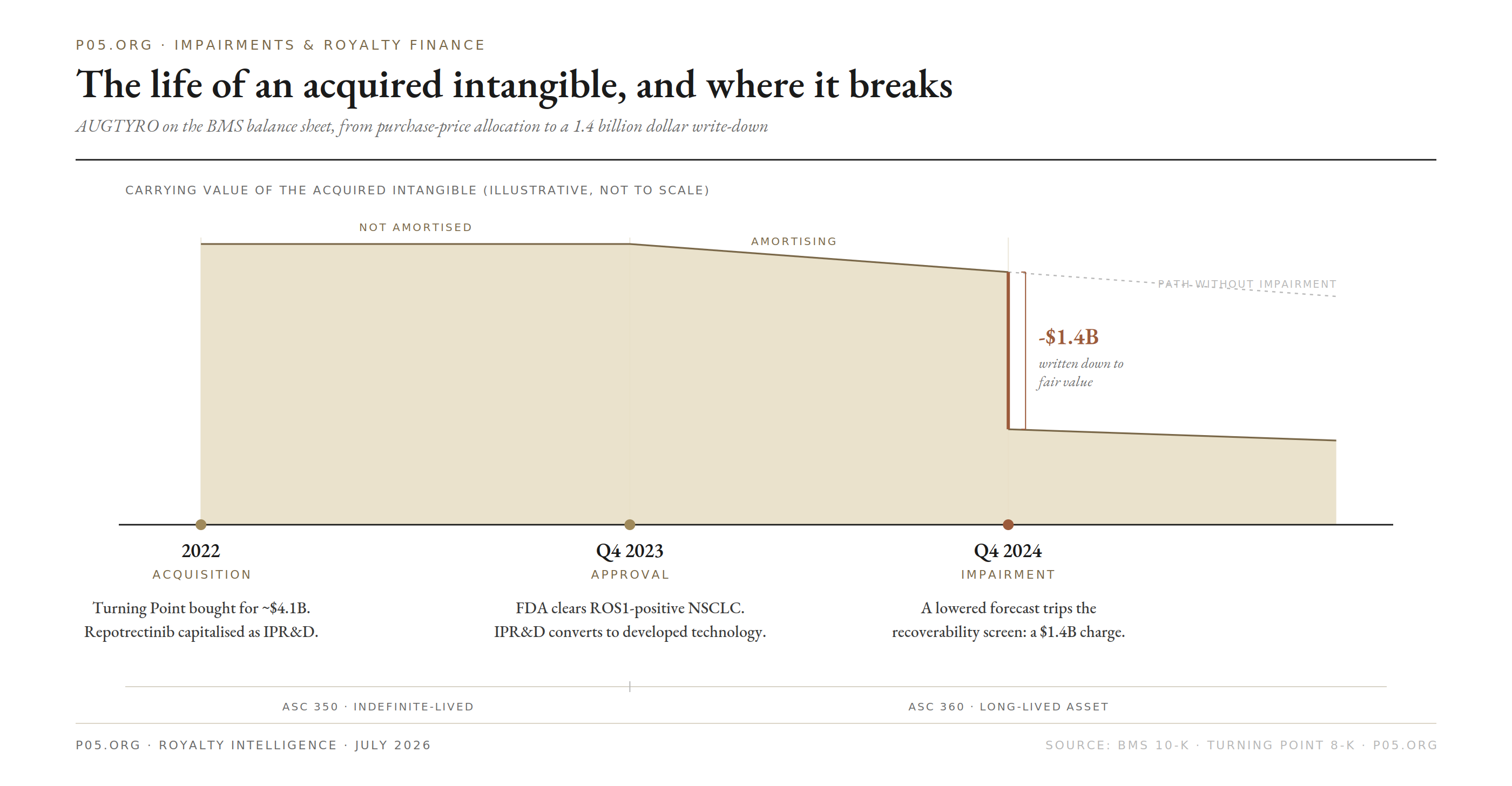
Figure 1. The AUGTYRO intangible across its life on the BMS balance sheet. Capitalised as IPR&D in the roughly 4.1 billion dollar Turning Point purchase-price allocation, tested under ASC 350; converted to amortising developed technology on the Q4 2023 approval, tested under ASC 360; written down to fair value by 1.4 billion dollars in Q4 2024 when a lowered forecast tripped the recoverability screen. Carrying values illustrative, not to scale.
What an Impairment Actually Is
Start with the mechanics, because the whole argument sits on them.
When a large pharma buys a smaller one, it does not book the price as a single lump. It runs a purchase-price allocation: the consideration is spread across the identifiable assets acquired, and a great deal of it lands on intangibles, the rights to the pipeline molecules that were the point of the deal.
A molecule that is not yet approved is capitalised as in-process research and development, an indefinite-lived intangible that is not amortised but is tested for impairment. On regulatory approval it converts to a finite-lived intangible, developed technology or product rights, and begins amortising over its useful life.
AUGTYRO made exactly that journey. It arrived as IPR&D with the Turning Point acquisition, and on the fourth-quarter 2023 approval it became an amortising product-rights intangible on the BMS balance sheet.
An impairment is what happens when the carrying value of that intangible can no longer be justified by the cash the asset is now expected to produce. Indefinite-lived IPR&D is tested under ASC 350; once approval turns it into a finite-lived intangible it moves to the long-lived-asset model in ASC 360, and IFRS reporters run the equivalent under IAS 36. A triggering event, a competitor launch, a reimbursement setback, a lowered internal forecast, forces the test.
The US screen is deliberately blunt. The carrying amount is first compared to the undiscounted future cash flows, and only if those fall short is the asset remeasured to fair value, the discounted number, with the difference booked as a charge. That two-step design is why intangibles absorb bad news quietly and then take the whole revision at once: the asset sits untouched until the screen breaks, and then it breaks hard.
Two features matter for everything that follows.
It is non-cash. No money leaves the building on the day of an impairment. The cash was spent years earlier, at acquisition. The charge is an admission that the earlier spend will not be recovered, recognised now because the accounting rules force recognition once the forecast drops far enough.
It is a lagging confession, not the event. The commercial disappointment happened first, quarter by quarter, in the sales line. The impairment is the balance sheet finally acknowledging it. By the time the charge prints, the news is old: the launch has already underperformed for long enough that the auditors will no longer let the old carrying value stand.
Hold both of those. A royalty investor who understands that an impairment is non-cash and lagging will treat it very differently from one who reads a 1.4 billion dollar headline and flinches.
The AUGTYRO Write-Down, Read Closely
BMS acquired Turning Point in 2022 for roughly 4.1 billion dollars, 76.00 dollars a share, all cash, for a pipeline whose centre of gravity was repotrectinib.
The thesis was explicit at signing: a potential best-in-class, next-generation ROS1/NTRK inhibitor, with a differentiated duration of response, expected to become a new standard of care in first-line ROS1-positive NSCLC. The durability data delivered on that. The commercial opportunity did not, at least not on the timeline and the scale the purchase price implied.
The arithmetic of the addressable population is unforgiving. ROS1 rearrangements occur in roughly 2 percent of advanced NSCLC, and AUGTYRO entered a market already held by established agents. A differentiated molecule in a small, contested biomarker niche can be an excellent drug and still miss a forecast built for a standard of care.
So when BMS wrote that the impairment reflected lower revised cash flow projections due to the evolving commercial opportunity, it was saying something precise: we have re-run the discounted cash flow on this asset, the number came back materially lower, and the carrying value from the 2022 allocation no longer holds.
Here is the part that matters for royalty finance. That revised DCF is the same exercise a royalty investor runs. Same epidemiology, same competitive set, same net-price erosion, same discount-rate debate. When BMS impaired AUGTYRO, it published, in effect, its own downward revision of a model that any buyer of an AUGTYRO royalty would have been maintaining independently.
The impairment is BMS marking its homework in public. The question is what a royalty investor does with that mark.
There is a further twist that makes AUGTYRO a fitting anchor for this piece. The same molecule already wears two accounting identities on the BMS balance sheet. Outside Greater China it is an owned intangible, the one just written down. Inside Greater China it is licensed to Zai Lab, which pays BMS a royalty, an inbound financial asset rather than an impaired one. One drug, one ultimate owner, two ledgers: an impairment on the asset BMS built, and a royalty on the territory it licensed out. The rest of this article is that split, generalised.
The Royalty Investor Books the Same Event, and Calls It Something Else
A royalty investor holding a stream on a drug that disappoints does not book an impairment. It books a provision. The label is different. The underlying event is identical.
Take Royalty Pharma, whose disclosures are the clearest in the sector. It carries acquired royalties as financial royalty assets and accretes income on them using the effective interest method, the same amortised-cost machinery a lender uses on a loan.
Each period it re-forecasts the cash flows on every asset and re-derives the effective interest rate. When the forecast falls, so that the current-period rate is lower than the prior period's and the gross expected cash flows have declined, it records a provision. The provision is measured as the gap between the asset's amortised-cost basis and the present value of the revised cash flows, and it builds a cumulative allowance that reduces the net carrying value of the royalty asset. The credit-loss overlay on these positions runs through the CECL model in ASC 326, which is why the disclosures speak in the language of allowances rather than write-offs.
The forecast that drives all of this is not proprietary. Royalty Pharma names the trigger for its provisions, period after period, as movements in sell-side equity research consensus on the underlying product. The royalty investor's write-down is, in substance, the analyst community's revised sales model flowing through an amortised-cost calculation, which is worth remembering whenever the provision is mistaken for private information. It is mostly public information, discounted.
Read that against the impairment definition and the parallel is exact. Carrying value on one side, present value of revised expected cash flows on the other, and a charge for the shortfall. The pharma calls it an impairment of an intangible. The royalty investor calls it a provision for changes in expected cash flows from financial royalty assets. It is the same test, on the same economics, run on two different balance sheets.
There is one honest difference, and it runs in the royalty investor's favour. Under US GAAP an impairment of a developed-technology intangible is not reversed if the outlook later improves: the write-down is permanent. The royalty investor's provision is not. If forecasts recover, or actual cash beats the earlier expectation, the allowance is reduced and the charge reverses back through income. The royalty asset is measured with a two-way valve. The intangible has a one-way valve.
That asymmetry is worth keeping. It means an impairment overstates the buyer's freedom to change its mind, and a provision understates the royalty investor's permanence of loss.
The Classification Fork, and Why the Deal Documents Decide It
Everything above assumed the royalty investor carries its position as a financial asset. Not all of them do, and which side of that line a royalty falls on is a drafting question before it is an accounting one.
Royalty Pharma set out the test itself in correspondence with the SEC. Whether a purchased royalty is a financial asset or an intangible asset turns on the nature of the rights in the purchase agreement. If they are protective, creditor-like, the asset is financial. If they convey ownership or decision-making over the intellectual property, the sort of rights that let the holder commercially exploit it, the asset is an intangible. The distinction is not cosmetic. It picks the entire rulebook.
A financial royalty asset accretes income on the effective interest method and is written down through a provision that can reverse if the outlook recovers. An intangible royalty asset is amortised, usually on a units-of-revenue basis, and impaired under the long-lived-asset model, where under US GAAP the write-down is permanent. PDL BioPharma carried its royalties the second way, as definite-lived intangibles amortised into cost of royalty revenues and impaired when fair value fell below carrying value. Royalty Pharma carries them the first way. Two funds can hold economically identical streams and report them on different rulebooks, with different earnings volatility and different reversibility, purely on how their agreements were written.
Jurisdiction adds a second axis. US GAAP does not reverse an impairment of an intangible or a long-lived asset once taken. IAS 36 does, to a capped extent, if the conditions that caused it reverse. That matters for anyone reading across the pharma names and the TSX-listed streaming and royalty companies, most of which report under IFRS and deplete their interests on a units-of-production basis under IAS 36. The same underperformance can be a permanent charge on one balance sheet and a reversible one on another, for reasons that have nothing to do with the drug.
So the lawyer's version of this article's thesis is sharper: the accounting consequence of a drug disappointing is set, in large part, by the rights language in the purchase agreement and the framework the holder reports under, both decided long before the disappointment arrives.
Tazverik: The Same Disease on the Royalty Side
The royalty world has already lived the AUGTYRO story, on a different molecule, and it is the cleanest available worked example.
In November 2019 Royalty Pharma agreed to pay up to 330 million dollars for Eisai's ex-Japan royalty on tazemetostat, Epizyme's first-in-class EZH2 inhibitor, and separately put 100 million dollars of equity into Epizyme, with Pharmakon providing senior-secured debt alongside. Tazverik was a precision-oncology asset with a biomarker-defined niche and, at underwriting, a large forecast. Royalty Pharma's own filing put projected global sales at roughly 1.0 billion dollars by 2026.
The drug did not get there. Tazverik booked around 12 million dollars of global sales in 2020, and 30.9 million dollars for full-year 2021. Quarterly net revenue through 2022 sat in the high single digits to low teens of millions.
Royalty Pharma marked it, repeatedly. It recorded provision expense for Tazverik across multiple periods as sell-side consensus forecasts fell, including in the first quarter of 2022, when Tazverik and Imbruvica together drove 234.2 million dollars of provision expense for changes in expected cash flows. Epizyme itself was absorbed by Ipsen in a distressed 2022 sale.
Line the two up. AUGTYRO: precision oncology, differentiated molecule, small biomarker niche, forecast built for a standard of care, delivered tens of millions, written down by the acquirer. Tazverik: precision oncology, first-in-class molecule, small biomarker niche, forecast near a billion, delivered tens of millions, written down by the royalty holder. The same disease of optimistic niche-oncology forecasting. Two different balance sheets caught it, under two different names.
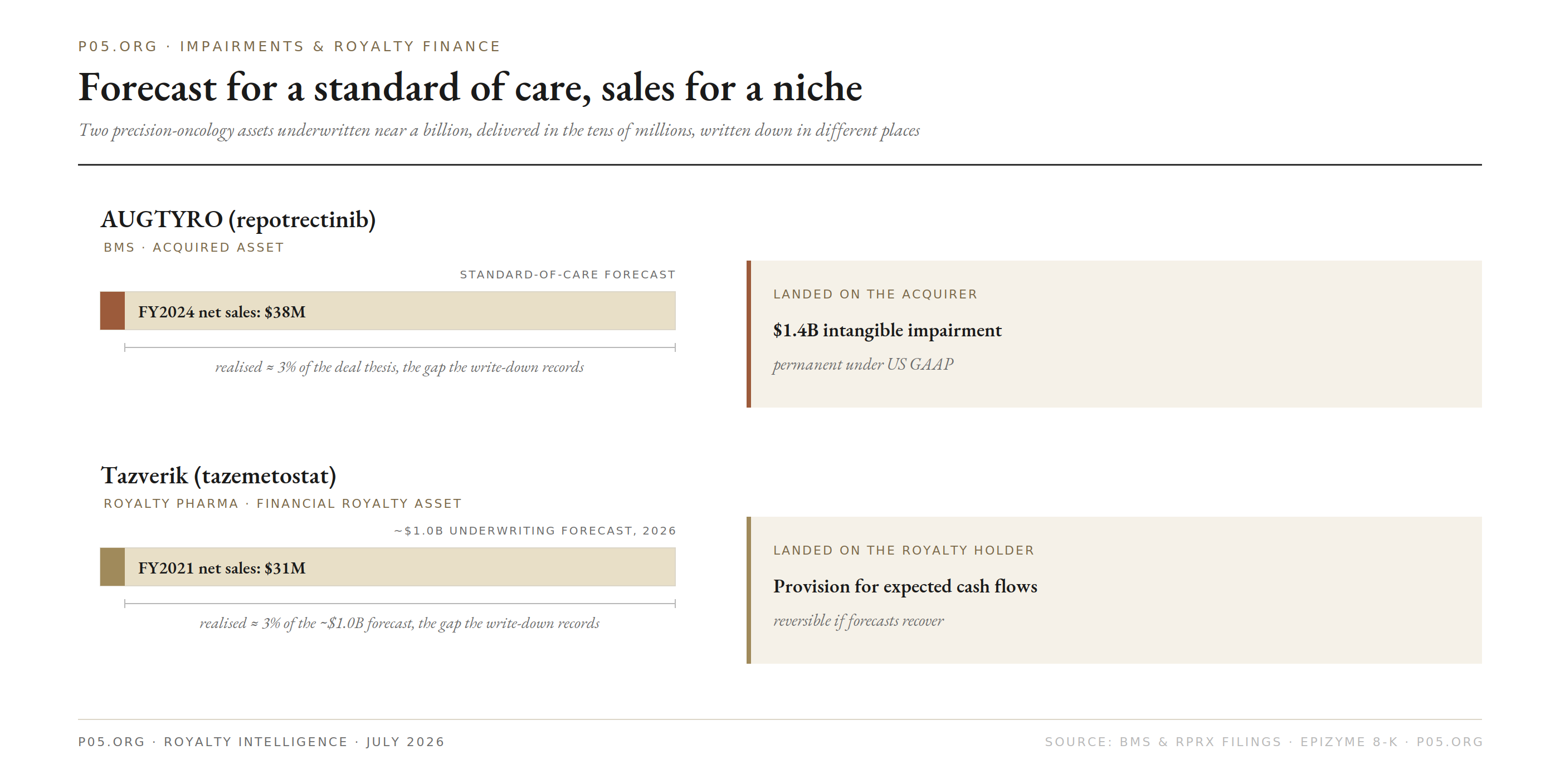
Figure 2. Two precision-oncology assets underwritten for a market they never reached. AUGTYRO, a first-line standard-of-care thesis, delivered 38 million dollars in FY2024 and was written down on the acquirer as a 1.4 billion dollar intangible impairment, permanent under US GAAP. Tazverik, underwritten to roughly 1.0 billion dollars by 2026, delivered tens of millions and was written down on the royalty holder as a provision, which can reverse.
Why the Same Loss Lands in Different Places
Here is the structural core, and it is the reason this topic belongs on a royalty-finance site rather than an accounting one.
A drug that underperforms produces one economic loss. That loss does not fall evenly. It falls where the structure sends it, and the structure decides both the size of the hit and the line it prints on.
Equity and the acquired intangible take it in full. BMS bought AUGTYRO outright. It owns the upside and the downside, and the impairment is the downside arriving. The full gap between the 2022 allocation and the revised cash flows lands on the BMS income statement. There is no counterparty to share it with.
A synthetic royalty holder takes real cash, and books a provision. An investor who had bought a royalty on AUGTYRO net sales would feel this twice. First, and most concretely, in the cheque: a royalty on 38 million dollars of sales is a fraction of a royalty on the forecast that justified the purchase price. Second, in the accounts, as a provision that writes the carrying value down towards the new reality. The synthetic royalty is exposed to precisely the commercial disappointment the impairment describes, because it is paid out of the same sales line.
A guaranteed bond holder takes nothing. This is the pointed contrast, and it connects directly to the development funding bond. A fixed, parent-guaranteed instrument is a claim on the obligor's corporate credit, not on the drug. Had AUGTYRO been funded through a guaranteed development funding bond rather than a royalty, the holder would be paid its fixed multiple on schedule whether AUGTYRO sold 38 million dollars or 380 million. The disappointment that forced a 1.4 billion dollar impairment on BMS would not touch the bond, because the bond was never exposed to sales in the first place.
So the same underperformance is a full write-down for the equity owner, a cash-and-provision event for the royalty holder, and a non-event for the guaranteed bond. The instrument is the filter. Read the structure and you know, before any drug data arrives, which of these three you are.
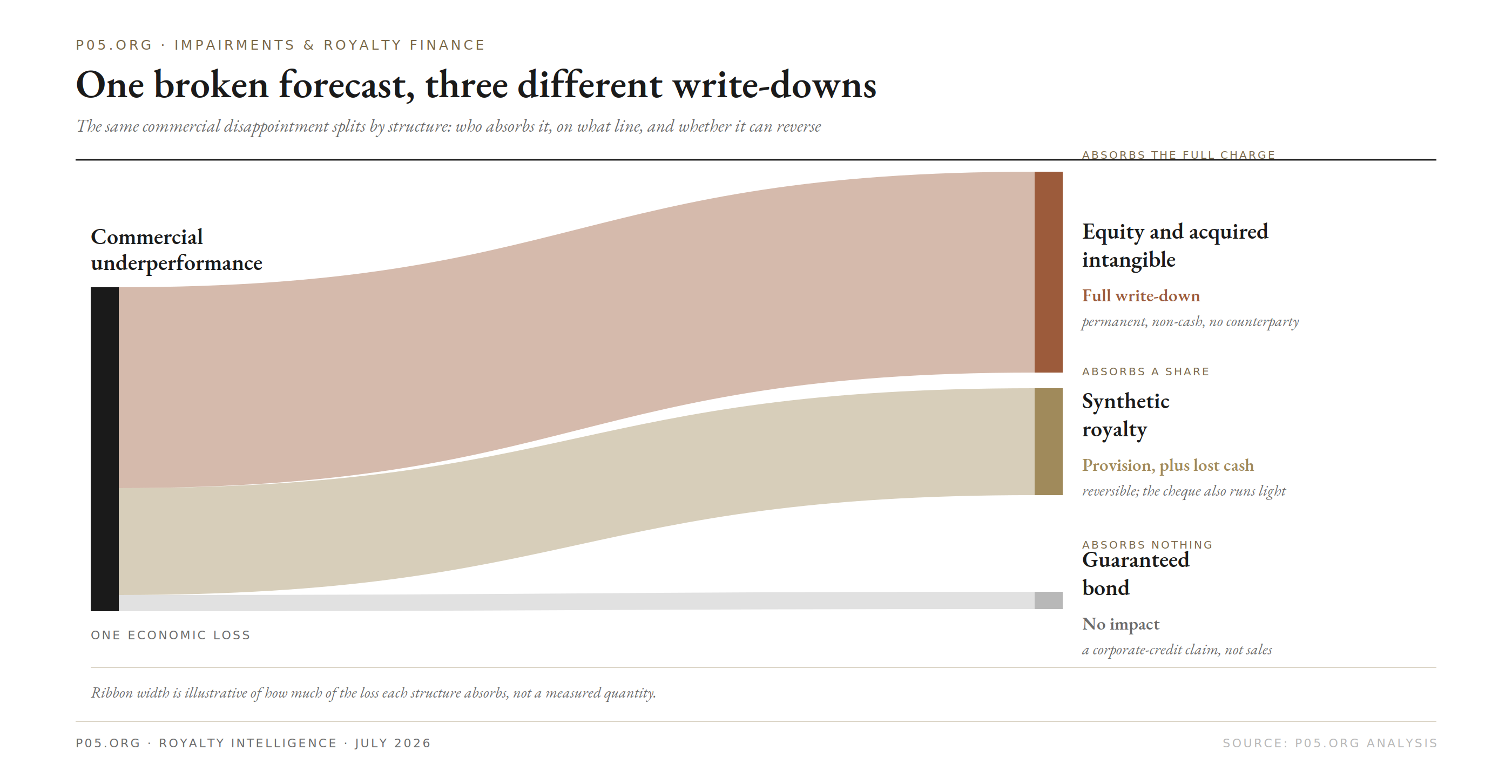
Figure 3. One commercial underperformance, filtered by structure. The equity and acquired-intangible owner absorbs the full charge, permanent and non-cash. The synthetic royalty holder books a provision and, more concretely, collects a smaller cheque. The guaranteed bondholder absorbs nothing, because a corporate-credit claim is indifferent to whether the drug sold. Ribbon width is illustrative of the share each structure bears, not a measured quantity.
What the Impairment Signals, and What It Does Not
For a royalty investor, an impairment on a drug you hold, or one you are diligencing, is information. It is not, by itself, your loss. Getting that distinction right is most of the value here.
What it signals. The obligor has formally revised its own cash-flow model downward, and the revision was large enough to breach a carrying value that auditors had previously accepted. That is a high bar. Companies do not impair casually; the charge is ugly, public, and taken only when the forecast has moved enough to force it. An impairment is therefore a credible, if late, confirmation that the commercial thesis has weakened. If you hold a royalty on that asset, it is a prompt to re-run your own model, not a licence to assume your number equals theirs.
What it does not signal. It is not your cash flow, and it is not necessarily your loss. The impairment is computed on the buyer's assumptions, the buyer's discount rate, and the buyer's whole-asset economics, including indications and geographies your royalty may not even touch. A royalty capped at a fixed multiple, or tied to a single indication, or sitting on a tiered scale, can be worth materially more or less than the acquirer's intangible implies. The headline is theirs. Your number is your own to compute.
The timing carries its own information. Management has real latitude over when a triggering event is deemed to occur, which is why impairments cluster at year-end, around strategic resets, and after changes in leadership. A charge taken in a clearing-the-decks quarter says as much about a company's reporting posture as about the asset. For a royalty investor that cuts two ways: a late, large impairment can flag an obligor that had been holding an inflated carrying value, and a cluster of them can flag a management team resetting expectations wholesale. The date and size are a read on the obligor's candour and forecasting discipline, not only on the drug.
The trap is to treat the impairment as a mark on your position. It is a mark on their position. The two rhyme, because they draw on the same commercial reality, but they are not the same instrument and they will not move by the same amount.
The Asymmetry Worth Naming
There is a second-order point that the AUGTYRO and Tazverik cases make together, and it is easy to miss.
An impairment is a non-cash charge on an asset the buyer already paid for. The pain is accounting pain: earnings, ratios, the optics of a deal that did not work. The cash was gone at closing.
A royalty provision, by contrast, is the accounting shadow of a loss that is playing out in cash, right now, quarter by quarter, as the royalty cheques come in below plan. The provision is itself non-cash, but the thing it tracks, the shortfall in royalty receipts, is entirely cash.
So the two write-downs are not symmetric in what they cost. The buyer's impairment looks enormous and is non-cash and sunk. The royalty holder's provision looks smaller and is tracking a live, ongoing cash shortfall. A 1.4 billion dollar impairment headline is, in an important sense, less painful to BMS today than a much smaller provision is to a royalty fund that is currently not being paid what it underwrote.
This is the same form-versus-substance gap that runs through the rest of this site. The big number is accounting. The real number is cash. Read the cash.
Two Notes on Disclosure and Tax
Two points sit just outside the accounting, and any adviser on these deals will want them flagged.
Disclosure. A material impairment is itself a reportable event. Under Item 2.06 of Form 8-K a US registrant must disclose a material impairment conclusion within four business days. There is a practical carve-out: no separate 8-K is required if the conclusion is reached in the course of preparing a periodic report that is filed on time and discloses the charge. That exception is why most pharma impairments, AUGTYRO included, surface in the quarterly release and the 10-K rather than in a stand-alone 8-K. The absence of an 8-K is not the absence of an impairment, and the acquired-intangible write-down is almost always a critical audit matter in the auditor's report besides.
Tax. An impairment is a book event, not a tax event. It moves GAAP earnings and deferred taxes; it does not, by itself, produce a cash tax deduction. Tax basis follows its own regime: acquired intangibles in an asset acquisition amortise straight-line over fifteen years under section 197 regardless of the book write-down, and in a stock acquisition like the Turning Point tender offer, absent a special election, the target's historic basis carries over and there is no stepped-up intangible basis to impair for tax at all. The 1.4 billion dollar charge is real for earnings and ratios and largely invisible to the current tax bill. The royalty investor's provision behaves the same way: a book reserve, not a realised loss, generally not deductible until the position is disposed of or written off. Book and tax diverge here, which is the theme the Debt for Deferral piece pushes on from the monetisation side.
What Each Side Should Ask
For the developer or acquirer, and its advisers:
If we are carrying the intangible, is our forecast still one an auditor will accept, or are we deferring an impairment that the sales line has already justified? An impairment taken late is worse than one taken early.
If we financed this asset with a royalty rather than owning it outright, would the loss be smaller for us, because it would sit with the royalty buyer instead? The choice of financing instrument is also a choice about who absorbs disappointment.
For the royalty investor:
When an obligor impairs an asset we hold a royalty on, have we re-run our own model, or are we borrowing their number? Their charge is a prompt, not a valuation of our position.
Does our royalty touch the same indications and geographies that drove their write-down, or is our exposure narrower, or capped, in a way that breaks the read-across? A whole-asset impairment can badly misstate a single-indication royalty in either direction.
And the underwriting question that sits behind both cases: is this forecast built for a niche, or for a standard of care? AUGTYRO and Tazverik were both fine molecules with forecasts sized for a market they were never going to reach. The impairment was written years before it printed, in the gap between the addressable population and the model.
The impairment is not the loss. It is the moment the accounting stops arguing with the cash.
BMS wrote AUGTYRO down by 1.4 billion dollars because the sales line had already told the story, and the carrying value could no longer pretend otherwise. A royalty investor exposed to the same molecule would have written it down too, under a different name, on a different balance sheet, tracking a shortfall that was real cash rather than sunk cost. And an investor who had structured the exposure as a guaranteed bond would have written down nothing at all.
Three instruments, one broken forecast, three different answers to the question of who pays. That is not an accounting curiosity. It is the whole of what structure buys you.
Read the cash flow, not the charge. The charge is only the cash flow, confessed late.
All information in this article was accurate as of the research date and is derived from publicly available sources including SEC filings, issuer annual reports, accounting standards guidance, and financial news reporting. Information may have changed since publication. This content is for informational purposes only and does not constitute investment, legal, accounting, tax, or financial advice. The author is not a lawyer, accountant, tax adviser, or financial adviser.