Company of the Week: Jiangsu Hengrui Pharmaceuticals
Hengrui booked $392M of licence revenue in the first nine months of 2026, equal to about two-fifths of its net profit, and received $612M of licence cash. Its partners include GSK, Bristol Myers Squibb, Merck, and Novo Nordisk. None of its licences abroad has yet paid a royalty.
On the evening of 27 October 2026 Jiangsu Hengrui Pharmaceuticals published its accounts for the nine months to September. Licence income from its new drugs came to $392M (RMB 2.781B), up 31.1 percent on a year earlier. In the same period the company received $612M (RMB 4.343B) of upfront and milestone cash, most of it a single payment of $600M from Bristol Myers Squibb.
Net profit attributable to shareholders rose 88.9 percent in the third quarter alone, to $346M (RMB 2.458B), and the report gives higher licence revenue as the main reason. Product sales for the nine months grew 2.5 percent.
Over the nine months licence revenue equals about 40 percent of net profit. The ratio compares a revenue line with an after-tax profit, and Hengrui does not report what licensing earns after costs and tax. In 2022 the same line came to $0.9M (RMB 6.4M).
Every licence that Hengrui has signed abroad carries a royalty on sales outside China, from 5 to 10 percent on a heart drug to 20.5 percent on its PD-1 antibody. No product licensed by Hengrui is on sale in America or Europe. Its licence revenue so far is upfront and milestone money, booked as each obligation is met, and the royalties in the same contracts have yet to produce any.
At a Glance
| Item | Detail |
|---|---|
| Company | Jiangsu Hengrui Pharmaceuticals Co., Ltd., Lianyungang, Jiangsu. Listed in Shanghai (600276) and, since 23 May 2025, in Hong Kong (1276) |
| Hong Kong listing | 224,519,800 H shares at HK$44.05, the top of the range, for gross proceeds of $1.27B (HK$9.89B). The over-allotment option was exercised in full on 19 June 2025 |
| Revenue, nine months to September 2026 | $3.44B (RMB 24.41B), up 5.3 percent |
| Net profit attributable, nine months | $975M (RMB 6.92B), up 20.4 percent |
| Licence revenue, nine months | $392M (RMB 2.781B), up 31.1 percent, mainly from GSK and BMS as performance obligations are met, with milestones on some licensed products |
| Licence cash received, nine months | $612M (RMB 4.343B), mainly the BMS upfront |
| Cash and deposits | $6.12B (RMB 43.45B) at 30 September 2026 |
| Licence revenue, 2025 | $478M (RMB 3.39B), against $1.09B (RMB 7.71B) of net profit |
| Overseas transactions | 12 from 2023 to March 2026, with potential value above $27B by the company's count. BMS and Novo Nordisk followed |
| Largest partners | GSK, $500M upfront in July 2025, and BMS, $600M upfront in May 2026 |
| Disclosed royalty bands | From 5 to 10 percent at Braveheart Bio to 20.5 percent on camrelizumab with Elevar Therapeutics. Merck, GSK, BMS, and Novo Nordisk rates are unpublished |
| Equity in licensees | Shares in Kailera Therapeutics (Nasdaq: KLRA) and Braveheart Bio (Nasdaq: BRVE), both taken as part of the licence price |
| Royalties received | None identified on any product sold outside China |
| Royalty posture | Holds a royalty on every licence abroad. None sold, pledged, or financed in the public record |
A Note on Scope
Hengrui reports in two sets of accounts. The quarterly reports filed in Shanghai follow Chinese accounting standards, and the annual and interim reports filed in Hong Kong follow international standards. The nine-month figures in this profile come from the Shanghai report and the annual figures from Hong Kong. The two bases differ in some balance-sheet lines, and the cash figures are not directly comparable.
Renminbi amounts are converted at RMB 7.10 to the dollar and Hong Kong dollar amounts at HK$7.78, whatever the year. Euro and dollar deal terms are given as the parties announced them.
Hengrui reports licence revenue as a single line. It has no separate royalty line, and it does not report the cost or profit of its licensing work. Its 2025 annual report says royalties are recognised as the related sales occur, and the record shows no such sales outside China.
Several royalty rates in this profile come from Hengrui's own notices to the Shanghai exchange, as reported by the China Securities Journal. Where a licensee publishes a band in its own filing, the profile cites that filing. A 2020 licence of camrelizumab in Korea to CrystalGenomics is left out, because its terms rest on secondary reporting.
What Hengrui Has Licensed
The record begins in September 2015, when Incyte paid $25M for camrelizumab, a PD-1 antibody, outside Greater China, with up to $770M of milestones and tiered royalties in the high single digits to mid-double digits. The two companies ended the collaboration in February 2018.
Two licences followed in January 2018. TG Therapeutics took two BTK inhibitors for $1.0M in its own stock and royalties in the low double digits. Arcutis took topical uses of the JAK1 inhibitor ivarmacitinib, with royalties from mid single digits to sub-teen rates in America, Europe, and Japan.
Hengrui signed four licences abroad in 2023. Treeline Biosciences took the EZH2 inhibitor SHR2554 in February for $11M upfront and, according to Hengrui's notice, royalties of 10 to 12.5 percent. In August One Bio, later renamed Aiolos Bio, licensed the TSLP antibody SHR-1905 for $25M and up to about $1B of milestones.
Five months later GSK agreed to buy Aiolos for $1B upfront. It took on the milestones and tiered royalties owed to Hengrui, and it has not published either.
In October Elevar Therapeutics, a subsidiary of Korea's HLB, licensed camrelizumab for use with its own drug rivoceranib in liver cancer. The press release gave up to $600M of sales milestones and a double-digit royalty. Two weeks later Merck KGaA paid EUR 160M upfront for the PARP1 inhibitor HRS-1167 and an option on a Claudin 18.2 antibody-drug conjugate.
In May 2024 Hengrui used a different structure. It licensed three metabolic drugs, among them the GLP-1 and GIP agonist HRS9531, to Hercules CM NewCo, a company formed to receive them. Hercules, renamed Kailera Therapeutics, paid $100M upfront and $10.0M for technology transfer and issued Hengrui preferred shares valued at about $96.4M.
The licences that followed went to large companies. IDEAYA paid $75M for a DLL3 antibody-drug conjugate in December 2024. Merck paid $200M in March 2025 for HRS-5346, an oral inhibitor of lipoprotein(a).
In July 2025 GSK paid $500M for HRS-9821, a PDE3/4 inhibitor for chronic obstructive pulmonary disease, and options on up to 11 further programmes, which it may exercise after Phase 1. Hengrui runs the early trials. If GSK exercises every option the deal is worth about $12B.
Braveheart Bio, a second company formed around a single Hengrui asset, licensed the cardiac myosin inhibitor HRS-1893 in September 2025 for $32.5M in cash and $32.5M in its shares. Glenmark took the HER2 antibody-drug conjugate trastuzumab rezetecan for emerging markets only, for $18M upfront.
By one count Hengrui was the largest Chinese licensor of 2025. PharmCube's figures, reported by Caixin, put Chinese out-licensing that year at $135.7B across 157 deals, and Hengrui first with $16.7B. In the first quarter of 2025 China accounted for 32 percent of out-licensing deal value, on Jefferies's figures.
The two largest upfronts came in 2026. On 12 May Hengrui and BMS signed an agreement covering 13 preclinical programmes. Four are Hengrui oncology and haematology assets licensed out, and five will be discovered jointly. The other four are BMS immunology assets licensed in to Hengrui for China. BMS pays $600M upfront and $175M on the first anniversary, with a further $175M in 2028 subject to conditions. It also owes up to $14.3B of contingent milestones and tiered royalties on sales outside the Chinese mainland, Hong Kong, and Macau.
On 29 September Novo Nordisk licensed HRS-1596, an oral weekly GLP-1 and GIP agonist ready for Phase 1, for $300M upfront and up to $2.6B in all. The deal awaits clearance under American merger rules.
From Upfront to Profit Line
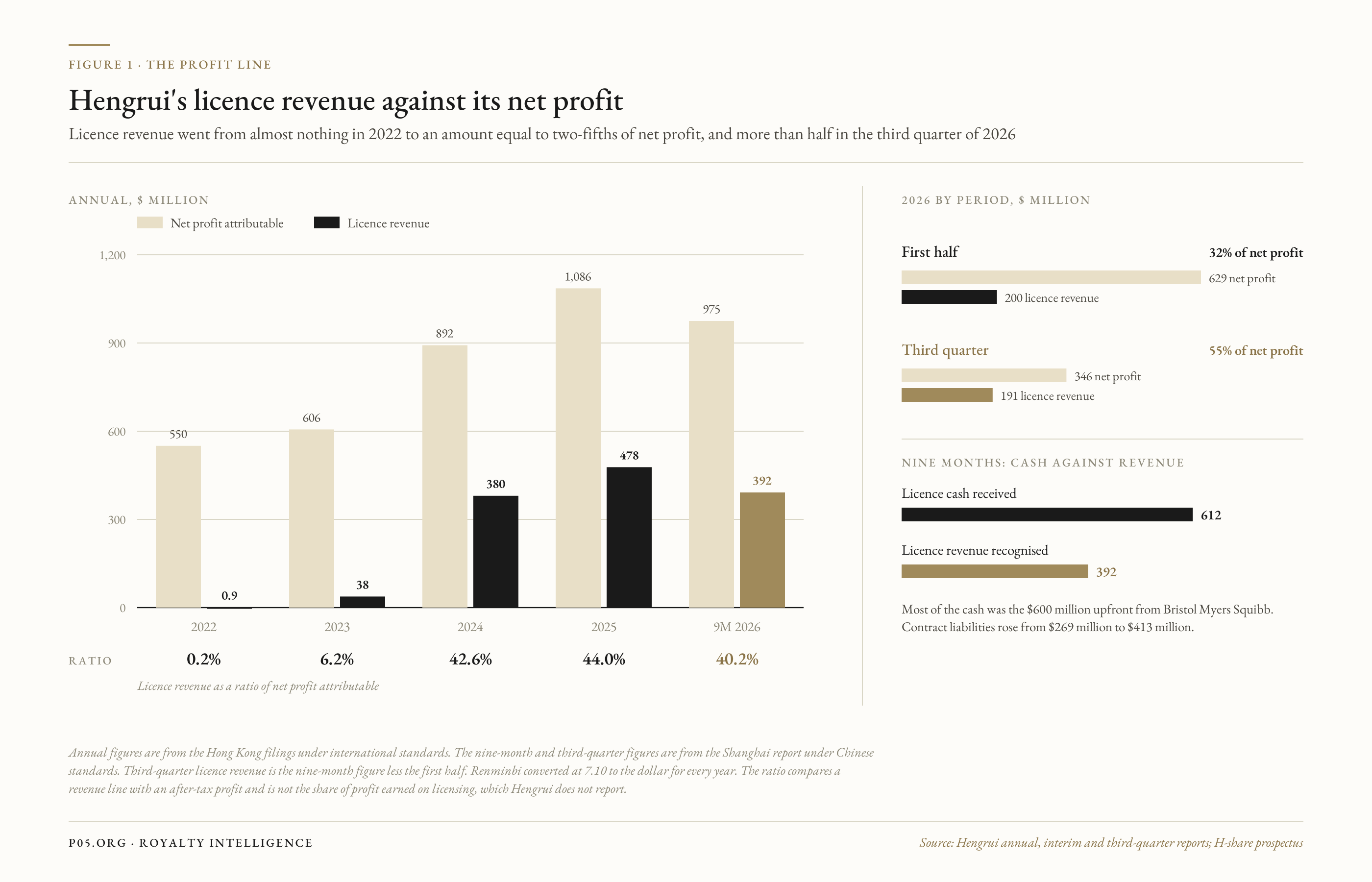
Licence revenue and net profit attributable to shareholders, 2022 to the first nine months of 2026, with licence revenue shown as a ratio of net profit
Licence revenue was $0.9M (RMB 6.4M) in 2022 and $38M (RMB 268.4M) in 2023. In 2024 it reached $380M (RMB 2.70B), 9.6 percent of revenue, and in 2025 $478M (RMB 3.39B).
Hengrui's net profit rose from $550M (RMB 3.91B) in 2022 to $1.09B (RMB 7.71B) in 2025. Set against net profit, licence revenue went from 0.2 percent in 2022 to 6.2 percent in 2023, 42.6 percent in 2024, and 44.0 percent in 2025.
For the first nine months of 2026 the ratio is 40.2 percent. In the third quarter alone it is higher. Licence revenue for the first half was $200M (RMB 1.42B), which leaves about $191M (RMB 1.36B) for the quarter, or 55 percent of its net profit.
How fast the cash becomes revenue depends on the contract. Hengrui's accounting policy, set out in the 2025 annual report, books an upfront for a distinct licence in full when the licence passes to the buyer. Hengrui booked Merck's $200M and IDEAYA's $75M that way in 2025. Where a contract bundles a licence with research, options, or other obligations, the cash is held in contract liabilities and released as each obligation is met.
GSK's $500M arrived in 2025, and Hengrui recognised about $100M of it that year. In the first half of 2026 GSK contributed $166M (RMB 1.18B) of the $200M of licence revenue. Hengrui had yet to recognise any of the BMS upfront by 30 June. By the end of September it had begun to, and the third-quarter report names GSK and BMS as the main sources of the nine-month figure.
Contract liabilities, which hold cash received for work still to be done, rose from $269M (RMB 1.91B) at the end of 2025 to $413M (RMB 2.93B) at 30 September. Cash received from licensing in the nine months exceeded licence revenue by $220M (RMB 1.56B).
Hengrui's prospectus for the Hong Kong listing said licensing has a relatively higher gross margin than its other business and can help improve overall profitability. The company gives no margin figure. Product sales, at $3.02B (RMB 21.48B) for the nine months, grew 2.5 percent, and research spending charged to profit came to $764M (RMB 5.42B).
The Licence Book
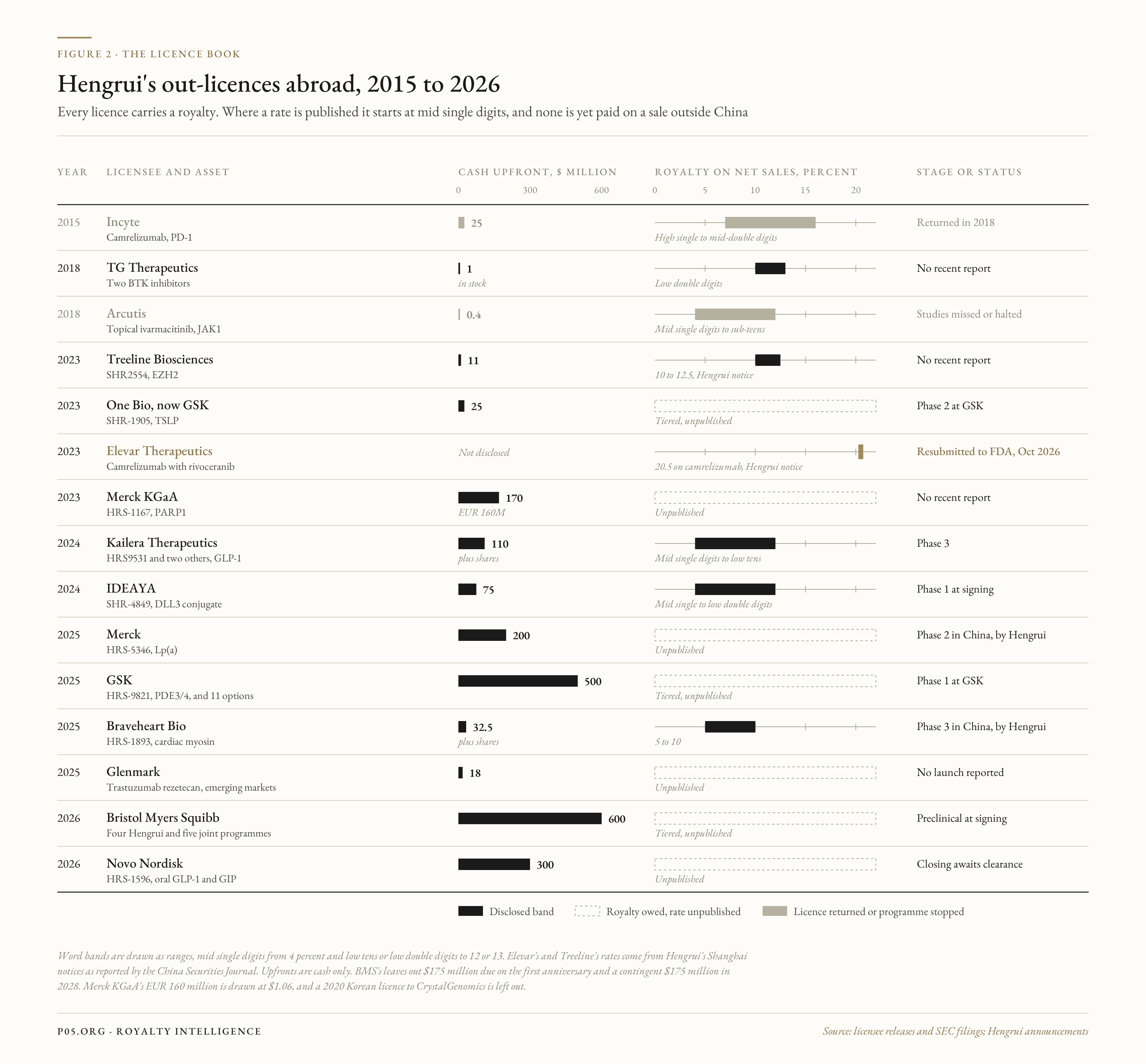
Each out-licence since 2015, with the upfront paid, the royalty band where one is disclosed, and the stage of the licensed asset
Every published band starts at mid single digits or above. Braveheart's runs from 5 to 10 percent, and IDEAYA's from mid single digits to low double digits. The highest rate on record is the 20.5 percent on camrelizumab that Hengrui's notice gives for the Elevar licence.
Kailera's prospectus describes its royalty as tiered from mid single digits to the low tens of percent. It runs product by product and country by country until the latest of patent expiry, the end of regulatory exclusivity, and the tenth anniversary of first sale. Kailera redacted the rates in the filed licence.
The contracts with the largest upfronts publish no rate. Merck's release says only that Hengrui will receive royalties on net sales if HRS-5346 is approved. GSK and BMS use the word tiered and give no band. Novo Nordisk says royalties will be based on net sales in the licensed territory. Those four contracts account for $1.6B of the $2.04B in cash upfronts agreed since 2023. The total counts Merck KGaA's EUR 160M as $170M and leaves out equity and the undisclosed Elevar payment.
None of the licensed assets has been approved outside China. The furthest along in the West is camrelizumab with rivoceranib, which the Food and Drug Administration has turned down three times. The third complete response letter, in July 2026, cited manufacturing compliance at a site on the rivoceranib application. HLB resubmitted both applications around 9 October.
Kailera's lead drug is in Phase 3. GSK lists the TSLP antibody, now GSK5784283, in a Phase 2 asthma trial of 307 patients, and HRS-9821, as GSK6582701, in Phase 1. Hengrui itself is running the Chinese trials of several licensed drugs. It began a Phase 2 trial of HRS-9821 in July 2026 and has completed a Phase 2 trial of HRS-5346. Merck has registered no trial of its own on HRS-5346.
Incyte returned camrelizumab in 2018, three years after licensing it. Arcutis's 2025 annual report records that its hand eczema study of topical ivarmacitinib missed its primary endpoint in May 2021, that it ended a vitiligo study, and that it halted a second formulation for alopecia after a Phase 1b study in mid-2025. TG Therapeutics and Treeline have not reported on their Hengrui programmes in the filings and releases reviewed.
Two Companies Built on Hengrui Assets
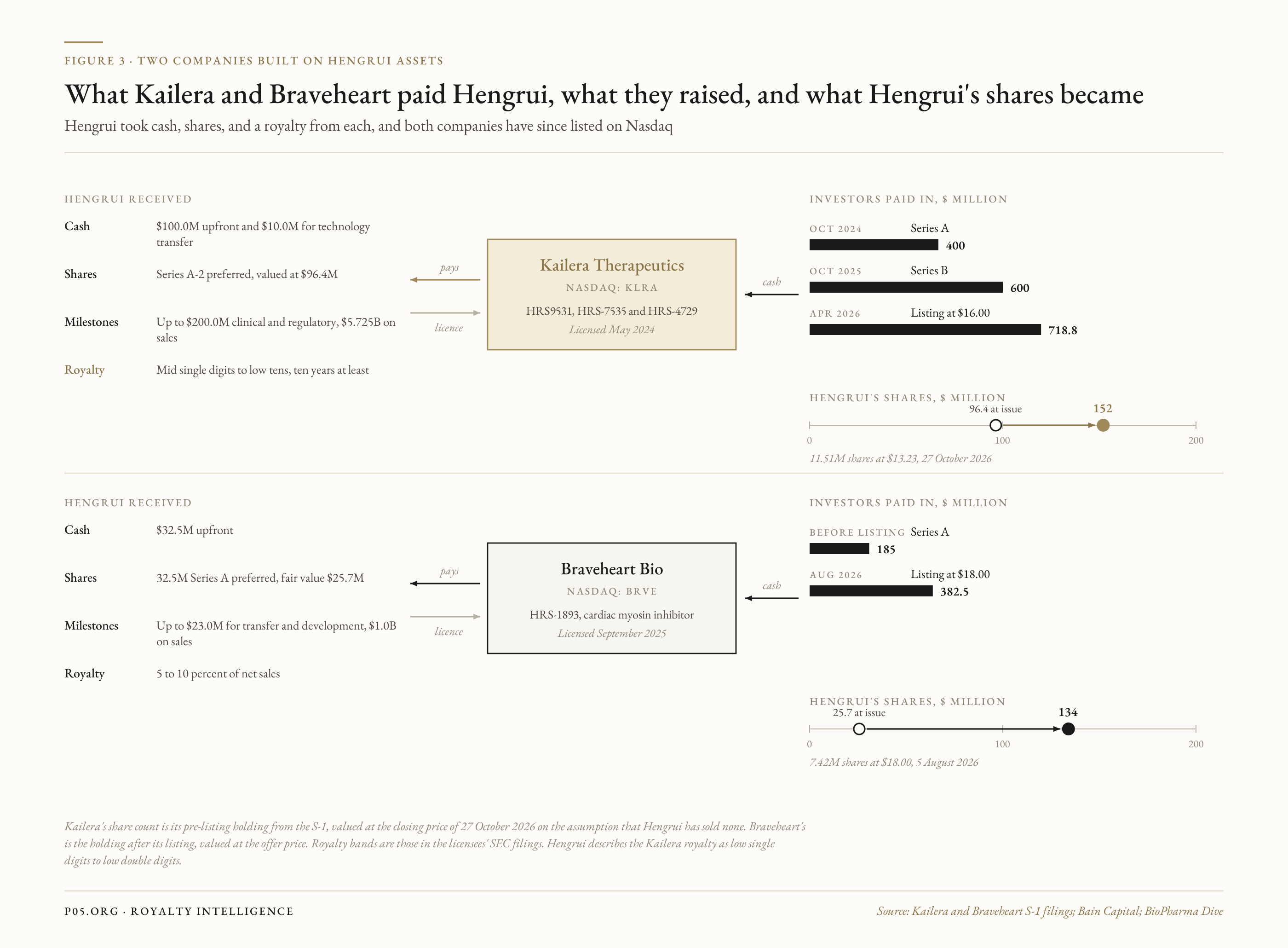
What Hengrui received from Kailera and Braveheart, what each company has raised, and what Hengrui's shares were worth on the dates shown
Twice Hengrui has licensed an asset to a company formed to hold it. It took cash, shares, and a royalty from each, and both companies have since listed on Nasdaq.
Kailera raised $400M of Series A money in October 2024 and $600M of Series B a year later, led by Bain Capital Private Equity. Royalty Pharma, CPP Investments, and the Qatar Investment Authority were among the Series B investors. The company completed its listing on 20 April 2026 at $16.00 a share, raising $718.8M gross.
Hengrui held 11,511,853 Kailera shares, or 13.6 percent, before the offering. Its interim report records a fair-value gain of $116M (RMB 820.7M) on the stake in the first half of 2026. Kailera's shares closed at $13.23 on 27 October, which would value the same holding at about $152M if Hengrui still owns all of it.
The licence also gives Hengrui up to $200.0M of clinical and regulatory milestones and up to $5.725B of sales milestones. Kailera began its three Phase 3 trials of the drug, now KAI-9531, between December 2025 and January 2026, and expects the first results in 2028. Its prospectus names royalty financings among possible future sources of funding.
Braveheart's licence carries royalties of 5 to 10 percent of net sales, up to $23.0M of technology transfer and development milestones, and up to $1.0B of sales milestones. Braveheart also pays Hengrui's continuing programme costs, and it valued the 32.5 million preferred shares it issued to Hengrui at $25.7M.
The company raised $185M in a Series A and priced its listing on 5 August 2026 at $18 a share, raising $382.5M. Hengrui's 7,420,091 shares, 8.5 percent after the offering, were worth about $134M at that price. Hengrui is running a Phase 3 trial of the drug in obstructive hypertrophic cardiomyopathy in China, which Braveheart believes may support an American application.
At Kailera and Braveheart together, Hengrui received $142.5M in cash for its licences and shares then valued at about $122M. At the prices cited above the same shares come to about $286M.
Financial Profile
| Item | Amount | Source and date |
|---|---|---|
| Revenue, nine months | $3.44B (RMB 24.41B), up 5.3 percent | Third-quarter report, 30 September 2026 |
| Net profit attributable, nine months | $975M (RMB 6.92B), up 20.4 percent | same |
| Net profit attributable, third quarter | $346M (RMB 2.458B), up 88.9 percent | same |
| Licence revenue, nine months | $392M (RMB 2.781B), up 31.1 percent | same |
| Licence cash received, nine months | $612M (RMB 4.343B) | same |
| Product sales, nine months | $3.02B (RMB 21.48B), up 2.5 percent | same |
| Research and development, nine months | $1.01B (RMB 7.15B), of which $764M (RMB 5.42B) expensed | same |
| Contract liabilities | $413M (RMB 2.93B), against $269M (RMB 1.91B) at 31 December 2025 | same |
| Cash and deposits | $6.12B (RMB 43.45B) | same |
| Licence revenue, first half 2026 | $200M (RMB 1.42B), of which $166M (RMB 1.18B) from GSK | Interim report, 30 June 2026 |
| Fair-value gain on Kailera shares | $116M (RMB 820.7M) | Interim report, six months to 30 June 2026 |
| Revenue, 2025 | $4.45B (RMB 31.63B), up 13.0 percent | Annual report, 31 December 2025 |
| Licence revenue, 2025 | $478M (RMB 3.39B) | same |
| Net profit attributable, 2025 | $1.09B (RMB 7.71B) | same |
| Licence revenue, 2024 | $380M (RMB 2.70B) | same |
| Net profit attributable, 2024 | $892M (RMB 6.34B) | same |
| Licence revenue, 2023 and 2022 | $38M (RMB 268.4M) and $0.9M (RMB 6.4M) | H-share prospectus, May 2025 |
| Hong Kong offering | $1.27B (HK$9.89B) gross at HK$44.05 | Allotment results, 22 May 2025 |
| BMS upfront and anniversary payments | $600M, $175M, and a contingent $175M | Hengrui announcement, 12 May 2026 |
| GSK upfront | $500M | GSK release, 28 July 2025 |
| Kailera shares held before its listing | 11,511,853, or 13.6 percent | Kailera S-1, 2026 |
| Braveheart shares held after its listing | 7,420,091, or 8.5 percent | Braveheart S-1/A, August 2026 |
| Royalty income from sales outside China | Not reported | No licensed product approved outside China |
Blue Team
- Licence revenue has run at $380M in 2024, $478M in 2025, and $392M in the first nine months of 2026
- The four largest upfronts came from GSK, BMS, Merck, and Novo Nordisk, which will owe the royalties on those licences
- Revenue still to be recognised sits in contract liabilities of $413M at 30 September, and BMS owes a $175M anniversary payment in 2027
- No disclosed royalty band starts below mid single digits, and the Elevar rate on camrelizumab is 20.5 percent
- The Kailera royalty runs at least ten years from first sale in each country, and its lead drug is in three Phase 3 trials
- The two stakes in companies formed around Hengrui assets came to about $286M at the prices cited, against about $122M on receipt
- Hengrui runs the Chinese trials of several licensed drugs, among them HRS-9821 and HRS-5346
- Hengrui holds $6.12B of cash and deposits and has borrowed against no royalty in the public record
Red Team
- No royalty has been paid on any product sold outside China, and the nearest candidate, camrelizumab, has three complete response letters
- Licence revenue fell to $200M in the first half of 2026 from $280M (RMB 1.99B) a year earlier, when Hengrui booked the Merck and IDEAYA upfronts at once
- Product sales grew 2.5 percent over the nine months, against 31.1 percent for licence revenue
- Royalty rates on the Merck, GSK, BMS, and Novo Nordisk contracts are unpublished, and the Kailera rates are redacted in the filed licence
- Several published rates come from Hengrui's own notices to the Shanghai exchange, not from the licensee's filings
- The BMS assets are preclinical and unnamed, and GSK's 11 options are exercisable only after Phase 1
- Incyte returned camrelizumab in 2018, and Arcutis's topical ivarmacitinib missed its primary endpoint in hand eczema
- The Kailera stake has fallen with the share price, from $16.00 at listing to $13.23 on 27 October
- Licence revenue for the nine months is reported as one line, with no split by partner, and Hengrui does not report the cost of earning it
Implications for the Pharmaceutical Royalty and Biotech Capital Markets
Hengrui has licensed its pipeline abroad asset by asset, and every licence keeps a royalty for Hengrui. Upfronts arrive at signing, and milestones as trials and filings succeed. Royalties begin only when a product is sold, and the BMS, GSK option, and Novo Nordisk programmes were preclinical or at Phase 1 when signed.
Hengrui books upfronts on two schedules. A licence recognised at a point in time, like Merck's, lands in a single quarter. A licence with obligations attached, like GSK's and BMS's, is spread over the periods in which Hengrui does the work. Hengrui will recognise royalties as each licensee sells.
No rate has been published for any licence with Merck, GSK, BMS, or Novo Nordisk. The only published rate above 12.5 percent is Elevar's 20.5 percent, and Elevar is a subsidiary of HLB. A buyer pricing a Hengrui royalty on a Merck or GSK product would need the licence itself.
The royalties owed by Kailera and Braveheart are described in public filings. Both companies are listed in America and describe the royalty in SEC filings, as Paragon's licensees do. A royalty on KAI-9531 is owed by a Nasdaq company to a Chinese licensor, and the filings show no step that Hengrui has taken to sell it.
Where royalty financing appears in the record, it is on the licensee's side. Kailera's prospectus names it among possible future sources of funding, and Royalty Pharma is among Kailera's shareholders. Hengrui holds $6.12B of cash and deposits and received $612M of licence cash in nine months. A revenue interest sold by Kailera would be a second claim on the same sales as Hengrui's royalty.
Hengrui's terms have passed through one change of owner. When GSK bought Aiolos in January 2024 it assumed Hengrui's milestones and royalties owed to Hengrui. The TSLP antibody that One Bio licensed for $25M is now a GSK asset in Phase 2, and the royalty on it is a GSK obligation.
Recent Developments
- Hengrui reports licence revenue of $392M for the nine months to September and $612M of licence cash received, on 27 October 2026
- HLB resubmits the American applications for rivoceranib and camrelizumab around 9 October 2026
- Novo Nordisk licenses HRS-1596 for $300M upfront and up to $2.6B in all on 29 September 2026
- Hengrui reports licence revenue of $200M for the first half, with no BMS revenue yet recognised, on 19 August 2026
- Braveheart Bio prices its Nasdaq listing at $18 a share, raising $382.5M, on 5 August 2026
- The FDA issues a third complete response letter on rivoceranib and camrelizumab in July 2026
- Hengrui and BMS sign their agreement on 13 programmes on 12 May 2026. It closed in July
- Kailera Therapeutics completes its Nasdaq listing at $16.00 a share, raising $718.8M gross, on 20 April 2026
- Hengrui reports 2025 licence revenue of $478M on 26 March 2026
- Caixin reports Hengrui as the largest Chinese licensor of 2025, with $16.7B of deal value, on 14 January 2026
- Kailera raises $600M of Series B on 14 October 2025
- No sale, pledge, or purchase of a Hengrui royalty has been identified
Financial History
| Date | Event |
|---|---|
| Sep 2015 | Incyte licenses camrelizumab for $25M upfront |
| Jan 2018 | TG Therapeutics licenses two BTK inhibitors, and Arcutis licenses topical ivarmacitinib |
| Feb 2018 | Incyte and Hengrui end the camrelizumab collaboration |
| Feb 2023 | Treeline Biosciences licenses SHR2554 for $11M upfront |
| 15 Aug 2023 | One Bio licenses SHR-1905 |
| 17 Oct 2023 | Elevar Therapeutics licenses camrelizumab for use with rivoceranib |
| 30 Oct 2023 | Merck KGaA licenses HRS-1167 for EUR 160M upfront |
| 9 Jan 2024 | GSK agrees to buy Aiolos Bio and takes on the royalties owed to Hengrui |
| 15 May 2024 | Hercules CM NewCo, later Kailera, licenses three metabolic drugs for $110M and equity |
| May 2024 | FDA issues its first complete response letter on camrelizumab and rivoceranib |
| Oct 2024 | Kailera raises $400M of Series A |
| 29 Dec 2024 | IDEAYA licenses SHR-4849 for $75M upfront |
| Mar 2025 | FDA issues a second complete response letter |
| 25 Mar 2025 | Merck licenses HRS-5346 for $200M upfront |
| 23 May 2025 | Hengrui lists H shares in Hong Kong, raising $1.27B gross |
| 28 Jul 2025 | GSK licenses HRS-9821, with options on 11 programmes, for $500M upfront |
| Sep 2025 | Braveheart Bio licenses HRS-1893, and Glenmark licenses trastuzumab rezetecan for emerging markets |
| 14 Oct 2025 | Kailera raises $600M of Series B |
| Dec 2025 | Kailera starts its first Phase 3 trials of KAI-9531 |
| 26 Mar 2026 | Hengrui reports 2025 licence revenue of $478M |
| 20 Apr 2026 | Kailera completes its Nasdaq listing |
| 12 May 2026 | Hengrui and BMS sign their agreement, with $600M upfront |
| Jul 2026 | BMS deal closes, and FDA issues a third complete response letter |
| 5 Aug 2026 | Braveheart prices its Nasdaq listing |
| 29 Sep 2026 | Novo Nordisk licenses HRS-1596 for $300M upfront |
| 9 Oct 2026 | Applications for camrelizumab and rivoceranib resubmitted |
| 27 Oct 2026 | Third-quarter report: $392M of licence revenue and $612M of licence cash in nine months |
| 2027 | BMS anniversary payment of $175M due |
| 2028 | Contingent BMS payment of $175M, and first Phase 3 results for KAI-9531 expected |
Conclusion
Hengrui's product sales grew 2.5 percent in the first nine months of 2026, and its net profit 20.4 percent. Its Shanghai report gives higher licence revenue as the main reason for the third-quarter rise. Since 2023 it has signed contracts with GSK, BMS, Merck, Novo Nordisk, and others, and they now produce revenue equal to about two-fifths of its net profit.
That revenue is upfront and milestone money, booked as Hengrui completes its side of each contract. The royalties in the same contracts run from 5 percent to 20.5 percent where they are published, and most of the largest are not published. None has produced a payment from a sale outside China.
The third-quarter report of 27 October shows the $600M from BMS passing through the accounts. BMS will owe a royalty only once a product from those programmes, all preclinical at signing, is sold outside China. The licensed products at the latest stage abroad are camrelizumab, back before the FDA since 9 October, and KAI-9531, whose Phase 3 results are due in 2028.
All information in this report was accurate as of the research date and is derived from publicly available sources including court opinions, regulatory guidance, academic literature, SEC filings, and financial news reporting. Information may have changed since publication. This content is for informational purposes only and does not constitute investment, legal, or financial advice. The author is not a lawyer or financial adviser.