Company of the Week: Paragon Laboratories
Paragon has seeded nine biotech companies in five years. It takes cash and shares from each while the research runs, and a single-digit royalty on any drug that sells. AbbVie kept the royalty when it paid $10.9B for the first of them.

On 13 October 2026 Alaunos Therapeutics, a Nasdaq company with $0.12M of cash at the end of June and a delisting determination from the exchange dated 5 October, bought Velaris Therapeutics. None of Velaris's drug candidates has been given to a person.
The same day investors led by Fairmount agreed to pay about $350M for new Alaunos shares, enough by the company's account to fund it into 2029.
Three months earlier Fairmount had paid Velaris $200,000 for 20 million preferred shares. The merger exchanged each Velaris share for 5.2643 Alaunos share equivalents, and those 20 million became the 105.3 million share equivalents carried by Fairmount's new Series B stock. At the placement price of $1.4357 a share they are worth about $151M.
Velaris's drugs come from Paragon Laboratories, a company in Waltham, Massachusetts, that Fairmount founded in 2021. In the merger Paragon and an affiliate received 26,322 Series C preferred shares, or 26.3 million share equivalents.
Under a discovery and option agreement signed before the merger, Velaris owes Paragon milestones, two warrants of 1 percent each, and a single-digit royalty on net sales of every product it licenses. Paragon may take the licences back if the company's stockholders' equity does not exceed $200M at the end of its second full fiscal quarter.
Velaris is the ninth company built on antibodies that Paragon discovered, and each of the other eight signed a version of the same contract. The record shows a licensor that writes a single-digit royalty into every company it seeds, on terms agreed while Fairmount sits on both sides.
The first of those royalties has already passed through a sale. AbbVie paid about $10.9B for Apogee Therapeutics and kept the royalty, amended. No royalty in the book has been sold, and no drug it attaches to is on the market.
At a Glance
| Item | Detail |
|---|---|
| Company | Paragon Laboratories, Inc., Waltham, Massachusetts. Private. Works beside its predecessor, Paragon Therapeutics, Inc., which holds the licences signed with the first eight companies |
| Founded | 2021, by Fairmount as a joint venture with FairJourney Biologics of Porto |
| Control | Fairmount appointed Paragon's board and approves its officers. Peter Harwin of Fairmount is a director of Paragon and of Alaunos |
| Chief executive | Michael Henderson, from 13 October 2026. Chief executive of Apogee until its sale, and president of Velaris |
| Companies launched | Apogee, Spyre, Oruka, Jade, Crescent, Korsana, Mentari, Damora, and Velaris |
| Capital raised at listing | About $2.30B across eight companies, June 2023 to October 2026. Mentari's placement of about $490M awaits a vote on 4 November |
| Royalty | From low single digits at Apogee to low to mid single digits at Jade. Velaris's is a single-digit percentage. Every one runs to the later of patent expiry and the twelfth anniversary of first sale |
| Equity | Common units at Apogee. Two warrants of 1 percent of the fully diluted shares at each later company, and 5,000,000 founder shares at Crescent, Korsana, and Mentari |
| Cash terms | Cost reimbursement with a 20 percent mark-up on certain direct costs, research initiation fees, and milestones of up to $22.0M a programme at most companies |
| Most advanced royalty | Zumilokibart, an antibody against IL-13 for eczema, which had finished Phase 2 when AbbVie agreed to buy Apogee. Owed by AbbVie since 3 September 2026 |
| Founding investor | Fairmount Funds Management, West Conshohocken, Pennsylvania, with $5.80B of regulatory assets in August 2026 |
| Fund vehicle | Paragon Laboratories L.P., which filed a Form D in April 2026 and reported gross assets of $50.0M and 47 beneficial owners in August |
| Counsel on the Velaris merger | Gibson Dunn, for Velaris |
| Royalty posture | Holds a royalty on every licensed programme. None sold, pledged, or financed in the public record |
A Note on Scope
Paragon is private and publishes no accounts. Its revenue, cash, and ownership are not on record, and the figures in this profile are what its licensees report paying it. They have to report them because Fairmount holds large stakes on both sides of each contract, which makes every payment a related-party item in the licensee's filings.
Two companies use the name. Paragon Therapeutics, Inc. signed the agreements with the first eight companies. Paragon Laboratories, Inc. signed the newer ones, including the Velaris agreement, and from Mentari onwards it takes some or all of the warrants itself.
Mentari's merger prospectus treats the two together as Paragon, and so does this profile. Neither company has published an account of how the work and the contracts are divided between them.
No Paragon licence is on file with its royalty rate visible. Apogee filed its IL-31R licence with the rate redacted. The Velaris agreement will be filed with Alaunos's next annual report. The rates below are the word bands the licensees use.
The Velaris royalty was first recorded in The Weekly Term Sheet for week 42. Perceptive Advisors, which bought into the Alaunos placement, was the Fund of the Week after the profile of Alentis Therapeutics.
What Paragon Has Built
Fairmount was co-founded in April 2016 by Peter Harwin, who had come from Boxer Capital, and Tomas Kiselak. In 2021 it set up Paragon as a joint venture with FairJourney Biologics, an antibody discovery company in Porto. Partners Group agreed to buy a majority of FairJourney from GHO Capital in July 2024.
The method was to take targets that other companies had already proved in patients and to make antibodies against them that last longer in the body. Apogee was first. Its option agreement of February 2022 covered IL-13, IL-4Rα, and OX40L, targets in eczema.
Apogee paid $1.3M in cash and 5,000,000 common units, reimbursed Paragon's research costs, and agreed to a low single-digit royalty on sales, and it listed on Nasdaq in July 2023, raising $300.05M at $17.00 a share.
A month earlier Paragon had used a second route to market. Its bowel disease programmes sat in a private company called Spyre, which Aeglea BioTherapeutics, a listed company, bought for stock on 22 June 2023.
Fairmount led a $210M placement beside it. Seven of the eight companies that followed Apogee reached Nasdaq the same way, and BioPharma Dive counts eight reverse mergers in all.
The targets kept to the pattern. Oruka took IL-23 and IL-17A/F for psoriasis, and Jade took APRIL for a kidney disease. Crescent's lead is a PD-1 and VEGF bispecific designed to replicate ivonescimab. Korsana has an anti-amyloid antibody carried into the brain by a transferrin receptor shuttle.
Mentari is working on PACAP and CGRP for migraine, and Damora on mutant calreticulin in blood cancers. Velaris's lead, VLR199, is meant to reproduce the pharmacology of Merck's Winrevair in pulmonary arterial hypertension.
In October Paragon took on a management team. Michael Henderson, who ran Apogee until AbbVie bought it, became chief executive, and four other Apogee executives came with him. Velaris was the first company launched under the new team, and Henderson, as its president, now sits on both sides of its licence.
The Capital Record
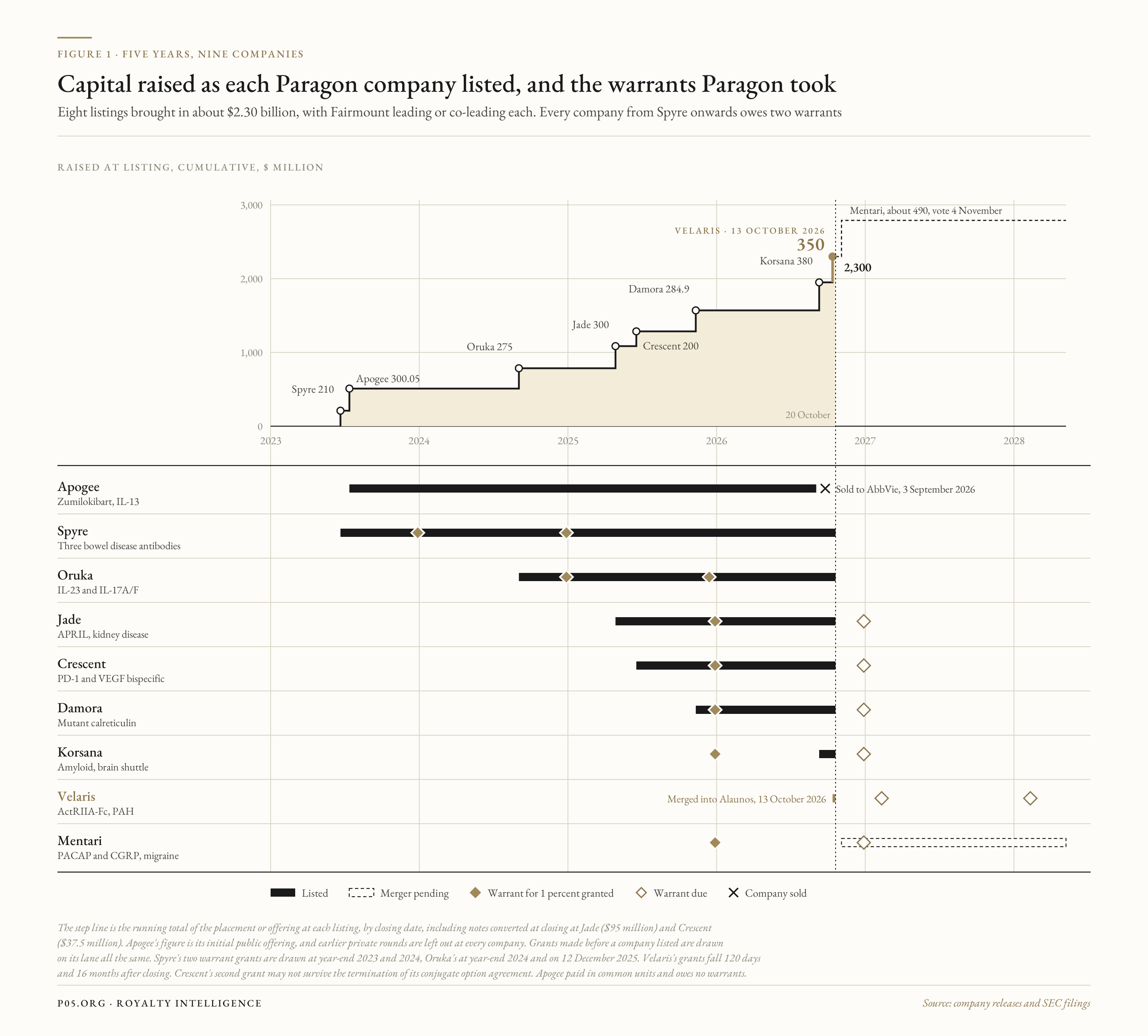
Placement or offering size at each listing, with the stage each company's lead drug has reached and the date of Paragon's two warrant grants
Fairmount has led or co-led the financing at every listing. Spyre raised $210M in June 2023 and Apogee $300.05M a month later. Oruka's $275M came in 2024. Jade's $300M and Crescent's $200M followed in 2025, each counting notes converted at closing.
Damora raised $284.9M in November 2025, Korsana $380M in September 2026, and Velaris $350M in October. The total is about $2.30B.
The shells brought a listing and little else. Their holders kept about 2.38 percent of Oruka and 1.1 percent of Korsana, and InMed's will keep about 0.97 percent of Mentari. The legacy Alaunos holders have about 1 percent of the shares on an as-converted basis, by the capitalisation table in the investor presentation.
Fairmount's own stakes are large and mostly non-voting. At the AbbVie vote its second fund held 9.3 percent of Apogee's shares and 0.5 percent of the votes. Its filing on closing shows that every share was cashed out at $135.11. On 7,041,968 shares that comes to about $951M, before options.
In February it held 19.99 percent of Oruka. At Alaunos it will hold about 45 percent of the shares once the preferred converts, subject to a cap of 19.99 percent on what it may own at any one time.
Fairmount reports $5.80B of regulatory assets, of which its second fund accounts for gross assets of $5.60B. The same filing lists Paragon Laboratories L.P., a pooled fund with Paragon Labs GP LLC as general partner. In August it held $50.0M for 47 beneficial owners, a quarter of it owned by Fairmount and its related persons. Its purpose has not been published.
The Velaris Agreement
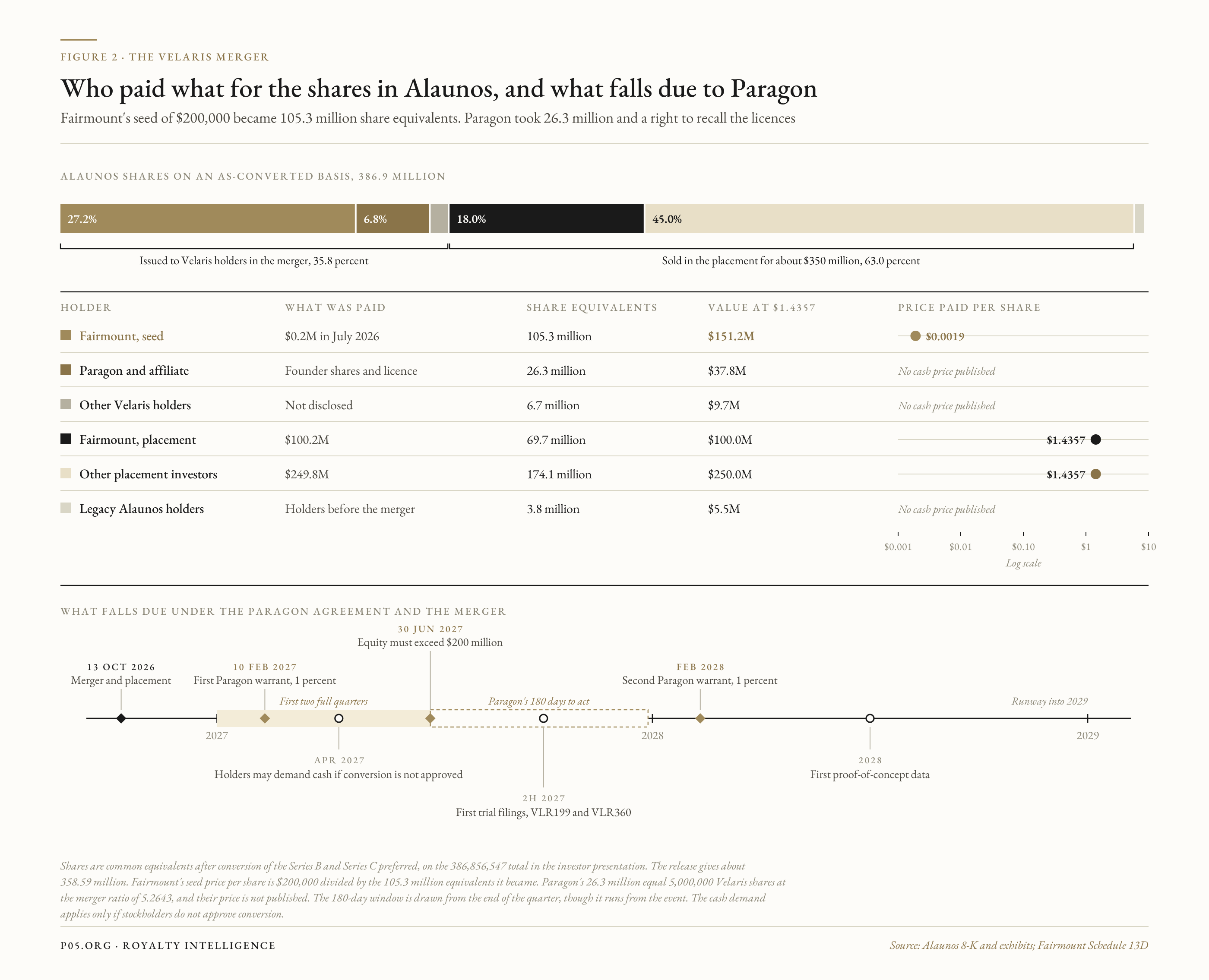
What each group paid for its Alaunos shares, and the dates on which Paragon's warrants and reversion right fall due
What Was Signed
The Alaunos 8-K describes a Fusion Protein Discovery and Option Agreement between Velaris and Paragon Laboratories. It covers Fc fusion proteins against ActRIIA and ActRIIB, including a version of ActRIIA designed to spare the BMP9 and BMP10 signalling proteins, and Velaris holds an exclusive option, programme by programme, to a worldwide licence over each of them.
Three antibody programmes, among them an anti-PDGF-B antibody and a bispecific, run under a separate research letter and will be written up later.
Velaris pays a one-time research initiation fee after a qualifying financing. It also pays Paragon's third-party costs, with a mark-up on some of them, and a monthly fee for Paragon's staff.
Each licence carries development, regulatory, and commercial milestones, and the royalty is a single-digit percentage of net sales, subject to customary reductions.
It runs product by product and country by country until the later of patent expiry and the twelfth anniversary of first sale.
Each warrant is for 1.00 percent of Alaunos's shares on a fully diluted basis, counting those issued in the merger and the placement. Each is priced at fair market value on the day of grant and runs ten years. The first is due 120 days after closing, which falls on 10 February 2027, and the second a year later.
What Paragon Can Take Back
The reversion right appears in no earlier Paragon contract on file. Paragon may end a licence and recover the rights if stockholders' equity, measured under Nasdaq's rules, does not exceed $200M at the end of the second full fiscal quarter after closing.
Alaunos reports on the calendar year, so the test falls on 30 June 2027. Filing that quarter's report late triggers the right too.
So does a failure to deliver freely tradeable shares within 120 days of a warrant exercise. Paragon has 180 days to act. A later cure does not remove the right, and until the right lapses Velaris may not sublicense, assign, or pledge the rights without consent.
The equity test sits beside a stockholder vote. Alaunos must ask its holders to approve conversion of the preferred stock under Nasdaq's rules, along with a change of name to Velaris Therapeutics and a move of domicile. If they do not approve it, holders may demand cash at fair value from six months after issue.
A share that its holder can put back to the company for cash is usually reported outside stockholders' equity.
Alaunos has not said how it would report the preferred if the vote failed. Its officers and directors, and the holders of its older preferred stock, have agreed to vote in favour. Once the vote passes, Harwin and three designees of Fairmount will fill four of the five board seats.
What Is Not Published
No figure in the agreement has been released. The research initiation fee, the mark-up, the monthly fee, the milestones, and the royalty rate are all blank, and so are the customary reductions, the exclusivity that Paragon gives in return, and the date by which Velaris must exercise its options.
The 8-K is silent on whether the royalty falls when a patent lapses. Every earlier Paragon licence that addresses the point cuts the rate where no valid claim covers the product, by a third at Spyre and by 30 percent at Jade.
It is also silent on whether a product combining two Paragon molecules pays a higher rate, as at Spyre and Jade.
The documents also disagree with each other. The investor presentation refers to a $250M financing, while the 8-K and the release give about $350M, of which Fairmount's funds paid $100.2M. The release puts the as-converted share count at about 358.59 million and the presentation at 386,856,547.
One Template, Nine Companies
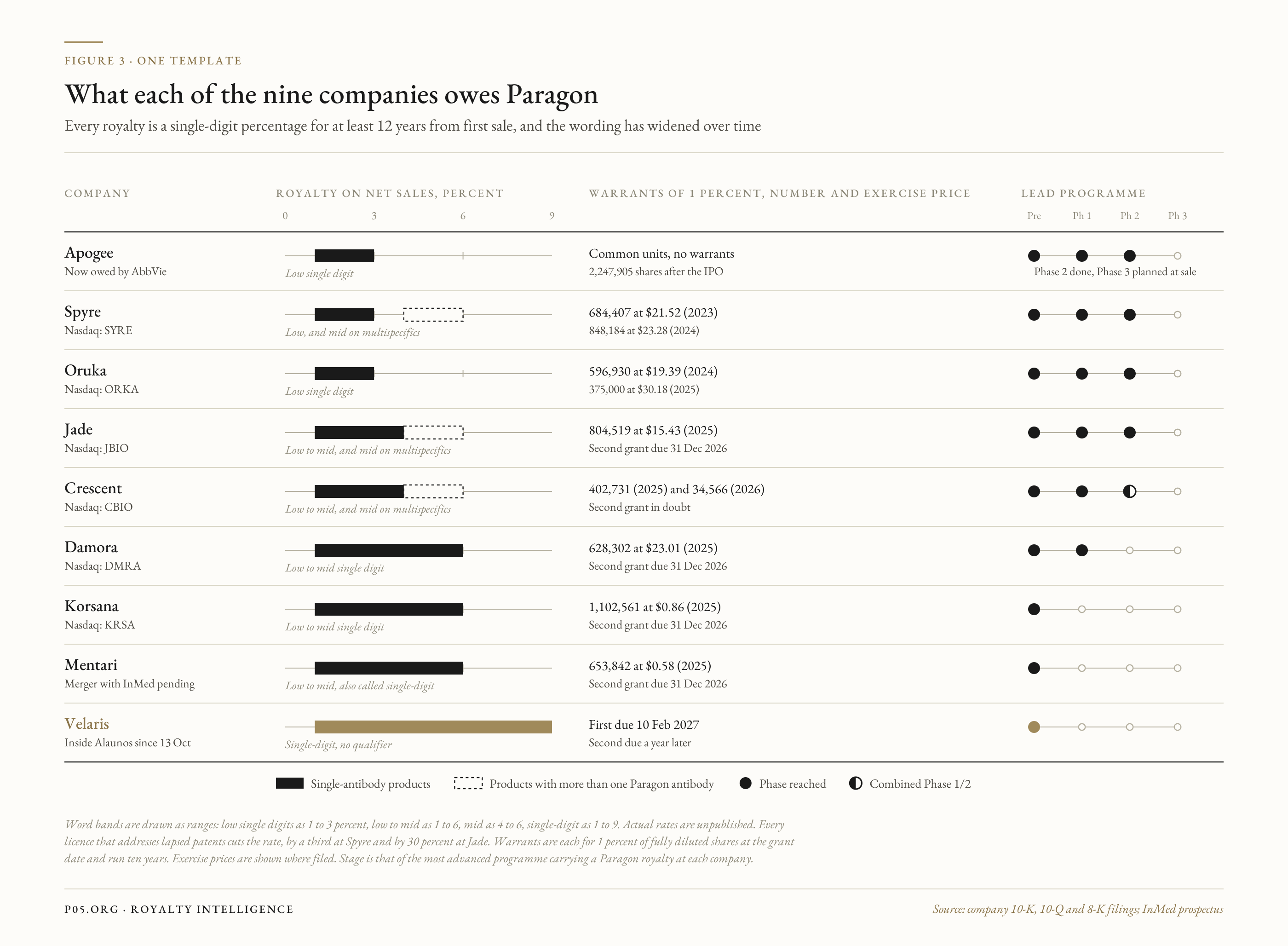
The royalty band, warrant grants, founder shares, and stage of the lead programme at each company built on Paragon assets
Set side by side, the nine contracts differ in wording more than in substance. Every royalty is a single-digit percentage of net sales and runs to the later of patent expiry and 12 years from first sale. All reimburse its costs. Most pay milestones capped at $22.0M a programme.
The wording has drifted upward. Apogee, Spyre, and Oruka owe a low single-digit royalty on single-antibody products. Jade, Crescent, Korsana, and Damora owe low to mid single digits. Mentari's prospectus uses both phrases, and the Velaris 8-K says single-digit with no qualifier.
Spyre, Jade, and Crescent pay a mid single-digit rate on products that contain more than one Paragon antibody. Paragon in turn owes Apogee a royalty. It is due on the multispecific products that Apogee licensed back to it.
The equity has changed. Apogee paid in common units and owes no warrants, and Paragon held 2,247,905 Apogee shares after its IPO, or 4.7 percent. Spyre's agreement first required a warrant for 1 percent of the fully diluted shares every year. A 2023 amendment limited it to two grants, of 684,407 warrants at $21.52 and 848,184 at $23.28. Every later company owes two.
Crescent, Korsana, and Mentari also sold Paragon 5,000,000 founder shares for between $0.01 and $0.20 each, and half of each block passed to a holding company.
Those holding companies carry the warrants: Parapyre at Spyre, Paruka at Oruka, Parade at Jade, Parascent at Crescent, Parasa at Korsana, Paratari at Mentari, and Paramora at Damora. Spyre's filing describes Parapyre as a vehicle to share profits with certain Paragon employees.
From Mentari onwards Paragon Laboratories takes some or all of them directly. At Damora the warrants were carried as a liability of $9.5M at the end of June.
None of the drugs that carry a Paragon royalty has been approved. None has been filed. Zumilokibart, the most advanced, had finished Phase 2 when AbbVie agreed to buy Apogee, and Phase 3 was planned for the second half of 2026. Spyre's antibodies are in Phase 2 trials, and Oruka, also in Phase 2, expects to start Phase 3 in the first half of 2027.
Jade dosed its first Phase 2 patient in May. Crescent's lead began a Phase 1/2 trial in February and Damora's a Phase 1/1b trial in August. Korsana, Mentari, and Velaris have yet to reach the clinic.
One programme has come back. Crescent terminated its option agreement for antibody-drug conjugates on 26 March 2026 and settled it with 34,566 further warrants. Its filing leaves open whether the second annual grant survives.
What Paragon Is Paid
Most of what licensees report paying Paragon is reimbursement. Apogee recorded $10.8M of research costs with Paragon to the end of 2022, then $26.3M in 2023 and $19.2M in 2024, and had incurred $17.0M of milestones by the end of 2025.
Spyre paid $39.5M of costs and fees in 2023 and $31.8M in 2024, and $21.0M of milestones from 2024 to June 2026. Damora paid $29.3M in the first half of 2026.
The later agreements put a price on that research. Jade's upfront payment of $5.6M covered Paragon's historical direct costs plus a 20 percent mark-up meant to stand in for overheads. Research initiation fees run from $0.8M to $3.0M a programme.
At most companies the milestones fall due on nomination of a development candidate and on first dosing in Phase 1, typically $1.5M and $2.5M, inside the $22.0M ceiling.
Paragon is bound too. It may not start new discovery work against a licensed target for a period, which at Spyre is at least five years. In May Spyre's IL-23 licence was widened from bowel disease to all uses, with limits on dosing in other diseases until 2028 or 2030.
The royalty is the one term that has been through a sale. At Apogee it survived the sale for $10.9B. On 14 June, four days before the merger agreement was signed, AbbVie's counsel asked Apogee to sign a new licence with Paragon for IL-31R and to amend the existing licences in one omnibus amendment.
The proxy says the amendment changed the scope and duration of Paragon's exclusivity, the royalty deductions Apogee may take, and the conditions on which products revert if a licence ends. It takes effect immediately before closing, and Apogee's audit committee approved it as a related-person transaction. No payment to Paragon on the change of control is disclosed. The amendment is not on file.
AbbVie now owes Paragon a low single-digit royalty on zumilokibart and on the other Apogee programmes licensed from Paragon. In the projections Apogee's management gave its bankers, gross profit is revenue less the cost of goods and less royalty or revenue-share payments to Paragon, WuXi Biologics, and Blackstone.
A Priced Comparable
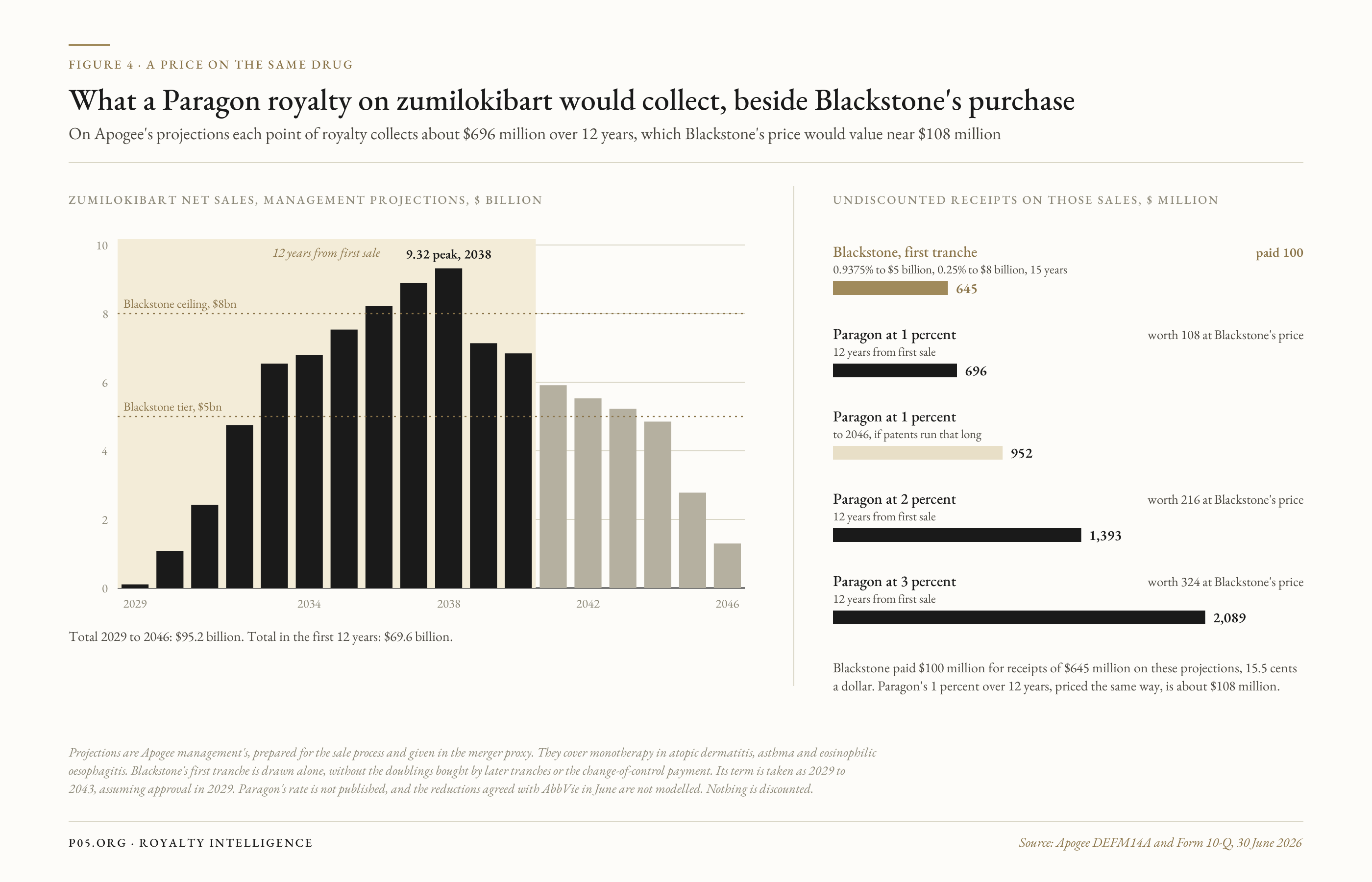
Management's sales projections for zumilokibart, what a Paragon royalty of 1 to 3 percent would collect from them, and Blackstone's first tranche on the same sales
No one has paid for a Paragon royalty in public. Someone did pay, three weeks before AbbVie agreed its terms, for a slice of the same drug's sales.
On 26 May 2026 Blackstone Life Sciences paid Apogee $100.0M for a revenue participation in zumilokibart. It receives 0.9375 percent of annual worldwide net sales up to $5B and 0.25 percent of sales between $5B and $8B, from first sale until 15 years after approval.
The rate doubles if Blackstone pays a further $100.0M once the Phase 3 trials are fully enrolled, and doubles again for $200.0M on positive data.
A fourth payment of $250M to $400M on approval in eczema adds 2.50 percent of the first $5B, up to $1.0B of payments in all. A change of control triggered a specified payment to Blackstone, and the proxy says only that Blackstone would benefit meaningfully from the merger.
Apogee's management projections give sales to run against both claims. They show net sales of $106M in 2029, rising to $9.32B in 2038 and falling to $1.30B in 2046, for a total of $95.2B. On those figures Blackstone's first tranche would collect about $645M from 2029 to 2043, or 6.45 times its price, before discounting.
A Paragon royalty of 1 percent on the same sales would collect about $696M over 12 years from 2029. It would collect about $952M if patents kept it running to 2046. A rate of 2 to 3 percent would collect $1.39B to $2.09B over the 12 years. None of these sums is discounted.
Priced as Blackstone priced its first tranche in May, one percentage point of Paragon's royalty would be worth about $108M, and two or three points about $216M to $324M.
The two claims differ in ways that matter to a buyer. Blackstone's schedule tapers above $5B and ends 15 years after approval. Paragon's royalty does not taper so far as the filings show. It can be cut where patents lapse, though, and by whatever deductions AbbVie negotiated in June.
Blackstone also bought rights to later tranches and to a payment on a sale. The projections themselves were prepared by the seller's management for a sale process, and they are the only public forecast of zumilokibart's sales.
Financial Profile
| Item | Amount | Source and date |
|---|---|---|
| Spyre placement | $210M | Aeglea release, 22 June 2023 |
| Apogee initial public offering | $300.05M at $17.00 a share | Prospectus, 13 July 2023 |
| Oruka placement | $275M | ARCA and Oruka release, 3 April 2024 |
| Jade placement, including $95M of notes | About $300M | Jade release, 28 April 2025 |
| Crescent placement, including $37.5M of notes | $200M | Crescent release, June 2025 |
| Damora placement | About $284.9M | Galecto release, 10 November 2025 |
| Korsana placement | $380M | Korsana release, September 2026 |
| Alaunos placement for Velaris | About $350M | Alaunos 8-K, 13 October 2026 |
| Mentari placement, pending | About $490M | InMed prospectus, 1 October 2026 |
| Fairmount's seed in Velaris | $200,000 for 20,000,000 preferred shares | Fairmount Schedule 13D, 15 October 2026 |
| Fairmount's purchase in the placement | $100.2M | same |
| Paragon's shares from the Velaris merger | 26,322 Series C, or 26.3 million share equivalents, about $37.8M at $1.4357 | Alaunos 8-K, 13 October 2026 |
| Alaunos cash before the merger | $0.12M | 10-Q, 30 June 2026 |
| AbbVie price for Apogee | $135.11 a share, about $10.9B | Apogee release, 22 June 2026 |
| Blackstone first tranche on zumilokibart | $100.0M for 0.9375 percent of sales to $5B | Apogee 10-Q, 30 June 2026 |
| Apogee research costs with Paragon | $10.8M to 2022, $26.3M in 2023, $19.2M in 2024, $2.2M in 2025 | Prospectus and 10-K, 31 December 2025 |
| Spyre costs and fees paid to Paragon | $39.5M in 2023, $31.8M in 2024, $0.2M in 2025 | Spyre 10-K, 31 December 2025 |
| Damora payments to Paragon | $29.3M | Damora 10-Q, six months to 30 June 2026 |
| Fairmount regulatory assets | $5.80B | Form ADV, August 2026 |
| Paragon Laboratories L.P. gross assets | $50.0M | same |
| Winrevair sales at Merck | $1,443M in 2025 and $1,114M in the first half of 2026 | Merck release, 4 August 2026 |
| Paragon revenue, cash, and ownership | Not published | Private company |
Blue Team
- The terms have been accepted by every syndicate that bought into a Paragon company, about $2.30B across eight listings
- The lead royalty survived a $10.9B acquisition. AbbVie asked for a ninth Apogee licence with Paragon before it signed
- The drug behind it has Phase 2 data. Zumilokibart reached EASI-75 in 65.9 percent of patients on the Phase 3 dose against 23.4 percent on placebo
- The royalty term has a floor. It runs at least 12 years from first sale in each country, whatever happens to the patents
- Research is paid as it is done, with a mark-up of 20 percent on certain direct costs, so Paragon does not wait for a launch to recover its spending
- The equity is repeated across the book: two warrants at each company from Spyre onwards and founder shares at three, with 26.3 million Alaunos share equivalents from Velaris alone
- The Velaris contract adds a reversion right that returns the licences to Paragon if its licensee cannot show $200M of equity by mid-2027
- The new management team has taken five Paragon assets into the clinic and sold a company
- Velaris's market is growing. Winrevair sold $1,114M in the first half of 2026, and Keros ended development of its rival ActRII drug in pulmonary hypertension in May 2025
Red Team
- No drug carrying a Paragon royalty has been approved, and on management's own projections zumilokibart sells nothing before 2029
- The rates are unpublished. Licensees describe them in word bands, and the one licence on file is redacted
- Fairmount sits on both sides. It appointed Paragon's board, holds large stakes in each licensee, and has directors on their boards, so every royalty was set without an independent counterparty
- AbbVie renegotiated the royalty deductions on zumilokibart before closing, and the effect on the rate has not been disclosed
- Every licence that addresses lapsed patents cuts the rate, by a third at Spyre and by 30 percent at Jade
- Velaris is preclinical. Its first trial applications are due in the second half of 2027, and GSK bought 35Pharma for $950M in April to develop a similar molecule
- Velaris's presentation lists reliance on an acting management team serving in an interim capacity among its risks, and Paragon's chief executive is also president of its licensee
- The Velaris documents disagree on the size of the financing and on the share count
- Crescent terminated its conjugate option agreement in March 2026
- Paragon publishes no accounts, and how the work is split between its two companies is not explained
Implications for the Pharmaceutical Royalty and Biotech Capital Markets
Paragon writes its royalty into each licence before the licensee has outside shareholders. The rate is agreed between companies that Fairmount controls, and the first independent investors meet it as a fixed term of the placement.
For anyone who later buys such a royalty, the question that matters is whether the term holds when a licensee is sold or fails.
Apogee is the only test. Four days before signing, AbbVie's counsel asked for Paragon's exclusivity and the royalty deductions to be renegotiated and for a new licence to be signed. The royalty itself stayed.
The proxy describes the amended terms in words and gives no figures for them, and the royalty is now an obligation of AbbVie, which paid about $10.9B for the company that owed it.
Zumilokibart now carries a stack. Paragon's low single-digit royalty sits beside Blackstone's revenue participation, which starts at 0.9375 percent of the first $5B of annual sales and rises with each later tranche.
WuXi Biologics is owed a fraction of a percent if the drug is made elsewhere. All three are obligations of AbbVie. A buyer of the Paragon royalty would be buying a claim on sales that Blackstone's contract also reaches, with no ranking between them in the public record.
The reversion right at Velaris changes what a licensee holds. Until mid-2027 its licences can return to Paragon on a balance-sheet test, and until then they cannot be pledged or sublicensed without Paragon's consent. A lender or royalty buyer dealing with Velaris before that date would be taking security over rights that the licensor can recall.
Paragon holds royalties on programmes at nine companies, one of them now owned by AbbVie, and none on a marketed product. A royalty fund that buys at or near approval would find one asset ready for Phase 3 and several in Phase 2. The Blackstone price gives a mark for the first. A fund carrying Paragon's name and managed by Fairmount holds $50.0M for 47 investors, and its mandate is unpublished.
For the companies, the cost of the template is visible in each filing: research at cost plus 20 percent, milestones of up to $22.0M, two warrants of 1 percent, and a royalty of a few percent for 12 years or more. For Fairmount the arithmetic runs the other way. At Velaris its seed of $200,000 became shares worth about $151M at the placement price within three months.
Recent Developments
- Alaunos completes its acquisition of Velaris and agrees a placement of about $350M led by Fairmount on 13 October 2026. The financing closed on 14 October
- Paragon names Michael Henderson chief executive, with four other former Apogee executives, on 13 October 2026
- Nasdaq issues a delisting determination to Alaunos on 5 October 2026
- InMed publishes its prospectus for the Mentari merger on 1 October 2026, with a shareholder meeting set for 4 November
- Korsana completes its merger with Cyclerion and a $380M placement on 8 September 2026
- AbbVie completes its acquisition of Apogee on 3 September 2026
- Damora starts its Phase 1/1b trial of DMR-001 on 5 August 2026
- Jade licenses JADE301 from Paragon on 29 June 2026
- AbbVie agrees to buy Apogee for $135.11 a share on 22 June 2026, after Apogee and Paragon sign the IL-31R licence and the omnibus amendment
- Spyre widens its IL-23 licence to all uses on 29 May 2026
- Blackstone pays $100.0M for a revenue participation in zumilokibart on 26 May 2026
- Paragon Laboratories L.P. files a Form D on 3 April 2026
- No sale, pledge, or purchase of a Paragon royalty has been identified
Financial History
| Date | Event |
|---|---|
| Apr 2016 | Fairmount founded by Peter Harwin and Tomas Kiselak |
| 2021 | Paragon formed by Fairmount as a joint venture with FairJourney Biologics |
| 24 Feb 2022 | Apogee signs its option agreement with Paragon |
| 4 Nov 2022 | Apogee licenses the IL-13 programme that becomes zumilokibart |
| 25 May 2023 | Spyre signs its agreement with Paragon |
| 22 Jun 2023 | Aeglea buys Spyre with a $210M placement |
| 13 Jul 2023 | Apogee prices its initial public offering, $300.05M |
| Dec 2023 | First warrant grant to Parapyre, 684,407 Spyre warrants at $21.52 |
| 3 Apr 2024 | ARCA and Oruka announce their merger with a $275M placement |
| 19 Jul 2024 | Partners Group agrees to buy a majority of FairJourney from GHO Capital |
| 24 Jul 2024 | Jade signs its option agreement with Paragon |
| 3 Sep 2024 | Oruka begins trading on Nasdaq |
| Dec 2024 | Second and last Parapyre grant, 848,184 Spyre warrants at $23.28 |
| 28 Apr 2025 | Jade completes its merger with Aerovate |
| 16 Jun 2025 | Crescent completes its merger with GlycoMimetics |
| 10 Nov 2025 | Galecto acquires Damora with a $284.9M placement |
| 31 Dec 2025 | First 1 percent warrant grants at Jade, Crescent, Korsana, Mentari, and Damora |
| 26 Mar 2026 | Crescent terminates its conjugate option agreement |
| 3 Apr 2026 | Paragon Laboratories L.P. files a Form D, and Paragon Laboratories signs a research letter with Korsana |
| 26 May 2026 | Blackstone buys a revenue participation in zumilokibart for $100.0M |
| 18 Jun 2026 | AbbVie and Apogee sign their merger agreement, and Apogee and Paragon sign the omnibus amendment |
| 1 Jul 2026 | Mentari licenses MT-001 and MT-002 and signs an option agreement with Paragon Laboratories |
| Jul 2026 | Fairmount buys 20,000,000 Velaris preferred shares for $200,000 |
| 3 Sep 2026 | AbbVie completes its acquisition of Apogee |
| 8 Sep 2026 | Korsana completes its merger with Cyclerion |
| 13 Oct 2026 | Alaunos acquires Velaris, and Henderson becomes chief executive of Paragon |
| 4 Nov 2026 | InMed shareholder meeting on the Mentari merger |
| 31 Dec 2026 | Second 1 percent warrant grants due at the legacy companies |
| 10 Feb 2027 | First Velaris warrant due |
| 30 Jun 2027 | Velaris stockholders' equity test for Paragon's reversion right |
Conclusion


Paragon is a five-year-old laboratory in Waltham that has licensed its antibodies to nine companies financed by its own founder. It is paid in cash and shares while the research runs, and in a single-digit royalty if a drug ever sells. Fairmount set the terms on both sides of every contract. Investors put about $2.30B into eight of the companies on those terms.
Of its royalties, the one that matters most is on zumilokibart, which AbbVie now owns and has yet to take through Phase 3. A sale of Apogee at $10.9B left it in place on amended terms that the public cannot read.
Velaris received its licences three months after Fairmount paid $200,000 for its first shares. By 30 June 2027 its parent must show more than $200M of stockholders' equity or risk handing them back. Its first drug is due in the clinic in the second half of 2027, and the royalty Paragon holds on it will pay nothing until a product is sold.
All information in this report was accurate as of the research date and is derived from publicly available sources including court opinions, regulatory guidance, academic literature, SEC filings, and financial news reporting. Information may have changed since publication. This content is for informational purposes only and does not constitute investment, legal, or financial advice. The author is not a lawyer or financial adviser.