Is the successor a Licensed Product? What the Lucentis award says about next-generation molecules

On 13 October Judge Christopher Cooper of the District of Columbia recognised and enforced an arbitration award between Genentech and Novartis.
The award, issued by a tribunal of the International Chamber of Commerce on 14 April 2025, declares that Vabysmo is not a Licensed Product under the agreements by which Genentech licensed Lucentis to Novartis outside the United States. The facts of the order were reported in the Weekly Term Sheet for week 42.
The award turned on a single word. Faricimab, the active ingredient in Vabysmo, is a bispecific antibody. One of its two arms binds VEGF, and the award's glossary describes that arm as the RhuFabV2 sequence with one amino acid substitution. The licence defines its subject as Fab antibody fragments with one or more substitutions in that sequence.
The sequence was in faricimab. Novartis argued that the substitution sits outside the binding portion and has no therapeutic effect, and that Genentech itself had introduced it. A majority of the tribunal held that the licence covered the sequence only when it stood alone as a fragment.
A licence of this age reaches a successor molecule through its nouns. The amino acid count, the binding target and the clinical use all pointed towards Novartis. The definition's words for the physical form of the molecule, and the parties' conduct over nearly twenty years, pointed the other way.
The vote was two to one. A parallel run of disputes, from daratumumab to deuterated ivacaftor, shows the same question coming back each time a licensed molecule changes form.
One substitution
The 2003 License and Collaboration Agreement gave Novartis the exclusive right to develop and sell "Licensed Products in the Field in the Territory", and in exchange Novartis agreed to pay Genentech ongoing royalties.
The Field was the treatment of diseases of the eye and its vasculature. The Territory was the world outside North America, later narrowed to the world outside the United States.
Three nested definitions set the reach of that grant. A Licensed Product was "a RhuFabV2 Antibody and any formulation thereof".
A RhuFabV2 Antibody was RhuFabV2 itself and other Fab anti-VEGF antibody fragments derived by or on behalf of Genentech that have one or more substitutions in the RhuFabV2 sequence and retain its epitope binding specificity, including glycosylated, pegylated or toxin-conjugated forms. RhuFabV2 was "the Fab anti-VEGF antibody fragment, known as RhuFabV2 or ranibizumab", with the amino acid sequence set out in an exhibit.
Lucentis launched in 2006 and made both parties a great deal of money. In May 2019, with some of the ranibizumab patents expiring, they amended and restated the agreement.
Among other changes, the 2019 agreement carved Genentech's Port Delivery System out of Novartis's exclusivity and reduced the efforts Novartis owed to the product.
On 27 July 2021 Novartis wrote to Genentech claiming that faricimab fell within the definition of a Licensed Product, so that Novartis held the exclusive right to it outside the United States. Genentech disagreed on 26 August.
The FDA approved Vabysmo on 28 January 2022, and Genentech and Roche, its parent since 2009, began selling it around the world. Novartis began an ICC arbitration on 16 September 2022, seated in Washington and decided under New York law. Kirkland & Ellis and Goodwin Procter acted for Novartis, and Orrick for Genentech.
Liability was heard in New York over four days in March 2024. The tribunal sent its draft to the ICC Court at the end of 2024, and the parties then held the case in abeyance from February 2025 to try to settle. On 9 April Genentech told the tribunal the talks had failed, and the award issued five days later.
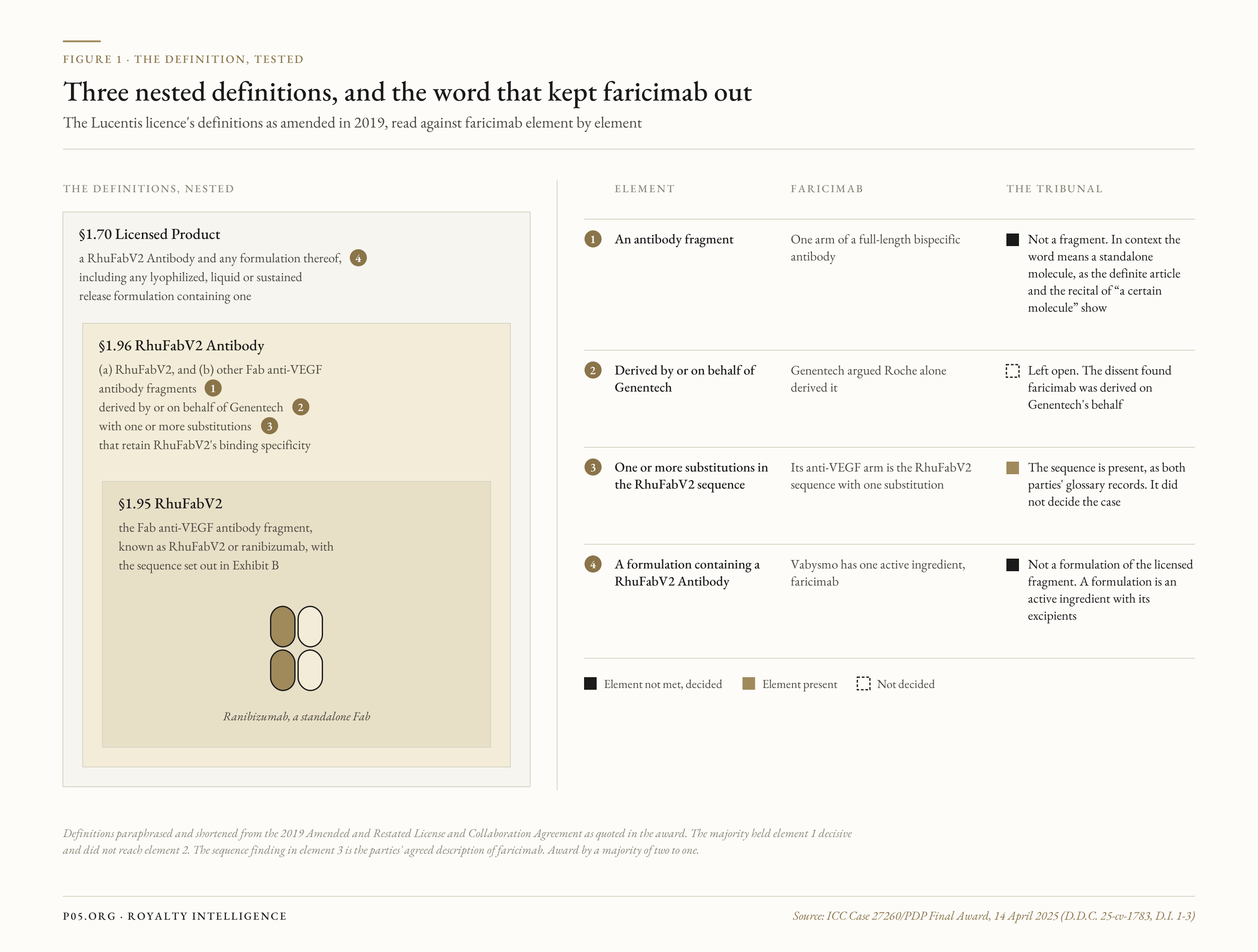
The three nested definitions in the Lucentis agreements, and how the tribunal read faricimab against each element. It left the "derived by or on behalf of Genentech" element undecided.
What the word "fragment" meant
The majority began by conceding the ground Novartis needed. The evidence, including an acknowledgement from the Genentech executive who negotiated the 2003 agreement, was that "fragment" could mean an isolated piece of an antibody or a stretch of amino acids inside a full-length one, and the tribunal found the word ambiguous in the abstract as of 2003.
Asked under cross-examination whether an antibody fragment could be either, one witness replied that he had learned so at the hearing itself.
In context, the majority found the ambiguity resolved. If RhuFabV2 meant the amino acid sequence wherever it appeared, half the words in its definition would do no work. The sequence in the exhibit would have been enough, and the phrases "the Fab anti-VEGF antibody fragment" and "known as RhuFabV2 or ranibizumab" would be surplus.
New York law reads a contract so that every part has effect. The definite article pointed to one particular fragment. A recital in the 2003 agreement described Genentech as having developed "a certain molecule", in the singular, and once the sequence sits inside faricimab it is no longer a molecule of its own.
Each side also showed how the other could have drafted its way to victory. Novartis said the parties could simply have written "isolated". Genentech pointed to the parties' own 2000 IgE agreement, which covered "all IgE inhibiting antibodies (including fractions or derivatives thereof)", as the wording they used when they did mean to reach full-length antibodies.
The tribunal treated such hindsight drafting as of limited use, and most useful when it removes words from the text. That test brought it back to the redundancy in section 1.95.
Two further clauses decided the chemistry. On section 8.1(g) the tribunal found Novartis's argument the more persuasive, since the clause contemplates Licensed Products with more than one active ingredient.
The argument still failed on the evidence. Novartis compared Vabysmo to a combination product such as Tylenol PM, and its expert described faricimab as one active ingredient with two active sites.
The tribunal declined to stretch "active ingredient" to an arm or a site within a molecule. It read "active ingredient" as the FDA uses it. It read "formulation" in its pharmaceutical sense, as an active ingredient with its excipients, so a formulation containing a RhuFabV2 Antibody could not reach a different active ingredient that incorporates its sequence.
What the parties had done
The majority said the text alone was enough, and then tested its reading against the parties' conduct. Novartis argued that the parties had entered "a broad LCA designed to follow the science wherever it went". Its own chief negotiator testified that "the product on offer was ranibizumab, indeed." Two episodes carried weight.
The first was bevacizumab, the full-length anti-VEGF antibody in Avastin, which contains a ranibizumab-like sequence. Under an opt-in agreement appended to the parties' 2000 IgE agreement, Roche held a product-by-product option over the ex-US rights to future Genentech products, with no field limits.
Roche exercised it for bevacizumab three days after the 2003 agreement was signed, and Novartis knew it was coming. If the licence covered the ranibizumab sequence wherever it appeared, bevacizumab would have been a Licensed Product. Novartis would then have held the exclusive right to it in the eye outside the United States and, on its own theory, an obligation to develop it there.
It never claimed the right or attempted the development. Genentech had also represented in the 2003 agreement that the licence did not conflict with its obligations to Roche, which on Novartis's reading it would have.
The second was the 2019 renegotiation. The structure of faricimab, then called RG7716, had been public since a 2016 paper by Roche scientists that described its anti-VEGF arm as based on ranibizumab.
A Novartis presentation a few months later placed RG7716 in its competitive landscape. The tribunal found that Novartis went into the 2019 renegotiation with full knowledge of faricimab and never raised it.
It drew the conclusion that Novartis had not understood the licence to cover faricimab, and it stressed that this was a point of interpretation, since Genentech had pleaded neither estoppel nor laches.
The argument that gave the tribunal pause
The majority called it "probably Novartis' best argument" that Genentech's reading let it do indirectly what it could not do directly. Genentech could not itself exploit ranibizumab in Novartis's Field and Territory.
By building essentially the same sequence, through Roche, into a larger molecule that replicates what ranibizumab does, Genentech could benefit from the licensed product without paying for it. The majority accepted that this gave it pause and could be called gamesmanship.
It rejected the point for two reasons. The collaboration had already brought both sides billions of dollars and was winding down by 2019, so a reading that ended it there was hard to call commercially unreasonable.
The patents over the licensed technology had expired, biosimilar ranibizumab could be made and sold cheaply, and no one develops a new bispecific over ten years to avoid a royalty on an off-patent fragment.
Novartis had argued that faricimab's ANG-2 arm added no demonstrated therapeutic value. The majority answered that even if the arm proved less effective than Roche had hoped, faricimab was still designed and developed as a new, full-length molecule.
It also refused to ask what the parties would have agreed had they known what came later. In 2003 the field believed smaller molecules held more promise in the eye than full-length antibodies, and the parties contracted for a small, standalone fragment.
Robert S. Smith, the arbitrator Novartis had nominated, dissented. He would have held that the ambiguity in "fragment", together with the risk of circumventing the agreement's general purpose, required Novartis's reading.
He also found that faricimab was "derived by or on behalf of" Genentech, a question the majority left open. Genentech had argued that Roche, and no one else, derived faricimab.
What rode on the word
Novartis was claiming exclusive rights to a product much larger than the one it held. Its Lucentis sales, all outside the United States, fell from $1,475M in 2023 to $1,044M in 2024 and $643M in 2025, a decline Novartis puts down to competition.
Roche reported Vabysmo sales of CHF 4,102M, of which CHF 1,245M came from Europe, Japan and its international region, the markets Novartis claimed. Roche reported growth of 21 per cent in Europe, 22 per cent in Japan and 116 per cent in its international region, against 3 per cent in the United States. Those markets kept growing faster in 2026.
In the first half Roche sold CHF 726M of Vabysmo in those three regions, and Novartis sold $230M of Lucentis, down 36 per cent.
The arithmetic of a Licensed Product finding runs in a direction that royalty buyers seldom model. Novartis's request for arbitration asked for an order requiring Genentech to let it market Vabysmo in its territory, and it later dropped that request in favour of a declaration and damages for breach.
Under the first request Novartis would have sold Vabysmo and paid Genentech royalties on it. Genentech, the licensor and royalty owner, argued its own successor out of the licence, because its own group sells that successor directly. A licensor that holds a successor of its own has every reason to keep the definition narrow.
A third party holding the licensor's royalty on the original product can find its interest running the other way.
The loser paid for the question. Genentech claimed $17.87M for the liability phase, including $15.39M of legal fees for 18,824.4 hours of lawyers' time, more than twice the 8,013.4 hours Novartis's counsel claimed.
Novartis objected to the hours. The tribunal noted that Novartis had not disclosed all of its own fees and allowed the claim in full. It ordered Novartis to pay Genentech $17,840,178.62, its legal costs and its share of the ICC fees, with interest at 9 per cent a year, and the court's order records that Novartis has paid.
The tribunal said a party with little to lose but its costs had brought a claim with large stakes, and it let the costs follow the result.
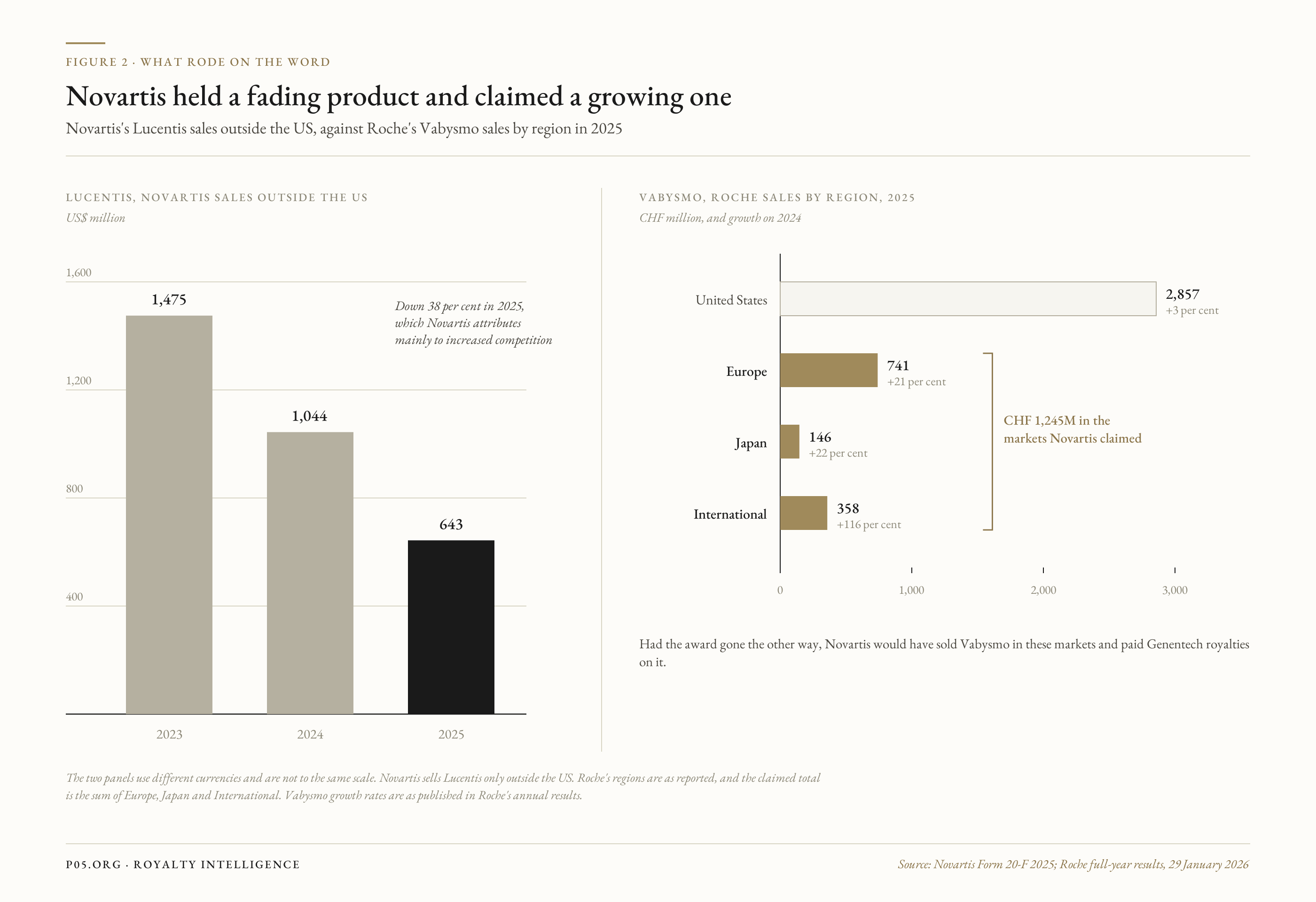
What Novartis held and what it claimed: its ex-US Lucentis sales from 2023 to 2025, against Roche's Vabysmo sales by region in 2025.
The same question asked the other way
Genmab and Janssen fought over a successor in the opposite configuration. Under their daratumumab licence, Genmab receives royalties on Janssen's sales of Darzalex, and Janssen later launched a subcutaneous version, Darzalex Faspro, built with Halozyme's enzyme.
In an arbitration decided in April 2022, a majority held that Janssen could keep reducing its royalties to Genmab by a share of the mid-single-digit royalty it pays Halozyme. The ruling rested on a finding that Faspro was a new licensed product.
Genmab then tried to turn that finding to its advantage. In a second arbitration it claimed $405M in accrued milestone payments for Faspro and a new 13-year royalty term running from Faspro's first commercial sale.
On 21 April 2023 the tribunal dismissed the claims, by two votes to one, because they should have been brought in the first arbitration. Genmab's request for review of the award was denied in January 2024. The successor was inside the licence, and Genmab still lost the new milestones and the longer royalty term.
The third dispute is still open. Royalty Pharma holds royalties on Vertex's cystic fibrosis medicines, and Vertex's newest, Alyftrek, contains deutivacaftor, a deuterated form of ivacaftor. Royalty Pharma's annual report puts the blended Alyftrek royalty at about 8 per cent if deutivacaftor counts as ivacaftor and about 4 per cent if it does not.
Its report for the second quarter of 2026 says it has not received the full Alyftrek royalty it believes it is owed since the second quarter of 2025, and that any recovery will be recognised only if the dispute is resolved in its favour.
Our Fund of the Week on Royalty Pharma in November 2025 put the Vertex cystic fibrosis franchise at roughly a quarter of the fund's portfolio receipts, and described a passive holder bound by decisions the manufacturer makes.
Vertex's move from ivacaftor to deutivacaftor in Alyftrek is such a decision, and the dispute tests how far the royalty follows it. The definitional problem behind it was set out in the deuterium piece in May, before either side's position had been tested.
Royalty Pharma has met the question in patent law as well. It owned a European patent, filed in April 1997, on lowering blood sugar with inhibitors of the enzyme DP IV. Sitagliptin, the active ingredient in Januvia, is such an inhibitor, but a licensee of the patent developed it after the filing date and patented it separately.
The German patent office refused Royalty Pharma a supplementary protection certificate for sitagliptin, and on 30 April 2020 the Court of Justice of the European Union ruled that a product developed after the filing date through an independent inventive step is not protected by the earlier patent, even where it falls within the claim's functional definition.
The court fixed the reach of the patent at its filing date. The Lucentis tribunal fixed the reach of the licence at what the parties knew in 2003.
| Licence | Original product | Successor | What changed | Whose case inclusion served | Result | Source |
|---|---|---|---|---|---|---|
| Genentech to Novartis, 2003 and 2019 | Lucentis, ranibizumab, a Fab fragment | Vabysmo, faricimab, a bispecific antibody | The ranibizumab sequence, with one substitution, built into one arm of a full-length antibody | Novartis, the licensee | Outside the licence by two votes to one in April 2025, recognised by the court in October 2026 | ICC award |
| Genmab to Janssen | Darzalex, daratumumab for infusion | Darzalex Faspro, daratumumab with Halozyme's enzyme | A new formulation for injection under the skin | Janssen, the licensee, which could then offset its Halozyme royalty | A new licensed product in April 2022, and Genmab's claim to new milestones and term dismissed in April 2023 | Genmab 20-F |
| Vertex royalty held by Royalty Pharma | Kalydeco and Trikafta, ivacaftor | Alyftrek, with deutivacaftor | Deuterium in place of hydrogen at set positions | Royalty Pharma, the royalty holder | Unresolved, with Royalty Pharma short of its claimed royalty since the second quarter of 2025 | Royalty Pharma 10-Q |
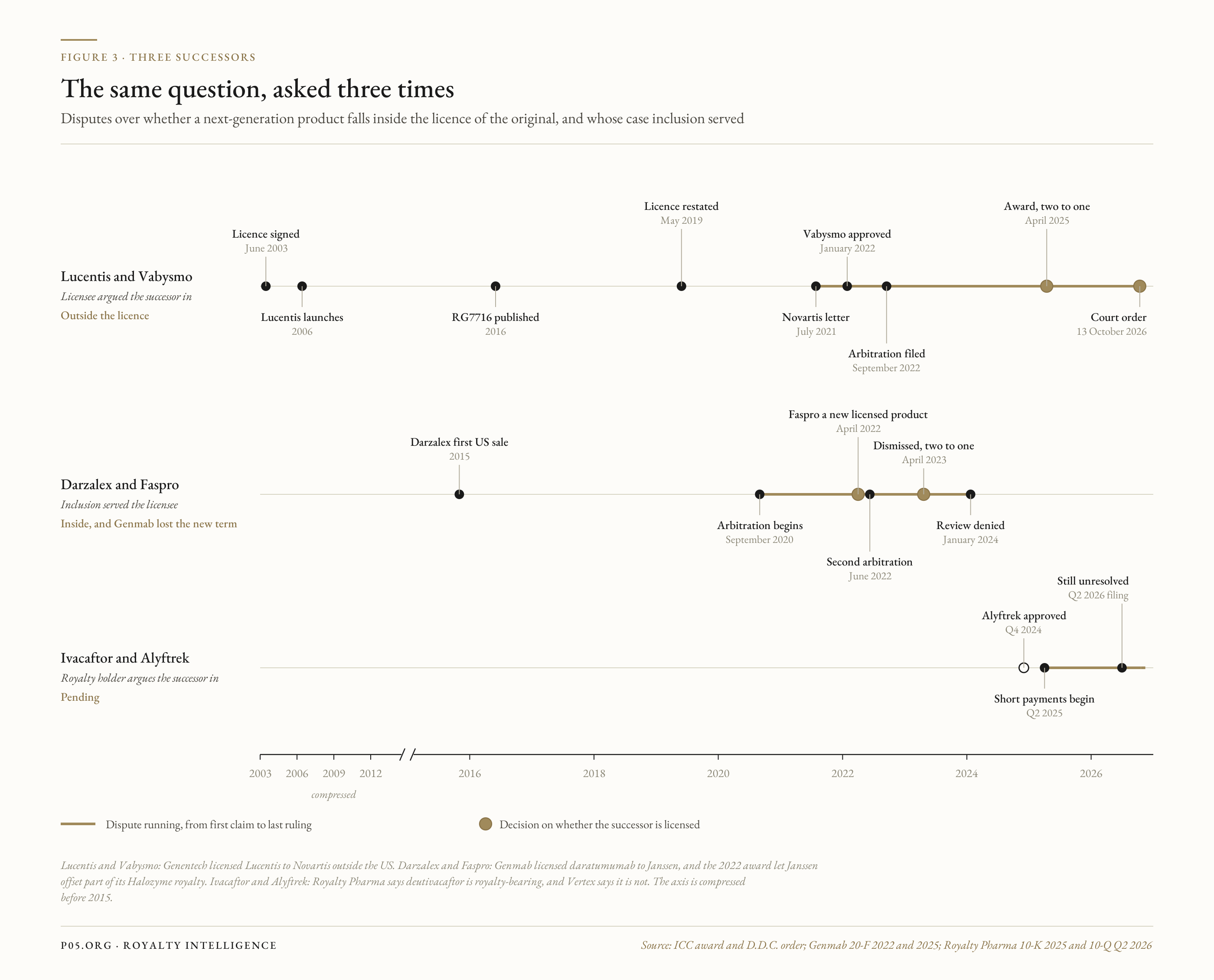
Three disputes over whether a next-generation product falls within the original's licence, with whose case inclusion served and the result so far.
Implications for the Pharmaceutical Royalty Market
The Lucentis award gives the market a reasoned decision on a question it usually meets only in risk factors. The definition reached faricimab's sequence, its target and its binding behaviour, and the majority still found it did not reach faricimab.
What decided the case was the form the definition gave the molecule: "the" fragment, "a certain molecule", an active ingredient as the FDA counts one, and a formulation as a pharmacist would describe it. A buyer checking whether a royalty follows a molecule into its successor has to read those nouns first, and the amino acid count afterwards.
The April piece on anti-dilution mechanics proposed definitions reaching products that incorporate or derive from the defined antibody sequence, whatever the format. The Lucentis agreements show what an older definition without that language does, and the parties' own 2000 IgE agreement shows that the broad form was available to them three years earlier.
They also show the cost of the language, since the tribunal treated bevacizumab as the proof that the parties had never meant the sequence to travel. A definition that follows a sequence into every format can sweep in products that the licensor has already promised to someone else.
Who benefits from a broad definition depends on where the holder sits. The Lucentis royalty owner argued for the narrow reading because its own group sells the successor. In the daratumumab case the licensor ended up worse off once the successor was held to be inside, because the licensee could then offset another party's royalty.
Royalty Pharma, a holder with no product of its own, is arguing for the broad reading. A buyer of a royalty should establish whether the licensor or the licensee has a successor in development, and which way each would then argue.
Conduct counts against the party that stays silent. The tribunal read Novartis's failure to raise faricimab in the 2019 renegotiation as evidence of what the licence meant, and the Genmab tribunal held that claims Genmab could have made in the first arbitration were lost.
A holder that learns of a successor should reserve its position in writing at the next amendment, and bring every claim the successor raises at once.
Every decided round went by majority. The Lucentis tribunal and Genmab's second tribunal each split two to one, and Genmab's first award was also a majority decision. Novartis paid nearly $18M of Genentech's costs.
That record suggests pricing a successor's inclusion as a probability well short of certain, whatever the sequence alignment shows, and carrying the cost of finding out. The component royalties discussed in the September piece on someone else's molecule ride the component into each product by design.
A definition like the one in the Lucentis agreements attaches the royalty to a named form of the molecule, which a buyer should map against every successor in the licensor's pipeline.
Conclusion
When Judge Cooper signed the order on 13 October, Novartis had already paid the costs and Vabysmo had been on sale for more than four years. The order changes no cash flow. It confirms, with a court's judgment behind it, that the Lucentis licence covered a standalone fragment and stopped there.
In Novartis's territory the ranibizumab sequence, with its one substitution, now sells mostly inside faricimab. Under the reading the tribunal adopted, none of that money flows through the 2003 licence.
All information in this report was accurate as of the research date and is derived from publicly available sources including court opinions, regulatory guidance, academic literature, SEC filings, and financial news reporting. Information may have changed since publication. This content is for informational purposes only and does not constitute investment, legal, or financial advice. The author is not a lawyer or financial adviser.