
Company of the week: Tanabe Pharma
Tanabe is a 348-year-old Japanese drugmaker that a Boston private equity firm bought and is now converting, asset by asset, into a royalty book. In eight months it has sold its largest product, sold a royalty back to its own licensee, and sold its best pipeline asset.

Most of the companies this series reads are trying to build a royalty position. Tanabe Pharma is doing the opposite, and doing it fast.
Since Bain Capital took control on 1 July 2025, the company has divested its flagship commercial franchise for two and a half billion dollars, accepted a lump sum to extinguish a royalty it held on a late-stage hypertension asset, sold its domestic manufacturing subsidiary, dissolved a vaccine joint venture, and, as of yesterday, handed global rights to its most advanced in-house molecule to a Danish dermatology specialist. Every one of those transactions converted an operating position into either cash or paper.
For a royalty desk that sequence is the whole story. What is left after the disposals is a Japan-focused commercial business, a set of legacy out-licensed molecules still throwing off royalties from the 1990s and 2000s, and a newly created stack of forward-looking royalty claims on assets that other people will now develop and sell. The company that used to make and sell drugs is becoming, in part, a company that collects on drugs other people make and sell.
This piece treats Tanabe the way a royalty desk would: not as a Japanese pharma with a pipeline, but as a set of cash-flow claims running in both directions, being actively restructured by a financial sponsor with a defined holding period.
At a glance
| Item | Detail |
|---|---|
| Company | Tanabe Pharma Corporation (formerly Mitsubishi Tanabe Pharma Corporation; TSE: 4508 until 2020), Doshomachi, Osaka |
| Founded | 1678, one of the oldest pharmaceutical companies in the world |
| Owner | Funds advised by Bain Capital Private Equity, via K.K. BCJ-94; carve-out from Mitsubishi Chemical Group |
| Deal | Announced 7 February 2025 at roughly $3.3 billion (¥510 billion) enterprise value; completed 1 July 2025 |
| Rename | Mitsubishi dropped from the name effective 1 December 2025; ASEAN affiliates transition through December 2026 |
| Leadership | CEO Akihisa Harada (former President, Pfizer Japan); Chairman Costa Saroukos (former CFO, Merck KGaA) |
| Last public scale | Revenue of about $2.89 billion (¥437.4 billion) for the year to March 2024, down 18.3 per cent year on year; R&D spend about $415 million (¥62.9 billion) |
| Disposal 1 | RADICAVA/Radicut (edaravone) global rights to Shionogi for a $2.5 billion lump sum plus a contingent royalty on future sales; signed 22 December 2025, completed 1 April 2026 |
| Disposal 2 | Lorundrostat royalty repurchased by licensee Mineralys for $200 million upfront plus up to $100 million in milestones, June 2026 |
| Disposal 3 | Tanabe Pharma Factory (Onoda and Yoshitomi plants) plus 17 legacy products to Towa Pharmaceutical, announced 3 July 2026 |
| Disposal 4 | Dersimelagon (MT-7117) global rights to LEO Pharma for up to $435 million in upfront and near-term milestones, plus downstream milestones and tiered royalties, announced 18 August 2026 |
| Royalties collected | Fingolimod (Novartis, Gilenya); canagliflozin (Janssen, Invokana); now dersimelagon (LEO Pharma) and, contingently, edaravone (Shionogi). The historic obicetrapib royalty is not traceable to a live position |
| Royalties paid | Uplizna (inebilizumab, now Amgen); vadadustat (Akebia); valbenazine (Neurocrine); cariprazine (Gedeon Richter lineage); loncastuximab tesirine (ADC Therapeutics) |
| Owned late-stage asset | Onerji (ND0612), from Israeli subsidiary NeuroDerm; EU marketing authorisation granted 27 April 2026; two US complete response letters, most recently October 2025 |
| Geographies | Japan core; US (Jersey City); Europe (Düsseldorf); Israel (Rehovot); China (Tianjin); Taiwan, Korea and ASEAN; Canada exited 2023 |
| Royalty posture | Historically a net collector on out-licensed chemistry, a net payer on in-licensed commercial products; now actively converting operating assets into new royalty claims |
What Tanabe is
Tanabe traces to 1678 in Doshomachi, the Osaka street that was the origin of Japan's pharmaceutical industry. The modern entity is the 2007 merger of Tanabe Seiyaku and Mitsubishi Pharma, and until last year it was the pharmaceutical arm of Mitsubishi Chemical Group.
Its stated priority areas are immunology and inflammation, central nervous system disease, diabetes and metabolic disease, and vaccines. In practice, three things define it for a royalty analyst.
The first is that it is a genuine originator. Tanabe chemists discovered fingolimod, canagliflozin, obicetrapib, dersimelagon and lorundrostat. That is an unusually dense record of molecules that went on to matter in Western hands. Every one of them left Japan on someone else's paper, which is precisely why Tanabe has a royalty book at all.
The second is that its domestic commercial business runs largely on other people's products. Uplizna, Mounjaro and Zepbound, Dysval, Vafseo and Remleas are in-licensed. That is the paying side.
The third, and the reason to read the company now rather than in a year, is that it is mid-restructuring under a financial sponsor. Bain acquired the business at roughly $3.3 billion (¥510 billion) in February 2025 and closed on 1 July 2025, with the Mitsubishi name dropped in December. Bain installed Akihisa Harada, formerly head of Pfizer Japan, as chief executive, and Costa Saroukos, formerly chief financial officer of Merck KGaA, as chairman.
The strategy they have described publicly is narrow and clear. Harada told Bloomberg in March 2026 that a new team of roughly eight people in the United States, alongside an existing Japan team, is sourcing therapies globally in rare disease, rare inflammation and immunology, oncology and neuroscience. In May he and Saroukos told Reuters the company aims to bring up to three new drugs to Japan each year, rebuilding the pipeline through a mix of internal research and in-licensing of overseas medicines.
Read that alongside the disposals and the shape resolves. Tanabe is selling global assets to fund becoming a Japanese in-licensing platform. Global assets sold on royalty-bearing terms leave royalties behind. In-licensed Japanese products create royalty obligations. Both halves of the book are being rewritten at once.
The disposals, in sequence
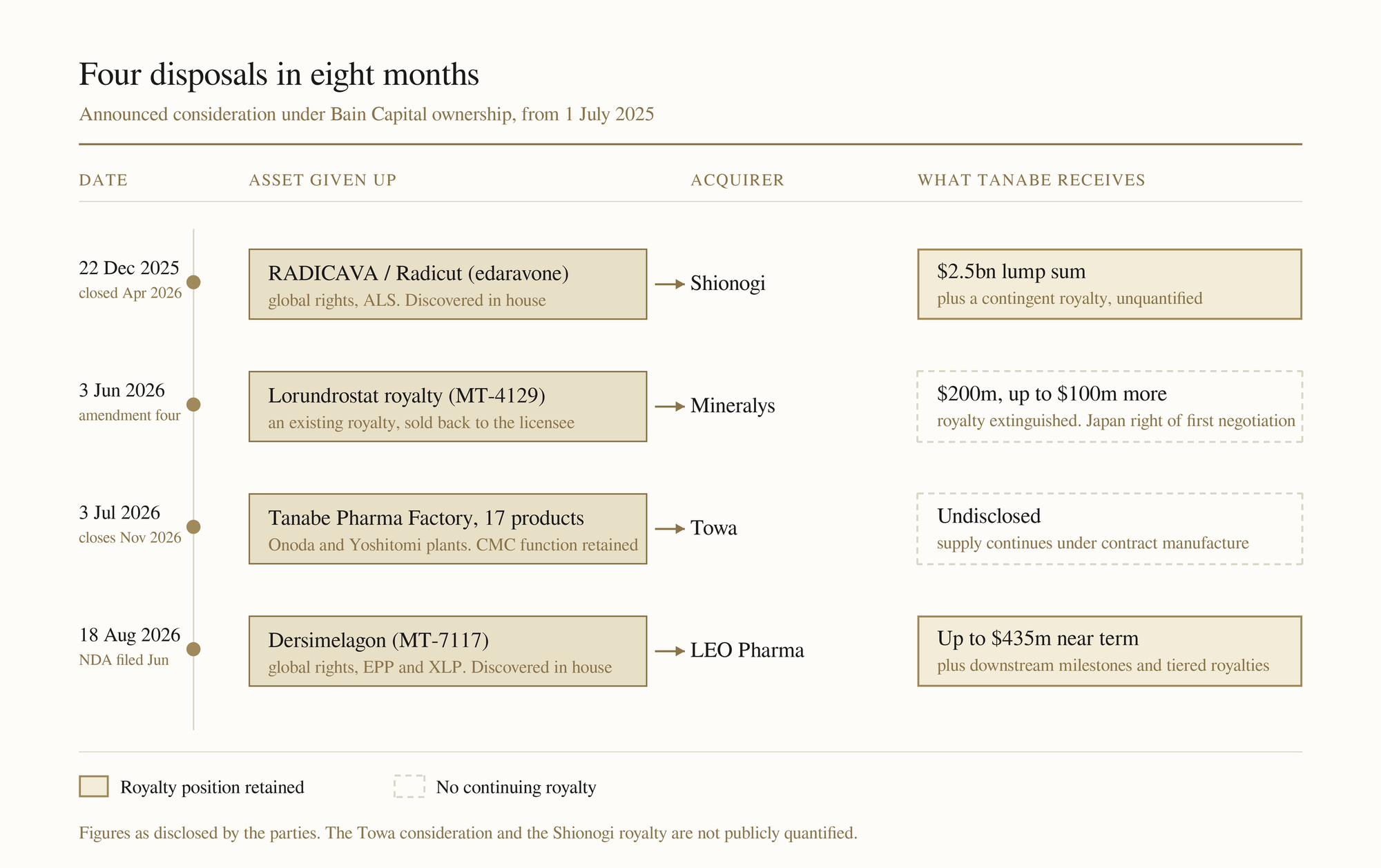
The pace is the point. Four transactions in eight months, each converting an operating position into cash, paper, or both.
Edaravone to Shionogi
On 22 December 2025 Tanabe agreed to transfer global rights to the RADICAVA and Radicut business, including Japan and the United States, to Shionogi. The consideration was a lump sum of $2.5 billion, paid through Shionogi Inc. in New Jersey, with Tanabe additionally eligible to receive a royalty on future sales subject to certain conditions.
Edaravone was Tanabe's own discovery, researched for ALS from 2001, approved in Japan and South Korea in 2015 and by the FDA in 2017, with the oral suspension RADICAVA ORS approved in the United States in May 2022. It had treated over 19,000 US patients. It was the company's most significant commercial asset and its principal claim to a global franchise.
The transfer completed on 1 April 2026 for major territories including Japan, the United States and Canada, with remaining regions transferring sequentially. Centerview Partners led for Tanabe with Goldman Sachs also advising, Ropes & Gray acted as counsel, and Bank of America advised Bain.
Two structural points deserve flagging. First, the royalty is contingent and unquantified in the public disclosure, which means a desk cannot currently size it. Second, an originator that discovered a molecule, carried it through thirteen years of development, and commercialised it in its own name has now converted that position into a lump sum plus a conditional residual. That is a full round trip from developer to royalty holder on a single asset.
The lorundrostat royalty, sold back
Lorundrostat is MT-4129, an aldosterone synthase inhibitor Tanabe discovered and licensed to Mineralys Therapeutics in 2021. Mineralys, founded by Catalys Pacific, took it through positive late-stage hypertension trials.
On 3 June 2026 Mineralys announced it would repurchase the royalty obligation entirely. Tanabe receives $200 million upfront and up to $100 million on commercial milestones to extinguish the stream, leaving aggregate potential future milestones of up to $265 million, including $165 million in existing commercial milestones and up to $10 million tied to a second indication. Under the fourth amendment Mineralys obtains an exclusive, worldwide, royalty-free, perpetual licence with diligence obligations removed, and Tanabe agreed to subsequently assign the underlying intellectual property. Tanabe preserved a right of first negotiation for Japan.
Mineralys funded it with a $500 million senior secured term loan from Pharmakon Advisors and a $150 million equity offering.
This is the cleanest royalty event in the set, and it runs against the direction of the rest. Tanabe held a royalty on a de-risked, near-commercial asset in a very large indication, and sold it for a fixed sum shortly before launch. The counterparty paid to remove an encumbrance ahead of commercialisation, financing the buyout with royalty-adjacent debt. Whether $200 million plus contingent milestones was the right clearing price on a first-in-class aldosterone synthase inhibitor is the question a desk would want to model, and the answer sits inside assumptions neither party has published.
The factory, and the long-listed tail
On 3 July 2026 Tanabe agreed to transfer Tanabe Pharma Factory to Towa Pharmaceutical, the Osaka generics manufacturer. The subsidiary operates the Onoda and Yoshitomi plants, employs over 500 people, and reported revenue of roughly $105 million (¥15.8 billion). Alongside it go domestic manufacturing and marketing approvals for 17 products across 35 specifications, including Urso, Depas, Tanatril, Anplag and Kalgut.
Terms were not disclosed. The share transfer is planned for end November 2026 and the approval transfers begin in April 2027, both conditional on antitrust clearance. Products will continue to be made at the same plants under contract manufacturing. Tanabe's chemistry, manufacturing and control function is explicitly excluded and stays in-house. KPMG FAS led financially with Ropes & Gray and Mori Hamada & Matsumoto on legal.
The read is straightforward. Tanabe is shedding fixed manufacturing cost and a long-listed product tail to concentrate capital on R&D and licensing. It also reduces the company's ability to supply its own products, which is a dependency a counterparty would want to price.
Dersimelagon to LEO Pharma
The most recent transaction is one day old at the time of writing and the most interesting for royalty purposes.
On 18 August 2026 Tanabe agreed to transfer all rights, including global development and commercialisation rights, to MT-7117 (dersimelagon) for erythropoietic protoporphyria and X-linked protoporphyria, to LEO Pharma of Ballerup, Denmark.
Dersimelagon is a selective melanocortin 1 receptor agonist, discovered and developed by Tanabe from early research through global clinical development, holding FDA fast track and orphan drug designations. Topline results came in January 2026, detailed Phase 3 INSPIRE data followed on 30 March 2026, and Tanabe Pharma America submitted the NDA on 30 June 2026. If approved it would be the first oral treatment for these conditions.
The terms: up to $435 million in upfront and near-term milestone payments, together with downstream milestones and tiered royalties on sales. Tanabe continues pursuing US approval, and ongoing trials will transfer to LEO at an appropriate stage. Evercore and Bank of America advised, with Ropes & Gray as counsel.
Note what this does to the balance sheet of claims. Tanabe has taken a molecule it originated, carried it to a positive pivotal readout and a filed NDA, and converted it into a cash payment plus a permanent royalty position on an asset that a specialist dermatology company will now sell worldwide. This is the archetype of a well-constructed royalty: originator retains economics, specialist partner carries the commercial burden.
The counterparty is worth a look, because a royalty is only as good as the company paying it. LEO is co-owned by the LEO Foundation and, since 2021, Nordic Capital, and reaches close to 100 million patients across more than 70 countries. It reported first-half 2026 revenue up 10 per cent to about $1.12 billion (DKK 7.26 billion), and is working toward a stated goal of launching a new medicine every two to three years. It bought the gene therapy company Replay in April 2026 and partnered with Boehringer Ingelheim on Spevigo the year before. It has also been reported to have selected banks for a Copenhagen initial public offering.
That last point cuts both ways for a royalty holder. A licensee heading toward a listing has strong incentives to build and disclose a credible launch, which is good for the stream. It is also a licensee acquiring aggressively ahead of a liquidity event, which is a different risk profile from a settled commercial partner.
The stated use of proceeds is explicit and consistent across all four disposals. The money goes back into Japan, to expand the pipeline through business development and R&D.
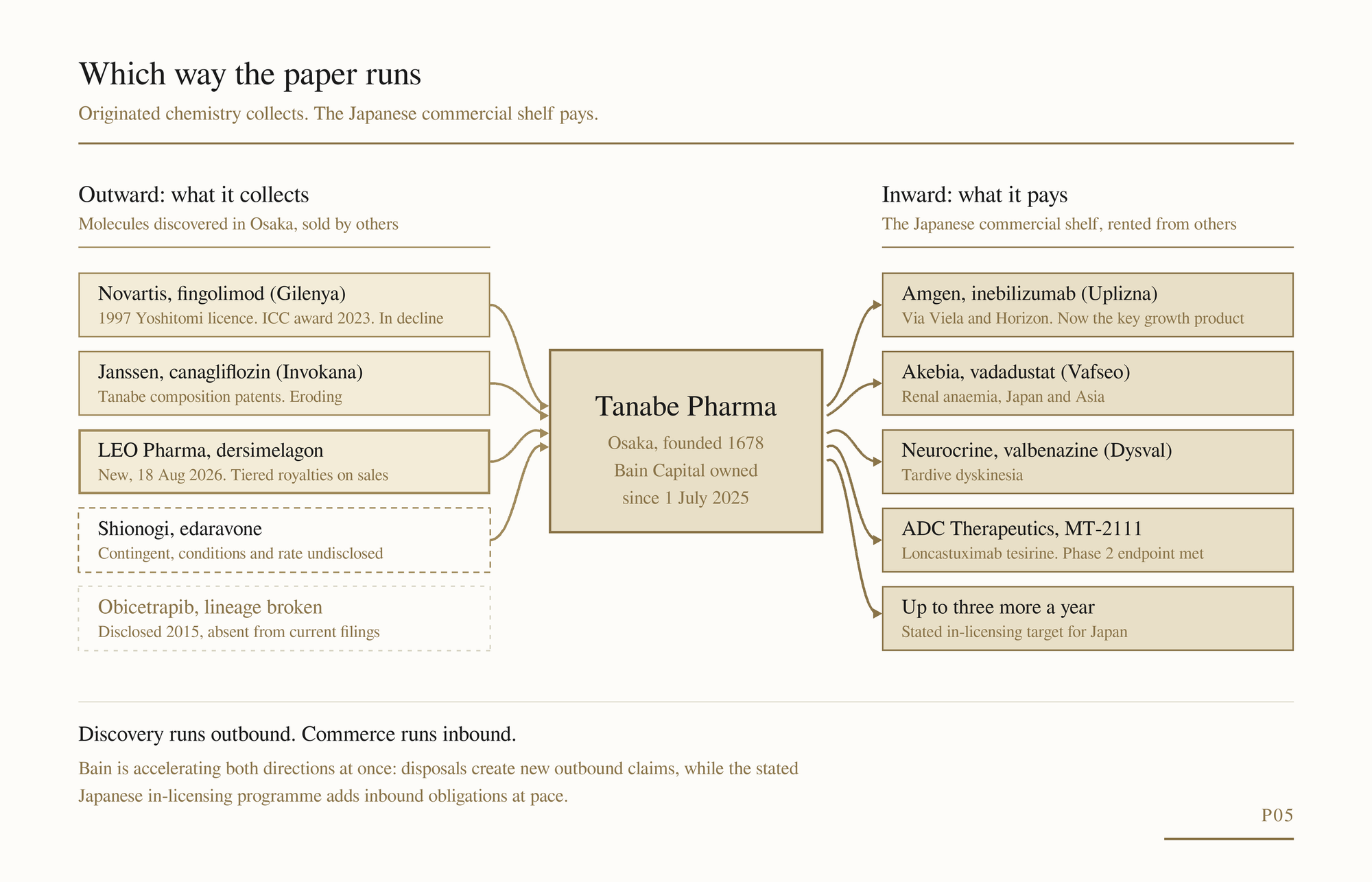
The royalty book, and which way it runs
Outward: what Tanabe collects
Fingolimod, and the arbitration that defined it. The oldest and largest stream in the book runs from a 1997 licence signed by Yoshitomi Pharmaceutical, a Tanabe forerunner, granting Novartis worldwide development and marketing rights to fingolimod. Novartis commercialised it as Gilenya, approved by the FDA in 2010, peaking above $3 billion in annual sales in 2018.
Novartis filed for arbitration in 2019, arguing that provisions governing the royalties it owed in the United States, the European Union and other jurisdictions were invalid. On 13 February 2023 an ICC tribunal seated in London denied all of Novartis's claims, covering past and future royalties, and awarded Tanabe more than $22 million in fees and costs. Mitsubishi Tanabe reported that the award allowed it to recognise approximately $940 million in already-paid royalties as revenue, which it had been unable to book under IFRS 15 while the dispute was live.
Two things a desk should take from this. Gilenya is in generic decline, so the forward stream is a shrinking asset. But the case is a rare, fully litigated confirmation that a Japanese-law licence from the 1990s survived a coordinated attack on validity grounds across three legal systems. That is useful precedent for anyone underwriting an old originator royalty.
Canagliflozin. Tanabe discovered TA-7284 and licensed it to Janssen, which markets it as Invokana across North America, South America, Europe, the Middle East, Africa, Australia, New Zealand and parts of Asia. Janssen's own materials consistently note that canagliflozin is licensed from Mitsubishi Tanabe. The composition patents are Tanabe's: Janssen and Tanabe jointly pursued ANDA filers in New Jersey on the 582 and 202 patents among others, and Tanabe prevailed on the hydrate patent in 2021. Tanabe retained Japan and parts of Asia, selling it domestically as Canaglu, and has extended the franchise into ASEAN, with Thailand marketing beginning May 2025 and the Canalia combination approved there in June 2026.
Like Gilenya, this is a mature stream facing erosion.
Obicetrapib, and a royalty that appears to have evaporated. This one is worth walking through, because the answer a desk reaches after doing the work is the opposite of the answer it expects when it starts.
TA-8995 was discovered by Tanabe chemists and out-licensed to Dezima Pharma in 2013. Amgen acquired Dezima in September 2015, and Amgen's own release was explicit about what Tanabe kept: MTPC would receive a portion of the upfront, future development and sales milestone payments, and royalties on net product sales above a certain threshold, described as low single digit, while retaining development and commercialisation rights in certain territories.
Amgen shelved the molecule. In 2020 NewAmsterdam Pharma, founded by Forbion and John Kastelein, reacquired Dezima from Amgen. Obicetrapib is now one of the more advanced cardiovascular assets in the industry, with three positive Phase 3 trials, a CHMP positive opinion in July 2026 and European decisions expected in the second half of the year. A. Menarini International Licensing holds the European rights and pays NewAmsterdam a €115 million upfront, up to €833 million in milestones and tiered royalties from the low double digits to the mid-twenties on net sales in its territory.
On the face of the 2015 disclosure, Tanabe should be sitting underneath all of that with a low single digit royalty. It does not appear to be.
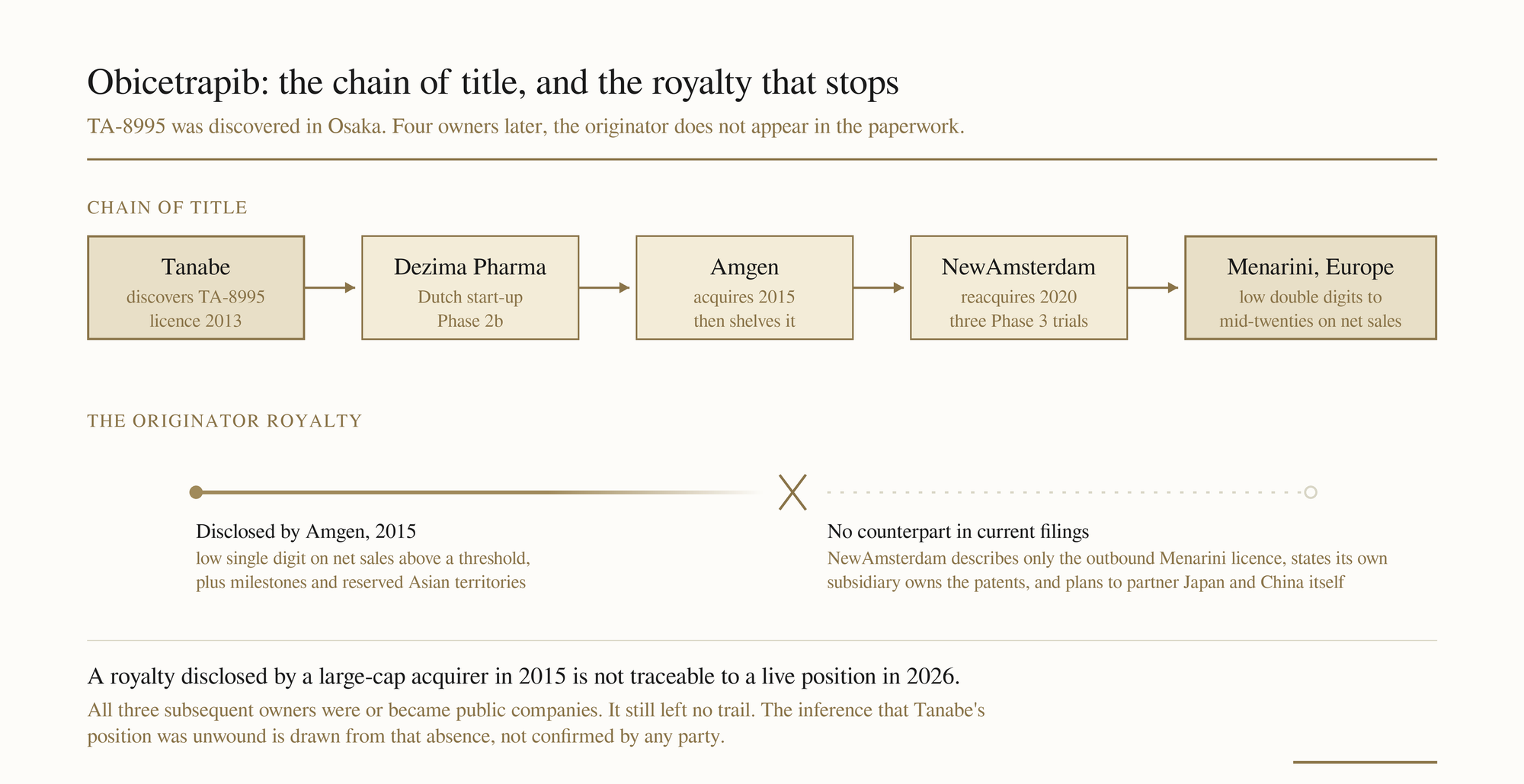
NewAmsterdam's most recent annual report describes only one licence arrangement on obicetrapib, the outbound Menarini agreement. It states that all issued patents and pending applications in the portfolio are owned by its own subsidiary, NewAmsterdam Pharma B.V. It describes no inbound licence, no third-party royalty obligation, and no milestone ladder running to any originator.
It also states that the company intends to commercialise in the United States itself and to consider partners for other jurisdictions including Japan and China, which is not the language of a company operating under a licence that reserved Asian territories to someone else. NewAmsterdam has run its own Japanese Phase 2b trial.
The inference a desk should draw is that the Tanabe position on obicetrapib was extinguished, bought out or otherwise unwound at some point between Amgen shelving the asset and NewAmsterdam building its Phase 3 programme, and that the reversion of the molecule in 2020 was cleaner than the 2015 language implied. That inference is not the same as a confirmed fact, because none of the relevant agreements were ever filed, and the possibility remains that an obligation exists and is simply immaterial enough to omit.
The point for this series is the method rather than the outcome. A royalty that was publicly disclosed by a large-cap acquirer in 2015, on a molecule that has since become a major launch candidate, is not traceable to a live position in 2026 from public sources. It did not leave a trail. Anyone underwriting an originator's legacy book on the strength of decade-old press releases would have mispriced this one badly in either direction. That is the private-agreement gap, in a case where all three subsequent counterparties were or became public companies.
The new claims. Dersimelagon with LEO, and the contingent edaravone royalty with Shionogi, are both fresh outbound positions created in the last eight months.
The smaller bench. Amiselimod (MT-1303) went to Biogen in 2015, was returned in 2017 and re-licensed to Salix in 2019. MT-5356 went to Kynexis in 2023. Avanafil (TA-1790) reached market through VIVUS as Stendra and Spedra. None of these is material on its own, but together they establish a consistent thirty-year pattern: Tanabe originates, Tanabe out-licenses to a Western partner, Tanabe collects.
Inward: what Tanabe pays
The domestic commercial business runs substantially on rented molecules, and each one carries an obligation running outward.
Uplizna (inebilizumab). Licensed from Viela Bio in October 2019 for Japan and other Asian territories. Viela was acquired by Horizon Therapeutics, which Amgen then acquired, so the counterparty is now Amgen. Approved in Japan for neuromyelitis optica spectrum disorder in 2021, and in November 2025 it became Japan's first approved drug for IgG4-related disease. A generalised myasthenia gravis filing went in that October. This is now the most important growth product Tanabe sells in Japan, and it is not Tanabe's molecule.
Tirzepatide. Tanabe has a sales collaboration with Eli Lilly Japan covering Mounjaro and Zepbound. Mounjaro alone ran at roughly $270 million (¥40.7 billion) on Japanese NHI prices in the year to March 2025. The economics here are distribution rather than royalty, but the dependency is the same.
The rest of the rented shelf. Vadadustat (Vafseo) from Akebia. Valbenazine (Dysval, Remleas in ASEAN) from Neurocrine. Cariprazine from the Gedeon Richter lineage. Loncastuximab tesirine (MT-2111) from ADC Therapeutics, which hit its primary endpoint in a Japanese Phase 1/2 in January 2026. Moderna's mRNA respiratory vaccine portfolio in Japan under a 2024 joint agreement. Fostamatinib, sublicensed onward to Kissei in Taiwan in January 2025.
The Janssen relationship, which once supplied Remicade, Simponi and Stelara to Tanabe's Japanese business, has been unwinding. The Stelara co-promotion expired in September 2025.
Reading the two together
The historical shape was symmetrical in an unusual way. Tanabe collected on chemistry it invented and gave to the West, and paid on biologics it rented for Japan. Discovery ran outbound, commerce ran inbound.
What Bain has done is accelerate both directions at once. The disposals convert Tanabe's remaining owned commercial franchises into cash plus new outbound royalties, while the stated in-licensing strategy of up to three new Japanese launches a year will add inbound obligations at pace.
The end state, if the plan executes, is a company whose Japanese revenue increasingly carries royalties out to Western originators, funded and supplemented by royalties coming in from Western partners selling molecules Tanabe discovered. That is a more capital-efficient structure than an integrated pharma. It is also a structure with very little left that is unencumbered.
The geographies, and what is left of them
Tanabe's international footprint has been contracting for several years, and the Bain disposals have accelerated it.
Japan is the declared core and the destination for all disposal proceeds. It is also a difficult market: the executives have publicly cited unpredictable price cuts under the national scheme and the multi-year drug lag between Western and Japanese availability. Their thesis is that the lag is the opportunity, because assets already approved in the West can be brought in with reduced risk.
United States. Tanabe Pharma America sits in Jersey City. It has been substantially hollowed out by the disposals: RADICAVA was its commercial franchise, and dersimelagon, whose NDA it filed in June 2026, now belongs to LEO. What remains is the ND0612 filing and the new eight-person business development team sourcing assets for Japan. The US entity is becoming a scouting and regulatory office rather than a commercial one.
Europe. Tanabe Pharma GmbH in Düsseldorf holds the Onerji marketing authorisation, which the European Commission granted on 27 April 2026 following a positive CHMP opinion in February. The European argatroban business was transferred out in 2024. Europe is now essentially a single-product regulatory presence.
Israel. NeuroDerm in Rehovot, acquired for $1.1 billion in 2017, developed ND0612. It is the source of the one significant late-stage asset Tanabe still owns outright, and the company's most concentrated remaining development risk.
China. Tianjin Tanabe Seiyaku manufactures and sells locally, with Tenelia promoted through partners and edaravone approved by the NMPA in 2019.
ASEAN, Taiwan and Korea. Subsidiaries in Thailand, Indonesia, Malaysia, Singapore and Vietnam, with the Indonesian, Malaysian and Thai affiliates continuing under their outgoing names until December 2026. Recent activity is steady but small: Canaglu marketing in Thailand from May 2025, Canalia approved there in June 2026, Radicut suspension approved in Korea in December 2025.
Canada is gone. Medicago, the plant-based vaccine subsidiary that produced Covifenz, ceased operations in 2023.
The vaccine business has also contracted domestically, with the BIKEN joint venture dissolved in March 2026, notwithstanding that vaccines were listed as a priority area in Bain's acquisition announcement fourteen months earlier.
The opacity, and why it compounds
Tanabe has gone dark in two stages, and the second is more complete than the first.
It was delisted from the Tokyo Stock Exchange in 2020 when Mitsubishi Chemical Holdings bought out the minority. After that, the business remained visible through MCG's segment reporting: revenue, core operating income, R&D spend, product-level detail on Mounjaro and the diabetes franchise, and a line item for royalty revenue. That is how we know revenue for the year to March 2024 was about $2.89 billion (¥437.4 billion), down 18.3 per cent, with R&D of about $415 million (¥62.9 billion). It is also how we know the company took a special retirement charge of roughly $110 million (¥16.6 billion) on a voluntary retirement programme in that year, and that MCG's after-tax proceeds from the sale were estimated at roughly $570 million (¥85 billion).
Since 1 July 2025, MCG has reported the business as a discontinued operation and reports nothing about it. Bain publishes nothing. Tanabe publishes press releases and a quarterly pipeline chart, and no financial statements at all.
So the last clean look at this company's economics is the year to March 2024, and every disposal since has changed the business materially. A desk trying to size Tanabe today has to work entirely from counterparties: Shionogi's disclosure of what it paid, Mineralys's 8-K on the royalty repurchase, LEO's account of the dersimelagon terms, Towa's filing on the factory, NewAmsterdam's 10-K for the obicetrapib lineage, Novartis and Janssen for the legacy streams.
This is the same condition the Taisho piece described, with one difference that matters. Taisho went private under a family that intends to hold it. Tanabe went private under a sponsor with a return requirement and a holding period, which means the pace of transactions is high and the informational half-life of any reconstruction is short. Four material disposals in eight months is not a steady state. Anything written about this company is accurate for a quarter at best.
That is not a reason to skip it. It is the reason the private-company data problem is worth solving.
Red team versus blue team
Risk analysis (red team)
The best assets have been sold. Edaravone was the global franchise and it is gone. Dersimelagon was the most advanced in-house molecule and it is gone. The lorundrostat royalty was a claim on a large-indication asset near launch and it has been extinguished for a fixed sum. What remains in-house is ND0612, which has taken two US complete response letters, the most recent in October 2025, and a Japanese commercial book built substantially on other companies' products.
The legacy royalties are in decline. Gilenya is well past peak and facing generics. Canagliflozin faces the same erosion. The two largest historical inbound streams are shrinking assets, and the arbitration that secured the Gilenya position, however emphatic, does not change the sales trajectory.
One legacy claim has gone missing. The obicetrapib royalty disclosed by Amgen in 2015 does not appear in NewAmsterdam's current filings, which describe outright patent ownership and no inbound obligation. The likely reading is that Tanabe's position was unwound before the asset reached late-stage development, meaning the originator will not participate in what may be a major cardiovascular launch.
Manufacturing dependency is increasing. With Tanabe Pharma Factory going to Towa and supply continuing under contract manufacturing, Tanabe is trading fixed cost for counterparty risk on its own supply chain.
The disposals may be outrunning the rebuild. Two in-licensing deals were described as in the works for 2026 and the target is three Japanese launches a year. Against that, four disposals have already completed or been signed. The proceeds are real; the replacement pipeline is a stated intention.
Sponsor economics are not disclosed. The capital structure of the Bain vehicle, the leverage against these cash flows, and the treatment of disposal proceeds are all outside public view. A counterparty underwriting Tanabe paper cannot see the claims that sit above it.
Opportunities and mitigants (blue team)
The arithmetic is striking. Bain acquired the business at roughly $3.3 billion (¥510 billion) in February 2025. Announced consideration since comprises $2.5 billion from Shionogi, $200 million from Mineralys with up to $100 million more, and up to $435 million from LEO in upfront and near-term milestones, plus undisclosed Towa proceeds. On headline figures alone that approaches the acquisition price inside fourteen months, while retaining the Japanese commercial business, NeuroDerm, the legacy royalty streams and new royalty claims on two of the sold assets. This is an analytical reading of published deal figures rather than anything either party has stated, and the actual net position depends on tax, transaction costs, deal structure and capital already deployed. But the direction is not ambiguous.
Origination capability is proven and repeated. Five molecules that mattered in Western hands, across CNS, metabolic, cardiovascular and rare disease. That is not luck. The company that produced fingolimod, canagliflozin, obicetrapib, dersimelagon and lorundrostat retains the research organisation and the CMC function, which was deliberately excluded from the Towa sale.
The new royalty positions are well-structured. Dersimelagon goes to a dermatology and rare disease specialist with reach in more than 70 countries, on tiered royalties, after Tanabe absorbed the development risk through a positive Phase 3 and a filed NDA. That is the position a royalty desk would want to hold: risk retired, commercial burden transferred, economics retained.
The Japanese in-licensing thesis has real support. Japan is the fourth largest drug market with the highest per capita medicine use among developed countries, and the drug lag creates a repeatable arbitrage for a company with local regulatory and commercial capability and now substantial cash. Uplizna's IgG4-related disease approval, a first in Japan, shows the model working.
Cash-rich and now flexible. A company with several billion dollars of disposal proceeds, an explicit mandate to deploy them into licensing, and no public market to explain itself to, is exactly the kind of counterparty that can transact on structured or royalty terms quickly.
Summary
| Risk | Concern |
|---|---|
| Assets sold | Edaravone, dersimelagon and the lorundrostat royalty all gone in eight months |
| Legacy streams declining | Gilenya and Invokana both past peak and facing generics |
| Obicetrapib claim absent | 2015-disclosed royalty not traceable in NewAmsterdam's current filings |
| ND0612 regulatory risk | Two US complete response letters; EU approved, US not |
| Supply dependency | Manufacturing sold to Towa, supply continues under contract |
| Total opacity | No financial disclosure since July 2025; sponsor capital structure unseen |
| Opportunity | Observation |
|---|---|
| Disposal arithmetic | Announced consideration approaches the acquisition price within fourteen months |
| Proven originator | Five molecules of Western significance; research and CMC retained |
| Well-built new royalties | Dersimelagon transferred post-Phase 3 to a rare disease specialist, on tiered terms |
| Japan lag arbitrage | Fourth largest market, structural drug lag, local capability, cash to deploy |
| Transaction-ready | Private, funded, mandated to license, able to move without public explanation |
Conclusion
Tanabe Pharma is a 348-year-old originator being rebuilt in public, at speed, by a financial sponsor, with no financial disclosure to accompany it.
The molecules tell one story. Fingolimod, canagliflozin, obicetrapib, dersimelagon, lorundrostat, edaravone: a research organisation that has repeatedly produced compounds that mattered, and has almost always handed them to Western partners to sell. The transactions of the last eight months tell a second story, which is that the current owners have decided the company is worth more as a set of claims than as an integrated operator.
For a royalty desk the interest is in the second story, and specifically in the fact that Tanabe now sits on both sides of the table more completely than it ever did as a listed company. It collects on chemistry from the 1990s that Novartis and Janssen still sell, and it has already lost at least one legacy claim it once disclosed. It collects, contingently, on the ALS drug it just sold to Shionogi. It will collect on dersimelagon if LEO gets it approved. It pays on almost everything it sells at home, and intends to add three more paying obligations a year.
The tests ahead are concrete. Whether ND0612 clears the FDA on a third attempt. Whether the in-licensing engine replaces divested revenue at the promised rate. Whether any legacy claim on obicetrapib resurfaces, which on current filings looks unlikely. And whether a sponsor that has already recovered most of its purchase price chooses to keep building or to keep selling.
Until those resolve, Tanabe is best understood not as a Japanese pharmaceutical company with a pipeline, but as a large, cash-rich, entirely private royalty position under active reconstruction, whose paper is visible only through the counterparties who file. Reconstructing exactly that is what a royalty desk is built to do.
All information in this article was accurate as of the research date and is derived from publicly available sources including the company's own press releases, counterparties' SEC and regulatory filings, Mitsubishi Chemical Group's pre-transfer segment disclosures, European Medicines Agency records, law firm and partner announcements, and financial news reporting. Tanabe Pharma Corporation has been privately held since July 2025 and publishes no consolidated financial statements; figures for periods after the year ended March 2024 cannot be independently verified from the company and are not stated here. Deal terms described for the Shionogi, Mineralys, Towa Pharmaceutical and LEO Pharma transactions are as disclosed by the parties; several components, including the contingent edaravone royalty and the Towa consideration, are not publicly quantified. The discussion of obicetrapib reflects disclosure made by Amgen at the time of the 2015 Dezima transaction and the absence of any corresponding obligation in NewAmsterdam Pharma's most recent annual report; the conclusion that Tanabe's position was unwound is an inference drawn from that absence and is identified as such in the text, not a fact confirmed by any party. The comparison of announced disposal consideration to the 2025 acquisition price is an analytical reading of published headline figures, does not account for tax, transaction costs, deal structure, contingency or capital subsequently deployed, and is not a statement made by any party to those transactions. Information may have changed since publication. This content is for informational purposes only and does not constitute investment, legal, or financial advice. The author is not a lawyer or financial adviser.