
Fund of the week: Beiersdorf Venture Capital

Beiersdorf Venture Capital is the corporate venture arm of Beiersdorf AG, the Hamburg skin care group behind NIVEA, Eucerin, Hansaplast, La Prairie and tesa.
The unit began life in August 2019 as OSCAR&PAUL, an internal brand-innovation platform named after the company's two founding figures, Paul C. Beiersdorf and Oscar Troplowitz. A dedicated corporate venture fund followed in 2020. On 31 March 2026 Beiersdorf announced a second-generation vehicle, the Skin Care Innovation Fund, with a $116M (€100M) commitment that the company described as double the volume of the 2020 fund.
The mandate runs across four thesis fields: life sciences and biotechnology, sustainability, AI, and digital health. Initial cheques are $0.6M to $5.8M (€0.5M to €5M). The stated sweet spot is Series A, and the fund takes minority positions of up to 20 percent.
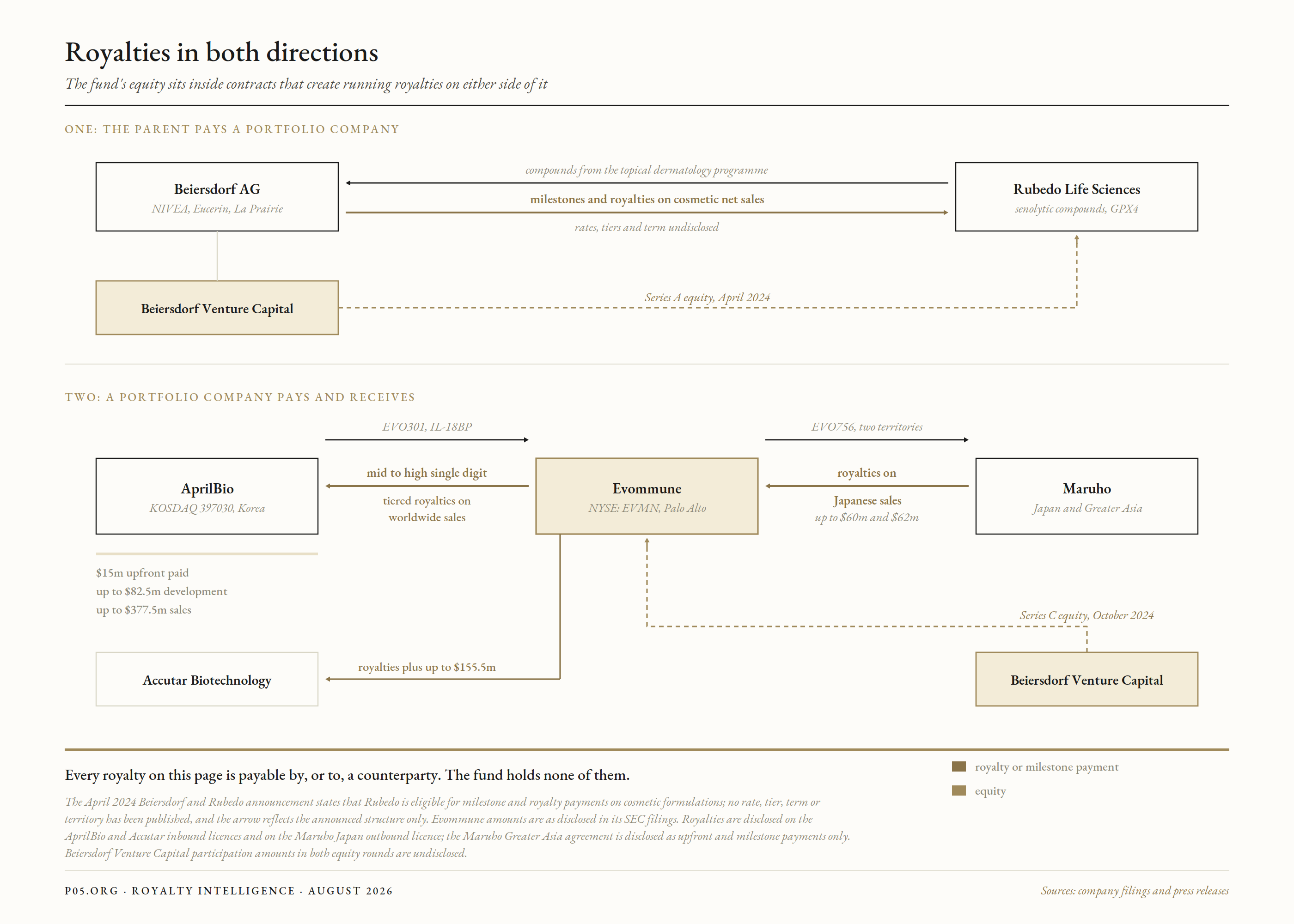
The equity book is the visible part. What matters for a royalty audience is the contract layer around it. Beiersdorf has agreed to pay milestones and royalties to a portfolio company on cosmetic products built from that company's compounds. One portfolio company, now NYSE-listed, discloses a complete inbound and outbound royalty stack in its SEC filings. Both sets of economics run through counterparties, not through the fund.
The fund holds no purchased royalties.
Currency note: euro, franc and krona figures are converted to USD at approximately $1.16 per euro, the mid-August 2026 rate, with the original in brackets. Where a source published its own conversion, that figure is used.
At a glance
- What it is: the wholly owned corporate venture unit of Beiersdorf AG, investing group balance-sheet capital in startups at the intersection of skin care and four thesis fields; no external limited partners
- Parent: Beiersdorf AG, Hamburg (Beiersdorfstrasse 1-9 / Unnastrasse 48), listed on the Frankfurt exchange as BEI and a DAX constituent; maxingvest GmbH & Co. KGaA holds a controlling stake
- Predecessor unit: OSCAR&PAUL, launched August 2019 as a "corporate indie brand" business unit under Hauke Voß, with the venture capital function attached; the venture activity was later separated and rebranded Beiersdorf Venture Capital
- Fund I: launched 2020; size never published, but the 2026 release states the new fund "doubles the volume of the fund launched in 2020", implying roughly $58M (€50M)
- Fund II: the Skin Care Innovation Fund, $116M (€100M), announced 31 March 2026; published conversions at the time ranged from $114M to $116M
- Cheque size and stage: $0.6M to $5.8M (€0.5M to €5M) initial, seed to Series B, primarily Series A, minority stakes up to 20 percent, with follow-on capacity
- Geography: Europe, North America, APAC; data vendors also list Korea and Israel as target markets
- Portfolio: 13 startups and 4 fund LP positions on the public page; CB Insights records 16 investments, one exit and one acquisition
- Realised outcomes: S-Biomedic (entered at the 2018 Series A alongside Verve Ventures, majority acquired by the parent in December 2022, price undisclosed) and Evommune (NYSE IPO, November 2025)
- Leadership: Ascan Voswinckel, Head of Venture Capital since the unit's founding; Dr. Gunes Bozkurt, Director of Venture Investments and Lead of Life Science Investments; Oleg Chervonnyi and Chunchun Yao, Investment Principals; Dr. Thomas Raschke and Dr. Janina Zippel on R&D startup scouting
- Executive sponsor: Dr. Gitta Neufang, Chief Research & Development Officer
- Committed capital visibility: none at fund level; the closest group disclosure is the Level 3 "non-current equity investments" line in the half-year reports, which stood at $22M (€19M) at 30 June 2025 against $13M (€11M) a year earlier
- Royalty interests: none purchased. Beiersdorf is a contractual royalty payer to portfolio company Rubedo Life Sciences under a 2024 development agreement; portfolio company Evommune carries a fully disclosed two-sided royalty stack in its SEC filings
- Parent scale: FY2025 sales of €9.9B; H1 2026 sales of $5.7B (€4.952B), down 3.5 percent organically, with EBIT excluding special factors of $891M (€768M)
A note on scope
BVC is a captive, balance-sheet-funded corporate venture unit. There is no separate fund entity with outside investors, no management fee, no carried interest structure in the public record, and no reporting obligation. What the market sees is a website, a press release cadence, and a single line item in the group accounts that aggregates all equity investments held at fair value.
The unit is distinct from Beiersdorf's four fund LP commitments: NCA, YZR, Emerald and Revent. Those are separate vehicles managed by third parties, in which Beiersdorf is one investor among several.
It is also distinct from Beiersdorf's corporate M&A function. S-Biomedic began as a 2018 venture investment and ended as a majority acquisition by the parent. Chantecaille and Clinique La Prairie's Montreux real estate came through the M&A route, not the venture route.
Investment thesis and mandate
The stated approach is to invest where breakthrough science meets consumer skin care, and to pair capital with access to Beiersdorf's R&D organisation and brand distribution.
Four fields are named: life science and biotech, sustainability, AI, and digital solutions and digital health. Voswinckel identified longevity science and AI-enabled actives discovery as the two areas driving current deal flow.
The offer to founders is explicit about the corporate side of the bargain: access to more than 170 markets via NIVEA, Eucerin and La Prairie, R&D validation support across the cosmetic product lifecycle, and the supplier and agency network. Collaboration models are described as flexible, running from investment only through strategic collaboration to joint development.
That flexibility is the operative point. In several positions the investment is the smaller half of the relationship.
Rubedo, Macro Biologics, Melt&Marble, DePoly and S-Biomedic all combine an equity cheque with a technology or supply agreement. Neufang's framing in the 2026 release describes the fund as the mechanism for connecting external science to Beiersdorf's internal pipeline.
There is no royalty, credit, or revenue-interest mandate.
How capital enters and returns
Capital comes from one place, the group balance sheet, and returns arrive by four routes.
Direct venture equity. Cheques of $0.6M to $5.8M (€0.5M to €5M) into rounds led by others. BVC does not lead. Recent examples include Evommune's $115M Series C in October 2024 co-led by RA Capital and Sectoral, Turbine's $25M Series B in February 2026 led by Interactive Venture Partners, and Melt&Marble's $8.5M (€7.3M) Series A in December 2025 led by Industrifonden.
Fund-of-funds positions. Four LP commitments give sourcing coverage beyond the direct team. Emerald Technology Ventures' Sustainable Packaging Innovation Fund is the most documented: Beiersdorf joined as a founding LP alongside Chevron, Henkel and WM in 2022, with Nestlé and Huhtamaki added later. Beiersdorf's own account of the decision notes that 120 funds were evaluated before Emerald was selected. The other three are NCA (Next Commerce Accelerator, where Beiersdorf is a founding member and LP), YZR Capital (European health tech) and Revent (Berlin impact fund).
Absorption into the parent. The S-Biomedic path. Beiersdorf invested in 2018, ran a multi-year collaboration, then acquired a majority stake in December 2022 and folded the technology into its microbiome design platform.
The purchase price was never disclosed. This is the outcome the fund's own marketing leads with. It is also a strategic return rather than a financial one, so the exit multiple is unknowable from outside.
Public market liquidity. The Evommune path, and to date the only one. Evommune priced a $150M IPO at $16.00 on 5 November 2025, rising to $172.5M gross with the full greenshoe.
Financial profile and assets
| Item | Amount | Source and date |
|---|---|---|
| Fund II committed capital | $116M (€100M) | Press release, 31 Mar 2026 |
| Fund I committed capital | undisclosed; approximately $58M (€50M) implied | Inferred from "doubles the volume" language, 2026 |
| Initial cheque size | $0.6M to $5.8M (€0.5M to €5M) | Fund website, 2026 |
| Target ownership | minority, up to 20 percent | Fund website, 2026 |
| Disclosed investments | 16 | CB Insights, 2026 |
| Portfolio companies displayed | 13 startups, 4 fund partners | Fund website, Aug 2026 |
| Group Level 3 non-current equity investments, 30 Jun 2025 | $22M (€19M): €13M FVOCI plus €6M FVPL | Half-Year Report 2025 |
| Group Level 3 non-current equity investments, 30 Jun 2024 | $13M (€11M): €6M FVOCI plus €5M FVPL | Half-Year Report 2024 |
| Group Level 3 non-current equity investments, 30 Jun 2023 | $7M (€6M): €3M FVOCI plus €3M FVPL | Half-Year Report 2024, prior-year column |
| Additions to long-term equity investments, H1 2025 | $5.8M (€5M) | Half-Year Report 2025 |
| Additions to long-term equity investments, H1 2024 | $2.3M (€2M) | Half-Year Report 2024 |
| Parent sales, FY2025 | €9.9B | Company, Mar 2026 |
| Parent sales, H1 2026 | $5.7B (€4.952B), organic -3.5% | Half-year results, 3 Aug 2026 |
| Parent EBIT excluding special factors, H1 2026 | $891M (€768M), margin 15.5% | Half-year results, 3 Aug 2026 |
| Parent R&D expense, H1 2025 | $213M (€184M) | Half-Year Report 2025 |
| Parent R&D expense, FY2024 | $411M (€354M) | Company data via Statista |
| Additional NIVEA consumer investment, H2 2026 | approximately $116M (€100M) above H2 2025 | Half-year results, 3 Aug 2026 |
| Announced buyback | up to $870M (€750M) over two years | Q4 2025 call, Mar 2026 |
| Evommune Series C (participation) | $115M round | Press release, 31 Oct 2024 |
| Evommune IPO | $150M priced, $172.5M gross with greenshoe | Nov 2025 |
| Evommune market data | $14.08 per share, $511M market cap | PitchBook, 7 Aug 2026 |
| Turbine Series B (participation) | $25M round | Press release, 24 Feb 2026 |
| DePoly seed, first close (participation) | approximately $15M (CHF 12.3M) | Beiersdorf release, Jun 2023 |
| DePoly seed, total | $23M; more than $30M raised across two rounds and grants | Press release, 29 Apr 2025 |
| Salvalco corporate minority round (participation) | $3.08M | CB Insights, May 2022 |
| Salvalco funding to date | $5.18M to $6.69M depending on source | CB Insights and PitchBook, 2026 |
| Vincere Biosciences funding to date | $16.3M | PitchBook, 2026 |
| Melt&Marble Series A (participation) | $8.5M (€7.3M) | Press release, 8 Dec 2025 |
| DeepLife Series A (participation) | $10M round | Dec 2024 |
| Cellvie round (participation) | $5M | Sep 2025 |
| Dermanostic funding to date | $4.71M across two rounds | Tracxn, 2026 |
The portfolio book
The displayed startup portfolio groups into longevity and therapeutics, AI and digital, and sustainability.
Longevity and therapeutics. Rubedo Life Sciences (GPX4 modulation of senescent cells; positive preliminary Phase 1 data in psoriasis, atopic dermatitis and photo-aged skin, March 2026). Vincere Biosciences (USP30 inhibition and mitophagy). Beiersdorf combined its May 2025 investment with a strategic research partnership announced on 22 May 2025, pairing Beiersdorf's coenzyme Q10 history with Vincere's USP30 work to pursue mitophagy as a skin-ageing mechanism.
Vincere completed its Series A late in 2025 and took a $5M Michael J. Fox Foundation grant in November 2025 to fund IND-enabling work toward a 2026 clinical start. Cellvie (therapeutic mitochondria transplantation, Zurich, Harvard Medical School spinout, $5M raised September 2025). Evommune (immune-mediated inflammatory disease, NYSE: EVMN). Macro Biologics (biodegradable antimicrobial peptides, with a joint development partnership announced September 2024). S-Biomedic remains listed although it is now a subsidiary.
AI and digital. Turbine (simulated-cell virtual assays, working with MSD, AstraZeneca and Bayer). DeepLife (digital twins of cells, Paris). Dermanostic (app-based teledermatology, Düsseldorf, tied commercially to Eucerin).
Sustainability. DePoly, the EPFL spinout doing PET and polyester depolymerisation, inaugurated its 500 tonne per year showcase plant at the Monthey industrial park on 6 and 7 July 2026, the first facility of its kind and scale in Switzerland, with Beiersdorf among the investors present and Una Terra Venture Capital joining as a new backer; the company expects to name the site for a 50,000 tonne commercial plant in the first half of 2027. Melt&Marble (precision-fermented lipids, Gothenburg, first personal care launch targeted for 2026).
ReVentas, the Scottish dissolution recycler, took a £3.5M Scottish Enterprise grant in July 2026 as part of a £9M project, on top of a £2M Scottish Enterprise investment, and has signed an engineering and licensing alliance with KBR to support global rollout of the technology. Salvalco, the York-based inert-gas aerosol valve company, opened a manufacturing facility in Thailand in January 2026; OSCAR&PAUL participated in a $3.08M corporate minority round in May 2022.
One position is no longer displayed. Routinely, the Amsterdam personalised-serum brand backed in May 2021 alongside Belgian co-investor 9.5 Ventures, has dropped off the portfolio page. The brand appears to be still trading and no wind-down, sale or write-off has been announced, so the removal is a presentation change of unknown meaning rather than evidence of an outcome in either direction. It is noted here only because the fund otherwise lists its positions completely.
What the group filings show
Beiersdorf does not report the venture unit. It does report, twice a year, the fair value of its Level 3 equity investments, and that line is the only quantitative window on the book.
| Reporting date | FVOCI | FVPL | Combined |
|---|---|---|---|
| 30 June 2023 | €3M | €3M | €6M |
| 30 June 2024 | €6M | €5M | €11M |
| 30 June 2025 | €13M | €6M | €19M |
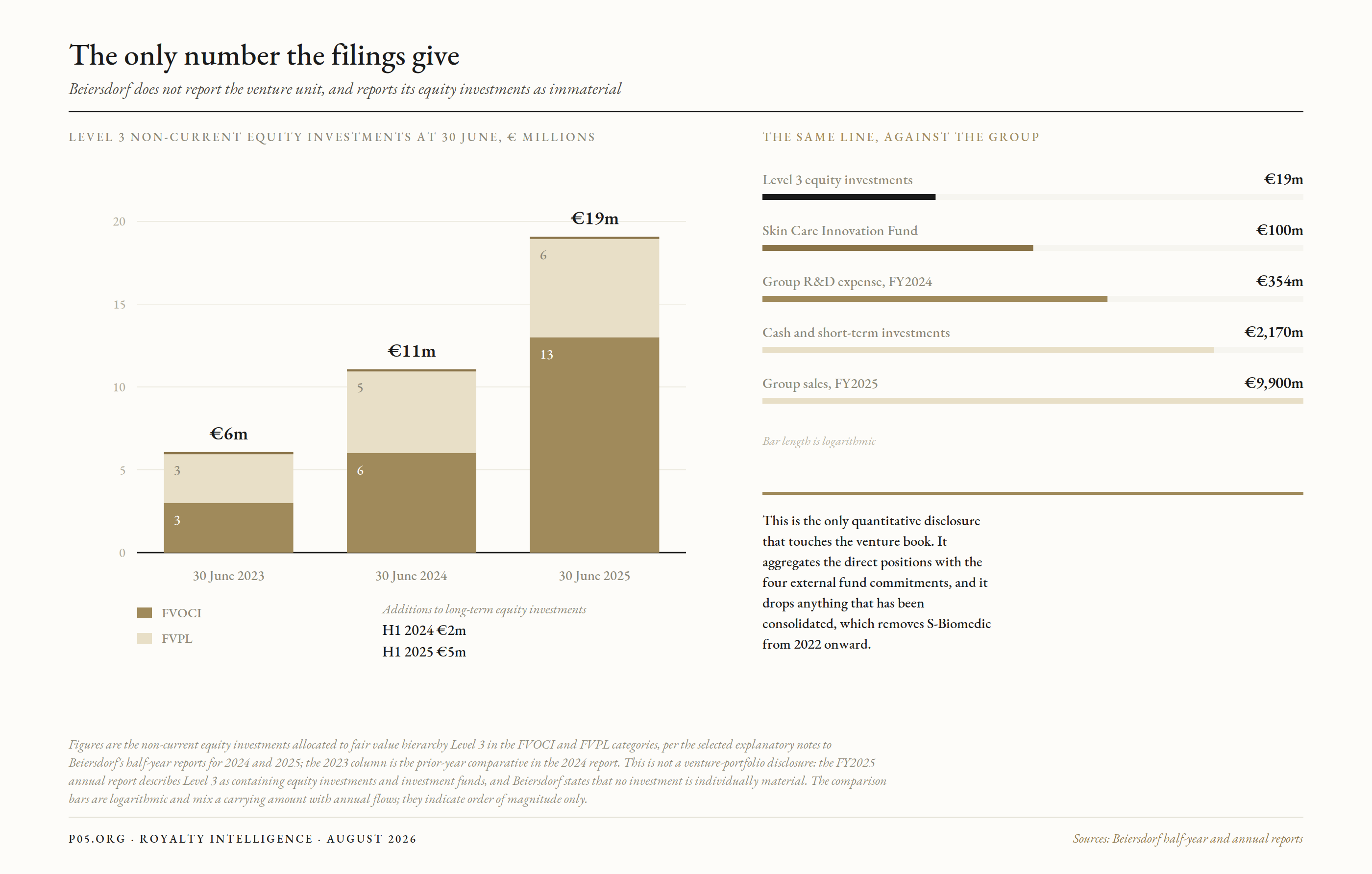
Additions to long-term equity investments were €2M in H1 2024 and €5M in H1 2025. The cash flow statement shows the corresponding "payments for investments in associated companies and other investments" at €2M and €5M for the same periods.
The venture relationships do surface elsewhere in the reporting, if not in numbers. The FY2025 annual report's research and development section names the Vincere partnership directly, describing work since May 2025 on restoring mitophagy. That is the venture programme appearing in the management report as a pipeline input rather than as a financial asset, which is a fair summary of how the group treats it.
Two cautions apply to the fair value line.
It is not a venture-only line. The FY2025 annual report describes Level 3 as containing equity investments and investment funds, which would sweep in the four fund LP positions. It also excludes anything reclassified into consolidated subsidiaries, which removes S-Biomedic from 2022 onward.
Beiersdorf states that "none of the investments in themselves are material for the Beiersdorf Group" and declines to run a sensitivity analysis on the unobservable inputs.
Still, the trajectory is informative. A book that roughly tripled in carrying value over two years on €7M of cumulative half-year additions implies one of two things: write-ups on existing positions, or full-year additions well above the half-year run rate.
Against a group balance sheet carrying $2.5B (€2.17B) in cash and short-term investments and zero debt, the venture programme is a rounding error. That is why it attracts no separate disclosure and no analyst question.
The group's 2026 posture makes the timing of the fund doubling worth flagging.
Beiersdorf priced the new $116M (€100M) commitment on 31 March 2026. Four months later it reported H1 sales down 3.5 percent organically, announced an 18-month NIVEA turnaround plan, committed roughly $116M (€100M) of additional consumer-facing spend in H2, and cut guidance. Derma grew 7.8 percent and La Prairie fell 6.9 percent.
The venture commitment survived the reset, which says something about where the R&D organisation ranks in the group's priorities. It was still made in a different weather system.
Investors
There is no limited-partner roster. BVC deploys Beiersdorf AG capital and Beiersdorf AG is the sole beneficiary.
Capacity is therefore set by board authorisation rather than by fundraising, and the fund carries no distribution clock.
In practice the constraint is different. A captive fund inside a listed consumer group competes for capital against marketing spend, buybacks and dividends, all three of which are currently absorbing large amounts of Beiersdorf's cash.
The four external fund positions run the other way. There Beiersdorf is the LP, buying deal flow and diligence coverage in packaging, commerce, health tech and impact from managers whose economics it does not control.
Governance and team
Six people are named on the fund site, and the composition tells you how the unit is wired.
Ascan Voswinckel has led the venture activity since the OSCAR&PAUL days. He is the quoted voice on every deal from Routinely in 2021 through Melt&Marble in 2025 and the fund launch in 2026.
Continuity of a single head across two fund generations and six years is unusual in corporate venture, where turnover is high and mandates get reshuffled with each strategy cycle.
Dr. Gunes Bozkurt holds the title Director of Venture Investments and Lead of Life Science Investments, which reflects the portfolio's drift from consumer brands towards clinical-stage biology. Oleg Chervonnyi and Chunchun Yao are Investment Principals.
The two remaining seats are R&D roles rather than investment roles. Dr. Thomas Raschke leads R&D startup scouting and Dr. Janina Zippel is a senior scientist in the same function. Embedding scouting scientists inside the investment team is how the thesis is wired into the org chart. Deal flow reaches the fund via the R&D organisation.
Above the unit sits Dr. Gitta Neufang, Chief Research & Development Officer, who is the executive quoted alongside Voswinckel on the fund launch. Ultimate authority rests with the Executive Board under CEO Vincent Warnery and CFO Astrid Hermann.
No fund-level compensation, carry arrangement or performance benchmark has been published. Team members are Beiersdorf employees.
IP, royalties, and the economics of return
No purchased royalty and no revenue interest is attributable to the fund. Return comes from equity appreciation, from strategic absorption of technology into the parent, and from the commercial value of ingredient access.
What makes BVC worth a royalty-market write-up is the contract layer sitting underneath the equity.
Beiersdorf as royalty payer
The April 2024 Rubedo agreement is the clearest instance. Beiersdorf and Rubedo entered a multi-year partnership to develop compounds from Rubedo's topical dermatology programme into cosmetic formulations, with Beiersdorf running the in vitro, in silico and eventually in vivo work. Beiersdorf simultaneously invested in Rubedo's Series A through the venture fund. And, in the words of the announcement, Rubedo "shall be eligible to receive milestones and royalty payments".
Rates, tiers, term, territory and the milestone schedule are all undisclosed. The structural point still stands.
A DAX-listed consumer group has taken on a running royalty obligation to a private clinical-stage biotech on future face care sales. It holds equity in the counterparty at the same time.
This is a royalty class that receives almost no analytical attention. Cosmetic-ingredient royalties differ from pharmaceutical royalties in the ways that matter for underwriting.
There is no regulatory approval gate and no reimbursement risk, so time to first cash is short. There is no orange-book exclusivity either. The durability question therefore turns on formulation patents, trade secrets and trademark-linked marketing investment rather than on composition-of-matter expiry.
Volumes are large and prices are low, which flattens the payout curve relative to a specialty pharmaceutical asset. And the licensee controls the brand, which means the licensor's economics depend on a marketing decision it cannot influence.
Beiersdorf's own experience is instructive here. NIVEA is currently the subject of an 18-month turnaround plan, and any royalty tied to a NIVEA line would be exposed to that.
Beiersdorf's flagship actives run the other way. Thiamidol and Epicelline were developed internally, the latter after a 15-year epigenetics programme and a screen of more than 50,000 substances, with the skin-specific age clock patented in 2021. The company owns those outright and pays nobody. The venture route is the exception, and it is the exception the company is now scaling.
The Evommune royalty stack
Evommune is the only BVC position whose royalty economics are fully visible, because the IPO made them SEC-reportable. The stack runs in both directions.
Inbound, Evommune pays. Under the June 2024 AprilBio licence, Evommune took worldwide rights to APB-R3, now EVO301, an IL-18 binding protein fusion.
The terms are $15.0M upfront plus development milestones of up to $82.5M, sales milestones of up to $377.5M, and tiered royalties in the mid to high single digit percentage on worldwide sales. A sublicence revenue share applies, with the percentage stepping by the timing of the grant, and AprilBio retains a right of first negotiation on other IL-18 products. Evommune had paid $16.5M in total under the agreement by 31 December 2025.
A separate November 2023 Accutar Biotechnology partnership carries a $3.0M upfront, up to $155.5M in per-target milestones, and royalties.
Outbound, Evommune receives. The September 2023 Maruho Japan agreement licenses EVO756 in Japan for up to $60.0M in upfront and milestone payments plus royalties on Japanese sales. The March 2024 Maruho Greater Asia agreement covers Greater China and other Asian markets for up to $62.0M in upfront and milestones. Evommune has recognised $13.0M of Maruho revenue in the nine months to September 2025 and $7.0M in the comparable 2024 period.
The asset performance since then has been mixed, and the royalty consequences are direct.
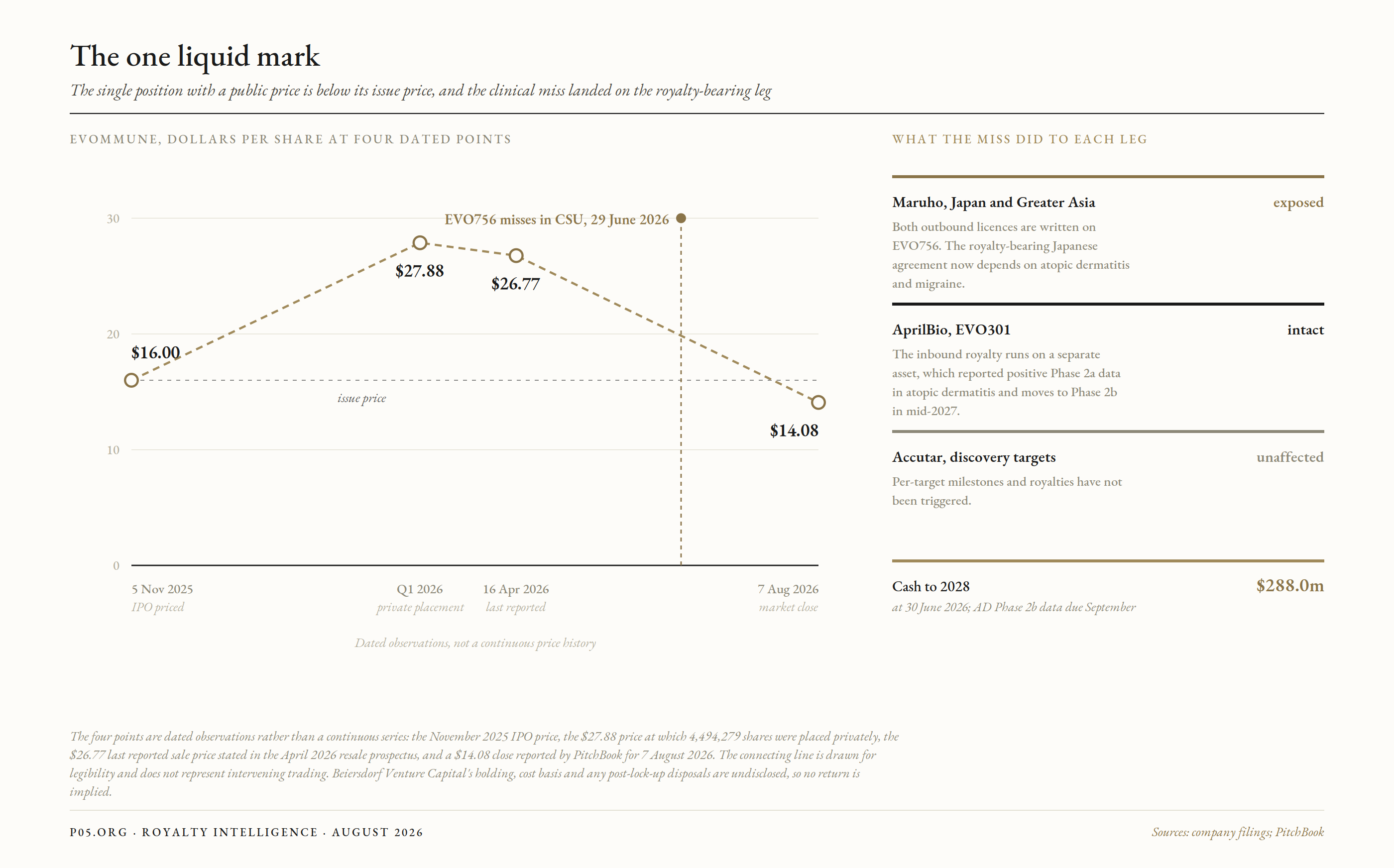
On 29 June 2026 Evommune reported that EVO756 missed its primary endpoint in the 160-patient Phase 2b trial in chronic spontaneous urticaria, with no dose beating placebo on UAS7 at week 12. The company discontinued CSU and redirected the molecule to atopic dermatitis and migraine prophylaxis. The Maruho royalties therefore now depend on indications that were secondary when the licences were signed.
EVO301, the AprilBio-derived asset, produced positive Phase 2a proof-of-concept data in atopic dermatitis, with a Phase 2b trial planned for mid-2027.
The market has repriced accordingly. Evommune closed at $14.08 on 7 August 2026 for a $511M market capitalisation. That is below the $16.00 IPO price, and well below the $27.88 at which the company placed 4,494,279 shares privately in the first quarter of 2026.
Cash, equivalents and investments stood at $288.0M at 30 June 2026, funding operations into 2028. Atopic dermatitis Phase 2b top-line data is due in September 2026.
For a royalty desk, AprilBio is the more interesting name in that chain. It is a KOSDAQ-listed company (397030) holding a mid to high single digit tiered royalty and up to $460M of milestones on a US clinical asset.
That asset's mid-stage development was funded in part by a German cosmetics group's venture arm. The interest is monetisable, it sits on a small-cap Korean balance sheet, and it sits in a jurisdiction the royalty buy-side has historically underworked.
Where royalties do not exist
The sustainability positions do not create royalty streams in the pharmaceutical sense. DePoly monetises through product sales and offtake, Salvalco through valve sales and technical support, and Melt&Marble through ingredient supply. Beiersdorf's return there is supply security and scope 3 emissions reduction, and the equity is a call option on the technology becoming a standard.
ReVentas is the partial exception. Its engineering and licensing alliance with KBR is a technology licensing arrangement of the kind that typically carries running fees on licensed plant capacity or throughput. No terms have been published, and process technology licensing economics work differently from pharmaceutical royalties, but the structure is closer to a royalty than anything else in the sustainability cluster.
The digital positions are software and services businesses. Dermanostic is a fee-per-consultation teledermatology service commercially linked to Eucerin. Turbine and DeepLife sell platform access and run collaborations.
Turbine's February 2026 round came alongside a new immunology collaboration with an unnamed top ten pharmaceutical company, in which the partner supplies proprietary datasets to train virtual assays. Those contracts can carry downstream economics, but nothing has been disclosed.
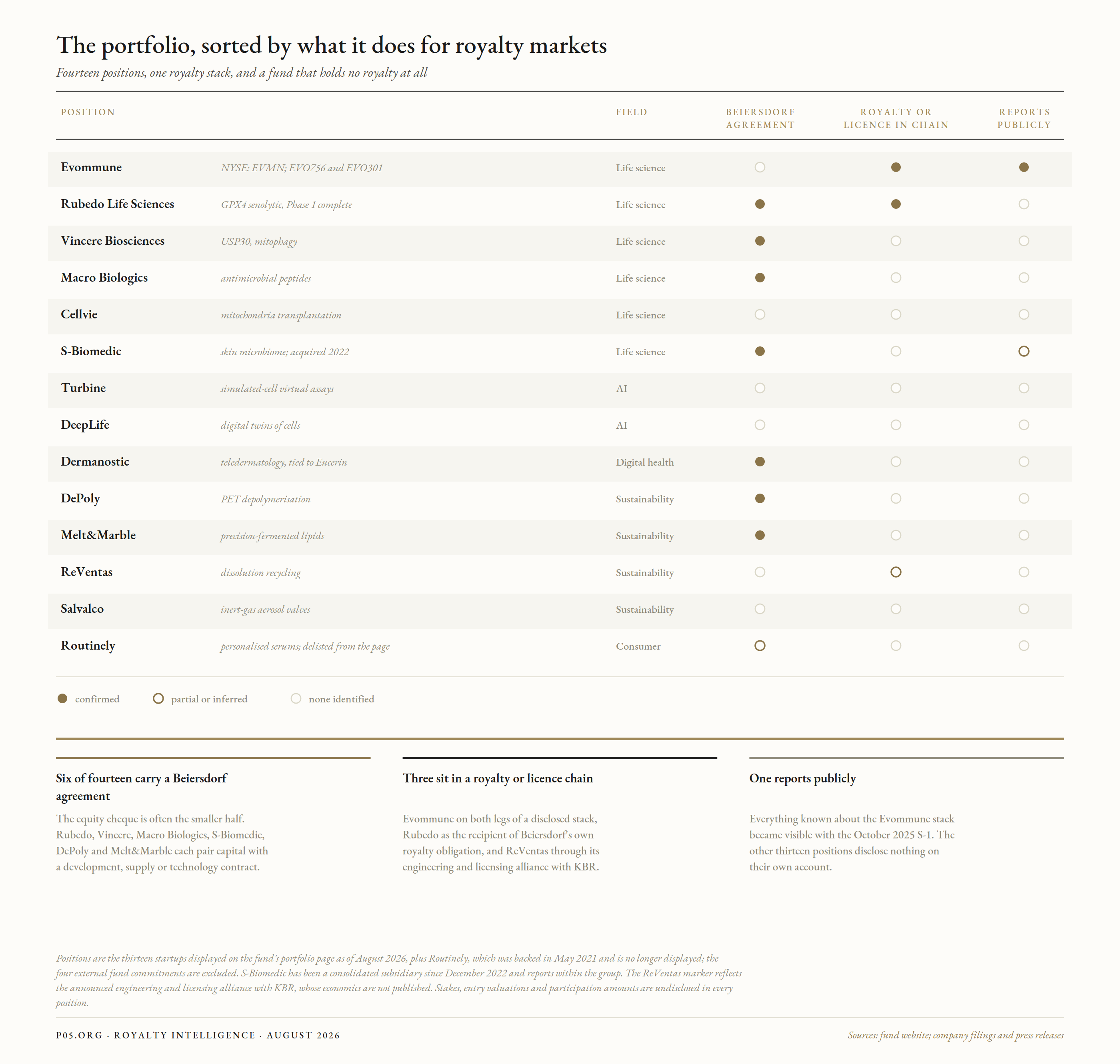
Portfolio, as of August 2026
Stakes and entry valuations not disclosed in any position.
| Position | What it is | Royalty relevance |
|---|---|---|
| Evommune (NYSE: EVMN) | Clinical-stage immunology; EVO756 (MRGPRX2) and EVO301 (IL-18BP) | Pays AprilBio mid to high single digit tiered royalties plus up to $460M milestones; pays Accutar royalties plus up to $155.5M; receives Maruho royalties on EVO756 in Japan |
| Rubedo Life Sciences | GPX4 modulator RLS-1496 targeting senescent cells; Phase 1 complete, Phase 1b/2a in actinic keratosis underway | Eligible to receive milestones and royalties from Beiersdorf on cosmetic formulations; terms undisclosed |
| Vincere Biosciences | USP30 inhibition and mitophagy, Parkinson's and age-related indications | Strategic research partnership with Beiersdorf since May 2025 on mitophagy in skin ageing; economics undisclosed; therapeutic pipeline pre-partnering |
| Cellvie | Therapeutic mitochondria transplantation, Harvard spinout, Zurich | Pre-partnering; upstream Harvard licence economics likely, terms not public |
| Macro Biologics | Biodegradable antimicrobial peptides for skin and wound care | Joint development agreement with Beiersdorf, Sep 2024; economics undisclosed |
| S-Biomedic | Skin microbiome actives; majority acquired by Beiersdorf Dec 2022 | Now consolidated; technology integrated into the microbiome design platform |
| Turbine | AI simulated-cell virtual assays; immunology collaboration with a top ten pharma | Platform and collaboration revenue; no disclosed royalty |
| DeepLife | Digital twins of cells for drug discovery, Paris | Platform and collaboration revenue; no disclosed royalty |
| Dermanostic | App-based teledermatology, Düsseldorf; linked to Eucerin | Services model; none |
| DePoly | PET and polyester chemical recycling; 500 t/y showcase plant inaugurated at Monthey, 6-7 Jul 2026 | Offtake and product sales; 50,000 t commercial plant site to be named in H1 2027 |
| Melt&Marble | Precision-fermented designer fats; first personal care launch targeted 2026 | Ingredient supply and co-development with Beiersdorf and Valio |
| ReVentas | Polyethylene and polypropylene dissolution recycling, Livingston, Scotland | Engineering and licensing alliance with KBR for global rollout; terms undisclosed |
| Salvalco | Inert-gas propelled aerosol valves, York; Thailand plant opened Jan 2026 | Valve sales and technical support; no disclosed royalty |
| Routinely | Personalised serum brand, Amsterdam; backed May 2021 | No longer displayed on the portfolio page |
Fund LP positions: NCA (Next Commerce Accelerator, founding member and LP), YZR Capital (European health tech), Emerald Sustainable Packaging Innovation Fund (founding LP alongside Chevron, Henkel and WM), Revent (Berlin impact fund).
Blue team and red team
Blue team
- Six years of continuous operation under one leader across two fund generations, with the commitment doubled rather than trimmed during a group turnaround
- A demonstrated absorption path: S-Biomedic went from 2018 venture cheque to collaboration to majority acquisition to integrated platform technology, which is the outcome corporate venture units are built for and rarely deliver
- A realised public-market outcome in Evommune, entered at Series C in October 2024 and liquid from November 2025
- Sourcing runs through the R&D organisation, with two scouting scientists seated inside the investment team, giving technical diligence a corporate venture unit of this size could not otherwise buy
- The commercial offer is differentiated for ingredient and actives companies: access to more than 170 markets and to formulation, safety and claims-testing infrastructure that no financial investor can provide
- Beiersdorf is willing to write royalty-bearing development contracts alongside equity, which gives portfolio companies a second economic path that does not depend on an exit
- Four external fund positions extend coverage into packaging, commerce, health tech and impact at low cost
- Balance sheet is unlevered, with $2.5B (€2.17B) in cash and short-term investments, so the fund faces no forced-seller dynamic
Red team
- No purchased royalty, revenue interest or structured credit; every royalty relationship described here is one the fund's counterparties hold, not one the fund holds
- Fund size is not published, portfolio stakes are not published, and no performance figure of any kind has ever been disclosed; the $58M (€50M) figure for Fund I is an inference from a press release adjective
- The only quantitative disclosure, the Level 3 equity investments line, aggregates venture positions with fund LP interests and is described by the company itself as immaterial
- Cheques of $0.6M to $5.8M in Series B and later rounds mean small ownership, no board control and heavy dilution risk; BVC did not lead a single disclosed round
- The one liquid mark is currently below cost for the IPO buyer and well below the Q1 2026 private placement price: $14.08 against a $16.00 IPO and $27.88 placement
- Evommune's lead asset failed its Phase 2b primary endpoint in CSU in June 2026, removing the indication that anchored two outbound royalty-bearing licences
- Strategic and financial objectives are not separable: the S-Biomedic outcome was an internal transfer at an undisclosed price, so it cannot be benchmarked as a return
- Royalty-bearing development agreements sit with an operating counterparty that controls launch timing, brand allocation and marketing spend, and that counterparty is currently redirecting roughly $116M (€100M) into a turnaround of its largest brand
- Group revenue declined 3.5 percent organically in H1 2026 and guidance was cut; corporate venture budgets are historically the first line reviewed when a consumer group's core brand is under pressure
- At least one early position, Routinely, has disappeared from the portfolio page without explanation, and the fund does not report exits, write-downs or holding periods, so the shape of the book's realised outcomes cannot be reconstructed
- Concentration risk on Voswinckel, who is the sole public face of the unit across every deal since 2021
Implications for the pharmaceutical royalty and biotech capital markets
Several things here carry beyond this fund.
Cosmetic-ingredient royalties are a real and largely unexamined asset class. The Rubedo agreement puts a running royalty obligation on a DAX-listed consumer group in favour of a private biotech, on products with no approval gate, no payer, and consumer-scale volumes. The same pattern shows up elsewhere in beauty and personal care whenever a large group in-licenses an active rather than developing it. The underwriting profile differs from a specialty pharmaceutical royalty: faster to first cash, less binary, but with duration governed by brand strategy and formulation IP rather than by regulatory exclusivity, and with the licensee free to reallocate marketing support at will. No comparables set exists for cosmetic-ingredient royalties, which is the first thing anyone underwriting one would need.
Corporate venture arms are royalty originators in disguise. BVC's own accounts contain no royalty. Its counterparties' accounts contain several. A screen of CVC portfolios in consumer, animal health, food ingredients and industrial biotech would surface a meaningful population of private-company royalty streams payable by investment-grade corporates, which is a better credit than the typical private royalty payer. The obstacle is disclosure: none of these terms appear anywhere except when a counterparty happens to list.
Listing events unlock royalty visibility retroactively. Everything known about the Evommune stack, the AprilBio rates, the Accutar milestones, the two Maruho licences, became public only because the company filed an S-1 in October 2025. Before that, a fund holding a royalty on EVO301 had nothing to price against.
This is the same mechanic that makes charity filings useful for academic licensors and KOSDAQ disclosure useful for Korean out-licensors. The visibility comes from the counterparty's reporting obligation, not from the licensor's. In practice that means starting diligence with whichever party in a chain has a reporting obligation.
The AprilBio position is worth a second look on its own terms. A small-cap Korean biopharmaceutical company holding tiered mid to high single digit royalties plus $460M of contingent milestones on a US clinical asset, with a right of first negotiation on follow-on products, fits the profile of a monetisation candidate. Korea and Japan were flagged as interesting markets at AUTM 2026 for exactly this reason.
Recent developments, as of August 2026
- Beiersdorf launched the Skin Care Innovation Fund on 31 March 2026 with a $116M (€100M) commitment, doubling the 2020 vehicle, with longevity science and AI-enabled actives discovery named as priority areas
- Turbine closed a $25M Series B on 24 February 2026 led by Interactive Venture Partners with BVC participating, alongside a new immunology collaboration with an unnamed top ten pharmaceutical company; this is the fund's most recent disclosed investment
- Rubedo reported positive preliminary Phase 1 data for RLS-1496 on 26 March 2026 in plaque psoriasis, atopic dermatitis and photo-aged skin, the first human proof of concept for a GPX4-based senolytic, with a Phase 1b/2a in actinic keratosis due to complete later in the year
- Evommune's EVO756 missed its Phase 2b primary endpoint in CSU on 29 June 2026; the indication was discontinued and development redirected to atopic dermatitis, with top-line data due September 2026, and to migraine prophylaxis, with a 330-patient Phase 2b initiated in July 2026 and data expected in 2027
- Evommune reported positive Phase 2a proof-of-concept data for EVO301 in atopic dermatitis, with a Phase 2b to initiate mid-2027 and cash of $288.0M funding operations through 2028
- Melt&Marble closed a $8.5M (€7.3M) Series A on 8 December 2025 led by Industrifonden with Beiersdorf and Valio as strategic investors, targeting first personal care launches in 2026
- DePoly inaugurated its Monthey showcase plant on 6 and 7 July 2026, the first depolymerisation facility of its kind and scale in Switzerland, with Beiersdorf among the investors attending and Una Terra Venture Capital joining the register; the site for a 50,000 tonne commercial plant is due to be named in the first half of 2027
- ReVentas secured a £3.5M Scottish Enterprise grant in July 2026 as part of a £9M project to expand its Livingston pilot plant, following a £2M Scottish Enterprise investment, and has signed an engineering and licensing alliance with KBR
- Beiersdorf cut 2026 guidance on 3 August 2026, reporting H1 sales down 3.5 percent organically, announcing an 18-month NIVEA turnaround plan and roughly $116M (€100M) of additional H2 consumer investment; Derma grew 7.8 percent
- No royalty or revenue-interest transaction has been identified at the fund level
Financial history and recent developments
| Date | Event |
|---|---|
| 2018 | Beiersdorf makes its first corporate venture investment in S-Biomedic |
| Aug 2019 | OSCAR&PAUL launched as a corporate indie brand and venture platform |
| 2020 | First-generation corporate venture fund launched; size never disclosed |
| May 2021 | Investment in Routinely alongside 9.5 Ventures |
| Jan 2022 | Investment in Dermanostic, linked commercially to Eucerin |
| Apr 2022 | Beiersdorf joins Emerald's Sustainable Packaging Innovation Fund as a founding LP with Chevron, Henkel and WM |
| Dec 2022 | Beiersdorf acquires a majority stake in S-Biomedic; price undisclosed |
| Jun 2023 | Investment in DePoly's approximately $15M (CHF 12.3M) seed round, co-led by BASF Venture Capital and Wingman Ventures |
| Apr 2024 | Rubedo partnership and Series A participation; Rubedo eligible for milestones and royalties from Beiersdorf |
| Jun 2024 | Evommune licenses EVO301 from AprilBio: $15M upfront, up to $460M milestones, mid to high single digit tiered royalties |
| Sep 2024 | Macro Biologics joint development partnership announced; Epicelline launches in Eucerin Hyaluron-Filler Epigenetic Serum |
| Oct 2024 | BVC joins Evommune's $115M Series C as a new investor |
| Dec 2024 | BVC participates in DeepLife's $10M Series A |
| Apr 2025 | DePoly seed reaches $23M total with MassMutual Ventures joining the second close |
| 22 May 2025 | Beiersdorf invests in Vincere Biosciences and announces a strategic mitophagy research partnership |
| Sep 2025 | BVC participates in Cellvie's $5M round; NIVEA launches Epicelline |
| 5 Nov 2025 | Evommune prices a $150M IPO at $16.00 on the NYSE; $172.5M gross with the greenshoe |
| Dec 2025 | BVC participates in Melt&Marble's $8.5M (€7.3M) Series A |
| Q1 2026 | Evommune places 4,494,279 shares privately at $27.88 |
| Jan 2026 | Salvalco opens a manufacturing facility in Thailand |
| 24 Feb 2026 | Turbine closes a $25M Series B with BVC participating |
| 26 Mar 2026 | Rubedo reports positive preliminary Phase 1 data for RLS-1496 |
| 31 Mar 2026 | Skin Care Innovation Fund launched at $116M (€100M) |
| 29 Jun 2026 | Evommune's EVO756 misses its Phase 2b primary endpoint in CSU; indication discontinued |
| 6-7 Jul 2026 | DePoly inaugurates its Monthey showcase plant, the first depolymerisation facility of its kind in Switzerland |
| Jul 2026 | ReVentas secures a £3.5M Scottish Enterprise grant within a £9M project and signs an engineering and licensing alliance with KBR |
| Jul 2026 | Evommune initiates a 330-patient Phase 2b of EVO756 in migraine prophylaxis |
| 3 Aug 2026 | Beiersdorf reports H1 2026 sales down 3.5 percent organically, cuts guidance, announces an 18-month NIVEA turnaround |
| 6 Aug 2026 | Evommune reports Q2 2026 results; cash of $288.0M through 2028, AD Phase 2b data due September |
Conclusion
Beiersdorf Venture Capital is a captive corporate venture unit funded off a single balance sheet. It has sixteen disclosed investments, one absorption into the parent, one public listing, no published fund size and no published performance.
Its relevance to royalty markets sits in the contracts around the equity. Beiersdorf has agreed to pay milestones and running royalties to a clinical-stage biotech on cosmetic products, a royalty class the buy-side has not studied. One portfolio company carries a fully disclosed two-sided royalty stack in its SEC filings, running from a KOSDAQ-listed Korean licensor through a Palo Alto biotech to a Japanese dermatology company, with mid to high single digit tiered rates and $460M of contingent milestones on the inbound leg. The fund holds no part of either arrangement.
The group filings give one number: a Level 3 equity investments line that reached $22M (€19M) at 30 June 2025 against $7M (€6M) two years earlier, described by Beiersdorf as immaterial and not subjected to a sensitivity analysis. Position-level values, entry prices and marks are not disclosed anywhere.

The doubling of the commitment in March 2026 and the guidance cut in August 2026 sit four months apart in the same company's news feed. Whether the second event eventually reaches the first is a question the next few years of deployment will answer.
All information in this article was accurate as of the research date and is derived from publicly available sources including company press releases, SEC filings, Beiersdorf's published financial reports, fund websites, data-vendor records and financial news reporting. Beiersdorf Venture Capital does not publish committed capital, portfolio stakes, entry valuations or performance; the approximately €50M figure for the 2020 fund is an inference from the company's description of the 2026 fund as doubling that volume, not a disclosed amount. Fund-level participation amounts in the rounds cited are not disclosed; round sizes are totals across all investors. The Level 3 non-current equity investments figures drawn from Beiersdorf's half-year reports aggregate all equity investments and investment funds held at fair value and are not a venture-portfolio-specific disclosure; the company states that none of the investments is individually material. The terms of the Beiersdorf-Rubedo development agreement, including royalty rates, tiers, term and territory, are not public; only the existence of milestone and royalty eligibility has been announced. The absence of Routinely from the current portfolio page is noted as a fact; the brand appeared to be still trading at the research date, no transaction or wind-down has been announced, and no conclusion about the status of that investment should be drawn from the omission. The characterisation of the ReVentas-KBR alliance as royalty-adjacent is an inference from the announced structure of the agreement; no financial terms have been published. Evommune share price and market capitalisation figures are as of 7 August 2026 and will have changed. Currency conversions use approximately $1.16 per euro, the mid-August 2026 rate, unless the cited source published its own conversion; historical euro and franc figures converted at this rate do not reflect the exchange rate prevailing at the transaction date. Holdings and contractual relationships described are as of the cited dates and do not constitute a recommendation. The fund holds no pharmaceutical royalties identified in this research. Information may have changed since publication. This content is for informational purposes only and does not constitute investment, legal, or financial advice. The author is not a lawyer or financial adviser.