
Until terminated: evergreen royalties in service contracts

A pharmaceutical royalty is normally bounded by something. The last-to-expire patent, a fixed number of years from first commercial sale, the loss of regulatory exclusivity, or some later-of formulation combining them. The bound is what makes the stream a finite series, and the finite series is what the discounting machinery is built for.
A meaningful population of royalties inside contract manufacturing and contract research agreements has no such bound. The term clause says the agreement continues until terminated, the royalty obligation survives termination, or both. The prior piece on manufacturing versus sales royalties dealt with the base these royalties are struck on and who sits in the chain. This one deals with the term, which turns out to be the harder variable.
It is the harder variable because the term is what the pricing machinery consumes. The biosimilar piece put the point in its opening line: a royalty market prices duration, and a biosimilar is an asset engineered to have none, which is why it generates cash flow and no bid. The contracts below are the same failure from the opposite end. They are engineered to have unbounded duration, and they attract no bid either.
1. Where the evergreen actually sits
Not in the headline supply agreements. Those are dated, sized and renewable, and they behave like take-or-pay contracts. The perpetual structures sit one layer down, in the cell-line and platform documents that the supply agreements rest on, and they are visible because licensees have been filing them for two decades.
The clearest specimen is the Catalent GPEx Cell Line Sale Agreement. In the version DiaMedica filed with its 2018 S-1, Section 9.1 reads in full that the agreement commences on the effective date and continues until terminated in accordance with Article 9. There is no expiry, no royalty term, and no reference to any patent. Section 3.1(B) provides for a quarterly royalty on net sales following first commercial launch, supported by a net sales definition running to five categories of deduction and a full combination-product allocation formula. Section 1.17 defines Product as anything whose development, manufacture, use or sale utilises or is derived from the cell line, so the base follows derivation rather than patent claims.
Selexis, now part of Sartorius, runs a stated perpetuity. Outlook Therapeutics describes an option to obtain a perpetual, non-exclusive, worldwide commercial licence under the Selexis technology, exercised in April 2013, carrying a single-digit royalty on worldwide net sales, with a right to terminate the royalty obligation by paying a royalty termination fee. The buyout is the interesting half of that sentence and section 5 returns to it.
The most replicated structure is WuXi Biologics' Cell Line License Agreement, and it is a standard form. Dianthus, Paragon, Apogee, Spyre, Janux and Invivyd have all filed substantially the same terms: a non-exclusive worldwide licence to WuXi's know-how, cell line and media, a non-refundable fee of USD 150,000, and an agreement that continues indefinitely unless terminated on six months' notice. Janux's version runs on three months. The royalty is where the design shows itself, and section 3 returns to it.
Lonza sits on the other side of the line and shows what a bounded version looks like. NGM Bio discloses that its GS Xceed royalty obligation runs product by product until the later of the expiry of the last licensed patent or ten years after first commercial sale, alongside annual licence fees that step up by clinical phase and a further annual fee if anyone other than Lonza does the commercial manufacturing. That is a defined tail with a floor. It can be modelled.
On the research side the equivalent structure is a survival clause rather than a perpetuity.
OmniAb states that its platform licences are terminable by partners without penalty on notice, but that all milestone payments and royalties survive termination and continue with respect to any OmniAb-derived antibody, with a royalty term running to the longer of ten years from first commercial sale or the last expiry in any jurisdiction of the partner's patents covering the antibody. The term is keyed to patents the payee neither owns nor files. A partner that keeps prosecuting continuations in any jurisdiction keeps extending the obligation.
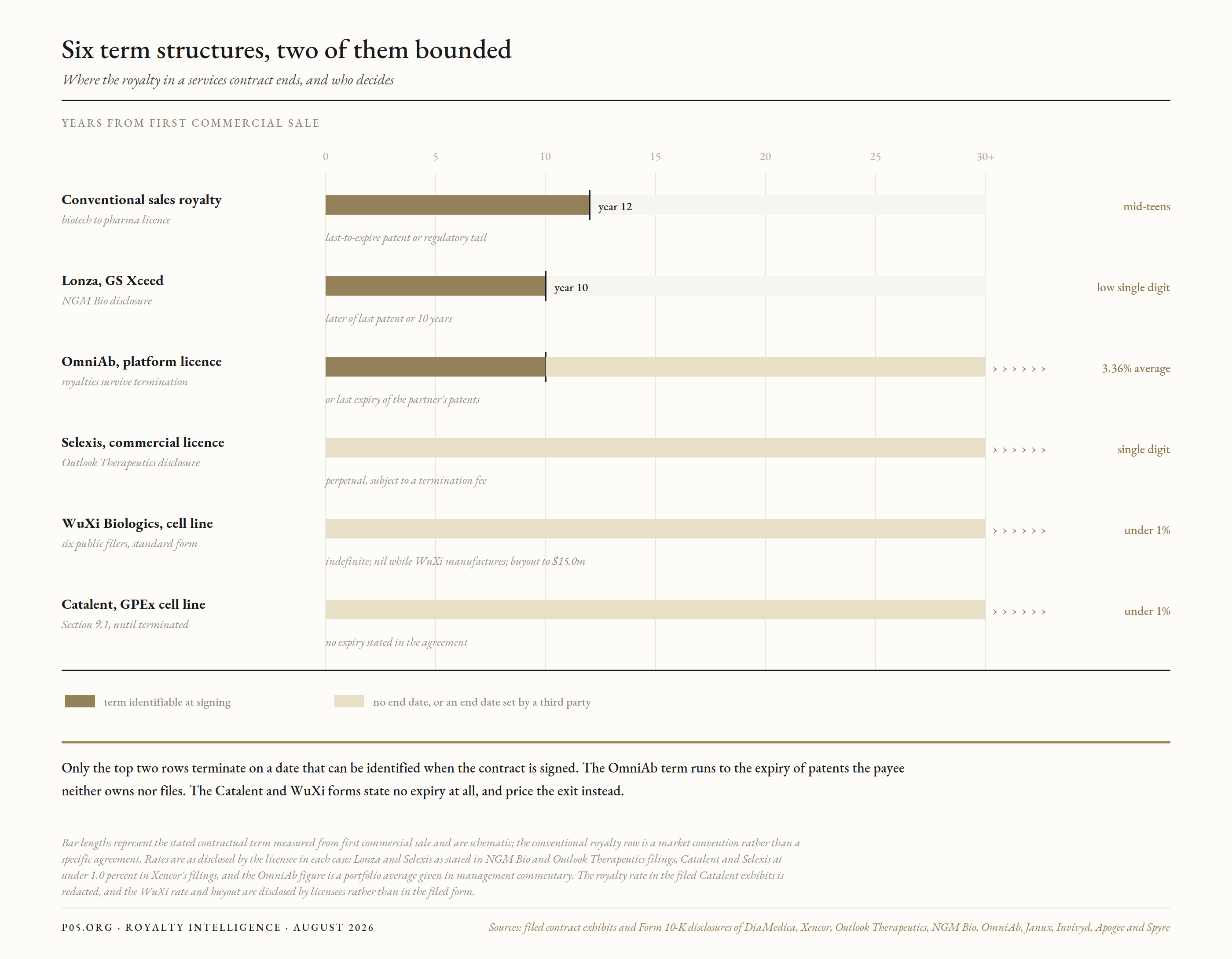
Figure 1. Five disclosed term structures. Only the Lonza and conventional licence forms terminate on a date that can be identified at signing. The Catalent agreement has no expiry at all, the Selexis licence is stated as perpetual with a buyout, and the OmniAb term is set by patents the payee does not control. Rates are as disclosed; the Catalent rate is redacted in the filed exhibits.
2. Why they are lawful, and where the constraint actually binds
The reason these structures exist in service contracts and not in patent licences is Brulotte and its reaffirmation in Kimble. A royalty calculated on post-expiration use of a licensed patent is unlawful per se in the United States. A royalty on know-how or trade secret is not, and a perpetual obligation is generally permissible where the consideration is non-patent rights. The escape routes Kimble itself catalogued are now standard drafting: deferral of pre-expiration liabilities, a term running to the last patent in a portfolio, hybrid licences with a step-down at patent expiry, and joint ventures.
Cell-line and platform agreements land outside the rule almost by construction. The GPEx document sells a physical cell line and grants a patent licence only to the extent Catalent's patents would otherwise be infringed. The commercial substance is the engineered line and the process know-how attached to it, neither of which expires. Courts have collapsed separately papered patent and know-how agreements into a single hybrid where the economics warranted it, so the separation has to be real rather than cosmetic, but where the know-how genuinely carries the value the perpetual term survives.
In Europe the constraint runs through competition law rather than patent misuse. The 2014 Technology Transfer Guidelines took the position that royalties extending beyond the expiry of the licensed patents do not generally restrict competition where the licensee remains free to terminate on reasonable notice, on the reasoning that the parties are spreading payment rather than extending a monopoly. That framework has just been renewed: the Commission adopted a revised TTBER and updated Guidelines on 16 April 2026, applicable from 1 May 2026, replacing Regulation 316/2014 with a one-year transitional period.
Notice what the European condition does. It makes the enforceability of a perpetual royalty depend on the licensee having a genuine right to walk away. That is precisely the right the next section shows to be worthless.
3. The termination right that cannot be exercised
The GPEx agreement gives the client an unconditional exit. Section 9.2 permits termination without cause on ninety days' notice. Read alone, that is a clean option and the stream should be valued as terminable at will.
Section 9.4 prices it. On termination by the client without cause, the client's ownership rights in the cell line automatically terminate and title reverts to Catalent, the client must immediately destroy all remaining stores and certify the destruction, and it has no more than six months to sell remaining product inventory, with those sales still bearing the royalty.
For a preclinical programme that is a real option and clients exercise it. For an approved biologic it is not an option at all. The cell line is the manufacturing identity of the product in the regulatory dossier. Destroying it and reverting title does not free the client from a royalty, it removes the client's ability to make the drug. The exit that makes the perpetual royalty lawful in Europe is, after approval, an exit into having no product.
The two dominant forms diverge here, and the divergence is worth pricing. WuXi's licensees disclose that on termination the licence continues in full force with respect to all products manufactured using the cell line already generated. The client keeps the line and keeps making the drug. Under the Catalent form it does not. One design retains the client through a payment that only bites on exit; the other retains it by holding the manufacturing asset hostage.
The asymmetry runs the other way too. Section 9.3 closes with the provision that once the client has made all payments required under Article 3, Catalent has no right to terminate. The payee can be locked in by performance; the payer cannot escape by it.
Two further clauses convert this from a bilateral obligation into something closer to an encumbrance on the asset. Section 2.1 characterises the transaction as a sale of the cell line that remains contingent on continued observance of the agreement, so title is conditional rather than absolute. Section 2.6(A) permits the client to sell or transfer the line to any third party provided that party assumes the deferred payment obligations, and provides that the original client remains liable for non-payment regardless. The royalty follows the cell line rather than the counterparty, and the original obligor stays on the hook behind whoever holds it.
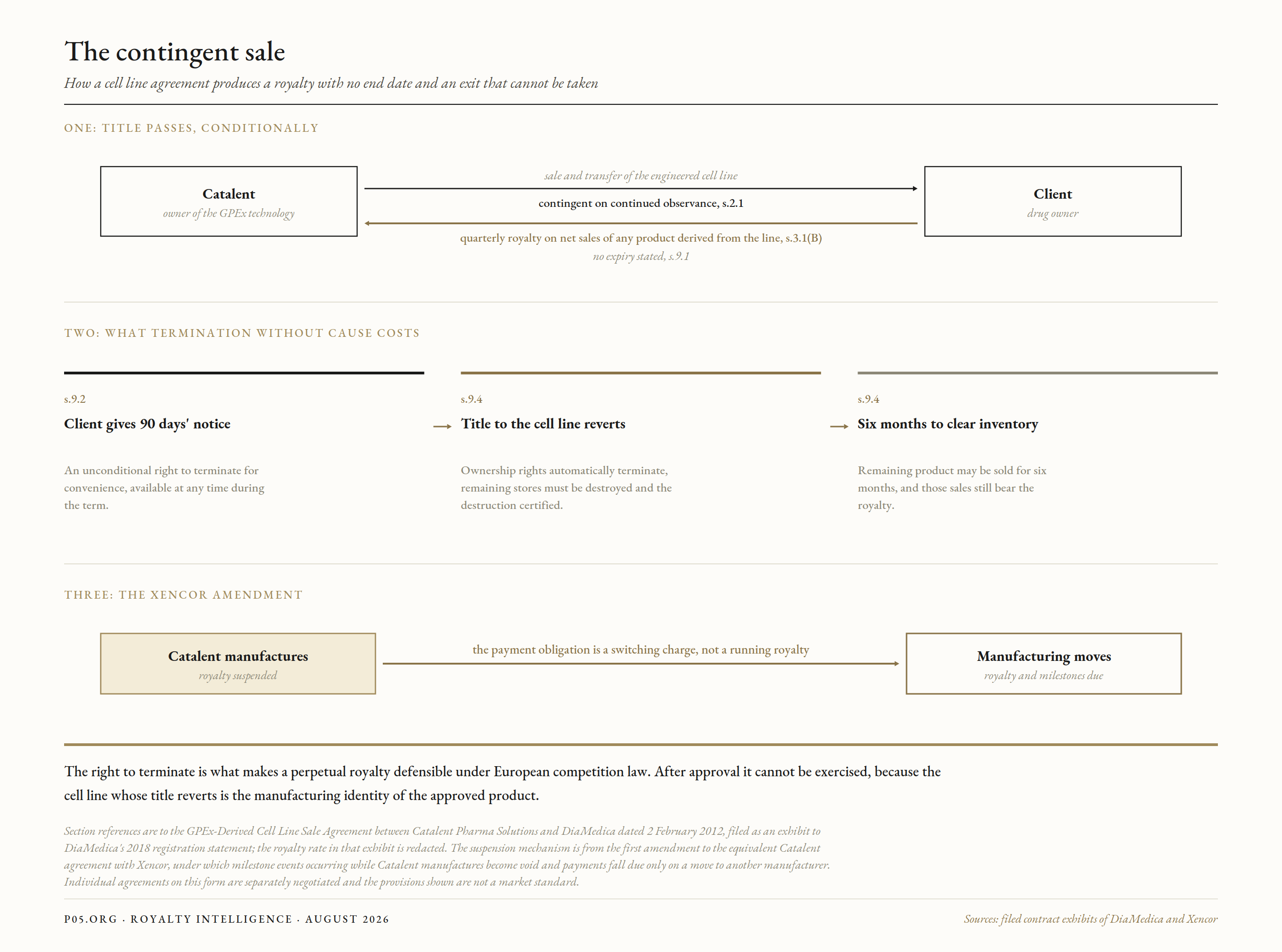
Figure 2. The contingent sale. Title to the cell line passes but remains conditional; the royalty attaches to anything derived from the line; termination without cause reverses the title transfer. The Xencor amendment overlays a second switch, suspending the payment obligation while Catalent manufactures and reinstating it if manufacturing moves.
That second switch is not a bespoke concession. Xencor and Catalent amended their GPEx agreement in 2015 so that milestone events occurring while Catalent is manufacturing become null and void, and payments become due only if Xencor later moves to another manufacturer. WuXi Biologics writes the same logic into its standard form as the primary payment mechanic. Its licensees disclose that the royalty is payable only if commercial supplies are manufactured somewhere other than WuXi or its affiliates, at less than one percent of global net sales, reduced pro rata where WuXi makes part of the supply. Invivyd states the corollary directly: if WuXi manufactures all commercial supply, no royalty is owed at all.
So the dominant evergreen structure in biologics is not compensation for the cell line in any continuing sense. It is the price of leaving, held in suspense for as long as the client stays, and prorated to the share of supply that walks. A client that never moves never pays it. A client that dual-sources pays a fraction proportional to how much it moved. Calling the resulting instrument a royalty overstates what it is: it is a supply-retention charge that happens to be denominated in net sales.
4. Are any of them actually paying
Mostly not yet, and the honest answer matters for how the class should be underwritten.
OmniAb is the most complete public disclosure. At 31 December 2025 it reported 107 active partners and 407 active programmes, including 27 in clinical development, two under regulatory review and three approved products commercialised by partners. Management has put the portfolio average royalty rate at 3.36 percent against more than USD 3 billion of remaining contracted milestones. Full-year 2025 revenue was USD 18.7 million across licence, milestone, service and royalty lines together, so three approved products against 407 programmes is the shape of the thing: a large book of small contingent claims, of which under one percent have reached the point of paying anything on sales.
Invivyd's disclosure is the one that states the term problem in the contract's own words. Royalties run on a product-by-product basis from first commercial sale and continue for so long as the company commercialises the licensed products, or, if earlier, until it exercises its buyout option, with no royalties having become due through the end of 2024. The end date is the product's commercial life or a payment. It is not a date.
The cell-line agreements are smaller still per unit. Xencor disclosed royalty percentages under both its Catalent and Selexis cell line agreements at less than 1.0 percent of net sales. Selexis commercial licences carry single-digit royalties with milestone packages measured in hundreds of thousands of Swiss francs. On a product doing USD 500 million, a 0.75 percent cell-line royalty is USD 3.75 million a year, which is real money to the licensor and a rounding error against the supply contract it sits beneath.
So the class is genuine but its present cash yield is negligible relative to the number of contracts outstanding. What is accumulating is a very long-dated portfolio of options on other people's products, held by parties whose primary business is services, disclosed nowhere in aggregate, and unbounded in time.
5. The valuation problem
A finite royalty is valued by forecasting to a known end date. An evergreen royalty removes the end date without removing the need for one, and three things follow.
The terminal dominates. Take a stream growing at 2 percent. At a 10 percent discount rate the Gordon value is 12.5 times the first year's cash, while the first fifteen years contribute 8.47 times. Just under a third of the value sits beyond year fifteen. At 8 percent the proportion beyond year fifteen is 42 percent; at 12 percent it is 25 percent. For a conventional royalty with a defined term inside that window the corresponding figure is zero by construction. The valuation is therefore most sensitive precisely where the analyst has the least information, which is the competitive position of a product more than fifteen years out.
That is a long way from where the rest of the asset class sits. The duration piece put the modified duration of a royalty book near five years, which is what makes the conventional stream a rates-sensitive instrument with a manageable terminal. An evergreen royalty on the same product has no such anchor. Two claims on identical cash flows, differing only in the term clause, sit at opposite ends of the duration spectrum, and only one of them can be hedged or benchmarked.
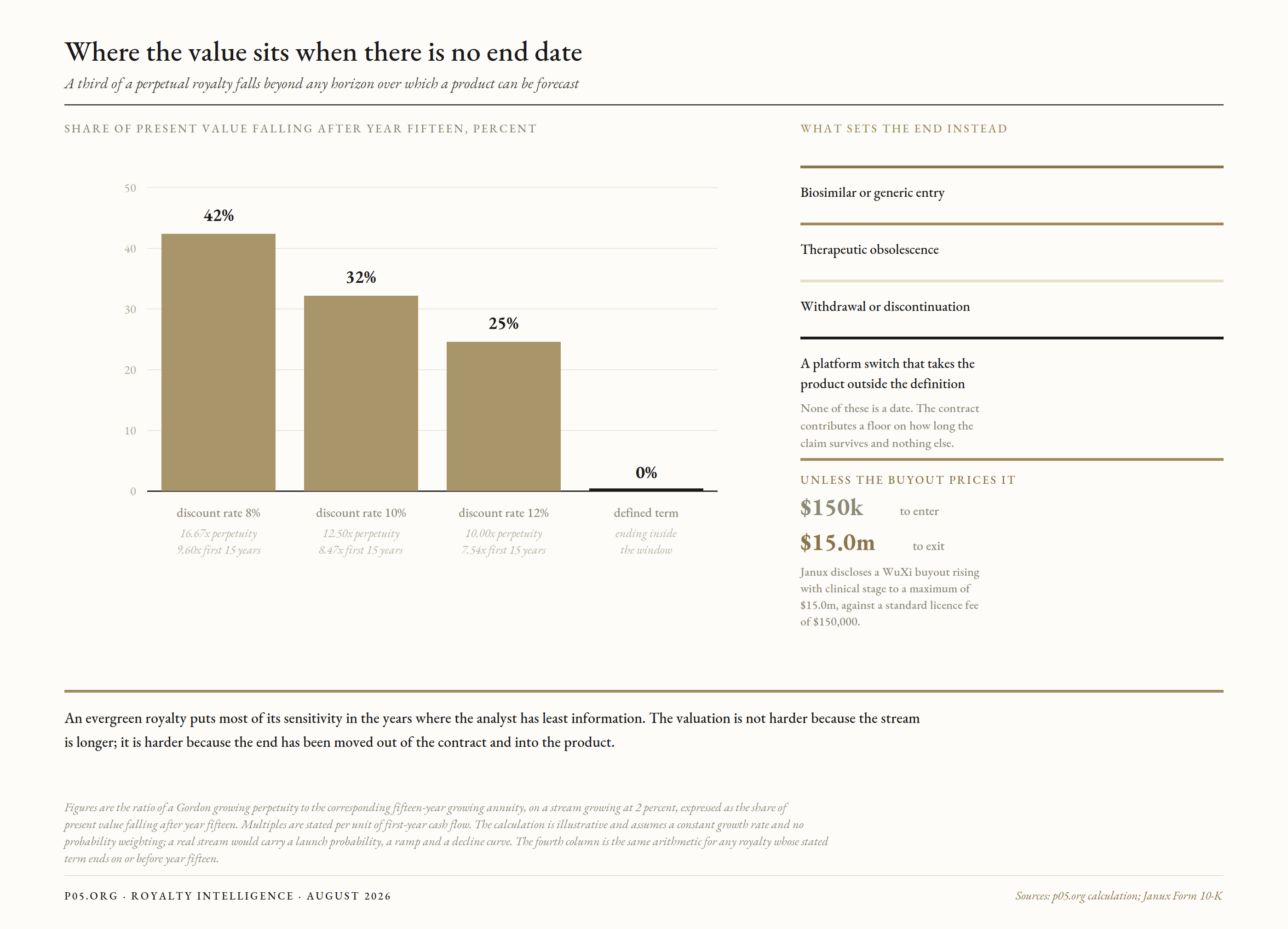
Figure 3. Where the value sits when there is no end date. Bars show the share of present value falling after year fifteen for a stream growing at 2 percent, at three discount rates. A royalty with a defined term inside that window has no value beyond it. The arithmetic is a Gordon growing perpetuity against the corresponding fifteen-year growing annuity and is illustrative.
The real bound is the product, not the contract. Because the contract does not expire, the stream terminates when the product does: biosimilar entry, therapeutic obsolescence, withdrawal, or the payer switching manufacturing platform in a way that takes the derived product outside the definition. None of those is a date. The correct treatment is a hazard rate applied to the underlying product, with the contract contributing only a floor on how long the claim survives. Modelling it as a perpetuity overstates it; modelling it to a patent cliff that does not apply understates it and, worse, uses the wrong risk driver.
The buyout is the market's own price, and it has been published. Where the agreement carries a termination fee or buyout option, the payer holds an embedded call on the entire remaining stream, which caps the payee's value at the strike and converts an unbounded perpetuity into a bounded American option. Selexis commercial licences carry a royalty termination fee. WuXi's form carries a buyout exercisable product by product, and two licensees have disclosed the numbers.
Janux discloses a buyout ranging from low single-digit millions to a maximum of USD 15.0 million depending on the development and commercialisation stage of the product, on payment of which the licence becomes fully paid-up, irrevocable and perpetual. Invivyd puts its own buyout in the low eight figures per licensed cell line.
Set that against the entry price. The licence fee is USD 150,000 to USD 200,000. The option to escape it is worth up to a hundred times the option to acquire it, and the strike escalates with clinical stage, which is the counterparty pricing exactly the thing an evergreen royalty is hard to value for: the growing probability that the underlying product is real. A stage-linked buyout schedule is a better disclosure than any rate, because it is the only number in the document that represents an arm's-length view of the perpetuity.
Two consequences for anyone looking at these as acquirable assets. Neither party carries the stream on a balance sheet before it pays. ASC 606-10-55-65 excepts sales-based royalties on licensed intellectual property from the general variable-consideration model and defers recognition to the later of the underlying sale and satisfaction of the performance obligation, so the payee never estimates the stream at inception. An evergreen portfolio of several hundred programmes is therefore entirely off-balance-sheet on both sides until individual products launch, which is why its aggregate size is not observable from any filing.
And nobody is set up to buy them. The buyer taxonomy piece separated the phrase royalty fund into at least five distinct businesses, from clipping the coupon on finished marketed royalties through to funding the last year of development. Run this population past each of them in turn and it fails on a different criterion every time: too small for the coupon clippers, too early and too diffuse for the development funders, no identifiable product for the underwriters, and no defined term for anyone pricing duration. A sub-1 percent royalty with no end date on a programme that may never be named is not a hard asset to price so much as an asset with no natural buyer, which is why no monetisation market for it exists despite the number of contracts outstanding.
6. What moves the position, and what only appears to
Terms that move it:
- A stated royalty termination fee or buyout schedule, ideally stage-linked, which bounds the payee's exposure to the payer's option, gives both sides a number to argue about, and is the only figure in the document that prices the perpetuity.
- A step-down at the expiry of the licensed patents, which both preserves the Brulotte position in a hybrid and marks the point at which the consideration becomes purely know-how.
- Suspension mechanics of the Xencor kind, which convert the royalty into a switching charge and should be valued as an option on the payer's supply-chain decisions rather than as a claim on product sales.
- Transfer provisions binding successors while keeping the original obligor liable, which make the claim an encumbrance on the cell line rather than a personal obligation of a company that may not survive. These sit alongside, and are frequently confused with, the change of control triggers that reshape deal economics on an acquisition; a transfer provision travels with the asset where a change of control provision fires on the counterparty.
- A definition of Product keyed to derivation from the licensed material, which extends the base to follow-on presentations and formulations without renegotiation.
- Section 365(n) acknowledgements, which the GPEx form contains at Section 11.16, and which put the payer's position through a service provider's insolvency on the ground mapped in the section 365 piece. The direction of exposure is inverted here: it is the drug owner, not the royalty holder, that needs the executory contract to survive.
Terms that only appear to:
- A termination right for convenience where exercising it reverts title to the manufacturing cell line, which after approval is not an exit but a shutdown.
- A short notice period, which measures the wrong thing when the constraint is comparability and regulatory refiling rather than contractual notice.
- A perpetual grant unaccompanied by a buyout, which leaves the payee holding an asset with no realisable value short of the product's own decline.
- An audit right with a 3 percent understatement threshold and three-year record retention, standard in these forms, which is adequate for a defined-term royalty and thin for one that may run for forty years.
- A rate expressed as sub-1 percent, which is often treated in negotiation as immaterial and is the reason so little attention is paid to a term clause with no end.
7. What each side should ask
The service provider. Is the term genuinely unbounded, or is it bounded in substance by a buyout the payer will exercise the moment the product succeeds? Does the royalty attach to the material, so that it survives a transfer of the programme, or only to the counterparty? If the obligation is suspended while you manufacture, is what you actually hold a royalty or a retention device, and are you pricing it as the latter?
The drug owner. What is the present value of a sub-1 percent perpetual obligation at peak sales, and was it priced at signing when the programme was preclinical? Does termination for convenience remain available in substance after approval, and if not, what is the buyout you did not negotiate? Do the transfer provisions leave you liable behind an assignee?
The acquirer or investor. Where a target's products rest on platform or cell-line agreements, has the aggregate perpetual burden been quantified, given that none of it appears on either balance sheet and that it stacks beneath whatever conventional royalty is already attached to the product? Which of those obligations survive a change of control, and which reset on a manufacturing transfer you were planning anyway? If you are underwriting the service provider rather than the drug owner, are you paying for a royalty book or for a book of very long-dated options on programmes you cannot name?
The evergreen royalty in service contracts is not a variant of the pharmaceutical royalty with the term left blank. It is a different instrument. Its consideration is know-how rather than patents, which is why it can run forever. Its termination right exists to satisfy competition law and stops being exercisable at approval. Its base follows a physical cell line rather than a claim set, so it travels with the asset. Its cash yield today is negligible and its accumulated notional is undisclosed.
Catalent's form has no expiry date and takes the cell line back if you leave. WuXi's charges nothing while it manufactures, less than one percent of net sales if you go elsewhere, and up to USD 15 million to be rid of it. Selexis sells a perpetuity and then sells the right to end it. OmniAb's royalties survive the termination of the agreement that created them and run to the expiry of patents it does not own. Lonza's stop ten years after first sale.
One of those five can be discounted to a date. The rest require the analyst to decide, without help from the contract, when the product dies, or to read the buyout schedule and let the counterparty decide it for them.
All information in this article was accurate as of the research date and is derived from publicly available sources including SEC filings and filed contract exhibits, company disclosures, EU competition instruments, and legal commentary. Contract provisions cited are from the specific executed agreements filed by the named parties and are not representative of any standard form. Information may have changed since publication. This content is for informational purposes only and does not constitute investment, legal, accounting, tax, or financial advice. The author is not a lawyer, accountant, tax adviser, or financial adviser.